Bloody Bloody Andrew Jackson: Rock Musical Launches SF Playhouse To A New Home

By Flora Lynn Isaacson

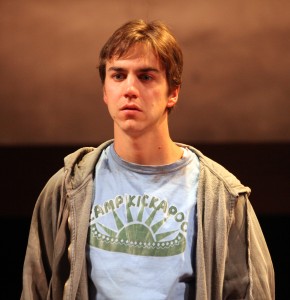
President Jackson ponders a difficult decision on how to deal with Indians (Ashkon Davaran & Michael Barrett Austin)

The SF Playhouse’s 10th season gets off to an energetic start in a new theatre at 450 Post Street known as Theatre On the Square. Perfect for an election year, Bloody Bloody Andrew Jackson has a book by Alex Timbers who was nominated for a Tony. The music and lyrics are by Michael Friedman.  Ashkon Davaran, who made a splash with his rendition of “Don’t Stop Believin'” during the Giants 2010 World Series game leads the cast as Andrew Jackson.

Alex Timbers’ book re-imagines and reinvents the life of President Andrew Jackson, and Michael Friedman sets it to an infectious rock score.  Bloody Bloody Andrew Jackson tells the story of the pioneer of humble stock–known as “Old Hickory” who invented the Democratic Party, moved the Indians west and rose to the highest office in the land as our 7th President.  The show also tracks his humble beginnings on the Tennessee frontier to his days as a Populist Commander-In-Chief where he wrestles political power away from the elite.

Ashkon Davaran is dynamic as Andrew Jackson.  He is the only one in the cast portraying only one character.  The eleven person ensemble that also doubles as the band includes Michael Barrett Austin whose Martin Van Buren is a bundle of laughs, El Beh who acts, sings, dances, plays the cello and brings down the house with her “Ten Little Indians,” Angel Burgess in a moving performance as Jackson’s wife, William Elsman’s outstanding John C. Calhoun, Jonathan Fadner, the Bandleader, Safiya Fredericks who does double duty as Henry Clay and Black Fox, Lucas Hatton as James Monroe, Ann Hopkins who is delightful as the Storyteller and Olive Mitra as John Quincy Adams.

Jon Tracy’s direction is in your face and energetic.  Nina Ball’s set is an impressive outline of the capitol dome, a perfect environment for what amounts to a musical in the form of a rock concert with flashy lighting design by Kurt Landisman.  This is presentational theatre, not representational theatre.

According to Artistic Director Bill English, “We’ll never look at a twenty dollar bill quite the same way again.”

Bloody Bloody Andrew Jackson runs through November 24, 2012. Performances are at 7 p.m. Tuesday-Thursday; 8 p.m. Friday-Saturday; and 3 p.m. Saturday.  Performances are held at 450 Post Street (2nd floor of Kensington Park Hotel b/n Powell and Mason), San Francisco.  For tickets, call 415-677-9596 or go online at www.sfplayhouse.org.

Coming up next at SF Playhouse is Bell, Book and Candle by John Van Druten and directed by Bill English opening December 8, 2012.

Flora Lynn Isaacson


Cash is going away!!!

By Joe Cillo

WHAT WILL THE TOOTH FAIRY DO?

Lynn Ruth Miller


Most people can’t even think what to hope for

 When they throw a penny in a fountain.
Barbara Kingsolver

There is talk on this side of the pond, of getting rid of money. “Today, only 7% of all transactions in the United States are done with cash, and most of those transactions involve very small amounts of money.“ says the internet blog, The Economic Collapse. “Our financial system is dramatically changing, and cash is rapidly becoming a thing of the past.”


These days, it costs more than it’s worth to manufacture the cash we stuff into our wallets and bulging coin purses. In America, it costs 11.18 cents to mint a 5 cent piece and a penny costs 2.41 cents.  It isn’t much better in Britain.  Although the Royal Mint will not reveal how much it costs to mint 1p, rumor has it that the cost from manufacture to distribution is approximately £3.


That doesn’t make sense.


Besides the cost to make them, there is the threat to our health and well being.  Coins and bills land in thousands of pockets, are touched by millions of hands and no one ever cleans them up.  The bills are tattered and full of germs; the coins are not only cumbersome but they create embarrassing bulges that aren’t what you think they are.


When coins were first invented, everyone thought it was the greatest idea since the fig leaf.  Coins didn’t rot or die on you.  Their value didn’t deteriorate with time.  You could stick them in the bank and they would be there for years and still have value. You used them to reward children and toss in fountains.  You stuck them under pillows when children lost their baby teeth and you put them in your shoe for good luck.


What will happen to the Piggy Bank when pennies are no more? When I was a child, this was the time of year when I began stuffing pennies in the little ceramic pig I got for Christmas last year so I could buy my Mama a present for Christmas this year.  Every day, I would put in a penny I had earned for helping her bring in the groceries or drying the dishes (now you know how old I am) and by December first, my little pig was bulging with the hard earned cash I had fed him. I would go to the jewelry store, hand the clerk my piggy bank and say, “What can I buy my mother with this?”  She and I would smash the bank and pile the pennies into columns of ten and then tabulate the results.  One year, I was able to buy my mother a silver candle snuffer and another time, I bought her a lapel pin with a little blue stone in the middle…all with the money I earned doing chores.


Children these days would either have to type in a code on their cell phones or swipe a credit card to pay for that special something they want to buy for their parents.  It just couldn’t give them the same sense of accomplishment.  Every penny I gave that saleslady had a story behind it. All a credit card has is an APR.

Say good-by to wallets when cash is no more.  You can keep all your credit information on your cell phone or slip your credit card in your pocket.   Profiles will be slimmer and, because seeing the cash, made you realize how much you were actually spending, expenditures will go up.  But who cares?  It’s all just numbers and as every politician knows you can make numbers say anything you want.


The good news is if you keep your pennies stashed away in a bureau drawer, they will become valuable relics from another time, like vinyl records and rotary dial phones.   Your heirs can sell your stash for at least 500% of their face value.  That should pay for your casket!

When I was young I thought that money

Was the most important thing in life;

Now that I am old, I know that it is.
Oscar Wilde


Thrills, chills aplenty in “Deathtrap”

By Judy Richter

By Judy Richter

Despite the rotary dial phone and manual typewriter, Ira Levin’s “Deathtrap” remains as fresh and surprising as it was when it became a Broadway smash in 1978. Celebrating its 72nd season, Hillbarn Theatre makes this point abundantly clear in its production of the classic thriller.

The play is set in the comfortable Westport, Conn., home of Sidney Bruhl (Paul Stout) and his wife, Myra (Paige Cook ), who has health problems. Sidney is a well-known playwright who has written a number of wildly successful thrillers, but his recent works have flopped. Moreover, his finances are running low.

We meet him as he sits at his desk reading a play sent to him by a young man who attended one of Sidney’s playwriting seminars. Sidney immediately realizes that this play could be a sure-fire Broadway hit. He’s also quite jealous.

Thus the central question of “Deathtrap” emerges: How far will Sidney go for this script? To say any more would spoil the fun as the plot takes one unexpected, sometimes shocking, twist after another.

As directed by Karen Byrnes, this production works well on the surprise level, but the acting is uneven. Stout’s portrayal of Sidney is so smug that it’s off-putting right from the start. He also tends to overact. Cook’s Myra is one-dimensional, resorting to too much hand-wringing as she becomes more nervous about Sidney’s intentions.

On the other hand, Adam Magill is convincing as the young playwright, Clifford Anderson, who’s in awe of Sidney. Monica Cappuccini has fun with the play’s most outsized character, Helga Ten Dorp, a famous Dutch psychic who is temporarily living next door and who comes by to warn the Bruhls of dire doings. Richard Albert completes the cast as Porter Milgrim, Sidney’s level-headed friend and attorney.

The handsome set is by R. Dutch Fritz, while the effective sound and lighting are by Valerie Clear. The costumes are by Mae Matos. Durand Garcia served as fight choreographer.

Although this isn’t a perfect production, the play itself is so well written that the audience is in for a big treat.

“Deathtrap” will continue at Hillbarn Theatre, 1285 E. Hillsdale Blvd., Foster City, through Nov. 4. Call (650) 349-6411 or visit www.hillbarntheatre.org.

Lohengrin — San Francisco Opera Performance

By Joe Cillo

Lohengrin
SF Opera Performance, October 20, 2012

The concept of love put forward in Lohengrin is that of a fragile flower very dependent upon maintaining illusions. Love is equivalent to blind Faith in goodness and constancy that must be absolute and unquestioning. But the underlying anxieties of this kind of naive faith ultimately undermine it and do it in. Lohengrin echoes Christianity in its demand for simple faith and the basic concept of a man is sent from God to rescue a damsel in distress, accused of a terrible crime. He saves her, not through self sacrifice, as in the Christian model, but through militaristic combat — a Wagnerian variant on the Christian theme. Superior prowess on the battlefield saves the girl from her enemies and wins her love. The woman’s love is the hero’s reward for her rescue from desperation. But there is one condition. The woman cannot ask her rescuer who he is or where he comes from. She has to take him completely on faith and let his actions of rescue and his superior strength in battle be the sole foundation of her devotion and love. If she is to question him and demand to know more of who he is, then he will be forced to leave her and renounce her. It is love founded on the most narrow, simplistic grounds and maintained with a gun pointed at the woman’s head, so to speak. Love can only be maintained with the woman in a desperate position of neediness with the man serving as the heroic figure of strength who magnanimously saves her from perpetual impending catastrophe. Love as worship of the conquering hero. While a woman may feel grateful to be delivered from impending doom — at least for a time — she will soon feel the extreme vulnerability of this position of helpless dependence, as the opera demonstrates. She will question her own worthiness of the man’s continuing love, she will want to broaden the base of the relationship and feel more appealing to the man beyond mere helplessness and need. She will feel the fragility of the connection to him. She feels vulnerable to his tiring of her and moving on. She seeks to strengthen her position through a greater understanding of the man, who he is, and what his own needs and vulnerabilities are. The message of Lohengrin is that this is a destructive tendency, that love can only be this primitive, blind devotion stemming from a condition of imminent undoing. Love between a man and a woman essentially depends on a woman being in a perpetual state of crisis. But on the other hand, if the woman gets to know who the man is and where he comes from, then she will realize that he is not the invulnerable hero, not the idealized figure of goodness and strength that he presented himself to be, and thus her love and devotion will be annuled. The man’s insecurity and feelings of unworthiness are activated upon a deeper probing of his true self. It is a very pessimistic outlook on relations between the sexes. Love can only be born and continue within these very narrow confines of faith sustained through willful ignorance, and that fragile foundation gives rise to the anxieties and demands that sabotage and destroy it. It is an outlook on life that is essentially dark and tragic — and a little silly too.
A few quibbles with the San Francisco Opera’s performance.
This production of the opera is set in a modern context in modern costumes, although Wagner’s original conceptualization set it in 10th century Saxony. On the cover of the program is a photograph by Erich Lessing of the destruction of the Stalin monument in Budapest, Hungary, during the Hungarian Revolution of 1956. The idea according to Director Daniel Slater is that a contemporary setting would make it “more exciting and relevant for the audience.” Well, most Americans living today can probably relate to the Hungarian Revolution of 1956 about as well as they can relate to 10th century Saxony. Many of us would be surprised to discover that there was a revolution in Hungary in 1956. And where is Hungary, by the way?
There are some militaristic and nationalistic elements in the opera that resonated well with the National Socialists, but you have to keep in mind that Germany did not even exist as a unified nation at the time this opera was composed. Invasion from the East was a long standing European fear that would be readily grasped by any European audience. The fact that this was a pressing matter in the 10th century would not be peculiar to that time or have any compelling significance as a factor in setting the opera in that time and place. I think Wagner’s purpose in setting the opera long in the past, aside from these nationalistic overtones, was to give the opera a context where the kind of romantic idealizations in the personal sphere that the opera treats would have traction for the viewer free from the distractions of a contemporary political and social context. Moving it forward in time and bringing up contemporary political issues in my view disrupts the essential focus of this opera on the nature of human relationships. True, the opera takes place under the threat of impending war. But this was a condition of European life as far back as one cares to look. So in that sense it did not matter when the opera was set, this background factor of imminent war was going to remain a constant in whatever time period it occurred. Wagner set it long in the past precisely to expunge the contingencies of the immediate contemporary circumstances. Bringing the opera forward and setting it in our own time defeats that artistic purpose and makes the whole thing sort of confusing.
Director Slater sees Lohengrin as a problematic character who renounces his godlike status in order to experience human love with Elsa. This is based on musings external to the opera itself. Within the opera there is nothing problematic about Lohengrin. He was sent on a mission by the Grail. He fulfilled the mission, he accepted Elsa as his prize, he accepted the leadership position as a warrior, he laid out his conditions, and he stuck to them steadfastly and departed without any apparent signs of misgiving. Slater says he is seeking redemption through Elsa’s love and is willing to sacrifice his immortality to achieve it. There is nothing in the opera to substantiate this view. Within the opera, Lohengrin is a knight in shining armor coming to the rescue of a damsel in distress and then to lead an army into battle. Slater puts him instead in a leather trench coat, which tends to deemphasize his heroic qualities. But counterculture figures don’t usually lead armies. I’m not sure that it works. Lohengrin is not Hamlet.
Generally the staging is rather static and unimaginative. At times it gets dull because there is not enough activity in the staging or aesthetic interest in the lighting to sustain one’s attention. The lighting in the first act is bright and harsh. The early part of the second act feels a little cramped against the front edge of the stage. In the original conception the swan was supposed to pull a boat down the river bearing Lohengrin. Slater gives that up and opts for much less impressive imagery of a static pair of wings from which Lohengrin emerges. At the end the long lost Gottfried reappears as a small boy from the transformed swan. But it doesn’t make sense that Gottfried should reappear as a small boy. He disappeared years ago as a child. His sister Elsa has grown into a mature woman. He should be contemporary with Elsa. Furthermore, he is supposed to arrive ready to lead an army into battle, to step into the role being abdicated by Lohengrin, but he can barely lift a sword. What is Slater seeking by casting Gottfried as an 8 year old boy? Some sort of cutesy sentimentality? A child’s appearance at the end of this dark, gloomy opera trying to wave a sword is a rather ridiculous juxtaposition if you ask me, and I take it to indicate that he completely misunderstands what the opera is all about. This is not a child’s opera at all and introducing a child as a final punctuation mark on this tragedy is a colossal malapropism.
What works in this opera is the music. If it wasn’t for the music, it probably wouldn’t even be staged. The orchestra, the singers, the chorus, did a superb job and made it a musical success, even if it left much to be desired as a dramatic production. Wagner’s great creativity and strength was as a composer of music more than as a dramatist or as a prophet. It is clearly evident in this dark opera and in its problematic staging in this San Francisco Opera production.

‘I Love Lucy’ spoof overcomes glitches galore

By Woody Weingarten

Adrianne Goff (right) stars as Lucy Bicardi, and Leslie Klor is Ethel Schmertz, in "Trouble at the Tropicabana," a comic murder-mystery dinner show at the Marin Rod & Gun Club, San Rafael. Photo by Wendell H. Wilson.


Adrianne Goff could be a magician.

On a recent Saturday night at the Marin Rod & Gun Club, she yanked several rabbits out of a hat — simultaneously — to successfully produce, direct and star in an interactive comic murder-mystery dinner show aptly titled “Trouble at the Tropicabana.”

The slight-of-hand was needed because so many things were going south, as if Murphy’s Law had been cloned and re-cloned by a humorless sitcom writer.

Somehow, Goff managed to make the difficulties vanish — including a pre-show party that lingered too long, 30 aggressive wannabe theatergoers who showed up unexpectedly, waitresses who filled tall water glasses from a tiny pitcher that could replenish only two at a time at tables that sat eight, and a computer that conked out and had to be replaced before any essential recorded music could be played.

Goff’s Band-Aids, chewing gun and similar quick-fixes kept a packed house from shouting, “Adrianne, you got some ‘splainin’ to do.”

Not incidentally, if that reference means nothing to you, you must have missed each and every episode of the classic “I Love Lucy” series — and each and every one of Ricky’s mangled sentences.

The audience obviously hadn’t missed any. It cackled each time it was expected to during the campy, pun-laden, mistaken-identity, mega-melodramatic antics that took off where the historic and hysteric sitcom left off.

And at least a third of it grinned gleefully while misstepping all around the huge room in a makeshift, voluntary conga line.

None of the deer or elk heads on the walls criticized their dancing.

Goff, who, believe it or don’t, was also responsible for the costumes, was a comic standout as a whiny Lucy, donning a carrot-colored fright wig that intentionally didn’t cover all of her own brunette locks.

She and perfect sidekick Leslie Klor, who inhabited the body of Ethel, were funniest when they dressed in slapdash mustaches and black suits and delivered seamless clowning in the majestic tradition of Mutt and Jeff, Laurel and Hardy, Martin and Lewis.

They also were strikingly and stridently amusing in a set piece in which they talked extra fast trying to out-jabber one another.

Another dazzling performance came in the form of Vanessa Vazquez as Cookie, aka the duplicitous siren-vamp Celia B. DeMilo.

The dinner by caterer Stacy Scott that complemented the show was spicy, tasty and, appropriately, Cuban-based.

But not everything hit an “A” level.

The five “Tropicana Girls” would have garnered many more giggles had their simplistic choreography been outrageously klutzy instead of bland.

The often-repetitive script would have evoked a lot more guffaws had its spoofiness not been so faithful to the original and, instead, been translated into more visual, fresh gags.

And, unfortunately, the actors stayed mostly in the front of the audience rather than mingling with it, unlike the last Marin Murder Mysteries production at a smaller venue, San Rafael Joe’s.

The best move of the evening, however, was an ad lib from Wendell H. Wilson, who portrayed Ricky.

When a two-year-old sitting on his dad’s lap at a front table started to cry after a handgun was wielded, he told the boy, “We’re just playing. We’re all gonna have fun.”

Surely, most folks did.

“Trouble at the Tropicabana,” part of the Marin Murder Mysteries series, will play at the Marin Rod & Gun Club, 2675 E. Francisco Blvd., San Rafael, on various dates through New Year’s Eve. Reservations required. Tickets: $40 to $65, including dinner, tax and tip; $30, show only. Information: www.marinmurdermysteries.com or (415) 306-1202.

The Ghost Sonata an auspicious start to the Strindberg cycle.

By Kedar K. Adour

STRINDBERG CYCLE: The Chamber Plays in Rep. Production translations by Paul Walsh. Directed by Rob Melrose. The Cutting Ball Theater in residence at EXIT on Taylor, 277 Taylor St., San Francisco. Part 1: The Ghost Sonata; Part 2: The Pelican and The Black Glove; Part 3: Storm and Burned House. October 12 – November 18. For specific dates call 415-525-1205 or www.cuttingball.com

The Ghost Sonata an auspicious start to the Strindberg cycle.

Cutting Ball Theater dedicated to mounting experimental, modernist and absurdist plays is honoring August Strindberg on the 100th anniversary of his death. Their undertaking is as ambitious as one can imagine with the production of his five Chamber plays in repertory and set aside one day where Strindberg aficionados and those who have a touch of masochism to view all five plays at one sitting on a Saturday or Sunday running from noon to 11 pm!

The Chamber Plays were written in his latter years and designed to be performed in his Intimate Theatre in Stockholm. According to Artistic Director Rob Melrose the Cutting Ball workspace is about equal in size to Strindberg’s Theatre.

After the opening performance last night, we had the lucky chance to chat with the translator Paul Walsh who is professor of Dramatugy and Dramatic Criticism at the Yale School of Drama He collaborated with Melrose and Paige Chamber to complete the final project. Walsh emphasizes that his translation is not an adaptation and he has strived to keep the semblance of Swedish speech patterns. It was specifically translated for the stage as Strindberg would have it if he were alive today. Strindberg has added to the musical connotation by labeling them Opus 1 through Opus 5.

The Ghost Sonata is Opus 3 and if there is a reason why this was staged first it is moot since the five plays do not share a single plot nor do they share characters. They do share similar character types such as The Old Man, The young Mother, and The Young Girl etc. In The Ghost Sonata Strindberg visualizes a three story apartment and three parts of the play. The first being on the street in front of the apartment, the first floor and a third higher inner sanctum filled with fragrant hyacinths to protect The Girl (Caitlyn Louchard) from the offensive smells from the outside world.

Before the protagonist The Student (Carl Holvick-Thomas) reaches the upper levels that he so much desires, he has to go through a Purgatory type experience to reach “paradise” that is more like hell. His second encounter is with Director Hummel, The Old Man (James Carpenter) in a wheel chair. Hummel is the personification of evil with enough dastardly deeds performed in his past life to earn the severe comeuppance he eventual suffers.

There is a Milkmaid (Ponder Goddaerd) that only the Student can see, a mummy in a closet who speaks like a parrot and comes to life to torment Hummel, The Cook who sucks the nourishment out of the food before it is served, an ethereal Lady in Black and others who add to the confusion. It is an amalgamation of reality, imagination and ghost story filled with lies, vengeance, death and love. If this were not a supposed fine example of the absurdist trend, it could be called ludicrous.

All the actors (James Carpenter, Robert Parsons, Caitlyn Louchard, Danielle O’Hare, Carl Holvick-Thomas, David Sinaiko, Ponder Goddard, Paul Gerrior, and Gwyneth Richards, along with Anne Hallinan, Nick Trengove, Michael Moerman, and Alex Shafer) perform with intensity and appear to believe in the play. Melrose controls the action on the black box stage with great help from his production and design staff. According to the press notes there is a lot of intellectualism and serious insight within the text. Most of it escaped this reviewer.

Kedar K. Adour, MD

Courtesy of www.theatreworldinternetmagazine.com


Chinese Melodrama: Music you know, but have never heard like this. . .

By David Hirzel

It was one of those rare Friday nights that didn’t involve a longish drive for me.  I was staying close to home, so when my friend Evelyn sent out her weekly “things to do this weekend in Pacifica” and how much she loved this duo Chinese Melodrama  I thought: I’ll check ‘em out.  Playing this night (October 19) at “A Grape in the Fog” wine bar in Pacifica.

A classically trained violinist of clearly Asian descent (Lisa  Chu—the Chinese part) and a white-guy singer-songwriter (Randy Bales—the Melodrama part, as he himself put it).  Put them together, and you have something you have never seen before, but you are sure to want to see again.  The evening starts off at a relaxed pace, a trio of songs including Cat Stevens’ “Father and Son.”  Guitar and vocal didn’t stray far from the original (true of many of the evening’s offerings) but with Lisa’s poignant violin it took on a dimension I never knew it had.  The same holds true for other offerings from the familiar songbooks of Soundgarden, Mettallica, Led Zeppelin, rendered ethereally beautiful with the Lisa’s haunting melodic counterpoints. At more than one point during the show I found myself wondering, what is it about the sound of a violin that literally brings a tear to the eye.  Randy Bales handles all the vocals, and it’s his detailed and potent guitar work that give the performances their underlying foundation.  By the third song, one of their original compositions, we were getting a taste of what was about to come.  “Seasons,” ostensibly about the spirituality of our being, started of suitably restrained and introspective, but when the music hit the bridge, it positively ignited.  Just an amazing little interlude of stringed pyrotechnics, before settling back down into its muted, reflective groove.

But by this time, the show was just getting started.  When Lisa felt his spoken introduction to another of their originals was going on a bit too long, she tapped the music stand with her bow:  “More music, less talk.”  And, boy was there more music.  That hot interlude of “Seasons” was just a teaser for the real power these two bring to their performance.  After the first break, the real show started off.  There is a subtle personal interplay between these two.  Watch their faces.  She takes a half-closed look over her strings at his fingers on his own, while the song begins to take on its shape, growing slowly, methodically, inevitably she leaps into the music, and the whole performance ignites again in complex syncopated rhythms, amazing melodic lines sweeping and soaring breathtaking power.  And then this happens again.  And again.  I no longer care who wrote what I am hearing, or what the lyrics might have had to say, so powerful has this performance become.

By the end of the show, I had to marvel that their instruments—just a guitar and a violin—had not burst into flames.  You really have to see these two in person.  You can check their website http://chinesemelodrama.com/ for upcoming dates in the Bay Area, including house parties, surely the best way to see Chinese Melodrama.

Lisa Chu and Randy Bales


Ideas clash in “Freud’s Last Session”

By Judy Richter

By Judy Richter
Two of the 20th century’s greatest intellects converse in London on Sept. 3, 1939, the day that Britain, France, Australia and New Zealand declare war on Germany to begin World War II. As air raid sirens wail and British bombers roar overhead, psychoanalyst Sigmund Freud and author-professor C.S. Lewis meet in Freud’s study in “Freud’s Last Session” by Mark St. Germain.

Presented by San Jose Repertory Theatre in a co-production with Arizona Theatre Company, this one-act, two-man play features J. Michael Flynn as Freud and Benjamin Evett as Lewis. Although the play clocks in at less than 90 minutes, it covers a range of philosophical territory focusing on the existence of God but delving into other topics such as love, sex and the meaning of life.

At first the 40-year-old Lewis doesn’t know why the 83-year-old Freud wants to meet. Lewis assumes that it’s because he recently satirized Freud. However, Freud explains that he wants to understand why Lewis, who was an atheist like Freud, has recently become a Christian. Hence much of their discussion focuses on religious ideas.

Along the way, both men talk about their upbringings, Freud as a Jew in Vienna and Lewis as a Protestant in England. Lewis also talks about his traumatic experiences as a soldier in World War I, while Freud explains that he moved to London because of Hitler’s persecution of Jews in Vienna and elsewhere. His daughter Anna, who followed in her father’s professional footsteps, is an unseen third character in the play.

Also figuring prominently in the drama is the fact that Freud is suffering from inoperable oral cancer and plans to end his life when he can’t stand the pain anymore. Lewis tells him that suicide would be a selfish act, but Freud died only 20 days later from fatal doses of morphine.

Although the play is mostly all conversation on weighty subjects, it has some elements of humor, and director Stephen Wrentmore keeps the action flowing smoothly. The handsome set and complementary lighting are by Kent Dorsey, while the costumes are by Annie Smart. Sound designer Steve Schoenbeck deserves special praise for effects ranging from a barking dog to scary air raid sirens, overhead planes and snatches of radio speeches by Prime Minister Neville Chamberlain and King George VI.

Both actors are outstanding in this Bay Area premiere. Evett as Lewis goes through a range of emotions as the conversation veers from areas where he’s comfortable to personal topics he’d rather not discuss.

Flynn successfully masters the greater challenge in portraying Freud as a stooped, stiff, sometimes pain-wracked man whose mind and powers of observation remain sharp. It’s a bravura performance in this talky, intellectual play about an imagined meeting.

“Freud’s Last Session” will continue at San Jose Repertory Theatre in downtown San Jose through Nov. 4. Call (408) 367-7255 or visit www.SJRep.com.

Marin Theatre has a winner

By Joe Cillo

TOPDOG/UNDERDOG

By Suzan-Lori Parks

Directed by Timothy Douglas

Starring Biko Eisen-Martin & Bowman Wright

Being black is not a matter of pigmentation –

Being black is a reflection of a mental attitude.
Steven Biko

Be prepared to be spellbound from the moment Biko Eisen-Martin walks on the Marin Theatre Company’s stage until the climax of this disturbing, all too real drama, two and a half hours later. You will see and actually feel this story of two brothers barely scavenging their way uphill through one disappointment after another not because of their lack of ability or ambition, but because of what they are and what they have been.


Booth (Biko-Eisen Martin) is living in a one room tenement flat with no running water that his older brother Lincoln (Bowman Wright) is sharing with him because Lincoln’s wife has thrown him out of his former home.  Booth’s is the only bed and Lincoln sleeps in a recliner.


The brothers have managed to survive a rollercoaster childhood. They were abandoned by both parents two years apart; first their mother then their father.  Lincoln, at sixteen, was forced to watch out for Booth who was only 11 years old.  Throughout this play, Lincoln continues to worry about his younger brother. He still feels responsible for Booth’s well-being and he shields him from unpleasant truths.   He gives him the food he prefers, gives him money not just for rent and utilities but for special treats that Booth doesn’t really need.  Booth’s talent is stealing and he is so light-fingered he can take any product from anywhere undetected.  Lincoln’s talent is dealing cards but he has given up that kind of life for a conventional one with a real job with benefits….and he isn’t doing very well.


His job is Impersonating Lincoln the day he was assassinated.  He has to whiten his face to resemble the famous president  and he is being paid less than the going rate for his services because he is black.  He swears he likes his job because it gives him time to think about things and compose songs in his head, but he is worried he is going to be replaced by a fabric dummy.  The real reason Lincoln clings to the daily grind that is wearing him down is his determination to live the conventional way with a steady job, one where he isn’t depending on his wits for fast cash.  Before he started this job, he was a highly successful dealer in a Three Card Monte scam.  Three Card Monte is a con game that no one can ever win.


The game is as much a performance as it is a contest that proves the hand is always quicker than the eye.  Lincoln was so quick with his hands that he was the best on the street.  He made more money than he could spend and he felt good about himself.  His luck seemed eternal until his mark, Lonny, the man who starts the betting and keeps the game moving, was killed.  In that moment, Lincoln saw the game for what it was and he knew he wanted no part of it.   Still, dealing is his special gift and he is proud of what he could do.  “Lucky?” he says.  “Aint nothing lucky about cards.  Cards aint luck.  Cards is work. Cards is skill. Ain’t never nothing lucky about cards.”


Booth doesn’t share his brother’s sense of right and wrong and he is desperate to earn the kind of money his brother once did on the street. .  He believes the two of them can start their own game and earn a living together.  Booth is sure he can be a dealer because he is so quick and facile with his hands.  He is so adept at stealing that he managed to get both them both new suits, a room divider, a blanket and food.


This play is dialogue driven and the plot takes its shape from the brothers’ rapid fire conversation.  The acting is beyond wonderful and the two men manage to make their characters loveable and very vulnerable.  We know that they are trapped their life because of their color and because of the disruptive, chaotic childhood that prepared them for nothing but a desperate, frustrating fight to keep their heads above water.  The author Suzan Lori Parks says “There is no such thing as THE Black Experience.  That is there are many experiences of being Black which are included in the rubric….What can theatre do for us? We can tell it like it is, tell it as it was, tell it as it could be.”


And in Top dog/ Underdog that is just what she does, using rich and textured dialogue delivered with consummate skill by Martin and Wright.  Make no mistake.  This is not a play about being black.  It is about being poor and underprivileged.  It is about living on the edge of society, never feeling that your humanity gives you privilege.


This production sparkles and moves at so rapid a pace one cannot believe over two hours have passed since the play began.   Timothy Douglas’s direction is a masterpiece of movement and staging.  The men co-ordinate their actions across the stage as if in a macabre dance.  As their dialogue bounces off one another, we relive their hopes, their disappointments and we ache for them.  We watch in terror as they deceive themselves and each other leading them both to their own inevitable destruction.


I realize that I’m black, but I like to be viewed

as a person, and this is everybody’s wish.
Michael Jordan


Topdog/Underdog continues through Oct. 28.

Marin Theatre Company, 397 Miller Ave., Mill Valley.

Tickets  $36-$57. (415) 388-5208. www.marintheatre.org.


“Xingu” — Back in Time

By Judith Wilson

When Brazilian filmmaker Cao Hamburger set out to make “Xingu” (2012), he aimed to make a movie that was completely different from his previous film, “The Year My Parents Went on Vacation” (2006). Both go back to earlier times and touch on Brazil’s politics, but the resemblance ends there. While the first takes place in urban São Paulo, the second is set in the undeveloped interior of the country and is a true story that shows an emerging environmental sensibility years before such consciousness became mainstream.

The film opens in 1943 with brothers Cláudio (Jão Miguel) and Leonardo (Caio Blat) Villas Bôas smearing dust and dirt from the ground on their clothes so they will fit in with the poor laborers they join in line to apply for jobs. They pass the test, in part by feigning illiteracy, and are assigned to a crew that is charged with building an airstrip in an undeveloped area adjacent to the Xingu River, a tributary of the Amazon, in Mato Grosso state. They recruit a third brother, Orlando (Felipe Camargo), who leaves his office in São Paulo to join them, and they are off on an adventure that proves to be life changing.

The brothers are educated and articulate, and their natural leadership abilities, particularly those of Cláudio, soon come to the fore along with some reasoned risk-taking. As they paddle along the Xingu, they encounter indigenous people who greet them with bows and arrows, but Cláudio insists on approaching them in the spirit of peace and friendship nonetheless, in the belief that he and his men will have to speak with them eventually, and sooner is better than later. It’s a good move. The crew makes friends with the natives, visits their village and proceeds in safety to build the airstrip.

Contact comes with a price, however, and when a crisis strikes the village, the consequences of interaction with the newcomers becomes all too clear. Colonization seems inevitable, but the Villas Bôas brothers come to believe that assimilation, though unavoidable, should proceed slowly, at a time and pace that the indigenous people themselves deem appropriate.

They engage in years of activism on behalf of the natives, confronting moral problems and lobbying politicians as they try to stall further development, and they see their efforts rewarded with the establishment of the Xingu Indigenous Reserve in 1961 and a subsequent Nobel Peace Prize nomination. The largest national park in South America, the reserve encompasses 6.5 million acres of tropical forests and savannahs and continues to protect the lifestyle and culture of 14 different indigenous groups who live there in the traditional way.

The film is in Portuguese with English subtitles, with the addition of Portuguese subtitles when the native people are speaking their own language. The subtitles move quickly, and it would be an improvement if they stayed on the screen a little longer.

Pictures, however, often say more than words, and Hamburger is masterful at showing rather than telling. Close-up shots of native people with painted faces and bodies catch expressions that go from fear to curiosity at the strange sight of white men with facial hair and glasses, and other scenes show details of the culture, including one that involves building a house without the benefits of modern technology. The photography, particularly the panoramic aerial shots, shows the rugged landscape and the vast pristine wilderness that is under threat.

“Xingu” screened at Mill Valley Film Festival 35 and was an award winner at the Berlin International Film Festival. One of the joys of festivals is the opportunity they give viewers to see foreign films on the big screen that otherwise wouldn’t make it into local cinemas. “Xingu” is one of them, and although the film festival is over, it’s likely to be available on DVD or Netflix for home viewers. It’s worth seeking, because in addition to its cinematic merits, it’s a chance for one to see and get some insight into a part of the world that has become the target of demonstrations and the subject of international controversy.

The government of Brazil has approved moving forward with construction of the Belo Monte dam on the lower Xingu River in the state of Pará in northeastern Brazil, and it will be the third largest in the world. The resulting water diversion and other environmental effects are likely to affect others areas in the Xingu River basin, including the reserve upstream. “Xingu” gives us a glimpse of a rich land as it exists now and helps us to understand the lives and ecosystem that are at risk.