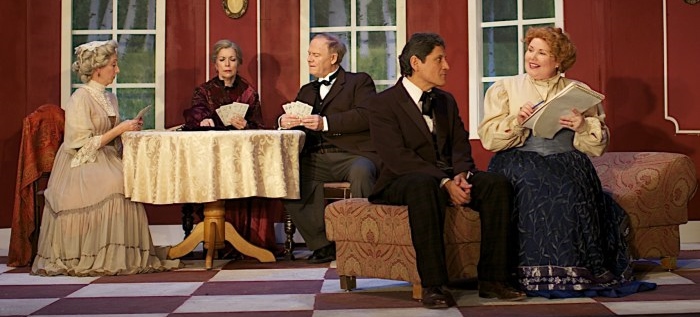
Shining City at Main Stage West, Sebastopol CA

By Greg & Suzanne Angeo, Uncategorized

Reviewed by Suzanne and Greg Angeo

Members, San Francisco Bay Are Theatre Critics Circle

Photos courtesy of Main Stage West

John Craven, Nick Sholley

Ghosts of the Soul

Modern Irish playwright Conor McPherson is known for crafting stories with elements of the paranormal. His 2004 play “Shining City” was first performed in London’s West End and saw its Broadway debut in 2006. It was nominated for the Tony Award for Best Play.

This is a ghost story that’s about more than just floating bits of protoplasm. It’s about haunted people who carry their ghosts around with them. The tale unrolls like an interesting fabric with frayed edges purposely left undone. Set in contemporary Dublin, “Shining City” is spooky drama leavened with wry humor. Taking place entirely in a dingy therapist’s office, it was written to flow seamlessly over five scenes without intermission. At Main Stage West, there is one, and the dynamics remain intact.

The play opens with John (John Craven) arriving at the appointed time. He is jittery and jumpy, as if wired to an electric current. His wife died in a car crash a few months back, and now he’s seeing her spirit in the house they shared. Positive he’s coming unhinged by grief and guilt over his past failures as a husband, he’s visiting a therapist to unload. His therapist Ian (Nick Sholley), an ex-priest, has his own inner ghosts to exorcise. John is his very first patient, and he’s unsure how to proceed. His relationship with his fiancé Neasa (Ilana Niernberger) has hit a rocky patch. For mysterious reasons, he has estranged himself from her and their baby, and she shows up at the office later and demands to know why. Finally, an enigmatic drifter named Laurence (John Browning) appears, summoned by Ian for what he hopes will be a moment of self-discovery.

Ilana Niernberger, Nick Sholley

The expressions “on your own”, “on my own”, “on her own” are used over and over again. This suggests not independence, but loneliness and isolation, a sense of being alone in the company of others. “Frightening” is also repeated a number of times, as if to drive home the terror of aloneness. A number of cathartic monologues delivered by Craven are sheer, spellbinding magic.

The dialogue flows very naturally including those long, awkward conversational gaps where the silence says more than the words ever could. All four performances, as an ensemble, are courageous, creative and spot-on. As the tormented John, Craven’s unease is palpable. Sholley’s Ian conveys the sense of a great listener, assured on the surface with turmoil just beneath. Niernberger gives a notable performance in showing Neasa’s frantic attempt to understand Ian and salvage what’s left of what they once had. And Browning is restrained and insightful as Laurence in his single, surprising scene with Sholley.

Beth Craven’s sensitive and perceptive direction lends just the right touch, enhancing the unique situation of each scene. “Shining City” is quietly moving and provocative at the same time, with an eerie conclusion that raises more questions than it answers. More than just the story, the words pull you along, a mastery of wordcraft over stagecraft.

John Browning, Nick Sholley

When: Now through March 15, 2015

8:00 p.m Thursdays, Fridays & Saturdays

5:00 p.m. Sundays

Tickets $15 to $27 (Thursdays are “pay what you will” at the door only)

Where: Main Stage West

104 North Main Street

Sebastopol, CA 95472

(707) 823-0177

www.mainstagewest.com

A Lie of the Mind is a long night’s journey at the Magic Theatre

By Kedar K. Adour

Frankie (Juan Amador) listens to Beth (Jessi Campbell) as Baylor (Robert Parsons) looks on.(Photo by Jennifer Reiley)

A Lie of the Mind: Drama. By Sam Shepard. Directed by Loretta Greco. Magic Theatre, Building D, Fort Mason Center, S.F. Two hours 50 minutes. (415) 441-8822 or www.magictheatre.org 

A Lie of the Mind is a long night’s journey at the Magic Theatre [rating:3]

Extended through March 14, 2015

Once again 24 hours separated an evening of fun and an evening of intense drama with nary a separation of two miles between the two theatres. Wednesday the national tour of the musical Newsies at the Orpheum left the audience with warm feelings as they gave the production a standing ovation. The next night an exceptionally fine staging of Magic Theatre’s local production of Sam Shepard’s A Lie of the Mind led some of the audience to leave at intermission. It was not an unexpected situation at the Magic that seems to stage plays involving dysfunctional families.

Sam Shepard who honed his art as playwright-in-residence for 10 years (1974-1984) at the Magic is known for his portrayal of dysfunctional families. In doing so he has earned honors heaped on honors with his plays and Buried Child earned the 1978 Pulitzer Prize. That play has received stunning staging by A.C.T and the Magic. The present production of Lie of the Mind has never been produced in the Bay Area and can be recommended for its historical relationship to the Shepard’s development as a writer and as an example of Lorretta Greco’s directorial skills. It has been suggested it is the final chapter of Curse of the Starving Class (1976), Buried Child (1979), True West (1980), and Fool for Love (1983) that are semi-autobiographical with the male characters dominating.  Although the action of the male characters In A Lie of the Mind are the causation of events, his female characters take center stage and are given almost equal status as the males. 

The story involves two dysfunctional families, separated by miles but tied together by marriage. Jake, his brother Frankie, sister Sally and their mother Lorraine live in a Western State. Jake’s wife Beth is from a North Dakota family that includes a mother Meg, a father Baylor and a brother Mike.  Their abstruse relationships are gradually defined though Shepard’s mastery of dialog and action creating fully rounded individuals but ends with more questions than answers.

The play begins and ends with violence and is filled with intense situations that are gut-wrenching but at times somehow garner stifled laughs from the audience. Those moments are few. What can one expect when the opening scene is a telephone call between brothers Jake and Frankie where hyper-manic Jake is confessing his near fatal beating of his wife Beth and a second hospital scene of brain-damaged Beth being consoled by her brother Mike?

Shepard is a master at developing bits of information combined with physicality to create fully rounded characters but he is not above using exposition in the guise of ordinary conversation to unravel past actions that defines personality. A specific scene that defines the true relationship between the manic Jake and his deceased drunken father is one of those lapses in the plays construction. This may be due to the fact that he gives those specific lines to Jakes young sister Sally (Elaina Garrity) and it does not carry the horrific nature of a past event that leads to a momentous decision by mother Lorraine (a marvelous Catherine Castellanos) and Sally to abandon the family home.

Jessi Campbell gives a Tony Award winning type of performance as the brain damaged Beth and you will find yourself trying to help her find the words buried in the prison of her mind. Sean San Jose gives a histrionic patina to his performance as Jake just as Shepard has suggested in his stage directions. (Shepard directed the original production). You can feel the mental and physical pain tinged with loyalty of Jake’s younger brother Frankie in Juan Amador’s performance. James Wagner’s transition as Beth’s concerned and protective brother Mike to an unbalanced deer hunter seems artificial even if Shepard had intended the dichotomy. Robert Parsons and Julia McNeal as the parents of Beth and Mike do a superbly believable job of displaying the attributes written into their characters.

This three act play as suggested by the author has complicated scene changes and may be one reason it has not had many productions. Director Greco has wisely simplified the staging and the scenes flow smoothly even when the action is hectic. Original music written and performed by Nicholas Aives and Jason Cirimele is used as bridges between scenes, underscores monologs and opens and closes each act.  Running time 2 hours and 50 minutes with one intermission.

CAST: Juan Amador (Frankie); Jessi Campbell  (Beth); Catherine Castellanos (Lorraine);  Julia McNeal (Meg); Robert Parsons (Baylor); Sean San Jose (Jake); James Wagner (Mike); Elaina Garrity (Sally).

CREATIVE TEAM: Director, Loretta Greco; Set Design, Robert Brill; Costume Design, Alex Jaeger; Lighting Design, Burke Brown; Sound Design, Sara Huddleston; Stage Manager, Karen Szpaller;  Dramaturg, Jane Ann Crum; Vocal Coach, Deborah Sussel; Fight Director, Dave Maier; Director of Production, Sara Huddleston; Technical Director, Dave Gardner; Props Design, Jacquelyn Scott; Local Casting,Dori Jacob and Ryan Guzzo Purcell; Original Music Composed and Played by Nicholas Aives and Jason Cirimele

Kedar K. Adour, MD

Courtesy of www.theatreworldinternetmagazine.com  


Dragon’s “Show People” humorously honors theater folk

By Judy Richter

As the audience files into Dragon Theatre for the opening of its 15th season, a recording of Ethel Merman singing this line, “There’s no people like show people,” can be heard.

It’s an apt way to settle into “Show People,” Paul Weitz’s often funny salute to the people who bring plays and musicals to life.

As the play opens, two actors, Marnie (Monica Cappuccini) and Jerry (Bill Davidovich), who have been married to each other for a long time, are arriving at a beach house owned by Tom (Casey Robbins). He has hired them for the weekend to impersonate his parents in order to impress his live-in girlfriend, Natalie (Sara Renée Morris).

She in turn tries to impress them. For example, she bakes blueberry muffins, but she adds some horseradish, rendering them almost inedible, but everyone else is too polite to say so.

To say much more about the plot as it twists and turns would be to spoil the surprises except to say that little is as it seems on the surface. However, one thing is clear: Despite all the trials and tribulations Marnie and Jerry have gone through over the years, they still love each other and the theater.

Astutely directed by Austin Edgington, all four actors fully inhabit their characters and their shifting relationships while mining both the humorous and the serious moments of the play.

Cappuccini’s performance as Marnie is especially noteworthy. In addition to impeccable comic timing, she relays volumes with her unspoken reactions to various situations and the other characters.

The tall, deep-voiced Davidovich allows Jerry to be something of a ham most of the time, but he can also tone him down to become serious and sincere when necessary. Robbins as Tom and Morris as Natalie are believable.

Kirsten Royston’s two-level set, with lighting by Leonardo Hidalgo, works well in Dragon’s intimate space. The character-appropriate costumes are by Jeff Hamby, the sound by Jesse Scarborough.

This 2006, two-act play runs just over two hours with one intermission. It’s an enjoyable production for the audience and a great way for the company to begin its new season.

“Show People” will continue through March 22 at Dragon Theatre, 2120 Broadway St., Redwood City, through March 22. For tickets and information, call (650) 493-2006 or visit www.dragonproductions.net.


Storytelling, Simpsons central in ‘Mr. Burns’ at ACT

By Judy Richter

Storytelling becomes a powerful survival tool in “Mr. Burns, a post-electric play,”  presented by American  Conservatory Theater in a co-production with the Guthrie Theater.

Playwright Anne Washburn sets the action in California after meltdowns at nuclear power plants across the country have knocked out the electrical grid, causing massive death and destruction.

As the play opens, a group of survivors is gathered around a campfire trying to reconstruct “Cape Feare,” an iconic episode of TV’s long-running “The Simpsons.” The approach of a stranger puts them in a defensive mode, guns drawn, but he’s just another survivor, and he brings news, none of it good.

The next scene fast-forwards seven years when the band of survivors has become a seven-member theater troupe. They’ve moved into an abandoned warehouse where they rehearse their performance of  “Cape Feare,” making due with limited resources. By now, lines from “The Simpsons” have become valuable currency for which the troupe must compete against others doing the same thing.

The second act is set 75 years later when a theater troupe is staging “Cape Feare,” complete with a mix of popular songs from the era of the Simpsons.

Although the play is filled with pop culture references that can evade some audience members, it’s still enjoyable for the strength of Washburn’s writing and her lyrics for the score by Michael Friedman.

It’s also enjoyable for the outstanding performances that director Mark Rucker elicits from the engaging ensemble cast: Nick Gabriel, Anna Ishida, Kelsey Venter, Ryan Williams French, Charity Jones, Jim Lichtscheidl, Tracey A. Leigh and Andrea Wollenberg. Wollenberg also works with musical director David Möschler as part of the two-person, offstage band.

The set by Ralph Funicello (with lighting by Alexander V. Nichols) becomes ever more fanciful, as do the costumes by Alex Jaeger. The sound is by Jake Rodriguez, the choreography by Amy Anders Corcoran.

Although the play stresses the importance of storytelling, it also honors humankind’s instinct for survival no matter how dire the circumstances.

After closing in San Francisco, the production will move to the Guthrie in Minneapolis.


King Lear at the Lark: Up close and personal like you’ve never seen him

By David Hirzel, Uncategorized

You may think you know him, the tragedy of a doddering old man whose senses are beginning to leave him, and whose children use his failing powers to take what is his in the name of protecting him. It must have been as common an occurrence in Shakespeare’s day as it sometimes seems to be today. To hear the arguments of King Lear’s daughters Goneril (Maev Beaty) and Regan (Lisa Repo-Martell) it only makes sense to do so. Seen through the filter of his still sound mind in its lucid moments, it is betrayal that he calls out and confronts with all the passion his soul can muster. In Colm Feore’s King Lear, that is a lot of passion, and his early face-to-face confrontations with his daughters it spills out with volcanic fury, and is met with the same.

There are other betrayals—son against father, brother against brother, wife against husband—and they are played out with equal, unbridled passion, to their ultimate Shakespearean tragic and ruthlessly bloody end. But this performance is Lear as you’ve never seen it. Stratford Festival  has filmed the play live in their great theater in Ontario, Canada. Those in the audience are watching and responding to the performance, but they see it only from a distance.

This film brings us into the play in a way that watching it on stage can never do. The miracle of modern film brings the action, the faces, the tears of sorrow right to your own eyes. At its most beautiful moments—Cordelia reunited with her father, Lear comforting the blinded Gloucester—we the audience are moved to tears ourselves. At its most horrid—slash of the knife to the eyes, the brutal deaths by blade—we recoil in fear. Mercifully some of the deaths at the end of the play occur offstage. Lest anyone think the Bard was unusually bloodthirsty in his depictions of eye-gouging and murder, one has only to look to the recently discovered, violently mutilated remains of another medieval monarch, Richard III.

The performances are of the highest caliber, and we view them with the greatest clarity in detail, lighting, and sound. The one-night showing at the Lark is over now, but this is one version of King Lear you can see if it comes again to an art-house theater near you, or by renting a DVD to watch at home. It casts a whole new light on a play you may have thought you already knew.  Directed by Antoni Cimolino.

Look for two more of Shakespeare’s finest—King John and Anthony and Cleopatra—coming later this year to the Lark. Mark these dates on your calendar:  April 8 and May 21, 2015.  Don’t miss them.

If you haven’t already been to the Lark theater in Larkspur, give yourself plenty of time. It’s not easy to find, but believe me, if this is your only chance to see Shakespeare this close and personal, it will be well worth the effort.

 Lark Theater:  549 Magnolia Ave., Larkspur CA  415-924-5111

Review by David Hirzel


Address

Link


Review by David Hirzel link

2/26/15


‘The Convert’ looks as little-known aspect of African history

By Judy Richter

Irony ultimately rules in “The Convert,” presented in its Bay Area premiere by Marin Theatre Company.

Danai Gurira sets her play in Salisbury, Rhodesia, (present day Harare, Zimbabwe), between 1895 and 1897. A young African woman, Jekesai (Katherine Renee Turner), is taken to the home of Chilford (Jabari Brisport) by her cousin, Tamba (JaBen Early).

Because Tamba’s mother, Mai Tamba (Elizabeth Carter), works there as a maid, Tamba hopes that Jekesai can find refuge from her uncle (L. Peter Callender) who would force her to marry a much older man, whom she despises.

Chilford is an African who has renounced his tribal heritage and become a lay Roman Catholic minister trying to convert other Africans. He changes Jekesai’s name to Ester.  She comes to embrace Catholicism and to join him in his missionary work.

Over time, however, the natives begin to rebel against the white English settlers who have repressed them. Violence follows on both sides.

Chancellor (Jefferson A. Russell) warns Chilford that their fellow Africans regard him and other converts as traitors. Chancellor’s fiancee, Prudence (Omoze Idehenre), urges Ester to be her own woman.

Although Ester is presumably the title character, Chilford, too, is a convert, and both become increasingly conflicted between their new faith and their tribal traditions. Tragedy ensues.

Playwright Gurira, who was born in the United States to Zimbabwean parents and reared in Zimbabwe, is a promising young playwright. However, this nearly three-hour play could benefit from judicious pruning to reduce it from three acts and two intermissions to two acts and one intermission.

MTC artistic director Jasson Minadakis directs the outstanding cast, eliciting strong performances from everyone. The simple set is by Nina Ball with lighting by Gabe Maxson. Fumiko Bielefeldt designed the mix of Western and African costumes. The music and sound are by Chris Houston.

Dialect coach Lynne Soffer deserves credit for the accents, which are usually understandable if one listens carefully. Julia Chigamba, a native Zimbabwean, served as cultural consultant and guest vocal artist.

Despite its length, “The Convert” makes for fascinating drama while shedding light on a part of African history that probably is unfamiliar to most Americans.

It will continue through March 15 at Marin Theatre Company, 397 Miller Ave., Mill Valley. For tickets and information, call (415) 388-5208 or visit www.marintheatre.org.


Are writer and his wife in danger of losing it? Nah

By Woody Weingarten

Granddaughter’s front teeth rank low on columnist’s list of worrisome lost items. Photo: Woody Weingarten.

My wife keeps me busy by endlessly assigning me unwanted tasks.

Like finding her lost cell phone.

And umbrellas.

My search parties are mobilized weekly.

Not long ago Nancy phoned from downtown San Anselmo while walking our little white rescue mutt.

No, she hadn’t misplaced our biodegradable poop bags.

“Please come and rescue me,” she wailed. “I’ve lost my keys again.”

I scoured virtually every inch of her trail — Creek and Inspiration parks, block after block of San Anselmo Avenue, the lawn of Town Hall.

I pushed aside foliage where Kismet had deposited some stinky stuff and Nancy had bent over to collect it. I checked each early-blooming flower, each parked vehicle. I kicked aside fallen leaves that had accumulated at curbside.

I stopped counting at 1,439,574.

Diddly squat.

Happily, a young lad found the keys soon after we’d retreated to our home. He turned them into the police, whom we’d been smart enough to notify.

Losing this ‘n’ that has for sure become too habitual for both of us.

As well as for a slew of our aging friends.

On a whim, Nancy and I crafted a list — and noticed that losing something isn’t necessarily bad.

When she partially lost her hearing, for instance, she could no longer hear my snoring.

And when I lost my taste for alcohol, weed and Pall Malls, she — not to mention my liver and lungs — was grateful.

Losses also can fill our mental safety deposit box of anecdotes.

Nancy once got a Jaguar tour of the Civic Center parking lots when she coaxed a young attorney into helping her locate her vanished Camry by pleading, “Pretend I’m your mother.”

Then, of course, there’s the negative side of the ledger.

Topping my list of worrisome recent disappearances is my diminished eyesight, abetted by cataracts.

To counteract my growing anxiety, I’ve stooped to regularly kissing the rings of Kaiser Permanente ophthalmologists and optometrists in San Rafael.

At the bottom of my list of worries are my granddaughter’s missing and wiggly baby teeth. I’d be willing to bet the 8-year-old doesn’t believe in the Tooth Fairy anymore but firmly believes in the five-dollar bill she gets for slipping a tooth under her pillow.

Lost through inflation along the way has been the value of a buck. I used to give my kids a quarter. And I felt no deprivation whatsoever even though my parents stiffed me completely.

Some losses undeniably are permanent.

My underwear somehow evaporated in Europe, for example, while quick drying on a wine rack.

Nancy’s luck with AWOL clothing is infinitely better. A hotel employee once took the trouble to mail her back an unwashed, wrinkled nightgown from a Bahamas vacation.

But the truth is, my wife doesn’t fret in advance about losing things.

That’s mainly because she strongly believes in karma and always returns what she finds.

I can verify this fantastical account about a wallet she found: When she called the owner to inform her about it, the woman was dining with Nancy’s dermatologist.

Finding is, naturally, the flip side of losing.

My 75-year-old wife recently unearthed an old, old, old supposedly lost outfit in the way-back of her closet.

She wore it just for giggles while strolling with Kismet in Fairfax one evening. A woman she didn’t know approached her just to say, “What a magnificent vintage dress.”

Without losing a beat, Nancy answered, “Thanks. It goes with the face and body — I’m vintage too.”

Losing things is hardly a new experience for us.

In fact, my wife and I wrote a song called “Lost It Blues” for our unproduced musical revue, “Touching Up the Gray.” And we’re still living out the lyrics, despite having composed the piece 16 years ago.

“I’ve lost 2 billion pens, 3 dozen pinky rings

“Over the last 40 or 50 years.

“And where’s the car I just parked

“With all its dings.

“I’ve lost count of what I’ve lost.

“It’s so embarrassing.”

But the song ends on a more serious note by referring to what we both consider our biggest loss — our youth:

“Time is irretrievable,

“It is unbelievable

“I had time on my hands,

“But now it’s lost.”

Contact Woody Weingarten at voodee@sbcglobal.net or check out his blog at www.vitalitypress.com/

Duo musically spoofs romance, marriage and aging

By Woody Weingarten

[Woody’s [rating: 5]
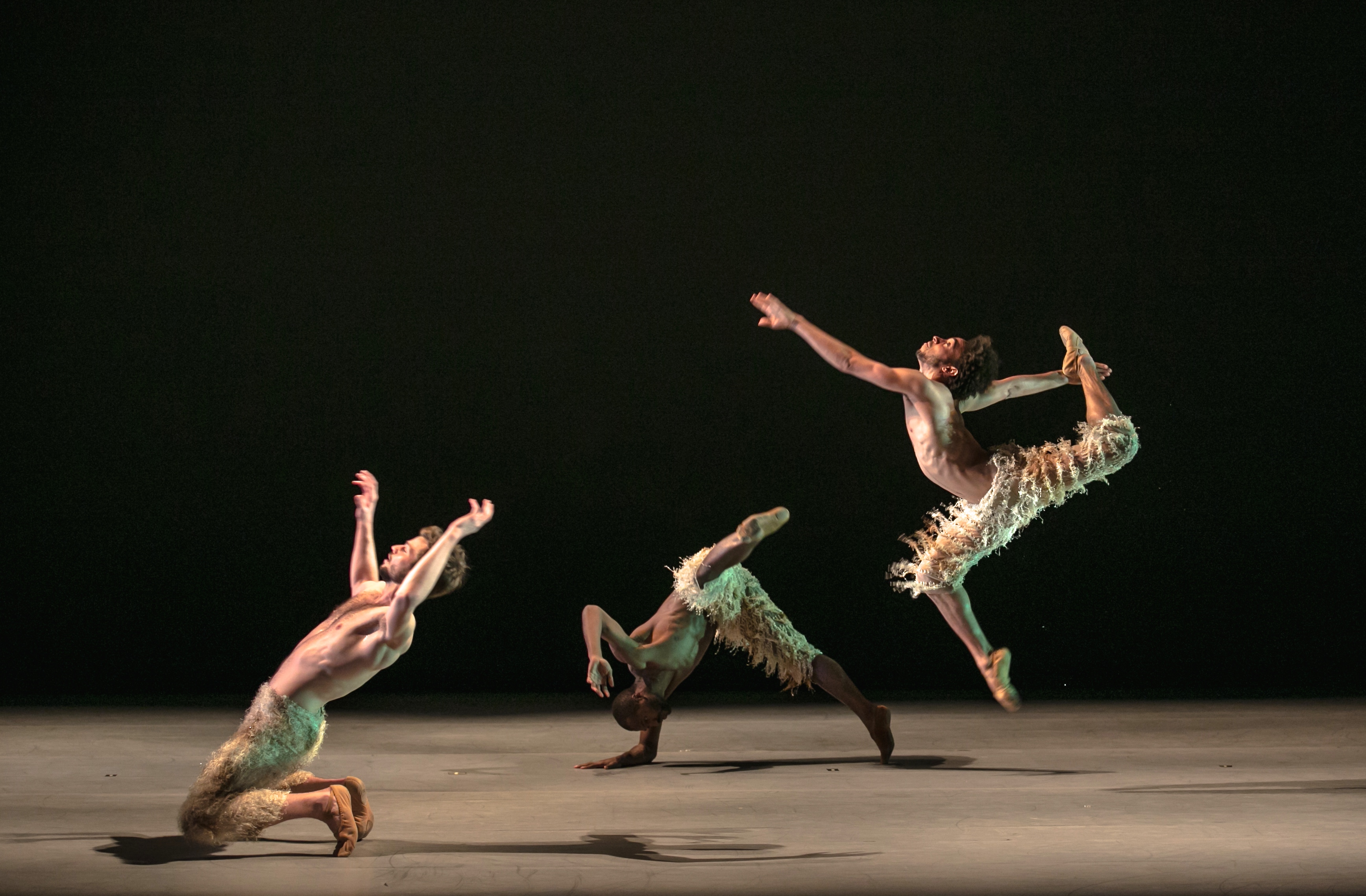
Sandy Riccardi is an accomplished New York comedienne-actress.

Tall and attractive.

With a robust, polished singing voice.

Pianist Richard Riccardi has played with San Francisco’s symphony, opera and ballet companies — and accompanied Pinchas Zuckerman, Joel Grey and Diahann Carroll.

But he’s short and bald. And has a gravelly singing voice.

Yet he’s Sandy’s trophy husband.

She even sings an incomparable homage to his hairless head.

At Petaluma’s Cinnabar Theater recently, the pair presented a loving, charming cabaret act, “My Raunchy Valentine,” that made me laugh aloud often and feel good for 90 minutes.

Mostly, the rib-tickling diva vocalized and mugged.

Mostly, Richard played.

With tongue permanently implanted in cheek, and with lyrics that leaned toward the clever, they started with the downside of texting and tweeting (“you don’t quite care enough to call”) and ended with gallows humor from a Rodgers and Hart tune about serial husband-icide.

In between, they dealt with a “Southern girl’s mating call — ‘I can hardly taste the liquor,’” waggish fallout from forgetfulness and blame, and other comic pitfalls of the wrinkling process (with a pill-filled bottle doubling as a rhythm instrument).

I did find the “My Raunchy Valentine” title a touch misleading, though.

The Riccardi duo performed several tunes with double entendre after double entendre but its major focus was on the snags and snares of relationship.

They used their own as comedic fodder.

Sandy noted, in fact, that they total five marriages between them — and illustrated “Our Perfect Family” with a stage-length scroll featuring stick figures of the blended family (including three nurses from Fiji).

“He’s a glutton for punishment,” she noted of her husband. “I’m the third wife Richard has seen through menopause.”

The couple offered many original numbers, then interjected amusing parodies of such familiar ditties as “I Could Have Danced All Night,” “Memories” and “Cat’s in the Cradle.”

Twice, the pair — married six years with 4 million YouTube hits under their collective belt — paused the merriment to execute love ballads penned for each other. Once, Sandy apologized for being saccharine (“we were supposed to be anti-Hallmark”).

All in all, I found the show fluffy and fun.

And I definitely could relate to their occasional public expressions of love.

To continue our Valentine’s Day tradition, I’ve already purchased the hundreds of tiny candy hearts I’ll hide in my wife’s music books, desk drawers and medicine cabinet — and tuck into various clothes in her closet.

I know she’ll undoubtedly take similar liberties with my things.

And if the past is any indication, we’ll still be finding each other’s sugar treats for months and months. And smiling.

And that’s the way we like it. After all, we consider each other a trophy spouse.

Even though we, too, have five marriages between us.

“My Raunchy Valentine” was part of the Sunday concert series at Cinnabar, 3333 Petaluma Blvd. N., right off Hwy. 101, Petaluma. Upcoming shows in the series, all beginning at 7:30 p.m., include The Ring of Truth Trio on March 15, Red Hot Chachkas on April 19, Le Jazz Hot on May 17 and Amanacer Flamenco on June 14. Tickets: $15 to $30. Information: (707) 763-8920 or cinnabartheater.org.

Contact Woody Weingarten at voodee@sbcglobal.net or check out his blog at www.vitalitypress.com
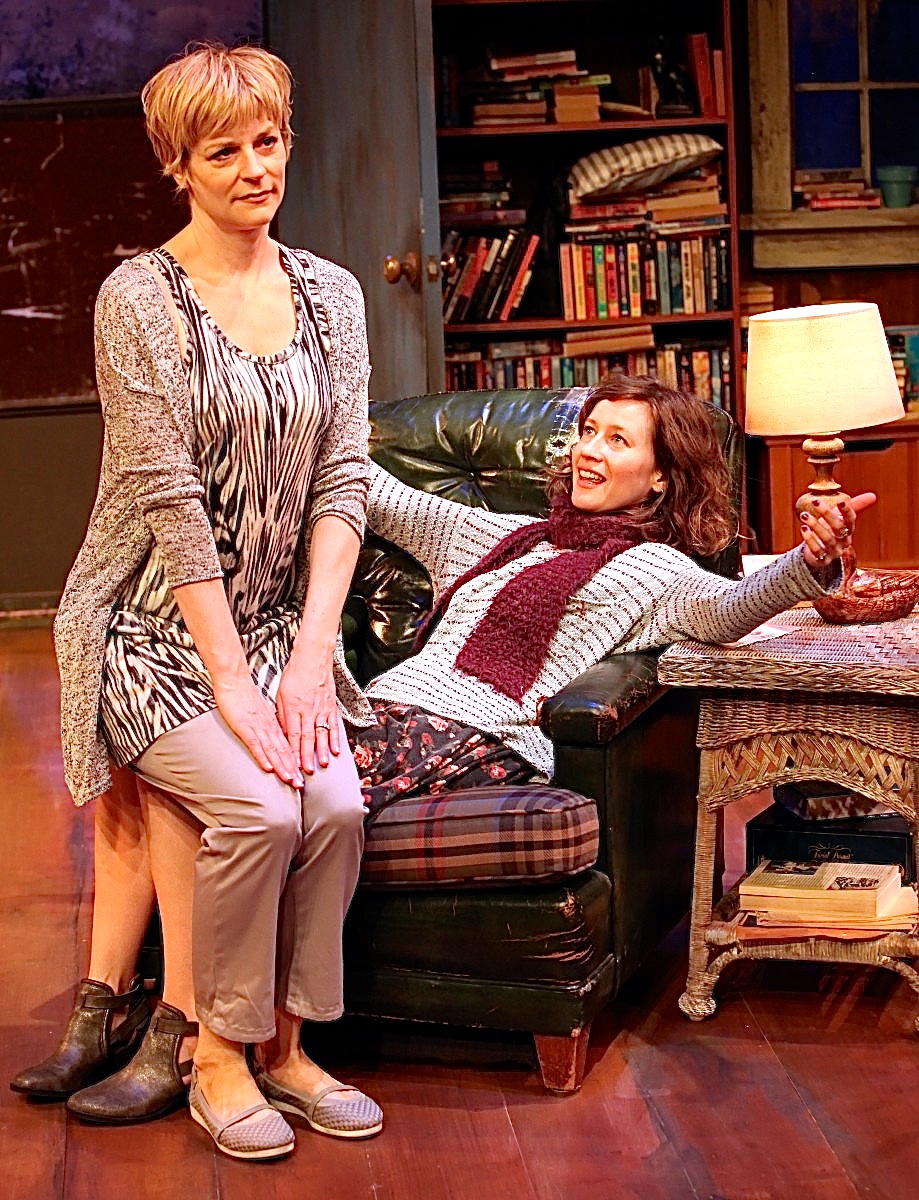
Foothill spends ‘Sunday in the Park With George’

By Judy Richter

Foothill Music Theatre has taken on a major challenge by staging “Sunday in the Park With George.”

Stephen Sondheim’s music and lyrics always are tricky. There are design challenges, too, in this 1984 fictionalized account of the creation of French artist Georges Seurat’s monumental painting, translated as “A Sunday Afternoon on the Island of La Grande Jatte.”

The first act in James Lapine’s book for the show takes place between 1884 and 1886, mostly on the island in the Seine near Paris as George (Tyler Bennett) paints his model/mistress, Dot (Katie Nix), other people and their surroundings. Other scenes take place in his studio as he continues to paint.

George is so absorbed in his work that he neglects Dot. Because he’s developing a new technique, his work baffles fellow artists. Even when Dot becomes pregnant with their daughter, Marie, he remains focused on his art, causing Dot to marry a kindly baker, Louis, (Michael Weiland), and go to America with him.

Act 2 takes place 100 years later in an American museum, probably the Art Institute of Chicago, where the painting hangs today. George’s great-grandson, also named George and played by Bennett, is displaying his latest creation, “Chromolume # 7,” a kind of light show, and trying to raise money for the next one during a reception. He’s accompanied by his grandmother, Marie, played by Nix.

Later, he goes to Le Grande Jatte in hopes of finding a new direction for his art.

Seurat experimented with color and light by using only 11 colors, no black. Instead of mixing them on his palette, he applied them in tiny dots so that the eyes would do the fusing. This technique came to be known as pointillism.

Inspired by Seurat, Sondheim orchestrated the work for 11 instruments and emulated pointillism with staccato notes in some songs, especially those George sings while painting. Throughout the score, Sondheim fans will recognize echoes of his earlier “Sweeney Todd” and foreshadowings of “Into the Woods.”

Musical director Dolores Duran-Cefalu, who conducts from the keyboard, uses a scaled-down orchestration for six other musicians, but it works well.

Bennett as George (Sergey Khalikulov appears in some performances) convincingly portrays his prickly personality and sings well.

Although Nix as Dot/Marie looks the part and acts well, she doesn’t blend well with Bennett in songs like the title song, “We Do Not Belong Together” and “Move On.”

Noteworthy in the strong supporting cast is Linda Piccone as his mother in Act 1 and an art critic in Act 2.

Many of the design challenges in this show radiate from the coup d’ theatre that ends Act 1. That’s when the cast and designs gradually move into place to recreate Seurat’s painting. Costume designer Robert Horek and lighting designer Michael Rooney play their parts well, as does scenic designer Bruce McLeod. However, FMT’s Lohman Theatre is perhaps too small to allow the audience to sit back far enough to get to full effect.

The show hasn’t been seen often locally. ACT presented the Bay Area premiere in 1986, followed by TheatreWorks in 1987 and again in 1999.

Patrons who aren’t familiar with the show or who want to learn about the cast are advised to arrive early to read that pertinent information in the lobby. Budget constraints presumably prevent FMT from providing it in the program.

Overall, though, director Milissa Carey, her colleagues (including choreographer Amanda Folena) and the performers have created an enjoyable production.

“Sunday in the Park With George” will continue through March 8 in the Lohman Theatre, Foothill College, 12345 El Monte Road, Los Altos. For tickets and information, call (650) 949-7360 or visit www.foothillmusicals.com.


NEWSIES rocks the Orpheum in San Francisco

By Kedar K. Adour

Dan DeLuca (Jack Kelly) (center) and the original North American Tour company of NEWSIES. ©Disney.
PHOTO BY: DEEN VAN MEER

NEWSIES: Musical. Book by Harvey Fierstein. Music by Alan Menken. Lyrics by Jack Feldman. Directed by Jeff Calhoun.  Disney Theatrical Productions, SHN Orpheum Theatre, 1192 Market St., San Francisco. 888-746-1799 or  www.shnsf.com. February 18 – March 15, 2015

NEWSIES rocks the Orpheum in San Francisco [rating:5]

If you are looking for a musical evening of fun, dancing, singing with a feel-good ending and a smidgen of social consciousness get thee hence to the Orpheum Theatre to see the sparkling, energetic Newsies.  Actually, it would be more than a smidgen of social consciousness since the plot of Newsies revolves around the New York City Newspaper delivery boys’ strike of 1899.

During the 1890s newspaper delivery was mainly accomplished by young boys (girls?) who paid 50 cents for 20 or so newspapers and then hawked them on the streets. In 1899, the city newspaper magnets, led by Joseph Pulitzer owner of “The New York World” bumped the price up to 60 cents (a 20% increase!) and no refund for unsold papers. The “Newsies” as they were called organized a rag-tag ‘union’ and went on strike, paralyzing the city. Those are, or as close to, the “bare-facts” in the musical.

The 1992 Disney movie “Newsies” was a commercial and critical flop even though Christian Bales played the lead of Jack Kelley the titular leader of the group. That movie now has cult status. The movie-turned-musical had its premier run at the Paper Mill Playhouse in New Jersey. By that time Alan Menken (music), Jack Feldman (lyrics) and Harvey Fierstein (book) were aboard and when it opened on Broadway in 2012 it won two Tony Awards and ran for two years. The road show of Newsies that opened last night at the Orpheum is Broadway quality all the way.

The show opens with the youthful, attractive, energetic ensemble performing dances on the stage apron and on three revolving metal frameworks with spectacular projected visuals of scenes from old New York. It wisely ends with a curtain call of the same caliber receiving a standing ovation.

Jack Kelley (a marvelous Dan DeLuca) is a 17-year-old runaway from a hell-hole called the “ Refuge” and thus is wanted by the police. He gets help from no-last-name Katherine (gorgeous dulcet voiced Stephanie Styles) a budding reporter to expose the inequities of the time in general and of the Newies in particular. They unite all the boroughs including the reticent Brooklyn boys. Now we have a classic pot-boiler story of boy-meets-girl from the upper class uniting to resolve worker injustice.

Pot-boiler be damned. The acrobatic staging by Jeff Calhoun keeps the action nonstop on Tobin Ost’s constantly moving set with Sven Orel’s projection adding a touch of class to the fine acting, singing and dancing of the cast.

The key roles of the youngsters include Zachary Sayle as the optimistic and limping Crutchie who adds a touch of pathos to the evening. Jacob Kemp as Davey, the intellect advising much need moderation does a great job morphing from a reluctant by-stander to able leader.  Audience favorite was nine-year-old Anthony Rosenthal (alternating with Vincent Crocilla) as Davey’s younger brother steals a few scenes. Picking out separate great performances by the fantastic ensemble is impossible as they propel themselves into all forms of athletic dancing/ballet movements.

 The adults hold their own and with full-bodied Angela Grovey as chanteuse Medda bringing the house down with “That’s Rich” in act one. Steve Blanchard handles the unenviable role of Joseph Pulitzer with authority and will have you wanting to give him a melodramatic boo!

You will not be leaving the theater humming any of the songs but they all are appropriate for a feel-good musical and may even want you desiring to join Jack on a trip to “Santa Fe.”

Running time 2 hours and 20 minutes with intermission. Highly recommended.

CAST STARRING: Dan Deluca (Jack Kelly); Steve Blanchard (Joseph Pulitzer); Stephanie Styles, (Katherine); Angela Grovey, (Medda Larkin); Jacob Kemp (Davey); Zachary Sayle, (Crutchie); Vincent Crocilla & Anthony Rosenthal (Les).

ENSEMBLE: Mark Aldrich, Josh Assor,evan Aijtio,bill Bateman,joshua Burrage,  Kevin Carolan,demarius Copes, Benjamin Cook, Julian Deguzman, Nico Dejesus,  Sky Flaherty, Michael Gorman, Jon Hacker,jeff Heimbrock, Stephen Hernandez,meredith Inglesby,molly Jobe, James Judy, Eric Jon Mahlum Michael Ryan,jordan Samuels, Jack Sippel, Melissa Steadman Hart, Andrew Wilson, Chaz Wolcott

ARTISTIC STAFF: Director, Jeff Calhoun; Music, Alan Menken; Lyrics, Jack Feldman; Book, Harvey Fierstein; based on the Disney film written by Bob Tzudiker and Noni White; Set designer, Tobin Ost; Costume designer, Jess Goldstein; Lighting designer: Jeff Croiter; Sound designer,  Ken Travis; Projection designer,  Sven Ortel (Adaptation by Daniel Brodie);

Kedar K. Adour, MD

Courtesy of www.theatreworldinternetmagazine.com