‘The Addams Family’ not for all tastes

By Judy Richter

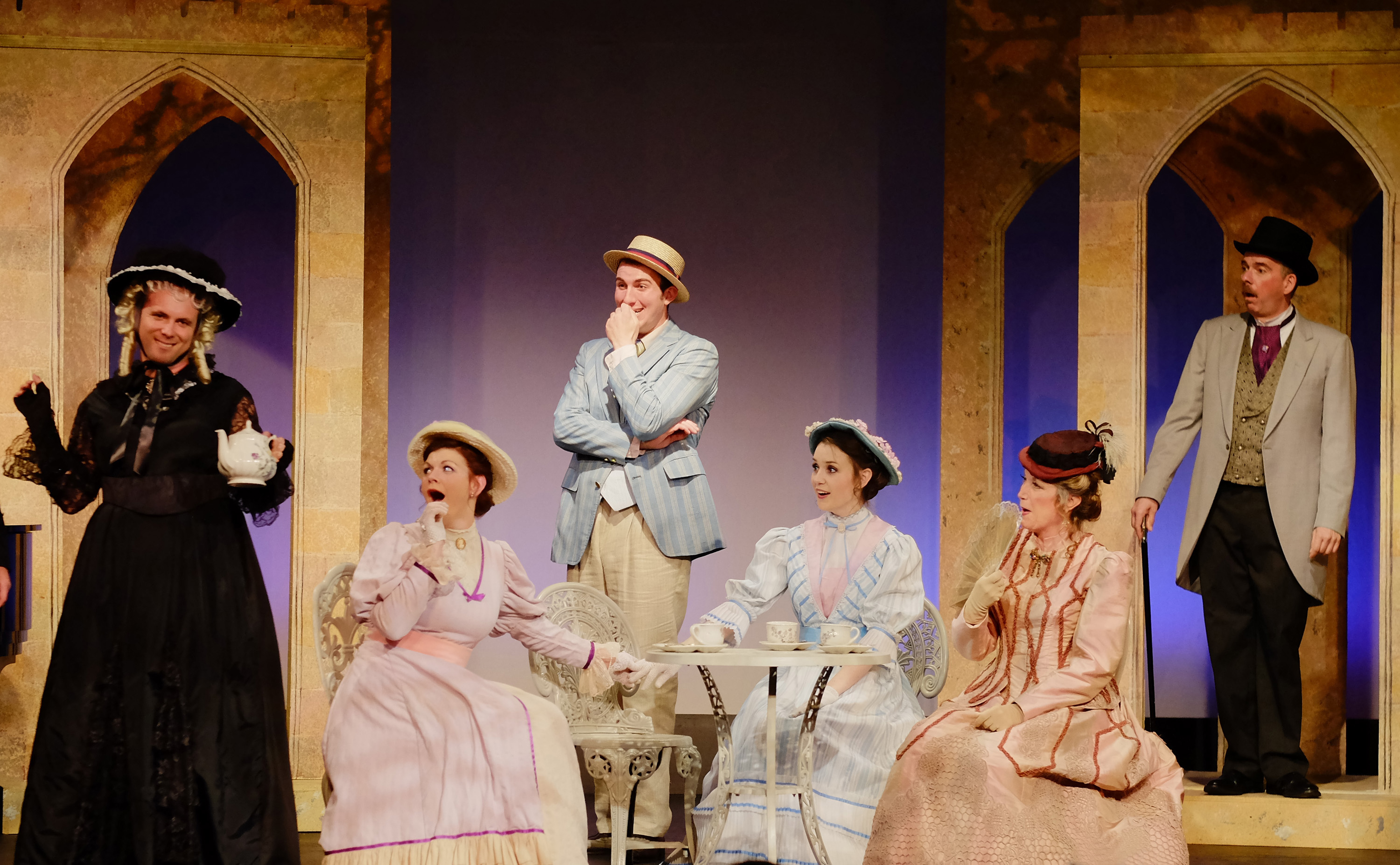
Originally a cartoon and then a popular TV series that ran from 1964 to 1966, “The Addams Family” has taken on a musical form presented by Palo Alto Players.

With music and lyrics by Andrew Lippa and a book by Marshall Brickman and Rick Elice, this bizarre show takes a page from “You Can’t Take It With You” for its plot.

Wednesday (Catherine Gloria), the daughter in this macabre family, has fallen in love with a normal young man, Lucas Beineke (Adam Cotugno), and wants to marry him. Therefore, she asks her parents, Gomez (Doug Santana) and Morticia (Betsy Kruse Craig), to invite his parents, Mal (Kennan Blehm) and Alice (Jen Wheatonfox), to their home for dinner. That’s when she and Lucas plan to tell everyone about their plans. Therefore, she wants her family to behave as “normally” as possible.

That’s not easy for a household that includes Wednesday’s younger, torture-loving brother, Pugsley (Leo Jergovic); green-faced Uncle Fester (Joey McDaniel); and potion-creating Grandma (Linda Piccone); along with their zombie-like butler, Lurch (David Murphy). Lurking in the background are a dozen Addams Ancestors who serve as the singing, dancing chorus.

Rather than playing Charades after dinner, this family’s game is Full Disclosure. Each person must reveal a secret unknown to anyone else. The results are predictably disastrous, leading to disharmony between both sets of parents as well as Wednesday and Lucas. In the end, though, all turns out well.

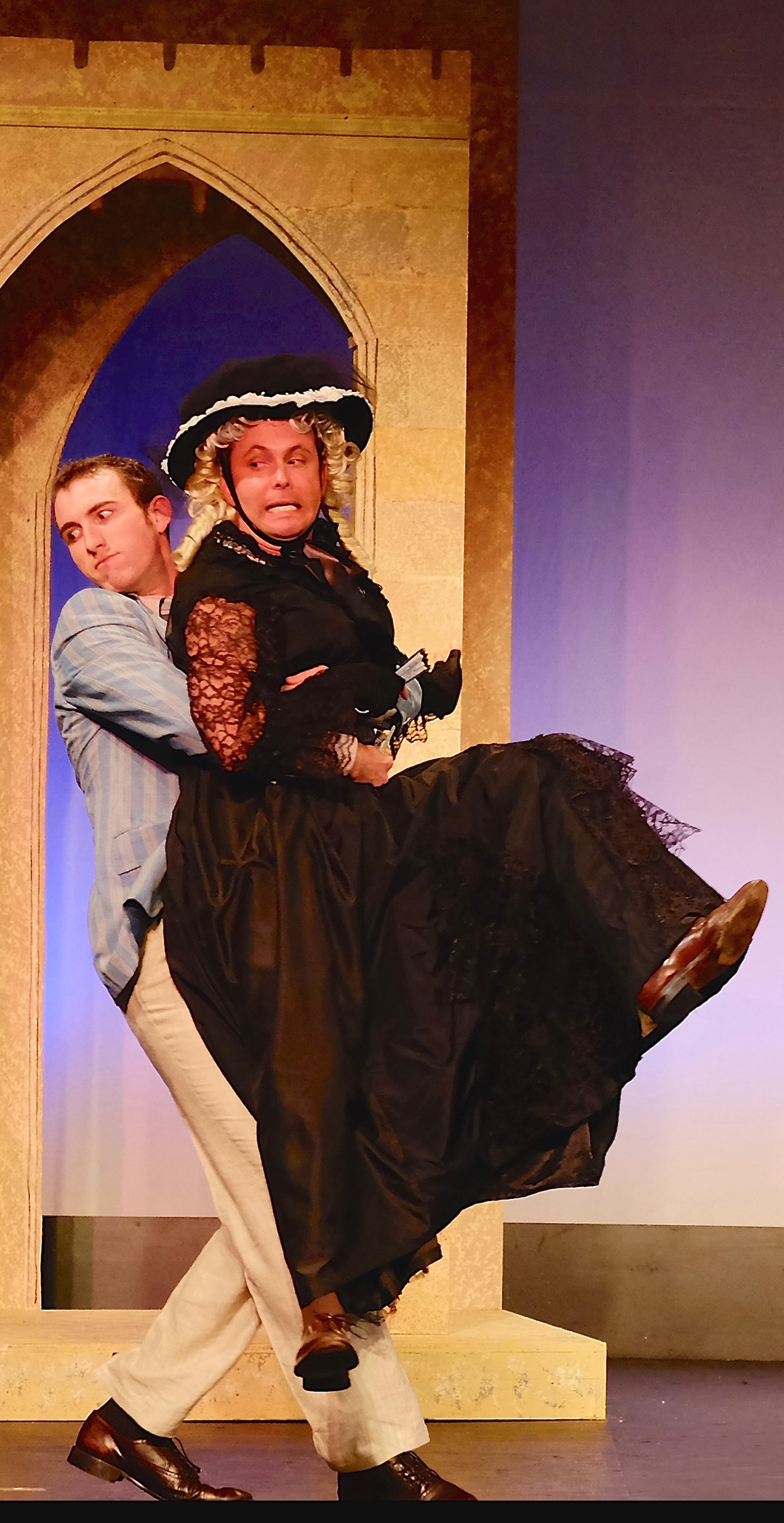
All forms of cartoonist Charles Addams’ “The Addams Family” focus on mordant subjects — albeit with a satirical edge. Thus this show is not to everyone’s taste. The first act is especially difficult to swallow because so much of the humor is sophomoric, but the second act is easier to take because it focuses on somewhat more realistic situations.

Nevertheless, the PAP cast, directed by Janie Scott, does its best with the material, and it seemed that most people in the opening night audience enjoyed it.

Under the baton of musical director Matthew Mattei, Lippa’s tuneful music is well sung by everyone, especially Gloria as Wednesday and Craig as Morticia.

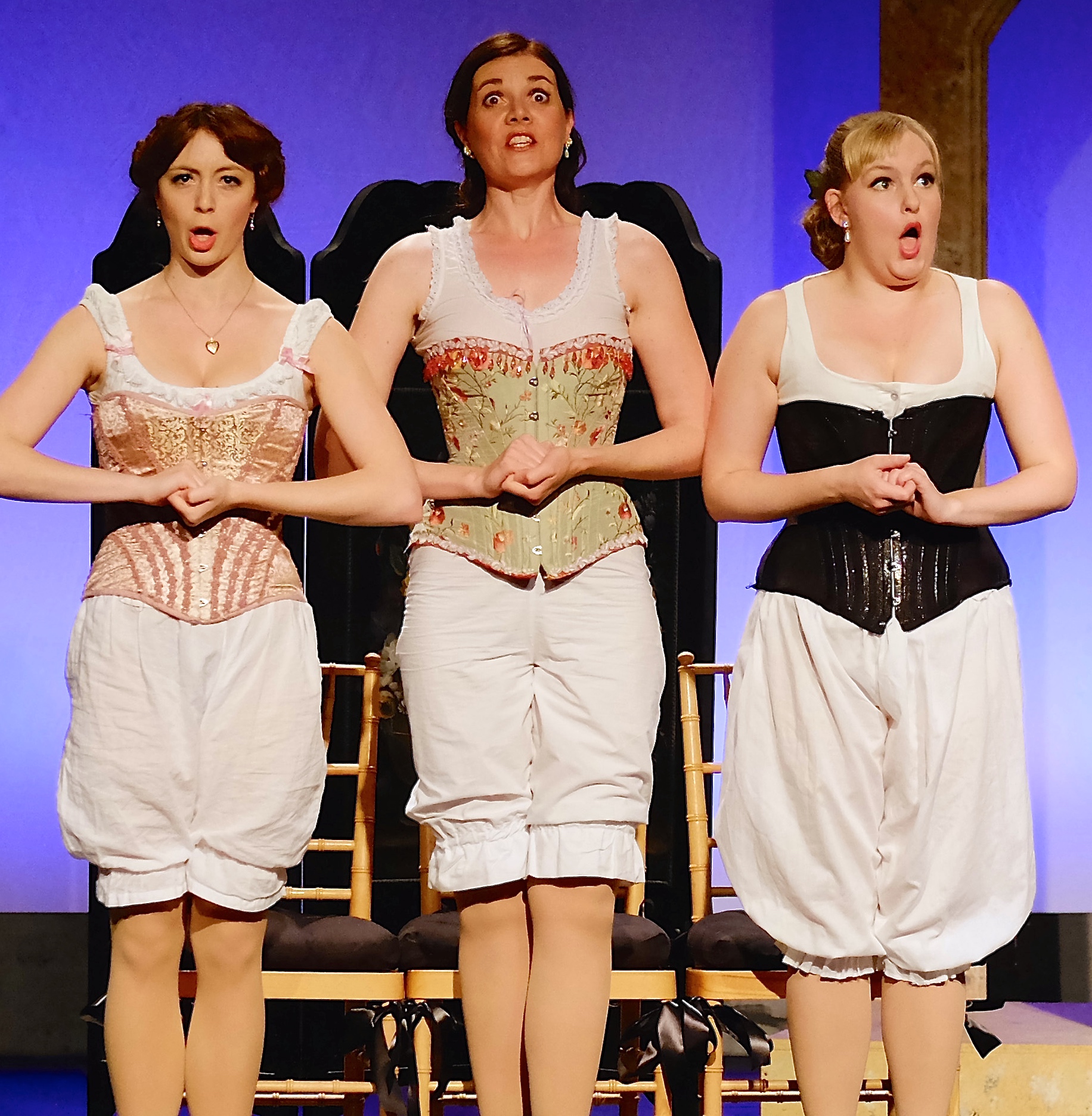
Director Scott choreographed the show, creating interesting, well-executed dances.

The show is episodic, but set designer Ron Gasparinetti keeps it running smoothly with various devices. Kudos to costume designer Shannon Maxham, especially for the Ancestors’ outfits, which cover many centuries. The lighting is by Carolyn A. Foot, the sound by Grant Huberty.

The show runs 2 1/2 hours with one intermission. It can be fun for most viewers but a long night for others.

“The Addams Family” will continue through May 10 at the Lucie Stern Theater, 1305 Middlefield Road, Palo Alto. For tickets and information, call (650) 329-0891 or visit www.paplayers.org.


The Addams Family at the Palo Alto Players will rattle your cage.

By Kedar K. Adour

THE ADDAMS FAMILY: Musical. Written by Marshall Brickman & Rick Elice. Music and lyrics by Andrew Lippa. Based on the comic strip characters created by Charles Addams. Palo Alto Players, Lucie Stern Theater, 1305 Middlefield Road in Palo Alto. www.PAplavers.org or 650.329.0891.

April 24 – May 10, 2015

The Addams Family at the Palo Alto Players will rattle your cage. [rating:3]

One might wonder if Charles Addams, the creator of “The Addams Family” made famous on the pages of New Yorker magazine with his single-panel cartoons so ghoulish and macabre to be side splitting funny, would rise from his grave to appreciate the lasting legacy the theatre has bestowed upon him. There were a plethora of film and TV adaptations but there is only one musical that hit the Broadway stage in 2010 for an almost two year run before being released to community theatres after a national tour in 2011. The Palo Alto Players snapped up the option and the resulting production has Uncle Fester baying (making love) to the moon while pandemonium reigns below.

Photo credit: Joyce Goldschmid
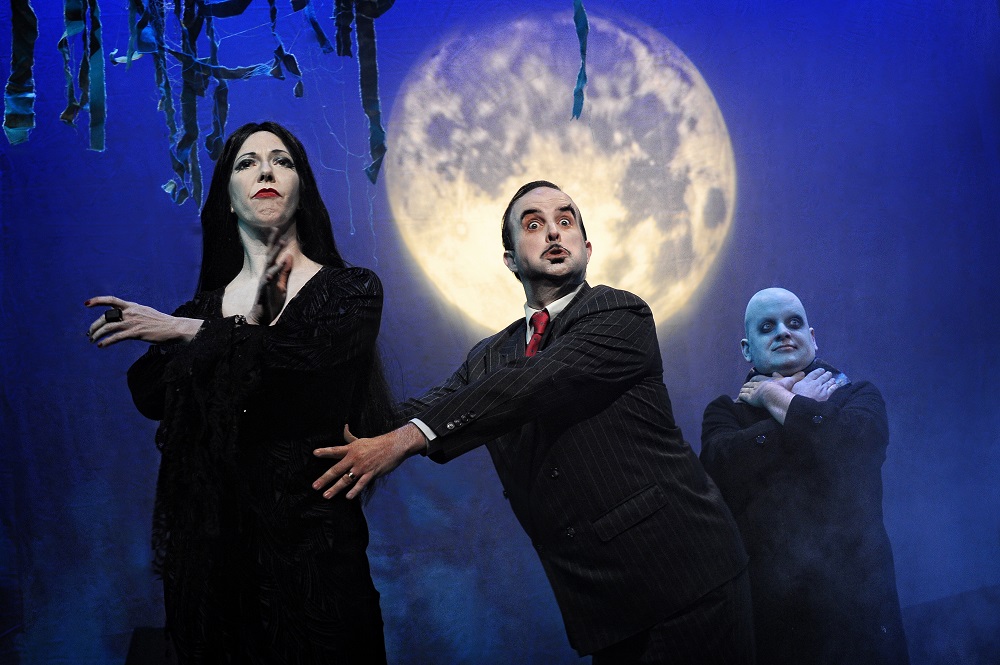
Palo Alto Players’ The Addams Family – l-r: Betsy Kruse Craig (Morticia Addams), Doug Santana (Gomez Addams), Joey McDaniel (Uncle Fester)


Who is Uncle Fester (Joey McDaniel)?  He is the fifth member of the immediate (sort of living) Addams family that includes Gomez (Doug Santana), his wife Morticia (Betsy Kruse Craig), Wednesday (Catherine Gloria) and Pugsley (Leo Jergovic). There are serious questions about the Addams family DNA of Grandma (Linda Piccone). Then there are non-living ‘Ancestors’ that rise from the crypts to dance up a storm and contribute to the mayhem that unfolds.

There cannot be a musical without  a love interest and that is provided by bizarre Wednesday falling in love with a ‘normal’ boy Lucas. The parents of the lovers both object to the potential marriage of the mismatched couple. Another person who strongly objects is younger brother Pugsley Addams since Wednesday’s departure means that she would not be around to torture him. The only family member (excluding the questionable Grandma)  to approve of the mismatch is Uncle Fester who is in love with the moon and brings down the house with his trip to the moon to consummate his love in act two. He wants to help the young lovers and convinces the Ancestors not to return to the crypt and help. That is a great idea since the Ancestor ensemble perks up the entire performance.

While Wednesday pleads with her parents to be “normal’, Lucas (Adam Cotugno ) does the same with his parents Mal (Kennan Blehm) and Alice Beineke (Jen Wheatonfox). The plot is much too complicated for a brief review but be assured it almost makes sense and the music, although not memorable, carries the plot along and is very well sung by most of the cast.

The dinner scene where the hilarious game of “Full Disclosure” is being played and Pugsly’s trick backfiring leads to another show stopping scene by local favorite Jen Wheatonfox. Milquetoast Mal has a marvelous transformation that allows Kennan Blehm to share the spotlight with Jen Wheatstone. Linda Piccone milks her Grandma role to perfection.

Photo credit: Joyce Goldschmid
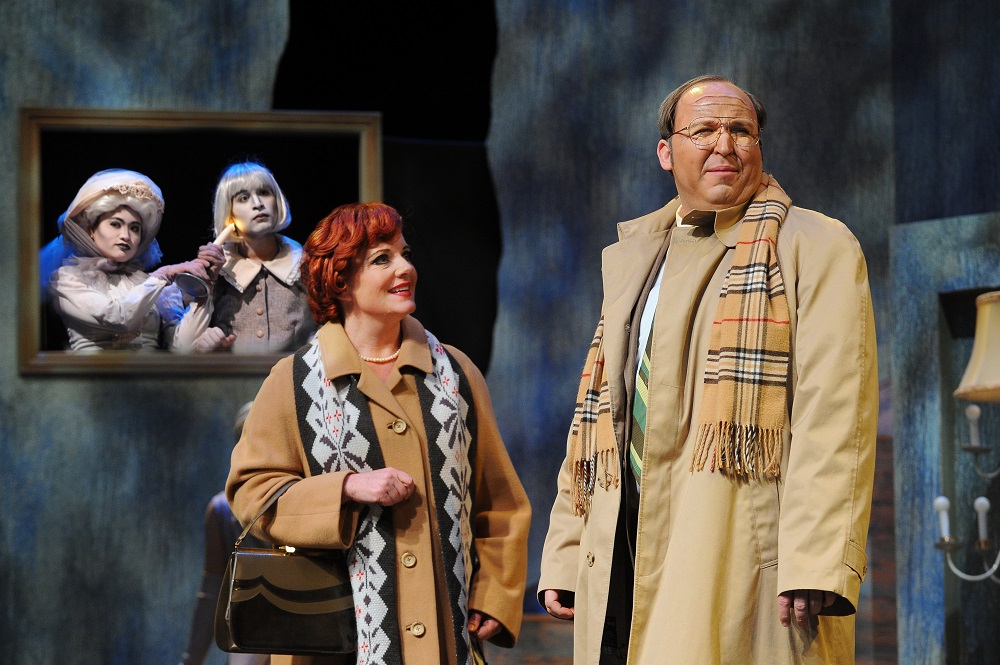
Palo Alto Players’ The Addams Family – l-r: Danielle Mendoza (Ancestor), Shahil Patel (Ancestor), Jen Wheatonfox (Alice Beineke), Kennan Blehm (Mal Beineke)


Doug Santana as Gomez Addams and Betsy Kruse Craig as Morticia Addams are perfect for each other with excellent comic timing and adequate voices to hold the appropriately disjointed story line in check. Their final song and dance romp before the curtain call is eye-popping, but they have to share accolades with David Murphy who blossoms from the quiet tall jack-of-all trades as Lurch to a whirlwind basso just before and during curtain call.

The running time of 2 hours and 30 minutes with an intermission is a bit too long but well worth a visit to the Lucie Stern Theatre.

CAST: Gomez Addams, Doug Santana; Morticia Addams, Betsy Kruse Craig; Uncle Fester, Joey McDaniel; Grandma, Linda Piccone; Wednesday Addams, Catherine Gloria; Pugsley Addams, Leo Jergovic; Lurch, David Murphy; Mal Beineke, Kennan Blehm; Alice Beineke, Jen Wheatonfox; Lucas Beineke, Adam Cotugno; Male Ensemble: Juan Castro, Zendrex Llado, Jomar Martinez, Shahil Patel, Michael Saenz. Female Ensemble: Jessica Ellithorpe, Yuliya Eydelnant, Jennifer Gorgulho, Danielle Mendoza.

CREATIVE STAFF: Director/Choreographer: Musical Director: Scenic Designer: Costume Designer: Lighting Designer: Sound Designer: Properties Designer: Hair & Makeup Designer: Stage Manager: Janie Scott Matthew Mattei Ron Gasparinetti Shannon Maxham Carolyn A. Foot Grant Huberty Pat Tyler Shiboune Thill Jeff Grafton.

Kedar K. Adour, MD

Courtesy of www.theatreworldinternetmagazine.com


Fifth of July does not ring true at Aurora Theatre

By Kedar K. Adour

Ken Talley (c. r. Craig Marker*) debates his future with family and friends (l-r, Harold Pierce, John Girot*, Nanci Zoppi*, Oceana Ortiz, Jennifer LeBlanc*, Elizabeth Benedict*) in Aurora’s production ofFifth of July

FIFTH OF JULY: Drama by Lanford Wilson. Directed by Tom Ross. Aurora Theatre Company, 2081 Addison Street, Berkeley, CA. (510) 843-4822 or at www.auroratheatre.org.

April 17 – May 17, 2015

Fifth of July does not ring true at Aurora Theatre. [rating:3]

There are times when theatre brings dramatic impetus to historical events. When Lanford Wilson’s play the Fifth of July hit the stage in 1977-1980 it was close enough to the end of the Vietnam War to be a cogent searing denunciation of a dark era in America’s history. Rather, the play is a taut personal family drama and does not reflect the horrific impact on thousands of Vietnam veterans that are still suffering from the effects of that conflict.

During that war there was a large anti-Vietnam war movement that was part of a larger Counterculture of the 1960s. Now, 40 years since the end of that war and 35 years since the production of Fifth of July the power of the original production has lost its visceral punch.

The action takes place on the afternoon of July Fourth and morning of July fifth in the Town of Lebanon, Missouri. Major characters in the play have been members of the counterculture that was rife with antigovernment rallies and the use of alcohol, marijuana and cocaine. Director Ross has inserted a wild bacchanal prolog in an apparent attempt to etch that era in the minds of the audience. Doing so undermines the charming quiet scene between Kenneth Tally (Craig Marker) and his lover Jed Jenkins (Josh Schell) that opens the play.

The family involved in this play has a last name of Talley and is part of a trilogy that was written non-sequentially beginning with the Pulitzer Prize winner Talley’s Folly (1979) and continues with Talley and Son (1981).  Aurora Theatre is honoring Wilson’s legacy by mounting all three plays. Talley’s Folly is playing to full houses in the in intimate Harry’s UpStage in the Dashow Wing with scheduled staged reading of Talley and Son on the main stage.

It is not necessary to be familiar with the first two parts of the trilogy since the only character from the previous plays who appears in the final play is Sally Friedman nee Aunt Sally. Ken Tally’s older sister June (Jennifer Le Blanc ) has had an out-of-wedlock child, Shirley ( Oceana Ortiz) now 13 years old. John Landis (John Girot) a former close friend/ classmate of Ken has married affluent Gwen (Nanci Zoppi) a wannabe country singer who has inherited and is running  a successful business.  The final character is Gwen’s guitar playing song writer Weston Hurley (Harold Pierce).

Ken has been living on the family estate with botanists Jed who has been planting shrubbery over the past two years to create an English style garden. Ken who has suffered bilateral above the knee amputations has been reluctantly preparing to return to his High School teaching job and has been transcribing the verbal ruminations of a brilliant eccentric friend who has been impaired by the Vietnam War.  The question of selling the family home to John and Gwen who wish to convert it to a recording studio plays a major role in the conflict.

With all the characters in place, and as with every family drama, secrets, hidden animosities and past experiences unfold. Lanford Wilson is a master at setting up the premises and effectively dovetailing their interaction. Humor abounds and by the end of the play there is resolution.

Craig Marker gives a stunning performance and Jed’s love is expressed realistically in Josh Schell’s taut underplayed delivery. Director Ross has allowed the remainder of the cast to give over-the-top delivery of their lines that often times is excessive. It is difficult to develop empathy with Oceana Ortiz, who is actually only13 years old, playing the bratty Shirley. Elizabeth Benedict playing Sally Friedman who has preserved her husband’s ashes in a chocolate box, gives the show much of its humor.

Richard Olmsted’s beautiful interior-exterior set takes up a significant portion of the small three-sided acting area. This limits director Ross’s ability to move his characters about when all eight actors are on stage thus detracting from their interaction. Running time two hours and ten minutes with an intermission.

CAST: Craig Marker, Kenneth Talley Jr.; Josh Schell, Jed Jenkins; John Girot, John Landis; Nanci Zoppi, Gwen Landis; Jennifer Le Blanc, June Talley; Harold Pierce, Weston Hurley; Oceana Ortiz, Shirley Talley; Elizabeth Benedict, Sally Friedman.

ARTIST CREW: Set Designer, Richard Olmsted; Costume Designer, Heidi Leigh Hanson; Lighting Designer, Kurt Landisman; Stage Manager, Susan M. Reamy; Sound Designer, Chris Houston; Properties, Laraine Gurke; Movement/Fight Consultant, Dave Maier.

Kedar K. Adour, MD

Courtesy of www.theatreworldinternetmagazine.com

Ken Talley (c. r. Craig Marker*) debates his future with family and friends (l-r, Harold Pierce, John Girot*, Nanci Zoppi*, Oceana Ortiz, Jennifer LeBlanc*, Elizabeth Benedict*) in Aurora’s production ofFifth of July

Flower children mostly grown up in ‘Fifth of July’

By Judy Richter

In Lanford Wilson’s “Fifth of July,” presented by Aurora Theatre Company, college-age anti-war activists of the ’60s are more grown up.

Now that it’s 1977, much has changed. Ken Talley (Craig Marker) is living in the family home in Lebanon, Mo., with his supportive partner, Jed (Josh Schell), a botanist. Ken has lost both legs in Vietnam but is ambulatory thanks to prostheses. He’s supposed to resume his career teaching English in the local high school, but he’s frightened.

They’re joined by Ken’s single-mom sister, June (Jennifer Le Blanc); her 13-year-old bratty daughter, Shirley (Oceana Ortiz); and their 64-year-old aunt, Sally Friedman (Elizabeth Benedict). Sally is there to scatter the ashes of her late husband, Matt.

The story of their courtship 33 years earlier is told in “Talley’s Folly,” also being presented by Aurora as part of its Talley Trilogy project.

Some unexpected guests are John and Gwen Landis (John Girot and Nanci Zoppi), who were Ken and June’s fellow flower children at Cal. With them is Weston (Harold Pierce) a guitarist who’s involved in developing Gwen’s singing career.

Besides visiting his old friends and hometown, John has another motive. He wants to buy the Talley home and convert it into a recording studio for Gwen, who has fried her brain with drugs and still indulges.

Tensions rise over John’s proposal as well as his desire to have Shirley, who’s apparently his daughter, live with him and Gwen.

During the course of the play, which begins July 4 and continues the next morning, there are satisfying resolutions for the Talleys. Even young Shirley, an annoying drama queen, becomes more tolerable and mature.

Wilson has created some idiosyncratic characters well enacted by the Aurora cast under the direction of artistic director Tom Ross. Marker as Ken has the double challenge of not only developing his character but also walking like an amputee using crutches or a cane. Schell’s Jed is a quiet, scholarly man who keeps a sharp eye out for Ken’s welfare.

As the drug-addled Gwen, Zoppi provides much of the show’s comedy as well as some words of wisdom for Shirley. Pierce’s spacey Weston tells weird stories. The rest of the cast also is notable, especially Le Blanc as June, another character who’s ready to assume a more mature role.

Even though the cast of eight is somewhat large forAurora’s intimate stage, Ross stages the action well on the set designed by Richard Olmsted with lighting by Kurt Landisman and sound by Chris Houston. The ’70s costumes are by Heidi Leigh Hanson.

Despite the specific era, the play has a timelessness because it’s focused on the characters and their evolution.

“Fifth of July” will continue at Aurora Theatre Company, 2081 Addison St., Berkeley, through May 17. For tickets and information, call (510) 843-4822 or visit www.auroratheatre.org.


Focus on immigrants evokes tears, laughs at A.C.T.

By Woody Weingarten

[Woody’s [rating: 5]

Alfred (Carl Lumbly) and his live-in caregiver, Maria (Greta Wohlrabe), share a moment of sheer joy in “Let There Be Love.” Photo by Kevin Berne

Donnetta Lavinia Grays portrays an angry lesbian daughter, Gemma, in “Let There Be Love.” Photo by Kevin Berne.

As I left the American Conservatory Theatre’s “Let There Be Love,” I noticed an unusual number of men dabbing tears from their eyes with hankies.

Some openly.

But most, a bit embarrassed, swiped surreptitiously. Or prayed no one would witness their glistening cheeks.

Earlier, I’d seen the same guys rolling with laughter.

Stirring work by three actors and inspired writing by British playwright Kwame Kwei-Armah are the reasons why.

And classic jazz recorded by singer-pianist Nat King Cole — juxtaposed with smile-inducing moments triggered by Madonna’s “Like a Virgin” and calypso champion Lord Invader — becomes the superglue that binds characters in the new A.C.T. comic family drama in San Francisco.

Cole’s lyrics particularly enhance the action at critical moments.

The setting — including intentionally mismatched wallpaper — is a contemporary London home that’s grown a tad shabby.

From neglect.

Attention is paid only a wood cabinet-enclosed gramophone that Alfred (an ill-tempered, seriously sick West Indian elder who emigrated to England four decades before) lovingly calls Lily.

Plus an oversized globe that houses a well-stocked liquor bar.

Alfred, in a masterfully sensitive yet nuanced performance by Carl Lumbly, has antagonized his estranged wife and both of his daughters — including Janet, the absent “born-again nut” and mother of his mixed-race grandson, and Gemma, the present but unhappy lesbian (played with appropriate anger by Donnetta Lavinia Grays).

The former goatherd and hospital porter regrets his distancing actions but feels powerless to fix what occurred long ago.

Enter Maria, a young, boyfriend-abused Polish immigrant who becomes Alfred’s caregiver, confidant, nurse, cook, friend and surrogate daughter.

Greta Wohlrabe, whose elastic face runs an expressive gamut that’s never unconvincing or mawkish, is impeccable in that demanding role.

Her solo dancing spurts are highlights, too.

Director Maria Mileaf — differing from most plays staged in the Bay Area (and anywhere else, in fact) — makes sure there are no slack spots in “Let There Be Love.”

No lagging whatsoever. No watch checking.

And no dropped accents.

Alfred isn’t above dropping an occasional f-bomb, though. The word, he insists, “brings a wonderful clarity to my…sentences.”

The play manages to cover a lot of ground in two hours: racial bitterness, social change, end-of-life dignity, redemption — and trips to both the local Ikea and faraway Granada.

While the first act of “Let There Be Love” offers mostly laughs, the second switches into a touchstone of courage and forgiveness.

The climax of the play, which I felt was now and then a bit too pat, is astoundingly sentimental.

But it’s also astoundingly poignant, the very definition of moving.

Which explains why the hankies came out.

Including mine.

“Let There Be Love” plays at the American Conservatory Theater, 415 Geary St., San Francisco, through May 2. Night performances: 8 p.m. Tuesdays through Saturdays. Matinees: 2 p.m. Wednesdays, Saturdays and Sundays. Tickets: $20 to $85. Information: 1-415-749-2228 or www.act-sf.org

Contact Woody Weingarten at voodee@sbcglobal.net or check out his blog at www.vitalitypress.com

Acting works in Marin, but play and humor don’t

By Woody Weingarten

[Woody’s [rating: 1]

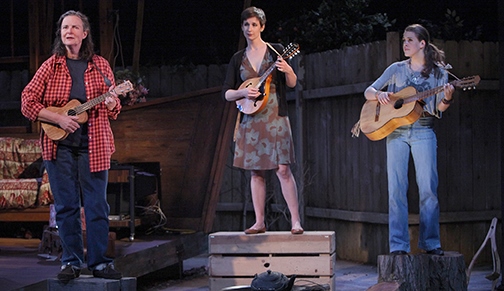
Starring in “The Way West” are (from left) Anne Darragh (as mom), Kathryn Zdan (Manda) and Rosie Hallett (Meesh). Photo by Ed Smith.

Mom’s body and world are in a race to see which will break down first.

Even her garage is collapsing.

But armed with Paul Bunyanesque tall tales of the American frontier, a ukulele and an endless supply of cockeyed optimism, she’s hell-bent on retaining her pioneer spirit.

Unfortunately, it doesn’t work.

Nor does the play in which she’s the main character — the Marin Theatre Company’s “The Way West,” which is meant to be a whimsical but serious look at how a Central Valley family of three copes with the Great Recession.

A lot within the production does work, I concede.

The three main actors — Anne Darragh as mom, Kathryn Zdan as her older daughter, Manda, and Rosie Hallett as the younger, Meesh — are first-rate.

Costuming, set and sound all provide ideal trappings, and director Hayley Finn succeeds in keeping the play hurrying toward its abrupt end.

But original songs by Sam Misner and Meghan Pearl Smith don’t add much beyond a copycat Woody Guthrie folky flavor of the Old West — even though the three principals passably strum and sing.

A terminally shallow script by award-winning playwright Mona Mansour is the main stumbling block.

It attempts to tackle serious topics of financial ruin and homelessness and familial relationships but glosses over them with exaggerated, clichéd situations and forced humor.

“The Way West” is the third play on which the MTC has bestowed its Sky Cooper New American Play Prize. First came Bill Cain’s “9 Circles,” which I called “multi-faceted” and “dazzling.” Next was “The Whale,” which I found “touching.”

I suppose that, as the platitude goes, two out of three ain’t bad.

In “The Way West,” a 62-year-old mother has filed for bankruptcy and isn’t doing well physically. Yet she still stares through rose-colored glasses and embellishes already hard to swallow western mythology.

And hopes her daughters will follow her lead.

The kids, however, also are screwed up — and in deep emotional and fiscal trouble.

Mandy has overextended her credit cards and endangered her job back East by overlooking an obscene typo. Meesh has run into a legal hassle peddling stuff online.

“I always try,” Mansour has been quoted as saying, “to be equal opportunity about how messed up the characters are.”

She does accomplish that in “The Way West.”

But messes up the play in the process.

To be fair, the opening night audience laughed often, and a good deal more than I did.

I found most of the humor juvenile — including dialogue that demanded intentional overacting, and including satirical, melodramatic signs that resembled silent movie title cards.

“We are all in this together — and it’s not good,” one proclaimed.

To me, the line might also apply to performers and audience.

Toward the climax of the play, which at times crosses the fine line between clever and insipid, one character says, “Talking creates hysteria.”

The playwright creates stylized onstage hysteria, however, by having her inventions talk incomprehensively over each other — and panic because of a living room fire.

Having just published a book, I fully recognize what tremendous effort and perseverance goes into completing any creative effort, so I’m hesitant to pan any artist — especially a writer.

Sometimes, though, benevolence must give way to conscientiousness.

This is one of those times.

The Way West” plays at the Marin Theatre Company, 397 Miller Ave., Mill Valley, through May 10. Night performances, 7:30 p.m. Wednesdays; 7 p.m. Sundays; 8 p.m. Tuesdays and Thursdays through Saturdays. Matinees, 1 p.m. Thursdays; 2 p.m. Saturdays and Sundays. Tickets: $10 to $53. Information: (415) 388-5208 or marintheatre.org.

Contact Woody Weingarten at voodee@sbcglobal.net or http://vitalitypress.com

Berkeley drama swings from plodding to powerful

By Woody Weingarten

[Woody’s [rating: 4]

Shelah (Cheryl Lynn Bruce) tests her faith as Creaker (Michael A. Shepperd) looks on in “Head of Passes.” Photo courtesy of kevinberne.com

When “Head of Passes” ended, a stunned audience forgot to clap for a few seconds.

Thunderous applause then filled the void.

And the crowd silently shuffled from the Thrust Stage of the Berkeley Rep, struggling to decrypt mentally what it just experienced.

“Head of Passes” is a play on many levels — an epic about loss and an African American family in the marshlands of southern Louisiana, certainly — but mostly it’s about faith.

And after a first act that ground exceedingly slow, I could intensely feel playwright Tarell Alvin McCraney’s power in the second — his power to enthrall, to confuse, to evoke long discussions afterward.

My wife and I dissected it for a full hour on the way home.

To no conclusion.

Or accord.

The allegorical, mostly tragic drama bursts with homages to the biblical tale of Job.

But the modernized lightning rod for good and evil is Shelah Reynolds, a widow so pious she can’t stand even hearing the phrase deviled eggs.

She’s seriously ill, coughing up blood.

An increasingly dense storm threatens her home, outside and in, and a metaphorical tempest imperils her family on the eve of her birthday.

A remarkable Cheryl Lynn Bruce plays Shelah with alternating disorder and control, making the central role even more her own than when Chicago’s Steppenwolf Theatre Company first produced the play in 2013.

McCraney’s reworked other parts of “Head of Passes” as well, declaring in a Berkeley Rep magazine interview that it’s gotten “deeper and more focused.”

Shelah’s sermonettes to her family and herself gradually build to a soliloquy-crescendo in a tirade to God about life and sin.

Her patience and her rage become the hues on a canvas splashed with semi-madness, muddle and, finally, clarity.

The gifted cast adds many textures.

Francois Battiste and Brian Tyree Henry ably support Bruce as Shelah’s adult sons, garrulous Aubrey and lethargic Spencer.

And Nikkole Salter brings her drug-addicted half-daughter, Cookie, to life.

But I dare not omit any actor because each does well in a play in which family relations are cavernous, complicated and chaotic.

That includes Michael A. Shepperd as Creaker, a giant-sized employee responsible for much of the play’s sparse but welcome humor; Kimberly Scott as Mae, a bouncy friend; Jonathan Burke as Creaker’s indecisive son, Crier; and James Carpenter, as Shelah’s dispirited healer, Dr. Anderson.

Finally, a buff angel only Shelah can see hangs around, tolerantly watching and waiting for her to strip away her wig, outer garments, character armor and lies.

Sullivan Jones portrays him as embodied with both menace and hope.

Despite McCraney’s talent and the skill of the players, G.W. Skip Mercier’s set almost overpowers everything. It comes apart on cue, ostensibly destroyed by the deluge, with parts of the stage incrementally becoming a moat-like riverbank.

It’s the most memorable stagecraft I’ve seen in decades, as imaginative as the falling chandelier of “Phantom.”

Longtime McCraney collaborator Tina Landau directed “Head of Passes,” which refers to the tri-forked marshlands where the Mississippi joins the Gulf of Mexico.

She’d been with McCraney at Steppenwolf, too, so the pair has shaped the play from its genesis.

The playwright, Bay Area theatergoers may remember, created the Brothers/Sisters Plays, a trilogy performed at the Marin Theatre Company, the Magic Theatre and the American Conservative Theater.

For me, “Head of Passes” brings to mind, at once, the Old Testament, Kafka and Shakespeare.

Inspired antecedents, indeed.

And powerful.

“Head of Passes” plays at the Berkeley Rep’s Thrust Stage, 2025 Addison St., Berkeley, through May 24. Night performances, 8 p.m. Tuesdays and Thursdays through Saturdays, 7 p.m. Wednesdays and Sundays. Matinees, 2 p.m. Thursdays, Saturdays and Sundays. Tickets: $14.50 to $79, subject to change. Information: (510) 647-2949 www.berkeleyrep.org

Contact Woody Weingarten at voodee@sbcglobal.net or check out his website at http://vitalitypress.com

Floral exhibit enriches paintings, sculpture at de Young

By Woody Weingarten

[Woody’s [rating: 4.5]

Picasso’s “Still Life with Skull, Leeks and Pitcher” hangs on de Young Museum wall. In foreground is “Bouquets to Art” impression of it by Hunter-Lee Flowers. Photo: Woody Weingarten

Life imitating art? “Lady in Black with Spanish Scarf,” by Robert Henri, is simulated by a Plumweed Floral and Event Design construction. Photo: Woody Weingarten.

I was afraid I wouldn’t like it.

I’ve been going to the de Young Museum’s “Bouquets to Art” for so many years I thought I might be too jaded.

I wasn’t.

What I’d forgotten was that not only is each year’s floral art exhibit different by its very nature, trends spawn even greater changes.

The first time — when my wife had to drag skeptical me there because I was pre-positive it would be neither art nor good — I was totally blown away by how outstanding, how unique, the floral arrangements were.

Oh, how those designs enhanced and enriched the museum’s permanent collection.

That year, as the several before when my wife had gone alone, displays consisted basically of flowers, flowers and more flowers.

And green leaves.

A gadzillion varieties of flora to simulate the paintings and sculptures in front of which they rested.

Not many non-living materials.

Not many foundations.

Not many structures.

But inch by inch, year by year, like osmosis, those elements slipped in.

So it shouldn’t have surprised me that his year’s four-day displays were more structural than ever.

It turns out that that wasn’t a bad thing at all. It just meant more elaborate designs.

More — and more elaborate — eye candy.

And visceral joy.

Such as the Hunter-Lee Flowers’ impression of Picasso’s “Still Life with Skull, Leeks and Pitcher.”

Floral artist Valerie Lee Ow, marking her 16th year as a participant in “Bouquets to Art,” refreshes some flowers in her design (which sits in front of “Rhapsody” by Richard Mayhew). Photo: Woody Weingarten.

Floral peacock created by Natasha’s Designs stands in front of “The Flora and Fauna of the Pacific” by Miguel Covarrubias. Photo: Woody Weingarten

Or life imitating art as a Plumweed Floral and Event Design construction simulated “Lady in Black with Spanish Scarf” by Robert Henri.

The bigger and better designs weren’t limited to displays favoring intricacy or heavy foundations, though.

Consider, for instance, the enormous, chock-full-o’-color bouquet by floral artist Valerie Lee Ow, who was celebrating her 16th year as a participant in “Bouquets to Art.”

It sat in front of “Rhapsody” by Richard Mayhew and, in fact, seemed to overpower it.

Want something a bit whimsical yet still colorful? The answer could be found in a floral peacock created by Natasha’s Designs in front of “The Flora and Fauna of the Pacific” by Miguel Covarrubias.

All in all, the evolved, more complex displays somehow helped my wife and me enjoy the show more than ever.

We can’t wait for next year.

Top billing at the de Young, 50 Hagiwara Tea Garden Drive at John F. Kennedy Drive, in San Francisco’s Golden Gate Park, now goes to the “Botticelli to Braque” exhibit, which displays masterpieces from the national galleries of Scotland through May 31, and “Richard Diebenkorn Prints,” which will run through Oct. 4. Information: 1-415-750-3504 or contact@famsf.org.

Contact Woody Weingarten at voodee@sbcglobal.net or check out his blog at www.vitalitypress.com

Alvin Ailey dance troupe still spiritually exciting

By Woody Weingarten

[Woody’s [rating: 4.5]

Alvin Ailey American Dance Theater members recreate “Revelations.” Photo by Christopher Duggan.

Seven males in Alvin Ailey American Dance Theater execute “Uprising.” Photo by Paul Kolnik.

Alvin Ailey American Dance Theater members do “Suspended Women.” Photo by Paul Kolnik.

I first saw Alvin Ailey’s choreography when I lived in New York City in 1960.

That was two years after he’d founded his troupe, one year after I’d returned from post-undergrad stints in Mexico and Hollywood — a time for both of us to be experimenting with innovation.

I embarked on a lifelong career as a journalist. He pursued his dream of coupling traditional African-American culture with modern dance.

And he drew upon his memories of his Baptist church upbringing in Texas, integrating traditional spirituals, gospel and blues in his legendary work, “Revelations.”

Now, 55 years later, the Alvin Ailey American Dance Theater’s still performing that ballet, still celebrating spiritual exuberance.

When I saw the Cal Performances offering at Zellerbach Hall the other night, it was as captivating, as viscerally exciting as ever.

Maybe more so.

I couldn’t help notice it’s aged without a wrinkle.

Two other reprises were equally compelling — the percussive “Uprising,” by Israeli-born Hofesh Shechter and Vex’d, performed with surging testosterone by seven male dancers, and “After the Rain,” a pas de deux by Christopher Wheeldon that gracefully enhances music by Arvo Pärt.

“Suspended Women” by Jacqulyn Buglisi, danced to music by Ravel, seemed flimsy by comparison with the others — almost like watching 14 ballerinas twirling atop a music box.

“Uprising” was intensity incarnate.

It featured mock wrestling, macho slapping and punching, with guys appearing and disappearing into a shadowy mist.

Riveting.

I found it impossible to look away.

But “Revelations” was the most fun to watch.

The “Wade in the Water” sequence was exceptionally eye-catching, with all its costuming and props white except for one blue sheet-like material that seamlessly simulated waves.

Most rousing were the portions devoted to the familiar — “Sinner Man” and “Rocka My Soul in the Bosom of Abraham.”

The traveling troupe’s performances run only through April 26. But if you can make it, do.

In my book, it’s the best dance troupe extant.

A few folks must agree.

The multi-racial New York City-based company has performed before 25 million people in 48 states, 71 countries and on six continents.

Ailey created 79 ballets for the troupe but long wanted it to include works of others.

It has.

More than 235 pieces by more than 90 choreographers now help constitute a repertoire for the company, which after Ailey’s death in 1989 was helmed first by Judith Jamison and now Robert Battle.

Both would have made him proud.

Upcoming Cal Performances dance dates include “Cinderella,” by the Marlinsky Ballet and Orchestra, Oct. 1-4; and Twyla Tharp’s 50th anniversary tour, Oct. 16-18. Information: www.calperfs.berkeley.edu/ or (510) 642-9988.

Contact Woody Weingarten at voodee@sbcglobal.net or at www.vitalitypress.com/

‘The Way West’ loses its way

By Judy Richter

In one way, “The Way West” is about the indomitable spirit that drove pioneers ever westward despite near-insurmountable odds.

In another way? Mona Mansour’s play, presented by Marin Theatre Company doesn’t seem sure where it wants to go.

It’s set in Central California, probably in StocktonorModesto during the recent recession. Mom (Anne Darragh) wants to declare bankruptcy after ignoring unpaid bills. The 62-year-old is also ignoring potentially serious health issues.

Her older daughter, Manda (Kathryn Zdan), is visiting from Chicago to try to organize Mom’s finances. She’s more or less assisted by her sister, Meesh (Rosie Hallett), who is living with Mom and whose finances are shaky, too.

Manda seems fairly OK financially, thinking nothing of paying $150 for a haircut, but she’s heavily reliant on credit cards.

One bit of bad news after another leaves the three women destitute, unable to pay even for a pizza delivery. Nevertheless, Mom remains relentlessly upbeat.

Stressing the pioneer theme, many scenes begin with a Mom monologue telling the story of some pioneer adventure that usually ends badly. Sometimes her daughters join her in song (music and musical direction by Sam Misner and Megan Pearl Smith).

What’s confounding is that no one does anything about Mom’s health issues. A possible rekindling of the romance between Manda and former boyfriend Luis (Hugo E. Carbajal) is left hanging. Some situations seem to come from theater of the absurd.

For example, a family friend, Tress (Stacy Ross), has invested thousands of Mom’s and her own money in a get-rich-quick, get-thin-quick scheme that’s nothing short of ludicrous.

Despite holes in the script, the production directed by Hayley Finn keeps moving thanks to outstanding performances, especially by Darragh as Mom and by Ross, who is underused but brilliant as Tress.

The set by Geoffrey M. Curley (lit by Masha Tsimring) captures Mom’s disorganization while evoking the pioneer theme with overhead arches reminiscent of a covered wagon. Costumes are by Christine Crook with sound by Brendan Aanes.

The two-act play runs about two hours with one intermission. Despite its basic premise and a fine cast, it goes too many different ways to be satisfying.

“The Way West” continues through May 10 at Marin Theatre Company, 397 Miller Ave., MillValley. For tickets and information, call (415) 388-5208 or visit www.marintheaatre.org.