Astonishing aspects in ‘Head of Passes’ at Berkeley Rep

By Judy Richter

People who live in the southernmost part of Louisiana have a precarious existence as three passages of the Mississippi River create swamps and cause the land to shift constantly.

Nevertheless, Shelah Reynolds (Cheryl Lynn Bruce), a longtime black resident, clings to her home even as it and her life literally and figuratively begin crashing in on her in “Head of Passes,” presented by Berkeley Repertory Theatre.

Tarell Alvin McCraney named his play after this coastal area, which often experiences severe storms and hurricanes.

“Head of Passes” takes place during a heavy rainstorm as Shelah’s family and friends gather to celebrate her birthday. The party was arranged by her sons, Aubrey (Francois Battiste) and Spencer (Brian Tyree Henry). Joining them are old friends Mae (Kimberly Scott) and Creaker (Michael A. Shepperd), along with Creaker’s teenage son, Crier (Jonathan Burke). Their good-natured banter reflects their long friendships as well as their love for Shelah.

Her stepdaughter, the edgy, troubled Cookie (Nikkole Salter), makes a brief appearance before rushing off.

A surprise guest is her white physician, Dr. Anderson (James Carpenter). He’s the only one who knows she’s seriously ill, but she wants to be the one to tell the others.

The only other character is the Angel (Sullivan Jones), whom only Shelah can see because he’s the angel of death. He, like the other actors, does well in a challenging role.

Symbolically, the living room sprouts one leak after another as more is revealed about Shelah’s situation. Much of the house collapses at the end of Act 1.

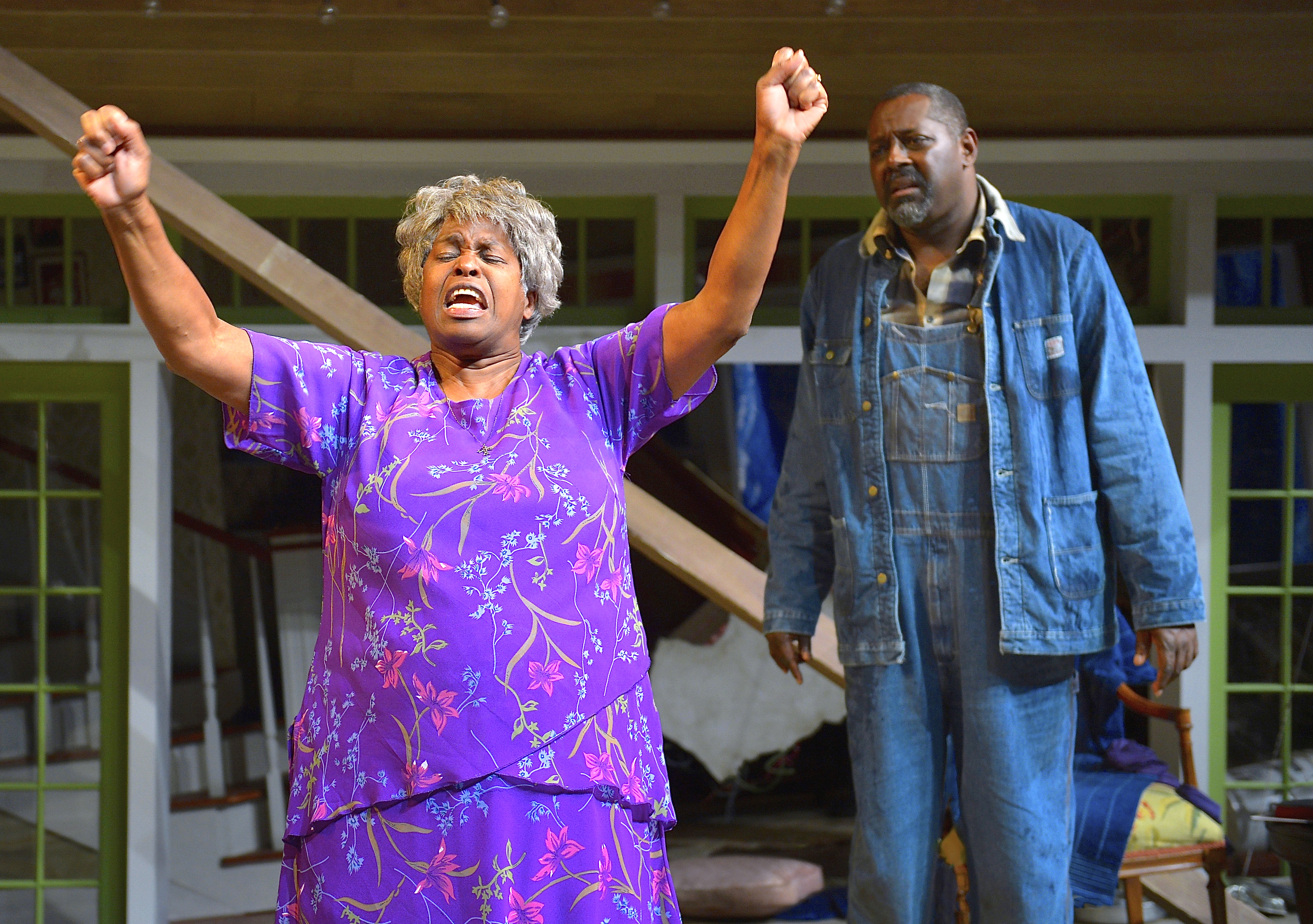
Act 2 begins the next morning, when Shelah’s friends arrive and deliver one piece of tragic news after another. After she orders them to leave, she launches into a lengthy prayer-monologue bewailing her sorrows and regrets.

It’s an astonishing performance that holds the audience rapt. Under Tina Landau’s direction, Bruce paces this scene well, building Shelah’s lamentations, then easing off before going too far.

Also astonishing is the set designed by G.W. Skip Mercier and built by a Berkeley Rep crew that had to incorporate not only water but also beams and other structural elements that could collapse without injuring anyone.

Credit for the other designs goes to Scott Zielinski for lighting, Rob Milburn and Michael Bodeen for sound and Toni-Leslie James for costumes.

Running about two hours with one intermission, “Head of Passes” is the work of a most promising young playwright and an engrossing theatrical experience.

It runs through May 24 on Berkeley Rep’s Thrust Stage, 2025 Addison St., Berkeley. For tickets and information, call (510- 647-2949 or visit www.berkeleyrep.org.


Love brightens life in ‘Let There Be Love’ at ACT

By Judy Richter

A sick, bitter old black man has one last love in life, Lillie, his radiogram, or combination radio and record player, on which he plays Nat King Cole records.

Otherwise, Alfred (Carl Lumbly) is estranged from everything and everyone in Kwame Kwei-Armah’s “Let There Be Love,” presented by American Conservatory Theater. His life begins to change for the better when his two adult daughters arrange for a young home health aide, Maria (Greta Wohlrabe), to look in on him and try to help him.

Like Alfred, Maria is an immigrant. She recently arrived  in London from Poland, while he emigrated from the West Indies several decades earlier. Among the people he dislikes are immigrants who arrived later than he. Therefore, he doesn’t take kindly to this white woman at first, but her persistence and genuine interest in him break the ice.

Alfred has a prickly relationship with his younger daughter, Gemma (Donnetta Lavinia Grays). He’s downright nasty to her, and she reciprocates. She becomes even more angry with him when he allows Maria to move into his home after learning that her unfaithful boyfriend abuses her.

As Alfred’s health continues to deteriorate, Maria engineers a plan that allows him to reconnect with his roots, apologize to his ex-wife and reconcile with Gemma while finding renewed energy and a more optimistic outlook.

Playwright Kwei-Armah raises thorny issues like racism, family relations, medical care, homophobia and death with dignity while also creating three believable characters.

As directed by Maria Mileaf, all three actors successfully navigate their characters’ emotional journeys. Lumbly is especially effective as Alfred.

Lighting by Russell H. Champa reflects Alfred’s changing outlook and Maria’s influence as his living room (set by Daniel Ostling) becomes progressively brighter. Costumes by Lydia Tanji and sound by Bart Fasbender add to the ambience. The choreography is by Stephen Buescher.

Taking place in the present, the two-act play runs about two hours with one intermission. It’s a challenging yet rewarding experience.

“Let There Be Love” runs through May 3 at ACT’s Geary Theater, 415 Geary St., San Francisco. For tickets and information, call (415) 749-2228 or visit www.act-sf.org.

Max Understood explores Autism in musical drama

By Kedar K. Adour

MAX UNDERSTOOD: Musical Drama. Book by Nancy Carlin. Music by Michael Rasbury. Lyrics by Nancy Carlin & Michael Rasbury. Directed by David Schweizer. The Paul Dresher Ensemble, in co-production with Fort Mason Center @ Fort Mason Center, Cowell Theater , San Francisco.

April 15 – April 26, 2015 Max Understood explores Autism in musical drama [rating:2]

Theatre functions on many levels other than to entertain. At times it is designed to forward social and political agenda (agitprop) and often to dramatize medical/psychological disabilities. Three striking examples of the latter include Larry Kramer’s The Normal Heart and Tony Kushner’s Angels in America (HIV), the musical Next to Normal  by Brian Yorkey and Tom Kitt (Bipolar Disease) and most recently The Curious Incident of the Dog in the Night-Time Simon Stephens’ adaptation of the novel with the same name (Asperger’s Disease).

The classification of Asperger’s disease has been removed from our medical lexicon and it is now listed as a degree  of Autism Spectrum Disorder (ASD) that now affects one in 68 individuals. To disseminate knowledge and unify research/treatment, April has been designated as ASD Awareness month and Max Understood is the latest “disability drama” with the major character a seven year old autistic boy named Max (Jonah Broscow).

The concept for this musical play had its beginning seven years ago and has had three workshop productions including a re-tooling at the Eugene O’Neill National Music Theater Conference in 2008 and an Off-Broadway outing in 2009. The present production is labelled as its world premiere co-produced by the Paul Dresher Ensemble, Fort Mason Center and the Behavioral Intervention for Autism group. Coinciding with this two week run is an installation of “Sound Maze for Max” at an adjacent venue.

Three of the major symptoms of autism are non-verbal relationship with people, repetitive physical activity and peculiar toy habits. These signs of ASD are dramatically, non-verbally portrayed in the opening scenes with Max standing against a white wall with his favorite toy, a Pegasus doll, performing continuous hand motions before his frustrating lack of interaction with his Mom (Elisa Youssef) and Dad (Teddy Spencer) are conveyed in song.

After these initial forays into characterization of the family unit, he leaves the protective mantle of home/family and Max’s foray into the outside world begins. First up are a group of unfriendly children before he is rescued by Munc (Jackson Davis) a working class gardener/philosopher with a leaf-blower. Munc’s introduction on the stage is a highlight of spectacular use of projections, lights and sound.

The play is handsomely mounted with a rotating steeply raked geometric elevated central stage used effectively for the scene changes that are taking place  in actual time and in the phantasy of Max’s mind.

Pictured (l to r) Hayley Lovgren and Jonah Broscow; Max helps Pegasus hang out the laundry and fly. Photo: Mark Palmer

Two of those phantasies include a live Pegasus and a mermaid, both bathed in beautifully orchestrated light and music. All the action is interspersed with Mom and Dad circling the revolving platform searching for Max who is unable to respond to their calls and his non-verbal the interaction  with the outside world continues.

The eleven year old fifth grader Jonah Broscow has a show stopper with his recitation of all the U.S. Presidents during his foray with the dumpster diving Albert (Jeremy Kahn) who nails the rap song “Rushed Up” with a projection of Mount Rushmore on center stage.

Pictured (l to r) Teddy Spencer, Hayley Lovgren, Jonah Broscow, Jeremy Kahn, Elise Youssef, Alyssa Rhoney; Abercrombie models/Presidents of the US get “Rushed Up” Photo: Mark Palmer

With the exception of the two mentioned songs the eclectic music is non-memorable but the actors put their hearts into their roles and the direction by David Schweizer is admirable. Running time is 75 minutes without intermission.

CAST:  Elise Youssef as Mom, Teddy Spencer as Dad, Jonah Broscow as Max, with Jeremy Kahn as Albert, Alyssa Rhoney as Fin, Jackson Davis as Munc and Hayley Lovgren as Peg.

CREATIVE STAFF: Direction by David Schweizer; Music director Jennifer Reason; Scenic design by Alexander V. Nichols; Lighting design by David Robertson; Projection design by Alexander V. Nichols and Micah J. Stieglitz; Costume design by Beaver Bauer and  Deborah M. Bauer; Choreography by Mary Beth Cavanaugh; Sound design by The Norman Conquest; Stage management Kevin Johnson.

Kedar K. Adour, MD

Courtesy of www.theatreworldinternetmagazine.com.

Pictured (l to r) Hayley Lovgren and Jonah Broscow; Max helps Pegasus hang out the laundry and fly. Photo: Mark Palmer

Pictured (l to r) Teddy Spencer, Hayley Lovgren, Jonah Broscow, Jeremy Kahn, Elise Youssef, Alyssa Rhoney; Abercrombie models/Presidents of the US get “Rushed Up” Photo: Mark Palmer

LET THERE BE LOVE a ‘must see’ show at A.C.T.

By Kedar K. Adour

Carl Lumbly as Alfred, a cantankerous and aging West Indian immigrant, in Kwame Kwei-Armah’s intimate family drama, Let There Be Love, playing at A.C.T.’s Geary Theater through May 3, 2015. Photo by Kevin Berne.

Let There Be Love: Family Drama by Kwame Kwei-Armah. Directed by Maria Mileaf. American Conservatory (A.C.T.)Theater, 415 Geary St., S.F. (415) 749-2228 or www.act-sf.org. April 15 – May 3, 2015

LET THERE BE LOVE a ‘must see’ show at A.C.T. [Rating:5]

In 1957 Britain’s Arnold Wesker (now Sir Arnold) wrote a play titled The Kitchen that gave birth to the term “kitchen sink drama.” That spawned a myriad of plays of that genre that slowly lost favor with playwrights and today it is difficult to find such well written plays with classical beginning, middle and end (dénouement). Woven into the structure of Wesker’s plays are themes of self-discovery, love, confrontation of death and social/political disillusionment.  British born playwright Kwame Kwei-Armah can doff Wesker’s mantle with his latest play Let There Be Love receiving standing ovation production at the American Conservative Theatre (A.C.T.).

Just as Wesker’s kitchen plays unfolded in his world at the time they were written, so does Kwei-Armah’s Let There Be Love. The time is ‘Now’ and the place is London. There are two protagonists. The aging black Alfred (Carl Lumbly  who arrived in London in 1963 from his native Grenada and young white Marie (Greta Wohirabe) a part-time care giver newly arrived from Poland. Both have emigrated to seek a better life. A third character is Gemma (Donnetta Lavinia Grays) Alfred’s disenfranchised 35 year old daughter who refuses to be a sounding board, often responding with vitriol, to the irascible Alfred who has as undefined medical illness.

All the action takes place in the living room of Alfred’s home within a time frame of several months. The sparks between Alfred and Gemma explode in the first scene when he learns that his daughters have arranged for a caretaker to look in on him a few hours a week. The unseen daughter has married a white man and he refers to her children as “half-breeds” especially when he is smoking marijuana. This obviously is not conducive to genial family relationships.

With the dramatic entrance of Marie the play builds in well-defined incidents with fits-and-starts between Alfred and Marie ending in a predicable but plausible friendship. Although Alfred has denied Gemma’s request to move in with him, he eventually invites Marie, who is being abused by her boyfriend, to do so and he becomes her mentor and she his confidant.

Woven into the script are the songs of Nat King Cole that are played on a “state of art” radio-record player that were ubiquitous in the 60s. The songs, as well as the gramophone, add a touch of nostalgia as they dove-tail into the storyline when we learn that Alfred has terminal cancer and he is reading a book Final Exit that is a primer on gracefully ending one’s own life.

One could quibble about some inconsistencies in the plot but there is only praise for the tour-de-force acting of Carl Lumbly who has been a mainstay on Bay Area stages for the past few years. In this production his demeanor is a direct opposite of his brilliantly underplayed role in Tree at SF Playhouse.  Greta Wohirabe’s debut at A.C.T. is memorable. The Bay Area and beyond will have the pleasure of seeing her in multiple venues this coming summer. Donnetta Lavinia Grays as Gemma is a dynamic force in her confrontations with the vitriolic Alfred.

Maria Mileaf’s direction appropriately varies the pace keeping all the parts in balance including moving Lumbly around in a wheel chair. Running time is two hours and 10 minutes. Highly recommended. CAST: Carl Lumbly, Donnetta Lavinia Grays and Greta Wohirabe

CREATIVE TEAM: Maria Mileaf (director); Dan Ostling (set design); Russell Champa (lighting design); Lydia Tanji (costume design); Bart Fasbender (sound design).

Kedar K. Adour, MD Courtesy of www.theatreworldinternetmagazine.com  


Carl Lumbly as Alfred, a cantankerous and aging West Indian immigrant, in Kwame Kwei-Armah’s intimate family drama, Let There Be Love, playing at A.C.T.’s Geary Theater through May 3, 2015. Photo by Kevin Berne.

Antigonick ‘spellbinds’ the audience at Shotgun Players

By Kedar K. Adour

Foreground Left to Right: Parker Murphy as Nick and Rami Margron* as Antigone. Background: Kevin Clarke* as Kreon, David Sinaiko as The Chorus

ANTIGONICK: A translation of Sophokles’ Antigone by Anne Carson. Co-directed by Mark Jackson & Hope Mohr. Shotgun Players, Ashby Stage, 1901 Ashby Ave., Berkeley. (510) 841-6500. www.shotgunplayers.org. EXTENDED to May 3, 2015!

Antigonick ‘spellbinds’ the audience at Shotgun Players. [rating:4]

The multitalented Anne Carson (world-class poet, classicist and MacArthur “genius” fellowship winner) in 2012 wrote a new truncated translation of the Greek masterpiece “Antigone.” With her collaborator Robert Currie they published a beautiful book on hand-inked pages with impressionistic drawings by Bianca Stone. The Shotgun Players under the guidance of the ever inventive director Mark Jackson have used that book (script) to mount the present version exploding on the Ashby Stage. Jackson shares the accolades with co-director Hope Mohr who choreographed the play creating stunning dance movements that are integral to and expand the text.

The words are exiguous but as delivered by a superlative cast carries more meaning than reams of text. After a very raucous introduction by Antigone (Rami Margron) and her sister Ismene (Monique Jenkinson) outlining the basic conflict within the play the Chorus of old Theban men compressed into one portrayed by the superlative David Sinaiko begins his commentary on the action.

Antigone is engaged to marry Haimon (Kenny Toll) the son of Kreon (Kevin Clarke) the King of Thebes. Antigone and Ismene’s two brothers have slain each other fighting on opposite sides of the conflict for control of Thebes. Kreon believes that one brother is a traitor and refuses to bury him. Antigone convinces Ismene that it is familial duty to bury their brother. Thus the conflict between personal duties versus the will of the State is established leading to the inexorable death to members of both families.

Rather than explore the ethical questions ingrained in Sophocles’ play, the author allows each protagonist to express and justify their view points with non-judgmental commentary by the Chorus. It is the powerful modernistic dancing, staging and dramatic music that intensifies the 75 minute tour de force performance piece.

The title of the play is an idiosyncratic conceit by the author who has created a non-speaking part for “Nick” who remains on stage throughout the play and “measures things.” The most obvious measurement is of time . . . as in the “nick of time.” He is dressed in white, using stylistic measured movements that intermingle with actors giving questionable significance to his purpose.

All this plays out on a bare set resembling a curved highly polished wall of a skateboard arena. This may be symbolic of the characters inability to escape the confines of their intellectual and physical entrapment. 

The physicality of the direction by Jackson and Mohr is extremely demanding and all members of the cast perform admirably. However, there are times when that physicality overshadows some very significant dialog. On the Sunday matinee of this performance there was very, very appreciative applause but did not gain a standing ovation.

CAST: Kevin Clarke, Kreon; Monique Jenkinson, Ismene / Eurydike; Rami Margron, Antigone / Teiresias; Parker Murphy, Nick; David Sinaiko, Chorus; Kenny Toll, Haimon / Guard /Messenger; Megan Trout, Understudy for Ismene / Eurydike (Performing March 19 – 21) & Antigone / Teiresias ; Soren Santos, Understudy for Haimon / Guard / Messenger & Nick

PRODUCTION TEAM: Nina Ball, Set Design; Christina Bauer, Production Assistant; Stephanie Buchner, Light Design; Christine Crook, Costume Design; Theodore J.H. Hulsker, Sound Design; Mark Jackson, Co-Director; Anne Kendall, Technical Director; Hope Mohr, Co-Director; Kirsten Royston, Properties Design; Katherine Bickford, Stage Manager.

Kedar K. Adour, MD

Courtesy of www.theatreworldinternetmagazine.com

Foreground Left to Right: Parker Murphy as Nick and Rami Margron* as Antigone. Background: Kevin Clarke* as Kreon, David Sinaiko as The Chorus

New S.F. troupe morphs tortured souls into softer beings

By Woody Weingarten

[Woody’s [rating: 5]

Paul Ulloa (Danny) and Kimberley Roberts (Roberta) star in “Danny and the Deep Blue Sea.” Photo by Sharon Rimando.

“Danny and the Deep Blue Sea” would merit a rave review were the theatrical company decades old.

But it deserves special acclaim because the two-character, two-act drama is Flynn Spirit Productions’ first outing.

Let’s say, six stars out of five.

Paul Ulloa and Charlotte Garwood, who named their new venture after their son, Flynn, have said they “want to bring risk-taking and [emotionally] moving theater to audiences and artists.”

They’ve fully met both prongs of that goal.

From the git-go.

Ulloa gets maximum credit because he effectively doubles as the play’s star, assuming the violence-prone title role opposite Kimberley Roberts’ power as Roberta, a divorced mother tormented by the ever-present image of an ugly sexual encounter with a family member.

Both tattooed characters in their mid-30s are foul-mouthed, angry, father-hating, tortured souls — the epitome of self-loathing.

Both seek compassion and forgiveness.

And both shout a lot — almost eardrum-splittingly — in the 20-minute first act, which is as intense as anything I’ve seen on a Bay Area stage in many a moon.

Playwright John Patrick Shanley and director Estelle Piper turn down the decibel count a notch for Act 2, which is nearly twice as long — and soften the would-be lovers into something approximating likability.

That let me breathe normally again.

And be grateful for experiencing something fresh, crisp and improbably believable in the 48-seat Phoenix Theater, high up in a building just off Union Square in San Francisco.

What had drawn me there was the playwright, John Patrick Shanley, who’d written two other plays I admired, “Doubt” and “Moonstruck.”

It wasn’t the fact that Danny, a possible killer known to his fellow truck drivers as “The Beast,” believes his inner pain (“everything hurts all the time”) will lead to a heart attack, or that unemployed Roberta thinks she’s nuts, desires punishment and fantasizes about being blissful in jail, and has relegated care of her 17-year-old son to her parents.

It wasn’t that either’s desperate craving for tenderness, for happiness, for love, may appear too rapidly.

Or that they both are momentarily naked.

And it certainly wasn’t that the set reminded me of a seedy neighborhood bar in the Bronx where, on my first newspaper job, I’d frequently guzzled tap beer with locals.

In any case, I’m glad I could watch two downtrodden theatrical caterpillars morph into butterflies.

Despite Danny undoubtedly remaining, as Roberta labels him, “a caveman.”

“Danny and the Deep Blue Sea” runs at the Phoenix Theatre, 414 Mason St. (between Geary and Post), Suite 601, San Francisco, through May 3. Night performances, 8 p.m. Fridays and Saturdays. Matinees, 3 p.m. Sundays. Tickets: $30. Information: www.eventbrite.com.  or (510) 843-4822.

Contact Woody Weingarten at voodee@sbcglobal.net or at www.vitalitypress.com

Aurora stages Pulitzer-winning play on Southern bias, conflicts

By Woody Weingarten

[Woody’s [rating: 2.5]

In “Talley’s Folly,” Sally (played by Lauren English) has trouble explaining her past to Matt (Rolf Saxon). Photo by David Allen.

She’s in a dual struggle — to transcend prejudices of her redneck family and to deflect ridiculing of her singsong name, Sally Talle.

He’s in an uphill battle to conquer his fears of remaining an underdog and misfit.

And to neutralize her anxiety about being adversely linked with him.

They’re an unlikely pair of walking wounded, unlikely to triumph over her kin’s biases.

Whether they eventually can is the puzzlement of “Talley’s Folly,” a two-character drama that won a Pulitzer Prize for drama in 1980 and is currently being revived by the Aurora Theatre Company in Berkeley.

I found the new, 97-minute production much like life itself — sometimes electrifying and fast-moving, sometimes sluggish enough to be doze-worthy.

It also made me remember a classic Yogi Berra phrase: It’s déjà vu all over again.

“Talley’s Folly” focuses on circa-World War II differences in religion and class — and on a prickly intimacy achieved through verbal and physical dances of love on the Fourth of July, 1944.

And because it’s replete with a glut of references to barefaced anti-Semitism, it repeatedly jerked me forward to scary 2015 headlines from Europe.

Sally’s family was once one of the two wealthiest in Lebanon, Missouri, a community that happens to be prolific playwright Lanford Wilson’s real hometown.

So the Talleys had severe expectations of her — the gentile princess.

Matt Friedman, a Lithuanian-born Jewish accountant from St. Louis, arrives unexpectedly after a year away — to persuade Sally, a nurse’s aide once fired as a Christian Sunday School teacher, that he loves her and that she should escape with him.

He’s disregarded her not answering his letters.

They verbally fence in her family’s rundown boathouse (the physical folly of the title). They talk and talk and talk, and finally swap secrets (which, in my opinion, dovetail a little too easily).

Insults become part of the mix.

She accuses him, for instance, of not having “the perception God gave lettuce.”

He in turn knocks her family (particularly brother Buddy, who apparently can’t see him as anything but a semi-human outsider/Communist-socialist/traitor).

Lauren English plays Sally with Southern drawl and demeanor intact, opposite Rolf Saxon, who’s utterly convincing as the urbane Matt.

“Talley’s Folly” is a serious play laced sporadically with humor.

Especially funny is Matt’s rambling opening monologue to the audience (which he repeats at breakneck speed).

Imitations of Humphrey Bogart and a repugnant German likewise evoke amusement.

For most of the play, though, Sally and Matt are both awkward, “private people” trapped in their histories and what she might have called their Sunday best.

It’s as if they were pimply teenagers at ages 31 and 42.

And they essentially resemble one of his verbalized thoughts: Because people are like eggs, they must be careful not to bump into each other too hard.

The play was directed by Joy Carlin, a Bay Area theatrical hall-of-famer who portrayed Sally in the 1979 American Conservatory Theater production of “Fifth of July,” the last part of Wilson’s trilogy, which the Aurora will reprise from April 23 through May 17.

Although “Talley’s Folly” — which acts as a prequel within that trilogy — is filled with conflicts, it’s almost action-less.

Which makes Carlin’s task of injecting life nearly impossible.

She actually does amazing well considering the loquacious raw material Wilson provides.

“Talley’s Folly” runs at Harry’s UpStage at the Aurora Theatre, 2081 Addison St., Berkeley, through June 7. Night performances, Tuesdays, 7 p.m.; Wednesdays through Saturdays, 8 p.m. Matinees, Sundays, 2 p.m. Tickets: $30-35. Information: www.auroratheatre.org or (510) 843-4822.

 Contact Woody Weingarten at voodee@sbcglobal.net or at www.vitalitypress.com

The Dawn of Human Culture — Book Review

By Joe Cillo

The Dawn of Human Culture:  A Bold New Theory on what sparked the “Big Bang” of Human Consciousness.  By Richard G.  Klein and Blake Edgar.  New York:  John Wiley & Sons.  2002.


This is the best overview of the archeological perspective on human evolution that I have seen.  I have not seen them all, but I have followed developments in this field for at least forty years.  Reading about the different fossils and different archeological finds and different human ancestors in isolation can be confusing.  It is hard to tell the relationships between one ancient ancestor and another.  It is hard to keep the chronology in mind.  It is not clear what came from what or how and when developments took place.  This book straightens a lot of that out.  It is a clearly written, readable, interesting, well organized presentation, well illustrated with many drawings, charts, and maps that powerfully enhance the text.

The dawn of culture doesn’t really break until the last chapter.  Most of the book is just setting the stage for the dawn of culture.  But that is very OK, because it underlines how long it took to get to the place where what we think of as human culture could appear, and it emphasizes through most of human evolution there was no “culture” as we think of it.  People have been making tools out of stone for about 2.5 million years, but if culture means representing ideas to one’s fellow creatures, thinking beyond day to day survival, that did not exist until very recently, say about 50,000 years ago.

It appears to have been a quantum behavioral and psychological leap.  There was no gradual evolution toward “culture.”  It seems to have exploded with modern humans after about 50-60,000 years ago, and within a relatively short time spread to the far corners of the earth.  This seems to call out for an explanation since the ways of life, technology, economy, social organization, and relationship to the natural world remained relatively stable in human ancestor populations for eons prior.  Human anatomy has been stable for about 200,000 years.  Brian Sykes tells us that all living humans can be traced to a single woman living in East Africa about 150,000, years ago, and all non-African modern humans can be traced through another East African woman about 50,000 years later.  (Sykes, 2001, pp. 276-78)  So modern humans, homo sapiens sapiens, have been established as a species for at least 150,000 years.  But culture did not appear until about 100,000 years into that span.  What took so long?  And when it did appear, it came in a flood.  It was around that time that modern humans began to migrate out of Africa and displace all of the proto-human ancestor populations like the Neanderthals, homo erectus, and perhaps others in the Middle East, Europe, and Asia.  Technology dramatically changed.  Stone tools developed much greater variety and sophistication.  Beads and jewelry appeared.  The first sculptures and figurines were made.  Cave painters began painting magnificent murals on the walls of caves starting at least 32,000 years ago.  What was the spark that lit this fire?

Klein and Edgar think it had to do with a genetic mutation that altered brain function and/or anatomy.  They cite a 2001 paper by Lai, et al.  (Lai, et al, 2001) that claims to have discovered a gene that plays a role in language development.  Were such a gene to be missing or mutated in non-human hominids, it could explain why humans have spoken languages and non-human hominids didn’t.  If that were a gene that mutated in a small human population 50,000 or so years ago and allowed people to develop spoken languages, it could have been the point at which modern humans leaped into the Late Stone Age.   The problem with it is that it is putting a lot on one gene.  This kind of theory is going to be hard to validate from fossils.  The human brain reached nearly its full size by 600,000 years ago.  The Neanderthals actually had larger brains that we do.  So size isn’t everything.  Klein and Edgar think that a genetic modification altered the organization of the brain that allowed for the development of spoken languages.  Spoken languages are considered to be closely linked to the development of “culture.”  Spoken languages powerfully change social relations between people, facilitate organization, enable human beings to develop ideas, modify behaviors, make corrections, improve things, “advance.”  The Neanderthals lived in Europe and the Middle East for at least 200,000 years.  But their technology and way of life did not change very much over that vast time period.  Once modern humans set the cultural snowball rolling it has been growing and accelerating at an increasing pace ever since, to the point where we now completely dominate the globe and are on the verge of destroying it, ourselves, and everything else.  Human intelligence and human culture may turn out to be a failed evolutionary experiment.

I don’t have an opinion on what sparked the advent of human culture.  Klein and Edgar’s hypothesis is speculative.  It could have some plausibility, but the arguments are inconclusive.  The real value of this book, aside from wrestling with the issue of how human culture originated, is its clear, comprehensive, well organized, well illustrated exposition of the evolution of the human species from the fossil record, how that record was assembled, and the issues and controversies that accompanied its growth.  This book makes it all much more comprehensible than anything else I have seen to date.


Notes


Lai, Cecelia S. L.; Fisher, Simon E.; Hurst, Jane A.; Vargha-Khadem, Faraneh; Monaco, Anthony P. (2001)  A forkhead-domain gene is mutated in a severe speech and language disorder.  Nature 413: 519-23.

Sykes, Brian (2001)  The Seven Daughters of Eve:  The Science that Reveals our Genetic Ancestry.  New York & London:  W.W. Norton.

Opposites attract in ‘Talley’s Folly’

By Judy Richter

To have a chance at happiness, two mismatched people must take risks and let go of their fears.

That’s the challenge in Lanford Wilson’s 1980 Pulitzer Prize-winning “Talley’s Folly,” presented by Aurora Theatre Company.

One of the two, Matt Friedman (Rolf Saxon), a 42-year-old, European-born Jewish accountant, takes the first risk by driving 300 miles from St. Louis to the small town of Lebanon, Mo., to woo the gentile Sally Talley (Lauren English), a 31-year-old nurse’s aide he had met the previous summer.

They meet in a decrepit boathouse near the Talley family farm in the early evening of July 4, 1944, during World War II.

Matt appears first, telling the audience in an extended monologue that this is a waltz. When Sally arrives from work, their encounter is prickly. She rebuffs his efforts to win her over and tells him to leave. Yet when he starts to go, one or the other finds a reason to continue their conversation.

Eventually they reveal what lies behind their fears. And it’s more than just the surface differences between them and the fact that Sally’s family doesn’t think he’s suitable for her.

This production takes place in Aurora’s second space, Harry’s Upstage. This intimate setting works well for the one-act, 97-minute, two-person play, especially with Jon Tracy’s rundown boathouse set and ambient lighting, aided by Chris Houston’s sound design.

The play’s title comes from the boathouse, which was built by Sally’s grandfather to resemble a Victorian gazebo. A folly is defined as a decorative structure that looks as if it has some grander purpose.

For the most part, director Joy Carlin paces the show well, but there’s not enough chemistry between the actors. Saxon’s performance as Matt can seem repetitious, a problem mainly with the script but partially with the actor. The role of Sally is more challenging because she has fewer lines, requiring the actor to convey reactions with body language and facial expressions. English does well with both.

This play is part of a trilogy that includes “Talley & Son,” set in the farmhouse on the same day, and “Fifth of July,” set at the farm 33 years later. Aurora will present staged readings of “Talley & Son” and will soon open “Fifth of July.”

“Talley’s Folly” will continue through June 5 at Aurora Theatre Company, 2081 Addison St., Berkeley, through June 7. For tickets and information, call (510) 843-4822 or visit www.auroratheatre.org.


Nick and Nora survives its resurrection by 42nd Street Moon

By Kedar K. Adour

(l-r) Brittany Danielle and Ryan Drummond (as Nick and Nora Charles), with Allison Rich and Nicole Frydman (front) in 42nd Street Moon’s production of Nick & Nora, playing April 1-19 at the Eureka Theatre. Photo by David Allen

Nick and Nora: Mystery Musical. Music by Charles Strouse. Lyrics by Richard Maltby, Jr. Book by Arthur Laurents. Directed by Greg MacKellan. Music Direction by Dave Dobrusky. 42nd Street Moon Theatre, Eureka Theatre, 215 Jackson St., San Francisco. April 1-19, 2015. Box Office:  415/255-8207 or www.42ndstmoon.org.

Nick and Nora survives its resurrection by 42nd Street Moon [Rating:2]

For aficionados of musical theatre from past generations there is a good reason to see 42nd Street Moon’s resurrection of the 1991 flop Nick and Nora since they probably will not have an opportunity to see a full scale production again. This is the first and only full scale production of the musical since it opened on Broadway in 1991after 71 previews of writes and rewrites to last a total of nine days on Broadway. As is their pedigree, 42nd Street Moon pulls out all stops with this staging giving its loyal audiences their money’s worth even though the plot is convoluted and the music non-memorable.

The story is based on the immensely popular 1930s “Thin Man” movies starring William Powell and Myrna Loy created from Dashiell Hammett’s novel. Nick (suave Ryan Drummond) and Nora (a miscast Brittany Danielle) Charles are an urban married couple with martini drinking Nick a whiz at solving murder mysteries and Nora wanting to match his abilities. Her competitive spirit is aroused and she takes on the assignment of solving the murder of a Hollywood actress Lily Connors (a marvelous Cindy Goldfield). As clues and miss-clues pile up the solution to the murder is equally unexpected as those from the movies.  Drummond commented in a pre-production interview “. . . movies. . . do not translate well to the stage.”

Greg MacKellan is a master at musical direction and moves the characters in and out of multiple and often non-linear scenes gracefully with panache gaining the most humor possible from the script. Staci Arriaga’s choreography is superlative and Hector Zavala’s 1930s costumes are gems with more than a touch of humor especially for the shoes! Megan Stetson’s dresses for her role as the fireball wanna-be actress Maria Valdez would be envied by Carman Miranda. She, Davern Wright and Justin Gilman have a song and dance show stopper with “Boom, Chika Boom” that is a highlight of Act two.It is Nicole Frydman as much put upon blonde Lorraine Bixby who steals parts of the show. Accolades also go to William Giammona as Victor, Allison Rich as an egotistical actress and hilarious Brian Herndon as director Max Bernheim the initially accused murder. OK, so that’s a tip off, but be advised to beware of red herring clues.

Running time two hours and 40 minutes with an intermission.

C A S T: Ryan Drummond* (Nick Charles); Brittany Danielle* (Nora Charles); Allison F. Rich* (Tracy Gardner); William Giammona (Victor Moisa); Michael Barrett Austin* (Lt. Wolfe); Michael Kern Cassidy* (Edward J. Connors); Nicole Frydman (Lorraine Bixby); Justin Gillman (Spider Malloy; Juan); Cindy Goldfield* (Lily Connors); Brian Herndon* (Max Bernheim); Megan Stetson (Maria Valdez); Reuben Uy* (Yukido); Davern Wright (Selznick, The Other Juan).

C R E A T I V E CAST:  Greg MacKellan (Director);  Dave Dobrusky (Musical Director); Staci Arriaga (Choreographer); Kris Vecere (Stage Manager); Hector Zavala (Production Manager/Set & Costume Design); Danny Maher (Lighting Designer); Yvonne Ortiz (Design Assistant); Nick Di Scala (Musician Woodwinds).

Kedar K. Adour, MD

Courtesy of www.theatreworldinternetmagazine.com.