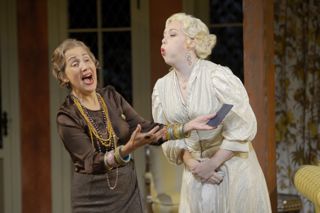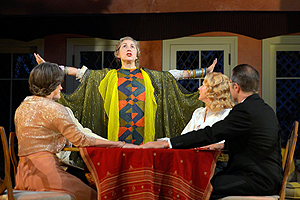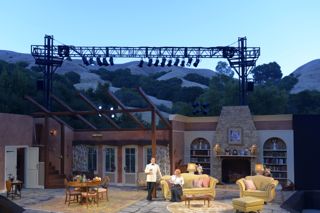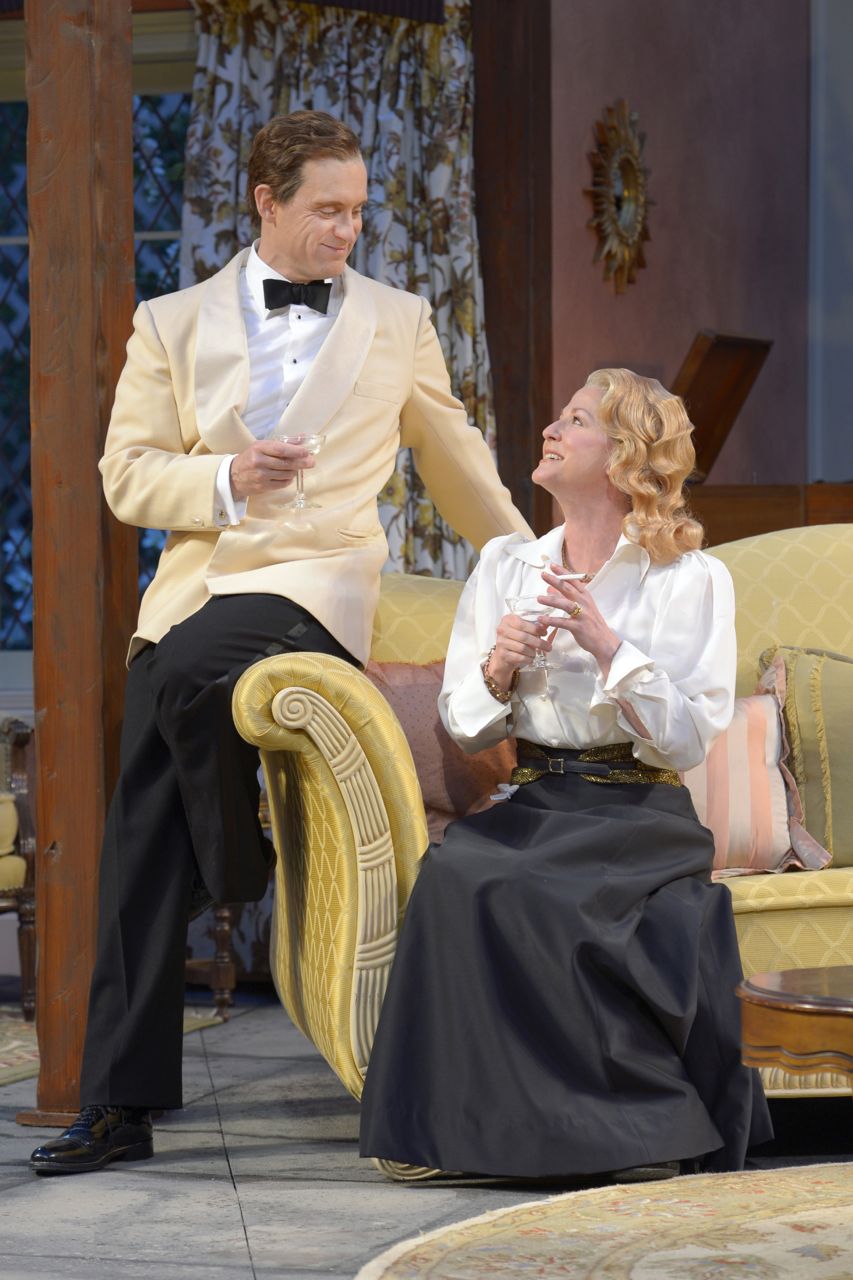

Room Service was a smash on Broadway and a wild and wacky ride in Orinda!

By Charles Jarrett

  
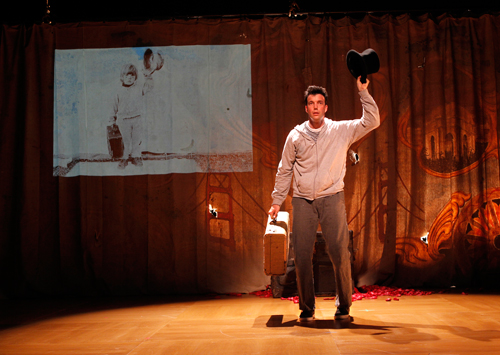
David Weiner (the Waiter) and Charles Guitron (playwright Leo Davis) in a lighthearted moment!

Photo by Dave Dierks

“Room Service”, written by John Murray and Allen Boretz in 1937 is a deliriously funny play that was a smash hit on Broadway in 1937 and 1938, running for 500 performances until the movie rights were purchased by RKO as a comedy vehicle for the wild and wacky Marx Brothers later in 1938. This delightful fun-filled farce is currently playing in the Starlight Amphitheater in downtown Orinda. The show epitomizes the perpetual financial nightmare that producers and writers face all the time, that of finding someone with the money and vision to invest in a show. Generally the less promising the show, the more difficult it becomes to find investors. Ergo, this company has been having a very difficult time finding their money man, their backer.This story opens with theatrical producer Gordon Miller (Geotty Chapple) in his hotel room attempting to read a script while an annoying room service waiter, Sasha (David Weiner) is attempting to convince an uninterested Mr. Miller that he was a very successful actor as a younger man in Russia, who would be perfect as one of the characters in a new play Miller’s actors are rehearsing in another part of the hotel. As the hotel manager and Miller’s brother-in-law, Joseph Gribble (Barry Hunau), barges into the room in a fear induced rage, it quickly becomes evident that Miller has incurred a huge unpaid bill for not only his own room and expenses, but also for approximately 20 other actors and staff, all residing in and sponging off the hotel as well, on a promise to pay pending the receipt of a huge advance from a hypothetical show backer. Gribble smells impending doom as an auditor is due to arrive any moment, an auditor who is bound to discover that a huge credit has been granted to a relative of the manager, a highly unethical action which he knows will end his hotel management career.

Upon learning that the auditor is going to quickly discover the huge deficit and financial deception, Miller initially decides to skip out, leaving his brother-in-law holding the bag. Almost within the next breath, Miller’s associate, Christine Marlowe (Laura Martin-Chapin), charges into the room announcing that she has finally found a financial backer for the show, a very well-known and wealthy individual. Somehow, the mottely theatrical crew has to remain in the hotel for at least 24 hours in order to pull off the deception of being very successful for the benefit of the potential backer, at least until he signs a contract. At the same time the theater company has to avoid the eviction and wrath of the auditor who will soon be on the war path.

As if this is not convoluted enough, the neophyte author of the play, Leo Davis, shows up at the hotel, seeking the next installment of the previously promised advance. Unable to pay the monies due the author, Miller convinces Davis (Charles Guitron) that it would be to his advantage to just hang out here in the hotel, “as Miller’s guest”, until the investor/backer comes and meets all of the principals, including the author.

The play continues to get wilder and wackier by the minute as an ever evolving cast of 16 characters are introduced in various supporting, albeit convoluted roles. I knew you were going to ask, yes, there is a love interest as the very attractive and young manager’s secretary, Hilda Manney (Giuliana Karezis), runs into Leo Davis, and faster than the flash of a zippo lighter, they immediately fall head over heels in love!

As you can probably guess, “Room Service “ is a totally madcap, mile-a-minute, door slamming, head banging play that is a perfect vehicle for the likes of the Marx Brothers or any other erstwhile comedic troupe of actors willing to participate in such absolute dumb fun. Dumb fun it is – – – and other than a few missed lines, gaps in timing and typical community theater faux paux, it is an absolute kick in the comedic pants. The acting for the most part is quite acceptable and several of the more experienced actors are really quite good. Regular admission is $16 for adults other than seniors and children, who pay only $8 per ticket. For seniors, that’s only 50 cents per actor, what a deal! I’m only kidding of course. It is a heck of a deal, a heck of lot of fun and it runs Fridays and Saturdays at 8:30 p.m., with the Sunday, August 5th performance at 4 p.m. and the Thursday, August 9th play at 8 p.m., closing on August 11th. The seating is the old fashioned wood benches on tiered stones on a hillside, amphitheater seating, so I would recommend you bring a folding lawn, beach chair or healthy cushions and dress in layers. If the fog rolls in over the Orinda hills, it can get downright chilly. The Orinda Outdoor Theatre is located in the Orinda Community Center Park, next to the library at 26 Orinda Way, across the street from the Rite Aid Pharmacy and the Orinda Post Office. Call (925) 528-9225 or visit their web site athttp://www.orsvp.org/ or you can email them at info@orsvp.org.

I love amateur, Community Theater, especially being able to meet and greet the hard working actors after the show, as they wait at the stage door to share their excitement and joy with you. I have always loved and supported the Orinda Outdoor Starlight Theater which has no community funding, they do everything out of their love of theater and their desire to share their experience of acting with you! Try it, you may like it!

Laurence Carr’s “Vaudeville”, rings with passion and compassion in the Willow’s Cabaret Theater in Martinez!

By Charles Jarrett

  
The boarding house cast pleads with Landlady Kit Turner (Sally Hogarty) for her permission to add her daughter’s neophyte singing talent to the opening number in the Willows Theatre production of “Vaudeville” !

Photo by Judy PotterThe Willow’s Campbell Cabaret Theater at 636 Ward Street in downtown Martinez is currently playing a delightful and engaging production about a day in the life and times of “on stage” theater performers in Laurence Carr’s delightful comic and poignant musical entitled simply, “Vaudeville”. This theater is the perfect venue because, as live theater evolved, variety shows” were born in concert saloons, cabaret theaters and variety halls. Gradually they moved into more sophisticated and less provocative, less alcohol serving venues. As time passed and audiences became more educated towards live theatre, the entertainment business became more family oriented and gravitated towards a more “genteel” theatrical environment. The Willow’s Cabaret Theater is a wonderful cross between modern theatre venues with a legitimate stage, full stage lighting and stepped seating, but complete with little cabaret tables and independent chairs. The theatre even offers a minor selection of food and drinks so that you can sip or munch while you soak up the theatrical offering for the evening. Carr’s “Vaudeville” takes you back to a time in the early 1900’s, just after the ending of World War I, when jobs were scarce, money was tight, and the “talkies” were in tight competition with live theater for America’s entertainment expenditures. In many respects, the scenario is very similar to our own times, finding us emerging from a decade of war, tight finances across the country and mega-movies in heavy competition with live theater! Regardless of the time, the constant, evident by this wonderful production, is the “heart of the performers” who win out over their ingrained competitive nature.

On the vaudeville circuit of live performance theaters, it was said that if an act was good enough to succeed in Peoria, Illinois, it would succeed anywhere. The question, “Will it play in Peoria?”, has now become a metaphor for whether something appeals to the American mainstream public. The three most common levels of theatrical accreditation were the “small time” theaters (lower-paying contracts for more frequent performances in rougher, often converted theatres), the “medium time” theaters (moderate wages for two performances each day in purpose-built theatres), and the “big time” theaters (where possible remuneration levels of several thousand dollars per week were common in large, urban theatres, largely patronized by the middle and upper-middle classes). As performers rose in prominence and established regional and national followings, they worked their way into the less arduous working conditions and better pay of the big time. The capitol of the big time was New York City’s “Palace Theatre”.

In this particular production, nine seasoned vaudeville performers are stuck in Philadelphia in Kit Turner’s Boarding house. It is in this boarding house that the play with music, “Vaudeville”, unfolds, introducing us to its short term theatrical entrepreneurs. They return to the boarding house following their afternoon show to share dinner with the other performers prior to their return to the theater for their evening’s live performance. At once, it becomes obvious that each of these performers are diversified, each uniquely different from the other, and are highly competitive, while at the same time supportive of each other’s craft and talent, as long as the other guy doesn’t steal their theatrical thunder. With acts that range from animal acts, acrobatics, singing, dancing, and comedy, we get a chance to examine a little of their theatrical wares as they rehearse impromptu in the boarding house parlor before they leave for the theater.

This particular group of vaudevillian entertainers’ world is generally the small to medium theatrical venues where their rugged performance schedules consist of split weeks and two or more shows a day, and a new venue practically every week in the somewhat less than well-known theaters. They keep their hopes alive for finding greater recognition and eventually locating a sweet spot theatre and the pathway to “The Big Time” theatrical circuit. Hopefully they will finally find their way to theatrical nirvana, a theater in New York City called “The Palace”.

The show people residing in this boardinghouse at this time include the entertainment team of Benny Cohen (Morgan MacKay) and Frankie Cobb (Johnni Lew); Mack Maxwell (Tom Leone) and his wonder dog, Maxie; Mademoiselle Yvette (Donna Turner) “Vaudeville’s (Faux-French) Sweetheart”); Jackson Washington (Trevor Moppin); Billy Wiggins, a British war hero and entertainer extraordinaire; Paul Clayton (Michael Barrett Austin) the other half of the Cook and Clayton (Andrea Snow) duo, a song and dance team, and culminating with “The angry Mick” (Tiny), Tim O’Reilly, a salty and sarcastic Irish comedian. They represent a cross-section of this later generation of hoofers, comics and “novelty acts” who kept America entertained while Vaudeville was still king prior to being overtaken by the talking picture era.

Landlady Kit Turner (Sally Hogarty) and her daughter Kitty (Erika March) are in the midst of preparing the evening meal when they discover that one of their longer boarding house residents, Mack Maxwell, has come back to the boarding house and gone straight to his room, following the on-stage collapse of his longtime performing partner, Maxie, the wonder dog. Mack and Maxie have been the opening act of the local theater’s shows for a long time and with the looming crisis of not knowing who will open the show, suddenly thrust upon this passel of performers preparing to “hit the boards” in just a couple of hours, severe panic is setting in. Nobody wants to be the opening act, because the opening act cannot afford to flop while warming the audience up to the evening’s broad spectrum of performers. As with any tightly knit group of people whose world is a bit shaky anyway, the stress brings out the good, the bad, and the really ugly.

Vaudeville is a great show, with a great cast and a heartwarming message. I strongly recommend it. The acting is really quite excellent with long time local favorites, Sally Hogarty and Morgan Mackay, leading the way. The set, designed by Jan Zimmerman, is really quite amazing. Costumes, wigs, makeup, lighting and even the sound, all work very well.

This production plays Thursdays, Fridays, and Saturdays at 8 p.m., with matinees on Saturdays at 2 p.m. and Sundays at 3 p.m., now through March 31st. Call (925) 798-1300 or visit their website athttp://www.willowstheatre.org/ for more information. Tickets range between $25 and $30 each. Tickets for seniors are a very reasonable $25 each. Great acting, great voices, great fun – – don’t miss this opportunity to journey back to the wonderful world of “Vaudeville” in the fun-filled Willows Theater!

Glickman — Film Review

By Joe Cillo
Glickman
Directed by James Freedman
This is an outstanding documentary about a sports broadcaster who was very well known in and around New York, but probably not much beyond that area.  I had never heard of him before attending this film and neither did my companion, who is a sportsfan, Jewish, and a little bit older than me.  Marty Glickman (1917-2001) was probably the most influential sports broadcaster of all time, but he also had a profound influence on the nature of sports entertainment in the United States.  His style and the quality of his delivery did much to popularize sports through the (new at that time) mass media of radio and later television.  He was the voice of the New York Yankees, the New York Giants, later the New York Jets, the New York Knicks, as well as boxing, horse racing, and a number of other minor sports.  Listening to the recordings of his broadcasts presented in the film, I was impressed by the fluency of his delivery.  He was able to translate the fast moving action before him immediately into words that conveyed not only the action, but the visual experience of that action.  People called it ‘watching the game on the radio.’  And indeed his crisp, concise, rapid fire descriptions enabled one to visualize the action as it happened.  It is a rare talent and he had mastered it.  It is a kind of poetry, really.  It is words used succinctly and imaginatively — and orally — to their maximum effect.  If you are a sportsfan, if you are from New York, or if you were born before about 1975, and whether you are Jewish or not, you should definitely find this film interesting. 
Marty Glickman was Jewish and this fact was a crucial factor at many points in his life.  He was selected for the 1936 U.S. Olympic track and field team when he was eighteen, along with Sam Stoller, the only two Jews on the team.  Off they went to Berlin to race under Nazi banners and before Hitler and the top echelon of the Third Reich.  They were scheduled to race in the 400 meter relay, in which the U.S. was heavily favored to win, but were replaced at the last minute by Jesse Owens and Ralph Metcalf — two black athletes — over Owens objections.  Their removal was engineered by U.S. Olympic Committee Chairman Avery Brundage and the U.S. Olympic track coach, Dean Cromwell in order to appease Hitler and prevent the Nazis from being embarrassed by having to award medals to two Jews on the winners’ podium.  The U.S. did indeed win, but Glickman carried the insult with him a long way.  He was not forward about it, but the wound was evident many years later upon his return to Berlin and the stadium where it occurred.  Brundage and Cromwell were Nazi sympathizers and after the Olympics Brundage’s construction firm was awarded the contract to build the new German embassy in Washington D.C.  This wasn’t the last time Marty Glickman’s Jewish origins resulted in his being shunted aside.  He was scotched from being the voice of the NBA games on NBC because his name was considered “too Jewish.” 
There is also an interesting, extremely provocative episode that Glickman and Isaacs chose to leave out of their book, a moment that might easily be dismissed as apocryphal, except for the fact of my close relationship with Glickman.  Marty and Morris (he insisted that he be called Maurice’ but his name was Morris) Podoloff, the first commissioner of the NBA, were invited to meet with Tom Gallery, the Sports Director for NBC’s television network in his office at 30 Rockefeller Plaza. The intention, Podoloff told Marty, was to discuss Glickman’ becoming the “Voice” of the network’s newly acquired rights to weekly nation-wide telecasts of NBA games. Gallery was effusive in his praise of Marty’s TV work on the games shown locally on the Dumont local outlet, Channel 5 in New York. Gallery, however had one reservation; the name Marty Glickman sounded “too New York” he claimed.  Marty knew immediately what Gallery was implying. The name of Glickman was “too Jewish.” Glickman then told Gallery that he wasn’t averse to changing it. Gallery smiled and asked Marty whether he had an alternative name that he could use. “Yes,” said Marty. “And what would that be,” asked Gallery. “Lipschitz.” said Marty, Marty Lipschitz.” “Gallery’s face reddened,” Marty reported, ˇthat ended the meeting.” It also ended any intention that Marty Glickman would broadcast any NBA games on NBC.
Nat Asch, from a review of The Fastest Kid on the Block, (1999) by Marty Glickman, on WNEW website
While the film does feature the suffering Glickman endured as a result of the anti-Semitism that was prominent in American society during his lifetime, it also illustrates how Glickman was able to triumph in spite of prejudice and discrimination.  Although in a few significant cases his path was blocked, what he was able to achieve was vast and awe inspiring.  In the question session after the screening I saw, Director James Freedman remarked that one of the unintended consequences of the film was that through the life of Marty Glickman a documentation of the progress of assimilation of Jews into the mainstream of American society in the twentieth century becomes evident. 
The film is very comprehensive in its treatment of Marty Glickman’s professional career as a broadcaster.  It is very superficial in its treatment of his personal and family life.  He was married and had a family.  His daughter, Nancy, does appear in the film.  Interestingly, she had been a lawyer for the American Civil Liberties Union.  However, his wife, although pictured, never speaks or comments on her famous husband, who is praised so honorifically by so many others.  Freedman was asked during the question session about the omission of Glickman’s family life from the film, and he said it was due to considerations of space and that he wanted to focus the film on Glickman’s professional career.  That is fair, but much of the film is taken up with presenting Marty Glickman as a great person, a Mensch, who helped so many people, and who was so active in community organizations and activities for children and high school athletes, in addition to being a great broadcaster.  It seems that at least a word or two from his wife would be worthy support to such a presentation and strengthen its credibility. 
After the showing Freedman chatted a bit with a few people who lingered, and I asked him about something else that was omitted which I was curious about, namely, what relationship, if any, Marty Glickman had with Howard Cosell, a Jewish broadcaster that I was very familiar with from my teens.  Freedman’s answer was that they hated each other, and the reasons for the omission were again space and focus.  I was able to find the following anecdote about Cosell in Glickman’s 1999 autobiography, The Fastest Kid on the Block.
“From one of my favorites, Costas, let me move on to say something about my unfavorite, Howard Cosell.  I recall in particular the occasion when he and I were inducted into the Jewish Sports Hall of Fame in California in the mid-1980s.  We both spoke:  he last; I, just before him.
I spoke for about ten minutes.  I spoke about the beauty and joy of sport, the camaraderie that exists among athletes, the understanding and affection that athletes have for each other, particularly in international athletics.  The talk seemed to be well received. 
Then Cosell got up and immediately started talking about Munich in 1972.  “I saw no camaraderie,” he said in that sneering tone of his.  “I saw these men shot and killed. I was there watching those desperadoes.  I saw none of that good feeling.”
He equated murdering terrorists with Olympic athletes.  He went out of his way to knock the whole point I was trying to make.  He was as nasty and vitriolic about the Olympic Games and international athletics as he could be.  He scoffed at “alleged sportsmanship” among athletes. 
I was sitting there furious at what he was saying.  But I was gentleman enough not to get up and make a scene about it.  He sat down, and then, in moments after concluding, left the ballroom.”
                                                            from The Fastest Kid on the Block, p. 156
I suspect that Freedman, aside from the incidents of anti-Semitism, wanted to keep the film upbeat and positive in tone.  It is an acceptable approach, but it does leave some unfinished business that I wish he would at least have touched upon.
Generally the film is a well made, well thought out, honorific presentation of Marty Glickman, who was not only a great sports broadcaster, but also a great person, a person who was not diminished by the injustices that he suffered, but who was made better and who rose above the adversity in his life to give of himself to many others in great abundance.  Anyone with a significant interest in sports should by all means see this film, but even those who have little or no interest in sports will find the human story of his life compelling.   Seen at the San Francisco Jewish Film Festival, Castro Theater, July 22, 2012.

WOODY ALLENS ‘TO ROME WITH LOVE – GORGEOUS!

By Lee Hartgrave
A Scene from ‘To Rome with Love’ Courtesy photo
\\\\\\\\\\\\\\\\\\\\\\\\\\\\\
WOODY ALLEN’S “TO ROME WITH LOVE”
Woody Allen is in the movie. Allen is just as clever and perky now as he has ever been. And he has not lost his directing touch.
The film can get a little confusing in the four different plots. Trying to figure out who and what each plot is about, it can be a little tricky.
Alec Baldwin plays a role of a famous architect. Baldwin’s part is very strange. Half of the time it’s like he is in a group of people talking, but they don’t hear him. Is he dead? You figure it out. On the other hand he converses with some of the people in the movie and other times they don’t seem to know that he is even there. Ummm – very confusing. Strange that they don’t intersect.
Woody Allen has plenty of funny lines to throw around. And that’s why he’s in the movies. Also Roberto Benigni (remember him from the Academy Awards when he walks on the back of the Theatre chairs?)In this movie he wakes up one day and discovers that he has become a national star in Rome. Believe it or not – he became famous for saying things like: “I got up this morning.” Yep – that’s it. People want to know what he will say tomorrow – and he gives them this. “I had breakfast this morning”. His fans love it and follow him everywhere. It’s just hilarious.
There are lots of gorgeous women in the cast – Ellen Page, Alessandra Mastronardi, Penelope plays a hot looking high-class prostitute in a very tight dress that covers very little. Tsk, Tsk – what is this world coming to?
Well “To Rome with Love” will make some bucks – it will not be as “hot” as Allen’s “Midnight in Paris” – but like the Paris Movie – “Rome” is just as gorgeous. The Italian comedy is a riot. At times it even reminds of Sacha Baron. All in all this entire Movie is probably much, much better than what is playing around town. Summer time is not the best time for movies. Woody Allen gives Rome a Special Glow. It’s a tale full of love and beauty. I say – “It’s Bright and Charming!”
Now playing at Theatres everywhere
RATING: THREE BOXES OF POPCORN!!!
-TRADEMARKED-
(((Lee Hartgrave has contributed many articles to the\\\\\\\\\\\\\\\\
San Francisco Chronicle Sunday Datebook and produced and    Hosted a long-running Arts Segment on PBS KQED))) \\\\\\\\\\\\\


Mime Troupe lambastes the 1 percent — and the rest

By Woody Weingarten

The San Francisco Mime Troupe has been performing free shows for just over half a century.

It may be starting to show its age.
“For the Greater Good, or The Last Election, a Melodrama of Farcical Proportions,” might win a prize for longest title but is unlikely to harvest awards for anything else.
Has the troupe, which blossomed in the ‘60s, lost its edge? Perhaps.
Its previous barbed, acerbic quality apparently dissipated when Dick Chaney and George W. Bush stopped being targets.
That’s a shame.
Have the non-silent lampooners turned from biting humor to slight satire a la “Glee”? Perhaps.
That, too, is cause for regret.
They still draw laughs through over-the-top melodrama, at least from intrepid fans, but even devotees are apt to find the technique a tad stale.
The problem may stem from the Mimers trying to be — instead of hardline leftist radicals — even-handed (or, to lift a spurious Fox News slogan, “fair and balanced”).
San Francisco Mime Troupers (from left, Keiko Shimosato Carreiro, Velina Brown, Victor Toman, Ed Holmes, Lisa Hori-Garcia and Reggie D. White) call for “power to the people” during “For the GreaPhoto: Fletcher Oakes.

In this musical comedy, the cast castigates not only capitalists (camouflaged as an oppressed 1 percent) but it lambastes the 99 percent as well (pinpointing welfare recipients and the jobless as well as socialists, occupiers and the naïve).

When the 90-minute show recently played on the lawn of the Mill Valley Community Center, where nearby amateurs propelled a soccer ball throughout the performance, theatergoers cloaked to ward off an evening summer chill munched on gourmet salads and cheeses, dips and roasted chicken.
The affluent Marin County audience of 209, give or take, occasionally shouted approval and clapped at allusions to credit unions, the 99 percent and the occupy movement, and booed references to Mitt Romney’s possible election and Michelle Bachmann being one of the “best minds of our time.”
But it failed to flaunt the fury of outdoor followers in San Francisco’s Dolores Park or any of several Berkeley parks.
And it displayed virtually no reaction to bait such as “There are some things more important than decent and fair in this world — the free market.” Or to wannabe gag lines such as “This country has enough wealth for everyone — as long as we don’t try to share it.”
None of the troupers’ half dozen songs seemed to connect either.
Mill Valley simply may be too tame, too civilized a venue.
Only Green Party stalwart Laura Wells handed out flyers, as opposed to countless proselytizers distributing political vilifications at most other sites where the mimics perform.
Michael Gene Sullivan, who’s been with the troupe since 1988 and wrote this year’s play, also directed “For the Greater Good…” He extorted stellar performances despite his nondescript script, chiefly from Ed Holmes as financial finagler Gideon Bloodgood and Lisa Hori-Garcia as his pampered daughter Alida (and her revolutionary alter ego, Tanya).
Most of the cast did significant double- or triple-role duty, aided by quick changes of costumes designed by Blake More and intentionally unnatural wigs.
Stagecraft by Toman, Ben Flax and Maurice Beesley was delightfully conspicuous, particularly in sequences that simulate a deadly blaze and a rising angel.
Pat Moran, a veteran Mimer, turned out a bland score, lyrics and musical direction that when best felt borrowed from “The Perils of Pauline” or a Buster Keaton short.
Choreography, by Victor Toman, was severely limited to a few movements by a small stage.
Although “For the Greater Good…” is based on a 19th century melodrama, “The Poor of New York,” the storyline’s been upended and updated to 1987 and 2012. Its intent, clearly, was to skewer the billionaires and banking barons who’ve bought elections and fleeced the public while lining their own pockets.
Had it limited its targets to those specific bandits, instead of acting like a Gatling gun, it might have found a more receptive crowd.
Even in Mill Valley.
For a complete listing of upcoming San Francisco Mime Troupe performances of “For the Greater Good, or The Last Election” through Sept. 9, go to www.sfmt.org or call (415) 285-1717

King John: Best Shakespeare Play You’ve Never Seen at Marin Shakespeare Company

By Flora Lynn Isaacson


Erik MacRay as the Bastard in King John at Marin Shakespeare Company.

King John was largely popular on the Elizabethan stage, but it is rarely produced today.  In the Victorian era, King John was one of Shakespeare’s most frequently staged plays, in part because its spectacle and pageantry were congenial to the Victorian audiences.  It has been staged four times on Broadway, the last time in 1915.  It was also been staged from 1953-2010 at the Stratford Shakespeare Festival.  

Bravely directed by Leslie Schisgall Currier, this rousing story of the battle for the English throne is an action-packed history play full of humor, drama and pathos. When King John (Scott Coopwood) is asked to renounce his throne in favor of his nephew Arthur (Samuel Berston).  According to the director, “King John shows us Englishmen who, for all their faults, are less deceitful, haughty, manipulative, coarse and unethical than the play’s arrogant French, brutish Austrians and hypercritical Italians.”

The action of the play takes place in England and France in courts and on battlefields.  The battle scenes are outstanding taking place among and above the audience seating as well as on stage.

There are many outstanding performances in this production.  Scott Coopwood, in the title role, stands up to his enemies and brings out both the strength and weakness of his character.  Erik MacRay as Philip Faulconbridge, known as the Bastard because he is the illegitimate son of King Richard the Lionheart, has all the natural Plantagenet intelligence and charisma, and stands like a chorus, outside of the action, where he can comment on the foibles and political decisions with insightful wit and to illuminate all the turmoil going on around him.  Liz Sklar as Queen Constance, the mother of young Prince Arthur, makes the laments of Constance her own.  In contrast to his performance as Julius Caesar, Ashland veteran Barry Kraft, gives a performance full of affectation as Philip, King of France.  With a cast of 30 actors, Director Leslie Schisgall Currier, handles her cast with skill and brings to life many surprises along the way.

Abra Berman’s costumes are colorful and accurate period.  Dialect Coach Lynne Soffer is to be commended for the clarity of speech each actor utters in several dialects.  Be sure to see King John which opened Friday, July 13 at the Marin Shakespeare Company’s Forest Meadow’s new and vastly improved outdoor setting.

King John plays through August 12, 2012.  Performances are at 8 p.m. Friday and Saturday and 4 p.m. on Sunday.  The place is Forest Meadow’s Amphitheater, 490 Belle Avenue, Dominican University of California, San Rafael.

For tickets call the box office at 415-499-4488 or go online at www.marinshakespeare.org.

Coming up next at Marin Shakespeare will be A Midsummer Night’s Dream directed by Robert Currier, opening July 28 through September 30, 2012.

Flora Lynn Isaacson

A Taste of Tuna in Greater Tuna at RVP

By Flora Lynn Isaacson


Wood Lockhart as Didi Snavely in Greater Tuna at RVP

Come visit the fictional small town of Tuna Texas during the Ross Valley Players final production of Greater Tuna by Jaston Williams, Joe Sears and Ed Howard.  The show focuses on small town, southern life.  It depicts the folks at the radio station OKKK and the Greater Tuna Humane Society as well as many other characters in this small town.  

Director Linda Dunn is a native of a small town in Texas just like this one and has coached her cast to provide us with authentic Texas accents.  

Greater Tuna opened in New York City, October 21, 1982 at Circle in the Square Downtown.  In the original production, all of the citizens of Tuna, Texas were played by two actors.  Linda Dunn has stretched her cast to seven with the challenge of playing multiple roles.  This day in Tuna, the third smallest town in Texas, begins as usual with Thurston Wheelis (Jim Dunn) and Arles Struvie (Wood Lockhart) at the microphones at Radio OKKK broadcasting at a big 275 watts.  Topping the headlines is the winning entry in the American Heritage Essay Contest entitled “Human Rights, Why Bother?”  Then, Arles exits and comes back as Didi Snavely (Wood Lockhart in drag), of Didi’s Used Guns; she leaves and gives way to Weatherman Harold Lattimer (Javier Alarcon). And the comedy continues from Petey Fisk of the Humane Society (Tom Hudgens) talking about the duck problem and Yippy the Pet of the Week to Phineas Blye (Javiar Alacorn), perpetual losing candidate for City Council announcing he’s running again and revealing his plan to tax prisoners.  Of course a day is not complete without a visit to Dog Poisoner Aunt Pearl Burras (Steve Price) and her niece Bertha also played by Steve Price who is the town censor trying to make Tuna a better place by banning Romeo and Juliet and Huckleberry Finn as dangerous works of literature.   Her two children, Jody and Stanley are portrayed by a youthful Robyn Grahn.  Jeffrey Taylor effectively portrays Commentator Leonard Childer’s, Sheriff Givens and Chad Hartford.  

The 20 inhabitants of Tuna parade across the stage in all their outrageous costumes designed by Michael A. Berg on Ron Krempetz’s truly Texas set and comment on life, politics and what makes them tick.  

Greater Tuna is Ross Valley Player’s final production of their 82nd season.  Come and enjoy this fun loving show!

Greater Tuna runs from July 12-August 12, 2012.  Thursday performances are at 7:30 p.m., Friday-Saturday at 8 p.m. with Sunday matinees at 2 p.m. Performances take place at Ross Valley Player’s Barn Theatre, Marin Art and Garden Center, 30 Sir Francis Drake Blvd., Ross, CA.  

For reservations, call 415-456-9555, extension 1 or go online at www.rossvalleyplayers.com.

Coming up next at RVP will be Lend Me A Tenor by Ken Ludwig, directed by Kris Neely from September 13-October 14, 2012.

Flora Lynn Isaacson


Event 1 July 2012

By Joe Cillo

Event 1 July 2012

Lorem ipsum dolor sit amet, consectetur adipiscing elit. Suspendisse fringilla dignissim rhoncus. Sed semper mattis dolor et faucibus. Aliquam mollis accumsan dolor porta laoreet. Aliquam vel metus urna, eu sagittis nisi. Aliquam ultrices hendrerit dui, vitae bibendum ipsum tincidunt eget. In accumsan aliquet tincidunt. Nullam lobortis magna ut nunc egestas eu faucibus leo sollicitudin. Fusce id mauris malesuada orci ullamcorper.

Lorem ipsum dolor sit amet, consectetur adipiscing elit. Phasellus justo est, malesuada vitae semper non, iaculis in elit. Suspendisse ac metus magna, porta tristique orci. Nulla malesuada faucibus lacinia. Pellentesque aliquet, quam in pharetra cursus, tellus elit egestas leo, id tincidunt orci purus vitae magna. Duis mi ante, fermentum in sagittis id, rutrum id velit. Aenean accumsan ligula non leo rhoncus in ultrices ipsum tincidunt. In nulla ante, iaculis sed tristique sed, congue hendrerit leo.

Maecenas pulvinar orci vel tortor laoreet at suscipit dolor condimentum. Sed rutrum pellentesque placerat. Nulla facilisi. Praesent congue, turpis porta venenatis ullamcorper, purus enim malesuada massa, vel auctor libero urna vel ligula. Suspendisse non pulvinar eros. Donec consequat pulvinar molestie. Fusce non sollicitudin metus. Duis vitae purus sit amet nisl sodales auctor. Sed vitae scelerisque nunc. Nullam non est et ligula rutrum adipiscing. Pellentesque eu nunc erat, hendrerit ultrices nisi. Pellentesque varius quam eu dolor iaculis sed blandit velit faucibus. Integer sagittis mi in leo tincidunt posuere.

Integer tincidunt accumsan lacus sit amet venenatis. Fusce ut dui sed risus ultricies rutrum ut non massa. Integer aliquet tristique felis non porta. Quisque tempus sem vitae nunc mattis egestas eu at risus. Donec ut dolor enim, posuere varius arcu. Vivamus ultricies gravida magna a semper. Etiam sit amet felis vitae felis interdum auctor.

Vivamus mollis magna ac purus tincidunt congue. In mattis dolor eu erat dictum tincidunt. Suspendisse scelerisque convallis mollis. Vivamus sed sem ante, in scelerisque dolor. Sed lorem lacus, ornare non convallis ut, feugiat in ante. Curabitur sed ligula sem, et hendrerit sem. Suspendisse ultrices, enim sit amet iaculis auctor, massa neque malesuada dui, ac condimentum risus leo varius neque. Mauris vel metus dolor, vel imperdiet enim. Vivamus in urna nisi. Vivamus id elit in tortor rhoncus fermentum non eu lacus. Proin et ullamcorper neque. Pellentesque suscipit est sit amet velit molestie aliquam. Donec suscipit bibendum enim, ut ornare nulla dictum in. Morbi eu risus turpis, in dignissim justo. Ut eget porta velit.

Etiam sit amet neque id mauris convallis lacinia id in risus. Class aptent taciti sociosqu ad litora torquent per conubia nostra, per inceptos himenaeos. Morbi condimentum euismod sagittis. In nec erat eget eros porttitor mollis non ut justo. Suspendisse nisi nisl, pellentesque in placerat sit amet, commodo vel elit. Quisque nec justo nunc. Maecenas id risus vitae nulla laoreet semper.

July 2012

Marat Sade

By Joe Cillo
The Thrillpeddlers are currently performing “The Persecution and Assassination of Jean-Paul Marat as Performed by the Inmates of the Asylum of Charenton, Under the Direction of the Marquis de Sade.” If you cannot remember that prolix title then the succinct, MARAT SADE, will suffice and get you tickets for the correct show at the Brava Theatre in San Francisco’s Mission District. If you cannot remember Marat Sade and his role in the French Revolution then perhaps you might remember Marat Sade via the painter Jacques-Louis David who immortalized Marat in his painting “The Death of Marat;” the painted resides in the Musées Royaux des Beaux-Arts in Brussels. Before launching into the play, a historical excursus may be helpful, given that the adversarial relationship between Marat Sade and the Marquis de Sade as depicted in the play is not without historical basis. In the days prior to his assassination, Marat had fallen out with the Marquis de Sade and was arranging for his arrest. We might call the assassination a preemptive strike given that the Marquis de Sade was becoming appalled with the excesses of the Reign of Terror which Marat fanned with his uncompromising incendiary revolutionary rhetoric. Given the excesses of the French Revolution, it seems incongruous that the infamous Marquis de Sade should be removed from office and imprisoned for his “moderatism.” Marat’s assassin—about which this play orbits—was the crafty Charlotte Corday. Corday gained access to Marat via a ruse, an urgent letter of petition—one of the first of many murders conducted by letter carriers. Prior to ripping through Marat’s sternum with a kitchen knife, Corday engaged him a political discourse for nearly a quarter of an hour; her salient points were obviously lost on Marat. The nefarious Corday hid her knife in her corset which fashion historians argue was probably a size too large in order to comfortably accommodate both her anatomy and her weapon. As George Santayana said, “Those who ignore history are doomed to repeat it.” Marat, ignoring the lessons of the ORESTIA, like Agamemnon, feels the sting of the assassin’s blade while trustingly and vulnerably soaking in a bath. It calls to question if sponge baths or a speed baths in public restrooms would not be better suited to political extremists. Miss Charlotte defended the assassination saying “I killed one man to save 100,000.” As the whirly-gig of time would have it, for her well-meaning treachery, Charlotte Corday ultimately ends up on the receiving end of an ever bigger blade; the angled blade “humanely” advocated by Doctor Joseph-Ignace Guillotin. Peter Weiss, author of the play on which this adaption by Adrian Mitchell is based, questions whether revolution can truly achieve lasting change or significantly improve the human condition. We may vote out, toss out or execute the current cadre of bureaucrats, bankers, brokers and tax collectors, but necessity and culture will replace them with possibly an even more rapacious brood—remember: after the French Revolution came Napoleon. Be warned: when the English version of this play opened at the Royal Shakespearian Theatre, a minimum of 30 repulsed and disgusted people slipped away each night under the anonymity of intermission. Critics charged that the “nudity and bodily effluvia were shocking and the text itself was overwhelmed by the raw outpourings of primal emotion.” Now that’s a pretty strong endorsement. Be warned a second time: the show does contain nudity so depending on your degree of prurience or priggishness and where you are seated, opera glasses or a lorgnette may be appropriate. The philosophical debate between the Marquis de Sade, who “fails to delve into his words fully,” and Marat seems to take a back seat to the chaotic violence it precipitates. De Sade is the engine in the play; he cynically conducts philosophical dialogues with Marat; badgering him, all the while observing the proceedings with sardonic satisfaction. De Sade remains detached when the inmates speak of rights and justice; he shows little regard for practical politics; de Sade stands by as an observer and an advocate for his own nihilistic, epicurean and individualist beliefs. Topically, the show is highly relevant given that it is an election year and perhaps a critical turning point for the middle class of the hitherto pampered world. As in the case of a revolution, the audience might ask itself, “Will a different political party be able to affect change?” or “Does the economy even have a political solution?” Perhaps it is time that the middle class reinvents itself: steps away from its consumer identity and redefines itself in terms of its cultural, intellectual, humanitarian and creative aspirations. MARAT SADE is a graphic diatribe against inadequate leaders who manipulate their people into complacency. While a revolution is taking place within the central cage of the set—leaving the floor strewn with clothes and bodies—the spectators i.e. the bourgeoisie as symbolized by the hospital director, Coulmier, his wife and daughter, sit in silence, uncertain as to how to react. Despite the best efforts of Coulmier, the patients make a habit of speaking lines Coulmier attempts to suppress; the patients deviate entirely into personal opinions. The play is both highly original and shockingly potent philosophically; it is a psychological journey into one of the most complex and brutal periods of recorded history. Multi-layered ideas come at the audience like insects splattering on a windshield; the words and images can be overwhelming; this is not casual entertainment; this is an exploration of history and the deepest questions of good and evil and free will. Dazzling and provocative costuming by the Bay Area’s award winning Beaver Bauer take this show from spectacle to spectacular; as Oscar Wilde once said, “Anything worth doing is worth doing to excess,” and Beaver has clearly approached that ideal. Jeff Garrett is smashing as the Marquis de Sade; when it is time to be whipped by the “cat of nine tails” Garrett is no shirker; the cracking of leather on his flesh would send a freak on holiday. Aaron Malberg as Jean-Paul Marat is masterful, he proves that understatement is the best depiction of profundity; caught in the web of his own political conceits, MR Malberg’s Marat is visibly tangled in a philosophical loop that does not provide exit strategies. Bonni Suval, as the nefarious Charlotte Corday, portrays a heightened psychopathic urgency and intensity; her every expression and movement seem to beg the question, “Can I kill him now?” Director Russell Blackwood does a marvelous job conducting this chaotic, riotous three ring circus orgy that seems to oscillate between a cast party and a mental hospital. Rarely does the carnal spirit of the French Revolution get captured by the Klieg Lights. MARAT SADE at the Brava is not the faint hearted; this is gritty; shocking; offensive; this is well worth the time and money. For more info, surf on over to thrillpeddlars.com

“CAVALIA” the equestrian cirque nouvelle arrives in the South Bay for the first time!

By Charles Jarrett

image above: (Mathieu Bianchi – horseman)image far right: (Keith Dupont – horseman)

All photos by Charles F. Jarrett, Rossmoor News(Fairland Ferguson – horsewoman)

Two years ago I had the good fortune to attend the San Francisco premier of “CAVALIA” in the big white tent across the street from AT& T Park, and this was the second time I had witnessed this extravaganza of flying hoofs and sweaty equestrian costumes in the past 8 years. Now, the City of San Jose and the citizens of the South Bay get to play host to this equestrian show of all equestrian shows as it opens this evening just a few blocks from San Jose’s Norman Mineta Field Airport. I will be taking my grandchildren this evening to see this spectacular show.
If you have not seen “CAVALIA” the equestrian cirque nouvelle, a thrilling multimedia theatrical experience that is the equivalent of an ethological equestrian union between man, woman and horse, then listen up – – because that opportunity is now back on our southern doorstep!
Created by Norman Latourelle, one of the founders of Canada’s famed Cirque du Soleil, this show does for the equestrian lover what the original Cirque du Soleil has done for the circus. It re-invented the old style circus horse show, that had horses parading in a small ring, generally alongside two other rings under a typical circus tent, and elevated it to a new plane.
The previous shows were built around the talents of Frenchman Frederic Pignon and his wife Magali Delgado, and their predominantly large horses (Lusitanos, Belgians, and Warm Bloods) including the gorgeous and brilliantly trained, Templado, but they retired from Cavalia and returned to France in 2009. Sylvia Zerbini stepped into the arena in the 2010 show and delivered a stunning “Grande Libertè” parade featuring her own eight unbridled Arabian horses in a liberty act of breathtaking freedom combined with precision and stunningly orchestrated beauty.
This year’s show is equally beautiful, with new practitioners of the art of acrobatic and bareback riding; demonstrations of rapid fire tumbling and majestic aerial acrobatics, melding man, woman and horses in incredible feats of trick riding. Roman riders stand on horseback and defy gravity as they race across the 160 foot sand covered stage and hurtle jumps of constantly changing heights, all in a colossal coliseum setting.
Yes, there are still plenty of Lusitanos, Percherons, Belgians, plus Paints, Appaloosas, a Comtois, and Ardennes, Quarter horses and even a miniature horse, in addition to over 30 human performers (including aerialists, tumblers, acrobats, musicians, a vocalist, and dancers).
The most spectacular feat in “Cavalia” is its marriage and integration of all these elements into a highly choreographed production, melded with incredibly sophisticated digital multimedia backdrops projected onto a 200 foot high screen, live music and a living kaleidoscope of lighting effects. The light and visuals can take you back in time to ancient Rome, to a mystical and exquisite south eastern Asian landscape, and even whisk you through the seasons of the year, as though you were traversing the world in a timeless magical musical orb.
One of the most exciting and romantic vignettes to me is an exquisite and breathtakingly romantic magical winter scene, where a beautiful woman descends from the heavens to meld with a man and his horse amid the starlight sky and falling snow! This is definitely a don’t miss show!
All of this equestrian nirvana is contained within the largest touring white big top in the world. The tent alone is 110 feet tall and covers over 26,000 square feet, large enough to accommodate a stage as wide as a football field width (160 feet), and all the seating and mechanicals that make it work. When you walk into the tent and see the staging and its awesome size, it almost leaves you frozen in your place before the show even begins. It is truly amazing!
This shown has been seen by more than 3.5 million people worldwide. Cavalia is a living tribute to the beauty and highly personal relationship that humans and horses have shared together for centuries. Cavalia has traveled throughout Europe, including multiple cities in Mexico, Spain, Portugal, Belgium, the Netherlands, Germany and North America. If you would like to check the latest developments with Cavalia, you can check outhttp://www.tw%20%20%20%20%20itter.com/cavalia or www.facedbook.com/cavalia . For information on regular tickets, plus special package deals, visit http://www.cavalia.net.tickets/ range in price on weekdays between $44.50 and $139.50. The toll free phone number for ordering tickets is 1 (866) 999-8111. Check out the incredible “Horse Lovers Package” on line that offers special food, drinks and even allows you to take the children behind the scenes to actually meet the horses in person after the show. “CAVALIA” has just extended the run through August 12th. Performance times are at 8 p.m. on Tuesdays, Wednesdays, Thursdays and Fridays, with two performances on Saturdays at 3 p.m. and 8 p.m. and Sunday performances at 3 p.m. through July 29th, when the schedule for Tuesdays, Wednesdays and Thursdays changes from 8 p.m. openings to 7:30 p.m. openings. Performance dates & times can be confirmed on the http://www.cavalia.net/ website in the schedule section.
“CAVALIA” has raised its magnificent and majestic white tents on the highway 101 Tech Campus Site, at 301 Atmel Way, located between the Bayshore Freeway (Hwy 101), Charcot Ave., North 1st street and West Trimble Road. It took me approximately 45 minutes to drive to the tent site from Walnut Creek, Alamo area. I take highway 680 South to Montegue Expressway, then wend your way West to Tremble Road, then South on Orchard Parkway approximately two blocks until you come to Atmel Way. Then turn right until you arrive at the “CAVALIA” parking lot where you will disembark and make your way to the “Rendez-Vous” greeting tent or the Box Office. Have a great time, don’t miss this incredible visual event, perhaps the best entertainment you will see and experience all year!