My Fair Lady

By Kedar K. Adour

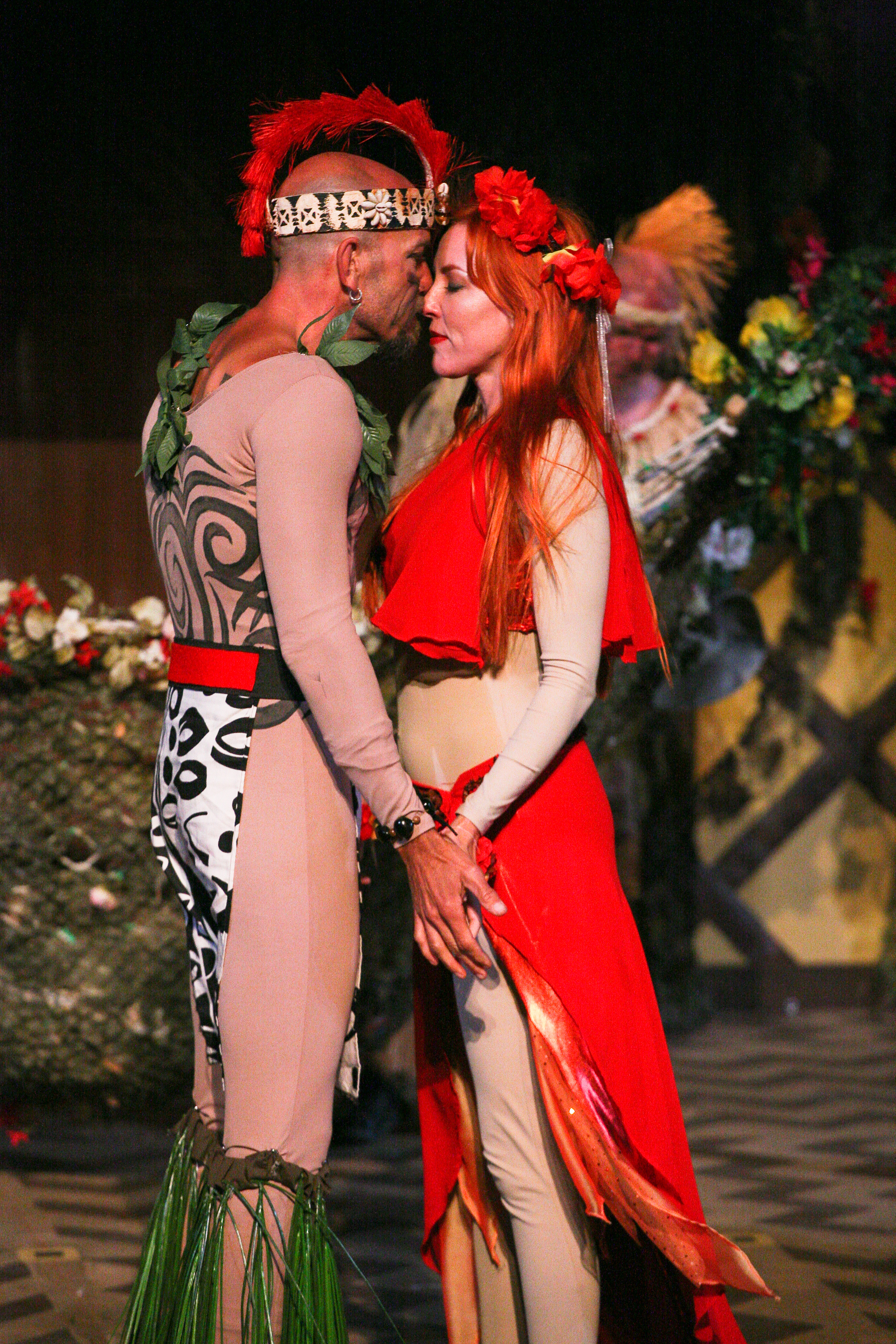
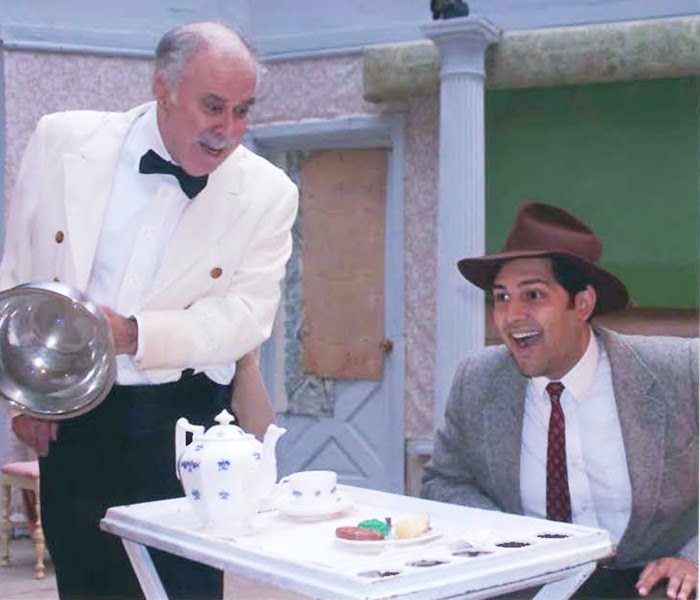
Pickering, Higgins and Eliza work long into the morning hours

MY FAIR LADY: Adapted from George Bernard Shaw’s Play and Gabriel Pascal’s motion picture “PYGMALION”. Book and lyrics by Alan Jay Lerner and music by Frederick Loewe. Directed by Bill English. SF Playhouse, 533 Sutter Street, San Francisco.  415-677-9596 or www.sfplayhouse.org. July 10th to September 29th, 2012.

MY FAIR LADY at SF Playhouse must be seen to be believed.

It seemed incredulous when the word came out that SF Playhouse had scheduled My Fair Lady the musical to be performed with only nine characters even though local icon and superb actor Charles Dean was to play Alfred P. Doolittle. How could they mount a splashy musical on their miniscule stage in a theater holding 99 seats? They have done it, increasing the cast size to 11 with the help of twin pianos (Greg Mason and Dave Dobrosky), a fantastic set  and a spirited cast earning the honor of being a must see play.

After George B. Shaw’s play Arms and the Man was converted into the mediocre The Chocolate Soldier he would not allow his marvelous play Pygmalion to suffer the same fate. Permission was granted only after his death and the rest of the story is history. Alan J. Lerner and Frederick Lowe teamed up in 1956 for the Broadway production that was a runaway hit and in the intervening years played throughout the world.

What you will see at SF Playhouse is best described as Pygmalion with Music.  All the lovely music is still there: “Wouldn’t It Be Loverly?,” “Little Bit of Luck,” “The Rain in Spain,” “I Could Have Danced All Night,” “On the Street Where You Live,” “Get Me to the Church on Time,” and “I’ve Grown Accustomed to Her Face.” and the major characters are in good voice. In the pivotal role of Professor Higgins Johnny Moreno gives a powerful strutting performance with his musical patter and an occasional turn at song.

Director Bill English makes the story-line the centerpiece of his interpretation eschewing saccharine sentimentality and opting for a more rugged concept of Higgins. Moreno has the personality to pull it off. He makes the role his own and is a marvel to watch and a joy to hear with a crisp voice with perfect enunciation, as one would expect from a Professor of Linguistics. His bravado is balanced by Richard Frederick as the stolid Colonel Pickering.

Monique Hafen adroitly  makes the difficult transition from a rough voiced Cockney speaking flower girl to a sophisticated Lady with hi-brow speech fit to be a “salesperson in a flower shoppe” or the consort to a king. Her petite frame stands tall when she responds to Higgins’ indifference in the infamous slipper throwing scene.

Karen Hirst doubles as Mrs. Pearce the housekeeper and Mrs. Higgins giving each the stature they deserve and slipping unobtrusively in out of the ensemble. Also slipping out of the ensemble to play a major part is handsome willowy Justin Gilmore as the love smitten Freddy Eynsford-Hill garnering audience approval with the signature song “On the Street Where you Live.”

And then there is Charles Dean as a memorable dustman Alfred P. Doolittle beginning with his first appearance to put the touch on Eliza for half a Crown, later in an  encounter with Higgins requesting only a ‘fiver’ for his daughter and lastly his rousing request with the ensemble to “get me to the church on time.”


                                                      Doolittle (Charles Dean*) and Ensemble getting to the church on time.

What is absolutely amazing is Nina Balls intricate set design that appears solid enough to withstand a San Francisco earthquake yet fluidly changes with sliding panels without missing a beat. It alone is worth the price of admission to the “Ascot Gavotte” that is cleverly staged with the audience waiting with bated breath for Eliza to exhort her mount to “move your bloody arse!”

                                                                 Eliza shocks at Ascot (Full Ensemble and Monique Hafen*)

All is not praiseworthy since the dancing is best described as clunky and Randy Nazarian unbalances the ensemble with his mugging playing his part as a combination of Marcellus Washburn from The Music Man and Nicely Nicely from Guys and Dolls (both parts he has frequently played) that rocks the boat.

G. B. S. viewing the show from his place in the Theatrical Heaven might not approve of Bill English allowing Higgins and Eliza to share a kiss but it is certain the opening night audience did. Running time is 2 hours and 30 minutes including the intermission.

Kedar K. Adour, MD

Courtesy of www.theatreworldinternetmagazine.com


MY FAIR LADY — “POWERFULLY ACTED!”

By Lee Hartgrave

COURTESY PHOTO SF PLAYHOUSE

THE STARS: LUKE CHAPMAN & MONIQUE HAFEN
MY FAIR LADY – MEGA, MEGA ENTRANCING!

MY FAIR LADY (the musical) is based on George Bernard Shaw’s ‘Pygmalion’ with book and lyrics by Alan Jay Lerner and music by Frederick Loewe. The story whirls around Eliza Doolittle, a Cockney flower girl who reluctantly takes speech lessons from professor Henry Higgins, a phoneticist. He is trying to pass Eliza off as a well-born lady.
The musical’s 1956 Broadway production certainly stirred up the show as it hit the record for the longest run of any musical theatre production in history. Then it was followed by the hit London production. That was followed by the film version, and numerous revivals. And ever since – it has been called ‘the perfect musical”.
Presented on the Tiny Stage at the SF Playhouse – I was getting ready to wonder if a lavish show like this show would capture the brilliance of former fame. But, you know what? The Cast was full of energy. They gave the impact, the fullness of the story and the full glory of the music. 
This “Lady” gives us another impressionable evening of watching Eliza’s blooming into a proper ‘Lady). The magnificent songs are brilliantly performed. So real – so enticing. I love musicals and “ My Fair Lady” is one of the best. The lyrics shine all the way to the races. When Eliza finally makes a break through with proper English in Act Two – Higgins, Pickering, Mrs. Pearce and the Servants jubilantly sing the rousing – “You Did it” – referring to the miracle that Eliza no longer sounds like a waif on the streets. And you know the famous song – “On the Street Where You Live” (sung by Freddy) who slowly falls in love. Whether he likes it our not. 
The musical is just wonderful. It’s a ride that starts out wild on the streets, and accelerates from there – then it is Fun, Fun, and Fun – in this richly clever entertainment. Oh, by the way — the set is a spectacular wonder.
THE CAST IS BRILLANT. HERE THEY ARE: Johnny Moreno (Henry Higgins) – Luke Chapman (Freddy) – Charles Dean (Alfred P. Doolittle) – Richard Frederick (Colonel Pickering) – Monique Hafen (Eliza Doolittle) – Karen Hirst (Mrs Higgins) and Justin Gilman, Mandy Khohnevisan – Kenneth McPherson- Randy Nazarian – and Corinne Proctor. Thanks to this Cast – this is a musical that you will never forger. A love story –for all time! You can’t get anymore powerful acting than in this gorgeous romantic tale.
RATING: Four glasses of Champagne!!!! (highest rating) – trademarked-
NOW PLAYING AT THE SF PLAYHOUSE ON SUTTER (near Powell) 
MORE GOOD NEWS! SAVE THE DATE! Tenth Anniversary Season Opening Celebration! At the New Venue @ 450 Post Street! 
Name of playhouse will remain as: SF Playhouse at new location. The Opening show will be on Saturday, October 13th, 2012 – 8pm . The show: “Bloody, Bloody, Andrew Jackson. Director: Jon Tracy. See you there. 


Truffaldino Says No at Ashby Stage

By Kedar K. Adour

Truffaldino Says No: By Ken Slattery. Directed by M. Graham Smith. Presented by Shotgun Players a Co-production with Playground. Ashby Stage, 1901 Ashby Ave., Berkeley. (510) 841-6500. www.shotgunplayers.org. July 6 – July 22, 2012.

Say yes to TRUFFLADINO SAYS NO at Ashby Stage

Looking for an evening of theatrical fun? If so, get thee hence to the Ashby Stage where eight characters created by an up and coming playwright are having a merry hysterical romp with enough physical activity for a dozen plays. You will also witness the rebirth of the 500 year old Commedia dell’Arte and then be treated to its transformation as modern day TV sit-com before the figurative curtain descends and the audience erupts with a spontaneous standing ovation.

If you are not familiar with the playwriting group known as Playground you should be. It is where budding writers submit 10 minute scripts to be judged by theater professionals. The best of those submitted are given a full stage production (although limited in scope) and presented as The Best of Playground. In 2009 Ken Slattery, an Irish transplant from Dublin, had one of his short plays Truffaldino Says No selected for production.

The stimulus for the Truffaldino Says No was the noun “arlecchino” which is the Italian word for harlequin the most popular comic servant character from the Italian Commedia dell’Arte. The 10 minute gem was the favorite of the 2009 plays and Slattery was given a commission to develop it into a full length play. Shotgun’s production is even more hilarious and colorful than the short version. It should be, since it is has been three years in the making and the show is a labor of love for all involved. They have brought back Michael Phillis and Brian Herndon from the original cast and filled the other six roles with superb performers.

Commedia dell’Arte involves stock characters with distinctive masks and clothing with only the Inamorata (lovers) without masks. The productions are very physical with a great deal slapstick with fixed routines as the basis for improvisation. There are no improvisations in Slattery’s version although M. Graham’s Smith’s slick direction would make you wonder if he gave his cast license to do so.

Truffaldino (William Thomas Hodgson), his father Arlecchino (Stephen Buescher) and mother Colombina(Gwen Loeb) are servants (zanni) to a greedy old miser and lecher Pantalone (Brian Herdon) and he is given a mask with an appropriate hooked nose and a garish costume to boot. His flighty daughter, beautiful Isabella (an Innamorata) is in love with the other half of the Innamorati young poet Flavio (Michael Phillis). Alas the potential lovers have never been able to be alone together. Although poor Truffaldino’s love for Isabella is not reciprocated, he agrees to help his father arrange a tryst and in the best Comedia dell’Arte twist everything goes wrong.

Tied up in all the shenanigans are other stock characters that include the intellectual bore Il Dottore (Joe Lucas), a grandiose, cowardly Il Capitano (Andy Alabran) who fears a Turkish attack on Venice that just happens to be the setting for the play. A seamy secondary plot line involves Pantalone’s pursuit of voluptuous and willing Colombina.

Truffaldino has had all he can take of being a stock character and says “I’m not going to take it anymore.” (That line is from an academy award winning movie. He simply says “No” and goes on to tell us why.) Most, or is it all, of the characters step forward to address the audience or express inner thoughts throughout the play and do so beautifully. Our hero will not be dissuaded and departs for the New World. In the play the New World is modern day Venice, California.

With some brilliant writing Slattery converts all the Old World characters into New World denizens and the actors are forced to slip in and out of New to Old and vice versa roles at the drop of a line. You will split a gut keeping up with them and wonder “how did he/she do that?”

The acting is of course very broad. In the opening sequences Buescher who is the head of Physical Theater at ACT and Hodgson are virtual pretzels of human form bouncing around the stage without missing a line. Gorgeous Ally Johnson and willowy Michael Phillis demonstrate charming contrasts in technique but Phillis (the cad) is a scene stealer. Gwen Loeb exudes sex and uses great timing in her punch lines and is a perfect sounding board for those who challenge her. Andy Alabran as the Il Capitano in act one Old World is reincarnated as Prewitt a local border guard searching for illegal immigrants giving further justification for what is new is old. Joe Lucas’s Il Dottore garners his share of laughs in the Old World and as the Wiseman in the New.

Directing such a play with diverse settings in time and place must have been a tremendous burden but M. Graham Smith’s direction is spot on with so many deft touches one would be hard pressed to find specific instances to praise. OK, I’ll tell you one: Look for the vignette when Columbina is folding a bed sheet while consoling Isabella about Flavio.

Summary of why you should go: The writing is Sublime. The acting is Superb. The costumes and masks are Sensational. The staging is Super. Finally, as alliteration is depleted let’s end with it’s a Swell evening.

Kedar K. Adour, MD

Courtesy of www.theatreworldinernetmagazine.com

The Marvelous Wonderettes at 6th Street Playhouse, Santa Rosa CA

By Greg & Suzanne Angeo

“The Marvelous Wonderettes” by Roger Bean at 6th Street Playhouse – GK Hardt Theatre


From left: Ashley Rose McKenna, Katie Veale, Julianne Lorenzen, Shari Hopkinson

Photo by Eric Chazankin

Reviewed by Suzanne and Greg Angeo

Too “Marvelous” For Words

Few decades in recent history had as much cultural turbulence as the one spanning 1958 to 1968, but for just a few hours, any social significance recalled from that era will just have to take a backseat to pure entertainment. “The Marvelous Wonderettes” at 6th Street Playhouse is an irresistible delight for the senses. It will please fans of classic pop music and anyone else who loves a good time. To coin a phrase, it’s cotton candy done right.
Although it’s loaded with girlish charm, “Wonderettes” cleverly manages to avoid the saccharine trap, with just the right touch of tartness to keep it light and refreshing. The story begins in 1958, about four high school chums who belong to their beloved school’s song leader squad. The Wonderettes, as they call themselves, have been asked to perform at their “Super Senior Prom”. They are terribly, terribly excited about it, and their stories begin to unfold with each new song. We are treated to gossamer confections like “Lollipop”, “Mr Sandman” and “Dream Lover”, among many others. The clever little gambits used to bring the audience into the action onstage keeps everyone fully engaged from the first moment to the last. But the music! It’s nearly non-stop and performed in such spectacular four-part harmony that the Wonderettes get you to wondering why they haven’t been signed to a record contract and taken their act on the road.
“The Marvelous Wonderettes” by Roger Bean has been a long-running hit and crowd-pleaser right from the start, when it first premiered in Milwaukee in 1999. The show was expanded into a longer version and ran at the El Portal Theatre in Los Angeles for two years beginning in 2006, receiving an Ovation Award. It also appeared off-Broadway in 2008, garnering a Drama Desk Award and running for nearly two years.
At 6th Street, each of the four cast members turns in a virtuoso performance with solidly crafted characters that play off each other like pinballs setting off flashing lights and ringing bells. Julianne Lorenzen (Suzy) and Katie Veale (Missy) are both standouts, possessing incredibly strong, beautiful soprano voices. Shari Hopkinson (Betty Jean) is brassy and bold in both vocal talent and style. Ashley Rose McKenna as the troublemaker Cindy Lou has perhaps the lightest vocal instrument of the four. But when these ladies join together in song, there’s nothing but good vibrations.
There is also exceptional teamwork between director Craig Miller, choreographer Alise Girard and musical director Janis Dunson Wilson, representing a true collaboration of creativity. Miller keeps our attention onstage with frisky staging and crisp dialog, without any slow spots so common in musicals. Girard, in her first full-length show, lends amazing expressive movement to the performers. She did extensive research on singers of the era, and designed it to look like choreography that high schoolers may have done themselves, but still striking enough for a truly professional-looking show. Wilson leads the backstage band unseen but most definitely heard, displaying wonderful musical insight into both vocal and instrumental sounds of the day.
Lighting Designer April George dazzles with special effects that include spinning stars and dramatic spotlights. Authentic costumes by Tracy Hinman Sigrist help establish and maintain the feeling of the era, with huge, stiff petticoats beneath swirling voluminous skirts. At one point the girls roll on the floor and reveal a glimpse of old-fashioned nylon stockings and garters of the 1950s. By the second act ten years have gone by and it’s their class reunion, with cute mini-dresses and go-go boots in day-glo candy colors bringing back the mod fashions of 1968.
The vocal talents of these four young ladies alone would be reason enough to recommend “The Marvelous Wonderettes”. But its bright, lively storyline and setting, and tremendous production values, makes it a must-see.

When: Now through May 13, 2012 
8 p.m. Fridays and Saturdays
8 p.m. Thursdays 
2 p.m. Sundays
2 p.m. Saturday March 24
Tickets: $15 to $35
Location: 6th Street Playhouse – GK Hardt Theatre, 52 West 6th Street, Santa Rosa CA 
Phone: 707-523-4185 
Website: www.6thstreetplayhouse.com 

“The Tyranny of Cheerfulness” Samantha King

By Joe Cillo
PINK RIBBONs, INC., directed by Léa Pool, written by Patricia Kearns and Léa Pool; based on the book by Samantha King.
Statistics state that every 23 seconds a woman is diagnosed with breast cancer and one dies every 69 seconds.

The eye-opening Canadian documentary, “Pink Ribbons, Inc.,” is aptly subtitled “Capitalizing on Hope.”  Director Léa Pool filmed events in Susan G. Komen Walk-for-the-Cure during Breast Cancer Awareness Month (BCAM), held in major locations around the world.   AstraZeneca, a corporation that produces cancer-causing chemicals and drugs, founded BCAM, which takes place annually in October.
Watching the film, the preponderance of hot-pink EVERYTHING got to me- from the twisted pink ribbon to pink flamingo glasses.  Nowadays, you can’t turn around without a proliferation of pink products being pushed at you.   As seen in the film, the Komen’s “walk for the cure” has spread globally.  World leaders throw pink spotlights on monuments and/or historic sites, like Niagara Falls, during BCAM, an activity akin to breaking a bottle of champagne on the hull of a ship.  When interviewed, someone asked, “What does lighting up Niagara Falls with pink lights mean?”   It’s enough to make you gag.   Pool interviewed social commentator Barbara Ehrenreich.  Diagnosed with breast cancer, she opted out of going pink, saying she was highly offended by the infantilizing of women; and how one was expected to be upbeat.   Anger is negative; the efforts to find a cure are made to be fun!   Still, I wondered, where would AIDS research and treatment be if it weren’t for the anger of ACT UP (AIDS Coalition to Unleash Power) in the 1980s?
The efforts to find a cure started in the 1940s.  It was seen as a battle (Ehrenreich commented, “I wasn’t battling anything.  I chose to live”).  During WWII, members of the American Cancer Society, marched in military uniforms to demonstrate the “fight against” cancer here at home while “our boys” fought the enemy overseas.   Back then, the ratio of breast cancer deaths was 1 in 22, now it’s a shocking one in eight.  Today, an astounding 59,000 women a year die of breast cancer.  What is going on?  Ronald Reagan had pledged to throw millions of dollars into finding a cure.  It became a philanthropic endeavor and huge corporations came on board.  Many wonder where all the money is going; there is very little to show for it.  Philanthropic foundations believe that the solution is more money.   Yet there is no coordination between federal and/or private foundation cancer research organizations.  Andl only a tiny percentage of all the Komen funds go to research ( 15% last year, down from 20%.  Komen has cut by nearly half the proportion of funds it spends on research grants).
It has been noted that drug companies profit by making people terminally ill- a truly egregious cycle.  Heads of pharmaceutical corporations must be rubbing their hands knowing that the more drugs they sell, the more people will develop cancer.  Cancer is a disease with an indefinite remission or end-time, so corporations can sell their wares indefinitely.   Cancer surgeon, Dr. Susan Love feels that chemotherapy and radiation are poisons.  She wants more research.   Yet few scientists are studying the effects of pesticides, toxins, and plastics in the environment- some plastic products disrupt hormones in all species.  It is a known fact that certain plastics mimic female hormones, destroying endocrine functions.   Interestingly, so far, studies have included only white women, when an inordinate number of women of color, due to income disparities, live in environmentally compromised areas.   Yet Komen sponsors can’t work with environmentalists because Komen has ties to companies whose products contain carcinogenic substances!  Interestingly, no mention was made in the film concerning men with breast cancer.  Perhaps Polo or some other male-oriented product will step up.  Still, since 2009, men get their own week during BCAM
The Komen “cancer industry” hooked up with corporations and evolved into selling their products.  Yoplait, until it was discovered that its yogurt contained bovine growth hormone-  the company has since stopped using it and iIt still supports Komen; Revlon and Estée Lauder got on the pink bandwagon, both whose cosmetics contain carcinogenic chemicals-  they promised to investigate.  Avon’s Avon Foundation for Women disassociated itself from Avon Products to protect them from liability from its cancer causing ingredients.   During one BCAM, Kentucky Fried Chicken sold its deep-fried chicken in pink buckets (a short film clip shows that Colonel Saunders had switched his trademark white suit to pink), creating controversy.  The hypocrisy is stunning considering that these companies purport to fight cancer.
Sports teams signed on to BCAM realizing they could profit.  Since many NFL players were not nice guys, they joined the cause, and, in my eyes, made themselves ridiculous wearing pink laces in their cleats; pink ribbon logos on helmets and other equipment.  After an influential breast cancer survivor ordered herself a white, pink- striped Mustang, Ford held raffles for a designer Mustang, proceeds to benefit Komen.  Sadly, a dozen female Ford employees who had assembled the cars’ plastic interiors, died from breast cancer.   “When I see a pink ribbon,” activist Judy Brady says, “I see evil.”   That’s how I felt each time, Nancy Brinker,  Komen Foundation founder was interviewed in her blush, band-box pink jacket –  her robotized voice and smooth, heavily made up face, and perfect hair.
Pool interviewed a group of women with Stage IV, or end-stage- cancer, whose breast cancer metastasized.   “We’re made to feel we didn’t try hard enough,” one said.  Their doctors say that they can take drugs to prolong their lives.  The women ask: “But what kind of life would we be living?” Another said, “It’s like they’re using our disease to profit and that’s not OK.”
The film was made before the Planned Parenthood controversy where Komen pulled its funding from that organization.  Karen Handel, a Komen vice-president, and five other leaders have resigned, yet the flack continues.  The pink ribbon hype is a total phenomenon.    Would that the hundreds of thousands of people who participate could realize that they are being exploited for corporate profit so that they’ll get angry, organize, and speak out!   We need the energy of an ACT UP, the organization that propelled the eventual success of a viable AIDs treatment.

A Spirited and Lively Production of Spunk Sparkles at Cal Shakes

By Flora Lynn Isaacson

Dawn L. Troupe as Blues Speak Woman and Anthony Michael Peterson a.k.a. Tru as Guitar Man
in Cal Shakes’ SPUNK, directed by Patricia McGregor; photo by Kevin Berre.

California Shakespeare Theater continues its 39th season with a bluesy dynamic look at love in Spunk directed by Patricia McGregor.  Live music performed by Anthony Michael Peterson aka Tru frames the stories Harlem Renaissance Writer Zora Neale Hurston adapted into a staggeringly theatrical play by George C. Wolfe, who won an Obie for its 1989 off-Broadway premiere production.

A trio of vignettes of African-American life in the first half of the 20th century, Spunk is a raucous, charming, blues-infused look at love, revenge, jealousy and the fine art of the hustle.

Spunk is an anthology of three folk tales narrated and acted out by the characters and the Guitar Man (Tru) and Blues Speak Woman (Dawn L. Troupe) who transform the tales into a mini-musical. This blend of storytelling and blues makes for a spunky, delightful 90 minutes.

Director Patricia McGregor’s brilliant staging draws on three periods in a single century–the 1920’s when Hurston’s story was written; the 1980’s when it was adapted by George C. Wolfe and 2012, where we now live.  McGregor has granted her production the full force of music, movement, text and expanded theatrical space.

The three tales that make up Spunk are inventively dramatized by having the six actors float back and forth as narrators, chorus and characters while retaining the dialogue of the written page. The Guitar Man is in good hands with Tru and his musical partner, Dawn L. Troupe has the  requisite belting power to do justice to the Blues Speak Woman.

Michael Locher’s multi-level wood set provides an imaginative background for the actors, successfully representing everything from a humble cabin to a Harlem street corner. Callie Floor’s costumes are right on target as are the outrageous Zoot suits.

As music frames the stories so do the two marital tales–“Sweat” about a long-suffering wash woman (Margo Hall) who finally gives her abusive husband (L. Peter Callender) his comeuppance and “The Gilded Six Bits” about a tender loving husband (Aldo Billingslea) who must learn to forgive his young wife (Omoze Idehenry) who betrayed him. These two pieces frame “A Story in Harlem Slang,” a comic sendup of some Harlem hustlers.

Hurston’s stories and Wolfe’s adaptation are remarkably brought to life by Spunk’s vibrant quintet of actors. The show demands versatility; each performer sings, dances and alternately narrates the action and becomes part of it.  Music is an integral part of Spunk, underlying each phrase, plot point and conflict. Composed by Chick Street Man, the play’s score is arguably its main character.

The essence of Spunk is in its details and in its magnificent approach to storytelling. This production draws on a range of influences from African-American culture; from art to modern Harlem architecture as well as the vibrant choreography of Harlem-based Paloma McGregor.

Go see Spunk–it positively sings!

Spunk plays July 4-July 29 at Bruns Amphitheatre, 100 California Shakespeare Theater Way, Orinda.  Tickets are available by calling 510-548-9666 or online at www.calshakes.org.

Coming up next at Cal Shakes will be Noel Coward’s Blithe Spirit August 8-September 2 directed by Mark Rucker.

Flora Lynn Isaacson

New Eve Ensler play hopes to motivate young women

By Woody Weingarten

“Emotional Creature,” a new Berkeley Rep play by Eve Ensler, is all about empowerment and diversity for young women.
And universality.
Ensler’s obituary undoubtedly will start with the phrase “creator of ‘The Vagina Monologues,” referring to her word-medley that’s been translated into 48 languages and performed in more than 140 countries.
   
But now, while she’s alive and well and dripping with success, she’s into promoting what she calls the V-girls, members of a youth movement she believes will “amplify their voices and ignite a global girl revolution through art and activism” — to, in effect, reshape the world.
Ensler’s involvement stems from the fact that, according to the United Nations, “one in three women will be beaten or raped during her lifetime.”
The V, she explains, stands simultaneously for victory, valentine and vagina.
Cast of Berkeley Rep’s “Emotional Creature” brings Eve Ensler’s words to life. 
Photo, courtesy kevinberne.com

“Emotional Creature” focuses on all three of those elements in a string of disparate vignettes in a monologue-montage punctuated by singing and dance.

Consider the following:
• A high-school clique disses an outsider, keeping her off balance by changing from moment to moment who and what’s “in.”
• Youths jauntily swap sexual details with friends.
• Girls show obsessions with body image (focusing, for a change, on a nose job rather than boob enhancement) and clothing (short skirts are not an invitation to rape).
• Barbie symbolizes the unattainable — as well as the inability of women to communicate about their plights.
• Third-world women become sexually enslaved, or are forced to suffer clitoral mutilation.
“Emotional Creature,” based on Ensler’s best-selling novel, “I Am an Emotional Creature: The Secret Life of Girls Around the World,” also rips stories from news headlines (or, perhaps, episodes of “Law and Order”).
It dramatically bares, for instance, the suicide of a gay teen not bullied by peers but rejected by her parents.
Although the show does inject sporadic bits of humor, most of its exposition and delivery are hyper-serious — ranging from melancholy ballads to an anthem-like piece that extols a dozen activists such as Angela Davis, Joan of Arc, Julia Butterfly Hill and Anne Frank.
A world premiere tightly directed by Jo Bonney, “Emotional Creatures” — which runs under an hour and half — is headed for off-Broadway in the fall. 
Meanwhile, each of the six current cast members — Ashley Bryant, Molly Carden, Emily S. Grosland, Joaquina Kaulkango, Sade Namel and Olivia Oguma — is a pro at a young age. Individual skills with accents are especially deserving of plaudits.
There’s always a touch of polemic in Ensler’s creations. “Emotional Creature” is no exception.
Before the show starts, for example, projected images include statistics that scream at you: “The body type portrayed in advertising as ideal is possessed naturally by only 5% of American females.” “When asked to cite their hobbies, 80% of girls aged 13-18 listed shopping.”
Once “Emotional Creature” begins, the proselytizing doesn’t end. Heavy-handed rhetoric runs wild: “Would you rather be called a dyke or a bitch?” “Would you rather be killed in a high school shooting or a nuclear war?”
When it’s over, cynics may find the play and its weighty messages to be an expanded update on the 1971 hit song by Helen Reddy, “I Am Woman,” aimed this go-round at younger females.
My wife, an older female, thought the show was impressive — and important.
That figures. She has a vagina.
I wasn’t as touched. I found it superficial and riddled with old news.
But then, of course, I’m missing that key organ.
“Emotional Creature” plays at the Berkeley Repertory Theatre‘s Roda Theatre, 2015 Addison St., Berkeley, through July 15. Night performances, Tuesdays, Thursdays, Fridays and Saturdays, 8 p.m.; Wednesdays and Sundays, 7 p.m. Matinees, Thursdays, Saturdays and Sundays, 2 p.m. Tickets: $14.50 to $73, subject to change, (510) 647-2949 or www.berkeleyrep.org.

‘Scottsboro Boys’ skewers racism via satire, minstrels

By Woody Weingarten
The minstrel-show framework of “The Scottsboro Boys” may be irritating for several minutes — until the brilliance of the device osmoses into your brain cells.
Outmoded burlesque and tambourines become the underpinnings of our oppression of blacks.
By limelighting a defunct racist motif, along with faded components such as the cakewalk and tap-dancing, the musical effectively makes white racism prance before your eyes like a carnival mirror distortion.
It might make you writhe, though.
And when the American Conservatory Theatre production ends, you may experience a slightly bad aftertaste — not from the show but from the realization that  racial discrimination isn’t dead. Case in point: southern states currently trying to block minorities from voting in 2012’s presidential election.

The Interlocutor (Hal Linden) is flanked by Mr. Bones (Jared Joseph, left) and Mr. Tambo (JC Montgomery) in “The Scottsboro Boys,” playing at the American Conservatory Theater. 
Photo by Kevin Berne.

The musical starts with solo banjo-pickin’ followed by a tableau of nine teenaged black boys unjustly accused and repeatedly convicted in Alabama of raping two white women in the 1930s.

It ends by detailing how pathetically they fared as men.
In between, there’s enough in the two-hour, intermission-less show to offend anyone who’s distressed by racial inequality — seasoned with enough hope to believe the future will be better.
The ensemble cast is excellent, with strong voices and equally strong dramatic and comedic chops. It’s so forceful in a true team effort it’s hard to pick a standout, even though Jared Joseph as Mr. Bones and JC Montgomery as Mr. Tambo glisten in their exaggerated postures.
C. Kelly Wright also turns in a subtle, stellar performance as a symbolic black woman, The Lady, mute until the very end.
Metal chairs are used, surrealistically and effectively, to represent everything from jail cells to a train car. Unfortunately, their sheer cleverness could detach theatergoers from emotions the storyline might otherwise evoke.
The surrealistic flavor is intensified by black men portraying whites, the lone Caucasian in the cast being former “Barney Miller” TV star Hal Linden as the Interlocutor.
It’s also odd, though purposefully staged that way, to find two black men playing caricatures of the white female accusers via bug eyes and clown-like gestures.
Barbed lyrics by Fred Ebb repeatedly bring you back to reality, however.
Consider a tune that begins with allusions of grits, honeysuckle and “mammy” but morphs into cross-burnings and lynchings.
In contrast, burlesque humor seeps from David Thompson’s book, including this grisly exchange: “What do you call a black boy in an electric chair?” “A shock absorber!”
“The Scottsboro Boys” has a running subtext about telling the truth.
But the harshest truths stem from moments of painful satire. A “white” St. Peter, for example, informs a black man he can enter Heaven but he must go “through the back door.”
A score that’s basic John Kander, alternately bouncy and mournful, is counterbalanced by Ebb’s edgy words. Check out a bigoted prosecutor verbally abusing a recanting witness with claims she accepted “Jew money” for her testimony.
None of that should be surprising, considering Kander & Ebb’s semi-obsession with mankind’s underbelly (as evidenced by their “Cabaret,” “Chicago” and “The Kiss of the Spider Woman”).
Costumes here are extraordinary, ranging from ragtag garb of the defendants to the crisp, pristine whites of the minstrels. Also exemplary is the lighting, especially in instances where creative silhouettes dance behind live characters.
Although “The Scottsboro Boys,” directed and choreographed by Susan Stroman, played but 49 performances on Broadway in 2010, the opening night San Francisco audience couldn’t have cared less. It clapped and cheered throughout, then rose in unison for a standing ovation.
One exiting woman intoned uncomfortably, “It’s painful to re-experience all those civil wrongs before they became civil rights.”
But another theatergoer probably spoke for most when she declared, “Wow! Everything about it was wonderful.”
“The Scottsboro Boys” plays at the American Conservatory Theater, 415 Geary St., San Francisco, through July 22. Night performances Tuesdays through Saturdays, 7 or 8 p.m. Matinees, Wednesdays, Saturdays and Sundays, 2 p.m. Tickets: $20 to $95. Information: (415) 749-2228 or www.act-sf.org.

Paul Taylor Dance Company

By Jo Tomalin


Gossamer Gallants (Francisco Graciano & Michael Apuzzo) (c) Tom Carava

Paul Taylor Dance Company in Paris 

at Les Etés de la Danse Festival

The brilliant Opening Night of the Paul Taylor Dance Company on June 20th 2012 at the Théâtre National de Chaillot was also the official opening of the 8th annual international dance event in Paris of the Les Etés de la Danse festival. 

Every summer since 2005 the Les Etés de la Danse festival invites one or two of the most prestigious international dance companies to Paris. Previous companies are: San Francisco Ballet (2005), Alvin Ailey American Dance Theater (2006 and 2009), Ballet National de Cuba (2007), Les Grands Ballets Canadiens de Montreal (2008), Ballet Novossibirsk (2010),  “Duet” with Ana Laguna and Mikhail Baryshnikov (2010), and “In Paris” with Mikhail Baryshnikov and the Dmitry Krymov Laboratory (2011).

Paul Taylor (c) Paul Palmaro

This summer, Les Etés de la Danse 2012 offerings are both from the USA: the Paul Taylor Dance Company, from June 19 to 28, and a return of the Alvin Ailey American Dance Theater, from June 25 to July 21.

On Opening Night the Paul Taylor Dance Company program I saw comprised three ensemble pieces: “Gossamer Gallants”, “The Uncommitted”,  and “Syzygy”.

“Gossamer Gallants” choreographed by Paul Taylor premiered in November 2011. Presented for the first time in Paris by Les Etés de la Danse – it is playful, fresh and tells the story about fire-flies and how they pair up, the females searching for their gossamer gallant. The movement of the fire-flies was authentic with quivering arms and hands with quick changes of directions, leaps and symmetry to musical extracts by Bedrich Smetana. Humorous moments of brief acrobatic moves folded into the movement or competition as the males vied for the females were well received.

Stylish décor and Costumes designed by Santo Loquasto added to the creativity and playfulness – the men in shimmery sleek black and turquoise metallic detailed body suits, headdress caps and beautiful glistening gossamer wings –the women in shimmery leaf green metallic body suits, headdress caps and glistening white wings. Décor by Loquasto and warm dramatic lighting by Jennifer Tipton provided a wondrous atmosphere for these insects with a backdrop of a huge circular castle surrounded by the silhouettes of trees with wiry branches, evoking the dark of night when fire-flies play.

The Uncommitted (Eran Bugge, Robert Kleinendorstet Aileen Roehl)

(c) Photo : Rick McCullough

“The Uncommitted” choreographed by Paul Taylor premiered in July 2011. Presented for the first time in Paris by Les Etés de la Danse – is a lugubrious and mystical piece set to Arvo Pärt’s exquisite music: Fratres, Mozart-Adagio, Ricercar and Summa.

This dance, in four parts firstly explores the mood of the music, and secondly, the dynamics of individuals, pairs and groups coming together – and separating.

The Uncommitted (Michelle Fleet)(c) Tom Caravaglia

In the first part of “The Uncommitted” a dance phrase is repeated by nine dancers as pairs and groups form and disperse depositing a new dancer alone onstage to do their version of the phrase. Each part evolves with the next piece of music, including an outstanding solo by Michelle Fleet and different combinations of dancers. It’s a fascinating meditative piece. The dancing is often muscular with low center of gravity, and slowly sustained in the beautiful section of lifts in the adagio pairs.   

This piece transports you visually and viscerally. It’s sultry music, ever changing formations of dancers and poignant relationships, Tipton’s rich red lighting and Loquasto’s red and blue/gray shaded ancient tapestry inspired patterned costumes make this a very special piece indeed.

Syzygy (Michael Trusnovec & Robert Kleinendorst (c) Paul B. Goode)


“Syzygy” choreographed by Paul Taylor in 1987 to Donald York’s music is a wonderfully fun and fluid piece. According to the program, the astronomical term “Syzygy” means the configuration of “a nearly straight line of three or more celestial bodies in a gravitational system”. As if in orbit, the dancers are in continual motion around each other, changing speed – with falls, twirls, and darts. This piece is brilliantly choreographed to the music; it is a whole and a very well realized work.

Piazzolla Caldera (Annmaria Mazzini,Lisa Viola & Robert Kleinendorst (c) Paul B. Goode)


Brandenburgs (Robert Kleinendorst,James Samson & Lisa Viola) (c) Lois Greenfield

For modern dance fans this festival is a feast because both companies perform a varied program of several short dance pieces at each performance, so it is possible to go more than once and see the repertoire of different dances by each outstanding dance company. 

Cloven Kingdom (Jeffrey Smith,Michael Apuzzo, Michael Novak & Francisco Graciano)(c) Tom Caravaglia


A wonderful feature of the Les Etés de la Danse festival is the “Rencontres-Spectacles” on Wednesday afternoons during the festival.


These events are for the public and especially young people to learn about dance at these specially selected Alvin Ailey Dance Theater performances, followed by a Q&A with the dancers.

Alvin Ailey American Dance
Theater
Kirven J. Boyd dans Takademe
(Robert Battle)
Photo : Andrew Eccles

 Alvin Ailey American Dance TheaterRevelations (c) Eduardo Patino


Les Etés de la Danse Festival Dates 2012:

Paul Taylor Dance Company – June 19 to 28, 2012 at the Théâtre National de Chaillot.Alvin Ailey American Dance Theater – June 25 to July 28, 2012 at the Théâtre du Châtelet.

Websites – tickets & more information:

Les Etés de la Danse:  http://www.lesetesdeladanse.com

Paul Taylor Dance Company: http://www.ptdc.org

Alvin Ailey American Dance Theater: http://www.alvinailey.org

Jo Tomalin Ph.D. 

www.forallevents.com

To Rome With Love — Movie Review

By Joe Cillo
To Rome With Love
Directed by Woody Allen
Woody Allen has always been hit and miss for me.   Sometimes I like him, sometimes I don’t.  I’ve seen many of his films and he keeps drawing me back despite my mixed feelings.   This one is a miss, I’m afraid I have to say.  It is a travel brochure for the city of Rome.  Not a lot of substance.  Several parallel narratives are going on at the same time.  Variants on similar themes.  Many traditional Woody Allen themes of upper middle class malaise reappear.  This time he particularly takes aim at the American cult of celebrity and the Italian obsession with opera celebrities.  The way he goes about it doesn’t work for me, although the image of the opera star performing on stage in the shower is memorable.  Some situations are amusing, here and there is a good line.  Other people in the theater were laughing and seemed to be enjoying it.  Was I the only one bored to death?  What’s the matter with people?  There was one line that stayed with me.  “Go ahead.  Walk into the propeller.”  I can relate to that.  The acting is good, although there isn’t anything really challenging in this.  The part that worked was Penelope Cruz and the sequences of the whore drawn into the role of the ersatz wife, shocking the new groom’s family.  At the party all the men knew her.  Penelope Cruz is always a hit, even in a bad movie.  The rest was pretty lame.  But I’ll probably go see the next thing he does.  He doesn’t appear to be contemplating retirement.