Baryshnikov: Theatre “In Paris”

By Jo Tomalin

Legendary performer Mikhail Baryshnikov comes to Berkeley Rep for a special presentation of In Paris.
Photographer: Maria Baranova

Mikhail Baryshnikov at Berkeley Rep Theatre – In Paris

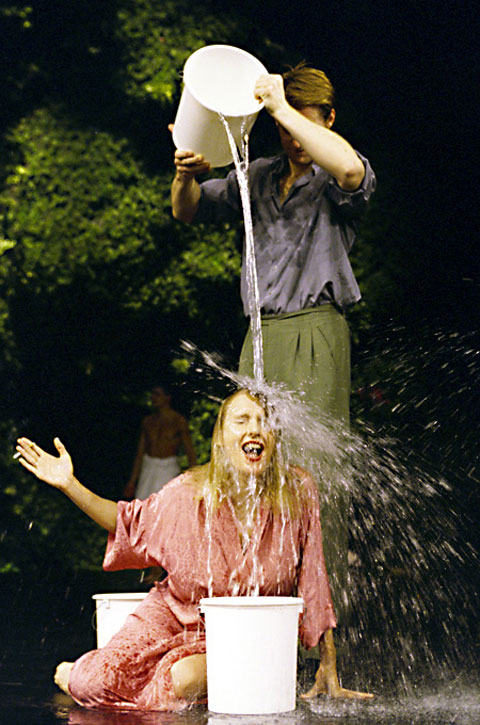
“In Paris” is a performance piece incorporating movement, music, projections, video, text in Russian and French with English supertitles, adapted from a short story by Nobel Prize-winner Ivan Bunin, about a lonely Russian man who meets a lonely young Russian woman. Set in the city of light, Paris, in the 1930s this romantic tale is creatively brought to life by the cast of seven led by legendary dancer and award-winning performer Mikhail Baryshnivov, and director Dmitry Krymov, who also adapted the story. Mikhail Baryshnikov at Berkeley Rep for a special presentation of In Paris.
Photographer: Annie Leibovitz

Krymov is a painter, set designer and director who develops innovative pieces (that are often silent) in Moscow at the Dmitry Krymov Laboratory which play internationally.  For sure, Krymov’s Laboratory with young actors, his innovative approach to theatre making together with Baryshnikov’s legendary presence and instinctive acting and movement skills make an interesting collaborative group. The result is fascinating. It’s stripped down production style is a welcome challenge to the imagination and engenders complicity with the audience.

Mikhail Baryshnikov (right) and Anna Sinyakina at Berkeley Rep in presentation of In Paris.
Photographer: Maria Baranova

 The transformative set by Maria Tregubova is simple and effective comprising a turntable stage, rigging on view, large cut out images that transport us to Paris and an absurdist looking bar table and chair. The cast interact around and within the set pieces as the revolving scene becomes a Parisian bar, a taxi ride and a wonderful old cinema scene evoked by dim projections of Charlie Chaplin and cigarette smoke (Audio & Video Design by Tei Blow).

Mikhail Baryshnikov (right) and Anna Sinyakina at Berkeley Rep in presentation of In Paris.
Photographer: Maria Baranova

 Baryshnivov’s Russian man and the Russian woman played by Krymov Laboratory member and film actor Anna Sinyakina meet, converse and flirt – they express themselves at first in the bar with brief, abstract movements and attitudes tilting the bar table and chair beautifully (movement Coach Andrey Schukin and Choreographer Alexei Ratmansky). Krymov’s staging is brilliant given the spare text and dialogue – with surreal imagery such as a “Magritte look” when Baryshnikov stands in shadows with an umbrella.

The story and subtext of sentiment is often told through non-verbal moments such as when she changes clothes for the date and as he shaves himself and prepares.  A moment in the narrative that might have been interesting to bring to life was near the end of the date when they were deciding whether to go to his or her place, however, at this point the couple was in shadows and the supertitles covered the stage.

Visionary director Dmitry Krymov teams up with other
Russian artists like Mikhail Baryshnikov for Berkeley Rep’s
special presentation of In Paris.
Photo courtesy of Berkeley Repertory Theatre

All images © Berkeley Repertory Theatre. All rights reserved.

A supporting cast of five from Krymov’s Laboratory play background characters, quietly move set pieces to create the scenes, and help Baryshnikov change clothes onstage as in Japanese theatre. They also sing arias, motets and more to accompany the action and Tei Blow provides a variety of additional music and sound effects that add humor and pathos.

Krymov and his team have created clever effects which are part of the whole in this production, such as the woman’s beautiful  long gown transforming to a short dress (costumes by Tregubova), dramatic lighting by Damir Ismagilov – with humor when the spot light following Baryshnikov walking across the stage seems to develop a mind of its own.  A chase between Sinyakina and Baryshnikov becomes magical – and transforms as she turns upside down into a pietà-like statue. In response, Baryshnikov  transforms his coat into a cape and performs an intensely moving brief matador dance. A wonderful production that sells out fast – see it if you can!

More Information:

  • Baryshnikov Arts Center: http://www.bacnyc.org/

    Additional Tour Dates/Locations: Spoleto Festival, Italy, June 30-July 1, 2012; Lincoln Center Festival, New York City, August 1-August 5, 2012.

Jo Tomalin Ph.D.
Critics World
www.forallevents.com
https://forallevents.com/reviews/jo-tomalin/

Juliette Binoche: Miss Julie

By Jo Tomalin

 Photo: Juliette Binoche as Mademoiselle Julie © Christophe Raynaud De Lage


Dazzling Mademoiselle Julie

Imagine a wide white cube with floor to ceiling windows and several tall, lithe, barren tree trunks in the background. There you have the brightly lit stage (set and light Design by Laurent P. Berger) for this contemporized version of August Strindberg’s Mademoiselle Julie, now playing (in French, translation by Terje Sinding) at the world renowned Odéon Théâtre de l’Europe, Paris. While this stark vision may not evoke the traditional home of 1888 when Strindberg wrote “Miss Julie”, it is a perfect canvas for the volatile dance of death director Frédéric Fisbach has created.

Photo: Nicolas Bouchard and Juliette Binoche in Mademoiselle Julie © Christophe Raynaud De Lage

Strindberg wanted to write a tragedy about men and women and the story focuses on the angst and entanglements of male female relationships but with a twist – class issues of master and servant. In this case Miss Julie is the daughter of the owner of the house and Jean is the servant, engaged to Christine the cook. Although scandalous when first produced at end of 19th century Strindberg’s writing and the emotional possibilities of the characters in Miss Julie continue to inspire interpretations and productions worldwide

Fisbach interprets Miss Julie as an existential play that embodies love, desire, and explores naturalism and symbolism. He also sees this as a modern day relatable battle of brains, based on the intelligence + psychology of the two main characters, Mademoiselle Julie played by Juliette Binoche and Jean played by Nicolas Bouchaud.

Juliette Binoche creates an astoundingly believable character physically and emotionally embodying a vast arc and range of sincerity, exuberance, curiosity, naïveté, who is also domineering, passionate and needy. She is masterful at owning the dialogue, as a contemporary woman.

Nicolas Bouchaud as Jean is equally engaging and a good match for Binoche in his carefully drawn worldly servant who is usually in charge downstairs in the kitchen where most of the action takes place, but the unexpected intrusion of Miss Julie from the upstairs world as she returns from a party (continuing in view behind the cube among the trees) causes Jean’s relationship to her through the evening and early next morning,  to hover – at first courteous and sensible, later seduced then confused and ultimately quietly manipulative.

Photo: Nicolas Bouchard and Juliette Binoche in Mademoiselle Julie © Christophe Raynaud De Lage

The human interactions of Binoche wearing an elegant shimmering gold gown (costume design by Alber Elbaz for Lanvin) and Bouchard are true, wrestling with man and woman issues as if in real time, pushing and pulling with poetic, emotional and unexpected challenges leading to the dramatic last moments of the play. Bénédicte Cerutti is wonderful as Christine, coming and going as she finishes her work at night or starts again in the morning. Cerutti’s Christine is earthy, less complex than Jean and Julie and is often the voice of reason in this psychological thriller. A chorus of about thirteen actors dances at the party in the background to pop dance music which disperses as the evening progresses.

The contrasting characters of the three main actors are not only due to the text and the actors themselves, but also due to Fisbach’s direction and attention to detail. Fisbach has very successfully guided his actors to develop different movement qualities in their characters which show the hierarchy and suggest point of view. Binoche is often symmetric and confident standing her ground firmly, while Bourchard’s Jean is often less so with nuances in his asymmetric stance and gestures, however he moves and speaks with stealth which ranges from respectful to romantic and at times chilling.

The rhythm of the play is fluid and takes its time, punctuated by volatile moments, plus two or three short, mesmerizing visceral flashes between Jean and Julie, accompanied by pulsating sounds that make them even more breathtaking. One very moving moment of the play is when the balance of their relationship is fleetingly equal and they are just a man and woman sitting on a step outside chatting during a date – she is getting cold, so he gently puts his jacket on her shoulders while they sit on the edge of the set close to the audience. The magic of simplicity!

This evocative Julie is one to be seen. It premiered at the annual Summer Avignon Theatre Festival in 2011 and continues at the Odéon Théâtre in Paris until June 24, 2012. Then it moves to the Barbican in London from September 20 to 29, 2012.

For more information:
Odéon Théâtre Website
Jo Tomalin Ph.D.
Critics World

“Circle Mirror Transformation” at Marin Theatre Company, Mill Valley CA

By Greg & Suzanne Angeo
“Circle Mirror Transformation” by Annie Baker Presented by Marin Theatre Company
A Bay Area premiere, co-produced with Encore Theatre Company of San Francisco

From Left: Marissa Keltie, Robert Parsons, L Peter Callender, Arwen Anderson, Julia Brothers

Intelligent, Magical “Mirror” Reflects the Familiar in Unique Ways

Reviewed by Suzanne and Greg Angeo

To launch its 46th season, Marin Theatre Company presents “Circle Mirror Transformation”, an accidental journey to self-discovery. It’s an engagingly honest, tenderhearted story in which we can see ourselves clearly reflected in each of the five characters, much like the “Mirror” of the title. Celebrating our all-too-common moments of frustration, social ineptness, awkward pauses and regrets, it embraces a subtle comedy, the kind that arises from real-life human interaction.

The setting is a small college town in Vermont. In a dingy basement dance studio, five people are participating in a “Creative Drama” workshop, a series of six weekly sessions intended for beginning actors. Together they discover the theatre games and exercises that help them to capture and use their innermost creativity and awareness. The very nature of these exercises forces them to get to know themselves, and each other, in sometimes painful, sometimes funny and sometimes lovely ways.

The story unfolds in a series of short vignettes separated by blackouts, and combined with the extended pauses in dialogue that happen in everyday conversation, it allows us freedom of imagination to wonder about the moments being lived onstage and what might happen next. The style is starkly naturalistic, with a spare set and elemental lighting. The costumes could be the actors’ own very casual clothing.

Acclaimed young playwright Annie Baker won an OBIE Award for Best New American Play for her “Circle Mirror Transformation” after its premier Off-Broadway in 2009, also receiving a Drama Desk nomination for Best Play. Her work, which includes her two other plays “Body Awareness” and “The Aliens”, has been produced with great success here in the Bay Area, around the U.S. and worldwide. In an interview before the premiere of “Circle” in September 2009, she described her original style of writing, where less is so much more: she writes a rough draft of her story, and then records herself speaking each of the characters’ parts. Admitting “I’m a pretty bad actor”, she said “It’s so important to me that I capture the cadences of painful, ordinary speech and it’s hard to tell if it’s believable on the page.”

Stripped of artifice, such natural dialogue requires especially skilled actors able to translate the sometimes inarticulate words and pauses for the audience. It’s almost like musicians playing a jazz musical score, relying on the improvisational instincts and connectedness of the performers. Julia Brothers brings emotional dynamism to her role as Marty, the magnetic but vulnerable workshop instructor who ultimately learns more than she teaches. Like a butterfly emerging from a cocoon, Marissa Keltie as the introverted sixteen-year old Lauren keeps her character petulant and subdued, gradually revealing life-changing secrets. The renaissance-man James, Marty’s charmingly intense husband, is played with subtle power by L Peter Callender. In perhaps the most moving performance of the show, Callendar’s character recognizes the painful truth in his own life during a role-playing exercise that will have unintended consequences later on. The role of Theresa, on the run from an abusive relationship, is gracefully played by Arwen Anderson, displaying a fine sense of timing and nuance when interacting with the other characters. Robert Parsons as the dejected Shultz, freshly wounded by a divorce, delivers a performance that will resonate with men everywhere. The brief, stormy romance between Shultz and Theresa forms the sweet hub of the story. All five characters in turn grow and transform, sharing the experience with the audience right through to the surprising ending.

L Peter Callender, Robert Parsons, Julia Brothers

New York director Kip Fagan has an impressive background developing new plays, teaching and directing at the Julliard School, NYU and countless regional workshops and theatres all over the country. In “Circle”, his first play at MTC, he shows unmistakable skill at drawing out the very best improvisational talents of his cast. His vision brings truth and relevance to the stage, perfectly realized in his deceptively simple, almost invisible staging. The success of “Circle” relies in part on his faith in Baker’s unique storytelling style with regards to her special use of blackouts, dialogue and blocking of characters. Scenic Designer Andrew Boyce and Lighting Designer Gabe Maxson recreate the drab, utilitarian workshop with uncanny accuracy. Musical compositions and Sound Design by Cliff Caruthers provides understated, atmospheric support to the performers.

Almost reflexively, we react to the experiences of the actors onstage with a suddenly increased awareness of ourselves and others. It’s a truly refreshing and liberating effect from such a simple concept, like breathing in pure oxygen. The magic onstage comes not from seeing fancy stagecraft, but from recognizing and sharing our human connection. This is priceless, and it makes “Circle” irresistible.

Photos by Kevin Berne

When: now through September 2, 2012

8 p.m. Tuesdays, Thursdays, Fridays and Saturdays

7:30 p.m. Wednesdays

2 p.m. and 7 p.m. Sundays

2 p.m. Saturdays August 11 and August 25

1 p.m. Thursday August 16

Tickets: $36 to $57

Location: Marin Theatre Company

397 Miller Avenue, Mill Valley CA 94941

Phone: 415-388-5208

Website: www.marintheatre.org

Our Country’s Good-A Challenging and Ambitious Production at Porchlight

By Flora Lynn Isaacson

In a scene from Porchlight Theatre Company's outdoor production of "Our Country's Good," 2nd Lt. Ralph Clark (Nick Sholley, far left) rehearses a cast of misfits and illiterate prisoners (pictured L to R - Michael Barr, Shannon Veon Kase, Natalie Palan Walker and LeAnne Rumbel) for a staging of "The Recruiting Officer." Photo by Thais Harris

This outdoor production of Our Country’s Good by Timberlake Wertenbaker takes us to a New South Wales penal colony in the 1980’s where a group of Royal Marines and convicts come together to stage a production of The Recruiting Officer by George Farquhar convinced that art and theatre could inspire and restore the human spirit, a British lieutenant, Ralph Clark (Nick Sholley), plans to present a stage play featuring a cast of misfits and illiterate prisoners when he meets opposition from his fellow officers.

This show is based on true events and characters right out of Australia’s past.  The playwright, Timberlake Wertenbaker did careful research into historic documents, ship’s log and journals to make the play historically accurate. It is right after the conclusion of the American Revolution. Actors wear clothing appropriate to the time with military officers in red coats and convicts dressed in their cloth shirts and dresses that appear to be sewn together from rags.

Our Country’s Good is absorbing theatre.  Broadly, the play is about the triumph of the human spirit against the force of oppression and the metaphor for that is theatre itself offered as educative, restorative and ultimately cathartic.  It is not only the convicts with no more dignity than caged animals who achieve humanization through the staging of a play, but many of the King’s officers become touched and awakened by the spirits of those they have tried to subordinate.

Wertenbaker draws her characters vividly with humor and compassion, and the cast, most doubling roles, fervently bring them to life. Ann Brebner and Tara Blau direct their ensemble with skill, and all are outstanding, but particularly notable are: Michael Barr in the duel role of Captain David Collins and the convict, Sideway, who went on to establish Australia’s first theatre company; Ron Wood (also in a duel role) as the liberal-thinking governor of the colony, Captain Arthur Phillip and the thoughtful convict writer, Catch; Nick Sholley’s decent, and innocent Lieutenant Clark, the director of the proposed play; LeAnne Rumbel’s wonderfully hostile and supercilious Liz insisting that Mary (Natalie Palan Walker) do her lines first; and Shannon Veon Kase as the spirited Dabby Bryant.

It is a real treat to have Porchlight Theatre back in town. Porchlight Theatre Company, based in Marin County, California is an award-winning theatre company established in 1999 by Tara Blau and Molly Noble.  Porchlight Theatre’s production of Our Country’s Good was itself an enactment of one of the play’s own central observations; theatre transforms.

Our Country’s Good plays at Porchlight Theatre, August 16-September 8, 2012. Performances are held at Redwood Amphitheatre, Marin Art & Garden Center, 30 Sir Francis Drake Blvd., Ross, CA.  Performances are at 7:30 p.m. Thursday-Sunday. For tickets, call 415-251-1027 or go online at www.porchlight.net.

Flora Lynn Isaacson


A “Spirited” Comedy by Noel Coward at Cal Shakes

By Flora Lynn Isaacson

Domenique Lozano as Madame Arcati and Jessica Kitchens as Elvira Condomine in Cal Shakes’ production of BLITHE SPIRIT, directed by Mark Rucker; photo by Kevin Berne


California Shakespeare Theatre continues its 39th season with Noel Coward’s Blithe Spirit directed by ACT Associate Artistic Director and Cal Shakes Associate Artist Mark Rucker.

Charles Condomine (Anthony Fusco), a successful novelist, wishes to learn about the occult for a novel he is writing, and he arranges for the eccentric medium, Madame Arcati (Domenique Lozano) to hold a seance at his house.  At the seance, she immediately summons Charles’ first wife, Elvira (Jessica Kitchens), who has been dead seven years.  Madame Arcati leaves after the seance unaware that she has summoned Elvira.  Only Charles can see or hear Elvira, and his second wife, Ruth (Rene Augesen) does not believe that Elvira exists until a floating vase is handed to her out of the air.   The ghostly Elvira makes continued and increasingly desperate efforts to disrupt Charles’ current marriage.  She finally sabotages his car in the hope of killing him so he can join her in the spirit world, but it is Ruth rather than Charles who drives off and is killed.

Ruth’s ghost immediately comes back for revenge on Elvira and though Charles cannot, at first, see Ruth, he can see that Elvira is being chased and tormented and his house is in an uproar.  He calls Madame Arcati back to exorcise both of the spirits, but instead of banishing them, she materializes Ruth.  With both of his dead wives now fully visible, and neither of them in the best of tempers, Charles, together with Madame Arcati, goes through seance after seance and spell after spell to try to exorcise them and at last, Madame Arcati succeeds.  Charles is left seemingly in peace, but Madame Arcati, hinting that the ghosts may still be around unseen, warns him that he should go away as soon as possible. Charles leaves at once, and the unseen ghosts throw things and destroy the room as soon as he goes.

Noel Coward has such a good time making mischief with marriage and mediums, and Director Mark Rucker does nothing to interfere with the fun.  His light touch has given the actors freedom to spirit themselves around Annie Smart’s spacious, upscale living room and creates a delicious souffle of a play.  Six of Rucker’s seven actors are from ACT.  Anthony Fusco, a regular at Cal Shakes plays Charles as a self-absorbed, upper-class, witty novelist.  Rene Augesen portrays Ruth as rather staid and conventional, while Jessica Kitchens is both sexy and kittenish as Elvira.

Domenique Lozano as Madame Arcati practically steals the show making a real person out of her boisterous character being aided by Katherine Roth’s wonderful costumes. Rounding out the cast are Kevin Rolston as Doctor Bradman and Melissa Smith as Mrs. Bradman, Charles’ seance companions.  Rebekah Brockman is absolutely wonderful as Edith, Charles’ dim-witted maid.

A large part of what makes this production so successful is how well spoken all of the actors are.  Their British accents are accurate, their diction precise and their voices commanding.  Even though Coward wrote Blithe Spirit during England’s battle scarred year of 1941, this play still feels fresh today.

Blithe Spirit will run at California Shakespeare Theatre August 8-September 7 at Bruns Amphitheatre, 100 California Shakespeare Theatre Way, Orinda, CA.  For tickets, call the box office at 510-548-9666 or go online at www.calshakes.org.

Coming up next at Cal Shakes will be William Shakespeare’s Hamlet directed by Liesl Tommy from September 19-October 14, 2012.

Flora Lynn Isaacson


Get out the bubbly for “Blithe Spirit”

By Judy Richter

Like a light, bubbly glass of Champagne, there’s nothing quite like a well written, well executed comedy on a warm summer night. California Shakespeare Theater serves up just the right blend of the latter with its production of Noel Coward’s “Blithe Spirit,” adroitly directed by Mark Rucker.

With the setting sun turning the background hills to gold, Annie Smart’s gracious living room set transports the audience to Kent, England, in the late 1930s. That’s where successful author Charles Condomine (Anthony Fusco) and his wife, Ruth (Rene Augesen, are awaiting three dinner guests. One of those guests is Madame Arcati (Domenique Lozano), an eccentric local medium, who will conduct a seance. She doesn’t know that the evening’s real purpose is for Charles to gather information for his next book. The other two guests are a local physician, Dr. George Bradman (Kevin Rolston), and his wife, Violet (Melissa Smith).

The evening turns out to be far more eventful than Charles had bargained for because it results in the appearance of his first wife, Elvira (Jessica Kitchens), who has been dead for seven years. Complicating matters even more, only Charles can see her. Hence, when Charles makes some snappish replies to something Elvira says, Ruth thinks they’re directed at her and takes offense. As events continue to unfold, Elvira makes all sorts of mischief, resulting in Ruth’s joining her “on the other side” and making life miserable for Charles.

Rucker allows the pace to bubble along with its talented cast. Fusco is nicely understated as the heretofore unflappable Charles becomes more exasperated with Elvira. Augesen’s Ruth serves as the gracious hostess while dealing with difficulties on several fronts. Lozano is nothing short of hilarious as her bicycle-riding Madame Arcati goes through her elaborate preparations for the sance. This is a role that lends itself to overacting, but Lozano wisely knows where to draw the line. Kitchens is a slinky, sexy Elvira who reveals more of her true character along the way.

More comic antics come from Rebekah Brockman as Edith, the Condomines’ wide-eyed, fast-moving, slow-on-the-uptake maid. Rolston and Smith fulfill their auxiliary roles competently.

In addition to Smart’s attractive set, the three-act production is enhanced by Katherine Roth’s fashionable period costumes, York Kennedy’s lighting and Will McCandless’s compositions and sound.

Coward is said to have written “Blithe Spirit” in five days in 1941, when England was in the throes of war against Germany. One of his purposes was to buoy the spirits of his countrymen in those dire times. Apparently he succeeded on that front, for the play initially ran for 1,997 performances. Since then it has enjoyed numerous revivals, among them this lovely production by Cal Shakes.

Performances continue through Sept. 2 at the Bruns Memorial Amphitheater, 100 California Shakespeare Theater Way, Orinda, CA. For tickets and more information call (510) 548-9666 or go to www.calshakes.org.

BLITHE SPIRIT a brilliant resurrection at Cal Shakes

By Kedar K. Adour

Annie Smart's Blithe Spirit Set

BLITHE SPIRIT: Comedy by Noel Coward. Directed by Mark Rucker. California Shakespeare Theatre (Cal Shakes), Bruns Amphitheater, 100 California Shakespeare Theater Way (formerly 100 Gateway Blvd), Orinda, CA 94563. 510.548.9666 or www.calshakes.org. August 8 – September 2, 2012.

BLITHE SPIRIT a brilliant resurrection

California Shakespeare Company (Cal Shakes) has raided the American Conservatory Theatre (A.C.T.) company to stock the cast for their production of Noel Coward’s Blithe Spirit. It was a brilliant move as they resurrect this 70 year old drawing room comedy just as the inimitable Madame Arcati brought to protoplasmic life Elvira who had passed over to the “other side.”

The only non A.C.T. associate Domenique Lozano plays the pivotal role of Madame Arcati. She follows a distinguished line of actors who have dominated the role. The first actors to invest Madame Arcati with theatrical life in 1941 were Margaret Rutherford in London (she was also cast in the movie), Mildred Nantwick in the New York and most recently Angela Lansbury in 2009 winning a Tony for Best Featured Actress. Lozano, as directed by Mark Rucker, adds a different spin to the character that makes Arcati less loveable and a bit harsh. That is not a criticism but an observation since her performance was well received with the audience giving her an added burst of applause at the curtain calls.

Who is this Madame Arcati that dominates the opening paragraphs of this review? She is the product of Noel Coward’s fertile satiric mind that fashioned Blithe Spirit over a period of five days while on retreat in Wales after his London quarters were bombed in 1941. It was his successful attempt to create a comedy to cheer a British populous under continual bombing attacks by the Nazis. It was a huge success running for almost 2,000 performances.


René Augesen as Ruth Condomine and Anthony Fusco as Charles Condomine in Cal Shakes production of BLITHE SPIRIT, directed by Mark Rucker; photo by Kevin Berne.


The main character is not Madame Arcati, although actors covet playing the role that is designed to steal scenes. It seems that novelist Charles Condomine (Anthony Fusco) now married to his second wife Ruth (Rene Augesen) in doing research for a new mystery book, arranges a séance to be performed by the ditzy local spiritual medium Madame Arcati whom is suspected of being a charlatan. Dr. and Mrs. Bradman (Kevin Ralston and Melissa Smith) share a pre-séance dinner served by an inept Edith (Rebekah Brockman) and stay expecting a bit of fun at Madame Arcati’s expense. Horrors, Arcati is the real thing and she accidentally conjures up the spirit of Elvira (Jessica Kitchens) the selfish and spoiled first wife of Charles.

It seems that Charles is the only one able to see Elvira. This allows Coward to write some witty bits of dialog between Charles and Elvira that are misinterpreted by Ruth who becomes hysterically distraught. Things go from bad to worse when Elvira, with murder in her heart, decides to sabotage Charles’s second marriage to Ruth. Hilarious wildness ensues with surprising plot twists and disastrous results that keep you enthralled.

Cal Shakes elected to perform the play in its original three act format lasting 2 hours and forty minutes with two 10 minute intermissions. Doing so is confirmation of Henri Bergson’s concept of relative time can be encapsulated in “who notices time when you’re having fun?” Seasoned actors Augenson and Fusco perform with authority giving equal depth to their verbal duels although Coward gives Charles the last words. Jessica Kitchens, a recent A.C.T. MFA graduate, is a vision of beauty as the ghostly Elvira and A.C.T. MFA student Rebekah Brockman as Edith is a joy to watch.

Much of that credit given to the actors must be shared by Mark Rucker’s spot on direction that matches his reign over the 2009 Cal Shakes multi award winning staging of Private Lives. Annie Smart’s set uses the full outdoor stage and although expansive has the intimate feeling needed for a drawing room comedy. What happens to that tidy set in the final scenes is shocking. The attachment of white wisteria and a flowering bush outside of the ubiquitous French doors is a nice touch. Not to be outdone by the acting, directing and sets Katherine Roth’s costume designs including the garish “spiritual” outfit worn by Madam Arcati earn equal accolades.

Kedar K. Adour, MD

Courtesy of www.theatreworldinternetmagazine.com.


Circle Mirror Transformation: Theater Games Reveal Real Life Situations

By Flora Lynn Isaacson


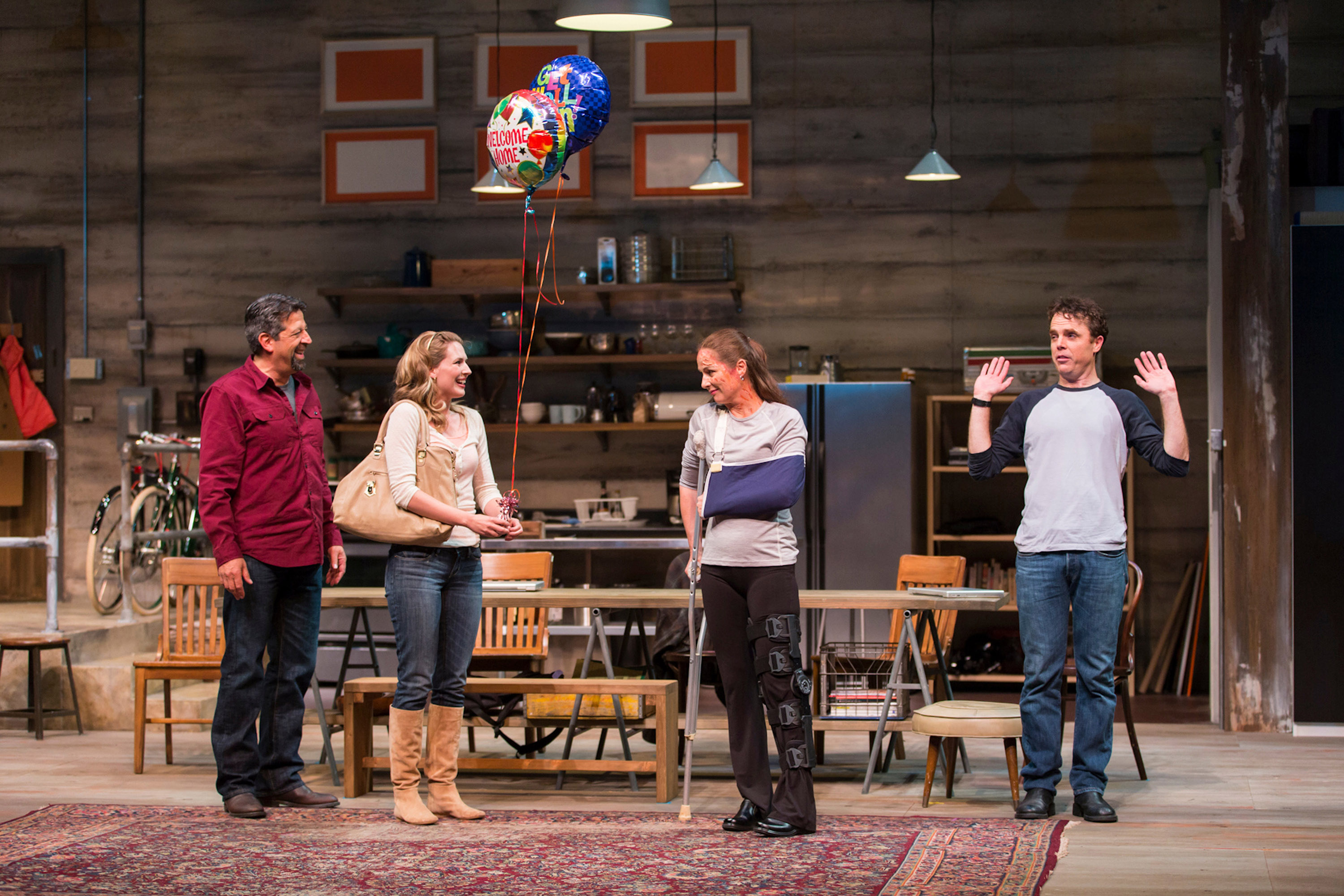
Theresa (Arwen Anderson) and Marty (Julia Brothers) talk during a break from their adult Creative Drama class in the Bay Area Premiere of Annie Baker’s Circle Mirror Transformation, now playing at Marin Theatre Company, in co-production with Encore Theatre Company, through August 26.

Marin Theatre Company in a co-production with Encore Theatre Company of San Francisco, has opened its 2012-13 Season with a regional premiere of Circle Mirror Transformation by Annie Baker, a hot, young, New York-based playwright.  Earlier this year, the Aurora Theatre Company gave Annie Baker’s Body Awareness a strong production, followed by the San Francisco Playhouse’s superb production of her second play, The Aliens, which were both set in the fictional town of Shirley, Vermont.  Circle Mirror Transformation, also set in Shirley, Vermont, has become her most popular play.

Since Annie Baker’s Circle Mirror Transformation is an actor’s play, it wouldn’t be surprising if any person who has taken an acting class has played at least one of the games presented in this play. However, Circle Mirror Transformation is not just a play about acting. It is also a play about life.  Acting could be viewed as mirroring the transformation of life.  According to Annie Baker, life is about circles, mirrors, and transformations.  Life is often described as a circle, observing only six weeks of an acting class, Baker grapples with many common issues in life.

In 33 brief scenes, spread over six weeks, Circle Mirror Transformation follows the discovery of four students with the guidance of Marty, their teacher (Julia Brothers).  The class includes recently divorced carpenter Schultz (Robert Parsons), precocious aspiring actress Lauren (Marissa Keltie), teasing former actress Theresa (Arwen Anderson) and Marty’s husband James (L. Peter Callender).

The play opens on the group in the first day of class playing a concentration game where the goal is to count to ten, one by one, without signaling who is going to say what number and when.  The group is unable to do it. The play is essentially a compilation of acting games with two real scenes in between.

Staged by New York Director Kip Fagan in his first Marin production, the show displays the talents of a marvelously strong cast.  Andrew Boyce’s set is a community center rec room. The class taking place in the center is called “Adult Creative Drama–six weeks of once a week classes conveyed in two hours with no intermission, but with lots of short scenes and blackouts. These pauses are one of the defining trademarks of Annie Baker’s work.  Silence allows the characters to think before they act; everything becomes much more deliberate.  It also gives the audience time and space to take in the story and participate in the moment the characters are living through.

The “transformation” in the title refers to the barely perceptible ways people change each other for good and sometimes forever.  What’s most amazing over the course of the play is the occasional “re-enactments” in which one student plays another.  From the depth and detail of the portrayals, you realize just how much quality time they’ve spent together.  Annie Baker has created a theatrical compliment to real life.

Circle Mirror Transformation runs August 2-August 26, 2012 at the Marin Theatre Company, 397 Miller Avenue, Mill Valley, CA.  Performances are at 8 p.m. Tuesday & Thursday-Saturday; 7:30 p.m. Wednesday; and 7 p.m. Sunday.  Matinees are at 2 p.m. every Sunday. There are also performances Saturday, August 11 and 25 at 2 p.m. and a 1 p.m. performance, Thursday, August 16.

For tickets, call 415-388-5208 or go online at www.marintheatre.org.

Coming up next at Marin Theatre Company will be Top Dog/Under Dog by Susan-Lori Parks and directed by Timothy Douglas, September 27-October 21, 2012.


How Composer Marvin Hamlisch Strutted His Soul

By Woody Weingarten

Marvin Hamlisch, back when

EDITOR’S NOTE: Twenty years ago, Woody Weingarten talked with composer Marvin Hamlisch, who just died at age 68. This is a slightly edited version of the tribute he filed shortly after that one-on-one interview.

Marvin Hamlisch dresses as if he’s first in line for a sale on invisibility.

The composer’s gray, gray suit looks like it had been pressed only minutes ago. His crisp pink tie attempts to disappear in the pale same-hue shirt on which it reclines. Although his black slip-ons are perfectly buffed, they somehow don’t reflect the light.

Behind that CPA exterior, however, is a soul that struts like a peacock.

Marvin Hamlisch, who by the age of 31 had won three Oscars and a Pulitzer, talks at first like a mama’s boy.

His eyes twinkle from behind rimless glasses and his thick lips curl into an industrial size grin when he describes Lilly.

“I had two wonderful parents,” he begins an interview in a San Francisco hotel suite, but when asked if he has a favorite anecdote, he draws laughter with a quick one-liner: “My mother was a Jewish anecdote.”

“She was the ultimate Jewish mother,” he continues. “When my father came home, she had a meal ready. Eat, eat, eat.”

Lilly and Marvin’s father, Max, taught their boy prodigy to love his music and his Jewishness. Because both had fled Nazi terrorism in Europe, however, they suggested he downplay his heritage.

But Marvin Hamlisch advertises his ethnicity. Like Barbra Streisand, whom he’s worked with, he has his original nose. Like Sandy Koufax, Hall of Famer who also balanced his background against his career, he won’t work on Rosh Hashanah or Yom Kippur.

Hamlisch has a piano with 88 keys and a mind with 888 opinions. Ask him a simple question and his mouth starts a marathon.

On cultural lines, for instance: “I feel ecumenical. I don’t like thinking of things being Jewish, Moslem, whatever. A piano is a piano — here, in China, in Tibet. Music is universal. I’m writing for everybody.”

Regarding his best-known creation, Chorus Line, the composer says he particularly enjoys when someone refers to it as “classic Hamlisch.”

In most other instances, Marvin Hamlisch hates to look back. So the man whose career hit a low when his musical Jean bombed in New York not long ago has climbed a new rocket, one with dual exhaust.

First, he’s peddling The Way I Was, a 234-page autobiography from Scribners written with the aid of Gerald Gardner.

It’s unlikely to become a smash because there’s no sex or violence, no kiss-and-tell sizzle.

“I have no desire to talk about old girlfriends,” Hamlisch says. “Why would I want to hurt my wife, to hurt myself, with that crap.”

Besides, he comments, “I hardly ever dated anybody. I had no high school sweethearts because I was working — zoom, off to here; whoosh, off to there.  My mind was always on one thing: ‘Get to Broadway.’”

Writing a book is a learning experience, he says. “It’s very cathartic. You let yourself off the hook for your mistakes.”

Hamlisch’s other new venture is a $7 million show, a musical adaptation of Neil Simon’s Goodbye Girl for Broadway.

“We haven’t had a musical-comedy in a long time,” he says, “and we’ve got comedy up the wazoo.”

Hamlisch worries, though, about the future of big-time theater. “I pray that Broadway will be here a generation from now. Look how many are not going to the theater. It’s too expensive. It’s becoming elitist entertainment. It costs $65 a person, plus dinner, plus parking — if everything goes right, if you get your car back, if you don’t get mugged.”

It’s becoming tougher and tougher, too, to find backers for shows. “Revivals are great for producers,” he notes. “They can raise the $5- or $6 million in a second. But for a new show, you have to audition, you have to play music out of context for very rich people. It’s a degrading way of working.” 

Once things get under way, however, everybody lightens up. “I’m a team player, part of a mosaic. I like it when the whole thing works,” says Hamlisch, who contends that “everything I write is in pencil. I’ll change anything —until we open.”

As for what he wants out of it all, it’s not money, it’s not fame. “My writing will give me, God willing, a legacy,” he says.


CIRCLE MIRROR TRANSFORMATION misses the mark at MTC

By Kedar K. Adour

 Theresa (Arwen Anderson), Lauren (Marissa Keltie), Schultz (Robert Parsons), James (L. Peter Callender) and Marty (Julia Brothers) play the improvisational theater game “Circle, Mirror, Transformation” in the Bay Area Premiere of Annie Baker’s Circle Mirror Transformation, now playing at Marin Theatre Company, in co-production with Encore Theatre

CIRCLE MIRROR TRANSFORMATION: Comedy by Annie Baker. Directed by Kip Fagan.
Marin Theatre Company/ Co-production with Encore Theatre Company at Marin Theatre Company, 397 Miller Avenue, Mill Valley, CA 94941. (415) 388-5208 or  marintheatre.org. August 2 -26, 2012

CIRCLE MIRROR TRANSFORMATION at MTC misses the mark

Marin Theatre Company’s 45th 2011-2012 season was a resounding success with all six of their productions receiving glowing reviews. Thus their 46th season beginning with Circle Mirror Transformation (CMT) with a star studded cast was received with great expectations. It was not to be even though the ensemble cast of five played it straight displaying great acting. Director Kip Fagan who directed Michael Von Siebenberg Melts Through the Floorboards at this year’s Humana New American Play Festival that bombed in Louisville, may have better served the cast to play it for laughs.

There are laughs, mostly unintentional and few and far between. The decision to produce the two hour play without intermission was probably a wise decision since at the one hour mark many of the audience were looking at their watches.

This is the third play by the much praised Annie Baker to be produced in the Bay Area in the past year, each being very successful. Unfortunately this reviewer missed Body Awareness that had an extended run at the Aurora Theatre but had the pleasure giving The Aliens a rave review for the SF Playhouse production.( http://kedaradourforallevents.blogspot.com/2012/04/aliens-beautifully-staged-at-sf.html)

CMT is one of three plays set in the mythical town of Shirley, Vermont but the author insists that they are not a trilogy. The set up for CMT is based on the need for locals to express themselves by being transformed through improvisations that is the keystone of some drama schools and ridiculed by others. Examples are the “Gibber-view” where one ‘actor’ asks a question in English and another answers in gibberish and if they are good at it we can understand the gibberish. Another is ‘The Mirror’ where the two players imitate “mirror” the others’ movements exactly thus transforming him/herself. Thus the play’s title.

Yes, these techniques are used by Marty (welcome back the talented Julia Brothers) who teaches a six-week Creative Drama class in the Community Center of Shirley, Vermont. She has attracted four eclectic characters who wish to become actors or better actors. There is the vivacious Theresa (a fine Arwen Anderson) a sometimes actress who has broken up with her abusive partner in New York City and is new to the town. Next up is James (an underutilized L. Peter Callender) whose relationship with Marty becomes somewhat clear late in the play. Lauren (a charming Marissa Keltie) is an introverted 16 year old who hasn’t decided to be an actor or a veterinarian. Last but hardly least is Schultz played by the scene stealer, matching Brothers’ performance, Robert Parsons.

The ‘play’ is a series of blackouts some lasting only seconds with many, many pauses that engenders a feeling of ‘let’s get on with it’. The biggest laugh is earned by Brothers when she has asked the students to write down a secret that they would not tell anyone about. When the request is received with reticence her comment, “Trust me guys” brings down the house.

Kedar K. Adour, MD

Courtesy of www.theatreworlinternetmagazine.com