


L’enfant Qui… Photo credit: Anne Baraquin
Review by Jo Tomalin
www.ForAllEvents.com
L’enfant Qui… ***** (Five Stars)

L’enfant Qui…
Photo credit: Anne Baraquin
L’enfant Qui… an organic and earthy theatrical circus show by Belgian company T1J is wowing audiences at the Edinburgh Fringe Festival! Live cello music sets the mood for this extraordinary visual storytelling incorporating puppetry and a fascinating form of hand balance/ acrobatics.
Built around a story based on the early life of Jephan de Villiers, a Belgian sculptor, and how he dealt with childhood illness, this may sound an unusual plot for a show, but it is beautifully told expressionistically through energetic acrobatic movement, brilliant puppetry, live music and an exciting yet poetic atmosphere.

L’enfant Qui…
Photo credit: Anne Baraquin
The cast are multi-talented and highly skilled at what they do. Entering in different combinations they perform clever versions of scenes and acts with a theatrical focus, enthralling the audience.
Wonderfully slow lighting changes add to the dramatic ambiance in this circus tent/chapiteau, which was specially made for the company.
L’enfant Qui… is a magical experience and very highly recommended.
This is one of four very interesting and entertaining shows offered by Vive le Fringe! for the Institut français d’Écosse – and it is worth seeking out this venue for these treasures of shows – plus a cosy French café, Le Bistrot which serves snacks and drinks.
Other shows at the Institut français d’Écosse:
 Colette Garrigan in Sleeping Beauty
Photo credit: Cie Akselere
- Weird and Wonderful Antiquithon by Company des Femmes à Barbe (Read Review here)
- binôme – Souris Chaos / Thibault Rossigneux & Cie les sens des mots – a witty comedy about food as catharsis.
- Sleeping Beauty by Cie Akselere -A bold performance of a princess tale told by Artist and Puppeteer Colette Garrigan. Incorporating shadow theatre, object theatre and direct dramatic bi-lingual storytelling, Garrigan tells of an intense era in her life growing up in Liverpool.
L’enfant Qui…Performance information:
Dates | 8-24 August
Time | 6 pm
Duration | 55 minutes
Space | Chapiteau
Age Category | 14+
Location/Venue:
Institut français d’Écosse
Venue 134
13 Randolph Crescent
Edinburgh EH3 7TT
BOOK TICKETS : 0131 225 53 66
More Information:
Vive le Fringe! http://vivelefringe.org/
Edinburgh Fringe Festival show page: https://tickets.edfringe.com/whats-on/l-enfant-qui
T1J: www.t1j.be

Jo Tomalin, Ph.D. reviews Dance, Theatre & Physical Theatre Performances
More Reviews by Jo Tomalin
TWITTER @JoTomalin
www.forallevents.com Arts & Travel Reviews
Review by Jo Tomalin
www.ForAllEvents.com
Chef – is Brilliant!
***** (5/5 stars)
Chef is a theatrical monologue written by award winning poet Sabrina Mahfouz and vibrantly performed by Jade Anouka, about an haute cuisine chef who ends up as a convicted inmate running a prison kitchen. Anouka’s chef character is elegant and passionate gushing forth with stories flowing from the heart.
Staged in the curved metal dome of Underbelly’s Big Belly theatre and well directed by Kirsty Patrick Ward, the set comprises a shiny metal kitchen table, several utensils and a whiteboard. Anouka wears a chef’s jacket, a black and white scarf on her head, and grey just below the knee length trousers.
Mahfouz’s language is poetic and the layers are fascinating as she leads us through each chapter of a cook-book about the art of cooking peppered with juicy life stories. Anouka writes several intriguing headings on the whiteboard, such as…The Perfect Peach…and Coconut Curried Tofu then tells us about different eras of her life – her philosophy of the perfect peach, her loves, distrust, hopes and dreams.
The combination of Anouka’s earnest, gutsy, alive and on point physical performance as the chef and the beautifully fluid crafting by Mahfouz makes this an outstanding performance piece. Satisfying in every way, this one-hour monologue is very entertaining and moving, going deep into a raw emotional core, captivating the audience.
Information and Tickets:
Location: Underbelly, Cowgate (Venue 61)
Box Office: 0844 545 8252
More Info/Tickets: https://tickets.edfringe.com/whats-on/chef
Underbelly: http://www.underbellyedinburgh.co.uk
Jo Tomalin, Ph.D. reviews Dance, Theatre & Physical Theatre Performances
More Reviews by Jo Tomalin
TWITTER @JoTomalin
www.forallevents.com Arts & Travel Reviews
This is a letter I wrote recently to Dr. Patrick J. Ferrillo Jr., Dean of the University of the Pacific, Arthur A. Dugoni School of Dentistry. It conveys my reaction to their new clinic that opened in July at 155 5th St. in San Francisco.
Dear Dr. Ferrillo,
Yesterday I had the privilege of being treated as a patient at your new clinic at 155 Fifth Street in San Francisco. I have been a patient at the University of the Pacific Dental School for over twenty years, and your students and faculty have done a marvel with my teeth for which I am very grateful.
However, my reason for writing today is that I was disturbed and troubled by my experience yesterday, so much so, that I feel compelled to write and share my thoughts and observations with you. My student dentist, (name omitted) and his assistant, (name omitted) were excellent and showed great capability and conscientiousness. This letter, though, has nothing to do with their performance or my treatment as a dental patient. It has, rather, to do with the ambience and character of the new space where the clinic is now located.
My initial impression as I walked through was one of sterility and impersonality. I don’t mean sterility in the sense of the absence of bacteria, but rather the absence of human warmth and personality. This initial impression grew and intensified throughout the afternoon.
The layout and arrangement of the new clinic has been calculated in every consideration to minimize the interaction between the student dentist and the patient. The patient sits in a chair that is facing into the back of the cubicle, with the student’s workstation and computer directly behind the patient. The result is that the student is constantly talking to the back of the patient and the patient is responding away from the dentist into empty space. The student may try to lean around the back of the chair and the patient may try to twist his body on that uncomfortable seat so they can see each other a little bit, as we did, but it is a very awkward, uncomfortable, stilted way to conduct a conversation. And the effect is that it discourages the patient and the dentist from talking to each other anymore than is absolutely necessary, reducing personal interaction to an absolute minimum. I believe this was a deliberate, conscious choice on the part of the interior designers. I would not say that the layout of the space was thoughtless. On the contrary, I think it has been carefully thought out under the guidance of the most perverse and misguided values.
One positive thing I can say about the interior design is that the cubicles are spacious. There is plenty of room in those cubicles in contrast to the ones on Sacramento Street, which were so cramped that the students could hardly move around the dental chairs. It is too bad that you have made such poor use of that generous spatial allotment. The student’s computer is positioned on an unmovable pavilion at the front of the cubicle that divides and partially blocks the wide entranceway creating a closed in effect. Perhaps it was intended as a visual obstacle to make it less easy to see in or out of the cubicle. But its immobility means that the student has to do all of his work and analysis out of sight of the patient. The patient never sees what the student is looking at.
At one point early on, my student presented me with a small electronic tablet on which I was to sign my name to authorize charges. But the cord was too short. It wouldn’t reach from the computer station to the dental chair. I had to twist awkwardly on the chair and reach around and the student did something I could not see to get a little more length out of the cord so I could sign my name. This is one example of the ridiculous inconvenience of having the computer and related equipment on something that cannot move, and positioned so that the patient in the chair is completely excluded from it.
When the instructor comes to discuss the case with the student, the discussion takes place behind the patient with the patient facing in the opposite direction being unable to participate or comprehend what is being discussed. The patient is effectively excluded from the deliberations on his own case. I think this was also a conscious, considered decision in the design.
The height of the partitions between the cubicles is about shoulder high effectively preventing anyone who is not standing up (and many that are) from seeing anything else that is going on in the clinic. This underlines the sense of isolation that the patient feels being positioned away from the dentist and his associates who are working on him. In the Sacramento Street clinic a person sitting upright in a chair could see all around the clinic humming with activity. I always enjoyed this and found it stimulating and interesting to watch: the people coming and going, the diverse activities, the buzz of conversations, the attractive female dental students. It provides stimulation and a sense of inclusion and participation in a group activity.
On your website you boast that the dental school, “is renowned for its humanistic model of education. Accentuating the positive, respecting the individual and empowering its dedicated faculty to provide the best possible learning environment for every dental student are among the school’s primary goals.” I had to laugh when I saw that. This new clinic makes a mockery of those values. This new space is one of the most inhuman, depersonalized environments I have ever seen in a medical context.
This is all justified under the guise of preserving the patient’s privacy. What does that amount to? Is it that you imagine that people do not wish to be seen or have it known that they are being treated in your clinic, like it’s some pornographic book store? Or do you think people might feel self conscious or embarrassed should someone see them laid back in a dental chair with their mouth open being worked on by the student dentists? This is a very minimal inconvenience and should not drive the design of the entire clinic. The feeling of self consciousness or embarrassment is a signal that one is not alone. It is impossible to feel self conscious when one is alone. In order to eliminate the feeling of self consciousness, of being vulnerable in the gaze of another person, it is necessary to eliminate all sense of connection, to create a sense of solitude, which is exactly what you have done. It is a great price to pay to remedy a most unobtrusive problem, if it can even be called a problem. I would just call it a phenomenon, a condition of the experience of being in a teaching clinic. It should be seen as benign since it underlines the sense of participating in a communal activity. It creates a sense of inclusion and mitigates whatever indignity one might feel by virtue of the fact that we are all subject to the same conditions and we all share a common experience in this place.
The elevation of “patient privacy,” to a paramount value, I don’t see as benevolent. I see it as another instance of the dehumanization and depersonalization that is increasingly pervading society in our architecture and our public space. “Privacy” is interpreted to mean minimizing interpersonal contact by structuring the physical environment to make it as difficult as possible. This new dental clinic is a paradigmatic example of that trend.
However negative these effects that I have pointed out are on the patient, the most insidious and detrimental impact of this architectural misdirection is the impact it has on the students and on their relationship with their patients, and most importantly, on their attitude toward their patients. Throughout the afternoon I pointed out to my student dentist the things that I saw wrong with the way the clinic and the cubicle space was laid out. His attitude was “Well, that may be, but these are the conditions that are given and we have to make the best of them.” At the end of the day, when his assistant walked me to the escalators she asked me what I thought of the new clinic. When I explained to her exactly what I thought about it, she probably wished she hadn’t asked. But she could understand my point of view, but again, she is reconciled to a circumstance about which she can do nothing.
So what is going to happen is that students, and faculty alike, are simply going to accept this as the given conditions in which they must work. And they will make the best of it, of course. But they will fail to perceive the impact that this is going to have on their interactions with their patients and on their relationships with their patients — if there are to be any relationships. These conditions discourage the formation of “relationships.” The patient becomes an impersonal “object” to be worked on. The whole atmosphere becomes depersonalized. The students will accept this as “normal.” They will be conditioned to expect things to be this way. It won’t be taught. It won’t be pointed out. It will just be absorbed the way one breathes poisoned air. This is the most far reaching and malignant impact that this architectural affront will have as long as this clinic exists. It affects the many thousands of people who will be treated in this clinic in the coming years, but it will extend beyond the clinic and affect the character and practice of dentistry in the United States more broadly by virtue of the students who will be acculturated to this impersonal style of relating to their patients. This is a public issue that goes well beyond my personal case and even beyond the clinic.
If I were in your position I would fire the people from the university who were on the design committee for this clinic, and sue the architectural firm that realized the design and layout of this clinic for creating a brutal, oppressive atmosphere for the students and faculty to work in and for the patients to be treated.
There are three things you can do to fix that place, although it would be expensive. But I think the expense would be worth it and would create a permanent improvement in the ambience of that clinic for every single person who comes through it or works in it.
1. The dental chairs need to be turned 180 degrees, so they are facing out toward the entrance of the cubicle rather than toward the back wall.
2. The computer and all of the related equipment needs to be on a mobile stand that the student can move as he needs to, instead of being in a rigid, fixed location. It should be closer to the patient and visible to the patient.
3. The height of the partitions between the cubicles should be about half of what they are now, giving anyone sitting up in a chair a full view of the entire clinic. This would not enable people to see patients who are prone and being worked on. It would simply create a panorama of visual interest and a sense of inclusion, rather than isolation.
Since this issue is of public interest rather than my personal medical case, I decided to post this letter on my blog where the world can see it https://forallevents.com/reviews/. I think it is important for people to resist the depersonalization that is taking place more and more in our public spaces and our architecture, and the first step in resistance is to point out what is happening. So that is why I am writing to you and that is why I am posting this in a public forum that others may perceive and be inspired to speak out and voice their opposition to the creeping dehumanization that is affecting all of us, and to prompt the University of the Pacific to live up to the humanistic values that it professes.
Sincerely,
Michael Ferguson

How do you create a special, interesting musical evening?
Why not:
– Start with a scenic, atmospheric water location? Say Hyde Street Pier, the historic ferry pier on San Francisco’s northern waterfront, in Fisherman’s Wharf tourist frenzy zone.
– Add an unusual performance venue? Maybe a tall ship, the Sailing Ship Balclutha, a 3-masted, steel-hulled, square-rigged ship built in 1886.
– Include a 5 person musical group? Perhaps 3 vocalists, guitar, percussion, saxophone, bass for rich sensual sound.
Well, that’s exactly what We Players did in their repeat of last year’s sold-out performance of Canciones del Mar: Songs of the Sea!
 In partnership with the San Francisco Maritime National Historical Park, a special one-night music event was held aboard the tall ship Balclutha in July. The program: Canciones del Mar: Songs of the Sea, was an intimate concert, songs about the sea, boats, love, and life, drawn from folkloric and popular music traditions of Latin America and the Caribbean. Performing were:
• Diana Gameros – vocals and guitar
• Jose Roberto Hernandez – vocals and guitar
• Edgardo Cambon – vocals and percussion
• Charlie Gurke – saxophone
• David Pinto – bass
The musicians, at the top of their game and clearly enjoying themselves, gave a terrific concert: original, soulful, rhythmic. A nice mix of instrumentals and vocal renditions. Held inside a snug cabin up top on the ship, the nautical tight quarters headed to the intimacy of the event. When over, we all reluctantly left in that curious state of being very satisfied but wanting more. The 2 hour concert began at 6pm and we had to leave/make way for the 8 pm performance.

About We Players
We Players “presents site-integrated performance events that transform public spaces into realms of participatory theater. …….brings communities together, reclaiming local spaces for public discourse and civic celebration through art…….. extends the transformative powers of performance beyond the stage, ……..invites our collaborators and audience to engage fully and awaken to the spectacular world around us.”
San Francisco Magazine recently honored We Players with the “Best of the Bay” pick for their unique site-specific performance work and declared, “We Players didn’t just break the fourth wall, it toppled the whole playhouse”.
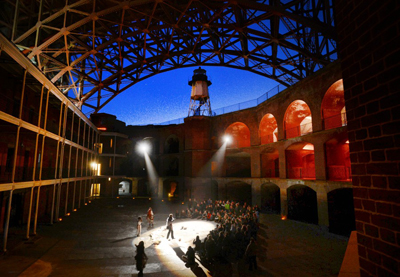
We Players has a 5 year cooperative agreement with San Francisco Maritime National Historical Park — the first partnership of its kind in the nation. As a result, they collaborate with a wide range of artists, creating work from diverse vantage points in a variety of media as an exercise in exploring the many layers of story within the park. The extended venue of the Park, including Maritime Museum building, Municipal Pier, Hyde Street Pier, historic vessels, Victorian Park, and Aquatic Park and lagoon serves as a laboratory for We Players experiments in site-integrated programming. Projects include generating new theatre works inspired by classical literature and Greek mythology, music concerts, dance, staged readings, visual art exhibits, conversations, parties, workshops.
About San Francisco Maritime National Historical Park
Located near Fisherman’s Wharf, open year-round. Visitors view exhibits at the Park’s Visitor Center at the corner of Jefferson Street and Hyde, and walk onto the pier to visit the park’s collection of floating historic ships, and for breathtaking views of the San Francisco Bay and Golden Gate Bridge. Tours, videos and demonstrations are offered daily, including ferryboat Eureka below-decks tour and Balclutha staysail demonstration.
About Balclutha
3-masted, steel-hulled, square-rigged ship built to carry variety of cargo all over the world. Launched 1886 near Glasgow, Scotland, the ship carried goods around Cape Horn (tip of South America) 17 times. It took a crew of about 26 men to handle the ship at sea with her complex rigging and 25 sails. Balclutha also had a brief career as a movie star in Mutiny on the Bounty, alongside Clark Gable and Charles Laughton; she narrowly escaped World War II scrap metal drives before being purchased by the San Francisco Maritime Museum in 1954.
Experiencing The Bay Area With We Players
As with recent performances on Alcatraz and Angel Island State Park, We Players continues its collaboration with the National Park Service and California State Parks to connect people with local Bay Area public spaces through site-integrated theatre. “An essential goal of our work is to inspire in our audience personal relationships with the places in which we play,” says Ava Roy, the company’s Artistic Director.
more info at www.weplayers.org
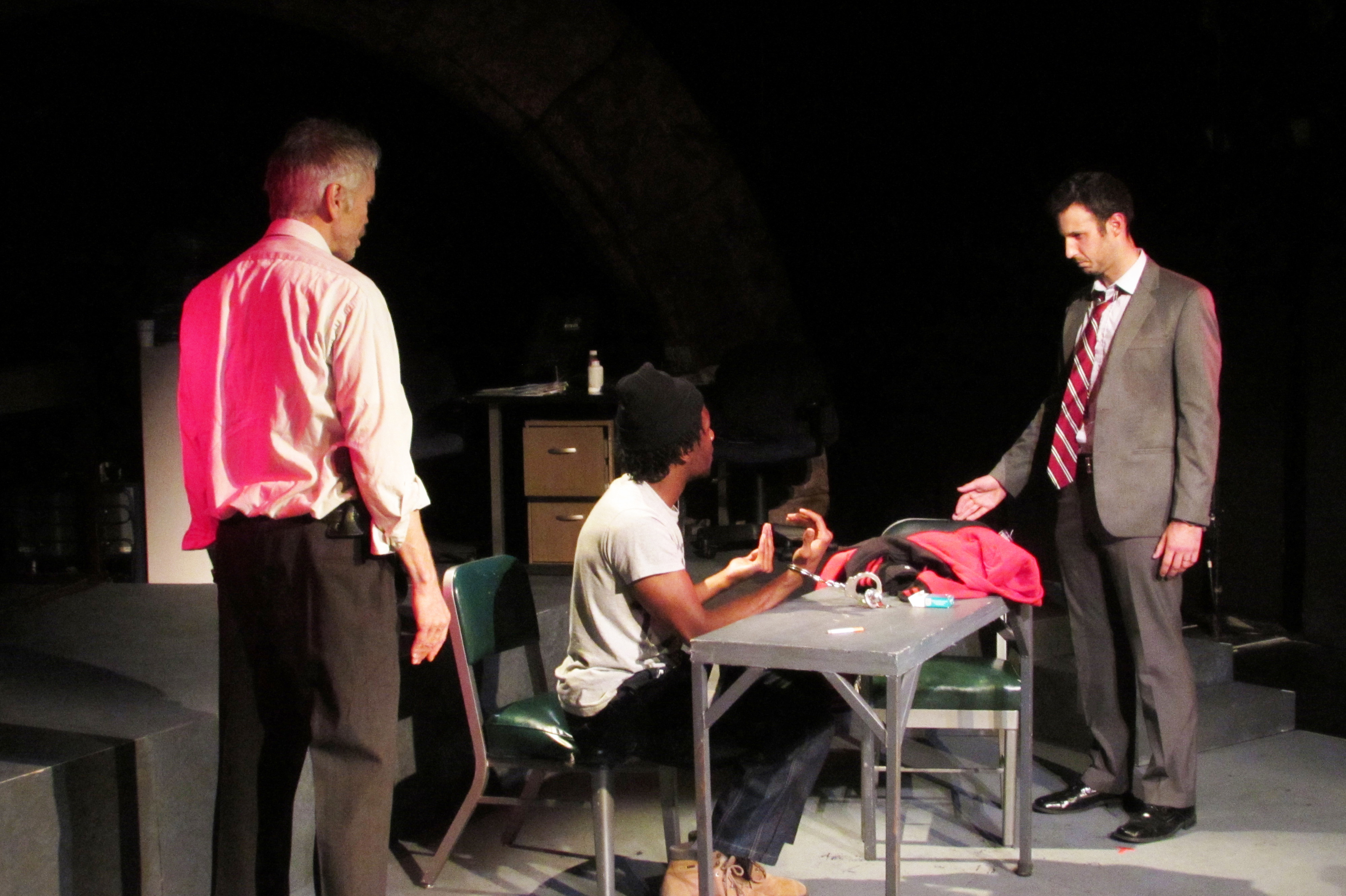
Detectives (Charles Shaw Robinson* and Matthew Baldiga*) interrogate William (Isiah Thompson).
FROM RED TO BLACK: Drama by Rhett Rossi. Directed by Susi Damilano. SF Playhouse San Box Series, A.C.T. Costume Shop on 1119 Market Street (at Seventh Street)/Civic Center Bart, San Francisco, CA. 415-677-9596 or www.sfplayhouse.org. August 9 -30, 2014
From Red to Black reminiscent of a Law & Order TV script. [rating:3] (3 of 5 Stars)
San Francisco Bay Area has become a destination for playwrights seeking workshops and productions of their plays. In the past the Magic Theatre was the premiere venue for nurturing new writers but now five other local groups, including the SF Playhouse, have joined the fray. SF Playhouse’s entry into that group is called “Sandbox” that began with simple staged readings in the “back room” of their previous venue. They have branched out into limited full productions and From Red to Black is their latest offering.
The title ‘red to black’ refers to an esoteric binary tree, used in computer science to organize pieces of comparable data, such as text fragments or numbers. In Rhett Rossi’s play that ‘binary tree’ becomes two Irish detectives interrogating William (Isiah Thompson) an insecure young black man suspected (accused) of shoving a white man into the path of a subway train. The detectives are the stereotypic ‘good cop/bad cop’ each with their individual hang-ups.
The older “bad’ detective is Denny Mitchell (Charles Shaw Robinson) and the younger is “good” Jack Flanagan (Matthew Baldiga). As the play progresses there is a subtle to compelling shift in personalities but they remain stereotypic characters and both actors give powerful performances. Isiah Thompson has the best role as the accused and he brings to life the claustrophobic insecurity enshrouded in bravado demanded of the writing.
The writing is commendable and adroitly carries the plot line but relies on some extended exposition disguised as conversation between the detectives. To discuss the fourth member of the cast Lawrence Stevens (Michael Shipley) would be a spoiler since that character is the keystone of the surprise ending.
Director Susi Damilano’s tight direction is made easier by Bill English’s multi-area set allowing her to move the characters smoothly from scene to scene keeping the entire evening less than 90 minutes without an intermission. The play is being performed at the intimate A.C.T. Costume shop with limited technical support but light design by Jessica Brent backed up by Hannah Birch Carl’s sound design using the rumble of subway trains give the proper atmospheric claustrophobic effect. Recommended as a ‘should see’ production.
Cast: Matthew Baldiga (Detective Jack Flanagan); Charles Shaw Robinson (Detective Denny Mitchell); Michael Shipley (Lawrence Stevens); Isiah Thompson (William).
Creative Team: Set Design by Bill English; Costume Design by Jeffrey Hamby; Stage Manager by Jessica Charles; Light Design by Jessica Bent; Sound Design by Hannah Birch Carl; Props Designer by Jordan Puckett; Casting Director by Lauren English; Fight Choreographer by Miguel Martinez; Dialect Coach Lynne Soffer; Dramaturg by Kevin Kittle
Kedar K. Adour, MD
Courtesy of www.theatreworldinternetmagazine.com.
Detectives (Charles Shaw Robinson* and Matthew Baldiga*) interrogate William (Isiah Thompson).

Dracula Inquest : Drama. Written by Gary Graves. Directed by Jan Zvaifler. Central Works, At the Berkeley City Club, 2315 Durant, Berkeley, CA. www.centralworks.org or 510-558-1381. July 12–August 17, 2014 World Premiere #44
Dracula Inquest by Central Works a thriller. [rating:4] (4 of 5 five stars)
If you are a member of Central Works the Bay Area collective dedicated to the production of new plays, you surely must subjugate your ego to the collective ego or at least leave your ego at the door. Now, what the hell does that mean or have to do with a review of their latest world premiere Dracula Inquest?
It means a hell-of-a-lot. The collective concept has worked for them since their decision in 1997 to “write, develop, and produce world premieres.” Whereas most plays go through workshop after workshop, Central Works’ timeline for a play is four to six months. A playwright’s idea is taken to the group and before any script is written, a director is selected and they set about casting the non-existent play. They plan about 10 meetings with the playwright, director and cast contributing to the final script. For Dracula Inquest Gary Graves is their resident playwright and is given full credit for the script.
In Dracula Inquest Graves has taken Bram Stoker’s novel, pared the characters down to four and postulates a “what if” scenario. In the novel the four are the “good guys’ who eventually do Dracula in with a wooden stake through his heart. Wait just a while, what if those “good guys” were not what they seemed and were just after Count Dracula’s wealth? They hide behind their façade as the “Crew of Light” insisting that their heinous act was done in the name of humanity.
In the play the four “Crew of Lights” are the lawyer Jonathon Harker (Joshua Schell), his wife Mina Harker (Megan Trout), Dr. Seward (Kenny Toll) who has prescribe opiates for Minna and the leader of the group Professor Van Helsing (Joe Estalack). They are all locked up in an insane asylum.
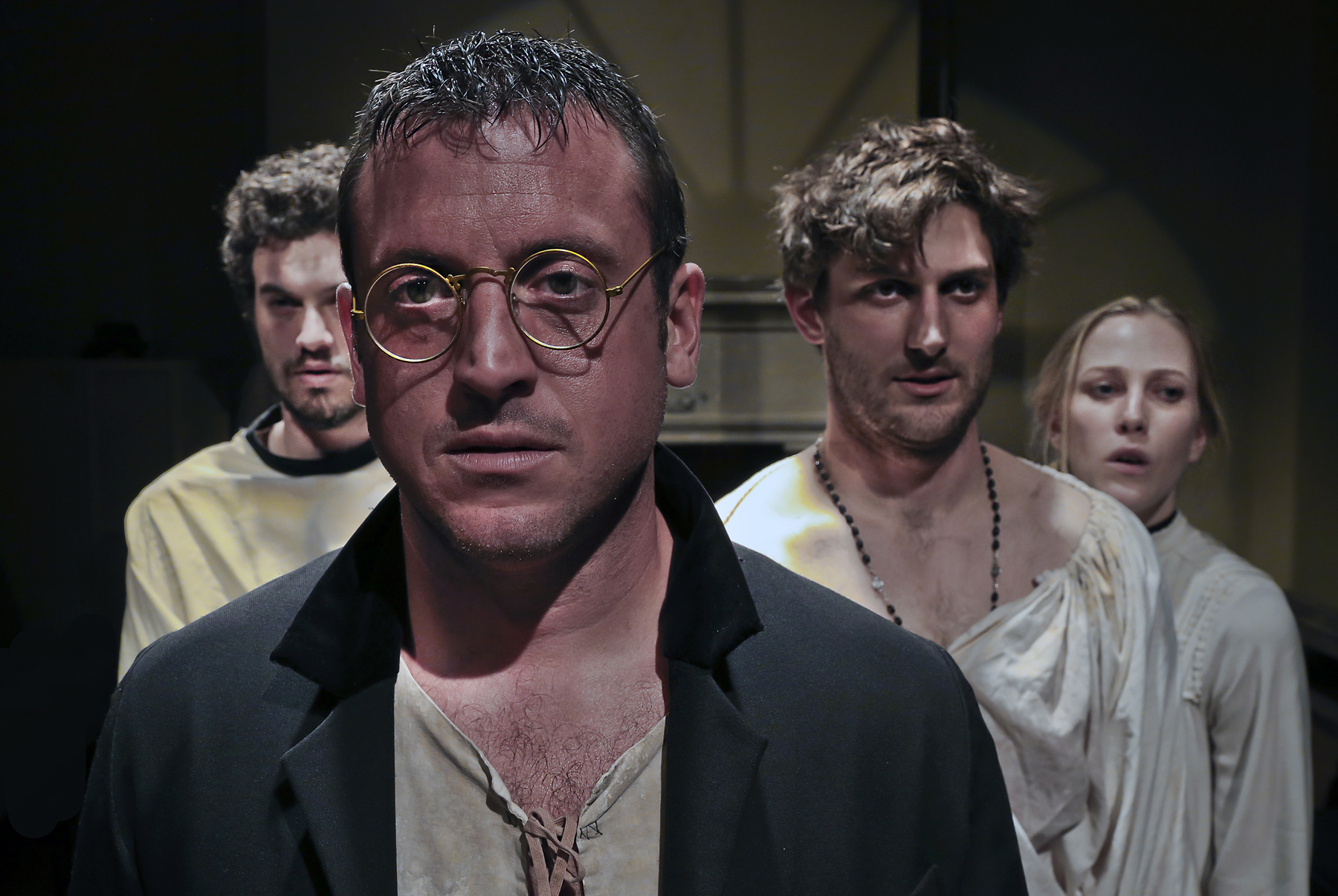
Professor Van Helsing and his intrepid team of vampire hunters, now all inmates of the Whitby Asylum for the Criminally Insane —and under investigation regarding
the disappearance of a mysterious nobleman from Transylvania.
(l to r): Kenny Toll, Joe Estlack, Joshua Schell & Megan Trout.
The time is 1895 three years after the disappearance of the wealthy Count Dracula. Scotland Yard Detective Sly (John Flanagan) arrives at the asylum to interview the miscreants having in his possession a typed book describing all the details (much of it apparently taken verbatim for Stoker’s novel) of Count Dracula’s disappearance. The disbelieving Sly may have his convictions changed by the dramatic ending end of the show.
Central works now is ensconced at the Berkeley City Club using the miniscule 50(?) seat three sided theatre with only two rows of seats on each side. This intimacy works wonders for this production with the audience pushing back in their seats to avoid the “insane” action on stage. The play is a shocker and should be rolled out for Halloween. The quality of the actors is superb and all deliver their long speeches with veracity. If there is a weakness of the writing it is that the play is a series of monologs with minimal interaction between the characters. However when there is interaction it is dynamic and allows the actors to appropriately emote.
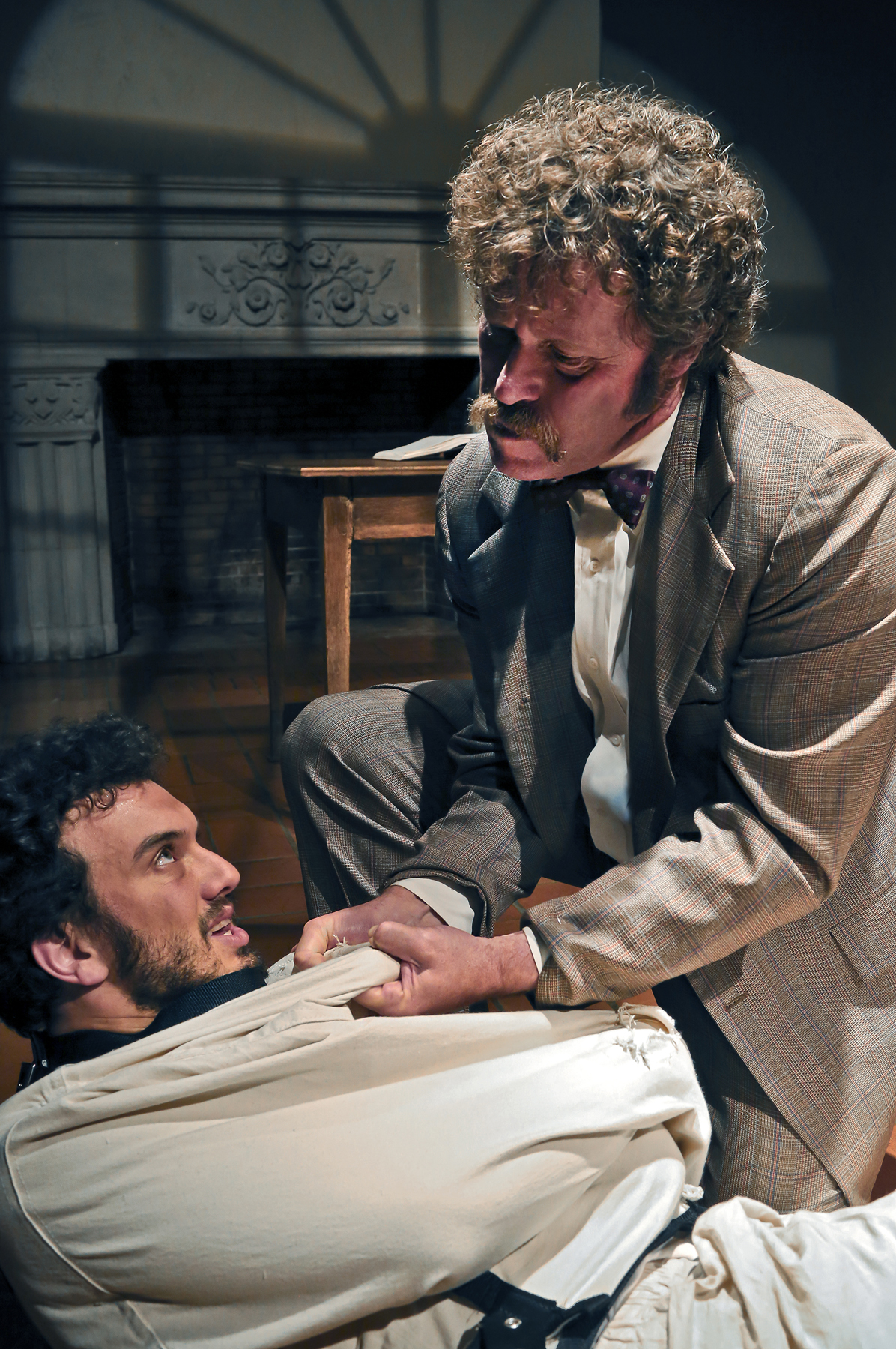
Detective Avery Sly of Scotland Yard (John Flanagan R)
interrogates Dr. Seward (Kenny Toll L).
John Flanagan has been cast as a detective in other plays and has not lost his touch at interrogation. Without giving a “spoiler” the last scene is problematic for him. Kenny Toll as Dr. Seward, bound in a straight-jacket for the entire play, gives a Tony Award performance. Joe Estlack brings his innate acting ability honed at Shotgun Theatre to this play in his role as the Professor. Joshua Schell and Megan Trout as the Harker’s earn their share of accolades. Running time 2 hours with an intermission.
Cast: Joe Estlack as Professor Van Helsing; John Flanagan as Detective Sly; Joshua Schell as Jonathan Harker; Kenny Toll as Dr. Seward; Megan Trout as Mina Harker
Production Team: Tammy Berlin, costumes; Gary Graves, lights; Gregory Scharpen’ sound/operator; Debbie Shelley, properties; Vanessa Ramos , stage manager; Alandra Hileman, production assistant; Robin Low, box office. Photos by Jim Norrena.
Kedar K. Adour, MD
Courtesy of www.theatreworldinternetmagazine.com
Woody’s [rating:5]
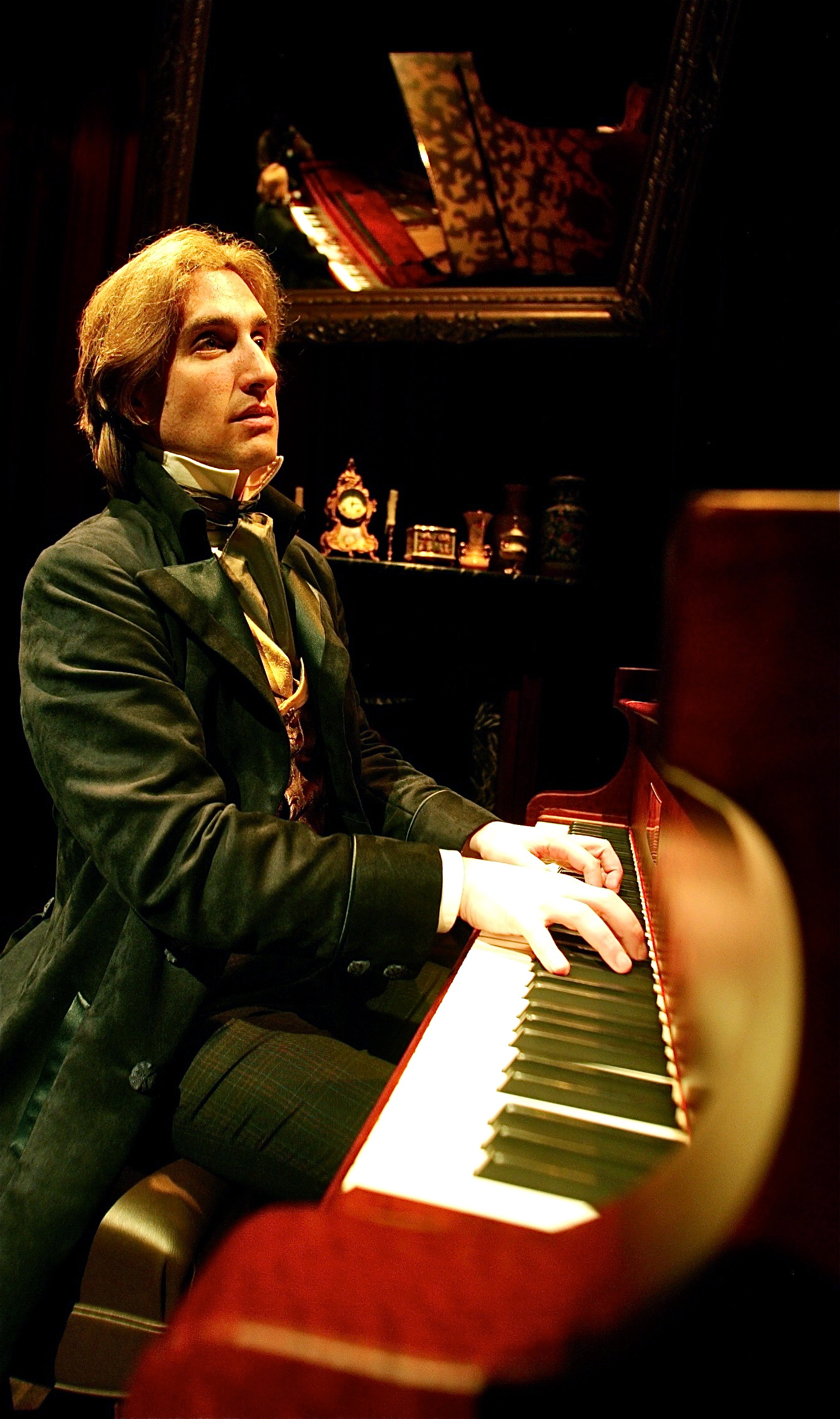
Hershey Felder portrays “Monsieur Chopin” in one-man show at the Berkeley Rep. Photo by John Zich.
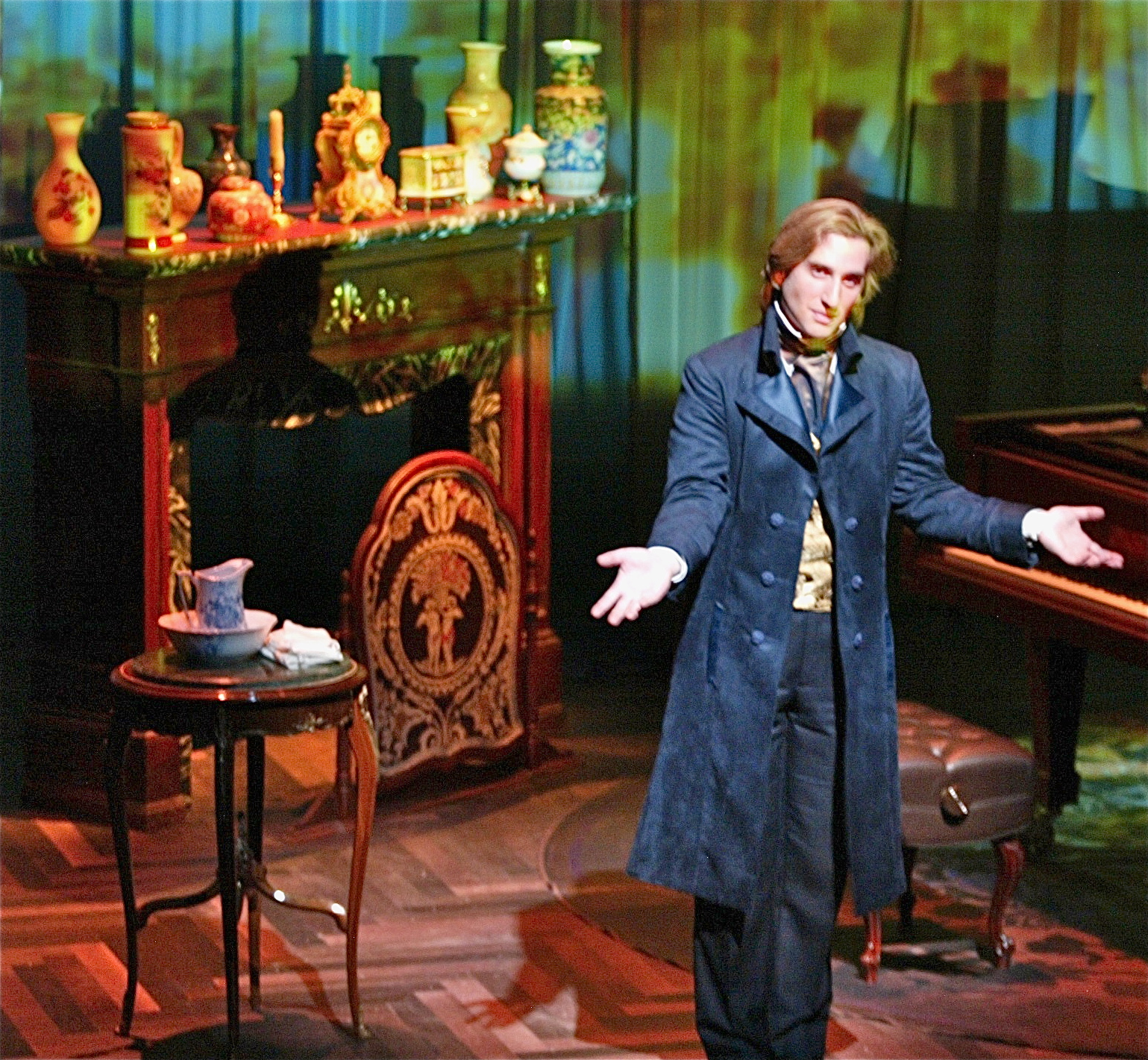
- Pianist-actor Hershey Felder stars in a musical bio, “Monsieur Chopin.” Photo by John Zich.
When I watched him transform into George Gershwin in a one-man Berkeley Rep show in June 2013, I’d never heard of Hershey Felder.
Still, I reveled in his virtuosity as a pianist, actor and writer.
And wanted more.
When last fall I witnessed his puissant direction of Mona Golabek as the daughter of a Holocaust survivor in “The Pianist of Willesden Lane,” I basked in another of his talents.
I craved more.
And when I saw him morph into conductor-composer Leonard Bernstein in June of this year’s “Maestro” musical bio, I couldn’t wait for what came next.
Next is now.
“Monsieur Chopin,” also a solo show, is a bio and concert predictably more romantic than the others — musically, at least.
Some of Fryderyk Chopin’s melodies will be as instantly recognizable by classical music buffs as quarterback Colin Kaepernick’s tattoos would be to 49er fans.
But director Joel Zwick, who guided the Gershwin and Bernstein shows as well as the film “My Big Fat Greek Wedding,” proficiently has the keyboardist-playwright intersperse less familiar strains.
“Hershey Felder as Monsieur Chopin,” which runs at the Berkeley Repertory Theatre through Aug. 10, transports audiences to the 1848 Paris salon of the “Polish poet of the piano.”
There he hunkers down with an enigmatic, volatile author, George Sand, and entertains painter Eugene Delacroix, a sometimes bff.
And there, I, and an audience that leapt to its collective feet at the two-hour opening night’s conclusion, could appreciate Felder’s piano dexterity and a characterization that overcomes a heavy accent and feels authentic.
His Steinway tones range from ultra-soft to thunderous.
He nimbly plays all or parts of more than a dozen pieces, including three Polonaises (emphasizing their “rise to glory”), a handful of preludes and nocturnes, “Mazurka in A-Flat Major, Opus 50 No. 2,” “Marche Funébre, Opus 35” and “Romanza, E-Minor Concerto.”
Credit goes to lighting designer Richard Norwood for creating instant mood changes, and scenic designer for fashioning a period setting with just an upholstered chair, end tables, mirror and trinket-laden mantle.
Norwood’s pièce de résistance, however, is a gilded frame that borders the stage and heightens what occurs within: historic legitimacy, histrionic biography.
Felder injects heaps of humor, from the play’s get-go to the end of a 30-minute coda with the house lights on (in which he quick-wittedly answers questions from the crowd in character, cleverly improvising occasional anachronistic jests about cell phones and other today-technology).
He’s especially laugh-inducing when Chopin, a child prodigy and adult genius who died prematurely at age 39, sneers at Franz Liszt’s piano playing and works (“scales and arpeggios and so much noise”).
But pathos is even more prevalent.
From the performer’s description of the death of Emilia, Chopin’s sister, to the composer’s frequent sidekick, melancholia (in modern terms, depression).
And from his obsessive hand-washing to his semi-romantic proclivities (focusing on an eight-year relationship with the pseudonymous Sand, a woman he first encounters dressed in man’s clothing and smoking a cigar).
The playwright’s major conceit is to address the audience as if it were a Chopin class, a theatrical device that’s slightly awkward.
But some of his teaching moments are pithy and poetic:
“You must dust the keys with your fingers as if you were dusting them with your breath.”
“Forget your lunatic family and play as if you are playing for God.”
Felder, who’s been a scholar-in-residence at Harvard’s department of music and is married to Kim Campbell, former Canadian prime minister, apparently cannibalized “Monsieur Chopin” from his own, original three-performer construct, “Romantique,” first performed 11 years ago and skewered by critics.
He obviously rewrote, fixed and honed it.
And salvaged it.
So much so that, nine years after its debut, he’s performed “Chopin” more than 800 times to more than 250,000 theatergoers.
So much so that now it’s become a masterwork, a near-perfect integration of recital and biography.
“Hershey Felder as Monsieur Chopin” plays at the Berkeley Rep’s Thrust Stage, 2025 Addison St., Berkeley, through Aug. 10 and then returns for encore performances Sept. 16-21. Night shows, 8 p.m. Tuesdays and Thursdays through Saturdays, 7 p.m. Wednesdays and Sundays; matinees, 2 p.m., Saturdays and Sundays. Tickets: $14.50 to $87, subject to change, (510) 647-2949 or www.berkeleyrep.org.
You can contact Woody Weingarten at voodee@sbcglobal.net.
Woody’s [rating: 2.5]
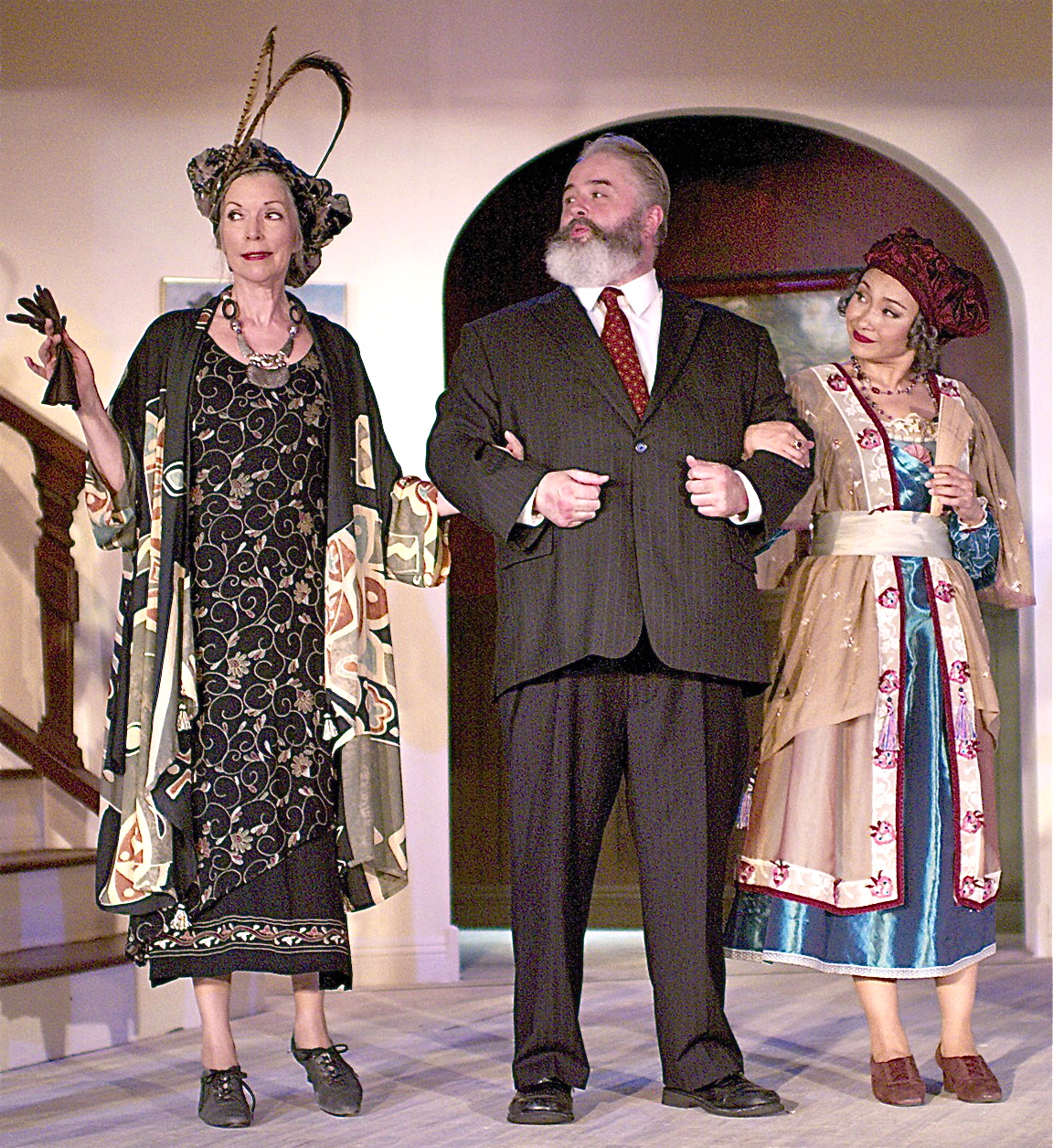
Swaggering in “Old Money” are (from left) Robyn Wiley, Johnny DeBernard and Trungta Kositchaimongkol. Photo: Robin Jackson.
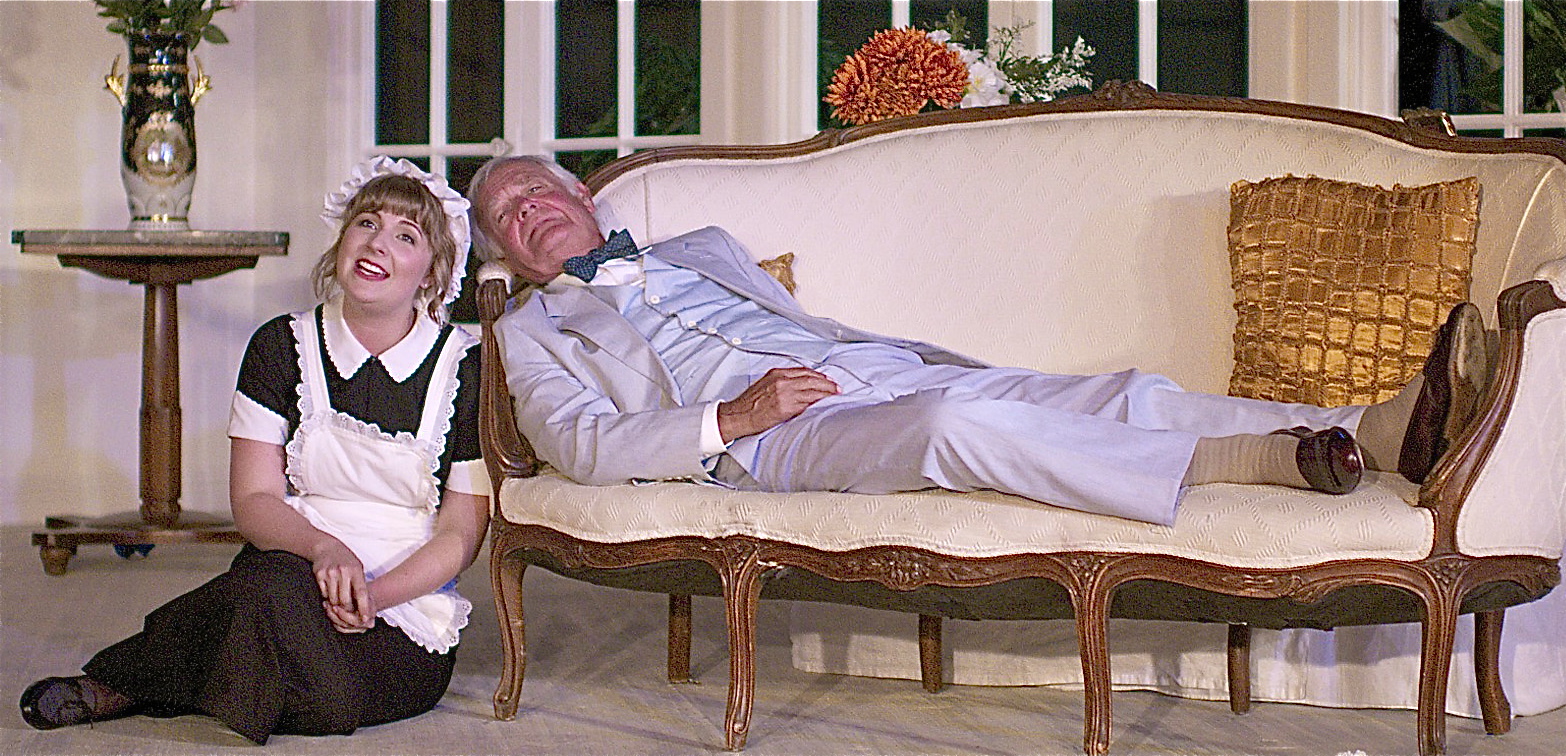
- Gillian Eichenberger and Wood Lockhart appear in “Old Money.” Photo: Robin Jackson.
The more things change, the more they stay the same — except they droop.
That’s the greeting card text I wrote 30 years ago.
My gag line again came to mind as I watched the Ross Valley Players’ new production of Wendy Wasserstein’s “Old Money.”
The play’s all about social climbing, generational gaps, moolah, art and real estate — with dual roles for each of the eight actors. But it feels stodgy and stilted despite the playwright’s renowned skill with barbed dialogue.
Her construct may be too clever, her play too New York.
Wasserstein invites us into a lavish mansion on the Upper East Side of Manhattan.
There we witness two dinner parties.
Jeffrey Bernstein, an arbitrage kingpin played as a man of equanimity by Geoffrey Colton, hosts the first — at the beginning of the 21st century.
The second, nearly 100 years earlier, spotlights Johnny DeBernard as a boisterous robber baron, Tobias Pfeiffer.
Colton doubles as even-tempered retail tycoon Arnold Strauss, and DeBernard also personifies Sid Nercessian, a Tinseltown director who repugnantly spews an f-bomb every fourth word.
All the actors do well, no mean feat considering they’re burdened with a plot unnecessarily complicated and convoluted.
Director Kim Bromley admittedly struggled with the plotline complexities and mélange of Wasserstein characters (“I had to read it three times to grasp the scope of it,” she writes in the program).
She suggested opening night reviewers feel what the characters feel.
I couldn’t.
Perhaps because Wasserstein — known for her intelligent, independent but self-doubting female characters trapped by male power — thwarted me by pricking too many heavy subjects.
Relentlessly, she tackles youthful rebellion and self-destruction, aging and death, legacy and immortality, Jewishness and assimilation, platonic relationships and sexuality, snobbery and acceptance.
Which almost bury all her valiant attempts at humor.
The script of the two-hour, two-act comedy of manners, which premiered off-Broadway in 2001, immediately tells theatergoers what they’re watching — an examination of how new money becomes old money (and what impact that evolution has on its wealthy stakeholders).
The problem is that the theme gets underscored over and over.
Mind-numbingly.
A single summation, such as the scene in which Bernstein and Pfeiffer engage in a verbal mine’s-bigger-than-yours debate about influence, would have sufficed.
Striking, however, are spot-on costumes by Michael A. Berg that range from elegant to flamboyant and instantly allow audiences to know which characterization an actor in inhabiting, and a ideal set by Michael Walraven, replete with large paintings and a massive always-needing-polish wooden railing.
Wasserstein, who won a Pulitzer and a best play Tony in 1989 for “The Heidi Chronicles,” isn’t above contrasting schmaltziness and whimsy. Check out, for instance, her having one actor stylishly dance the Gavotte but later prance in a lobster costume.
The playwright’s signature one-liners are numerous:
• “If the rich aren’t happy, who the hell will be?”
• “I like the opera. Big girls with elephants. Isn’t that enough?”
• “I’m having trouble ignoring you tonight.”
Top-notch performances are turned in by Gillian Eichenberger as both silver-voiced servant and self-destructive daughter; Robyn Wiley, as outdated as the figure sculpted by her character, Auntie Mame-ish Saulina Webb; Karen Leland as strident publicist Flinty McGee; and Jesse Lumb as sons of both Bernstein and Pfeiffer (and part-time narrator).
Add to the mix Wood Lockhart, who may hold the record for most RVP performances and is wistful as Tobias Vivian Pfeiffer III, and Trungta Kositchaimmongkol, snarky as underwear designer Penny Nercessian.
“Old Money” has many amusing and edifying moments yet, in the final analysis, couldn’t excite me.
And it somehow felt both long and long in the tooth (though not quite as antiquated as Richard Brinsley Sheridan’s “The Rivals,” the 1777 play it references) — despite anachronistic references to Jennifer Lawrence and Silicon Valley.
If asked to stick my two cents in, I’d have to say earlier works by Wasserstein — who died of lymphoma at age 55 in 2005 — were much easier to bank on for laughs or insights.
The RVP recently produced some incredibly good entertainments.
This wasn’t their best choice.
“Old Money” will run at The Barn, Marin Art & Garden Center, 30 Sir Francis Drake Blvd., Ross, through Aug. 17. Night performances, Thursdays at 7:30, Fridays and Saturdays at 8; matinees, Sundays at 2. Tickets: $13-$26. Information: www.rossvalleyplayers.com or (415) 456-9555.
You can contact Woody Weingarten at voodee@sbcglobal.net.
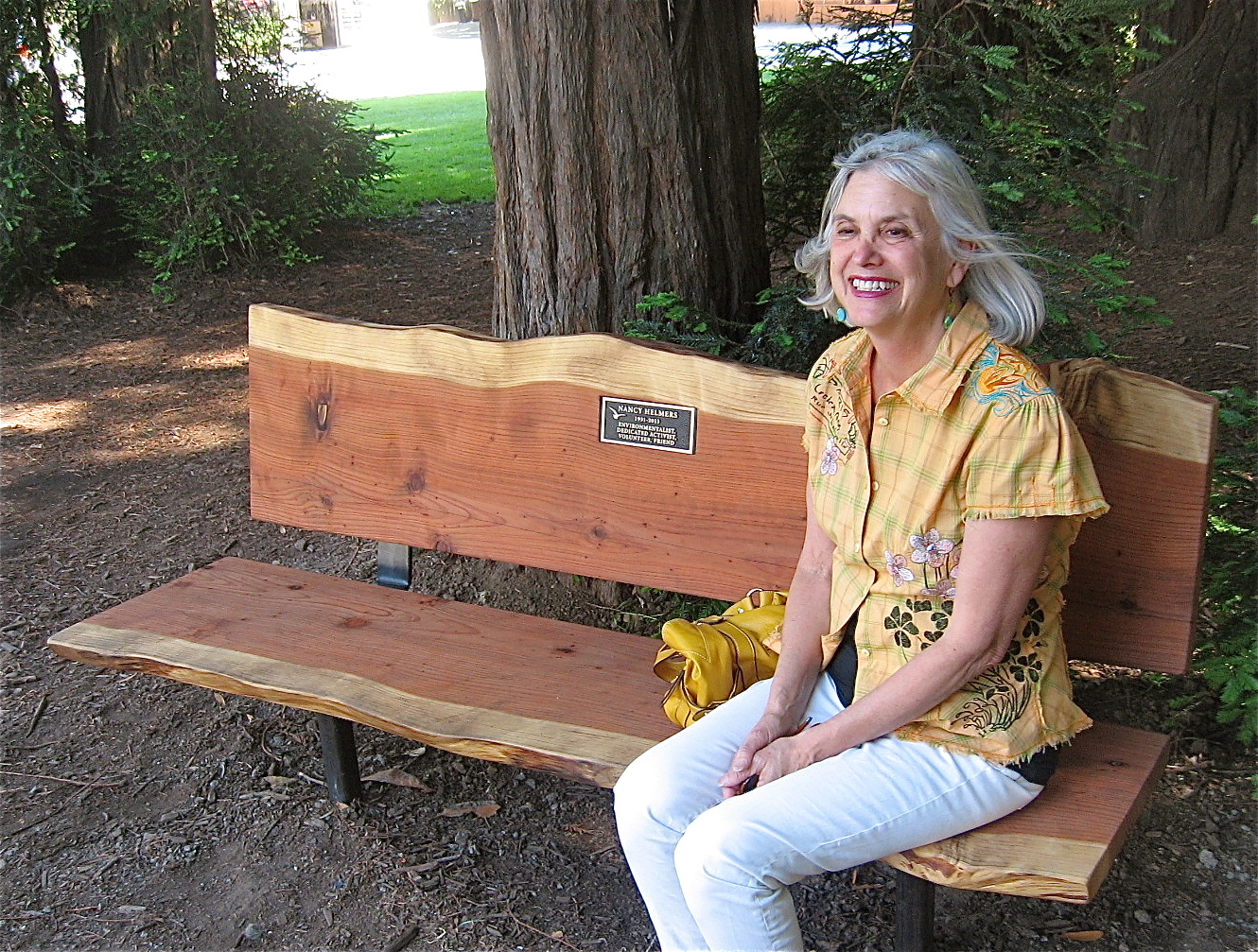
Patrice Hickox sits on memorial bench in Bolinas Park in Fairfax that she fought to get installed. Photo: Woody Weingarten.
Patrice Hickox would prefer I think of her as ordinary.
She isn’t.
The Fairfax resident’s a real-life Energizer Bunny.
Without floppy ears.
A perpetual motion machine with platinum-hued hair and hands that intermittently sketch pictures in thin air. A do-gooder everlastingly battling for one cause or another.
Since I’ve tilted at a few windmills myself, I like that.
Still, no matter how much she achieves, she’s never able to rest on her laurels.
She is resting one recent Saturday, however, on a memorial bench at the edge of Bolinas Park in Fairfax she fought hard to get installed at the end of May.
Not quite relaxed.
Trying to figure out how she best can help Marin’s foster children keeps her mind flashing like a July 4th sparkler.
She can’t know a Marin County Civil Grand Jury will shortly issue a report saying more funds must to be spent on the issue, more communication must occur between foster parents and social workers, and more access to therapy must be provided those neglected kids.
What to do? What to do?
She and I are together, me armed with interview pad and pen, she momentarily staring off into the distance at a bald hill she knows must be preserved.
Of course.
One cause at a time isn’t her style.
She’s also thinking about finding a way to replace “the dingy, worn-out, style-less sign announcing the Town of San Anselmo.”
And improving local median strips.
How?
“Re-plant, re-think, re-design,” she tells me.
The artsy wood bench we’re on is dedicated to the memory of her friend, Nancy Helmers, an environmental activist who died last year at age 82.
Patrice tactfully declines to reveal the political obstacles — “the kerfluffle, the brouhaha” — she had to vault to make it happen.
She’s just glad it’s a done deal.
Nancy had served on the county’s Open Space Committee for 10 years, as well as many other boards, and had been as non-stop energetic as Patrice.
She also was an unrelenting firebrand when it came to pushing petitions. “No one could collect a signature like Nancy,” Patrice tells me. “No one would say ‘No’ to her.
The two women met in 1988 when Nancy was collecting names in favor of creating a multi-purpose park on the 28 acres of the Marin Town and Country Club, which was being eyed by a developer.
The pair stopped the development from happening.
But they couldn’t come up with an effective plan to raise enough money to build their dream park.
“Instead, we became friends,” Patrice remembers. “We were both birders and environmentalists. We hiked, and we eventually collected thousands of signatures for a lot of things that failed.”
There were, however, sporadic triumphs.
Such as Lansdale Park in San Anselmo, a pocket-sized space with a children’s playground — or, as the town’s website says, “just what the neighborhood needed! Parents can enjoy a coffee-to-go from the nearby café while watching their children play outdoors.”
Patrice recalls “they were going to put condos there, but we got a petition to stop it. We got two grants from the Buck Fund, and got students from the White Hall Middle School in Fairfax to help. It was great.”
Her awareness began shortly after reading Rachel Carson’s best-selling “Silent Spring,” which detailed the detrimental use of pesticides.
“I was off and running after that,” she says. “I stopped eating meat and started paying attention. I was 14.”
As a Manhattan teenager, she’d attended be-in’s in Central Park, marched in Washington against the Vietnam War, and rallied for civil rights.
“I guess I’ve been a die-hard liberal ever since I figured out what that was,” she says.
Sometimes Patrice, who’s lived in Fairfax since 1995 with Charlie, her musician husband of 41 years, volunteers longer than she’d intended.
She helped out at WildCare for more than 10 years, for instance, “raising hundreds of baby things — from snakes to foxes to raccoons and squirrels.”
If she could accomplish anything in the world, what would it be, I ask. She replies without hesitation: “Get rid of Putin and Assad.”
Then she says, “I think I’d like to be empress of Oakland and just fix that city.”
And then, after a slight pause, she adds seriously, “Anything that I’d be effective at — so I wouldn’t have to beat my head against the wall again.”
I smile.
Since I’ve tilted at a few windmills myself, I understand completely.
You can contact Woody Weingarten at voodee@sbcglobal.net