Oregon Shakespeare Festival stages classics, premieres

By Judy Richter

Those who stay a week or so in Ashland, Ore., can see up to nine plays ranging from Shakespeare to world premieres in the Oregon Shakespeare Festival’s three theaters.

Altogether, the company stages 11 plays in a season that runs from mid-February through Nov. 2.

Currently playing in the outdoor Elizabethan Theatre are the Bard’s “Richard III” and “The Two Gentlemen of Verona” (with an all-female cast) plus a musical, Stephen Sondheim’s “Into the Woods.”

The indoor Bowmer Theatre features Shakespeare’s “The Tempest” and Irving Berlin and George S. Kaufman’s “The Cocoanuts” along with two world premieres: Tracy Young’s “A Wrinkle in Time,” based on the book by Madeleine L’Engle, and Robert Schenkkan’s “The Great Society.”

Finally, the more intimate Thomas Theatre is the venue for Shakespeare’s “The Comedy of Errors” and the world premiere of Stew’s “Family Album.” After going on hiatus in June, Quiara Alegría Hudes’ “Water by the Spoonful” will return to the Thomas on Sept. 4.

Lorraine Hansberry’s “The Sign in Sidney Brustein’s Window” has completed its run in the Bowmer.

My recent visit included “Richard III,” “Into the Woods,” “The Comedy of Errors,” “The Cocoanuts” and “The Great Society.” Here are brief rundowns on each.

THE GREAT SOCIETY

Of those five, Robert Schenkkan’s “The Great Society” was by far the most powerful and intriguing. It’s the successor to Schenkkan’s “All the Way,” which premiered at OSF two years ago and went on to Broadway to win this year’s Tony Award for best play.

“All the Way” focused on President Lyndon Johnson’s first year in the White House, following the assassination of President John F. Kennedy on Nov. 22, 1963. It looked at Johnson’s successful effort to secure passage of the landmark Civil Rights Act followed by his campaign against Republican Sen. Barry Goldwater to win the 1964 election.

Featuring many of the same actors from “All the Way” and the same director, artistic director Bill Rauch, “The Great Society” looks at Johnson’s push to enact a package of bills focusing on education, anti-poverty programs and medical care, including Medicare for seniors. With black people increasingly demanding an end to segregation and easier access to the ballot box in the South, he also wanted Congress to enact a voting rights bill.

All of this takes place against a backdrop of increasing social unrest, starting mainly with civil rights campaigns that encountered strong resistance in the South by the likes of Alabama Gov. George Wallace, other officials and the Ku Klux Klan. The resultant violence spread throughout the country to such places as Watts in Los Angeles and the slums of Chicago.

In the meantime, the nation became more deeply mired inVietnam, a war that exacted huge costs in American lives and money. The war was so polarizing that Johnson announced in 1968 that he wouldn’t run for a second term. Instead he was succeeded by Republican Richard Nixon.

Once again Jack Willis plays LBJ, a Texan who might have come across as homespun, but he was wily and politically astute. Willis brings all of LBJ’s contrary traits to the fore and convincingly conveys his increasing anguish over the war and social unrest.

The large cast also features Danforth Comins as Sen. Bobby Kennedy of New York, LBJ’s nemesis; Peter Frechette as Vice President Hubert Humphrey; Jonathan Haugen as Wallace, Nixon and others; Kenajuan Bentley as Dr. Martin Luther King Jr.; Mark Murphey as Secretary of Defense Robert McNamara and others; and Richard Elmore as FBI Director J. Edgar Hoover.

Those individuals and more populate this ambitious re-enactment of one of the most turbulent periods in recent history.

Immediately after closing, this play and many of its actors will move to Seattle Repertory Theatre, which commissioned it and co-produced it with OSF. It will run in rotating repertory with “All the Way.” Presumably it will undergo some needed tightening and other improvements.

In the meantime, it evokes vivid memories for those who lived through those painful times and teaches some important lessons to those who were born later. It’s a brilliant accomplishment.

RICHARD III

Shakespeare’s “Richard III” makes strong demands on the title character, a man who left a trail of bodies in his quest for the English throne. Dan Donohue ably meets those demands, making the deformed Richard charming when doing so suited his aims and revealing all of his callous evil at other times.

Director James Bundy moves the action smoothly, thanks to a strong supporting cast, including Robin Goodrin Nordli as Queen Elizabeth, Judith-Marie Bergan as the Duchess of York, Franchelle Stewart Dorn as Queen Margaret and Jeffrey King as George, Duke of Clarence.

William, Lord Hastings, is played by Howie Seago, a deaf actor who delivers his lines in American Sign Language, voiced by Omoze Idehenre as Mistress Jane Shore. She also uses ASL to convey other characters’ lines to him.

Bucking a trend to place the play in another time or place, costumes by Ilona Somogyi and the set by Richard L. Hay are contemporary to Shakespeare’s time.

This is an excellent production of one of Shakespeare’s masterpieces.

THE COMEDY OF ERRORS

An example of moving a Shakespeare play into another time and place is the OSF production of “The Comedy of Errors.” This time the play of mistaken identities takes place the late 1920s, the dawn of the Harlem Renaissance.

Hence most of its actors are black, and Ephesus becomes Harlem, the play’s main setting. Syracuse, the visitors’ homeland, is Louisiana.

The main characters are two sets of identical twins who were born on the same day. One pair, both known as Dromio, are servants to the other pair, both known as Antipholus.

The Dromio-Antipholus pairs were separated in infancy, with one pair landing in Harlem and the other pair returning toLouisiana with Egeon, father of the Antipholuses.

As the play opens, Egeon (Tyrone Wilson) has traveled to Harlem to find the Antipholus and Dromio who had lived with him until setting out in search of their brothers.

As luck would have it, Antipholus and Dromio of Louisiana have just arrived in Harlem, where they are immediately confused with their counterparts, who have lived there for many years.

Although some productions use four actors for the two sets of twins, this one uses only one actor, Tobie Windham, for both Antipholuses and one actor, Rodney Gardiner, for both Dromios. The only exception comes at the very end, when both sets must be on stage at the same time. In this case, two other actors (not identified) are used.

The production is full of pratfalls and slapstick, but director Kent Gash never allows the action to get out of hand. Still, he overuses one gimmick: a chime that sounds at every mention of a ring that is pivotal to the plot. In the midst of all the physical comedy, Mark Murphey, who plays a butler and an Irish cop, is one of the funniest performers because he manages to keep a straight face throughout.

Overall, it’s a fun production.

THE COCOANUTS

In contrast to “The Comedy of Errors,” the antics in “The Cocoanuts” tend to go over the top.

With music and lyrics by Irving Berlin and a book by George S. Kaufman, this adaptation by actor Mark Bedard supposedly features the Marx Brothers as the main characters. Bedard is Mr. Hammer, the Groucho character, while Eduardo Placer is Robert Jamison, the Zeppo character; John Tufts is Chico,  and Brent Hinkley is Harpo.

The setting is the Cocoanut Hotel in Florida in the 1920s. It’s owned by Mr. Hammer, who’s in financial straits but who hopes to get rich by auctioning off some lots during Florida’s land boom. Robert is his beleaguered desk clerk who’s in love with one of the guests, Polly Potter (Jennie Greenberry). She’s the daughter of the very rich Mrs. Potter (K.T. Vogt), who wants her to marry another guest, Harvey Yates (Robert Vincent Frank), who has his own plan in mind with his longtime cohort, Penelope Martin (Kate Mulligan).

Bedard, Tufts and Hinkley are the principal makers of mayhem. Hinkley wears the nonspeaking Harpo’s silly grin and runs around squeezing a horn.

Bedard and Tufts deliver most of the deliciously awful puns. However, they let the silliness get out of hand during the first act when they come down from the stage and involve the audience, taking a woman’s room key and a man’s phone and shoe. They even climb over the seats and venture up several rows to interact with audience members. It’s a ploy that goes on too long.

It should be noted that Bedard, Tufts and Hinkley also were featured as the Marx Brothers in “Animal Crackers” in 2012. It was a far more enjoyable yet still hilarious show because the director had them showing some restraint. The current director, David Ivers, seems to have given them free rein.

It should also be noted that the majority of the audience seemed to love the show.

The rest of the cast, which includes David Kelly as a detective, does well. Special mention goes to Greenberry for her singing.

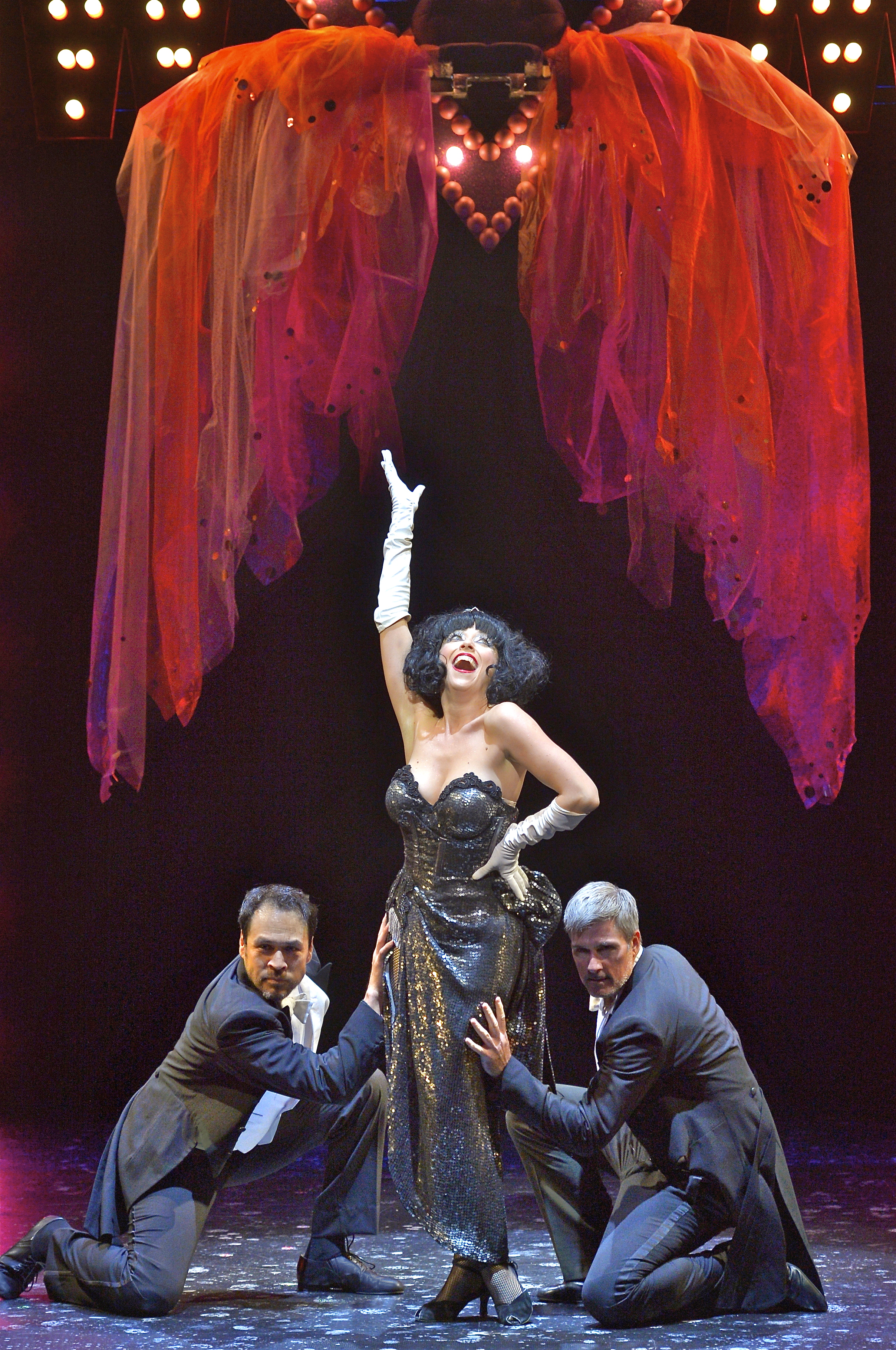
The colorful set is by Richard L. Hay with costumes by Meg Neville.

INTO THE WOODS

Also in the musical mode is “Into the Woods,” featuring music and lyrics by Stephen Sondheim and a book by James Lapine.

Sondheim and Lapine bring together several fairy tale characters and show them getting their wishes in the first act, when presumably they all live happily ever after. The second act is the ever after, when things aren’t nearly as ideal as the characters had imagined.

Directed by Amanda Dehnert, who does double duty as musical director, the uniformly excellent cast features, among others, Miriam A. Laube as the Witch, Rachel Warren as the Baker’s Wife, Miles Fletcher as Jack (of beanstalk fame), Robin Goodrin Nordli as his mother, Jennie Greenberry as Cinderella, Jeremy Peter Johnson as Cinderella’s Prince and Kjerstine Rose Anderson as Little Red Riding Hood. The versatile Catherine E. Coulson plays Cinderella’s stepmother, Granny, the giant and Milky White, the cow.

With the 25-member orchestra seated upstage, scenic designer Rachel Hauck employs minimal scenery in this outdoor production. Costumes by Linda Roethke are a different story. They’re wonderfully colorful. Some nifty stage magic also helps.

Of course the real stars of this show are Sondheim’s intricate music and lyrics. He’s a genius with both.


‘Fetch Clay, Make Man’ sees two black men trying to make their way

By Judy Richter

After heavyweight champion boxer Cassius Clay had joined the Nation of Islam and changed his name to Muhammad Ali, death threats caused the promoters to move his much-ballyhooed rematch against Sonny Liston to Lewiston,  Maine, in 1965.

Presented by Marin Theatre Company, Will Power’s “Fetch Clay, Make Man” goes behind the scenes into Ali’s locker room (set by Courtney O’Neill with video by Caite Hevner Kemp) as he prepares for that fight.

He seeks help from an unlikely source — actor Stepin Fetchit. Fetchit, whose real name was Lincoln Perry, had created a character that was the epitome of stereotype, a lazy, shiftless Negro. Audiences didn’t perceive how clever he was, but he was the first black actor to become a millionaire.

Ali invited him to serve as his secret strategist before the fight because he had worked with another famous fighter, Jack Johnson. Ali wants Fetchit to teach him the secret “anchor punch” that Johnson had used so successfully.

Eddie Ray Jackson embodies Ali’s dancing footwork as well as his enormous ego. Roscoe Orman is the canny Fetchit, who seems to know the right thing to say and do to protect himself and to defuse some of the play’s tensions.

Much of that tension comes from Jefferson A. Russell as the menacing Brother Rashid, Ali’s bodyguard and strict adherent to Nation of Islam beliefs. Although the relationship between Ali and his wife, Sonji Clay (Katherine Renee Turner), is loving at first, it becomes more dicey when she refuses to wear Muslim garb for women (costumes by Heidi Leigh Hanson) and mentions parts of her past.

Completing the cast is Robert Sicular as William Fox, founder of the Fox movie studio. He’s seen in flashbacks as he and Fetchit negotiate the actor’s contract.

Each in his own way, Ali and Fetchit represent pioneering black men trying to succeed in American society. Playwright Power and director Derrick Sanders weave their stories and relationship into compelling theater.

“Fetch Clay, Make Man” will continue at Marin Theatre Company, 397 Miller Ave., MillValley, through Sept. 7. For tickets and information, call (415) 388-5208 or visit www.marintheatre.org.


TheatreWorks has a hit with ‘Water by the Spoonful’

By Judy Richter

Real and virtual families connect in “Water by the Spoonful,” an intricately constructed, intriguing drama by Quiara Alegría Hudes.

Presented by TheatreWorks, this Pulitzer Prize-winning play focuses on two kinds of families.

The real family is two cousins, Elliot (Miles Gaston Villanueva) and Yazmin (Sabina Zuniga Varela), in a Puerto Rican neighborhood in North Philadelphia. An aspiring actor, Elliot was wounded in Iraq and now works at Subway. He’s haunted by a ghost (George Psarras) from Iraq. Yazmin is a recently divorced Swarthmore professor of music.

Their aunt, whom Elliot calls his mother and whom he cared for, dies of cancer. She reared him after her sister, his crack-addicted mother, gave him up.

In the meantime, his estranged birth mother, Odessa (Zilah Mendoza), who has since kicked the crack habit, administers a virtual family on an anonymous online chat room for other crack addicts in various stages of recovery. Her handle is Haikumom.

This disparate group includes the 50ish Chutes&Ladders (Anthony J. Haney), an IRS employee; the 20ish Orangutan (Anna Ishida), a smart-mouthed Japanese American; and the newest member, Fountainhead (Patrick Kelly Jones). He’s a 30ish entrepreneur on his way down because of his addiction, which he tries to hide from his family. He’s having a hard time kicking the habit.

Over the course of the two-act play, several characters take tentative strides to improve their lives and/or to connect with others, but it’s not easy.

Intelligently directed by Leslie Martinson, each actor portrays a distinct, interesting character confronting challenges.

Erik Flatmo’s multi-level set creates defined spaces for the action, augmented by Erik Scanlon’s projections and Steven B. Mannshardt’s lighting. The character-specific costumes are by Anna R. Oliver. The sound design by Gregory Robinson includes works by pioneering jazz saxophonist John Coltrane, whom Yazmin cites in one of her lectures.

All of these elements add up to a compelling theatrical experience.

“Water by the Spoonful” will continue at the Mountain ViewCenterfor the Performing Arts, 500 Castro St., Mountain View, through Sept. 14. For tickets and information, call (650) 463-1960 or visit www.theatreworks.org.


Water by the Spoonful given a Prize winning performance at TheatreWorks.

By Kedar K. Adour

Strangers (played by clockwise from lower left: Zilah Mendoza, Patrick Kelly Jones, Anthony J. Haney, and Anna Ishida) come together in an online support group in TheatreWorks’ Regional Premiere of the Pulitzer Prize-winning drama WATER BY THE SPOONFUL, playing August 20 – September 14 at the Mountain View Center for the Performing Arts Photo by Kevin Berne

WATER BY THE SPOONFUL: Drama by Quiara Alegria Hudes. Directed by Leslie Martinson. TheatreWorks, Mountain View Center for the Performing Arts, 500 Castro Street, Mountain View. (650) 463-1960 or visit www.theatreworks.org.

August 20—September 14, 2014

Water by the Spoonful given a Prize winning performance at TheatreWorks. [rating:5]

TheatreWorks once again demonstrates its standing as one of the Big Three theatrical groups, along with A.C.T. and Berkeley Rep, in the Bay Area. This time they have mounted a stunning and powerful production of Water by the Spoonful. The play won, and deserved, the Pulitzer Prize for drama in 2012. It is the second part of her “Elliot Trilogy” plays dissecting the life of a Puerto Rican Iraq War veteran living in Philadelphia. It is a standalone play in the trilogy with Elliot (Miles Gaston Villanueva )being the only character from the other plays. It is a play for our time and transcends ethnic stereotyping.

For this reviewer who does not do Facebook, Twitter, Linkedin, have an IPhone or enter chat rooms it was a learning experience. The aforementioned means of communication have replaced personal social interaction and in Quiara Alegia Hudes play she demonstrates their omnipresence in our digital world.

The play’s construction is a fascinating jigsaw puzzle intermingling present day personal action, internet connectivity, out of body experiences, didactics and symbolism. The symbolism of course involves water beginning with the ‘spoonful of water’ and ending with a Puerto Rican waterfall. (Marvelous projections by Erik Scanlon on Erik Flatmo’s three level split set).

In an early scene Quiara Hudes, a trained musician and composer who wrote the book for the Tony Award winning In the Heights”, introduces Yazmin (Sabina Zuniga Varela), cousin to Elliot and a music composition professor. Using John Coltrane’s music as examples, she lectures the students (the audience) on the meaning of dissonance. The tone is set for very dissonant relationships.

Elliot, a wounded Iraqi War veteran would be actor, works in a menial job in a sandwich shop and is the caretaker for his dying aunt who raised him.  He has his own demons from the war experience. When the aunt dies, Elliot and Yazmin search for his birth mother who gave him up as child.

In a parallel story taking place in the digital world , the birth mother Odessa (Zilah Mendoza), known as Haikumom online, functions as a leader in a chat room dedicated to recovering ‘crack-head’ drug addicts. The members of the chat room trust her guidance and are unaware of her own demons.

  The other members of the chat room are “Orangutan/Madeleine” (Anna Ishida); “Chutes & Ladders/Wilkie” (Anthony J. Haney) and “Fountainhead/John.”( Patrick Kelly Jones). Orangutan is in Japan. She had been given up by her mother, adopted and raised in Maine but has returned to Japan to discover her roots. Chutes & Ladders is a middle-aged black man, lives in San Diego and works in a dull office job.   Fountainhead is a former leader in the digital world who has kept his addiction secret from his family. There is seventh character that occasionally roams on stage, is the Arabic ‘Ghost’ in Elliot’s imagination and does not fit very well into the intricately constructed play.

The acting of the each major actor is distinctive, believable and memorable under director Leslie  D Martinson’s  tight control as she moves them like chess pieces on Flatmo’s unique multi-level set amongst brilliant projections and dissonant music. Running time 2 hours 25 minutes with an intermission. Highly recommended.

CAST: Miles Gaston Villanueva as “Elliot”; Sabina Zuniga Varela as “Yazmin”; George Psarras as “Professor Aman/Ghost”;  Zilah Mendoza as “Odessa/Haikumom”; Anna Ishida as “Orangutan/Madeleine”; Anthony J. Haney as “Chutes & Ladders/Wilkie”; Patrick Kelly Jones as “Fountainhead/John.”

Artistic Staff: Scenic Designer,Erik Flatmo;Costume Designer,Anna R. Oliver;Lighting Designer,Steven B. Mannshardt;Sound Designer,Gregory Robinson;Projections Designer,Erik Scanlon;Dialect Coach,Kimberly Mohne Hill;Casting Director;Leslie Martinson;Los Angeles Casting Director, Julia Flores;Stage Manager,Randall K. Lum;Assistant Stage Manager,Stephanie Schliemann.

Kedar K. Adour, MD

Courtesy of www.theatreworldinternetmagazine.com.


Pleasant ‘Dreamgirls’ from Broadway By the Bay

By Judy Richter

R&B, soul and pop from the ’60s and ’70s take center stage in “Dreamgirls,” presented in a highly polished production by Broadway By the Bay.

With tuneful music by Henry Krieger and a book and lyrics by Tom Eyen, “Dreamgirls” tells the story of three young Chicago women who call themselves the Dreamettes and who sing their way to Motown musical success, but not without some major bumps along the way.

Based on actual groups like the Shirelles and Supremes, the Dreamettes start with Effie Melody White (Miranda D. Lawson) singing the lead and with her brother, C.C. White (AeJay Mitchell) writing some of their songs.

However, their manager, Curtis Taylor Jr. (Anthony D. Jackson), dumps Effie not only as his lover but also as the lead singer, replacing her with Deena Jones (Janelle LaSalle). When Effie begins to rebel at her diminished role in what is now called the Dreams, Curtis dismisses her entirely. She responds with the defiant “(And I Am Telling You) I’m  not Going,” which brings down the house near the end of the first act.

The story goes on to detail the payola and other devious methods that Curtis uses to derail Effie’s solo career in the second act.

Director Angela Farr Schiller, aided by associate director and choreographer Robyn Tribuzi, keeps the action moving swiftly, thanks also to the light tower-based set by Kelly Tighe. This BBB production is inspired by the original Broadway production directed by Michael Bennett. After premiering in 1981, it went on to win six Tony Awards and became a movie in 2006.

Although the large cast features fine performances throughout, some of the best come from Jackson as Curtis, Lawson as Effie and Dedrick Weathersby as James Thunder Early, a funky soul singer.

Sean Kana directs the fine orchestra. Kudos also to Margaret Toomey, whose costume designs become ever more glamorous and timely for the women.

“Dreamgirls” will continue at the Fox Theatre, 2215 Broadway St., Redwood City, through Aug. 31. For tickets and information, call (650) 579-5565 or visit www.broadwaybythebay.com.


“Funny Girl” at 6th Street Playhouse, Santa Rosa CA

By Greg & Suzanne Angeo

Reviewed by Suzanne and Greg Angeo

Members, San Francisco Bay Area Theatre Critics Circle


Photos by Eric Chazankin

Taylor Bartolucci and Company

A-dork-able, Dazzling “Funny Girl”

We owe a debt of gratitude to YouTube. Thanks to this ubiquitous online video site, there’s a historical record of nearly every human activity that was or can be captured in visual form, from lessons on how to apply eyeliner to grisly executions; from old TV reruns to ballet and opera. And YouTube is one of the remaining places where you are sure to see Fanny Brice in all her original glory.

This legendary and trailblazing singer, comedian, actress and radio star performed from the dawn of the 20th century until her death in 1951 at only 59 years old. She was an ordinary-looking woman possessed of extraordinary talent that captured the hearts of generations of theatregoers. Her legend took a flight of fancy in the retelling of her inspirational story when the musical “Funny Girl” first appeared in 1964, catapulting Barbra Streisand into the stratosphere. The show had a tortuous beginning with false starts in casting, directing and choreography. After many long delays, writes and rewrites, the book was finally completed by Isobel Lennart with a musical score by Jule Styne and Bob Merill. The story begins in 1910 with Brice’s early work in vaudeville, chronicles her rise to international fame in the Ziegfeld Follies, and ends in 1926 with her heartbreaking separation from her husband, the gangster and professional swindler Nicky Arnstein.

Taylor Bartolucci, James Sasser

As told in flashback, the stage musical and subsequent film present a highly fictionalized but equally entertaining version of Brice’s life. The original Broadway hit that was “Funny Girl” was produced by Brice’s own son-in-law Ray Stark. He was facing a possible lawsuit by then-living Arnstein, so almost the entire story of Brice’s life was altered to cast Nicky in a more favorable light. And, as is the case with many biographical works, quite a bit of creative license was taken by Lennart to make Brice’s story even more compelling than it already was. Brice was from a prosperous family, not a poor one. She used neither roller-skates nor pregnant-pillows in her act. Nicky was far from handsome and was not even Brice’s first husband. It’s fact vs fiction, but at the end of the day, on stage and film, the results were nothing short of sensational.

“Funny Girl” isn’t presented at regional theaters very often, possibly because the title role calls for more than your usual triple-threat. In just one person, you need top-notch talent in both broad and subtle physical comedy, dramatic and comedic acting, and a strong, lyrical voice. These folks are hard to find outside of Broadway and Los Angeles, but with the help of a lucky penny, 6th Street Playhouse found its star, and does a pretty wonderful job presenting this challenging show for its new season kickoff.

Barry Martin, co-founder and president of of Napa’s Lucky Penny Productions was tapped to direct. He had always loved the show, but in directing it he fell in love with Brice, too. He describes her as “an amazing woman who was far ahead of her time, who took her career into  her own hands and became a star on her own terms.” And for the role of Fanny Brice, his Lucky Penny co-founder Taylor  Bartolucci – a treasure-trove of local talent – was chosen. From her opening scene until the end, Bartolucci grabs onto your heart and won’t let go. She plays Brice with such honest humility and originality, and her lovable klutz Fanny is so very down to earth that, just between us, she makes that other Funny Girl look like a big phony. Bartolucci shows us very clearly that Fanny uses her clowning as a shield to protect her tender heart. There’s no gloss, no glamour in this Fanny Brice – just raw, energized talent.

Anthony Martinez, Janine LaForge

Playing Fanny’s shady husband Nicky is James Sasser, who imbues the role with polish and appeal, slowly developing his character from a rather stiff but classy dude to a loving friend. Janine LaForge as Fanny’s mother Rose nearly steals every scene she’s in, along with Barbara Nemko as her prickly-pear best friend Mrs Strakosh. Fanny’s longtime showbiz pal Eddie Ryan is played with warm sincerity by Anthony Martinez in a very engaging performance. Eddie stays by her side through thick and thin, harboring a hidden love as he helps her on her way to stardom.

There are so many wonderful moments in this show that it’s hard to choose favorites without writing a whole book, but let’s try. Some of the early Follies scenes, like the number “His Love Makes Me Beautiful”, complete with zany gorgeous showgirls, authentic period costumes (and that fateful pillow), take your breath away. “Don’t Rain on My Parade” is a standout number about Fanny knowing what she wants and going for it. The most popular hit song from the show, “People”,  is featured in a key scene with Fanny and Nicky, and Bartolucci’s phrasing and interpretation of this lovely ballad are sheer perfection. But it’s the final number that sears the soul with her rendition of Brice’s standard “My Man”. It will make you forget you ever heard anyone else sing it. She makes the song, and the show, her own.

Taylor Bartolucci

Martin’s confident direction trims the extravagant production down to size, distilling it to a potent, soulful elixir. He guides the performers in unexpected ways, especially if you’ve only seen the film. Dance numbers are effectively staged by LC Arisman, recently arrived from New York, although there are the usual troubles with tap numbers. Costumes by Barb Beatie work well in recalling fashions from late Edwardian to the Jazz Age. It’s easy to overlook the off-key horn section since it only seems to add to the charm. Occasional stumbles in choreography and uneven vocals are forgivable. The standing ovation at the end was saved for our Fanny, and it was well-deserved. Looks like 6th Street has another hit on its hands.

When: Now through September 14, 2014

8:00 p.m. Thursday, Friday and Saturday

2:00 p.m. Saturday and Sunday

Tickets: $15 to $37

Location: GK Hardt Theater at 6th Street Playhouse

52 West 6th Street, Santa Rosa CA
Phone: 707-523-4185

Website: www.6thstreetplayhouse.com

‘Moonlight and Magnolias’ goes behind the scenes for ‘GWTW’ script

By Judy Richter

“Moonlight and Magnolias” is a behind-the-scenes look into the process of transferring “Gone With the Wind” from print to screen 75 years ago.

Based on actual events, Ron Hutchinson’s comedy shows that despite the book’s enormous popularity, it wasn’t easy to distill the 1,037-page saga of the Civil War South by Margaret Mitchell.

Dragon Theatre’s intimate stage (set by Kevin Dunning) facilitates the sense of confinement imposed by producer David O. Selznick (Aaron Weisberg), who brings in newspaperman Ben Hecht (Dave Leon) to write the screenplay with the assistance of director Victor Fleming (Bill C. Jones). Hecht is trying to succeed where numerous other writers have failed.

There’s one more problem: Hecht hasn’t read the book. Therefore, his two colleagues venture to re-enact it for him during the five days that all three are locked in Selznick’s office with nothing to eat except bananas and peanuts.

Their only contact with the outside world is Selznick’s beleaguered secretary, Miss Poppenghul (Sarah Benjamin).

In the process, Hecht objects to the book’s explicit racism. He also equates that racism with the anti-semitism that the two of them and numerous otherHollywoodluminaries have faced.

The recently defunct San Jose Repertory Theatre successfully presented the Bay Area premiere of the play in 2006 under the astute direction of Timothy Near. Unfortunately, Dragon director Lennon Smith seems unequal to the play’s challenge.

Weisberg and Jones do fairly well as Selznick and Fleming, respectively, but Leon is too one-dimensional as Hecht. Benjamin seems to be directed to be one step above the dumb blond, belying the efficiency of the character’s actions.

Thus the play tends to be flat rather than funny, a disservice to this look at what it takes to create cinematic magic, which is what “Gone With the Wind” was and still is.

“Moonlight and Magnolias” will continue at Dragon Theatre, 2110 Broadway St., Redwood City, through Sept. 7. For tickets and information, call (650) 493-2006 or visit www.dragonproductions.net.


The Masquers’ BERLIN to BROADWAY with Kurt Weil ends on a “Happy Note”

By Kedar K. Adour

Berlin to Broadway with Kurt Weill: Musical Revue. Music by Kurt Weill text by Gene Lerner.  Directed by Ellen Brooks, Musical direction by Bruce Haines. Masquers Playhouse, is located off of Highway 580 (Richmond Parkway exit) at 105 Park Place, Point Richmond.   (510) 232-4031 or www.masquers.org.  August 22 – September 20, 2014

The Masquers’ BERLIN to BROADWAY with Kurt Weil ends on a “Happy Note” [rating:4] (4 of 5 Stars)

The mention of the name Kurt Weill automatically brings to mind three things. They are The Threepenny Opera, Lotte Lenya and the song “Mack the Knife.” You are in for a big pleasant surprise when you attend, and you should, the charming but uneven production of Berlin to Broadway (B to B) at the Masquers’ well-appointed 99 seat theatre in Port Richmond. In this their 59th year of producing plays they have accepted the challenge of mounting a musical revue that requires quality singers and actors.

They seem to have a plethora of actors/singers at their casting calls to make even the problematic shows work. B to B requires a tenor ((Nick Hengl), baritone/bass (J. Scott Stewart), soprano(s) (Tina Marzell & Gayelan Tietje-Ulrich) and a mezzo-soprano (Maria Mikheyenko). The role of the narrator is shared by the entire cast.

This musical revue using the biography and songs of the musical genius Kurt Weil first appeared in 1972 at the experimental Theatre de Lys Off-Broadway in New York City. It is a tribute to Weil’s work and chronologically unfolds beginning in 1928 Berlin where we are introduced to his longtime collaborator Bertholt Brecht and his sole-mate/wife Lotte Lenya and the rest of the cast. They are putting on their version of  John Gaye’s Beggar’s Opera renamed The Three Penny Opera. The milieu of that era is reflected in song with “How to Survive” and an ensemble rendition of “Mack the Knife.”

With rise of Nazism and objection to the musicals Happy End and Rise and Fall of the City of Mahagonny, there is an exodus from Germany to Paris and London. Those two shows had social consciousness with antiwar sentiment that is apparent in all of his later work . From those shows, the writers extracted, amongst others,  “March Ahead to the Fight, “Bilbao Song”, “Surabaya Johnny”, “Alabama Song”, “Pirate Jenny” with “Sailor’s Tango” ending the first act.

An often heard critical comment about plays: “There is a ‘problem’ with the second act. That was not so at opening night of the Masquers’ musical revue of Berlin to Broadway.  The second act is a humdinger appropriately ending with “Happy Ending.”

When Weil moved to America  in 1935 his diligent and superb musical compositions led to collaboration with such noted librettists as (alphabetically) Maxwell Anderson Marc, Blitzstein, Bertolt Brecht, Jacques Deval, Michael Feingold, Ira Gershwin, Paul Green, Langston Hughes, Alan Jay Lerner, Ogden Nash, George Tabori and Arnold Weinstein.

From the many Broadway shows, the writers of B to B have selected some of the most notable songs and the women in the cast have show-stoppers. First up is Jenny Matteucci , in a gorgeous blue-sequined gown to nail “September Song” from Knickerbocker Holiday. Audience favorite diminutive Tina Marzell steals the limelight with “Saga of Jenny” followed by

Tina Marzell

Maria Mikheyenko’s trained contralto voice singing “My Ship” both from Lady in the Dark.  Beautiful Gaylen Tietje-Ulrichbly is extremely competent in the most difficult role as Lotte Lenya. Nick Hengl and J. Scott Stewart earn accolades for their acting and song interpretations.

And then the cast has great support by the fine six piece on stage orchestra headed by musical director Bruce Haines on the piano. Running time a little over two hours with an intermission.

CAST: Nick Hengl, Tina Marzell, Jenny Matteucci, Maria Mikheyenko, J. Scott Stewart, Gayelan Tietje-Ulrich.

ARTISTIC STAFF: Directed by Ellen Brooks; Musical direction by Bruce Haines; Costumes design, Maria Graham; Lighting design, Ellen Brooks, Production manager, Arthur Atlas; Properties, Jean Rose, Set Design, Malcolm Rodgers; Sound Design, Billie Cox; Stage Manager, Betsy Bell Riger.

ORCHESTRA: Piano, Bruce Haines; Percussion, Barbara Kohler; Synthesizer, Dean Starnes; Flute,       Crystal Diamond; Trumpet, Brett Kelin; Double Bass, Vincenzo Delarosa.

PRODUCTION TEAM: Costume Assistant,  Daniel Yelen; Lighting & Sound Technician, Judy Zimola; Set Construction, Rob Bradshaw, Norman DeVeyra, John Hull, Heinz Lankford, Malcolm Rodgers, Bob Westman; Postcard/Poster, DC Scarpelli; Program Layout & Design, Linda Ellinwood; Lobby Manager, Anne Collins; Scenic Coordinator, Rob Bradshaw.

Kedar K. Adour, MD

Courtesy of www.theatreworldinternetmagazine.com.

Photo by Budinger & Scarpelli


Andy and Renee in House Concert: Catch Them When You Can!

By David Hirzel, Uncategorized

House concerts—what a concept! Invite a few musicians over to your house to make music all afternoon, invite all your friends and their friends over to your impromptu venue bringing something to drink and something to share, and some cash for the band, and there you have it.

All the logistics are the same as for any party, with live music. It helps if you have a good-sized living room, a nice yard in sunny weather, or a clubhouse at your condominium. It helps even more if the musicians have the outsized talent of Andy and Renee. This L.A. based duo have been performing together for twenty years, and make a west-coast tour every August up to Canada and back, stopping to do house concerts along the way. If you hear of one of their stops near you, by all means go.

I’ve seen them performing six times now, in bars, on stage, and best of all in the Living Rooms of mutual friends. Last night in the clubhouse at Pacific Point Condominiums was in its own unique way the best of them all (but I think I say that every time. . .) Not the best room, hard walls and floors with too much echo, but Andy and Renee made the best of it. The music—almost all original, always thoughtful and intriguing, and always performed at the highest level of profession and art—comes through wherever they play. They both sing, play keyboards and guitar, and write songs you aren’t likely to hear anywhere else.

Andy and Renee at Telluride

Andy and Renee started out following a printed setlist (a handy reference for those who really like a song, and want to buy the CD), but about the fourth song in abandoned the sequence, and went for the flow. Some of my favorites—”Murder on the Pier,” “14thof February,” “New Orleans I’m Coming Home”-— some new to me—“Insignificant Other, “ “Kids These Days” –performed in this intimate setting to just the few of us gathered, was on transitory moment of absolute purity, one to return to in memory, every time wondering how anything could be so beautiful.

Well, until they turned off the amps, gathered the chairs into a circle, and sang to us as friends not audience, and the evening turned from amazing to magical. Two guitars, two voices, eight or ten songs. Among the songs Lucinda Williams’ “Jackson,” my own favorite Andy and Renee song “Everything Disappears,” Renee’s unique take on “Sweet Home Chicago,” Andy’s powerful “The Night that I Left Town” with its extended guitar coda, an acoustic miracle that amazed even Andy this night out. All this, and the dozen or so of us on hand to share this moment.

Here’s a comment from one of our friends last night: “ Wowowowow! They rock! It was the absolute sweetest concert I’ve ever attended. So much talent and so much heart! I love them!! Just fabulous!!! Bravo!! What a way to start the weekend, and going forward I’ll be driving up and down 280 rocking out to their cds. . .”

So, take my advice. If you ever have the chance to catch these two on their west-coast house-concert tour, do it.  Until then, hover your icon over some of the song titles above for a preview.

Website:  http://www.andyandrenee.com/

Review by David Hirzel

Fetch Clay, Make Man West Coast premiere at MTC

By Kedar K. Adour

Fetch Clay, Make Man: Hip Hop Drama by Will Power. Directed by Derrick Sanders.Marin Theatre Company, Marin Theatre Company (MTC), 397 Miller Avenue, Mill Valley, CA 94941.(415) 388-5208  or www.marintheatre.org. West Coast premiere. August 14 to September 7, 2014.

Fetch Clay, Make Man West Coast premiere at MTC   Rating: ***1/2 stars of 5

A former Professor of drama who taught fledgling playwrights strongly suggested that a play’s title is integral to attracting an audience. Will Power, whose play Fetch Clay, Make Man is receiving a thought provoking production at Marin Theatre Company before it moves on to Maryland’s Round House Theatre might wish to rethink the title.  Or, maybe not. It is definitely intriguing and possibly appropriate considering there are various ways of interpreting it.

Former Hip-Hop artist author Will Powell most likely is still influenced by his stint with Anne Bogart’s ensemble based SITI Company where he collaborated with three other authors to dramatize the story of black man John Henry who in the 1800s died working on the railroad and was made famous in song. That title was Steel Hammer and the plight of Blacks was stunningly depicted at the Humana New American Play Festival in a multi media production.

Whereas John Henry accepted his role in a white society, Powell’s inspiration, the former heavy weight boxing champion Cassius Clay (Mohammed Ali played by Eddie Ray Jackson), was equally as powerful as John Henry but did not accept a subservient role. Clay refers to himself as “The People’s Champion” and is honored as a leader in the Civil Rights Movement. Powell imagines an intimate relationship between Clay and the famous comedian and film actor Stepin Fetchin (Roscoe Orman ) whose real name was Lincoln Andrew Perry.

The production is a multimedia staging relying heavily on projections and music to create the atmosphere of the 1960s era. The time is 1965 and the place is Clay’s dressing room in Lewiston, Maine where he is training for his second fight with ex-con Sonny Liston. Clay has converted to the Islamic religion eventually taking the name of Mohammed Ali. He is despised by my many whites and there have been death threats. He is protected by a cadre of the Muslim Brotherhood with a private bodyguard Brother Rashid (Jefferson A. Russell). The then 27 year old Ali has married Sonji (Katherine Renee Turner) who rejects the acquiescent role of Muslim women and their traditional dress.

Ali has summoned the controversial Perry who has parlayed his characterization as “laziest man in the world” into a respectable fortune and being the first black man to receive screen credit. In Power’s mind, Perry was, if not equal, almost as important to Civil Rights in the 60s as was Clay/Ali.  Stepin is in Lewiston as the “secret strategy man” to teach Ali the infamous “anchor punch” used by legendary heavyweight champion Jack Johnson.

In order to give credence to his concept about the importance of Perry’s role in furthering Civil Rights, Power has written a second story line about Perry’s conflicts in Hollywood in general and his relationship with white William Fox (Robert Sicular) the head of 20th Century Fox Studio.

There are personal levels of conflict woven into the overpowering inequalities suffered by the blacks and the rage of the white populous depicted in the projections.  There is the individual animosity of Brother Rashid (a perfect Jefferson A. Russell) to “uncle Tom” Stepin Fetchit that bristles with frightening rage. Perry’s general conflict with 20th Century Fox studio and specific relationship William Fox is not well defined. The individual schism between Ali and his wife Sonji bristles with authenticity and is the best scene in the play. Eddie Ray Jackson has the physical attributes to portray Ali and the acting ability to give credence to the role. Katherine Renee Turner as Sonji captures the audience with her strength under adversity.  Roscoe Orman seems uncomfortable as Stepin Fetchit/ Lincoln Andrew Perry.

There are many levels for discussion generated by this play including what is meant by the title beyond the obvious fact that it reflects the name of the characters in the play. In the Qur’an (Koran): “God created man from clay.” Ali always emphasized that he was God’s creation both “handsome and strong.”  Thus fetch clay [and] make [a] man [of God]. Running time 2 hours and 15 minutes including the intermission.

CAST: Eddie Ray Jackson (Clay/Ali), Roscoe Orman (Stepin Fetchit); Jefferson Russell (Brother Rashid), Robert Sicular (William Fox); Katherine Renee Turner (Sonji Clay)

ARTISTIC STAFF:  Director, Derrick Sanders;  Scenic Designer, Courtney O’Neill; Lighting Designer, Colin Bills; Costume Designer, Heidi Leigh Hanson; Sound Designer, Christopher Baine; Video Designer, Caite Hevner Kemp; Stage Manager, Sean McStravick; Properties Artisan, Kirsten Royston; Casting Director, Meg Pearson; Dramaturg, Margot Melcon; Assistant Director, Edgar Gonzalez.

Kedar K. Adour, MD

Courtesy of www.theatreworldinternetmagazine.com