
The World Goes ‘Round

By Joseph Cillo


Warm, Witty Revue of Kander & Ebb’s Best Broadway Moments

The Lark Theater’s production of The World Goes ‘Round is a vibrant and heartfelt celebration of the iconic songwriting team John Kander and Fred Ebb. This tightly woven musical revue delivers some of their greatest hits—songs known from Cabaret, Chicago, Kiss of the Spider Woman, and more—along with a few lesser-known gems that deserve their time in the spotlight.

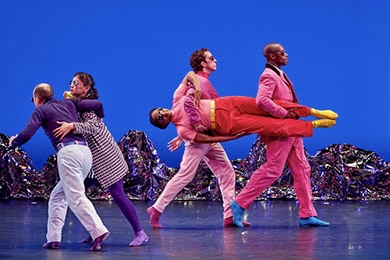
Directed and choreographed with flair by Carolyn Hutchinson, the show moves briskly, but with grace. The cast— Maureen McVerry, Emma Roos, Noel Anthony, Ken Brill and Dyan McBride (pictured) — bring both polish and playfulness to the stage, each with moments to shine. Whether it’s comedy, tenderness, or full-on Broadway razzle-dazzle, they meet the moment.

photo credit: Stephanie Clarke

Seated in the Lark’s supremely comfortable chairs, with perfect sightlines in every direction, you feel more like a guest in the showroom of a luxury cruise ship than an audience member at a small-town venue. The Art Deco interior is beautifully restored, and the theater’s atmosphere matches the class and style of the performance onstage.

The musical direction by Dave Dobrusky is sharp and inventive. These are familiar tunes—but here, they get fresh arrangements full of tight cross-harmonies and clever transpositions that reveal new layers. The cast delivers them with clarity and heart, and Dobrusky’s presence on the keys adds energy and connection.

Adding even more dimension are the full-screen digital projections that roll behind the performers—beautifully designed and precisely timed to support the mood of each number without ever distracting from it. They help set the tone, the place, and sometimes even the punchline.

Song List

21 songs from across Kander and Ebb’s prolific careers:

  • “The World Goes ‘Round”

  • “Coffee in a Cardboard Cup”

  • “Colored Lights”

  • “Sara Lee”

  • “Arthur in the Afternoon”

  • “My Coloring Book”

  • “I Don’t Remember You”

  • “Sometimes a Day Goes By”

  • “All That Jazz”

  • “Mr. Cellophane”

  • “There Goes the Ball Game”

  • “How Lucky Can You Get”

  • “Marry Me”

  • “A Quiet Thing”

  • “Kiss of the Spider Woman”

  • “The Grass Is Always Greener”

  • “We Can Make It”

  • “Isn’t This Better?”

  • “Money, Money”

  • “Cabaret”

  • “New York, New York” (with a rousing, join-in finish)

Performances Through Sunday, April 20

Remaining showtimes:

  • Thursday, April 10 – 7:00 pm

  • Sunday, April 13 – 2:00 pm

  • Saturday, April 19 – 7:00 pm

  • Sunday, April 20 – 2:00 pm

Tickets:

$50 General Admission
Order online at www.larktheater.net or call the box office at (415) 924-5111
Location: The Lark Theater, 549 Magnolia Avenue, Larkspur, CA

This is a high-quality, joyfully performed production that honors its source material while adding something fresh and local. Whether you’re a Kander and Ebb devotee or someone just looking for a stylish night out, this show is well worth catching before the curtain falls.

Wannabe thriller at Magic Theatre morphs into cerebral puzzle

By Woody Weingarten


Lawrence Redecker, as crazed Carrier X in “The Boiling: A tale of American nihilism,” stands before a striking projection. Photo by Jay Yamada.

By WOODY WEINGARTEN

If you relish theatrical productions that can merge disparate elements into a unique gel, the Magic Theatre’s The Boiling: A tale of American nihilism might satisfy your appetite.

It’s a complicated, offbeat, wannabe thriller that challenges the mental acuity of its audience, which may be left answerless to a carload of questions.

Major themes include roots and the question of if you can go home again, whether human relationships and identity do change, how personal and community histories can be integrated with today’s beings and events, how to deal with major violence in our lives, and whether science and book-learning can protect us from danger.

Plus, where serene birding fits into all of it.

The world premiere that’s presented by the Magic in conjunction with Campo Santo combines acting that ranges from muted subtlety to emotional outbursts, perfectly inserted music that skips from raucous rock to melancholy softness, and striking video, sound and lighting effects that can startle and delight.

Sunhui Chang’s drama, which jumps back and forth in time and from the Carolinas to Colorado, certainly isn’t linear. But there is a storyline:

Edris Cooper-Anifowoshe (left) and John Brougher are befuddled agents trying to track down a killer virus spreader. Photo by Jay Yamada.

Brian, a Korean American virologist from the Midwest, and Vee, a Southern-bred Black detective linked to the Pacific Northwest, team up as agents of a new government agency to hunt down David, a rampaging nomadic Caucasian carrier of a killer virus labeled “the boiling.”

For those who enjoy stage puzzles that dip into mental masturbation, the play covers several aspects of nihilism, including the concept that the attitude can be a source of despair as well as a catalyst for individual freedom. If you have the patience to look deep enough, you may discover that The Boiling also touches on fundamental nihilistic notions such as life is basically meaningless, without purpose or value; objective moral codes and beliefs don’t exist; and the possibility of knowledge or unbiased truth is nil.

That sounds awfully negative on paper, yet in the skilled hands of the cast of seven, it’s not overpowering but integrated with whatever else is happening onstage — and off, because characters join the chain of events from deep in the seats (and even surprisingly plop down in the front row).

The device of characters reading — in the third person — a book entry that describe themselves and what they’re doing can be seductive. Also alluring is the projection of plot locations in big letters on the stage floor between scenes, perhaps an outgrowth of the author originally conceiving of the slow 95-minute creation as a screenplay.

Jesse Vaughn (front) performs a ritual in “The Boiling” as Jeannine Anderson shuts her eyes in quietude behind him. Photo by Jay Yamada.

Off-putting, unlike a movie or video where the volume can be adjusted by a techie, is the choice by director Ellen Sebastian Chang of having two actors turn their backs to the audience in one long scene, muffling their words despite being mic’d.

From a more positive viewpoint, Lawrence Reducer excels as Carrier X, as do Jeannine Anderson as Miss Lolli (a narrator), and John Brougher as Brian.

All three — part of a metaphoric road trip — help bring the puzzle and story home.   

The Boiling: A Tale of American Nihilism runs at the Magic Theatre, 2 Marina Blvd., Landmark Building C, Suite 260, Fort Mason, in San Francisco, through April 20. Tickets: $35 to $75. Info: 415-441-8822 or https://magictheatre.org

Sherwood “Woody” Weingarten, a longtime member of the San Francisco Bay Area Theater Critics Circle and the author of four books, can be contacted by email at voodee@sbcglobal.net or on his websites, https://woodyweingarten.com and https://vitalitypress.com.

Buttercup

By Joseph Cillo


Madcap Farce with Big Ideas, Bold Performances, and a Pipe-Smoking Nun

Buttercup, the theatrical debut of St. Helena’s J.D. Murphy, now playing at Marin Shakespeare Company—is a smart, fast-paced, and delightfully ridiculous ride through 1880s France. Directed by Bay Area theater veteran Nancy Carlin, this new comedy delivers sharp satire disguised as farce, complete with door slamming, social skewering, and a heroine guided by visions of Joan of Arc.

From the opening moment, Lizzie Calogero sets the tone with comic precision as a witty, pipe-smoking nun who serves as our dryly observant narrator. With a raised eyebrow and the calm of someone who’s clearly seen it all, she introduces us to a world where social hypocrisy and comic mayhem go hand-in-hand.

Then the madness begins. The play features three doors onstage—always a good sign—and they’re constantly in use. But that’s not all. With a square stage setup, actors dash in and out from all four corners, weaving through the audience and into the action with perfectly-timed chaos. It’s physical comedy done right: choreographed confusion, crisp pacing, and just enough absurdity.

Gianna DiGregorio Rivera plays Buttercup with spark and sincerity, anchoring the show with warmth even as she leaps through farce-worthy hurdles. A former nun turned courtesan, Buttercup is determined to reunite with her baby daughter—and winds up in a traveling group of bourgeois couples, a cool-headed coachman, and a reserved Prussian officer. Her scenes bring both humor and heart, grounding the absurdity in real emotional stakes.

Nancy Carlin’s direction is tight, lively, and laced with nuance. She guides a strong ensemble—Rebecca Pingree, Titus VanHook, Brennan Pickman-Thoon, Richard Pallaziol, Norman Gee, Sarah Mitchell, and Brian Lohmann—through quick turns, layered dialogue, and rapid-fire entrances and exits, all while keeping the audience engaged and grinning.

The production is visually sharp, thanks to a talented creative team. Scenic designer Randy Wong-Westbrooke crafts a clever, flexible space. Maggie Whitaker’s costumes are a parade of period flair and comic exaggeration. Lighting by Christian Mejia, sound by Ray Archie, and choreography by Bridgette Loriaux all work together to support the show’s quick rhythm and high energy.

Underneath the laughs, Murphy’s script offers commentary on class divides, hypocrisy, and resilience. The humor lands, but so does the message. Buttercup is farce with a brain—and a soul.

Performances run through April 13, at Marin Shakespeare Company, 514 Fourth Street, San Rafael. The show runs Thursdays through Sundays. Evening performances are at 7:30 p.m., with Saturday and Sunday matinees at 2:00 p.m.

Tickets are $20–35, available at purplepass.com/buttercup. More information at buttercupstage.com.

Murphy, known for his award-winning film Valley of the Heart’s Delight and political satire, proves he knows how to stir theater into the mix. Buttercup is quick, clever, and consistently fun. A terrific debut—and a thoroughly entertaining night out.

MMTC’s musical ‘Cabaret’ in Novato comes as close to ideal as possible

By Woody Weingarten

Evvy Calstrom-March (center, as Sally Bowles) and Stephen Kanaski (also center, as the Emcee) star in Cabaret. (All photos by Katie Wickes)

By WOODY WEINGARTEN

There’s no perfect show, no perfect production. But the Marin Musical Theatre Company’s interpretation of Cabaret comes within a hair’s breadth of reaching those pinnacles.

The best Bay Area theatrical work of the year, perhaps the season, it stars Evvy Calstrom-March as chanteuse Sally Bowles, the main draw in Berlin’s shabby Kit Kat Club, circa the Roaring Twenties and the rise of Hitler.

Calstrom-March is a joy to watch every second she’s on stage at the Novato Theatre Company (which presented Cabaret). She’s a quadruple threat: vocals that might make many a Broadway starlet jealous; dancing that puts a capital “L” in limber; dramatic acting chops that make you feel with her; and a rubberized face that can deliver comic expressions with ease.

Also completely watchable is Stephen Kanaski, the Emcee, who changes costumes as often as kids check out their smart phones, and who leers and sneers with the best of them — even though actor/singer Joel Grey originally “owned” the role.

Choreography by Katie Wickes — who also seamlessly co-directed the show with Jenny Boynton — derivatively reminds theatergoers of Bob Fosse at his peak with an underlay of classic Jerome Robbins (and that’s not a bad thing). She staged and rehearsed each of the four nightclub dancers so well they seemed to fill the spotlights as if there were two or three times that many hoofers.

Superlative costumes by Krista Lee and Andria Nyland ranged from a military uniform to glitzy, skimpy burlesque outfits to “ordinary clothing” that blended so well it became invisible so they didn’t distract from the plotline.

A trio of instrumentalists, led by music director Daniel Savio just off the stage, doesn’t miss a proverbial beat and couldn’t have supported the cast better with its bouncy jazz rhythms suitable to the era.

Others worth lauding include Daniela Innocenti Beem, who smoothly injects landlady Fraulein Schneider (who feels pressured by the political upheaval to not marry the Jewish fruit peddler she loves) with humor and pathos and a voice that won’t quit, and Michael Lister, who portrays Ernst, a Nazi smuggler, with appropriate sleaze.

Cabaret, as most theatergoers know, is a rough-edged tragic double-love story engraved on a backdrop of Nazism. Today, the 1966 musical again acts as a red-flag metaphor suggesting that extreme nationalism, racism, Antisemitism, anti-LGBTQ+ism, and blindness to burgeoning authoritarianism can imperil our frail democracy.

Fräulein Schneider (Daniela Innocenti Beem), a landlady, cozies up to Jewish fruit peddler, Herr Shultz (Jere Torkelsen).

The Marin Musical Theatre Company (MMTC) show isn’t for everyone, certainly — despite the production’s overall superb quality and the show’s Tony award-winning history. MAGA devotees probably won’t like it just because. And anyone who can’t handle its cornucopia of heavy sexuality, debauchery, homophobia, immorality, hedonism, prostitution, and drugs most likely will stay home.

Sally Bowles (Evvy Calstrom-March, center) and Kit Kat Club girls come on strong.

Regardless, classic Broadway music by John Kander and lyrics by Fred Ebb, a team that also spawned another Great White Way blockbuster, Chicago, remain a perfect fit. Several of the tunes, in fact, can be sung or hummed or whistled as you leave the theater, an endeavor that’s almost as dead as the proverbial dodo if you think about more modern musicals.

Joel Grey, not incidentally, gets cited online by Wickes and Boynton, in lieu of a production prologue, by reprinting an op-ed he wrote for the New York Times last November.

In it, he sounds an alarm about “the dangers of apathy” and distraction — as he simultaneously warns us about being seduced by a sense that we are facing dark times but “they won’t really affect our own day-to-day lives.”

That sense, he notes, echoes “the tragically shortsighted assessment of so many European Jews in the 1920s and ‘30s.”

The MMTC/Novato Theatre Company co-production of Cabaret will play at the Novato Theatre Company, 5420 Nave Drive, Novato, through April 13. Tickets: $35 to $50. Info: 415-883-4498 or info@marinmusicals.org.

Sherwood “Woody” Weingarten, a longtime member of the San Francisco Bay Area Theater Critics Circle and the author of four books, can be contacted by email at voodee@sbcglobal.net or on his websites, https://woodyweingarten.com and https://vitalitypress.com.


Behind the scenes of ‘Jaws,’ three actors bare their teeth

By Woody Weingarten

Actor Richard Dreyfuss (Dylan James Pereira, front) gestures while the other main performers in the film Jaws, Roy Scheider (Nathan Luft-Runner, left) and Robert Shaw (Matt Cadigan), look on in a dramedy at the Left Edge Theatre, The Shark Is Broken. (Photo by Dana Hunt)

By WOODY WEINGARTEN

The Shark Is Broken may be billed as a comedy but might better be viewed as a drama peppered with laughs.

The 95-minute play details the real-life, repugnant interactions of actors Richard Dreyfuss (Dylan James Pereira), Robert Shaw (Matt Cadigan), and Roy Scheider (Nathan Luft-Runner) off and on the set of Steven Spielberg’s 1975 cinematic blockbuster, Jaws.

Tensions spring from shooting delays caused by pre-CGI and AI mechanical devices — intended to power the threatening shark — conking out. Add to that a feud between a young Dreyfuss and an aging Shaw (known as much for his Shakespearean roles and his writing as for his Hollywood work) that sets a troublesome tone throughout.

Scheider, a more stoic, professorial type, can’t elude Shaw’s negativity either. When he bemoans the two-month ocean shoot in Martha’s Vineyard as “a long time to be stuck together,” Shaw one-ups him: “It’s an eternity.”

Many scenes in the Dana Hunt-directed play replicate precisely what happened. At least that’s what Ian Shaw, the actor’s son, would have us believe. It was he who co-wrote the play with Joseph Nixon (never shrinking from repeatedly depicting his dad as a stumbling drunk).

The Shaw character, who alludes to his own father killing himself when the actor was 12, is fully cognizant of his shortcomings and how they affect others. He refers to priding himself for being able to act at all after “a tidal wave of booze” and notes that he can find himself “with a drink in my hand as a reward for not drinking.”

Trying to cozy up to the British actor, and hopefully eliminating an avalanche of putdowns, Dreyfuss brings his elder joy by looking for and finding two hidden bottles of booze. But he also dumps the contents of yet another bottle, an action that transforms a war of words into more physical combat.

Much of the play’s humor is pitch black, with sarcasm being the main coin of the theatrical realm. Early on, the panic attack-prone Dreyfuss fears for his career because the film they’re in could end up being like Planet of the Apes“without the monkeys.”

In brazen contrast while alone in the show’s funniest moments later, he presents a mocking imitation of Shaw.


Starring in The Shark Is Broken are (from left) Dylan James Pereira, Nathan Luft-Runner, and Matt Cadigan. (Photo by Dana Hunt)

Together, the three characters touch on a gamut of subjects: father-son relationships, philosophical and scientific journeys of the mind and mouth, and pointed references to Nixon (“tricky Dickie”), the Silent Majority, and Nobel Prize-winning dramatist Harold Pinter,

To pass the time, they gamble on cards and a British coin-flip game — and almost constantly refer to their previous hits, as well as films that crashed and burned, and other actors.

They also debate their billing and who is the film’s star, their egos never letting them think for an instant that it’s the animatronic shark.

Just before their final scene, in both reel and real life, Shaw indicate he doesn’t think much of Jaws and goes on to trash Spielberg’s next unnamed project that will become E.T. — the Extra-Terrestrial with one pejorative word, aliens, and then predicts that the film industry in the future will be limited to churning out “sequels and rewrites and sequels.”

Snarkily, he also says, “Do you really think anybody is going to be talking about this in 50 years?”

The Shark Is Broken will play at the Left Edge Theatre of the California Theatre, 528 7th St., Santa Rosa, through April 11. Tickets: $22 to $33. Info: 707-664-play or https://leftedgetheatre.com.

Sherwood “Woody” Weingarten, a longtime member of the San Francisco Bay Area Theater Critics Circle and the author of four books, can be contacted by email at voodee@sbcglobal.net or on his websites, https://woodyweingarten.com and https://vitalitypress.com.

Ross Valley Players musical comedy ‘Pet Lingerie’ a tech spoof with some laughs

By Woody Weingarten

Did you ever dream up a get-rich-quick app idea? Three wannabes do just that in “Pet Lingerie,” an original musical comedy playing in Ross.

Presented by the Ross Valley Players, the two-act show, which takes clever potshots at technology in general and crowdfunding in particular, can be summed up in a single word: Silly.

Did writers Fred Raker and Bruce Tallerman (who met in Hollywood, writing for TV) expect that every one of their rapid-fire verbal gags would draw laughs? It turns out that the 105-minute play develops a rhythm something like this: Funny gag, laugh-out-loud gag, a bomb, funny gag, lol gag, a bomb, ad infinitum.

However, audience laughter and sporadic applause nonetheless pummel the rafters of the Barn Theatre at the Marin Art and Garden Center, where the show runs through April 6.

“Pet Lingerie” takes place in the Airport Suites Hotel in Terre Haute, Indiana, where muffler peddler Ruben Mondello (Landers Markwick), ex-plumber Frank Pincus (Robin Schild) and yoga devotee Frances Ulrich (Vicki Victoria) try to learn from marketing maven Gary Panko (Laszlo Horner) how to kickstart their products.

L-R, Vicki Victoria and Robin Schild portray aspiring entrepreneurs in Ross Valley Players’ premiere “Pet Lingerie” at the Barn Theatre in Ross through April 6. (Robin Jackson via Bay City News)

His three-day workshops may be too intense for some participants, but there are no refunds — “mental breakdowns are no exceptions.”

Their brainstorms are, to say the least, innovative: how to tell whether orgasms are fake; how to smother a toilet flush with recorded operatic arias; and how to get “sweet revenge” via “FU” cookies and bird-flipping mitts.

Panko’s own apps are no less imaginative: They include a flak jacket that dispenses coffee through a tube and, of course, pet garments.

Supporting characters add to the madcap mirth. Silvana Concino (Natalie Buck-Bauer) portrays a sexy but angry Italian flight attendant jettisoned by Panko, her lover; Susan Night (Annejelika “AJ” Ong Cortez) plays a tribute band singer craving Broadway lights. And Rabbi Moshe Ben-Hogan (Dan Schwager) is a playwright who’s long been blocked.

Also: There’s Ron Talbot, who guides a pope puppet that doubles as a giggle-getter and center of a morality play within the play.

A sample of the show’s humor: “We had sex before there was sexting” and “I always thought we’d tie the knot, but you turned out to be a bot.” And, from old chestnuts: “Why’d the Florida chicken cross the road? … to avoid becoming an early bird dinner.”

As for the music, no one’s likely to leave the theater whistling the tunes composed by Tallerman. Still, Buck-Bauer as Silvana, Markwick as Ruben, and Schild as Frank all showcase impressive singing voices.

Gary Stanford Jr., responsible for the show’s cutesy low-tech choreography, also directs “Pet Lingerie,” which has a delightfully droll twist at its tail. And Valera Coble’s winning costumes contrast bright and colorful garb with an orthodox rabbi’s all-black attire.

“Pet Lingerie,” a Ross Valley Players New Works production, was selected from more than 70 other previously unproduced plays by living Bay Area writers. While RVP New Works have smaller budgets, shorter runs and less elaborate sets than some of the company’s other shows, they often take more creative chances.

Here, for example, are offbeat but endearing concepts as a retired tradesman who still carries a plunger with him, an idea man who hides under the covers wearing a virtual-reality headset, and a non-traditional Partridge Family Tribute Band.

And even if RVP New Works are imperfect, they deserve support. It’s exciting and brave to stage original plays with topical themes.

Ross Valley Players “Pet Lingerie” runs through April 6 in the Barn Theatre at the Marin Art and Garden Center, 30 Sir Francis Drake Blvd., Ross. Tickets are $20-$35 at rossvalleyplayers.com.

This article was first published on LocalNewsMatters.org, a nonprofit site supported by Bay City News Foundation http://www.baycitynews.org/contact/.  


Sherwood “Woody” Weingarten, a longtime member of the San Francisco Bay Area Theater Critics Circle and the author of four books, can be contacted by email at voodee@sbcglobal.net or on his websites, https://woodyweingarten.com and https://vitalitypress.com.

Mrs. Krishnan’s Party

By Joseph Cillo


More Than a Show—It’s a Celebration

The thing about a good party is, you don’t always know what you’re walking into. You might get an awkward silence. You might get lukewarm spinach dip. Or—if you’re lucky—you might find yourself wrapped up in something unexpected, like a room full of strangers laughing together over a bubbling pot of dahl. Mrs. Krishnan’s Party, now at Marin Theatre, is that kind of lucky.

This isn’t a play where you sit back quietly in the dark, politely ignoring the person rustling candy wrappers two rows over. It’s a full-on, feet-on-the-table, hands-in-the-cooking-pot kind of night. Marin Theatre’s Boyer Main Stage has been transformed into the cluttered backroom of a convenience store, with audience members seated right in the thick of it. And your level of participation? Well, that depends on how adventurous you’re feeling.

Want to stay in the safe zone? You can. But if you sit in the “Cheeky Seats,” be prepared: you may end up cooking, dancing, or suddenly finding yourself in an impromptu comedy duo—no rehearsal required. It’s immersive theater at its most unpredictable, which means no two performances are ever the same.

And what a party it is. Even before the story begins, the atmosphere buzzes with energy. Guests are handed colorful gauze scarves, garlands, and leis to wear. Balloons are passed around and, when the moment strikes, sent soaring into the air like we’re all in on some giant, joy-filled secret. It’s the kind of immersive experience that doesn’t just break the fourth wall—it dances on top of it.

At the heart of it all is Mrs. Krishnan, played with warmth and spark by Kalyani Nagarajan, a woman hoping for a quiet evening in her store’s back room. But James—a university student with DJ dreams, played by Justin Rogers—has other plans. He kicks off the show, welcoming guests and organizing a surprise Onam celebration in her honor. James sets the tone as the party’s emcee and master of ceremonies, drawing the audience into the spirit of the evening with high energy and improvisational flair. While Mrs. Krishnan tries to keep things grounded, James leans into the chaos, creating space for connection, laughter, and joy.

Nagarajan brings infectious energy and expressive physicality to the role, embodying Mrs. Krishnan’s warmth, exasperation, and joy with every glance and gesture. Her thick Indian accent can sometimes make dialogue tricky to catch, but her face, her body language, and her impeccable comedic timing do a lot of the talking. You might miss a word here or there, but you’ll never miss the meaning. She carries the performance with such a vibrant presence that Mrs. Krishnan doesn’t feel like a character—she feels like the host of the best dinner party in town.

And speaking of dinner—yes, there’s food. Throughout the show, a pot of dahl simmers gently onstage, filling the space with warm, comforting aromas. And then, as the night winds down, the cast serves it to the audience. No plastic-wrapped intermission snacks here—just a simple, shared meal that turns an already communal experience into something even more intimate.

The script shifts each night, responding to audience interaction. Someone might be invited to help with the cooking. Another might suddenly be part of a spontaneous skit. A bit of improv here, a dance break there—this production thrives on unpredictability.

And yes, there’s dancing. One moment Mrs. Krishnan is stirring dahl and cracking jokes; the next, she’s leading a dance from atop a table, sweeping everyone into celebration. Between the music, movement, and moments of unrehearsed connection, the play becomes less of a performance and more of a shared experience—one you don’t just watch, but feel part of.

What truly sets Mrs. Krishnan’s Party apart is how it lingers. As the lights came up, no one rushed to the exits. We stayed. We ate together. A small, simple gesture—but one that brought everything full circle. The play ends, but the party continues.

Playwrights Jacob Rajan and Justin Lewis, co-founders of New Zealand’s Indian Ink Theatre Company, have created something uniquely heartfelt—part storytelling, part improv, part social experiment in joyful human connection. John Verryt’s cluttered, lived-in set and Jane Hakaraia’s warm, inviting lighting make the space feel less like a theater and more like someone’s kitchen on a festival day.

If you’re in the mood for something different—something surprising, genuine, and irresistibly fun—Mrs. Krishnan’s Party is worth pulling up a chair for. And if you leave a little hungrier than when you arrived, well—don’t worry. They’ve got that covered too.


Performances & Tickets

Mrs. Krishnan’s Party runs through March 30 at Marin Theatre, 397 Miller Avenue, Mill Valley. Tickets range from $47–$97, plus a $6 handling fee per total order. Visit MarinTheatre.org or call 415-388-5208 for availability and ticket purchases.

This is a short run, so get your tix now!

Push / Pull

By Joseph Cillo


A Play That’ll Work You Over Like a Bad Personal Trainer

Central Works opens its 2025 season with Push/Pull, a play so packed with intensity and gym lingo, you might leave the theater feeling sore. Written by Harry Davis, this production takes a deep dive into the fine line between self-improvement and self-destruction—a line so fine, it might as well be written in protein powder.

Clark, our protagonist, is in rough shape—emotionally, not physically (yet). After a tough breakup and a stint in a mental health facility, he reconnects with his childhood buddy Nolan, who’s now an amateur bodybuilder with the kind of dedication usually reserved for medieval monks or tax auditors. Nolan offers to turn Clark into a muscle-bound marvel, provided Clark helps him win his Pro Card. What ensues is equal parts bro-bonding, existential unraveling, and enough posing routines to make a peacock self-conscious.

Under the direction of Gary Graves, Push/Pull finds its rhythm in the push-pull (see what I did there?) of these two men’s ambitions. The intimate setting at the Berkeley City Club means you can see every muscle twitch and every drop of sweat (hopefully stage sweat, but no guarantees). It’s the kind of play that makes you think deep thoughts, like: What drives us to reinvent ourselves? Can we ever really escape who we are? And do I need to start lifting weights?

Andre Amarotico plays Clark with the kind of quiet desperation that sneaks up on you, while Matthew Kropschot’s Nolan is the embodiment of a guy who truly believes discipline can fix everything. Together, they create a chemistry that feels like two guys stuck in an elevator, each convinced the other one has the key.

Davis’ writing is smart, funny, and sneakily profound. The dialogue snaps like a weight belt in need of replacement, and the themes hit as hard as a deadlift gone wrong. There’s a rhythm to the words that makes you feel like you’re watching two people spar, except instead of punches, they’re throwing doubts, fears, and occasional flexes.

Visually, the play delivers the goods—sharp lighting, well-timed sound cues, and a general sense that if you sat too close, you might get drafted into an impromptu push-up contest. The whole thing is beautifully staged, making the audience feel like voyeurs at the gym, watching two men lift more than just weights.

Central Works has done it again—taking a topic you didn’t know you needed to see on stage and making it riveting. If you’ve ever wrestled with the idea of self-worth, ambition, or whether you should be drinking more raw eggs, Push/Pull is for you.

Ticket Information

  • Performances Through March 30
  • Berkeley City Club, 2315 Durant Ave, Berkeley, CA
  • Showtimes
    • Thurs & Fri: 8 PM
    • Sat: 7 PM
    • Sun: 5 PM
  • Tickets
    • Fri–Sun: $35–$45
    • Thurs: Pay-What-You-Can
    • Sliding scale tickets ($20–$45) available at noon on the day of the show
  • How to Get Tickets

Stretch first.


Play in Santa Rosa crammed with gags, sexuality, insightful opinions

By Woody Weingarten

Clyde (Shanay Howell) weaponizes a kitchen knife in comedy at the 6th St. Playhouse. (All photos by Eric Chazankin.)

By Woody Weingarten

Clyde’s, at the 6th St. Playhouse in Santa Rosa through March 23, is a sneaky little devil of a play.

Sandwiched between frequent effervescent sight and verbal gags and a generous helping of street slang mixed with overt sexuality, you can discover layers of caustic but insightful opinions.

The Pennsylvania greasy spoon of the title is a work haven for ex-cons, most of whom regret the reason for their incarceration and yearn for a second chance to become more fully realized human beings.

How do the felons aim to achieve that? Believe it or not, by creating the perfect gourmet sandwich — onstage — despite the truckdriver clientele preferring simple turkey on rye.

Love, anger. Teasing, testiness. Thoughtfulness, spite. All are menu ingredients.

Added in are pinches of racial inequities and pain.

And sporadic munching by the six-member cast.

Light throwaway lines like “Now you’re disrespecting the lettuce” and “Don’t say that — she can hear through walls” are precursors to serious tidbits such as “I can’t walk down the street without feeling like everyone’s hating on me” and “Just ‘cause you left prison, don’t think you’re outta prison.”

Shanay Howell instills in sandwich shop-owner Clyde more piss and vinegar than you might imagine, all the while popping her eyes, pouting her mouth, and exaggeratedly strutting flirtatiously so viewers can’t help but laugh.

Nate Musser portrays Jason, a homeless dude dotted with white supremacy face and arm tattoos whose vitriol knows no limits but who can also draw humor from slapstick postures and soften like room-temperature butter when a scene calls for that attitude.

Jason (Nate Musser) rests his head on chest of Montrellous, who gives him a healing hug.

And Tajai Jaxon Britten re-creates Montrellous, resident philosopher with a sonorous voice and a Zen attitude, as someone to emulate.

Meanwhile, director Marty Pistone resembles a conductor timing multiple instruments to end on the same micro-dot — in this parallel case, when characters excitedly talk over each other and then stop abruptly.

Intermittent music, mainly staccato drumbeats orchestrated by sound designer Laurynn Malilay during the blackouts between frequent brief scenes, acts as a perfect accompaniment.

The set designed by Bruce Lackovic also deserves praise for seamlessly blending real and simulated kitchen equipment.

Cast of Clyde’s are tickled by blurb in a local newspaper.

Have you ever stumbled on a hole-in-the-wall that can dish out melt-in-your-mouth food? Or a place that could satisfy your food-for-thought cravings? Whether or not your answer is “yes,” you might want to taste-test Clyde’s.

Not every performance of the fast-paced 90-minute play by two-time Pulitzer Prize winner Lynn Nottage, is sold out. That, truly, is a shame.

Clyde’s will play on the Monroe Stage of the 6th St. Playhouse, 52 W. 6th St., Santa Rosa, through March 23. Tickets: $29 to $47.95. Info: 707-523-4185 or https://6thstreetplayhouse.com.

Sherwood “Woody” Weingarten, a longtime member of the San Francisco Bay Area Theater Critics Circle, can be contacted by email at voodee@sbcglobal.netor on his websites,