CARMELINA a charming and robust hit at 42nd Street Moon

By Kedar K. Adour

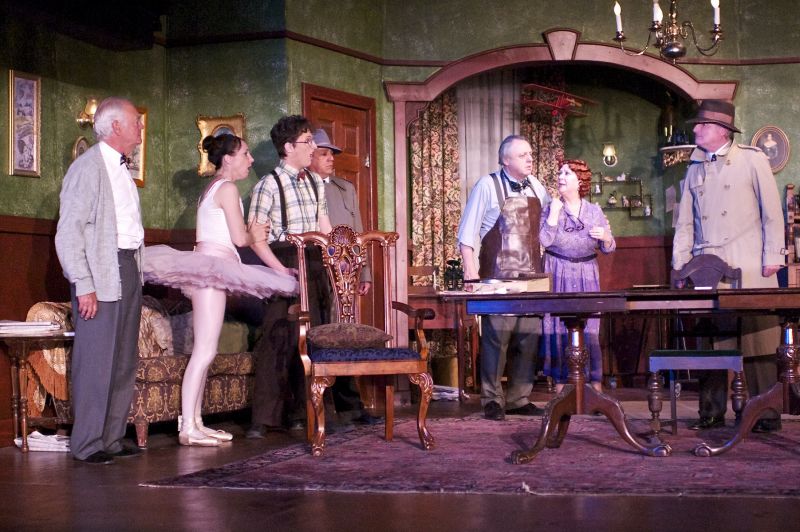
Carmelina (Caroline Altman) is wooed by café owner Vittorio (Bill Farhner)

CARMELINA: Musical. Lyrics by Alan Jay Lerner.  Music by Burton Lane.
Book by Alan Jay Lerner & Joseph Stein. 42nd Street Moon, Eureka Theatre, 215 Jackson Street, San Francisco, CA. (415) 255-8207 or www.42ndstmoon.org.

CARMELINA a charming and robust hit at 42nd Street Moon

When you first enter the Eureka Theatre you are greeted by an attractive colorful set stretching across the entire stage and there is no doubt that you are being transported to sunny Italy. That’s where we meet the townspeople of the village of San Forino, somewhere between Sorrento and Naples and the year is 1962. It just happens that on an April day18 years before the US Army liberated that village from the Fascists . . . a time fondly remembered by our heroine Carmelina.

Starting with a rousing opening number by Manzoni (Bill Olson) the village mayor, guitar plucking Father Tomasso  ( Michael Doppe)and young fisherman Roberto (Stewart Kramar) the evening is filled with song, dance, humor and a touch of pathos creating a winning show that this reviewer highly recommends.

The original story began with the hit movie, Buena Sera, Mrs. Campbell that starred Gina Lollobrigida as an Italian woman who told three different men that each was the father of her daughter.  The original musical by Alan Jay Lerner, Burton Lane and Joseph Stein had an ignoble run of 17 performances even though the score won a Tony nomination. You will recognize the story line as the smash hit by the ABBA singing group that became the world stage favorite Mamma Mia and in 2008 the movie with Meryl Streep.

The show has never been seen outside New York since its initial run, marking this 42nd Street production as both its first post-Broadway full production and its West Coast premiere. Artistic Director Greg MacKellan has rounded up a top-notch cast of  past favorites with a sprinkling of ‘newbies’ who work together as an ensemble and yet have individual traits giving  the show a fresh energetic look.

Caroline Altman, as Carmelina has the right touch of libidinousness to match her apparent pious nature as the widow (“A Widow’s Prayer”) of 2ndLieutenant Campbell the father (??) of her daughter Gia (Emily Kristen Morris). It just happens that there were three (count them, three) young U.S. soldiers whom she couldn’t resist in 1944. The telling of the tale in song (“Someone in April”) to her trusted servant Rosa (Darlene Popovic) has tricky lyrics and Popovic’s double take responses will tickle your funny-bone. The ingenious scheme she devised to maintain her dignity among the natives of San Forino is about to unravel when all three of the April misadventure are to arrive . Rosa reluctantly joins in to the

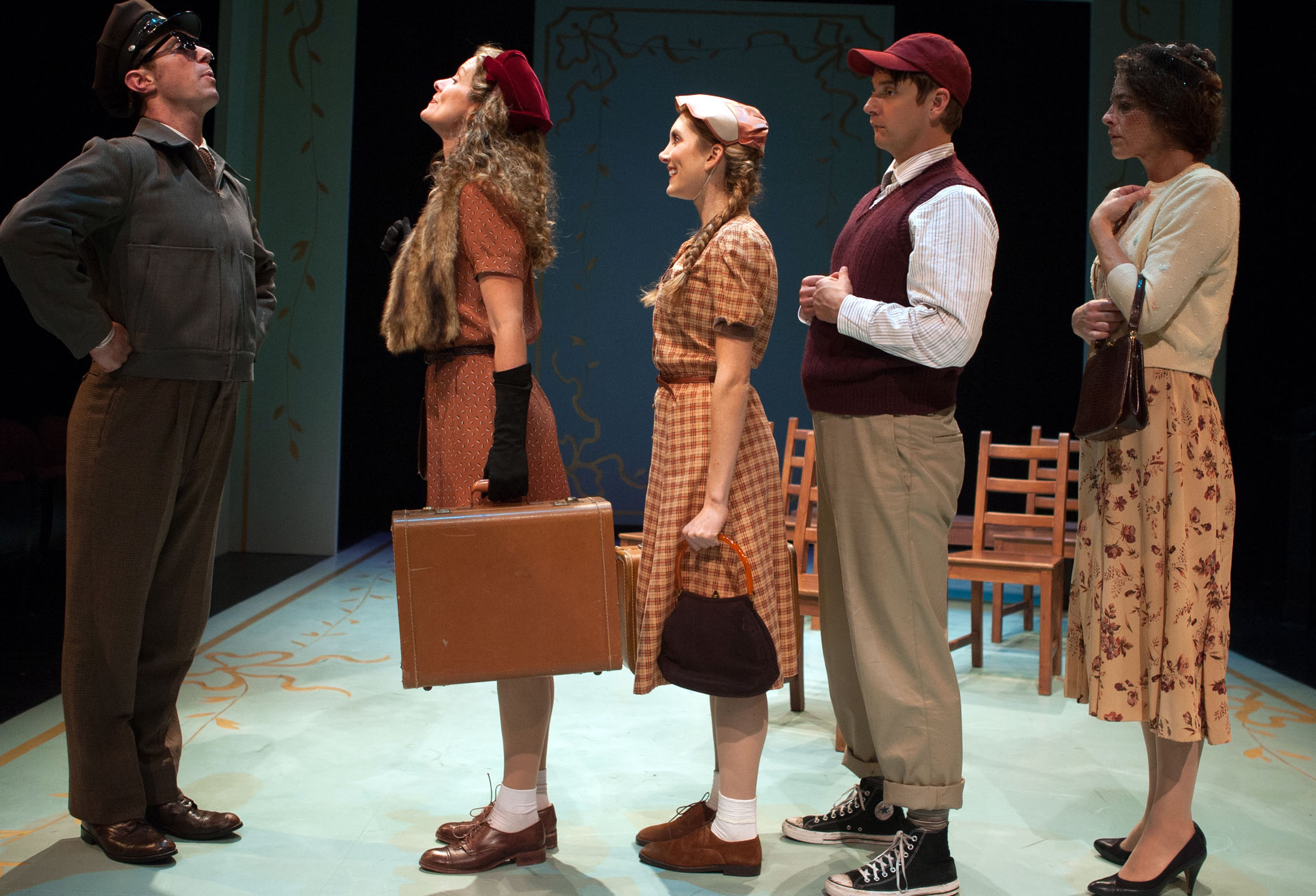
Carmelina’s (Caroline Altman) scheming past amazes
her maid Rosa (Darlene Popovic)

deception making.

Enter the self-proclaimed lothario Vittorio (Bill Fahrner) who has women from A to Z at his beck and call but one look at Carmelina and he is willing to forsake all others. Or does he really? Fahrner’s entrance with “It’s Time for Love”, exuding his magnetic charm, fantastic stage presence added to his pitch perfect tenor voice is a show stopper only minutes into the show. The charisma between Fahrner and Altman is palpable beyond the footlights and their marvelous voices entwine in their duets of “Why Him” and “Love Before Breakfast.”

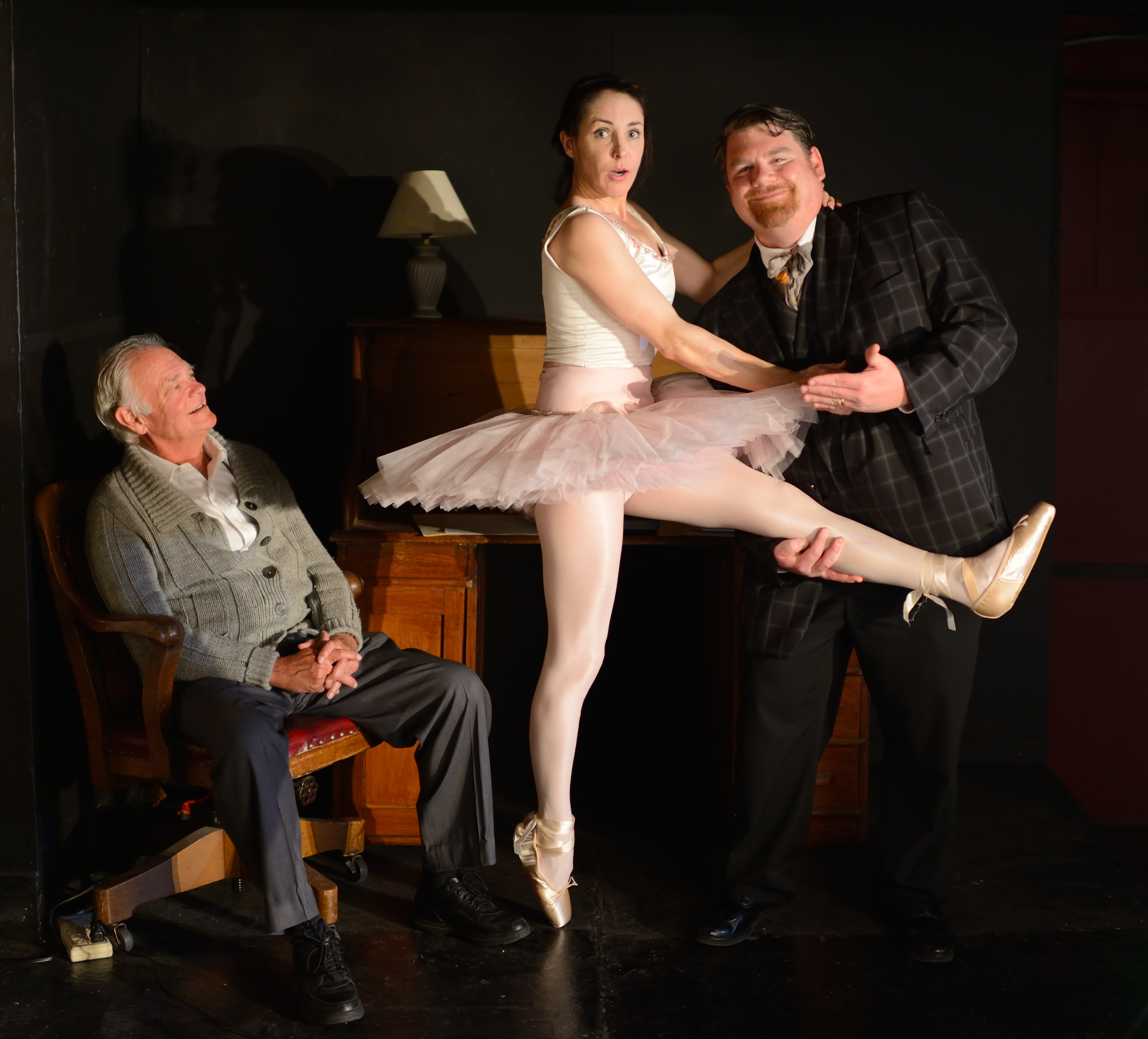
Carmelina Campbell (Caroline Altman, middle) has been
collecting child support from three American GIs – but
which is the real father of her daughter:
Carleton (Rudy Guerrero), Walt (Will Springhorn Jr.), or
Steve (Trevor Faust Marcom)

The Yankee Doodles who come to town (Will Springhorn, Jr., Trevor Faust Marcome and Rudy Guerrero) do yeoman duty in song and dance adding to the evening’s humor and touch of pathos. They have been assigned the charming “One More Walk Around the Garden” and “The Image of Me” as they admire Gia. Beautiful ingénue Emily Kristen Morris is a stunner and stirs the audience with her solo “All That He’d Want of Me.”

The running time is two hours and twenty minutes with intermission but it will seem much shorter while you are having fun. MacKellan paces the evening beautifully and is aided by Dave Dobrusky’s musical direction.

Kedar K. Adour, MD

Courtesy of www.theatreworldinternetmagazine.com


Fringe of Marin Fall 2012: Program One off to a good start

By David Hirzel

The Fringe of Marin opened its 30th season November 2, 2012 with a near full house set to enjoy the seven new plays presented in Program One. So much happens on such a small stage!

The night got off to a fast start with Shirley King’s Hollywood Confidential a spy-caper spoof, a witty SNL-flavored take on “007” in Hollywood.  Gigi Benson perfectly cast as the lady in red.  George Dykstra wrote and delivered the evening’s most powerful performance in Mysterious Ways, a well-paced and very moving soliloquy from a grieving widower.

Minerva and Melrose gave us a change of pace from the somber to the silly, as the clueless Minerva spins off malapropisms gives us plenty to laugh at as she tries on one arts career after another with dizzying speed.  Written and directed by Martin A. David, this play also featured the most inventive set of the evening with a glass door on a pivot between a bathroom/prison and a living room.

The highlight of the lineup came just before the intermission. Carol Eggers directs veteran Fringe actor Rick Roitinger as a passive-aggressive husband scheming to get his wife (Emily Soliel)  involved in a wife-swapping party. Don Samson’s script has the flavor of a real marital argument, coming around time after time to the same arguments in the same words with no apparent resolution in sight. “Marion” being the wiser of the two doesn’t want to play, but fed up with “Tom’s” badgering finally she consents to play The Game, but only on her terms.

After the intermission, we are treated to another (the best so far) of Annette Lust’s kitchen fairy-tales.  In this delightful show, Cynthia Sims (Salt), Terri Barker (Pepper), and French chef Charles Grant ham it up in equal measure to tell us exactly How Salt and Pepper Got Put into Shakers.  The evening turns serious again with Michael Ferguson’s look at the Sharp Edgesthat doom the budding romance between a man and a woman who has been scarred by assault. In another change of pace, the final play Sunday Sundays (written and directed by Peter Hsieh) brought the most laughs in a four-way take on a simple absurdist sketch, repeatedly played word-for-word, each time funnier than the last.

As promised, the Fringe gives you something you won’t see anywhere else, you will be glad you came.  Don’t miss Program Two (eight different new plays) starting November 3.

Fringe Programs One and Two through November 18.  For times and dates see schedule:  http://www.fringeofmarin.com/performanceschedule.html

At Meadowlands Hall, Domincan University, 50 Acacia Ave. @ Grand Ave., San Rafael CA

Reservations and Information 415-673-3131  http://www.fringeofmarin.com

Review by David Hirzel www.davidhirzel.net

Russell Maliphant Company: AfterLight

By Jo Tomalin
Image of Russell Maliphant Company

Russell Maliphant Company
Thomasin Gülgeç and Gemma Nixon in AfterLight
Photo: Dana Fouras


Dynamic New Dance Work from London

Opening Night of the London based Russell Maliphant Company’s new dance work titled AfterLight on October 13, 2012, presented by San Francisco Performances at the Lam Research Theater, Yerba Buena Center for the Arts, glowed very warmly.

AfterLight is co-produced by the Russell Maliphant Company and London’s prestigious dance venue Sadler’s Wells, where it had it’s world premiere on September 28, 2010. Maliphant directed and choreographed this work that comprises several parts set to Erik Satie’s beautiful Piano Music: Gnossiennes 1 – 4 and Original Music by Andy Cowton.

Originally trained in ballet Maliphant danced with the Sadler’s Wells Royal ballet for several years. He has since danced with DV8 Physical Theatre, Michael Clark & Company, then created his own company and set works on renowned artists and companies including Sylvie Guillem, Robert Lepage, Ballet Boyz and Lyon Opera Ballet.

AfterLight is not a story ballet. Malipant describes it as a Nijinsky inspired piece he developed while working closely with Lighting Designer Michael Hulls, that is more about “painting in space” with the dance flowing through space and light, expressing elements from photos of the legendary dancer Vaslav Nijinsky. Maliphant and Hull worked at first by improvising light and dark elements to produce a “shower of light” with projections and animations (by Jan Urbanowski & James Chorley) to explore the movement and light together, before refining the choreography for an audience.

As an interesting aside, not all of the music choices were made before the dances – some music was selected after the dance and light choreography, according to Maliphant. This is extraordinary, because the choreography as a whole seems to respond to the music – and the one complements the other incredibly well.

Malipant’s choreography melds traditional dance to his interests in physical movement and bio-mechanics. AfterLight, with Costume Design by Stevie Stewart, is an exquisite one hour performance of ephemeral, sculptural, meditative, muscular movement, which resonates from the three outstanding dancers, Silvina Cortés, Thomasin Gülgeç and Gemma Nixon to produce a dynamic and stirring audience experience.

The Russel Maliphant Company is currently touring internationally and will perform The Rodin Project in New York City December 3, 5-9, 2012.

San Francisco Performances upcoming November events include:

More Information & Tickets:

Russel Maliphant Company
http://www.rmcompany.co.uk

San Francisco Performances
http://www.performances.org

Jo Tomalin
Critics World
www.forallevents.com

ACT’s “Elektra” features Augesen, Dukakis

By Judy Richter

By Judy Richter

Echoes of the Trojan War and the generation-to-generation woes of Greece’s House of Atreus reverberate in Sophocles’ “Elektra,” presented by American Conservatory Theater in a translation and adaptation by playwright-scholar Timberlake Wertenbaker.

In brief, the title character, played by René Augesen, is still lamenting the murder of her father by her mother and her mother’s lover several years earlier. Elektra is hoping that her brother will return to Mycenae to avenge their father’s death. Because of her loud, unending mourning, Elektra has become something of an outcast in her own home and may be teetering on the brink of insanity.

In a tense confrontation between mother and daughter, the steely Clytemnestra (Caroline Lagerfelt) tells Elektra that she had killed Agamemnon to avenge his sacrificial murder of Elektra’s sister Iphigenia. Therefore, Clytemnestra felt her actions had been justified. ACT program notes go into further detail about all of the background leading up to this play, but Wertenbaker’s accessible translation provides basic background information clearly and simply.

Running 90 minutes without intermission, ACT’s production is directed by artistic director Carey Perloff, now in her 20th season with the company. Unlike many other classical Greek dramas, which use a Chorus of several people to comment on the action and serve as a kind of jury, this adaptation uses only one person, Olympia Dukakis, 81, to fill that role. With her silvery hair and dignified stage presence, Dukakis’s Chorus Leader serves as a voice of reason and a welcome counterpoint to Elektra’s rage. The Chorus Leader also helps the audience to explore the play’s key questions about the nature of justice.

Augesen, an ACT associate artist, has the daunting challenge of sustaining Elektra’s rage, grief and the frustration of being a powerless woman. She meets that challenge successfully even though her character’s extremes can be a bit much to take at times.

Lagerfelt’s Clytemnestra evokes little sympathy in her treatment of Elektra, yet she makes a persuasive argument for why she was so aggrieved by her husband. Nick Steen as Orestes, Elektra’s brother, brings an aura of strength, resolve and heroism as he returns and fulfills what he and Elektra see as his duty to avenge their father’s death.

Their sister, Chrysothemis, well played by Allegra Rose Edwards, has curried favor with their mother as a way of going along to get along, but Elektra wins her over. Among the other supporting characters, Anthony Fusco as Orestes’ Tutor has a standout scene when he gives a vivid (but fictional) description of Orestes’ death in a chariot race. Steven Anthony Jones as Aegisthus, Clytemnestra’s lover, and Titus Tompkins as Pylades, Orestes’ cousin and companion, complete the cast.

Ralph Funicello’s set foreshadows the play’s mood as the audience enters and sees a chain link fence topped by barbed wire stretching across the stage. Lighting by Nancy Schertler reveals the grimly black palace behind the fence and later uses red to symbolize the bloodshed within.

Costumes by Candice Donnelly run the gamut from, as Perloff says, ancient Greece to haute couture. The latter is seen in Chrysothemis, whose prissy white outfit evokes the mod mode of the late ’60s or early ’70s. Sound by Cliff Caruthers completes the play’s design components..

Another key element in this production is provided by composer David Lang’s haunting score, played and sometimes sung by cellist Theresa Wong, who sits on one side of the stage.

Because of its near-unrelenting keening, “Elektra” may be hard for some observers to take, but the acting and design elements are all outstanding.

“Elektra” will continue at American Conservatory Theater, 415 Mason St., San Francisco, through Nov. 18. For tickets and information call (415) 749-2228 or visit www.act-sf.org.

Mourning does not become ELEKTRA at ACT.

By Kedar K. Adour


L to R: René Augesen as Elektra, Olympia Dukakis as the Chorus Leader, and Allegra Rose Edwards as Chrysothemis in Sophocles’ Elektra. Photo by Kevin Berne.

ELEKTRA: Sophocles’ Greek Tragedy. A new translation by Olivier Award–winning playwright Timberlake Wertenbaker. Directed by Carey Perloff, American Conservatory Theatre (ACT), A.C.T.’s Geary Theater, 415 Geary Street, San Francisco. 415-749-2228 or www.act-sf.org. October 25 – November 18, 2012

Mourning does not become ELEKTRA at ACT.

The Greeks have invaded both sides of Bay Bridge with Berkeley Rep extending their run of the brilliant An Iliad and American Conservatory Theatre (ACT) mounting an adaptation of Sophocles’s Elektra that had its world premiere in 2010 at the Getty Villa outdoor theater in Los Angeles. ACT artistic director Carey Perloff directed the world premiere and has redirected the present staging bringing along local favorite Olympia Dukakis from the LA production.

The connection between Homer’s Iliad and Sophocles’ and Elektra is temporal. The Greek king Agamemnon has sacrificed his youngest daughter Iphigenia to the gods in exchange for a favorable wind to bring back his ships from the siege of Troy. His wife Clytemnestra (Caroline Lagerfelt) and her lover Aegisthus (Steven Anthony Jones) have murdered Agamemnon. The young son Orestes (Nick Steen), who would be a threat to the throne that Aegisthus has usurped, has been sent away to safety with his Tutor (Anthony Fusco). Elektra (Renee Augesen) and her sister Chrysothemis (Allegra Rose Edwards) have remained with their increasingly paranoid mother Clytemnestra. Whereas Chrysothemis is resigned to her fate, Elektra openly and often mourns the death of her father and seeks revenge.

Years have intervened but revenge remains paramount in the minds of Orestes, his best friend Pylades (Titus Tompkins) and the Tutor. The trio plan to arrive in disguise to kill Clytemnestra and Aegisthus. The deed gets done. End of play.

Although a few of the audience spontaneously arose to applaud the actors, the majority remained seated politely applauding and on exit did not exhibit the usual enthusiasm after seeing an Olympia Dukakis performance. The chorus in a Greek drama is extremely important since they unite the past, present and predict an ominous future. Dukakis makes her entrance from the aisle, to spend the major portion of the evening standing around while the action proceeds. She does not demonstrate her usual command of the stage and much of the time used excessive arm flaying.

Then too, the superb multitalented Augesen seemed to be emoting rather than acting as she groveled much of the time on the floor. Her quality acting did not project and this probably was the fault of the directing, translation and adaptation. For this concept production the set (Ralph Funicello) was a city slum area with a metal chain-link fence, topped with barbed wire extending across the full length of the stage with debris scattered about.

Caroline Lagerfelt & Rene Augesen

The finest performance is given by Caroline Lagerfelt. Her depiction of the arrogant paranoid Clytemnestra was regal and chilling conveying the treachery that is her undoing. Anthony Fusco gives a quality performance as the Tutor and Steven Anthony Jones’ brief entrance is powerful. Running time 90 minutes without intermission.

Kedar K. Adour, MD

Courtesy of www.theatreworldinternetmagazine.com


SO NICE TO COME HOME TO at Cinnabar is an asperous but appealing musical.

By Kedar K. Adour

SO NICE TO COME HOME TO: A World War II Musical. Music by Richard B. Evens, Lyrics by Kate Hancock, Book by Evans and Hancock. Suggested by two plays by J. M. Barrie. Cinnabar Theater, Petaluma, CA 707-763-8920 or www.cinnabartheater.org. October 26 – November 11.

SO NICE TO COME HOME TO at Cinnabar is an asperous but appealing musical.

Jan Klebe, founder of the often acclaimed Cinnabar Theatre commissioned a musical to have its world premiere in their Petaluma Theater. The result of that commission opened last night under an almost full moon on an exceptional balmy evening with the mostly mature audience anticipating an evening of nostalgia. They were not disappointed as nostalgia sang/rang from the rafters as the music and story crossed the stage apron.

For those of us who lived through the mid-forties when the world was at war and U.S. Bond drives were part of our existence, the nostalgia should have been more compelling. As noted, the subtitle of the play proclaims the “A World War II Musical” and the creators have not led us astray. The play takes place in New York City from Friday September 1 through Sunday through September 3, and a final scene on December 24th 1944. A lot can happen in New York in 3 days and it certainly does in this contemplative musical.

Based on James M. Barrie’s plays The Old Lady Shows Her Medals and The Twelve Pound Look the authors have cleverly interwoven the stories, given it a 1940s look, created songs in the style of that era and selected a very competent local cast. They were also fortunate to have Equity singer and actor Michael McGurk, a seasoned Broadway and roadshow veteran to bolster the cast.

After a rousing opening chorus, via radio, of “We’ll Never Give Up” the story begins. During those turbulent war years every parent, although having serious misgivings, were proud to have a son in the service of our country. Like the Lady in Barrie’s play, childless Kate Downey (Elly Lichenstein), has invented a son serving in Europe and shares her fantasy with her friend Jean (Valentine Osinski) with “He’s Such a Wonderful Boy” and “”My War Too.”

Another friend Al O’Donahu (Stephen Walsh) who entertains at the famous New York Stage Door Canteen has accidently ‘discovered’ 2nd Lt. Kenneth Dowling (Michael McGurk)erroneously assuming he is Kate’s son. When Al brings Kenneth, a Silver Star war hero, to Kate’s apartment the self-deception is compounded (“What Have We Got to Lose?”) for reasons that are made clear later in the play.

The secondary ‘twelve pound look’ plot is introduced when Kate completely by chance meets her former rich husband Harry Sims (powerful baritone Bill Neely) and his new trophy wife Eleanore ( you won’t recognize Valentine Osinski in this dual role). They have an aged butler named Tombs (Michael Van Why) that has been added for humor but to this reviewer is a misstep by the authors. However, when Michael Van Why struts his stuff as “Carmen Miranda” and “Rosie the Riveter” at the Stage Door Canteen he brings the house down. He has to share accolades with scene stealing, full bodied baritone Stephen Walsh as an emcee at the canteen. Another show stopper is an authentic Andrew Sisters style “Uncle Sam Wants You” belted out by the trio of Walsh, Osinski and Van Why.

The story follows a pedestrian course into the second act and Kenneth is given a plaintive solo of what “Heroes” are made of. Kate and Kenneth go on a tour of New York City beginning with “What’s So Great About New York City” before reality kicks in with “Happy Endings”, “I will Come Home to You” and “Empty Spaces.”

The two hour evening, including an intermission, is laudable but has the feeling of a work in progress.

Kedar K. Adour, MD

Courtesy of www.theatreworldinternetmagazine.com

Fringe of Marin: Advance Review Fall 2012

By David Hirzel

The season hasn’t started yet, so don’t look here for reviews of what you will or will not see.  But of course, you will have to go to Meadowlands Hall at Dominican University in San Rafael, to see the plays for yourself.  Then, should you be inspired, you can write your own reviews.

I can say this.  In all the Fringes I have attended (and we are going on eight or nine now), there is at least one play, and often more, that will astound you with a deft script, sensitive direction, and superb acting.  You will be, as I have often been, amazed at the dynamic confluence of all these appearing on stage before you.

These are all one-act plays, by unknown or little-known playwrights, having their world premiere right in front of you. You could (and in fact probably are) watching the incubation of the next Harold Pinter or David Mamet (or Eugene O’Neill—everybody starts somewhere).  That stage is literally no more than twenty feet in front of you, so close that you are no longer an audience separated from the action by the supposed fourth wall.  You are, and sometimes quite literally, a part of the action.

This is not to promise that every play at the Fringe will deliver a memorable theatrical experience.  With thirteen plays produced twice a year for lo! these thirty seasons, that is a standard impossible to keep up.

I can promise that you will see something you have never seen before.   And if you attend both Programs, something that will leave you thinking and talking to your friends for days afterward.  This is the best bargain in small theatre you can find.  There are only five performances of each Program, starting November 2.  Don’t miss it.

Fringe of Marin website for Program and Performance Schedule: http://fringeofmarin.com

by David Hirzel www.davidhirzel.net

“Memphis” returns to Silicon Valley roots

By Judy Richter

By Judy Richter

It was 8 1/2 years ago that TheatreWorks presented the world premiere of “Memphis” in Mountain View. My review at the time concluded, “The show does need some work, … but it’s very close to being ready to move on to bigger venues, especially with this dynamite cast, exciting music and first-rate creative team. It’s a feel-good show that casts light on a little-known aspect of American musical history.”

After becoming a smash on Broadway with several of its TheatreWorks cast members, a touring production of the show has returned to its Silicon Valley roots to open Broadway San Jose’s fourth season. With it comes an array of 2010 awards, including Tonys for Best Musical, Best Original Score (David Bryan and Joe DiPietro), Best Book (DiPietro) and Best Orchestrations (Bryan and Daryl Waters). The cast and designers are totally different from the original, and the show has undergone substantial revisions. Only about half of its original songs remain, but the basic story, based on a concept by Geroge W. George, is the same.

As implied by the title, the show is set in Memphis during the 1950s, when segregation was still deeply embedded in the South. The central character, Huey Calhoun (Bryan Fenkart), is based on DJ Dewey Phillips, who is credited with introducing rock ‘n’ roll to the American mainstream.

Huey, a white high school dropout who can’t read, happens to hear the music emanating from a downstairs black nightclub on Beale Street in Memphis. He’s so taken with it that he decides it needs wider exposure. The story takes him from the record counter of a department store to a radio station where he manages to play so-called race music. At each place, his bosses are ready to fire him, but the public response, especially from white teenagers, is so great that he goes on to become one of the city’s most popular DJs.

Along the way, he also falls in love with the nightclub’s star singer, Felicia Farrell (Felicia Boswell), sister of its owner, Delray Jones (Horace V. Rogers). Neither the protective Delray nor Huey’s mother, Gladys Calhoun (Julie Johnson), approves of their relationship. Neither do some rednecks who see them together in public and attack them. Still, thanks in large part to Huey, Felicia becomes a famous singer in her own right, leading to a chance to go to New York. She wants Huey to join her, but he’s too tied to Memphis to leave.

The music and the singing, especially by Boswell, are terrific. Director Christopher Ashley keeps the action flowing smoothly. The choreography by Sergio Trujillo is both inventive and energetic, well executed by the ensemble cast, starting with the opening number, “Underground.” The onstage band is led by Darryl Archibald on keyboard. The sets are by David Gallo, with costumes by Paul Tazewell, lighting by Howard Binkley and sound by Ken Travis.

The acting also is noteworthy, especially by Boswell, George and Johnson. Fenkart’s Huey is more problematic. Even though Huey is supposed to a bit of a wild man, Fenkart’s portrayal is too manic, making him less sympathetic than he should be.

Still, there’s no denying the overall power of this show, thanks in large part to its music and dancing.

“Memphis” will continue at the San Jose Center for the Performing Arts through Oct. 28. Call (408) 792-4111 or visit www.broadwaysanjose.com.

THE UNDERPANTS a raucous/ribald/romp at Center Rep.

By Kedar K. Adour


THE UNDERPANTS: Comedy by Steve Martin. Adapted from the1910 German farce Die Hose by Carl Sternheim. Directed by Michael Butler. Center REPertory Company, 1601 Civic Drive, Walnut Creek, CA . 925-295-1413 or www.centerrep.org. October 23 – November 17, 2012

THE UNDERPANTS a raucous/ribald/romp at Center Rep.

The Center Rep’s production of The Underpants that is Steve Martin’s adaptation of the 1910 German Farce Die Hose is by far the most original staging of the four that this reviewer has seen. This includes the two directed by the highly regarded Jon Jory at San Jose Rep and seasoned Robert Currier at Ross Valley Players. But leave it to Artistic Director Michael Butler to put his personal stamp on the show and in doing so grabs the brass ring for ingenuity and it is hilarious. The three “R”s of ‘Reading, wRiting and aRithmatic are perverted in this production to a Raucous, Ribald, Romp that now includes Riotous.

The words in The Underpants belong to the multitalented Steve Martin via the German expressionist play by Carl Sternheim. The core of Expressionism emphasized that the basic primal instinct is sex and the uninhibited sexuality of Bohemian lifestyle was de rigueur. Women are the polar opposite of men whose only purpose is to nurture the men. Maybe so in 1910 but this is the 21st century and things have been turned topsy-turvy especially on the stage at Center Rep. That being so, we can give this version of the play (thanks to director Butler) a PG-13 rating and four stars for being vastly entertaining with a modicum of social didactics thrown in.

Consider the improbability of it all. Theo (Keith Pinto) and Louise (Lyndsy Kail) Maske are a respectable, cash strapped German couple. To balance the budget and earn enough money to afford a baby, have placed a “Room for Rent” sign in their window without takers. No takers, until Louise has unintentionally (??), dropped and retrieved her underpants while standing in a crowd waiting to see the King appear in a downtown parade. How quickly she retrieved the fateful piece of clothing becomes suspect when a “parade” of would be renters appear.

Frank Verati (Ben Johnson) an unpublished poet arrives complete with black cape, and we later learn dyed hair. The underpants have stimulated his creative juices , among other things (“I want to go to sleep with you. It will only take a minute.”). Gertude (AJ Jamie Jones) the sensual, full-bodied, red-headed neighbor has heard the goings on. Her visceral juices flow thinking about what Versati and Louise could be doing. She does her damnedest to aid Louise in getting the dastardly deed done.

Next to enter is the smitten Cohen (Cassidy Brown), “Jewish?” Theo asks. “No. It’s Cohn. . . with a K.” “OK.” Theo splits the room in two and rents to both, thus setting up the competition between Cohn and Versati to get another look at the underpants . . . or is to get into her underpants? The gentle Cohen becomes Louise’s protector.

Later, but not lastly, Klingehoff (Evan Boomer) a professorial type arrives and adds a bit of humor with his naivety that misses the mark due to the one directorial misstep by Butler. The last arrival will surprise you.

Keith Pinto controls center stage when it his turn to emote. He plays the man of the house with stogy humorous veracity that even makes him likeable. Petite attractive Lyndsy Kail is absolutely charming as she progresses from the put-upon wife, to the woman desirous of an affair and finally the controller of her own destiny with the admonition, [I will do it] “In my own time!” Scene stealer Jamie Jones in her bright red wig exudes repressed sexuality as her pheromones boil over and she overhears that “Water still runs in rusty pipes” when it is her turn to be the object of desire. Ben Johnson plays the egocentric Verati as if he were born to the role. My favorite is Cassidy Brown playing Cohen (with a K) who recognizes vanity and jealously of it all and receives applause when he finally declares to Theo “That’s Cohen with a C!”

Steve Martin will have to step aside since this is Michael Butler’s play. He uses all the six doors on stage, he adds deft directorial touches to his almost slap-stick direction and throws in music, dance and light to this fanciful not to be missed evening. The set is a marvel (Nina Ball) being a huge gilded bird cage populated by distinctive characters dressed in outrageous Victoria Livingston-Hall costumes with wigs to die for by Judy Disbrow. Running time about 90 minutes without intermission.

Kedar K. Adour, MD

Courtesy of www.theatreworldinternetmagazne.com

Freud’s Last Session

By Joe Cillo

San Jose Rep presents….

FREUD’S LAST SESSION

By Mark St. Germain

Directed by Stephen Wrentmore

Starring Ben Evett & J. Michael Flynn

To be an atheist requires an indefinitely greater measure of faith

Than to receive all the great truths which atheism would deny.

Joseph Addison

This play is an imaginary glimpse into the minds of two great thinkers, C. S. Lewis and Dr. Sigmund Freud in a conversation the day before England enters World War II and two weeks before Freud, dying of oral cancer ends his own life.  The two men discuss love, sex and the existence of God and debate the value and impact of all three on the human condition.


Kent Dorsey’s magnificent set recreates Freud’s study and sets the mood for the 90 minute discussion between the two men.  Director Stephen Wrentmore manages to keep the play moving by making use of the entire stage.  The characters move from the tea table, to the couch to the radio to listen to the news proclaiming the imminence of war.  Somehow, the combination of excellent direction and superb acting keeps the dialogue from descending into a tiresome recitation of two men’s conflicting philosophies.


C. S. Lewis ((Ben Evett) has recently embraced religion and Freud (J. Michael Flynn) says, “I want to learn why a man of your intellect would abandon truth and embrace a lie.”  The remaining 90 minutes is spent hearing the reason Lewis knows that God exists and Freud is equally sure religion is a myth.


Freud points out that the very existence of Hitler proves that there is no supreme being watching over us and Lewis disagrees.  “Hitler’s actions reinforce the opposite,” he says. “We have to accept that there is a moral law.” And he goes on to say, “The wish that God doesn’t exist can be stronger than the wish that God does.


Freud counters with “Theologians hide behind their ignorance;” and as the discussion continues he says, “I always find what people don’t tell me is less important than what they do.”    Lewis sees that Freud is dying and he says, “How can a man of your intelligence think the end is the end?   When you are faced with death, then what?”


Indeed, through the endless back and forth discussion whether God exists or if He is a product of our imagination, the arguments presented were the same l ones religious leaders and atheist have been tossing back and forth every since religion began.  It was Michael Bakunin who said, “All religions, with their gods, their demi-gods, and their prophets, their messiahs and their saints, were created by the prejudiced fancy of men who had not attained the full development and full possession of their faculties.”


In contrast Calvin Coolidge said, “It is hard to see how a great man can be an atheist. Without the sustaining influence of faith in a divine power we could have little faith in ourselves. We need to feel that behind us is intelligence and love.”


The debate we heard on the San José Repertory’s stage was the one that has been going on for centuries.  There were no shocking revelations, no new lights cast on the eternal conflict between religion and its opponents.  The play is saved by the virtuosity of the actors moving across an amazing set that recreates the time the play is taking place and the pace of the production.  You won’t hear anything new in this play, nor will the ideas presented convince you that your own belief is invalid.  I doubt that either argument presented in the script will be innovative or strong enough to convert a believer and convince one who does not.  The virtue of this production is in the acting and direction and for that alone it is well worth the price of admission.


FREUD’S LAST SESSION continues through  November 4, 2012

San Jose Repertory theatre

101 Paseo de San Antonio

San Jose

Tickets $29-$74 408 367 7255 or www. Sjrep.com