Chasing Ice: a movie you ought to see. . . .

By David Hirzel

Chasing Ice, a documentary, follows the tracks of photographer James Balog and his crew as they set out to create time-lapse motion pictures of the retreat of glaciers. The idea is to set cameras in place with timers so that each will record one still photograph of a single scene from a single viewpoint, once in twenty-four hours. The cameras will be left untouched, and the film record retrieved every six months, to be assembled into motion pictures of glaciers in motion.

In 2005 this had never been done before, and requires whole new sets of technology, cameras, timers and voltage regulators, and a team of mountaineering adventurers to place them in some pretty daunting mountainsides. The locales are at the melting ends of glaciers in Iceland, Greenland, Alaska, and Montana. The results are stunning, in more ways than one.

The glaciers under observation are in a state of accelerated collapse and retreat that, now that it can be seen as a movie, is more horrifying than any pop-culture genre film you will see. Such films are fiction; this one is just scientific record, undeniably true even for those who still doubt the existence of climate change. Some of the statistics, presented graphically, recall those of Al Gore’s movie. Chasing Ice presents a clear picture of science and photographic record, unmistakable and beyond argument, but it carries no taint of politics or posturing.

We follow James Balog and his technical and field team from the germ of the idea in 2005 to the present, as he presents the results to astounded audiences. These glaciers are as he calls them “the canary in the coal mine,” the sensitive warning system of impending doom. One glacier is shown retreating in ten years a greater distance than (as the record shows) it had in the previous hundred years, to a haunting piano score that serves to emphasize the unfolding tragedy. We are witness to the cataclysmic collapse of another glacier, the calving of an iceberg the size of lower Manhattan. On the crest of Greenland’s icecap, deep canyons of white ice show blue rivers descending into the bottomless pit. There is no end in sight. The water is going to lubricate the underside of the icecap, to speed it ever faster to its demise. At one point Balog, briefly overcome by the magnitude of destruction that he is now recording, pauses to remind us: “You go out over the horizon—and sometimes you don’t come back.”

There is some hauntingly beautiful still photography also, of ice forms and weird lights, of the aurora borealis, that helps us understand the passion that polar explorers have always shared for these extremes. But what is more haunting is the thought that these images tell us only the beginning of a story that is unfolding now, that has already begun. We don’t know exactly how it will end, but the scientific evidence keeps coming in that the earth’s atmospheric temperature has risen, sea levels have risen, the predictions of extreme weather patterns are being proven.

I’m not writing this to convince you of anything. This movie will be able to do that, and if it succeeds with you, then the best thing you can do is recommend it to everyone you know.

The canary is singing, louder every day. Can you hear it?

Now playing at the Rafael:   http://www.cafilm.org/   Also at select theaters in the Bay Area and nationwide, but not for long

Website: http://www.chasingice.com/

It’s A Wonderful Life: A Live Radio Play at MTC

By Flora Lynn Isaacson


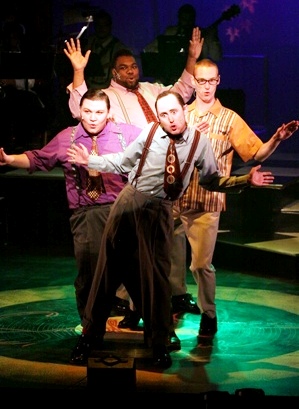
Gabriel Marin as George and Sarah Overman as Mary in MTC’s It’s A Wonderful Life: A Live Radio Play

The Frank Capra film classic takes on a different twist at Marin Theatre Company in Joe Landry’s adaptation with five actors playing radio actors voicing dozens of characters and creating all the sound effects as if performing in a radio drama in front of a studio audience.  Jon Tracy directs this famous tale of George Bailey’s crisis of faith and his lovable guardian angel, Clarence.

The intimate space of MTC is transformed into the 1940’s radio studio of New York Station A at WMTC. The audience is whisked back in time as they watch five wonderful actors create all the characters who populate the magical world of Bedford Falls.

Gabriel Marin plays Jake Laurents who plays a sincere and earnest George Bailey.  Sarah Overman is Sally Applewhite who plays a sunny and delightful Mary who becomes George’s wife.  Michael Gene Sullivan plays the announcer for WMTC as well as the voices of the villainous old miser, Mr. Potter, Uncle Billy, Mr. Gower (the druggist) and bartender, Martini.  Carrie Paff plays Lana Sherwood who lends her versatile voice and acting skills to every other female in the play, ranging from a small child to a senior citizen and from the town’s siren, Violet to George Bailey’s mom.  Rounding out the cast is Patrick Kelly Jones who plays Harry “Jazzbo” Heywood who brings to life the saving angel Clarence, Harry Bailey (George’s father), Sam Wainwright, Harry’s close friend and others.

This charming MTC production sets it all in an elegant, warmly lit studio.  Scenery by Eric Sinkkonen achieves some holiday effects with a lovely tree and a view through a high window of falling snow.  Lighting by Michael Palumbo adds a special glow.  The actors are costumed by Callie Floor in attractive period suits and dresses. The ladies hairstyles even look right.

Michael Gene Sullivan does a warm up with the audience at the beginning of the show to get them to applaud when the applause light goes on. Director Jon Tracy lets the actors open up to one another by having them memorize their lines. They only make use of their scripts as a prop.

Rekindle your holiday spirit with this delightful, family-friendly celebration with this special holiday gift from Marin Theatre Company.

It’s A Wonderful Life: A Live Radio plays runs November 23-December 16, 2012 at  MTC. Performances are Tuesday and Thursday-Saturday at 8 p.m.; Wednesday at 7:30 p.m. and Sunday at 7 p.m. Matinees are every Sunday at 2 p.m. and also, Saturday, December 15 at 2 p.m. as well as Thursday, December 6 at 1 p.m.

Marin Theater Company is located at 397 Miller Avenue, Mill Valley.  For tickets, call 415-388-5208 or go to www.marintheatre.org. Coming up next at MTC will be Waiting for Godot by Samuel Beckett, directed by Jasson Minadakis, January 24-February 17, 2013.

Flora Lynn Isaacson


HOLIDAY GOSSIP by Buzzin Lee Hartgrave

By Lee Hartgrave

Defender of the truth, the American way, and the right to gossip.

THE REALLY FAMOUS DO NOT DIE – They just make other arrangements: For instance, you can attend a Cyril Magnin cheap matinee at A.C.T. for a Christmas Carol. Ooops – they don’t call it the Magnin matinee anymore – it’s just a “Matinee”. How quickly they forget.

SOME WRITERS LIVE ON COFFEE – OTHERS GO OUT! Celeb watching has never been better, than at the Posh Rrazz Room. Everybody who is

Sharon McNight–Head Shot

anybody shows up to have a buffo time. Attitudes are dropped outside the door. Color the place FUN! Especially Sharon McNight in a xmas treat.

FEEL LIKE SEEING A CLASSIC ROMANTIC COMEDY? Well – “Bell, Book and Candle” is just perfect Holiday Entertainment. You will be bewitched, bothered and bewildered. Hey, what do you expect when you fall in love with a witch. She really has some good Witchy things about her, but when she falls in love she might lose her magical powers forever. Remember – The movie version starred Kim Novak and James Stewart. It won a Golden Globe in 1959. I promise that you won’t be bewildered – you’ll just be gassed at the stage play at the San Francisco Playhouse (450 Post Street) above the Farallon Restaurant. Sounds like another Smash hit to me.

NUDE IS GOOD! Well, that’s not exactly true. S.F. wants them to at least put on a fig leaf. The nudies hanging out on Castro Benches (and elsewhere) notice that they are being photographed from the waist down. This really is a “Full Monty” treat. What will Diane “F” think? “Some like it Not!”

On Dec. 10th is another wonderful “Help is on the way” at the Marines Memorial Theatre. The program will feature stars from “Book of Mormon” and “The Lion King”. There will be Stars Galore and music to send you on a Baz Lehrmann evening. He has the power to haunt us forever. No, it won’t be there – but I can imagine that he will be.

FUNNY, SEXY, ENGROSSING! Who Dat? Oh, that would be Sharon McNight. She almost knocks us out of the chairs at the Rrazz Room. And what can she do this Xmas? Well, lets see – Oh, I know – How about hanging some Balls. She has plenty of them. Ha, Ha. No, that was not Santa. Oh, and by the way – electrical devices (self pleasuring) are strictly prohibited during the performance. You know – it’s a Xmas show.

If I were to predict – I would say that the best shows in town are — These movies: “Lincoln”, “Anna Karenina” (Intoxicating Love story) – and “A Royal Affair” (vibrant and hypnotic! – Best bets on the stage are “Bell, Book and Candle” (Sf Playhouse) – “Sharon McKnight at the Rrazz” – Theatre Rhino is presenting a new John Fisher play at ‘Thick House’. The show is “Slugs and Kicks” – It’s being called “Vibrant and Uplifting!” I’ll be checking it out on Dec. 2nd.

AN ACTRESS is planning to quit show Biz to end world hunger! And how will she do this? Drag her refrigerator around the world? We know who it is, but we won’t tell.

Celebs wanna know – will the Golden Gate Theatre ever open again? And then there is this person of Market Street said: “Light up the Damn Sign (Golden Gate Sign). It would help that corner come to life again. What’s a couple of bucks to the high and mighty?” – (Request by angered reader that prefers to remain anonymous.) You know – like Shakespeare.

THE SWACKAT is a new clothing look for men. The Turtle Neck is back…so are the Cargo Pants. Oh, and don’t forget The Shacket. It’s a sport coat that looks like a Jacket. And for real new old treat – take a look at the new rage: “Denim Shirt”.

Virgo guys are really stuck on themselves. They are perfectionists and very detail-oriented. Virgo also means that they have big hands, big feet and – well, two out of three ain’t bad!” Ooops…Too much info. We were hoping for three out of three!

It’s Phone Buzz Time. Start the sexting.


‘Wonderful Life’ in a new light

By Judy Richter

By Judy Richter

If you’re like many people, watching “It’s a Wonderful Life” on TV is probably one of your favorite holiday traditions. Even if you’ve seen it umpteen times, you never get tired of this story about the triumph of good over evil, the emphasis on what’s truly important and the far-reaching impact that one person’s actions can have.

Marin Theatre Company dramatizes these simple truths in its production of “It’s a Wonderful Life: A Live Radio Play.” Adapted by Joe Landry from director Frank Capra’s now-classic film, this version takes place in a New York City radio studio on Christmas Eve, 1946. Five actors portray actors who create all of the beloved characters as well as the sound effects and commercials in front of a live studio (theater) audience.

In this production well-directed by Jon Tracy, Gabriel Marin stars as George Bailey, the character so memorably created by James Stewart in the 1946 film. His wife, Mary, the Donna Reed role, is played by Sarah Overman. Carrie Paff plays all of the other female characters, while Patrick Kelly Jones and Michael Gene Sullivan portray the other male characters. Sullivan also serves as the emcee, warming up the audience before the show starts.

Set in the small town of Bedford Falls shortly after the end of World War II, the story revolves around the night that George, discouraged that his bank is about to go under, considers committing suicide. Instead, he’s distracted by his guardian angel, Clarence (Jones), who’s dispatched from heaven to earn his wings by saving George. He does so by showing George all the bad things that would have happened if he’d never been born. In short, many people would be a lot worse off, and Bedford Falls would have been taken over by the greedy, heartless Mr. Potter (Sullivan). But before Clarence descends to Earth, he learns about George’s early life, his dreams and the reality of how he came so close to ending it all.

While Marin and Overman play only one role each, the other three actors have a chance to display their versatility, which they do commendably. Since we first meet Paff as Violet, the town flirt, costume designer Callie Floor has outfitted her in a flattering, form-fitting dress. Nevertheless, it serves her well as Paff portrays little girls as well as older women, all convincingly.

Jones is especially notable as Clarence, the low-key guardian angel, while Sullivan appears as some of the older men, including Mr. Potter and befuddled Uncle Billy. Overman is sweetly appealing as Mary. Marin does a credible job as George, but he can become too loud and overwrought, especially near the end.

Besides acting and creating sound effects, the actors sing music by composer and sound designer Chris Houston. Eric Sinkkonen’s set, complemented by Michael Palumbo’s lighting, is a suitably cluttered radio studio complete with “Applause” and “On the Air” signs. Seren Helday, credited as properties designer, apparently was responsible for the items needed to create realistic sound effects for a radio audience.

This two-act, 105-minute production is a great way to see a holiday favorite in a new light and to enjoy watching some of the Bay Area’s best actors. It continues at Marin Theatre Company, 397 Miller Ave., Mill Valley, through Dec. 16. For tickets and information, call (415) 388-5208 or visit www.marintheatare.org.

BUZZIN AROUND WITH LEE HARTGRAVE

By Lee Hartgrave

DEFENDER OF THE TRUTH, THE AMERICAN WAY, AND THE RIGHT TO GOSSIP 

BUZZIN AROUND WITH LEE HARTGRAVE 

THE REALLY FAMOUS DO NOT DIE – They just make other arrangements: For instance, you can attend a Cyril Magnin cheap matinee at A.C.T. for a Christmas Carol. Ooops – they don’t call it the Magnin matinee anymore – it’s just a “Matinee”. How quickly they forget.

SOME WRITERS LIVE ON COFFEE – OTHERS GO OUT! Celeb watching has never been better, than at the Posh Rrazz Room. Everybody who is anybody shows up to have a buffo time. Attitudes are dropped outside the door. Color the place FUN! Especially Sharon McNight in a xmas treat.

FEEL LIKE SEEING A CLASSIC ROMANTIC COMEDY? Well – “Bell, Book and Candle” is just perfect Holiday Entertainment. You will be bewitched, bothered and bewildered. Hey, what do you expect when you fall in love with a witch. She really has some good Witchy things about her, but when she falls in love she might lose her magical powers forever. Remember – The movie version starred Kim Novak and James Stewart. It won a Golden Globe in 1959. I promise that you won’t be bewildered – you’ll just be gassed at the stage play at the San Francisco Playhouse (450 Post Street) above the Farallon Restaurant. Sounds like another Smash hit to me.

NUDE IS GOOD! Well, that’s not exactly true. S.F. wants them to at least put on a fig leaf. The nudies hanging out on Castro Benches (and elsewhere) notice that they are being photographed from the waist down. This really is a “Full Monty” treat. What will Diane “F” think? “Some like it Not!”

On Dec. 10th is another wonderful “Help is on the way” at the Marines Memorial Theatre. The program will feature stars from “Book of Mormon” and “The Lion King”. There will be Stars Galore and music to send you on a Baz Lehrmann evening. He has the power to haunt us forever. No, it won’t be there – but I can imagine that he will be.

FUNNY, SEXY, ENGROSSING! Who Dat? Oh, that would be Sharon McNight. She almost knocks us out of the chairs at the Rrazz Room. And what can she do this Xmas? Well, lets see – Oh, I know – How about hanging some Balls. She has plenty of them. Ha, Ha. No, that was not Santa. Oh, and by the way – electrical devices (self pleasuring) are strictly prohibited during the performance. You know – it’s a Xmas show.

If I were to predict – I would say that the best shows in town are — These movies:  “Lincoln”, “Anna Karenina” (Intoxicating Love story) – and “A Royal Affair” (vibrant and hypnotic! – Best bets on the stage are “Bell, Book and Candle” (Sf Playhouse) – “Sharon McKnight at the Rrazz” – Theatre Rhino is presenting a new John Fisher play at ‘Thick House’. The show is “Slugs and Kicks” – It’s being called “Vibrant and Uplifting!” I’ll be checking it out on Dec. 2nd.

AN ACTRESS is planning to quit show Biz to end world hunger! And how will she do this? Drag her refrigerator around the world? We know who it is, but we won’t tell.

Celebs wanna know – will the Golden Gate Theatre ever open again? And then there is this person of Market Street said:  “Light up the Damn Sign (Golden Gate Sign). It would help that corner come to life again. What’s a couple of bucks to the high and mighty?” – (Request by angered reader that prefers to remain anonymous.) You know – like Shakespeare.

THE SWACKAT is a new clothing look for men. The Turtle Neck is back…so are the Cargo Pants. Oh, and don’t forget The Shacket. It’s a sport coat that looks like a Jacket. And for real new old treat – take a look at the new rage: “Denim Shirt”.

Virgo guys are really stuck on themselves. They are perfectionists and very detail-oriented. Virgo also means that they have big hands, big feet and – well, two out of three ain’t bad!” Ooops…Too much info. We were hoping for three out of three!

It’s Phone Buzz Time. Start the Sexting.

(((Lee Hartgrave has contributed many articles to the San Francisco Sunday Datebook and he produced a long-running Arts Segment on PBS KQED)))

Dead Certain–A Psychological Thriller at the Cartwright

By Flora Lynn Isaacson

Pictured: (l-r) Diana Brown as Elizabeth, Andrey Esterlis as Michael
Photo by Stacy Marshall

Dead Certain is an intricately plotted psychological thriller, which tells the story of Michael (Andrey Esterlis), a charismatic out of work actor who is hired for an evening by Elizabeth (Diana Brown), a wheelchair-bound ex-dancer to read a play she has written.  The plot thickens as Michael begins to realize that Elizabeth’s play is mirroring real life and that their paths may have crossed at least once before. There are many twists and turns before the play builds toward a shocking climax.

Diana Brown and Andrey Esterlis both give lively, theatrically entertaining performances throughout.  They both play off each other extremely well.  Also, as the director, Esterlis does an excellent job with the blocking as the theatre space at the Cartwright is very intimate and this makes the play even more exciting.

Dead Certain is presented by Expression Productions and continues at the Hotel Cartwright, 524 Sutter, San Francisco Thursday-Saturday at 8 p.m. with Sunday matinees at 2 p.m. through December 15, 2012.  For tickets, call Expression Productions at 415-307-0470 or email: expressionproductions@gmail.com.

Flora Lynn Isaacson


“La Virgen Del Tepeyac” at Mission San Juan Bautista

By David Hirzel

Here is a show that will set a mood for the upcoming holiday season that has no Christmas music, no re-creations of the nativity, no heartwarming hallmark sentimentality.  It takes not in a theatre but in a church—Mission San Juan Bautista—where the thick adobe walls have echoed for two hundred years and still resound today with voices raised in song and praise.

“La Virgen Del Tepayac” is a vibrant retelling of an old story, the miracle of the four miraculous apparitions of Our Lady of Guadalupe to the Aztec messenger Juan Diego in 1531.  Night has already fallen as we wait in line outside the mission, reading over the detailed synopsis of the story we are about to witness.  We’ll need this information, because the pageant is performed by El Teatro Campesino (“the peasant theatre”) entirely in Spanish.  Inside, we take our seats facing the center aisle with the altar at our right hand and the central raised stage at our left.

The lights dim; long blasts from a conch-horn echo through the darkened sanctuary, dancers clad in Aztec robes and feathers gather in the rear, and offer a song in salute and prayer to “Estrella del Oriente,” the Star of the East.  The year is 1519; enter the Spanish clergy and soldiers, a symbolic conquest, baptism of the Indios.  Appearing from the smoke and mist to our hero Juan Diego (Ruben C. Gonzalez), La Virgen is an apparition to us as well.

All this story is told with compelling music, great flashes of color and dance, moving through the mission from one end to the other and back again.  The great hall has been so built that spoken words are heard throughout with not need of amplification.  When La Virgen (Stephani Garcia Canedlaria) appears a second and third time to Juan Diego, her song captures the resonance of the great hall perfectly, a truly stunning performance.   There are turns of fine acting by the Bishop (Gustavo Mellado) and the Friars (especially Luis Juarez as Fray De Gante), some comic relief by Rosa Mari Escalante as Citlamina, a sprightly children’s dance, leading up to climactic dance and final apparition at the altar.

This show, adapted by Luis Valdez from an anonymous 18th century script, conveys all the wonder of Juan Diego’s vision and the miracle that became the seed of the Christianity to spread throughout Mexico.  As we depart into the crisp starlit night the entire ensemble sings “Vamos Caminando” and invite us to take our own journey with the true spirit, unity and essence of Christmas.

Mission San Juan Bautista, San Juan Bautista CA

Through December 16, 2012

Tickets and Information:  http://www.elteatrocampesino.com or 1-800-838-3006

I heartily encourage you to take the trip to San Juan Bautista and see this remarkable pageant this year. Look for Posada de San Juan Hotel, a perfect blend of traditional appearance with modern hospitality (http://paseodesanjuan.webs.com) in the midst of a town that seems to have changed little in the last century.


Chasing Ice — Film Review

By Joe Cillo

Chasing Ice

Directed by Jeff Orlowski


This is a film about making a film, rather than the film that should have been made.  I think a good opportunity was missed.  This film should have been about the melting ice, the retreating glaciers, and the implications this has for the world.  Instead it was a self indulgent portrayal of James Balog, the photographer in charge of the mission, the suffering hero, and the trials and tribulations of making a film in the harsh conditions of the Arctic.

What is good in the film is the spectacular photography of the glaciers, ice formations, and seascapes in the frozen worlds of Iceland, Greenland, and Alaska.  The film visually documents the dramatic retreat of the glaciers, which is accelerating with the warming of the Earth.  They placed 25 cameras set to continually photograph numerous glaciers throughout the Arctic creating a time-lapse record of the ice melt and retreat of the glaciers that is undeniable.  There is powerful footage of a massive calving from the Colombia glacier in Alaska the size of Manhattan.  One cannot help but be awed by the visual beauty and obvious, alarming decline of these unbelievably massive glaciers.

The film falls short in establishing the significance of its own report.  So what if the glaciers are melting?  Let them melt.  Who cares?  The film does not deal with this.  It does not spell out the implications of all of this melting ice for climate, the oceans, and human societies.  There is brief, passing mention that 150 million people will be affected by a sea level rise of one foot, but who, or how, and over what period of time is not described.

The problem is that too much time is spent on James Balog and the gory details of how the film was made.  All of this should be relegated to minor footnotes.   Frankly, I don’t find James Balog particularly interesting, nor his wife, his kids, his knee, nor all the different problems he had getting his cameras to work under the inhospitable conditions of the glaciers.  He is much too grandiose and masochistic for my taste.  Tramping through ice water in his bare feet to get the best shot.  Gimme a break!  He thinks he is going to save the world through his self sacrifice.  But carbon dioxide is at 391 parts per million and it is still climbing.  That is about 30% more than the maximum over the last 800,000 years.  The Earth is in for some rough sailing ahead and there is nothing we can do about it.  The only question is how extreme the catastrophe will be and how quickly it will rain down upon us.  Balog claims he wants to inform people and get the message out about global warming;  he should do that and get himself out of the way.

Much of the film is preoccupied with the petty troubles of the expedition and establishing what a great photographer James Balog is and his dedication to the project and how much he is prepared to suffer and punish his body to accomplish this noble challenge.  But the issues this film should be dealing with are far bigger than James Balog, his life, or any of the difficulties in making the film.  The dirty laundry of how the film was made should be kept well in the background.  His photographic work is stunning and incomparable.  He really is the Ansel Adams of the Arctic.  If he would put his work in the forefront instead of himself, I would go see anything he does.

This film offers some magnificent views of the glaciers of Greenland, Iceland, and Alaska, and it establishes without question that what is going on is well outside the boundaries of normal fluctuation.  Maybe the filmmakers thought that simply showing the glaciers and documenting the severity of their melting would be too boring, and therefore they felt they needed this human interest aspect to draw people in and hold their interest.  Actually it is the other way around.  I found myself getting impatient watching them figure out the best way to mount a camera on the side of a mountain.  I want to see the pictures they took with that camera once they finally got it to work.  So the film is worth seeing, but it gets a little tiresome and falls far short of its potential.


PRIDE & PREJUDICE

By Joe Cillo

PRIDE & PREJUDICE

Reviewed by Jeffrey R Smith of the San Francisco Bay Area Theatre Critics Circle

The Encinal Drama Department, never one to back away from a challenge, has successfully taken on Jane Austen’s PRIDE & PREJUDICE.

In a theatrical context, there exists a continuum of risk taking ranging from informed confidence, to ungrounded hubris and on to reckless abandon.

Director Gene Kahane may have hugged the shore of hubris on this one, but at the same time he signaled his unflagging trust and confidence in the cast and crew.

As they set sail across the proscenium, he obviously set the yardarm high, proclaiming that success would be their only port of call.

Imagine the odds of an amateur production company taking on a major opus—which required five hour-long episodes when performed for public television—and compressing it into a two act play that would not exceed the attention span of a high school audience nor be reduced to a dramatic narrative.

An adequate plot synopsis of the play alone is over 1200 words, and such a summary is so skeletal that it provides for little character development.

As is a director’s prerogative, MR Kahane rightfully pared the script down to the essentials, leaving enough meat on the bones so that his earnest troupe had plenty of opportunity to showcase their thespian talents.

As the curtain rises . . . wait . . . what curtain?

The set design was so expansively spacious—yet intimate with the audience—that the need for a curtain was obviated.

As the Klieg Lights came up, we were greeted by the tempered strains of violin music provided by Marquise Robinson, first violin and concert master of the Encinal Drama Department.

What? Is this FIDDLER ON THE ROOF?

By coincidence the play parallels TEVYE THE DAIRYMAN by Sholem Aleichem.

In Aleichem’s tale, Tevye, the father is trying to marry his daughters into advantaged positions within Anatevka; in Austen’s book it is the over-reaching, meddling, manipulating mother—MRS Bennet—who is the match-maker of Longbourn.

Just as our planet has two poles, the true north pole and the magnetic north pole, so too does this excellent production.

One pole, consistent with Jane Austin’s original intent, is Elizabeth Bennet, perhaps the true pole.

Elizabeth is the protagonist, the second eldest of the Bennet brood; twenty years old, with character, confidence, intelligence and willfulness cantilevered well beyond her easily measured years.

But alas Lizzy is saddled with the proclivity to judge on first impression.

She reinforces her opinions, engaging in confirmational psychology, sifting through a conflicting body of evidence discarding all that argues against her conceits and embracing all that supports her predilections.

Hence Elizabeth single handedly accounts for the “prejudice” of the title.

Kinga Vasicek is simply stunning as Elizabeth Bennet.

Like an overzealous district attorney she argues with biased passion, unsubstantiated conviction, blanket condemnation and compulsion.

When she finishes dressing down Mister Darcy, the jury i.e. the audience is ready to drag Darcy to either the pillory, the confession booth or to the scaffold.

Miss Kinga’s persuasive and powerfully delivered misguided indictments are augmented by her stern and roiled countenance; one wonders how does she get her face to flush and the veins to standout on her temples when expresses stage anger and mock ire?

Miss Kinga’s role as Elizabeth afforded her opportunities to square off with, dress-down and dismantle nearly every character in the play; by the final curtain the audience is convinced that Miss Kinga’s next stop should be Berkeley’s Boalt Hall.

One also wonders if the character Miss Kinga unleashes could ever be able to shelve her contentiousness for the sake of a domestic tranquility with Mister Darcy.

In the absence of an epilogue, we will never know the answer.

The other pole, perhaps the magnetic pole—although to set the record straight, no one is confirming nor denying allegations of up-staging—is the tremendous performance of Tina Burgdorf as Mrs. Bennet.

Miss Burgdorf’s character—perhaps based loosely on Austen’s Mrs. Bennet—is absolutely a riot; every development in the Bennet family fortunes becomes a melodrama catapulting Burgdorf’s Mrs. Bennet on a soaring, hyperbolic emotional arc.

True Austen’s matriarchal Mrs. Bennet is frivolous, excitable and narrow-minded, and her manners and unbridled social climbing are an embarrassment to Jane and Elizabeth but Burgdorf exaggerates these minor character flaws into hilarious parodies reminiscent of Saturday Night Live comedy sketches.

As the stage adage has it, “there are no small roles in theatre.”

Great acting and a willingness to run with a character—indeed hijack a character—succeeded in inflating Miss Burgdorf’s Mrs. Bennet into a Macy’s Parade Float; she elevated a romantic gothic novel into highly enjoyable modern entertainment.

Almost as ballast for the unmoored Mrs. Bennet, Zachary Bailey plays Mr. Bennet; a character described as a patriarchal gentleman commanding a sarcastic and cynical sense of humor that he uses to irritate and neutralize his wife.

Given our Mrs. Bennet, can we fault Mr. Bennet if he prefers to withdraw from the never-ending marriage concerns of the women around him rather than offer up constructive help?

True to his character, Zachary delivers his well measured lines with low modulation and steady inflection as if to avoid igniting his highly volatile wife; in this respect Burgdorf and Bailey are a perfect pairing for the stage.

Beatriz Algranti plays the pivotal role of Jane Bennet, the catalyst that breaks the Bennet family out of its provincial doldrums and lurches it forward into the vagaries of matrimonial dice rolls.

As is revealed later into the play Darcy tried to scotch Bingley’s plan to marry Jane because he observed “no reciprocal interest in Jane” for Bingley.

Here may lie a glitch in the script.

Contrary to Darcy’s observations, Miss Algranti’s radiant, effulgent and sustained smile for Bingley—as played by Chase Lee—dismantles Darcy’s credibility as a witness.

Miss Algranti’s Jane is a veritably beacon of luminous infatuation; every time she is within eyeshot of Mr. Bingley she radiates romantic love.

Chase Lee is the love smitten, handsome counterpart to Miss Algranti’s Jane; to his acting credit Mr. Lee achieves a certain blissful obliviousness that only Eros and young love can perpetrate on the uninitiated.

Austen’s Jane is arguably the most beautiful young lady in Netherfield; her character—which Miss Algranti has captured with precision—contrasts sharply with Elizabeth’s; Jane is sweetly demure.

Jane too is prejudiced; only she strains to see only the good in others.

Another Klieg Light in this show is Lizzy Duncan; she superbly plays Lydia Bennet, the youngest and most wayward of the Bennet sisters.

Miss Duncan is arguably the best piece of casting in the entire play.

Her character Lydia, is barely 16, is frivolous and headstrong; she enjoys socializing, especially flirting with the officers of the local militia.

Miss Duncan, possibly coasting on the elfin enchantment of her twinkling eyes, signals her character’s casual disregard for the strictures of convention and . . . ahem . . . the moral code of her society.

Lizzy’s blithe smile, lithe gait and insouciant expression collectively signal the audience that her Lydia is devoid of any inkling of remorse for the disgrace she causes her Victorian family.

As Mr. Fitzwilliam Darcy, Mario Jimenez is the master of ambiguity and transformation.

Faithfully portraying Mr. Darcy’s initial arrogance, contemptus mundi and haughty pride, Mario deludes the audience in to believing every accusation and invective launched by rush-to-judgment Elizabeth and the perfidious Mr. Wickham.

Mr. Darcy’s aloof decorum, dislike of dancing and small talk, and exacting rectitude are understandably construed as excessive pride.

Darcy makes a poor impression on strangers—particularly Elizabeth—yet he is respected by those who know him well.

Mr. Jimenez’s acting provides for a certain transparency that reveals to his audience that Darcy has more than one dimension and that the true Mr. Darcy is in fact a noble being.

As Darcy and Elizabeth are forced to be in each other’s company, Mr. Jimenez begins to effuse a certain romantic glow, signaling an expanding romantic interest in the naively and forgivably prejudiced Elizabeth.

Ryan Borashan is delightful as the nefarious Mr. Wickham, pouring his perfidious venom into the eager ear of Elizabeth.

Wickham was a childhood friend of Mr. Darcy and now, as an officer in the militia, he is superficially charming and smarmy; just as Elizabeth is wrong about Darcy so too does she misjudge Wickham.

For all the wrong reasons Wickham and Lizzy form an erroneous alliance.

Mr. Borashan’s Wickham displays a convincing, yet duplicitous, charm that earns him the privilege of running off with the bright-eyed Lydia and marrying her.

Again, no epilogue informs us on the outcome of that union.

Several frosty characters, like large monolithic hailstones, litter Netherfield Park and its environs; chiefly amongst them are Caroline Bingley and Lady Catherine.

Caroline Bingley is played with cryogenic frigidity by Caroline Campbell.

Miss Bingley is the snobbish sister of Charles Bingley—Charles, along with Mary and Kitty Bennet all suffered a horrific accident when the director’s hedge trimmers, which he used to hew down the prolix script, went amuck excising poor Charles, Mary and Kitty from the play entirely; they are now known as the desaparecidos.

Miss Bingley has a dowry of twenty thousand pounds and harbors hopelessly misplaced romantic intentions for Mr. Darcy; she is viciously jealous of Darcy’s growing attachment to Elizabeth and is disdainful and rude to Elizabeth.

Miss Campbell is so convincing when performing the condescending snobbishness and vile jealously of the rich, that we eagerly await tax increases for anyone who earns more than we do.

Even more chilling is Cienna Johnson’s portrayal of Lady Catherine de Bourgh.

We learned that several people in the orchestra section had frost bitten toes due to their proximity to the set and Miss Johnson.

As Miss Johnson veritably hissed her threatening lines to Elizabeth, one could imagine icy vapors billowing with her every vituperation.

Lady Catherine, as personified by Miss Johnson, reinforces stereotypes of the wealthy leisure class and those with inherited social standing.

Thanks to Miss Johnson’s glacial performance, we are now psychologically prepared to boost taxes on inheritances and tax the daylights out of the trust funds of haughty, domineering dowagers like Lady Catherine de Bourgh and her ilk.

Rarely when actors are double cast do they appear on stage simultaneously as both characters, but Assistant Director Tait Adams breaks that taboo; she played both Mr. and Mrs. Gardner at once.

While Mrs. Gardner was three-dimensional, poor Mr. Gardner was merely two-dimensional, was always forced about by his wife and never spoke without Mrs. Gardner speaking first.

Tait Adams exuded a degree of stage confidence rarely evidenced in amateur productions; her delivery was well chiseled and clearly articulated.

There were several times that the quality of the acting in this play was indistinguishable from professional stage acting—certainly Miss Vasicek’s heated denouncements and Miss Burgdorf’s high blown histrionics—Miss Adams indisputably reached that plane.

Necessity or resourcefulness placed Laura Gomez in the androgynous role of Mr. Collins: an obsequious boot-licker to his employer: her haughty highness the Lady Catherine de Bourgh.

Miss Gomez ably transmitted Mr. Collins’ exaggerated sense of self-important and even more vividly Mr. Collins’ pedantic nature—Miss Gomez should consider public education someday.

Supporting actors of this thoroughly enjoyable production included Linnea Arneson, Jess Vicman, Skye Chandler, Megan Jones, Gabe Lima, Brad Barna and Alexandra Barajas.

While this reviewer approached the marquee with a certain amount of misplaced trepidation, he was delighted by the creative spontaneity and vitality of the show.

You may have missed Hendrix at Monterey, Janis at the Fillmore West, Bob at Newport, the Stones at Altamont, hopefully you did not miss a superlative PRIDE & PREJUDICE at Encinal nor will you miss the upcoming DINING ROOM and HAIR, THE MUSICAL.

Make the Most of Life–You Can’t Take It With You

By Flora Lynn Isaacson

Wood Lockhart as Martin Vanderhof.  Photo by Robin Jackson

You Can’t Take It With You by the beloved team of George S. Kaufman and Moss Hart just opened as the second show of Ross Valley Players’ 83rd season. At the helm is James Dunn, renowned Marin director.  The original production of the play opened the Booth Theatre on December 14, 1936.  The play won the 1937 Pulitzer Prize for Drama.

This timeless classic relates the humorous encounter between a conservative family and the lunatic household of Martin Vanderhof.  The play takes place in the Vanderhof home in New York City, mid-1930’s on a magnificently detailed set by Ken Rowland.  “Grandpa” Martin Vanderhof (Wood Lockhart) was once part of the competitive business world. However, one day he realized he was unhappy, so he stopped working and is doing whatever he wants to do.  His daughter Penny (Maureen O’Donoghue) writes plays simply because a few years ago a typewriter was accidently delivered to her house.  She also paints.  She is easily distracted and never finishes a single project. Her son-in-law, Paul Sycamore (Richard Kerrigan) spends hours in the basement making illegal fireworks and playing with erector sets.  His granddaughter Essie (LeAnne Rumbel) sells candy and has been clumsily attempting ballet for over eight years.  His grandson-in-law, Ed (Ross Berger) plays the xylophone (or tries to) and innocently distributes Marxist propaganda.  In addition to the family, many “odd ball” friends come and go from the Vanderhof house.  Some never leave.  Mr. DePinna (Bob Wison), the man who used to deliver ice, now helps out with the fireworks and dresses in a Greek toga to pose for Penny’s portraits.

In contrast to these delightful people are the unhappy Kirby’s.  Tony (Isaac Islas), the attractive son of the Kirby’s, falls in love with Alice Sycamore (Robyn Grahn) and brings his parents to dine at the Sycamore home on the wrong evening.  The shock sustained by Mr. and Mrs. Kirby (Stephen Dietz and Robyn Wiley), who are indignant from the cheap food offered, shows Alice that marriage with Tony is out of the question. The Sycamores find it hard to understand Alice’s view.  Tony knows the Sycamores live the right way with love and care for each other, while his own family is the one that is crazy.  In the end, Mr. Kirby is converted to the happy madness of the Sycamores after he happens to drop in during a visit by the Grand Duchess of Russia, Olga Katrina (Christina Jacqua) who is currently earning her living as a waitress at Child’s Restaurant.

Under the careful direction of James Dunn, the Vanderhof household is filled with activity, all of it chosen and purposeful to the person doing it. In addition to the wonderful cast ideally selected by James Dunn, there are delightful cameos by Kim Bromley as Reba, the Vanderhof’s maid and Donald (Javier Alarcon), the Vanderhof’s chef and Kolenkhov (John Starr), Essie’s ballet teacher. This play is delightful fun for the entire family.

You Can’t Take It With You runs at Ross Valley Players November 15-December 16, 2012.  Thursday performances are at 7:30 p.m., Friday-Saturday at 8 p.m. and Sunday at 2 p.m. The venue is Ross Valley Players Barn Theatre at the Marin Art and Garden Center, 30 Sir Francis Drake Blvd., Ross. For reservations, call 415-456-9555, ext. 1 or go online at www.rossvalleyplayers.com.

Coming up next at Ross Valley Players will be Pack of Lies by Hugh Whitemore and directed by Molly Noble, January 18-February 17, 2013.

Flora Lynn Isaacson