Berkeley Rep director reconceives ‘Pericles’

By Judy Richter

“Pericles, Prince of Tyre” is one of Shakespeare’s later plays and, according to most scholars, probably wasn’t written entirely by him. Director Mark Wing-Davey goes a step further by reconceiving this work, with movement consultant Jim Calder, for Berkeley Repertory Theatre.

Wing-Davey cuts text and characters to clarify the story of Pericles (David Barlow). This nobleman flees Antioch in fear of his life after realizing that the king and his daughter, whose hand Pericles was pursuing, were involved in an incestuous relationship.

Pericles’ travels take him through stormy seas to far flung places such as Pentapolis. There he wins the hand of Thaïsa (Jessica Kitchens), daughter of the king (James Carpenter). On their return voyage toTyre, Thaïsa dies while giving birth to a daughter, Marina. Many more adventures separately await father and daughter, who has been given to the care of the governor of Tarsus.

Ultimately, the distraught Pericles believes that both his wife and his daughter are dead, but in true Shakespearean fashion, they’re reunited by coincidence.

All this takes place on a two-level industrial set created by Peter Ksander and Douglas Stein with lighting by Bradley King. Three musicians, including composer/music director Marc Gwinn, sit on one side of the upper level.

Except for Barlow as Pericles and Anita Carey as Gower, who serves as the chorus and a trusted lord of Tyre, everyone else in the eight-member cast plays three or more roles. Thanks to Meg Neville’s often-ingenious costumes, the characters are easy to identify.

The two-act production runs about two hours plus intermission. It starts with music director Gwinn and the cast, in street clothes, warming up the audience with a sing-along.

Wing-Davey has come up with some wildly theatrical stagings. However, some of it seems excessive and distracting. For example, during the shipwreck scene, Carey’s Gower soaks the actors with a steady stream of water from a fire hose aimed above them.

Despite fine acting, especially by Barlow, Kitchens, Carpenter and Carey, the production sometimes lags. Still, it’s a notable attempt to make one of Shakespeare’s lesser works more accessible and palatable.

“Pericles, Prince of Tyre,” will continue through May 26 in Berkeley Repertory Theatre’s Thrust Stage, 2025 Addison St., Berkeley. For tickets and information, call (510) 647-2949 or go to www.berkeleyrep.org.


BEING EARNEST at TheatreWorks has charming star quality

By Kedar K. Adour


Cecily (Riley Krull) and Gwendolen (Mindy Lym) both fall in love with men they believe are named “Ernest”
in the World Premiere musical BEING EARNEST,  presented by TheatreWorks April 3 – 28
at the Mountain View Center for the Performing Arts.  Photo credit: Tracy Martin

BEING EARNEST: Musical. By Paul Gordon and Jay Gruska, adapted from Oscar Wilde’s “The Importance of Being Earnest.” Directed by Robert Kelley. TheatreWorks, Mountain View Center for the Performing Arts, 500 Castro St., Mountain View. (650) 463-1960. www.theatreworks.org. Through April 28, 2013

BEING EARNEST at TheatreWorks has charming star quality.

There are others who have undertaken to put Oscar Wilde’s near perfect 1895 satirical drawing room comedy The Importance of Being Earnest to music with a modicum of success. The first was in 1960 when Ernest in Love (Earnest without the ‘a’) received laudatory reviews off Broadway and move uptown where it played for about four months. The next incarnation was as a London musical simply called Earnest (the ‘a’ reinserted) that moved on into theatrical oblivion. Paul Gordon and Jay Gruska have kept the ‘a” in the title but their marvelous TheatreWorks’ production under Robert Kelly’s spot on direction only deserves a solid ‘B’.

Oscar Wilde’s play has a riotous plot with satirical characters that beg to cavort in gorgeous costumes trying to do justice to Wilde’s well known witticisms. Many of those (in)famous lines appear in the libretto and often provide titles for songs. Recognizing the necessity to incorporate the best (they are all good) of those wicked lines into the play the opening scene of the second act is devoted to the ensemble cast of seven quoting many of them to the audience with a photo of Wilde projected on the back scrim. It is a great touch and I would bet director Kelly had a hand in it.

The ludicrous convoluted storyline of two supercilious English girls who can only love a man with the name of Earnest has been transplanted to 60s London, specifically Soho’s Carnaby Street. It is a stretch of the imagination that there are similarities between 1965, the time period of this musical adaptation, and beginning of the Victorian Era but the authors wish the audience to think so as an explanation for the style/intent of the music.

The music is extremely clever and the lyrics incorporate Wilde’s words as cues for the actors but the final result does not reach the level of sophistication of Alan Jay Lerner’s use of Shaw’s dialog in My Fair Lady. The major actors (Hayden Tee as Jack, Euan Morton as Algernon, Riley Krull as Cecily and Mindy Lym as Gwendolen) are expert singers and the entire performance exudes good nature humor that carries through from opening number to an interesting Shavian type epilog with slide projections informing us that Wilde was right on, and it is true daughters become what their mothers are. This brings us to local favorite Maureen McVerry being miscast or misdirected as the formidable Lady Bracknell. Audience favorites are Brian Herndon playing multiple roles and Diana Torres Koss as Miss Prism who left poor baby Jack (Earnest) in a handbag at Victoria Station.

Dr. Chausable (Brian Herndon) and
Miss Prism (Diana Torres Koss)

Placing the action in the Carnaby Street Era (that has since faded) allows costume designer Fumiko Bielefeldt to go wild starting with gorgeous Mondrian style dresses in the early scenes maintaining the high style throughout the show. Joe Ragey’s set with a central stairway allows the girls to use it as a runway for Bielefeldt’s fashion show. Running time two hours and 10 minutes.

Kedar K. Adour, MD

Courtesy of www.theatreworldinternetmagazine.com


STUCK ELEVATOR at A.C.T. is ambitious and a long 81 minutes

By Kedar K. Adour

Julius Ahn as Guang in STUCK ELEVATOR at A.C.T. Photo BY Kevin Berne

STUCK ELEVATOR: A Theatrical Piece.Music by Byron Au Toung. Libretto by Aaron Jafferis. Directed by Chay Yew. American Conservatory Theater, 450 Geary St., S.F. (415) 749-2228. www.act-sf.org.April 16 – 28, 2013.

STUCK ELEVATOR at A.C.T. is ambitious and a long 81 minutes 

San Franciscowith its plurality of Asians is probably the perfect venue for the world premiere of Stuck Elevator with a Chinese protagonist, his family and a mostly oriental production crew. To further appeal to the locals, while the libretto is in English, Chinese super-titles are used. It is a clever idiosyncrasy.

 The entire production can rightfully be called clever but a more appropriate designation would be ‘eclectic” and the PR material labels it “a hybrid of musical theater, opera, and solo performance.”  The single word ‘opera’ would be equally appropriate. The stark libretto is sung mostly in long stretches of resistive and hip-hop rap. The staging is brilliant and that alone is worth a visit. The entire production that is packed into the 81 minutes (without intermission) becomes tedious although it is often mesmerizing. 

The libretto is based on the true story of a 35 year old Ming Kuang Chenoa a Chinese “take out” delivery boy for the Happy Dragon Restaurant inBronxwho was stuck in an elevator for 81 hours. It features Julius Ahn, given the name of Guāng, in the lead and a very competent ensemble of Raymond J. Lee, Marie-France Arcilla, Jose Perez and Joseph Anthony Foronda – all of whom play multiple roles. 

The 81 days is compressed into 81 minutes with a series of over-lapping scenes, some taking place in actual time but mostly in the mind of the trapped Guāng. He is working the sometimes dangerous “take out” job to earn money for his family still inChinaand also to pay off a huge debt to the Snakehead who smuggled him intoNew Yorkinside a cargo container. During that stifling trip his nephew has died of suffocation. 

Interestingly he initially thinks about losing money to his friend/competitor Mexican Marco to whom he has sold his cell phone that would have been his contact with the outside world. He thinks about his wife Ming and son Wang Yue and imagines they are there with him. An interesting conceit: When he fantasizes talking with Ming, Marco answers in Spanish. This is the start of hallucinations that become more bizarre as the hours, morph into days.

 His anger rises as he recognizes that he is an invisible immigrant stuck in the elevator and he eats the few fortune cookies and sauce packets in his delivery bag. Guang’s mind is obsessed with thoughts of his nephew’s death and the time he was mugged losing $200. That last memory elicits a bladder spasm wetting his pants. 

All the previous scenes are performed with the stage in blacks and grays. As his hallucinations become more outlandish color and humor is injected in the proceedings. The elevator becomes a slot machine inAtlantic Cityand when he pushes the button he wins the jackpot, color lights up the video projections, the ensemble cavort in amazing costumes. The winnings are used to buy a home and he and is family can now live the good life inAmerica. . . the futile goal of every immigrant is fulfilled. 

His letters exchange between Guang andChinaare folded paper airplanes that are flung on the stage and into the audience. . . a great way to involve the audience into the mix. In his dreams he wrestles with an Elevator Monster, complete in a glistening metallic costume only to be temporarily rescued by a Fortune Cookie monster that is revealed as Ming when the ever dangerous Snakehead rips off the Cookie Monsters mask. Alas Guang is defeated. 

A mugging scene enters Guang’s dream as he is stabbed with a pocket knife. Realizing he is not dead he imagines himself bicycling through the night sky over the city with Ming, Wang Yue and Marco before the 81 hours is up and the elevator door opens. End of play. It is to be noted that earlier Quang eats his last fortune cookie finding a blank fortune. Symbolic? Of course. 

Scenic designer Daniel Ostling; costume designer MyungHee Cho; lighting designer Alexander V. Nichols; video designer Kate Freer, IMA; and sound designer Mikhail Fiksel; music director Dolores Duran-Cefalu; choreography by Stephen Buescher; orchestrations by Byron Au Young.   

Kedar K Adour, MD

Courtesy of www.theatreworldinternetmagazine.com.

Shivalingappa, Namasya — Dance Performance Review

By Joe Cillo

Shantala Shivalingappa

Namasya — Dance Performance

Herbst Theater, San Francisco

April 16, 2013

I didn’t care for this.  This was a solo performance of Indian dance in the Kuchipudi style, to Indian music.  The music was better than the dancing.  I couldn’t relate to it.  I found it wearisome and dull.  It lacked engagement.  It was solipsistic.  Some of it reminded me of those pantomime games where one person acts out a scenario and the rest of the group tries to guess what it is.  It was like she had something in her head, but I couldn’t seem to connect with what it was.

She started out on her back toward the rear of the stage making painfully slow movements as if she were getting up in the morning very, very slowly — a decidedly downbeat way to start.  I often get up like that myself first thing in the morning, but it is not interesting to watch, and I would never have the temerity to perform it on stage and expect people to be interested in it.

Most of this performance was slow and static, decidedly undramatic and even disengaged.  For a couple of segments she left the stage allowing screens came down and a video of her dancing in costume appeared on the screen.  It was a video I would never watch were it to be given to me.  It was totally uninteresting.  I couldn’t understand why this was presented in a video.  Was she too lazy to just go out there and do it herself?  I think it emphasized her unwillingness to make full contact with the audience, which seemed to be a theme of this performance.

A further segment underlined this.  It was done mostly on her knees with her back to the audience making movements with her arms and torso.  When her back was not to the audience, she hid her face in her arms.  It was as if she were avoiding making contact with the audience, refusing to look at them.  I got the same feeling from it that I have had sometimes pursuing a woman I am interested in and she is making no response.  Not a negative response, but no response.  As if her back is to me and she is ignoring me, totally stonewalling, not willing to be engaged or communicative in any way whatsoever.   Not exactly the way for a woman to get a good review from me, and that was how I felt during much of this performance.

I made up my mind as I was sitting there not to even review this show.  I don’t like to write this kind of a review.  I like young women and I try to encourage them, but I started getting annoyed as it dragged on.  This woman is unprepared to be doing this kind of a performance, and San Francisco Performances did not do her a favor presenting her in a venue for which she is not artistically ready. Someone has to tell her.  A reviewer also has a responsibility to inform the public what they are in for when they take time and spend money to attend a performance.  Why should I keep silent to protect a poor performer who is out there soliciting paying audiences?

When you go out on a stage and do a solo performance: an hour or more of nothing but you, it has to be strong, and you have to have an imposing presence that can connect with the audience and sustain their attention.  People are paying money and spending their time to view this.  It has to have something to offer, something to engage them, stimulate them, connect with them on some level or other.  You can’t just bore them to death and expect them to like it.  You take a big risk when you do a show like this as a solo performer.  If people don’t like it, it all comes down on you.  You’re not part of a group that shares responsibility and offers support.  Shivalingappa does not have the kind of presence and artistic strength necessary to pull this off.  This performance was not substantial.  It was tedious.  She is way out of her league.  She should be dancing in a troupe learning her craft.

Maybe I am spoiled.  I just saw the San Francisco Ballet the other night and those dancers are first rate.  Every single one of them is masterful with a commanding presence that you can feel all the way up to the top of the balcony.  Shivalingappa is not anywhere near that caliber and certainly not of a stature to be doing a solo show on her own.  But it was mercifully short.  That was the best part.  Some serious rethinking need to be done with this one.  I’m sorry, but I cannot recommend this.


Renoir — Film Review

By Joe Cillo

Renoir

Directed by Gilles Bourdos


This is an outstanding dramatization of the French painter Pierre-August Renoir (1841-1919) (Michel Bouquet) in his later years.  (In French with subtitles.)  It takes place in 1915 during the First World War.  At the time Renoir lived on a farm in Cagnes near the Mediterranean coast above Nice.  He seems to have had an entourage of women around him who took care of the household and attended to him.  The film never explained exactly who they were or what their relationships were to him.  Some of them seem to have been former models.  His wife of 25 years, Aline, died prior to the time of the film, which would have been recently.  He had three sons with Aline, two of whom figure prominently in the film, Jean (Vincent Rottiers), the older, and Claude (Thomas Doret), the younger.

The film begins with the arrival of Andree Heuschling (Christa Theret), a.k.a. Catherine Hessling, who becomes his last model and the future wife of his son, Jean.  Born in 1900, she would have been fifteen at the time of this film, although in the film she appears to be somewhat older, probably in her early 20s.   Renoir’s son, Claude, whom she encounters at the outset, in actuality was only a year younger, although in the film he appears to be at least ten years her junior.

Theret is gorgeous and she spends a good part of her time in this film naked or nearly so, which is a huge plus.  Her naked body helps a great deal to maintain interest in this somewhat slow moving domestic film.  There isn’t a lot of action in this film.  It is domestic drama, but it is interesting and has substance.  The characters are intriguing and their circumstance dealing with the aging patriarch against the backdrop of the horrendous First World War give the film a strong engagement.

The center of gravity of the film is not really Renoir, who mostly sits and paints throughout the film, and sometimes talks — and what he has to say is always interesting — but rather, the romance that develops between the older son, Jean, and Andree.   I’ll let you watch the film to see how that goes, but it is very well done and both characters are strong and captivating, particularly Andree.

What I want to talk about are some of the comments Renoir made on painting and art.  Renoir’s paintings, particularly in his later years, are warm, colorful, and his subject matter tends to be benign:  domestic scenes, landscapes, portraits, and nude women.  His colors are strong, but tend to be pastel, softening contrast and shapes.  He didn’t use black very much.  He felt that viewing a painting should be an enjoyable encounter, reflecting positive, uplifting themes.  It wasn’t that he was unfamiliar with the darker side of life, but he did not wish to portray it.  And this is the point.  A painting, or a work of art more generally, reflects the inner reality, and especially the values, of the artist who created it.  The choice of subject matter and the way it is portrayed say a lot about who the artist is as a person and what he finds most important and valuable in life.  It takes considerable time, sustained attention, and skill to create a work of art.  What you choose as a subject matter upon which to spend that time, attention, and skill is not arbitrary.  An artist chooses to depict what he feels is interesting and important to share with others.  When you view a work of art, you are immersing yourself in the mindset and world view of another person.  You are allowing your attention to be guided by the interest and outlook of another person.  He may be a good person or a bad person.   His outlook may be positive and constructive, or negative, hostile, and biased.  But it is highly personal, individualized, and idiosyncratic.  This is the reason why art and artists often run afoul of prevailing morays and attitudes of their societies.  If they make political statements, they may get into trouble with the authorities.

Art, at least in our western tradition of individual creators, is a forum that lifts up the inner world of particular persons for public view.  In contrast to say, commercial art, which does not do this, or does it to a greatly circumscribed extent.  The operating values in commercial art are to sell a product, promote a name, or create an image associated with a brand or company.  The artist who is commissioned to do such work has limited, if any, choice over the subject matter or how it is to be portrayed.  The artist becomes something of a technician, executing work with a predefined object.  If he is skilled and imaginative, he may have some influence over the final depiction, but the work does not come from his own initiative, his inner need to share of himself.  He is doing the work in the service of an agenda that has been brought to him by someone else.  In the Middle Ages, when life and art was dominated by the church, religious themes were the norm in art.  Individual artists found ways to express themselves within that context, but radical departures from this prevailing mindset were not tolerated and simply had no venue.  The names of artists who created artworks in ancient times were not recorded.  The individual was not important and the individual’s perspective was not to be emphasized in the public forum of art.  Art’s role was to reflect the values of society as a whole, or at least the dominant class within it.

Modern art that you see in museums and galleries today, celebrates highly individualized, idiosyncratic perspectives.  If you contrast the paintings of women by Renoir, and say, Picasso, you see very different attitudes toward women and how they are portrayed.  Renoir saw women as beautiful and sensual, somewhat idealized, perhaps, but women are exalted in his paintings.  They are set in congenial circumstances in warm, vibrant colors.  You see their faces with expressions reflecting the mood and personality of the woman.  Picasso’s women, by contrast, are distorted, grotesque, their faces blank, cold, expressionless.  There is nothing beautiful or inviting about them.  Many of them are frankly hideous.  Certainly there is no idealization.  Neither is more “real” than the other.  The point is that artists depict the world, not as it is, but as they need to see it.  These needs are largely unconscious and are shaped by early experiences going back to the beginnings of their lives.  What you see in art is an interpretation, not “reality”.  When you look at a work of art, you are seeing a selective view of the world the way the artist needs to see it and chooses to share it.  So it is very personal.  Art is a way of connecting with other people on the level of the inner self through selective symbolic communication.  It is inherently limited, but on the other hand, it exposes one to aspects of another person not readily available, and can thus expand one’s awareness of the external world, the inner world of another, and awaken unexplored aspects of oneself.

The film is not so preoccupied with this philosophical topic of the nature of art — which might be a relief to you.  It emphasizes, rather, the romance between the young lovers, which is intriguing and spirited.  It is well crafted and well acted.  Not an action packed film.  You have to wear your thinking cap for this one, if you have one.  It does offer a convincing picture of Renoir in his later years, and particularly the inspiration he derived from attractive young women.  Renoir seems to have used his wealth to isolate himself from the world in an idyllic landscape surrounded by beautiful, attentive women.  (I would do the same thing, if I had the money.)  This was a cause for some tension between himself and his older son, Jean, who had been a soldier at the front.  Wounded in battle, he felt the pull of responsibility to his comrades and the nation, choosing to reenlist and go back to the war, against the strong opposition of Andree and his father.  Renoir senior sat out the war painting naked girls.  His warm, sensual, inviting paintings didn’t seem to sit so well with Jean, who had seen action at the front, which gave him a very different perspective on life from what his father portrayed.  Renoir painted until the very end of his life in 1919.  He was still painting on the day he died.  The film is an excellent introduction to his life and work.

TINSEL TARTS IN A HOT COMA is bicoastal and omnisexual

By Kedar K. Adour

Carmen Miranda Banana number

TINSEL TARTS in a HOT COMA: The Next Cockettes Musical Unabashed Drag Show. Thrillpeddlers. The Hypnodrome, 57510th St., S.F. (415) 377-4202  or www.brownpaper.com.

Through June1, 2013

TINSEL TARTS IN A HOT COMA is bi-coastal and omni-sexual

If you are not familiar with the original Cockettes you are in for a rollicking treat when you go to see the latest Thrillpeddlers production. It is a belly full of laughs when the 20 member cast cavorts, trip the light fantastic and belt song parodies with sex infused lyrics. Not only are the hilarious costumes covered with glitter, so are the faces and every (and I mean EVERY) exposed body part. Be warned that nudity, especially in the cataclysmic finale, is rampant.

This resurrection of this Cockettes musical had its origins in 1971 when the original show caused a semi-sensation, often for the wrong reasons, when their 1930 musical Tinsel Tarts in a Hot Coma opened in New York for a three-week run. Two of the original cast, Scrumbly Koldewyn and “Sweet Pam” Tent have rewritten the script added 18 (count them) new songs, music and lyrics. Another core member of the Cockettes, Rami Missabu, joins the cast.

The time is the 1930s and Hollywood is the place, filled with egocentric divas, actor wan-a-bees, eccentric directors and gaggles of movie extras. Conflict is as rampant as the songs and dances spill out into the audience. The theatre is a very, very intimate space. Vedda Viper a bitchy news broadcaster ala Walter Winchell is sort of the master of ceremonies as she spreads the gossip “no matter who gets F—-d!”

The irreverent hijinks just keep coming and coming and you will have a tough time if you try to figure out who is who. You’ll meet, Mayor Fiorello Laguardia, Goldie Digger Cow (complete with a two titted udder), Auntie Social, Salvador Deli, Graucho, Chico and Harpo Marx. Then there is the Tender Loin Chorus (you will not have to use your imagination since they leave nothing uncovered), Brunnhilde, Angel Gabrille and finally The Devil in the finale to end all finales.

Scrumbly plays the piano and directs the orchestra (Sax, Bass and drums) from on stage and has his chance to emote and take part in the action. Running time a bit too long but never boring and that is a promise.

(Music and Lyrics by Scrumbly Koldewyn. Book by Pam Tent and Scrumbly Koldewyn. Additional Lyrics by Link Martin,”Sweet Pam” Tent, Martin Worman, Tom Orr)

Kedar K. Adour, MD

Courtesy of www.theatreworldinternetmagazine.com

‘The Happy Ones’ charts recovery from grief

By Judy Richter

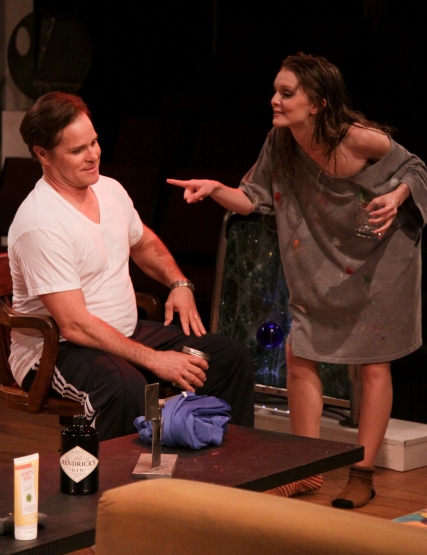
One minute life is perfectly happy. The next minute, everything comes crashing down. That’s what happens to Walter Wells (Liam Craig) in Julie Marie Myatt’s “The Happy Ones,” presented by Magic Theatre.

It’s 1975 in Garden Grove, CA. Walter has a beautiful wife and two great kids, a boy and a girl. They live in a lovely home and have good friends and neighbors. He owns a successful appliance business.

Then a phone call changes his life. His wife and children have been killed in a traffic accident caused by a wrong-way driver. He plunges into grief.

Among others, his best friend, Unitarian minister Gary Stuart (Gabriel Marin), and Gary’s new girlfriend, Mary-Ellen Hughes (Marcia Pizzo), try to cheer him up, but he just wants to be left alone.

When he goes to the hospital to confront the injured driver, Bao Ngo (Jomar Tagatac), who killed his family, Walter rejects the Vietnamese refugee’s requests to kill him.

Bao later shows up at Walter’s store begging to give Walter something or to do something for him, like cooking or cleaning. Walter reluctantly relents, unknowingly setting both himself and Bao on a path toward recovery.

Like Walter, Bao has endured the loss of his wife and two children. When Bao fled Vietnamduring the fall ofSaigon, they stayed behind, only to be killed a few days later. Bao also lost his livelihood as a pediatrician and now works nights in a bakery.

Director Jonathan Moscone skillfully leads his four well-cast actors along the emotional road that Myatt has laid out for them. Craig embodies Walter’s initial near-catatonia as he somehow gets himself to work every day.

Tagatac is sympathetic as the guilt-ridden Bao, who has his own losses to overcome. Marin and Pizzo as Gary and Mary-Ellen, both of whom are insecure but well-intentioned, are good foils to Walter and Bao.

Erik Flatmo’s set (lit by Stephen Strawbridge) and Christine Crook’s costume design recreate the time and place, aided by Cliff Caruthers’ sound design, which is highlighted by some popular music of that era.

The two-act “The Happy Ones” is a fascinating, memorable study of grief and recovery, leavened by humor. It’s well worth seeing.

It continues at Magic Theatre, Building D, Fort MasonCenter, San Francisco, through April 21. For tickets and information, call (415) 441-8822 or visit www.magictheatre.org.


CARNIVAL! jumps off the stage at 42ndStreet Moon

By Kedar K. Adour

CARNIVAL!: (1961) Musical. Music and Lyrics by Bob Merrill. Book by Michael Stewart. Directed by Greg MacKellan. 42nd Street Moon, Eureka Theatre, 215 Jackson Street, San Francisco, CA 94111. (415) 255–8207 or www.42ndstmoon.org. April 3 -2, 2013

Converting movies to stage musicals has been both highly successful as well as disastrous. The charming 1953 movie Lili, based on the novel Love of Seven Dolls by Paul Gallico was a huge hit. And why not, since it starred Leslie Caron, Mel Ferrer, Jean-Pierre Aumont and Kurt Kasner. The 1961 stage show, now called Carnival!, starred Anna Maria Alberghetti, James Mitchell, Kaye Ballard, Pierre Olaf and Jerry Orbach making his Broadway debut. In opened to rave reviews winning two Tony Awards.

Other notable names starred in the many road shows but it disappeared from the stage in the late 1970s until New York’s Encore series recently revived it with Anne Hathaway and Brian Stokes Mitchell. With such notable luminaries having filled the roles in the past, there must have been trepidation by Artistic Director in selecting his present cast.

If so it is not apparent with an equity cast filling the major roles. The stage story line follows the movie script where orphan Lili Daurier (charming diminutive Ashley Jarrett), a unsophisticated waif runs away to joint the “Grand Imperial Cirque de Paris.” After falling in love with Marco the Magnificent (Bill Olson) a lothario of the first order, she is given a part in his show as a supplement to the worldly Rosalie (seductive Dyan McBride) who just happens to be Marco’s live-in lover. After a disastrous (and hilarious) turn at her job, Lili is rudely dumped.

Never fear along comes puppeteer Paul Berthalet (the ubiquitous Ryan Drummond)  and his colleague Jacquot (Michael Doppe) to the rescue and Lili becomes a mainstay in their act with that features the puppets Carrot Top, Horrible Henry the walrus, Marguerite, and Reynardo the Fox. The signature tune from the movie, “Love Makes the World Go Round” gets a tear inducing rendition by Jarrett and the story is off to the races.

The opening scene involves an accordion rendition of  “Love Makes the World Go Round” before the lights come up full on the colorful set (Hector Zavala) that becomes filled with juggler/acrobats (Jordan Plutzer and Kyle Stoner) and a plethora of beauties dressed in gorgeous costumes (Moises Mora) who dance up a storm (Jayne Zaban) throughout the show.

Where “Love Makes the World Go Round” was the mainstay of the movie, Merrill has come up with other winners including “Her Face”, “She’s My Love”, “Grand Imperial Cirque de Paris”, “Mira” and the catchy “Yum, Ticky, Ticky, Tum, Tum.”

Although the matinee we attended was entertaining and expertly staged by MacKellan, the competent singing did not garner serious applause and the running time of two hours and 30 minutes taxed ones attention span.

Kedar K. Adour, MD

Courtesy of www.theatreworldinternetmagazine.com

‘Whipping Man’ is a fresh, exciting Mill Valley must-see

By Woody Weingarten

Momentarily celebrating in “The Whipping Man” are (from left) Tobie Windham (as John), L. Peter Callender (Simon) and Nicolas Pelczar (Caleb). Photo: Kevin Berne.


Minutes into it, I surmised that all the elements in “The Whipping Man” would come together as exquisitely as a Rubik’s Cube.

My instincts were right.

The drama by Matthew Lopez, who simultaneously slices into the vagaries of humanity and inhumanity as skillfully as he depicts a gangrenous Civil War amputation, is a one-of-a-kind powerhouse despite it making me think of August Wilson one minute and Redd Foxx the next.

The Marin Theatre Company production in Mill Valley in fact isn’t derivative. It’s as fresh and exciting as anything on the boards in the entire Bay Area.

Director Jasson Minadakis has excelled his previous successes with this show, making the opening night audience leap to its collective feet with approval. Like a magician whose magic wand is finely tuned, he ensures that each action, each phrase, each emotion is cloaked in authenticity.

The acting — by L. Peter Callender as black patriarch and ex-slave Simon; Tobie Windham as John, a freed sneak thief and dreamer seeking refuge; and Nicholas Pelczar as Caleb, a Jewish white slaver’s scion who’s been wounded in more than one way — is universally superb.Inspired, also, are the intentionally decrepit set by scenic designer Kat Conley, the dramatic lighting by Ben Wilhelm, the moody sound effects by Will McCandless and the apt costumes by Jacqueline Firkins.

On the surface, the play — marked by sharp dialogue that draws not nervous laughter but guffaw

s triggered by genuine characters rather than stereotypes — is about Jews and blacks and, surprisingly, black Jews. Its themes erupt in a series of verbal mazes — including the DNA of slavery, the roots of freedom, and the construction and deconstruction of family and forgiveness.Let alone brotherhood, faith and hypocrisy.

Much of the subject matter’s been tackled before, but rarely executed as well, possibly never in a scenario involving black Jews.

The scene is a dilapidated homestead in Richmond, Virginia, in 1865, over a stormy three-day peri

od that includes Abe Lincoln’s assassination.A makeshift Passover Seder (commemorating the Israelites escape from Egyptian bondage) becomes an unusual focus, masterfully created by Lopez, a gay Episcopalian of Puerto Rican and Polish-Russian heritage whose direct knowledge of Jewish holidays apparently came in part from attending ritual meals hosted by his Semitic aunt and cousins.

The play, presented as a co-production with Virginia Stage Company, stays on point throughout — another kudo due Minadakis.

Its only inconsistency is the dialogue, which sometimes veers into current usage rather than yesterday’s.

And its only flaw is that once in a while a character talks in needlepoint-speak. Such as: “War is not proof of God’s absence; it’s proof of his absence from men’s hearts.”More insightful is what I perceive to an accurate portrayal of Jewish sensibility: “We talk with God…sometimes we even rassle with Him. But [as Jews] we keep asking questions.”

Astute, too, is this poignant passage about slavery: “It wasn’t a friendship…not when one owns the other.”

Lopez is consistently sharp but occasionally shows flashes of brilliance. As in labeling Lincoln, in keeping with biblical inserts and the Exodus theme of Passover, as “Father Abraham, who set us free” and “our American Moses.”

Highlights in “The Whipping Man” range from a hilarious set piece about cutting and chewing horsemeat to a rousing rendition of a multi-purposed spiritual, “Let My People Go” — along with shocking, intense moments stemming from both verbal and visual reminders of whippings and their aftermath.Revelations of long-held secrets only deepen the drama.

“The Whipping Man,” finally, attacks with passion and muscle. There’s no question that it burned into my brain and resonated long after I left the theater. Bay Area showcases seem to exist in every nook and cranny, but a theatrical must-see is rare.

This is one.

“The Whipping Man” plays at the Marin Theatre Company, 397 Miller Ave., Mill Valley, through Sunday, April 28. Performances Tuesdays through Saturdays, 8 p.m.; Sundays, 7 p.m.; Wednesdays, 7:30 p.m.; matinees Saturdays and Sundays, 2 p.m. Tickets: $15 to $57. Information: (415) 388-5208 or marintheatre.org.

‘The Happy Ones’ fails to make reviewer happy

By Woody Weingarten

Woody [rating:3] (3/5 stars)

Walter (played by Liam Craig, left) and Gary (Gabriel Marin) momentarily experience a 1975 version of the Good Life in “The Happy Ones.” Photo: Jennifer Reiley.

The Magic Theatre habitually risks audience disapproval.

It nurtures edginess.

It wrestles with uncomfortable subject matter.

And, happily, it aims many productions at crowds more youthful — and ready to laugh and cry — than your average card-carrying AARP member/theatergoer.

In recent years, it has produced “Any Given Day,” a tragicomedy that examined fear and hope through two developmentally disabled characters; “Jesus in India,” which tackled and turned upside down the oft-debated lost years; “Brothers Size,” a tear-jerking drama (peppered with spicy humor) about brotherly love; and “Another Way Home,” a serio-comedy that probed how a family’s life could be narrowed by a teenager’s mental problems.They all flourished. They all pleased me. A lot.

“The Happy Ones,” unfortunately, is an exception that proves different isn’t necessarily good.

The synthetic comic drama falls several degrees south of mediocre.

In my view, the Bay Area premiere at San Francisco’s Magic was almost totally void of theatrical magic.Ostensibly a peek at lives being inside-outed by a fatal accident, Julie Marie Myatt’s play simply languishes as it turns grief into boredom.

Before it flat-lines, her creation crawls like an injured sloth, working its predictable storyline about suburban Paradise Lost into a non-crescendo — despite a final scene that contains the lone sincerely touching moments in close to two hours.

It’s a shame, because all four actors — Jomar Tagatac as Bao Ngo, Marcia Pizzo as Mary-Ellen Hughes, Liam Craig as Walter Wells and Gabriel Marin as Gary Stuart — are top drawer as they project awkwardness and distance (and because the details of the period set, costuming and ‘70s music work extremely well).

Yet all of it becomes wasted wrapping paper for a basically empty gift box.Opening night, “The Happy Ones” — which drew lukewarm laughter and polite applause from a mega-friendly audience — kept the word “contrived” flashing in my mind like a neon sign gone bonkers.

That made it difficult for me to relate to the plights of the Orange County husband/father/appliance store owner who discovers his American Dream turned into a nightmare, the accidental Vietnamese killer who repeatedly says he wants

to die but can’t and therefore concocts an unbelievable route to forgiveness, a fifth-rate minister who repeatedly bemoans his being a fifth-rate minister, and an aging, insecure sexpot looking for a good time or a good partner, whichever comes first.In a similar vein, allusions to the end of the Vietnam War and the wave of refugees to the United States had zero emotional impact for me.

I’d hoped to find “The Happy Ones,” as advertised, hilarious and heartbreaking — filled with nuances and strength.

I didn’t.

“The Happy Ones” plays at the Magic Theatre, Building D, Fort Mason Center, Marina Boulevard and Buchanan Street, San Francisco, through Sunday, April 21. Performances Wednesdays through Saturdays, 8 p.m.; Tuesdays, 7 p.m.; matinees, Saturdays and Sundays, 2:30 p.m. Tickets: $22 to $62. Information: (415) 441-8822 or www.magictheatre.org.