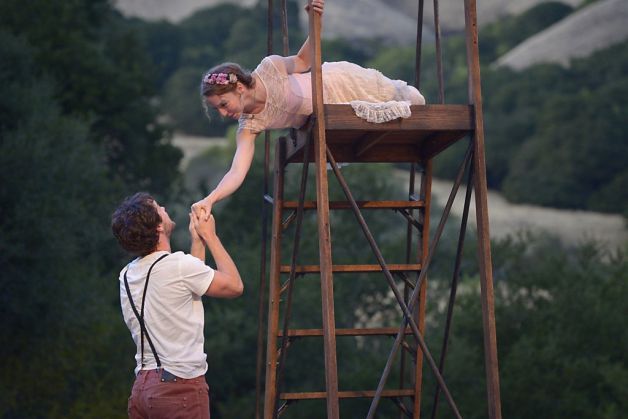
Into the Woods at the Eureka where energy tops quality

By Kedar K. Adour

(left to right): Allison Meneley (Little Red), Kyle Stoner (Jack), David Naughton (Cinderella’s Prince) and Courtney Merrell (Cinderella)

INTO THE WOODS: Musical. Music and Lyrics by Stephen Sondheim. Book by James Lapine.Ray of Light Theatre, The Eureka Theatre (Jackson @ Battery) in San Francisco. www.rayoflighttheatre.comMay 31 – June 29, 2013

Into the Woods at the Eureka where energy tops quality

After seeing four local productions of Into the Woods comparisons are inevitable. The TheatreWorks production was the most professional, the Sixth Street mounting the most charming, the Broadway by the Bay staging most hectic and this Ray of Light creation the most energetic. Energy is a trademark descriptive adjective for Ray of Light as is professionalism .Most of the dissatisfaction can be attributed to the direction of the final act where visual humor supersedes quality diction and necessary intricate timing to make it a rewarding evening.

Sondheim and Lapine’s contorted view of fairy-tales begins with a narrator, who doubles as Mysterious Man (Derek Travis Collard) saying “Once upon a time, a Baker and his Wife journey into the woods. . .” where they meet Little Red Riding Hood (Allison Meneley), Cinderella (Courtney Merrell), Jack of Beanstalk fame (Kyle Stoner), Rapunzel (Melissa Reinertson)), two Princes (Ted Zoldan and a fine David Naughton)) and a menagerie of other characters. The creators have added their own fairy tale of a Baker (Austin Ferris), and his wife (Nikki Arias) who is childless due to a curse placed on them by the neighboring Witch (Michele Jasso) because the baker’s father has stolen the greens from her garden. This is the first bit of morality that abounds in the play; the son shall be punished for his father’s sin.

The witch will remove the curse if they venture forth (into the woods) and gather ingredients for a potion to remove the curse. Searching for the ingredients the Baker and his wife meet the aforementioned characters. Each possesses one ingredient: Jack “a cow as white as milk”, Red Riding Hood “the cape as red as blood”, Rapunzel “the hair as yellow as corn” and Cinderella “a slipper as pure as gold.” All have ventured “into the woods” for their own purpose to “find what they wish for.”  By the end of the energetic, humorous, intriguing 90-minute first act all have found what they wish for singing a rousing first act curtain chorus of “Ever After” and they should “live happily ever after.”

It has been said that when the musical is performed by High School groups it ends with the rousing happy “Ever After” finale. There is the admonishment to “beware of what you wish for.” The narrator’s Act II prologue “So Happy” ends with the Baker’s house destroyed by a huge footprint.  The widow of the Giant Jack has slain is back to seek her revenge. Back into the woods they all go. This time the plot is indeed black surrounded by death and destruction and “happily ever after” is not to be. Sondheim interjects a hopeful note with the plaintive “No One Is Alone” and the finale “Children Will Listen.”

Collard as the narrator and Mysterious man does not project enough authority to keep the story going. Pity that the Giant’s widow throws him into oblivion thus predicting the characters will never know how their stories will end. Michele Jasso makes the wicked witch wicked, while singing Sondheim’s convoluted lyrics, and is gorgeous when transformed into a mere mortal with no unearthly powers but lacks the vocal demeanor for the role. Austin Ferris as the gentle but reticent Baker is the splendid foil for Nikki Arias (the wife) whose voice and acting almost steals the show. Almost, but not quite, since Kyle Stoner is charming and loveable as Jack of Beanstalk fame and David Naughton and Ted Zoldan are fun to watch as they preen and prance on and off stage.  Courtney Merrell’s over the top depiction of the gluttonous Little Red Riding Hood has her moments but could tone down the histrionics.

To mention all 18 members of the cast would make a long review. Be assured they all perform admirably with enthusiasm, zany humor, and flair while seeming to have fun. Once again, as with their previous productions, Sondheim’s delicious lyrics are not enunciated clearly and often drowned out by the orchestra. They are moving back to the Victoria Theatre for their next show where the acoustics are much better. Running time a long 2 hours and 50 minutes with intermission.

Kedar K. Adour, MD

Courtesy of www.theatreworldinternetmagazine.com


Abigail’s Party Explores Life’s Values at SF Playhouse

By Flora Lynn Isaacson

Wife, Bev (Susi Damilano) is threatened by husband Laurence (Remi Sandri). Photo by Jessica Palopoli.

Abigail’s Party is a play written and directed in 1977 by Mike Leigh. It is a suburban situation comedy of manners and a satire on the aspirations and tastes of the new middle-class that emerged in Britain in the 1970’s.

The place is “the London side of Essex” according to Leigh. Beverly Moss (Susi Damilano) invites her new neighbors Angela (Allison Jean White) and Tony (Patrick Kelly Jones) who moved onto her street two weeks ago over for drinks.  She has also invited her neighbor Sue (Julia Brothers), divorced for 3 years, whose 15 year-old daughter, Abigail is holding a party at her home.  Beverly’s husband Laurence (Remi Sandri) comes home late from work, just before the guests arrive.  The gathering starts off in a stiff, insensitive British middle-class way as the strangers tentatively gather until Beverly and Laurence start sniping at each other.  As Beverly serves more drinks and the alcohol takes effect, Beverly flirts more and more overtly with Tony as Laurence sits impassively by.  Within this simple framework, all of the obsessions, prejudices, fears and petty competitiveness of the protagonists are ruthlessly exposed.

Sue represents the middle-class being the ex-wife of an architect and living in one of the older homes on the street.  She also brings a bottle of wine and has not yet eaten, indicating she expects dinner as opposed to just drinks.  The others present have already had their tea.   Beverly and Laurence represent the aspirations of the lower middle-class and Tony and Angela, the new arrivals are also lower, middle-class, but Tony is less successful than Laurence.  Despite their similar background, Laurence seeks to differentiate himself from Tony by highlighting the differences in their general level of culture and makes condescending comments towards him.

Director Amy Glazer and her strong cast caught the mood and style just about perfectly.  In the role of Beverly, Susi Damilano was able to indulge herself in this gem of a role as she moved seamlessly from a snobby, flirtatious hostess to bullied wife with equal assurance. Remi Sandri delivers the downtrodden, yet superior Laurence very effectively.  His frustrations were convincing as his temper brewed and was finally unleashed he did not hold back. The part of Angela was brought to life by Allison Jean White. She brought out the humor and innocence in her role with ease.  Patrick Kelly Jones’ performance as Angela’s husband Tony was appealing with his economy of words.  Julia Brothers turns in a wonderful comedic performance as Sue, Abigail’s worried mother.

According to Artistic Director Bill English, who also designed the marvelous set, “Mike Leigh is most interested in what this consuming desire for one-upmanship and keeping up with the Joneses does to our humanity…how coming out on top and feeling superior to others diminishes us—when we think we’ve won, we’ve really lost.”

Abigail’s Party plays at SF Playhouse, May 21-July 6, 2013.  Performances are Tuesday-Thursday at 7 p.m.; Friday-Saturday at 8 p.m.; Saturday at 3 p.m.  The SF Playhouse is located at 450 Post Street (2nd floor, Kensington Park Hotel b/n Powell and Mason), San Francisco.  For tickets, call 415-677-9596 or go online at www.sfplayhouse.org.

Coming up next at SF Playhouse will be Camelot by Alan Jay Lerner (book and lyrics) and Frederick Loewe (music), directed by Bill English, July 16-September 14, 2013.

Cal Shakes opens season with ‘American Night’

By Judy Richter

By Judy Richter

On the eve of his test for American citizenship, a legal Mexican immigrant has fantastical dreams in “American Night: The Ballad of Juan José” by Richard Montoya.

Juan, well played by Sean San José for California Shakespeare Theater, has been studying American history. He sees portions of it in a dream, starting in the early 19th century with the Lewis and Clark expedition and continuing to the present. Thus, he meets some little-known heroes as well as more familiar figures.

San José is the only actor in the cast of six men and three women who portrays one character. Everyone else fills multiple roles, giving costume designer Martin Schnellinger and the uncredited wig designer major challenges that they meet successfully.

One of Margo Hall’s memorable characters is Viola Pettus, a black nurse who cared for Spanish flu victims — be they Mexican, Ku Klux Klan or otherwise — in 1918 in West Texas. Dan Hiatt is the Klansman as well as labor leader Harry Bridges and a Mormon who assists Juan in his waking hours.

Dena Martinez is seen as Juan’s wife, whom he left in Mexico with their infant son, as well as Sacagewea, Lewis and Clark’s Indian guide. She displays her musical talents as Joan Baez at Woodstock.

Others in this versatile cast, directed by Jonathan Moscone, are Sharon Lockwood, Todd Nakagawa, Brian Rivera, Richard Ruiz and Tyee Tilghman.

“American Night” premiered at the Oregon Shakespeare Festival in 2010 as a commission in its American history series.

There’s a segment about Japanese Americans in the Manzanar internment camp during World War II. Later, a young techie brags about being a Stanford grad, only to lose his job when it’s outsourced toIndia.

As a co-founder of Culture Clash, a 30-year-old Chicano troupe known for “politically sharp sketch comedy and ‘slapstick-erudite sociology,’ ” according to CST dramaturg Philippa Kelly, Montoya liberally laces the play with those qualities.

However, some segments are too long. They include Manzanar and negotiation of the treaty that ended the Mexican American War in 1848 and ceded California and other Western lands to the United States.

Erik Flatmo’s set serves the play well, but lighting designer Tyler Micoleau directs blinding spotlights into the audience several times. Likewise, Cliff Caruthers over amplifies sounds of gunfire.

Running an hour and 45 minutes without intermission, the play holds one’s attention because of its cast and its portrayal of prejudice against immigrants and minorities through the decades. All that — and the opening night of the season was unusually warm in this beautiful outdoor venue, which can be quite chilly.

“American Night” continues at CST’s Bruns Memorial Amphitheater, 100 California Shakespeare Theater Way, Orinda, through June 23. For tickets and information, including on-site dining and the BART shuttle, call (510) 548-9666 or visit www.calshakes.org.

AMERICAN NIGHT: THE BALLAD OFJUAN JOSEat CalShakes rocks!!

By Kedar K. Adour

(L to R) Dena Martinez as Sacajawea, Sharon Lockwood as William Clark, Dan Hiatt as Meriwether Lewis, and Sean San José as Juan José in Cal Shakes’ American Night: The Ballad of Juan José by Richard Montoya, directed by Jonathan Moscone; photo by Kevin Berne.

American Night: The Ballad of Juan José: Comedy. By Richard Montoya. Directed by Jonathan Moscone.California Shakespeare Theater, 100 California Shakespeare Theater Way, Orinda.(510) 548-9666. www.calshakes.org. June 1- June 23

AMERICAN NIGHT: THE BALLAD OFJUAN JOSE at CalShakes rocks!!

A wise teacher once said “A lesson taught with humor is a lesson learned.” The rolling laughter in the audience at the Bruns Amphitheater on the opening of American Night: The Ballad of Juan José indicated that lessons were being learned big time scene after scene.  Written by Richard Montoya and developed by Culture Class and Jo Bonney it had its world premiere in 2010 at the Oregon Shakespeare Festival and was the only show in their entire history to be extended by popular demand. Because of commitments of their 2013 season CalShakes may not have that option so don’t wait to get your ticket(s).

It all begins on the eve of the day Mexican immigrant Juan Jose (Sean San Jose) will take his citizenship exam. He falls asleep and has a fantastic dream tracing mostly the history of America. His dream trek though time is full of esperanza (hope) and the characters he meets are broad caricatures, in extravagant costumes (Martin Schnellinger) backed up by jarring music to match the nonstop action and irreverent dialog. Director Jonathon Moscone has imbued them with enough slapstick to fill a couple of shows.

Who is our intrepid hero Juan José traveling through a chimerical dream? He is a former honest Mexican policeman and when he does not accept bribes to “just do nuthin” or else there will be a contract on his life. What is an honest Mexican cop to do but seek sanctuary in the marvelous country north of his border where the sign reads (in red, white and blue of course): U.S.A.  BIENVENIDOS. Time has passed and now Juan must pass the citizenship exam before he can bring his family into America.

Of the nine member cast eight actors play 80 plus roles and Sean San Jose plays only one, the lead. For example local favorite Dan Hiatt starts out as a proselytizing Mormon, ends up as labor leader Harry Bridges and in between as Abraham Lincoln, a Klu Klux Klan leader, etc, etc. Sharon Lockwood switches genders often once playing William Clark (of Lewis and Clark) to Dan Hiatt as Meriwether Lewis, She is a riot as “Who Wants to Be an American” Game Show Spokesmodel.  Dena Martinez plays the recurring role of Juan’s wife but also shows up as Joan Baez and Sacajawea. Margo Hall is a joy as she flips in an out of her characters and she even plays a living clock to mark the passage of time and is most effective as Viola Pettus the African-American nurse who treated friend and enemy alike during the Spanish flu pandemic. Two roles played by Tyee Tilghman’s are a black cowboy and Jackie Robinson. Todd Nakagawa starts out as Brother Clark, Dan Haitt’s Mormon cohort and has a serious stint upon the stage as teen-aged Mexican Ralph Lazo who joined his Japanese friends at the Manzanar Internment Camp.

All the actors are marvelous but if you must pick out one of the bunch for special praise it would be full bodied Richard Ruiz who bounces around the stage with the agility of a Billy goat playing Juan José the First, Teddy Roosevelt, a Sumo wrestler, Bob Dylan and to close  the show as Neil Diamante belting a song in a Woodstock setting. Running time 90 minutes without intermission.

Kedar K. Adour, MD

Courtesy of www.theathreworldinternetmagazine.com

Drunk Enough to Say I Love You? at the Rhino

By Kedar K. Adour


Pictured left to right: Sam Cohen as Jack and Rudy Guerrero* as Sam and in “Drunk Enough to Say I Love You?” Directed by John Fisher; A Theatre Rhinoceros Production at The Costume Shop. Photo by Kent Taylor.

Drunk Enough to Say I Love You?: Agitprop Drama by Caryl Churchill. Directed by John Fisher. Theatre Rhinoceros, At the Costume Shop, 117 Market Street @ 7th, San Francisco, CA. 415-552-4100 or www.therhino.com. EXTENDED THROUGH JUNE 23

Rhino Theatre’s latest work requires your attention.

Since the Rhinoceros Theater group has had to relocate from the 16th Street digs they have performed in local venues including the Eureka Theatre and Thick Description. For their present production through the courtesy of A.C.T. they are ensconced at Costume Shop on Market Street. Word has filtered down that they have had to good fortune for their 2014 Season will be a spot in Z Space where The Traveling Jewish Theatre performed.

In the present space that is a black box affair the audience and actors are in intimate  contact. For Drunk Enough to Say I Love You? as directed by John Fisher that may be too intimate. Caryl Churchill, the noted British playwright who champions feminist movements and has a reputation for taking political establishments to the wood shed draws you into the controversy that surrounds her work. Her last foray into San Francisco was the brilliant production A Number at A.C.T. in which human genetic cloning was the topic. At the end of that play there was no doubt what her position on the subject was.

She leaves no doubt about her political feelings in Drunk Enough to Say I Love You? She bluntly suggests that Britain’s Prime Minister Blair had prostituted himself to George W. Bush. The two male characters are given the names of Sam and Jack. Sam representing the U.S. of A. . . . Uncle Sam, get it? And Jack as in Union Jack of Britain. She forcefully suggests that their alliance furthered world political devastation. It is not surprising that noted Rhino director John Fisher has elected to over emphasize the homosexual extent of the pairing since they advertise as “35th Anniversary of Queer Theatre in San Francisco.” A large comfortable bed fills most of the space and it is often used for the sexual encounters that often appropriately fit into the dialog.

Speaking of the dialog, there are no, absolutely no complete sentences even when one character interrupts but never finishes off what the other is saying. Yes, your attention is required. After the opening line as Jack asks “Am I drunk enough to say I love love you?” and is interrupted by Sam. Jack insists “Not that I don’t still love my wife and children but. .”

It is established that men are gay before the political diatribe begins with Sam being the aggressive macho leader and Jack the follower eventually a believer. There are no extraneous props since Fisher has elected to use projections effectively allowing no interference with Churchill’s dialog. Rudy Guerrero as Sam is a dynamo and Sam Cohen is the perfect foil and has the most difficult job of switching his emotional stance as the play progresses.

Drunk Enough to Say I Love You? is less than an hour long and Rhino has filled out the evening with two 10 minute plays that are related to it. Churchill’s short play Seven Jewish Children: A Play for Gaza was reviled for being anti- Jewish. In response to Churchill, Deborah S. Margolin wrote in rebuttal Seven Palestinian Children: A Play for the Other. They are two character plays both written in Churchill’s discursive style with no indication whether the man or the woman should speak the line. The former play takes place in Europe, America and Israel and the later in Palestine. Kim Stephenson is teamed with Sam Cohen in the first and Rudy Guerrero in the second. Again the use of projections are an integral part of Fisher’s direction and they are extremely affective.

Running time for the entire evening is one hour and 30 minutes including an intermission.

Kedar K. Adour, MD

Courtesy of  www.theatreworldinternetmagazine.com


The Beauty Queen of Leenane—A Mother/Daughter Tug of War at MTC

By Flora Lynn Isaacson

Beth Wilmurt (Maureen Folan) and Rod Gnapp (Pato Dooley) in Martin McDonagh’s The Beauty Queen of Leenane, directed by Mark Jackson, at Marin Theatre Company in Mill Valley, now through June 16.

The Beauty Queen of Leenane by Martin McDonagh is set in the Irish countryside where a woman in her forties tries to gain control of her life and destiny from her mother.  This play is a blend of black comedy, melodrama, horror and tragedy.  The story is set in the Irish village of Leenane, Connemara, in the early 1990’s. It takes place in a shabby, poorly lit kitchen and living room resulting in a claustrophobic sense of entrapment.

The play centers on the life of Maureen Folan (Beth Wilmurt), a forty year old virgin who takes care of her selfish and manipulative seventy year old mother Mag (Joy Carlin).  Maureen’s sisters have escaped into marriage and family life, but Maureen, with a history of mental illness, is trapped in a seriously dysfunctional relationship with her mother.

The Folan cottage is visited by Pato Dooley (Rod Gnapp) and his younger brother Ray (Joseph Salazar).  Pato is a middle aged construction worker fed up with having to live and work in England, disappointed by the limitations and loneliness of his life.

The glimmer of a last chance romance between Maureen and Pato sparks up in the first act and continues in the second one with a notable monologue by Pato.  The plot, full of deceptions, secrets and betrayals keeps surprising the audience. Hopes are raised only to be dashed.

In this play, much credit must also go to a flawless cast in Mark Jackson’s finely tuned production.  Beth Wilmurt is compelling as Maureen.  We are no less delighted to be in the company of Joy Carlin’s manipulative Mag. Rod Gnapp’s Pato is the most sympathetic of the four characters. His younger brother Ray is too impatient to wait to put Pato’s romantic letter into Maureen’s hands.

Martin McDonagh is an interesting and good storyteller. This production owes much to Mark Jackson’s fine direction, York Kennedy’s perfectly targeted lighting and Nina Ball’s wonderfully grungy set—and worth repeating—a superb cast!

The Beauty Queen of Leenane plays at Marin Theatre Company, May 23-June 16,2 013.  Marin Theatre Company is located at 397 Miller Avenue, Mill Valley. Performances are held Tuesday & Thursday-Saturday at 8 p.m.; Wednesday at 7:30 p.m. and Sunday at 7 p.m. with matinees every Sunday at 2 p.m.; Saturday, June 15 at 2 p.m. and Thursday, June 6 at 1 p.m. For tickets, call the box office at 415-388-5208 or go online at marintheatre.org.

Coming up next at Marin Theatre Company will be Good People by David Lindsay-Abaire and directed by Tracy Young, August 22-September 15, 2013.

Flora Lynn Isaacson

TERMINUS at the Magic is a dramatic, dark, daring and devastating production

By Kedar K. Adour

Marissa Keltie, Carl Lumbly, and Stacy Ross in the first American production of Mark O’Rowe’s “Terminus” at Magic Theatre. (Photo: Jennifer Reiley)

TERMINUS: a Dark Drama. by Mark O’Rowe. Directed by Jon Tracy. at Magic Theatre, Building D, FortMasonCenter, 3rd Floor, San Francisco, CA94123. 415-441-8822 or www.magictheatre.org    Through June 16, 2013

TERMINUS  at the Magic is dramatic, dark, daring and a devastating production

In 1925 Harold Ross, the editor of the New Yorker, famously declared “that it is not edited for the old lady in Dubuque.” In 2007 Irishman Mark O’Rowe wrote Terminus that is being given a dramatic, dark, daring and a devastating first American  production  that would shock that old lady in Dubuque. The opening night audience was silently spellbound until the final curtain when they erupted with a standing ovation.

O’Rowe has created a three-hander series of monologs written in non-descript rhyme without a whit of action yet filled with action in the words of three superior actors. His three characters are nameless indicated only as A, B and C. Consider them as tour guides that take us on a profane trip through the underbelly of Dublin. Before the play concludes the lives of these three disparate human beings mingle, nay collide as that meet death . . . the terminus of the title.

[DARK]: The intimate three-side theatre is shrouded in dark smoke and the stage an irregular black blob that could be a pile of slag from a coal mine or an unfinished construction site that is the place where the play reaches its climax.

[DRAMATIC]: A (Stacy Ross) is a female of 40 whom we learn was a teacher and now volunteers at a suicide crisis hotline.  She receives a call from a former student who is 8 months pregnant seeking an abortion. There has been a previous relationship with the student and A sets out to aid the girl. On her trip through the back alleys of the city she encounters lesbian gangs who perform abortions in the back of bars with improvised instruments that will appall you.

[DARING]: B (Marissa Keltie) is twenties lonely depressed female who accepts an invitation to share a pint at a local pub. This apparently simple decision leads to an “I dare you to” situation ending high up on a construction crane leading to a brush with death. Fantasy enters into O’Rowe’s dialog and there is the most beautiful passage as B ‘relives’ her past life.

[DEVASTATING]:  C (Carl Lumbly) a 30s male whose insecurity causes him to seduce women and disembowel them. He is a mass murder who has sold his soul to the Devil. Lumbly mesmerizes the audience with his sharp diction and frightening change of personality that is written into his monolog(s).

Each actor has two turns upon the stage and their paths inextricably cross leading to a contrived ending suggesting that they are all going to Hell. This is the type script that director Jon Tracy can sink his teeth in and he does not disappoint. His actors are pitch perfect in their delivery. Running time is 100 minutes without intermission.

Kedar K. Adour, MD

Courtesy of   www.theatreworldinternetrmagazine.com


‘Dear Elizabeth’ chronicles poetic friendship

By Judy Richter

By Judy Richter

Robert Lowell and Elizabeth Bishop were major 20th century American poets whose 30-year professional and personal friendship was chronicled by extensive correspondence between the two.

Playwright Sarah Ruhl skillfully encapsulates this friendship in her 2012 “Dear Elizabeth,” presented by Berkeley Repertory Theatre in its West Coast premiere.

The friendship started in 1947 and continued until Lowell’s death in 1977. During that time, the two lived quite different lives, but the respect and affection they had for each other surmounted all that.

Bishop, played by Mary Beth Fisher, lived with a succession of female lovers in Florida, Brazil and elsewhere for a number of years while struggling with alcoholism.

Lowell, played by Tom Nelis, spent most of his life in the Eastern United States, was married three times and was manic-depressive, resulting in several hospitalizations.

They shared many details of their lives in their letters, and they gave each other valuable feedback on their poems.

Although the idea of back-and-forth letters might sound dramatically dull, Ruhl and director Les Waters make “Dear Elizabeth” lively and engaging. The two actors personify their characters’ keen intelligence and wit as well as their emotional ups and downs. It’s an altogether captivating production.

The only misstep comes at the end of Act 1, when a torrent of water pours onto the stage. While an earlier downpour quickly drained, this one didn’t, leading to the distraction of the actors slogging through 2 or 3 inches of water before exiting.

Then the stage crew had to spend the 15-minute intermission mopping the stage and drying every inch of the floor, furniture and walls.

Otherwise, it’s a beautifully conceived and executed play, aided by Annie Smart’s set, Maria Hooper’s costumes, Russell Champa’s lighting and Bray Poor’s sound. Bray co-wrote the music with Jonathan Bell.

“Dear Elizabeth” continues in Berkeley Repertory Theatre’s Roda Theatre through July 7. For tickets and information, call (510) 647-2900 or visit www.berkeleyrep.org.


DEAR ELIZABETH is not about Elizabeth Barrett Browning.

By Kedar K. Adour

Sarah Ruhl and Les Waters return to Berkeley Rep with Dear Elizabeth, which stars Mary Beth Fisher (left) and Tom Nelis as esteemed poets and lifelong friends Elizabeth Bishop and Robert Lowell.  Photo courtesy of kevinberne.com

DEAR ELIZABETH BY Sarah Ruhl and directed by Les Waters. Berkeley Rep’s, Roda Theatre, 2015 Addison St., Berkeley. (510) 647-2949. www.berkeleyrep.org. Through July 7, 2013

DEAR ELIZABETH is not about Elizabeth Barrett Browning.

Many of the opening night audience were totally unaware of poets Elizabeth Bishop and Robert Lowell even though they were prominent writers from the late 30s to the early 70s. When director Les Waters was first asked to collaborate with Sarah Ruhl who was working on a stage version of the complete correspondence between Bishop and Lowell, published in 2008 as the 900-plus “Words in Air.” He confesses that he too was unaware of their work or fame but that did not deter him.

Ruhl and Waters are close friends and their collaborative works have graced the Berkeley Rep’s stages including the superb Eurydice and In the Next Room (or the Vibrator Play. They have again come up with a winner but it lacks the total qualities displayed in their previous outings. This may be due to the limitations place on Ruhl by the trustees of the poets’ estates. She could only use the words written in the letters without embellishment. The words at times soar and apparently create a true picture of two troubled souls that intellectually united even when many miles separated them.  It is Les Waters’ staging and direction that keeps the evening mostly alive.

This show is a co-production with the Yale theatre group where it received its world premiere in 2012 and Mary Beth Fisher reprises her role as Elizabeth Bishop. The talented Tom Nellis is the second half of this two-hander and creates a multifaceted Robert Lowell including bouts of manic depression (now known as bi-polar disorder), flights of fancy and touching unrequited love. Fisher is completely comfortable in her role and displays a perfect touch of reticence between her underplayed bouts of alcoholism.

They sit side by side on a desk center stage on Annie Smarts beautiful yet utilitarian set that must become multiple locations such as Yaddo an artist’s colony in Saratoga Springs, New York, Brazil, Maine, Italy, the Library of Congress and many more. Projections are used to delineate time and place.The actors leave the desk to make forays to left or right stage that become their individual domains and they only physically embrace once. This gesture may be imaginary gesture since Bishop was enamored with Lota de Macedo Soares her Brazilian partner.

To spice things up, clever Les Waters actually adds a real waterfall that floods the stage, not once but twice to emphasize Bishop’s poem:

“There are too many waterfalls here; the crowded streams

hurry too rapidly down to the seas,

and the pressure of so many clouds on the mountaintops

makes them spill over the sides in soft slow-motion,

Turning to waterfalls under our very eyes.

(Excerpt from “Questions of Travel”)

In summary: A charming evening worth a visit. Running time under two hours including intermission.

Kedar K. Adour, MD

Courtesy of www.theatreworldinternetmagazine.com


Marin’s ‘Beauty Queen of Leenane’ misses the mark

By Judy Richter

By Judy Richter

In “The Beauty Queen of Leenane,” a mother and daughter are caught in a web of dependence, distrust, manipulation and antipathy.

The Marin Theatre Company production catches most of those undertones in this 1996 drama by Irish playwright Martin McDonagh. It also undermines several other aspects of what should be a riveting play.

The action takes place during the mid-1990s in a rundown cottage in the Irish village of Leenane. The mother is 70-year-old Mag (Joy Carlin), who recites a litany of physical ailments both real and imagined.

Her spinster daughter is 40-year-old Maureen (Beth Wilmurt). Mag is controlling yet dependent on Maureen, who seems to have no other options in their economically distressed town.

Her fortunes appear to brighten when she and a neighbor, Pato Dooley (Rod Gnapp), connect romantically. He affectionately calls her the beauty queen of Leenane, but her dreams are dashed when Mag intervenes, leading to a tragic ending.

Carlin effectively portrays Mag’s wiliness, neediness and approaching dementia. For the most part, Wilmurt conveys Maureen’s emotional roller coaster as well as her underlying mental instability, but some of the character’s vulnerability is missing.

Gnapp does well as Pato, the play’s most decent, likable character. His monologue that opens Act 2 captures those qualities in a letter that he writes to Maureen fromEngland, where he has gone to work in construction.

The play’s weakest link is Joseph Salazar as Pato’s younger brother, Ray, a selfish, boorish lout who taunts Mag and Maureen. As directed by Mark Jackson, however, he talks so fast in his Irish accent that he’s often unintelligible.

That’s a problem because Ray plays an important, though unwitting role in the play’s outcome. Salazar also looks too clean-cut for the character.

The cottage set by Nina Ball dilutes some of the play’s power because its back wall is open, minimizing the claustrophobic atmosphere that’s so integral in the Mag-Maureen relationship.

Bay Area theatergoers who didn’t see Berkeley Repertory Theatre’s brilliant 1999 production or San Jose Stage Company’s excellent 2002 production might underestimate the power of McDonagh’s award-winning play mainly because of some of director Jackson’s choices. That’s unfortunate.

“The Beauty Queen of Leenane” continues through June 16 at Marin Theatre Company, 397 Miller Ave., MillValley. For tickets and information, call (415) 388-5208 or visit www.marintheatre.org.