LOVE ME LOVE MY DOG

By Joe Cillo

MY FAMILY, MY DOG

There is no psychiatrist in the world
Like a puppy licking your face.
Ben Williams

When Daphne sits on my lap, my blood pressure drops 30 points.  Why bother with Lipitor?  Daphne is not dispensed to me by a pharmacist although she is definitely good medicine. She is a five-pound Chihuahua with blue eyes and an attitude.  However, when she sits on MY lap, her blood pressure elevates…and no wonder.  She is at work; she is doing her job.

Daphne’s mother dresses her in high fashion: ruffled skirts with matching knickers and booties, a warm hoodie to wear when she and her mum are on the slopes and a bright strawberry vest to welcome spring.

Daphne has a stubborn anal gland that does not process her food properly and her mother has spent hundreds, nay, thousands of pounds on Daphne’s alimentary canal, to no avail.  At last, her mother resorted to holistic remedies and feeds Daphne a nightly soupcon of pumpkin and rice to soothe her aching bottom.

Daphne is well aware of her privileged position in the family.  She dines with us at our table.  We do not consider her germs as lethal as those of her former daddy or all her cousins…some with four legs, some with only two.   We all know her preferences and we do our best to keep her as happy as her presence makes us.  She does not like the rain; she considers walking on the other end of a leash demeaning; she loves to watch movies and never so much as woofs lest she disturb the others watching with her.  We know that Daphne is absorbing the action on the screen because she often weeps at a sad ending, and she still wails when she remembers what happened to poor Jackie Robinson.

We who know and love Daphne think she is unique but it appears that she is no different than any other dog in any other home anywhere in the world.  One look at her stimulates human oxytocin, a bonding hormone that increases our trust and attachment to those close to us and makes us suspicious of strangers.  The fact is that the longer Daphne stares at me, the more I love her and want to shoot that yapping little dachshund next door. This explains why we think nothing of spending half our wages on Daphne’s attire, rushing her to a doctor at the slightest hint that she is not in perfect health even as we ignore our own coughs, tummy spasms and exploding lungs. She is far more than part of our family…she is the very adhesive that keeps us together. For, although we all  have spats with one another over toilet seats left up or down, toothpaste tubes squeezed wrong and dishes unwashed, we all unite in our love for Daphne.  It is she who keeps us human.

Dogs are miracles with paws.
Susan Kennedy

SIDEBAR ONE:

Percy is a Corgi without a tail.  He stares at me with the same intensity Jewish men look at me.  You know: something is missing and he doesn’t remember how he lost it.  The interesting thing is that the more Percy stares at me, the more I adore him.  I cannot say the same for Jewish men.

SIDEBAR TWO:

Dorothy is a shih’ Tzu with a raging metabolism. When she sits on your lap, you can feel the heat of her tiny little body warm you right to your toes. When her blood pumps through her veins and burns her calories you will swear the house is on fire.  Dorothy’s mother says she has saved 1000 pounds a year on heating bills and her only cost is dog food.  That, after all, is Dorothy’s fuel and it is a lot cheaper than petrol.

Fringe of Marin Festival of Original One-Act Plays, Dominican University of California San Rafael

By Greg & Suzanne Angeo

Reviewed by Suzanne and Greg Angeo

Current “Fringe” Offers the Ridiculous and the Sublime 

The Fringe of Marin Festival is celebrating its 31st season, the first without its spirited founder and artistic director Annette Lust, who passed away in February at age 88. She often referred to the Fringe – with great affection – as her “peanut stand”. It was, and is, so much more than that.

The Fringe was founded by Dr Lust nearly 20 years ago to give local writers, actors and directors the chance to try out their original work in an informal setting.  Produced by the Dominican University Community Players and performed by actors of all ages, races and ethnicities, nothing is off-limits:  comedy, drama, slapstick, cerebral musings, political rants. The one-act plays are presented in a converted lecture hall with a rudimentary stage and very simple props. Many plays are clearly works in progress, only partly successful, but you can see the germination of something truly wonderful in many of the offerings. In 2004, the Bay Area Theatre Critics Circle gave the Dominican Players a special award for excellence in staging the Fringe of Marin during the ten years of Festivals it had presented by that time.

Although Dr Lust was small in size, she left some very big shoes to fill. Her formidable legacy has been handed down to two very courageous colleagues who are determined to carry the baton – to Mount Olympus, if necessary. Dominican University alumnus Gina Pandiani is the dynamic new Managing Director. She is passionate about the Fringe’s mission of presenting diverse and cutting-edge work. Pamela Rand, a talented graduate of Ecole Jacques Lecoq, the acclaimed school of theatre movement and mime in Paris, is the new Production Manager. She shares her gift of physical comedy in one of this season’s productions.

The Spring 2013 Festival features 14 one-act plays evenly divided between two 90-minute programs.  All manner of subjects are explored: from the demise of the U.S. Postal Service to the siege of Leningrad during WWII; from a madcap send-up of Sid Caesar’s 1950s TV show to an adaptation of a Chekhov classic. There’s song and dance, dumpster diving and a magic act, too – something to please just about everyone. This season’s efforts may not be quite as edgy or daring as those of earlier days, but there are the usual standouts. “Not Death, But Love”, written by Roberta Palumbo, is a solo piece delivered by Molly McCarthy as Elizabeth Barrett Browning. McCarthy displays amazing imagination through her vivid yet controlled expressions. “The Wreck”, another solo, is a cleverly creative adaptation of the poem by Henry Wadsworth Longfellow and is performed by Deanna Anderson, who is also the writer. Anderson weaves memories of her own childhood into her performance, making for a unique and moving piece. “Here’s Your Life” is a cavalcade of craziness. This homage to Sid Caesar has eight performers displaying perfectly-honed comic timing, led by Pamela Rand as the hapless but agile lead character, Susannah P. Metcalf. Rand is also the play’s co-writer, with Stacy Lapin. Some alarming acrobatics will have you on the edge of your seat.

The primary appeal of the Fringe is that you never quite know what to expect. The programs present a mixed bag of quality ranging from the groan-inducing to polished professionalism. The Fringe of Marin was and remains a worthy undertaking, but it faces an uncertain future. Its current home at Meadowlands Hall, which was built in 1888 as the DeYoung family’s summer estate, must be closed soon so it may finally receive a much-needed renovation. The Fringe will relocate to the much larger space at Angelico Concert Hall, and it remains to be seen if it can find the necessary storage space for important props and equipment. The Fringe of Marin has a storied history in Bay Area theatre, and deserves to carry on with the tradition of giving budding theatre professionals a laboratory in which to conduct their novel, and entertaining, experiments.

When: Now through May 5, 2013

7:30 p.m. Fridays and Saturdays

2 p.m. Sundays

Tickets: $5 to $15

Location: Meadowlands Assembly Hall, Dominican University

50 Acacia Avenue, San Rafael CA
Phone: 415-673-3131

Website: www.fringeofmarin.com

“Jesus Christ Superstar” – City College of SF

By Joe Cillo

1970 album cover for the American musical production.


The theatre arts department of City College of San Francisco has done it again,  in fact, it exceeds its previous productions with  Andrew Lloyd Webber and lyricist Tim Rice’s iconic rock opera “Jesus Christ Superstar.”   It literally rocks the house!

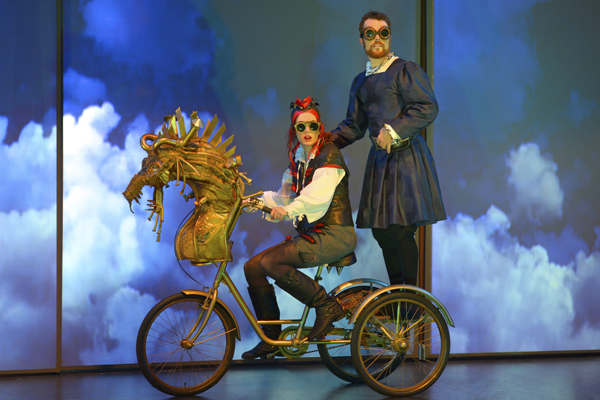
Director and choreographer Deborah Shaw and musical director Michael Shahani, worked closely with set designer Patrick Toebe and lighting designer Jeffrey Kelly to create what Shaw described as a “steam punk” atmosphere, enhanced by George Georges sound design of clanking metal and hissing steam.  A metal scaffolding makes up the many-leveled set, backed by what appears to be a wall of thick, heavy, frayed ropes descending from the flies behind a scrim against which an array of psychedelic lights play, often changing colors and pulsing in time to tunes like “What’s the Buzz.”   Shahani’s orchestra can barely be seen behind the scrim, but it’s certainly heard.

The large cast of close to three dozen actors, singers and or dancers consists of students, alumni, and other Bay Area talent.  They are outfitted in Ralph Hoy’s inventive costumes.  He and his staff: Sarah Moss, Julie Wong, Tatiana Prue, and Steve Murray, gives the production a certain 1930s Brechtian look.  Characters such as the Soul Girls, Dancers, and Prostitutes wear short-skirts and blouses of colorful netting with flared sleeves, and low-cut, form-fitting, leather-like and metal studded vests, in the “Xena, Warrior Princess” mode.  Their feet are shod in thick-soled, black, stomper boots fastened with metal buckles.  The Three Angels’ (Natalie Ayala, Kasia Kransnopolska and Holly Labus, who also double as Prostitutes) costumes are augmented with black wings.  The apostles and chorus wear outfits of early 20th century laborers.

After the Overture, black-bearded David Peterson as Judas Iscariot enters, singing “Heaven on Their Minds.”  He wears a long, brown duster over pants and vest;  his long hair in dreads, eyes rimmed in black.  The amazing Peterson is electric, charismatic and passionate, yet, at the same time he allows Judas’s vulnerability and confusion to surface, so that you almost feel sorry for the guy for selling out Jesus.  Peterson’s  voice,  like rough velvet, is strong and full of emotion.

Jesus (Zachary Bukarev-Padlo)  is not the robed, long-haired, bearded sandal-wearing  ethereal being we’re used to seeing, but a sweet-faced guy with a neat goatee and short blonde, wavy hair.  He wears a khaki shirt, jodhpurs, boots, and a strange skewed plaid vest with an over the shoulder strap.    Bukarev-Padlo’s tortured delivery allows us to experience his dilemma as he questions himself and his fate.  Unasked for demands made on him prove too much.

Jenneviere Villegas plays a red-headed Mary Magdalene.  You hear the sweet, plaintive keening of unrequited love  in her voice as she sings, “I Don’t Know How to Love Him.”  Like David Peterson, Villegas, too, shows her vulnerability to and confusion about her feelings for Jesus.

Pilate is played by Ron McCan whose physical disability serves to enhance his role.  He pushes himself from his “throne”/electric chair, moves purposefully across the stage wearing a kind of crown and embroidered robe, singing, “Pilate’s Dream” in which he meets Jesus, singing words that tell of his  guilt for what he’s about to do to him, which he overcomes with his arrogance.

The entire production is remarkable, though some scenes stand out:  One lively scene is of Jesus destroying the temple where drugs are sold, and pimps tout their prostitutes, as the chorus sings, “Temple”;  another- gut-wrenching and dramatic-  is that of lepers costumed in off-white pants and extended sleeved shirts resembling straightjackets, crawling, pulling themselves across the stage, moaning as they confront Jesus, grabbing at him, beseeching him to heal them.  Overwhelmed, he tells them to “heal themselves.”

Act 1 ends with Judas, priests Annas (Kevin Hurlbut), and Caiaphas (David Richardson), and the chorus singing the rousing, “Damned for All Time/Blood Money,” and Judas accepts his 30 pieces of silver.

Priests seem always to be dressed in long black gowns.  Ralph Hoy gets around this  stereotype by outfitting them with multi-lensed eyewear that looks like something out of “The Matrix” (or an optometrist’s office), which are not only inventive, but extraordinary and effectively sinister.

Outstanding actors are David Richardson as  Caiaphas, the head priest.  Richardson intones in his basso profundo, singing with Annas the above number, and with other priests (Joey Alvarado, David Herrera, and Jack Landseadel) “This Jesus Must Die,” and more.   Pablo Soriano gives a believable performance as the wide-eyed, intimidated, burdened apostle, Peter, who denies Jesus in “Peter’s Denial” in a scene with Maid by the Fire (Elizabeth Castaneda), Mary, and old man, and a soldier.   Another is Spencer Peterson as Herod, playing the king as only Spencer Peterson can: as a heavily made up, top-hatted, flamboyant gay dude in tights and a huge brown leather cod-piece straight out of an early Roman comedy.  He dances, prances, and jumps around the cabaret-like set singing, “King Herod’s Song (Try it and See)” with the dancing girls, prostitutes and chorus.

After Judas’s suicide (Judas, Annas, Caiaphas, and the Chorus sing the dirge, “Judas ‘s Death”), he appares to Jesus as a vision in a tuxedo- jacket open revealing his bare chest- black bow tie, and red suspenders.  He, the Soul Girls, Dancers, and Angels dance and sing “Superstar.”    Brilliant!    The staging of Jesus’ crucifixion (“The Crucifixion,” Jesus, Mary, the ‘apostles), is beautiful.  Enhanced by Kelly’s lighting-  light beams fan out behind Jesus like searchlights,  he appears in silhouette, arms out-stretched.

Each actor, including priests, Herod, Pilate, and the apostles play more than one role.  Exceptions are Jesus, Judas, Mary Magdalene, and Caiaphas.   That said, each sprechstimme-singing  or singing actor is believable in his or her role.

One problem with a large cast is ensuring that everyone is invested in the story and its principles.    An audience is aware when this doesn’t happen; it feels it; something is off.  I didn’t sense this at all.  Each actor gives his or her all to make  “Jesus Christ Superstar” a success.  The singing and acting in this production is some of the best I’ve seen in a musical.

April 26-28 are its final performances, so  don’t miss it.

Diego Rivera Theatre on the City College of SF campus, Gennessee @ Judson, or Phelan and Judson. Go to City College of SF website, click on index, scroll down to  Theatre Arts Department current productions for more information.


Isaac’s Storm — Book Review

By Joe Cillo

Isaac’s Storm:  A Man, A Time, and the Deadliest Hurricane in History. 

By Eric Larson.  New York:  Vintage/Random House.  1999.  pp. 323.


This is a harrowing story of survival and death during the Galveston Hurricane of 1900.  The book bills it as the deadliest hurricane in history, however the hurricane of 1780, which struck the Western Caribbean during the American Revolution, and Hurricane Mitch of 1998, did cause greater loss of life.  But the Galveston Hurricane of 1900 is right up there among the most deadly with an estimated 8000-12,000 deaths. This book is not only a story of the Galveston Hurricane, but it is also a history of meteorology and hurricane forecasting, a history of the U.S. Weather Service, and a biography of Isaac Cline, the Weather Service’s agent in charge of the Galveston Bureau at the time of the hurricane.

The book is a magnificent accomplishment.  I truly admire it.  It has been scrupulously researched in original sources at the National Archives, the Library of Congress, and the Rosenberg Library of Galveston, many of which have not been touched since they were deposited.  There are detailed footnotes.  It is a gripping narrative with many sub-narratives that interweave, yet do not get in each other’s way.  The style is very readable and draws the reader in and takes hold of you.  What I especially liked was Larson’s ability to create a pervasive tone of ominous foreboding amidst the retelling of rather mundane occurrences.  People blithely went about their daily routine business in Galveston during the days leading up to the hurricane without a clue what was coming.  Small decisions were made that proved fateful.  Minor events, seemingly trivial, contained a hint of menace.  Of course, it is hindsight that enables one to make such a reconstruction.  But there is also the lingering question of whether greater attention had been paid to certain small indicators, might the catastrophe been mitigated?  No one had any concept of the magnitude of what was coming.  There had been storms in Galveston before.  People, including Isaac Cline, constructed their houses on stilts in anticipation of flooding from storms.  They thought they were well prepared.  The problem was they underestimated Nature and the massive power it can unleash.

Many of the lessons of this story will seem familiar and timeless.  The mercilessness and indifference of Nature to the fate of living things and civilization.  Nature truly does not care if we live or die.  We are not being punished, nor are we being cared for, by anything that occurs in Nature.

The power of denial.  There are a number of examples of this throughout the book, but I will single out two.  Isaac Cline observed an interesting phenomena during his first summer in San Angelo, Texas, of 1885 (before he was transferred to Galveston).  It was a long, hot summer on the Texas prairie.  The Concho river was dry and temperatures went as high as 140 degrees.

One evening in mid-August he was walking toward town along his usual route, crossing the footbridge over the riverbed, when he heard a roar from somewhere far upstream.  Not thunder.  The roar was continuous, and got louder.   He saw a carriage carrying a man and a two women descend into the riverbed at a point where wagons and horsemen often crossed.  An escarpment of water that Isaac estimated to be fifteen or twenty feet high appeared beyond the carriage.  Isaac began to run.  The water caught the carriage broadside and ripped it from the soil.  Isaac reached the other side of the riverbed just as the water surged past him, the carriage tumbling like a tree stump in a spring flood.  The wagon passed.  Rescue was impossible.

His heart racing, Isaac looked upstream.  Men had gathered and with their bare hands were plucking fish from the water.  Large fish.  As Isaac walked toward the men, he saw a fish two feet long drift slowly by.  Me moved closer.  The fish did nothing.  He reached for the fish.  It kept still.  Isaac thrust his hands into the water, and two things happened.  He caught the fish; he froze his hands.

It was August in Texas but water had abruptly filled the riverbed and this water was the temperature of a Tennessee creek in January, so cold it paralyzed fish.

But where had the water come from?  Isaac scanned the skies for the rolling black-wool cloud typically raised by blue northers, but saw nothing.

Days later, townsmen recovered the bodies of the carriage driver and his two female passengers.

And a week later, the mystery of the ice-water flood was resolved.

Visitors from the town of Ben Ficklin fifty miles up the Concho came to San Angelo and reported that a monstrous hailstorm had struck about ten days earlier, the day of the flood.  The storm discharged stones the size of ostrich eggs that killed hundreds of cattle and fell in such volume they filled erosion gulches and piled to depths of up to three feet on level ground.  The ice melted quickly.

For Isaac this was explanation enough.  The deadly flood was the downstream flow of flash-melted hail.  He wrote an article on the incident for the weather service’s Monthly Weather Review, edited by Cleveland Abbe.  To Isaac’s “surprise and chagrin,” Abbe rejected the article on grounds it was too far-fetched to be believed.  (pp. 61-2)

Isaac was annoyed at this rejection and went on to document other cases of massive hailstorms across the Great Plains that caused great destruction.  They are not by any means unprecedented.

Another case of denial is exhibited by the U.S. Weather Service’s handling of the storm in its forecasting.  It was a widespread belief among forecasters at the time that all hurricanes followed a curving path from the Caribbean through Florida and then northeast into the Atlantic.  They did not believe it was possible for a hurricane to proceed from Cuba, west toward Galveston — but that was exactly what this hurricane did.  Reports of the storm and forecasts were issued consistent with these false expectations, but contrary to facts on the ground.  The Cuban Weather Service, however, reported accurately on the storm and warned of its danger.  The U.S. Weather Service banned the Cubans from transmitting their reports over telegraph lines to the United States. They enlisted the help of Western Union in this effort.

Willis Moore, acting Secretary of Agriculture at that time, wrote a letter to General Thomas T. Eckert, president of Western Union .

The United States Weather Bureau in Cuba has been greatly annoyed by independent observatories securing a few scattered reports and then attempting to make weather predictions and issue hurricane warnings to the detriment of commerce and the embarrassment of the Government service. . .  I presume you have not the right to refuse to transmit such telegrams, but I would respectfully ask that they be not allowed any of the privileges accorded messages of this Bureau, and that they be not given precedence over other commercial messages. (p. 106)

The Cuban weather raised vigorous opposition to the ban, but they were suppressed.  After the storm, with Galveston in ruins, The Cuban Weather Service’s Julio Jover visited H.H.C. Dunwoody, head of the U.S. Weather Bureau in Cuba, and had a contentious discussion about hurricane prediction.  At one point Dunwoody told Jover

“a cyclone has just occurred in Galveston which no meteorologist predicted.”

Jover, incredulous, paused a moment.  He said, slowly as one might address the inmate of an asylum: “That cyclone is the same one which passed over Cuba.”

“No sir,”  Dunwoody snapped.  “It cannot be; no cyclone ever can move from Florida to Galveston.”  (p. 114)

Although Larson’s book is straightforward history, there are many parallels to contemporary events.  Larson does not draw them, which is to his credit, but it can readily be seen that the mentality and often the methods of bureaucrats and government leaders seem to have a timelessness that transcends historical contexts.

Governments and corporations find it extremely important to control the flow and quality of information about public events.  It is through the selective use of information (or misinformation) that public attitudes and can be shaped and behavior controlled.  It is also how credibility and authority are maintained.  We see this today in the government’s handling of the Boston bombings, 9/11, the wars in Afghanistan and Iraq, the Kennedy Assassination, the Lincoln Presidency, and above all in the so-called “War on Terror”, that phantasm of the imagination that has no beginning, no end, and no fixed enemy, except whom the government declares it to be.  It is the ultimate power grab because it does not admit contradiction by any “facts.”  Actually, the facts disappear.  Reality becomes what solely the government declares it to be.  This same pattern can be seen over a hundred years ago in the Galveston Hurricane.

The biggest elephant in this room of denial and dismissal of imminent catastrophe is climate change.  This, I think, gives this book special relevance to events occurring before our eyes today.  We often see today, in the media and in the government, people who refuse to accept, in the face of overwhelming evidence, that the earth’s climate is changing, that it is changing rapidly, that human activity is the cause of the change, and that the consequences are potentially devastating on a scale heretofore unimaginable.  It is very similar to the underestimation that the people of Galveston and the officials of the U.S. Weather Service made before the Galveston Hurricane.  People simply had no concept of the vast destructive potential of Nature and how quickly it could be visited upon them.  We are in that same state of impoverished imagination and blissful denial today before the specter of global warming.  There are some people who know and are trying to sound the warning.  But they are discounted and dismissed.  The scenarios of doom they paint are too fantastic to be credible.  Yet once these forces are unleashed, or rather, once they begin to break upon us, it will be too late and the outcome will be inevitable.

I once shared some of my concerns about this with a friend of mine, explaining to him that San Francisco draws most of its water from the Hetch Hetchy Reservoir in the Sierra Nevada mountains.  The pipeline from Hetch Hetchy to San Francisco crosses a number of major geological fault lines, but the concern I was sharing with him was that climate change may make our weather much drier and warmer.  If the Sierra snowpack were to disappear, and the Hetch Hetchy Reservoir were to dry up, where will that leave San Francisco for a water supply?  His response, “Well, I guess we’ll just have to drink Perrier.”

Bureaucratic infighting and turf wars impaired the Weather Service’s functioning and weather forecasting became politicized.  It is worth noting that an important motivation for the improvement in weather forecasting was the military.  Naval fleets were often sunk by storms, and being able to understand and predict weather was important to maintaining military strength and superiority.  President McKinley ordered the creation of the hurricane warning service in the Caribbean on the eve of the Spanish-American War.  “I am more afraid of a West Indian hurricane than I am of the entire Spanish Navy.”  (p. 74)

Once the storm began to break upon the city and people saw they were in real trouble, there were divisions between people over how to respond.  There were sharp differences among family members including Isaac Cline’s over whether to move to a presumably safer location or stay put.  These decisions were fateful.  Many families perished as a consequence of these decisions.  Larson points out an interesting gender divide. Men tended to stand pat and ride out the storm, where women wanted to flee.  Many of these were their last marital arguments.

Much of the book is taken up with dramatic anecdotes of survival and death.  But many larger issues of great interest are also discussed along the way.

One interesting small point that Larson only mentions in passing, but I find worth drawing attention to, is a description of a walk Dr. Samuel Young, Secretary of the Cotton Exchange made the night before the hurricane.

Ahead, Murdoch’s pier blazed with light.  The crests of incoming waves seemed nearly to touch the lamps suspended over the surf.  There would be no nude bathing tonight — unlike other nights, when as many as two hundred men would gather in the waves beyond the reach of the lamps and swim frog-naked in the warm water.  (p. 130)

Apparently, there was a vibrant homoerotic culture in Galveston around the turn of the century.  I wonder how common such gatherings were across the United States at that time, before the suppression of male-male sex became firmly established in the culture?

After the storm there were so many corpses that disposing of them became a major public health issue.  Cremation was a rare practice in 1900, but many bonfires were built across Galveston to burn the many dead bodies from all over the city.  There was racism.  Rumors were spread of black people defiling and robbing the bodies.  Black males were recruited at gunpoint to help load and dump bodies into the ocean for which they were paid in whiskey (p. 239).  But the bodies were not weighted enough and by the end of the day many of the bodies dumped into the ocean were washing back up on the beaches of Galveston.

Larson notes the sources of relief contributions for Galveston.  The State of New York gave the most at more than $93,000.  New Hampshire sent $1.

One of the final chapters details how the spin doctors went to work in the aftermath to influence how the media portrayed the storm to the public and the Weather Service’s handling of it.  A lot of it sounds very familiar.

[Willis] Moore continued to portray the bureau as having expertly forecast and tracked the storm, and credited in particular the West Indies Service. . .   Most U.S. newspapers, unaware of the nuances of the bureau’s performance and inclined in those days to be more accepting of official dogma, adopted Moore’s view.  (p. 252)

Which was in direct contradiction to the facts.

Isaac Cline lost his wife in the storm — arguably in consequence of a decision he made to remain in his house.  The subsequent lives of many of the participants are noted by Larson, which makes for satisfying closure.

Willis Moore wrote at the time “Galveston should take heart, as the chances are that not once in a thousand years would she be so terribly stricken.” (p.272)  But Galveston was hit by hurricanes in 1915, 1919, 1932, 1941, 1943, 1949, 1957, 1961, and 1983.

Toward the end of the twentieth century, meteorologists still considered Galveston one to the most likely targets for the next great hurricane disaster.  Unlike their peers in the administration of Willis Moore, they feared that the American public might be placing too much trust in their predictions.  People seemed to believe that technology had stripped hurricanes of their power to kill.  No hurricane expert endorsed this view.  None believed the days of mesoscale death were gone for good.  The more they studied hurricanes, the more they realized how little they knew of their origins and the forces that governed their travels.  There was talk that warming seas could produce hypercanes twice as powerful as the Galveston hurricane.  (p. 273)

This is the not so subtle message of this book for our time that goes beyond its being a historical narrative or a gripping adventure story.  The conditions created by the warming earth and the warming oceans will eventually bring storms upon us of a much greater destructive scale than we have ever experienced.  People of our time would do well to heed the lessons of the city of Galveston in not being too smug and arrogant against the monumental power of Nature, which can outstrip our imagination for sudden and ruthless destruction.  We like to believe that the world is a congenial place and meant to support our lives.  It does not have to be that way, and it can change in a very short time.  Reading the story of Galveston can help bring that message home for whatever good it might do, and Larson’s account is as powerful and effective a recounting as any that might be done.


Exciting new opera “Stuck Elevator” at A.C.T. in SF; Benecia Old Town Theater’s money dissappears and Diablo Actor’s Ensemble mounts final show in Walnut Creek this week!

By Charles Jarrett

This past week the A.C. T. Theater in San Francisco opened their doors to a world premiere of an extraordinary hybrid of musical theater and opera entitled “Stuck Elevator”. This is a very different form of opera, one that touches base with more modern lyrics and librettos of today, occasionally embracing story telling through hip-hop poetry and street style opera!

This musical is a fictional creation by two very imaginative collaborative writers, composter Byron Au Yong and librettist Aaron Jafferis, who take elements of a true life experience and fill in the gaps with their own imaginings. These two young men met in the musical theater program at New York University. Jafferis defines himself as a “hip-hop poet and playwright” and Yong envisions himself as a“composer of songs of dislocation”.

In this A.C.T. production, “Stuck Elevator” is a re-envisioned story that actually happened to an illegal Chinese immigrant in 2005 in New York City. In the true story, Ming Kuang Chen was a friendly, hardworking delivery man in the Bedford Park neighborhood of the Bronx for the Happy Dragon restaurant. On one fateful April 1st in 2005, a normal delivery of Chinese food to a customer in the Tracey Towers, just three minutes away from the restaurant, changed his life in a way he could never have imagined. This incident became a very frightening experience for this gentleman as he attempted to exit the building to continue his night’s work. Ming Kuang Chen found himself an unwitting victim of poor maintenance in a rundown apartment complex where he became a prisoner in an elevator cell for over 81 hours, while friends, police and rescue workers searched for him for several days in and around that very same building unaware of what had actually happened to him. At the same time, Chen was unaware of the search going on for him. He remained a captive, hoping that a workman would soon discover him and free him from this 4x6x8 square foot iron prison.

Compounding the problem was the fact that Ming Kuang Chen knew very little English, knew he was in the country illegally and feared attracting the attention of the police or the authorities who would probably deport him back to China. He dared not to have this happen as being deported would break the chain of meager income he was sending home to his wife and young son in China. Further, it would cause him to renege on the repayment of his $60,000 debt for his passage to America. That failure could eventually cost him his life!

“Stuck Elevator” is similar to the real story, taken from this man’s experience. A story that accentuates the day to day reality of the fear and assimilation struggles that many immigrants live with.

“Stuck Elevator” is a musical that is beautifully crafted, imagined and designed, right from the very first scene, as Guāng (our author’s substitute for Ming Kuang Chen) begins his fateful delivery experience and his elevator story begins to unfold. The musical is translated for the audience with both Chinese and English sub-titles, as is necessary, to provide appropriate translation, on a screen above the stage. Guāng’s story emerges in a simple, almost understated manner until it builds to a crescendo of panic and fear. Guāng (played brilliantly by opera singer Julius Ahn), arrives on his bicycle carrying his bag containing food from his employer’s shop, in an ally-way next to a commercial elevator. We see him enter the elevator to make a deliver on one of the top floors. A short time later, we witness him counting his money and re-enter the elevator to begin his decent, followed by the very realistic fall of the elevator in its shaft.

As the hours begin to crawl past him, Guāng becomes more and more hungry, begins to hallucinate, imagining many things. These dream-like encounters and conversations with his employer’s difficult wife, his son still in China (Wang Yue played by Raymond J. Lee), his wife still in China (Ming played by Marie-France Arcilla), Marco, his co-delivery friend (played by Joel Perez), and many other familiar people in his life (all played by the same above three actors and Joseph Anthony Foronda), all take place in and around the skeletal elevator structure. In an incredibly simple but effective set, we join Guāng in his very active hallucination generated imaginary world, hoping for release before he starves to death.

Director Chay Yew has brought this story to full fruition, encompassing a broad range of human emotions including extreme fear, humor, laughter, and even crazy imaginative game-show type dreams. The evocative and eclectic music features Cary Koh on Violin, Michael Grahm on Cello and Allen Biggs on percussion. This is a very powerful theatrical piece that brought a standing ovation from the audience and continues Tuesdays through Saturday with performances at 8 p.m., Matinees on Wednesdays, Saturdays and Sundays at 2 p.m. and Sunday performances at 7 p.m., closing on April 28th. The performance is 1 hour and 20 minutes with no intermission. Tickets range in price between $20 and $85 which can be accessed by going on line to www.act-sf.org or by calling (415) 749-2228. This is theater well worth the journey to A.C.T.’s Geary Theater located at 415 Geary Street in San Francisco.

Meanwhile, back in our own neighborhood, there are two wonderful little theatrical venues that are in need of your support and best thoughts. The Diablo Actor’s Ensemble at 1345 Locust Street in Walnut Creek has just recently learned that their little theatrical venue and the building surrounding it, has recently been sold to a new owner. Artistic Director Scott Fryer informed me this week, that they have been advised that in order for them to stay in this venue, their rent would probably be increased fourfold, something that is completely out of question for a marvelous little company that was barely surviving at their current rent structure. This exceptionally well designed compact 49 seat theater is anything but little when it comes to sterling performances. It has been a very popular theater for Rossmoor audiences over the years, but following DAE’s upcoming production of “Grace and Glory” which opens this coming Friday, the 26th of April, it will exist no more. I strongly recommend that you join me this weekend at DAE’s production by calling (866) 811-4111 or by visiting their website at www.diabloactors.com for more information.

I thought the events of this past week could not get any worse but when I joined close friends in Benecia at the Benecia Old Town Theater Group’s theater in Benecia to celebrate the remarkable life of longtime friend and actor Robert Parke (OBE) O’Brien who passed away earlier this year, I learned of another disaster in progress. While there, I heard from BOTTG Board President Dan Clark, that the theater discovered this past week that their bank account had been fraudulently emptied of all of its operating funds!

Dan told me that while the company was assessing what shows they were hoping to present in this year’s seasonal offerings, he had asked one of the board members to contact the company that they normally contract with to secure production rights to their plays, in order to determine what the costs would be for a particular show already announced. To the board member’s complete shock, he was told that this particular company would no longer do business with the BOTTG, as there were two previously contracted shows for which they had not been paid; in addition to the fact they had received a bounced check for another production. This was reported to Board President Dan Clark, who immediately went to the bank and discovered that there was only $27 left in their account.

They had been assured as recently as a month ago by their treasurer, Kimble Goodman, that there was at least $10,000 in their account. The theater reported the theft to the police. While Mr. Goodman, through his attorney, Amy Morton, denies the theft allegation, at the same time his attorney admits that there may have been “negligent commingling of funds” and that Mr. Goodman, who filed for Chapter 7 bankruptcy in January, “intends to make whole the theater group’s loss.”
Solano County District Attorney Robert Hightower stated publicly following the accusations by the theater, that the fact that the District Attorney filed charges against Mr. Goodman, “speaks for what we think of the conduct”.

Now, with absolutely no funds to operate with, the theater is pleading for public support in asking that they try to attend their current production of David-Lindsay-Abaire’s powerful play, “Rabbit Hole” to keep them afloat financially, while they try to raise funds to mount their next show. I have been attending shows in this theater for over 20 years and it would be an absolute shame for them to have to close their doors due to this type of event.

“Rabbit Hole” is a story of a family in crisis following the death of their 4 year old son who was run down by a reckless teenager with his car. The young driver wants to express his regrets to the family for his inappropriate action but the grieving mother, Becca, does not want to hear it.
There are problems with other family members as well and the subsequent grief motivated actions of Becca. While initially a very dark and disturbing tale, the resolution is kinder and gentler and in the end, a very thought provoking award winning play. I have seen this play at least twice and I appreciate the message. I recommend you attend BOTTG’s production. This company puts together some very excellent community theater productions. You can contact the company to secure tickets by calling (707) 746-1269 or by visiting their website at www.beneciaoldtowntheatergroup.com . This production plays Fridays and Saturdays at 8 p.m., with Sunday matinees at 2 p.m. in the historic old BDES Hall at 140 West “J” Street in downtown Benecia.

Fringe of Marin: Season 31, Program Two–Another Winning Lineup

By David Hirzel

Program Two gets off with a bang, a great piece of broad ensemble comedy,”Here’s Your Life (A Tribute to Sid Caesar)”. Great lines (Stacy Lapin and Pamela Rand), great timing, great physical comedy, just what you’d expect from the title, all delivered under the firm and driving hand of director Jerry Ambinder. The mood changes abruptly with Deanna Anderson’s touching and thoughtful reading of Longfellow’s “The Wreck” (of the Hesperus), interwoven with adult memories of a turbulent childhood. “The Freeons” (written and directed by Rachel Cohen) take us to an unusual dining experience near an elegant restaurant, and helps to challenge a young lady’s and our own preconceptions about the meaning and value of food. Right before the intermission Steve North takes us on another wild ride through his psyche and his life experience. His piece is full of laughs and insights where “Something’s Not Wright” but neither he nor we quite know what or why as he veers between seemingly unscripted moments. All a part of the stagecraft of this consummate professional.

Terri Barker in her directorial debut gives us the maturing friendship between a young student aspiring to art, an older man whose muse has left him staring out at the horizon In Peter Hseih’s “Lauren and the Ocean.” In an art of a different kind, Michael Belitsos returns to the stage with a spellbinding mix—“Admissions in the Dark”—of illusionism, stage hypnosis, and a paean to monster and “Ghost” films from Hollywood’s glory days in the genre. The evening closes with a Gina Pandiani’s wry update of Chekhov’s “A Marriage Proposal (2013)” with the battle this time between the Tea Party conservative Ivan and his intended, the Knee-Jerk liberal Natalia, with a surprise ending that Chekhov would never considered.

All in all, a great 31st season, strong line-ups in all departments, for both programs. Special thanks to Pamela Rand and Gina Pandiani for their heroic work in carrying on the noble tradition of the Fringe of Marin started 31 seasons ago by Annette Lust. Also to light + sound wizard Jeremy Block, and the behind the scenes stagehands who help to make it all happen. The spirit continues! Long live the Fringe!

‘Stuck Elevator’ is astute musical look at immigration

By Woody Weingarten

Julius Ahn portrays Guāng in A.C.T.’s “Stuck Elevator.” Photo: Kevin Berne.


Like God with a capital G, the little-g theater gods work in mysterious ways.

Or maybe it’s all happenstance.

Either way, A.C.T.’s “Stuck Elevator,” an insightful peek at the mental meanderings of Guāng, an undocumented Chinese worker, coincided with the U.S. Senate beginning debate on immigration reform and feasible pathways to legalization and citizenship.

The American Conservatory Theatre’s world-premiere musical leans on a true story of a takeout delivery guy trapped in a Bronx elevator 81 hours.

It’s chiefly about fear:

Rescuers might learn he has no papers, and that would lead to deportation.

Guāng frets, too, about thieves stealing the seat of his bike, a Mexican deliveryman “getting all my tips,” and being fired because he’s too old.

Stuck Elevator,” like Joseph’s biblical coat of many colors, rapidly becomes a metaphor, in this case unveiling deep personal feelings of apprehension, frustration and prejudice.

Its framework is a bilingual montage that conveys multi-pronged points (led by the strain of being an outsider).Thematically, the 80-minute, one-act show works incredibly well.

Yet it lacks the musical power it might have had despite the commendable operatic voices of Julius Ahn as Guāng and Marie-France Arcilla as Ming, his wife (who’s also stuck — in a Nike factory in China).

Because the issues are so blatant, the blandness in some of the sung-through score by Byron Au Yong and verbal redundancies by librettist Aaron Jafferis may leave audiences desiring more oomph. That’s true even with the show’s two dozen tunes cross-fertilizing contemplative Chinese melodies (albeit sometimes too withheld, other moments too screechy) with bouncy Latin airs and wistfully romantic refrains.

Ahn, as an immigrant caught as much in his fantasies and self-limitations as he is by the shaft, gets enough stage time for a one-man performance though four supporting actors play multiple roles.In rapid succession, he thrusts his voice, body language and facial expressions into an emotional gamut: fear, sadness, joy, acceptance.

But it’s Joel Perez as Guāng’s co-worker, Marco, who stops the show with a hip-hop tune.

In addition, Raymond J. Lee is artfully villainous as Snakehead, the human parasite who forced Guāng into lifelong debt by charging $120,000 to smuggle him and his nephew into this country. And Joseph Anthony Foronda is appropriately over-the-top in the drag role of the Ross’ Wife and the armor-clad Elevator Monster.

It takes no time for Ahn to bring home everyone’s dread of elevator entrapment and claustrophobia.

And it takes no time for the crowd to adjust to supertitles that alternately translate the lyrics into Chinese or English, depending on which language is being sung.

Occasional bittersweet humor makes the sung-through show’s earnestness more palatable — like a line referring to Guāng’s predicament being “the first time in my life I haven’t had to share a room.”Quirky characters that populate his past, current and future daydreams and nightmares also amuse.

Guāng sings and sings and sings — to himself, to his family, to the elevator.

His mental twists and turns include, at one point, being attacked in song by a

mugger, his boss’ wife, his own wife — and his bladder. At another juncture, he imagines becoming so successful he can make Donald Trump deliver chicken to him.

In his darkest reverie, though, he watches “the edge of mind…starting to fray.”

His fantasies sharply vary in tone.

The best one may be a sequence in which characters drum with chopsticks and then use them as utensils to poke at a carcass on a table.“Stuck Elevator” is ably supported by Daniel Ostling’s set design (with dreamlike frame and simple cage), effective projections by Kate Freer, lighting by Alexander V. Nichols that facilitates quick mood changes, and costuming by Myung Hee Cho that detail characters’ socioeconomic status as it showcases flamboyant figments of Guāng’s imagination.

The Bay Area, with its large blocs of new Hispanic and Asian immigrants (as well as older Italians, Russians and you-name-its), people who fled poverty and oppression, should be particularly receptive to “Stuck Elevator.”

Regular theater buffs are likely to enjoy it because it’s different.

Once-in-a-whilers might consider it because it’s inspirational, a paean to the human spirit.

“Stuck Elevator” plays at the American Conservatory Theater, 415 Geary St., San Francisco, through April 28. Night performances Tuesdays through Saturdays, 8 p.m., and Sundays, 7 p.m. matinees, Wednesdays, Saturdays. Tickets: $20 to $85. Information: (415) 749-2228 or www.act-sf.org.

37th Humana Festival of New American Plays 2013

By Kedar K. Adour

Breaking New Ground at the Humana New American Play Festival

37th Humana Festival of New American Plays 2013:  Actors Theatre of Louisville;

Reams could be written about plethora of fine acting, directing and production values at the Humana New Play Festival but for this reviewer the emphasis is on “the plays the thing.”

Les Waters’ first full year as Artistic Director of Actors Theatre of Louisville and over-seer of the 37th Humana Festival of New American Plays came to a successful conclusion on April 7 with plays that stimulate the mind, ask cogent questions, exposes political corruption with drama and humor.  Only one play, The Delling Shore by Sam Marks misses the mark although our own local Bay Area favorite director Meredith McDonough gave it a noble try.

All of the plays that arrive at the festival undergo professional scrutiny and are assigned a dramaturg(s) as well as technical staff. Rewrites have been often been incorporated while they are in rehearsal and previews. Along with Mark’s play that seems incomplete, Appropriate by Branden Jacobs-Jenkins has a dynamic first act that would benefit from a second act revision.  Cry Old Kingdom by Jeff Augustin, Gnit by Will Eno and O Guru Guru Guro or why I don’t want to go to yoga class with you (yes it is all in the title) by Mallery Avidon are all ready for road.

GNIT  by Will Eno (Two hours 10 minuts with intermission)

The best of the lot in this years offering is Gnit by Will Eno, the master of language with a wicked sense of humor. This time around Eno tackles the rambling epic poem of Peer Gynt and comes up with a winner that will surely grace the boards of Berkeley Rep who, like Christopher Isherwood of the NY Times are ‘Enophiles.”

It helps that Les Waters directed the show with an excellent cast of Linda Kimborough playing the Mother and Dan Weller as Peter along with four other cast members that play a multitude of roles. Our own San Francisco product, Danny Wolohan, who has relocated in New York, reinforces his selection as San Francisco’s Best Ensemble Actor with sparkling wit befitting an Eno play.

Eno has subtitled his play “a rough translation of Henrik Ibsen’s PEER GYNT.” That may be true since this reviewer is not familiar with the poem or the story line. Rough or not it just seems right without any apology. It begins with Mother saying “Never have children. Or, I don’t know, have children. You end up talking to yourself, either way” and her first words to Peter, “You’re a liar.”

From this point Peter goes off on a far flung journey to find his true self leaving behind his bedridden mother. Before he leaves Norway, with neighbors in hot pursuit, he runs off with the bride betrothed to another. She gets deserted because Solvay is his true love.

His journey takes him to Morocco, Egypt (fantastic moveable set pieces by Antje Ellerman) and a dozen other places where he encounters the real world only to return unfulfilled to Norway. One wonders what Ibsen would say of this work.

APPROPRIATE by Branden Jacobs-Jenkins  (2 hours and15 minutes with intermission)

Actors Theatre has great acting spaces including the spacious Pamela Brown proscenium arch stage, the medium sized theatre-in-the-round Bingham and the intimate three-sided Victor Jory theatre.  Appropriate directed by Gary Griffen is mounted on the Pamela Brown stage and Antje Ellermann’s sensational set design evokes the mood even before two characters enter through a window.

Author Branden Jacobs-Jenkins who was born in the South and whose mother lives in Arkansas is familiar with the depressed areas where once glorious mansions are gradually crumbling. He also has a fascination with family interaction, specifically dysfunctional families. And so it is with Appropriate.

The three generations of Lafayettes arrive at their Arkansan plantation to liquidate the estate of their deceased patriarch. Those arriving through the window are a wayward son Franz and his significant other, a young female who is a believer in meditation and has had a salutary effect on Franz’s screwed up life. The oldest daughter Toni has been burdened with the care of their father who had descended into complete dependency before his eventual death. She is arranging the liquidation, is extremely defensive and offensive about the misery she has endured.

Arriving from New York is successful lawyer and oldest brother Bo, with his Jewish wife and two children. The animosity between the siblings escalates and layer by layer the past transgressions are exposed. When a photo album containing graphic photos of blacks being hanged is discovered the secret of the patriarch’s racist life is revealed. Although denial abounds, the truth of that discovery seems real although Jacob-Jenkins leaves it up to the audience to believe or not to believe.

The play, after a brilliantly written first, partially falls apart when violent physical action erupts between the family members. A non-dialog epilog with the set falling apart as strangers invade the mansion, although very dramatic, is unnecessary and probably will be excised from the final script.


CRY OLD KINGDOM by Jeff Augustin (80 minutes no intermission).

Although Jeff Augustin has never been to Haiti, the setting for Cry Old Kingdom, his mother was born there and he has been immersed in the oral history of the island nation. There was a dichotomy between his mother’s romanticizing and news stories of the brutality of the François “Papa Doc” Duvalier’s regime. Set in1964 the protagonist Edwin a once admired artist painter is hiding in a secluded seashore location to avoid conflict with the oppressive Papa Doc’s henchmen the Tonton Macoutes. Into this secluded area ventures young Henri Marx who is building a boat to sail to America and freedom.

The inspirationally depleted painter/poet Edwin is rejuvenated when he meets Henri and will allow the boat to be built if he allows Edwin to paint the boy in the process. A poetic dependency develops between the two and progress continues on the boat building.

Edwin’s wife Judith continues to work each day and supplies the necessities for living. Her intellectual strength and love of country leads to her jailing, forcing Edwin to make a horrendous decision of whether to reveal Henri’s escape attempt thus freeing his wife or to remain silent. The ending is devastating.

O GURU GURU GURU or why I don’t want to go to yoga class with you by Mallery Avidon (90 minute no intermission)

Mallery Avidon’s strange play with the exceptional long title also has the tag of being a “triptych.”  Not only is it written in three parts, it is also a lesson in what really is yoga. To the initiated, this reviewer being one of them, it is a lesson in the history and art of Hindu transcendental meditation, not just the bone twisting physical exercises.  An ‘ashram’ is a hermitage, monastic community, or other place of religious retreat for Hindus and meditation is the game.

The play is semiautobiographical since Avidon lived for a time in an ashram in the Catskill Mountains but she moved on with her life forgoing satsangs that are gatherings where the participants experience a higher state of consciousness through music, meditation and wisdom.

The first part of the triptych on a stark blank stage is a lecture given by 30 year old Lila who projects blank slides in explaining the intricacies of yoga and how she got to this stage in her life. OK, now what? Now what is a full blown satsang beautifully staged with colorful saris and incidental music on an accordion type instrument with audience participation. At the performance I attended, 23 of the audience took off their shoes and sat cross-legged on stage to participate. As part of the satsang is a beautiful long shadow puppet show about the Hindu God Shiva and how he got his elephant head.

The final scene is a Hollywood set of a movie Eat, Pray, Love that stars Julie Roberts who dispenses wisdom to Lila playing an extra. Really. End of play.

**********************************

The Apprentice Company play this year, Sleep Rock Thy Brain, was written byRinne Groff, Lucas Hnath  and Anne Washburn. It was an off venue location where the cast members had a chance to fly suspended by wires from the ceiling. Fun but fails to win the brass ring.


The Fringe of Marin Lives On! 31st Season 4/19-5/5

By David Hirzel, Flora Lynn Isaacson

The Fringe is upon us again.  We have lost our guiding light, Annette Lust, but the long-running series of one-act theater productions she created and nurtured through 31 seasons lives on, still suffused with her energy, and now her memory.  Opening night April 19, with its mixture of low comedy, witty insight, and real-life drama, is a powerful testament to that memory.

The evening opens with “Mr. Wonderful” (long-time Fringer Harold Delinsky) and MC/writer/director George Dykstra exchanging vaudevillian one-line groaners between sets of 60s popular dance (think “the Swim”) by a trio of local high-school students.   Danielle Littman has written a touching, insightful ode to the “Last Letter” that will ever be carried by our dwindling USPS, and actress Hilda Roe delivers.  Maureen Coyne and Al Badger return to the Fringe with their trademark well-tuned performances, this as a married couple who never quite got what they wanted in Norma Anapol’s “Rose Levy Learns at Last.”

After the Intermission, the Romantic poet Elizabeth Barrett Browning (Molly McCarthy) comes to life, choosing “Not Death, but Love” (written and directed by Roberta Palumbo) and leaving the father who never quite knew her for the poet now taking her away to new and unknown adventures.  “The Dead Celebrity Line” (by Gaetana Caldwell Smith) looks into the inner workings of a lingerie store, and the lives of the young ladies in retail.  Amazing performances by Hilda Roe and Flora Lynn Isaacson reach deep into the real tragedy that war brings to those who have no part in it in David Hirzel’s “The Two Hundredth Day” (very well directed by Steve North).  The evening comes to a well-tuned close with a witty take on the complicated ritual of birthday-gift choices in modern marriage.

As always, the Fringe of Marin continues to surprise and delight.  Program Two opens tonight.  See the Fringe website for performance times and dates for both programs.


All shows at Meadowlands Hall, Dominican University in San Rafael.

Five performances only of each program, weekends.

Last show May 5 matinee.

Box Office 415-673-3131

Fringe of Marin website and program

Review by David Hirzel (author of “The 200th Day”)

PERICLES, Prince of Tyre is a theatrical event at Berkeley Rep

By Kedar K. Adour

David Barlow, Jessica Kitchen and James Carpenter bring humor and grace to Pericles at Berkeley Rep.

PERICLES, Prince of Tyre: Drama by William Shakespeare. Conceived by Mark Wing-Davey with Jim Calder. Director Mark Wing-Davey. Berkeley Repertory Theatre, Thrust Stage, 2025 Addison Street @ Shattuck, Berkeley, CA 94704. (510) 647-2949 – www.berkeleyrep.org.

April 12 – May 26, 2013

PERICLES, Prince of Tyre is a theatrical event at Berkeley Rep

How does a theatrical company change a Shakespearean drama that involves incest, murder, three shipwrecks, revival of a dead queen and a virgin forced into a brothel into a comedy? First hire Mark Wing-Davey as the director, surround him with an excellent production staff, compose original music for a live on stage trio and assemble a talented ensemble cast of eight to play all the roles originally written for 17 characters and a narrator/chorus named Gower (Anita Carey, the directors partner in life) chanting:

To sing a song that old was sung,
From ashes ancient Gower is come;
Assuming man’s infirmities,
To glad your ear, and please your eyes.

Even before the formal play begins “to glad your ear, and please your eyes”, the cast has been mingling with the audience and the leader of the musicians warms up the audience by composing a song using plebian words and eventually ending with a frere  jacques type three part melody. It works.

Antiocles, King of Antioch is having an incestuous relationship with his beautiful daughter. To keep her to himself and hide his actions he has created a riddle that every suitor for her hand must solve. By not doing so the suitors lose their heads. The severed heads of the unsuccessful ones are represented as heads of cabbage that fall from rear balcony. Yes humor rears its ugly head(s) and it is only the first scene!

When Pericles is given the riddle, it is written in mirror type and he reads it by reflecting the parchment in a series of mirrors fastened to the daughters dress. Now that is a clever directorial conceit and many more are to come. Alas he can solve the riddle and dare not do so and begs 40 days to study it. Pericles knowing his fate flees and his picaresque sea voyage journey begins. On his first stop he fills the coffers of the famine ridden people of Tarus thus making a friend of Dionyza, the governor. That will hold him in good stead later on. A sub-title should be “virtue rewarded.”

His first encounter with a storm at sea tosses him to the waves and rescued by two fisherman taking him to Pentapolis where a jousting contest is being held to win the hand of the beautiful Thaisa, daughter of King Simonides. He wins of course in a hilarious jousting contest acted out behind a black screen. The marriage night consummation on a platform bed mounted on heavy duty springs would make a virgin blush.

Off he goes with his pregnant bride on another sea voyage and the production crew mounts a storm to end all storm scenes with a fire hose spraying the stage with copious amounts of water while the ship (that consists of the aforementioned spring mounted platform) is tossed and buffeted while Queen Thaisa gives birth to a girl to be named Marina, of course since she was born at sea. To appease the gods Thaisa gets placed in a casket and dumped overboard but when the casket washes ashore she is brought back to life with magic herbs and she goes off to mourn in the Temple of Diana.

Time passes, Marina grows into a ravishing beauty, is about to be killed by her jealous guardians, is ‘rescued” by pirates, sold to a brothel but maintains her virginity by her virtuous nature. Eventually she is reunited with Pericles and they both find Thaisa in the Temple of Diana and all ends well.

The entire production has twists and turns of lights, sound, music that will keep you entertained. But the members of the cast are a marvel as they slip into character after character without a hitch. David Barlow as Pericles carries most of burden with a perfect demeanor of virtue personified even as he suffers the tribulations of Job. James Carpenter’s clear senatorial Shakespearian voice and commanding stage presence makes him perfect on to play the kingly roles. Jessica Kitchens’ regal/bawdy bearing almost matches Carpenter line for line and Annapurna Sriram exudes virtuous virginity even when she is hoisted high above the stage in a cargo net.

This is a not to be missed theatrical event that could become a model for further Shakespearean staging.  Note: Mark Wing-Davey may not be taking liberties with Shakespeare since there is question whether Shakespeare wrote this play or only part of it. A non-entity named George Wilkins may be the true author.)
Kedar K. Adour, MD

Courtesy of www.theatreworldinternetmagazine


Kedar K. Adour, MD

Courtesy of  www.theatreworldinternetmagazine.com