OREGON SHAKESPEARE FESTIVAL 2013

By Kedar K. Adour

Elizabethan/Allen Pavilion for the 2012 Season

OREGON SHAKESPEARE FESTIVAL 2013, P.O. Box158, 15 South Pioneer Street, Ashland, Oregon 97520. 541-482-2111 or www.osfashland.org

The Oregon Shakespeare Festival (OSF) in Ashland has been under the Artistic Directorship of Bill Rauch for the last five years and each year there seems to be larger and more appreciative audiences. Rauch’s first foray into the OSF venue was in the 2006-2007 seasons when he received accolades for his directing of Romeo & Juliet and Two Gentlemen from Verona. He seems dedicated to the idea of “concept productions” of Shakespeare’s plays and the only ‘straight’ production in the last five years was the brilliant Henry VIII. The concept idea still dominates in 2013 and all three Shakespearean plays are parading the boards in very original and thought provoking style.

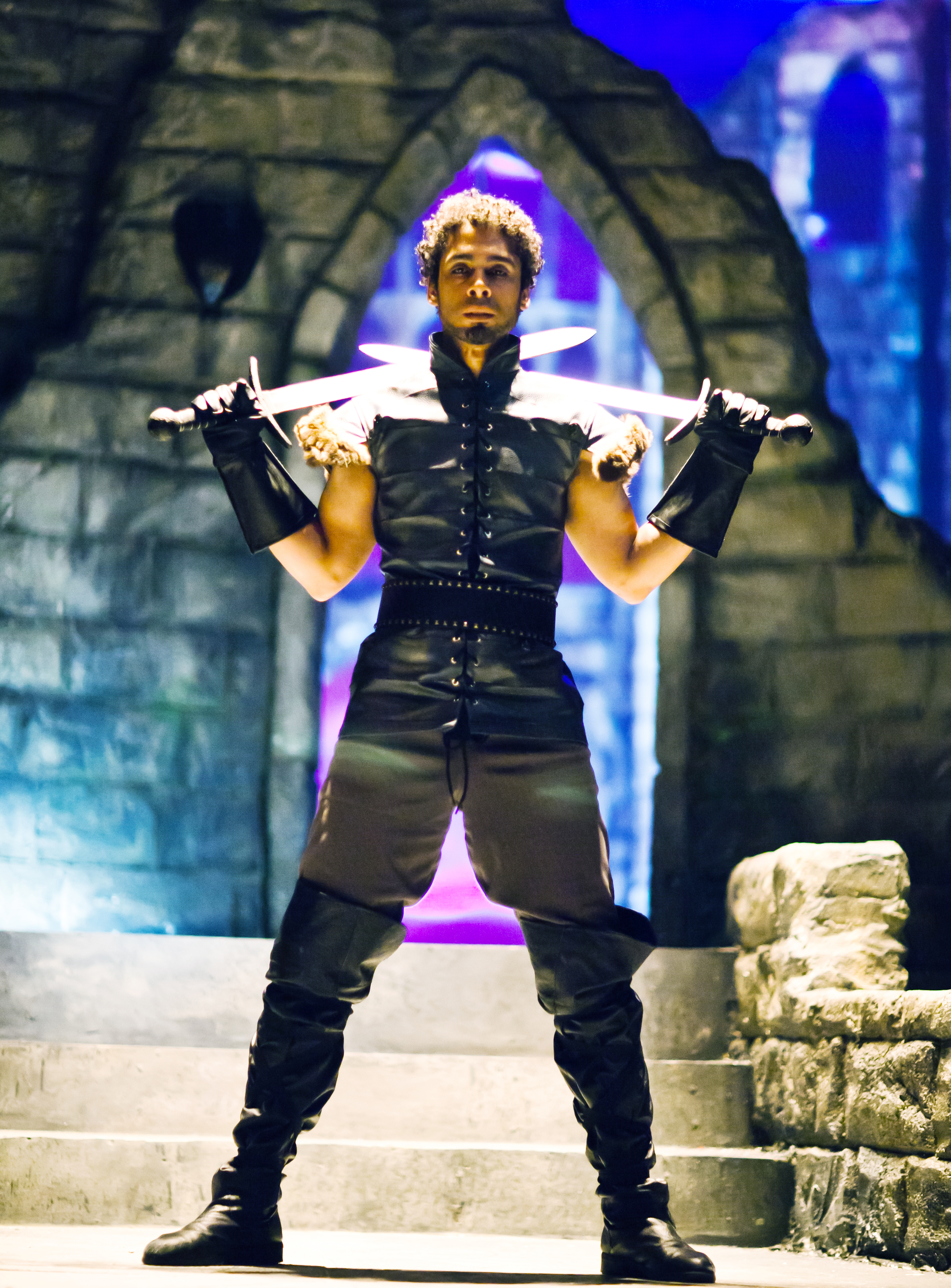
The least often produced Cymbeline and the ubiquitous A Midsummer Night’s Dream are gracing the outdoor Elizabethan Stage/Allen Pavilion and King Lear in the intimate theatre-in-the round Thomas Theatre (formerly the New Theatre). This year the evening performances begin at 8 rather than 8:30 p.m. which is a wise decision since many of the shows run three hours or more with King Lear ringing in at three hours and 15 minutes with two intermissions. Cymbeline takes second honors at three hours and 10 minutes with one intermission. The third play for the outdoor Elizabethan Stage is the U.S. Premiere The Heart of Robin Hood by David Farr an import from the Royal Vic of London that stole the hearts of the opening night audience. Most of the OSF plays receive standing ovations (whether they deserve them or not) but this one was the most spontaneous and deserved. It is ingeniously directed by Joel Sass who is no stranger to the Cal Shakes and the Bay area. Another familiar director is Amanda Dehnert who staged The Verona Project at the Bruns Amphitheatre also for Cal Shakes. Dehnert gets the brass ring for her imaginative, brilliant staging of Lerner and Loewe’s My Fair Lady. These last two mentioned plays alone are worth a visit to Ashland.

Another change for this year’s Elizabethan Stage is a “uni-set” used for all three productions. There probably is a cost savings but at a press conference the explanation was that Cymbeline, Dream and Robin Hood all have sylvan settings within their plots thus the unity of the set designs was appropriate. Sounds reasonable.

The final Shakespearean play is The Taming of the Shrew receiving a riotous rendition with the action taking place on an Atlantic City type board walk with a three piece onstage band. This production is part of Shakespeare for a New Generation, a national theatre initiative sponsored by the National Endowment for the Arts in cooperation with Arts Midwest. Its purpose is to attract younge audiences. This Taming of the Shrew will most certainly do that. It starts and ends with a hip-hop style dance with the amplified guitar, bass and drums bringing cheers.

The final two plays seen in this five day visit are Tennessee Williams’ popular A Streetcar Named Desire and the World Premiere of The Unfortunates. Whereas Desire is well worth, with a few caveats about the staging, since Kate Mulligan as Blanche gives a Tony Award type performance. The Unfortunates commissioned by OSF with book, music, lyrics by 3 Blind Mice (Jon Beavers, Ian Merrigan, RamizMonsef and Casey Hurt, with additional material by Kristoffer Diaz) is an unfortunate experience. It was put together by a committee and it looks it. It is dressed in grunge, the music fluctuates between Hip-Hop, blues, jazz and Gospel without rhyme or reason and the convoluted inanely excessive story line is difficult to follow.

SHAKESPEARE’S PLAYS:

Thomas Theatre.

KING LEAR by William Shakespeare (2/21- 11/3) Directed by Bill Rauch. Scenic design by Christopher Acebo. Costume design Linda Roethke.

Lightening design by Christopher Akerlind. Music and Sound Andre J. Pluess.

King Lear (Michael Winters) awaits answers to his question–a question that ultimately undoes him. Photo by Jenny Graham

The interpretations/analyses of King Lear are multitudinous. Director Bill Rauch waxed eloquent in the program notes “. . . of this masterpiece. As deep as the Mariana Trench, as high as Mt. Everest, as vast as the star-filled sky? You bet.” Taking this as his gospel one might be engulfed in the magnitude of his dark and powerful staging on the intimate theatre in the round Thomas Stage. You are part of the action yet you may withdraw with revulsion at the violence of man’s inhumanity to man and the thought that individual characters must virtually and actually be blinded in order to “see” clearly.

If you accept Rauch’s premise, and it is very reasonable, why after a precisely staged and acted first scene does he have the technical crew wheel a massive basketball backboard onto the acting area having Edmund (Raffi Barsoumian) enter dribbling a basketball and shooting hoops? After much thought Rauch may to suggesting that it is all a game to Edmund and that game will turn deadly. OK, that’s almost acceptable.

Michael Winters, who was a brilliant Prospero at CalShakes, will alternate in the role of Lear with former ACT favorite Jack Willis. Winters played the role in the production we saw. He gave a commanding and dominating performance ably supported by Vilma Silva (Goneril), Robin Goodrin Nordli (Regan), Richard Elmore (Earl of Gloucester) and Sofia Jean Gomez (Cordelia).

The technical effects, that sometime overpower the acting, are at times massive (an eight foot high metal gate and fence stretching diagonally across the floor), a staircase extending to the rafters,  appalling (Gloucester’s eyes being put out) and clever (four flashlights illuminating Lear’s face as he goes mad in the storm scene). The elevator conveniently lifting a portion of center stage with props gets extended use.   Suggestion: Reservedly recommend.


Petruchio (Ted Deasy) and Kate (Nell Geisslinger) affirm their love for one another as Bianca (Royer Bockus) looks on. Photo by Jenny Graham.

Angus Bowmer Theatre:

THE TAMING OF THE SHREW (2/15-11/3) by William Shakespeare. Director  David Ivers. Scenic Design    Joe Winiarski. Costume Design Meg Neville. Lighting Design Jaymi Lee Smith. Video/Projection Kristin Eflert. Music/SoundPaul James Prendergast.

In this age of political and social correctness The Taming of the Shrew becomes a problematic play as differentiated from Shakespeare’s problem plays. It is problematic because it treats women as chattel and has a misogynistic streak.  Fear not, David Ivers’ ingenious, hilarious staging is a joyful affair that will leave you laughing and is one of the must see productions at OSF.

You all know the story of rich Master Batista (Robert Vincent Frank) with two marriageable daughters. Elder shrewish Kate (Nell Geisslinger) and younger adorable beauty Bianca (Royer Backus) is being pursued by Gremio (David Kelly) and Hortensio (Jeremy Peter Johnson).  Alas along come Lucento (Wayne T. Carr) and his servant Tranio (John Tufts). They switch costumes in a screwball plot to get close to Bianca. But alas, no one gets Bianca until Kate is married off.  From Verona improvised Petruchio (Ted Deasy) with his servant Grumio (Tasso Feldman) come to Padua (A cue from Kiss Me Kate: “I’ve come to wed in wealthy in Padua”) and the fun begins.

Director David Ivers has set the action on an Atlantic City type boardwalk complete with neon everywhere and plentiful projections. A huge “Batista” sign blazes above his meat emporium that appropriately sputters when certain actions occur . Did I mention the three piece rock-a-billy band underneath that sign? Yep, they are there and with amplified sound accompany the denizens of the town in a hip-hop dance to start and end the evening.

The action is non-stop, the costumes garishly glorious, the acting spot on and funnier then hell. David Kelly as Gremio in robin-egg blue shorts is a hoot-and-a-holler stealing laughs from all. Deasy and Geisslinger are a perfect match and when the two newly married go off for their life together there is no doubt that Kate will win the day. Suggestion: Not to be missed.

Elizabethan Stage/ Allen Pavillion

The Queen (Robin Goodrin Nordli) gives a show of support to Imogen (Dawn-Lyen Gardner) and Posthumus (Daniel José Molina). Photo by Jenny Graham.

CYMBELINE (6/4-10/11) by William Shakespeare. Director Bill Rauch. Scenic Design Michael Ganio. Costume Design Ana Kuzmanic. Lighting Design David Weiner. Music/Sound Paul James Prendergast. Choreographer Jessica Wallenfels.

Bill Rauch’s directorial abilities are legion. His versatility and imagination are on display (again) with his mounting of Cymbeline. Consider that he has converted and made sense of Shakespeare’s convoluted plot that takes place in England, Wales and Rome. It is often played as a dark tragedy but Rauch visualizes it as a romantic comedy with eventual happiness abounding while death liters the stage. It works to perfection. All this includes a kidnapping of King Cymbeline’s (Howie Seago) two sons that took place 20 years ago by a trusted friend Belarius (Jeffery King). Then there is the King’s beautiful, beautiful daughter Imogen (Dawn-Lyen Gardner) who is in love with orphaned Posthumus (Daniel Jose Molina). Alas, a mean Queen (Robin Goodrin Nordli), step-mother to Imogen has a nasty son Clothen (Al Espinosa) that she is grooming to be King and therefore must marry Imogen. The queen puts out a contract on Posthumus who flees to Italy.

In Italy, not to bright love smitten Posthumus meets and makes a stupid bet with egocentric lothario Iachimo (Kenajuan Bentley) who travels to London to attempt a dastardly deed on Imogen. England is still under Roman rule and a sub-plot brings a Roman General (Jack Willis) to England to collect tributes that Cymbeline will not pay. That leads to Shakespeare’s obligatory fight scenes (Fight director U. Jonathan Toppo). You know that Shakespeare is fond of girls disguising themselves as boys, so Imogen gets do that as she heads off to Wales now named Fidele.

Back in Wales we meet Belarius and the rowdy/royal (but loyal) sons Guiderius (Raffi Barsoumian) and Ariviragus (Ray Fisher) and they get to ‘adopt’ Fidele as a brother. A magic potion enters into the plot, Posthumus shows up (don’t ask), confusion eventual reigns, the bad guys die off, the good guys win the day, lovers unite and peace between Rome and England is resumed. A pair of ghosts flit on and off the stage and add little to the evening, even though they are written into the script

Suggestion: A must see show.

A MIDSUMMER NIGHT’S DREAM (6/6-10/13) by William Shakespeare. Director Christopher Liam Moore. Scenic Design Michael Ganio. Costume

Puck (Gina Daniels) advises one of the Fairies as Oberon (Ted Deasy) and Titania (Terri McMahon) vow their love. Photo by T. Charles Erickson.

Design Clint Ramos.  Lighting Design David Weiner. Music/Sound Sarah Pickett. Choreographer Jessica Wallenfels.

What a difference five years makes in the production of A Midsummer Night’s Dream.  In 2008 the show was directed by Mark Rucker and it was a fiasco to this reviewer and to OSF audiences. It was a raucous, rock music infused and garishly lighted production with the woodland fairies as high-heeled drag queens straight from a San Francisco Folsom Street Fair. Happily Liam Moore who is the adoptive parent of two pre-teen boys asked them, and other youngsters, their opinions of what fairies looked like. They all agreed they should wings.

Moore has helmed a marvelous cast of youngsters and adults (with wings of course) to play the fairies and surrounded them with charming mortals but maybe “What fools these mortals be.” This is a gentle modern dress version that begins at the graduation within a Catholic Boarding School in Athens. A Catholic priest replaces Duke of Athens Theseus (Richard Howard) and Mother Superior replaces Hippolyta (Judith-Marie Bergan). They are to be married in four days.

When Egeus (Robert Vincent Frank ) complains that his daughter Hermia (Tanya Thai McBride ) is messing around with Lysander (Joe Wegner ) but is  promised to Demetrius (Wayne T. Carr ), she is offered an ‘or else’. Or else what? Or else be sent off to a nunnery and remain a virgin forever and ever. That’s not for Hermia so she runs off into the forest with Lysander. But wait, Helena (Christiana Clark ) is in love with Demetrius but he not with her. They end up in the forest in hot pursuit.

But then there are the rag-tag group of would be thespians, that includes egotistical Nick Bottom (Brent Hinkley), who are to perform the  Pyramus and Thisbe interlude at the wedding four days hence. Off to the woods they go to rehearse by moonlight. There is a charming scene of that moon rising in various increments to dominate upstage right and is reversed as the evening ends.

King of the fairies Oberon (Ted Deasy) is upset with his queen Titania (Terri McMahon) and concocts a fairy dust to make her fall in love with the first person she sees on awakening. This fairy dust will also be used on our runaway lover(s). More complications: Puck (Gina Daniels) has turned Bottom into an ass and he is the first person Titania sees. . . love blossoms. Puck also puts the dust into Lysander’s eyes and the first person he sees is Helena.

From here on in the acting is an over-the-top romp with marvelous visual effects, a bit of slapstick and the little fairies (Peaseblossom, Cobweb, Mustardseed and Moth) running around looking very cute. The greatest humor is provided by the acting troupe. Although Brent Bently has the most inane action and many of the laughs, Francis Flute playing Thisbe in drag and unbelievable costumes is hysterical. Not to be out done is

(L-R) Thisbe (Francis Flute) The Moon (K.T. Vogt) Pyramus (Brent Bently) perform the Interlude before the wedding guests.

marvelous K. T. Vogt playing the wall in the interlude. Director Moore wisely extends the slapstick of the acting troupe since they set the audience in a fit of laughter.Suggestions: Highly recommended and bring the kids. The coupling of Bottom the ass and Titania is very discrete.

Kedar K. Adour, MD

Courtesy of www.theatreworldinternetmagazine.com


BRIGHTON FRINGE REVIEWED

By Joe Cillo

NEWS FROM THE BRIGHTON FRINGE

SHORT COMMENTARY ON WHAT IS HAPPENING ON THE OTHER SIDE OF THE POND

I had the unexpected pleasure of stumbling on BITCH BOXER  written and performed by Charlotte Josephine.  I am not a sports fan and I particularly abhor boxing, yet this play with its fast moving dialogue, exquisite direction by Bryony  Shanahan and truly brilliant lighting effects by Seth Rook Williams captivated me from the moment Josephine stepped on the stage and brought tears to my eyes as I relived a young girl’s torment,  torn by her own determination to validate herself in her fathers eyes.   This is a play that must be seen because words cannot cast its spell.  I takes place in 2012 when women entered  the Olympic boxing ring for the first time.  We see Chloe training to compete in the event even as she is torn by cosmic events in her own life.  Through it all, we see her hanging on to a tattered faith in herself and reaching for a star she knows belongs to her.  It is Josephine’s performance that makes this production stellar.  She is an artist in every sense of that word and beyond

BITCH BOXER returns to the Marlborough Theatre May 25,26,& 27 7:30 pm

www.brightonfringe.org; 01273 917272

———————————————————————————-

THE SPEIGEL TENT IS THE PLACE TO BE ……

LA CLIQUE  happens every night but MOnday at 9 pm and iach performance is unique.  You will see Scotty the Blue Bunny charming you with is wagging little tail and marvelous repartee;  Shay Horay amaze you with rubber bands, Lilikoi Kaos spinning hula hoops in ways you cannot imagine and the Wau Wau Sisters doing a trapeze act that defies gravity.  The show is spellbinding from start to finish and for me a huge highlight is Paul Zenon’s combination of magic and comedy.  This is an hour and a half of superb entertainment…fun, exhilarating and spirit lifting.


My favorite performers ever are and have always been MIKLEANGELO AND THE BLACK SEA GENTLEMEN.   They perform at 5 pm in the tent from the 13-19 and are an experience not to be missed “These are performers at the top of their game,” says The Scotsman;  The Sydney Morning Herald says “They are not so much a band as a dream you cannot wake from.”


The show combines musical theatre and black humor in unexpected ways.  You will never see its like anywhere in the world. Mikelangelo has composed and arranged songs that blend Balkan melodies and European Kabaret with comedy and farce.  The Gentlemen are superb musicians and each has his own comedic sense. Mikelangelo is brilliant on every level as their leader and your host in the production.  When they play AN A MINOR DAY you laugh and yet you know just what they mean…and I defy you not to nod your head at the black humor in A FORMIDABLE MARINADE.  You will chuckle; you will dance and you will love every minute you spend with MIKELANGELO AND THE BLACK SEA GENTLEMEN.  That is a promise.  Tickets 01273 917272  www.brightonfringe.com.


THE BIG BITE-SIZE BREAKFAST: Fresh Fruit *****

This is a series of award winning one-minute plays delightfully presented with coffee and a croissant included in the 12.50/9.50 ticket.  Fresh Fruit is a collection of 5 vignettes directed and produced by Nick Brice/Sam Holland and Sophia Wylie.  Each play in this series gives us a new take on what it is to be human, mixing pathos with humor.  Of special note is Tegen Hitchens whose monologue Thin Air  about a tight rope walker who learns what courage is all about is mesmerizing and unforgettable.  Do not miss this delightful mid day hour. Tickets 01273 917272  www.brightonfringe.com.


THE BIG BITE-SIZE BREAKFAST: Interpretations  *****

It is rare to see a show that has an almost universal appeal.  The audience for this “menu” ranged from a rapt 3 year old to a woman of 80 and everyone there was captivated by the selection of plays that combine comedy with a dose of unvarnished reality.  Of special note was Becky Norris’s monologue VALENTINE’S DAY about a woman who receives a valentine from a most unusual stranger.  Norris’s characterization is multi-faceted and believable, yet laced with dead-pan humor.  Kudos to Nick Brice, Sam Holland and Sophia Wylie for their programming and expert direction.  Once again they have given us a delightful and unforgettable morning. Tickets 01273 917272  www.brightonfringe.com.

ROAD Written by Jim Cartwright and directed by Julian Kerridge *****

This award winning play is as moving today as it was when it was written in 1986.  “Now, 24 years later, as the gap between rich and poor grows ever wider….once again it is the very poorest in society who suffer,” says director Julian Kerridge.  Theater is our best vehicle for social outrage and this gorgeous piece will make you cry, laugh and ponder at what is happening now in our world.  Perfectly paced, beautifully directed and acted by an all-star cast, it is the most important piece of theater I have seen in a very long time. Tickets 01273 917272  www.brightonfringe.com.


THE BIG BITE-SIZE BREAKFAST: Desires.  The Latest Music Bar May 19, 2013 *****

Once again, the audience is beautifully entertained with five ten-minute plays, all  unforgettable because each is a commentary on the human experience.  The  play selection for all three menus (at Theatre Royal and The Latest) is superb.  We are given literary quality, spot-on direction and amazing acting.  These talented performers must switch from one character to another in a repertory of fifteen plays (for all 3 shows) and not one of them loses the narrative flow.  Each menu is well worth seeing both for its social commentary, its quality, humor and pace. Tickets 01273 917272  www.brightonfringe.com.


THE TREASON SHOW *****

This special Festival show is at the Sabai Pavilion at 9pm Tuesday May 21 until Thursday May 25. The very talented cast present fast moving acerbic commentary on the news in song and satire that cannot help but appeal no matter what your level of political interest.  This venue is very large and lacks the intimacy that works so well for the production at The Latest Music Bar, but the skits still get  laughs and leave the audience with unforgettable memories that poke holes in the public image of our all too pompous public officials. Most memorable in this production was Daniel Beales’ impersonation of Angela Merkell singing a parody of My Way.  This show runs monthly. If you missed this one go to www.treasonshow.co.uk for the next edition.


BIG BOYS DON’T DANCE *****

This show is a must see for every age. The music is superb, the dancing is mind boggling and the talent of the two stars amazing.  There is a recognizable and believable story line running though the hour about two brothers about to split up because one is getting married.  However, the show is held together with almost magical rhythm, dialogue and dance. The hour passes in an instant, so memorable are the performances of these two South African actors with unequalled comedic timing and pace.   At The Warren until May 24 at 6 pm  Tickets www.otherplacebrighton.co.uk or 01273 917272  www.brightonfringe.com.


QUA, QUA, QUA !! *****
Prepare yourself for a delightful, interactive experience creating comedy in the Jacques Tati tradition.  This charming hour sweeps the audience into the Tati experience highlighting the tiny absurdities that are life itself.  Chris Cresswell has created this gem of a piece and it is his comedic genius that propels the action.  He is supported by a talented cast who pantomime his words. Marion Deprez is outstanding in her characterizations of the conductor on a train, a frustrated sunbather and just another woman in the rain.    Do not miss this tribute to a moviemaker who saw what being human means.  Cresswell’s presentation is sensitive to every nuance that makes life worthwhile.  Tickets: emporiumbrighton.com.  May 30-June 1 @ 7:30    13.50 pounds


NIGHT AFTER NIGHT *****
Paul Shaw is a consummate actor, a thrill to see on any stage.  His performance in this touching and very wise production is nothing short of stellar.  The story begins in 1958 when homosexuality was considered a mental disease.  A married couple meet for theater and ponder on their future and the baby soon to be born.  Shaw who plays all the characters in Neil Bartlett’s profound script has an understated delivery that makes the dramatization all the more powerful.  His series of characters explore the need to accept who we are and what we have become as a fact of our lives.  The music composed by Nicolas Bloomfield only enhances the poetic rhythms of the monologue.  The tragedy is that this show was only performed May 31 and June first at the Marlborough Theatre and more people lost the opportunity to experience it.


THE WEATHERMAN *****


Kiki Lovechild proves how unnecessary words can be in his charming pantomime of how to amuse yourself in purgatory. His show is beautifully paced and combines movement with sound and lighting that sweeps his audience into a world of fun and fantasy unlimited by earthly notions.  Anything can happen on his stage and does from umbrellas swirling to multicolored lights flashing and unexpected gifts shared by a captivated audience.  Nothing verbal can describe the magic of this production and why should it?  The show is an unforgettable hour that cannot fail to make you laugh and love being alive.  Seen at the Marlborough Theatre May 30-June 1.

JULIAN CADDY SPEAKS ON THE IMPACT OF THE 2013 BRIGHTON FRINGE

This is the second year that Julian Caddy has been at the helm of the Brighton Fringe.  In that time, the number and quality of shows have increased by 60% as have the number of attendees.  The Brighton Fringe is the second largest festival in the UK.  Caddy made these comments after a spectacular performance of THE BIG BITE SIZED BREAKFAST: INTERPRETATIONS (reviewed in this article).  The Big Bite Sized Breakfast series was a group of delightful and very meaningful 10-minute plays, each one giving the audience a new view of our own life experience.  Caddy spoke to us after the show.  “What Bite Sized is doing is basic to what we are about,” he said.  “Over 200,000 come to The Brighton Fringe.  And the shows that come here reflect the values of the society that hosts it.”

The majority of the patrons that attend shows for this festival are from Brighton as opposed to The Edinburgh Festival Fringe where the majority of punters are visitors. Each production lives or dies on what they produce and the audience’s reaction to their work.  “That is why we should make more of what we have here, now,” Caddy said.  “The Fringe should continue to support the arts by giving vibrant offerings throughout the year.  That is my ambition.”

Nick Brice produced the Bite Sized Breakfast show.  “Showing people the choices they have gives them the power to make change happen,” he said.

Brice pointed out the parallel between theatre and business.  He creates similar productions to businesses to help both employees and employers empathize with one another and learn how to actually understand what the other person is thinking.  His goal is to show people how to do business in a different way through theater. “Building a brand is making a piece of theatre,” he said.

Theater then is a reflection of life in all its many phases.  Perhaps, this is why experiencing a fringe festival anywhere is so very exhilarating.  Suddenly, the arts take precedence over profit…even over our daily routines.  Instead of going home, eating dinner and watching television, we take in a play, listen to music, laugh at a comedy and experience live entertainment with people of like interests.  All the shows that came to The Brighton Fringe this year were forms of communication and so was the act of attending them.  Theater, be it a play, a dance, a concert…  indeed, in all its forms…. gives us  invaluable tools to keep us human.


Farce takes off in Palo Alto Players’ ‘Boeing Boeing’

By Judy Richter

By Judy Richter

“We’re in for a bumpy ride,” the housekeeper says at the end of Act 1 of “Boeing Boeing,” Marc Camoletti’s hilarious, Tony-winning farce presented by Palo Alto Players. That’s an understatement.

It starts smoothly enough as Bernard (Michael Rhone), an American architect living in Paris, deftly juggles his engagements to three glamorous stewardesses, each working for a different airline.

The key to his success, he smugly says to the visiting Robert (Evan Michael Schumacher), is to make sure that no two or three of them are in town at the same time. It’s all in knowing the timetables, he tells his old school chum.

Then circumstances conspire against him. Between inclement weather and faster jets, schedules change. Soon Bernard, aided by his housekeeper, Berthe (Mary Moore), and Robert, is frantically trying to keep the stewardesses from discovering each other in his flat near the airport.

When Robert first arrives, he comes across as a Wisconsin rube, but as the play continues, he becomes the comic center of the action. He also finds himself attracted to the German woman, Gretchen (Robyn Winslow), and tries to fend off the attentions of Gloria (Damaris Divito), an American; and Gabriella (Nicole Martin), an Italian.

Schumacher’s expressive face and eyes carry much of the play’s comic momentum as Robert reacts to quickly changing circumstances and tries to help Bernard while trying not to succumb to his growing attraction to Gretchen.

Playing Berthe, Moore adds another dimension of comedy to the goings-on as she shifts from deadpan reactions to disbelief to resignation. Both she and Schumacher prove to be masterful comic actors.

Rhone’s Bernard is suave and self-assured until things start to unravel. Then he becomes ever more frantic as he tries to protect his deceptions.

 Divito, Martin and Winslow are all suitably attractive as the stewardesses, but Winslow’s Gretchen can be too strident.

Director Jeanie K. Smith deftly orchestrates all the madcap action with precise timing for every entrance and exit. She also keeps most of the hysteria under control, not an easy task in farce.

A farce would hardly be a farce without many doors. Patrick Klein meets this criterion with seven doors as part of the Mondrian-inspired decor of his set.

Shannon Maxham’s costumes, which feature sexy teddies for the stewardesses, are character-specific and suitable for the year, 1965. However, Robert wears his jacket and vest throughout the show, making him work up a sweat in this physically demanding role.

Running two and a half hours with one intermission, the show is lightweight but highly entertaining, just right for early summer.

“Boeing Boeing” continues at the Lucie Stern Theatre, 1305 Middlefield Road, Palo Alto, through June 30. For tickets and information, call (650) 329-0891 or visit www.paplayers.org.


Pina Bausch: Théâtre de la Ville, Paris

By Jo Tomalin
(above) KONTAKHTOF – PHOTO CREDIT Copyright : Olivier Look

Pina Bausch Tanztheater Wuppertal  KONTAKHTOF
(Photo Credit Copyright : Olivier Look)

Incomparable Pina Bausch Tanztheater at its Best!

Review by Jo Tomalin

Pina Bausch Tanztheater Wuppertal performed Kontakthof, June 11-21 2013, at the Théâtre de la Ville, Paris, France.

The legendary Kontakthof, premiered in 1978 by renowned choreographer Pina Bausch, is set in a dance hall and expresses the range of human emotions between men and women through humor, awkward seductions, tenderness, discomfort and sadness.

Starting with individuals standing close to the audience, a woman in a red cocktail dress checks out her side and front view in the imaginary mirror, a man checks his teeth and adjusts his hair,  someone chases a woman with a fake mouse across the stage…Kontakthof brilliantly explores the phobias of people in public.

A banal set comprises a large gray curtain with a high wall backdrop and several rows of chairs – Scenography and Costume Design by Rolf Borzik. Throughout two hour plus performance the women wear an array of beautifully tailored multicolored satin cocktail dresses and long flowy silk robes, the men wear elegant suits, complemented by lyrical and dramatic music selections by Juan Llossas and Jean Sibelius.

KONTAKHTOF
(Photo Credit Copyright : Olivier Look)

This is dance theatre at its best and there’s plenty of both in Kontakthof performed by this superb company.

Dancers enter and exit playing tricks on each other, dance together or alone, make suggestive gestures and undress – always with a wry smile. A chorus line of impressive dancers dynamically advances towards the audience, couples do discrete and sad yet saucy slow dances, and at times the entire ensemble dances with restrained fluidity with movement dissolving into stillness. Bausch’s choreography surprises us yet also has fascinating repetitive motifs and sequences performed by exceptionally well-trained and tuned in dancers.

Theatre is infused in relationships, dances and clever situations. Disappointment shows in body language of several characters when a child’s mechanical horse ride does not work – until realization that a coin is needed – so they approach audience members for coins. In another short scene actors sit in a row downstage and talk to the audience in their own language (english, german, french, spanish), while a dancer playing the stage manager holds a microphone.  A character walks around with a human size blow up doll getting reactions from onlookers…

These outstanding dancers are sexy, have perfect timing and invest themselves emotionally and believably in play and dance – transcending techniques to produce a piece of exciting visual sensory art that thrills audiences – the norm for this exceptional world-class company.

More information:
Théâtre de la Ville, Paris
Pina Bausch Tanztheater Wuppertal

   Jo Tomalin Reviews: Theatre, Dance and Movement Performances

For Critics World
www.forallevents.com

Jo Tomalin, Ph.D.
More Reviews by Jo Tomalin
TWITTER @JoTomalin

ABIGAIL’S PARTY

By Joe Cillo

Reviewed by Jeffrey R Smith of the San Francisco Bay Area Theatre Critics Circle

The Award Winning San Francisco Playhouse is presently performing the riotous ABIGAIL’S PARTY by Mike Leigh as directed by Amy Glazer.

Susi Damilano, rightfully the first lady of San Francisco stage comedy, marvelously plays Beverly: a diabolical, deranged hostess reminiscent of the Stanford Prison Experiment, Mommie Dearest and Lindsay English.

Half hostess, half Nurse Ratchet, all evil; Beverly is the accidental devil herself; plying her guests, or captives, with alcohol as if it were mineral water, Beverly turns a perfectly wretched, boring party into a disaster and psycho-drama.

Even the audience is held captive because the play is gut-wrenchingly hilarious; insanely funny; but, you might catch yourself asking, “Should I be laughing at this?”

Neither a professional elevator operator, an evil spouse, nor a trained psychologist could ever push buttons as effectively as Beverly; tormenting her guests with gouging remarks which run the spectrum from careless, to tasteless, to tactless to ruthless.

Beverly shepherds her ovine victims into Dante’s stygian depths of tormented revelers.

Even a liter of gin won’t dull the mental anguish inflicted by Madame Beverly.

Ms. Damilano is the closest San Francisco is going to get to having its own Lucille Ball, Carol Burnett or Lily Tomlin; her comedy is nuanced to the rafters, her timing is to the nanosecond and her movements as salacious as they are comic.

Despite a supporting cast of four characters; this is nearly a one woman show; like a dominatrix, Beverly takes charge, rough riding her guests right into the fetid carpet stains.

A great set design by Bill English captures the very essence of chintzy kitsch, glitzy pretense and cheesy misguided intentions: superbly done; it induces a visual queasiness even before the house lights flicker.

If you are looking for a fun evening in San Francisco, then ABIGAIL’S PARTY is your ticket; this is art wrapped in bacon, wrapped in Velveeta, topped with Whip and Chill.

To reserve your night of laughter, surf over to SFPLAYHOUSE.ORG or call 415-677-9596.

Play honors short-lived Gershwin’s lasting musical legacy

By Judy Richter

By Judy Richter

How much more would George Gershwin have accomplished if he hadn’t died of a brain tumor in 1937 at the age of 38?

One asks that question after seeing playwright-performer Hershey Felder’s “George Gershwin Alone” at Berkeley Repertory Theatre’s intimate Thrust Stage.

In this engrossing one-man show, the multi-talented Felder sings, plays piano and spins the fascinating story of one  of America’s greatest, most original composers.

Felder goes into stories behind works like 1924’s “Rhapsody in Blue,” which was inspired in part by the rhythm of a train. He touches upon some aspects of composition such as the change from a minor to a major key in “Swanee,” his early hit song sung by Al Jolson.

He describes some milestones of Gershwin’s life such as his first musical job as a rehearsal pianist for the Ziegfeld Follies at the age of 19.

Dissecting songs like “I Loves You, Porgy” and “Summertime,” he spends quite a bit of time on “”Porgy and Bess,” 1935’s landmark full-length work that was such a departure from musical theater of the time yet not quite like opera. Though highly regarded today, it wasn’t well received by the major critics then.

Gershwin and his older brother, Ira, were close collaborators, with George writing the music and Ira writing the lyrics. Ironically, the last song that George wrote was “Love Is Here to Stay,” with Ira writing the lyrics after George’s death.

Directed by Joel Zwick, Felder presents all of this information in a highly entertaining fashion. He plays the Steinway grand piano well and sings in a pleasant baritone.

One highlight of this show comes when Felder reverently displays the original annotated score for “Porgy.” On a more dissonant note, he recites a diatribe against Jewish musicians, especially Gershwin, in a publication backed by Henry Ford.

Although the show itself runs about 90 minutes without intermission, it goes on for another half-hour as Felder chats with the audience, leads singalongs and, at opening night, invites a man in the audience to imitate Ethel Merman singing “I Got Rhythm.” Also at opening night he introduced Mike Strunsky ofS an Francisco, Ira’s nephew and the trustee and executor of Ira’s musical estate.

Felder, who also has created shows about Beethoven, Chopin and Bernstein, premiered “George Gershwin Alone” in 2000. He said that this run, a scant two weeks, might be its last. It’s not to be missed.

It runs through June 23 in Berkeley Repertory Theatre’s Thrust Stage, 2025 Addison St., Berkeley. For tickets and information, call (510) 647-2949 or go to www.berkeleyrep.org.


Son works through grief in ‘Wild With Happy’

By Judy Richter

By Judy  Richter

Not everyone deals with grief in the same way. Take Gil, for example.

In Colman Domingo’s “Wild With Happy” Gil is a black, gay, 40-ish actor in New York who returns to his hometown of Philadelphi aafter his mother’s death.

Short of money and somewhat paralyzed by grief, he opts for cremation rather than a traditional funeral — much to his aunt’s distress. What happens eventually is a road trip to Disney World.

What happens in the meantime is laugh after laugh as Gil, played by the playwright, deals with his maternal Aunt Glo (Sharon Washington). He also has memories of phone calls from his mother,Adelaide (also played byWashington).

He’s attracted to Terry (Richard Prioleau), the funeral director, and gets moral support of sorts from his flamboyant young friend Mo (Duane Boutté) in this West Coast premiere by TheatreWorks.

As Mo and Gil head for Disney World with Adelaide’s ashes, Terry and Glo follow them. Disney World is where Adelaide was happiest during a visit with Gil. In the end, it’s where Gil and the others find some resolution.

Washington’s performance as Adelaid eand Aunt Glo goes a long way in making the play so hilarious. Some of  Terry’s and Mo’s actions can seem a bit outrageous, too. Often Gil reacts with incredulity, as if he can’t believe or doesn’t want to accept what he’s seeing or hearing, thereby ignoring the feelings of others, especially his mother and aunt.

Director Danny Scheie stresses the play’s comedic and campy aspects, sometimes at the cost of its more serious aspects. Hence, the play and Domingo’s reactions as Gil might come across as superficial in spots.

There’s no denying how funny it is, though, especially in the motor-mouth speeches byAdelaide and Aunt Glo. Adelaide seems adept at laying guilt trips, some well deserved, on Gil, while Aunt Glo spouts some choice malapropisms and mixed metaphors.

Despite the similarities between the sisters, Washington clearly delineates between them. However, Aunt Glo frequently takes what appear to be prescription pills, which aren’t explained except once when she mentions high blood pressure. Otherwise, she seems to pop pills like candy.

Erik Flatmo designed a set with a proscenium, red velvet curtains and footlights. Some scenes take place in front of the curtains, allowing for seamless set changes in this 95-minute, intermissionless work. The lighting and media are designed by David Lee Cuthbert with costumes by Brandin Barón and sound by Brendan Aanes.

“Wild With Happy” audiences are in for a wild ride on the way to a touching conclusion.

It continues at the Mountain View Center for the Performing Arts, 500 Castro St., Mountain View, through June 30. For tickets and information, call (650) 463-1960 or visit www.theatreworks.org.

GEORGE GERSHWIN ALONE a pleasant evening but no brass ring at Berkeley Rep.

By Kedar K. Adour

Hershey Gelder on the set for GEORGE GERSHWIN ALONE on Berkeley Rep’s thrust stage playing until  June 23,2013

GEORGE GERSHWIN ALONE: Music and lyrics by George Gershwin and Ira Gershwin. Book by Hershey Felder, with Hershey Felder as George Gershwin.  Directed by Joel Zwick. Berkeley Repertory Theatre’s Thrust Stage, 2025 Addison St., Berkeley. (510) 647-2949. www.berkeleyrep.org  june 8–23, 2013

GEORGE GERSHWIN ALONE a pleasant evening but no brass ring at Berkeley Rep.

George and Ira Gershwin provided Broadway and Hollywood with a plethora of lyrics and music that thrilled audiences at the time they were written and are still doing so today. They wrote more than 1000 popular songs together and if asked the question of what came first, the music or the lyrics, Ira would insist that they were intrinsically created as one. This is what Hershey Felder playing George Gershwin tells us early on in his 90 minutes upon the stage as he takes on the mantle and persona of George Gershwin and occasionally lectures to us.

Felder who is an accomplished pianist and adequate singer wrote the show after doing extensive research perusing original manuscripts, personal letters, interviewing family and biographers and, of course, listening to audio recordings. The results are very apparent as we learn about the short life of George Gershwin and listen to his music played on the center stage grand piano, sung by the performer and often in recorded music.  George and Ira wrote over 1000 popular songs and George, who wished to be known as a serious composer alone created “Rhapsody in Blue”, “An American in Paris” and “Porgy and Bess.”

Felder has been playing Gershwin for over 10 years and his polished delivery never misses a beat from his narrative, singing or piano playing. His first big hit was “Swanee” that was picked up and made famous by Al Jolson. Felder’s mimicry of  Jolson’s singing and the similarity of Ethyl Merman’s singing brought the most laughter of the evening.

There is not much laughter during the evening since Gershwin’s life is not the stuff that dreams are made of since he died at age 38 of a brain tumor. Early in his career he was financially successful enough to buy a 5 story Brown Stone house in New York City where his entire family lived. This period in the story telling of the relationship between his diminutive father and large dominating Russian-Jewish mother and his fathers deep love was both funny and touching.

Where acclaim and financial success were the end result of their popular music, George’s foray into the semi-classical genre with “Rhapsody in Blue”, “American in Paris” and opera with Porgy and Bess was devastating to his ego when they were panned by the critics.  In time his genius was recognized but critical failure of Porgy and Bess also was a financial one and the brothers went off to Hollywood to write for the movies. Alas, the moguls there wanted songs that could be whistled like “those of Irving Berlin.”

Into this biographic story telling Gelder liberally introduces such memorable songs as “I Got Rhythm”, “Summertime”,“They Can’t Take That Away from Me”,  “Fascinating Rhythm”, “But Not for Me”, “S’Wonderful” and more.  To end the evening he plays the entire score of “Rhapsody in Blue” with appreciated energy. Although he received a standing ovation, for this reviewer and companion it was a pleasant evening but did not grab the brass ring.

Kedar K. Adour, MD

Courtesy of www.theatreworldinternetmagazine.com

Wild with Happy at TheatreWorks a hysterical bittersweet ride.

By Kedar K. Adour

Gil (Colman Domingo) and Mo (Duane Boutté) embark on a wild road trip in WILD WITH HAPPY,receiving its West Coast Premiere June 5 – 30 at TheatreWorks at the Mountain View Center for the Performing Arts. Photo credit: Mark Kitaoka

WILD WITH HAPPY: Comedy by Colman Domingo and directed by Danny Scheie. TheatreWorks at Mountain View Center for the Performing Arts, 500 Castro Street, Mountain View.  (650) 463-1960 or visit www.theatreworks.org.Through June 30, 2013.

Wild with Happy at TheatreWorks a hysterical bittersweet ride.

The meaning of the title of Colman Domingo’s smash hit that is gracing TheatreWorks stage in Mountain View does not become known until the penultimate scene of his 90 minute opus. From the opening song “Get Happy” (Forget your troubles, come on get happy. Get Ready for the Judgment Day) played before the curtain rises to the final fireworks a cast of four playing multiple roles will take you on a ride to end all rides. Since the play is sort of a gay fairy tale, in more ways than one, be assured that it will have a happy ending . . . well sort of.

The play is non linear with characters breaking the fourth wall for explanations and smoothly moving from the past into the present time frame with nary missing a beat. Our hero Gil (Colman Domingo) returns from New York to Philadelphia to make arrangements for his mother’s funeral. But there are problems both emotional and financial.  He is afraid of church. Flash back: He is 10 years old and his Mother Adelaide (Sharon Washington) has dragged him into a Black Church revival ceremony to end all ceremonies and  after an unnamed singer (Duane Boutte) belts out a gospel that drives the congregation mad including Adelaide who goes into a frightening swoon.

Gil, with feelings of guilt up to his expressive eyeballs ends up at the Four Seasons Funeral home where you “always check in but never check out.” Gil meets Terry (Richard Prioleau), fourth generation owner of the establishment. Sparks fly, physical humor abounds, the unexpected happens. Gil loses a shoe after he “bonds” with Terry, and Mother Adelaide is cremated.

Enter our protagonist, Gil’s Aunt Glo (Sharon Washington) who expresses in no uncertain terms that Black people don’t do cremation and her description of what should be done and how it should be done is a lesson in class culture with humor and sincerity abounding. “You only do cremation when you’re too fat to fit into the coffin!” “We’ve got tradition going back to Lucy.” Aunt Glo may be into tradition but she is not above emptying the departed Adelaide’s clothes closet in a scene that is hilarious and reminiscent of Zorba the Greek. Later she accepts modern technology taught to her by Mexicans (really?).

Along comes Mo (Duane Boutte), Gil’s best friend and former lover to take Gil and Adelaide’s ashes where she was most happy. Not only where she was most happy but ‘wild with happy.” You will have to see the show to find out where that is.

Thus begins the wild ride in beautiful cutout cars (Sets by the Eric Flatmo) with TV projections of Gil, Mo and the cremation urn in the robin-egg blue convertible Zip Car being chased by Glo and Mo in a brown sedan using the Mexican installed GPS chip in a Cinderella doll. Remember that fact and a previous fact above. They will give you hints to the climactic ending.

Aunt Glo (Sharon Washington) and Gil (Colman Domingo)

Sharon Washington as Aunt Glo is a whirlwind of action, actually verbal action, which is astounding as she shifts adroitly between her two roles. Coleman Domingo almost matches Washington’s performance, after all he did write the script. Director Danny Sheie splashes on some shtick giving Duane Boutte the opportunity to be overly gay and emote. This includes a scene of being chased up and down the aisles and ending up twirling a baton.  Understandably handsome Richard Prioleau as Terry is attractive to Gil. Think the Prince and Cinderella.

All is not comedy and Domingo has inserted a few scenes, including the surprising ending that adds the needed pathos. So, forget your troubles, come on get happy and head down to TheatreWorks for this 90 minute evening of fun without intermission.

Kedar K. Adour, MD

Courtesy of www.theatreworldinternetmagazine.com


The Dark Room by Rachel Seiffert — Book Review Discussion

By Joe Cillo

The Dark Room, a novel

By Rachel Seiffert.  New York: Vintage International/Random House.  2001. pp. 278.


I used to be a darkroom photographer, and have spent many hours processing photographs with film and paper and chemicals struggling to get a print just exactly right in a darkroom under safe lights.  So I could relate very well to the opening vignette in this triptych novel set in Germany from the 1920s until the end of the twentieth century. 

The book is actually three independent novellas, the first of which, called Helmut,  is the story of a boy growing up in Berlin during the Nazi era.  It is the shortest of the three and my favorite.  The character, Helmut, is the most appealing person in the book and his observations of life in Berlin and his development as a photographer had special resonance for me.  The last novella, Micha, is the crux of the book and the motivation and impetus for writing it, I think.  However, I find this novella the least appealing, although it offers the most in substantive issues that will dominate the discussion presented here.

In each novella photography makes an appearance, and Seiffert seems to have intimate knowledge of photography and processing photos in a darkroom.  The title of the book, The Dark Room, ostensibly refers to Helmut’s use of the darkroom for processing his photographs.  Apart from that there is nothing else that relates to the title and by the end of the book, one is left wondering what the title of the book has to do with the content, because the darkroom is not central to the story line or to the larger issues raised by the book.

Reading Helmut, I could feel that the story was written by a woman.  Although the protagonist is a man, a handicapped man in fact, he has the sensibility and temperament of a woman.  He cries way too much for a man.  This is true of all the men throughout this book, with the exception of Kolesnik in the last segment, Micha.  They all seem like women in men’s bodies.  They are always crying over one thing or another, confused, and ambivalent, unsure of themselves, indecisive.  This is particularly so in the case of Micha.  He is the most feminine and most conflicted of all the male characters in the book, and I think the one closest to Seiffert’s own voice and perspective.  Helmut’s story is told in a tone of detachment, it has a surreal quality that makes it very interesting.  Helmut is absorbed within himself, seems almost oblivious to the political ferment going on around him.  He seems to go about his daily business unconscious of the momentous changes happening in German society under the Nazis.  For example, there is a description of his rising one morning and finding broken glass on the sidewalk.  There is no explanation or analysis of where the broken glass came from, but the implication is that it was the result of Nazi gangs smashing the windows of shopkeepers who were either Jewish or anti-Nazi.  Helmut simply sweeps it up apparently without reflection or reaction.

He has a preoccupation from childhood with watching the comings and goings of trains at the Berlin Bahnhof.  During the war years his observations reveal that Berlin is slowly being depopulated, and he carefully documents this development on a daily basis.  But he does not question it.  He does not ask himself why this is happening.  He does not seem to reflect on his acute observations.  He is observationally engaged, but emotionally detached.  He seems to have only minimal sexual interest for an adolescent boy.  Helmut finds some pictures of nude women in a stash of magazines kept hidden away by his employer, Gladigau.  “At night he conjures the images against his bedroom ceiling as the long, slow freight trains clatter below, a soothing rhythm of sleep.” (p.12)  That’s all the sex he gets in the first twenty-four years of his life.

The middle of the three segments centers around a young girl named Lore.  Her age is not given, but one surmises her approximate age must be twelve to fourteen at most.   She has a younger sister Liesel, who is probably eight to ten, two twin brothers who must be six or seven, and an infant brother, Peter, who is a babe in arms.  The story takes place at the end of the war and their mother, who appears to have been a Nazi operative of some sort, is being taken into detention by the invading Americans.  She instructs Lore to take the children on a trek from southern Germany to their grandmother’s residence in Hamburg far to the north, and gives her money and jewelry for the trip.  The mother then disappears and the story becomes the adventurous trek of this small troop of children making their way the length of Germany to Hamburg, largely on foot, during the chaos and uncertainty of the aftermath of the war.  A rather unlikely and unhopeful scenario, I think, but Sieffert’s sensitive writing style and attention to detail make one want to believe it.  Along the way they pick up an additional companion, an older boy named Tomas, who at first appears to be Jew who has been released from a concentration camp by the Americans.  Later it seems that he may have been a soldier or a prison guard who stole the identity of a dead Jew to escape detection by the Americans (pp. 150-52).  Tomas befriends the young group and proves himself vital to their success in completing the journey.

The story is a succession of perils and hardship which the children negotiate with a combination of resourcefulness and luck.  It gets a little repetitive after a while, but there is enough richness and variety to keep it from dragging.  Seiffert is a good story teller with a vivid imagination for detail that keeps her narrative alive and moving.

There is almost no mention of sex or sexual interest in this whole book, which is remarkable in a book featuring adolescents.  The only glimpse we have of any sexual experience in Lore is a negative one.

Lore is awakened by noises in the dark.  English male voices, whispering.  German female, coaxing.  Shifting rubble, no more talking, only breathing.

Lore knows Tomas is awake, too.  She is uncomfortable under the blankets, shifts back against the cold grit of the bricks behind her.  She doesn’t want to hear what they are doing under the ruined walls.  She counts the beams on the floor above her to block it out, but her mind keeps forming pictures.  Liesel turns over next to her.  Lore fights the urge to cover her sister’s ears.

There is whispering, and after that, walking.

Lore wakes again later to more noise: stifled breath and sobs.  She battles her straining ears, wills herself to sleep again.  The sounds are closer, muffled by blankets, not rubble walls.  Lore allows herself to listen to the dark around her.  Tomas cries with his jacket over his face, arms wrapped over the top to keep the sound inside.  He pulls in gasps of air, body a heaving shadow against the opposite wall.  Lore doesn’t want to see it or hear it.  She would cry, only his tears have taken over.  She lies, awake and furious, until daylight seeps through the cracks in the brickwork over her face. (p. 133-34)

What a prude she is!  This doesn’t sound like the sensibility of a very young, presumably inexperienced, girl.  I would expect more curiosity and receptiveness in a girl of that age.  To me this seems like the very unattractive attitude of an older woman, who has been conditioned to shut out and devalue sexual experience and react to it in a negative way.  It is rather un-German, I think.  That’s the juiciest part of this book.  A very negative, sanitized presentation of young people coming of age.

On the cover of the book an anonymous critic from the Philadelphia Inquirer is quoted who calls the book a novel about the German soul in the twentieth century.  I fear many people will be misled by this.  This novel doesn’t come anywhere close to being about the German soul.  It purports to be an exploration of the German soul, it tries to present itself in this way, but this is a novel about an English woman trying to come to terms with her own conflicted feelings about Germans and Germany.

The characters do not seem like Germans.  They have German names and they are set in Germany, but to me they don’t feel like German people.  The male characters do not feel like men, as I mentioned earlier.  In two of the three stories the protagonists are male and in the Lore episode there is a male character, Tomas, who plays a significant role.  The only male character who seems authentically male and authentically German is Kolesnik, in the final segment, Micha, and he is cast as Polish rather than German.

This is a woman writing about a subject and a domain that is quintessentially male, namely, warfare.  There is nothing wrong with a woman offering her perspective on warfare through the medium of a novel.  It can be a valuable and illuminating perspective.  But this novel is disingenuous in that it purports to represent male soul searching and conflict over the nature of war and wartime atrocities, when it is in fact a gently aggressive, judgmental, moralistic attack on the brutality and excess of warfare from a very female perspective of naive shock and outrage.  Seiffert’s position amounts to “How could you do such a thing, Grandpa?”  She finds it hard to grasp how men who can shoot young children in cold blood can still love their families and be good citizens.

Micha, more than any other character and more than the other two novellas, represents what Seiffert really wants to get at in this book.  Micha is a German man, probably in his 20s, who, as a hobby, takes up tracing his own family history.  The story is set in 1997, so he is looking back over a century of upheaval, warfare, and social disarray that his forebears had lived through.  This leads to an investigation of his deceased grandfather who was in the Waffen SS stationed in Belarus.

The Waffen SS in Belarus and Poland committed some of the most bestial atrocities of the war.  After the war the German government labeled it a criminal organization.  Their behavior was extreme even by SS standards.  In Poland they were so wantonly rampaging that Heinrich Himmler had to send a battalion of SS police to make sure they did not attack their own commanders and other German units in the vicinity.

Micha became obsessed to find out for sure if his grandfather had participated in any of that, or if he was the teddy bear that he always knew him to be.  After the war, the Russians had kept his grandfather in prison for nine years.  He did not rejoin his family in Germany until 1954.  That ought to serve as a clue.  Micha digs up where his grandfather had been stationed in Belarus and some of the atrocities that had gone on there.  He makes several journeys to Belarus to investigate and after a lengthy negotiation, interviews a Polish man named Kolesnik, who was there and saw what happened and was himself a participant.  Kolesnik essentially stands in for the deceased grandfather, and is the screen against which Seiffert projects the issues that are preoccupying her in the writing of this book.

After page 220, I became disgusted with it, and by page 250, I was raining down the full brunt of my wrath upon it.  It was when Micha was photographing Kolesnik and his wife (p. 254-55) that Seiffert tipped her hand and I saw her for what she is.  Elena (Kolesnik’s wife) wants to take a photograph of Kolesnik and Micha together, but Micha refuses to be photographed with Kolesnik.  Why did he refuse to be photographed with this man with whom he had established a relationship of trust and who had been sharing intimate confidences of an utmost personal nature over several months?  Why would he not want to participate in a permanent commemoration of the relationship?  The photograph would represent a personal bond and an acknowledgment of this personal quest that Micha had embarked upon.  The refusal indicates a rejection of Kolesnik by Micha as well as a hypocrisy in that he wishes to deny, both to himself and others, the personal connection he had forged with Kolesnik in order to induce him to talk.  This refusal shows that he is not reaching out to Kolesnik from the heart to create a personal bond of trust and mutual understanding, rather he is seducing Kolesnik in order to use him to satisfy his own personal need: when he is finished with him he will discard him.  It is dishonest and disgusting.  I think it is a crucial moment in the novel in that it is not just a further development of the character of Micha, but rather a revelation of Seiffert’s attitude and purpose in writing the story.

Seiffert is still fighting the war and still fighting within herself how to regard Germany and German people, particularly of the World War II generation.  She herself is not a wounded victim.  Her family did not suffer under the Nazis.  This grudge comes from an attitude of moral outrage over the atrocities committed in the war.  She is making it personal by setting it in the context of a family, a German family — at least a German family as she imagines them.  But I think it is a false picture, or at best very atypical.

What is offensive about this book is not so much its point of view, although I take strong exception to it, but that it purports to be something that it isn’t.  As such it will misguide and misinform English speaking readers about German people and German culture.  If even critics like the reviewers for New York Times and the Philadelphia Inquirer are befooled, then what of the general reader?

This book is a fraud, but I will tell you the truth.  I was in Berlin last fall and observed a vibrant, thriving, multicultural city growing rapidly and moving forward into the future with high energy and enthusiasm.  But it is also a city very conscious of its past, much more than any American city I have ever seen.  The contrast between past and present in Berlin is evident in nearly every block.  The weight of the past is visible in the architecture, old and new, the streets, the public art visible all over the city, and in the minds and conversations of the residents.  But it is nothing like the anguish and ambivalence that you see in Seiffert.

Today there is a community of approximately 12,000 Jews living in Berlin.  There are active synagogues, a large, very interesting Jewish Museum, opened in 2001, and a sizeable Memorial to the Murdered Jews of Europe, opened May 2005, just one block south of the Brandenburg Gate.  I was told by a tour guide that it was built on the site of Josef Goebbels residence during the Nazi era, but I was not able to verify this.  This memorial is very controversial in many respects, but the fact that such a substantial memorial, extending over nearly five acres, exists in such a prominent place in the city is evidence of official repudiation of the Nazi policies and attitudes toward Jews and everyone.  That is a firm conviction literally set in stone.  The architect who designed it was an American Jew named Peter Eisenman.  In the following excerpt from an interview with Der Spiegel (May 9, 2005) he comments on the memorial and its psychological meaning and purpose.

Spiegel Online:  Who is the monument for?  Is it for the Jews?

Eisenman:  It’s for the German people.  I don’t think it was ever intended to be for the Jews.  It’s a wonderful expression of the German people to place something in the middle of their city that reminds them — could remind them — of the past.

Spiegel Online:  An expression of guilt, you mean?  Some have criticized the monument by saying it looks like a gigantic cemetery.

Eisenman:  No.  For me it wasn’t about guilt.  When looking at Germans, I have never felt a sense that they are guilty.  I have encountered anti-Semitism in the United States as well.  Clearly the anti-Semitism in Germany in the 1930s went overboard and it is clearly a terribly moment in history.  But how long does one feel guilty?  Can we get over that?

I have always thought that this monument was about trying to get over this question of guilt.  Whenever I come here, I arrive feeling like an American.  But by the time I leave, I feel like a Jew.  And why is that?  Because Germans go out of their way — because I am a Jew — to make me feel good.  And that makes me feel worse.  I can’t deal with it.  Stop making me feel good.  If you are anti-Semitic, fine.  If you don’t like me personally, fine.  But deal with me as an individual, not as a Jew.  I would hope that this memorial, in its absence of guilt-making, is part of the process of getting over that guilt.  You cannot live with guilt.  If Germany did, then the whole country would have to go to an analyst.  I don’t know how else to say it.

The memorial and the behavior of the Germans toward the architect illustrate a decisive repudiation of Nazi-ism within the mainstream German culture.  There is no squeamishness about facing up to the past as represented in The Dark Room.  This memorial in the center of Berlin is vast.  It doesn’t show any indecisiveness or unwillingness to face up to the issue.  At the same time a controversy blew up during the construction of the memorial because of a coating on the stone slabs meant to inhibit the scrawling of graffiti  on them.  It happened that the company that manufactured this coating to preserve the Jewish Memorial from defacement was also the same company that manufactured the gas that was used to poison Jews in the concentration camps.

The product was to have been provided by Degussa, a big German chemical company.

Now it turns out that Degussa once owned Degesch, the firm that produced the Zyklon B used to gas Jews in concentration camps. At first, nobody noticed—or nobody wanted to notice. But then the press discovered the link, reportedly after being tipped off by a Swiss company that had hoped to win the contract until Degussa decided to donate half the material needed.

 After the story broke, the memorial’s board of trustees, after an apparently heated discussion, concluded that using the firm’s product, called Protectosil, would be “unacceptable given the specific nature of the Memorial project”. It advised the construction company to stop using the coating until another product could be found.

Degussa has not, in fact, been one of the companies that shies away from its past. It is an active member in the foundation created by German companies to compensate victims of forced labour. And it has commissioned researchers to look into its history, without having any say over what they publish.

This behavior is by no means exceptional these days. Since the mid-1990s, says Manfred Pohl, a historian and head of corporate cultural affairs at Deutsche Bank, most large German companies have reappraised their history. It is now time, he argues, to forgive them (not the same as forgetting). By excluding Degussa from the Holocaust memorial, an opportunity has been missed to do just that. One could also claim that it is unfair to penalise today’s shareholders or employees of Degussa for the actions of the company in the past.   (The Economist, October 30, 2003)

It is exactly the same issue in play in Seiffert’s novel.  But the Germans do not show the anxiety and confusion and paralysis before the issue that Micha shows.  He does not represent typical German attitudes or behavior.  Germans are quite good about facing up to the issue. They might come to differing conclusions, but they are almost always decisive and surefooted in whatever their direction.  Germans want to get on with it.  That doesn’t mean they want to forget.  They are not deniers.  But the kind of anxious preoccupation shown in Sieffert’s lead character is very un-German in my eyes.

When I was in graduate school, I took several seminars that fell under the umbrella description of “Ethics.”  We studied books by authors such as John Rawls and Robert Nozick.  I was shocked at how naive and simple-minded they were, and the crudeness of the methods whereon these intellectual edifices were constructed.  My professors took it all very seriously, but I had undisguised contempt for what I was being taught.  The professors and the authors of these books believe that there are timeless principles of ethical conduct that are independent of time and circumstance and culture, and that they can be discerned and refined by a process of concocting (usually) hypothetical situations and then testing various alternatives and outcomes against our “intuitions.”  In the case of Robert Nozick it was individual rights, in the case of John Rawls, it was principles of distributive justice.  My professors had great faith in this faculty of moral intuition which they thought was inherent in people and could lead in principle to universal agreement.  Absolute standards of Right and Wrong could be discerned and applied to people and events independent of cultural or historical frames of reference.

For example, Aristotle, and virtually everyone in the ancient world, took slavery for granted and never questioned its legitimacy as an institutionalized social practice.  My professors thought that today, from our vantage point of modern enlightenment, we can judge with finality that Aristotle was wrong and that those ancient societies were unjust with the same surety that we can judge that their calculation of the circumference of the earth was wrong as well as their conception of the causes of disease.  In other words, “ethics” can make “progress,” and our understanding of proper moral conduct can be “improved.”  In fact, human beings can themselves be made better in terms of their moral character should they apply these advances in ethical insight to their daily lives.  By implication, some people can be judged to be morally superior to others with absolute certitude and conviction.  One professor once asserted with fervent conviction the he was a better human being than Adolf Hitler.  I nearly laughed in his face.  This whole project of constructing these “ethical” systems by which human beings could be evaluated and compared seemed to me to be breathtakingly arrogant, naive, and stupid.  Unworthy of serious scholarly consideration.  I couldn’t believe they were teaching this in a university and that they expected me to read this stuff and take it seriously.  They judged me to be devoid of capacity for ethical thinking and unsuitable to even be in graduate school.  We didn’t like each other.

This approach and mindset behind all of these modern formulations of universal human rights and war crimes goes back to Immanuel Kant in the late 18th century, who believed that moral principles must be understood a priori, that is independent of the contingencies of time, circumstance, and experience.  A categorical imperative is one whose validity and applicability is universal, that is, in all circumstances and it is justified as an end in itself — as opposed to being a means toward some greater good.  How one recognizes such imperatives and applies them to practical situations is not easy to grasp, but Kant had great faith in reason and he also believed that we had an innate sense of what was right that was not dependent on experience, that conscience tempered by reason could yield access to this inner light of moral right.  This was roughly the approach that my professors believed in and tried unsuccessfully to inculcate in me.

I think Rachel Seiffert believes something similar to what my ethics professors believed, although she doesn’t think in these grand philosophical superstructures, but I feel that same revulsion toward her and what she is doing that I felt toward them.  She thinks she can judge her Waffen SS grandfather with the same righteous certitude that my professor felt when he asserted his moral superiority to Adolf Hitler.  What is offensive about it is that Seiffert and the professor think they are delivering “objective” judgments that have universal validity rather than subjective reactions.  They want to claim a correctness that goes beyond themselves and their own subjectivity, the limitations and contingencies of their own personal point of view and position in the world.  This “correctness” can be imposed as “truth” on anyone.  It is not simply a point of view.  It is what everyone should think.  This is what is objectionable.

I probably would not like her son of a bitch Nazi grandfather either, and I’m sure I wouldn’t care much for Adolf Hitler.  But that is because of who I am, how I have been brought up, my values and goals and assumptions about life that have been shaped by long experience and the time in which I live.  I do not claim that they has any validity beyond myself.  I’m willing to concede that others with different experience in different times and circumstances may see things differently.  Seiffert and the philosophy professors are not.

I am squarely in the Nietzschean camp, who reject Kant and any attempt to formulate moral principles that are absolute and universal.  Moral sentiments have to be understood as arising not from abstract principles, reason, or some window of universal conscience, but in deep, visceral, emotional reactions.  When we see the piles of emaciated bodies in the concentration camps, our reaction of shock and horror is not a reasoned inference based on some universal principle.  It is a gut reaction of the most visceral emotion.  Our sense of morality, our understanding of Right and Wrong, begins in these primitive emotional responses.  Principles are abstractions that attempt to generalize from these primitive feelings to guide our future conduct and judge the conduct of others in situations that might have less immediate clarity.  But the fundamental basis for morality is our human emotional dispositions.  As such, moral preconceptions are highly variable and dependent on time, circumstance, culture, experience, and personal psychology.  They are inherently precluded from ever becoming anything like a universal imperative or a consensus across humanity.  Attempts to formulate a universal moral code or universal moral principles is an exercise in futility.  At best it is self-deception.  At worst it is hypocrisy and a legitimization of authoritarianism.

Rachel Seiffert, without being self-conscious about it, does have this predominant religio-Kantian context operating in the background and takes its presumptions for granted.  Her book can be seen as an illustration of how this absolutist attitude toward moral principles plays out in the interpersonal relations of a family and the estrangements and antagonisms that result.

The advantage of my point of view over Seiffert’s or the ethics professors’ is that it allows greater openness, greater flexibility, and greater tolerance.  The ethics professors who believe in absolute Rights and Wrongs are afraid to let anyone think differently from themselves.  They want to feel like their rightness is not limited to themselves and therefore they are justified in imposing their judgments of right and wrong on others and in requiring others to follow their mandates and conform to their standards.  It is the instinct of the religious priesthood in a different guise.  Instead of being the spokesmen for God, they claim to be speaking for “all humanity.”  We don’t need it, and its arrogance and blindness is a potentially dangerous, pathological force in society.

I can like people that I don’t like and the contradiction does not bother me.  Seiffert, believing as she does in absolute rights and wrongs, always has to be aligned with the side of right and never with the side of wrong.  She is convinced that there is a right and a wrong from which to orient oneself.  She can never allow herself to like someone who is evil.  Micha thinks he will never get used to it that Kolesnik likes him (p. 259).  I do not have these limitations.

As far as war crimes are concerned, you need to keep in mind that it is always the winners who try the losers.  The winners define what the crimes are, who the criminals are.  They appoint the judges, conduct the trials, pass sentences, and mete out punishments.  Victorious armies rarely try their own soldiers, commanders, or political leaders for war crimes.  The United States can point to a few well publicized exceptions, but these are always low level soldiers who are portrayed to be rogue.  The opportunity to discredit a few low level common soldiers for excess actually masks the larger, more systematic destructiveness being wreaked upon a country and its population that is sanctioned and promoted at much higher levels.

For example, today about 20% of the territory of Vietnam is uninhabitable because of unexploded American munitions.  On much of the landscape nothing will grow because of the use of the defoliant Agent Orange during the war (Atlantic, June 2012).  Is this a war crime?  Is anybody being prosecuted for it?  Not even the Vietnamese are pursuing it as such.  They don’t see it in their political interest to continue the conflict with the Americans despite the lingering effects of the war upon their country.

Charles Anthony Smith (2012) traces the beginnings of the concept of war crime to the trial of King Charles I of England by Oliver Cromwell.

This prosecution came about after the conclusion of a conflict for the nominal purpose of punishing the defeated leader for crimes such as the murder of civilians, torture of captives, and forced conscription.  The trial of Charles I was antecedent to modern war crimes trials.  (p. 21)

Once the Nazis were defeated and World War II came to a close, however, the Allies institutionalized the concept of war crimes tribunals through the Nuremberg Trials.  (p. 22)

The Nuremberg Trials have been judged a success and a role model for future proceedings of this type.  A similar series of trials in Tokyo at the end of World War II have not been so favorably judged.   The Nuremberg Trials

embraced concerns about substantive due process and procedural process as inherent to a just proceeding, the trials in Tokyo reverted to a show trial model with an almost complete disregard for the concepts of justice. (p. 80)

Smith goes on to present detailed analyses of subsequent war crimes trials in many modern contexts including Argentina, South Africa, the former Soviet States, the former Yugoslav States, Rwanda, Iraq, Afghanistan, and the “War on Terror.”

The fundamental question considered here through the historical evolution and development of war crimes tribunals in their various forms is whether human rights tribunals, ad hoc or standing, promote and are the product of concerns about justice or are they more likely to be a manifestation of normal political processes and efforts to consolidate political power. (p. 270)

The cases examined here demonstrate that the purpose of the tribunals has been the consolidation of political power. (p. 271)

I concur with his analysis and evaluation of these processes and their underlying philosophical preconceptions.

Smith contrasts the character of the war crimes tribunals that are the consequence of peace through victory and the peace accord reached in Ireland in 1998, known as the Belfast Agreement, or the Good Friday Agreement.

One of the notable aspects of the case of Northern Ireland is the complete omission of any provision for war crimes trials or tribunals of any sort.  The long and violent history of the conflict in Northern Ireland includes multiple tragedies and the killing of non-combatants, indiscriminate bombings in civilian areas, the unlawful imprisonment of opponents, and a variety of other actions that, in other contexts, have led to prosecutions for gross violations of human rights. (p. 278)

Smith points out that this was not simply an omission on the part of the parties to the agreement, but a considered judgment.

The tragedies of the past have left a deep and profoundly regrettable legacy of suffering.  We must never forget those who have died or been injured, and their families.  But we can best honor them through a fresh start in which we firmly dedicate ourselves to the achievement of reconciliation, tolerance, and mutual trust and to the protection and vindication of the human rights of all.  (Belfast Accord 3, quoted in Smith, p. 279)

One important factor influencing the character of this peace settlement was that no side in the conflict was able or likely to accomplish a sustainable military or political victory.  In other words, a draw on the battlefield means no war crimes trials will take place.  So much for absolute, indelible principles of Right and Wrong.

Micha is carrying out a war crimes tribunal on a personal level within his own family.  The story reveals how disingenuous, hypocritical, and destructive it is.  In the final pages the pent up rage and vengeance begins to pour forth.  Micha seems to care about nothing else but the crimes of his grandfather.  The desire for  punishment even extends to the grandfather’s wife.  He knows she covered it up, so she is also guilty.  He fights with his sister, is estranged from his wife, refuses to visit his grandmother, does not speak with his parents.  Every relationship he has is poisoned by his obsession with the facts of his grandfather’s Nazi past. (p.261)  This orgy of self-castigation is very un-German.  It appears to me to be Germans the way Seiffert would like to see them, what she hopes they might be.

At the very end of the book there is a perfunctory, supremely unconvincing gesture toward reconciliation as Micha brings his young daughter to visit her grandmother for the first time, apparently some years after the main subject matter of the story.  It doesn’t work as a repudiation of the thrust of the whole narrative, nor does it work as a logical outcome of character and events.  This flippant gesture feels like an afterthought, and a rather thoughtless one at that.  I think it reflects Seiffert’s utter confusion in the face of the issues she’s struggling with.

As Nietzsche pointed out, if God is dead, then there can be no absolute, timeless basis for moral imperatives.  Moral preconceptions and judgments become context dependent subject to variables of culture, social context, and personal psychology.  It does not mean, as Dostoevsky mistakenly thought, that all things become permissible.  Who grants permission?  It means that all moral judgments and all human conduct must be understood within the social, cultural, and psychological context in which they occur.  This is not a distressing situation as Jean Paul Sartre lamented in Existentialism is a Humanism (1946, p. 294).  It means we are in charge, and we are making the decisions.  And those decisions will be made according to the perceptions and values and norms of the times in which we live.  There is nothing wrong with this.  There never were any gods and there were never any priests speaking with God’s voice.  Everything is as it has always been.  A clearer understanding of the human condition removes the arrogance and grandiosity from our claims of moral certitude, and with that demise comes an opportunity for greater understanding of even the most evil people and the most despicable actions.  It doesn’t mean that we won’t kill them for it.  But we will do it on our own authority, not the authority of God or universal Right.

I can condemn the piles of bodies at Belsen and Buchenwald the same as Seiffert can.  I can feel the same horror and revulsion at the atrocities and brutality of the war.  But I know that my rejection and condemnation of these actions does not go beyond myself and there may be others who feel very differently.  I do not speak with the voice of God or for all humanity.  At the same time I have the capacity to relate with warmth and congeniality to the perpetrators of the most unspeakable crimes.  No matter how bad people are, not everything about them is bad.  There is always more to them than their worst manifestations.  Windows and bridges are always possible.  I believe it is a positive advantage in human relating that surpasses that offered by the perspective displayed in Seiffert’s book and by my ethics professors.

The Dark Room is a book about Rachel Seiffert.  It is not about Germans or Germany.  Keep that in mind if you decide to read it.


Notes


The BBC has a nice concise summary of the history of the concept of war crimes and their application.

http://www.bbc.co.uk/ethics/war/overview/crimes_1.shtml

Der Spiegel Online May 9, 2005

http://www.spiegel.de/international/spiegel-interview-with-holocaust-monument-architect-peter-eisenman-how-long-does-one-feel-guilty-a-355252.html

The Economist, October 30, 2003.  http://www.economist.com/node/2179097

Kaplan, Robert D. (2012) The Vietnam Solution.  The Atlantic.  June 2012.

http://www.theatlantic.com/magazine/archive/2012/06/the-vietnam-solution/308969/

Sartre, Jean Paul (1946)  Existentialism is a Humanism.  In Existentialism from Dostoevsky to Sartre.  Edited by Walter Kaufmann.  Cleveland and New York:  World Publishing/Meridian.  pp. 287-311.

Smith, Charles Anthony (2012)  The Rise and Fall of War Crimes Trials:  From Charles I to Bush II.  Cambridge, New York:  Cambridge University Press.  316 pp.