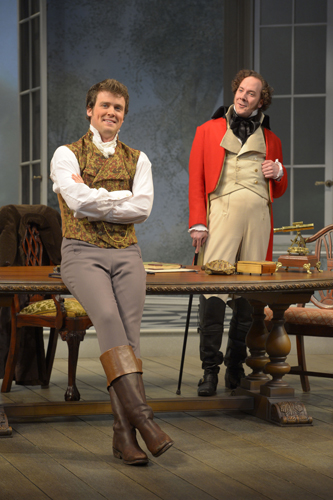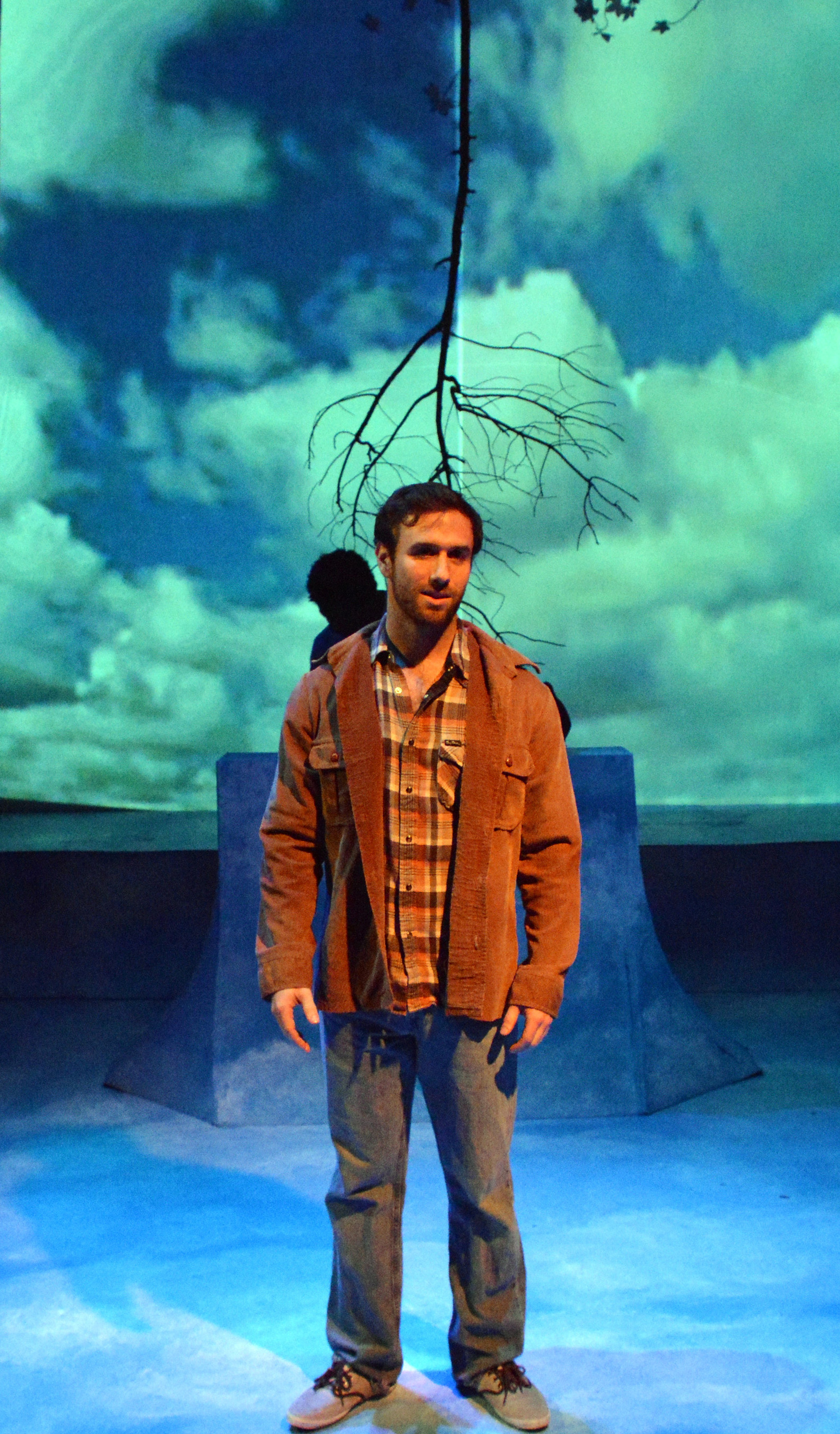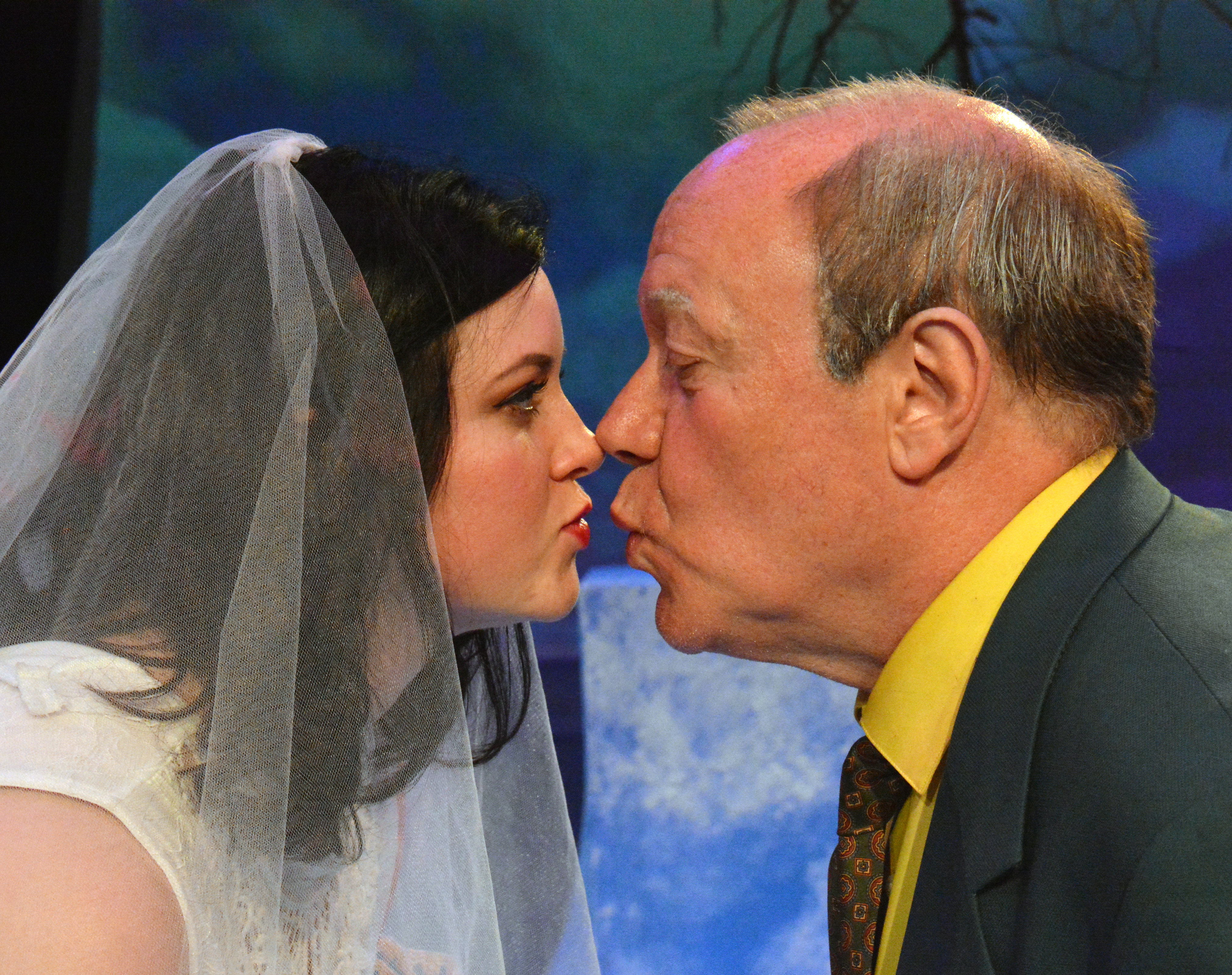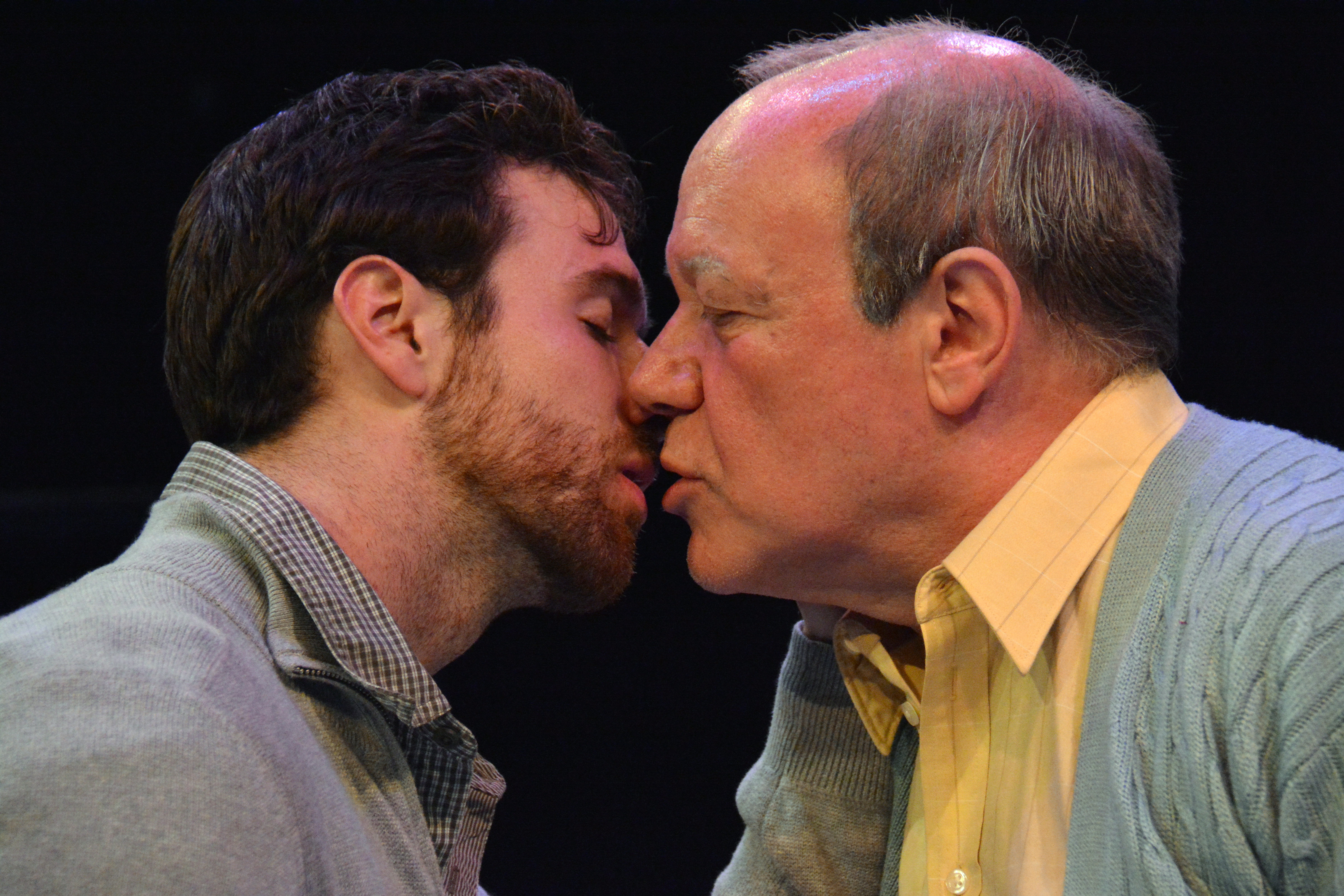
LITTLE ME at 42nd Street Moon is bright, sassy and ‘dressed to the nines’.

By Kedar K. Adour

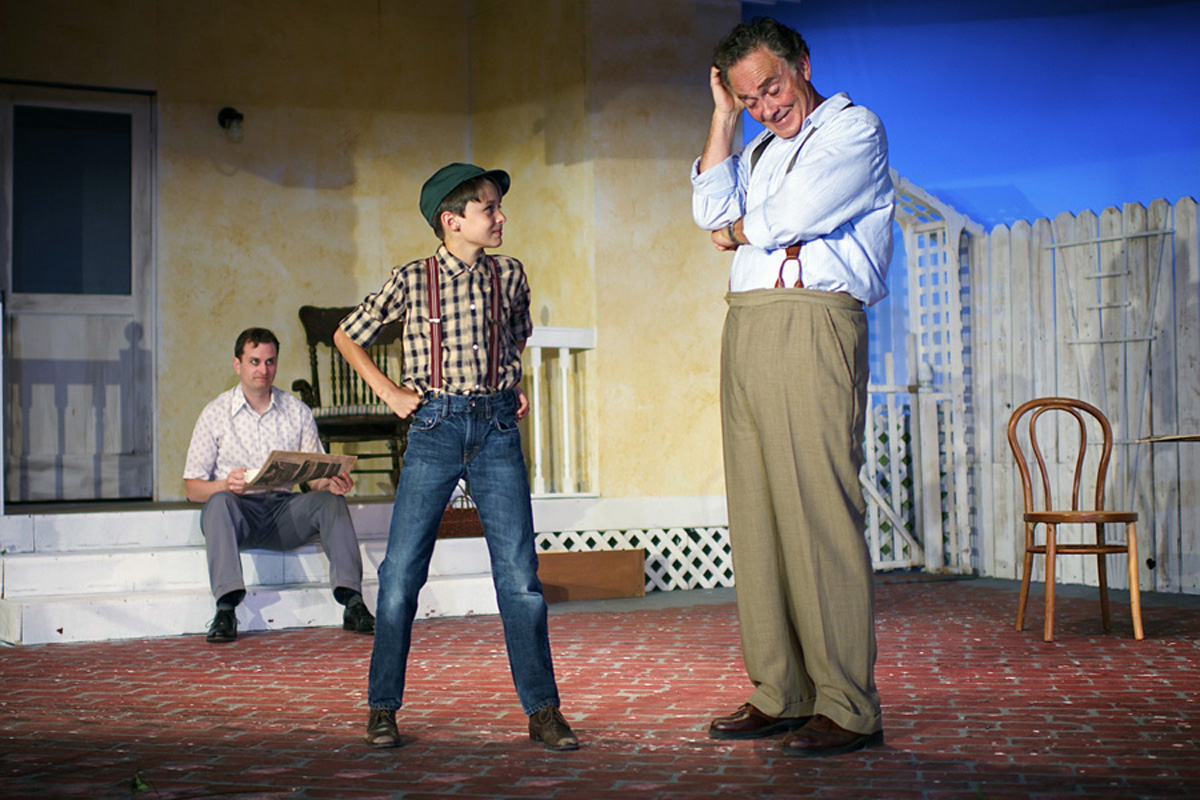
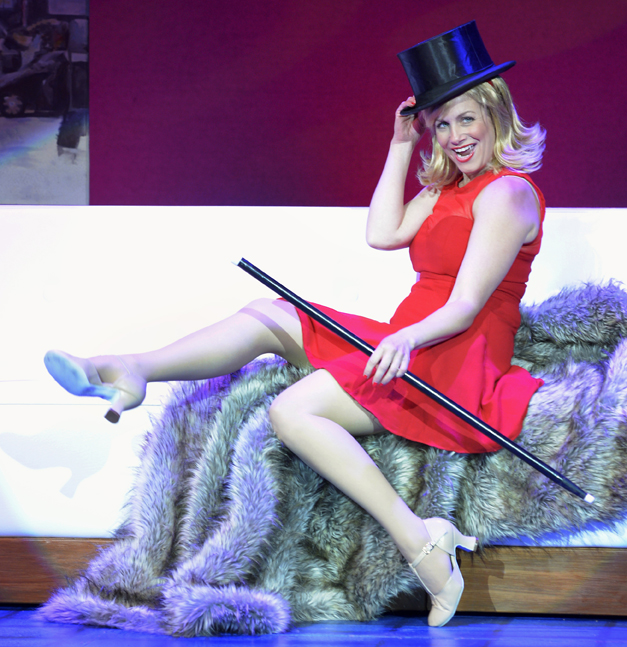
Jason Graae stars as all the men who woo the irresistible
“Belle Poitrine” (Sharon Rietkerk) in LITTLE ME
at 42nd Street Moon Photo Credit: David Allen

LITTLE ME: Musical Comedy. Book by Neil Simon. Music by Cy Coleman. Lyrics by Carolyn Leigh. Based on the novel by Patrick Dennis. Directed by Eric Inman. Music Direction by Brandon Adams. Choreography by Staci Arriaga. 42nd Street Moon, The Eureka Theatre, 215 Jackson Street between Battery and Front Streets in San Francisco. 415-255-8207 or www.42ndStreetMoon.org   May 1 – 19, 2013

LITTLE ME at 42nd Street Moon is bright, sassy and ‘dressed to the nines’.

To end their 20th season, the much lauded 42nd Street Moon has mounted the 50 year old star vehicle Little Me with a top notch cast dressed in a plethora of costumes that must have strained their budget. Where Sid Caesar was the original star in the 1962 Broadway production, our intrepid local group has imported the charming, versatile Jason Graae from the Southland to handle the multiple roles demanded by the script.

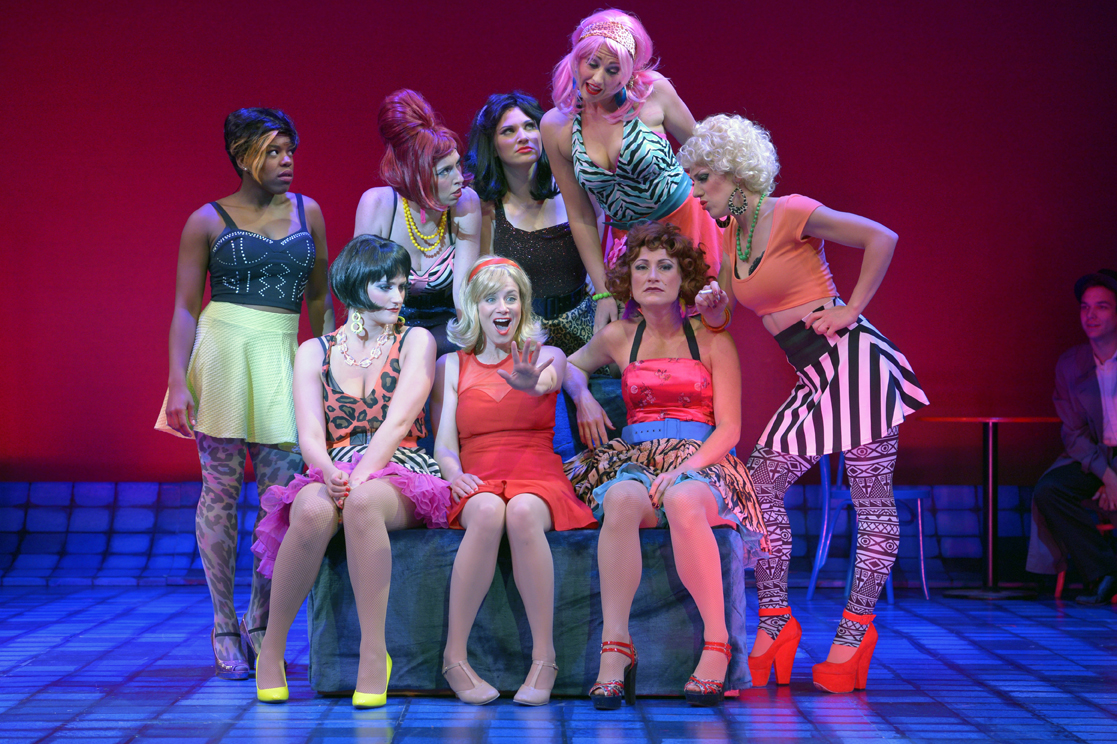
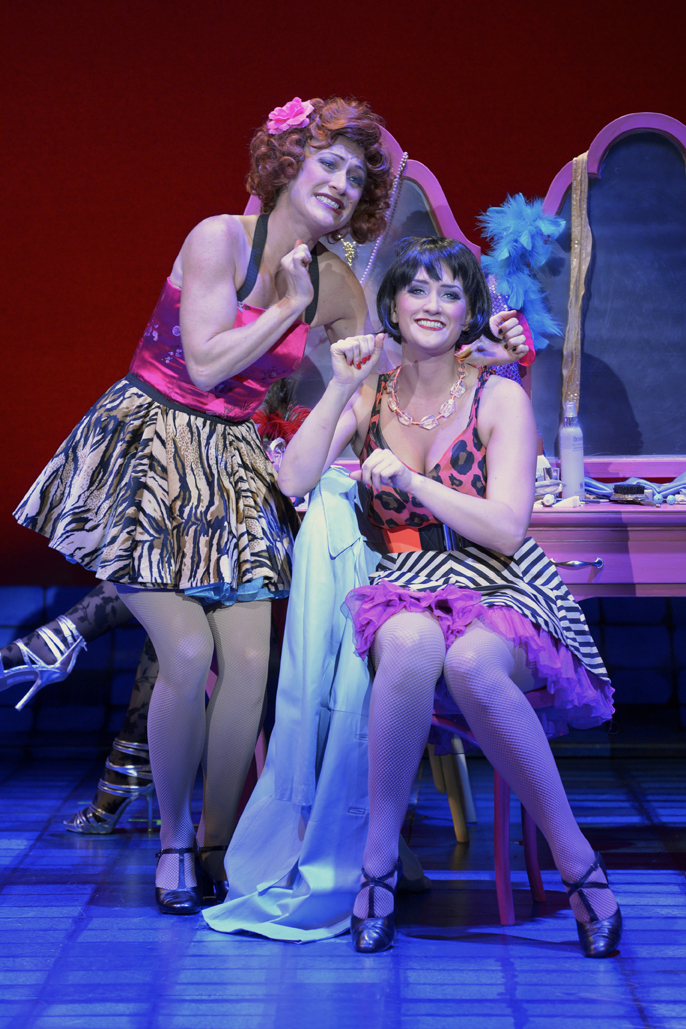
Jason is a whirlwind of activity playing seven different roles with an occasional hitch that he molds into the character he is playing at that specific moment with a wink and a nod to the audience. He is not the only one playing multiple roles since the ensemble group prances and dances on and off stage as non-gender specific characters with costumes to match. Our own local favorite Darlene Popovic first appears in a tight fitting red gown as “Momma” and later is a hit as Bernie Buschbaum to strut her stuff in a  ‘buck and wing’ show stopper “Be a Performer” with Zack Thomas Wilde as her/his side kick Benny.

Although Jason Graae is superb in the star vehicle roles of Noble Eggleston, Mr. Pinchley, Val Du Val, Fred Poitrine, Otto Schnitzler, Prince Cherney and Noble Junior he is matched line for line by the gorgeous Sharon Rietkerk (Belle Baby) and Teressa Byrne (Miss Poitrine Today) who play only one character.

But we are getting ahead of who, what, where and when of the original production. First produced in 1962 as a star vehicle for Sid Caesar, Little Me won two Tony Awards. It seems that Patrick Dennis (a pseudonym) of Auntie Mame fame wrote a parody of the autobiographical books that are the rage for the famous and not-so-famous society types entitled:  “Little Me: The Intimate Memoirs of the Great Star of Stage, Screen and Television.”  It tells the story of social climbing Belle Poitrine, born on the wrong side of the tracks in Venezuela, Illinois who seeks, and gains “wealth, culture, and social position.”

Even before the book was published, and became a best-seller, producers Cy Feuer and Ernest Martin optioned it for the stage and brought aboard Neil Simon on the book, Cy Coleman as composer, and Carolyn Leigh as lyricist. It lasted for only 257 performances on Broadway and quoting Artistic Director Greg MacKellan “And then it was over. . .perhaps it had too satirical and edge for Broadway audiences at the time.” There were two other mountings of the show (1982 and 1999) that were not too successful in the U. S. but did big business in London

Mackellen who is a stickler for producing the ‘lost musicals’ in their original format has used the 1962 version that runs two hours and forty minutes with intermission and there’s the rub. Maintaining audience interest with humor piled on humor runs a little thin. This is not a criticism but an observation that may explain the abbreviated Broadway run.

There is lot to like beginning with the superb acting, fine singing, excellent staging, memorable musical numbers (“Real Live Girl”, “I’ve Got Your Number”, “On the Other Side of the Tracks”, and “To Be a Performer”), energetic dancing and costumes to die for.

Kedar K. Adour, MD

Courtesy of www.theatreworldinternetmagazine.com


Cinderella — San Francisco Ballet Performance

By Joe Cillo

Cinderella

San Francisco Ballet Performance

May 4, 2013


There are many versions and variants of the Cinderella story.  The most popular in recent times are the French version written by Charles Perrault in 1697 and the German version(s) of the Grimm Brothers from the early 1800s.  The Disney animated movie version, which was released in 1950, is heavily influenced by Perrault and is probably the most familiar version of the story in America.  The American Cinderella has been forcefully criticized by Jane Yolen (1982) as being

“a sorry excuse for a heroine, pitiable and useless.  She cannot perform even a simple action to save herself . . . Cinderella begs, she whimpers, and at last has to be rescued by — guess who — the mice! (p. 302)  “The mass-market books have brought forward a good, malleable, forgiving little girl and put her in Cinderella’s slippers.  However, in most of the Cinderella tales there is no forgiveness in the heroine’s heart.  No mercy.  Just justice.” (p. 301)  “Hardy, helpful, inventive, that was the Cinderella of the old tales, but not of the mass market in the nineteenth century.  Today’s mass market books are worse.” (p. 300)  “The mass market American “Cinderellas” have presented the majority of American children with the wrong dream.  They offer the passive princess, the ‘insipid beauty waiting . . . for Prince Charming’ . . . But it is the wrong Cinderella and the magic of the old tales has been falsified, the true meaning lost, perhaps forever.”  (p. 302-03)

I concur with this assessment, and so it was with great expectancy that I attended the San Francisco Ballet’s performance this weekend in the high hope that they would do something interesting and inventive with this ancient tale and its endless possibilities.  Boy, did they ever deliver!  The performance was magnificent.  It fulfilled the highest and best potential of dance as an art form.  It perfectly realized my own aesthetic and conception of what dance should be.  Of all the dance performances I have seen, I would say this was the best one.  It had everything.  The dancers, of course, were superb, as always at the San Francisco Ballet, but this production was well thought out with great intelligence.  It is a big concept.  It has a broad narrative line with numerous subplots.  The story is told in nonverbal language that can be easily followed by a viewer.  The ballet was not about athleticism, or a celebration of the physical beauty and grace of the body for its own sake, but rather the body and its capacity for movement and communication are employed to tell a story and create relationships between characters that evolve and change throughout the drama.  It was dynamic as well as emotionally and intellectually challenging.  The music was perfectly suited to the dancing and to the action on stage, which I always notice and appreciate.  The lighting, the sets, the staging, and the costumes were highly imaginative, and beautifully done.  It is a visually enchanting spectacle.  Large bouquets to Choreographer Christopher Wheeldon, Librettist Craig Lucas, Scene and Costume designer Julian Crouch, and Lighting Designer Natasha Katz, Tree and Carriage Designer Basil Twist, and Projection Designer Daniel Brodie, and the entire staff.  This show is a first rate accomplishment.

The production draws more from the Grimm tradition rather than from Perrault, but it incorporates creative, original innovations that give it a uniqueness and individuality that in my opinion is superior to the older versions of the tale.  The San Francisco Ballet version has complexity.  The characters have depth in contrast to the fairy tale characters, which tend to be simplified and cartoonish.

Following the Grimm version, the story centers around a tree growing out of Cinderella’s mother’s grave.  There is no fairy god mother in this story.  Instead four Fates shadow Cinderella throughout the performance, watching over her, encouraging her, and guiding her in the right direction at crucial times.  There are a variety of wonderfully costumed fairies and animal characters who support Cinderella.  Cinderella’s father remains a player throughout the story, sometimes protecting her from the harshness and excess of the stepmother.  In the fairy tale versions the father seems to disappear and abandons Cinderella to her fate at the hands of her stepfamily.  This tends to gut the story of its emotional sense.  It makes it seem as if stepmothers and stepsisters are inherently evil or hostile toward their stepsiblings, and this is not necessary the case nor inevitable, particularly if the father is absent or dead.  It also leaves one wondering how the father could simply abandon his natural daughter from his first wife to the cruelty of his new family.  However, once it is realized that the hostility between Cinderella and her stepfamily is rooted in a sexual rivalry for the father, then the whole story makes perfect sense — but most versions of the story will not deal with this.  Cinderella becomes sanitized and desexualized.

I liked the San Francisco Ballet’s concept because it moves in the direction of keeping the story emotionally and sexually alive by retaining the father as an involved player throughout the story.  He is at the ball with everyone else and dances with all three of his daughters.  It would have helped if this had been a little more overtly sexual, but it worked.  The conflict and the implications could be discerned.

When the father remarries and the stepmother and her two daughters are brought to meet Cinderella for the first time, they offer her a bouquet of flowers which Cinderella contemptuously throws on the ground.  This action seems to set up the antagonism between Cinderella and her stepfamily.  On the other hand, was the bouquet a genuine gesture, or a cynical act of hypocrisy?  This was an interesting twist that contrasted with the usual the versions of the fairy tale where the animosity between the stepfamily and Cinderella is attributed to the inherent cruelty of the stepsisters and their mother, which is rather simpleminded.  In the San Francisco Ballet’s conception the arriving stepfamily appears to reach out to Cinderella and she rejects them.  Why?  Obviously, because she had her father all to herself and their arrival brings her exclusive possession of his attention and affection to an end.  This involves Cinderella in creating her own predicament.

If anything, I think Cinderella should have been even more of a bitch.  This is a nasty, ugly sexual rivalry and should not be cast as a struggle between Good and Evil, as it traditionally is.  The San Francisco Ballet moves a long step in the right direction, but I think it could be emphasized even more.  I liked that in this performance the sexual attraction between the father and the step sisters as well as Cinderella was evident, and Cinderella’s relationship with the Prince has palpable sexual overtones.  During the ball they disappear several times from the stage as if going off for a tryst and then return for more dancing.  This Cinderella was not a sanitized, innocent, passive player being helplessly pushed around.  She had some character and some strength of her own.  Nor are the stepsisters and their mother uniformly evil and cruel.  Cinderella is able to form a somewhat friendly rapport with the younger sister, Clementine.  The Prince also becomes more interesting in this retelling.  He is not an idealized Prince Charming devoid of personality, but is something of a rogue who causes his parents, the King and Queen, consternation.  He has a companion, Benjamin, who takes a fancy to the step sister, Clementine, and in the end, they, too, marry in a sort of double wedding.

At the end of the first act when the animals dress Cinderella in her gown for the ball there was no pumpkin carriage (that comes from Perrault).  Instead Cinderella disappears into an opening in the trunk of the tree — which looks remarkably like a vulva — and shortly emerges transformed by the forest animals into a princess in a splendid carriage being whisked off to the ball. It is a very powerful, effective scene.

In the final scene the reconciliation between Cinderella and her stepmother is very modest.  She plants a small kiss on her stepmother’s cheek, but it shows considerable restraint.  It is almost perfunctory.  However, it is less grotesque than having the birds peck out their eyes as in the Grimm version.

Altogether the San Francisco Ballet’s recasting of Cinderella goes several steps beyond the Grimm Brothers in quality and emotional sophistication.  I hope it replaces the Disney version in the popular consciousness.  It was truly a privilege to see it.  As far as dance performances go, this is as good as it gets.  It makes me grateful to be living San Francisco where it is possible to go out in the evening and see a performance of this high quality.  If you can go out in the evening and see something of this caliber and imaginative power, you know you are in one of the best places in all the world to be.  This is why we live here.


Yolen, Jane (1982)  America’s Cinderella.  In Cinderella: A Casebook.  Edited by Alan Dundes.  Madison, WI:  University of Wisconsin Press. pp. 294-306.

MERRY WIVES OF WINDSOR by the African-American Shakespeare Company(A-ASC) is Shakespeare on the “Chitlin Circuit.”

By Kedar K. Adour

The Merry Wives(l-r) Safiya Fredericks (Mistress Ford) and Leotyne Mbelle-Mbong (Mistress Page)and  send Falstaff (Beli Sullivan) “to the cleaners” in The Merry Wives of Windsor by the African-American Shakespeare Company

THE MERRY WIVES OF WINDSOR by William Shakespeare. Adapted and directed by Becky Kemper. African-American Shakespeare Company, Buriel Clay Theater at the African-American Art & Culture Complex, 762 Fulton Street, S. F. 800-838-3006 or www.African-AmericanShakes.org.  May 2 -24, 2013

MERRY WIVES OF WINDSOR by the African-American Shakespeare Company(A-ASC) is Shakespeare on the “Chitlin Circuit.”

Shakespeare’s The Merry Wives of Windsor is a comedy/farce that begs to be staged/spoofed as a concept performance and that is exactly what is happening at the Buriel Clay Theater at the African-American Art & Culture Complex.  It is a wild, wacky, ribald and uneven night of fun where the cast shares their enthusiasm and the lights never dim on the audience.

Adapted and directed by Becky Kemper, a relative Bay Area newcomer, who founded the Maryland Shakespeare Company has pulled out all the stops to make it a solid African-American production. Taking a cue from the “chitlin’ circuits”  that were the only places African-Americans could perform prior to 1960 racial integration. She has selected the time of 1950 as an appropriate era.

Before the play begins the audience is warmed up by members of the cast singing acappella and dancing to songs of the 50s advising that the auditorium lights would remain on for the entire show to encourage participation by the audience members who obliged with synchronous clapping to the music and singing when asked. The two intervals between the acts continued the audience interaction

In Shakespeare’s time women were not allowed on the stage and men dressed and played as women. A-ASC has turned that around and many of the male characters are played by women, including the pivotal role of Sir John Falstaff (Beli Sullivan) adorned with a false pot-belly to rival all pot bellies. That conceit works well earning most of the laughs. Casting of Tavia Percia and Fe’lisha Goodlow as Pistol and Nim (respectively) members of Falstaff’s gang is not so successful.

The familiar story line involves Falstaff the disenfranchised free spirit of Shakespeare’s King Henry IV plays who hatches a plot to gain money by wooing and winning the love of two wealthy wives Mistresses Ford (Leotyne Mbelle-Mbong) and Page (Safiya Fredericks).  Falstaff’s shenanigans go astray when the ladies discovered that each has received identical love letters from the treacherous would be swain. They plan revenge to end all comical revenge plans and our intrepid Sir John suffers well deserved indignities. Egotistical Falstaff is conned into a second try at seducing the Merry Wives and that has a more unsuccessful ending in the most riotous scene of the evening. A major factor in creating conflict is the jealous Master Ford (Armond Dorsey) who sets his own trap to determine his wife’s suspected infidelity.

The secondary storyline involves the thwarted love of young Anne Page (Tavia Percia) for her paramour Fenton (Terrence Moyer). It seems that Justice Shallow (Twon Marcel) has a not too bright nephew Master Slender (Terrence Moyers doubles in the role) also seeking the hand and fortune of Anne. Then there is French Dr. Casius (Martin Grizzell) who is also hot for Anne and he has a grievance with Reverend Evans who supports Slender’s suit for Anne. This leads to a hilarious “fight” between the Dr. and the Reverend. Would you believe a duel with boxing gloves and kung-fu replacing swords and the antagonists becoming good friends? Believe it!

Director Kemper encourages broad acting styles and encourages mugging.  Safiya Fredericks, Leontyne Mbele-Mbong and Tavia Percia are drop dead gorgeous and Armond Dorsey gives a strong display of Master Ford’s insecurity and jealousy. Sheri Young’s portrayal of Quickley, a pivotal role needs work. Martin Grizzel’s tall stature and inane nonstop antics dominates whenever he is on stage. His homoerotic twist in the final scene is a hoot and a holler.

The staging is appropriately bare bones with the minimal scenery changes keeping the action moving as well as adding to the overall humor of the evening. Running time two hours and 30 minutes with two ‘interludes’.

Kedar Adour, MD

Courtesy of www.theatreworldinternetmagazine.com


“Happy” by Robert Caisley at 6th Street Playhouse, Santa Rosa CA

By Greg & Suzanne Angeo

Edward McCloud, Rose Roberts

Reviewed by Suzanne and Greg Angeo

Photos by Eric Chazankin


Misery Loves Company

“Happy” by acclaimed English playwright Robert Caisley is one of the most provocative, powerful and disturbing new plays ever presented at 6th Street Playhouse. Caisley is now based at the University of Idaho teaching theatre, film and dramatic writing. One of his earlier plays, “Front”, received the 1996 Kennedy Center/Fourth Freedom Forum Award for playwriting. Both “Front” and “Happy” have been picked up for publication by the Samuel French Company. Now, in a series of openings called a “rolling world premiere”, four American theaters – the Montana Rep in Missoula, the New Theatre in Miami Florida, 6th Street Playhouse in Santa Rosa, and New Jersey Rep in Long Branch – are each in turn presenting unique productions of this original play over the 2012-2013 season. These premieres are in collaboration with the National New Play Network, which allows the playwright time to refine his work after seeing it produced with different directors and casts.

The tale unfolds in the city loft of offbeat Spanish artist Eduardo, which is lavishly decorated with modern sculpture pieces and paintings. He has invited his longtime friends Alfred and wife Melinda over for a simple dinner and conversation, and to meet his newest lady love, the young and beautiful Eva. Alfred arrives early, with Melinda still on her way and Eduardo nowhere in sight. Only Eva is at home, and it’s not long before we realize this will not be your typical evening of casual chit-chat. Eva launches immediately into a series of pathological cat-and-mouse mind games, slinking about the stage in a bath towel and gulping tumblers full of gin. She zeroes in with laser-like precision on what she perceives as Alfred’s “fake” sense of contentment with his life. Eva’s apparent mission is to strip away the veneer and make people see “reality”, on her terms. The others soon arrive, but not after some serious damage has been done. Everyone gets a major attitude adjustment after an evening with Eva. She’s a good cook who likes serving up a little sadism with the shish kebab. The story has a compelling build and dramatic flow, but also has an oddly comic tone. The many laugh-inducing moments are a setup for the tragedies to come, and come they do.

Brian Glenn Bryson, Liz Jahren

Rose Roberts delivers a fearless, tour-de-force performance as the seductive, brutal Eva. From the very beginning, Roberts overwhelms the stage with mesmerizing authority. She reveals Eva’s deep, gut-level pain showing through her own veneer – cruel sarcasm – which she wields like a dagger to cut others down to size. We know this girl will soon end up either in the psycho ward, or in the morgue, and we can’t take our eyes off of her.

Edward McCloud as Alfred has a challenging task. He is forced to turn from blissful unawareness to face the unhappiness of his life head-on, like a car crash that he must survive. We see ourselves in him, which seems to be the intent of the playwright, and the actor has fulfilled this promise. Alfred’s slightly ditzy but lovable wife Melinda is played by Liz Jahren, who brings a delightful sort of new-age earth-mother quality to her character.  Jahren, who works with special-needs students, is able to find an authentic connection with Melinda’s love for their disabled daughter. Eduardo provides comic relief as portrayed by Brian Glenn Bryson, with lots of charm and appeal. Eduardo is an expressive man, with big emotions and big appetites. He serves as the bridge between the cruelty of Eva and the near-delusional optimism of Alfred and Melinda. There is also a vague suggestion that he may have engineered the whole evening, but it’s not clear, and may be one of several elements that needs refinement. “Happy” is a work in progress, and in some respects, it shows.

Lennie Dean is known to 6th Street audiences for her brilliant work on last season’s original production “Tennessee Menagerie” which was, like “Happy”, performed at 6th Street’s black box Studio Theater. It features an open thrust stage, which allows the audience a view from three sides. Dean makes us forget how small this stage is. As with “Menagerie”, she employs every corner of the space. She effectively makes use of the combined visual impact of the set and sculpture pieces, and the actors’ movements. The set design by Jesse Dreikosen includes original artwork by internationally recognized sculptor Boback Emad and other artists. Many of the set pieces are for sale, and a portion of the proceeds will benefit 6th Street. Splendid lighting design by April George and costumes by Liz Smith provide the perfect environmental touches.

We all know someone like Eva, or Eduardo, or Alfred and Melinda. Whether anyone is happy or not, who can say? Some believe that happiness is freedom from all desire. Some, like Eva, believe you can’t be happy unless you drag everyone around you down to your level. As it turns out, happiness, like beauty, is in the eye of the beholder. “Happy” will certainly make you think about it, long after you walk out of the theater.

When: Now through April 21, 2013

8:00 p.m. Thursday, Friday and Saturday

2:00 p.m. Saturday and Sunday

Tickets: $10 to $25

Location: Studio Theater at 6th Street Playhouse

52 West 6th Street, Santa Rosa CA
Phone: 707-523-4185

Website: www.6thstreetplayhouse.com

Ron Paul’s commentary on the Boston bombing

By Joe Cillo

Liberty  Was Also Attacked in Boston

 by Ron Paul


Forced lockdown of a city.  Militarized police riding tanks in the streets. Door-to-door armed searches without warrant. Families  thrown out of their homes at gunpoint to be searched without probable cause.  Businesses forced to close. Transport shut down.

These were not the scenes  from a military coup in a far off banana republic, but rather the scenes just  over a week ago in Boston as the United States got a taste of martial law. The  ostensible reason for the military-style takeover of parts of Boston was that  the accused perpetrator of a horrific crime was on the loose. The Boston bombing  provided the opportunity for the government to turn what should have been a  police investigation into a military-style occupation of an American city. This  unprecedented move should frighten us as much or more than the attack  itself.


What has been sadly  forgotten in all the celebration of the capture of one suspect and the killing  of his older brother is that the police state tactics in Boston did absolutely  nothing to catch them. While the media crowed that the apprehension of the  suspects was a triumph of the new surveillance state – and, predictably, many  talking heads and Members of Congress called for even more government cameras  pointed at the rest of us – the fact is none of this caught the suspect.  Actually, it very nearly gave the suspect a chance to make a getaway.

The “shelter in place” command imposed by the governor of Massachusetts was lifted before the suspect  was caught. Only after this police state move was ended did the owner of the  boat go outside to check on his property, and in so doing discover the  suspect.

No, the suspect was not  discovered by the paramilitary troops terrorizing the public. He was discovered  by a private citizen, who then placed a call to the police. And he was  identified not by government surveillance cameras, but by private citizens who  willingly shared their photographs with the police.

As journalist Tim Carney wrote  last week:

“Law enforcement in Boston  used cameras to ID the bombing suspects, but not police cameras. Instead,  authorities asked the public to submit all photos and videos of the finish-line  area to the FBI, just in case any of them had relevant images. The surveillance  videos the FBI posted online of the suspects came from private businesses that  use surveillance to punish and deter crime on their  property.”

Sadly, we have been conditioned to  believe that the job of the government is to keep us safe, but in reality the  job of the government is to protect our liberties. Once the government decides  that its role is to keep us safe, whether economically or physically, they can  only do so by taking away our liberties. That is what happened in  Boston.

Three people were killed in  Boston and that is tragic. But what of the fact that over 40 persons are  killed in the United States each day, and sometimes ten persons can be killed in  one city on any given weekend? These cities are not locked-down by paramilitary  police riding in tanks and pointing automatic weapons at innocent  citizens.

This is unprecedented and  is very dangerous. We must educate ourselves and others about our precious civil  liberties to ensure that we never accept demands that we give up our  Constitution so that the government can pretend to protect us.


April  29, 2013

Palo Alto Players stages “Miss Saigon”

By Judy Richter

“Miss Saigon,” a musical theater updating of Giacomo Puccini’s opera “Madama Butterfly,” moves the action from 19th centuryJapanto 20th centuryVietnam. The names and setting differ, but the plot is similar.

Palo Alto Players has undertaken this challenging, ambitious work in a mostly successful production directed by Patrick Klein.

“Miss Saigon” starts in its namesake city in April 1975, shortly before South Vietnam’s fall to the communist Viet Cong. A weary U.S. Marine, Chris (Danny Gould), meets a shy, virginal, 17-year-old Vietnamese bar girl, Kim (Katherine Dela Cruz). They fall in love during a brief affair, but Kim is left behind when U.S.personnel are hastily evacuated from the city before it’s overrun by the enemy.

Three years later, Chris and his American wife, Ellen (Lindsay Stark), return toVietnam after learning that he has fathered Kim’s son. The visit, just like Pinkerton’s in the opera, ends tragically.

Like the opera, most of this musical is sung. There’s little spoken dialogue. Moreover, it’s not always clear what’s happening if one isn’t familiar with this show or the opera. Hence, precise diction becomes vitally important, but this production sometimes falls short in that department. Compounding the problem is Jon Hayward’s sound design, which was problematic in seats on the far right close to the front.

The standout performer is Brian Palac as the Engineer, a pimp with an uncanny ability to survive and a strong desire to get to the United States. He has the show’s big production number, “The American Dream.” Stark as Chris’s wife is the most assured singer among the women. Dela Cruz is believable as Kim, who’s steadfast in her love for Chris.

Gould tries too hard as Chris and pushes himself vocally, usually singing too loud. His best friend, John, is well portrayed by Adrien Gleason.

Jennifer Gorgulho’s choreography is outstanding, especially in the militaristic “The Morning of the Dragon” and the Engineer’s “The American Dream.” The set, though not nearly as spectacular as the original Londonproduction or the touring production in San Francisco, works well, as do the costumes by Shannon Maxham and lighting by Edward Hunter. Musical director Matthew Mattei conducts four instrumentalists from the keyboard.

“Miss Saigon” was created by composer Claude-Michel Schönberg and lyricist Alain Boublil (with Richard Maltby Jr.), the pair behind the earlier “Les Miserables.” It became a huge hit after it premiered inLondon in 1989, when the Vietnam War was still fresh in the memories of most adults. Now it’s history to the PAP cast and to younger people in the audience.

Still, the show and this production capture some of the human costs of that war.


A HOME LIKE NO OTHER

By Joe Cillo

BEST DIGS EVER

If you want total security, go to prison…..
Dwight D. Eisenhower

I have always wanted to be daring and do something absolutely outrageous…but the truth is I fear the punishment.  I have read horror stories of what happens in prisons: brutality, rape, lousy plumbing…and I want none of it.  However, I am in the unenviable position of losing my house because it is under water and I am looking around for affordable housing for my declining years.  Unfortunately, the only shelter that is “affordable” for me on my pension is a used Yurt in the Andes or an abandoned cave in New Mexico.

Imagine my delight when I discovered the Maconochie Center, a prison in Canberra, Australia specifically designed to pamper lawbreakers with so much smother love that they realize the only way to have little fun is to obey the law and get out on parole.  The philosophy at Maconochie is that if you give love, you will receive it. I think that is a wonderful attitude.  It didn’t work for me with my two husbands, but it has been overwhelmingly successful with my dog.

The “guards” at the prison (called service providers) refer to the inmates as customers and do their best to give the darlings in their care whatever will make them feel wanted and secure.    If one of their customers is feeling a bit depressed, why not cheer him up with a couple gin and tonics, a shot of heroin and a little sniff of cocaine.  Whatever works as they say in the trade.

The residents at Maconochie Center live together in five bedroom cottages.  There is never a problem if a rapist cannot get along with the guy who strangled his baby.  Maconochie Center has mediators on call to help the boys (you KNOW they are boys) settle their differences.  Perhaps one of them needs a long walk in the country…where there are willing sheep?  Perhaps the other needs apple pie a la mode?  Who knows?  The staff at the center are there to help.

It sounds like a very fun place to live for me.   All I would have to do is grow a bit of cannabis in my yard before my foreclosure and sell it in a schoolyard.  If I wanted to be certain I could stay at this lovely place for the rest of my life (and after all, I am 80 years old.  How long can that be?)  I would have to toss someone around screaming “I am going to kill you!”  My mother said that to me often enough.  I know I can be convincing.  The good news is that I don’t actually have to plunge the knife into anyone’s heart…all I need to do in Australia is make the judge believe I really meant to do the deed.

The weather in Canberra is perfect for me.  You get four seasons, none too hot or too cold and at Maconochie there are endless opportunities to explore the outdoors.  I can use my computer at all hours and if I have a severe pain, I can get a prescription strong enough to use for recreation after the pain has disappeared.  But the best news of all is that there has been a rash of pregnancies at the center since it opened.  Why, I could finally have that baby I always wanted and not have to worry about dealing with the little sweetheart when it becomes a teenager.  By that time I will be long gone and the Maconochie service providers can take over.


The Artist and the Model — Film Review

By Joe Cillo

The Artist and the Model

Directed by  Fernando Trueba


This film is very similar to the film, Renoir, that I reviewed here a couple of weeks ago.  I wonder if they borrowed the script?  An aging artist (Jean Rochefort), who isn’t named, is sitting out the war (World War II in this case) in a placid pastoral landscape.  He meets up with a gorgeous young girl (Aida Foche) who becomes his model.  The girl spends a lot of her time on screen naked, which really makes the film.  Some young girls bodies are so compelling that you can just look at them for hours and hours without losing interest.  They have a mesmerizing quality about them that just won’t let go.  Foche has that, and that is what keeps this film alive.  Because there is not a whole lot going on.  Watching somebody sketch and sculpt and walk through the country meadows can wear out after a fairly short time.  But Foche’s nude body does not.

There is a lot of silence in this film, which I liked.  It gives you a chance to think about the characters and what is going on.  Unfortunately, that is not a lot.  The script is not as well constructed nor is the story line as interesting as Renoir.  Nor is the conversation as stimulating and as thought provoking.  By every measure this film is inferior.  So if you only have enough money to attend one of these, make it Renoir.  I would have said it is a good film, interesting to watch, although mostly devoid of action and rather slow moving, but the ending made me mad at the director and the screen writer.  It made absolutely no sense.  It completely nullified everything that had been established about the character throughout the film.  I took it as a gesture of futility on the part of the filmmakers.  They didn’t know what else to do, so they trashed the whole movie, their lead character, and everything the film had set out to do.  Were they so dissatisfied with what they did that they decided to turn it into Romeo and Juliet?  It’s utter nonsense.

The film is in black and white.  In French with subtitles.  Seen at the San Francisco International Film Festival, Sundance Kabuki Cinema, April 28, 2013.

A personal look at PILGRIMS MUSA AND SHERI IN THE NEW WORLD playing on Center Rep’s Off Center stage

By Kedar K. Adour

Gabriel Marin & Rebecca Schweitzer in Pilgrims Musa and Sheri in the New World at Off Center Rep

PILGRIMS MUSA AND SHERI IN THE NEW WORLD: By Yussef El Guindi and Directed by Michael Butler. CENTER REP on the intimate Knight Stage 3 Theatre. Lesher Center for the Arts 1601 Civic Drive in downtown Walnut Creek. www.CenterREP.org or call 925.943.SHOW (7469). April 27 through May 12, 2013

A personal look at PILGRIMS MUSA AND SHERI IN THE NEW WORLD playing on Center Rep’s Off Center stage.

Center Rep’s production of Pilgrims Musa and Sheri in the New World under Michael Butler’s provocative staging/direction is well worth a trip to the Lesher Center in Walnut Creek. For this play Butler is the scenic designer as well as the director putting his very personal stamp on Yussef El Guindi’s very personal play that won the 2012 Steinberg Award as the best American play that had not been produced on Broadway. It is playing at the intimate 130 seat Off Center ‘black box’ theatre where the audience becomes drawn into the action.

For this reviewer, the play brought back very personal memories. Both my parents were immigrants to America from Greater Syria that was divided into Lebanon and Syria after World War I.  He met my mother, the youngest of three sisters, who ran a boarding house in Upstate New York in 1911 and eloped with her on his motorcycle. The fact that he was a Muslim, though non-practicing, and she was a Catholic was as great a dichotomy as that between non-practicing Muslim-Egyptian Musa and white American waitress Sheri who elope in his taxi cab.

Although I have given away the penultimate scene it will in no way detract from the convoluted love story that is infused with modern day, post 9/11, angst of assimilation of Arab immigrants into American culture. In one scene, a dream sequence, a secondary character Abdallah (Dorian Lockett), a Sudanese Muslim, gives thanks for the American opportunities for success that led to his financial independence. When I offered to take my successful truck farmer father, whose name was Abdul(lah), back for a visit to Syria, his response, in colorful Arabic, suggested I was crazy because he was now an American.

Back to the play. Although the ancillary cast of Lena Hart, Carl Lumbly and Dorian Lockett are fine actors, the evening belongs to Rebecca Schweitzer as Sheri and Gabriel Marin as Musa.  She is a ditzy chatter-box waitress who accepts an invitation to visit Musa’s walk-up apartment knowing full well that sex should be the ultimate end of the evening. Schweitzer is a whirl-wind of insecurity as she prattles on and on about her past experience with abusive boyfriends, an alcoholic mother and inner emotional turmoil.  Marin as a young Egyptian-American taxi driver with his own insecurities is the perfect foil for Schweitzer with his minimalist verbal responses and expressive facial movements to her inane chatter.

It is a love story with political-social implications that are woven adroitly, but not seamlessly into the text. Musa is torn between his potential marriage to his fiancée Gamila (Lena Hart) and a life of oppressive sameness stifling his desire for change. Gamila an intellectual woman thoroughly integrated into the American dream but is willing to accept the customs of Arab culture where elders plan the future of their children.

Carl Lumbly is superb as Somali Tayyib, Musa’s best friend who makes a living illegally selling luggage on the street. El Guindi has given Tayyib the words explaining the devastating effects of cultural differences of a match between Musa and Sheri that can only lead to disaster. He has personally experienced such a disaster. This fact is emphasized in a poignant last scene between Tayyib and Gamila.

You may not cheer when El Guindi’s pilgrims head off in his taxi to uncertain adventure but you will wish them best of luck because they are in love. Running time is just under two hours with and intermission.

Kedar K. Adour, MD

Courtesy of www.theatreworldinternetmagazine.com

Blackfish — Film Review

By Joe Cillo

Blackfish

Directed by Gabriela Cowperthwaite


I have never been to SeaWorld, and I’ve never had any desire to go there.  It always seemed to me like shallow entertainment which gives people the wrong impression of orcas in particular, and the relationship between humans and the animal kingdom in general.  This film starts to set things in the right relationship.

It is a documentary about SeaWorld, the whales that perform in their shows, the trainers that train them, and whether or not it makes sense to be doing this.  The impetus and center of gravity of the film is the death of trainer Dawn Brancheau, who was killed on February 24, 2010, by Tillikum, a 12,000 pound male orca at SeaWorld, Orlando, Florida.  Brancheau was 40 years old and a senior trainer who knew Tillikum well and was comfortable with him.  SeaWorld blames Brancheau for the mishap, but Tillikum had killed at least two other humans prior to Brancheau, and he also had a history of maltreatment, not only at SeaWorld, but also before he came to SeaWorld from Sealand of the Pacific in Victoria, Canada.  The film explores all of this material in great detail.  It is well documented and accentuated with interviews with former trainers who know Dawn Brancheau, and who provide much background and insight into the world of training orcas, the relationships of the trainers to the whales, and the conditions the whales are forced to live under at SeaWorld.  Did Dawn Brancheau make a mistake that cost her her life, or was this a ticking time bomb destined to go off sooner or later?  You decide.

The film makes the case that it is not such a good idea to be keeping these huge animals in the cramped quarters of the SeaWorld pools, separated from their natural social connections, and it is even less prudent to be letting young trainers, who don’t really have a clue what they are getting into, to swim into a tank with these powerful undomesticated animals.

How do you think a behemoth like Tillikum gets to be 12,000 pounds?  Not by eating potato chips in front of his TV.  These animals are top predators.  There are good reasons why they are called “killer” whales.  There is one dramatic sequence in the film of several whales attacking a seal that is stranded on an ice floe.  The whales work together to tip the ice floe enough that the seal is toppled into the water.  Once that happens, it is all over for the seal in seconds.  It seems to me that this is the truth that people — including children — should see about these whales.

There is a video on YouTube of a man clowning on a beach at the water’s edge.  Two orcas creep up on him right at the shoreline, knock him down, and devour him in seconds right before your very eyes.  Some people think the video is fake.  It shows you how strong is this will to believe in the benign nature of fierce predatory animals.  Perhaps it is a way of denying our own vulnerability and how quickly we can be snuffed out and disappear at the hands — or rather jaws — of natural enemies.  But this sort of thing goes on in the animal kingdom all the time every day.  An animal can be placidly going about his business, and suddenly, without warning, be beset and completely devoured within seconds.   It is a discomfiting thought which we would prefer to dispel, how sudden our lives can be snuffed out by powerful predators, who don’t really hate us, they just want to consume us.  It’s nothing personal.  Just as it is nothing personal when we raise chickens, or pigs, or cattle on factory farms in minimal conditions feeding them just enough to get their weight to a certain point in an optimal number of days at which time they will be abruptly and unceremoniously slaughtered.  You don’t stew about that when you sit down and enjoy a sumptuous steak in a fine restaurant, do you?  Predators cannot afford to be sentimental about the animals they must kill in order to survive and thrive.  The orcas did not feel sorry for that seal they toppled from the ice floe, nor for the man they probably mistook for a seal on the beach.  Rather than dwell on that unsettling thought that these animals in their natural habitat would kill us in a moment, we turn them into friendly teddy bears, companions who can communicate with us and be friends with us.  Denial is a first line defense against anxiety.

The film does not mention the parent corporation of Seaworld (which used to be Anheuser-Busch until it was sold to the Blackstone Group in 2009).  It is now called Seaworld Entertainment Inc., which is 63% owned by Blackstone.  The Blackstone Group is a multi-billion dollar private equity firm based in New York City, with offices around the world.   Just this week Blackstone held an initial public offering of Seaworld Entertainment stock.  According to the Wall Street Journal the stock went up 24% on the first day of trading (Wall Street Journal, April 22, 2013).  After this film circulates I wonder how well the stock will do?

Blackstone cares about making money, and they’re making a lot of it on Seaworld.  They don’t particularly care about the trainers at Seaworld, much less the orcas.  They refused to be interviewed for this film or make any comment about its findings.  This is an entertainment business that sells illusions.  Illusions are strongly held beliefs or viewpoints that are in contradiction to facts or conditions that should be obvious.  They reflect a human need to see things in a certain way in order to allay anxiety, to provide a consoling view of life that offers comfort or a feeling of security.

The illusion in this case is the belief that the natural world is a benign place where humans are in control and living in harmony with the other creatures in nature: that orcas, who are top predators in the wild, are actually benign, friendly, good natured companions to humans who can be domesticated to behave like entertaining pets.  However, this illusion is starting to wear a little thin and fray around the edges.  In order to maintain it, much truth has to be concealed, downplayed, and outright falsified, which the film documents very effectively.

The Seaworld trainers seem to be goodhearted, but naive, young people who have very little background in orca behavior or ethology, but are possessed of the illusion that you can get into a tank of water with a 12,000 pound captive whale that lives by killing, make him do all kinds of ridiculous things that he would never do in the wild, and be perfectly safe.  People want to believe that they can be friends with their natural enemies, that the most fearsome predators can be tamed and transformed into loving companions.  Yes, the animals have personalities, they have intelligence, they have a complex social life, they have sophisticated ways of communicating among themselves.  Some people seem surprised and charmed to discover this.  But it doesn’t mean you can be friends with them.  They cannot be a substitute for wholesome, loving human companionship.  The captive environment is very artificial and the animals understand their dependence on their human handlers in this extraordinarily unnatural situation.

The film points to a record of at least 70 incidents where killer whales have attacked their human trainers and several where the trainers have been killed.  Seaworld consistently blames the trainers, saying they made errors which led to the attacks.  In some cases this was true, but on the other hand, you don’t have a lot of margin with killer whales, and it is also true that the whales are kept under inhumane conditions and often treated badly, which, over time, probably builds up a lot of rage and resentment.  Sometimes the whales reach a point where they decide enough is enough.

The film brings to light a lot of unsavory conditions in an inherently perilous enterprise that SeaWorld would prefer to keep under wraps, and which they have done pretty successfully for many years.  This speaks to the power of this illusory phantasm of the benign natural world in the public imagination.  People want to take their kids to this grandiose spectacle and be dazzled by huge powerful animals cavorting to entertain human audiences pleased with themselves to have subdued and dominated these breathtaking creatures.  But it is insipid and barbaric.  It gives kids the wrong message about the relationship between humans and animals and it gives them a very wrong impression about killer whales.   Don’t go to Seaworld.  Watch this film instead.  Seen at the San Francisco International Film Festival, Sundance Kabuki Cinema, April 27, 2013.