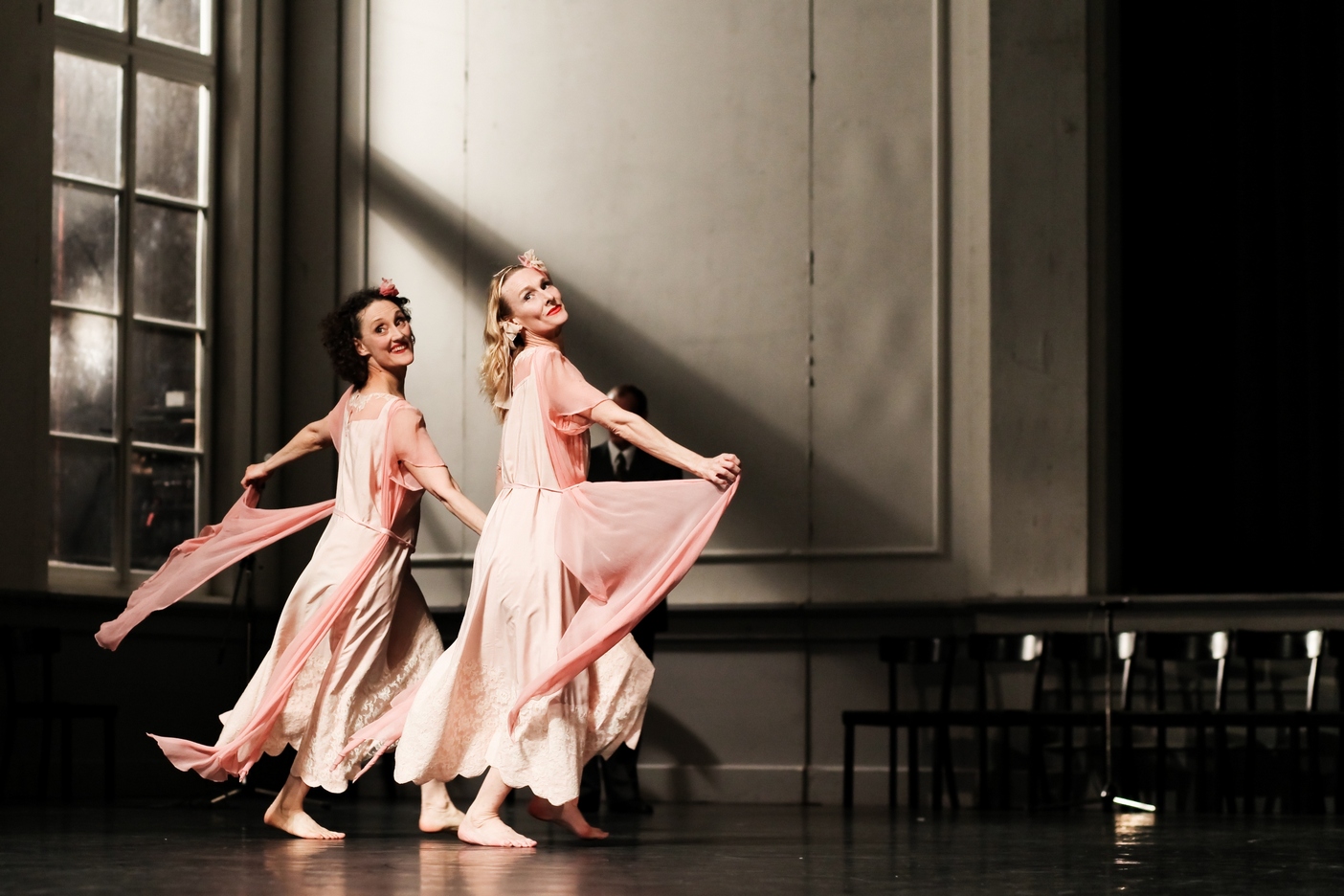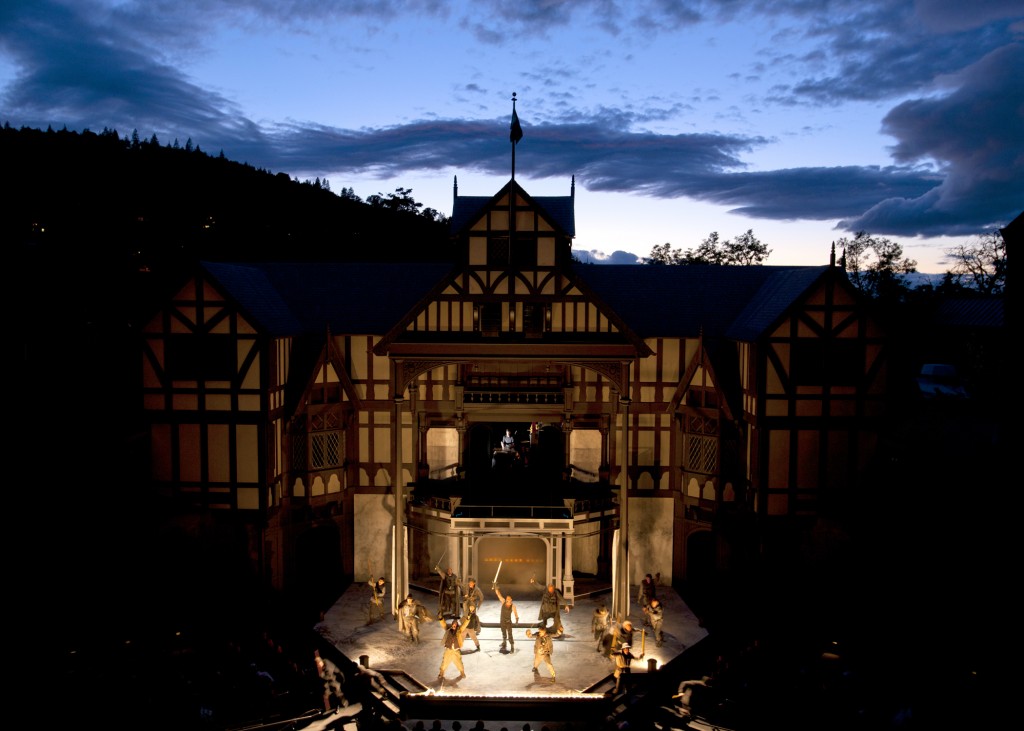
DEAR ELIZABETH is not about Elizabeth Barrett Browning.

By Kedar K. Adour

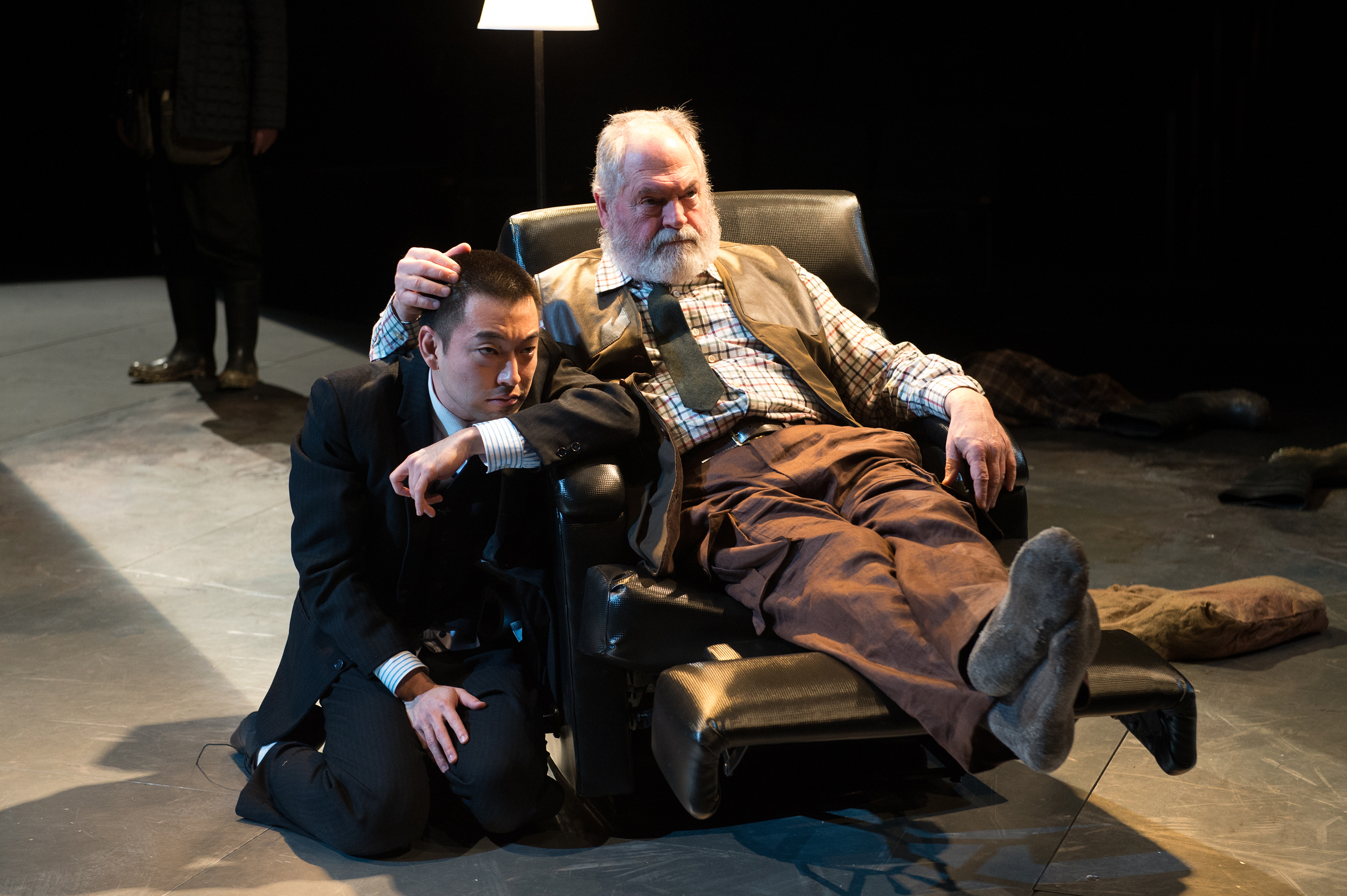
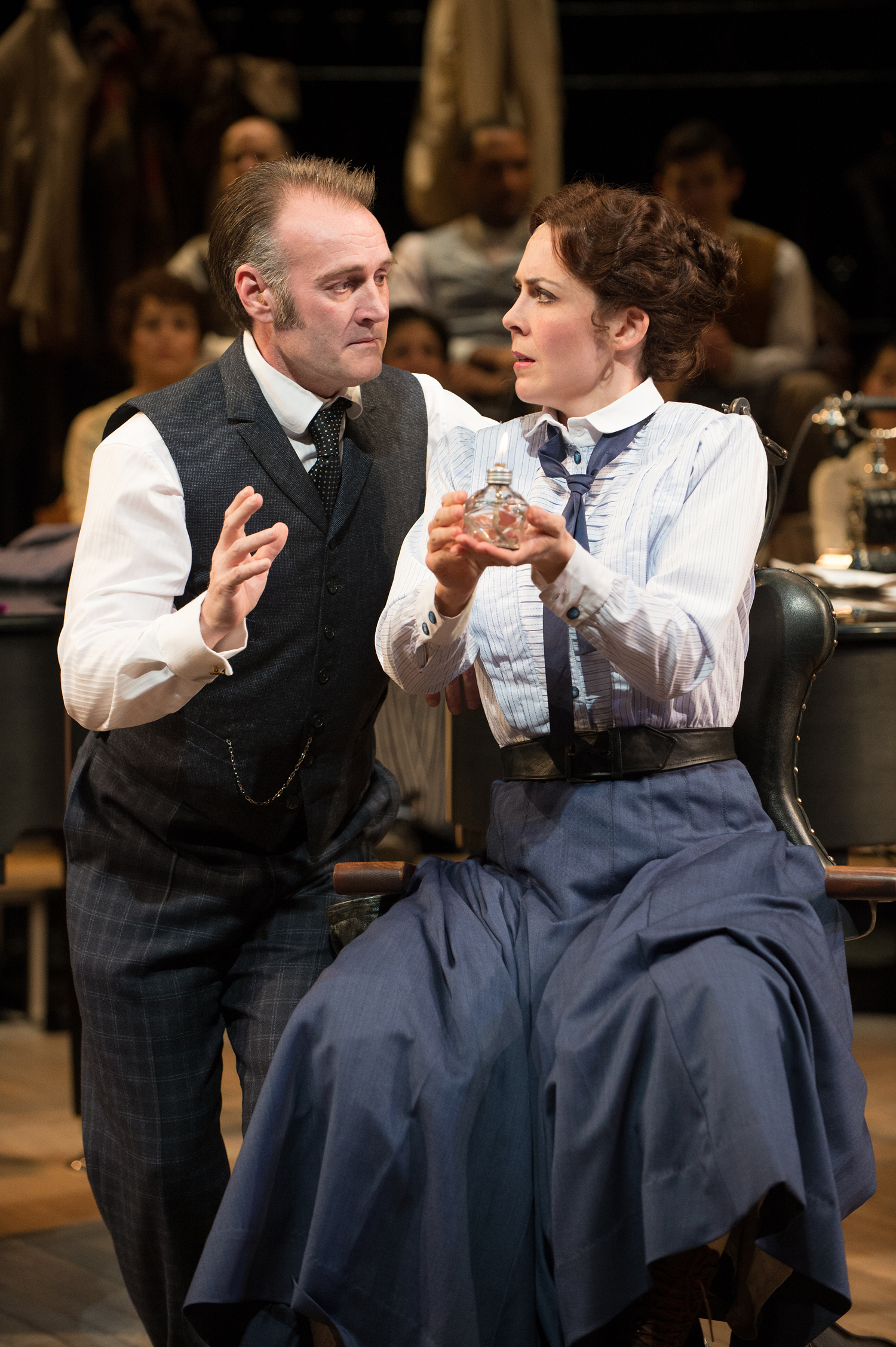
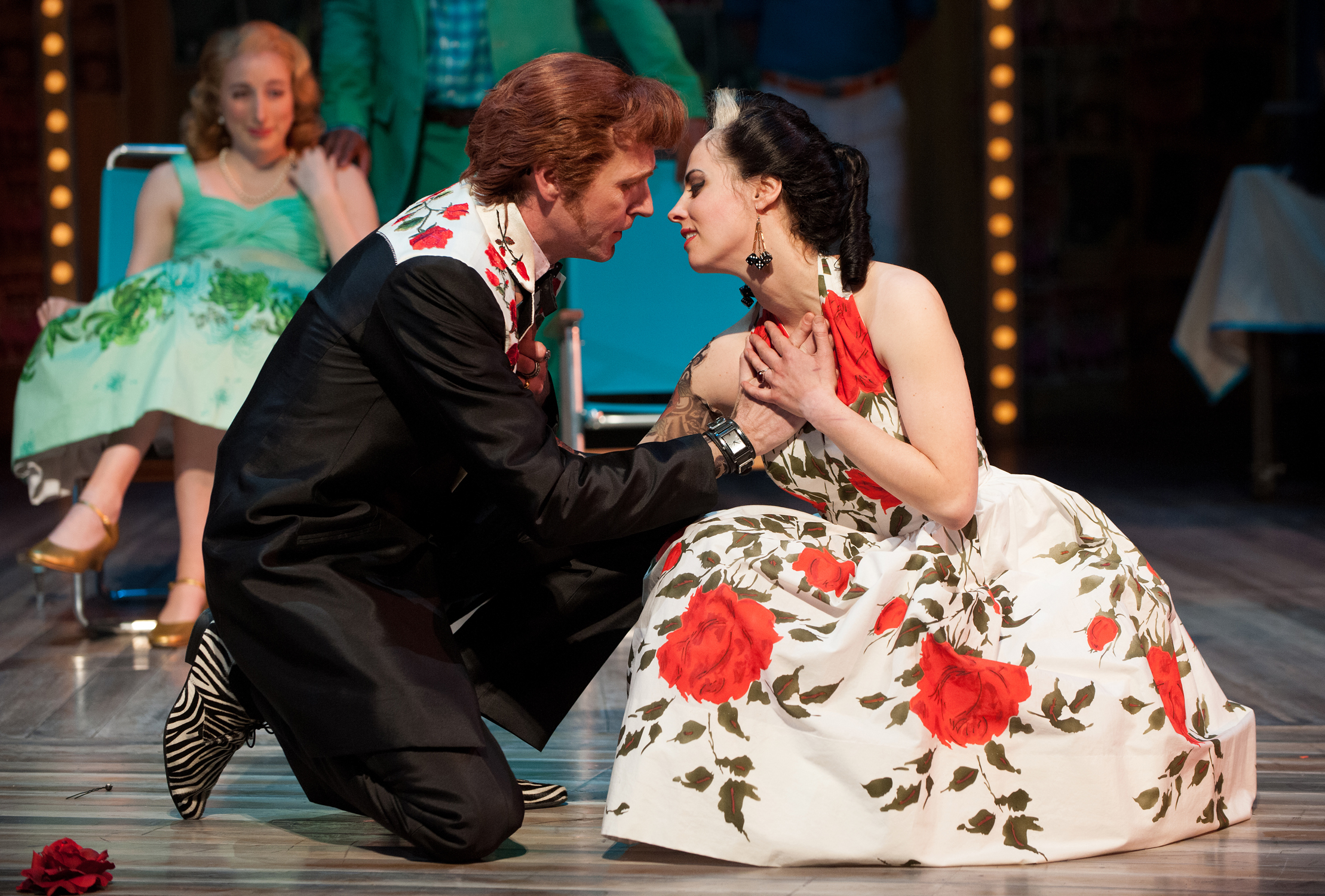
Sarah Ruhl and Les Waters return to Berkeley Rep with Dear Elizabeth, which stars Mary Beth Fisher (left) and Tom Nelis as esteemed poets and lifelong friends Elizabeth Bishop and Robert Lowell.  Photo courtesy of kevinberne.com

DEAR ELIZABETH BY Sarah Ruhl and directed by Les Waters. Berkeley Rep’s, Roda Theatre, 2015 Addison St., Berkeley. (510) 647-2949. www.berkeleyrep.org. Through July 7, 2013

DEAR ELIZABETH is not about Elizabeth Barrett Browning.

Many of the opening night audience were totally unaware of poets Elizabeth Bishop and Robert Lowell even though they were prominent writers from the late 30s to the early 70s. When director Les Waters was first asked to collaborate with Sarah Ruhl who was working on a stage version of the complete correspondence between Bishop and Lowell, published in 2008 as the 900-plus “Words in Air.” He confesses that he too was unaware of their work or fame but that did not deter him.

Ruhl and Waters are close friends and their collaborative works have graced the Berkeley Rep’s stages including the superb Eurydice and In the Next Room (or the Vibrator Play. They have again come up with a winner but it lacks the total qualities displayed in their previous outings. This may be due to the limitations place on Ruhl by the trustees of the poets’ estates. She could only use the words written in the letters without embellishment. The words at times soar and apparently create a true picture of two troubled souls that intellectually united even when many miles separated them.  It is Les Waters’ staging and direction that keeps the evening mostly alive.

This show is a co-production with the Yale theatre group where it received its world premiere in 2012 and Mary Beth Fisher reprises her role as Elizabeth Bishop. The talented Tom Nellis is the second half of this two-hander and creates a multifaceted Robert Lowell including bouts of manic depression (now known as bi-polar disorder), flights of fancy and touching unrequited love. Fisher is completely comfortable in her role and displays a perfect touch of reticence between her underplayed bouts of alcoholism.

They sit side by side on a desk center stage on Annie Smarts beautiful yet utilitarian set that must become multiple locations such as Yaddo an artist’s colony in Saratoga Springs, New York, Brazil, Maine, Italy, the Library of Congress and many more. Projections are used to delineate time and place.The actors leave the desk to make forays to left or right stage that become their individual domains and they only physically embrace once. This gesture may be imaginary gesture since Bishop was enamored with Lota de Macedo Soares her Brazilian partner.

To spice things up, clever Les Waters actually adds a real waterfall that floods the stage, not once but twice to emphasize Bishop’s poem:

“There are too many waterfalls here; the crowded streams

hurry too rapidly down to the seas,

and the pressure of so many clouds on the mountaintops

makes them spill over the sides in soft slow-motion,

Turning to waterfalls under our very eyes.

(Excerpt from “Questions of Travel”)

In summary: A charming evening worth a visit. Running time under two hours including intermission.

Kedar K. Adour, MD

Courtesy of www.theatreworldinternetmagazine.com

 

Marin’s ‘Beauty Queen of Leenane’ misses the mark

By Judy Richter

By Judy Richter

In “The Beauty Queen of Leenane,” a mother and daughter are caught in a web of dependence, distrust, manipulation and antipathy.

The Marin Theatre Company production catches most of those undertones in this 1996 drama by Irish playwright Martin McDonagh. It also undermines several other aspects of what should be a riveting play.

The action takes place during the mid-1990s in a rundown cottage in the Irish village of Leenane. The mother is 70-year-old Mag (Joy Carlin), who recites a litany of physical ailments both real and imagined.

Her spinster daughter is 40-year-old Maureen (Beth Wilmurt). Mag is controlling yet dependent on Maureen, who seems to have no other options in their economically distressed town.

Her fortunes appear to brighten when she and a neighbor, Pato Dooley (Rod Gnapp), connect romantically. He affectionately calls her the beauty queen of Leenane, but her dreams are dashed when Mag intervenes, leading to a tragic ending.

Carlin effectively portrays Mag’s wiliness, neediness and approaching dementia. For the most part, Wilmurt conveys Maureen’s emotional roller coaster as well as her underlying mental instability, but some of the character’s vulnerability is missing.

Gnapp does well as Pato, the play’s most decent, likable character. His monologue that opens Act 2 captures those qualities in a letter that he writes to Maureen fromEngland, where he has gone to work in construction.

The play’s weakest link is Joseph Salazar as Pato’s younger brother, Ray, a selfish, boorish lout who taunts Mag and Maureen. As directed by Mark Jackson, however, he talks so fast in his Irish accent that he’s often unintelligible.

That’s a problem because Ray plays an important, though unwitting role in the play’s outcome. Salazar also looks too clean-cut for the character.

The cottage set by Nina Ball dilutes some of the play’s power because its back wall is open, minimizing the claustrophobic atmosphere that’s so integral in the Mag-Maureen relationship.

Bay Area theatergoers who didn’t see Berkeley Repertory Theatre’s brilliant 1999 production or San Jose Stage Company’s excellent 2002 production might underestimate the power of McDonagh’s award-winning play mainly because of some of director Jackson’s choices. That’s unfortunate.

“The Beauty Queen of Leenane” continues through June 16 at Marin Theatre Company, 397 Miller Ave., MillValley. For tickets and information, call (415) 388-5208 or visit www.marintheatre.org.


THE BEAUTY QUEEN OF LEENANE needs closed-caption super titles.

By Kedar K. Adour


Beth Wilmurt (Maureen Folan) and Rod Gnapp (Pato Dooley) in Martin McDonagh’s The Beauty Queen of Leenane, directed by Mark Jackson, at Marin Theatre Company in Mill Valley, now through June 16. Phtos by Kevin Berne

THE BEAUTY QUEEN OF LEENANE: Drama by Martin McDonagh and Directed by Mark Jackson. Marin Theatre Company (MTC), 97 Miller Avenue, Mill Valley, CA 94941. (415) 388-5208 or www.marintheatre.org. May 23 – June 16, 2013

THE BEAUTY QUEEN OF LEENANE needs closed-caption super titles.

Irish plays are notoriously talkative and so it is with Martin McDonagh’s The Beauty Queen of Leenane. It is the first of his multi-award-winning “Leenane Trilogy” that includes A Skull in Connemara and, The Lonesome West taking place in the imaginary village of Leenane in Connemara, County Galaway. Leenane has “been described as not as a place to live, but a place to leave.”

McDonagh in his imaginary village has created a claustrophobic setting with the action taking place in a single room kitchen where the title character Maureen (Beth Wilmurt) is living with her demanding and controlling 70 year old mother Mag (Joy Carlin). The 40 year old Maureen has become Mag’s caretaker when the two other sisters ‘escaped’ by marrying and raising families.  Middle-aged construction worker Pato Dooley (Rod Gnapp) living in London re-visits Leenane and after a night of drinking is brought home and bedded by Maureen. As the first act ends there is the spark of romance and one last hope for Maureen to a live a life of her own.

The possibility for the two lonely souls of Maureen and Pato to bond continues in act two with a bitter-sweet monolog by Pato that Gnapp nails with pathos and sincerity. He puts those words into a letter that his brother Ray Dooley (Joseph Salazar) is to deliver only to Maureen. Not to bright Ray is conned by Mag into leaving the letter with her and after she reads the letter burns it. This sets up a chain of horrendous events that have become trade marks of McDonough’s plays.

Mark Jackson is noted for his physically inventive direction but this play becomes more of a fantasy rather than a cruel slice of life written into the text. His last turn at the Aurora Theatre for The Arsonists was stunning. He totally misses the mark for Beauty Queen and may have been undone by a platform set (Nina Ball) mounted in the center of the total stage with flat panels stretching from stage  floor to the ceiling used to project atmospheric lighting (York Kennedy). The music selections (Matt Stines) also leave something to be desired.

Then we return to the dialect coaching (Lynne Soffer). Joseph Salazar’s Irish brogue and speed of delivery makes his speeches almost completely

Joy Carlin as Mag Folan

unintelligible and the production crew would be wise to use closed caption super titles while he is on stage. Beth Wilmurt in the lead role is hesitant in the early scenes but becomes very professional as the story unfolds. What make the play worth a visit are the performances of theatre Bay Area legend Joy Carlin with her multilayered performance and the control of the stage by Rod Gnapp when he makes in entrances. Running time about 2 hours including an intermission.

Kedar K. Adour, MD

Courtesy of www.theatreworlinternetmagazine.com

ACT’s Perloff returns to ‘Arcadia’

By Judy Richter

Celebrating her 20th season as artistic director of American Conservatory Theater, Carey Perloff is returning to one of her favorite playwrights, Tom Stoppard, and reviving a play, “Arcadia,” she first directed for ACT in 1995.

Back then ACT was on the road, so to speak, while its home base, the Geary Theater, was being repaired and renovated after suffering major damage in the 1989 Loma Prieta earthquake. Therefore, “Arcadia” was staged in the nearby Stage Door Theater, a smaller venue that’s now Ruby Skye nightclub.

In some ways, it worked better there than in the Geary because of its intimacy. Still, the present production is well done, not an easy feat in view of how intellectually challenging and complex the play is.

The action takes place in one room of a large country house in England’s Derbyshire in 1809, 1812 and the present. It opens in 1809 when 13-year-old Thomasina Coverly (Rebekah Brockman) is being tutored by Septimus Hodge (Jack Cutmore-Scott).

Though somewhat naive, Thomasina is an original thinker who, we later learn, comes up with scientific theories far ahead of her time. She couldn’t prove them because she lacked the computer resources that today’s scientists command.

We also learn that Septimus is much admired by the ladies, including one of the Coverly family’s house guests, as well as Thomasina’s mother, Lady Croom (Julia Coffey).

Present-day happenings alternate with those in the past. The home is still occupied by Coverlys, who are playing host to Hannah Jarvis (Gretchen Egolf), an author studying the history of their garden. Another visitor is Bernard Nightingale (Andy Murray), a don who wants to learn more about a minor poet, Ezra Chater (Nicholas Pelczar), who was a guest at the Coverly home in 1809. He’s also pursuing the possibility that Lord Byron was there at the same time.

Besides those already mentioned, noteworthy performances come from Adam O’Byrnes as Valentine Coverly, one of the home’s present occupants; Anthony Fusco as Richard Noakes, Lady Croom’s landscape architect; and Ken Ruta as Jellaby, a butler for the earlier occupants.

As the action switches between the centuries, we see how what happened in 1809 influences discoveries by the people in the present and how some of the latter’s suppositions are inaccurate.

The set is by Douglas W. Schmidt with lighting by Robert Wierzel, costumes by Alex Jaeger, sound by Jack Rodriguez, music by Michael Roth and choreography by Val Caniparoli.

Stoppard laces all of this activity with humor, sexual undertones and lots of dense intellectual discussion that can be hard for the nonscientific listener to follow. Still, as the play unfolds, more of the action becomes clear, thanks to Stoppard’s genius, Perloff’s direction and an excellent cast.

“Arcadia” will continue at the Geary Theater, 415 Geary St., San Francisco, through June 9. For tickets and information, call (415) 749-2228 or visit www.act-sf.org.

ABIGAIL’S PARTY a dynamic resurrection at SF Playhouse

By Kedar K. Adour

Full cast: Angela (Allison Jean White*) Tony (Patrick Kelly Jones*), Sue (Julia Brothers*) Bev (Susi Damilano), and Laurence (Remi Sandri*)
Photos by Jessica Palopoli

ABIGAIL’S PARTY: Comedy by Mike Leigh and directed by Amy Glazer. SF Playhouse, 450 Post Street, @ Powell, San Francisco, CA 94102 . 415.677.9596 or www.sfplayhouse.org.

May 21 to July 6, 2013

ABIGAIL’S PARTY a dynamic resurrection at SF Playhouse

English drama underwent a critical change in the 60s and 70s with plays being infused with social conscience depicting ordinary people. Early on in that era the noted Arnold Wesker wrote a play titled The Kitchen Sink and that was partially the origin of the term “kitchen sink realism.”  Mike Leigh a contemporary of Wesker’s, but 10 years younger, was nurtured in that milieu and Abigail’s Party, written 35 years ago in 1977, is part of that genre.

Probably a major difference is the intellectual construct of the play that became Leigh’s unique methodology. Rather than write a finished script he started with improvisation after selecting actors for specific roles and allowing them to interact spontaneously. When they had sufficiently “become” that character, Leigh produced a script. So it was with Abigail’s Party. By using this method the final product did have minor topical social significance but truly was a script for directors and actors to demonstrate their wares.

SF Playhouse, in their trademark over-the-top productions, has grasped that quality and under Amy Glazer’s tight but free form direction with brilliant actors has come up with a sparkling production unfolding on another of Bill English’s fantastic sets.  That set is symbolic of the upward mobile “wannabes” of English society reflecting wealth without artistic taste.

The occupants of the house are financially successful and hyperactive estate agent Laurence (Remi Sandri) and his trophy wife Beverly (seductive Susi Damilano).  They are giving a cocktail party, complete with Hors d’oeuvre that include toothpick skewered pineapple-cheese  bites and music that includes a Donna Summer record. Significantly, in a clever plot twist that actually defines a trait in Laurence’s character there are no olives out on the huge coffee table.

Presumably, the reason for the party is to get to know the neighbors.  Angela (Allison Jean White) a nurse and Tony a husky working class bloke (Patrick Kelly Jones) have moved into the upward mobile area two weeks ago. The other guest is Susan (Julie Brothers) divorced 2 years ago whose 15 year old daughter Abigail (who never appears but is tied into a significant plot twist) is having a party at her home down the street.

In the opening scene Laurence has returned home late and in their banter is the first suggestion that their marriage is a bit tenuous. The neighbors are virtually strangers so why were they invited? Apparently for Laurence to display his artistic/affluence showing off his leather bound set of Dickens’ work, his garish overstuffed leather furniture and his love of classical music. Beverly’s motive is not specifically identified but apparently is an attempt to seduce Tony. After the alcohol takes effect, she overtly flirts with Tony.

That is the simple storyline that unfolds in less than two hours in two acts with an intermission. It is the acting that is absolutely superb making this show a must, must see production. Susi Damilano’s in a form fitting, bodice displaying gown exudes sexual attraction as bounces around the stage and garners your attention. The non-verbal performances of Julie Brothers and Patrick Kelly Jones who have minimal dialog would rate Tony Awards. Allison Jean White who initially is a motor-mouth dingbat for most of the evening swings into a gyrating dance late in the play bringing gales of laughter.  When the crisis occurs she switches demeanor adroitly taking charge as the virtual curtain descends.

Kedar Adour, MD

Courtesy of www.theatreworldinternetmagazine.com



The Foreigner by Larry Shue opens in NTC’s New Theater

By Flora Lynn Isaacson

Frederick Lein as Charlie and Johnny DeBernard as Froggy in NTC’s The Foreigner

The opening of The Foreigner represents a long overdue homecoming to Novato because it is the first play to be performed in Novato Theater Company’s new theater space at 5420 Nave Drive and the first play of the 2012-13 season performed in Novato.  While hunting for their new home, NTC produced the other four shows at San Rafael locations.

Director Jerrie Patterson has assembled a cast that seems almost tailor-made for this production.  Charlie Baker (Frederick Lein) is a shy Englishman traveling in rural Georgia with his friend, Froggy LeSueur (Johnny DeBernard), a member of the British army. The two men visit an inn run by Froggy’s old friend, Betty Meeks (Cat Bish).  Charlie is in the midst of marital problems so Froggy decides to leave him at the inn for a few days so he can enjoy some peace and quiet, but Charlie is terrified of having to make any conversation with the inhabitants of the inn, who besides the gregarious Betty, include a crooked Reverend (Robert Nelson), his pregnant fiancé Catherine (Rachel Brogdon) and her slow-witted little brother Ellard (Parker Neely).

Froggy has an idea.  He will tell Betty that Charlie is a foreigner and speaks no English. This gives Charlie the peace he wants as well as providing excitement for the others who have never seen a “real live foreigner” before. This also leads to many hilarious situations—and eventually to a run in with the loathsome Owen Musser (John Conway) and his Ku Klux Klan boys.  But Charlie, through sheer cleverness and courage, defeats the Klan and all ends happily.

The Foreigner incorporates many accents and notions as cultures collide in the Deep South.  This play needs thick Georgia accents, one cultured British and one Cockney accent. All of the cast give flawless performances. Charlie/Frederick Lein makes up his own dialect and tells one entire story in it. He really comes into his own and steals the show in which Charlie must tell a story in his “native language.”  Johnny DeBernard does a great Cockney accent as Froggy, the cheerful British army man who teaches the use of explosives.  Cat Bish plays the lovable southern lady, Betty Meeks with the right mixture of hillbilly charm and sensitivity.

Other standout performances include Robert Nelson as Reverend David Lee, a charming villain, Parker Neely’s sympathetic portrayal of Ellard and Rachel Brogdon’s self-effacing Catherine.  Parker Neely shines in the scenes where he’s teaching Charlie to speak English.  Rachel Brogdon’s Catherine starts out as a stereotype then beautifully unfolds into something much more complicated. John Conway, one of NTC’s best actors, gives an outstanding performance as Owen Musser, a dangerous racist.  Bravo to Michael Walraven who designed and constructed the set. If you can find a seat near the front-middle of the theater, it truly does feel like you’re in the living room of a rustic lodge in rural Georgia.

Jerrie Patterson directs The Foreigner as a warm, heartfelt drama rather than a farce.  In her words, “One man is forced to act and, in the process, becomes more alive, more connected with others and more aware of him self. As he grows, so do those around him.  By putting on the mask he finds the freedom to be him self…”

The Foreigner runs at Novato Theater Company, May 24-June 16.  The new location of the Novato Theater Playhouse is 5420 Nave Drive, Suite C, Novato, CA.  Performances are held at 8 p.m. Friday-Saturday; 3 p.m. Sunday.  For tickets, call 415-883-4498 or go online at www.novatotheatercompany.org

Coming up next at NTC will be The Lion In Winter by James Goldman, August 30-September 22, 2013.

Flora Lynn Isaacson


WHO SAID FIRST IS BEST

By Joe Cillo

WHO SAID FIRST WAS BEST?

A first child is your own best foot forward,
And how you do cheer those little feet as they strike out.
Barbara Kingsolver

In all things in life, being first is considered the best.  You win the game, you get the scholarship, you pass the test. You are a winner, that is, everywhere but in your family.

I was my mother’s first born.  She had never HAD a baby before but she was pretty enthusiastic about motherhood until the last three months before I emerged.  She read books about how delightful little babies are with their cute, cuddly ways and she expected me to be a bundle of exquisite joy.  When, at last, I came crashing out of her uterus, I left the warm amniotic fluid that encased me and landed in a cold, hospital room. A bunch of strangers pummeled me to make me cry, cleaned me up and snipped my umbilical cord without so much as a kiss or a word of comfort.

I never got over it.  And neither did my mother.

It appears that all first-born children are emotionally and physically bruised just by being first.   My own mother never expected to have to deal with a crying, spitting, demanding sleepless infant.  She never forgave me for her stitches, the pain, the endless labor she endured for a very questionable reward.  “You almost killed me,” she said, every time she looked it me.

She may have been more verbal than most new mamas, but she was actually no different than every new parent when they have to deal with the unexpected rigor of that first baby.  The crying, the diapers, the pulling at your breast….  …not to mention the terrible guilt because they are not REALLY enjoying the process.

Everyone knows first-borns seem smarter, more aggressive and more successful than their siblings.  This is because they are constantly proving to their parents and themselves that they were worth the pain and suffering they caused. First-borns are usually taller than their siblings because they are the ones that have to reach up to get the dishes off the shelf to feed their little brothers and sisters. They are thinner too and that is probably because parents are always more careful to feed the first one proper food and teach them the good eating habits child care books tell them are best.  I had to eat my spinach or else while my sister dined on leftover pie and gallons of pudding.  The result was that she tips the scale at 400 pounds and I have yet to top 100.

All that stress and responsibly can kill a person and we now know that it actually does.  Researchers in New Zealand discovered that the oldest child from the most well-meaning families suffer more heart attacks, higher blood pressure and have a stubborn resistance to insulin that makes them susceptible to diabetes.  That means that the child born first will probably be the first one to go to the other side.

By the time the second kid comes along, the parents are more relaxed.  They don’t really notice the germs or the squealing and besides they have the older one to baby-sit.  It is the oldest child who ends up being a substitute parent to the others.  He is the one who establishes the family reputation in school for industry and intelligence. Band most unfair, when he kicks off, the younger ones get the inheritance.

It doesn’t seem right, does it?  That is why I now call on all older children to unite!!!!  When that new little nipper comes into the house, use those brains that made you the smart one and smother it with a pillow before it gets out of line.

BIRDS OF A FEATHER an anthropomorphic evening of serious fun.

By Kedar K. Adour

“Birds do it, bees do it- Let’s fall in love!”
L to R: Dave Levine as Roy, Luke Taylor as Tango, Elissa Beth Stebbins as Zookeeper and Christopher Morrell as Birder

BIRDS OF A FEATHER: Comedy by Marc Acito and directed by Tom Bruett. New Conservatory Theatre Center, (Walker Theatre), located at 25 Van Ness Avenue near Market Street in San Francisco, 94102. (415) 861-8972 or online at www.nctcsf.org.

Through June 29, 2013

BIRDS OF A FEATHER an anthropomorphic evening of serious fun.

An excellent way to make a controversial point palatable to an audience is to give animals human traits known as anthropomorphism and allow them to convey your ideas/words. You see this every day in cartoons. Marc Acito, author of the comic novels How I Paid for College: A Novel of Sex has taken actual events involving birds and humans coming up with this clever play Birds of a Feather receiving its San Francisco premiere at the New Conservatory in the intimate Walker Theatre.

One of the three major elements of the story involve a real pair of male penguins who nested together and were allowed to hatch an egg and raise the chick with both sharing the nesting duties. This story of ‘gay’ penguins inspired the children’s book And Tango Makes Three by Peter Parnell and Justin Richardson. Alas, the book was banned from school library and it also raised the hackles of conservatives because of the homosexual nature of the penguin’s relationship.

The second part of the story involves a pair of red-tailed hawks, Pale Male and Lola, who built a nest on the upper floor of a luxury high rise building and became a viewing sensation for New York City and beyond. The nesting pair were the darlings of millions of people with the exception of those who lived in the building because of half-eaten rats and pigeons and bird s—t. The nest was taken down but the uproar of the populous was so great the condo rebuilt a platform for future nests. Pale Male and Lola never produced another chick in that nesting area.

The third element involves the humans Paula Zahn and her husband who were the darlings of the paparazzi who documented their nasty divorce proceedings in all the tabloids and on TV.

Four fine actors play multiple (25+??) roles and change swiftly in and out of costumes changing their demeanor to fit that specific character. The two penguins are Silo and Roy (Luke Taylor and David Levine) and the two hawks are the same pair playing Pale Male and Lola. Levine slips from the female caricature of Roy to the macho male image of Pale Male and vice versa for Taylor from male penguin Silo to female hawk Lola. It is all a lot of fun with serious over-tones of gender specific roles being unacceptable since each pair of birds is a ‘family’ sharing child rearing.

Elissa Beth Stebbins as the Zookeeper and Paula Zane give the most professional performance without infringing on the actions of her fellow thespians. The other ‘human’ is simply called Birder and Christopher Morrell who has to play it mostly straight is a great match for Stebbins. In the play those characters are loners but Acito has a charming semi-epilog who find the first tentative stirrings of love as the story of Roy and Silo comes to an end.  They discover each other reaffirming that being love is tough but is a hell of a lot better than loneliness.

The dialog and physical action is supplemented by projections including a video of  the hawks flying under the “Everywhere of Blue” so admired by penguin Silo. Running time about 90 minutes with an intermission.

Kedar K. Adour, MD

Courtesy of www.theatreworldinternetmagazine.com

Stoppard’s abstruse ARCADIA is beautifully staged by A.C.T.

By Kedar K. Adour

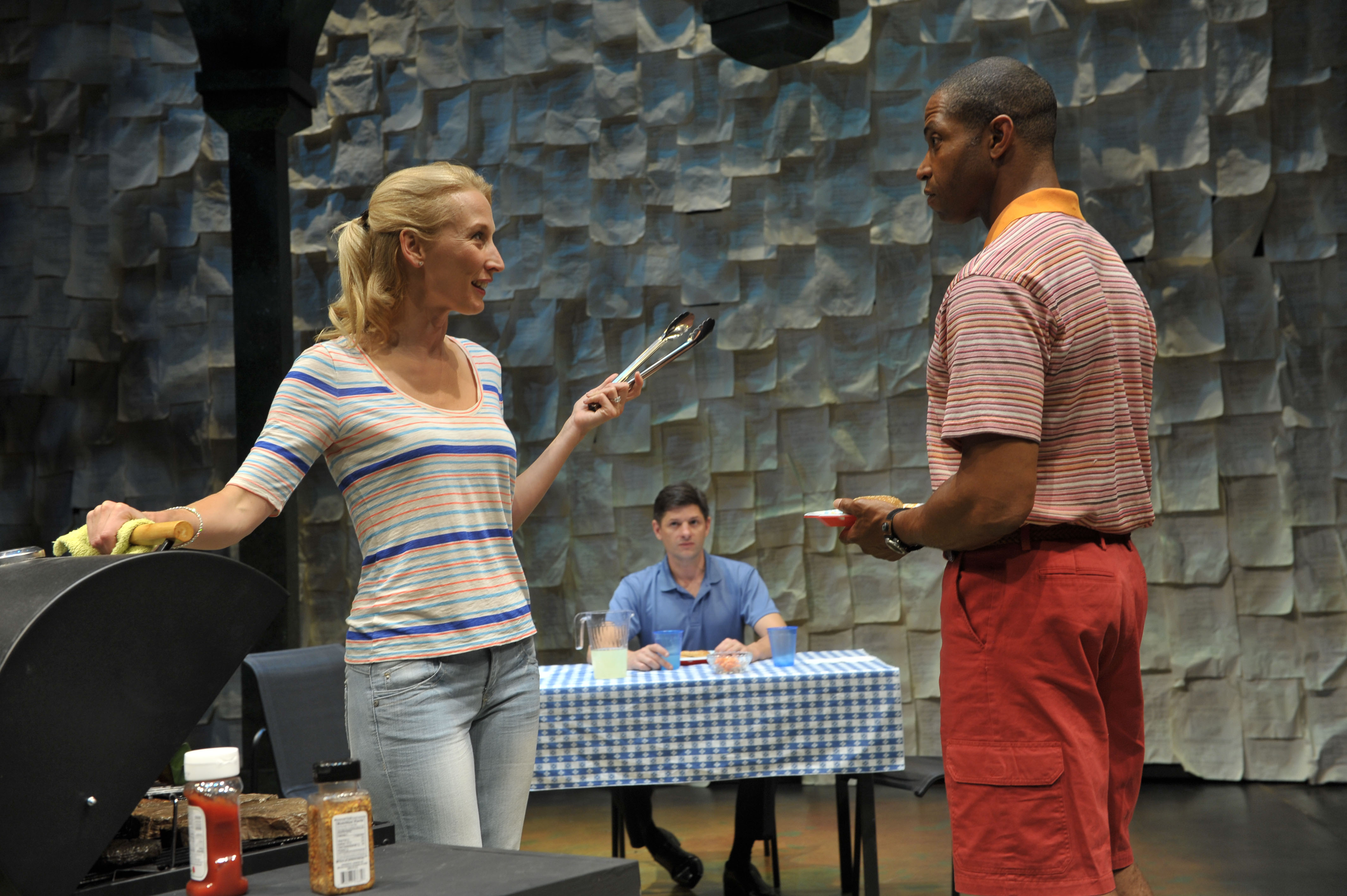
Rebekah Brockman (Thomasina Coverly) and Jack Cutmore-Scott (Septimus Hodge) in A.C.T.’s production of Tom Stoppard’s Arcadia, directed by Carey Perloff. Photo by Kevin Berne.

ARCADIA: Drama. By Tom Stoppard. Directed by Carey Perloff. American Conservatory Theater (A.C.T.), 415 Geary Street, San Francisco. (415) 749-2228 or www.act-sf.org. Through June 9, 2013.

Stoppard’s abstruse ARCADIA is beautifully staged by A.C.T.

The love affair between artistic director Carey Perloff and Tom Stoppard continues with a stunning staging of the esoteric Arcadia that is considered Stoppard’s masterpiece. A.C.T.’s first go around with Stoppard began in 1969 with Rosencrantz and Guildenstern Are Dead and continued with Jumpers, Travesties, Night and Day, The Real Thing, Hapgood, Arcadia I(1995), Indian Ink U.S. Premiere), The Invention of Love (U.S. Premiere), and lastly Rock ‘n Roll.  With the exception of Arcadia this reviewer had seen all of the plays listed and was impressed.

It behooves those of us who have never seen nor read Arcadia to do research about the concepts discussed in the two acts, seven scene, and three hour play before going to the theatre. Even then there will be difficulty understanding the interaction of two generations one who has lived and the other living 200 years later in a very large country house in Derbyshire, England. The scenes shift from1809 to the present with the final scene a confusion as Stoppard has taken a page from Alan Ayckbourn’s How the Other Half Loves having the two families, although in different eras, sharing the same space. The first scene is a joy to watch with fine actors romping about and capturing the audience with its self-contained storyline wrapped in humor with marvelous tongue-and-cheek direction.

It is 1809 and the place is a room on the garden front of the mansion. Intellectually precocious 13 year old Thomasina Coverly (Rebekah Brockman) is studying mathematics with her tutor Septimus Hodge (Jack  Cutmore-Scott). She is trying to prove Fermat’s last theorem but she is

Jack Cutmore-Scott (Septimus Hodge) and Nicholas Pelczar (Ezra Chater)

more interested in having a definition of “carnal embrace” since the word has spread that Septimus was seen in the gazebo having such an embrace with Mrs. Chater married to second-rate poet Ezra Chater (Nicholas Pelczar).  Ezra, with Captain Brice (Nick Gabriel) as his second is attempting to induce Septimus into a duel.  Pelczar plays the role of Ezra with flamboyant indignation while Cutmore-Scott’s Septimus parries with brilliant delicious aplomb and flattery that wins the day. It helps that San Francisco icon Ken Ruta plays the role of Jellaby the butler.

From this point on, Stoppard indulges in his trademark intellectual banter with each major character getting his turn to emote and carry the storyline as the time frame shifts between 1809 and the present. To Stoppard’s credit and Perloff’s direction the relationship between the family characters becomes understandable and the unraveling of who did what to whom is plausible.

Lord Byron is introduced into the mystery of what happened to Ezra Chater. Did Byron have a fling with Chater’s wife and did he kill Ezra in a duel? This allows Stoppard to introduce Bernard Nightingale (dynamic Andy Murray) a present day literary critic and chronicler of Lord Byron’s life into the mix. Murray’s time upon the stage adds greatly to the humor and his parrying with Gretchen Egolf playing author Hannah Jarvis whose book has been belittled by Nightingale is first rate theatre.

Interspersed with the individual gems of acting are longwinded stretches of dialog where Stoppard is conveying to us the dictum that he is an intellectual giant. That may be so, but with almost hours of running time Arcadia is not for everyone.

Kedar K. Adour, MD

Courtesy of www.theatreworldinternetmagazine.com.


Much to savor in ‘Sweet Charity’

By Judy Richter

The title character in “Sweet Charity” is Charity Hope Valentine, a hopeful yet hapless dance hall hostess who’s just looking for love. As played by Molly Bell for Center REPertory Company in Walnut Creek, she’s lovable and irrepressible.

She’s also a terrific singer, dancer and actress as Charity finds herself in some unusual situations. Director Timothy Near has surrounded her with a cast of triple-threat performers who deliver songs by composer Cy Coleman and lyricist Dorothy Fields with high energy and precision dancing, thanks to choreographer Jennifer Perry.

Much of Perry’s choreography reflects the influence of the late Bob Fosse, who conceived, staged and choreographed the original 1966 Broadway production starring Gwen Verdon. He also directed and choreographed the 1969 film starring Shirley MacLaine.

This stage production is more satisfying than the film in part because Bell has an air of naivete that’s more suited for the title role and in part because the final scenes are clearer about the motivation of Charity’s latest boyfriend, Oscar (Keith Pinto).

Moreover, the film feels bloated at times, whereas everything in this stage production stems logically from the characters and Neil Simon’s book.

The first act introduces Charity as a sunny but overly generous young woman who is literally dumped by a boyfriend.

Next comes the memorable “Big Spender,” performed by Charity’s jaded dance hall colleagues, including her two best friends, Helene (Brittany Danielle and Nickie (Alison Ewing).

The entire company is featured in production numbers like “Rich Man’s Frug” and “The Rhythm of Life,” the latter featuring James Monroe Iglehart as religious leader Daddy Brubeck.

Some of Bell’s more memorable moments come in “If My Friends Could See Me Now” and “Where Am I Going.”

Bell, Danielle and Ewing team up for the emphatic “There’s Gotta Be Something Better Than This.”

Other featured performers are Colin Thomson as Herman, the dance hall boss, and Noel Anthony as Vittorio, an Italian movie star.

Complemented by Kurt Landisman’s lighting, Annie Smart’s set design helps to keep the action flowing smoothly. Christine Crook designed the eye-catching costumes.

All elements of this show add up to a thoroughly entertaining evening that’s well worth the trip to Walnut Creek.

“Sweet Charity” continues at the Lesher Center for the Arts, 1601 Civic Drive, Walnut Creek, through June 22. For tickets and information, call (925) 943-7469 or visit www.CenterREP.org.