‘Once’ re-defines what a musical romance can be

By Woody Weingarten

Woody’s [rating: 5]

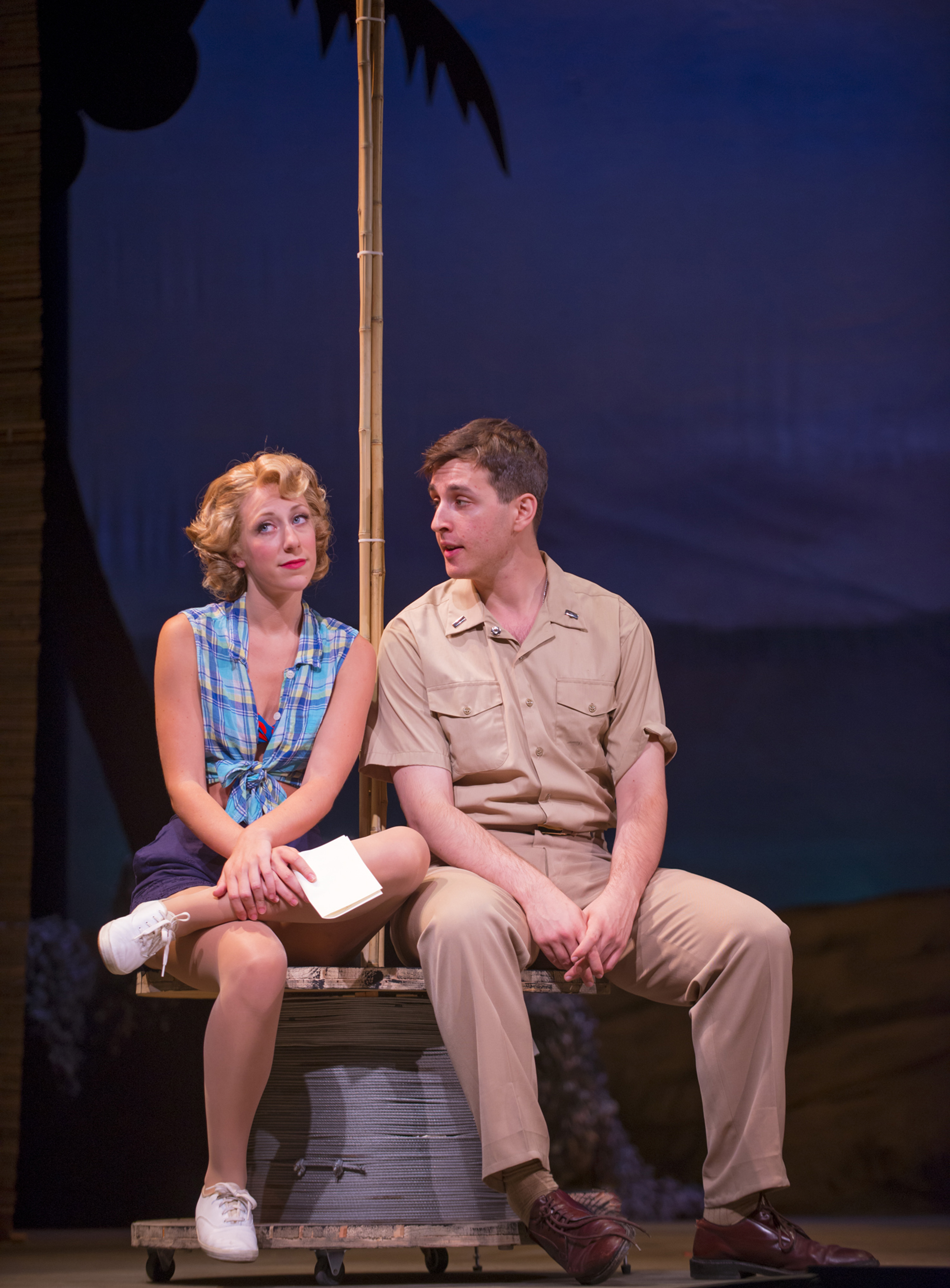
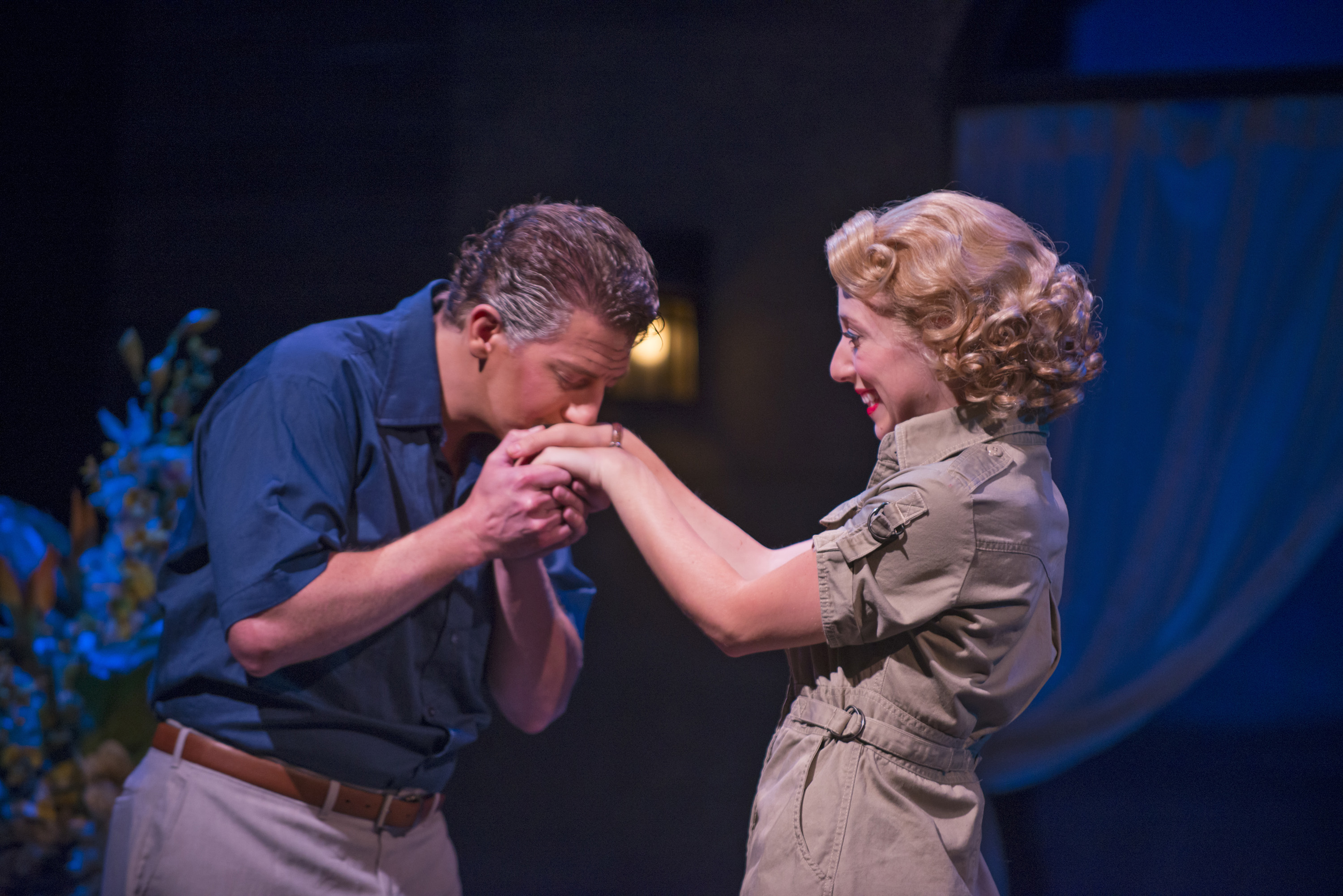
Stuart Ward and Dani de Waal share a tender moment in “Once.” Photo by Joan Marcus.

The multi-talented “Once” ensemble sings, dances, plays instruments and acts. Photo by Joan Marcus.

When it comes to theater and films, I differ from most critics: I embrace sentimentality and romance.

And I cry a lot.

It figures, then, that I loved the 2006 film “Once.” I thought it was sweet.

And sensitive.

Now I’ve fallen in love with a new staged adaptation at the SHN Curran Theatre in San Francisco.

It re-defines what a staged musical can be.

It’s not for those who want leggy chorus girls in skimpy, glitzy costumes; choreography that finds fresh but often maddening ways for bodies to move; huge props flying overhead; or light shows that make strobes feel a thousand years old.

But it is for anyone who wants to taste the potential depths — and heights — of the human condition.

Like me.

Both bittersweet film and play concern a romance in modern day Dublin that can’t quite be actualized, a situation many in the youngish opening night audience related to — to the degree they gave “Once” a standing ovation.

Stuart Ward and Dani de Waal head a multi-talented ensemble that sings, moves rhythmically and collectively plays guitar, fiddle, accordion, cello, mandolin, banjo, piano and cajon (a box-shaped percussion instrument).

Its 10 members also portray a pack of colorful secondary characters.

Those include a laugh-evoking shopkeeper, a dorky loser drooling over a hoped-for promotion, a banker who vocalizes atrociously, a sleazy woman with proverbial heart of gold.

Ward and de Waal portray un-named characters in limbo, the guy a disheartened singer-songwriter whose day job is repairing vacuum cleaners, the girl a separated young mother struggling to cobble together a life with her mom and daughter.

Both protagonists want to heal and move forward past unsatisfying relationships.

By linking musically, they help each other get un-stuck.

While unearthing quashed emotions.

Songs range from the familiarity strains of Irish pub and folk tunes to the angry complexities of “Leave” and the simple, plaintive melodies of “When Your Mind’s Made Up,” “Gold,” and the Oscar-winning “Falling Slowly.”

“Once” won eight 2012 Tony’s, including best musical. It’s easy to see why.

Even though it takes a minute or two to get used to the accents — the guy’s Irish, the girl’s Czech. Even though it’s much less subtle than the movie (in which the star-crossed duo never overtly discusses their relationship).

The musical, in contrast, has tons more verbal and physical humor.

And every bit as much tenderness.

Such as when the girl tells the guy in Czech she loves him, but when he asks what she said, she retreats and translates it as, “It looks like rain.”

“Once” also utilizes the gimmick of letting the crowd onstage, pre-show and during intermission, to inspect the antique-mirrored, semi-circle, bi-level set by Bob Crowley — replete with cash bar selling booze, wine, beer, water.

The show also features beguiling slo-mo movements (I hesitate to call them choreography) created by Steven Hoggett.


And innovative touches such as projected supertitles in Czech; fast-paced, unpretentious direction by John Tiffany; spot-on costumes by Crowley; and lighting by Natasha Katz that helped me effortlessly switch moods.

“Once,” of course, merges the talents of Glen Hansard and Markéta Irglová, whose original songs from the film are replicated, and Enda Walsh, who wrote the musical’s book — two elements that caused one theatergoer to exclaim as she was exiting: “It’s a breath of fresh Irish air.”

Halfway through the second act, my tears started to flow — and didn’t stop until after the final scene.

That duplicated my reaction to the film.

I seem to favor entertainment that makes me laugh and cry.

So I adored “Once” on film. And now the touring company has allowed me to love “Once” once again.

“Once” will play at the Curran Theatre, 445 Geary St. (between Mason and Taylor), San Francisco, through July 13. Night performances Tuesdays through Saturdays, 8 p.m. Matinees, Wednesdays, Saturdays and Sundays, 2 p.m. Tickets: $45 to $210 (subject to change). Information:(888) 746-1799 or shnsf.com.


Enthusiasm abounds INTO THE [Surrealistic] WOODS at SF Playhouse

By Kedar K. Adour

FULL CAST

INTO THE WOODS: Musical by Stephen Sondheim (music and lyrics) and James Lapine (book). Directed by Susi Damilano.Music Director Dave Dobrusky.  June 24 to September 6, 2014

Enthusiasm abounds INTO THE [Surrealistic] WOODS at SF Playhouse  [Rating: 4]

 Into the Woods the musical by Stephen Sondheim and James Lapine opened in San Diego at the Old Globe Theatre in 1986, and premiered on Broadway in 1987. It won Tony awards for Best Score and Best Actress in a Musical (Joanna Gleason) and has been staged many times in regional/community theatres throughout the United States along with London and TV productions. A Disney movie is scheduled to open during the 2014 Holiday season.

After seeing the memorable 2002 Broadway revival with Vanessa Williams as the Witch and reviewing five local productions of Into the Woods comparisons seem appropriate and inevitable. After rereading those local reviews it is concluded that the TheatreWorks production was the most technically/satisfyingly proficient, the Sixth Street mounting the most charming, the Broadway by the Bay staging most hectic, the Ray of Light creation the most energetic and this SF Playhouse the most original. Originality is what we have come to expect from the SF Playhouse and this production does not disappoint.

The massive monochromatic surrealistic forest (set by Nina Ball) with nary a green leaf in sight signaled that director Damilano would probably emphasize the darker elements of this masterpiece musical. Why then is the young Boy (Ian DeVaynes) prancing across the stage throwing his NERF ball into the audience? Ah ha!  When the Narrator (Louis Parnell) comes out to start the show with “Once upon a time. . .” and to end the show with the same line, he is telling the story to the boy. Clever? Yes, since the finale includes the plaintiff song “Children Will Listen.” That Boy with nary a line of dialog remains on stage for most of the evening and takes part manipulating some props with a unexpected twist becoming the reincarnation of the Mysterious Man as a boy.  To this reviewer he is a distraction to the fine performance of Parnell as the Narrator doubling as the Mysterious Man.

Damilano wisely limits her experiments with this classic allowing Sondheim traditionalist to enjoy the music played by a seven piece orchestra under the superb direction of pianist/music director Dave Dobrusky.  Also, the major characters of her 15 member cast (excluding the Boy) have good to great voices but sometimes do not capture the cadences of the recitative and spoken dialog.

Sondheim and Lapine‘s fantasy, a contorted view of  Grimm’s fairy-tales, includes characters taken from “Little Red Riding Hood”, “Jack and the Beanstalk”, “Rapunzel”, and “Cinderella”, as well as several others. They added their own tale of a Baker (an excellent Keith Pinto) and his wife ( El Beh) who is childless due to a curse placed on them by the neighboring Witch(Safiya Fredericks) because the Baker’s father has stolen the greens from her garden. This is the first bit of morality that abounds in the play; the sins of the father shall be passed on to the son.

If they gather four ingredients required for a potion the curse will be lifted. Into the woods they go meeting the aforementioned characters. Each possesses one ingredient: Jack (Tim Homsley) “a cow as white as milk”, Red Riding Hood (Corinne Proctor) “the cape as red as blood”, Rapunzel (Noelani Neal) “the hair as yellow as corn” and Cinderella (Monique Hafen) “a slipper as pure as gold.”

In the woods go two handsome/vain Princes (Ryan McCrary and Jeffrey Adams) from other fables that intersect through unexpected new plot twists. All have ventured “into the woods” for their own purpose to “find what they wish for.”

By the end of the energetic, humorous, intriguing 90-minute first act all have found what they wish for singing a rousing first act curtain chorus of “Ever After” and they should “live happily ever after.”

My personal choice would to head home in a happy mood after the first act curtain. It is not to be. There is the admonishment to “beware of what you wish for.” The narrator’s Act II prologue “So Happy” ends with the Baker’s house destroyed by a huge footprint.  The widow of the Giant that Jack has slain has arrived to seek revenge. Back into the woods they all go. This time the plot is indeed black surrounded by death and destruction and “happily ever after” is not to be.

The music is classic Sondheim with tricky cryptic lyrics and intricate tonality, which are handled fairly well by most of the cast. Sondheim and Lapine inject a hopeful note with the plaintive “No One Is Alone” and the finale “Children Will Listen.”

“Into The Woods” is a fascinating musical that can be appreciated on many levels starting with the selection of your favorite character. Dulcet voiced Monique Hafen is charming as Cinderella. Tim Homsley as simple minded Jack of beanstalk fame has a fine baritone voice and bounces up the down and across the se with alacrity. Pert Corinne Proctor has the right amount of insouciance for the part of Red Riding Hood. Jeffery Brian Adams and Ryan McCrary have a show stopper with their duet of “Agony.” Safiya Fredericks as the Witch in undone by a costume that appears to have been a cast-off from a second hand store and by her transformation wearing a dominatrix leather outfit. She overcomes her costumes with her dramatic singing of “Witch’s Lament” and “Last Midnight.”

To mention all 16 members of the cast would make a long review. Be assured they all perform admirably with enthusiasm, zany humor, flair and they all have fun. You will too. Running time 2 hours and 45 minutes.

CAST: Louis Parnell (Narrator/Mysterious Man), Ian DeVaynes (Boy); Safiya Fredericks (Witch); El Beh (Baker’s Wife); Keith Pinto (Baker), Tim Homsley* (Jack); Bekka Fink (Stepmom), identical twins, Lily and Michelle Drexler (Cinderella’s Stepsisters), Noelani Neal (Rapunzel), Corinne Proctor (Red), Ryan McCrary and Jeffrey Adams (Princes/Wolves) and John Paul Gonzales (Steward); Maureen McVerry (Jack’s Mother/Granny).

Creative Team: Susi Damilano (Director); Dave Dobrusky (Music Director); Kimberly Richards (Choreographer);Sound Design,Theodore J.H. Hulsker;Stage Manager, TatjanaGenser (through 8/10) & Courtney Legget(8/11- 9/6); Lighting Design, Michael Oesch;Set Design, Nina Ball; Costume Design, Abra Berman;Casting,Lauren English;Props Artisan,Jacquelyn Scott; Sound Engineer, Anton Hedman; Wig Design,Tabbitha McBride

Kedar K. Adour, MD

Courtesy of  www.theatreworldinternetmagazine.com

Double the fun in ‘Comedy of Errors’

By Judy Richter

“The Comedy of Errors,” William Shakespeare’s shortest play and one of his earliest,  is also one of his funniest, especially in the California Shakespeare Theater production.

This story of two sets of twins separated in infancy results in one hilarious case of mistaken identity after another when they all wind up in the same town as adults. Director Aaron Posner ups the ante by casting one actor to play one pair of twins and one to play the other. Then he uses only five more actors to play everyone else.

The action is set in the ancient Greek city ofEphesus, where Egeon (Ron Campbell), a merchant fromSyracuse, comes in search of his son, Antipholus (Adrian Danzig) and his son’s servant, Dromio, (Danny Scheie), who in turn are searching for their long-lost brothers, also named Antipholus and Dromio. When the two younger men arrive in Ephesus, they are mistaken for their twins, who have lived there for some time, long enough for Antipholus of Ephesus to be married to Adriana (Nemuna Ceesay).

The resulting confusion leads to plenty of laughs. Scheie is especially hilarious in the scene in which the two Dromios talk to each other supposedly with a closed gate between them. Merely by turning his cap and pivoting a few steps, Scheie becomes one or the other.

In the meantime, Danzig’s Antipholus of Syracuse is attracted to Adriana’s younger sister, Luciana (Tristan Cunningham), who is torn between her attraction to him and, believing he’s her brother-in-law, her loyalty to Adriana. Both prove to be graceful dancers (movement directed by Erika Chong Shuch). Danzig displays considerable physical skills elsewhere, too.

Besides the actors already named, the cast features Patty Gallagher and Liam Vincent, who, like Campbell, create varied characters thanks to their own acting skills and Beaver Bauer’s inventive costumes.

Multi-colored shutters with peeling paint along with several levels of wood plank ramps and platforms dominate the set by Nina Ball. Lighting is by David Lee Cuthbert and sound by Andre Pluess.

Before the show starts, the actors mingle with the audience. When they go onto the stage, they make the pre-show announcements that artistic director Jonathan Moscone and managing director Susie Falk usually make on opening nights.

All of this takes place in a dramatic outdoor setting of rolling golden hills and eucalyptus groves, adding up to a highly enjoyable experience.

“The Comedy of Errors” will continue at the Bruns Memorial Amphitheater, 100 California Shakespeare Way(off Hwy. 24), Orinda, through July 20. For tickets and information, call (510) 548-9666 or visit www.calshakes.org.


Comic Will Durst’s solo show on aging kills crowd

By Woody Weingarten

Woody’s [rating: 5]

Stand-up comedian Will Durst, not exactly standing up.

Clownish Geoff Hoyle created an ingenious one-man show, “Geezer.” It featured multiple characters and a storyline.

Will Durst apparently doesn’t need either.

His uproarious 85-minute monologue, “BoomeRaging: From LSD to OMG,” is all about him and his aging process.

Artfully skewed.

As stand-ups love to say, he killed.

The gray-haired, gray-goateed comic in gray suit and white sneakers was so hysterically funny recently that half a dozen folks in front of me often doubled up with laughter and nearly fell off their seats in Petaluma’s Cinnabar Theater.

As a baby boomer, the 62-year-old confesses, life once was filled with sex, drugs and rock ‘n’ roll — “now, naps.”

Folks his age are still doing drugs, he says, “only now there’s a co-pay.”

And urinating three times a night, he informs his audience, is “highly effective for home security.”

Durst’s rapid-fire delivery meant that if one joke didn’t get me to laugh aloud, I had only to wait a second or two and the next undoubtedly would.

His rolling eyes, ersatz pained pauses and intentionally sloppy use of an ancient overhead projector all added to my pleasure.

I can’t remember being more amused by anything in years.

My stomach ached from laughing.

If you’re aching for a similar experience, you’ll  have to wait a while. But you can catch him, for at least a few minutes, on Sept. 14 in Golden Gate Park — where he’s been for the previous 33 years (the only performer to walk softly and carry a big shtick in every one of the annual Comedy Day events there).

Durst, most familiar for his political satire, couldn’t have known it but he, himself, had primed me for his Cinnabar show.

I’ve been a picnicking regular for two decades at the Comedy Day events that have drawn such names as Robin Williams, Whoopi Goldberg, Ellen DeGeneres, Dana Carvey, Paula Poundstone and Margaret Cho. And although I laughed at each of them, I never admired anyone more than Durst, whose political insights have been rightfully compared to Will Rogers and Mort Sahl.

As if to keep me in thrall, before dealing in “BoomeRaging: From LSD to OMG” with the daily technological hells we all face these days, Durst slyly injected a soupçon of politics by exposing presidential candidates as Tweedledum and Tweedledee.

Yet all of it, in a sense, might be considered just a preamble to his unique vision of The Meaning of Life, a seriocomic subtext on pulling the plug.

Durst, an always-dependable master of sarcasm and sardonic one-liners, is hardly a one-trick pony. A five-time Emmy nominee, he claims PBS fired him thrice. But he still writes a syndicated newspaper column, does broadcast commentaries and weekly podcasts, and has written three books.

His radio commercials about creating state jobs have become ubiquitous.

So has he.

He’s been on TV 800 times.

One of his previous one-man shows, “The All American Sport of Bipartisan Bashing,” ran for a while off-Broadway.

And he still regularly produces “The Will Durst Journal” online, under the rubric “Comedy for people who read or know someone who does.”

His heroes, he insists, remain the same as when he was 12 — Thomas Jefferson and Bugs Bunny.

In a moment of pure weakness, the acerbic Durst revealed his hobbies include pinball, a lifelong passion of my own. Oh My God, could that be the underlying reason I’ve liked him so much?

Upcoming one-man shows at Cinnabar, 3333 Petaluma Blvd. N., right off Hwy. 101, include a revival of “Wretch Like Me,” David Templeton’s coming-of-age tale July 25 and 26, and “I Am My Own Wife,” with Steven Abbott playing 40 roles Feb. 6-15. Information: (707) 763-8920 or cinnabartheater.org.

‘Intimate’ exhibit shows small, small world — of art

By Woody Weingarten

 Woody’s [rating: 3.5]

“Mound of Butter,” oil on canvas by Antoine Vollon, is part of the Legion of Honor’s “Intimate Impressionism” exhibit. Photo, courtesy National Gallery of Art.

George Seurat’s oil on panel, “Seascape (Gravelines),” is a prime example of the technique he labeled Pointillism. Photo, courtesy National Gallery of Art.

“The Artist’s Sister at a Window” is a Berthe Morisot oil on canvas. Photo, courtesy National Gallery of Art.

Artistically speaking, does “small” translate into “intimate”?

In the case of “Intimate Impressionism from the National Gallery of Art,” the current show at San Francisco’s Legion of Honor, the answer is a definite “probably.”

All in all, the 21 artists on display created the 68 paintings, mainly oils on canvas, not for exhibit or salons but for drawing rooms or to share with friends and relatives.

The title is mildly misleading, however.

The 19th century artworks (which range from a tiny 5×7 — that’s inches, not feet — to about 24×29) represent pre- and post-Impressionist artists as well as the eight mainstream Impressionists.

All the usual suspects are paraded — among them Edgar Degas, Pierre-Auguste Renoir, Paul Cézanne, Claude Monet (the most prolific, yet under-represented in the Legion show), and Édouard Manet (though he’d appeared in none of the famed original Impressionist exhibits in France).

The pieces that most drew my attention, however, were done by others — Antoine Vallon’s “Mound of Butter,” George Seurat’s “Seascape (Gravelines)” and Berthe Morisot’s “The Artist’s Sister at a Window.”

I found Vallon’s painting exceptionally fascinating.

Oddly, I loved his oh-so-yellow dairy product and the knife swathed in it, his delicate see-through cheesecloth and the accompanying two oh-so-white companion eggs, but couldn’t bring myself to like the gestalt.

Seurat’s Pointillism has always been one of my favorite genres, so this 1890 oil on a panel made my color-ometer jump off the scale.

And Morisot’s fixed-figure study caught my attention simply because women were virtual pariahs in the Parisian movement, a direct reflection of the tenor of the times.

Individual Legion rooms were devoted to Renoir, Jean-Édouard Vuillard and Pierre Bonnard (the latter two being studio-mate post-impressionist Nabis, a group of artistic rebels).

Each contained material I’d call must-see’s.

Check out, for instance, Renoir’s wistful “Young Woman Braiding Her Hair” and, nearby, his “Woman with a Cat,” both sensual, both typical in regard to the artist’s palate and palette. And his flora spectacle, “Picking Flowers,” and his “Portrait of Claude Monet.”

Also, Vuillard’s “Child Wearing a Red Scarf,” an oil on cardboard, as well as several of his works with faceless figures disappearing into the canvas.

And Bonnard’s “The Yellow Curtain,” in which a woman pulls it back to find — well, your guess is as good as anyone’s.

Other items worth viewing include Degas’ “Horses in a Meadow,” a far cry from the more familiar images of “Dancers Backstage,” ensconced later in the exhibit; Eugene Boudin’s “Yacht Basin at Trouville-Deauville,” a colorful oil on wood depicting a multitude of flags that garnish sailboats; Paul Gauguin’s “Self-Portrait Dedicated to [the writer Eugène] Carrière,” Cézanne’s “The Battle of Love,” a Henri de Toulouse-Lautrec’s 1885 oil on wood (“Carmen Gaudin”), Vincent van Gogh’s “Flower Beds in Holland” (a rarely seen work with a gloomy background that contrasts sharply with the bright colors he’s known for); and a striking Manet still life, “Oysters.”

Regrettably, much of the exhibit, which is on tour while the National Gallery revamps its D.C. facility, is over-framed with mega-ornate woods.

And that adds to my overall impression that ”Intimate Impressionism from the National Gallery of Art” doesn’t compare well with last summer’s “Impressionists on the Water” at the Legion — or, for that matter, with previous impressionist exhibits at both the Legion and the de Young.

Still it contains sufficient exceptional material to more than enough merit a trip to the museum.

“Intimate Impressionism from the National Gallery of Art” will be shown through Aug. 3 at the Legion of Honor, 100 34th Ave. (at Clement St.), San Francisco, in Lincoln Park. Closed Mondays. Tickets are free for members and children 5 and under, $11 to $24 non-members. Information: (415) 750-3600 or contact@famsf.org.

Happy 40th Birthday to Beach Blanket Babylon

By Kedar K. Adour

Steve Silver’s BEACH BLANKET BABYLON: Musical Spoof.  Club Fugazi, 678 Beach Blanket Babylon Boulevard, San Francisco, CA. 415-421-4222, www.beachblanketbabylon.com

OPEN ENDED RUN. Running time: 90 minutes, no intermission

Happy 40th Birthday to Beach Blanket Babylon [rating:5]

Who would have thought that an irreverent 45 minute musical spoof written and acted in by an the then unknown 30 year old Steve Silver in the back room of the Savoy-Tivoli Bar & Restaurant would become the longest running musical revue in the world? Believe it, it has and continues to play to sold audiences at the 400 seat Club Fugazi in the North Beach area of San Francisco located on Beach Blanket Babylon Boulevard. Yes, the block of Green Street on which the theater is located was officially changed in honor of what we San Franciscans claim to be “our” show.

But it is rightfully advertised as Steve Silver’s Beach Blanket Babylon and it has been exported the White House, performed before Queen Elizabeth and the Duke of Edinburgh, had a successful run in Las Vegas and was guest of the 1997 Covent Garden Musical Arts Festival where it played to “enthusiastic audiences and rave reviews in London.”

In those intervening 39 years the staging has remained fresh with new faces, fancier sets, larger casts, with outrageous parody, zany satire and their trade mark hats have become bigger and bigger. Three of the cast members (Renee Lubin, Tammy Nelson, Doug Magpiong) have been in the show for 20 years and more.  Their performances, often show stoppers, are as vibrant as those of the relative new comers. Each year there are auditions for possible replacement. All the shenanigans have tremendous backup by a six piece band in partial view off-stage right that become part of the pandemonium on stage.

Describing the non-stop activity as pandemonium is unfair since the acts are intricately staged with hilarious (sometimes ribald) choreography, split second timing and unbelievable speedy costume changes. The hats may be the trade mark of the show but those costumes almost steal the show. The voices are excellent and the audience cheers when Lubin and Nelson belt out their songs. All the cast members play a dozen parts and keeping them separate is impossible while wearing the massive costumes and hair-pieces/hats. As an example Renee Lubin starts out playing Glinda the Good Witch switches to a suave Michelle Obama, a Country Western Cow-Gal wearing chaps and Tina Turner in a wig two feet tall.

To celebrate their 40th year there have been gala events at the Symphony Hall and City Hall along with multiple fluff pieces and cast/musician interviews for weeks in the daily and weekly newspapers. The adjective being used “magical, fun-filled; brilliant, sparkles, high paced, raucous, witty disorder, irreverence, zany musical spoof, pop culture, hilarious parodies of celebrities that changes with the times.”

The plot is simple. Poor Snow White is living in San Francisco and is looking for love. Before she goes out into the ‘real” world we meet Hippies [Age of Aquarius, Let the Sun Shine In, Flowers in Your Hair], The Beatles [Dr. Pepper] and Cher  [When the Moon Hits Your eye like a big Pizza] and we are whisked off to Rome.

Do not ask why we meet Oprah Winfrey [ book club hat], Hilary and Bill Clinton [The Heat is On], Senator Nancy Pelosi on a motorcycle, Barrack Obama [Rock Around the Clock and his Viagra ‘stimulant package’], Michelle Obama [Too Good to be True], Governor Jerry Brown [high speed train], Sarah Palin [Guns in her hair], etc. etc.

Held over from other shows are “Gay” Louie the XIV all in pink with a three foot wide pink hair-do, Tom Cruise [Scientology for Dummies], Conchita and her bannas, Jewish Mother and her shopping cart, Michael Jackson [Thriller], 50 Shades of Grey [Show you how to be a woman], and of course the naughty, naughty three French Poodles who dance up a raunchy storm and more and more.

Our intrepid heroine makes a magical change into Madonna and flies over the audience on wires before finally ending up back in San Francisco wearing a huge wedding cake hat [with a surprise inside] to share the stage with an updated skyline hat of san Francisco.

This is a MUST SEE show.

CAST: Jacqui Arslan; Isaiah Tyrelle Boyd; Curt Branom; Stephen Brennan; Paulino Duran; Renee Lubin; Doug Magpiong; Caitlin McGinty; Shawna Ferris McNulty; Tammy Nelson; Brendon North.

Originally, Conceived, Written, Performed & Directed by Steve Silver plus Costume, Scenic Prop & Hat Design by Steve Silver

Production Crew: Director Kenny Mazlow; Writers Kenny Maxlow & Jo Schyman Silver; Choreographer Kenny Mazlo; Assistant Director & Choreographer Mark Reina; Musical Director & Conductor Musical Arrangements Bill Keck; Production Manager Rick Markovich; Stage Manager John Francis Camajani;  Sound Designer Tom Schueneman; Costume Shop Manager Monique Motil; Additional Costume Design Jayne Serba; Prop & Hat Construction Matthew James; Wig Master Timothy Santry; Lighting Designer Michael Anderburg; Finale Hats Created and Executed By Alan Greenspan.

Kedar K. Adour, MD

Courtesy of www.theatreworldinternetmagazine.com

Opera’s historic “Show Boat” boasts old-timey music

By Woody Weingarten

 Woody’s [rating:3.5]

Morris Robinson (Joe) sings “Ol’ Man River,” with chorus behind him, in “Show Boat.” Photo: ©Cory Weaver/San Francisco Opera.

Among 14 principals in “Show Boat” are (from left, foreground) Kirsten Wyatt (Ellie Mae Chipley), John Bolton (Frank Schultz), Bill Irwin (Cap’n Andy), Patricia Racette (Julie La Verne) and Patrick Cummings (Steve Baker). Photo: ©Cory Weaver/San Francisco Opera.

Soprano Heidi Stober (Magnolia Hawks) and baritone Michael Todd Simpson (Gaylord Ravenal) find love in “Show Boat.” Photo: ©Cory Weaver/San Francisco Opera.

As a young buck, I’d often catch performances at the New York City Opera or the Met.

Embarrassing to admit, my tastes ran to the ultra-popular.

I’d see “Carmen,” “Figaro,” “Madama Butterfly” and “Rigoletto” and the like — again and again.

And if someone hinted I substitute part of Wagner’s “Ring” cycle, or experimental compositions such as Alban Berg’s “Lulu” or Dimitri Shostakovich’s “Lady Macbeth of the Misensk District,” I’d recoil.

Then, a budding love of jazz replaced opera in my entertainment life.

Almost entirely.

But seeing “Show Boat,” the new, panoramic San Francisco Opera production, makes me want to re-think my predilections.

And even venture beyond opera’s Top 10.

“Show Boat” certainly isn’t opera — and not truly an operetta either.

But it compares favorably with many of both when discussing spectacle, especially considering Paul Tazewell’s multi-hued costuming and Peter Davison’s resourcefully mobile sets.

And the musical’s 60-plus performers.

Happily, no one bumps into anyone else — unlike an opera I saw not long ago in Vienna, where the stage was so crowded by supernumeraries none could move.

To me, the most satisfying takeaway from “Show Boat” is the historical perspective it offers.

Followed by Bill Irwin’s antics.

The musical about life on the Mississippi had expanded theatrical parameters in its 1927 debut by introducing seriousness to Broadway houses that were previously rife with Ziegfeld’s “Follies” and similar girlie shows, implausible operettas or thoughtless musical comedies.

It may seem tame today, but “Show Boat” also confronted racism and miscegenation then by injecting an interracial love story.

Merely providing a storyline, in fact, broke new ground.

As for Irwin, the Tony Award-winner plays Andy Hawks, the floating theater’s captain, and steals every scene he’s in by stretching his rubber-ish body in ways that ensure all audience eyes stay on him.

This marks Irwin’s second San Francisco Opera appearance. His first was in “Turandot” as an acrobatic, when he was with the Pickle Family Circus.

Two more comic “Show Boat” sensations are Kirsten Wyatt as Ellie Mae Chipley and Harriet Harris as Parthy Ann Hawks.

Wyatt uses her squeaky voice as a laugh-inducing tool, much like the one Kristin Chenoweth rode to fame in “Wicked,” and Harris utilizes a gruff persona not unlike that of Bebe, the agent-manager she played on TV’s “Frasier.”

Some of Jerome Kern’s old-timey music (and Oscar Hammerstein II’s lyrics) may be as familiar as modern-day hits by Andrew Lloyd Webber. Tunes such as “Ol’ Man River,” “Can’t Help Loving’ Dat Man” and “Make Believe.” Others (“Hey, Feller” and “Dance Away the Night,” for instance), I don’t remember hearing before — despite seeing the show in New York years ago.

“Ol’ Man River,” of course, is a tune nearly everyone walks out singing, humming or whistling.

Few know it became Kern’s good luck charm. He purportedly played it each time he left for a trip.


And again when he returned.

Few also know Hammerstein’s wife claimed it was “my husband who wrote ‘Ol’ Man River.’ Jerry Kern only wrote dum-di-dah-dah, di-dum-di-dah-dah.”

At the revival’s opening, several white-haired theatergoers equated Morris Robinson’s show-stopping “Ol’ Man River” to those of James Earl Jones and Paul Robeson.

More strong voices?

Check out the soprano tones of Heidi Stober as Magnolia Hawks, and baritone Michael Todd Simpson as her suitor, Gaylord Revenal.

Musical director John DeMain blends everything as smoothly as a perfect gimlet.

But let’s not ignore the dancing in “Show Boat,” a co-production with Lyric Opera of Chicago, Washington National Opera and Houston Grand Opera.

It’s dazzling.

Choreography by Michele Lynch shrewdly melds old hat with a touch of modernity.

David Gockley, company general director (who previously staged “Show Boat” in 1982 and again in 1989 with the Houston company), says the new production is “the way the creators conceived” it. While director Francesca Zambello notes the original show employed a black and white chorus in an era when black cast members couldn’t even have their own families in the audience.

“Show Boat,” remember, trail-blazed the way for George and Ira Gershwin’s “Porgy and Bess” — and countless other musical works.

In a sense, though, it’s like a treasured 1927 photo album brought to life.

“Show Boat,” which runs in repertory with “La Traviata” and “Madama Butterfly,” will play at the War Memorial Opera House, 301 Van Ness Ave. (at Grove Street), San Francisco, through July 2. Tickets: $24 to $379 (subject to change). Information: www.sfopera.com or 864-3330.

Theater’s experiment in time travel and death almost works

By Woody Weingarten

Woody’s [rating:2.5]

Three sisters — from left, Jenny June (Liz Sklar), Gertrude (Megan Smith) and Nelly (Kathryn Zdan) — display temporary happiness in “Failure: A Love Story,” accompanied by Brian Herndon on trombone and Patrick Kelly Jones on snare drum. Photo: Kevin Berne.

Brian Herndon (right) and Patrick Kelly Jones, with musical accompaniment from Megan Smith, end a song and dance number in “Failure: A Love Story.” Photo: Kevin Berne.0

My main takeaway from “Failure: A Love Story” is that the Grim Reaper doesn’t always have to be grim.

He can, if re-imagined, almost be the life of the party.

Philip Dawkin’s curious tragicomedy, as inventively stylized by director Jasson Minadakis at the Marin Theatre Company with a hefty overlay of music, flourishes in numerous ways.

But it trips over its own ingenuity in others.

All five actors are outstanding. Costumes by Jacqueline Firkins are sunny and upbeat.  The clock- and instrument-packed art deco set by scenic designer Nina Ball, though cluttered, has a lot of eye appeal. And the lighting effects are effective.

But the play itself, with third-person narratives that are staggeringly verbose, is too cutesy.

Besides, I believe, it tries too hard.

We’re told early on, and then again and again and again in a feeble swing at humor, that the three perky Fail sisters die after a blunt object to the head, a watery disappearance and consumption “in that order.”

But death can’t stop any of them from first finding love — in the form of one guy, an investor in stocks who also invests in women.

Mortimer Mortimer (played charmingly by Brian Herndon) initially falls for Nelly (a bouncy Kathryn Zdan), but ends up as a hand-me-down serial suitor for both Jenny June (a buoyant Liz Sklar) and Gertrude (Megan Pearl Smith as a held back mother hen).

Mort (an undisguised reference to death) also befriends their adopted brother, John N. (an appropriately cheerless Patrick Kelly Jones), found as a baby floating down the river in a basket.

As John N. matures, he clings to critters rather than humans, making friends of the snake, which has evolved into a huge, spitting boa constructor called Moses; a dog, Pal; and two green parakeets — all puppets.

Death thrives.

And is almost as ubiquitous as the play’s bad puns, especially about time, as the sisters keep their parents’ clock shop functioning.

Not only do all three girls expire, following the accidental demise of mom and dad, but a couple of animals perish as well.

And then there’s a stillborn baby.

Sad?

Not really, at least not until the end of the 1928 Chicago-centric play is nigh.

Dawkins and Minadakis conspire to use Jazz Age music to ward off any heavy audience gloom-and-doom sensations.

Unfortunately, the MTC distancing gambit works too well.

Upon learning in advance that the sisters die, I became protectively distanced from them. And my difficulty in relating was amped up, later, by Mort’s being unable to touch either Jenny June or Gertie physically.

“Failure,” I found, also was burdened, beneath a glitzy exterior, with philosophical tenets never fully resolved. Like one character declaring that just because something ends, that “doesn’t mean it ain’t a great success.”

Dawkins gives directors free rein on staging the show.

A good idea?

Well, Minadakis commissioned original songs by musical director Chris Houston that supplemented standards like “In the Good Old Summertime,” “Let Me Call You Sweetheart,” “Lover, Come Back to Me” and “I Can’t Give You Anything But Love.”

Those musical reproductions should have fit exquisitely. But the players were sometimes melodically challenged.

Their voices and instruments — which include mandolin, piano, bass, guitar, violin, flute and horn from a Gramophone — were sometimes off key, sometimes flat, sometimes sharp.

But my favorite moment came when Herndon, then enamored with Jenny June, who yearned to swim across Lake Michigan, comically vocalizes his jealously of her idol, Johnny Weissmuller, an Olympic swimming champ.

Including Weissmuller’s throaty Tarzan movie yell.

Marinites who are chauvinists will relish the fact that three of the five actors are Marin natives — Jones hails from Larkspur, Sklar claims both Kentfield and Lucas Valley as home base, and Zdan is from Mill Valley.

Each person involved in “Failure” (behind-the-scenes folks, cast and crew) must be given credit for offering something fresh to an audience willing to take a chance.

Though the show falls short of wonderful, its peek at time travel and mollifying death is praiseworthy.

Flawed, yes; failure, no.

“Failure: A Love Story” plays at the Marin Theatre Company, 397 Miller Ave., Mill Valley, through June 29. Tickets: $20 to $58. Information: (415) 388-5208 or www.marintheatre.org. 

The Habit of Art returns by popular demand.

By Kedar K. Adour

L-R: Donald Currie as Auden, Tamar Cohn as Kay, Michael DeMartini as Neil, Justin Lucas as Stuart, and John Fisher as Britten in The Habit of Art by Alan Bennett, directed by John Fisher. Photo by Kent Taylor.

The Habit of Art: Comedy by Alan Bennett. Directed by John Fisher. Theatre Rhinoceros, being performed at Eureka Theatre, 215 Jackson St. (btwn. Front & Battery Sts.), SF, CA, 94111. Tickets available at http://www.brownpapertickets.com/event/723956 or 1-800-838-3006

The Habit of Art returns by popular demand.  July 31 –August 23, 2014  

Before every performance Theatre Rhinoceros prides themselves on their longevity as a unique gay theater company being in existence for 36 years. Unfortunately, after losing their home base on 16th Street in the Mission District they have been nomadic moving between various venues. For their latest venture bringing back by popular demand, The Habit of Art, they have landed in the comfortable Eureka Theatre giving credence to Alan Bennett’s play that is a paean to theatre as well as to W.H. Auden and Benjamin Britten.

 If you are not familiar with the writing of Auden and the music of Britten be advised to brush up on their biographies before seeing this problematic play. They were among the most revered artists of their generation and their reputations have extended beyond their graves. However, since their deaths information about their sexual orientation has been revealed by their biographers and is included in Bennett’s play.

To give verisimilitude to the personalities of Auden (Donald Currie) and Britten (John Fisher), his major characters in this intricately woven play, Bennett uses the device of a play within a play. The actors break the fourth wall to comment on their interpretation of the parts they are playing.

The setting is a theatrical rehearsal hall where the actors are having a run through of a play called Caliban’s Day that takes place in Auden’s rooms at Oxford in 1973. The play is about a fictitious meeting between Auden and Britten who had not been in contact for 25 years. Britten is writing an opera of Thomas Mann’s “Death in Venice” and is there to ask Auden’s advice on how to portray the potential pedophilic relationship within the book. Auden erroneously assumes Britten is there to ask him to write the libretto. Bennett slyly inserts comments about Britten’s association with Peter Pear and Auden’s partner Chester.

Before that engrossing scene takes place late in act one, we are treated to the semi-chaotic run through directed by Kay, the stage manager (Tamar Cohn) whose love of the theatre is palpable with her protective nature of her aging leading man who seems unprepared with his lines. Within the play within the play there are the conflicts between the author and actors and a hilarious scene where biographer Humphrey Carpenter (Craig Souza) arrives to interview Auden and is mistaken for the rent boy Stuart (Justin Lucas) hired by Auden. 

Bennett’s dialog between Auden and Britten are handled brilliantly by Currie and Fisher. Justin Lucas does a creditable job as the sensitive rent boy.

Within the play within the play, there is a conflict between the cast and the playwright as to the play’s ending. Currie gives a beautiful delivery of one of Auden’s poems that is suggested as the ending but Bennett has elected to give the love of the theatre the final shrift. Running time 2 hours and 20 minutes with intermission.

Cast: Tamar Cohn (Kay), Donald Currie (Auden), Michael DeMartini (Neil), John Fisher (Britten), Justin Lucas (Stuart), Seth Siegel (Charlie), Craig Souza (Donald/Carpenter 7/31-8/9), Ryan Tasker * (Donald/Carpenter 8/13-8/23),  Kathryn Wood (George).  

Creative team: Directed by the Glickman and Critics’ Circle Award winning John Fisher; Stage Manager: Valerie Tu; Scenic Design: Gilbert Johnson; Costume Design: Scarlett Kellum; Lighting Design: Jon Wai-keung Lowe; Accent Coach: Alicia Bales;

Kedar K. Adour, MD

Courtesy of www.theatreworldinternetmagazine.com

Madame Butterfly — San Francisco Opera Performance — Review

By Joe Cillo

Madame Butterfly

San Francisco Opera Performance

June 21, 2014


There are two ways of looking at this opera, and one of them makes sense and the other one doesn’t.  However the presentation favors the nonsense interpretation.  It’s the difference between a story from the Bible seen as a metaphor that has a moral lesson or a symbolic meaning, and taking it literally as a retelling of historical events.  Most of the time the literalist understanding is flawed and sometimes reduces to nonsense, but the moral message could still resonate and be comprehensible whether you agree with it or not.  Such is the case with Madame Butterfly.

This opera has some sophistication, in contrast to La Traviata, which I saw last night and dispatched to the ashcan.  Madame Butterfly is beautifully and imaginatively presented.  A special accolade should go to the production designer, Jun Kaneko.  His skillful use of lighting and special effects as well as colorful, attractive costumes created a marvelous visual spectacle.  The singers really put their hearts into this.  From the point of view of the performance and the staging it was truly world class.

It is the concept and interpretation of this opera that I have a problem with.  Lieutenant Pinkerton married Butterfly in Japan while he was there on assignment with the U.S. Navy.  Pinkerton is straightforwardly dishonest from the outset.  Even as he sets about to marry Butterfly, he explicitly states his anticipation of a “real wedding” with an American girl.  He does not take the Japanese girl or the wedding seriously and is quite frank about it.  So one might ask, “why is he doing this?”  Why does he need to marry Butterfly?  He could have her, or many other girls, on a short term basis for probably far less money than he paid to marry her.  Why is he saddling himself with a marriage in a foreign country that he does not take seriously, when he doesn’t really need to?  His behavior just doesn’t make sense.

They get married and the girl is crazy about him. By all measures she is highly motivated and devoted to him, and he seems pleased with her.  She wants to go to America and be his wife.  She renounces her religion, she wholeheartedly embraces American culture and the American way of life.  So why not keep her?  What more could a guy want in a wife?  Why not take her along when he leaves?  Why does he leave this wonderful young Japanese girl behind, when he just went to the trouble and expense to marry her?  It is left unexplained why he left Butterfly behind in Japan in the first place.  If he never wanted to keep her to begin with, it did not make sense to marry her.

Furthermore, Butterfly is a geisha.  Geishas were not prostitutes in the sense that we understand them.  They were entertainers, they were well trained for their role from an early age, and quite sophisticated.  They had social skills and acute perception of men and their needs.  But Butterfly is presented as an immature numbskull who lives in a cotton candy world of fantasy and self delusion — very unlike a geisha.  So Butterfly’s character lacks credibility from very early on.  She does not seem like a Japanese woman at all.  Pinkerton’s behavior also lacks credibility from the very beginning and throughout.  So I watched this whole opera in a state of profound skepticism about both of the lead characters.

So Pinkerton leaves and Butterfly stays in Japan.  He is gone three years.  During that three years’ time, he meets, courts, and marries and American woman whom he brings with him on his return to Japan.

Question:  At what point does Mrs. American Pinkerton find out about Mrs. Japanese Pinkerton?

Case 1:  Pinkerton tells her about his Japanese marriage before he marries her.

“Darling, I want to marry you.  But I think I should tell you something.”

“Sure, baby, what is it?”

“I’m already married.”

“You mean to another woman?”

“Right.  I married a Japanese woman in Japan less than three years ago.  But now I’m going to dump her and marry you.”

“That’s great.”

“So let’s go ahead and get married.”

“Sure, why not?  Oh, I’m so thrilled that you would dump another woman that you had just married and marry me!  I must be so powerfully appealing to you!”

“You are, indeed.  And there’s something else.”

“Oh?”

“I have a two year old son with my Japanese wife.”

“Really?”

“I want to go back to Japan with you in tow so you can meet my Japanese wife, I’m going to tell her I’m dumping her for you, and then we’re going to wrench my young son away from her and bring him home with us so that you can raise him as your own son.”

“Nothing could make me happier.  I’ll start packing.”

“Now I know why I married you.”

If that doesn’t seem real enough to you, then consider Case 2:  Mrs. American Pinkerton finds out about Mrs. Japanese Pinkerton after she is married to him.  Pinkerton courts her, proposes to her, and marries her without ever mentioning that he has another wife already in Japan.  They get married and the morning after their wedding they are having breakfast.  She serves him his pancakes and he says to her,

“Honey, I need to tell you something.”

“Sure, baby, you know you can tell me anything. I’m your beloved wife.”

“I’m already married, Sweetheart.  I have another wife.”

“Well, what about it?”

“I married her in Japan less than three years ago.  But I like you better.  I’m going to dump her and keep you instead.”

“I’m very touched.”

“There’s something else.”

“Don’t hold it back.  Share it with me, baby.  You know I’ll always be there for you.”

“I have a two year old son with her.”

“Big deal.”

“I want to go back to Japan.  I want you to go with me and meet my Japanese wife.  I’m going to let her know I’m dumping her once and for all, and we are going to take my son away from her and bring him back with us for you to raise as your own son.”

“That sounds awesome.”

“I’m glad you are so understanding.”

“Our love will conquer all, darling.”

I think either alternative is equally plausible.  But then, once we have the new Mrs. Pinkerton in Japan and the first Mrs. Pinkerton is enlightened as to what is going down, she is faced with several alternatives.  She could return to being a geisha, which would not be all that bad.  The production in its ignorance portrays this as “dishonorable,” but that is a very un-Japanese attitude.  In Japan geisha were, and still are for the few that are left, highly regarded.  The second alternative would have been to marry the wealthy Japanese man, Yamadori, who was very interested in her and wanted her.  That, of course, could have been a plus or a minus, you can never tell.  And the third alternative was to give up her child without an argument and kill herself, which is what she chose — totally ridiculous folly.  Why does she so willingly give up her child to this strange woman who shows up one day on her doorstep with the man she married just a few years ago?  She says that she must obey her husband and hand over the boy.  Why would she feel like she must obey a foreign man who deceived her, betrayed her, and now shows up with the woman he is dumping her for demanding the child that they had together.  Butterfly is not credible as a woman.

This is why I have concluded that looking at this opera as a story of interpersonal tragedy reduces it to total absurdity.  The presenting story simply lacks credibility.  But there is another way of looking at it that has much more plausibility.  If one looks at the story metaphorically, then it really does begin to make some sense.

This is the story of the rape of Japan by the western powers in the nineteenth century, and the United States in particular.  It is the story of ruthless colonial exploitation and the Japanese struggle to come to terms with it.  The United States did not send its warships into Japanese harbors in the nineteenth century as a gesture of friendship.  The object was to open it up to colonial exploitation as had happened to China and other Southeast Asian nations.  There was a great struggle in Japan over how to deal with this.  One strain of thinking was that Japan needed to modernize, to adopt western technology and culture or it would be inevitably subjugated.  But there was also resistance to this.  Many Japanese became enamored with western culture and fascinated with the United States.  To be sure Japan was a repressive, feudal society.  Westernization with its traditions of civil liberties and individual rights had a lot to offer ordinary Japanese.  This opera offers a verdict on that infatuation with the West and its likely outcome for the Japanese.

Butterfly should be seen as the simpleminded, superficial, trend in Japan to naively embrace western culture, values, religion, etc.  Butterfly represents the foolishness of this course and the disappointment and disaster it will inevitably lead to.  Taking the child away from Butterfly represents the younger generation of Japanese turning away from traditional Japanese values and culture and being wholeheartedly given over to westernization.  Butterfly’s embrace of all things Western is the instrument whereby the children are given away to the West — they follow her example.  Butterfly’s suicide should be understood as the outcome of that ill-considered embrace: the self-destruction of the Japanese as Japanese.  It is a much more profound tragedy than this preposterous love story that is only a facade.  This opera has promise and could be a great production if it could be directed to emphasize this clash of cultures and this imposition of imperial power upon Japan, rather than as a sorrowful tale of love gone wrong between two people who are both unconvincing on their own terms.

I think the opera makes this metaphorical intent very clear in the name of the American Lieutenant, “Benjamin Franklin Pinkerton,” and his ship’s name, the “Abraham Lincoln.”  He is clearly representing America, the historical power and cultural bellwether, and not just himself as a person.  His callous reprehensible behavior reflects the attitude of the American government toward Japan and serves as a warning to Japanese people enthused in their naive embrace of American culture.  This issue remains in play even today in Japan.

The problem with this opera is that it emphasizes the personal tragedy, which is kind of silly, really, and subordinates the symbolic clash between the intrusion of western imperial power and the relatively backward, technologically inferior Japan.  The story really does not work if it is conceived as a personal story of love and betrayal between two people.  But that is the way it seems to come out in the performance.  I don’t know if it could be directed and staged differently to bring out a more macroscopic interpretation, or if it is just badly written and can’t be fixed.  This story has to be seen symbolically, as a story of grand conflict between two civilizations of very different character.

I was surprised to see the director Nicola Luisotti make the remark in the program notes that “prostitution was illegal in Japan” (p.43) during the time of this story (the early 1900s).  Could it be that this man who says he has directed this opera 70 times, including twice in Japan, is so brazenly ignorant of its historical context?  Japan has had a thriving sex industry from time immemorial.1  Maybe it was a misprint in the program.  Prostitution was legal pretty much everywhere in the United States and everywhere else in the world around the time of this opera’s conception (very early 20th century).  It was only over the course of the first two decades of the twentieth century that commercial sex was suppressed in the United States.  In Japan prostitution continues to thrive, although the influence of the United States after World War 2, and pressure from Christian groups has steadily eroded the public acceptance it once enjoyed. (Bornoff, 1991, p. 331)  If Luisotti really thinks that prostitution was illegal in nineteenth century Japan, then he has no concept of this country at the time in which this opera is set.

The second act was excessively long and most of the time was spent simply waiting for Pinkerton to return to Japan.  Waiting for something to happen is not dramatically effective except for a short time to raise tension and expectancy.  If waiting becomes the dominant theme in a performance, it devolves into something akin to watching clothes tumble in a dryer.  Unless there is something else going on, waiting has to be kept within reasonable proportions.  In this opera there is nothing dramatic going on except the introduction of “Sorrow,” the toddler who is the son of Pinkerton and Butterfly.  He does take over the second act to a large extent.  That three year old boy, Miles Sperske, deserves a special award of merit for his demanding role.  He was on stage for most of the second act during which he was required to sit patiently, motionless, and silent in the midst of continuous ongoing drama and stimulation.  It was quite an achievement for a young toddler.

While this opera was staged and sung at a very high level of quality, it is a deeply flawed opera that is not well thought out and shows ignorance of Japanese culture and character.  It does at the same time present a telling lesson to the Japanese and to all nations and peoples around the world who thrall to America’s culture and its political and economic agenda.  Butterfly’s outcome could be you.  Think of Iraq, Afghanistan, Vietnam, Latin America, etc.  There are some universal themes here that it would pay to heed.  It would be a much better production if it emphasized those larger themes rather than this ill-conceived love story, which I don’t think was ever the primary intent of this opera.


1.  Bornoff, Nicholas (1991)  Pink Samurai:  Love, Marriage and Sex in Contemporary Japan.  New York, London:  Pocket Books.  See especially Chapter 11.