From Red to Black reminiscent of a Law & Order TV script

By Kedar K. Adour

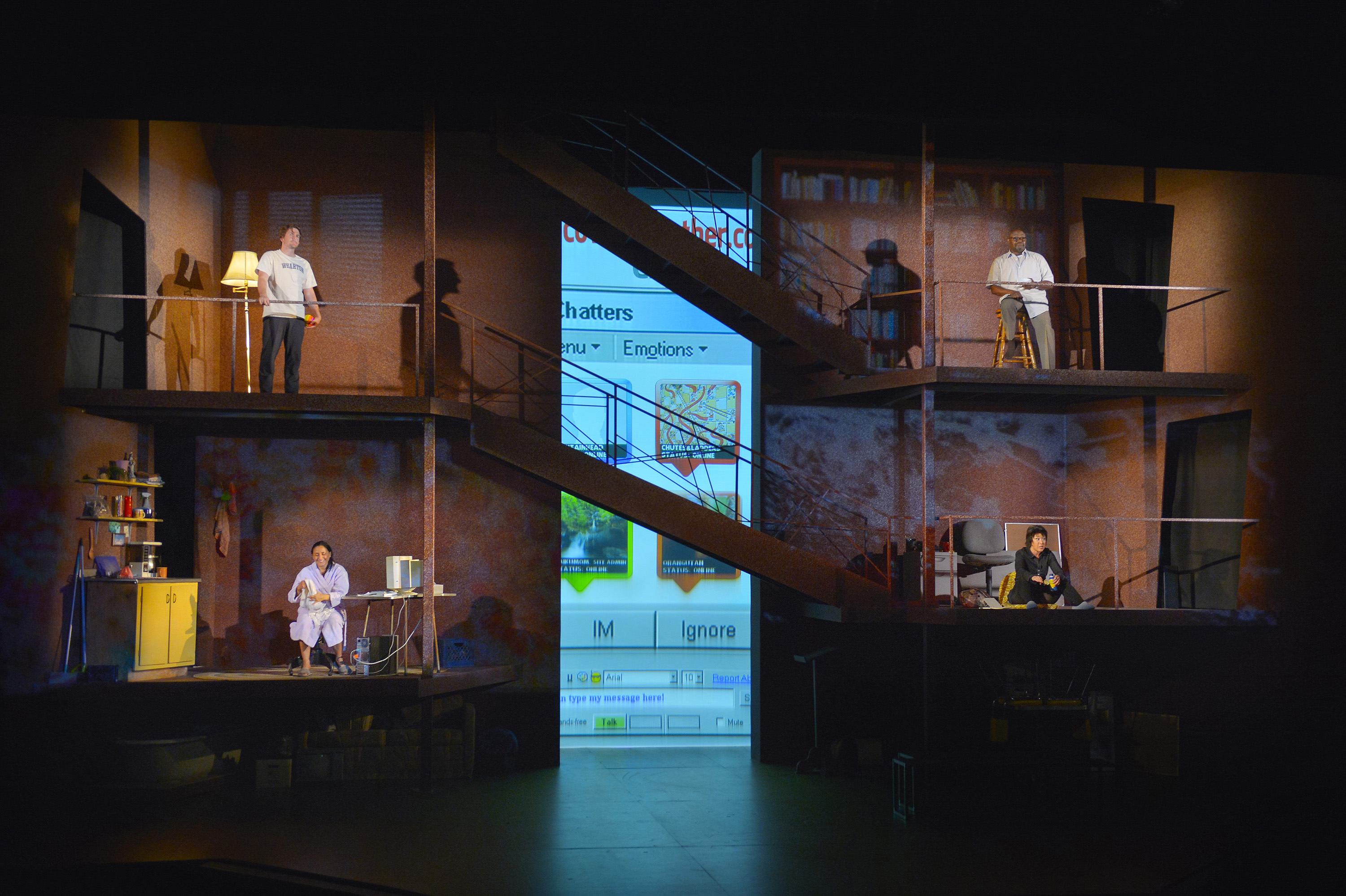
Detectives (Charles Shaw Robinson* and Matthew Baldiga*) interrogate William (Isiah Thompson).

FROM RED TO BLACK: Drama by Rhett Rossi. Directed by Susi Damilano. SF Playhouse San Box Series, A.C.T. Costume Shop on 1119 Market Street (at Seventh Street)/Civic Center Bart, San Francisco, CA. 415-677-9596 or www.sfplayhouse.org. August 9 -30, 2014

From Red to Black reminiscent of a Law & Order TV script. [rating:3] (3 of 5 Stars)

San Francisco Bay Area has become a destination for playwrights seeking workshops and productions of their plays. In the past the Magic Theatre was the premiere venue for nurturing new writers but now five other local groups, including the SF Playhouse, have joined the fray.  SF Playhouse’s entry into that group is called “Sandbox” that began with simple staged readings in the “back room” of their previous venue. They have branched out into limited full productions and From Red to Black is their latest offering.

The title ‘red to black’ refers to an esoteric binary tree, used in computer science to organize pieces of comparable data, such as text fragments or numbers. In Rhett Rossi’s play that ‘binary tree’ becomes two Irish detectives  interrogating William (Isiah Thompson) an insecure young black man suspected (accused) of shoving a white man into the path of a subway train. The detectives are the stereotypic ‘good cop/bad cop’ each with their individual hang-ups.

The older “bad’ detective is Denny Mitchell (Charles Shaw Robinson) and the younger is “good” Jack Flanagan (Matthew Baldiga). As the play progresses there is a subtle to compelling shift in personalities but they remain stereotypic characters and both actors give powerful performances. Isiah Thompson has the best role as the accused and he brings to life the claustrophobic insecurity enshrouded in bravado demanded of the writing.

The writing is commendable and adroitly carries the plot line but relies on some extended exposition disguised as conversation between the detectives. To discuss the fourth member of the cast Lawrence Stevens (Michael Shipley) would be a spoiler since that character is the keystone of the surprise ending.

Director Susi Damilano’s tight direction is made easier by Bill English’s multi-area set allowing her to move the characters smoothly from scene to scene keeping the entire evening less than 90 minutes without an intermission. The play is being performed at the intimate A.C.T. Costume shop with limited technical support but light design by Jessica Brent backed up by Hannah Birch Carl’s sound design using the rumble of subway trains give the proper atmospheric claustrophobic effect.  Recommended as a ‘should see’ production.

Cast: Matthew Baldiga (Detective Jack Flanagan); Charles Shaw Robinson (Detective Denny Mitchell); Michael Shipley (Lawrence Stevens); Isiah Thompson (William).

Creative Team: Set Design by Bill English; Costume Design by Jeffrey Hamby; Stage Manager by Jessica Charles; Light Design by Jessica Bent; Sound Design by Hannah Birch Carl; Props Designer by Jordan Puckett; Casting Director by Lauren English; Fight Choreographer by Miguel Martinez; Dialect Coach Lynne Soffer; Dramaturg by Kevin Kittle

Kedar K. Adour, MD

Courtesy of www.theatreworldinternetmagazine.com.

Detectives (Charles Shaw Robinson* and Matthew Baldiga*) interrogate William (Isiah Thompson).

Dracula Inquest by Central Works a thriller

By Kedar K. Adour

Dracula Inquest : Drama. Written by Gary Graves. Directed by Jan Zvaifler. Central Works, At the Berkeley City Club, 2315 Durant, Berkeley, CA. www.centralworks.org or 510-558-1381.  July 12–August 17, 2014  World Premiere #44

 Dracula Inquest by Central Works a thriller. [rating:4]  (4 of 5 five stars)

If you are a member of Central Works the Bay Area collective dedicated to the production of new plays, you surely must subjugate your ego to the collective ego or at least leave your ego at the door. Now, what the hell does that mean or have to do with a review of their latest world premiere Dracula Inquest?

It means a hell-of-a-lot. The collective concept has worked for them since their decision in 1997 to “write, develop, and produce world premieres.” Whereas most plays go through workshop after workshop, Central Works’ timeline for a play is four to six months. A playwright’s idea is taken to the group and before any script is written, a director is selected and they set about casting the non-existent play. They plan about 10 meetings with the playwright, director and cast contributing to the final script.  For Dracula Inquest Gary Graves is their resident playwright and is given full credit for the script.

In Dracula Inquest Graves has taken Bram Stoker’s novel, pared the characters down to four and postulates a “what if” scenario. In the novel the four are the  “good guys’ who eventually do Dracula in with a wooden stake through his heart. Wait just a while, what if those “good guys” were not what they seemed and were just after Count Dracula’s wealth? They hide behind their façade as the “Crew of Light” insisting that their heinous act was done in the name of humanity.

In the play the four “Crew of Lights” are the lawyer Jonathon Harker (Joshua Schell), his wife Mina Harker (Megan Trout), Dr. Seward (Kenny Toll) who has prescribe opiates for Minna and the leader of the group Professor Van Helsing (Joe Estalack). They are all locked up in an insane asylum.

Professor Van Helsing and his intrepid team of vampire hunters, now all inmates of the Whitby Asylum for the Criminally Insane —and under investigation regarding
the disappearance of a mysterious nobleman from Transylvania.
(l to r): Kenny Toll, Joe Estlack, Joshua Schell & Megan Trout.

The time is 1895 three years after the disappearance of the wealthy Count Dracula. Scotland Yard Detective Sly (John Flanagan) arrives at the asylum to interview the miscreants having in his possession a typed book describing all the details (much of it apparently taken verbatim for Stoker’s novel) of Count Dracula’s disappearance. The disbelieving Sly may have his convictions changed by the dramatic ending end of the show.

Central works now is ensconced at the Berkeley City Club using the miniscule 50(?) seat three sided theatre with only two rows of seats on each side. This intimacy works wonders for this production with the audience pushing back in their seats to avoid the “insane” action on stage. The play is a shocker and should be rolled out for Halloween. The quality of the actors is superb and all deliver their long speeches with veracity. If there is a weakness of the writing it is that the play is a series of monologs with minimal interaction between the characters. However when there is interaction it is dynamic and allows the actors to appropriately emote.

Detective Avery Sly of Scotland Yard (John Flanagan R)
interrogates Dr. Seward (Kenny Toll L).

John Flanagan has been cast as a detective in other plays and has not lost his touch at interrogation. Without giving a “spoiler” the last scene is problematic for him. Kenny Toll as Dr. Seward, bound in a straight-jacket for the entire play, gives a Tony Award performance. Joe Estlack brings his innate acting ability honed at Shotgun Theatre to this play in his role as the Professor. Joshua Schell and Megan Trout as the Harker’s earn their share of accolades. Running time 2 hours with an intermission.

Cast: Joe Estlack as Professor Van Helsing; John Flanagan as Detective Sly; Joshua Schell as Jonathan Harker; Kenny Toll as Dr. Seward;  Megan Trout as Mina Harker

Production Team: Tammy Berlin, costumes; Gary Graves, lights; Gregory Scharpen’ sound/operator; Debbie Shelley, properties; Vanessa Ramos , stage manager; Alandra Hileman, production assistant; Robin Low, box office. Photos by Jim Norrena.

Kedar K. Adour, MD

Courtesy of   www.theatreworldinternetmagazine.com


Hershey Felder stages a near-perfect Chopin bio, recital

By Woody Weingarten

Woody’s [rating:5]

Hershey Felder portrays “Monsieur Chopin” in one-man show at the Berkeley Rep. Photo by John Zich.

Pianist-actor Hershey Felder stars in a musical bio, “Monsieur Chopin.” Photo by John Zich.

When I watched him transform into George Gershwin in a one-man Berkeley Rep show in June 2013, I’d never heard of Hershey Felder.

Still, I reveled in his virtuosity as a pianist, actor and writer.

And wanted more.

When last fall I witnessed his puissant direction of Mona Golabek as the daughter of a Holocaust survivor in “The Pianist of Willesden Lane,” I basked in another of his talents.

I craved more.

And when I saw him morph into conductor-composer Leonard Bernstein in June of this year’s “Maestro” musical bio, I couldn’t wait for what came next.

Next is now.

“Monsieur Chopin,” also a solo show, is a bio and concert predictably more romantic than the others — musically, at least.

Some of Fryderyk Chopin’s melodies will be as instantly recognizable by classical music buffs as quarterback Colin Kaepernick’s tattoos would be to 49er fans.

But director Joel Zwick, who guided the Gershwin and Bernstein shows as well as the film “My Big Fat Greek Wedding,” proficiently has the keyboardist-playwright intersperse less familiar strains.

“Hershey Felder as Monsieur Chopin,” which runs at the Berkeley Repertory Theatre through Aug. 10, transports audiences to the 1848 Paris salon of the “Polish poet of the piano.”

There he hunkers down with an enigmatic, volatile author, George Sand, and entertains painter Eugene Delacroix, a sometimes bff.

And there, I, and an audience that leapt to its collective feet at the two-hour opening night’s conclusion, could appreciate Felder’s piano dexterity and a characterization that overcomes a heavy accent and feels authentic.

His Steinway tones range from ultra-soft to thunderous.

He nimbly plays all or parts of more than a dozen pieces, including three Polonaises (emphasizing their “rise to glory”), a handful of preludes and nocturnes, “Mazurka in A-Flat Major, Opus 50 No. 2,” “Marche Funébre, Opus 35” and “Romanza, E-Minor Concerto.”

Credit goes to lighting designer Richard Norwood for creating instant mood changes, and scenic designer for fashioning a period setting with just an upholstered chair, end tables, mirror and trinket-laden mantle.

Norwood’s pièce de résistance, however, is a gilded frame that borders the stage and heightens what occurs within: historic legitimacy, histrionic biography.

Felder injects heaps of humor, from the play’s get-go to the end of a 30-minute coda with the house lights on (in which he quick-wittedly answers questions from the crowd in character, cleverly improvising occasional anachronistic jests about cell phones and other today-technology).

He’s especially laugh-inducing when Chopin, a child prodigy and adult genius who died prematurely at age 39, sneers at Franz Liszt’s piano playing and works (“scales and arpeggios and so much noise”).

But pathos is even more prevalent.

From the performer’s description of the death of Emilia, Chopin’s sister, to the composer’s frequent sidekick, melancholia (in modern terms, depression).

And from his obsessive hand-washing to his semi-romantic proclivities (focusing on an eight-year relationship with the pseudonymous Sand, a woman he first encounters dressed in man’s clothing and smoking a cigar).

The playwright’s major conceit is to address the audience as if it were a Chopin class, a theatrical device that’s slightly awkward.

But some of his teaching moments are pithy and poetic:

“You must dust the keys with your fingers as if you were dusting them with your breath.”

“Forget your lunatic family and play as if you are playing for God.”

Felder, who’s been a scholar-in-residence at Harvard’s department of music and is married to Kim Campbell, former Canadian prime minister, apparently cannibalized “Monsieur Chopin” from his own, original three-performer construct, “Romantique,” first performed 11 years ago and skewered by critics.

He obviously rewrote, fixed and honed it.

And salvaged it.

So much so that, nine years after its debut, he’s performed “Chopin” more than 800 times to more than 250,000 theatergoers.

So much so that now it’s become a masterwork, a near-perfect integration of recital and biography.

“Hershey Felder as Monsieur Chopin” plays at the Berkeley Rep’s Thrust Stage, 2025 Addison St., Berkeley, through Aug. 10 and then returns for encore performances Sept. 16-21. Night shows, 8 p.m. Tuesdays and Thursdays through Saturdays, 7 p.m. Wednesdays and Sundays; matinees, 2 p.m., Saturdays and Sundays. Tickets: $14.50 to $87, subject to change, (510) 647-2949 or www.berkeleyrep.org.

You can contact Woody Weingarten at voodee@sbcglobal.net.

‘Old Money’ features dual roles, cleverness, but…

By Woody Weingarten

Woody’s [rating: 2.5]

Swaggering in “Old Money” are (from left) Robyn Wiley, Johnny DeBernard and Trungta Kositchaimongkol. Photo: Robin Jackson.

Gillian Eichenberger and Wood Lockhart appear in “Old Money.” Photo: Robin Jackson.

The more things change, the more they stay the same — except they droop.

That’s the greeting card text I wrote 30 years ago.

My gag line again came to mind as I watched the Ross Valley Players’ new production of Wendy Wasserstein’s “Old Money.”

The play’s all about social climbing, generational gaps, moolah, art and real estate — with dual roles for each of the eight actors. But it feels stodgy and stilted despite the playwright’s renowned skill with barbed dialogue.

Her construct may be too clever, her play too New York.

Wasserstein invites us into a lavish mansion on the Upper East Side of Manhattan.

There we witness two dinner parties.

Jeffrey Bernstein, an arbitrage kingpin played as a man of equanimity by Geoffrey Colton, hosts the first — at the beginning of the 21st century.

The second, nearly 100 years earlier, spotlights Johnny DeBernard as a boisterous robber baron, Tobias Pfeiffer.

Colton doubles as even-tempered retail tycoon Arnold Strauss, and DeBernard also personifies Sid Nercessian, a Tinseltown director who repugnantly spews an f-bomb every fourth word.

All the actors do well, no mean feat considering they’re burdened with a plot unnecessarily complicated and convoluted.

Director Kim Bromley admittedly struggled with the plotline complexities and mélange of Wasserstein characters (“I had to read it three times to grasp the scope of it,” she writes in the program).

She suggested opening night reviewers feel what the characters feel.

I couldn’t.

Perhaps because Wasserstein — known for her intelligent, independent but self-doubting female characters trapped by male power — thwarted me by pricking too many heavy subjects.

Relentlessly, she tackles youthful rebellion and self-destruction, aging and death, legacy and immortality, Jewishness and assimilation, platonic relationships and sexuality, snobbery and acceptance.

Which almost bury all her valiant attempts at humor.

The script of the two-hour, two-act comedy of manners, which premiered off-Broadway in 2001, immediately tells theatergoers what they’re watching — an examination of how new money becomes old money (and what impact that evolution has on its wealthy stakeholders).

The problem is that the theme gets underscored over and over.

Mind-numbingly.

A single summation, such as the scene in which Bernstein and Pfeiffer engage in a verbal mine’s-bigger-than-yours debate about influence, would have sufficed.

Striking, however, are spot-on costumes by Michael A. Berg that range from elegant to flamboyant and instantly allow audiences to know which characterization an actor in inhabiting, and a ideal set by Michael Walraven, replete with large paintings and a massive always-needing-polish wooden railing.

Wasserstein, who won a Pulitzer and a best play Tony in 1989 for “The Heidi Chronicles,” isn’t above contrasting schmaltziness and whimsy. Check out, for instance, her having one actor stylishly dance the Gavotte but later prance in a lobster costume.

The playwright’s signature one-liners are numerous:

• “If the rich aren’t happy, who the hell will be?”

• “I like the opera. Big girls with elephants. Isn’t that enough?”

• “I’m having trouble ignoring you tonight.”

Top-notch performances are turned in by Gillian Eichenberger as both silver-voiced servant and self-destructive daughter; Robyn Wiley, as outdated as the figure sculpted by her character, Auntie Mame-ish Saulina Webb; Karen Leland as strident publicist Flinty McGee; and Jesse Lumb as sons of both Bernstein and Pfeiffer (and part-time narrator).

Add to the mix Wood Lockhart, who may hold the record for most RVP performances and is wistful as Tobias Vivian Pfeiffer III, and Trungta Kositchaimmongkol, snarky as underwear designer Penny Nercessian.

“Old Money” has many amusing and edifying moments yet, in the final analysis, couldn’t excite me.

And it somehow felt both long and long in the tooth (though not quite as antiquated as Richard Brinsley Sheridan’s “The Rivals,” the 1777 play it references) — despite anachronistic references to Jennifer Lawrence and Silicon Valley.

If asked to stick my two cents in, I’d have to say earlier works by Wasserstein — who died of lymphoma at age 55 in 2005 — were much easier to bank on for laughs or insights.

The RVP recently produced some incredibly good entertainments.

This wasn’t their best choice.

“Old Money” will run at The Barn, Marin Art & Garden Center, 30 Sir Francis Drake Blvd., Ross, through Aug. 17. Night performances, Thursdays at 7:30, Fridays and Saturdays at 8; matinees, Sundays at 2. Tickets: $13-$26. Information: www.rossvalleyplayers.com or (415) 456-9555.

You can contact Woody Weingarten at voodee@sbcglobal.net.

Activist’s to-do list gets longer and longer and longer

By Woody Weingarten


Patrice Hickox sits on memorial bench in Bolinas Park in Fairfax that she fought to get installed. Photo: Woody Weingarten.

Patrice Hickox would prefer I think of her as ordinary.

She isn’t.

The Fairfax resident’s a real-life Energizer Bunny.

Without floppy ears.

A perpetual motion machine with platinum-hued hair and hands that intermittently sketch pictures in thin air. A do-gooder everlastingly battling for one cause or another.

Since I’ve tilted at a few windmills myself, I like that.

Still, no matter how much she achieves, she’s never able to rest on her laurels.


She is resting one recent Saturday, however, on a memorial bench at the edge of Bolinas Park in Fairfax she fought hard to get installed at the end of May.

Not quite relaxed.

Trying to figure out how she best can help Marin’s foster children keeps her mind flashing like a July 4th sparkler.

She can’t know a Marin County Civil Grand Jury will shortly issue a report saying more funds must to be spent on the issue, more communication must occur between foster parents and social workers, and more access to therapy must be provided those neglected kids.

What to do? What to do?

She and I are together, me armed with interview pad and pen, she momentarily staring off into the distance at a bald hill she knows must be preserved.

Of course.

One cause at a time isn’t her style.

She’s also thinking about finding a way to replace “the dingy, worn-out, style-less sign announcing the Town of San Anselmo.”

And improving local median strips.

How?

“Re-plant, re-think, re-design,” she tells me.

The artsy wood bench we’re on is dedicated to the memory of her friend, Nancy Helmers, an environmental activist who died last year at age 82.

Patrice tactfully declines to reveal the political obstacles — “the kerfluffle, the brouhaha” — she had to vault to make it happen.

She’s just glad it’s a done deal.

Nancy had served on the county’s Open Space Committee for 10 years, as well as many other boards, and had been as non-stop energetic as Patrice.

She also was an unrelenting firebrand when it came to pushing petitions. “No one could collect a signature like Nancy,” Patrice tells me. “No one would say ‘No’ to her.

The two women met in 1988 when Nancy was collecting names in favor of creating a multi-purpose park on the 28 acres of the Marin Town and Country Club, which was being eyed by a developer.

The pair stopped the development from happening.

But they couldn’t come up with an effective plan to raise enough money to build their dream park.

“Instead, we became friends,” Patrice remembers. “We were both birders and environmentalists. We hiked, and we eventually collected thousands of signatures for a lot of things that failed.”

There were, however, sporadic triumphs.

Such as Lansdale Park in San Anselmo, a pocket-sized space with a children’s playground — or, as the town’s website says, “just what the neighborhood needed! Parents can enjoy a coffee-to-go from the nearby café while watching their children play outdoors.”

Patrice recalls “they were going to put condos there, but we got a petition to stop it. We got two grants from the Buck Fund, and got students from the White Hall Middle School in Fairfax to help. It was great.”

Her awareness began shortly after reading Rachel Carson’s best-selling “Silent Spring,” which detailed the detrimental use of pesticides.

“I was off and running after that,” she says. “I stopped eating meat and started paying attention. I was 14.”

As a Manhattan teenager, she’d attended be-in’s in Central Park, marched in Washington against the Vietnam War, and rallied for civil rights.

“I guess I’ve been a die-hard liberal ever since I figured out what that was,” she says.

Sometimes Patrice, who’s lived in Fairfax since 1995 with Charlie, her musician husband of 41 years, volunteers longer than she’d intended.

She helped out at WildCare for more than 10 years, for instance, “raising hundreds of baby things — from snakes to foxes to raccoons and squirrels.”

If she could accomplish anything in the world, what would it be, I ask. She replies without hesitation: “Get rid of Putin and Assad.”

Then she says, “I think I’d like to be empress of Oakland and just fix that city.”

And then, after a slight pause, she adds seriously, “Anything that I’d be effective at — so I wouldn’t have to beat my head against the wall again.”

I smile.

Since I’ve tilted at a few windmills myself, I understand completely.

You can contact Woody Weingarten at voodee@sbcglobal.net

Edinburgh Fringe: Hecat’s Poison – Powerful One Woman Show

By Jo Tomalin

Photo + image provided by Tokyo Players

Review by Jo Tomalin
www.ForAllEvents.com

Hecat’s Poison:Enter the three Witches is an exquisite well acted one woman play adapted from Shakespeare’s Macbeth from the Witches’ point of view.

S. Sato plays all the characters in a beautifully nuanced and complete production. She becomes each character with full emotion, physicality and voice while imaginatively integrating object theatre.

From Japan, she is a British trained Actor and usually performs with her company, but this is a special adaptation of the Scottish play (in English) for the Edinburgh Fringe.

Sato’s presence on stage is strong as she deftly moves through the play’s demonic characters and scenes – her movement is fluid with visceral characters and transitions. Also, there  is a hint of Japanese intensity, steely calmness and flair in her movement, elegant costumes and fascinating minimal set, which make this performance even more special.

This is a wonderful dramatic show and well worth your time.

Go to Venue 40, Victoria street, just off the Mile (at George IV Bridge) daily except Sundays 11:30am.

More info and tickets:

https://tickets.edfringe.com/whats-on/hecat-s-poison-enter-the-three-witches
http://www.venue40.org.uk

Days/Time: 4-23 August (Except Sundays) 11:30(1H)

Location: Venue 40
7 Victoria Terrace EH1 2JL
Tickets: £6( Concession £5)
Box Office: 0131 220 6109 / The Fringe Box Office


Jo Tomalin, Ph.D. reviews Dance, Theatre & Physical Theatre Performances
More Reviews by Jo Tomalin
TWITTER @JoTomalin
www.forallevents.com  Arts & Travel Reviews

Edinburgh Fringe: “Bloom” **** Four Stars

By Jo Tomalin

(Above l to r) Robert Scobie + Abraham Parker in Bloom Photo Credit VocalPoint Theatre

Review by Jo Tomalin
www.ForAllEvents.com.

image of Bloom Abraham Parker Photo Credit VocalPoint TheatreBloom
Abraham Parker
Photo Credit VocalPoint Theatre

Moving Stories from the Glasgow Soup Kitchen

                 Four Stars ****

The Glasgow Mission Soup Kitchen is rich with characters whose lives change and experience poverty and homelessness. Robert Scobie and Abraham Parker of VocalPoint Theatre – with considerable theatre training, acting and directing experience – want to give a voice to these people, so they volunteered in this soup kitchen for a year and blend verbatim accounts of two individuals with a storytelling style to create Bloom.

Scobie and Parker first set the scene directly to the audience as themselves, showing us the layout of the soup kitchen and a quick rundown of the vital volunteers running the place, then they transition into their characters with a firm slam of the black metal chairs and change of posture, it’s simple and effective.

image of Bloom Robert Scobie Photo Credit VocalPoint TheatreBloom
Robert Scobie
Photo Credit VocalPoint Theatre

Video of green fields show on the two TV screens stacked to the left as Scobie starts his story with his character’s love of football and the European Cup Final, in his youth. Next, Parker takes over as his character tells about his life living as a child in Torrance on the Southern California coast, the video changes to a beach. You get the idea it is the calm before the storm, idyllic fields and waves on the sand – an equalizer – that everyone has an even chance before life deals what it deals.

The stories go back and forth and parallel each other chronologically, dealing with family, fathers, mothers, girlfriends, growing up, tragedy and arriving at the Soup Kitchen. However, they are contrasting characters regarding their childhood to adult years – and Scobie’s character is Scottish and walks 20 miles round trip each day to visit the soup kitchen, while Parker’s character is born in Los Angeles, moved to Ireland, Liverpool and so far, Glasgow.

image of Bloom Abraham Parker and Robert Scobie Photo Credit VocalPoint TheatreBloom
(l to r) Abraham Parker and Robert Scobie
Photo Credit VocalPoint Theatre

Scobie and Abraham are strong actors and physical storytellers, and take turns listening, telling and supporting each other on stage. Memorable moments include when Parker’s character is a teenager sneaking home to find his father questioning him – in a brilliant flash Parker becomes his own father as Scobie momentarily becomes Parker’s teenager…this theatrical ‘split screen’ and at least another subtle connection or two like it enhanced the interplay of two separate stories enormously. Genius.

The grey cement ceiling and institutional walls of this theatre space work perfectly as the soup kitchen environment, and the spare set with metal chairs and two TVs (which add the only colour) are appropriate.

During this journey we learn little things about life in the soup kitchen, like there’s a Glory Cupboard with shampoo etc. anything “to make it slightly easier to get through the next 24 hours.” There is also a women’s floor but most at the soup kitchen are men.

This is immersive theatre – like real life – and allows us to live vicariously as others for a short time, we can learn from this as well as be enlightened, entertained. It’s a fascinating show and it’s all not a downer – but shows that everyone has hopes and dreams no matter their circumstance. In short, Parker and Scobie have created a 55 minute slice of life that they are passionate about sharing and it deserves to be seen.

Location:
Underbelly, Cowgate (Venue 61)
56 Cowgate, EH1 1EG
Performances: at 14:40, July 31 -August 24.
Suitability:
14+ (Guideline)
Box office: 0844 545 8252


Jo Tomalin, Ph.D. reviews Dance, Theatre & Physical Theatre Performances
More Reviews by Jo Tomalin
TWITTER @JoTomalin
www.forallevents.com  Arts & Travel Reviews

Edinburgh Fringe: “Brush” from Haddangse Co. Korea

By Jo Tomalin
(above) Photo credit: Haddangse Company

Review by Jo Tomalin
www.ForAllEvents.com

Photo credit: Haddangse Company

 Charming & Magical Visual Storytelling

In this unique and eco-friendly show, the story is acted – and painted right in front of you. “Brush” uses a vibrant bilingual storytelling style in English and Korean – yet it does not need many words to understand it. The five playful and animated actors quickly make a warm rapport with the audience, through movement and drawing, which continues throughout the 55 minute show.

Photo credit: Haddangse Company

Haddangse Company Director Jun Lee took traditional Korean painting and created a modern variation with additional surprises and impressive results. The paintings on stage seem to come to life, sometimes to the surprise of the characters, which builds a compelling complicity with the audience. This is magical stuff!

Photo credit: Haddangse Company

“Brush” by Yoon Jobyung is a tale of a lonely boy called Daesung who wishes he had a brother. While his mother says ‘no’ she sends him to visit his grandmother and his best friend, Dalbong, a cute little pig, played by one of the actors. Still sad, his grandmother has a solution and sends him on a journey through the mountains.

Photo credit: Haddangse Company

These actors create characters and effects to tell the story physically and visually, accompanied by live music. In one scene, they even make a rain storm happen using large drawing paper and movement – so simple yet so effective. In another scene they need a house for the family in the story – so they paint a giant home complete with colored wall paper, it’s so imaginative that it makes you want to join in and play.

Photo credit: Haddangse Company

Experts in movement, the actors use many theatrical techniques in their performance – storytelling, puppetry, music, acrobatics, and weave them all together into a delightfully magical show. “Brush” is very well devised by Lee and the company, comprising several short scenes, which move the story forward – holding the rapt attention of even the smallest children. I went not knowing what to expect and was completely drawn in and enchanted, like everyone in the audience. You will be too.

Location:
C venues – C (Venue 34)
Chambers Street, EH1 1HR
Performances: 12 Noon, August 4-10, 12-24.
Box office: 0845 260 1234


Jo Tomalin, Ph.D. reviews Dance, Theatre & Physical Theatre Performances
More Reviews by Jo Tomalin
TWITTER @JoTomalin
www.forallevents.com  Arts & Travel Reviews

Edinburgh Fringe: Weird & Wonderful Antiquithon

By Jo Tomalin
(Above) ANTIQUITHON Edinburgh Fringe Banner

Review by Jo Tomalin
www.ForAllEvents.com

Image of characters in ANTIQUITHON

A gem of a show – best 30 minutes at Edinburgh Fringe!


(l to r) Gwen Aduh & Aurélie de Cazanove
in ANTIQUITHON
Photo by P.Bosc


Shows 5 times a day – Tickets £5 and £3
Performance Times (August 1-23) at  13:30 / 14:05 / 14:40 / 15:30 / 16:05
Location: Institut français d’Ecosse (Venue 134)       Duration: 30 min
Suitability: 12+ (Restriction)

In the spirit of side shows of long ago, the French Company des Femmes à Barbe’s Gwen Aduh and Aurélie de Cazanove invite you to a mysterious bijou room. Here, they tell their story (in English) and show objets from their fascinating and macabre collection to a wide eyed audience. The characters are brother and sister and there is a noticeable sibling tension between them throughout as they interact directly to the audience.

image of Gwen Aduh in ANTIQUITHON

Gwen Aduh in ANTIQUITHON
Photo by P.Bosc

You are in a small Victorian style living room, with a twist. In front of you is an array of memorabilia in various boxes – and it sometimes takes a while to realize what you are actually looking at in the subdued lighting.

In a genteel to intense atmosphere Aduh is a dour, correct character in a black pin striped suit, who has seen better days – yet he shows you the objects with pride. Mainly silent, Aduh is brilliant, using his subtle physicality and facial expressions to communicate. Cazanove as a bon vivant hostess welcomes us into their home wearing a formal long dress, she is charming and hospitable. However, all is not what it seems to be…

Shows like this are rare and although Antiquithon (smartly directed by Martin Petitguyot) is small, it is never predictable. Therefore, go and experience this for yourself!

For more information:
Institut français d’Ecosse (Venue 134)
13 Randolph Crescent, EH3 7TT
Box office:
0131 225 5366


Jo Tomalin, Ph.D. reviews Dance, Theatre & Physical Theatre Performances
More Reviews by Jo Tomalin
TWITTER @JoTomalin
www.forallevents.com  Arts & Travel Reviews

Cal Shakes stages sharp, witty ‘Pygmalion’

By Judy Richter

A mere Cockney seller of flowers on the streets gets much more than she bargained for in “Pygmalion,” George Bernard Shaw’s witty, early feminist comedy.

Eliza Doolittle knows that until she speaks English properly,  she can’t get a job in a real flower shop. She hopes she has found a way to achieve that dream when she meets Henry Higgins, an eminent professor of phonetics.

California Shakespeare Theater is staging a sumptuous production of this 1912 play under the astute direction of Jonathan Moscone, artistic director. He has assembled a first-rate cast of Bay Area stalwarts along with CST newcomer Irene Lucio as a pitch-perfect Eliza.

Henry (Anthony Fusco) agrees to take her under his tutelage in his house. He then bets his friend, Col. Pickering (L. Peter Callender), that he can pass her off as a duchess in six months.

He wins his bet. Eliza looks, acts and talks like a lady, but now what does she do, she angrily asks him. He offers to let her stay, but unwilling to continue putting up with his callous, indifferent treatment, she bravely leaves — unlike the more sentimental ending in “My Fair Lady,” the Lerner and Loewe hit musical based on the play.

Fusco fills the bill as Henry to a T. He’s nicely balanced by Callender as the more genteel, considerate Pickering, who nevertheless goes along with Henry.

Catherine Castellanos makes Mrs. Pearce, Henry’s housekeeper, a woman who does her best to call him to task when he verbally abuses Eliza. A woman who’s even more outspoken in her criticism of Henry’s behavior is his mother, Mrs. Higgins, played by Sharon Lockwood.

James Carpenter plays Eliza’s father, Alfred Doolittle, an opportunistic man who cheerfully calls himself part of the undeserving poor.

Ably completing the supporting cast are Julie Eccles as Mrs. Eynsford Hill; Elyse Price as her daughter, Clara; and Nicholas Pelczar as Freddy, her son, who’s quickly smitten with Eliza. Unlike the musical, however, the play doesn’t expand his role.

Annie Smart’s fluid set is noteworthy for the life size cartoon characters that populate the opening scene outside Covent Garden. Anna Oliver’s costumes are smartly stylish, punctuated by the elaborate hat that Eliza wears to tea at Mrs. Higgins’ house.

Kudos to Lynne Soffer, whose work as dialect and text coach is so vital to this particular play.

The entire production is thoroughly charming and thought-provoking.

It will continue at Bruns Amphitheater, 100 California Shakespeare Theater Way(off Hwy. 24), Orinda, through Aug. 24. For tickets and information, call (510) 548-9666 or visit www.calshakes.org.