Stanford celebrates Welles with ‘Moby Dick — Rehearsed’

By Judy Richter

“Moby Dick” by Herman Melville occupies a high spot on the list of great American novels. Another American great, Orson Welles, transformed it into a stage version called “Moby Dick– Rehearsed.”

Stanford Repertory Theater has taken on the challenges of this work in its second summer production featuring both Stanford students and Bay Area professional actors.

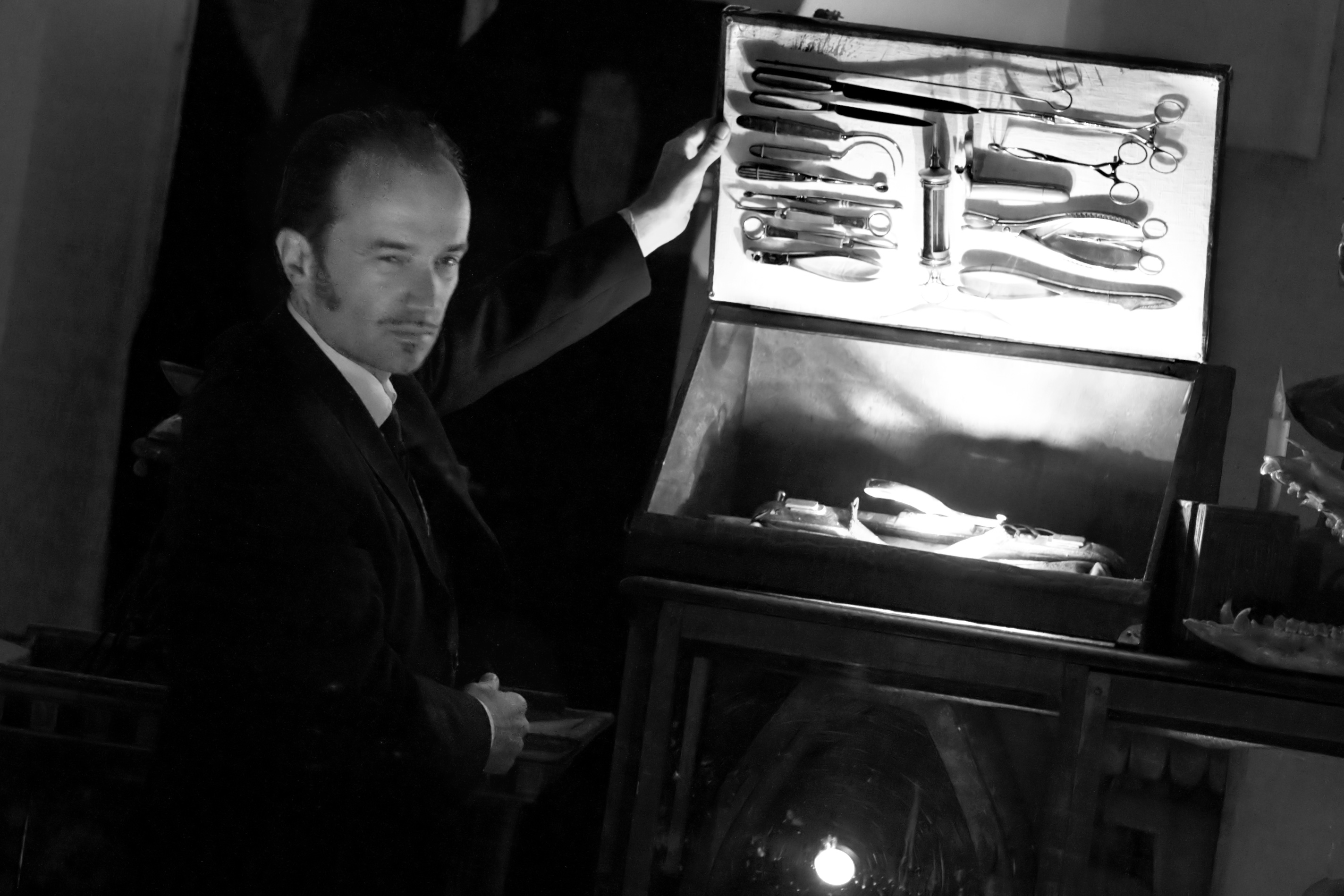
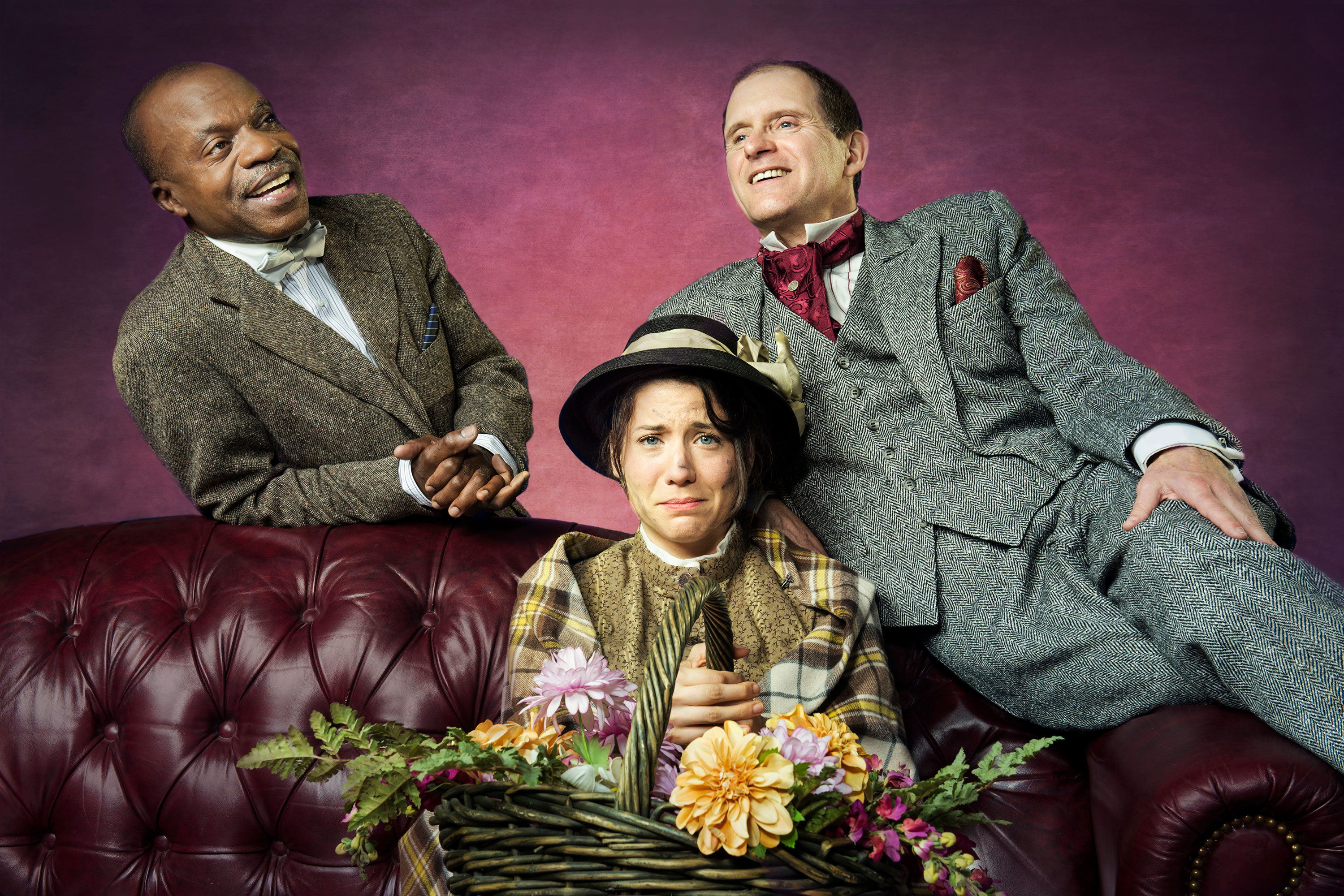
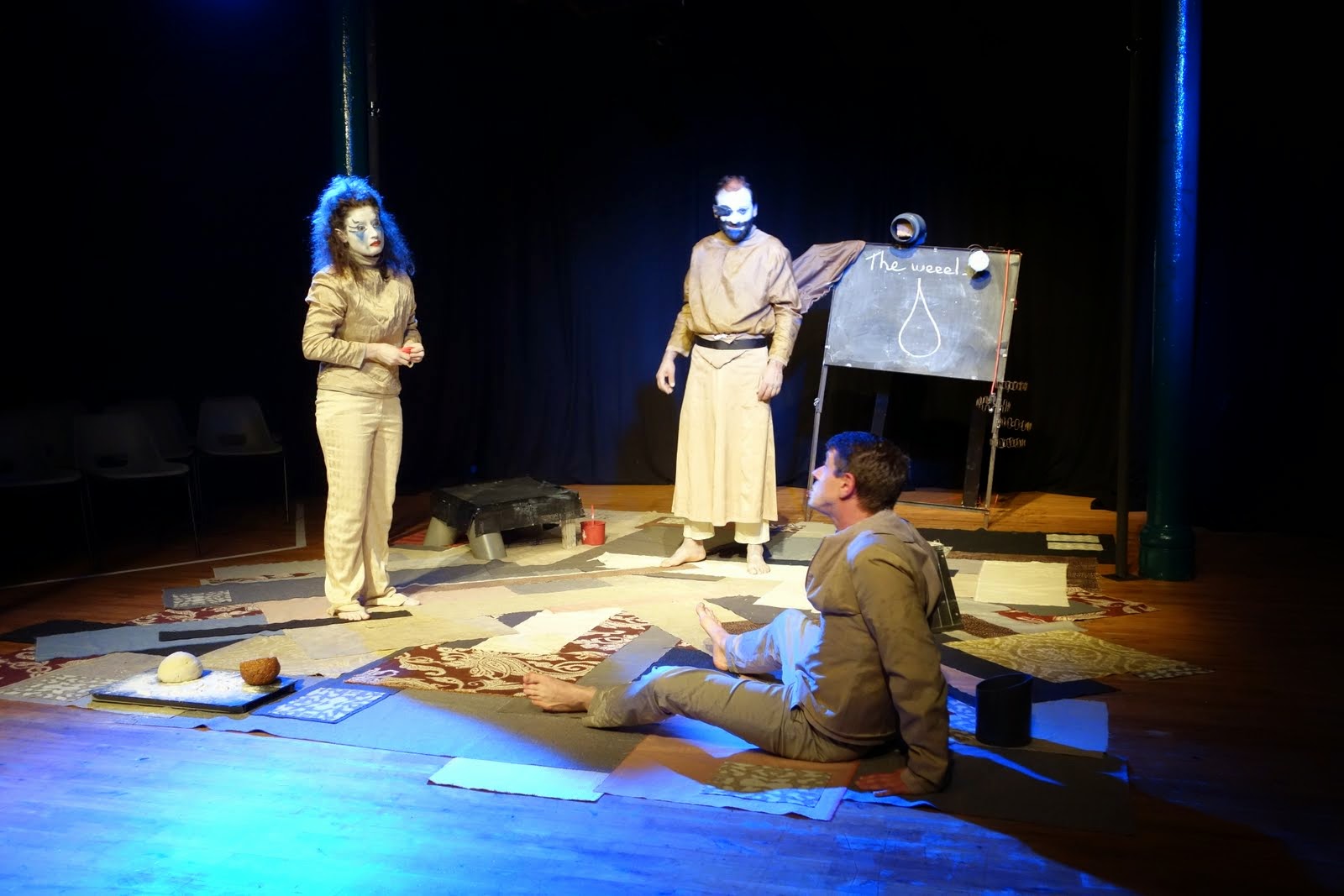
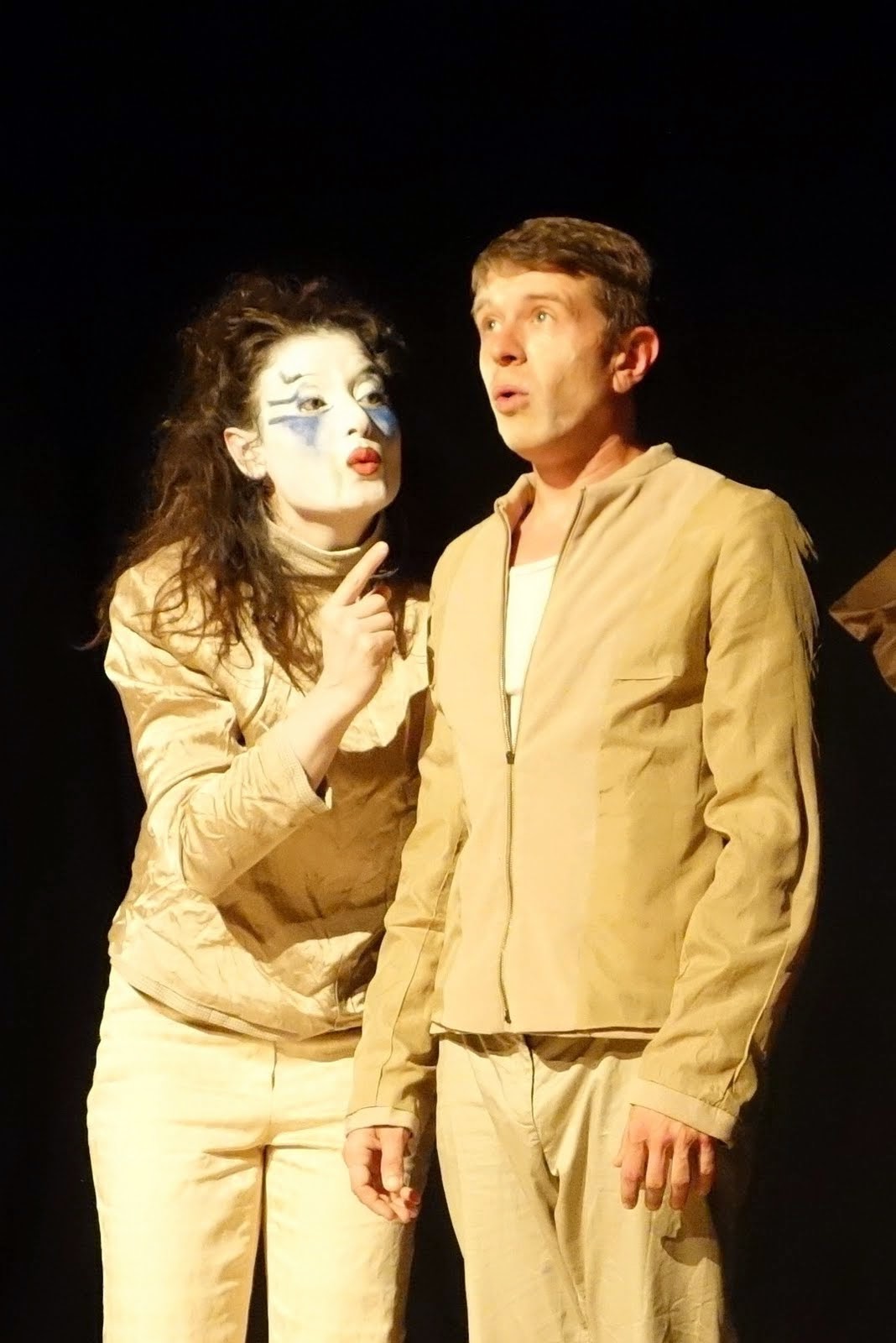
This one-act, approximately 100-minute play begins as casually dressed actors (costumes by Connie Strayer) rehearse Shakespeare’s “King Lear.” Dissatisfied with the director’s approach, they begin their own project, “Moby Dick,” starting with its memorable opening line, “Call me Ishmael.”

From there the 15 actors enact the epic story of a 19th century whaling boat, the Pequod, and its captain’s maniacal pursuit of the white whale, Moby Dick, that bit off one of his legs below the knee.

Veteran Bay Area professional Rod Gnapp plays Lear in the opening scene, then becomes the obsessed Captain Ahab in a memorable performance. Another standout in the cast is professional actor Peter Ruocco as Starbuck, the first mate and the only crew member who voices his doubts directly to Ahab.

Among the students, Louis McWilliams is noteworthy as Ishmael, the saga’s narrator.

Another professional in the cast is Courtney Walsh, who plays several roles and serves as movement/dance director.

Directed by Rush Rehm, the production moves fairly well with a few lulls in the middle. However, some of the actors need to work on diction, and the shouting is overdone in some scenes.

The scaffold set by Annie Dauber defines the ship, aided by lighting by Michael Ramsaur and the sound design by Michael Keck, who wrote some of the music. Music director Weston Gaylord elicits some fine choral singing, especially in “Eternal Father, Strong to Save,” a.k.a. “The Navy Hymn.”

It’s significant that Welles incorporated an opening scene from “King Lear” in his play, for some parallels can be seen. The most apparent is the ascent into madness by Lear and Ahab. In addition, the off-kilter cabin boy, Pip (Maia Kazin), can be compared with Tom or the Fool in “Lear.”

This production is part of SRT’s 16th summer festival, dubbed Orson Welles: Substantial Shadows. Later this summer the company will present a theatrical re-creation of Welles’ famous 1938 radio broadcast, “The War of the Worlds.” Free showings of several Welles  films feature Stanford professors leading discussions.

A symposium about Welles and Melville is scheduled for all day Aug. 2. For details, visit www.continuingstudies.stanford.edu.

“Moby Dick – Rehearsed” will continue through Aug. 10 in Pigott Theater (Memorial Auditorium), 551 Serra Mall, Stanford. For tickets and information about it as well as “The War of the Worlds” and the films, call (650) 725-5838 or visit www.repertorytheater.stanford.edu.


The Great Pretender a winner in progress at TheatreWorks

By Kedar K. Adour, Uncategorized

Steve Brady as Mr. Felt with his beloved puppet Frances

The Great Pretender: Comedy by David West Read. Directed by Stephen Brackett. Original Songs by David West Read. TheatreWorks, Lucie Stern Theatre, 1305 Middlefield Road, Palo Alto, CA. 650-463-1960 or www.theatreworks.org. World Premiere.  July 9 – August 3, 2014

The Great Pretender a winner in progress at TheatreWorks [rating:4] (4 of 5 stars)

TheatreWorks opens its 45th season with the world premiere of The Great Pretender at the Lucie Stern Theatre in Palo Alto. The play was commissioned by the Roundabout Theatre Company in New York and further developed for TheatreWork’s 2013 New Works Festival where it was the runaway favorite. The first scene is a superb prolog that sends the audience into gales of laughter promising a joyous evening. Mr. Felt (Steve Brady) and his puppets Frances and Barney the Pony (Suzanne Grodner) are filming a TV episode of a children’s show similar to an episode of the much loved “Mr. Roger’s Neighborhood.” The dialog and puppet action with the unassuming demeanor of Roy/Mr. Felt have the audience in hysterics.

Mr. Felt (Steve Brady) greets his puppets

The time frame shifts to the present, a year after the death in an auto accident of Roy’s wife who had become the voice and personae of Frances. Tom (Michael Storm) the director has encouraged Roy to try and resurrect the program. Tom has discovered hyperactive Jodi (Sarah Moser) a 24 year old who can mimic the voice of Frances and she arrives to meet Roy and Carol who plays the puppet Barney. To the consternation of Carol who feels that Frances cannot (actually should not) be replaced, Roy becomes entranced with Jodi’s voice as Frances bringing back memories of his wife. There is a beautiful scene where Roy describes the death of his wife using line drawings on a panel board. This leads to Roy becoming Jodi’s mentor while confusing the professional and personal relationship.

Carol (Suzanne Grodner), Tom (Michael Storm), and Mr. Felt (Steve Brady) discuss adding Jodi (Sarah Moser) as a puppeteerCarol (Suzanne Grodner), Tom (Michael Storm), and Mr. Felt (Steve Brady) discuss adding Jodi (Sarah Moser) as a puppeteer

Tension arises between Coral and Jodi with Tom being the intermediary. Carol, for personal reasons, attempts to derail bringing Frances “back to life” in a stunning diatribe that destroys the puppet Francis. Before that occurs author Read has written a fantastically funny scene for Carol pitching her screen-play of a foul-mouthed baseball-playing cat. Suzanne Grodner controls the stage and brings the house down.

There is a penultimate scene between Tom and Carol interrupted by Roy that seems misplaced and unnecessary before the telegraphed happy ending takes place. The actors imbue their roles with verisimilitude and their performance should not be missed. However, the evening has the feel of a play in progress.

This opinion is sort of verified noting that the program lists two acts with an intermission and opening night was performed in 100 minutes without an intermission.

CAST: Roy, Steve Brady; Carol, Suzanne Grodner; Tom, Michael Storm; Jodi, Sarah Moser.

PRODUCTION STAFF:  Scenic Design by Daniel Zimmerman; Costume Design by Cathleen Edwards; Lighting Design by Paul Toben; Sound Design by Cliff Caruthers; Puppet Design by David Valentine.

Kedar K. Adour, MD

Courtesy of www.theatreworldinternetmagazine.com

Photos by Kevin Berne

Favorite Fairy Tales Follow Into the Woods at SF Playhouse

By Flora Lynn Isaacson

 Baker’s Wife (El Beh) meets handsome Prince (Jeffrey Brian Adams) in Into the Woods at SF Playhouse. Photo by Jessica Palopoli.

The San Francisco Playhouse concludes its provocative 11th season with Into the Woods by Stephen Sondheim (music and lyrics) and James Lapine (book).  This musical intertwines the plots of many Brothers Grimm fairy tales and explores the consequences of the characters’ wishes and quests. The main characters are taken from “Little Red Riding Hood”, “Jack and the Beanstalk”, “Rapunzel”, and “Cinderella.”

The musical is tied together by an original story involving a childless baker and his wife and their quest to begin a family, their interaction with a Witch who has placed a curse on them, and other storybook characters during their journey.

Making her musical directorial debut, Susi Damilano deftly guides her large and talented cast through the overlapping story lines of the various tales and also adds the silent role of a boy (Ian DeVaynes) who introduces the characters. All the players have shining moments. Exceptional performances come from Keith Pinto as the Baker, Monique Hafen as Cinderella and Safiya Fredericks as the Witch.  Louis Parnell is delightful as the Narrator.

Music Director Dave Dobrusky brilliantly leads a seven-piece orchestra and Kimberly Richards’ choreography is outstanding.  Kudos also go to Nina Ball’s multilevel set and Abra Berman’s lovely costumes.

Into the Woods is structured so that Act I ends on an upbeat “happily ever after” note and then Act II delves into the darkness that follows when people get what they think they want.

Into the Woods runs at SF Playhouse from June 24-September 6, 2014.  Performances are held Tuesday-Thursday at 7 p.m., Friday-Saturday at 8 p.m., Saturday at 3 p.m. and Sunday at 2 p.m. at 450 Post Street (2nd Floor Kensington Park Hotel), San Francisco. Call 415-677-9596 or go to www.sfplayhouse.org.

Coming up next at SF Playhouse will be the World Premiere of From Red to Black by Rhett Rossi and directed by Susi Damilano, August 7-8 (previews) and August 9-30, 2014 at the A.C.T. Costume Shop, 1119 Market Street (at Seventh Street), San Francisco.

Flora Lynn Isaacson

A disconcerting Hick: A Love Story at Eureka Theatre

By Kedar K. Adour

Hick: A Love Story. The Romance of Lorena Hickok and Eleanor Roosevelt. Written by Terry Baum and Pat Bond, Directed by Carolyn Myers. The Crackpot Crones & Theatre Rhinoceros, Eureka Theatre, 215 Jackson St. (at Battery St.), SF 94111. ALL PERFORMANCES ARE FREE! Tickets can be reserved via e mail at http://www.brownpapertickets.com/event/602947.  July 10-27, 2014

A disconcerting Hick: A Love Story at Eureka Theatre [rating:2] (2 of 5 Stars)

For a monologist to capture an audience requires great acting skills with the ability to convey emotion(s) and characterization through voice tonality and body language. On opening night Terry Baum did not consistently display those qualities. This performance was further hampered by lack of continuity between poorly timed  exits and entrances needed for presentation of multiple scenes interspersed with blackouts.

Before the monolog begins the House manager steps onto the stage to inform the audience that the selections from Eleanor Roosevelt’s love letters to Lorena Hickok are “verbatim quotations.”  What’s the point? The audience had to wait until the second act to hear those words but they could view some of them written on the walls of the attractive three area set (Vola Ruben).  The love letters from Eleanor Roosevelt, an internationally admired wife of a United States President, to her lesbian paramour might have been shocking and interesting in the 1930s and 40s. But in 2014 they are staler than day old news.

The question that arises “For what purpose?” The answer to that question is made clear in the final scene when Terry Baum as Lorena Hickok (Hick) tells us that her motivation was to tell the world that great women could be lesbians. Really? So, that is why she did not burn those intimate letters that were released to the FDR Library 10 years after Hick’s death. Some letters are better read than said. Paula Barish wisely makes no attempt to mimic the distinctive aristocratic voice of Eleanor Roosevelt in her off-stage voice over reading bits of those letters.

Lorena Hickok’s (Hick) life is the stuff of a Horatio Alger novel. Born in poverty in 1893 Wisconsin she became a top-notch reporter for the Associated Press and the only woman in what was then an all-male press corps travelling with FDR and Eleanor on their pre-election stumping. Hick was the nation’s best-known woman journalist in 1932 when the story begins. Her renowned and feisty personality is fairly well defined in the opening scenes with telephone conversations with her New York bosses and the quirk that landed her an interview with Eleanor. It was love at first sight and the description of their “honeymoon” in Nova Scotia was charming.

After the election Hick was invited to stay at the White House and had a small sleeping room next to Eleanor’s bedroom and, with a sly wink, she did not always stay in her room. When they were apart there were frequent telephone calls and love letters from Eleanor. True love never runs smooth. Hick’s volatile personality caused a rift with Eleanor chastising and banishing Hick from public appearances with her. Late in the show in a telephone they profess love for each other. It is the most moving scene in the play.

Terry Baum as Hick


The first act is tightly written and takes place between 1932 and 1933. The second act takes a huge jump in time to 1968 when Eleanor has died and Hicks is vacillating about what to do with the 2300 plus letters from Eleanor she has kept.  The motivation for releasing them described above will divide the audience but is consistent with the philosophy of The Crackpot Crones who produced the show.


As noted, ALL PERFORMANCES ARE FREE. But beware: You get what you pay for. Running time less than 2 hours with an intermission.

Cast: Terry Baum as Lorena Hickcock (Hick) and Paul Barish as the voice of Eleanor Roosevelt

Production: Director Carolyn Myers; Set Design/Props Vola Ruben; Lighting Design Stephanie Anne Johnson; Sound Design Audrey Howard; Costumer Val Von; Stage Manager Pam Higley; Videographer Meja Tyehimba.

Kedar K. Adour, MD

Courtesy of www.theatreworldinternetmagazine.com

‘Shrek The Musical,’ a fairy tale with a twist, delights

By Woody Weingarten

Woody’s [rating: 4.5]

Shrek (Tony Panighetti) and Donkey (Brian Dauglash) begin their quest to slay the dragon and save Princess Fiona in “Shrek The Musical.” Photo by Ken Levin.

Clay David steals the show as Lord Farquaad, comic villain, in “Shrek The Musical.” Photo by Ken Levin.

Chloe Condon, who sings, dances and acts as Princess Fiona, leads chorus number with Bob Fosse overtones in “Shrek the Musical.” Photo by Ken Levin.

Fiona is one princess Disney’s tiara empire let get away.

But Shrek, a lovable ogre, didn’t.

So all ends well in “Shrek The Musical,” an enchanting two-hour-plus amusement that bends and flips stock fantasy characters to come up with a key moral for kids and adults: Everything can be better when you accept people as they are.

Even if they’re different. Green-skinned, for instance.

Or ugly.

It’s a message underscored by the presence of a huge cast that’s multi-ethnic and multi-aged.

Shrek himself is a fleeting pariah — extracted from several worlds of imagination. He was a 1990 brainchild of William Steig in a book, which in turn spawned a 2001 DreamWorks film, which in turn birthed the Broadway musical that ran from late 2008 until a year later.

Now the main character (brimming with Scottish brogue) is onstage locally, colorfully supported by professionals and youngsters, at the Julia Morgan Theater/Berkeley Playhouse.

It’s highly entertaining.

Often silly.

Fun.

I went because I thought my seven-year-old granddaughter would enjoy it. She did.

She giggled frequently.

But her vintage grandpa chuckled a lot, too, willing not only to suspend disbelief but happy to be swallowed by the fractured fairy tale motif.

Many of the oldtimers in the audience cackled louder than most kids. One little boy across the aisle from us never stopped squealing with delight, however.

There’s certainly enough slapstick to fill any two comedies. And enough synchronized movement onstage to get everyone’s attention (particularly in the sizzling production number, “Morning Person,” choreographed by director Matthew McCoy with an homage to Bob Fosse, and the upbeat closer, “I’m a Believer”).

I witnessed no fidgeting.

And while some melodies tended to be forgettable (despite the musical direction by Rachel Robinson being spot on), the lyrics by David Lindsay-Abaire usually moved the plotline forward — and were generally clever (“I’ve got your back when it gets scary; I’ll shave it when it gets hairy.”)

Except for turning the definition of beauty on its head, the tale is standard-issue kiddie fare.

Shrek’s swamp is invaded by storybook critters who’ve been exiled by the play’s comic villain, Lord Farquaad (Clay David in a show-stealing, short-puppet-legged performance that reminded me of Martin Short and Jerry Lewis at their best).

To regain his solitude, Shrek must rescue the princess from a dragon so the vertically challenged Farquaad can marry her and become king.

What happens?

Well, even though this is a mirror image of a fairy tale love story, we know upfront that our hero and heroine will get together and live happily ever after, right?

Although the younger cast members acquit themselves marvelously, it’s the leads who earn major respect (Tony Panighetti as Shrek, Brian Dauglash as a garrulous Donkey and Chloe Condon as Fiona).

But I must predict an extraordinary theatrical future for Emma Curtin, who provides an astonishing voice and stage presence as Fiona at age 7.

Characters that create excitement and glee by strutting around in recognizable Halloween-worthy costumes by Wendy Ross Kaufman include the Big Bad Wolf, the Pied Piper, the Wicked Witch, Pinocchio, Peter Pan, the Fairy Godmother, the Mad Hatter, the Sugar Plum Fairy and Humpty Dumpty.

What else is worth mentioning?

Well, my granddaughter was particularly awed when Shrek and Donkey pranced up and down the center aisle. But she laughed loudest at a burp-and-fart contest that could be compared favorably to Mel Brooks’ ground- and wind-breaking “Blazing Saddles.”

Some lines sailed over her head — local geographical and topical references such as Walnut Creek and the wedding of Kim Kardashian and Kanya West.

But that mattered not.

The show, partnered at the Berkeley Playhouse with Kidpower, a 25-year-old international nonprofit that highlights ways to stay safe from bullying, abuse and violence, delivers the best adult-child performance in these parts in a long time.

By far.

Or maybe I should say by Farquaad.

“Shrek — The Musical” will play at the Julia Morgan Theater, 2640 College Ave., Berkeley, through Aug. 3. Evening performances, 7 p.m. selected Wednesdays and Thursdays, 6 p.m. Saturdays, 5 p.m. Sundays; matinees, 1 p.m. Saturdays, noon on Sundays. Tickets: $17 to $60. Information: berkeleyplayhouse.org or (510) 845-8542, ext. 351.

Free stylings help patients cope with cancer, hair loss

By Woody Weingarten


Nicole Hitchcock styles cancer patient Brandi McWade’s hair as part of free Hairdressers with Heart program. Courtesy photo.

My wife abhorred having to suffer through breast cancer.

I wasn’t thrilled either.

But the idea of her losing her lengthy tresses didn’t bother me, possibly because hair didn’t register on my Meaning of Life scale.

Possibly because I have the male Y chromosome.

I knew I’d love her — and still find her beautiful — even if chemotherapy destroyed every follicle, even if I stumbled over reddish clumps in our San Anselmo home.

For Nancy, though, hair loss filled the No. 2 slot on her hate parade.

As soon as the docs said baldness would follow her chemo cocktails, she freaked. And she never did get comfy with the identity crisis it spawned, “the most psychologically devastating part of the cancer.”

That was 19 years ago.

Today she’d have more options to relieve her distress.

Some free.

Such as cutting and styling from Hairdressers with Heart, a nonprofit founded 18 months ago by Nicole Hitchcock and Nina Husen, co-owners of NH2 salon in Novato, after they saw close-up what treatment-induced hair loss could mean.

What they’d watched was the anguish Brandy Hitchcock, Nicole’s sister, had endured when her hair fell out.

Before leukemia killed her in 2009.

Nina and Nicole, armed with scissors, hair products and truckloads of compassion, now celebrate Brandy’s life by signing up Style Heroes, stylists who donate time to aid cancer patients.

They offer pre-chemo haircutting and head shaving, wig fitting and customizing, and 12 monthly post-chemo cuts.

Free hairpieces are provided financially disadvantaged patients.

The program’s stylists work hard at ensuring their pro bono clients no longer feel powerless. And its website at www.hairdresserswithheart.org  — while noting “over a million people will be diagnosed with cancer this year in the United States” — says clients can transform the way they feel by transforming the way they look.

I remember wishing for a magic wand to do that to Nancy.

None ever appeared.

But what HWH accomplishes best is give “a person something positive to focus on,” declares Nina in a YouTube video.

So far, Style Heroes have worked on 22 women.

Bridgene Raftery, a Sonoma recipient diagnosed in August who’s still being treated for breast cancer, is one of them.

While her pre-chemo hair was being trimmed, she decided “to have fun by trying different colors — lavender, a little bit of pink.”

She’s now thrilled with her hair’s reappearance, despite it “coming back in different sections, fluffy bits, straggly.”

The image jerks me into a time warp.

Nancy’s hair had returned thick and course, multi-colored and strangely different than its former soft texture. The curls had vanished. She couldn’t wait to tint it back to her original color.

But she almost felt like herself.

Nicole, who’s been a stylist since she was a teenager 21 years ago, feels especially connected to Brandi McWade, a recipient whose name is only one letter removed from her sister’s.

Brandi recalls that they developed “a beautiful friendship” as Nicole trimmed her pre-chemo locks.

When it came time to shave her head, Brandi employed a San Diego outfit to “make a hair ‘halo,’ which is what I wore with a hat instead of a wig because it was my own hair.”

The Fairfax recipient, whose breast cancer has since metastasized to her bones, has retained a positive attitude.

Nicole’s attitude is one of appreciation — because the program is expanding, boosted by an influx of donations.

A May fundraiser picked up $24,646 (money that will be used to help the organization go national).

Meanwhile, at MC23 salon in Ross, three stylists and an assistant have become involved in the HWH program, according to sales manager J.J. Kwan.

“It’s almost like a spiritual journey,” she says, “and helps us give back to the community.”

At Sproos Salon in San Anselmo, Angele Perez is an independent stylist who’s “known Nicole from high school and was totally inspired by what Hairdressers with Heart is doing. It’s an emotional, tough time for cancer patients, but we can help coach them through it.”

Bridgene calls the program “absolutely brilliant — because losing your hair is so traumatic.”

And she, as does virtually every woman who’s discovered Hairdressers with Heart, endorse its rallying cry: “You are not alone.”

Nancy certainly was glad I stayed by her side during her nightmare.

But I bet she’d have preferred that I could wield a comb and scissors.

University fringe festival swings from satire to solemnity

By Woody Weingarten

Woody’s [rating: 2.5]

“Woman” (Annette Roman) manhandles the title character (Adrian Ramos) in “Andrew Primo,” a highlight of Fringe of Marin. Photo: Gaetana Caldwell-Smith.

Edgy, electrifying, out-of-the-box mini-plays.

That’s what I’ve eternally hoped to discover at fringe festivals.

Typically, I’ve been disappointed.

I was surprised, therefore, to find a five-playlet Fringe of Marin program mostly satisfying in spite of it leaning heavily on conventional theatrical forms.

Its playwriting, acting and directing generally were a notch better than I’d expect on any campus.

The festival is over now, but you might seriously consider going to the next one.

My favorite piece in Program One at Dominican University was “Andrew Primo,” a lighthearted look at relationships in a phantasmagoric world populated by speed-dating devotees, androids and horny women.

Writer-director Gaetana Caldwell-Smith cleverly utilized her 20-20 satirical eyes to amuse me.

Thoroughly.

And that was sandwiched by two noteworthy shorts — “Fourteen” and “Fighting for Survival” — well-crafted by a lone playwright, Inbal Kashtan, and well-staged and well-paced by a single director, Jon Tracy.

“Fourteen” was a serious look at a self-starving, self-imprisoned teenage girl plagued by the absence of her mother and hospitalization of her cancer-ridden dad.

Stefanée Martin, a young actor with exceptional promise, used nearly every muscle in her face and body to depict her torment as Annie, a girl who makes prank phone calls and convulsively whips off one T-shirt after another to the click-clack beat of time passing.

“Survival” spotlighted the first-rate acting of Sarah Mitchell as a dying lesbian, Maya, and the comic exuberance of Lucas Hatton as Brent, a wilderness census-taker.

And it deftly shifted tone from slapstick to solemnity.

Gina Pandiani, managing artistic director, confided that “what Fringe of Marin’s all about for me is developing young talent.”

She’s already taken giant steps toward meeting that goal, quite a feat considering she’s been at the helm only since shortly after the 2013 death of 88-year-old company founder Annette Lust.

Moreover, she’s been flourishing without needing to embrace wild experiments.

This marks the festival’s 18th year (although, because there are annual spring and fall versions, it’s also its “33rd season”).

Opening night, I was quickly able to determine that the double-program festival provided lots to praise — even when the slightly uneven hour and half of vignettes (that ranged from under 15 minutes to about 35) didn’t quite jell.

And I was a virgin attendee.

Regulars, I suspect, became regulars because of Fringe of Marin’s quality.

Case in point: “Little Moscow,” the last show in Program One (and the sole reprise for the five-play second), which consisted of a long soliloquy about anti-Semitism and a man tattooed as a traitor because he dared criticize Russian life.

It could have been terrific if only…

• The rich, accented voice of Rick Roitinger — who squeezed every possible emotion from the Aleks Merilo-penned play as a reminiscing tailor — hadn’t sometimes gotten lost in the cavernous Angelico Concert Hall in which no microphones were evident.

• The actor’s voice hadn’t also been overwhelmed by recorded background music (that nevertheless helped the piece’s moodiness with — in rapid succession — melancholic, dramatic and sentimental strains).

• The poetic, sensitively written piece in which Roitlinger starred didn’t feel longer than a Russian winter.

“Pre-Occupy Hollywood,” an amateurish glimpse of Tinseltown as background film actors view it, forcing them momentarily to contemplate a revolution, was the weakest link in the evening.

And it was tolerable.

Opening night drew only 40 appreciative, supportive theatergoers, and that’s a shame because Fringe of Marin clearly merits vastly bigger crowds.

Riotous COMEDY OF ERRORS at CalShakes

By Kedar K. Adour

(Left: Poster for an 1879 production on Broadway, featuring Stuart Robson and William Crane)

The Comedy of Errors: Farce by William Shakespeare. Directed by Aaron Posner. California Shakespeare Theater (CalShakes), Bruns Amphitheater, 100 California Shakespeare Theater Way, Orinda.(510) 548-9666 or www.calshakes.org.    Through July 20, 2014.

Riotous COMEDY OF ERRORS at CalShakes [rating:5]

Many actors are known by their distinctive voices and so it is with Danny Scheie whose gay/fey demeanor and the ability to change octaves within a single word is instantly recognized even with your eyes closed. But do not close your eyes for a minute when you attend The Comedy of Errors at CalShakes. When it is his turn to tread the boards he usually becomes the center of attention but in this truncated/adaptation version of Shakespeare’s shortest play he is matched line for line and shtick for shtick (there is a plethora of shtick) by the international famous Adrian Danzig from the Chicago 500 Clown group. Scheie has met his match.

Danzig and Scheie are supported by a great cast who necessarily play double or triple roles since inventive director Aaron Posner, noted for the physicality of his directing has pared the number of players to seven.  It is a convoluted story that begs the use of slap-stick, stop action mugging and broad acting. It has been adapted for opera, stage, screen and musical theatre with the most notable being The Boys from Syracuse with music by Richard Rogers and lyrics by Lorenz Hart.

The major characters are two sets of twins with identical names Antipholus ( Danzig) of

(l-r) Danny Scheie & Adrian Danzig

Ephesus {A of E} and Antipholus (Danzig) of Syracuse {A of S} and Dromio (Scheie) of Ephesus {D of E} and Dromio (Scheie) of Syracuse {D of S}. Neither of the twins is aware that they have a twin brother. Each Dromio is the servant of each Antipholus. The action takes place in Ephesus and a prolog by Egeon ( Ron Campbell ) who is the father and step-father of the twins tells the tragic tale to the Duke of Ephesus (Liam Vincent) of how he happens to have two sets of twins and how a ship wreck separated them all. Posner has inserted a hilarious scene of the birth of the twins less than five minutes into the play that sets the tone for the entire evening.

Other major characters needed to add to the buffoonery about to unfold are Adriana (Nemuna Ceesay) wife of A of E, her unmarried sister Luciana (Tristan Cunningham), a Courtesan (Patty Duke) and an Abbess (Duke again) for the deus ex machina role leading to a happy ending.

Before that happy ending the cast is intricately running around the stage in chase scenes with Scheie and Danzig effortlessly switching between their roles with a simple twist of the body along with a twist of the hat allowing the audience to keep track of who is whom.  Adriana is confused about who shared her bed, the goldsmith (Campbell) wants his money, the Courtesan wants her ring back and on and on. The superb cast responds with vitality and humor in this 110 minute performance including an intermission.

Part of the fun of the evening is identifying which actor is playing which character. Not that it matters since they individually step forward at the curtain call.

Cast of Characters: Antipholus (Adrian Danzig); Dromio (Danny Scheie); Egeon/ensemble ( Ron Campbell ); Luciana/ensemble (Tristan Cunningham); Adriana (Nemuna Ceesay); Duke/Ensemble (Liam Vincent); Courtesan/Abbess/Ensemble (Patty Duke)

Production Staff: Nina Ball (set Designer); Beaver Bauer (Costumes); Andre Pluess (Sound); David Cuthbert (Lighting);  David Maier (Fight Director); Karen Szpaller (Stage Manager); Leah Gardner (Assistant Director).

Kedar K. Adour

Courtesy of www.theatreworldinternetmagazine.com

LIFE X 3

By Uncategorized

LIFE X 3

Reviewed by Jeffrey R Smith of the San Francisco Bay Area Theatre Critics Circle

The award winning Off Broadway West Theatre Company is currently presenting LIFE X 3, an intelligent comedy for audiences who enjoy simultaneous thinking and laughing.

Cecilia Palmtag directs this non-linear, domestic comedy crafted with thought provoking creativity by Yasmina Reza (also known for her acclaimed: CONVERSATIONS AFTER A BURIAL, ART and GOD OF CARNAGE).

LIFE X 3 explores the theme that every decision, even the seemingly trivial, is pivotal, changing the course of events downstream in time and fanning out, like a plume of smoke, in its sphere of influence.

Like RUN, LOLA, RUN, this play resets itself, three times, to demonstrate how seemingly insignificant factors exert major influences on life’s meandering, cause and effect, trajectory.

Cerebral audiences may sense that LIFE X 3 is a staged exploration of both Chaos Theory—as postulated by Henri Poincare in 1890—and the Butterfly Effect as encapsulated in a short story by Ray Bradberry in 1952, and couched in scientific language by Edward Lorenz in 1961.

With the introduction of super-computers, this trope has gained wider recognition in the scientific community; its most famous application was in prognosticating the erratic track of Hurricane Sandy.

According to this scientific theory, the down draft stirred by a fluttering butterfly wing can change the course of meteorological events and ultimately result in a level 5 hurricane, like the one that caused New Jersey Republican Governor Chris Christie to reach across the aisle to accept federal hurricane relief funds from a Democratic President (momentarily opening his opportunity in the next presidential election).

Politics aside, Sonia’s decision to wear a bathrobe to entertain guests, versus donning appropriate evening apparel, sets her husband Henry’s career on a whole new trajectory.

Sylvia Burboeck—wonderfully cast as Sonia—uses subtlety and nuance in retracing her steps in the three versions of the soiree; to her credit, Ms. Burboeck is able to accomplish the re-enactments with only small variations in detail yet side-step a tedious sense of repetition or haunting deja vu.

Aren Haun—marvelously cast as Henry—likewise uses high energy and creative expression, to not only keep the play out of the slough of redundancy, but to introduce new elements of comedy during each permutation and to clearly differentiate the branches.

Sylvia Kratins—as the ever petulant Inez—elects to attend the party in a pair of runny panty hose; the enormity of her petty decision casts an irritant pale over all that follows.

Peter Fitzsimmons—who plays the pivotal role as Hubert—effuses the energy of a power broker: seemingly a nice guy but with a full set of carnivorous choppers behind his glib condescending smile.

Combined, Cecilia Palmtag and Yasmina Reza, set forth a beautifully articulated demonstration on how initial conditions, in which a “small change at one place in a deterministic nonlinear system can result in large differences in a later states.”

Reza, being French, also borrows from Sarte’s NO EXIT in her depiction of the group dynamic; quickly shifting alliances and sudden betrayals add spontaneity to this multifaceted jewel.

LIFE X 3 is sophisticated theatre topped with two scoops of intelligent comedy.

For tickets go to www.offbroadwaywest.org or call 800-838-3006.

LIFE X 3

By Uncategorized

LIFE X 3

Reviewed by Jeffrey R Smith of the San Francisco Bay Area Theatre Critics Circle

The award winning Off Broadway West Theatre Company is currently presenting LIFE X 3, an intelligent comedy for audiences who enjoy simultaneous thinking and laughing.

Cecilia Palmtag directs this non-linear, domestic comedy crafted with thought provoking creativity by Yasmina Reza (also known for her acclaimed: CONVERSATIONS AFTER A BURIAL, ART and GOD OF CARNAGE).

LIFE X 3 explores the theme that every decision, even the seemingly trivial, is pivotal, changing the course of events downstream in time and fanning out, like a plume of smoke, in its sphere of influence.

Like RUN, LOLA, RUN, this play resets itself, three times, to demonstrate how seemingly insignificant factors exert major influences on life’s meandering, cause and effect, trajectory.

Cerebral audiences may sense that LIFE X 3 is a staged exploration of both Chaos Theory—as postulated by Henri Poincare in 1890—and the Butterfly Effect as encapsulated in a short story by Ray Bradberry in 1952, and couched in scientific language by Edward Lorenz in 1961.

With the introduction of super-computers, this trope is gained wider recognition in the scientific community; its most famous application was in prognosticating the erratic track of Hurricane Sandy.

According to this scientific theory, the down draft stirred by a fluttering butterfly wing can change the course of meteorological events and ultimately result in a level 5 hurricane, like the one that caused New Jersey Republican Governor Chris Christie to reach across the aisle to accept federal hurricane relief funds from a Democratic President (momentarily opening his opportunity in the next presidential election).

Politics aside, Sonia’s decision to wear a bathrobe to entertain guests, versus donning appropriate evening apparel, sets her husband Henry’s career on a whole new trajectory.

Sylvia Burboeck—wonderfully cast as Sonia—uses subtlety and nuance in retracing her steps in the three versions of the soiree; to her credit, Ms. Burboeck is able to accomplish the re-enactments with only small variations in detail yet side-step a tedious sense of repetition or haunting deja vu.

Aren Haun—marvelously cast as Henry—likewise uses high energy and creative expression, to not only keep the play out of the slough of redundancy, but to introduce new elements of comedy during each permutation and to clearly differentiate the branches.

Sylvia Kratins—as the ever petulant Inez—elects to attend the party in a pair of runny panty hose; the enormity of her petty decision casts an irritant pale over all that follows.

Peter Fitzsimmons—who plays the pivotal role as Hubert—effuses the energy of a power broker: seemingly a nice guy but with a full set of carnivorous choppers behind his glib condescending smile.

Combined, Cecilia Palmtag and Yasmina Reza, set forth a beautifully articulated demonstration on how initial conditions, in which a “small change at one place in a deterministic nonlinear system can result in large differences in a later states.”

Reza, being French, also borrows from Sarte’s NO EXIT in her depiction of the group dynamic; quickly shifting alliances and sudden betrayals add spontaneity to this multifaceted jewel.

LIFE X 3 is sophisticated theatre topped with two scoops of intelligent comedy.

For tickets go to www.offbroadwaywest.org or call 800-838-3006.