Ersatz diva specializes in the unforeseen

By Woody Weingarten

 Woody’s [rating:4.5]

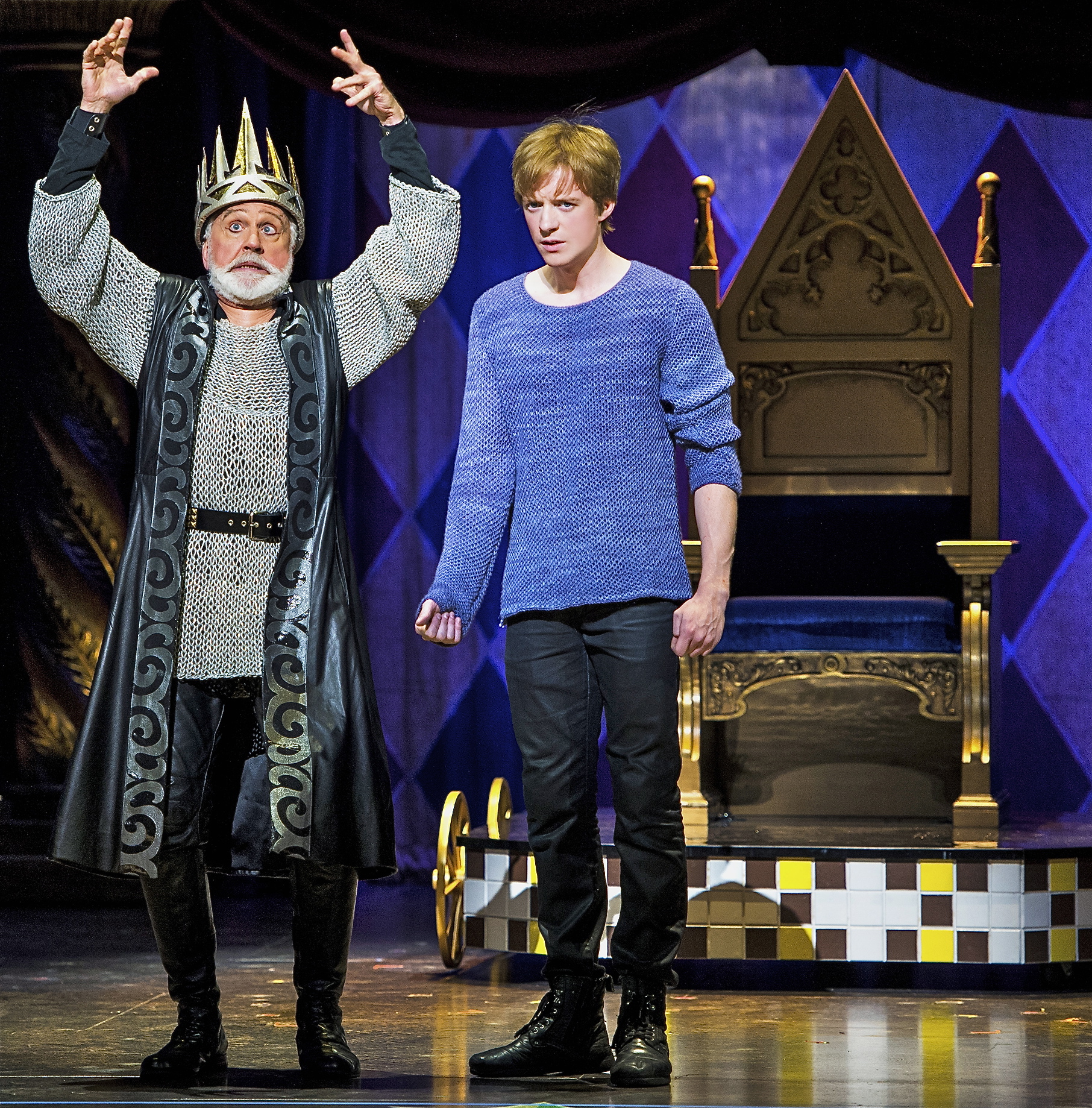
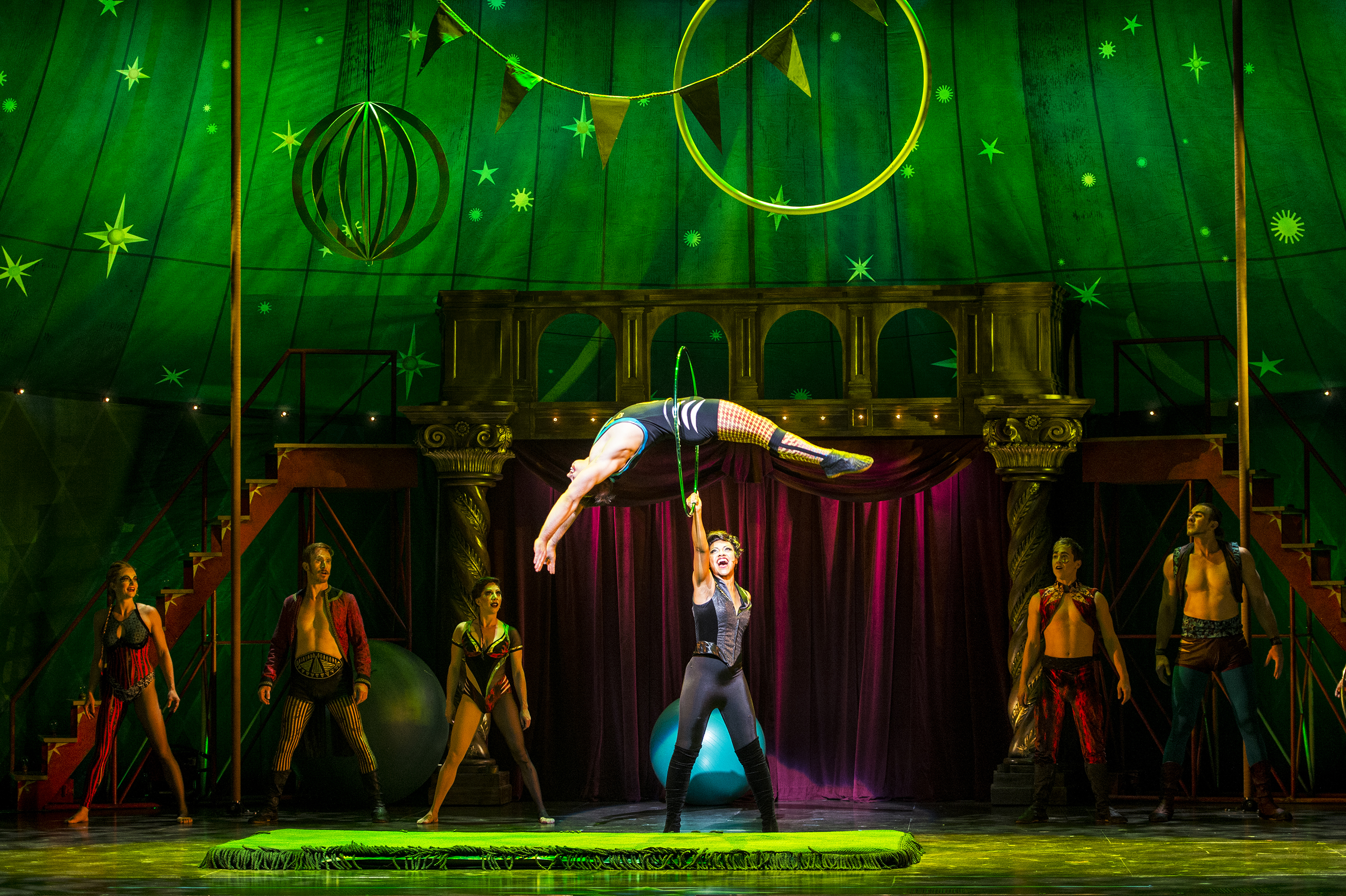
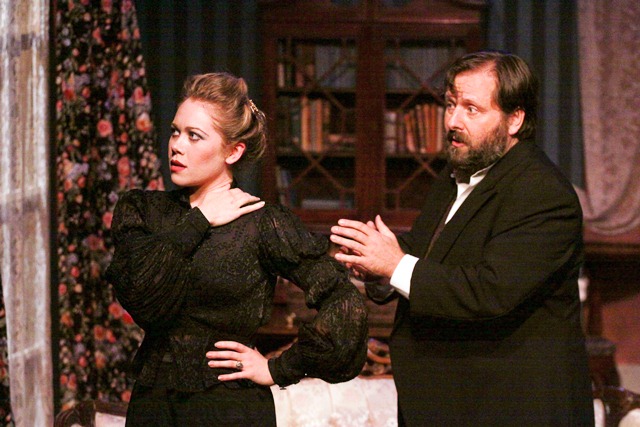
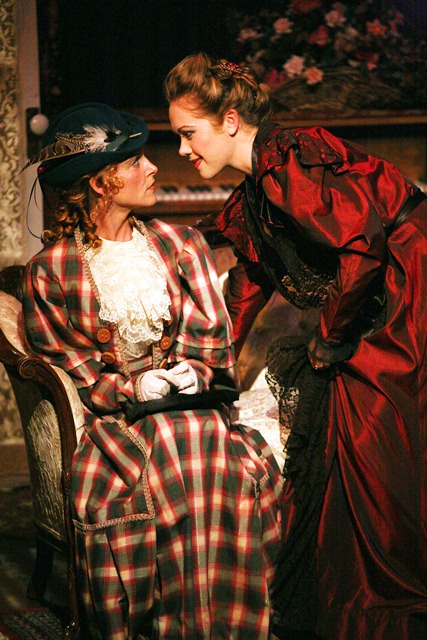
Her two dancing boy-toys, Michael Balderrama (left) and Bob Gaynor, flank Meow Meow at Berkeley Rep. Photo, courtesy kevinberne.com.

Expect the unexpected.

And Meow Meow, leggy brunette bombshell and mock diva, will energetically provide it at the Berkeley Rep.

She’s fabulous — in all meanings of the word: mega-excellent; larger than life-sized; and a spectacular invention, in the fabled sense.

She’s half wildcat, half wild card.

With ersatz desperation, the combo singer-comedian-actress-dancer weaves her innate talents and cleverness into a triumphant 90-minute patchwork-quilt, musical-spoof that’s headed for Broadway.

She also parades as a wannabe revolutionary and philosopher (“Is there a God?”).

But her main shtick is to pull male theatergoers onstage and womanhandle them during “An Audience with Meow Meow,” a title with multiple interpretations.

Not for a second did I envy folks dragged from the front rows to paw her legs, grope her torso and act as comedic chairs and foils.

But those repeated gambits, albeit somewhat cheesy, are extremely funny.

Meow Meow — whose given name is the slightly less glamorous Melissa Madden Gray — along the way dices and slices diva and cabaret mythology, turning theatrical clichés sideways and upside down.

She revels in taking risks.

She satirizes superstars who thrive on flowers tossed at them, who physically toss themselves onto their fans, who praise to the rafters whatever venue they’re in.

With hints of, and homages to, Marlene Dietrich, Edith Piaf and Lady Gaga.

And I wouldn’t be at all surprised to learn she’d secretly viewed re-runs of Carol Burnett and Lucille Ball’s televised physical antics.

Or been addicted to the black-and-white slapstick of Charlie Chaplin or Buster Keaton.

Meow Meow, who as a small girl wanted to be a ballerina but ended up getting a law degree instead, isn’t above making cabaret standards her own.

She particularly excels with Jacques Brel melodies and Harry Warren’s “Boulevard of Broken Dreams.”

But the show-stopper becomes an antique Bobby Darin novelty hit, “Itsy Bitsy Teenie Weenie Yellow Polka Dot Bikini,” with which she lampoons genre after genre after genre.

Her being exceptionally limber, agile and gymnastic also allows a self-serving self-reflection: “Is art a woman killing herself?”

Meow Meow says she especially loves entertaining audiences who’ve grown tired of green witches, jukebox musicals and singing Mormons.

I’d say the entire opening night crowd — including me — fully appreciated her creative efforts in that regard.

A multi-lingual international star (she’s been a headliner in Berlin, Sydney and Shanghai), she was ably supported by two boy-toy dancers, a four-piece band and a white-mouse puppet.

And competently directed by Kneehigh Theatre’s Emma Rice, previously represented winningly at the Rep by “The Wild Bride” and “Tristan & Yseult.”

Meow Meow, whose fame skyrocketed while performing in Michel Legrand’s “The Umbrellas of Cherbourg” in London in 2011, slyly tries to be mysterious and cloak her origins, purposefully referring both to Moscow and Berlin.

But she’s really an Aussie.

I couldn’t determine, however, if she adopted her stage name before or after meow meow, the street drug, gained popularity. Mephedrone, that potent designer amphetamine, has become a British rave favorite because it produces effects parallel to cocaine and ecstasy.

Meow Meow, the performer who’s also credited with writing her show, supplies a public wave of ecstasy as an alternative.

Consequently, I might hate myself in the morning for using what may be a cat-astrophic ending, but I really can’t stop myself (she instantly turned me into a fan, you see):

Meow Meow’s act may not reach purr-fection, but it does come as close as a whisker.

“An Audience with Meow Meow” plays at the Berkeley Repertory Theatre‘s Roda Theatre, 2015 Addison St., Berkeley, through Oct. 19. Night performances Tuesdays, Thursdays, Fridays and Saturdays, 8 p.m.; Wednesdays and Sundays, 7 p.m.; matinees, Thursdays, Saturdays and Sundays, 2 p.m. Tickets: $14.50 to $89, subject to change, (510) 647-2949 or www.berkeleyrep.org.

Folks mull what they’d do if they could alter the past

By Woody Weingarten


Woody Weingarten’s “chicken-scratches” — otherwise known as notes — for today’s column. Courtesy photo.

Fifty-six years ago I asked my first man-in-the-street question for a weekly newspaper.

I don’t recollect what it was, but it was shallow.

After all, I was a wet-behind-the-ears 21-year-old know-it-all who knew next to nothing. So it was appropriate that neither the query nor answers published in the Bronx Press-Review stirred any emotions.

The feature drew an unadulterated response:

Diddly-squat. Bupkis. Zilch.

Several weeks ago, hoping I’ve learned a speck or two in the interim, I decided to repeat the exercise. I expected, naturally, that my much deeper person-in-the-street probing would elicit vastly more profound responses from strolling passersby.

I was right.

Back in the day, I was forced to discard close to two-thirds of the replies I’d extracted.

They were unfathomable. Vacuous.

Or gibberish.

This time around, on picturesque San Anselmo Avenue rather than the hustle-bustle of a New York City street, I needed to trash only a few reactions (and then because they mirrored others).

My question prompted self-awareness, sensitivity and vulnerability: “Pretend I’m handing you a magic card. With it you get to do over any one thing in your life — not re-live, but do differently. What would your revision be?”

Most folks came up with their answers speedily.

But one guy went so far inside himself for such an elongated time I feared I’d have to summon either a shrink or a crew of paramedics.

Was there one predominant response?

Nope.

But the most prevalent had to do with education and academics.

The thought-provoking winner from that grouping, in my estimation, was what San Anselmo’s Katherine Willman, who categorized herself as “middle-aged,” conjured up.

Without hesitation, she said he’d have taken her “son out of public school and put him into a private school — because private schools promote individuality and independent thinking better.”

Spencer Hinsdale, 47, another San Anselmo resident, would have “chosen to study Spanish because I spent more years studying French than the number of French speakers I’ve met in this country. Meanwhile, everyone’s speaking Spanish.”

His choice made me ponder my own.

In retrospect, Latin and German didn’t quite turn out to be as valuable on a daily basis as I’d thought they might.

Erika Mott, 15, of Kentfield, wished she’d “have studied harder for my finals freshman year because it dropped down my Grade Point Average.”

Ronald Brozzo, 71, also of San Anselmo, said he’d “have finished college instead of going for only a year and a half. It would have helped me a lot later in life.”

And Josette Dvorak, a 48-year-old Mill Valley woman, mused that she’d “have spent a college semester abroad, at Oxford, so I could have experienced life in England.”

Others who were questioned provided a wide gamut:

• Amy Castagna, 58, Novato: “I would have gone home to Pennsylvania for my grandmother’s funeral. It’s my one big regrets in my life.”

• Alex Swanson, 32, Larkspur: “I’d have started investing in index funds, purchased my first rental property earlier, and learned to live on 50 percent of my income — so I could have been financially independent.”

• Yuko Fukami, 54, Berkeley: “I wouldn’t have become an architect but would have done something else — maybe become an artist.”

• Carlos Mock, 43, San Rafael: “I would have traveled more, all around the world, instead of being so responsible.”

• Mona Philpott, 63, San Anselmo: “I’d have taken my music lessons more seriously. My parents wanted me to, but I fought the practice.”

• Lynne Ashdown, 75, Novato: “I would have had one more child. I have two sons and I’d have liked to have a daughter.”

Several respondents declared they’d change nothing — folks like 61-year-old Cindy King of Mill Valley, visiting 57-year-old Yatra Sherwood from the United Kingdom and 35-year-old Mila Kronick of San Anselmo, who asserted “I’ve liked everything I’ve done.”

But my favorite answer came from Heather Richer, a 38-year-old San Anselmo resident — because of its levity. “I wish I’d have brought my Bed Bath & Beyond coupon with me to the store.”

When I posed the Big Question to myself, I thought that instead of becoming an editor and writer, I might have tried life as a cartoonist or actor.

The downside, of course, would be that this column, The Roving I, wouldn’t exist.

Hmmm…

“Fiddler on the Roof” at Cinnabar Theater, Petaluma CA

By Greg & Suzanne Angeo

Reviewed by Suzanne and Greg Angeo

Members, San Francisco Bay Area Theatre Critics Circle


Photos by Eric Chazankin

(standing at table) Stephen Walsh, Elly Lichenstein


“Fiddler”  is a Toast to Life

Here’s an interesting factoid about the original 1964 Broadway production of the highly acclaimed musical “Fiddler on the Roof”: The title, poster art and set design were all inspired by the celebrated Russian-Jewish artist Marc Chagall. Two of his paintings, “The Fiddler” from 1912, and “The Green Fiddler” from 1924, both show, in vivid colors, a fiddler cavorting on the rooftops of tiny homes. The dreamscape imagery represents music and dance as integral to life and a way to achieve communion with God, but the musical suggests even more. Based upon a series of stories published in the 1890s by Yiddish author and playwright Sholem Aleichem, the “Fiddler on the Roof” in the musical also represents the tenuousness of life as we joyfully struggle each day to do, and be, the best we can. The music and lyrics by Jerry Bock and Sheldon Harnick, and book by Joseph Stein, produced one of the most powerful  and cherished works in the history of theatre. It was the first musical ever to exceed 3000 performances, and for almost ten years held the record for the longest-running show. It won nine Tony awards.

“The Fiddler” by Marc Chagall, 1912

The story has been an enduring classic for 50 years because of it tremendous scope and beauty. It takes place in a small Jewish village in 1905 Russia just as the Revolution is fermenting and the Jews are coming under siege. A dairyman named Tevye and his family are facing political and social turmoil as they’ve never seen before. The 20th century is moving in fast, and the old traditions they used to hold dear are no longer holding up. They must shift, like the fiddler on the roof, to keep their balance as they and their village celebrate life’s events with humor and hope.

The richly textured production at Cinnabar has a cast of superb vocal talent. Leading the way is Stephen Walsh as Tevye, devoted to his family and his God. Walsh delivers a warm, sensitive and deeply satisfying rendition of this beloved character. He brings down the house with ”If I Were a Rich Man”, one of many one-sided conversations he has with God.  Elly Lichenstein plays Golde, Tevye’s wife and mother of their five daughters, as a sturdy, Jewish earth-mother with a soaring, lovely soprano voice that’s showcased in numbers like “Do You Love Me?” and “Sabbath Prayer”.  Madeleine Ashe in a key role as the village matchmaker Yenta is a champion scene-stealer.

Stephen Walsh

This show is all about the music and features pretty ambitious Russian-Jewish dancing which sets the audience to clapping in time. The show takes off in the thrilling opening number “Tradition” performed with great animation and confidence. “To Life” (“L’Chaim”) was energetic and got the audience going, but the choreography was a bit awkward. Nonetheless, there are some impressive attempts at acrobatics and Russian dancing, and the gorgeous harmony produced by the ensemble chorus can give you goosebumps. The wedding scene brings us “Sunrise, Sunset”, a wistful, beautiful and touching ballad, and features inspired Hebrew frolics. “Matchmaker”, performed by the three oldest daughters – Tzeitel (Jennifer Mitchell), Hodel  (Molly Mahoney) and Chava (Erin Ashe) is full of charm and beautifully sung by all three. Their romantic counterparts Motel (Michael Desnoyers), Perchick (Anthony Guzman) and Fyedka (Samuel Rabinowitz) all deliver solid performances, although the ladies have the vocal edge.

John Shillington’s simple, efficient direction includes creative touches like frequent use of frozen tableaus, very effective and well done. There’s lots of movement on the small stage, but during some of the large ensemble numbers when the entire cast of 38 is on board, it seems a bit over-crowded and clumsy. The small orchestra at times was off-key, an unfortunate but frequent occurrence at North Bay shows.

(left to right) Nate Mercier, Joseph Favalora, Jorge Covarrubias

Cinnabar’s engaging production to kick off its 42nd season resonates with universal truth, reminding us that we are all fiddlers, trying our best to prevail through jubilation and heartbreak.  “Fiddler on the Roof” is entertaining theatre for the whole family and is worth checking out. Shows are selling out each weekend, and even though they have added performances, it must close on September 28th. If you want to go, you should get your tickets without delay.


When: Now through September 28, 2014

8 p.m. Fridays and Saturdays

2 p.m. Saturdays and Sundays

2p.m. Thursday, September 25

Tickets: $25 to $35

Location: Cinnabar Theater

3333 Petaluma Blvd North, Petaluma CA
Phone: 707-763-8920

Website: www.cinnabartheater.org

Marin’s theater scene sets the stage for talent despite lack of funding

By Guest Review

As we enter the initial weeks of the 2014-15 theater season, the state of this beleaguered art form in Marin is good. Not great, but better than might be expected in a small county with a decentralized suburban population and two of the West Coast’s most important cultural hubs, San Francisco and Berkeley (with all that they offer) just a bridge crossing away. The picture might be even brighter if the severe water shortage we’re experiencing were not matched by another drought that’s been around for many years: money. More specifically, the widespread need for long-term, stable financial support for the arts.
It’s common knowledge that anyone brave or foolish enough to become seriously involved in a small nonprofit theater, whether at the professional or community level, is going to be overworked and underpaid. That people keep doing this year after year is one of the wonders of the world, and we who enjoy the results are blessed for it. A thriving arts scene enriches everyone, but when the money springs run dry, those who depend on them may be tempted to give up the daily struggle, and new ventures created by people endowed with creative vision and youthful energy are unable to take root.
With a few notable exceptions, that’s essentially a snapshot of Marin’s current theatrical landscape. In last year’s Fall Arts Preview, I noted that Porchlight Theatre was on the endangered list. Having cancelled its annual summer show in the rustic amphitheater behind Ross Valley Players’ Barn, the company was reportedly regrouping for a return in 2014. It didn’t happen. Lack of funding for required site changes and internal management squabbles sank a valuable cultural resource. It’s the latest in a series, with no replacements in sight.
That leaves us with the following lineup as we enter the 2014-15 season: Two professional companies operating under standard Equity contracts (Marin Shakespeare Company, with three summer productions at Forest Meadows Ampitheatre on the Dominican University campus, and Marin Theatre Company, with six productions during the regular season at their Mill Valley playhouse); two volunteer-run community groups (Ross Valley Players at the Marin Art & Garden Center in Ross, and the Novato Theater Company in its new digs adjacent to Hamilton); and, finally, a pair of professional/community hybrids (the Mountain Play, with one annual production, early summer on Mt. Tam, and Marin Alternative Theater (AlterTheater), presenting a couple of plays yearly in various empty San Rafael storefronts). A trio of non-mainstream participants—tiny Curtain Theater (one summer production in the amphitheatre behind the Mill Valley Library), the College of Marin Drama Department (various student shows on the Kentfield campus), and a festival of short plays called “Fringe of Marin” at Dominican—complete the list.
It might seem like a lot, but it really isn’t. During our “warm” summer months, except for Curtain’s free performances in Old Mill Park, Marin Shakespeare Company’s three productions are the only game in town. During the 10 months from September through June, the heart of the regular season, MTC’s six professionally produced shows are the focus of local attention. The lower-ranked companies have their loyal followings, but it’s hit or miss when it comes to play selection and performance quality. (I should add, however, that the Mountain Play, AlterTheater and RVP frequently offer entertaining fare and they have something going for them that the big boys don’t: bargain-priced tickets!)
Since Novato Theater company hasn’t been on my review schedule recently, I can’t make any judgments about quality, but play selection has been questionable in the past. Under Mark Clark’s leadership, that may be changing. See the “News” sidebar for NTC.
Marin Theatre Company is one of two major exceptions to the financial crunch most of its peers are facing. Its history is a classic example of how adequate funding can create a positive feedback loop. Back in 1984 a group of generous private donors raised several hundred thousand dollars and leveraged it to get grants and loan guarantees from the San Francisco Foundation, which was then administering the Buck Trust. The money raised was used to move the tiny but respected Mill Valley Center for the Performing Arts from the town’s old Golf Clubhouse to a vacant commercial building on Miller Avenue that was purchased and converted into the attractive theater complex that stands there today. Successive waves of other generous donors eventually replaced most of the founders, operations expanded and quality improved. In response, the subscriber list steadily lengthened—to the point that when the Marin Community Foundation (which took control of Buck grants after successful litigation) discontinued direct operational subsidies a few years ago, MTC could comfortably sail ahead under its own power.
While Marin Shakespeare Company has received substantially less contributed support from foundations and individuals than MTC, not having a building to maintain or a large permanent staff has allowed it to put most of its money into productions and outreach to local schools and prisons. That, in turn, has elevated its prominence in the community, attracting subscribers and helping to keep the company on a solid financial footing. Now, the recent receipt of a $1 million gift from an anonymous donor has the potential to transform what has essentially been a low-key mom-and-pop operation under Lesley and Robert Currier into one of Northern California’s top producers of the Shakespeare canon.
As we all know, success tends to build upon success. In the theater world, that means having the right combination of money and talent. One without the other won’t get the job done. Below the top echelon occupied by MTC and MSC, many leaders of second-tier companies that make substantial contributions to Marin’s cultural life, when interviewed for this report, wondered if they can avoid the financial crisis that closed Porchlight and others before it. They said the clear need is for a multitude of dependable revenue sources—from individuals, government, business and, most of all, from the Marin Community Foundation, which in recent years has been directing funding away from the arts to social justice and affordable housing projects.
Wishful thinking? Probably. But a cultural community is like a garden: plant the seeds with care, attract knowledgeable people to tend the plants, nourish them with adequate food and water, and they will reward you with a bountiful harvest. Neglect them and they will die. It’s as simple as that.
Marin Theatre Company 397 Miller Ave., Mill Valley. 415/388-5200, marintheatre.org
News: Now entering his eighth season as artistic director, Jasson Minadakis is watching MTC’s play development program pay off handsomely as two of six scheduled productions this season will be of scripts that were winners of the company’s Sky Cooper New American Play Prize. During the run of The Whale, its author, Sam Hunter, will be on hand for a public presentation of a project now in the workshop stage. Date and place to be announced. Public outreach is expanding with Q&A discussions after most performances and preview discussions of the season’s plays at libraries around the county.
Fall Productions: The Whale (Oct. 2-26), The Complete History of Comedy (abridged) (Nov. 28-Dec. 21)
Marin Shakespeare Company Forest Meadows Amphitheatre, Dominican University, 415/499-4488, marinshakespeare.org
News: Over and above the recent $1 million donation, contributions are at a higher level than previously, which is a welcome vote of confidence. With the support of a grant from the California Arts Council based on the impressive success of their Shakespeare at San Quentin Prison initiative (inmates guided by professionals perform plays for their fellow prisoners and members of the public), MSC is inaugurating a similar program at Solano State Prison in Vacaville. Managing Director Lesley Currier is in charge of a staff that will include interns with a drama therapy background. Discussions are underway with Dominican about facility improvements at Forest Meadows. One high priority item is to upgrade the stage lighting system, which is now over 40 years old.
Fall Productions: Romeo and Juliet and An Ideal Husband (running in repertory through Sept. 28)
Mountain Play Cushing Memorial Amphitheatre, Mt. Tamalpais, 415/383-1100, mountainplay.org
News: The Gala will feature stars from Mountain Play musicals that go back to 2006. The practice of bringing in new directors every year will continue and there may be other staff changes, with the goal being to make the organization “more dynamic,” according to Executive Director Sara Pearson. The $50,000 income shortfall for this year’s production of South Pacific has now been covered through fundraising.
Fall productions: Hooked on Broadway (Gala fundraiser) at the Hoyt Theater, OSHA Marin (Nov. 8) Next summer’s show is Peter Pan.
Antenna Theatre San Rafael, 415/578-2435, antenna-theater.org
News: After a 15-year occupancy, Antenna has had to move its headquarters from Marin Headlands to San Rafael’s Gerstle Park when its lease expired. The special effects-enhanced Magic Bus tours of San Francisco have been drawing more customers, especially among tourists, and a new tour bus experience is about halfway through the design process.
Fall productions: Summer of Love Magic Bus tours continue in San Francisco.
AlterTheater 1333 Fourth St., San Rafael 415/454-2787, altertheater.org
News: Unavailable
Fall productions: TBA
Ross Valley Players Marin Art & Garden Center, Ross, 415/456-9555, rossvalleyplayers.com
News: Last season ran a small deficit, but the good news is that the large rent increase the group originally faced has been reduced to a more manageable level. Chapter 2 and Old Money were the 2013-14 income laggards. Company goals include raising actors’ stipends (currently $100 for the production run) in order to make RVP more attractive to Bay Area talent who live outside Marin. There is also talk of starting an outreach program for school-age children, details of which have not yet been announced. This month RVP is also celebrating its 85th anniversary season, marking it as the oldest, continually operating community theater on the West Coast.
Fall productions: The Fox on the Fairway (Sept. 12-Oct. 12), Jane Austin’s Persuasion (Nov. 14-Dec. 12)
Novato Theater Company 5420 Nave Dr., Novato, 415/883-4498, novatotheatercompany.org
News: After several years of not having a permanent home, NTC is now happily settled into its space in the Hamilton area. Though the interior is still unfinished—audience risers are needed, among other things—there is a palpable sense of energy and vision coming from Mark Clark, its new artistic director/board chair. The recently concluded season saw an improved play schedule that featured Shakespeare’s As You Like It and the off-Broadway musical about a woman with bipolar disorder, Next to Normal. There will be staged readings of a new musical about life among the techies in Silicon Valley Nov. 14-16.
Fall productions: Leading Ladies (through Sept. 14), Avenue Q (Oct. 10-Nov. 9), Inspecting Carol (Nov. 29-Dec. 21)
College of Marin Drama Department Kentfield campus, Sir Francis Drake Blvd., 415/485-9558, marin.edu/departments
News: Drama Department Coordinator Lisa Morse says they are looking to expand their relationship with Kent Middle School, whose students can simply cross College Ave. to see a performance arranged specially for them. Consideration is being given to dropping the requirement that all actors must be enrolled students because it discourages experienced community actors (who often act as mentors for college beginners) from participating.
Fall productions: Little Women (Sept. 25-Oct. 5, Main Stage), The American Dream/The Zoo Story (Nov. 20-Dec. 7, Studio Theatre)
ONE FINAL NOTE: Although it lies a few miles north of the Marin County boundary, Spreckels Theatre Company, performing at the Spreckels Performing Arts Center in Rohnert Park (5409 Snyder Ln., 707/588-3434) is a convenient, low-cost way to view fully staged professional quality productions of Broadway musicals. Next up is Bell Book & Candle, Sept. 19-Oct. 9.
Charles can be reached at cbrousse@att.net.

The Fox on the Fairway earns kudos at Ross Valley Players.

By Kedar K. Adour

Lydia Singleton (Louise, front), Derek Jepson (Justin)., Louis Schilling (Bingham) and Eileen Fisher (Pamela) star in Ross Valley Players’ production of ‘The Fox on the Fairway.’ Photo by Robin Jackson

THE FOX ON THE FAIRWAY: Farce by Ken Ludwig and directed by Juliana Rees. Ross Valley Players Barn Theatre at the Marin Art & Garden Center, 30 Sir Francis Drake Blvd. in Ross. 415-456-9555 or www.rossvalleyplayers.com.  September 12-October 12, 2014

The Fox on the Fairway earns kudos at Ross Valley Players. [rating:4]

Ross Valley Players (RVP) has been treading the boards for 84 years and in this their 85th season has returned to what they do best, comedy/farce. It is an appropriate move since some of their more ambitious productions are beyond the ability of this community/non-equity theatre. They have again turned to a Ken Ludwig farce to regain applause and elicit laughter from the audience.

Two years ago they earned five stars for their production of Ludwig’s Lend Me a Tenor that has an almost a perfect ingenious farcical plot. This time around Ludwig’s plot is a strained and a bit “by-the-numbers.” The broadly drawn characters, ridiculous story-line, risqué double meanings, love gone awry and fast/ furious physical activity that uses the obligatory four doors needed for farce are all there. Not only do they have the aforementioned four doors, they have  huge French doors upstage center overlooking the golf course (Set by Ken Roland).

The time is the present and the place a tap room of the Quail Valley Country Club. The annual tournament between Quail Valley and Crouching Squirrel Golf Clubs is about to begin. Quail Valley has never won. This year Bingham (Louis Schilling), the Quail Valley president has brought in an expert golfer to assure they will win. He did not count on the deviousness of Dickie (Javier Alarcon); Bingham’s counterpart of Crouching Squirrel who has squirreled away Bingham’s  expert golfer. Bingham has made a huge bet with Dickie before he knew about the loss of his expert golfer. As luck would have it Bingham has hired a gofer, young Justin (Derek Jepsen) who shoots golf in the low 60s (for you non-golfers a low score is good). Quail Valley is on the way to a win but not before we meet all the characters who have made brief declamatory statements to the audience befitting the personalities of their characters before the plot begins.

Along with the three mentioned characters there is young scatter-brained Louise (Lydia Singleton) who works at Quail lodge and is in love with Justin. Unhappy sex-starved Pamela (Eileen Fisher) is married to Dickie but is oddly a member of the Quail Lodge Club but she has her reasons that become clear in the second act. Finally, there is Muriel, Bingham’s masculine wife who wears camouflage clothing and hasn’t been ‘drilled’ for years.

The scene is set and the golf tournament begins. We hear the partial results over a loud speaker. In the meantime Louise has lost her heirloom engagement ring in the toilet. She must not tell Justin who goes goes berserk under stress. As the golf games goes on, Quail lodge is ahead by 8 shots but alas there is a rain delay with Quail Lodge ahead by 8 shots with the18th hole to be played the next day.

All is set for the hysterical act two. Without giving away the surprises it is safe to say, Justin goes berserk, alcohol  (champagne) flows, Pamela and Bingham express their true feelings, (the truth of ‘in veno veritas’) with an recalcitrant open microphone announcing it to the entire club. Muriel enters in a butch outfit and adds further complications when she learns that her treasured sweater shop is part of the bet between Bingham and Dickie.   It is a wild time with all the doors being used with entrances and exits galore. The denouement is a humdinger.

The seasoned director, Juliana Rees an Equity actor, keeps the mayhem in check allowing the actors to emote. Yes, the term emote is correct, since the acting is rightfully very, very broad in the doctrine of farcical acting. Two of the actors are new to RVP including young handsome Derek Jepsen who worked under the legendary James Dunn and Louis Schilling who has played in venues throughout the Bay Area. Jepsen’s performance foreshadows a promising career in the theatre. Javier Alarcon who almost stole the show from James Dunn and Wood Lockhart in Tuna Texas is great as devious Dickie. The elegant Elleen Fisher exudes the sex written into her role and is matched in quality by Lydia Singleton as the ingénue. Sumi Narendran makes the most of her unenviable role as Muriel.

This review is being written on the last preview performance and tightening is needed that is surely to be corrected as the run progresses. Running time 2 hours with an intermission. Recommendation: A should see production.

CAST: Javier Alarcon  as Dickie; Eileen Fisher as Pamela; Derek Jepsen as Justin; Sumi Narendran as Muriel; Louis Schilling as Bingham;  Lydia Singleton as Louise.      

ARTISTIC STAFF: Director, Julianna Rees; Production Manager, Mark Toepfer; Stage Manager, Will Lamers;  Asst Stage Manager, Lisa Immel; Set Design, Ken Rowland; Costume Design, Michael A. Berg; Lighting Design; Property Design, Maureen Scheuenstuhl

Kedar K. Adour, MD

Courtesy of www.theatreworldinternetmagazine.com.


An earthy/athletic A Midsummer Night’s Dream at CalShakes

By Kedar K. Adour

A MIDSUMMER NIGHT’S DREAM: Comedy by William Shakespeare and directed by Shana Cooper. California Shakespeare Theater, Bruns Amphitheater, 100 California Shakespeare Theater Way, Orinda, CA 94563. (just off Highway 24 at the California Shakespeare Theater Way/Wilder Rd. exit, one mile east of the Caldecott Tunnel.). 510.548.9666 or www.calshakes.org. September 3–28, 2014.

An earthy/athletic A Midsummer Night’s Dream at CalShakes [rating:4]

A Midsummer Night’s Dream is probably the most produced of Shakespeare’s plays. CalShakes closed out their 2009 season with Aaron Posner’s version that featured the inimitable Danny Scheie as Bottom who is magically turned into an ass to woo bed and punishTitania Queen of the Faires. Once again, CalShakes closes out the 2014 season with another production of Dream with the scene stealing Danny Scheie as Puck and he does not disappoint.

Peter Brook’ version of Dream (1970 and 2012) is the standard by which all other production must be measured. It was a ‘dream’ production with trapeze artists flying high and brilliant staging creating awe within the audience. The talented director Shana Cooper, using multicasting, has brought the major cast down to eight in this earth bound production. They cavort in drab but inventive surroundings (set by Nina Ball) with stacks of cord wood backed by intertwined branches signifying the magical forest where most of the action takes place. That drab stack of cord wood magically sprouts flowers before the evening ends.

The play takes us from the mortal world of Athens to the charmed forest of the fairy band under the rule of Titania (Erika Chong Shuch) and Oberon (Daisuke Tsuji). In Athens, Theseus (Daisuke Tsuji) and Hippolyta (Erika Chong Shuch) are preparing for their marriage.  Director Cooper sets the tone for the entire play with a fantastic physical mating ritual that must be seen to believe as Tsuji and Shuch roll around on the stage with athletic agility, never missing a dialog line, before he carries her off into the wings.

A secondary storyline involves the Hermia (Tristan Cunningham) who is betrothed to Demetrius (Nicholas Pelczar ) but loves Lysander (Dan Clegg) and Helena (Lauren English), in love Demetrius.  Hermia’s father Egeus (James Carpenter), under the law of Athens, offers Hermia the choice of death or life in a nunnery. It is here one of the most quoted line appears: The course of true love never did run smooth.  The truth of that statement is about to begin when Hermia runs off into the forest with Lysander.

Demetrius and Helena are in hot pursuit of the eloping lovers and everything goes awry. Troublemaker Puck, Oberon’s sidekick, then screws everything up. He is ordered to place a magic potion in the eye of Demetrius but places the potion into the eye of Lysander. It is not Puck’s fault that Athenians dress alike? Of course when Helena is the first person Lysander sees it is love at first sight. Oberon seeing the mistake, orders Puck to rectify the error by placing the drops into the eye of the proper Athenian, Demetrius. Alas the first person Demetrius sees in Helena and all hell breaks loose with both men pursuing Helena.

The physical action of the scene with the battling lovers as designed by Erika Chong Shuch, directed Shana Cooper and performed by the actors with the help of the ensemble is worth the price of admission.

In the meantime we meet The Mechanicals who are arranging to put on a performance of the tragedy Pyramus and Thisbe at the nuptial ceremony of Thesus and Hippolyta. Liam Vincent has the frustrating role as Peter Quince their director. The egocentric Bottom (Margo Hall) gets his comeuppance when Puck turns him into Ass complete with long ears, hairy body and a tale. The rest of the Mechanicals take off leaving Oberon to fall in love Bottom/The Ass. Alas, Puck intones, “Lord, what fools these mortals be.”

Before the evening ends there is the staging of Pyramus and Thisbe that has the audience in hysterical laughter.  James Carpenter as Starveling, Catherine Castellanos as the Wall,  Craig Marker as Flute (in drag) double the fun by playing their parts absolutely straight increasing  the frustration exhibited  Liam Vincent as the director.

Scheie gets to return in the final scene as Philostrate, Master of the Revels and displays his scene stealing ability. The play has been truncated and running time is 2 hours and 20 minutes with an intermission. Recommendation: A should see production.

CAST: Featuring: Daisuke Tsuji* (Oberon, Theseus, Ensemble); Erika Chong Shuch* (Titania, Hippolyta, Ensemble); Danny Scheie* (Puck, Philostrate, Ensemble); Dan Clegg* (Lysander, Ensemble), Nicholas Pelczar* (Demetrius, Ensemble); Tristan Cunningham* (Hermia, Ensemble); Lauren English* (Helena, Ensemble); Margo Hall* (Bottom, Ensemble); James Carpenter* (Egeus, Starveling, Ensemble); Catherine Castellanos* (Snout, Ensemble); Craig Marker* (Flute, Ensemble); Liam Vincent* (Peter Quince, Ensemble); Travis Rowland (Fairy, Ensemble); and Parker Murphy (Fairy Ensemble).

CREATIVE TEAM; Set Designer – Nina Ball; Costume Designer – Katherine O’Neill;

Lighting Designer – Burke Brown; Composer/Sound Designer – Paul James Prendergast; Voice and Text Coach – Lynne Soffer; Movement Director – Erika Chong Shuch; Resident Fight Director – Dave Maier; Stage Manager – Karen Szpaller; Assistant Stage Manager – Christina Hogan; Assistant Directors – Adin Walker, Rebecca Deutsch; Movement Collaborators – Travis Santell Rowland, Parker Murphy; Assistant Lighting Designer – Krista Smith; Assistant Movement Director – Melanie Elms; Production Assistant – Christina Larson

Kedar K. Adour, MD

Courtesy of www.theatreworldinternetmagazine.com

Director misfires with ‘Midsummer Night’s Dream’

By Judy Richter

The opening scene of California Shakespeare Theater’s production of “A Midsummer Night’s Dream” sets the tone for the rest of Shakespeare’s play.

It’s a down and dirty wrestling match between Theseus (Daisuke Tsuji) and Hippolyta (Erika Chong Shuch), the Amazon queen whom he has conquered and intends to marry.

This scene foreshadows even messier goings-on when four young people go to the forest outside Athens in pursuit of love. Their encounters find them losing much of their clothing, especially on the women, and slathering mud on each other.

Director Shana Cooper is responsible for this staging, along with Shuch, who, in addition to playing both Hippolyta and Titania, serves as movement director.

The dirt comes from the set by Nina Ball. It is strewn with a black ground cover similar to wood chips that sometimes stick to the costumes.

As the audience arrives, large white plastic sheeting looking like a shower curtain is arrayed across the stage. Later it rises and billows overhead like clouds (lit by Burke Brown) as it reveals the forest with its woodpiles and outlines of trees.

The production’s black, gray and white color scheme is echoed in Katherine O’Neill’s costumes until the final scene. That’s when the six tradesmen, often called the Rude Mechanicals, stage the “lamentable comedy” of “Pyramus and Thisbe” for a wedding celebration.

While this scene often comes as an afterthought to the romantic resolutions that precede it, here it’s the hilarious highlight of the production. And, as noted, it breaks the color scheme with Flute (Craig Marker, his left arm in a sling) playing Thisbe in a white dress with red high heels, red wig and red accessories. Snug (Danny Scheie) plays the lion in a glittering head piece resembling a mane.

Director Cooper seems so intent on physicality that it could take a back seat to Shakespeare’s words were it not for a first-rate cast of veteran actors. One woman in the restroom line at intermission said that she enjoyed the play most when she closed her eyes and just listened.

All of the actors do at least double duty, serving in the ensemble in addition to their named roles. Two of the young lovers are played by Dan Clegg as Lysander, who is loved by Hermia (Tristan Cunningham). However, Hermia is supposed to marry Demetrius (Nicholas Pelczar), who had previously wooed Helena (Lauren English), who still loves him.

It took their retreat to the woods and some botched but eventually successful intervention by Oberon (Tsuji) and his assistant, Puck (Scheie). This intervention also applied to Titania, who had incited Oberon’s anger. The spell that Oberon put on her made her fall madly in love with Bottom (Margo Hall), one of the Rude Mechanicals, whom Puck had transformed into an ass.

Capably completing the cast in named roles are James Carpenter as Egeus and Starveling, Catherine Castellanos as Snout and Liam Vincent as Peter Quince.

It seems that Cooper, like some other directors, wants to take a different approach and make Shakespeare more trendy. It’s as if they don’t trust the Bard or the beauty and relevance of his words. Luckily for the Cal Shakes audience, though, Cooper has excellent actors who know how to speak the lines.

“A Midsummer Night’s Dream” will continue in the Bruns Memorial Amphitheater, 100 California Shakespeare Theater Way (off Hwy. 24), Orinda. For tickets and information, call (510) 548-9666 or visit www.calshakes.org.


The Last of Robin Hood — Film Review

By Joe Cillo

The Last of Robin Hood

Directed by Richard Glatzer and Wash Westmoreland


I have no criticisms of this film.  It is excellent in every respect.   It depicts the last couple years of Errol Flynn’s life (Kevin Kline) and his relationship with Beverly Aadland (Dakota Fanning).   Beverly Aadland was fifteen at the time the relationship started, although she passed for twenty.  Flynn comes off more favorably and sympathetically than he probably was in real life, but it was a positive, convincing portrayal of his relationship to Beverly Aadland.

Flynn involved Beverly’s mother Florence (Susan Sarandon) in the relationship, having her accompany them on trips and appear with them in public places.  It provided cover for his relationship with the young girl, and Florence cooperated and even encouraged the relationship.

It is an interesting romantic story: well acted, well conceived, and well presented.  I think the significance of this film is that it strikes a blow against some of the prejudice and nonsense that seems to prevail in our culture regarding sexual relationships across wide age gaps and with partners who are quite young — “underage,” as if the government can draw a line and declare people beneath a certain age boundary unfit, or unsuited, or incapable of behaving and functioning in a constructive sexual relationship, when it is well known that people show erotic response and interest in things sexual literally from birth.

I can tell you for a fact that many young women are attracted to men considerably older than themselves and that such relationships as depicted in this film are much more common that might be realized.  The vast majority of them play out in quiet discretion, but occasionally one is exposed and made into a public sensation and sanctimonious prosecution.

I think there is a growing perception that these laws and these hysterical prosecutions are much more destructive and pathological than the relationships that are their objects.  Lives and careers are destroyed, families are broken up, communities are disrupted and riven, institutions are shaken and weakened.  All over a little bit of sex with a young person.  It’s foolishness.  Sex does not harm children.  That has never been proven by anyone.   How could it?  Children are capable of erotic arousal from a very early age.  They are curious and quite readily explore it given the opportunity.  It is quite natural.

We live in a society where it is perfectly legal to train children how to use automatic weapons, but if you show a child an erect penis, you can be put in jail and tarred with being a sex offender for the rest of your life.  There is something wrong with that, ladies and gentlemen.  I think that the perversity of this is beginning to emerge into consciousness across a wide swath of American society.

These laws creating the concepts of “statutory rape,” or “child molestation,” are a legacy of religious prejudice and are designed to prevent children from growing up with healthy, accepting attitudes toward their bodies and their desires.  In recent years we’ve seen increasing havoc created throughout society at all levels by the boundless viciousness with which these laws are enforced.  It is time to dial this all back and rethink this in a fundamental way.  Religious conservatives have succeeded in hijacking the power of the state to enforce their negative sexual agenda on the entire society.  State power has replaced ecclesiastical courts.  This is improper and unconstitutional.  In 2003, in Lawrence v. Texas, the Supreme Court of the United States struck down laws against sodomy making consensual sex between same sex partners legal in all fifty states of the United States, although such sexual acts have been condemned by religious ideologies for centuries.  It was a declaration of independence for the state against the tyranny of religious prejudice in policing sexual behavior.  This trend needs to continue and be carried forward.

This film, while not belaboring the point, serves as an illustration of the wrongheadedness of the current statutes governing sexual relations between young people and adults.  It is an indirect critique of the current sexual regime in our legal system and a blatant contradiction to widespread prejudices against relationships that cross wide gulfs in age.  An excellent job on a neglected, but much needed theme.

Varying views of feminism in ‘Rapture, Blister, Burn’

By Judy Richter

At its most basic, Gina Gionfriddo’s “Rapture, Blister, Burn” is a heady, often humorous examination of feminism from various points of view.

Opening Aurora Theatre Company’s 23rd season, it initially focuses on two 42-year-old women who were friends and roommates in grad school.

One, Catherine (Marilee Talkington), has become a popular author and lecturer who links pornography with violent events like 9/11. The other, Gwen (Rebecca Schweitzer), dropped out, married Catherine’s boyfriend, Don (Gabriel Marin), and has become a housewife and mother to their two sons.

When Catherine returns to their hometown after her mother suffered a heart attack, she and Gwen find themselves envious of one another. Gwen regrets that she didn’t pursue a career, while Catherine wishes she had a real home and family.

Both come to realize that the grass isn’t necessarily greener on the other side of the fence.

Helping them reach that conclusion are 21-year-old student Avery (Nicole Javier) the babysitter for Don and Gwen’s younger son, and Catherine’s mother, Alice (Lillian Bogovich), who is in her 70s.

Another contributor is Don, an unambitious, low-level dean at the local college. He, Gwen and Catherine did a lot of heavy-duty drinking and partying in their grad school days. Gwen has since quit drinking and joined AA, but the other two still indulge. Moreover, Don smokes a lot of pot and is addicted to Internet porn.

Much of the discussion of feminism comes during the seminar taught by Catherine in her mother’s home to the only two students who signed up: Gwen and Avery. After each session, Alice serves martinis (Shirley Temples for Gwen) and joins the discussion, adding her generation’s view to those of the middle-aged and younger generations. It’s interesting that the oldest and youngest women seem to be the most realistic about their lives.

As directed by Desdemona Chiang inAurora’s intimate space (set by Kate Boyd), the actions and ideas sizzle.

Talkington’s Catherine comes across as erudite in her academic persona yet fearful, impulsive and uncertain in her personal life. Schweitzer makes Gwen a shrill, bubbly yet uptight woman who’s barely holding herself together.

Marin as Don, Javier as Avery and Bogovich asAliceall create believable characters.

A Pulitzer Prize finalist, the play offers ample food for thought as many women still struggle for a balance between home and career and for equality with men.

“Rapture, Blister, Burn” will continue at Aurora Theatre Company, 2081 Addison St., Berkeley, through Sept. 28. For information and tickets, call (510) 843-4822 or visit www.auroratheatre.org.


Center REP travels down memory lane in ‘Life Could Be a Dream’

By Judy Richter

Five years out of high school in the late ’50s, three guys are hoping to win the Big Whopper Radio contest and hit the big-time as a doo-wop singing group, Denny and the Dreamers.

That’s the plot line on which writer-director Roger Bean has hung “Life Could Be a Dream.” In actuality, it’s a way to combine some of the biggest hits from the late ’50s and early ’60s into a rollicking trip down memory lane, now at Center REPertory Company.

It’s hard to resist humming along to such tunes as the title song, a.k.a. “Sh-Boom,” as well as “Get a Job,” “Tears on My Pillow,” “Fools Fall in Love,” “Runaround Sue,” “Earth Angel,” “Only You” and “Unchained Melody.” These are just some of the songs in Act One of this two-act, two-hour show.

Some highlights of the second act include “(You’ve Got) The Magic Touch,” “The Glory of Love” and “Duke of Earl.”

All of this takes place in the basement rec room where the unemployed Denny (Ryan Drummond), the group’s leader, still lives with his mother. His two pals are Eugene (Tim Homsley) and Wally (Jerry Lee). Needing a $50 entry fee, they ask Big Stuff Auto to sponsor them, but the owner wants to check them out first.

Instead of coming himself, though, the owner sends his daughter, Lois (Sharon Rietkerk), and head mechanic, Skip (Derek Keeling). Before long, Skip becomes the group’s fourth member. He also tries to resist the mutual attraction with Lois, who’s also the object of affection for Eugene and Wally.

Naturally, complications arise, but just as naturally, all turns out well.

Bean’s staging on the detailed set by Michael Carnahan — note the wringer washer in an alcove — teams nicely with choreography by Lee Martino.

Bean also has selected an able cast, especially the three pals. Drummond’s Denny is just as persistent in his desire to do well in the contest as he is in ignoring his mother when she nags him to get a job. Lee’s Wally is appealingly sweet, while Homsley is hilarious as the inept, shy, dweebishEugene. All three are excellent singers.

Keeling’s Skip comes across as a greaser or Elvis wanna-be in his mannerisms and singing, which is off-pitch in a few spots. He plays guitar well.

Rietkerk’s Lois is tactful in her dealings with Denny, Eugene nd Wally and increasingly impulsive in her attraction to Skip. She sings well when a song is in her lower range, but her upper notes become shrill.

Also contributing to the show are musical director Brandon Adams, costume designer Bobby Pearce, sound designer Jeff Mockus and lighting designer Kurt Landisman.

Center REP and associates Bean and Jonathan Reinis reportedly hope to hone the show for Broadway. In its present form, it seems more appropriate for off-Broadway. A highly entertaining piece of fluff with enough story to keep it interesting, it’s a likely candidate for the regional theater circuit.

“Life Could Be a Dream” will continue at the Leshe rCenter for the Arts, 1601 Civic Drive, Walnut Creek, through Oct. 5. For tickets and information, call 925-943-7469 or visit www.centerrep.org.