Dame Edna needs a truncated more intimate setting

By Kedar K. Adour

DAME EDNA’S Glorious Goodbye: The Farewell Tour.  By Dr. Barry Humphries AO CBE. Directed by Simon Phillips. SHN Orpheum Theatre, 1192 Market St., San Francisco. 888-746-1799 or  www.shnsf.com. March 17- 22, 2015

Dame Edna needs a truncated more intimate setting. [rating: 3]

There are farewell tours that become second and third farewell tours. The inimitable, indomitable Dame Edna Everage (nee the multitalented Barry Humphries) the Melbourne Australian housewife has barged into San Francisco again with her second farewell tour. She graced the Curran stage in 2009 with Dame Edna: My First Last Tour and although she insists that this present hilarious spectacle is all unrehearsed big segments have been recycled from previous shows and that is not bad. At the curtain call her creator (and alter ego) Barry Humphries takes center stage and suggests that we cannot believe all that the mega-star Dame Edna tells us suggesting that a final, final tour is possible. But at age 81 it is time for her/him to hang up the purple wig, cat’s eye glasses and return to his native Australia and reap further honors for his intellectual and artistic life.

Barry Humphries is a true Renaissance man as a multifaceted intellect; actor/author/artist and has an honorary law degree from the University of Melbourne plus CBE from the Queen of the British Empire. His landscape paintings are much sought after. But we are not here to praise Mr. Humphries but to enjoy and be more than mildly appalled by the satiric bards of his creation (alter ego?) Dame Edna. Humphries insists that he, like Eddie Izzard (who will be in the Bay Area soon) is not a “cross-dresser” but an accomplished actor who has brought Dame Edna to life on the stage and in television.

Dame Edna was created in 1955 and she has parlayed her shtick into a mega personality and does not hesitate to tell her “possums” (those in the better seats) and to those in the cheap seats in the upper balcony she will give them attention “in exact proportion to what you have paid.” To her, all are her inferiors and should be prepared for her cutting remarks that often are risqué double entendres (“how long I lived with my husband’s prostate hanging over my head”).

Dame Edna’s brilliant timed improvisations are fortified by her withering glances and astonished look on her pliant face. Be warned not to sit in the front rows since much of her performance is directed to those seats and in the second act a man and a woman are brought on stage for a mock marriage. On opening night Dame Edna met her match with a diminutive matriarch who almost stole the skit.

Much of the show is actually audience participation especially with her signature finale with gladiolas thrown to the front rows and there is a semi-sing-a-long as her possums wave and clap on cue giving her the obligatory standing ovation she insists she deserves.

To buttress the show there are four dancers joining her for the musical numbers with onstage piano accompaniments by Jonathan Tessero. The show begins and ends with video clips that in themselves are worth a visit to the cavernous Orpheum Theatre.  However, Dame Edna’s sotto voice does not lend itself to amplification and some of the more delicious lines are garbled. When Dame Edna made her San Francisco debut in 1998 at the intimate Theatre on the Square, her scheduled brief stay was parlayed into a four month gig. If you plan on seeing this hysterical put down and becoming one of Dame Edna’s “possums” you will have to hurry since there are only seven local performances before it moves on eventually ending in Palm Springs the mecca for retirees who most probably will give her the standing ovation she demands and almost deserves. Running time 2 hours and 20 minutes with the intermission.

Cast: Barry Humphries  as Dame Edna; ensemble, Ralph Coppola, Brooke Pascoe, Eve Prideaux & Armando Yearwood, Jr.

Artistic Staff: Jonathan Tessero , musical director & onstage accompanist ;  set design, Brian Thomson; choreographer, Eve Prideaux; lighting design,  Aaron Spivey; musical supervisor, Andrew Ross; Songwriter (You Will Have to Do Without Me Somehow & Me Time), Wayne Barker; costume design to Dame Edna, Stephen Adnitt.

Kedar K. Adour, MD

Courtesy of www.theatreworldinternetmagazine.com

Beach Blanket Ephesus at COM

By Joe Cillo

When we’re enjoying a well-staged Shakespeare comedy, life’s a beach, and this one comes complete with a lifeguard chair, a parked surfboard and an obliging Pepsi machine. As soon as the Beach Boys launch into, “Surfin’ USA,” the boardwalk comes to life with skaters, twisters, comic policemen and dancers doing “The Swim.” The Bard’s Ephesus, it turns out, looks a lot like SoCal’s Venice Beach.
Instead, it’s “The Comedy of Errors” at College of Marin, and its director, James Dunn, has explained that the play is a farce, with all the characters trying to find out who they are and what they’re supposed to be doing. It’s fast-moving, he says, and Dunn should know. This was the first production from COM’s new Drama Department in 1964, which he founded. The present “Comedy,” being shown in the James Dunn Theatre, is the Department’s 272nd.
But not everybody is welcome in Ephesus. A new arrival, pushing a vendor’s cart, is from Syracuse, and the Duke — the one on the beach trike — says the stranger has to pay a big fine or die at sunset; sorry, but that’s the law.
Egeon, the stranger, using props from the cart, explains his situation. He’s here in search of his missing family, separated from him in a shipwreck five years ago. He had twin sons, entirely identical, even to their names. Both were named Antipholus. (Odd, but there’s more.) On the same day in his former home, a servant girl gave birth to another pair of identical twin boys, and these were both named Dromio. The servant twins were raised to serve Egeon’s twins. So there are two Antipholi and two Dromii.
One Antipholus is already a respectable citizen of Syracuse, while the other is about to arrive, each accompanied by a Dromio. More remarkable still, each pair is identically clothed. Let the fun begin.
Shakespeare loved mistaken identity jokes, and this plot gave him all a writer could ask for: a jealous wife, a lovestruck kitchen wench, an impatient goldsmith and general confusion, another comedy standby.
However, Egeon’s death sentence remains since his ransom money keeps vanishing, and everyone comes together for his scheduled execution, including a surprise witness. Then the Duke turns out to be a good guy after all.
Familiar names have contributed to this antic anniversary show. Kenneth Rowland designed the set, Patricia Polen and Jennifer O’Neill provided the costumes and Linda Dunn arranged the props.
In the cast, former Belvederean Steven Price plays the long-suffering Egeon, Skylar Collins appears as a doubly-confused Antipholus, and a tireless Jon Demegillo takes on the role of the much-battered Dromio. Both Demegillo and the saucy actress who plays Angela, the goldsmith — Trungta (Kae) Kositchaimongkol — also assisted with set and costume construction.
Robert Garcia plays both the trike-riding Duke and the creepy Dr. Pinch, Eileen Fisher is Antonius’ wrathful wife, with Melanie Macri as her sister. Michel Harris doubles as Antonius’ friend and a Merchant. The Beach Police are composed of Jesse Lumb, Evan Louie and Jeremy Snowden. Keara Reardon is a Courtesan, with Jannely Calmell and Ariana Mahallati serving as Apprentices. Jeffrey Taylor is another Merchant. (All the merchants have colorful bits.) Christina Jaqua as the Abbess provides the necessary happy ending.
Another reason to enjoy COM’s production: Shakespeare’s original was five acts; this one’s two.
A fine exhibit of artifacts and memorabilia from all fifty years of shows is open to the public in the College of Marin Fine Arts Gallery. The exhibit, assembled by set designer Ron Krempetz, is a lively collection of costumes, props, photos and mini-sets, with videos around the room to bring previous shows to life. The exhibition will remain the length of the show, through March 22. It’s free, but donations are encouraged. The theatre lobby also has a photo display from the early career of the late Robin Williams, when he was a student at COM.
Opening night’s show was also honored with visits by Supervisor Katie Rice and by a representative from Sen. McGuire’s office, presenting the Drama Department with a Certificate of Recognition for its fifty years in the community.
“The Comedy of Errors” will play in the James Dunn Theatre at the College of Marin Fridays and Saturdays through March 21 and Sunday, March 22. Friday and Saturday shows are at 7:30 p.m.; the Sunday matinee is at 2 p.m. Prices range from $10 to $20.
For additional information, call the box office, 415-485-9385, or see brownpapertickets.org.

750 words By ROSINE REYNOLDS

Beach Blanket Ephesus at COM
When we’re enjoying a well-staged Shakespeare comedy, life’s a beach, and this one comes complete with a lifeguard chair, a parked surfboard and an obliging Pepsi machine. As soon as the Beach Boys launch into, “Surfin’ USA,” the boardwalk comes to life with skaters, twisters, comic policemen and dancers doing “The Swim.” The Bard’s Ephesus, it turns out, looks a lot like SoCal’s Venice Beach.
Instead, it’s “The Comedy of Errors” at College of Marin, and its director, James Dunn, has explained that the play is a farce, with all the characters trying to find out who they are and what they’re supposed to be doing. It’s fast-moving, he says, and Dunn should know. This was the first production from COM’s new Drama Department in 1964, which he founded. The present “Comedy,” being shown in the James Dunn Theatre, is the Department’s 272nd.
But not everybody is welcome in Ephesus. A new arrival, pushing a vendor’s cart, is from Syracuse, and the Duke — the one on the beach trike — says the stranger has to pay a big fine or die at sunset; sorry, but that’s the law.
Egeon, the stranger, using props from the cart, explains his situation. He’s here in search of his missing family, separated from him in a shipwreck five years ago. He had twin sons, entirely identical, even to their names. Both were named Antipholus. (Odd, but there’s more.) On the same day in his former home, a servant girl gave birth to another pair of identical twin boys, and these were both named Dromio. The servant twins were raised to serve Egeon’s twins. So there are two Antipholi and two Dromii.
One Antipholus is already a respectable citizen of Syracuse, while the other is about to arrive, each accompanied by a Dromio. More remarkable still, each pair is identically clothed. Let the fun begin.
Shakespeare loved mistaken identity jokes, and this plot gave him all a writer could ask for: a jealous wife, a lovestruck kitchen wench, an impatient goldsmith and general confusion, another comedy standby.
However, Egeon’s death sentence remains since his ransom money keeps vanishing, and everyone comes together for his scheduled execution, including a surprise witness. Then the Duke turns out to be a good guy after all.
Familiar names have contributed to this antic anniversary show. Kenneth Rowland designed the set, Patricia Polen and Jennifer O’Neill provided the costumes and Linda Dunn arranged the props.
In the cast, former Belvederean Steven Price plays the long-suffering Egeon, Skylar Collins appears as a doubly-confused Antipholus, and a tireless Jon Demegillo takes on the role of the much-battered Dromio. Both Demegillo and the saucy actress who plays Angela, the goldsmith — Trungta (Kae) Kositchaimongkol — also assisted with set and costume construction.
Robert Garcia plays both the trike-riding Duke and the creepy Dr. Pinch, Eileen Fisher is Antonius’ wrathful wife, with Melanie Macri as her sister. Michel Harris doubles as Antonius’ friend and a Merchant. The Beach Police are composed of Jesse Lumb, Evan Louie and Jeremy Snowden. Keara Reardon is a Courtesan, with Jannely Calmell and Ariana Mahallati serving as Apprentices. Jeffrey Taylor is another Merchant. (All the merchants have colorful bits.) Christina Jaqua as the Abbess provides the necessary happy ending.
Another reason to enjoy COM’s production: Shakespeare’s original was five acts; this one’s two.
A fine exhibit of artifacts and memorabilia from all fifty years of shows is open to the public in the College of Marin Fine Arts Gallery. The exhibit, assembled by set designer Ron Krempetz, is a lively collection of costumes, props, photos and mini-sets, with videos around the room to bring previous shows to life. The exhibition will remain the length of the show, through March 22. It’s free, but donations are encouraged. The theatre lobby also has a photo display from the early career of the late Robin Williams, when he was a student at COM.
Opening night’s show was also honored with visits by Supervisor Katie Rice and by a representative from Sen. McGuire’s office, presenting the Drama Department with a Certificate of Recognition for its fifty years in the community.
“The Comedy of Errors” will play in the James Dunn Theatre at the College of Marin Fridays and Saturdays through March 21 and Sunday, March 22. Friday and Saturday shows are at 7:30 p.m.; the Sunday matinee is at 2 p.m. Prices range from $10 to $20.
For additional information, call the box office, 415-485-9385, or see brownpapertickets.org.

Shining City at Main Stage West

By Test Review

Shining City, by Conor McPherson, recently received an excellent staging by Main Stage West in Sebastopol. Directed by MSW Executive Director Beth Craven, the xxx play by one of Ireland’s best-known playwrights may disappoint those who were so enthralled by MSW’s earlier production of McPherson’s The Weir. Both plays display the playwright’s extraordinary gift for dialogue, but whereas The Weir is a true play, i.e., things happen, conflicts abound, situations evolve, etc., Shining City just sits there. One actor hogs the set with a spectacularly long tale of hallucinatory grief, while three others stand by to do their annotations to the central theme. Which is? Strangely, one-night stands.

Broadway By the Bay succeeds with ‘Les Miz’

By Judy Richter

Ever since it premiered in London30 years ago, “Les Misérables” has seen numerous revivals across the world, mostly by professional companies because of its enormous demands, both musical and otherwise.

Undaunted, the ambitious but non-professional Broadway By the Bay in Redwood City has risen to the challenge and has met it wonderfully.

Based on Victor Hugo’s French novel, “Les Misérables,” or “Les Miz,” is a sprawling story covering more than 17 years and dealing with the rampant poverty and oppression endured by many people.

The central character is Jean Valjean (Adam S. Campbell), paroled in 1815 after serving 19 years in prison for stealing bread for his sister’s starving child. Breaking his parole, he assumes a new identity, becoming a businessman and community leader.

When one of his fired factory workers, Fantine (Mia Fryvecind Gimenez), dies in 1823, he assumes guardianship of her young daughter. Nine years later inParis,  talk of revolution is brewing among university students.

Their talk becomes armed resistance, which is quickly squelched by the authorities, led by Javert (Anthony Bernal), who has pursued Valjean for more than 17 years.

With its soaring music by Claude-Michel Schönberg and quasi-operatic style, “Les Miz” needs outstanding singers for the principal and the many secondary characters. The BBB cast is equal to the task, with outstanding contributions by Campbell as Valjean and Bernal as Javert.

Other fine principals are Jason Rehklau as Marius, one of the students; Erin Ashe as Eponine, whose love for him is unrequited; and Samantha Cardenas as the adult Cosette, who captures Marius’s heart.

In secondary roles are Melissa Reinertson and Joseph Hudelson as the Thénardiers, unscrupulous innkeepers; Matthew Thomas Provencal as Enjolras as the students’ leader; and Gimenez as Fantine.

Numerous other people in this 33-member cast have their moments in the spotlight as soloists and in the ensemble. Music director Sean Kana elicits fine contributions from all of the singers as well as the 16-member orchestra.

Some of the more memorable songs include “At the End of the Day,” “Master of the House,” “A Heart Full of Love,” “One Day More,” “Bring Him Home” and “Empty Chairs at Empty Tables.”

Kudos to director Jasen Jeffrey, assisted by Maureen Duffey Frentz, and choreographer Devon LaRussa for keeping the action moving almost seamlessly amidst all the scene changes.

The set by Kelly James Tighe is part of this process, as are projections by Erik Scanlon.

Running about three hours with one intermission, this BBB production is one of the company’s most ambitious and successful undertakings in recent years. It’s a must-see.

Unfortunately it runs only through March 22 at the Fox Theatre, 2215 Broadway St., Redwood City. For tickets and information, call (650) 579-5565 or visit www.broadwaybythebay.org.

For those who don’t see it in Redwood City, it’s worth a trip to see it when it travels to the Golden State Theatre in Monterey from March 28 to April 5. Call (831) 649-1070 or visit www.goldenstatetheatre.org.


Hillbarn stages well-nuanced ‘Proof’

By Judy Richter

“Proof” playwright David Auburn has given his drama at least two meanings, one mathematical, the other more personal or psychological.

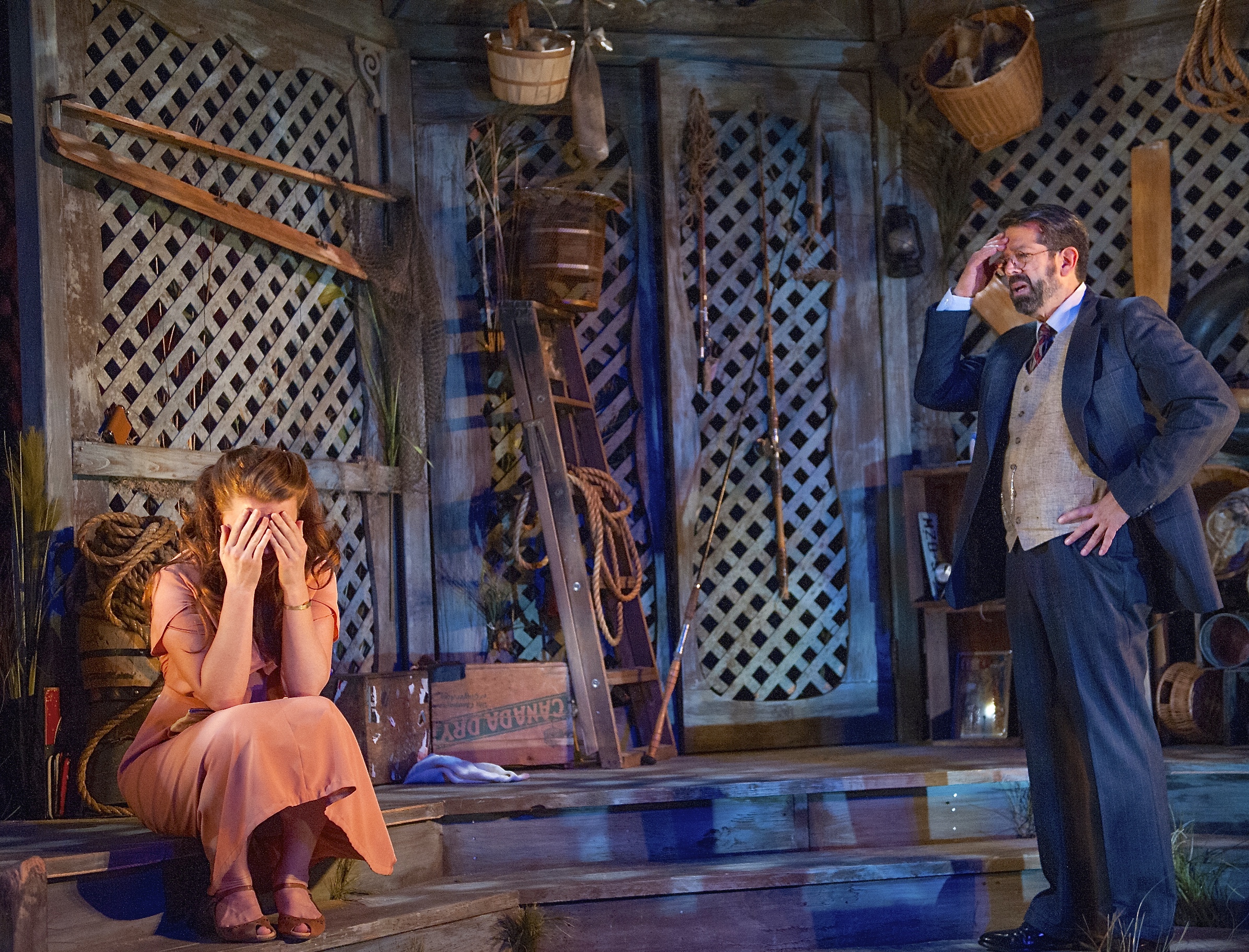
Presented by Hillbarn Theatre, “Proof” takes place in a Chicago backyard in September. Robert (Steve Lambert), the father of 25-year-old Catherine (Ali Marie Gangi), died five days earlier. She had been taking care of the once-brilliant mathematician andUniversityofChicagoprofessor because he was mentally ill for the past five years.

It’s the day before his funeral. She has allowed Hal (Brad Satterwhite), Robert’s former doctoral student, now a math professor, to go through his hundreds of notebooks in case they hold something important rather than gibberish.

They are joined by Claire (Cynthia Lagodzinski), Catherine’s older sister, a currency analyst in New York.

As Catherine and Hal become attracted to each other, she allows him to see one more notebook. It contains what Hal believes to be a profoundly important, even revolutionary mathematical proof.

Catherine has had relatively little formal mathematical training (she dropped out of Northwestern to care for Robert). Therefore, Hal challenges her to prove her contention that she developed it. There’s also an implication of sexism — that a woman couldn’t have accomplished such a feat.

Because Catherine has suffered from bouts of depression, she fears she might have inherited Robert’s mental illness. Claire is worried about her, too, for she urges Catherine to join her in New York.

“Proof” won both the 2001 Pulitzer Prize for drama and the Tony Award for best play after its premiere in 2000. Auburnhas created an absorbing plot and intriguing relationships between his characters.

Hillbarn director Greg Fritsch has hit the mark with three of his actors, but he has allowed Gangi too many shrill, over-the-top moments when Catherine becomes angry, which is fairly often.

Satterwhite’s Hal and Lambert’s Robert (seen in flashbacks) provide needed moments of calm to offset her. Lagodzinski’s Claire is both controlling and condescending, two hallmarks of the character.

Because the play opened on March 13, the eve of Pi Day on March 14, or 3.14.15, the refreshment stand featured pie. The number pi, 3.1415 to infinity, has major significance in math because a circle’s circumference is slightly more than three times longer than its diameter.

Steve Nyberg’s homey backyard set features the Greek letter pi spotlighted overhead (lighting by David Gotlieb). The sound is by artistic director Dan Demers. Costumes are by Mae Matos. Lagodzinski does double duty as hair and makeup consultant.

This well-written two-act  play runs about two hours with one intermission.

“Proof” will continue through March 29 at Hillbarn Theatre, 1285 E. Hillsdale Blvd., Foster City. For tickets, call (650) 349-6411 or visit www.hillbarntheatre.org.


Ensemble cast of 12 enlivens updated Turgenev comedy

By Woody Weingarten

[Woody’s [rating: 3]

Ensemble cast of “A Month in the Country” includes (left to right) Kim Bromley as Anna, Robyn Wiley as Lizaveta, Mark Shepard as Herr Schaaf, Ben Orega as Michel and Shannon Veon Kase as Natalya. Photo by Robin Jackson.

Shannon Veon Kase stars as Natalya, and Tom Hudgens portrays Arkady, in Ivan Turgenev’s classic comedy “A Month in the Country.” Photo by Robin Jackson.

Zach Stewart (Alexsey) and Emily Ludlow (Vera) toy with kite in “A Month on the Country.” Photo by Robin Jackson.

Sophisticated Natalya, 29, is having a premature midlife crisis.

So she flits between rage and passion.

She ignores the steady, boring love of her husband, Arkady, and the fawning adoration of a friend/wannabe lover, Michel, only to fall for Alexsey, her young son’s naïve 21-year-old tutor.

That’s the heart of “A Month in the Country,” a lightweight comedy of manners weighed down by a touch of the mustiness I should have expected from a play penned in the mid-1800s by Ivan Turgenev, Russian novelist famed for “Fathers and Sons.”

Yet the ensemble cast of Ross Valley Players largely keeps things effervescent and, through its professionalism, overcomes the sluggish pacing the playwright built in.

Not to mention his repetition.

The dozen community theater thespians were good enough, however, to ward off my sporadic desire to snooze.

I admired, too, other elements of the play adapted in 1992 by Irish dramatist Brian Friel (a Tony Award-winner for “Dancing at Lughnasa”):

• Friel’s updated language (“I’m not one of his college sluts”).

• Costume designer Michael A. Berg’s fetching women’s attire (a calculated contrast with his unexciting men’s formal ware).

• The artistic accomplishments of Ken Rowland, who’s created more than 100 extraordinary set designs for the company since 1982 but out-extraordinaried himself with this show’s elegant ebony-and-rose vision of a posh country estate (universal enough to have been located in the Hamptons as easily as Russia).

• Director James Nelson’s brave choice to absent anticipated Russian accents while not limiting actor Ben Ortega’s Hispanic inflections in the role of Michel — and then including comedic German dialect by Mark Shepard as Herr Schaaf (a character with a penchant for malapropisms such as calling himself “a lecher” when he means archer).

Unusual, besides, is the use of offstage actors mouthing interior musings for several characters.

Particularly outstanding performances are turned in by Shannon Veon Kase as Natalya; Wood Lockhart, the veteran workhorse of the RVR troupe as Dr. Shpigelsky, a “bitter, angry peasant” hanger-on who prefers being a matchmaker; and Ortega.

Despite the farcical facets of “A Month in the Country,” Turgenev’s pre-Chekhovian thesis might be summarized by one character declaring “I’m afraid all love is a catastrophe” and another proclaiming “when you find yourself enslaved by love…you’ll know what real suffering is.”

Cynical? Perhaps.

Snarky?

Without doubt.

But great fodder for what advance publicity tells us “A Month in the Country” does — let us laugh at our own foibles (and sometimes misguided appetites).

And yes, the 150-minute period piece is long, as well as long-in-the-tooth.

But that having been said, it’s ultimately as cheery as the recorded bird sounds played before the show starts.

“A Month in the Country” plays at The Barn Theatre, Marin Art & Garden Center, 30 Sir Francis Drake Blvd., Ross, through April 12. Evening performances, Fridays and Saturdays, 8 p.m.; Thursdays, 7:30 p.m. Matinees, Saturdays and Sundays, 2 p.m. Tickets: $14 to $29. Information: (415) 456-9555 or www.rossvalleyplayers.com.

Contact Woody Weingarten at voodee@sbcglobal.net or www.vitalitypress.com

Hysterically funny one-man show targets ethnicities and aging

By Woody Weingarten

[Woody’s [rating: 4]

Ron Tobin in “My Mother’s Italian, My Father’s Jewish & I’m in Therapy!” Photo by Rudy Lens.

Actor-comic Ron Tobin has mastered, I’d guess, at least 17 voices and 42 verbal sound effects.

Or maybe it’s the other way around.

Plus, give or take, 28 accents.

He can instantly change faces — and identities — by distorting his mouth or brow and scrunching up or widening his eyes.

His elastic body and swinging hands can conjure up hysterically dysfunctional and hysterically funny men, women, dogs and a cat.

During a one-man show at the Del Valle Theater — “My Mother’s Italian, My Father’s Jewish & I’m in Therapy!” — Tobin portrayed, in quick succession (and with exquisite comedic timing) a nasal stewardess, a cabbie from a Middle East country, a guru from India, an 83-year-old Jamaican gated community guard, a phlegm-ish uncle  — as well as the constantly bickering title characters based on writer-comic Steve Solomon’s ethnically divided parents.

I’m normally a tough audience for comedians. But Tobin made me laugh out loud repeatedly.

The show isn’t seamless, though.

It’s uneven, and may lean too heavily on potty humor.

It also becomes fleetingly awkward when a singular poignant grandma moment unexpectedly interferes with the cresting comedy.

And some of its gags and situations are older than Moses.

Like the clichéd notion of his wife loving sex — until the second they wed.

Promotional materials call the monologue “one part lasagna, one part kreplach and two parts Prozac,” and say it’s really all about leaving dinner “with heartburn and a headache.”

But I’m pleased to report “My Mother’s Italian” is much funnier than its publicity.

I couldn’t begin to count all the one-liners crammed into the two-act, 100-minute show that ran for two years in New York City and has toured internationally in more than 200 cites since.

What absolutely worked for me were the numerous set-ups about the aging process — especially hearing loss (maybe you had to be there, but mom hears “Lebanese” instead of “lesbian”) and bodily non-functions.

And the obvious ethnic jibes (“What are genitals?” “Those are the people who aren’t Jewish”).

Most of the jokes, such as those, play vastly better on stage than they read in a review. And the laughter they provoke is appropriately contagious.

A guy behind me saw the show in San Diego with Solomon and found it side-splitting enough to see again with Tobin.

He couldn’t stop laughing the second time around.

The cackles of several women near him were so raucous they nearly drowned out the next three punch-lines.

Tobin had learned his script well. But he also inserted an amusing smidgeon of reality. In a five-minute encore, he riffed about having gotten lost while trying to find the Walnut Creek theater where I saw him perform — after I, too, got lost.

“Tell your friends,” he mockingly pleaded, “not just about the show — about how to get here.”

“My Mother’s Italian, My Father’s Jewish & I’m in Therapy!” will run through March 29 at the Del Valle Theater, 1963 Tice Valley Road, Walnut Creek. Evening performances, Wednesdays and Thursdays, 7 p.m.; Friday and Saturday, 8 p.m.; Sundays, 6 p.m. Matinees, Thursdays, Saturdays and Sundays, 2 p.m. Tickets: $45 to $65. Information: www.LesherARTScenter.org or 1-925-943-7469.

Contact Woody Weingarten at voodee@sbcglobal.net or at www.vitalitypress.com/

Family issues arise in ‘The Lake Effect’

By Judy Richter

Long-held family secrets and resentments surface in Rajiv Joseph’s “The Lake Effect,” presented by TheatreWorks.

Anyone who has spent a winter east or southeast of a Great Lake knows about the lake effect. It’s heavy snowfall resulting from cold wind blowing over the warmer water and picking up moisture, which becomes snow. In the play, lake effect also has an allegorical meaning, which becomes clear near the end.

The action takes place during the winter in a dingy, now-closed Indian restaurant in Cleveland, along the Lake Erie  shoreline. Because its longtime immigrant owner is ailing, his estranged son, Vijay (Adam Poss), goes there for the first time in 15 years.

While Vijay reviews his father’s financial records, Bernard (Jason Bowen), a black man, comes in. He says that he always has lunch there and that the father, Vinnie (not seen), is his good friend. That’s when the first secret comes to light. The ever-frugal Vinnie has taken to betting on pro football. As his bookie (Bernard denies that status, says he just place bets for Vinnie), Bernard wants to give him his latest winnings.

Vijay is dismayed when Bernard tells him that Vinnie never mentioned a son but that he often talked about his daughter. Soon Vijay’s younger sister, Priya (Nilanjana Bose), arrives. Sibling rivalry is evident. Even more conflicts arise after Vinnie’s death.

All three characters have their own issues and problems, but Bernard copes more effectively in part because of his optimism. That attitude gradually affects the siblings and allows the three to form a quasi-family.

Set designer Wilson Chin (with lighting by Matthew Johns) recreates the lake effect with several inches of snow piled on a car parked outside the restaurant as more snow falls. Sound by Brendan Aanes evokes the cold, blustery weather every time the door opens and a bundled-up character enters (costumes by Jill Bowers).

Although the emotions can run high, the tension is often leavened with humor. Sensitive direction by Giovanna Sardelli capitalizes on this ebb and flow.

All three actors do well, but Bowen as Bernard has perhaps the deepest role and mines it well.

This intriguing play runs just under 90 minutes without intermission.

“The Lake Effect” will continue through March 29 at the Lucie Stern Theatre, 1305 Middlefield Road, Palo Alto. For tickets and information, call (650) 463-1960 or visit www.theatreworks.org.


Art imitates life in play about gay lover of logic and men

By Woody Weingarten

[Woody’s [rating: 3.5]

John Fisher (kneeling) directs himself (as gay scientist Alan Turing) and Heren Patel (as his young Greek lover, Nikos) in “Breaking the Code.” Photo by David Wilson.

The real Alan Turing.

One plus one can add up to more than one might expect.

Having seen the film “The Imitation Game,” I suspected I’d find “Breaking the Code,” a parallel play about math and men, merely a re-run since it leaned on the same biographical source — the real life of Alan Turing.

My computations were wrong.

“Code” adds considerable depth by emphasizing Turing’s homosexuality and humanness (as opposed to the hit movie’s slicker, dramatic focus on the gay scientist’s breaking a Nazi code).

Indeed, John Fisher doesn’t portray Turing. He instead inhabits the character’s body and makes him astoundingly authentic.

A mental giant and “an old poof” to whom “possessions per se mean very little.”

Powerful yet pathetic.

Fisher adroitly incorporates the atheist mathematician’s quirkiness without turning him into a caricature — his OCD-like insistence on lining up chairs and tables with exactitude (on an almost bare, pliable set); his fussy straightening of clothing; his recurrent fingernail-biting; and his childlike climbing into a fetal position in chairs.

The director also slyly prods the plot through a recording of “Someday My Prince Will Come” from the Disney cartoon classic, “Snow White and the Seven Dwarfs.”

Both play, which is surprisingly not devoid of humor, and film are well worth seeing.

And, happily, still catchable.

The former, presented by Theatre Rhinoceros, runs through March 21 at the Eureka Theatre in San Francisco; the latter can yet be found in various Bay Area movie houses.

I, for one, was glad I saw the movie first — it made the jerky backward-and-forward time shifts of the play simpler to discern.

Turing was an unlikeable, often neurotic, sometimes dysfunctional gay scientist who — despite odds of “50,000 to 1 against” —broke the Enigma code.

His work, which resulted in his pioneering the computer and artificial intelligence, helped win World War II because it enabled the Allied forces to pinpoint Nazi U-boat movements.

Turing, ironically a devotee of logic, nevertheless was convicted of being a homosexual.

He was sentenced to undergo hormone treatments that left him so physically and mentally bereft he, after two years of persecution, committed suicide at age 41.

That tragedy, apparently a historic inevitability, might well slice through a theatergoer’s emotional armor.

“Breaking the Code,” by Emmy award-winning playwright Hugh Whitemore, was based on Andrew Hodges’ book. It was originally produced in London and on Broadway in the late ‘80s.

But the playwright apparently took some liberties with the truth.

For instance, Turning, who was protected by Winston Churchill (and posthumously pardoned by Queen Elizabeth in December 2013), had been thoroughly investigated by police.

He didn’t accidentally blurt out his sexual preferences to a cop.

Accurately depicted, however, was the scientist’s fascination-flirtation with a schoolmate, Christopher Morcom, whose premature death haunted him all his life — and an awkward, non-sexual, short-lived entanglement with a female co-worker who worshipped him.

Not only is Fisher, the Rhino’s executive artistic director since 2002, brilliant in his acting, his direction is equally luminous.

He makes the play’s two hours race by, he ensures everyone’s British accent is consistent and easy to penetrate, and he draws the best possible performances from Celia Maurice as Turing’s doting but unenlightened mother, Sarah; Val Hendrickson as Dillwyn Knox, his supportive boss who personally doesn’t care if Turing goes “to bed with choir boys or cocker spaniels” but frets about what the authorities will think; Kirsten Peacock as his infatuated coworker friend Pat Green; and Justin Lucas as Ron Miller, Turning’s lover-user-betrayer.

Like most, I knew zilch about Turing before the publicity bandwagon gassed up for “Imitation Game” and Benedict Cumberbatch’s starring role.

I feel richer for having been informed.

“Breaking the Code” will play at the Eureka Theatre, 215 Jackson St. (at Front and Battery streets), San Francisco, through March 21. Evening performances, Sundays, 7 p.m.; Wednesdays through Saturdays, 8 p.m. Matinees, Saturdays, 3 p.m. Tickets: $10 to $30 (subject to change). Information: 1-800-838-3006 or www.TheRhino.org

Contact Woody Weingarten at voodee@sbcglobal.net or check out his blog at www.vitalitypress.com/

The Convert debuts at Marin Theatre Company

By Joe Cillo

African Drama in Troubled Times, Troubled Places

For its first production of the new year, Marin Theatre Company is presenting  “The Convert,” a Bay Area premiere by Zimbabwean-American playwright and actress, Danai Gurira.  The play is important for its originality. It’s an African period piece and a dual-language script set in the present Zimbabwe — Rhodesia in 1896 — at a time when native Africans had begun to strike out against the British colonists and other Africans who sided with them. It’s also another culture’s views of family loyalty.

The play opens with Jekesai, half naked, fleeing with her cousin Tamba from her forced marriage to a much-married older man. This flight will enrage her uncle, who was waiting to collect his “bride price.” Tamba takes her to a safe house, the home of Chilford, a young Catholic clergyman, not yet ordained, where Mai Tamba, Jekesai’s aunt, is housekeeper. The home is furnished with a few pieces of Victorian-style furniture and a small altar on one side of the room. The only other ornamentation is a large, wall-mounted crucifix that startles the young  Shona girl. Before Chilford arrives, Mai Tamba throws a concealing, shapeless gown over her niece, then introduces her as a new student and convert. His claim to have the power of God with him will keep Jekesai safe from her enraged uncle. And because Chilford needs converts to improve his status with the Jesuits, he accepts the protege and changes her name to Ester.

Mai Tamba keeps the house in order, but keeps her beliefs to herself. She recites her prayers as required: “Hail, Mary, full of ghosts,” but privately scatters unknown herbs around the home and later upbraids her niece for not going to the family ceremony to honor the dead.

Others come to the home. Chancellor, a friend of Chilford, affects British dress and language because he wants to be part of the winning team. The two friends speak an ornamented kind of English together, while Chancellor’s fiance, Prudence, presents herself as more British than Queen Victoria.

The play’s accents, bilingualism and length make huge demands on both cast and director. MTC’s Jasson Minadakis has assembled a superb, all-Equity cast from locals and imports. Both Katherine Renee Turner (Jekesai/Ester) and Jefferson A. Russell (Chancellor) were together in MTC’s recent production, “Fetch Clay, Make Man.” L. Peter Callender (Uncle) and Omoze Idehenre (Prudence) have made many appearances in the Bay Area, including in Marin Theatre Co’s “Seven Guitars.”  Elizabeth Carter (Mai Tamba) has multiple acting credits locally, while both Jabari Brisport (Chilford) and JaBen Early (Tamba) are making their Marin debuts in this play.

Excellent actors and direction will be necessary for “The Convert” to continue in production at other theatres. Ms. Gurira’s script is almost three hours long and burdened with lengthy speeches. “Wordy,” was a remark overheard at the first of two intermissions. Further, the accents can sometimes overcome the dialogue and make it hard to understand — especially during the speeches. This script will need a tune-up if it’s going to get “legs,” but meanwhile, Marin Theatre Company has given “The Convert” a fine introduction to the west coast.

“The Convert” will play at the Marin Theatre Company in Mill Valley Tuesdays through Sundays till March 15. Sunday matinees are at 2p.m.  All evening shows begin at 7p.m. Ticket prices range from $20 — $58, with discounts available for seniors and military. For additional information, see the website, marintheatre.org, or call the box office, (415) 388-5208.