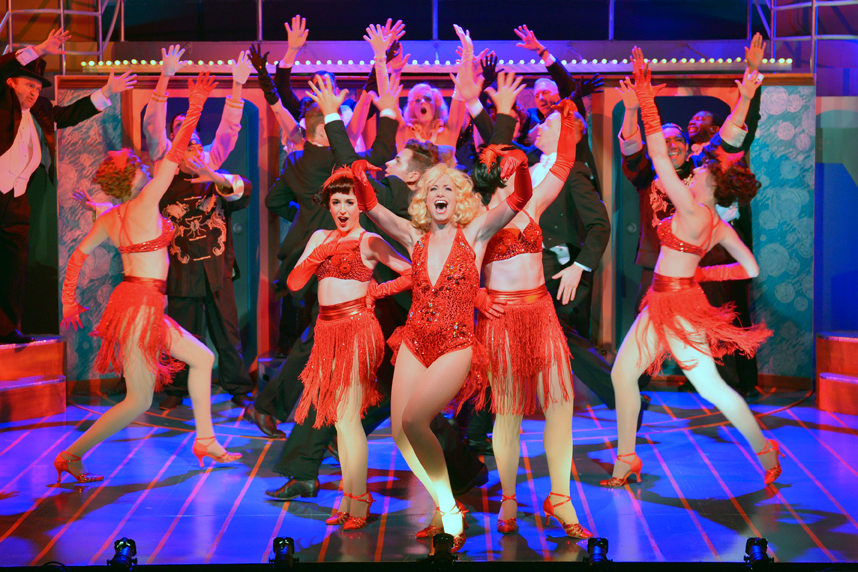
WHERE’S CHARLEY? Musical adaptation of Brandon Thomas’s 1892 farce Charley’s Aunt. Music and Lyrics by Frank Loesser. Book by George Abbott. Directed by Dyan McBride. 42nd Street Moon, Eureka Theatre, 215 Jackson St., San Francisco. Box Office www.42ndstmoon.org or 415-255-8207. April 29 – May l7, 2015.
Where’s Charley? is histrionically hysterical at 42nd Street Moon [rating:4]
42nd Street Moon closes its 2015 season with a winner. You do not have to be an aficionado of “lost musicals” to thoroughly enjoy one of the most attractive shows they have mounted in their 22 years of existence. They have come a long, long way from script-in-hand readings to full scale productions and have set the bar high for any future productions.
They have assembled a top-notch cast in beautiful period costumes (Rebecca Valentino) that San Francisco drag queens would die for. When the main character, Charley Wykeham (marvelous Keith Pinto) takes on the personae of his aunt Donna Lucia D’Alvadorez this improbable farce is a joy. As with many of the “lost musicals” setting the storyline in early scenes involves non-musical dialog and requires time to come up to speed. When it did the opening night audience had a treat.
You will not need a program to identify who is who and what is what but a short synopsis (and background data) is offered here. The original farce, titled Charley’s Aunt, was first produced in London in 1892 and is still making the rounds, including a movie with Jack Benny as its star. When the 1952 Frank Loesser and George Abbott musical, renamed Where’s Charley?, hit the Broadway stage with Ray Bolger in the lead it was an instant hit and eventually made into a movie with Bolger reprising his lead role.
The time and place is 1892 at Oxford University, England. The undergrads including Charley and best friend Jack Chesney (James Bock) are preparing for the Red Rose Cotillion. They need a chaperon who will allow a bit of hanky-prank (not a proper English word). Charley’s wealthy, widowed Aunt Donna Lucia (gorgeous Stephanie Rhoads) from Brazil fits the bill. Jacks father the widowed Sir Francis Chesney (John-Elliot Kirk) has lost his fortune and Jack suggests he marry the rich Donna. The best laid plans etc. unfold and Donna misses her train and will not show up on time. Charley is dressed as an older woman for his role in a student play and Jack cons him into playing his Aunt Donna. Good/bad idea.
The love interests are Charley loves Amy (Abby Sammons) and Jack loves Kitty (Jennifer Mitchell). Complications abound when Amy’s father/Kitty’s guardian, the avarice minded “Spettigue” (Scott Hayes) decides he will pursue the rich Donna unbeknownst of the true identity (imposter) of “Charley’s Aunt.” Further complications occur when the real Aunt Donna arrives and her true love is Jack’s father.
Since this is a farce there should be the obligatory four (or more doors) to allow the quick changes and chase scenes. Scenic designer Hector Zavala and director Dyan McBride have devised a simple attractive set with the “doors” being open arches allowing breakneck speed in the many “chase scenes.” The staging of a tea party with Charley/Donna as host(ess) is an absolute riot.
You will be humming some of the tunes that include: “The New Ashmolean Marching Society and Students’ Conservatory Band”, “My Darling, My Darling”, “Make a Miracle”, “Lovelier than Ever” and the show stopper “Once In Love With Amy.”
Every member of the cast performs with élan and the singing voices are a pleasure to hear. Keith Pinto who has often graced local stages has the right amount of class to make the swift changes from Charley’s aunt to Charley a joy to observe. In his solo of the signature song from the show, “Once in Love with Amy” he has the audience happily singing along with him.
Abby Sammons and Jennifer Mitchell have almost identical soprano singing voices that are a pleasure to hear. Abby Sammons received thunderous applause when she belted “The Woman in his Room.” The patter song “The Gossips” just misses the mark.
This highly recommended 2 hour and 20 minute show (with intermission) ends with spiffy dressed cast performing “At the Red Rose Cotillion.”
CAST: Keith Pinto as Charley; James Bock as “Jack Chesney,”; Roy Eilkeberry as “Percy”; Scott Hayes as “Spettigue”; John-Elliot Kirk as “Sir Francis Chesney”; Kate Leyva as “Violet”; Maria Mikheyenko as “Doretta”; Jennifer Mitchell as “Kitty Verdun”; Noelani Neal as “Rosamund”; Stephanie Rhoads as “Donna Lucia”; Abby Sammons as “Amy Spettigue”; Zac Schuman as “Albert,”; Stephen Vaught as “Brassett/Wilkinson” and Tim Wagner as “Reggie”.
CREATIVE STAFF: Director. Dyan McBride; Musical Director, Lauren Mayer; Choreographer; Nancy Dobbs Owen; Set Design, Hector Zavala; Costumes, Rebecca Valentino; Lighting Design, Danny Maher; Stage Manager, Daniel Schultz, Props: Daniel Schultz; Production Manager: Hector Zavala.
Kedar K. Adour, MD
Courtesy of www.theatreworldinternetmagazine.com
Photos by David Allen
Spettigue (Scott Hayes, back) takes an interest in Charley while he is disguised as his aunt (Keith Pinto) in 42nd Street Moon’s production of Where’s Charley? now playing through May 17 at The Eureka Theatre.
Keith Pinto, Abby Sammons, James Bock, Jennifer Mitchell, Stephanie Rhoads, and John-Elliot Kirk star in 42nd Street Moon’s production of Where’s Charley? playing April 29-May 17 at
The Eureka Theatre.
Salt of the Earth
Directed by Wim Wenders and Juliano Ribeiro Salgado
This documents the life and work of Brazilian photographer Sebastião Salgado. Salgado was one of my own photography teacher’s favorites and I went to see an early exhibit of his in San Francisco, probably around 1990, of South American Indians. I remember being impressed by the quality of his prints and his compositions. This film confirmed the correctness of that early impression and showed how much Salgado has developed in the intervening years to the point where I would call him one of the greatest photographers of all time. He belongs in the company of Adams, Weston, Steichen, Steiglitz, Cartier-Bresson, Evans, Frank, Strand, Maier, and Mapplethorpe — although Mapplethorpe was mostly a studio photographer, he had the same eye for quality, composition, and human sensitivity. Salgado is the very top level of photography. Whether he is photographing landscapes, portraits, refugee camps, dead bodies, burning oil wells, portraits, or his wife, he is always an artist. He is always aware of composing the image for the maximum aesthetic power and emotive effect. His mastery of light and how to use light in a photographic composition is equal to or beyond anyone’s. The film did not say whether he makes his own prints, but I was able to find out from an excellent interview by photographer Anthony Friedkin with Salgado’s gallery dealer Peter Fetterman, that Salgado works with several printers, at least in his later years, and he is very hands on in supervising them, going over contact sheets himself with a loupe, and directing the darkroom work in creating the prints. The interview with Peter Fetterman is lengthy and excellent and I highly recommend it.1
Salgado went through an interesting evolution in his work and within himself that the film presents to great effect. In his early years he documented the plight of the poor and the downtrodden. He photographed native peoples, workers, refugees. He traveled to war zones, famines, refugee camps, burning oil wells in Kuwait, Africa, Rwanda. He was interested in destruction, genocide, starvation, human brutality, indifference, and suffering. After decades of immersing himself in the abyss of human cruelty and suffering he came to the conclusion that “we are a terrible species.” The most destructive and pathological that evolution has produced. The darkness within human capability is unfathomable and horrifying.
And then there was a change, a turnaround. Since about 2004 he has been documenting the beauty and renewal of the earth. He discovered that there is as much going on in the world that is good as there is evil. And so his recent work, called Genesis, is a compendium of magnificent landscapes from around the world, especially Siberia, Antarctica, the Galapagos Islands, and Africa, coupled with the human interest photos of which he is a master. This inner transformation, from being preoccupied with destruction and brutality to growth and renewal, expressed outwardly in his photographic work, is one of the most interesting aspects of the film and of Salgado’s life.
In a world where everyone is a photographer and more pictures are being taken of everything than can ever be imagined or ingested, Salgado stands out as one at the very pinnacle of quality and substance. This film is a beautifully made presentation of his life and work and I wholeheartedly recommended it with high accolades.
1. Interview with Peter Fetterman by Anthony Friedkin. September 13, 2013. http://www.samys.com/blog?action=viewBlog&blogID=-103189848642139966&dest=/pg/jsp/community/printblog.jsp
[Woody’s [rating: 3.5]

Keith Pinto, who stars as the “Where’s Charley?” title character (and masquerades as his aunt), is hoisted by James Bock (as his buddy, Jack). Photo by Patrick O’Connor.
I was barely out of short pants when Ray Bolger starred in Broadway’s “Where’s Charley?” in 1948.
But I remember bouncing around the neighborhood singing “Once in Love with Amy,” the biggest hit from the musical, for anyone who’d listen — even though I knew no one with that name and had no real concept of boy-girl passions.
I just saw the show again, a 42nd St. Moon production at the Eureka Theatre in San Francisco.
It was deliciously quaint.
Keith Pinto, who takes on the title role with phenomenal gusto, is no Bolger — especially when it comes to soft-shoe dancing.
But his comic chops are superlative.
And his mock tango’s priceless.
Director Dyan McBride makes sure the other 13 cast members keep up with Pinto — particularly when it comes to wide-eyed, cartoon-like antics or outlandish melodrama.
The impossible-to-believe but amusing storyline was lifted from a popular 1892 play, “Charley’s Aunt.” What I watched, therefore, was a revival of a farce from the last century that referenced a play from the century before that.
England’s Oxford University is the setting. Chaperones are required for a proper woman to be in a man’s presence.
Charley Wykeham and Jack Chesney (James Bock) want to entertain the women they’re smitten with but Charley’s aunt, who could be the go-between, is late arriving from Brazil (“where the nuts come from”).
Jack convinces his buddy to impersonate the mega-rich relative, Dona Lucia D’Alvadorez (Stephanie Rhoads).
And two elderly male gold-diggers fall for her/him.
Soon afterwards, the real auntie shows up to complicate things.

Getting ready for their dates in “Where’s Charley?” are (from left) Doretta (Maria Mikheyenko), Rosamund (Noelani Neal) and Violet (Katherine Levya). Photo by Patrick O’Connor.
The show, whose melodies and lyrics were penned by Frank Loesser, who later composed “Guys and Dolls,” tips its musical top hat to Gilbert & Sullivan operettas.
“Charley’s Aunt,” though men had filled female roles for eons, was credited with being the first staging of explicit drag in Western theater. It worked, too, as precursor to such cross-dressers as RuPaul, Dame Edna, Bruce Jenner — and, I guess, J. Edgar Hoover.
Not to mention drag performances in “La Cage aux Folles,” “Pink Flamingos,” “Some Like It Hot,” “Tootsie,” “Mrs. Doubtfire”— and a slew of mediocre movies with Tyler Perry as Madea.
The sweet spot of this revival, however, is the clowning.
Scott Hayes supplements Pinto’s tour de farce via an over-the-top performance as lecherous Mr. Spettigue.
The character repeatedly chases Charley, not unlike the silliness of a Road Runner episode.
An appreciative audience titters.
The crowd laughs even louder at set pieces — Charley awkwardly serving tea, his removing Spettigue’s wandering hands from his knees, and Amy (Abby Sammons) screeching “The Woman in His Room” (with timing as extraordinary as Lucille Ball could have delivered).
A trio singing “The Gossips” provides yet another great comic turn: Rosamund (Noelani Neal), Doretta (Katherine Leyva) and Violet (Marie Mikheyenko).
Musically over all, female voices are exceptional, males not so much.
I particularly enjoyed hearing two women in duets — Kitty Verdun (Jennifer Mitchell) with Jack, her suitor, on “My Darling, My Darling,” and Dona with Jack’s father, Sir Francis Chesney (John-Elliott Kirk) on “Lovelier Than Ever.”
Pleasurable, also, is when Charley breaks the fourth wall, asking the audience to sing along with him on “Amy,” a throwback to what Bolger, who won a Tony for his performance, originally improvised.
And colorfully subdued costumes by Rebecca Valentino are fetching.
Weaknesses, regrettably, appear as well.
The dancing, though mostly precision-like, lacks spark. I suspect the original Broadway movements by George Balanchine were slightly better.
And while accompaniment by pianist Lauren Mayer is appropriately invisible, her choppy overtures aren’t.
British accents rise and disappear with frequency.
And Act 1 feels drawn out (it runs 80 minutes) — like a Carol Burnett sketch that was extended — and extended, and extended.
Ticket-buyers, despite such negatives, expect 42nd St. Moon shows to be positive experiences over all.
They are (and this is).
And they should be: The troupe’s been doing classic musical theater for decades.
And doing it well.
“Where’s Charley?” will play at the Eureka Theatre, 215 Jackson St. (at Front and Battery streets), San Francisco, through May 17. Evening performances, 6 p.m. Saturdays, 7 p.m. Wednesdays and Thursdays, 8 p.m. Fridays. Matinees, 3 p.m. Sundays. Tickets: $21 to $75 (subject to change). Information: www.42ndst.moon.org or 415-255-8207.
Contact Woody Weingarten at voodee@sbcglobal.net or check out his blog at www.vitalitypress.com/
Two daughters Meesh (a feisty Rosie Hallett) and Manda (a sleek Kathryn Zdan) try to help their Central Valley mom (an energetic Anne Darragh), as she regales them with songs and tales of the optimism that won the West, in this West Coast premiere of Mona Mansour’s comic family drama at Marin Theatre Company.
Complementing this incredible cast of Bay Area actors – MTC veterans Anne Darragh, Stacy Ross, and Kathryn Zdan, as well as newcomers Rosie Hallett and Hugo E. Carbajal – are the musical compositions of the country by the amazing folk duo Misner + Smith who create catchy musical tunes. All of the actresses accompany themselves on guitars.
Mona Mansour’s cautionary tale about a true-believer in her notions of Old West pioneer values has a wonderful cast and a fine director (from the Minneapolis Playwright Center), Hayley Finn. Haley Finn has a nice way of including lit-up cards for each of the different scenes to keep the audience on the same track.
One could say The Way West is a clash of Old West myths and modern financial reality.
Well-known Bay Area actress Stacy Ross has a clever cameo as Tress, mom’s wonderfully funny friend to join her magic water therapy business. Hugo E. Carbajal appears as two different characters, first as Manda’s lawyer ex-boyfriend and a secondary role as a pizza delivery man, who is quite amazing.
Geoffrey M. Curley’s set, which is an open-arch living room, full of clutter, suggests a type of covered wagon.
While The Way West has true moments of poignancy and even a few laughs, it needs a more compelling plot and a flushed-out tone. If we’ve learned anything from the gold rush and westward land-grabbing, it’s that that true pioneer spirit lives on, and with some work so will this play.
The Way West runs April 16 through May 10, 2015, with performances at:
Tuesdays, Thursdays, Fridays and Saturdays at 8pm
Wednesdays at 7:30 pm
Sundays at 2:00 pm and 7:00 pm
Thursday, April 30 at 1:00 pm
Saturday, May 9 at 2:00 pm
All performances take place at the Marin Theatre Company, located at 397 Miller Avenue, Mill Valley 94941. To order tickets, telephone 415-388-5208 or go online at www.marintheatre.org.
Coming up next at the Marin Theatre Company will be Choir Boy by Tarell Alvin McCraney, directed by Kent Gash, from June 4 through June 28, 2015.
Flora Lynn Isaacson
Originally a cartoon and then a popular TV series that ran from 1964 to 1966, “The Addams Family” has taken on a musical form presented by Palo Alto Players.
With music and lyrics by Andrew Lippa and a book by Marshall Brickman and Rick Elice, this bizarre show takes a page from “You Can’t Take It With You” for its plot.
Wednesday (Catherine Gloria), the daughter in this macabre family, has fallen in love with a normal young man, Lucas Beineke (Adam Cotugno), and wants to marry him. Therefore, she asks her parents, Gomez (Doug Santana) and Morticia (Betsy Kruse Craig), to invite his parents, Mal (Kennan Blehm) and Alice (Jen Wheatonfox), to their home for dinner. That’s when she and Lucas plan to tell everyone about their plans. Therefore, she wants her family to behave as “normally” as possible.
That’s not easy for a household that includes Wednesday’s younger, torture-loving brother, Pugsley (Leo Jergovic); green-faced Uncle Fester (Joey McDaniel); and potion-creating Grandma (Linda Piccone); along with their zombie-like butler, Lurch (David Murphy). Lurking in the background are a dozen Addams Ancestors who serve as the singing, dancing chorus.
Rather than playing Charades after dinner, this family’s game is Full Disclosure. Each person must reveal a secret unknown to anyone else. The results are predictably disastrous, leading to disharmony between both sets of parents as well as Wednesday and Lucas. In the end, though, all turns out well.
All forms of cartoonist Charles Addams’ “The Addams Family” focus on mordant subjects — albeit with a satirical edge. Thus this show is not to everyone’s taste. The first act is especially difficult to swallow because so much of the humor is sophomoric, but the second act is easier to take because it focuses on somewhat more realistic situations.
Nevertheless, the PAP cast, directed by Janie Scott, does its best with the material, and it seemed that most people in the opening night audience enjoyed it.
Under the baton of musical director Matthew Mattei, Lippa’s tuneful music is well sung by everyone, especially Gloria as Wednesday and Craig as Morticia.
Director Scott choreographed the show, creating interesting, well-executed dances.
The show is episodic, but set designer Ron Gasparinetti keeps it running smoothly with various devices. Kudos to costume designer Shannon Maxham, especially for the Ancestors’ outfits, which cover many centuries. The lighting is by Carolyn A. Foot, the sound by Grant Huberty.
The show runs 2 1/2 hours with one intermission. It can be fun for most viewers but a long night for others.
“The Addams Family” will continue through May 10 at the Lucie Stern Theater, 1305 Middlefield Road, Palo Alto. For tickets and information, call (650) 329-0891 or visit www.paplayers.org.
THE ADDAMS FAMILY: Musical. Written by Marshall Brickman & Rick Elice. Music and lyrics by Andrew Lippa. Based on the comic strip characters created by Charles Addams. Palo Alto Players, Lucie Stern Theater, 1305 Middlefield Road in Palo Alto. www.PAplavers.org or 650.329.0891.
April 24 – May 10, 2015
The Addams Family at the Palo Alto Players will rattle your cage. [rating:3]
One might wonder if Charles Addams, the creator of “The Addams Family” made famous on the pages of New Yorker magazine with his single-panel cartoons so ghoulish and macabre to be side splitting funny, would rise from his grave to appreciate the lasting legacy the theatre has bestowed upon him. There were a plethora of film and TV adaptations but there is only one musical that hit the Broadway stage in 2010 for an almost two year run before being released to community theatres after a national tour in 2011. The Palo Alto Players snapped up the option and the resulting production has Uncle Fester baying (making love) to the moon while pandemonium reigns below.

Photo credit: Joyce Goldschmid
Palo Alto Players’ The Addams Family – l-r: Betsy Kruse Craig (Morticia Addams), Doug Santana (Gomez Addams), Joey McDaniel (Uncle Fester)
Who is Uncle Fester (Joey McDaniel)? He is the fifth member of the immediate (sort of living) Addams family that includes Gomez (Doug Santana), his wife Morticia (Betsy Kruse Craig), Wednesday (Catherine Gloria) and Pugsley (Leo Jergovic). There are serious questions about the Addams family DNA of Grandma (Linda Piccone). Then there are non-living ‘Ancestors’ that rise from the crypts to dance up a storm and contribute to the mayhem that unfolds.
There cannot be a musical without a love interest and that is provided by bizarre Wednesday falling in love with a ‘normal’ boy Lucas. The parents of the lovers both object to the potential marriage of the mismatched couple. Another person who strongly objects is younger brother Pugsley Addams since Wednesday’s departure means that she would not be around to torture him. The only family member (excluding the questionable Grandma) to approve of the mismatch is Uncle Fester who is in love with the moon and brings down the house with his trip to the moon to consummate his love in act two. He wants to help the young lovers and convinces the Ancestors not to return to the crypt and help. That is a great idea since the Ancestor ensemble perks up the entire performance.
While Wednesday pleads with her parents to be “normal’, Lucas (Adam Cotugno ) does the same with his parents Mal (Kennan Blehm) and Alice Beineke (Jen Wheatonfox). The plot is much too complicated for a brief review but be assured it almost makes sense and the music, although not memorable, carries the plot along and is very well sung by most of the cast.
The dinner scene where the hilarious game of “Full Disclosure” is being played and Pugsly’s trick backfiring leads to another show stopping scene by local favorite Jen Wheatonfox. Milquetoast Mal has a marvelous transformation that allows Kennan Blehm to share the spotlight with Jen Wheatstone. Linda Piccone milks her Grandma role to perfection.

Photo credit: Joyce Goldschmid
Palo Alto Players’ The Addams Family – l-r: Danielle Mendoza (Ancestor), Shahil Patel (Ancestor), Jen Wheatonfox (Alice Beineke), Kennan Blehm (Mal Beineke)
Doug Santana as Gomez Addams and Betsy Kruse Craig as Morticia Addams are perfect for each other with excellent comic timing and adequate voices to hold the appropriately disjointed story line in check. Their final song and dance romp before the curtain call is eye-popping, but they have to share accolades with David Murphy who blossoms from the quiet tall jack-of-all trades as Lurch to a whirlwind basso just before and during curtain call.
The running time of 2 hours and 30 minutes with an intermission is a bit too long but well worth a visit to the Lucie Stern Theatre.
CAST: Gomez Addams, Doug Santana; Morticia Addams, Betsy Kruse Craig; Uncle Fester, Joey McDaniel; Grandma, Linda Piccone; Wednesday Addams, Catherine Gloria; Pugsley Addams, Leo Jergovic; Lurch, David Murphy; Mal Beineke, Kennan Blehm; Alice Beineke, Jen Wheatonfox; Lucas Beineke, Adam Cotugno; Male Ensemble: Juan Castro, Zendrex Llado, Jomar Martinez, Shahil Patel, Michael Saenz. Female Ensemble: Jessica Ellithorpe, Yuliya Eydelnant, Jennifer Gorgulho, Danielle Mendoza.
CREATIVE STAFF: Director/Choreographer: Musical Director: Scenic Designer: Costume Designer: Lighting Designer: Sound Designer: Properties Designer: Hair & Makeup Designer: Stage Manager: Janie Scott Matthew Mattei Ron Gasparinetti Shannon Maxham Carolyn A. Foot Grant Huberty Pat Tyler Shiboune Thill Jeff Grafton.
Kedar K. Adour, MD
Courtesy of www.theatreworldinternetmagazine.com

Ken Talley (c. r. Craig Marker*) debates his future with family and friends (l-r, Harold Pierce, John Girot*, Nanci Zoppi*, Oceana Ortiz, Jennifer LeBlanc*, Elizabeth Benedict*) in Aurora’s production ofFifth of July
FIFTH OF JULY: Drama by Lanford Wilson. Directed by Tom Ross. Aurora Theatre Company, 2081 Addison Street, Berkeley, CA. (510) 843-4822 or at www.auroratheatre.org.
April 17 – May 17, 2015
Fifth of July does not ring true at Aurora Theatre. [rating:3]
There are times when theatre brings dramatic impetus to historical events. When Lanford Wilson’s play the Fifth of July hit the stage in 1977-1980 it was close enough to the end of the Vietnam War to be a cogent searing denunciation of a dark era in America’s history. Rather, the play is a taut personal family drama and does not reflect the horrific impact on thousands of Vietnam veterans that are still suffering from the effects of that conflict.
During that war there was a large anti-Vietnam war movement that was part of a larger Counterculture of the 1960s. Now, 40 years since the end of that war and 35 years since the production of Fifth of July the power of the original production has lost its visceral punch.
The action takes place on the afternoon of July Fourth and morning of July fifth in the Town of Lebanon, Missouri. Major characters in the play have been members of the counterculture that was rife with antigovernment rallies and the use of alcohol, marijuana and cocaine. Director Ross has inserted a wild bacchanal prolog in an apparent attempt to etch that era in the minds of the audience. Doing so undermines the charming quiet scene between Kenneth Tally (Craig Marker) and his lover Jed Jenkins (Josh Schell) that opens the play.
The family involved in this play has a last name of Talley and is part of a trilogy that was written non-sequentially beginning with the Pulitzer Prize winner Talley’s Folly (1979) and continues with Talley and Son (1981). Aurora Theatre is honoring Wilson’s legacy by mounting all three plays. Talley’s Folly is playing to full houses in the in intimate Harry’s UpStage in the Dashow Wing with scheduled staged reading of Talley and Son on the main stage.
It is not necessary to be familiar with the first two parts of the trilogy since the only character from the previous plays who appears in the final play is Sally Friedman nee Aunt Sally. Ken Tally’s older sister June (Jennifer Le Blanc ) has had an out-of-wedlock child, Shirley ( Oceana Ortiz) now 13 years old. John Landis (John Girot) a former close friend/ classmate of Ken has married affluent Gwen (Nanci Zoppi) a wannabe country singer who has inherited and is running a successful business. The final character is Gwen’s guitar playing song writer Weston Hurley (Harold Pierce).
Ken has been living on the family estate with botanists Jed who has been planting shrubbery over the past two years to create an English style garden. Ken who has suffered bilateral above the knee amputations has been reluctantly preparing to return to his High School teaching job and has been transcribing the verbal ruminations of a brilliant eccentric friend who has been impaired by the Vietnam War. The question of selling the family home to John and Gwen who wish to convert it to a recording studio plays a major role in the conflict.
With all the characters in place, and as with every family drama, secrets, hidden animosities and past experiences unfold. Lanford Wilson is a master at setting up the premises and effectively dovetailing their interaction. Humor abounds and by the end of the play there is resolution.
Craig Marker gives a stunning performance and Jed’s love is expressed realistically in Josh Schell’s taut underplayed delivery. Director Ross has allowed the remainder of the cast to give over-the-top delivery of their lines that often times is excessive. It is difficult to develop empathy with Oceana Ortiz, who is actually only13 years old, playing the bratty Shirley. Elizabeth Benedict playing Sally Friedman who has preserved her husband’s ashes in a chocolate box, gives the show much of its humor.
Richard Olmsted’s beautiful interior-exterior set takes up a significant portion of the small three-sided acting area. This limits director Ross’s ability to move his characters about when all eight actors are on stage thus detracting from their interaction. Running time two hours and ten minutes with an intermission.
CAST: Craig Marker, Kenneth Talley Jr.; Josh Schell, Jed Jenkins; John Girot, John Landis; Nanci Zoppi, Gwen Landis; Jennifer Le Blanc, June Talley; Harold Pierce, Weston Hurley; Oceana Ortiz, Shirley Talley; Elizabeth Benedict, Sally Friedman.
ARTIST CREW: Set Designer, Richard Olmsted; Costume Designer, Heidi Leigh Hanson; Lighting Designer, Kurt Landisman; Stage Manager, Susan M. Reamy; Sound Designer, Chris Houston; Properties, Laraine Gurke; Movement/Fight Consultant, Dave Maier.
Kedar K. Adour, MD
Courtesy of www.theatreworldinternetmagazine.com
Ken Talley (c. r. Craig Marker*) debates his future with family and friends (l-r, Harold Pierce, John Girot*, Nanci Zoppi*, Oceana Ortiz, Jennifer LeBlanc*, Elizabeth Benedict*) in Aurora’s production ofFifth of July
In Lanford Wilson’s “Fifth of July,” presented by Aurora Theatre Company, college-age anti-war activists of the ’60s are more grown up.
Now that it’s 1977, much has changed. Ken Talley (Craig Marker) is living in the family home in Lebanon, Mo., with his supportive partner, Jed (Josh Schell), a botanist. Ken has lost both legs in Vietnam but is ambulatory thanks to prostheses. He’s supposed to resume his career teaching English in the local high school, but he’s frightened.
They’re joined by Ken’s single-mom sister, June (Jennifer Le Blanc); her 13-year-old bratty daughter, Shirley (Oceana Ortiz); and their 64-year-old aunt, Sally Friedman (Elizabeth Benedict). Sally is there to scatter the ashes of her late husband, Matt.
The story of their courtship 33 years earlier is told in “Talley’s Folly,” also being presented by Aurora as part of its Talley Trilogy project.
Some unexpected guests are John and Gwen Landis (John Girot and Nanci Zoppi), who were Ken and June’s fellow flower children at Cal. With them is Weston (Harold Pierce) a guitarist who’s involved in developing Gwen’s singing career.
Besides visiting his old friends and hometown, John has another motive. He wants to buy the Talley home and convert it into a recording studio for Gwen, who has fried her brain with drugs and still indulges.
Tensions rise over John’s proposal as well as his desire to have Shirley, who’s apparently his daughter, live with him and Gwen.
During the course of the play, which begins July 4 and continues the next morning, there are satisfying resolutions for the Talleys. Even young Shirley, an annoying drama queen, becomes more tolerable and mature.
Wilson has created some idiosyncratic characters well enacted by the Aurora cast under the direction of artistic director Tom Ross. Marker as Ken has the double challenge of not only developing his character but also walking like an amputee using crutches or a cane. Schell’s Jed is a quiet, scholarly man who keeps a sharp eye out for Ken’s welfare.
As the drug-addled Gwen, Zoppi provides much of the show’s comedy as well as some words of wisdom for Shirley. Pierce’s spacey Weston tells weird stories. The rest of the cast also is notable, especially Le Blanc as June, another character who’s ready to assume a more mature role.
Even though the cast of eight is somewhat large forAurora’s intimate stage, Ross stages the action well on the set designed by Richard Olmsted with lighting by Kurt Landisman and sound by Chris Houston. The ’70s costumes are by Heidi Leigh Hanson.
Despite the specific era, the play has a timelessness because it’s focused on the characters and their evolution.
“Fifth of July” will continue at Aurora Theatre Company, 2081 Addison St., Berkeley, through May 17. For tickets and information, call (510) 843-4822 or visit www.auroratheatre.org.
[Woody’s [rating: 5]

Alfred (Carl Lumbly) and his live-in caregiver, Maria (Greta Wohlrabe), share a moment of sheer joy in “Let There Be Love.” Photo by Kevin Berne
As I left the American Conservatory Theatre’s “Let There Be Love,” I noticed an unusual number of men dabbing tears from their eyes with hankies.
Some openly.
But most, a bit embarrassed, swiped surreptitiously. Or prayed no one would witness their glistening cheeks.
Earlier, I’d seen the same guys rolling with laughter.
Stirring work by three actors and inspired writing by British playwright Kwame Kwei-Armah are the reasons why.
And classic jazz recorded by singer-pianist Nat King Cole — juxtaposed with smile-inducing moments triggered by Madonna’s “Like a Virgin” and calypso champion Lord Invader — becomes the superglue that binds characters in the new A.C.T. comic family drama in San Francisco.
Cole’s lyrics particularly enhance the action at critical moments.
The setting — including intentionally mismatched wallpaper — is a contemporary London home that’s grown a tad shabby.
From neglect.
Attention is paid only a wood cabinet-enclosed gramophone that Alfred (an ill-tempered, seriously sick West Indian elder who emigrated to England four decades before) lovingly calls Lily.
Plus an oversized globe that houses a well-stocked liquor bar.
Alfred, in a masterfully sensitive yet nuanced performance by Carl Lumbly, has antagonized his estranged wife and both of his daughters — including Janet, the absent “born-again nut” and mother of his mixed-race grandson, and Gemma, the present but unhappy lesbian (played with appropriate anger by Donnetta Lavinia Grays).
The former goatherd and hospital porter regrets his distancing actions but feels powerless to fix what occurred long ago.
Enter Maria, a young, boyfriend-abused Polish immigrant who becomes Alfred’s caregiver, confidant, nurse, cook, friend and surrogate daughter.
Greta Wohlrabe, whose elastic face runs an expressive gamut that’s never unconvincing or mawkish, is impeccable in that demanding role.
Her solo dancing spurts are highlights, too.
Director Maria Mileaf — differing from most plays staged in the Bay Area (and anywhere else, in fact) — makes sure there are no slack spots in “Let There Be Love.”
No lagging whatsoever. No watch checking.
And no dropped accents.
Alfred isn’t above dropping an occasional f-bomb, though. The word, he insists, “brings a wonderful clarity to my…sentences.”
The play manages to cover a lot of ground in two hours: racial bitterness, social change, end-of-life dignity, redemption — and trips to both the local Ikea and faraway Granada.
While the first act of “Let There Be Love” offers mostly laughs, the second switches into a touchstone of courage and forgiveness.
The climax of the play, which I felt was now and then a bit too pat, is astoundingly sentimental.
But it’s also astoundingly poignant, the very definition of moving.
Which explains why the hankies came out.
Including mine.
“Let There Be Love” plays at the American Conservatory Theater, 415 Geary St., San Francisco, through May 2. Night performances: 8 p.m. Tuesdays through Saturdays. Matinees: 2 p.m. Wednesdays, Saturdays and Sundays. Tickets: $20 to $85. Information: 1-415-749-2228 or www.act-sf.org
Contact Woody Weingarten at voodee@sbcglobal.net or check out his blog at www.vitalitypress.com