
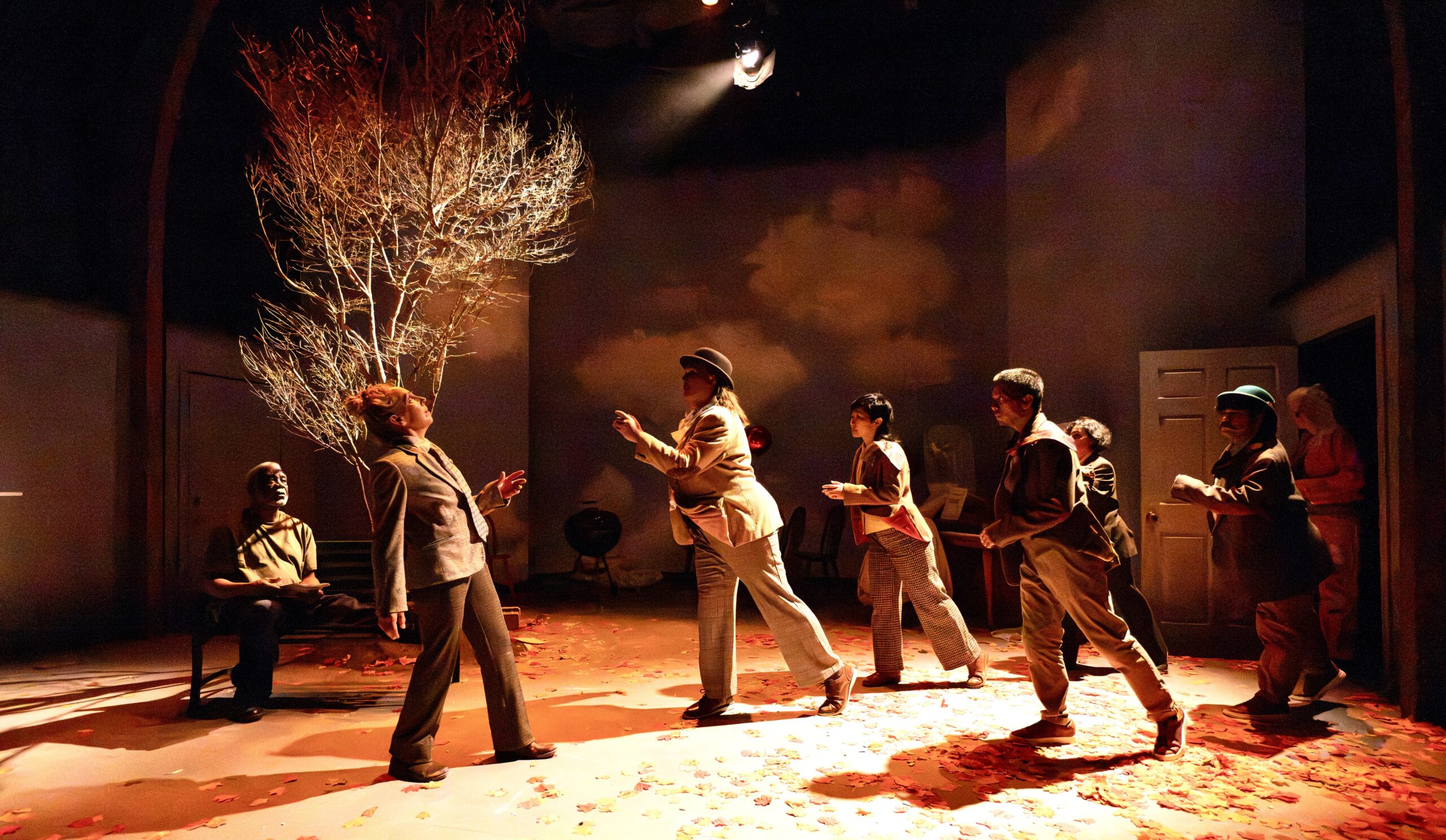
One of countless surreal moments in The Fall Show. Photo by Ben Krantz.
Surreal, serious Berkeley show is chaotic, humorous, tender — and well worth seeing
By WOODY WEINGARTEN
The marquee of the Ashby Stage in Berkeley gives away what the premiere performance of The Fall Show is all about: A surreal love story.
The theatrical mosaic leaps again and again from imaginative prop to unusually choreographed movement, often successfully exhibiting chaos and mania.
And it’s accented as if famed Belgian artist René Magritte snuck in and taught the actors how to recreate his famous paintings in living form.
Didn’t happen. The show’s the joint work of playwright “Chuck” Mee, who specializes in collage-like constructs, and skillful co-creator/director/choreographer Erika Chong Shuch. They’d swear, in fact, they created it rather than wrote it, across the country from each other, as the unique project evolved. Mee was in New York mostly providing stage directions and Shuch was in San Francisco sculpting the production. They “talked” by text.
So, start with such visual and sound tidbits as actors tossing around piles of maple leaves, smashing multiple plates (with joyous anger), and raising enough voices to become a symphony of screams.
Add an almost linear storyline with two older, lonely main characters, Eddie and Sam, inhabited by remarkable, mostly-understated actors, Beth Wilmurt (replete with AARP magazine) and Reginald Wilkins (replete with purposeful indecision). Their energy contrasts exquisitely with the crazed, most often in-motion group of six that surrounds them, a couple sporting Magritte-like black derby hats.
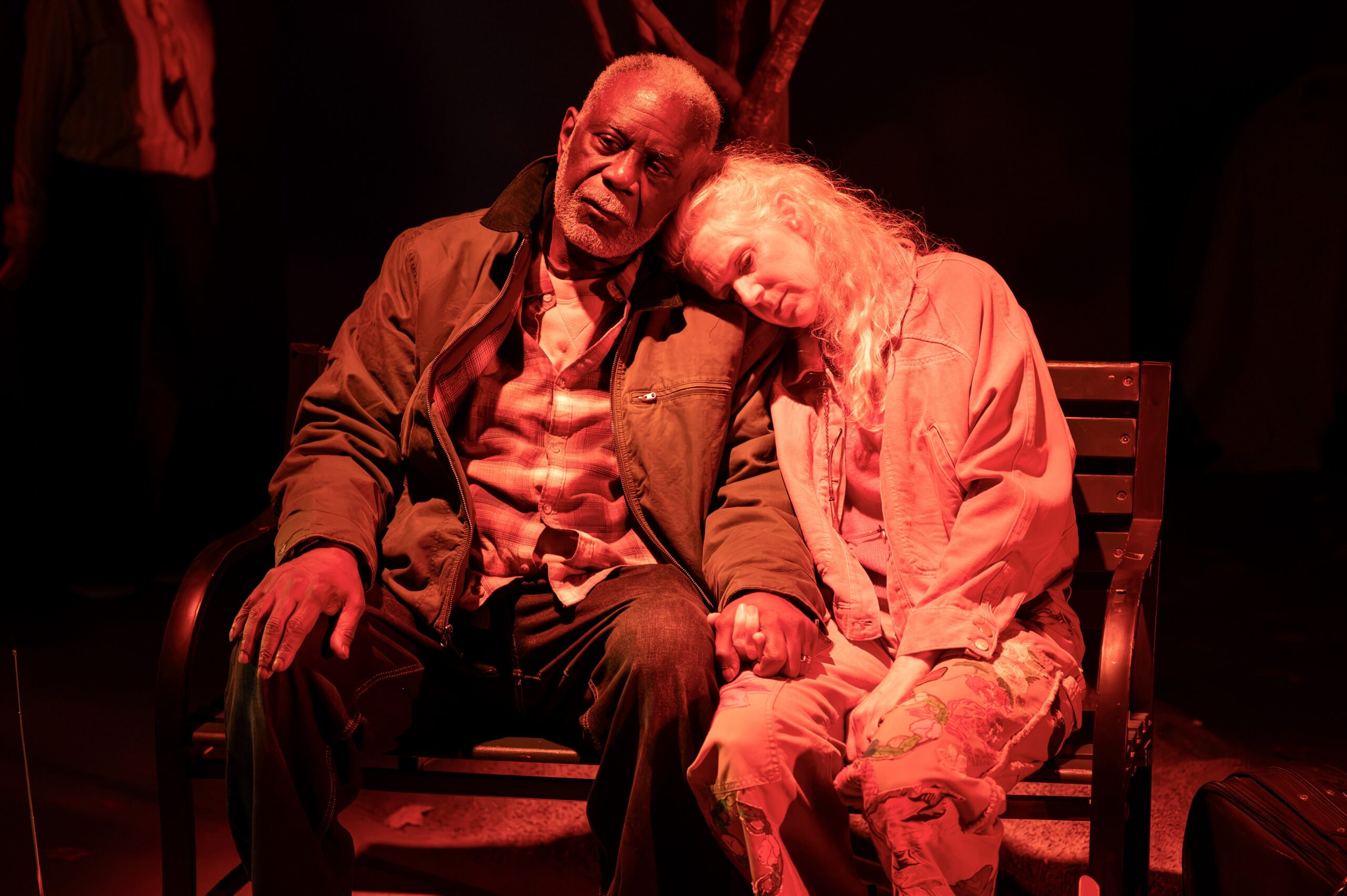 Tender moment between Reginald Wilkins (Sam) and Beth Wilburn (Eddie).
Her aggressiveness contrasts with his being laid back. Fodder enough for a volatile, tenuous relationship? Perfect for any audience member who wants to relate to his, hers, or their own? Yep!
Each member of the ensemble seems well cast, by the way, none more so than longtime Joe Goode dancer Marit Brook-Kothlow, who best shows her chops in a set-piece of improvised wildness in an improvised, oversized couch.
Need more minutia?
Maybe your seatmate knows why the center-stage barren tree has one green leaf near its peak. Or why an onstage pianist is pounding out German composerLudwig van Beethoven at his loudest. Or why four doors keep opening and slamming? Or why it’s necessary for a leaf-blower to aim at human beings.
Or how Wilmurt, who’s also the music director and vocal arranger, is able to so smoothly insert recorded tunes that so delightfully mesh with what’s on stage. Or why it’s necessary to learn how not to lie.
What there isn’t is cliches or bumper stickers or many f- bombs. What there is are burnt toast and burnt barbecue gloves; one of the longest intentional pauses ever seen on stage; a mic cord that can morph into a sexual device; the genderless, race-ignored crew that also tests out loving relationships and may (or may not) represent the inner thoughts and feelings of the couple; plus lots of hidden-meaning stuff and familiar objects in unfamiliar contexts (yeah, there’s Magritte again).
Ergo, the show should contain enough wonderment and puzzlement to drag the most curious theatergoers back for another shot or two at figuring everything out.
Enough clever humor is sprinkled throughout to keep the biggest sourpuss grinning, but underneath the slapstick and weirdness can be found a hyper-serious examination of an honest but iffy relationship.
And just a smidgeon of sadness.
But despite world of tumult and human-heart difficulties, these words keep bouncing around in a viewer’s mind: tender, sweet, brilliant.
And the Ashby Stage marquee displays three others that summarize a good deal: Music. Movement. Magic.
Go! Enjoy!
The Fall Show will run on the Ashby Stage, 1901 Ashby Ave., Berkeley, through Nov. 1 (it was extended). Tickets: $40 to $80. Info:(https://shotgunplayers.org) or 510-841-6500.
Woody Weingarten, a longtime voting member of the San Francisco Bay Area Theater Critics Circle, can be contacted by email at [voodee@sbcglobal.net](https://forallevents.com/reviews/woody-weingarten/voodee@sbcglobal.net) or on his websites, [https://woodyweingarten.com](https://woodyweingarten.com) and [https://vitalitypress.com](https://vitalitypress.com). His books include Rollercoaster: How a caregiver can survive a partner’s breast cancer or any other lethal disease; MysteryDates — How to keep the sizzle in your relationship; The Roving I, a compilation of 70 of his newspaper columns; and Grampy and His Fairyzona Playmates, a whimsical fantasy intended for 6- to 10-year-olds that he co-authored with his then 8-year-old granddaughter.