
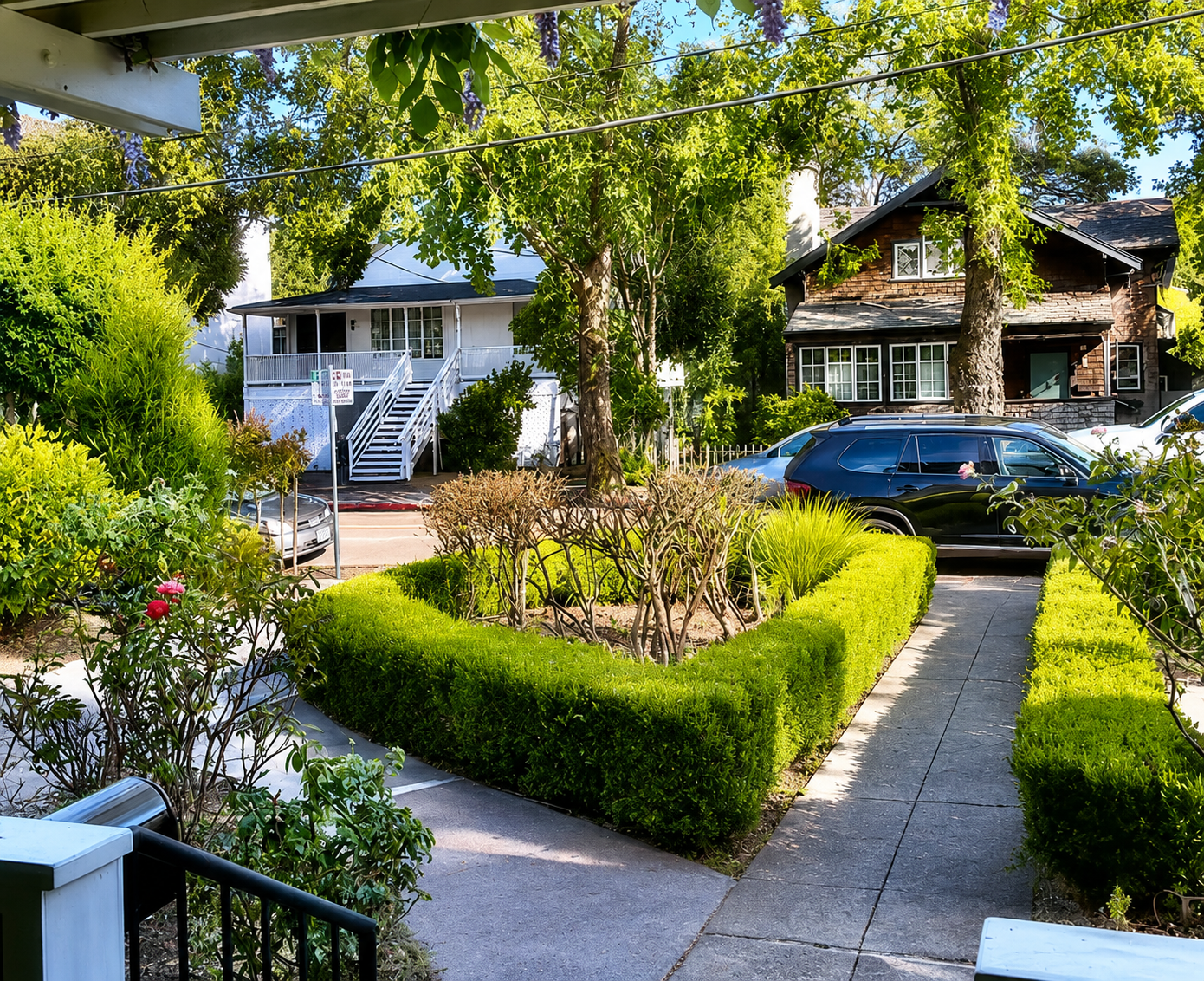
The front yard of Tam House 1 in San Anselmo, Calif., on Thursday, June 25, 2026. Tam House is a non-profit cooperative living facility in downtown San Anselmo, California, that provides affordable, shared housing for independent seniors aged 62 and over. (Suellen Lamorte via Bay City News)
By WOODY WEINGARTEN, Bay City News
Affordability is shaping up to be the buzzword for this year’s midterm elections, and housing is the central issue.
The solution to achieving widespread affordability is complex, certainly. But in upscale San Anselmo, Tam House offers a seemingly simple answer — lodging 21 single seniors in private rooms and communal spaces in two homes.
Low-income residents pay rents of only $1,130 (private bath) or $1,050 (bath shared with one other person).
Tam House, a nonprofit linked to the Ross Valley Ecumenical Housing Association (RVEHA), apparently achieves the “high quality affordable housing” that’s always been its goal. Because of that, it regularly draws kudos from its residents.

Peter Penhallow, a 72-year-old, has lived in Tam House 1 with 10 others for 3½ years. His attitude is upbeat. “I’m lucky to have a roof over my head at a reasonable price in a familial community in the town that I grew up in,” he reports.
Suellen Lamorte can see Tam 1 from her nearby home. She, too, as might be expected of a five-year member of the board, is a cheerleader. “I am honored to be a part of Tam House, which is unique and a good model that works so well it could be copied by communities all across the country. Seeing it just makes me happy.”
Tam House — which restricts itself to folks 63 or older willing to share chores such as washing dishes, sweeping floors, or light gardening — is subsidized by grants from a multitude of civic organizations.
And tradespeople sometimes give discounts to known residents, “because everyone seems to like the basic idea,” says Lamorte.
The facility is not assisted living, however, which means — she says — “that residents have to take care of all their daily functions alone and are mobile.”
Hal Russek, house manager for both buildings, explains that “generally, we are looking for people on fixed income, but whose funding is adequate so they can pay rent at this low rate.”
The maximum annual income for a working person is $65,000.

No smoking is allowed but shared-living benefits include Comcast on flat-screen TVs in the two living rooms and access to wi-fi and a newspaper. Tam 1 has an upright piano.
A few current residents have cars and drive, and a handful do work (one, for example, is a crossing guard, another is employed by a dog-grooming place).
“Generally, people who come in are a few years short of or over 70,” says Russek, who makes sure to point out that “we no longer require funds from local, state or federal subsidies. Tam House should be able to sustain itself for generations to come.”
To be accepted, prospective residents need credit and criminal background checks; once in, each person is expected to get along with the others and be considerate. “One man was a dangerous hoarder whose place wasn’t safe. He was asked to move,” notes Lamorte, a retired teacher who has also volunteered for Marin Villages and Age and Disability Friendly San Anselmo.
Although alcohol is permitted, “inappropriate, intoxicated behavior is cause for termination,” the Tam House website proclaims — as are bullying, verbal threats, and violence, the last being a cause for action right on the spot.
Rent includes five dinners a week, Monday through Friday, freshly cooked by affable Martin (pronounced Mar-teen) Michael. Although no special diets are accommodated, health-conscious menus vary considerably. Examples include eggplant parmesan with orzo and green salads; cashew chicken with jasmine rice; salmon with avocado, brown rice, and veggies; pasta with artichokes and sun-dried tomatoes; roast lamb; beef stew; and chicken enchiladas with rice and beans.
Food, the Tam House Mission Statement says, is also “on hand for residents to prepare their own breakfasts.”


Tam House has no wait list, “but if you would like to be informed when a place opens up, just send us your email [to tamanager@comcast.net] and we will let you know,” says Lamorte, who had been San Anselmo’s representative on the Marin County Commission on Aging.
Physically, Lamorte adds, “Tam 1 is on Tamalpais Avenue, right downtown, and Tam 2 is on the corner of Woodland and Cedar, so each is within walking distance of the other as well as the library, parks, coffee shops, and restaurants.”
Tam 1 opened in 1982, Tam 2 in 2007. Both sit on quiet, tree-lined, residential streets.
It took the four organizational founders — Ross Valley Rotary Club, First Presbyterian Church of San Anselmo, and St. Anselmo Catholic Church and St. John’s Episcopal Church, both in Ross — several years of exploration and study before they could incorporate RVEHA in 1977.
Lamorte notes that no ceiling exists on how long an individual can stay, so it’s not surprising that the two Tam House buildings have become the site of “lots of friendships.”
No romances have been leaked to the press.
This article was first published onLocalNewsMatters.org, a nonprofit site supported by Bay City News Foundation http://www.baycitynews.org/contact/. ‘
Sherwood “Woody” Weingarten, a longtime voting member of the San Francisco Bay Area Theater Critics Circle, can be contacted by email at voodee@sbcglobal.net or on his websites, https://woodyweingarten.comand https://vitalitypress.com. His books include Rollercoaster: How a man can survive his partner’s breast cancer, aimed at male caregivers; MysteryDates — How to keep the sizzle in your relationship; The Roving I, a compilation of 70 of his newspaper columns; and Grampy and His Fairyzona Playmates, a whimsical fantasy intended for 6- to 10-year-olds that he co-authored with his then 8-year-old granddaughter.