
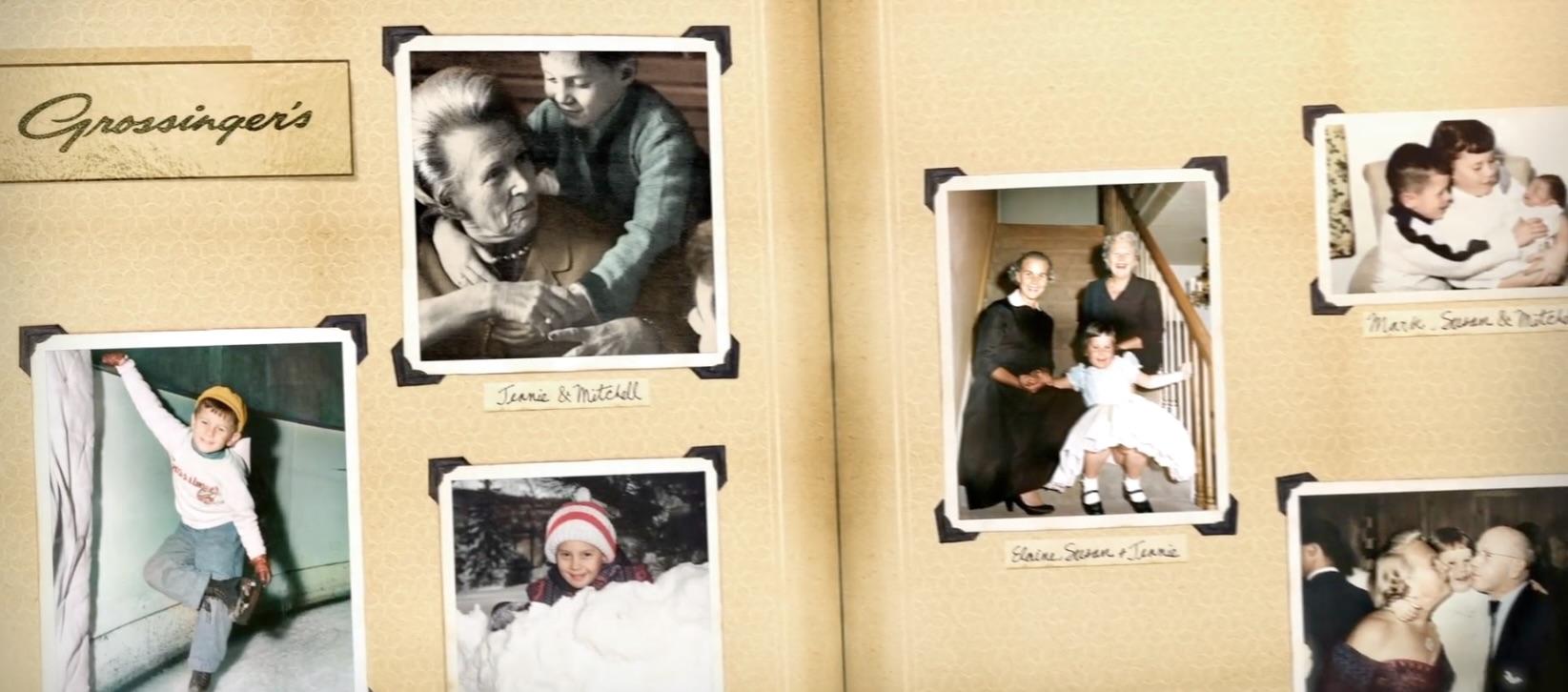
Snapshots of Grossinger family are featured in documentary. Screenshot from We Met at Grossinger’s.
By WOODY WEINGARTEN
People with a mere two drops of cultural Jewish blood trickling through their veins are still likely to enjoy a new film centering on the heyday of the Catskill Mountains, We Met at Grossinger’s.
The historical documentary also focuses on family (the Grossinger’s and everyone else’s), and on kosher food and vacations and corny jokes.
And anti-Semitism.
Not to mention Jackie Robinson, Barney Ross, Eleanor Roosevelt, Mel Brooks, The Marvelous Mrs. Maisel, and name changing.
Plus a taboggan slide, all-you-can-eat food orgies, and Woodstock.
The nostalgic documentary virtually guarantees that viewers — non-Jews included — can smile at its homey (haimish) tales and “Jewish vibe,” and maybe even once or twice tear up.
But it’s also likely to frustrate, with Borscht Belt stars like Joel Grey being interviewed too rarely live — and segments with five living members of the Grossinger family not being labeled enough so it’s tough to grok who’s narrating at any given moment.
The keyword in We Met at Grossinger’s could be excess — excess menu choices, excess sports and dancing and other activities, excess passive entertainment, excess exhaustion, even excess sex.
All salted with joy, however.
The 1¾-hour doc begins with the notion of the upstate New York resort hotel starting as a place for immigrant Jews and their children — who’d suffered from deprivation abroad and were still banned from many, many venues in the United States — to escape from discrimination and the intolerable summer heat of New York City.
We Met at Grossinger’s pulls no punches, referring to signs like “No Jews or dogs allowed,” in golf and country clubs and so many other venues.
The film talks of the family beginning with a boarding house with seven rooms that took in $81 a week, then building a nest egg that allowed purchase of a bigger structure down the road. Ultimately, Grossinger’s rested on 1,000 acres on a lake.
The growth spurts jumpstarted other Borscht Belt folks building “everything included” complexes that at the area’s peak in the ‘50s included 537 other hotels.
The hotel’s first turning point, the film indicates, comes when co-founder Jennie Grossinger invites Barney Ross, in effect, to be a “boxer in residence.” Another milestone follows shortly thereafter when she invites Major League Baseball’s black race barrier-buster Jackie Robinson to the facility.
Later in the documentary, directed by Paula Eiselt, Robinson shows up for television’s first interracial hug in the episode of the groundbreaking Ralph Edwards’ reality show, “This Is Your Life,” that was a tribute to her.
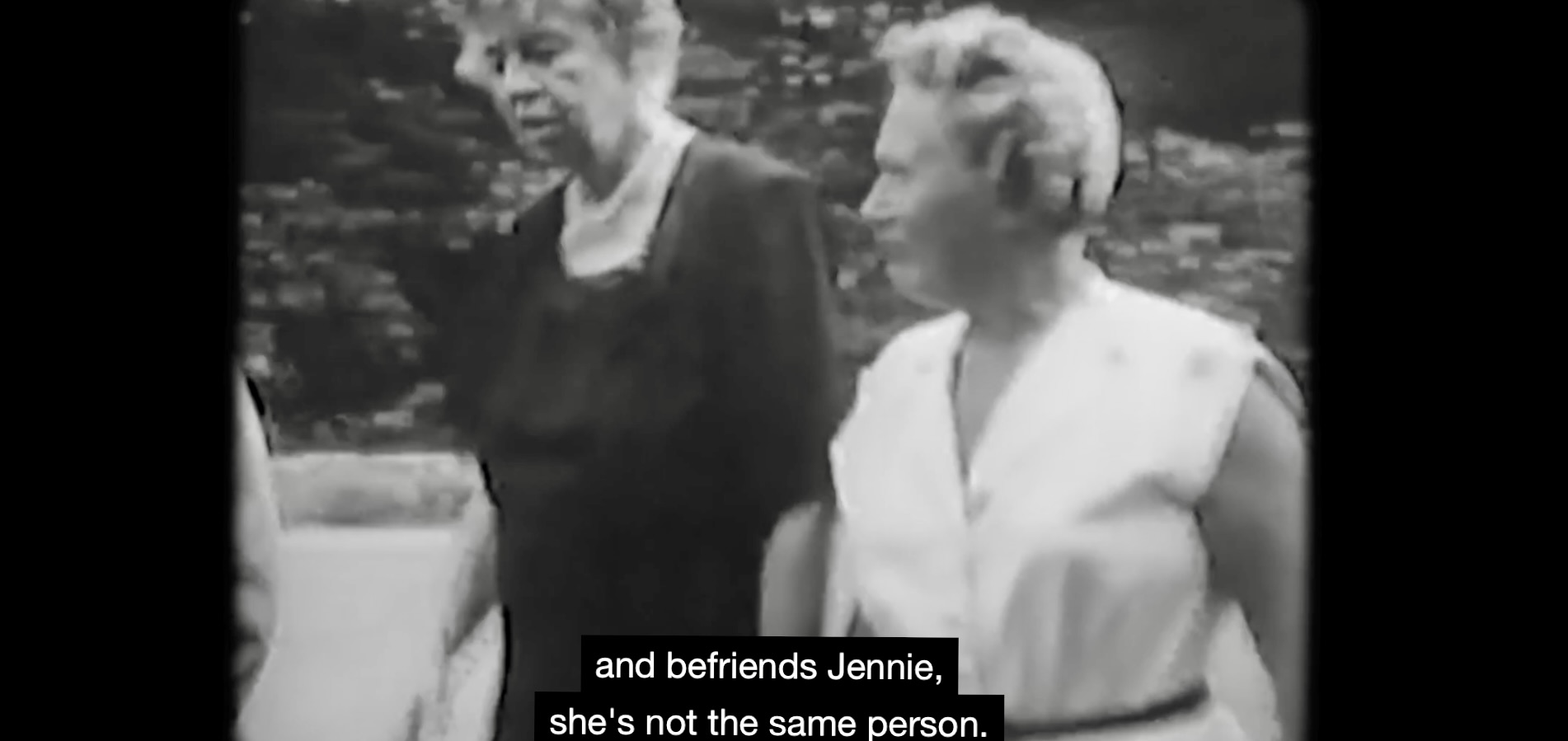
First Lady Eleanor Roosevelt (left) is a house guest of Jennie Grossinger. Screenshot from We Met at Grossinger’s.
In its mid-section, We Met at Grossinger’s details the story of its main character, Jennie, overachiever/hotel hostess who’d left school after the sixth grade to help her family get enough to eat.
Also spotlighted are Jennie’s immigrant mother, Malka, who is surprisingly progressive for an Orthodox Jew; and her daughter Elaine, who readily admits she was long angry with her mom because the elder Grossinger had dumped her into the lap of a governess while Jennie made love to a hotel.
Often and at length.
Ironically, perhaps, the women form a trifecta of successive empowerment that ran one of the biggest cold-beet-soup and entertainment centers in the mountains.
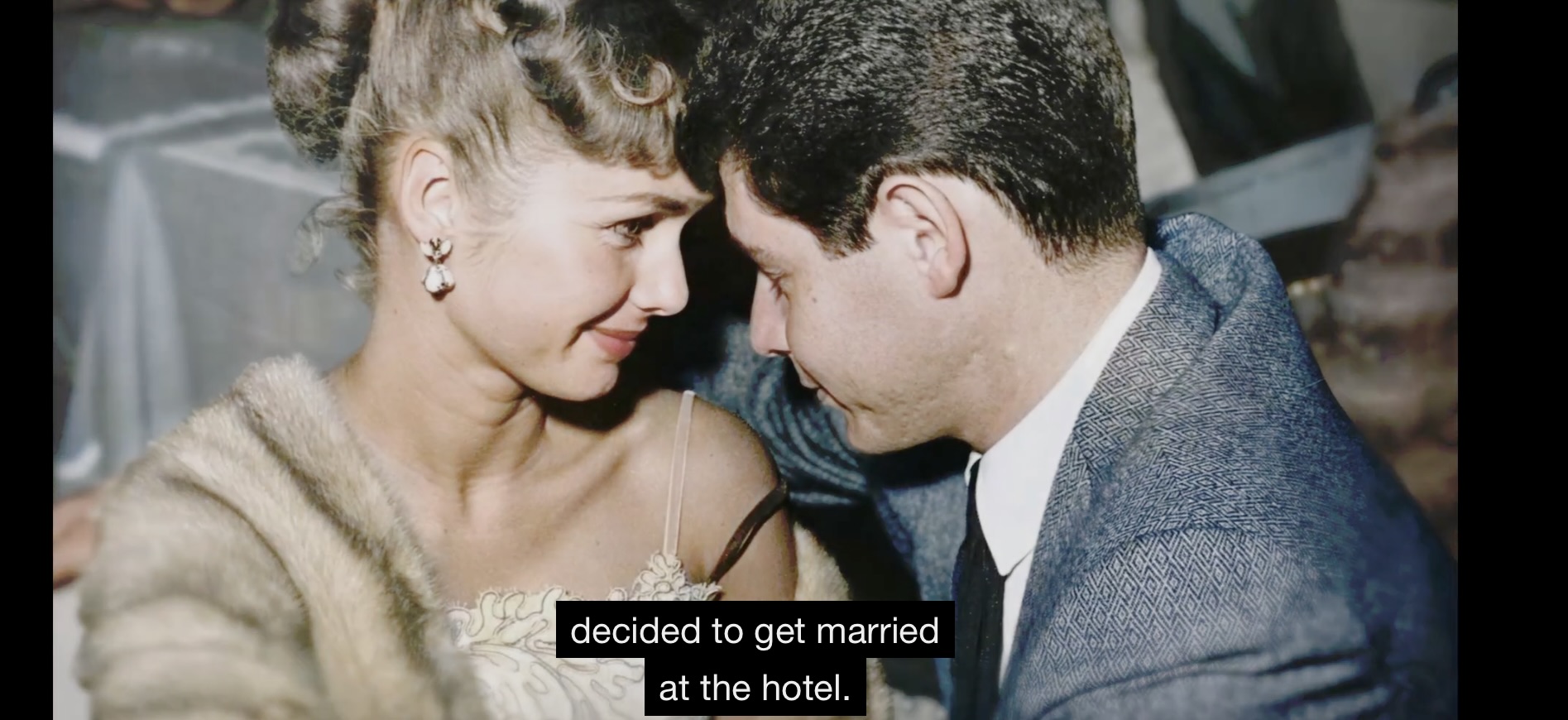
Actor Debbie Reynolds and singer Eddie Fisher are among the thousands who married at Grossinger’s resort. Screenshot from We Met at Grossinger’s.
Throughout the flick, as might be expected, there are talking heads interspersed with short film and TV clips, photo album family shots, gag-lines, and name-dropping, name-dropping, name-dropping.
Factual tidbits can be amusing when we learn that Jenny’s yummy rye bread made its way onto supermarket racks, and that she compiled a Grossinger’s cookbook even though she has no time to cook.
We stop, too, for a moment to linger at Dirty Dancing, which used Grossinger’s as the inspiration for its location.
We also are fed references to more modern times — including the Covid-19 pandemic and Israel’s plight in the Middle East.
We Met at Grossinger’s, which is sold out for tomorrow’s screening in the 46th San Francisco Jewish Film Festival (at the Jewish Community Center San Francisco), will be shown again, as the fest’s Closing Night feature, at the Piedmont Theatre in Oakland, on Saturday, Aug. 1.
The film uses words well to create a mood. It sums things up with these phrases, “We have made this country a better place, we have actually made this country a funnier place.”
Then it proffers the slightly schmaltzy, feel-good idea that Jewish history has “lots of dark moments, but the Borscht Belt was anything but.”
The title is a bit misleading, of course. We Met at Grossinger’s sounds like a run-of-the-mill rom-com — implying, let’s say, an actress like Jennifer Grey, after a botched abortion, runs off with a testosterone-heavy Patrick Swayze — when, in truth, the doc covers an entire short-lived universe at a time when The American Dream was a good deal more accessible than now.
Woody Weingarten, a longtime voting member of the San Francisco Bay Area Theater Critics Circle, can be contacted by email at voodee@sbcglobal.net or on his websites, https://woodyweingarten.comand https://vitalitypress.com. His books include Rollercoaster: How a man can survive his partner’s breast cancer, aimed at male caregivers; MysteryDates — How to keep the sizzle in your relationship; The Roving I, a compilation of 70 of his newspaper columns; and Grampy and His Fairyzona Playmates, a whimsical fantasy intended for 6- to 10-year-olds that he co-authored with his then 8-year-old granddaughter.