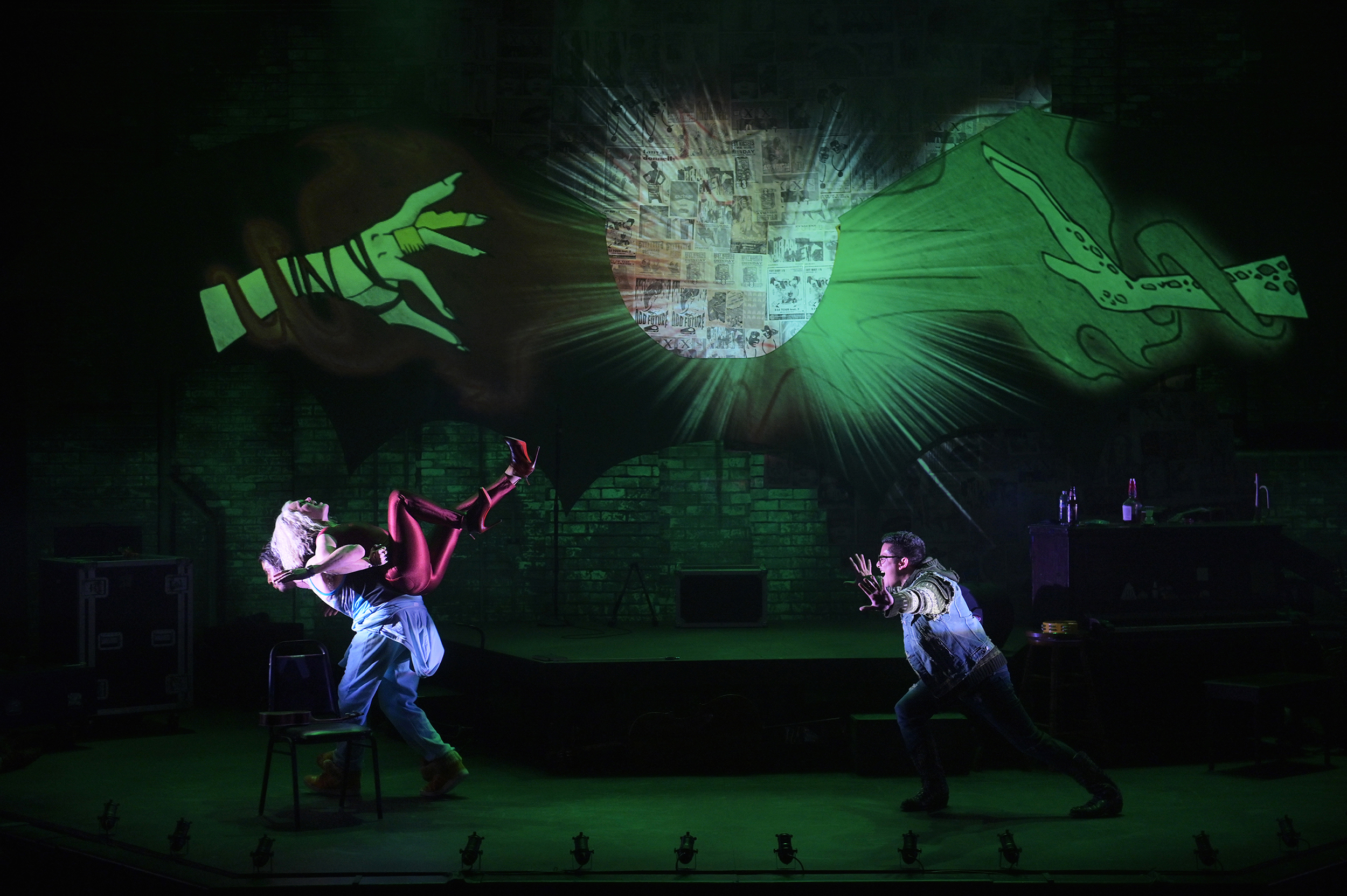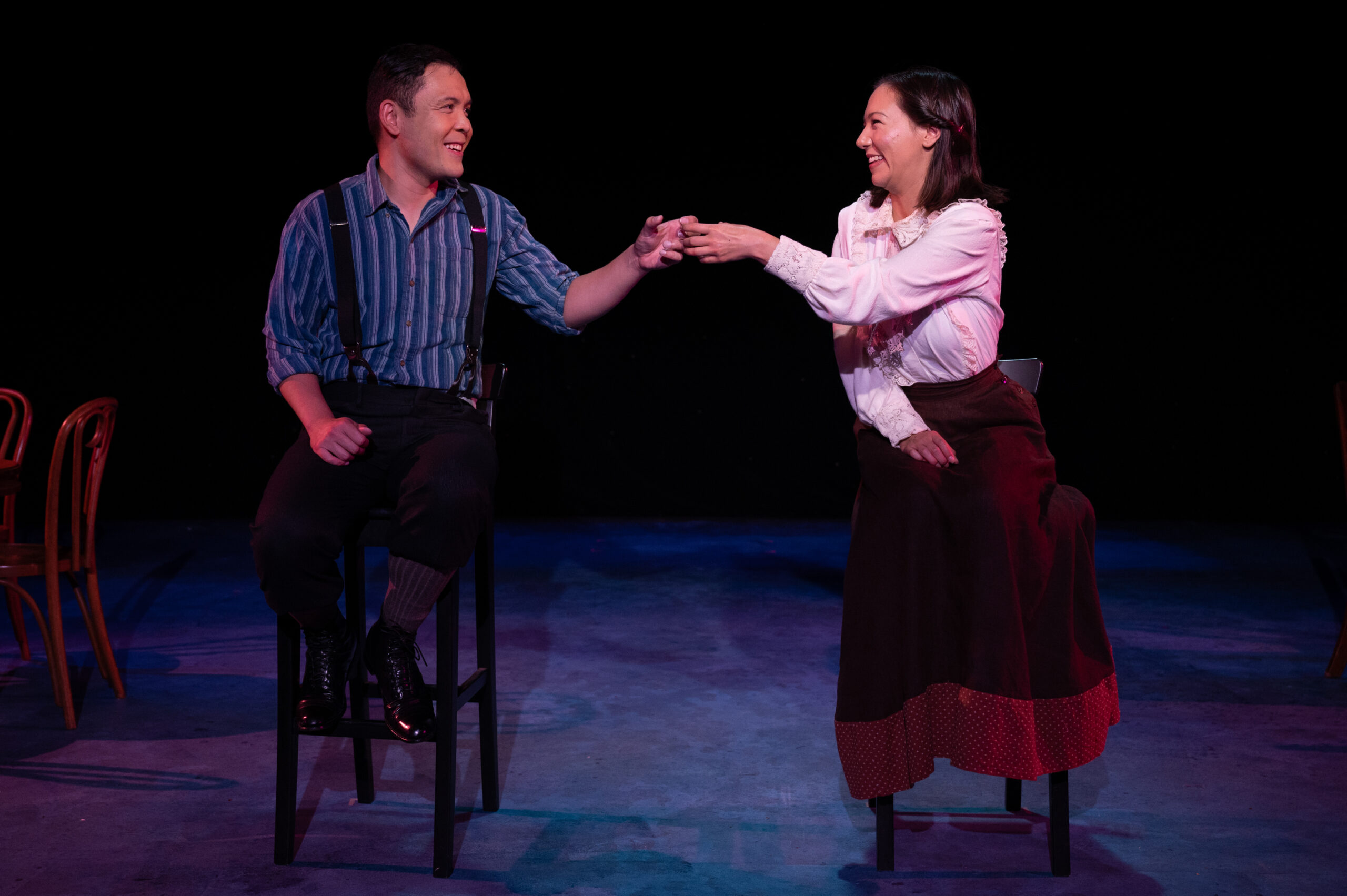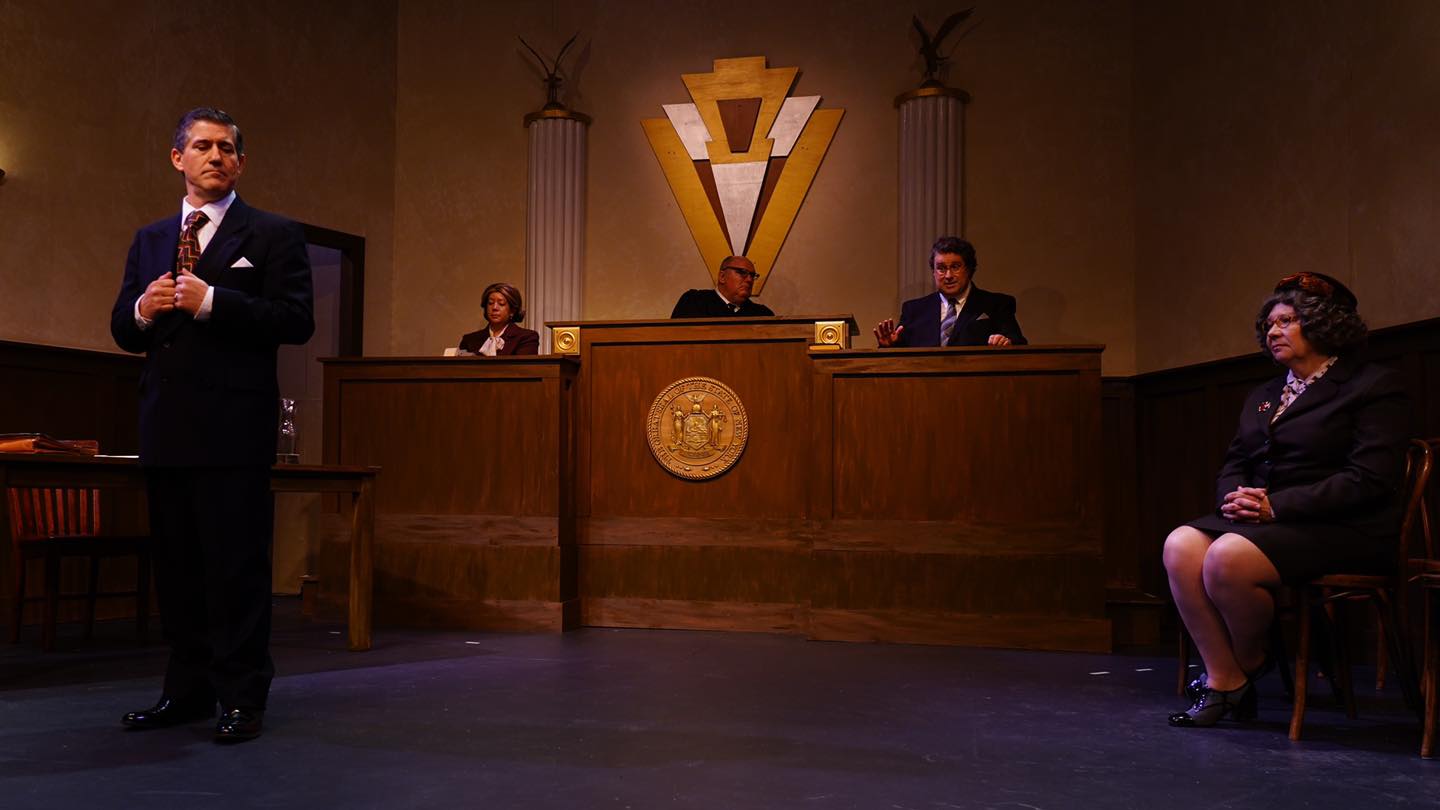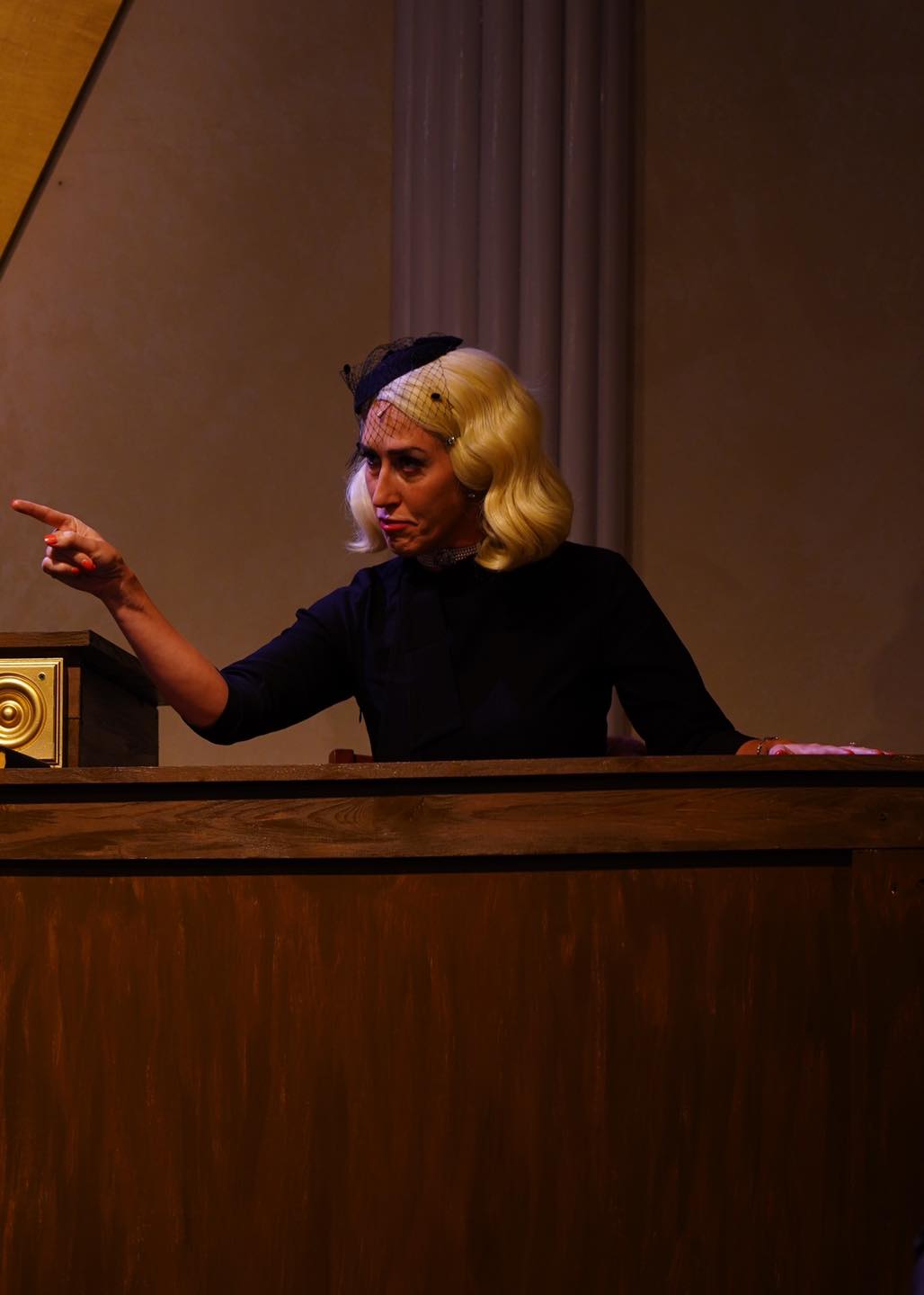
I Do! I Do!: a review by Victor Cordell

By Victor Cordell

Many entertainments succeed by drawing on the audience’s inside knowledge of the subject matter.  The musical “I Do!  I Do!” covers familiar ground that is nearly universal in most places and times.  The vignettes from 60 years of marriage include that unforgettable first night; gender roles; pregnancy and the challenges in rearing children; how people change over time, and often in opposite directions; the special highs of being a couple; infidelity, disinterest, and reconciliation; and ultimately, shared dotage.  Whew!  Woodminster Summer Musicals has mounted a pleasing production of this bittersweet confection.

These days of Covid have prompted special cautions for the return of theater.  In this case, the company’s venue offers special comfort for the audience.  The spacious Woodminster Amphitheater in the Oakland Hills’ Joachin Miller Park provides more than ample room for social distancing in an outdoor setting.  Plus, attendees can picnic in the park or have food and drink al fresco from the limited concessions stand or brought from home.

The musical itself also fits the safety needs of the company almost as well as possible.  Played on a single set, it is a two-hander, thus limiting the number of performer contacts on stage.  Musical accompaniment is two pianos at opposite ends of the huge stage, with a conductor in the pit.  But amongst these minimalistic elements, Kevin Stanford’s numerous and oft changing props and Lisa Danz’s costume coordination give visual variety and relevance to scenes representing various time periods.

Leslie Ivy as Agnes, Gary Stanford, Jr. as Michael.

The backstory of the musical starts in World War II Netherlands.  Author of the source material, Jan de Hartog, wrote the play “The Fourposter” while hiding in his homeland from the Nazis.  The detailed mileposts of a marriage’s long journey are clearly not based on personal experience, because he was still a bachelor at the time of its writing.  But the story was picked up by composer Harvey Schmidt and lyricist Tom Jones, the team who in 1960 had written what would become the longest running stage musical ever, “The Fantasticks.”  In 1966, their “I Do! I Do!” would commence an award-winning, 18-month run on Broadway.

Veterans of Bay Area stages Gary Stanford, Jr. as Michael and Leslie Ivy as Agnes make up the cast for this production.  They are well matched as a pair and manage the dramatic and comedic aspects with skill.

The songs are largely upbeat and support the plotline.  Although the show isn’t studded with memorable tunes, the jaunty opening title song lilts and sets up the narrative.  Perhaps the actors weren’t warmed up or had first night jitters, but that number and those immediately following are not as strong as they should be.  Later, in pieces that call for powerful vocals, Ms. Ivy settles in and shows her stuff.  Mr. Stanford reveals a mid-range sweet spot, but his solos never quite hit the mark.  However, in harmonies, his voice mixes extremely well with Ivy’s, and they excel when singing together.  In addition, his dancing is definitely an asset.  Like a power forward with the moves of point guard, he is remarkably light on his feet – nimble, quick, and graceful.

The show stopper is the beautiful, yet schmaltzy, “My Cup Runneth Over,” which became a Top 10 pop record single in 1967.  Sung as a duet in the show, the pair capture the essence of the song nicely.  But the most fun number is another duet, “Nobody’s Perfect.”  A lengthy piece that centers on each spouse enumerating the faults of the other, it is largely delivered in patter-talk.  It is hilarious and the couple ace this one.

Following on is another fractious, and this time, gasp-inducing song.  Michael has become a successful writer, whose novels are uninspiring to Agnes, a stay-at-home wife.  With an inflated sense of ego, he fancies himself a chick magnet, while not appreciating that his admirers at literary talks don’t see the side of him that only a wife suffers.  His self-indulgent anthem “A Well Known Fact” argues that a man only gets better with age, while a woman goes to pot, not winning him the gold medal in the diplomatic race.

Although the conflict songs are played for laughs, the clashes around them are serious.  The actors perform their best in these animated, hostile moments.  In all, the musical and the actors find a good balance between lightheartedness and dysfunction.  The years pass by quickly.

“I Do! I Do!,”  composed by Harvey Schmidt with lyrics by Tom Jones, is produced by Woodminster Summer Musicals and plays on its stage at 3540 Sanborn Drive, Oakland, CA through August 22, 2021.

Eliogabalo: a review by Victor Cordell

By Victor Cordell

Randall Scotting as Eliogabalo.

Perhaps unique among performed operas, Francesco Cavalli’s 1667 “Eliogabalo”’s world premiere was delayed – by over three centuries – until 1999 to be precise.  Why, one might ask?  Interestingly, an aficionado today can evaluate an opera simply on its own merits, mindful of how appealing it is within its own idiom.  But at the time of its composition, an opera is judged largely within its context.

For instance, while “Madama Butterfly” is one of the most beloved operas in the repertoire, the contemporary detractors argued that Puccini had not advanced his oeuvre sufficiently beyond “La Boheme” and “Tosca.”  Most contemporary opera lovers will appreciate “Butterfly” independent of its place in history.

Jean-Paul Jones as Lenia, Nathan Stark as Nerbulone.

In Cavalli’s case, he was the most successful composer of his era in the field of small orchestra opera with 38 operas to his credit before his composition of “Eliogabalo.”  But his musical style for this work was deemed passé for the tastes of the Venetian audience of 1667 – an issue that bears little meaning in the 21st century.  The composer would be pleased to observe that this historical oddity has now benefitted by performances from nearly a dozen companies. West Edge Opera’s delightful rendition with well-sung beautiful music, bawdy humor, orgyistic eye-candy production numbers, and an edge of tragedy validates the work’s delayed recognition.

The libretto is loosely based on the life of a teenage Roman emperor who reigned from 218 to 222.  Though officially Antoninus, he became known in death as Elagabalus, named after the God he worshipped.  In his brief life, he defied and debauched all religious and sexual conventions.   What’s more, his incompetence was matched perhaps only by his tyranny.  The emperor lived by the notion that “the law does not pertain to me” and didn’t really care about his people, stating that “he who does not follow me blindly is guilty.”   Does this resonate with frightening currency?

Nikki Einfeld as Gemmira, Matheus Coura as Giuliano, Aura Veruni as Eritea.

A charismatic Randall Scotting aptly portrays the self-indulgent, sexually ravenous title character.  The countertenor is himself a massive contradiction.  Scotting physically commands the stage having a Samson-like appearance with hunky muscularity.  Thus, his lilting, high voice seems anomalous.  Though his voice is profound, as is common with countertenor voicing, it doesn’t project the power of other voice types.

Eliogabalo’s main quarry is Gemmira, who is otherwise spoken for, but that doesn’t deter the predator.  The evasive maiden is played by Nikki Einfeld whose silky lyric soprano voice features well in arias and blends beautifully in several ensemble numbers.

But the liveliness in the production comes largely from secondary characters.  Cavalli adopts the older, unfiltered maid/nurse meme in Eliogabalo’s enabler, Lenia, who is played in drag by Jean-Paul Jones.  As it happens, Jones is not only an opera singer but also a professional drag queen.  Remarkably, his squawk-box, false alto voice is well controlled, and he switches back and forth to a sonorous baritone with humor and ease.  Director Mark Streshinsky has given Jones liberty to go campy and off script, and the results are hilarious.

Lenia’s sometime partner-in-crime is the henchman-looking harem master Nerbulone.  He also ad libs, including dropping into the audience to solicit additions to the harem, and like Lenia, he occasionally lapses from Italian to English with great comic effect.  Nathan Stark plays the role with great verve, and his baritone range is rich and pleasant.  But while he hit his notes in the low bass end, his power is depleted there, perhaps because of the outdoor acoustics.

Nikki Einfeld as Gemmira, Randall Scotting as Eliogabalo.

Cavalli’s medium of farcical dramedies set in ancient times was common when he was active.  The lasciviousness of “Eliogabalo” was maybe a bit extreme for its time, but the West Edge audience supported it completely.  The baroque score is surprisingly melodious and engaging with many charming arias and small ensembles.  Conductor Adam Pearl’s orchestra of seven includes period instruments and delivers a remarkably full and mellow sound. Kudos to the other principals Derek Chester, Aura Veruni, Mateus Koura, Shawnette Sulker, and Jonathan Smucker, whose voices and acting added to the overall enjoyment.

The look of Evan Streshinsky’s spare set is thematically appropriate, comprised of a huge, tilted bed and eight vertical panels.  All appear to be in a tufted red latex look, like straight out of a cheap honeymoon motel room.  But against that canvas is a recurring spectacle of writhing semi-naked and ninja-like dancers that provide the visual pop.

 West Edge Opera has once again shown its skill and daring in its 2021 Festival.  This third and final offering of the season is a welcomed addition that is delivered with great professionalism and flair.  Although the opera has been trimmed somewhat, at two hours and forty-five minutes, it could benefit from further cuts.

“Eliogabalo,” composed by Francesco Cavalli with libretto attributed to Aurelio Aureli is produced by West Edge Opera and plays at Bruns Amphitheater, 100 California Shakespeare Theater Way, Orinda, CA through August 8, 2021.

James Dunn Successfully Stages “The Pirates of Penzance” at RVP

By Flora Lynn Isaacson

Director James Dunn wanted us to have some fun!  He feels that summer is a perfect time for silliness.  He achieves this with his remarkable production of Gilbert and Sullivan’s (1879) The Pirates of Penzance. 

Before the curtain is even raised, the stage is set with 8 old-fashioned footlights and box seats on either side of the stage, fronted by a red-velvet curtain.  The time and place is toward the end of Victoria’s reign.  

When the curtain is raised for Act 1, it is on a rocky shore on the coast of Cornwall.  Act 2 takes place in a Ruined Chapel by Moonlight. 

As the story goes, Frederic (Cordell Wesselink) was apprentice to a group of pirates, due to an error by his guardian, Ruth (Christina Jaqua), who came along as the ship’s mate, because, you see, “pirates” sounds very much like “pilots.”  The members of this “pirate” band, led by the Pirate King (Philip Percy Williams) are brave, but their sensitive side prevents them from being completely successful – as should be for plundering pirates.  


At the age of 21, Frederic seeks the freedom to discover the non-pirate-side of life and very quickly falls in love with Mabel (Joni DeGabriele), who travels with her own troupe of 3 sisters.  Their father, Major-General Stanley (Norman A. Hall), seeks to protect his daughters from the pirates; allegiances are tested, and the police enter the fray before all is resolved by the final curtain.  

Once the curtain is raised, the atmosphere is set with Ron Krempetz’, Scenic Artist Dyhanisbrilliant set design and construction (by Michael Walraven), as well as the costumes by Michael A. Berg and Jan Koprowski and choreography by Sandra Tanner (which is excellent with every movement, adding another dimension).  The effective lighting design was by Ellen Brooks.  Music Director Paul Smith beautifully handles the accompaniment.  

Standout performances, worth the price of admission, include truly memorable performances by Norman A. Hall as Major-General Stanley; and Philip Percy Williams (who gives a broad, flamboyant, and charismatic performance as the pirate king with a richly-strong voice.  He is also accomplished at comedy, especially with the physical bits that make this show such a delight. ) Also, it’s hard to imagine a better voice than Joni DeGabriele’s beautiful soprano voice for the sweet and fetching role of Mabel. Christina Jaqua uses her wonderfully expressive face to show us the faithful Ruth, who after living with the pirates for a decade-and-a-half, is ready to choose one for her own. 

There are 22 actors whose performances are handled masterfully by James Dunn.  His wonderful direction keeps things going at a very fast pace, and he achieved his wish for us to leave this performance with both a laugh and a smile. 

Performances of The Pirates of Penzance have been running since July 16 and will go through August 16, at The Barn, home of the Ross Valley Players, 30 Sir Francis Drake Blvd., Ross. 

Regular performances are Thursdays 7:30 p.m., Fridays 8:00 p.m., Saturdays 8:00 p.m., and Sunday Matinees are at 2:00 p.m.  For tickets, go online to www.rossvalleyplayers.com or call 415/456-9555, ext. 3.

Photography by Robin Jackson

Coming up next to start the 86th Season of Ross Valley Players will be Glorious!  the true story of Florence Foster Jenkins, the worst singer in the world, by Peter Quilter, directed by Billie Cox, from September 18 through October 18, 2015.

 FLORA LYNN ISAACSON


Elizabeth Cree: a review by Victor Cordell

By Victor Cordell

Keith Phares as John Cree.

Murder!  Mayhem!  Ghoulish entertainment for the lower classes!  Terror in the night on the foggy, shabby back streets of Victorian London!  It sounds like the makings of a Gothic suspense novel.  But an opera?  With a canvas that is the amalgam of a 19th century English music hall milieu, a courtroom trial, and serial murders, it hardly seems likely.  Of significant works intended for the opera house, only Alban Berg’s “Lulu” comes close to being as lurid.

Keith Phares as John Cree, Katy Pracht as Elizabeth Cree.

In “Elizabeth Cree,” the eminent Pulitzer Prize winning team, composer Kevin Puts and librettist Mark Campbell, have crafted a score and a darkly comic libretto with Gothic atmosphere that is absolutely riveting.  West Edge Opera’s stellar new production at its wonderful outdoor venue channels the creepiness of the events even at a broad daylight matinee.

The opera is loosely based on fact.  Elizabeth Cree suffered a hard scrapple upbringing with a mother who badly abused Elizabeth’s genitals as punishment for the girl’s having been raped.   However, she rose from the bowels of society to take on as a performer with music hall troupe.  Later, she met and married John Cree, a literary critic and failed writer but with a comfortable income from his family.  John would be implicated in a series of Jack the Ripper like murders but would die from a dose of poison administered by Elizabeth, who would be tried for his murder.

Samuel Faustine as Dan Leno, Joe Meyers as Little Victor Farrell, Leslie Katter as Aveline Mortimer, Christopher Job as Uncle.

Like the company producing it, the opera is edgy in every way.  The plot line is delivered briskly in a series of 29 vignettes that move back and forth in place and time.  At one point Elizabeth reveals her unhappy childhood and at another her sexual frigidity.  Vaudevillian-like music hall entertainers in silly costumes amuse us.  Real-life luminaries Karl Marx and George Gissing are encountered at the reading room of the British Museum, also frequented by John Cree, and are interrogated on the witness stand of the trial.  Most vividly, we see the scenes of the swarthy, rakishly handsome John Cree enacting and describing in gory detail the bloody, precise vivisection of the murder victims.

The composer’s dizzying score engages throughout with the same rapid movement as the scenes.  The orchestra tinkles and tingles and screeches and pounds like a punch in the gut.  It soars as Cree contemplates impaling the next victim.  But at the same time, the music allows for a variety of lyrical vocalizations which are delivered with consummate skill.

Samuel Faustine as Dan Leno, Katy Pracht as Elizabeth Cree.

Mezzo Katy Pracht soars as Elizabeth with a mellow voice and full vibrato, conveying a panoply of enigmatic emotions from her lost innocence to her deadly scheming.  But her murderous character is mundane when contrasted to her male counterparts.  Pracht’s real-life husband, Keith Phares, portrays the sinister John Cree with flair.  His silky, rounded baritone includes a lilting high end and warm vibrato.  Finally, Samuel Faustine is the brassy and gaudy comedian Dan Leno, the head of the music hall performers.  His versatile tenor voice includes a well-controlled countertenorish high end that is put to great use in low volume passages.

This opera may not have the gravity of Verdi or Mozart works.  However, the score is multifaceted, fitting, and eminently listenable.  Not to mention, the libretto is clever in structure; gripping and engaging; and as propulsive as the music.  To top it off, there is an element of suspense with an intriguing denouement.  The West Edge production touch is a perfect fit to this delightful opera.

“Elizabeth Cree,” composed by Kevin Puts, with libretto by Mark Campbell, is produced by West Edge Opera and plays at Bruns Amphitheater, 100 California Shakespeare Theater Way, Orinda, CA through August 7, 2021.

Katya Kabanova: a review by Victor Cordell

By Victor Cordell

Phil Skinner as Dikoj, Kristin Clayton as Kabanicka, Alex Boyer as Tichon, Carrie Hennessey as Katya, Sarah Coit as Varvara, Chad Somers as Kudrjas. All photos by Cory Weaver.

For several seasons, the innovative and peripatetic West Edge Opera has performed at various historic, industrial, and sometimes noisy venues, all with unsloped  seating.  This season, they have moved outdoors to the glorious Bruns Amphitheater in Orinda.  Its tiered seating provides comfortable sight lines that are greatly welcomed, not to mention a spectacular backdrop of golden hills with green riparians from its setting in the Siesta Valley.  Many thanks to California Shakespeare Theater, which holds a long-term lease on the venue.  Cal Shakes has facilitated other companies performing at this wonderful outdoor arena in its “Season of Shared Light,” providing a safer haven from the pandemic than indoor spaces.

In keeping with its tradition of producing operas that open new horizons for much of the audience, West Edge’s 2021 Festival commences with Leoš Janáček’s 1921 masterpiece, “Katya Kabanova.”  A stellar cast led by soprano Carrie Hennessey turn in outstanding performances to make this a compelling opera experience.

Carrie Hennessey as Katya, Christopher Oglesby as Boris.

Until recent times in the United States, Janáček was a known but rarely performed composer, limited largely because of the difficulty of casting opera in Czech.  However, “Katya Kabanova” is exemplary of his searing dramas about common people who sing with the vocabulary, style, and rhythms of natural language, creating an authenticity that has found audiences.  His eclectic, somewhat dissonant 20th century musical style which draws heavily on folk music, especially Moravian, has created demand.  Although the format of “Katya Kabanova” is through-sung, it does contain some notable arias.

The opera is based on a Russian play, Nikolayevich Ostrovsky’s “The Thunderstorm.”  However, its passion also draws from Janáček’s own unrequited love for a married woman, like Boris’s love for Katya in the opera.  Needless to say, social convention in small town Russia in the 19th century was more restrictive than current day.  It bears noting that moral turpitude (if one even wishes to classify “illicit” affairs as such) derives not from possessing thoughts about socially-unacceptable deeds, but rather by the failure to prevent thoughts from translating to action.  In some cases, temptation is all but unavoidable.

Katya is a tragic figure. She is a young, attractive woman, caught in an unhappy marriage to Tichon.  He is not inherently evil, but suffers under the thumb of his domineering and socially-rigid widowed mother, Kabanicka, who makes life hell for the free-thinking Katya.  In the critical event of the narrative, the mother forces Tichon to go on a long business trip.  Katya knows that she will be tempted to make love with Boris if Tichon leaves and begs the husband to either stay home or take her with him.  He argues that his mother gives him no choice and denies her.  His absence marks the descent into Katya’s devastation.

Kristin Clayton as Kabanicka, Alex Boyer as Tichon.

It is good fortune that General Manager Mark Streshinsky and Music Director Jonathan Khuner had a history with Carrie Hennessey through her playing the lead in the company’s 2014 “End of the Affair.”  From her resumé, it isn’t apparent that she would be up to a demanding role of the magnitude of Katya.  Yet she totally commands it.  Dramatically, she captures the many emotions of the desperate young woman.  Musically, she captures those moods through the full vocal range and in both lyric and dramatic voicings.  These contrasts are particularly well expressed when she is conflicted, as when she first meets Boris and admits both her love for him along with her guilt and wishing to die.

Other performers are superb as well, starting with Kristin Clayton’s appropriate harshly-delivered depiction of the demanding Kabanicka.  The two men in Katya’s life are represented by two clarion tenors, Alex Boyer as her husband Tichon and  Christopher Oglesby as the lover Boris.  Booming baritone Phil Skinner, delightful mezzo Sarah Coit, and bright tenor Chad Somers also provide appealing turns.

The opera is set “with a nod to 1950s California.”  A few furniture pieces are consistent with midcentury modern design, but décor features like sepia-colored prints and an antimacassar don’t fit that period.  In any case, the predominance of institutional green wall coloring is dreary.  A true representation of the 20th century, perhaps bright looking in contrast to the dark action of the opera might be interesting, but otherwise full-on traditional version would work well.

Sarah Coit as Varvara, Chad Somers as Kudrjas.

The orchestra endures somewhat daunting conditions, placed completely under the stage with only a small aperture onto the apron.  Amplification is required to produce satisfactory volume (though singers voices come through with great power and clarity without mics).  On opening night, the striking introductory sequence with a deep and long held chord followed by a brief melody and timpani motif was muffled and almost lost, perhaps because the sound controls hadn’t yet been optimized.  Overall, the orchestra seemed to fare better when the instruments’ soundings had greater separation, but they occasionally seemed a little out of sync and tune during tracts demanding greater unison.

In sum, with “Katya Kabavona”’s powerful score and intense drama, Janáček expressed his full maturity in the vocal genre.  It is a classic, and West Edge’s production is well worth seeing.

“Katya Kabanova,” composed by Leoš Janáček with libretto by Vincenc Červinka is produced by West Edge Opera and plays at Bruns Amphitheater, 100 California Shakespeare Theater Way, Orinda, CA through August 5, 2021.

The Song of Summer: a review by Victor Cordell

By Victor Cordell

Jeremy Kahn, Monica Ho. All photos by Jessica Palopoli.


Nostalgia, that palpable yearning for past days of youthful enthusiasm and innocence, comprises the sights, sounds, and smells of those special times.  But a frequent trigger of those warm feelings comes from the soundtrack of the time.  Playwright Lauren Yee taps that vein and beyond with “The Song of Summer.”  With a nod to the music, the playwright takes a charming and humorous look at the relationships and trajectories of our lives.

Ever self-effacing Robbie has stumbled onto the brink of success.  While bartending in Tacoma, the bar’s manager, Joe, sees the potential of a song that Robbie introduced to him.  He organizes Robbie’s recording it, and it rises to become the emotional timestamp which young people would most associate with that summer.  The song’s popularity spawns a national tour for the nascent star, but when he receives boos at a North Carolina concert because some consider his lyrics “rapey,” he bails without notifying anyone.  His escape is into the bosom of his former piano teacher in Pottsville, PA, a coal town where he had grown up until a dozen years before at age 16.

Anne Darragh, Jeremy Kahn.

Who could portray Robbie’s nebbishy character more splendidly than Jeremy Kahn?  Eminently likeable, a talented musician, and nice looking, Robbie’s diffidence and lack of confidence leads him to repeatedly refer to himself as a 4 on a scale of 10.  As much as you like him, you want to make like Cher in the movie “Moonstruck,” and scream “Snap out of it!” and throttle him.

The piano teacher, Mrs. C, is delightfully performed by Anne Darragh.  Kind and supportive, she was more a mother to Robbie than his blood mother.  She is also a pack rat.  So when Joe, now Robbie’s artistic manager, catches up with him, Joe realizes that Mrs. C may possess information that could help benefit Robbie’s career.  Reggie D. White excels as the stereotypical artist’s manager – hyper, aggressive, and always keeping eyes on the prize, unlike the sometimes dreamy-eyed and ambivalent client.

Reggie D. White.

And then there is Tina, who had a complex relationship with Robbie growing up.  She is the daughter of Mrs. C played wonderfully by Monica Ho.  Very grounded as an adult, but in a flashback sequence to high school days, she is revealed as ambitious, yet fun-loving, and adventuresome.  She also has a foul mouth that could embarrass a sailor.

“The Song of Summer” contains many stock situations, but they are written and performed with great flair, and the outcomes are not always as expected.  Importantly, the play’s subtext provides layers of depth that result in a thoughtful work.  Though the work doesn’t wallow in self-importance, this is not an episode of “Happy Days.”

Perhaps the most important underlying theme concerns the effects of random events in life.  People like to think that they exercise great agency over their lives, and often that is true.  The dominant life arc of some people may have few arbitrary disruptions, but for others, uncontrollable events create a trajectory as erratic as shots from a loose cannon.  Their lives are full of “what-ifs” – if a life-altering appointment weren’t missed; if a parent hadn’t died; if one hadn’t been required to serve in the military, all lead to radically different pathways of life.  In this case, what if Robbie hadn’t moved to Tacoma, an act over which he had no control?  What if Tina had seen the camcording intended for her?   But we are also reminded that momentous what-ifs occur from decisions over which we do exercise control.

Monica Ho, Jeremy Kahn.

Another key element is chosen versus inherited family.  Here, the caring Mrs. C acts as the nexus.  Although the central element of family is blood kinship, she demonstrates that water can be thicker than blood.  Tina did not come to her by birth but by adoption, though their bond is no different than blood relatives.  Robbie comes from a dysfunctional background, and Mrs. C was like a mother to him, who he felt comfortable returning to.  By design, the playwright specifies characters to have ethnicities – Asian (Tina, who is adopted) and Black (Joe, who had been a replacement singer in The Four Tops) to demonstrate familial linkages across color.

The play is also about going home again, and the way of life in small town America.  There is a clash between the traditional view of unchanging practices and values versus the realities of the modern day.

Although they are chalk and cheese, Kahn and Ho sparkle together as well as apart.  “The Song of Summer” moves along at a brisk pace, and Director Bill English’s clever staging allows for rapid set changes in the absence of intermission.  Given the play’s centerline, the show would benefit from having more punch in the musical numbers (especially the opening, but with the exception of the karaoke duet “Alone”).  That said, it is a well-acted and directed, fun and provocative play with a modicum of suspense that should appeal to a wide audience.

“The Song of Summer” written by Lauren Yee and produced by San Francisco Playhouse appears on their stage at 450 Post St., San Francisco, CA through August 14, 2021.

Waco Film Festival- 2021

By Cathy Valentine

Waco’s Deep in the Heat of Texas Film Festival    -July 23-25 live, and July 25-31 Streaming Online

The Waco Hippodrome, at deepintheheartff.com, is again home to a four day film live and also a four day online film festival.  Full length films as well as shorts grouped together in 2 hour sessions include Electric Jesus, and the action thriller Outlaw’s Buckle.  While tickets are available for individual events at $8 per film, and 4 day VIP pass costs $100 with access to all events.  The Texas Film Commission will present two workshops led by filmmaking professionals on Friday at 4:45 and Saturday at 3:45.  While the Balcones Whiskey Tour on Friday is sold out, a Saturday morning Waco Film Locations Tour is still open.        Access the full list of films and events  at     deepintheheartff.com

Central Texas Experiences

By Cathy Valentine

State Parks abound in the central Texas region and within a short drive from Waco Texas.

Whether you are a camper or day tripper, the State Parks surrounding Waco Texas offer a variety of experiences.   They all offer numerous hiking trails, camping sites, access to lakes with aquatic activities for all members of the family.

Lake Whitney State Park – is 39 miles northwest of Waco and 955 acres on the shore of Lake Whitney. Entrance fees are $5.00 with children under 12 free.  Camping fees range from $14-$30 per night depending on the amenities.  Fishing in the 23,000 area US Army Corps of Engineers reservoir on the Brazos River with striped and white bass, smallmouth and largemouth bass, crappie and catfish are a prime attraction.

Meridian State Park- is 54 miles from Waco and 504 acres.  Entry fees are $5 and children under 12 free.  The park contains a 72 acre lake with Kayak rentals available.  Hiking on the 2.2 mile Bosque Trail  that circles the lake, and a 1.5 mile Shinnery Ridge Trail where golden-cheek warblers nest.  Group events can be booked.  Camp sites from from $15 to $35 per night depending upon amenities.

Mother Neff State Park – is 28 miles southwest of Waco.  Entry fee is $2 with children under 12 free. This 259 acre park offers camping, playgrounds, easy hikes which meander through wooded creek bottoms and wild-flower prairie.  Camping sites from $12 to $25 per night.  A Civilian Conservation Corp built lodge with kitchen rents for $160-$200 and sleeps eight with tent sites for 8 more.

Fort Parker State Park – 46 miles east of Waco and 1459 acres.  Entry fee is $4 and children under 12 free.  A 750 acre lake backs up to the park.  The amenities include hiking, camping, swimming, boating and historical sites..  Camp sites range from $12 to $45.

To make reservations at a Texas State Park – https://tpwd.texas.gov/state-parks/park-reservation-information/reservations

Oncea-Lifetime Photos

By Uncategorized


On Jun 29, 2021, at 9:45 AM, Joe Cillo <joe@forallevents.com> wrote:


 Doorway To Heaven in Big Sur

  orway To                                                            Heaven
  
 
Maple Ridge In Japan

  
A Hotel In The Netherlands
otel In                                                            The
 Sheep Going Through San Boldo Pass, Italy

 
 New York City Absolutely Massive Lightning Strike
Completely Spanning The Hudson River.
w York                                                            City Just

Under The Iceberg