LUCKY STIFF comes alive at Center Rep in Walnut Creek

By Kedar K. Adour

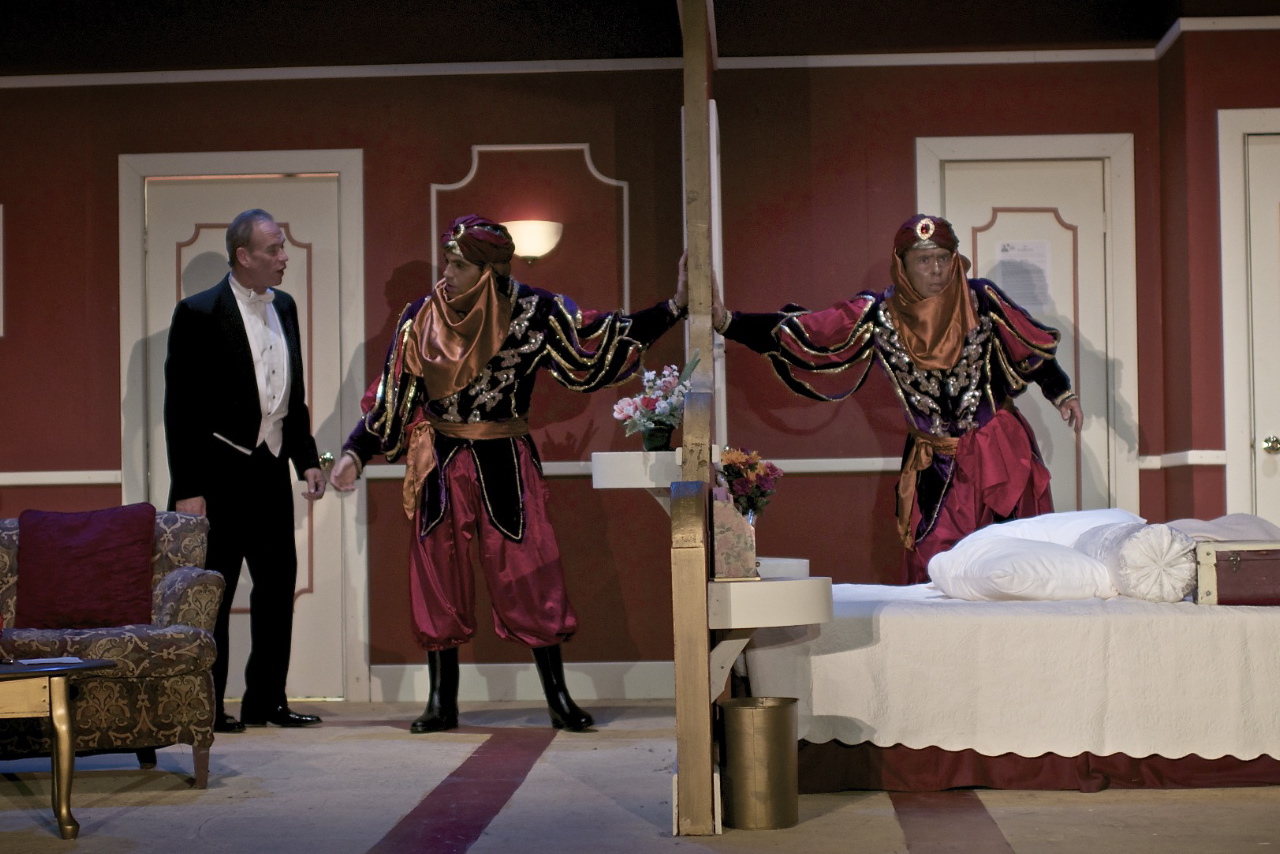
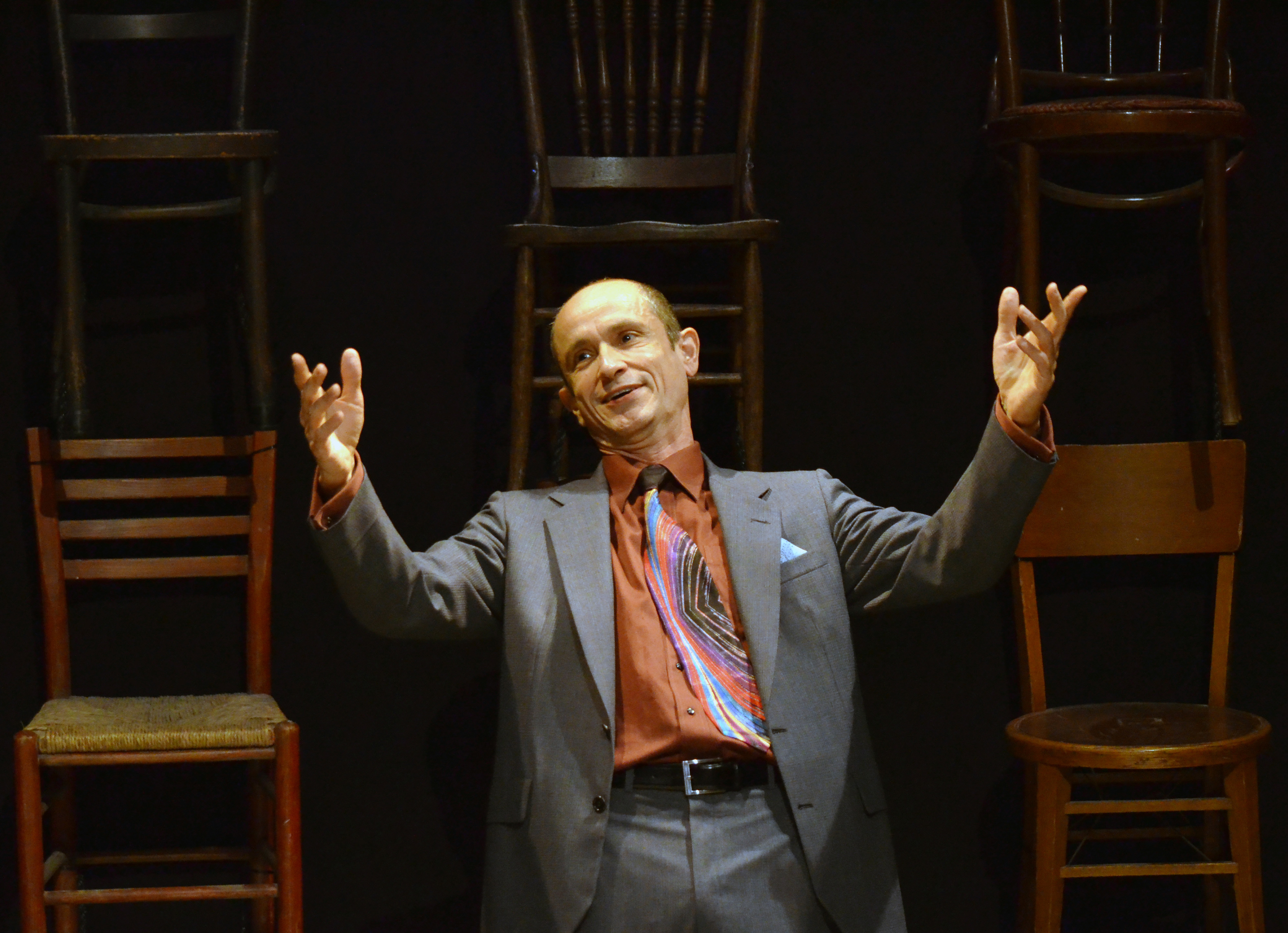
Harry Witherspoon (Keith Pinto) and Annabel Glick (Dani Marcus) are rivals for the 6 million dollar inheritance from recently deceased Uncle Anthony (Joel Roster).

LUCKY STIFF:  A Musical Murder Mystery Farce! Based on The Man Who Broke the Bank at Monte Carlo.”  Book and Lyrics by Lynn Ahrens.  Music by Stephen Flaherty. Directed and Choreographed by Robert Barry Fleming. Musical Direction by Brandon Adams. Center REPertory Company, Lesher Theatre,1601 Civic Drive in downtown Walnut Creek, CA. 925-295-1420 or www.centerrep.org. Through October 7, 2012

LUCKY STIFF comes alive at Center Rep

Lynn Aherns and Stephen Flaherty will always be remembered as the musical comedy creative team that captured audiences with Ragtime that won honors for original score (Flaherty) and outstanding lyrics (Ahern) on Broadway in 1998. They started their collaborative careers 10 years earlier with a madcap musical farce Lucky Stiff that had a brief Off-Broadway run and garnered a few accolades. Since that time, the show has been around the block making the boards from the midlands of England to New Zealand and is now being made into a movie starring Jason Alexander. On opening night Artistic Director Michael Butler confessed that he had designs on this play for years.  And here it is mustering up all the talents of Center Rep for another visual treat and evening of fun. It doesn’t match the brilliant farce Rumors that graced the stage last year but does match the staging of Xanadu. Once again it is Center Rep  not to be missed musical.

Surprisingly Butler who is adept at directing physical comedy turned over the reins to Robert Barry Fleming to shepherd the production. It was a wise choice since the multitalented Fleming also choreographed the show. The play is absolutely silly and harebrained with nonstop action that is the stuff good farce is made of. The set is a marvel with the obligatory four plus doors needed for farce but more about that later.

When the lights come up we are treated to a rousing opening number with the entire cast in unbelievable costumes parading about singing “Something Funny is Going On”  People in hum-drum jobs often fantasize about what life might be like if they were in other circumstances. Shy, English shoe salesman Harry Witherspoon (great musical comedy tenor voiced Keith Pinto) stuck in a dull job is able to fantasize about where specific shoes will carry the wearers. On this specific Friday night his personal shoes will carry him back to a boarding house run by a landlady from Hades (Tielle Baker) guarded by vicious (unseen but heard) dogs and filled with raunchy denizens from East London.

Rita La Porta (Lynda DiVito) discovers why Uncle Anthony (Joel Roster) has been unresponsive to her advances.

Harry receives a telegram informing him that he has (had) and unknown American casino owner Uncle Anthony(Joel Roster) who has been murdered and left him $6,000,000. Before we find out what is to unfold, enter Rita La Porta (Lynda DiVito who belts her song “Rita’s Confession” with gusto) the legally blind lover of Uncle Luigi whom she accidently shot but has also stolen his funds to buy six million dollars in diamonds.  She elicits the aid of her optometrist brother Vincent (Benjamin Pither) for her nefarious mission to get the diamonds back.

When Harry meets the lawyer (Marcus Klinger) he is told there is a stipulation. . . Harry must take the embalmed wheel-chair ensconced corpse (Joel Roster) to Monte Carlo. Don’t ask why, just go and see for yourself.

Every musical must have a secondary love plot. How about a do-gooder dog lover Annabel Glick (diminutive charming Dani Marcus) who represents the Home for Wayward Dogs who will get the dough if Harry doesn’t comply with the will. Of course Harry and Annabel will get together (again) after she brings the house down saying to Harry who calls her Annabel “It’s Miss Glick to you. Sharing a bed does not put us on first name basis [or something like that].”

There we are, all set to move around Monte Carlo to continue the wacky, quirky show. This is Aherns and Flaherty’s first show and some of the songs seem forced but the lyrics are extremely clever and satirical.  They give their characters ample opportunity to share the spotlight switching to the plethora of roles they invest. Sexy Taylor Jones as a French chanteuse in high-heeled red wedges dances and sings up a storm to match the scene stealing Lynda Divito. There is a hysterical/terrifying dream-nightmare dance number utilizing Kurt Landisman’s lighting to great effect.

Colin Thompson is always a joy to watch in his many get ups including Uncle Luigi or as an Arab Prince. Marcus Klinger morphs from a stuffy English lawyer to a French master-of-ceremonies and others. The willowy Even Boomer fills every other minor role with class and seems to be everywhere at once. You won’t believe the transformation of Tielle Baker from nosy boarding room hag to a drunken French cleaning maid who complicates the action allowing director Fleming to use all the doors on the stage and upper level ramp for a chase to end all chases.

The inventive Kelly Tighe’s set utilizing a revolving stage allows the action to move smoothly. Christine Crook’s costume designs will surely win a Bay Area Critics award. You will never see a roulette table like the one she designed. Joel Roster earns a Tony Award as The Dead Body for his immobility and ‘stiff’ acting.  Running time 2 hours and 10 minutes with an intermission.

Kedar K. Adour, MD

Courtesy of www.theatreworldinternetmagazine.com


THE ELABORATE ENTRANCE OF CHAD DIETY is a slambang show at Aurora

By Kedar K. Adour


he Mace (back, Tony Sancho*) watches the elaborate entrance of fellow THE wrestler Chad Deity (c, Beethovan Oden*) in the Bay Area Premiere of The Elaborate Entrance of Chad Deity

The Elaborate Entrance of Chad Deity: Comedy. By Kristoffer Diaz. Directed by Jon Tracy. Aurora Theatre, 2081 Addison St., Berkeley. 510-843-4822 or www.auroratheatre.org. Through September 30, 2012.

The Elaborate Entrance of Chad Deity is a slam bang show at Aurora

When you enter the small three sided Aurora Theatre to see their first offering of the 2012-13 season be prepared for a shock. An almost full sized boxing/wrestling ring fills three quarters of the acting area with just enough room at its periphery for the feet of the first row of patrons who swiftly learn they must share that space with one or more combatants who will cavort in and out of that ring. Set design by Nina Ball.

The adjective ‘cavort’ is apt since the play’s central theme is professional wrestling, and those in the know, know that pro wrestling is unreal physical acting to earn a buck. But do not tell that to the aficionados of the ‘sport’ who refuse to accept it as only theatre for profit. From the reaction of the few pro wrestling matches I have seen on TV the audience reaction seems authentic, spontaneous and hysterical. Surprisingly the women are the most vocal since many of the wrestlers are muscle-bound hulks exuding sex.  It certainly was that way with the two women seated in back of us who were the most vocal with hysterical exhortations as the menacing characters make their entrances dressed in sparse, very revealing  spandex and hardly anything more (Costumes by Maggie Whitaker). Their exhortations really were not spontaneous since the muscular Dave Maier instructed us how to respond as each actor with names like “The Bad Guy”, “Billy Heartland”, “Old Glory”, “The Mace”, and lastly “Chad Diety” when theymake their entrances. Maier is not only an actor(s) in the play but is the fight director.

 This satirical put down of the duplicity of wrestling mixes in more than a dollop of social injustice inflicted upon racial minorities and ethnic stereotyping. Elaborate entrances, hence the title, are de rigor. The most elaborate is reserved for an African-American that has been given the name of Chad Diety (Beethoven Oden) whose appearance in the arena with his huge gold “World Champion” belt around his midriff elicits a cacophony of cheers as he throws dollar bills in the air.

But there is no true champion since the matches are arranged as to who will be the good guy and win the match and who will be the bad guy to lose. The fights are finely choreographed to make body slams, camel humps, Korean kicks etc. all seem real without inflicting physical harm to both participants. To stimulate fan interest the promoters devise fake enmity often based on class hatred or perceived malfeasance.  Author Kristopher Diaz has created Macedonio “The Mace” Guerra (Tony Sancho), a barrio born Puerto Rican as his protagonist giving him reams of line to explain to the uninitiated the ins and outs of the game.

After Dave Maier has whipped up the audience and taught them how to respond, “The Mace” spouts in non-stop fashion his background, his role as a perpetual loser, his ability to make the other guy look good and his desires for something better. It really is an incessant monolog that Sancho sinks his teeth into as he bounces in and out of the ring or straddles the ropes. He is a marvel, extremely likeable and adept at physical maneuvers. “The Mace’s” opinion of the Chad Diety’s ability doesn’t amount to a hill of beans compared to him but he knows his role, plays it to the hilt and gets paid.

Not only does he know his role, he is constantly reminded by “EKO” Olson (Rod Gnapp) the sleazy promoter who fosters class and individual hatred to stimulate more attendance thus increasing the profitable bottom line. When “The Mace” develops a friendship with a first generation Indian American named Vigneshwar “VP” Paduar (Nasser Khan) an idea for a new act germinates and that will give “The Mace” more control over his destiny.

Their act will be a match between VP as a Muslim terrorist given a name of “The Fundamentalist” complete with a turban and fake beard resembling Osama Ben Laden. “The Mace” is cast as Che Chavez Castro a Mexican guerrilla complete with bandolier and garish sombrero. But alas, Mace is assigned the role of introducer and VP is pitted against Chad Diety. From this point the play tackles the crime of ethnic stereotyping and racial hatred detracting from the fun of wrestling mania.

VP (l, Nasser Khan) and Mace (r, Tony Sancho*), dressed as their wrestling alter egos, shoot a promo directed at champion Chad Deity in the Bay Area Premiere of The Elaborate Entrance of Chad Deity

The staging and acting are marvels. But even with the top-notch acting of Tony Sancho, Rod Gnapp, Dave Maier, Nasser Khan and Beethovan Oden the staging under Jon Tracy’s direction, steals the show. Tracy is known for his physical directing style and is perfect for this play. He makes full use of two screens placed high on the rear wall to project stock video clips and live projections of the action in the ring. (Congratulations to Jim Gross). Curt Landisman’s red white and blue (after all wrestling is an American sport) lighting is enhanced by Cliff Caruthers’ evocative sound design. Running time about two hours including intermission.

Kedar K. Adour, MD

Courtesy of www.theatreworldinternetmagazine.com.

Whither the Willows: Why Did This Theatre Die?

By Joe Cillo

By now, most people in the Bay Area theatre community are aware that The Willows Theatre Company, after a run of 35 years, is out of business.  The Willows Board filed for Chapter 7 bankruptcy on August 16.

Cast members of The Willows latest (and last) production, Ibsen’s A Doll’s House, were notified on August 13 that the final week of the show, August 15-18, had been cancelled.  Cast members reported receiving a phone call giving them thirty minutes to remove their belongings from the theatre in Concord.

I am, that is, I was the publicist for The Willows, on and off, from 2004 until the sudden closing two weeks ago.  The first I heard of the shut-down was when I read Lisa White’s Contra Costa Times online article, “It’s Curtains for the Willows Theatre,” on Monday afternoon, August 13.  Thank God for Google Alerts.

Many people knew that The Willows was on shaky financial ground, but what theatre isn’t?  The Willows had been through serious money problems before, closing its 210-seat Concord mainstage in 2009 and moving everything to its second space, the 150-seat Campbell Theatre in Martinez.  A new artistic/managing director team took over in 2010 and reopened the Concord stage in 2011.  The shows, as they say, went on – in both venues.

And then the lights went out.

How could this have happened?  Potential culprits abound: declining and ageing audiences, hard economic times, misjudging audience preferences, cannibalizing the same base of supporters with two theatres, fiscal mismanagement and overspending, corporate funding drying up, lukewarm community support, a board beset by too many problems coming at them too fast, perhaps even a publicist who couldn’t build a case for 9 to 5, the musical version of a 1980s Dolly Parton film – you can choose any or all of them all of them.

It’s probably too early for the autopsy, but in my view, at least right now, the demise of The Willows was caused by a series of Big Ideas that proved to be unsustainable.

“A Brief History of the Willows Theatre,” which appeared in each printed program for many years, recounts that “in the spring of 1977, Theatre Concord, a program of the City of Concord, began producing plays and musicals in the new Willows Theatre.  Nine years later, Theatre Concord became CitiArts Theatre, the first company in Contra Costa County to operate under a seasonal contract with Actors Equity Association.  In 1994 CitiArts Theatre became an operation of The Benefactors, a non-profit corporation organized in 1974 to support quality live theatre in Concord, and the company is now known as The Willows Theatre Company.”  In later years, The Willows estimated that it served over 70,000 patrons annually.

The Willows was dedicated to developing and producing “contemporary American plays and musicals,” although it extended its reach to include works originating in the U.K., as well.  It was, therefore, a real stretch for them to stage Ibsen’s A Doll’s House, the only non-US/UK show in their history.

As for Shakespeare, records indicate a production of The Taming of the Shrew in 1987. Former artistic director Richard Elliott once told me, “there are enough companies in the Bay Area doing Shakespeare.  We leave the Bard to them.”

The Willows’ stated mission was to “strive to perpetuate the art form of live theatre by creating relationships with playwrights, designers, actors, students and other theatre artists whose work will impact current and future audiences.”

The next part of the mission hints at why the Willows’ demise hurts the theatre community: “We provide a valuable opportunity for first employment for many developing theatre artists.”  In addition, since the Willows was an Equity house, many actors over the years were able to work their way toward their Equity card by performing there.

My wife and I became Willows subscribers in 1994, not long after moving to Clayton.  The Willows was, in essence, our local theatre, and we found the shows well cast, well directed, and quite simply, fun.  For my money, four or five of the best pieces of theatre I’ve ever seen were at The Willows, thanks to excellent casts and direction by Andy Holtz (Cabaret), Richard Elliott (On Golden Pond), Jon Marshall (Avenue Q), and Eric Inman (Chicago).

In our early subscriber days, my wife and I volunteered at the theatre. I read through stacks of unsolicited manuscripts, looking for the next blockbuster in the rough.  Kathy organized the mailing lists, using floppy disks that Rich or Andy would drop off at the house.  That was the state of technology then: no email, no Zip files, and disks that were truly “floppy.”

In 2004, after I’d started Rising Moon, Andy Holtz, the managing director, and Rich Elliott, the artistic director, contracted with me to do publicity for the revival of the theatre’s outdoor musical, John Muir’s Mountain Days, at the amphitheater in Martinez.  I was asked to stay on to publicize the next show, the musical version of The Night of the Hunter.  Both were stretches for a small East Bay theater – Mountain Days was a huge undertaking, with more than 50 in the cast, along with a team of horses. Hunter was based on the very creepy film that starred Robert Mitchum as an itinerant preacher who menaced two children and killed their mother. It’s the movie where Mitchum has the words “Love” and “Hate” tattooed on his fingers – hardly a show for the Hello, Dolly! Crowd, but it showed The Willows wasn’t afraid to take chances on a show that its Los Angeles producer was planning to take to New York.

In 2008, I was again contracted to do publicity for The Willows.  By this time, Andy Holtz had left for the Arizona Theatre Company in Tucson, and I worked with Rich Elliott and general manager Chris Marshall, the lady who wore a dozen hats and held the place together.  I was there from Brighton Beach Memoirs and Pageant, to the closing of the Concord theater in 2009, the restructuring under David Faustina and Eric Inman, the reopening of the mainstage in 2010…to what would be the last shows, Vaudeville at the Campbell and A Doll’s House at the original Willows Theatre.

So, The Willows is gone, joining the now defunct American Musical Theatre of San Jose, which died in 2008.  SF Chronicle critic Robert Hurwitt points out that, “a few years earlier AMTSJ had more subscribers than either A.C.T. or Berkeley Rep.” More recently, we’ve seen the departure of the Hapgood in Antioch, Arclight in San Jose, and Woman’s Will in Berkeley.

For many theatre companies, survival is day-to-day, show-to-show.  As one artistic director I know told me, “you’re only one flop away from closing the doors.”

Why did The Willows close?  Earlier, I listed a series of “culprits” that might have led to its going under, and to varying degrees, they are all probably to blame.  But I see the major problem as more than just running out of money.  That’s a symptom, not the cause.  In my opinion, The Willows went under because it was too ambitious, perhaps even too creative, and certainly too willing to follow a Big Idea.

The first Big Idea was getting a theater space of its own.  The Willows had for years been leasing its space in Concord’s Willows Shopping Center and grew tired of paying rent, along with all the associated issues renters face.  (Side note:  one positive for a theatre in a suburban shopping center – it solves the parking problem.)  As early as 2006, they were negotiating to move to the YMCA building in Danville.  While that idea remained on the back burner, Willows management looked north to Martinez and made plans to convert the old train station into a theatre, a plan that at the time found favor with the city of Martinez.  The Willows got as far as hiring an architect, developing blueprints and renderings, and starting a fundraising drive.  Why Martinez?  Rich Elliott and Andy Holtz lived there, liked the town, and thought it –and the train station – would be the ideal place for a theatre.

After the train station idea stalled, the Big Idea focused on another location – an unused auto parts warehouse on Ward Street. Thus, the Campbell Theatre came to be, thanks to a raft of donors led by the very generous Campbell family.

Every successful theatre has (or should have) a guaranteed moneymaker, a “Christmas Carol,” a “Nutcracker,” a “Sound of Music.”  Or an “Annie,“  the show that guarantees that every parent, grandparent, aunt, and uncle of the kids in the cast will buy tickets – and twice that number if you double-cast.

For The Willows, it was the Nunsense series, seven slapstick musicals by Dan Goggins (Nunsense, Nunsense Jamboree, Mushuga-Nuns, etc.) featuring five loony nuns. Ending the season with a Nunsense show pretty much paid for the rest of the year.  Nunsense became part of the Big Idea – the original proposal for the Campbell Theatre was for it to showcase nothing but Nunsense, year ‘round.  It would make money.

The all-Nunsense idea was soon abandoned, but the cabaret concept at the Campbell remained.  Was Martinez the right town for it?  Would Willows’ subscribers attend both theatres?  Or would the finite audience pie be divided in two?  Would a cabaret concept have to be marketed differently than a standard theatre?

As the theatre’s fortunes spiraled downward in 2009, the board and management decided the only way to save the company was to close one of the theatres – they chose to shutter the mainstage and move everything to the Campbell.

This turned out not to be a solution.  By 2010, a new management team was in place, led by managing director David Faustina and artistic director Eric Inman.  They saw that the only hope for sustaining the company was to return to Concord and reopen the theatre there, where the bulk of their patrons were.  Which they did, thanks to a fundraising campaign and a lot of volunteer hours, along with a big boost from the local IBEW, who donated the rewiring of the entire mainstage venue.

But for many reasons associated with the city of Martinez, the company wasn’t able to leave the Campbell behind; it had to sustain both theatres.  The Campbell was starting to find its audience, but it was too late.  What began as a Big Idea ended as Too Big a Task.

Another Big Idea was the amphitheater in Martinez, which was planned to be home to a whole series of outdoor historical musical dramas.  John Muir’s Mountain Days was only the first, and at first it was extremely successful.  It attracted a large audience when first staged at the amphitheater in 2005, but it was very expensive to produce.

Nevertheless, plans took shape under Andy and Rich for a series of seven musicals that would play in repertory at the amphitheater.  The next was Sacajawea, the tale of the Lewis and Clark expedition centering on the Native American woman who was their guide.  The book and lyrics for Sacajawea were by New York playwright  Mary Bracken Phillips, with music by San Jose native Craig Bohmler, the same team who had done Mountain DaysSacajawea was staged in 2008, but at the Alhambra Arts Center in Martinez, because the amphitheater was in disrepair.

The next in the amphitheater series was to be about the “Big Four,” the industrial barons (Leland Stanford, Collis P. Huntington, Charles Crocker, and Mark Hopkins) who brought the railroads to California.  However, the script for it and the other four shows in the series was never commissioned.  The amphitheater remained, however, as a continuing burden.  The upkeep was too much for the Willows, and the city of Martinez shied away from pumping municipal funds into the venue.  Another Big Idea foundered.  In retrospect, the historical drama project would have needed a Disney Corporation to make it work.

A third Big Idea is banking on a show to be a hit, or even artistic triumph that will lift the company to new heights and at least break even…and then seeing the show fail.  The Willows suffered its share of “one flop away from closing” events. The Kentucky Cycle, a two-part, six-hour production asked the audience to come to the theatre twice to see the story work out.  It was a wonderful piece, but it asked too much of its audience.  On another level, there was the afore-mentioned 9 to 5: the Musical – Dolly Parton brought no cachet.  Neither did two other musicals based on movies, The Night of the Hunter and The Wedding Singer.

Ironically, two weeks before The Willows closed, it was named one of the “Best Theatre Companies in the East Bay” by critic Charles Kruger in the Examiner.com and the CBS-5 web site. Kruger placed it in the company with Berkeley Rep, Shotgun Players, Aurora Theatre, and Central Works. Indeed, The Willows has, over the years, won more than its share of Drama-logue, Shellie, and Bay Area Theatre Critics Circle awards.

Kruger praised the theatre for “specializing in the great American tradition of the Broadway musical…delivering the old razzle dazzle with grace and style, presenting both classics and new musicals…constantly trying to take theatre to the next level.”

But it’s difficult, if not impossible, to rise to a new level when you’re tied to three very disparate venues – a proscenium house, a cabaret, and an outdoor amphitheater – at a time when the political and economic cards are stacked against you.

It will be interesting to see what rises from the ashes of The Willows…which shards will be reassembled, and by whom.

Like Ishmael in Moby Dick, I am only here to tell the tale from my perspective.  Others with deeper experience on the voyage of the good ship Willows are welcome to add their comments, corrections, and insights. – GC

Contact: Gary Carr, (925) 672-8717, carrpool@pacbell.net.  Learn more about Rising Moon Marketing & Public Relations at www.risingmoonarts.com.

Two for One: Petty Theft and Liars

By David Hirzel

Two only-in-Marin in one day—September 2, 2012.  First stop a free concert at Homestead Valley in Mill  Valley.  We arrived toward the end of the middle band’s set, found a place in the sun and settled in for the final act—a cover band for the Heartbreakers known as Petty Theft.  I was a fan of Hearbreakers radio play from the late 70’s, but listened less and cared less as the decades moved on.  Of course Petty has his enduring fans, but I was not particularly one of them.  I was in Mill Valley to lie in the sun (a perfect day for it), picnic and listen to some live music, so I was happy.

As the show went on, it became impossible for me to lie still.  After a while I was sitting up, then on my feet, then gotta-go-dance.  I was not alone in this.  Petty Theft does a near perfect cover of every Heatrbreakers song that ever got airplay, vocals and arrangement note-for-note, with plenty of room for the guitars to take flight on their own (and every other instrument as well) and singer Dan Durkin to stir the crowd up with when the time comes.  Audience participation?—You bet.  The set ended with a show-stopping “Need to Know” but when the band left the stage without playing “American Girl” we all knew there was an encore if we wanted it.  We got it, and a follow-on “Refugee” that brought down the house.  What a show!

Check out Petty Theft.  As they say themselves, “It’s about the music.”   They’re playing all around the Bay Area through September and beyond.   If you like Tom Petty and the Heartbreakers, you’ll be glad you did.  Website:  http://www.pettytheftrocks.com/

That was just the start of the evening.  We had just enough time between shows to get home and make another picnic—supper this time—and get to Marin Shakespeare’s evening performance of The Liar.  I hadn’t read the playbill and had no idea what to expect for this play, so I was surprised the actors appeared onstage foppishly costumed for 1643 Paris.  The first lines were another novelty when it became clear that the script was written entirely in metered verse approaching iambic pentameter and the quickly developed into farce.  The script was adapted in 2010 by David Ives from the 1643 French comedy by Pierre Corneille.  As Ives said, “to render this luminous world in English. . . .it had to be in verse, just as it is in Corneille.”

We have the standard ingredients of love affairs based mistaken identities, good and evil twins, intentional and unintentional conceits, all compounded by the lofty extravagances that gush from the lips of Darren Bridgett’s Liar.  His servant Clito (Jarion Monroe) is by similar token unable to say a single word that is not the absolute truth, despite detailed instruction:  “Don’t swerve. Be tripping. Poetry. Stay low. Irrelevant details. With verve!”

There is really no way to express in print how absolutely hilarious this play is from one end to the other.  The script is wonderfully absurd, and all in rhyme rhymes but it is these eight marvelous actors taking flight under the freewheeling direction of Robert Currier who make it all seem so, well, believable.  When the whole play is compounded on lies.  It’s something you’ll have to see to believe, and you will not be sorry.  You’ll be thinking and talking about this play for days.   At the Forest Meadows Amphitheatre, Dominican University in San Rafael CA, through September 23, 2012.

Website:  http://www.marinshakespeare.org/index.php

Box Office:  (415) 499-4488


Challenging Bay Area Theatre Stagings and Book

By Guest Review

Three challenging outstanding Bay Area productions currently offered are Marin Theatre Company’s Annie Baker’s “Circle MIrror Transformation”,  Porchlight’s “Our Country’s Good”, and Marin Shakespeare’s Company’s “The Liar”. For more information on these productions and  to read a detailed, objective description of Annette Lust’s new book “Bringing the Body to the Stage and Screen” by Phoebe Moyer see Forallevents.com, Critics World, Annette Lust.

Second Time Director

By David Hirzel

I would not by any stretch consider myself a “director” of theatre, no matter how small.  My own experience is very small, but I must confess I have felt it grow this afternoon in ways I would not have anticipated.  The call came from a friend, an amateur playwright who had penned a two-acter some years ago, based on true events in her own life.  This was to be “readers’ theatre” by non-actors in a community centers, with three rehearsals (and I would have to miss the first) one week apart before curtain.  As I was the only one among her circle of friends who had any directorial experience (see above), I was tapped and with a few misgivings and prequalifications, accepted.

As noted, I missed the first rehearsal.  At the second, two of the eight actors arrived without their scripts.  All but one had NO acting experience.  Neither a good sign.  But things improved by the third.  As “director” I must make do with what I had in hand, and hope for the best.  By the end of the dress rehearsal—lost scripts, missed cues, a general dearth of relevant emotion given the incipient deaths of three of the characters and the actual deaths of two, a different actor each time for the role of  “the stranger,” all compounded by the complete ineptitude of the “director”—it seemed clear that only the most modest of aspirations were likely to be met.

The audience would be shanghaied from among those departing community center lunch in the early afternoon.  Not likely to be terribly critical, if they were at least mildly entertained.

And here is what happened:  All of the “readers” became by miraculous osmosis “actors,” and assumed that wonderful generosity arises when cues are missed, props fail, actors don’t show up, pages are missing from the script.  We had a full house who caught all the humor in the playwright’s lines and the cast’s delivery and laughed all the way through it.  By any measure except box office, the show was a huge success.

And here is what else happened:  One of the cast came up to the director, and thanked me for all that she had learned from me.  I found out it was the other way around.

[Special thanks to Anna Boothe, playwright (Six Months to Live) and stage manager, and to: Tom Sullivan, Lydia Benetiz, Gus Tjgaard, Joyce Sorce, Jeanne Angle, Karim Kiram, Manuel Sequeria, Dick Moody, and Camincha, and Janice at the Pacifica Community Center]

by David Hirzel   http://davidhirzel.net/

“Chad Deity” wrestles unsuccessfully with satire

By Judy Richter

Professional wrestling isn’t a sport. It’s entertainment, a form of theater in which each player has an assigned role, and each move and the outcome are scripted.

 That’s one of the messages in “The Elaborate Entrance of Chad Deity” by Kristoffer Diaz. Being given its Bay Area premiere by Aurora Theatre Company, this two-act work has a five-male cast, but it’s essentially a monologue. The speaker is Macedonio “The Mace” Guerra (Tony Sancho), a Puerto Rican professional wrestler who has loved what he calls this art form ever since he and his two brothers watched it on TV in their New York City home.

Now he’s employed by THE Wrestling, a promotional company run by Everett K. “EKO” Olson (Rod Gnapp). Mace’s role calls for him to make his opponent look better than he and to allow his opponent to win. He takes on an entrepreneurial role when he encountersVigneshwar “VP” Paduar (Nasser Khan), an athletic Indian American man whom Mace’s brothers met through impromptu basketball games.

 EKO agrees to put VP in the ring, but promotes him as a potential Muslim terrorist and eventually puts him up against THE Wrestling’s champion, Chad Deity (Beethovan Oden), an egotistical black man. Before going up against Chad, though, VP is matched up with The Bad Guy, Billy Heartland and Old Glory, all played by Dave Maier, who also serves as fight director. Maier also warms up the audience before the show by telling observers how to react to various characters.

 Billed as a social satire, “Chad Deity” plays on racial and ethnic stereotypes, but it doesn’t work well. Except for The Mace, none of the characters is anyone the audience can care about, and the plot isn’t all that interesting either, unless – perhaps – one is a fan of professional wrestling. The script is loaded with obscenities and other street language.

 Jon Tracy directs the talented cast and orchestrates the action well. Nina Ball’s set features a wrestling ring and two giant video screens within Aurora’s intimate thrust stage. The videos are designed by Jim Gross with lighting by Kurt Landisman and costumes by Maggie Whitaker. The sound – often deafeningly loud – is by Cliff Caruthers.

Aurora usually presents interesting, provocative plays, but “The Elaborate Entrance of Chad Deity” falls short on both accounts.

 It continues through Sept. 30. For tickets and information, call (510) 843-4822 or visit www.auroratheatre.org.


‘Elaborate Entrance’ grasps pro wrestling — via satire

By Woody Weingarten

In “The Elaborate Entrance of Chad Diety,” the champ (Beethovan Oden, center) confronts VP (Nasser Khan) as The Mace (Tony Sancho) looks on. Photo by David Allen.


I’m surprised that, considering their enormous popularity, Spiderman, Batman, Wolverine and other trademarked superheroes don’t show up in professional wrestling circles.

Those figures apparently are confined, principally, to comic books and screen adaptations.

So wrestling buffs have to settle for the more mundane likes of John Cena or past heavyweights like Gorgeous George, Hulk Hogan, The Rock, Steve Austin or Andre the Giant.

Such mental meanderings lead me to Kristoffer Diaz’s “The Elaborate Entrance of Chad Deity,” one of the season’s worst titles but most amusing plays.

The serio-comic satire, proficiently directed by Jon Tracy, is unique.

The Aurora Theatre Company stage in Berkeley has been transformed into a wrestling ring by set designer Nina Ball and the actors mutated into what one correctly refers to as “caricatures in a world of cartoons.”

To ensure a frenzied atmosphere, the audience is urged during a pre-play warm-up to shout out the characters’ hyperbolic names, boo the villains, cheer the good guys, and perforate the air with outstretched fingers.

The crowd spiritedly follows instructions, lending an exciting interactive quality to the production.

The only thing missing, according to my archaic recall of a live match in New Jersey, would be a cloud of cigar smoke hovering over the ring.

Because the Aurora is small, the faux wrestlers often thrust themselves in your face.

More distant are twin screens in the rear. They playfully project a variety of images, including deliberately awkward and de-sexed go-go dancing by Elizabeth Cadd.

As well as two wonderful sequences that Photoshop real-life heroes Abe Lincoln and Martin Luther King into shots of the flamboyant champ, Chad Diety, and villains like Stalin and Darth Vader with the contender, VP, who changes into a Muslim-terrorist type, The Fundamentalist, who can annihilate foes with a mysterious kick dubbed “The Sleeper Cell.”

You need know nothing about wrestling or its Pay-Per-View paydays to enjoy the ridicule.

That’s because the protagonist, The Mace, a journeyman Puerto Rican wrestler from the Bronx who’s forever cast as a loser, provides all the necessary background.

He intertwines fact, fiction, labor-versus-management feelings, metaphor, social consciousness, seriousness and humor in his narration. At the same time, he deals with characters wrestling with their identities as men, as ethnics, as Americans, as wage slaves.

His is a fast-talking monologue that ties together action scenes as professionally as a doc might stitch a wrestler’s wounds.

Actual wrestling-mat moments, by the way, are chiefly limited to the second act of the two-hour play, which make it pass more swiftly than the first.

Nasser Khan is exceptional as VP (or Vigneshwar Paduar), an anti-stereotype character who speaks six languages, does one-arm push-ups and performs rap.

And Beethovan Oden stands out as Chad, a charismatic giant whose strut replicates actual “champions” of the World Wrestling Federation (now WWE instead of WWF).

Tony Sancho, who portrays Macedonio Guerra (or The Mace), also does well, considering he has about a zillion words to deliver. His speeches thankfully are leavened with bright asides to the audience and countless sardonic one-liners (“It is teamwork even if I’m the only one on the team doing the work”).

If I closed my eyes, I could visualize the WWF’s Vince McMahon via Rod Gnapp’s portrayal of THE league owner and chief conniver, Everett K. Olson, who at one juncture reclines effortlessly on one rope of the ring.

Finally, Dave Maier skillfully rounds out the cast — in multiple roles, including a lithe descent from the ceiling.

Sometimes “The Elaborate Entrance” message is a bit heavy-handed, such as the dollar sign displayed on Chad’s hindquarters. And sometimes it borders on the offensive, as when it derides pro wrestling’s racist and xenophobic attitudes via over-the-top costuming by Maggie Whitaker (an incredibly large Mexican sombrero and ammo belts, for example).

“The Elaborate Entrance of Chad Diety” won an Obie and was a finalist for the Pulitzer Prize. In my view, it deserved both accolades.

Playwright Diaz, an honest-to-goodness wrestling fan with a full grasp of the genre, has been quoted as saying that the mock sport is a “really wonderful art form but…does tend to play to the lowest common denominator.”

No matter. Diaz has created a let’s-pretend world that highbrow or middlebrow audiences can enjoy every bit as much.

“The Elaborate Entrance of Chad Deity” runs at the Aurora Theatre, 2081 Addison St., Berkeley, through Sept. 30. Night performances, Wednesdays through Saturdays, 8 p.m., Tuesdays and Sundays, 7 p.m.; matinees, Saturdays and Sundays, 2 p.m. Tickets: $32-$50. Information: (510) 843-4822 or www.auroratheatre.org

“Compliance”

By Joe Cillo

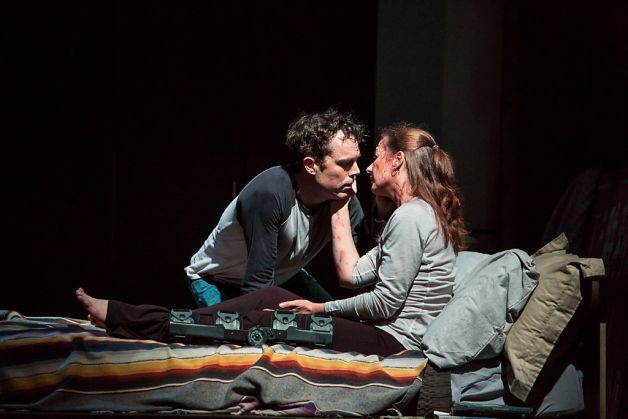
Dreama Walker as Becky being questioned by Sandra and Marti.

COMPLIANCE,   film based on true events, written and directed by Craig Sobel, starring Ann Dowd, Dreama Walker, Philip Ettinger, and Pat Healy.

                                                             UNSPEAKABLE ACTS

                                                            By Gaetana Caldwell-Smith 

The shocking, cringe-worthy film, “Compliance,” has the look of a cinema verité documentary.  It takes place during winter in a small-town strip-mall fast-food restaurant with problems of spoiled food due to employee negligence and an illness related short-staff.  Sandra (Ann Dowd), the manager, a stressed-out, heavy-set, middle-age woman, gets a phone call from a man saying that he’s Police Officer Daniels (Pat Healy) who unfortunately can’t take the time to go out there in person because he’s very busy.  He tells her that one of her customer’s complained that an employee, Becky (Dreama Walker), stole money out of her purse an hour ago; she’s with Daniels now along with Sandra’s boss, the franchise owner.  The mostly young staff is on edge as it is; Sandra has warned them that a company “secret shopper” is coming in to rate the place.

When Daniels asks Sandra to take Becky into the break room and search her purse, you know something is not kosher.  From merely rummaging through her purse, the search escalates incrementally, orchestrated by Daniels as the rest of the oblivious staff out front continues serving the steady stream of hungry customers.  He cows and intimidates Sandra, flatters her so that she’ll do anything he asks.  A foreshadowing scene occurs early in the film between Sandra and Becky so that when she takes his side, even referring to Becky as a thief, it rings true.  The cook, Kevin (Philip Ettinger) and a grizzled supplier (Matt Servitto) are the only ones who aren’t fooled.  Sensing things are not right, they make phone calls.

The fact that the entire film is based on telephone dialogue neither constricts nor undermines the suspense and pace.  Plus, the camera breaks it up with shots of customers chowing down in booths; rusted, greasy equipment, dirty dishwater, piles of discarded cartons and wrappers (Chef Ramsey would be appalled), and a parking lot rimmed with melting snow-drifts.  Soon scene will segue to a bland-looking, early fortyish man in sweater and slacks, sitting in front of a littered desk, or making a sandwich, with a phone to his ear.

Daniels threatens Becky with jail-time and fabricates drug deals, implicating her.  Confused, she denies everything, protests his demands, and insists that she’s innocent. He tells her frequently to calm down and insists that she address him as “sir” or “officer.”  He ensures that there is only one person at a time in the room with her. Becky, who now sits naked, covered only by an apron, ends up allowing Sandra, her assistant, Marti (Ashley Atkinson), as well as Sandra’s balding, sheepish, beer-drinking fiancé, Van (Bill Camp), to carry out Daniels’ phone directed, step-by step searches tantamount to those perpetrated on prisoners suspected of concealing contraband in bodily orifices.  Daniels rewards Van for conducting the most egregious search with a sex act by Becky. 

            You ask yourself why Sandra and the others allowed this to happen.  People are conditioned through religion, education, and government to obey the law and not to question authority.  The man spoke convincingly, repeatedly stating that he was an officer of the law, asking, “Don’t you want to do the right thing?” “Help me out here,” and “The sooner you do this, the sooner it’ll all be over,” interspersed with threats.  Also, he had done his homework on these people, knew their weaknesses and used the information to his advantage.

 Can we use the message of the film to explain how tyrannical, imperialistic governments gain control of its citizens?  How 100s of thousands of people are coerced into leaving their homes and boarding freight cars that will take them to their deaths?  How millions of innocent people are driven from their lands, herded into reservations, or concentration camps as were Japanese citizens in California?  Can it explain the exploitation of women?  Minorities?  The undocumented, and so on? 

Though this cringe-inducing film takes place in the restaurant, mostly in the back room, it is not claustrophobic.  The acting feels natural, you sense that these are real, hardworking people asked to carry out unspeakable acts on an innocent person.