Django Unchained

By Joe Cillo

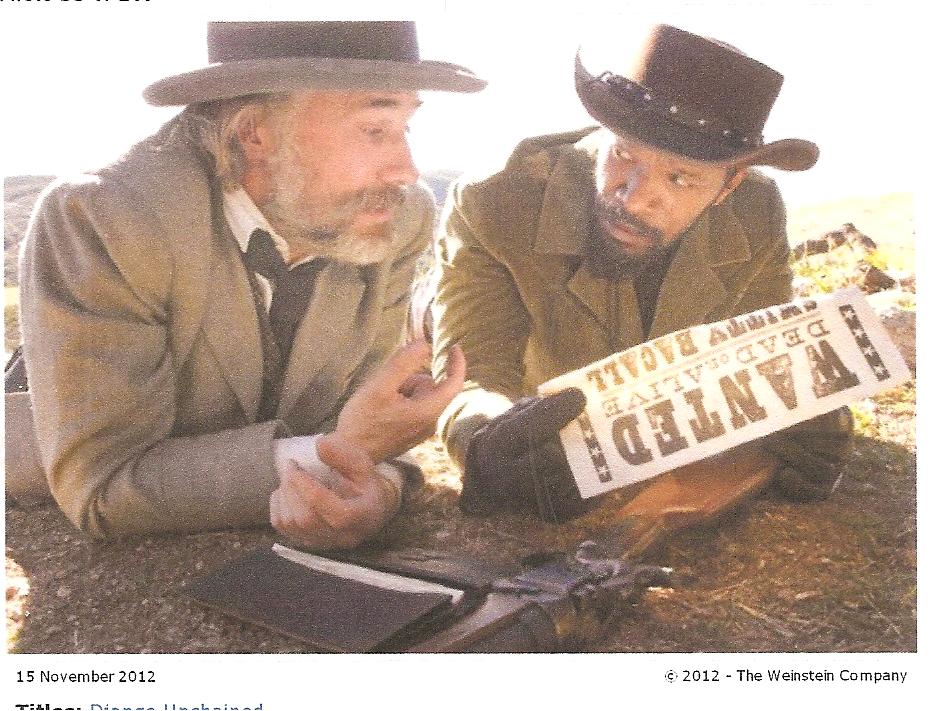
Django Unchained, written and directed by Quentin Tarantino.

Tarantino’s latest film takes place in 1858, two years before the Civil War-  the year that William Wells Brown published the first Black drama, Leap to Freedom; John Brown held an anti-slavery convention; Abraham Lincoln said  “A house divided against itself cannot stand;”  The  Richmond Daily Dispatch reported that 90 blacks were arrested for learning.  Early that year a series of events hostile to Blacks happened in San Francisco.  The case of the escaped slave, Archy Lee, heightened conflicts between pro- and anti-slavery contingents in town.  Black children were excluded from public schools and legislation was introduced to ban black immigration into California.

Tarantino made his engaging, well-acted and directed film in the true spaghetti-western style, with Ennio Marricone adding to the soundtrack as he had  for Sergio Leone’s films which featured Clint Eastwood.  However, he tackled a more serious issue than that of the typical pulp western of revenge, show-downs, and gun-battle one-upmanship.  Django Unchained is a seriously nutty “comedy” that elicits a sober discussion on enslavement, and its portrayal over the years by slaves to Hollywood.  Put bluntly, he does not employ mushy sentimental platitudes a la Spielberg in Amistad or The Color Purple.  It is about the deadly craziness of racism and slavery’s particular horrors.

“Django” stars Jamie Foxx, Kerry Washington, Leonardo DiCaprio, and the incredible German actor, Christopher Waltz, for whom Tarantino wrote delightful, erudite, highfalutin exchanges (as he did for Waltz in Inglourious Bastards).   He also wrote a lot of inflammatory dialogue for the white guys and some “domesticated” Blacks, including generous use of the “n” word.  Tarantino’s love for Japanese samurai films is evident in lots blood splattering, gushing, and spraying.

Dr. King Shultz (Waltz), a meticulous record keeper, is a bounty hunter who tracks wanted men: Dead or Alive.  He’s masquerading as a traveling dentist, evidenced by the oversize spring-mounted molar that jounces and wiggles on top of his horse cart as it rumbles along .  During a chance meeting in the woods at night, he comes across Django, an escaped slave in a chain gang.  Shultz frees him because  he knows where the bad guys are and elicits his help.  Django agrees only if Shultz helps find his wife, Broomhilda (an obvious play on the name Brunhilda of Wagnerian lore), played by Kerry Washington.  She is a slave at Calvin Candie’s Mississippi plantation.  When they ride into a town, the townsfolk are shocked:  “Looka there!  A n- – – – – on a horse!”  and dumbstruck.   A tavern owner shouts, “Get that n – – – – outta here!”  Over beers, Shultz tells Django that bounty hunting  is “like slavery, a flesh-for-cash business.”  He convinces Django to play his valet so as to come off more a business man than bounty hunter, and sends him off to a costume shop.  Django emerges dressed as Gainsborough’s  The Blue Boy  (Tarantino does have a wicked sense of cultural reference).   To his credit, Tarantino uses flashbacks sparingly; showing them only to flesh out character, such as Django and his wife and his early days as a slave.

Many scenes are shot through with gory brutality wreaked on blacks that are difficult to stomach, one of whipping a half-naked woman for breaking a few eggs.  Shultz and Django rile up white slave owners who resort to forming a hooded posse (precursors to the Klan?) who complain about the hand-made hoods- the eye holes, especially, which is hilarious; much needed levity in this bloody, violent film.  In one scene, Shultz asks Django about Broomhilda’s name, then tells him the German myth, how the hero, Siegfried rescues Brunhilda.  He then convinces Django to act like a slaver himself, to ingratiate themselves with Candie,  outfitting him in fine, well-to-do cowboy attire and a beautiful, hi-steppin’ horse, on which he cuts quite a figure.

By now, almost half-way into the near three hour film, I was getting impatient- when would meet we Candie (Leonardo DiCaprio)?  After witnessing a gruesome contest between slaves egged on by white plantation hands, involving a slave, d’Artagnan (Eto Assando), they arrive at  Candie’s plantation, CandiLand.   Candie is handsome, rich, smooth-talking, corrupt, and evil.  He stages a bloody wrestling-to–the-death matches between slaves in a gorgeously appointed room while guests drink and dine, oohing and ahhhing as they shrink from blood spatters.   Broomhilda is there, severely punished for trying to escape.  Stephen (Samuel L. Jackson, made up like, as one critic said, Uncle Ben), is Candie’s kowtowing, simpering house slave with his own agenda, who literally hangs over Candie’s chair at the head of the table.  He bows and nods as Candie explains to his guests why slaves don’t revolt, using a skull to illustrate.  At one point, Shultz is visibly appalled; Stephen asks Django why it doesn’t bother him, being Black himself.  Django answers that Shultz is German, “I’m more used to Americans than he is.”

One scene in particular: Shultz gets Candie’s goat by mentioning the slave d’Artagnan, telling him that the man who wrote The Three Musketeers, Alexander Dumas, was Black.  Candie loses it spectacularly, in a mad rage.  It’s fair to say that Christopher Waltz carries the film.  When both Candie and Shultz  are literally no longer in the picture (Shultz had a trick up his sleeve) near the end, the film becomes predictable.  Django turns himself in to spare his wife.  But he has an out: money- lots of it.  The ending is, of course, an absolute blood-bath, no one is spared, not even Candie’s toady, incestuous sister, Lara Lee (Laura Cayouette).  Django gives Stephen his comeuppance, too.  There are horrific explosions and a happy ending.   Django impresses Broomhilda with his horse’s dressage, then the couple ride off into a Gone with the Wind-like sunset.  Django becomes a legend for Blacks, almost like Toussaint L’Ouverture.

Tarantino is known to tap “has been” actors for his films.  In Django, the TV actor Don Johnson plays a sheriff, and film star Franco Nero who was in the original Django  a decade or so ago, is seen as one of Candie’s guests at the wrestling match.  The film is up for several Academy Awards.  See it now!

This review can also be read in an abbreviated version at www.socialistaction.org
‘Our Practical Heaven’ falls short of promise

By Judy Richter

Three generations of women celebrate holidays at the family’s coastal cottage, watch birds, bicker and look ahead in Anthony Clarvoe’s “Our Practical Heaven,” being given its world premiere byBerkeley’s Aurora Theatre Company.

Clarvoe’s two-act play is the main stage anchor production ofAurora’s eighth annual Global Age Project, which fosters 21st century play development.

It features excellent acting thanks to such Bay Area treasures as Joy Carlin, who plays Vera, the family’s widowed matriarch; Anne Darragh, who plays Sasha, Vera’s daughter; and Julia Brothers, who plays Willa, whom Sasha considers an honorary sister.

With them are three young up-and-comers: Blythe Foster as Suze and Adrienne Walters as Leez, Sasha’s daughters; and Lauren Spencer as Magz, Willa’s daughter.

Perhaps because Sasha is so uptight, her daughters don’t especially like her. While sitting next to each other, they communicate their feelings about her via text messages, which are projected onto the back of Mikiko Uesugi’s set.

Willa, who overcame lowly beginnings to become a successful businesswoman, is mostly level-headed, but she’s deeply concerned about Magz, who has an autoimmune disorder that often leaves her in severe pain.

Despite the excellent acting and Allen McKelvey’s direction, the play can feel vague at times. It needs more background to help the audience understand why some of characters are the way they are. Some details seem sketchy, as do issues like the threat of global warming. Still, there are some lovely scenes, especially the one in which Carlin’s Vera talks to Leez about the specialized functions of feathers she has collected.

The production benefits from Callie Floor’s costumes, Michael Palumbo’s lighting and Clifford Caruthers’ sound. Chris Black served as dance consultant.

The play went through much work after being given a reading as part of the 2011 Global Age Project. Some more work is needed for it to reach its full promise.

“Our Practical Heaven” will continue at Aurora Theatre Company through March 3. For tickets and information, call (510) 843-4822 or visit www.auroratheatre.org.


He wants to be a she in ‘Looking for Normal’

By Judy Richter

The desire and subsequent decision to change one’s gender are fraught with emotional peril, but playwright Jane Anderson handles them with great sensitivity in “Looking forNormal,” staged by Palo Alto Players.

Director Marilyn Langbehn and her cast are equal to the delicate task of developing the complexities of each character’s emotional journey.

The plot focuses on Roy (Keith C. Marshall), a 45-year-old Midwesterner who has been happily married to his wife, Irma (Shannon Warrick), for 25 years. However, he has been having problems such as severe headaches. Because no physical cause has been found, he and Irma go to their pastor, Reverend Muncie (Dave Iverson), for counseling. That’s whenRoysays out loud for the first time that he was born in the wrong body. He should have been a woman, he says.

From there the action focuses on how each person in his immediate circle responds to his revelation. Irma is dumbfounded at first, wondering if she’s somehow at fault. Their 13-year-old daughter, Patty Ann (Samantha Gorjanc), seems curious about what physical changes will occur. Some of her reaction might stem from the fact that she’s a tomboy who might be questioning her sexuality. She’s also entering adolescence.

Their 22-year-old son, Wayne (Thomas Toland), who’s on the road with a rock band, is angry and disbelieving. Likewise,Roy’s mother, Em (Jackie O’Keefe), is dismayed upon readingRoy’s letter and decides not to share it with Roy Sr. (Jack Penkethman). He’s a retired farmer who was harsh onRoywhen he was growing up, but now he’s declining physically and mentally.

Frank (Vic Prosak),Roy’s boss at the John Deere plant and a longtime family friend, is mainly supportive of Irma. Reverend Muncie searches for answers in the Bible and on the Internet.

The play’s other character is Grandmother Ruth (Billie Harris), Roy’s deceased paternal grandmother who left her family and went to Europe when Roy Sr. was 4 years old. Wearing a tuxedo, she appears at various times to talk frankly and happily about all of her adventures and lovers, both male and female, throughout her life.

The set design by Patrick Klein is relatively simple with the family kitchen on one side andRoyand Irma’s bedroom on the other. Costumes are by Lisa Claybaugh with lighting by Selina Young and sound by George Mauro. Fight choreography is by Michael Daw.

After premiering in 2001, the play was made into an HBO film, “Normal,” starring Jessica Lange and Tom Wilkinson.

Speaking to thePalo Altoaudience after a recent performance, playwright Anderson said, “The play is not about transsexualism. It’s about a marriage … a meditation on what commitment really means.”

She set the play in theMidwestbecause “No matter what happens, they just get back on the plow. … People in theMidwesthave the gift for normalcy.” They just go on, she said.

In the case of Roy and Irma, they do go on because, in the long run, they love each other no matter what. Even thoughMarshallwas quite hoarse, it didn’t seem to affect his creation of a gentle, loving man who’s pained by the reactions of those around him but who’s even more pained to remain male.

Warrick’s Irma has perhaps the most difficult emotional arc. “How do you redefine a relationship in the face of staggering pressure, or do you just end it?” Langbehn asks in a series of questions in her director’s note.

“This play is a study in soul love, or marital love,”Andersonsaid after the performance. Warrick’s Irma andMarshall’s Roy shows how powerful such love can be.

“This is an extraordinary piece of theater,” Langbehn concluded. It’s well worth seeing.

It continues at the Lucie Stern Theater, 1305 Middlefield Road, Palo Alto, through Feb. 3. For tickets and information, call (650) 329-0891 or go to www.paplayers.org.


The Great American Symphony Orchestra — Book Review

By Joe Cillo

The Great American Symphony Orchestra

by Anthony J. Cirone.  Galesville, MD:  Meredith Music Publications.  2011.


The Great American Symphony Orchestra is an informative, well-written overview of how a symphony orchestra operates.  It is a primer, an outline, a guidebook, not an in depth exploration or analysis.  It is not Ball Four, or The Paper Lion.  I attend San Francisco Symphony performances frequently, and over the years have developed a number of questions about just how does all of this come about and what keeps it going.  Cirone answered many of my questions, especially about the organizational structure of the symphony.  What you see on the stage is only the visible tip or a rather large enterprise.  In his Appendix B he lists the many departments that support and administer the orchestra.  He says the ratio of support staff to orchestra members is one-to-one, but it seems to me like it must be more than that.  There are many people behind the scenes that make a symphony orchestra possible.

Cirone was percussionist with the San Francisco Symphony from 1965 to 2001.  During this long tenure he served under Music Directors Seiji Ozawa, Edo DeWaart, Herbert Blomstedt, and Michael Tilson Thomas and noted guest conductors such as Leonard Bernstein, Igor Stravinsky, Aaron Copland, Eugene Ormandy, Kurt Mazur, Rafael Kubelik, and James Levine.  He has vast knowledge of the symphony and its personalities. I wish he would share more of what he knows.  What you get in this book is the public tour.  The Symphony as it would like to have itself presented.

Throughout the book he stresses the dedication demanded of the musicians to reach the high level or performance required of orchestra musicians.  It is an arduous process to create a symphony orchestra musician that begins early in life and continues throughout.  He describes in detail the training that musicians must undergo, the audition process for admission to the Symphony, which is very interesting, the rehearsals in preparation for a concert, the process of moving a symphony orchestra on a tour, the expenses of a symphony orchestra and its sources of funding.  There is a very nice chapter on Arthur Fiedler and his tenure presiding over the San Francisco Pops.  I was very interested in the role of the conductor and how the conductor shapes the character of the orchestra.  I would like to have heard more about the relations between the musicians within the symphony.  These are people who spend a lot of time together and are a rather close knit group that continues over years.  These very intimate relationships which he talks about only in generalities.  He is very discreet about the family business.  One point that he obliquely touches on, but does so repeatedly, is that developing extraordinary musical skill stunts young people in other areas of their development.

Professional musicians practice constantly; in fact, they become slaves to their instruments.  Even as young children, these artists-to-be spent years developing technique and preparing etudes for lessons — time that often replaced social activities. (p. 25)

Students who excel as music majors at the undergraduate level and want to pursue graduate-level studies in this field love to perform and have no other strong interest. (p. 39)

Although members of a family have hobbies, this is not always the case with symphony artists, many of whom have no interests outside of music. . . To  excel in any one area takes a great amount of energy and when family obligations are added into the mix, little time is left for anything else in a busy musician’s schedule. (p. 18)

This theme of the personal and social cost of producing high caliber musicians recurs throughout the book although he does not develop it in detail or illustrate it with specific anecdotes.  But I have the sense that there is some regret or ambivalence about his life as an orchestra musician when he weighs what he has missed in terms of his personal life against the notable achievements of a symphony musician.

Professional musicians spend an inordinate amount of time practicing in order to maintain technique and learn new music.  Besides juggling a major orchestra schedule, many players perform in chamber music ensembles or hold teaching positions in universities and conservatories; others compose, conduct, and participate in a variety of music-related activities.  These never-ending endeavors leave little time to master the personal life skills so necessary for enduring friendships and close relationships. (p. 197)

This de-emphasis of the personal is also reflected in how the book is written. The book is detailed and engagingly written.  He includes anecdotes from his personal experience that add interest and color to the narrative, but his anecdotes are generally not revealing of himself.  This is not a personal perspective on a life in the symphony.  It is not about his personal point of view on the symphony, it is written almost in a journalistic style that concentrates on the facts and the processes, while at the same time keeping the reporter’s subjectivity in the background.  I think it is in keeping with the mentality of a player in a symphony orchestra.  Symphony musicians are team players par excellence.  Individualism is discouraged.  The symphony musician must suppress his own idiosyncratic interpretations of the music to create a unified whole in the context of the group.  The individual musicians are submerged into this well-integrated totality.  He wrote the book as a member of the symphony, who executed his part flawlessly, carefully observant of the smallest details, but very discreet in his choice of what to report, and otherwise kept his mouth shut.

The other point that impressed me is the conservatism of this music and the players who perform it.  The demands of the profession foster a very conservative, structured lifestyle and personality.  There is great reverence for the printed score.  Punctuality is vital.  Interdependence is understood and taken for granted.  People who are unable to subject themselves to the regimen necessary to achieve the high level of technical proficiency and maintain it over years are weeded out of a symphony orchestra.  They will never even get close to one.  People without the even temperedness and tolerance necessary to be in close quarters with the same 100+ people for much of the time including traveling for months on end together cannot be in a symphony orchestra.

This book helped me understand why I have never been able to warm up to symphony music.  Although I often attend symphonic concerts, it is not to hear the Symphony.  I am far more interested in the soloists, usually pianists or violinists.  I like seeing that single figure standing out apart from the mass with his sound soaring out above the rest with spectacular strength and power, dominating the attention of the listeners.  In recent years my tastes have broadened somewhat, having become more interested in the different instruments and intrigued by the myriad ways a symphony orchestra can be used to create communicative sound, but I’ve never been much of a team player, unless I am the captain.  When I studied piano, I studied the solo repertoire, and I never liked to accompany people.  It is perhaps a limitation in my character, but it is reflected in the kind of music I like.  The Symphony interests me, but I do not feel passionate about it.

This book gave me a greater understanding of the organizational structure of a symphony orchestra, some of its inner workings, and especially the wholehearted dedication demanded of its players and the high cost it exacts on their personal lives.  I would like to see something that would fill out this picture more in terms of a personal perspective, an introspective look at an orchestra and its musicians.  But this book is a good, solid introduction for anyone who attends the Symphony.

Lots of laughs in “See How They Run”

By Judy Richter

Mistaken identities, chases and a closet for hiding all contribute to the laughs in “See How They Run,” a 1940s British farce presented by Hillbarn Theatre  in Foster City.

Playwright Philip King set the play (later made into a movie) in the vicarage of the fictional village of Merton-cum-Middlewick. The action takes place over the course of one afternoon and evening, starting with the arrival of the village gossip, Miss Skillon (Helen Laroche), who’s complaining to the Rev. Lionel Toop (Taylor J. Smith) about the conduct of his wife, former actress Penelope Toop (Maureen O’Neill). In short order, Penelope herself appears, as does the couple’s Cockney maid, Ida (Lauren Rhodes).

After her husband leaves for the evening, Penelope receives an unexpected visitor, Cpl. Clive Winton (Adam Magill), an American soldier stationed nearby. The two are old friends, having appeared together in a long-running production of “Private Lives.”

They decide to go see a performance of the Noel Coward play at a nearby village, but Clive can’t be seen there in his uniform. Therefore, he changes into one of Lionel’s suits, complete with clerical collar.

By the time the play ends, there are four men in clerical garb, including Clive, Lionel, the visiting Rev. Arthur Humphrey (Scott Solomon), and an escaped Russian spy (Dominic J. Falletti). Trying to restore order are Penelope’s uncle, the Bishop of Lax (Scott Stanley), and a police officer, Sgt. Towers (Robert James Fairless).

There’s far more reason for hilarity and confusion what with Miss Skillon getting drunk on cooking sherry and Lionel running around in his underwear, but suffice it to say that all gets sorted out at the end.

Ron Lopez Jr. has assembled a talented group of actors who create believable characters while going through their paces with sharp comic timing. This latter quality is especially notable since the reviewed performance was the preview, which usually is the last best chance for the cast and crew to make sure everything’s running smoothly.

The only problem during this performance was that some of the actors, including Magill as Clive and Smith as Lionel became too shrill. Since the director was in the audience taking notes for the cast, one assumes this problem will work itself out in subsequent outings.

The handsome set is by Robert Broadfoot, who also did the lighting. The period costumes are by Shannon Maxham with sound by Valerie Clear. Greg Sudmeier composed some of the music.

Nevertheless, the show was most enjoyable with lots of laughs. Even though it’s three acts with two 10-minute intermissions, the show clocked in at a crisp 135 minutes.

“See How They” run continues at Hillbarn Theatre, 1285 E. Hillsdale Blvd., Foster City, through Feb. 10. For tickets and information, call (650) 349-6411, or visit www.hillbarntheatre.org.


“Smokey Joe’s Café” at 6th Street Playhouse, Santa Rosa CA

By Greg & Suzanne Angeo

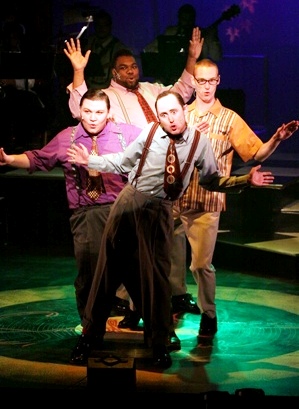
From left:  Zac Schuman, Dell Thomas,  Peter Warden, Mitch Thomas

 Reviewed by Suzanne and Greg Angeo

Photos by Eric Chazankin

 A Real Blast – From the Past

A diverse bunch of lively neighborhood kids gets together to celebrate love and life in 1950s America, to a soundtrack of smoking-hot rock’n’roll, soul, and rhythm and blues. Every song tells a story, and every singer has a story to tell. The musical revue “Smoky Joe’s Café” at 6th Street Playhouse is a cavalcade of 39 classic songs by Jerry Leiber and Mike Stoller, songwriters that together changed American culture and history with their groundbreaking music.  Accompanied by a groovin’ seven-piece band led by music director Mateo Dillaway, 6th Street presents one rowdy crowd-pleaser of a show. Timeless pop hits like “Young Blood”, “Searchin’”, “Poison Ivy”, “There Goes My Baby” and “Stand by Me” inspire foot-stomping and dancing in the aisles.

Conceived by musical theatre veterans Stephen Helper, Jack Viertel and Otis Sallid, “Smokey Joe’s Café” had its premiere at the Ahmanson Theater in Los Angeles in 1994. It went on to become the longest-running musical revue in Broadway history, nominated for seven Tonys in 1995. The show’s pretext is to tell the stories of these kids from the neighborhood, but using song instead of dialogue. There’s no plot, no story to speak of, just a string of sparkling tunes that pop up, one by one, to be interpreted by the performers, each with their own distinct character to play. This lack of structure and storyline allows a production the opportunity to explore and challenge their talent, and to craft their very own “Smokey Joe’s Café”.

At 6th Street, the cast and crew grabbed this opportunity with both hands and ran with it, creating a fun, entertaining show. The performers consist of five men and four women, each with their own magnetic stage presence, set in motion by the great choreography and stage direction of Alise Gerard, who provides for dramatic arcs and comedic escapades within several numbers. The performers’ remarkable emotional range, phrasing and interpretation of the lyrics are guided by vocal director Janis Dunson Wilson.

Zac Schuman, with his soaring, pitch-perfect tenor, most notable in “There Goes My Baby”, and Mitch Thomas’ deep, melodic voice that booms like low thunder in numbers like “Keep on Rollin”, are standouts in a group of truly outstanding singers that include Marc Assad, Dell Parker and Peter Warden.  Their thrilling 5-part harmony – thanks in large part to the balancing effect of Thomas’ reverberating bass — induces goosebumps and shrieks from the audience.  The hyperkinetic Warden practically steals every number he’s in, which is most of them. At times he seems to be channeling Stan Laurel, other times Pee-Wee Herman, but in any case he’s clearly an audience favorite with his engaging vocals and rubbery reflexes.

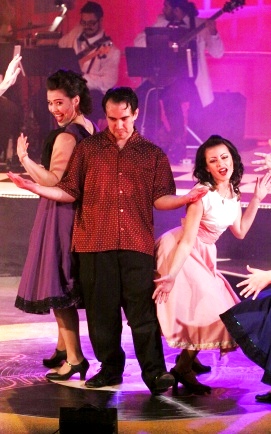
From left:  Kelsey Meille Byrne,   Marc Assad, Emily Somple

As a total performance package, Emily Somple delivers star quality with a sultry assurance and throaty voice showcased in numbers like “Falling” and “Trouble”.  Each of the other ladies is a formidable talent as well: Amy Webber, Kelsey Meille Byrne and Olivia Chavez offer unique personalities and vocal qualities, individually and as a group. This gives a nice texture to the overall production. Highlights of the show include Webber’s powerful yet wistful “Pearl’s a Singer”, and Byrne’s steamy “Some Cats Know”.  The rousing ensemble closing number to Act One, “Saved”, is led by Chavez.

Director and choreographer Alise Gerard brings a lively, fresh spirit to the proceedings, coming less than a year after her sensational debut as choreographer for 6th Street’s smash hit “The Marvelous Wonderettes”,  followed by “Great American Trailer Park Musical” and “It’s a Wonderful Life”. Unfortunately, this will be her last show for 6th Street, at least for awhile – she’s taking her talented self to new digs in New York City. Santa Rosa’s loss is Broadway’s gain.

Even though it seems to run out of gas near the end, only to come roaring back for the finale, this infectious show makes true believers of all within eye-and-earshot, with cheers and whoops of appreciation throughout. After all is said and done – even with good lighting, sound and costumes – it’s the performers that make “Smokey Joe’s Café” an exhilarating, spirit-lifting experience.

 When: Now through February 10, 2013

8:00 p.m. Thursdays, Fridays and Saturdays

2:00 p.m. Sundays

2:00 p.m. Saturday, February 9

Tickets: $15 to $35 (reserved seating)

Location: GK Hardt Theater at 6th Street Playhouse

52 West 6th Street, Santa Rosa CA

Phone: 707-523-4185

Website: www.6thstreetplayhouse.com

‘4000’ miles spans generations

By Judy Richter

It’s 3 a.m. when a 21-year-old man arrives at his 91-year-old grandmother’sGreenwich Villageapartment. The incessant buzzer finally awakens her, and she opens the door to him and his heavily laden bicycle. He has just completed a cross country bicycle trip and hopes to stay for a day or two. Thus begins Amy Herzog’s award-winning 2011 play, “4000 Miles,” presented by American Conservatory Theater.

Often funny, this work looks at how ecoconscious Leo Joseph-Connell (Reggie Gowland), a bit of a New Ager, interacts with the feisty Vera Joseph (Susan Blommaert), who takes pride in having been a communist. Now, though, politics are less important than personal interactions.

When he arrives, the easy-going Leo is self-absorbed, mostly oblivious to how his actions have affected some of the people closest to him. In short, he’s a jerk.

Vera has lived alone since her husband’s death 10 years ago. She manages fairly well even though age is catching up with her. She wears dentures; she needs hearing aids; and she has a stooped walk, probably because of arthritis and/or osteoporosis. Most frustrating to her, though, is that it’s hard for her to find words she wants to use.

The only other characters are Bec (Julia Lawler), Leo’s girlfriend who’s breaking up with him; and Amanda (Camille Mana), a Chinese American woman he picks up one night probably for a fling, but that episode ends on a negative note. There are several unseen characters, though, including Leo’s adoptive sister, Lily, who’s also Chinese American; Micah, his best friend, who died on the bicycle trip; and Leo’s mother, from whom he’s estranged.

During the course of the one-act play, which runs about an hour and a half, Leo starts to confront his grief over Micah’s death. He also becomes more considerate of others’ feelings and realizes he needs to patch up relations with his immediate family inMinnesota. He’s finally beginning to grow up.

However, his departure leaves one wondering how Vera will manage. She’ll be OK for a while, but she has lost most of her immediate support system, and she’s becoming more fragile.

Director Mark Rucker and his capable cast make each character believable and the action natural. Blommaert as Vera ages herself 26 years from her true age of 65 through her demeanor and actions. It’s an impressive transformation.

Erik Flatmo has created the comfy apartment (lighted by Alexander V. Nichols) with, among other details, its shelves of books and a variety of art on the walls. The character-defining costumes are by Alex Jaeger with sound by Will McCandless.

Because so much information is revealed through conversation rather than action, one must listen carefully to learn more about the seen and unseen characters as well as a lot of background. Some of this was lost on opening night because the actors didn’t always pause long enough to allow laughter to subside after amusing lines.

Otherwise, this is a thought-provoking play by an up-and-coming playwright who based parts of it on her own family.

“4000 Miles” will continue through Feb. 10 at ACT’s Geary Theater, San Francisco. For tickets and information, call (415) 749-2228 or visit www.act-sf.org.


They have a dream in “Somewhere”

By Judy Richter

“We are a family of dreamers,” says the matriarch of a Puerto Rican immigrant family in “Somewhere,” the Matthew Lopez drama presented by TheatreWorks in its regional premiere. For the Candelaria family, the dreams revolve around show business, but reality keeps them in a tenement apartment onWest 66th StreetinNew York Cityin the summer of 1959.

Still, everyone tries. The steely matriarch, Inez (Priscilla Lopez), does sewing for neighbors and works two jobs, including ushering at the Broadway theater where “West Side Story” is playing. Daughter Rebecca (Michelle Cabinian) also ushers and takes dance lessons. Son Francisco (Eddie Gutierrez) takes acting lessons. Son Alejandro (Michael Rosen) played one of the children in “The King and I” on Broadway, but now a burdensome secret has led him to abandon his dream and work 80 hours a week to help support the family. The long-absent family patriarch is inCubaworking as an entertainer.

Two catalysts set the plot in motion. The first is that choreographer Jerome Robbins is in town to film the dance prologue to the movie version of “West Side Story.” Inez and Jamie MacRea (Leo Ash Evens), a longtime family friend and an assistant to Robbins, urge Alejandro to try out.

The second is that the family must move in 30 days because their neighborhood is being razed to make way for theLincolnCenterfor the Performing Arts, but Inez refuses to go. She fears her husband won’t know where to find them. The end of Act 1 is fraught with peril as the three kids frantically pack while a wrecking ball whacks away at their building.

While the first act has some slow spots, especially in the middle, the second act is stronger as the family is settled in a larger, nicer apartment in aBrooklynhousing project a year later. By then, Inez is ushering for “Gypsy,” whose central character, Mama Rose, shares many of Inez’s characteristics. However, Act 2 ends anticlimactically after an Alejandro dance scene that might have worked better as the ending.

Because the play has several dance scenes well choreographed by Greg Graham, director Giovanna Sardelli needed a cast of skilled actors who also dance. She found them in this five-person ensemble, and she guides them well.

Scenic designer Andrea Bechert masters the challenge of changing the set from the Act 1 cramped brownstone apartment — complete with fire escape and laundry hanging outside — to the more spacious yet basic apartment of Act 2. Lighting by Steven B. Mannshardt and costumes by Cathleen Edwards serve the play well. Jeremy J. Lee’s sound design features music from the times as well as snatches of news broadcasts that give a sense of what’s happening outside the apartment.

Adding to the family feeling in “Somewhere,” playwright Lopez is the nephew of actress Lopez, who made such a powerful impression as Diana Morales in the original production of “A Chorus Line.” Candelaria was her mother’s maiden name, and in a sly aside, the family living downstairs in the play is named Lopez.

“Somewhere” had its premiere atSan Diego’s Old Globe Theatre in 2011. Besides being restaged from in-the-round to a proscenium, it was rewritten. Despite whatever changes may have been made, it still needs more work. Nevertheless, it’s worth seeing, especially for the dancing and acting.”

It continues at the Mountain ViewCenterfor the Performing Arts through Feb. 10. For tickets and information, call (650) 463-1960 or visit www.theatreworks.org.


They have a dream in “Somewhere”

By Judy Richter

“We are a family of dreamers,” says the matriarch of a Puerto Rican immigrant family in “Somewhere,” the Matthew Lopez drama presented by TheatreWorks in its regional premiere. For the Candelaria family, the dreams revolve around show business, but reality keeps them in a tenement apartment onWest 66th StreetinNew York Cityin the summer of 1959.

Still, everyone tries. The steely matriarch, Inez (Priscilla Lopez), does sewing for neighbors and works two jobs, including ushering at the Broadway theater where “West Side Story” is playing. Daughter Rebecca (Michelle Cabinian) also ushers and takes dance lessons. Son Francisco (Eddie Gutierrez) takes acting lessons. Son Alejandro (Michael Rosen) played one of the children in “The King and I” on Broadway, but now a burdensome secret has led him to abandon his dream and work 80 hours a week to help support the family. The long-absent family patriarch is inCubaworking as an entertainer.

Two catalysts set the plot in motion. The first is that choreographer Jerome Robbins is in town to film the dance prologue to the movie version of “West Side Story.” Inez and Jamie MacRea (Leo Ash Evens), a longtime family friend and an assistant to Robbins, urge Alejandro to try out.

The second is that the family must move in 30 days because their neighborhood is being razed to make way for theLincolnCenterfor the Performing Arts, but Inez refuses to go. She fears her husband won’t know where to find them. The end of Act 1 is fraught with peril as the three kids frantically pack while a wrecking ball whacks away at their building.

While the first act has some slow spots, especially in the middle, the second act is stronger as the family is settled in a larger, nicer apartment in aBrooklynhousing project a year later. By then, Inez is ushering for “Gypsy,” whose central character, Mama Rose, shares many of Inez’s characteristics. However, Act 2 ends anticlimactically after an Alejandro dance scene that might have worked better as the ending.

Because the play has several dance scenes well choreographed by Greg Graham, director Giovanna Sardelli needed a cast of skilled actors who also dance. She found them in this five-person ensemble, and she guides them well.

Scenic designer Andrea Bechert masters the challenge of changing the set from the Act 1 cramped brownstone apartment — complete with fire escape and laundry hanging outside — to the more spacious yet basic apartment of Act 2. Lighting by Steven B. Mannshardt and costumes by Cathleen Edwards serve the play well. Jeremy J. Lee’s sound design features music from the times as well as snatches of news broadcasts that give a sense of what’s happening outside the apartment.

Adding to the family feeling in “Somewhere,” playwright Lopez is the nephew of actress Lopez, who made such a powerful impression as Diana Morales in the original production of “A Chorus Line.” Candelaria was her mother’s maiden name, and in a sly aside, the family living downstairs in the play is named Lopez.

“Somewhere” had its premiere atSan Diego’s Old Globe Theatre in 2011. Besides being restaged from in-the-round to a proscenium, it was rewritten. Despite whatever changes may have been made, it still needs more work. Nevertheless, it’s worth seeing, especially for the dancing and acting.”

It continues at the Mountain ViewCenterfor the Performing Arts through Feb. 10. For tickets and information, call (650) 463-1960 or visit www.theatreworks.org.


Pack of Lies – Untold Secrets at RVP

By Flora Lynn Isaacson

Tina Taylor as Barbara Jackson and Tess O’Brien as Julie Jackson in Pack of Lies, an espionage thriller presented by Ross Valley Players. Photo by Robin Jackson.

Ross Valley Players is currently presenting Pack of Lies by Hugh Whitemore and directed by Molly Noble.

Pack of Lies takes place in a suburb of London during the autumn and winter of 1960-1961.  The main events of the story are true.

In 1961, Peter and Helen Kroger (Craig Neibaur and Mary Ann Rodgers), two Americans living in a London suburb who were convicted of spying for the Russians and sentenced to 20 years in prison.  From these true facts, Whitemore writes a powerfully moving fictional account of the events leading up to their arrest.

With the action centered on the totally unsuspecting Jackson household–Bob (Malcolm Rodgers), Barbara (Tina Taylor) and their daughter Julie (Tess O’Brien).  The Jacksons live opposite the Krogers, believing them to be a convivial Canadian couple and their closest friends.  Then a mysterious stranger, Mr. Stewart (Steve Price) arrives announcing he is from MIS and quietly coerces the Jacksons into allowing their house to be used as a surveillance post.  In the nightmare months that follow, the Jackson’s decent, happy life is shattered as the truth about the much loved friends is gradually revealed to them and, helpless in this world of deception and treachery, Barbara reaches a breaking point with the agonizing realization that the Krogers have betrayed her and she, in turn, has betrayed the Krogers.

In her first directorial role with Ross Valley Players, Molly Noble is to be congratulated with only one minor criticism. The pace lags at times.  Her British dialects are quite authentic though at times, hard to understand.  Especially effective were the monologues each character has with the audience where each actor steps out on a platform in front of the set. The split set by Ron Krempetz was excellent and worked very well.  The period was nicely captured and complimented by the costumes of Michael Berg.

Tina Taylor as Barbara Jackson looked wonderfully anxious throughout as she fussed over her wayward daughter, ably played by Tess O’Brien and contrasted beautifully with the exuberant warmth of Mary Ann Rodgers as Helen Kroger.  Craig Neibaur played an enigmatic Peter Kroger who gave nothing away, while Steve Price gave a strong and well paced performance as the mysterious Mr. Stewart, the man from the MIS whose surveillance operation led to the Kroger’s downfall.  Also, the beautifully observed performance of Malcolm Rodgers as the genial, bewildered Bob Jackson was genuinely moving. There were nice supporting performances, especially Melanie Bandera-Hess as Thelma and Livia Demarchi as Sally, the two MIS girls who stay with the Jacksons during the operation.

Pack of Lies is a bit on the “talky” side and demands your strict attention but it is well worth the effort!

Pack of Lies runs January 18-February 17, 2013 at Ross Valley Players Barn Theatre, Marin Art and Garden Center, 30 Sir Francis Drake Blvd., Ross.  Thursday performances are at 7:30 p.m.; Friday-Saturday at 8 p.m. and Sunday matinees at 2 p.m. For reservations call 415-456-9555, ext. 1.

Coming up next at Ross Valley Players will be Enchanted April by Matthew Barber and directed by Cris Cassell, March 14-April 14, 2013.

Flora Lynn Isaacson