Musical “Big River” flowing through College of Marin

By David Hirzel

You probably know Huckleberry Finn from Mark Twain’s famous 1884 novel, but I’ll bet you didn’t know he could sing!  Check out College of Marin’s new production of the 1988 Tony Award-winning musical Big River.  The big river is, of course, the Mississippi, and the show follows Huck’s transformative journey down that stream with the escaped slave Jim.  Twain’s book, an American classic seems to be aimed at the young adult reader, but it explores the deeper meanings of friendship, loyalty, and the knowledge of good and evil.  Closely following the book, Big River does the same.

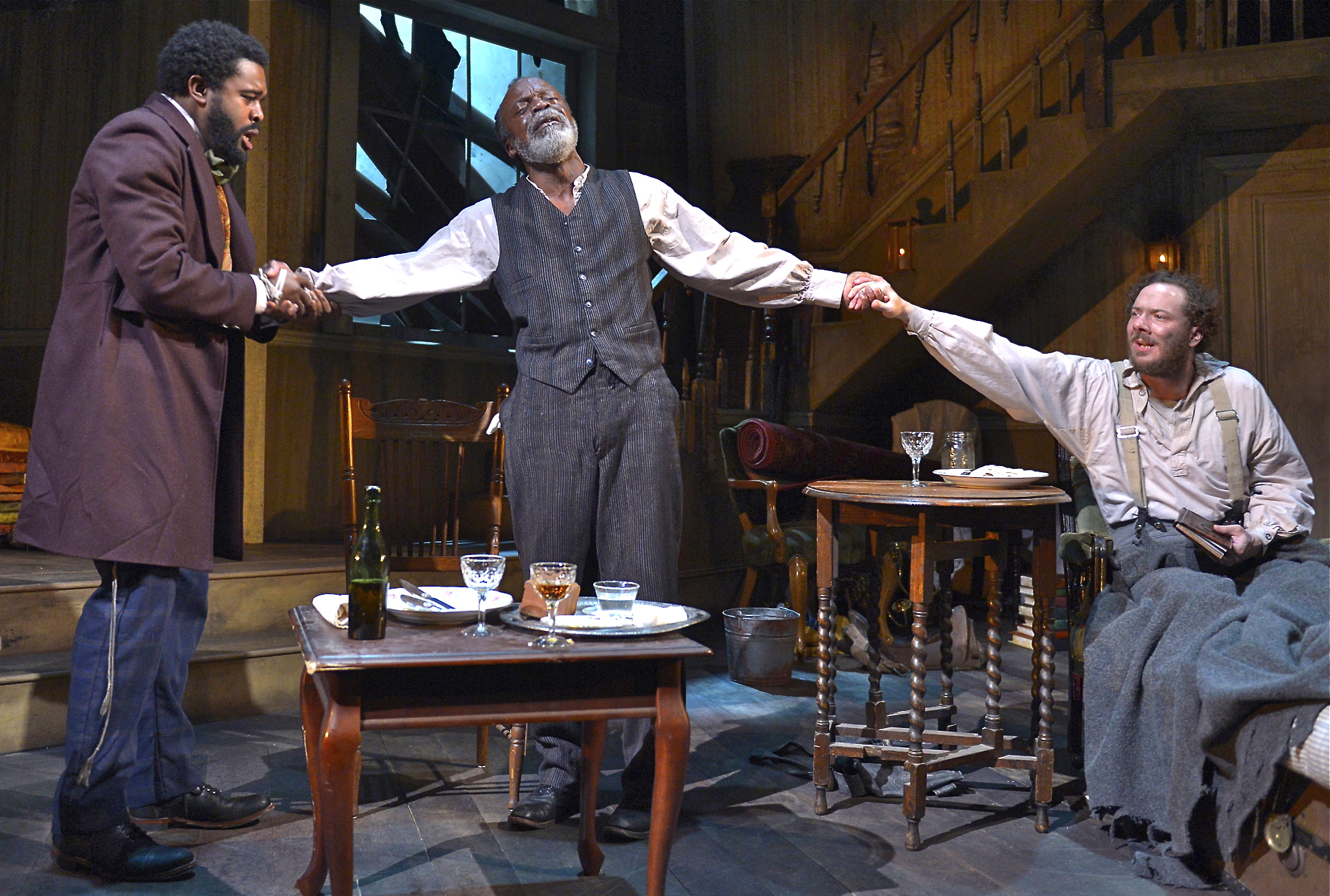
Zachary Isen’s amazing turn as Huckleberry evolves slowly over the course of the musical to an emotional maturity while never leaving behind the boyish charm that lies at the heart of the character.  Huck deliberately ignores the legal and social strictures of the day in helping the escaped slave Jim (Phillip Percy Williams) along his road to freedom.  Williams’ sensitive portrayal of Jim’s mentoring role, and powerful singing bring heart and soul to the production.  A large supporting cast allows a wide variety of production numbers that get heads nodding and toes tapping throughout the audience.  Especially moving songs include “The Crossing” by the Slave Ensemble, and “River in the Rain,” night crossings  during which we see a friendship bloom on its way into the tragic heart of the American South.

Roger Miller’s music and lyrics are reflective of the show’s historical era, alternating between high-stepping barn dance, quiet reflective waltz melodies, and the deep soul of the yet-to-be-freed Africans enslaved in America’s South.  Inventive staging has the same space doing multiple duty as a town and its wharves, steamboat, the shore and the big river itself.  A seven-piece orchestra provides the musical background, lively and poignant by turns, leading up to the powerful and triumphant reprise of “Muddy Water” that closes the show.

This wonderful show has only a short run.  Don’t miss it.

March 2, 8, 9, 15 and 16 at 8 pm
March 10 and 17 at 2 pm

Tickets: $25 general, $18 seniors, $15 students, $10 children 12 and under

James Dunn Theatre, College of Marin Kentfield Campus

Box Office: 415.485.9385

Website:  http://www.marin.edu/departments/PerformingArts/index.htm

Ex-champ Mike Tyson shadowboxes his life on stage

By Woody Weingarten

The tattooed Mike Tyson.

I went to “Undisputed Truth,” ex-heavyweight champ Mike Tyson’s one-man show, expecting to find a human version of a car wreck by the side of a highway.

Or a five-legged fuming bull.

I got what I’d anticipated — and much more.

His performance at the Orpheum Theatre in San Francisco confirms he’s still misogynistic and an egocentric bully — and that he’s still in denial about raping a beauty contestant (“I was convicted before the trial”), despite spending three years in prison for it.

He skirts no major details of his bad-boy history, though he excuses biting off a chunk of Evander Holyfield’s right ear because his foe head-butted him in a previous bout, and he justifies bashing his first wife, actress Robin Givens, because she and her mother “jumped on my wallet like the wild dogs of Africa.”

To me, that particular rant feels as brutal and painful as their yearlong marriage must have been.

The 46-year-old does, however, evoke sympathy and forgiveness from having been the son of a prostitute and a pimp, for conquering his drug and booze addictions (“I’ve been clean and sober for four years”), and for enduring the deaths of his mother, sister and 4-year-old daughter.

His troubled environment and childhood (“I was arrested 30 times by age 12”) and financially ripped-off adulthood (fight promoter Don King allegedly charged him $8,000 a week for towels) also draw compassion and a touch of pity.

In addition to a big box-office, “Undisputed Truth” clearly seeks an influx of forgiveness and love.

Spike Lee directed the show and indisputably helps Tyson obtain those two elements (while taking a break from his films and his courtside seats at N.Y. Knicks basketball games).

And Kiki Tyson, the ex-boxer’s third and current wife, aided the quest by scripting a 100-minute show peppered with tons of self-deprecating humor and a modicum of pathos (not to mention a torrent of rhythmic f-bombs and n-words).

Tyson does comedy set pieces particularly well.

For example, he evokes heavy laughter from his exaggerations of polite white speech patterns (which he juxtaposes with the rough ‘n’ tumble phrases that pour off the tongues of street hoodlums of color).

He claims, in context, that he would have preferred his show be called “Boxing, Bitches and Lawsuits.”

At Thursday night’s opening of the ultra-brief, three-day SHN engagement, Tyson’s fans and cheerleaders virtually packed the 2,200 seats. They made up an audience unlike most theater throngs — younger (mostly 20- to 40-year-olds), more ethnically diverse (lots of Hispanics and African-Americans), and less well attired (sneakers and jeans, with a smattering of baseball caps, some worn backwards).

More like a crowd I’d expect at ringside.

His devotees cheered and laughed enthusiastically and often, even when Tyson was recounting past behaviors that had brought him almost universal disfavor.

None seemed bothered by the ex-champion’s speech impediment or occasional mumbles. And no one visibly winced when he talked about becoming “tired of ripping off my prostitute girlfriend and waking up next to people I never saw before.”

The so-called “baddest man on the planet” drew extra sympathy by relating he went from banking $400 million to bankruptcy, finding himself “ho-less and homeless,” and suffering through rehab before hitting an emotional growth spurt in prison resulting in transformation.

The change didn’t hold, unfortunately.

So he continues to shadowbox his demons — and his life — onstage.

Though he skips it in the show, which is definitely not for the squeamish, Tyson has confessed to being on cocaine while filming a cameo appearance in the movie comedy “The Hangover.”

That altered state probably didn’t matter much: His meager acting chops are as evident here as they were there (as well as in the sequel that featured a replica of his facial tattoo more than it did his bigger-than-life persona).

Last December, Time magazine quoted Tyson as claiming he gets a high, despite constant nagging doubts, from going on stage — a similar high to the one he used to derive climbing into a boxing ring.

The opening night’s crowd, which proffered Tyson a standing ovation, apparently got its own high from the solo showcase.

Its excitement was palpable, even to the minority who weren’t disciples.

“Undisputed Truth” runs at the Orpheum Theatre, 1192 Market St., San Francisco, through March 2. Performances tonight and tomorrow, 8 p.m. Tickets: $50 to $310. Information: (888) 746-1799 or shnsf.com.

Steel Magnolias–A Sextet of Supportive Southern Women at Novato Theater Company

By Flora Lynn Isaacson

Shirley Nilsen Hall, Susan Zelinsky, Karen Clancy, Ashley McKenna (top row-standing); Laura J. Davies, Erin Ashe (bottom row-sitting) in Steel Magnolias.  Photographer: Mark Clark

 The Novato Theater Company currently presents Steel Magnolias, a story of love and trust among six very different women.  This 1987 play by Robert Harling has a title which suggests the female characters are as delicate as magnolias, but as tough as steel.

The action of the play centers on Truvy’s (Karen Clancy) beauty parlor in Chinquapin, Louisiana and the women who regularly gather there.  The drama begins on the morning of Shelby’s (Erin Ashe) wedding and covers events over the next three years.  We get a glimpse of the unlikely friendship between Clairee (Laura J. Davies), the mayor’s wife and Ouiser (Shirley Nilsen Hall), the town grouch; Annelle’s (Ashley McKenna) transformation from a shy, anxious newcomer in town to a good-time girl and then to a revival-tent Christian and Truvy’s relationship with a man in her family.  However, the main story line involves Shelby and her mother, M’Lynn (Susan Zelinsky).

Experienced Director Norman Hall and his wife Shirley Nilsen Hall have both been with NTC for many years.  They have teamed up again to re-mix the 1992 production they did of the same play. Twenty-one years ago, Norman directed Shirley as Truvy, she is now playing Ouiser.  Karen Clancy, now taking the role of Truvy played Annelle and Susan Zelinsky, who then played Shelby is now playing her mother, M’Lynn.

The realistic beauty parlor set is designed by Harry Reid.  Finally, this is not a production which depends on individual performances as much as the ensemble working together.  NTC’s Steel Magnolias is evidence that a thoughtful, committed production can pull magic out of a script that might otherwise seem a little bitter.

Steel Magnolias runs at Novato Theater Company through March 10, 2013.  The location is St. Vincent’s School for Boys at 1 St. Vincent Drive, San Rafael, CA. Performances are at 8 p.m., Thursday-Saturday and 3 p.m. Sunday.  For tickets, call 883-4495 or go online at www.novatotheatercompany.org

Coming up next at Novato Theater Company will be The Foreigner by Larry Shue, May 23-June 16, 2013.

Flora Lynn Isaacson


Hope arises in ‘Spring Awakening’

By Judy Richter

By Judy Richter


Ignorance and repression are a dangerous, sometimes tragic combination, as seen in “Spring Awakening,” presented by Foothill Music Theatre and the Foothill Theatre Arts Department.

Set in a provincial German town in the 1890s, this musical focuses on a group of young adolescent friends who have little understanding of the changes they’re undergoing. The adults in their lives often exacerbate the problem. The central characters are 14-year-old Wendla (Juliana Lustenader); her boyfriend, Melchior (Jason Rehklau); and his friend and schoolmate, Moritz (Ryan Mardesich). Of the three, only the scholarly Melchior knows about reproduction.

In the meantime, the boys and their friends are dealing with all sorts of sexual fantasies, and one of Wendla’s friends, Martha (Holly Smolik), suffers from her father’s beatings and sexual abuse. Tragedies ensue, but hope arises.

Based on a controversial 1891 German play by Frank Wedekind, “Spring Awakening” features music by Duncan Sheik with lyrics and book by Steven Sater. After itsNew Yorkpremiere in 2006, it went on to win eight Tony Awards, including Best Musical.

Although it’s billed as a rock musical, which could connote loud and raucous, many of its songs are calmer. Foothill’s seven-member orchestra, seated in a corner of the stage, includes a violin, viola and cello for a more refined sound. The musicians are led from the keyboard by musical director Mark Hanson.

Except for Caitlin Lawrence Papp and Justin Karr, who portray all of the adults, the cast is comprised mostly of college-age performers. Although they’re older than the characters they play, most of them still look young enough.

Director Milissa Carey, aided by choreographer Amanda Folena, has assembled an energetic, committed cast. The three principals — Lustenader as Wendla, Rehklau as Melchior and Mardesich as Moritz — are especially noteworthy. So, too, are Papp and Karr, who assume various personas as the adults. Beyond that, everyone in the cast deserves kudos for embodying adolescent angst.

Helping to set the stage are Bruce McLeod, production supervisor; Ken Kilen, sound; Rebecca Van De Vanter, lighting; Carlos Acevedo, scenery; and Julie Engelbrecht, costumes.

Although the show has obvious cachet for young people — who were the main demographic in the first Saturday performance — it’s definitely not suitable for younger children because of its sensitive, adult issues and occasional rough language. However, it can and does appeal to more mature audiences who appreciate an interesting plot, strong characters and solid production values.

“Spring Awakening” will continue at the Lohman Theater, Foothill, 12345 El Monte Road, Los Altos Hills, through March 10. For tickets and information, call (650) 949-7360 or go to www.foothillmusicals.com.


Nijinsky — Hamburg Ballet Performance

By Joe Cillo

Nijinsky

Hamburg Ballet Performance at the San Francisco Ballet

February 19, 2013


This is a huge, sprawling production done with imaginative, elaborate staging and lighting and superb technical skill from the dancers.  It is inspired by the troubled life of Vaslav Nijinsky the famous Russian/Polish ballet dancer from the early 20th century.  It is not an easy ballet to follow or immediately grasp.  Some aspects of the ballet seem to refer to events and relationships in Nijinsky’s life and some aspects seem to represent states of his inner life or fantasies, and some seem to be blends of the two.  There are ambiguities that seem to working on several different levels at the same time.  I came to the performance completely unprepared.  I didn’t know anything about Nijinsky except that he was a famous dancer and I didn’t know anything about the events of his life.  The result was I found the performance rather confusing and obscure.

When I attend a theatrical performance, I am always most interested in the concept of the piece, it’s psychological import and meaning, it’s cultural and historical significance.  I think about who wrote this and why.  What were they trying to get across.

In this performance those aspects are not easy to grasp.  Unless you are an expert on the history of ballet and know a lot about the life of Nijinsky, you are not likely to get all the references and allusions in this performance.  I went with a friend who happens to hold a doctoral degree in musicology and she did not get it either, although she got a lot more of it than I did.  She at least knew who he was and his significance, and was able to make connections to some of the other ballets he had been in and she knew a most of the music that was used.  But she did not know the biographical details of Nijinsky’s life and was thus unable to understand much of what was going on.

I was able to discern that it was a kind of retrospective, that many of the sequences represented the contents of the lead dancer’s mind, reminiscences of things that had happened in the past.  There was at least one and probably multiple triangles involving two men and a woman.  I’m not sure if it was the same woman in all of them.  There was a wedding, that was clear, but the character of the marriage was not clear.  The second act seemed to be a descent into psychosis with references to the war (World War 1) and many deaths.  The second act had a surreal quality that was less accessible to being grasped intellectually, but in my eyes it had a more powerful emotional and psychological impact.

This ballet should be very popular among experts on the ballet.  The general public will have a harder time with it unless a special effort is made to prepare in advance.  I studied for several months before attending the Ring of the Nibelung cycle in 2011, and that preparation paid off.   However, I don’t really want to have to do that with every performance, but this is one of that sort where significant early preparation would make a big difference.  Art should be challenging and it should push us beyond our natural boundaries of understanding and perception.  My feeling, in this case, is that the authors did not think enough about who the audience was going to be and the impact that it would have on a naive viewer, which is what most of them are going to be, at least in the United States.  Since this is a large scale production aimed at an audience made up of people who are mostly not experts on ballet and certainly not steeped in the details of Vaslav Nijinsky’s life, it could have been done in a way that would have made it more immediately accessible.  This production might have worked well as an opera.  It does seem to lend itself to that kind of grand conceptual enactment.  The verbal aspect available in opera would have helped a lot in terms of making it intelligible to a viewer not steeped in the life of Nijinsky.

Having said all of that, I still like this.  I liked that it was a big concept, that they were trying to do something with substance and powerful emotional significance, as opposed to gentle entertainment.  This was a performance with real import, although the character of it was not immediately evident.  It had narrative elements, it had subjective explorations of the inner life, it had allusions to historical events that were of relevant to the story line as well as the psychological development of the characters.  It was imaginatively staged, flawlessly executed, and superbly performed.  It is the kind of performance I like to attend.  I came to it unprepared, which was my own fault.  But even unprepared this ballet wins the audience over on the strength of its imaginative conception and first rate execution.

‘Se Llama Cristina’ bends characters and timeframes

By Woody Weingarten

Sarah Nina Hayon and Sean San José star in the Magic Theatre production, “Se Llama Cristina.” Photo: Jennifer Reiley.

Offbeat.

A handful of Bay Area theater companies strive for it by focusing on the uncommon, the unusual, the unique.

These troupes provide a contrast with those that prefer to pick low-hanging fruit like Chekhov’s “The Cherry Orchard” for the 17th time, or retread musicals like “Grease” for the 11th local go-round, or believe casting two women as “The Odd Couple” will add laughs.

The Magic Theatre, thankfully, belongs in the first category.

Witness its latest chancy venture into the known unknown, “Se Llama Cristina.” In it, San Francisco playwright Octavio Solis toys with words (ranging from coarse to poetic) and emotions (ranging all over the proverbial map) and timeframes (troubled flashbacks, a problematic present and tentative flashes forward).

He embraces hyper-serious subject matter, then switches moods by lacing it with verbal gags (many of the gallows humor variety).

His main characters often speak in ultra-short outbursts that can long remain ambiguous (or appear unrelated to the topic at hand).

Vespa (or Vera) and Mike (or Miguel or Miki), start off trapped in a seedy, locked room with drug paraphernalia on the kitchen table, scraps of crumpled poetry covering the floor, and an empty crib (except for a fried drumstick) enticing them.

Are they really victims? Are they really junkies (or alcoholics)? Are they really parents?

Interactions with Rod Gnapp’s alter ego (Abel and Abe) are equally unclear. Is he an abuser, a lover, a sperm donor?

Even if you can answer all those questions, more emerge. Did Vespa’s minister-father impregnate her, beat her, abandon her? Will Mike replicate those patterns?

Does all the action actually take place in one nightmarish room, or does it shift from Texas to New Mexico to Arizona to Daly City, where Miki proclaims, “This ain’t no home. This is squalor. This is a dead end. This is not my California dream.”

Was the pair’s relationship an extension of how they met — a wrong number? If they indeed had a child, is it a “weight” or an “encumbrance”?

Director Loretta Greco, in her fifth season as the Magic’s producing artistic director, keeps the 80-minute, one-act play moving at breakneck speed, and she skillfully keeps the audience guessing about the substantial changes Solis puts his characters through.

Now and then the dialogue acts as synopsis, as clear as a winter’s night illuminated by a full moon: “I’m scared, Miguel, that we’re not going to make it…that you’ll leave me in a town I don’t know with a child so sick and hungry and you’ll be gone. I’m scared that she’s gonna end up like me.”

More often than not, though, it’s terse and punchy: “I’m damaged goods.”

Alas, the comic drama feels marginally derivative, evoking shades of other plays and playwrights.

It may for a moment drag your mind back to the hysterical pregnancy of “Who’s Afraid of Virginia Woolf?” It also may bring to mind the four-letter words and poetic phrases created by David Mamet, or the humor that makes Tony Kushner uses to make his ultra-heavy “Angels in America” bearable.

“Se Llama Cristina” is far from perfect — you’re apt, for instance, to be fuzzy about the protagonists’ backgrounds (at first they don’t speak Spanish despite being of Mexican extraction, then they do, in torrents that include dueling curse words).

Sarah Nina Hayon, who plays Vesta (designated in the program only as “Woman”), and Sean San José, who becomes Mike (“Man”), both deliver potent anguish and stinging humor.

Gnapp, too, holds your attention — with a gamut of verbal moves.

Perhaps one reason the Magic fills most of its seats with enthusiasts under 40, as opposed to the gray-hairs that populate many local venues, is its willingness to take chances — with its plays, playwrights and actors.

“Se Llama Cristina” plays at the Magic Theatre, Building D, Fort Mason Center, Marina Boulevard and Buchanan Street, San Francisco, through Sunday, Feb. 24. Performances Wednesdays through Saturdays, 8 p.m.; Tuesdays, 7 p.m.; Wednesday, Saturday and Sunday matinees, 2:30 p.m. Tickets: $17 to $60. Information: (415) 441-8822 or www.magictheatre.org.

THE MOTHER F _ _ _ _ _ WITH THE HAT

By Joe Cillo

THE MOTHER F _ _ _ _ _ WITH THE HAT

 Reviewed by Jeffrey R Smith of the San Francisco Bay Area Theatre Critics Circle

 Now through March 16th, the San Francisco Playhouse is performing THE MOTHER F _ _ _ _ _ WITH THE HAT by Stephen Adly Guirgis.

 If theatre was invented, as Artistic Director Bill English avers, “to fulfill a spiritual purpose in our lives,” then this play reaches a close approximation of that raison d’être.

 The characters in the play are not the kinds of people who are likely to attend a performance of THE MOTHER … , they are not likely to be people you would strike up a conversation with on BART, well Veronica yes, but for all the wrong reasons.

 The show is a high octane blend of volatility: part mystery—whose hat is it?—part comedy and part dysfunctional love story.

 Jackie who discovers the hat in his girlfriend’s apartment—played by one of the finest actors in the Bay Area: Gabriel Marin—is likely to be the rantipole carrying on a heated conversation with himself on the subway; if you accidently sat next to Jackie, you would relocate to another seat, another car or possibly exit the train and wait for the next one.

 Profanity rolls off Jackie’s tongue like it did for Pacino in SCARFACE.

 Jackie—much to Marin’s superb acting credit—speaks a staccato Bronx dialect at a rate just a notch below the red line on your audio processing speed; were the entire cast to speak as rapid fire as Jackie, the show would be compressed to a half hour.

 If Jackie is the explosive, then Veronica—played by Isabelle Ortega with self-absorbed detachment and sizzling eroticism—is the both Chiquita who lights the fuse and the detonator.

 As the Jungians remind us, when the psyche is not well, it does not call in a psychotherapist, it invites a Joker into our lives; a Joker who resonates with us and one which has the power to torment us, lancing our psychic carbuncles and reopening scars.

 Veronica is that Joker; a masterful manipulator, operating on a low budget, giving everyone what they want while extracting everything she needs via an invisible symbiosis.

 Veronica is pure contractualism dressed up as intimacy and sensuality; you might let her into your life but you will never get her out of your mind.

 Cousin Julio—played delightfully by Rudy Guerrero—is the rose in Spanish Harlem: sharp, savvy, cool, hip, funny, sensitive, buff and faithfully connected at the familial root with Jackie; he puts leavening and light into the show.

 A set design by Bill English and Matt Vuolo looks like it was ripped from the hood; somewhere north of 125 Street.

 High Speed Rail might never get to California but THE MOTHER F _ _ _ _ _ WITH THE HAT … has already pulled into the station; it is a bullet train that rips through the evening air, powered by a high tension plot line and an energized cast.

 This is high speed entertainment; the seats should have shoulder harnesses.

 For tickets, contact the Box Office at SFPLAYHOUSE.ORG or 415.667.9596.

Joffrey Ballet: Cal Performances

By Jo Tomalin
(above) Joffrey Ballet “After the Rain” Victoria Jaiani & Fabrice Calmels Photo Credit Herbert Migdoll

Visceral and Dramatic Joffrey Ballet

Review by Jo Tomalin

Joffrey Ballet “Age of Innocence”
(Photo Credit Herbert Migdoll)

The Joffrey Ballet, an award winning and renowned American dance company from Chicago performed to sold out performances at Berkeley’s Zellerbach Hall, Cal Performances, on January 26 & 27, 2013. This world-class company presents classical to cutting edge eclectic dance works with excellence, and tours internationally.

On January 26th the program included three ballets: The Age of Innocence, After the Rain, and The Green Table.

For ballet fans the opportunity to see a live performance of The Green Table, the antiwar classic by German dancer and choreographer Kurt Jooss, was reason enough to come, because it is performed so infrequently and is macabrely fascinating. Premiering in 1932 by the Ballets Jooss and subtitled A Dance of Death in Eight Scenes, this is an abstract expressionistic dance-theatre ballet in both choreography and visual design, yet with literal meaning about war. The scenes start with the pedantic diplomats uniformed in tight tailcoats and masked balding heads – the Gentlemen in Black – arguing. Then the scenes continue to the Battle, Farewells, Refugees, Partisan, Brothel, Aftermath and back to the still pedantic still arguing Gentlemen.

The striking discordant to lilting piano music by F.A. Cohen was played live by Mungunchimeg Buriad and Paul James Lewis and complements the craziness of the Diplomats, the athleticism of Death (Dylan Gutierrez), and the emotional and dramatic duo of a soldier leaving a young woman, as he goes off to war.

Joffrey Ballet “Age of Innocence”
Victoria Jaian & Fabrice Calmels
(Photo Credit Herbert Migdoll)

The Age of Innocence opened the program. This is a sinuous and sensual ballet beautifully danced by the company, choreographed by Edwaard Liang. Music by Philip Glass and Thomas Newman is at times vibrant, playful, dramatic and soulful. Costume Design by Maria Pinto are dreamy and flowing, all beautifully lit with Lighting Design by Jack Mehler, after Mark Stanley.

Two duos were standouts – the exquisitely danced duo of Jeraldine Mendoza & Mauro Villanueva – she leans and twists as he pulls, she glides, and balances – outstanding and achingly beautiful. Victoria Jaiani & Fabrice Calmels powerfully and sublimely danced the second duo, with a high level of precision, flexibility and impressive extensions.

Joffrey Ballet “After the Rain”
Victoria Jaian & Fabrice Calmels
(Photo Credit Herbert Migdoll)

Christopher Wheeldon’s After the Rain is set to the steely sounding music by Arvo Pärt and a palette of steel grey and flesh Costume Design by Holly Hynes.

Rich, warm tones of lighting and panorama by Mehler, after Stanley,Jo To perfectly coalesced with the wistful music of the last duo – longingly and lovingly danced by Victoria Jaiani & Fabrice Calmels. Wheeldon’s choreography and these dancers transported us to a beautiful space.

The Joffrey Ballet is a superlative company and this program was outstanding in every way. Highly recommended!

For more information:

Joffrey Ballet: http://www.joffrey.com

Cal Performances: http://calperfs.berkeley.edu

Next Dance Performances at Cal Performances, Zellerbach Hall feature the Alvin Ailey American Dance Theater, April 23-29, 2013

   Jo Tomalin Reviews Dance, Physical Theatre, and Movement Performances

Jo Tomalin, Ph.D.
More Reviews by Jo Tomalin

Critics World
www.forallevents.com

Hats off to the SF Playhouse with a play that will draw your attention!

By Flora Lynn Isaacson

Jackie (Gabriel Marin) and Veronica (Isabelle Ortega)

The current production at the SF Playhouse, The Motherf**cker with the Hat, is their fourth show by Stephen Adly Guirgis (Our Lady of 121st Street, Jesus Hopped the “A” Train, and A Den of Thieves) which makes him their most produced playwright.

This West Coast Premiere is about Jackie (Gabriel Marin), a former drug dealer who has just been released from prison to join the American workforce.  His girlfriend, Veronica (Isabelle Ortega), however still uses cocaine and other drugs.  One night, Jackie finds a hat in Veronica’s apartment. Realizing it is not his, he accuses her of cheating and then goes to his drug and parole counselor, Ralph (Carl Lumbly) for help.  Meanwhile, Ralph’s wife, Victoria (Margo Hall) has really had it with Ralph.

Next, Jackie obtains a gun.  Ralph insists that he not keep it so Jackie gives it to his cousin, Julio (Rudy Guerrero) for safe keeping.  Jackie reveals that he slept with his previous AA counselor which may be part of the reason Veronica mistrusts him.  Later, Veronica is entertaining a lover which is revealed to be Ralph.  They had slept together a handful of times when Jackie was in prison.

Meawhile, Jackie gets the gun back and returns the hat and then throws it on the floor and shoots it.  He talks about this with Victoria who is tired of Ralph’s cheating and begs Jackie to sleep with her. She reveals to him that Veronica and Ralph slept together.

Jackie shows up at Veronica’s apartment drunk, accusing her of cheating, hurt because they had been in love since 8th grade.  When he gets loud, she hits him with a bat.  Julio takes Jackie in and reveals that he’s grateful because years ago, Jackie did an unexpected kindness for him.  Jackie wants to confront Ralph and Julio is willing to stand behind him.  Jackie goes to Ralph’s apartment and the two men try to fight it out, but end up futilely wrestling on the floor. Ralph admits he slept with Veronica, but he’s through with that and would like to be friends with Jackie.  Jackie refuses to accept his friendship and returns to the apartment to pick up his things.  He has broke parole by shooting the gun and is heading off to prison for a short time.  He tries to tell Veronica he loves her, but she runs out of the room unwilling to listen.  He leaves for a few moments.  Later Veronica comes out of hiding and calls his name.

Playhouse Artistic Director Bill English gives the play energetic and powerful staging.  He gets some superb performances from his talented cast. English is also a genius at set design with his expansive and multi-level set showing two apartments side-by-side and a patio looming high above with potted plants.  Costume Designer Abra Berman designed the character-specific costumes and Lighting Designer Jordan Puckett provides the properly stark lighting.

Hat is about growing up and accepting responsibility.  Stephen Adly Guirgis tells the story of five characters struggling with addiction, friendship, love and the challenges of adulthood.  According to Bill English, the five characters, “may be locked in the vicious cycles of self sabotage but they express their yearning and their hopefulness with a fire that reminds us of our own yearnings and makes us feel along with them, profoundly alive!”

The MF with the Hat runs through March 16, 2013 at the San Francisco Playhouse, 450 Post Street, San Francisco. Performances are at 7 p.m. Tuesday-Thursday; 8 p.m. Friday and 3 p.m. and 8 p.m. Saturday. For tickets, call 415-677-9596 or go online at www.sfplayhouse.org.

There are a few productions coming up next at SF Playhouse including the San Francisco Sandbox Series’ World Premiere of Inevitable by Jordan Puckett and directed by Lauren English opening March 2, 2013 at 8 p.m.  Reasons To Be Pretty by Neil LaBute and directed by Susi Damilano opens Saturday, March 30, 2013.

Flora Lynn Isaacson


Avner the Eccentric: Physical Theatre

By Jo Tomalin
(Above) Avner the Eccentric

The AMAZING Avner the Eccentric…

Review by Jo Tomalin

Avner the Eccentric

Avner the Eccentric performed his one-man show Exceptions to Gravity on January 29, 2013 at the Bankhead Theatre, Livermore Valley Performing Arts Center. It was a wonderful opportunity to see this world-class international master of physical comedy in an all too rare San Francisco Bay Area appearance.


Avner arrives as a janitor character busy sweeping the stage – aware of the audience he sits down to watch a show, but he is, unwittingly, the show. After a few moments looking at the audience he decides to juggle items he finds onstage such as baseball bats and a peacock feather. Sometimes he loses his hat or gets caught up in his clothing but he finds charming and clever solutions to each challenge.

Avner the Eccentric
(Photo: Marie Clauzade)

Later, he picks up a tall stack of paper cups and they seem to have a mind of their own as they bend and go out of reach, then one of his arms appears longer than the other…but again he finds a unique and entertaining resolution. Avner juggles, drops, defies gravity and plays with many other objects (and a few people), while the audience is totally absorbed in his fun and innocent world, laughing, oohing and aahing at his antics.

Avner the Eccentric

Oh, there’s something else, Avner the Eccentric never speaks a word. This is a silent theatrical clown show and Avner uses his physicality, eyes, facial expressions and timing so skillfully that he transcends language and cultural barriers – everyone understands what’s happening, especially if it seems like an impending threat (to him). In fact, the audience of adults and children enjoy this complicity, when the performer – and they – discover the situations Avner gets himself into quite accidentally and appreciate his creative ways out.

Avner the Eccentric

Avner is not only an expert clown, highly skilled at non-verbal physical communication, but he is also a magician. After an hour or so, Avner performed his Pièce de résistance – a special treat for the audience- Avner’s magical meal that playfully transforms itself unpredictably – and it thrilled everyone! Avner is brilliant and this was a fabulous ending to his show.

Interacting with the audience is the key to theatrical clowning and there is none better than Avner. He performed his one-man show Avner the Eccentric for a season on Broadway and co-starred in Lincoln Center’s production of Shakespeare’s The Comedy of Errors. In addition to acting in various other plays, TV appearances, film, and international tours, Avner directs and teaches workshops for aspiring and professional theatrical clowns. Check out his Schedule for where you can find him performing or teaching next – Avner the Eccentric‘s show is a must see for everyone!

For more information:
Avner the Eccentric: http://www.avnertheeccentric.com
Bankhead Theatre – LVPAC: http://www.mylvpac.com

   Jo Tomalin Reviews Physical Theatre, Dance and Movement Performances

Jo Tomalin, Ph.D.
More Reviews by Jo Tomalin

Critics World
www.forallevents.com