Rock ‘n Roll Heaven: the Dave Crimmen Band

By David Hirzel

You know, there are some kinds of music that make you just have to GET UP AND DANCE!  If that’s what you want, the Dave Crimmen Band in its various incarnations (full band on stage, straight acoustic sets with Dave and the Jordanettes, or the monthly amplified acoustic guitar and string-bass now and coming up at Sausalito’s A Taste of Rome) DELIVERS!

I’ve seen him (them) now in enough disparate venues to promise that what you have here is a bandleader who is (a) a breathing encyclopedia of R+R history starting in the late 50’s (b) a talented singer and guitarist—acoustic and electric—who at times seems to be the living, breathing incarnation of Elvis, the Everly Brothers, Conway Twitty, the Ventures, Buddy Holly. . . .and, oh yes!  Dave Crimmen himself, songwriter extraordinaire in the rockabilly sector.  Check out “Revved Up and Ready to Go” on his Big Daddy D CD.  Better yet, check out Crimmen at one of his live sets, and tell him yourself that’s what you want to hear, and tell him Dave H. sent ya.

The other thing about Dave Crimmen is that, in addition to being a consummate musician, musical historian, and entertainer, he is also a perfect gentleman always giving kudos to his bandmates and to his musical forebears who brought into the world of popular music the most memorable, romantic, and danceable music.  Arcane RnR history:  yep.  Spot on soulful renditions of your favorite slow-dance songs from the 60s:  yep.  Name your favorite song, no matter how obscure a B-side:  yep.

Dave and bassist John Alexander played in Sausalito recently.  The restaurant venue, small as it was, had room for another 20 at least.  Those empty seats couldn’t have enjoyed the show as much as the rest of us did, and more’s the pity for that.

So, for the absolute best in close-in rock-and-roll, don’t miss the Dave Crimmen Band in any of their performances.  Playing all around the Bay Area, in all sorts of venues, the best in old-school RnR.

Next up in Sausalito:  Fri. Feb. 8th, 2013 – A Taste Of Rome, 1000 Bridgeway, Sausalito, 94965, (415) 332-7660 6:30 P.M. – 9:30 P.M. NO COVER!

In Millbrae:  Sat.   Jan. 19th, 2013 – The Sixteen Mile House, 448 Broadway, Millbrae, CA 94030,   (650) 697-6118, 6:30 P.M. – 9:30 P.M. No Cover

Dave  Crimmen Band website:  http://www.davecrimmen.com/welcome.html

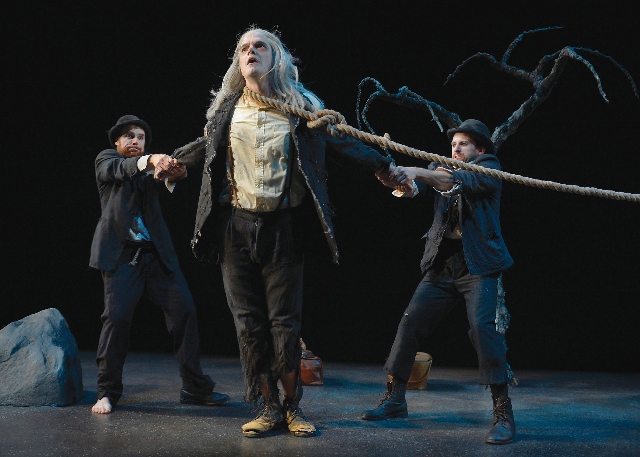
“A Couple of Blaguards” by Frank & Malachy McCourt, Cinnabar Theater, Petaluma CA

By Greg & Suzanne Angeo

Steven Abbott (left), Tim Kniffin

Reviewed by Suzanne and Greg Angeo

Photo by Eric Chazankin
 

Sure and It’s a Grand Time You’ll Have

Storytelling is an honored tradition in Ireland dating back to ancient times. A bit of the Ould Sod is on merry display at Cinnabar, and it’s so infectious and transformative that it just might make you Irish – or at least make you wish you were.

“A Couple of Blaguards” unfolds in a series of zesty anecdotes set to music, laced with sharp wit and occasional naughty bits. It’s based on writings by Frank McCourt that later on inspired him to write his vivid autobiography “Angela’s Ashes”, about growing up in Ireland amid wretched poverty. He co-wrote “Blaguards” with his brother Malachy McCourt, an author in his own right.

Born in Brooklyn at the dawn of the Great Depression, as toddlers Frank and Malachy moved with the rest of the McCourt family to Ireland, land of their parents’ birth. They suffered terrible hardships there, but while growing up never lost their courage, or their sense of humor. The brothers eventually moved back to America, Frank becoming a respected high school teacher, and Malachy, a popular Broadway actor and saloonkeeper. In the 1980s they teamed up to write “Blaguards”, originally performed with the brothers playing themselves. It was so popular that professional theatre companies began staging it. It has been performed to rousing applause all over the world ever since, for over 20 years. Frank went on to craft his phenomenal 1996 best-seller “Angela’s Ashes” based in part on this material. Two years later, Malachy wrote a memoir of his own, “A Monk Swimming”.

The set by David Lear takes the form of a rustic, cozy pub complete with dartboard and a most inviting fireplace. The effect is enhanced by the cabaret-style seating for the audience used by Cinnabar this time of year. The local Irish-Celtic folk ensemble Youkali is on hand, joined by Cinnabar Music Director Jim Peterson, supplying the evening with lively, whimsical Irish tunes that weave in and out between the vignettes.

Director Sheri Lee Miller’s choice of a pub setting is fitting, yet ironic; a pub represents the prime source of the McCourt family’s misery. Frank and Malachy’s alcoholic father spent most of his paltry income in pubs with little to spare to feed, clothe or shelter his family. In Miller’s skillful hands, the pub becomes a focal point of release, an ideal setting for witty narratives and darkly humorous recollections.

Miller’s staging is an ingenious collaboration with her talented actors, Steven Abbott (Frank) and Tim Kniffin (Malachy), who tell their tales with song and spoken word. Besides the two main roles, the script requires Abbott and Kniffin to perform a dizzying multitude of characters from the brothers’ past. There’s a grandmother in there, along with various priestly tormentors, gossipy young ladies and dodgy childhood companions, all quickly assumed with the nimble flick of a scarf, facial expression or attitude. It’s a triumph of imagination and magic: taking what exists only in the minds of the actors, and bringing it onto the stage.  Each actor in turn is a pure delight. Kniffin takes the stage with assurance, exuding a boyish yet devilish charm as Malachy, playing the role with an arch goofiness.  Abbott has Frank nailed: brashness mixed with sensitivity, a scholarly yet vulgar fellow whose ambition leads him to accomplishment and acceptance.

“Blaguards” denies its harsh and bitter origins: A sweet spirit permeates the show, teamed with a ribald gaiety that’s irresistible. Memories take on a warm and hazy glow, like that of the fireplace, softening the years of grinding poverty and desperation. One can only conclude that while the McCourt boys have not forgotten, they have certainly forgiven, finding joy and strength in what remains.


When: Now through January 27, 2013

8 p.m. Fridays and Saturdays – January 12, 18, 19 & 26

2 p.m. Sundays – January 13, 20 & 27

Tickets: $25 to $35

Location: Cinnabar Theater

3333 Petaluma Blvd North, Petaluma CA
Phone: 707-763-8920

Website: www.cinnabartheater.org

House of the Sleeping Beauties — Book Review

By Joe Cillo

House of the Sleeping Beauties, and other stories

By Yasunari Kawabata (1969)  Translated by Edward Seidensticker.  Tokyo and New York:  Kodansha International.


Recently I bought several porcelain figurines of nude young girls.  They are made by Kaiser of Germany and are exquisite in detail and craftsmanship.  The absolute smoothness of the surface of the porcelain and their pure whiteness coupled with the finely detailed features of the nude girl create at once an idealization of the young girl’s body and a kind of perverse reduction of a girl to this idealized representation.

As I look at these lifeless figures I find that I begin to recall living, breathing girls from the past that I once held in my arms.  I recall the details of their bodies, their “imperfections” in contrast to these perfect porcelain representations, the way they kissed, especially their kisses, the fierceness of the longing and hunger in their kisses, their pants, moans, and sharp cries in my ears.  My response to these porcelain figurines is exactly analogous to the memories awakened in Eguchi by the all but lifeless bodies of the deeply sleeping girls in the House of the Sleeping Beauties.

The House of the Sleeping Beauties is no ordinary brothel.  It is very exclusive and caters only to very old men, who “are no longer men,” that is, men who have lost sexual potency, and can thus be “trusted” to spend the night beside a sleeping nude girl without performing intercourse on her.  The girls are between about sixteen and twenty.  The madam supposedly drugs them into a deep sleep from which they will not awaken while the man is present.  They are not dead, but nearly so.  Customers are free to examine and explore the bodies of the sleeping girls to their hearts’ content, but the house rules are very strict and absolutely forbid the girls being sexually violated.  Eguchi claims to be still capable of sexual performance and on a number of occasions considers defying the house rules and taking sexual liberties with the girls, but he always backs off, finding one excuse or another.

The story is psychologically complex and works on a number of different levels.  First of all, on the obvious level of presentation one might question whether the girls really are drugged into a deep sleep, or is it an elaborate performance?  Numerous passages suggest that the girls are indeed aware of the man’s explorations of their bodies and they seem to respond at times to his overtures as if they had sensible awareness.  The madam told him on one occasion that the girl that evening was “in training.”  But how much training do you need to be drugged into a stupor and lie unconscious all night in the nude?

I had the sense that there is a pervasive and profound hostility toward women expressed throughout the story, but it must be qualified by some counterweighing factors.    The negative valuation and destructive impulses toward women are strong, but they are at the same time nuanced and tempered.  This extreme ambivalence is reflected in the way the story ends, which we will examine.

Eguchi, at sixty-seven, is a man who has had a lifetime of extensive sexual experience with many women.  He is not an ascetic and continues to desire to sleep beside the nude body of a young girl, even if drugged into insensibility.  He is deeply disappointed in women (p. 17, 22), yet they continue to offer a comfort that is worth paying for, and there is also profound comfort in the memories they evoke of women long faded in the past (p.27).  He still finds their bodies beautiful and fascinating.  He remains drawn to women and strongly so, despite his disappointment in them.  He has not renounced the pleasures of sex, a la Wagner or Tolstoy, in search of an ideal of “spirituality.”  He feels impulses to both violate the girls and to kill them.  His feelings toward the girls are extremely mixed.  There are murderous impulses, suicidal impulses, alongside a deep longing for connection which he is in despair of ever attaining.  I think this is part of the reason the girls must be unconscious, but at the same time nude.  They are reduced to their physical bodies, much like my porcelain figurines, devoid of personality, devoid of response, unable to interact — although not entirely, as it turns out.  As he told the madam, “It is not a human relationship” (p. 38).  Promiscuity is another way of interacting with women on a physical level while evading a deeper attachment and engagement with the personality of the woman.  Eguchi is able to make attachments to the women, something which commercial sex and promiscuity tend to discourage.  The madam takes the initiative in making sure that he does not sleep with the same girl more than once.  She understands Eguchi’s tendency to become attached to the girls and seek and involvement beyond this superficial acquaintance with her body, and she is very much at pains to avoid that development.

There is a deeply pessimistic attitude toward women, human relations, and life itself that runs throughout the story that hearkens back to the Zen Buddhism that has afflicted Japanese society for centuries.  This pessimism is also related to the profound sense of loneliness and isolation throughout the story.

Eguchi visits the house several different times.  Each time the girl and the experience is different.  On his final visit the madam provides him with two girls.  The experience of two girls divides his attention and makes it difficult for him to sleep.  During the course of the night one of the girls dies, perhaps from an overdose of the sleeping drug, or an allergic reaction to it.  This is only a minor inconvenience and the madam encourages him to stay on, “there is the other girl.”  The cold indifference with which the girl’s death is treated evinces the hostility toward women that pervades all of these stories.  Her death is no more than a nuisance such as a spill or a broken dish.  But it is balanced by the girl who remains living with whom Eguchi spends the remainder of the night.  This conflict between the impulse to kill the girls on the one hand, or to keep them alive and enjoy sleeping with them, even if only in a condition of near total insensibility, is the theme throughout the story from the beginning, and finally at the ending it is made stark and concrete.  Throughout all of these stories the attitude toward death is callous and diffident.  It reflects a low valuation of life itself.

There is no moral or message to the story.  It is a portrait of a man who is so fragile within himself that he is unable to interact on an intimate level with a living, breathing woman.  He can only deal with women on the level of their bodies, without the driving force of lust, and only with the utmost detachment, as if he were appreciating the beauty of an insensate object, like my figurines.  This desire is itself a source of pain for him, because it emphasizes his loneliness and isolation and his inability to reach beyond it.  This is probably the reason for the murderous impulses toward the girls.  If he can kill the girl, maybe he can kill the desire within himself for her, is the logic.  But, or course, it is futile.

Incidentally, this is a mechanism in some serial killers who kill women or prostitutes.  What they are trying to do is blot out an intolerable desire within themselves, a desire that is experienced as intolerably painful because of deep disappointments and frustrations in the past.  It is an attempt to externalize an internal problem.  But projecting it onto the girl who is the object of the desire and killing her does not work, so he has to keep on killing.  Serial killers of women are fundamentally lonely people to an extreme degree, who are trapped in a horrifically painful isolation from which they cannot escape, and which tortures them with relentless, hopeless desire.  In Eguchi we see a very similar psychic mechanism, but in this case the girl is not overtly killed, she dies, more or less by accident.   Eguchi has mitigating forces in his personality that prevent him from becoming a killer, although not by much.

House of the Sleeping Beauties might well be called a novella.  It is the flagship story in this small volume of three stories by Japanese writer, Yasunari Kawabata.  The additional two stories in this volume are One Arm, and Of Birds and Beasts.

One Arm is a tragic representation of the inability to accept intimacy, the partial merging of another with one’s body and one’s self.  The writer borrows an arm from a young girl just for one night — the right arm.  “I don’t suppose you’ll try to change it for your own arm, but it will be all right.  Go ahead, do,” the girl invites him.  And indeed he does exactly that.  In the course of the night he removes his own arm and replaces it with the arm of the young girl.  “Is the blood flowing?”

“[The arm] lay over my heart, so that the two pulses sounded against each other.  Hers was at first somewhat slower than mine, then they were together.  Then I could feel only mine.  I did not know which was faster, which slower.  Perhaps this identity of pulse and heartbeat was for a brief period when I might try to exchange the arm for my own.” (p. 118)

The arm is a symbolic representation of the girl, perhaps it might be better to call it an abbreviation of the girl, which the man brings to his residence and sleeps with in his bed.  The result is a partial merging with her.  The girl [the arm] become part of himself, incorporated into his own body.  He removes his own arm and replaces it with the girl’s.  His blood flows through it.  The girl becomes part of his self.  He and the girl merge into one.  “I’ll keep away the devils,” she tells him.  “Our sleep was probably light, but I had never before known sleep so warm, so sweet.  A restless sleeper, I had never before been blessed with the sleep of a child.” (p. 123)

But he awoke screaming.  “I almost fell out of bed, and staggered three or four steps.  I had awakened to the touch of something repulsive.  It was my right arm.”  (p. 123)  In an instant he tears the girl’s arm from his shoulder and replaces it with his own.  “The act was like murder upon a sudden, diabolic impulse.”  The story ends with him weeping over the dying arm of the girl.

The story is short on analysis and explanation, so I will try to provide some.

“Woman why weepest thou?  Whom seekest thou?”  These questions of Jesus to Mary Magdalene are recalled in the text “as if spoken by an by an eternal voice, in an eternal place.”  “Very often when I’m dreaming and wake up in the night I whisper [this passage] to myself.”  (p. 120)  These questions might well be posed to every woman a man ever sleeps with.  They truly are eternal in place and voice.  But the answers to them are myriad.  In One Arm no answers are attempted.  The man is entirely absorbed within himself.

Intimacy is a merging of the inner self with that of another.  It is the most profound communication between people.  In the Bible the phrase “he knew her” is used to represent having sex with a woman.  Having sex with a woman is equated with “knowing” her.  One knows a woman through sex.  I like this locution.  Sex is communication.  Sex is discovery.  Sex tells you where you are in your relationship with another person.  Sex is a merging of the body and the heart, and it extends beyond the act of sex.  Sex creates a bond, because once you “know” someone, that knowledge does not disappear with the sunrise.  It is this emotional bond, created by the intimate connection, that this protagonist revolts against.  It is experienced subjectively as a feeling of revulsion toward the woman, an intense desire to get away from her, even to destroy her, to repudiate the connection that had been made through the night of unleashed desire and longing with the merging of self and other that resulted.  Why is that?  Why did he wake up screaming after the warmest, sweetest sleep he had ever had?  The girl said she would keep away the devils, but she didn’t.  The devils were much deeper than her arm could reach.  In order to be intimate with another person, sexually and emotionally, one has to have good internal boundaries.  That means that one has to have a sense of oneself and who one is that is sturdy enough to withstand penetration by the needs and longings and inner world of another.  If one feels overwhelmed by the emotional needs of the other, if one merges with the hunger, longing, and pain that the other brings to your bed to the point where you begin to feel you are losing yourself, a kind of panic may result, experienced as an intense need to escape from the suffocating quicksand of the inner world of another.  The origins of the writer’s dilemma are not described, but we can surmise that he must have experienced some severe and confusing early rejection.

“Woman why weepest thou?  Whom seekest thou?” are probably questions he has been asking himself for many years.  Do you really want to know?  Are you really ready for the answers that might emerge?  Why does he wake up in the night with these questions in his mind?  They represent his greatest fear.  He is lonely and isolated.  He reaches out to the woman.  He wants to be close to her.  He needs the soothing and comfort of her body.  Yet the closeness overwhelms him.  The reality of merging with the woman’s heart is intolerable.  This is the tragedy of the story.  He longs to come close, and he succeeds.  But he has to turn around and destroy the connection he created.  He is not able to consolidate what he has gained through his connection to the woman.  Like Sisyphus, he has to start pushing the rock back up the mountain all over again.

Of Birds and Beasts describes a man in his late 30s — who is not named — who feels very little connection to other people.  It is the story of a man who is deeply depressed, estranged from human connection (with the exception of his maid), and on the verge of suicide.  He maintains a few small birds and dogs which provide him with his only joy.  I think it is fair to say that the only thing between this man and suicide is the fleeting vivaciousness he finds in these small animals.  The story opens with him and his maid in a taxi on his way to a recital and they become stuck in a funeral procession — essentially equating this excursion to the recital with a funeral.  Additionally, he mentions two dead birds to his maid, which have been left dead in their cage at his house for a week.  So the theme of death is at the forefront of consciousness right from the very beginning, and the indifference to death is also evident, represented by leaving the dead birds unattended in their cage for a week.  The bulk of the story is a discussion of his birds and his dogs, and especially their fates, which often come at his ineptitude in taking care of them.

He relates an anecdote about a group of children who find a baby bird that has been coldly thrown away by some neighboring bird keepers.  Our hero at first has the intent of taking in the discarded bird and raising it, but he abandons the idea when he considers that this bird was discarded as garbage by his neighbors, most likely because it would not become a singer, and he leaves the baby bird to be tortured to death by the children.  He points out how the human love of animals quickly becomes a quest for superior specimens, and the discarding of the inferiors is brutal and cruel.  He tells us he would not take in an animal that had been raised by someone else.

Smiling a sardonic smile, he excused them as symbols of the tragedy of the universe and of man, these animal lovers who tormented animals, ever striving toward a purer and purer breed.  (p. 134)

This transformation of the simple nurturing impulse into one of competitive striving for relentless improvement can be seen as a metaphor for modern middle class values of child rearing.  In many families great stress is created by the imposition of expectations for achievement on growing children.  In America today the entire educational system is obsessed with testing and retesting and measuring the progress of children — and teachers — in every imaginable way.  The whole system of education has been distorted by the testing regimen to the point where we have lost sight of what education is all about.  Education has become a competitive struggle to maximize certain numbers:  grade point averages, standardized test scores.  The problem that no one considers is: what happens to those who don’t measure up, or who are only average?  We are a society that only awards achievers.  In Garrison Keillor’s mythical Midwest town of Wobegon all the children are above average.  The anxiety of the American middle class is being average or below.  Because we all know there is no provision and no place for those who are only mediocre, like the small bird in Kawabata’s story who is brutally discarded and tortured to death because it could not sing.

The great strength of the Christian faith, which has sustained it for centuries and continues to be its wellspring of renewal, is that Jesus came to seek and to save that which is lost.  Jesus saw value in the losers, the outcasts, the rejected.  To the people nobody else wanted, he said “Come unto me, all ye that labor and are heavy laden, and I will give you rest.”  It has inspired millions who see hope for themselves in his promise.  That unconditional acceptance is powerfully appealing.  The great flaw in industrial capitalism is that its emphasis on competition, innovation, efficiency, and improvement makes no provision for the losers.  Those who do not measure up, those who can’t cut it, those who are left behind in the mad rush of progress:  What happens to them?  They simply perish.  It is not a workable value system for human societies, because, in fact, most people are losers.  Over time, the winners become an ever smaller and smaller group accumulating more and more of the wealth and power in the society while the vast majority of people are forced ever downward in their standard of living and in their prospects.

Kawabata captures this ruthless indifference in his attitude toward the baby bird discarded by its human possessors because it could not sing.  There are other such parallels drawn between the indifference to the deaths of animals and human deaths caused by human failings.  He describes a female dog who dug a nest of straw to sleep in and placed her puppies beneath it.  “she [the mother] would lie on the straw under which they were buried.  They would die in the night of cold and suffocation.  She was like a foolish human mother who suffocated her baby at her breast.” (p. 138)

The birds and beasts in this story provide this man with a tolerable, if feeble, connection to life.  The birds and the dogs do show personality and vitality with which he can choose to interact minimally. He observes them with coldness and detachment, and often neglects them to the point of death.  Nothing in the story suggests that he “cares” for the birds or the dogs.

But for him life was filled with a young freshness for several days after a new bird came.  He felt in it the blessings of the universe.  Perhaps it was a failing on his part, but he was unable to feel anything of the sort in a human being. (p. 131)

The three stories in this book provide an excellent representation of what the psychiatric literature calls a “schizoid personality.”1

The schizoid condition consists in the first place in an attempt to cancel external object-relations and live in a detached and withdrawn way.  . . . It pervades the whole life. (p. 19)

The attitude toward the outer world is . . . non-involvement and observation at a distance without any feeling. (p. 18)

The schizoid person’s capacity to love has been frozen by experiences of rejection and the breakdown of real life relationships.” and results in a “longstanding unsatisfied hunger for love about which, however, she could only feel hopelessness and despair. (p. 91)

This psychiatric description is rather abstract and from the outside looking in, but these three stories of Yasunari Kawabata illustrate this mode of existence very concretely from the inside out.  Through the eyes and voices of the protagonists one sees and experiences the detachment, the emotional coldness, the loneliness and isolation, the suppressed rage, and the indifference to death.  It is at once beautifully written and deeply tragic.  I’m not sure I would recommend this book to the general reader, but if you want to gain insight into this particular type of “borderline” personality, these stories bring you into the heart of how it is lived and experienced in the context of Japanese culture.


1.  Guntrip, Harry (1968)  Schizoid Phenomena, Object Relations and the Self.  London:  Hogarth Press.

HYDE PARK ON HUDSON

By Joe Cillo


HYDE PARK ON HUDSON, now playing at Landmark’s Embarcadero and Clay

Cinemas in San Francisco and elsewhere in the Bay Area, is a charmingly intimate look

at President Franklin D. Roosevelt’s life at his home in Hyde Park, New York.


The film focuses on Roosevelt’s erotic relationship with his cousin Daisy Suckley,

which only became public knowledge decades later when her letters (and some of his)

were discovered under her deathbed. Roosevelt is played, with a touch lighter than

air, by the great Bill Murray; Laura Linney’s Daisy is a wallflower at first flattered by

Roosevelt’s attention and then angered by its limits. Both are completely believable and

very affecting.


The other focus is on the weekend in June 1939 when the King of England, George

VI, and his wife Queen Elizabeth (later the Queen Mother), came to Hyde Park and

were famously treated to an informal (for them) hot dog picnic. They are presented (by

Samuel West and Olivia Colman) quite differently from the way we saw them in The

King’s Speech.


Olivia Williams is astonishing as Eleanor Roosevelt. She has her look, her manner,

her physical presence, even her gait, to the life. The screenwriter Richard Nelson gave

Eleanor almost nothing to do, which was a miscalculation. In her occasional few seconds

of action Williams gives the best performance in the film. Also excellent in brief roles

are Elizabeth Marvel as Roosevelt’s secretary Missy LeHand, and Elizabeth Wilson as

his gorgon of a mother. The costumes and production design are true to the period and

beautifully enhance the presentation.


The main interest of the film is the insight it gives into President Roosevelt’s life, and

by extension into his work. Nelson (who adapted his BBC radio play for this film), and

Murray too, succeed admirably by their restraint. Some reviewers have criticized the

film for not giving a rounded view of FDR, larger than life (as he could be) and booming

out an inspirational message. But Roosevelt was a hugely complicated man, and Hyde

Park on Hudson is not a biopic. A lot of the value of the film is precisely that it shows

him in a way we are not familiar with – quiet, lonely, exasperated by the tensions in

his household, needing intimacy but also moved as much by his own nature as by his

circumstances toward extreme reserve in his emotional life. By keeping most of the

action centered on small things, and by deliberately underplaying this publicly expansive

figure, Nelson and Murray give us a better look at Roosevelt than most of us have ever

seen before.


In particular, the film shows a lot about how Roosevelt’s paralysis affected his life.

We see him in his wheelchair, being carried when necessary, moving with difficulty

by clinging to the side of his desk. During his lifetime the press scrupulously avoided

showing any of this – there are only eight seconds of film in existence that show

him (after polio) walking (with a brace and a strong man to lean on), and only two

photographs (both taken by Suckley) showing him in a wheelchair. The film helps us

understand this part of his life in a way difficult to access otherwise.


The visit of the royal couple was not just a colorful episode, but a historically important

event. In June 1939 war in Europe was recognized as inevitable, and Britain urgently

needed American help to survive. But Roosevelt was constrained by the isolationist

views of Congress and the electorate, and couldn’t give the help he wanted to. Not

only were Americans determined not to repeat the experience of World War I, a lot of

them (especially the Irish) were actively hostile to Britain. The Mayor of Chicago said

publicly that if he ever met the King he would punch him in the nose. The real point

of the hot dog picnic was to humanize the British royals in American eyes and make

them appear friendly and approachable, so it would become easier to help them. And

Roosevelt did after this manage a lot of back door help (Lend-Lease, the Destroyers for

Bases program) before Hitler solved that problem by declaring war on the United States

after Pearl Harbor.


In keeping with the private focus of the film, close attention is given here to the

personal relationship between the King and the President, which developed into a

strategically important one. It is handled here with great sensitivity and insight.

One false note is the character of the Queen, who is shown here shrewishly hectoring

the King about his stammer and comparing him unflatteringly to his brother (the former

Edward VIII).

This is quite inconsistent with the historical record and all that is known about their

relationship, and it mars the film’s effectiveness.


But on the whole, and in almost all its parts, Hyde Park on Hudson is a superbly

crafted and beautifully presented look at a moment in time and an aspect of the life and

personality of one of America’s most important and compelling historical figures.


A Magical Bell Book and Candle at San Francisco Playhouse

By Flora Lynn Isaacson

Lauren English as Gillian Holroyd with her cat Pyewacket in Bell Book and Candle at SF Playhouse

SF Playhouse ushers in the holiday spirit for the company’s 10th season with the romantic comedy, Bell Book and Candle by John Van Druten and directed by Bill English.

The play opened on Broadway in 1950 and starred Lily Palmer and Rex Harrison. The movie version which starred Kim Novak and James Stewart opened in 1958.

The plot concerns Gillian Holroyd (Lauren English), a young, sultry witch who admires her neighbor, a publisher, Shep Henderson (William Connell), who one day stumbles into her gallery to use the telephone.  When she learns he is about to marry an old college enemy of hers, she impulsively takes revenge by casting a love spell on him that backfires when she ends up falling for him herself.

Once Gillian falls in love, she loses her witch’s powers.  She is unable to cast spells.  Her sister, Queenie (Zehra Berkman) and brother Nicky (Scott Cox), a witch and warlock, do not quite know how to relate to this new human Gillian.

Lauren English sparkles as Gillian! She plays her role with a combination of sophistication and naivete, and creates a warm and touching portrait of an unhappy, bewildered witch.

William Connell gives a solid performance as Henderson, the straight laced book publisher.  Gillian’s wacky sister Queenie is played by Zehra Berkman with delightful nervous energy.  Scott Cox gives a strong performance as Nicky, Gillian’s immature brother.  Louis Parnell gives a flawless performance as Sidney Redlitch, who wants Henderson to publish his manuscript on modern-day witchcraft.

Bill English’s handsome set done in red velvet gives a marvelous view of the Chrysler Building and the Empire State Building from Gillian’s arched picture window. The imaginative costume design is by Abra Berman with Kurt Landisman doing the lighting design.

Bill English has assembled five talented actors for this production and keeps the action fast and snappy.  Bell Book and Candle is light holiday entertainment and this production which runs through January 19, 2013 is thoroughly enjoyable.

Performances are Tuesday-Thursday at  7 p.m., Friday-Saturday at 8 p.m. and Saturday at 3 p.m. No show on 12/25 or 1/1.  Added Sunday matinees at 2 p.m. on 12/30, 1/6 and 1/13.

Performances are held at the SF Playhouse, 450 Post St. (2nd floor of Kensington Park Hotel b/n Powell and Mason), San Francisco.  For tickets, contact the SF Playhouse box office at 415-677-9596 or go online at www.sfplayhouse.org.

Coming up next at SF Playhouse will be The Motherf**cker with the Hat by Stephen Adly Guirgis and directed by Bill English, opening January 29, 2013.

Flora Lynn Isaacson

Clas/sick Hip Hop: YBCA San Francisco

By Jo Tomalin
(Above) Photo by Jo Tomalin

Clas/sick Hip Hop is HOT!

image of Classick Hip Hop Courtesy of Rennie Harris Puremovement

Clas/sick Hip Hop
Courtesy of Rennie Harris
Puremovement

CLAS/SICK HIP HOP featuring legendary hip hop pioneer Rennie Harris and accomplished musician and composer Daniel Bernard Roumain (DBR) was an exciting hip hop mini-festival comprising six “post-hip hop” dancers. This new twist to hip hop was presented by the Yerba Buena Center for the Arts (YBCA) in San Francisco, November 30, and December 1, 2012, curated by and with Concept Design by Marc Bamuthi Joseph, Director of YBCA Performing Arts.

Joining dancer, choreographer, artistic director, and professor of hip-hop Rennie Harris, were dancers Marquese “Nonstop” Scott and Arthur “Lil Crabe” Cadre of YouTube fame, trail-blazing b-girl Ana “Rokafella” Garcia, and California-based newcomers Ladia Yates and Levi Allen (AKA I Dummy).

The YBCA is a commendable presenter for this show because of their commitment to push boundaries by collaborating with and challenging such artists to take risks, performing within this institution. Without doubt, the versatility of the large open space of the Forum was an advantage – set up with an area of raised seating on each side of the room, and the dancers appeared from the audience or corners of the room into the huge dance space.

Clas/sick Hip Hop Photo by Jo Tomalin

Clas/sick Hip Hop
Photo by Jo Tomalin

However, as the audience entered we were told not to sit down – but to join in the first half of the evening by dancing. The YBCA Forum immediately became an animated dance party in a dark club, with fabulous light shows and projections on the walls and ceiling (Production Design by David Szlasa)  – as one by one, the hip hop dancers surprised the crowd and appeared in a spotlight doing an improvised solo and duos.

Photo by Jo Tomalin

Photo by Jo Tomalin Clas/sick Hip Hop  Photos by Jo Tomalin


The brilliant improvisations varied in style – from slow Butoh-like movement with silent screams, to stop start controlled robotic movement, perfectly coordinated moon walks, sensitive moments of lyrical dance, and lightning fast contortions and acrobatic moves.

What is different about the concept of this show is that the hip hop dancers are accompanied by virtuoso violinist Daniel Bernard Roumain (DBR) and his string ensemble including violinist Matthew Szemela. Classically trained, Roumain mashes his own cultural references with classical music, playing on a small stage while collaborating with DJ/Producer Elan Vytal, at the centre of the dance floor for his solo, or moving among the dancers.

Award-winning theater artist Marc Bamuthi Joseph, states in the program notes that the goal of the mini-festival, collaborating with Harris and Roumain, is to “”normalize” the movement vocabulary of 21st century social dance within the framework of a high end contemporary arts center, bridging classical and jazz music forms to the continuum of urban dance…Clas/sick Hip Hop engages this institution and some of the artists we love in an activist curatorial philosophy, and stakes a unique claim in performance that will only happen on our stages. We articulate a sense of added pedagogical agency to the notion of the “jazz intellect”, the under reported cerebral intonations of improvisation, particularly as manifested in African American culture.”

image of Classick Hip Hop Courtesy of Rennie Harris Puremovement

Rennie Harris
Courtesy of Rennie Harris
Puremovement

While hip hop and “post-hip hop” are their own genres of dance, they are esoteric and may not have been thought of as a mainstream dance form by all. However, Clas/Sick Hip Hop hopes to show that not only is this is its own dance genre but it is also a form of modern dance with rich multifaceted roots, especially when accompanied by Roumain’s poignant and expressive eclectic live violin performance.

In the second part of this show dancers performed in duos – with choreographed and improvised sequences that worked very well together and brought out each dancer’s personality and own dance style. What was remarkable and unexpected were the emotional arcs and personal storytelling that came through the movement in each pair.

In one piece, two guys look at each other, then circle around as if in a street, giving attitude…they try to outdo each other with their moves. One incorporates mime to sound effects very cleverly…in the end they both win – wonderful!

In another piece, two dressed as cowboys with checkered shirts and black hats have a dance conversation reacting and communicating through wonderfully contorted movements and exquisite footwork – light on their feet, slick and graceful.

A male dancer dressed in blue denim jacket, beige chinos and red sneakers, and a female dancer in tight black cat suit, red cap and red sneakers dance to soulful piano and violin music, relating to each other emotionally, yet the unorthodox is still present as he slowly walks on his tippy toes in sneakers, he’s bendy and contorts his limbs, then they move in a slow motion visceral pull towards each other.

Clas/sick Hip Hop Photo by Jo Tomalin

Clas/sick Hip Hop
Photo by Jo Tomalin

A dancer spins on her head, in a pool of light, accompanied by melodic violin music – and enthusiastic audience cheers – her partner contorts arms and legs impossibly and balances on one hand gymnastically. They slide and stretch across the floor together meeting upside down and contemplating each other, then bounce and spin in sync to the gentle music.

Clas/sick Hip Hop Photo by Jo Tomalin

Clas/sick Hip Hop
Photo by Jo Tomalin

The show culminated with an absorbing piece incorporating spoken word, with each of the six dancers taking the focus performing their own freestyle movement thoughtfully expressing the poetry and music.

A wonderful addition to this hip hop weekend were low cost dance classes all day on Saturday December 1, when students of any age could take mixed-level dance classes of five different genres including Afro-Peruvian to Congolese to Samba – for a day pass costing 50 cents!

Marc Bamuthi Joseph’s quest – and risk – paid off. He succeeded in producing a memorable mini-festival of hip hop dance and more, created by Harris, Roumain, Vytal, Szlasa, and the amazing dancers whose virtuosity and range of inspired choreography were ecstatically appreciated by the audience.

The Yerba Buena Center for the Arts is to be much applauded for producing this mini-festival. Benefits of producing this in a main stream and respected cultural center are very meaningful and worthwhile because the audiences of this sold out weekend were diverse in every way and exposed to the art of the hip hop dance form and culture – many for the first time – and I bet they would go back for more, I would.

More information and tickets for the YBCA Art Gallery, Films and Performances:

Jo Tomalin
Critics World
www.forallevents.com
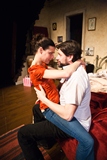
“It’s a Wonderful Life”, 6th Street Playhouse, Santa Rosa CA

By Greg & Suzanne Angeo

From left: Mark Bradbury, Heather Buck, Natalie Herman, April Krautner

Reviewed by Suzanne and Greg Angeo

Photo by Eric Chazankin

Ambitious, Enjoyable Stage Adaptation of Capra Classic


Frank Capra’s tender tribute to the value of a single human being, and to life itself, is being presented in a fresh new way at 6th Street Playhouse’s GK Hardt Theater. The world premiere of the newest original musical version of “It’s a Wonderful Life” makes for plenty of comfort and joy, with only a few bumps along the way.

Capra’s iconic fantasy film was based on an obscure short story “The Greatest Gift: A Christmas Tale” by American author and historian Philip Van Doren Stern. Stern could not find a publisher for his story, so he had 200 copies printed up as pamphlets, and put them inside the Christmas cards that he sent to his friends and family in December 1943. Somehow, one of these pamphlets fell into the hands of an RKO producer. Stern’s permission was obtained for film rights, an adaptation was written and kicked around, and in 1945 the motion picture rights were finally sold to Frank Capra. He was quick to see the emotional power and potential of the story, and the following year, through his production company Liberty Films, he lovingly crafted it into what many consider to be his most beloved film. In the late 1940s there were a couple of radio presentations, with Jimmy Stewart and Donna Reed reprising their roles. Within the past 20 years or so there have been a few other musical stage adaptations and even some live radio plays staged around the country. And, yes…Stern’s little story finally did get published!

Veteran Bay Area actor, teacher and playwright Larry Williams adapted the screenplay for his own original stage production, enlisting the considerable talents of 6th Street Music Director Janis Dunson Wilson to create the musical score. Wilson also collaborated with Williams and Marcy Telles to create the lyrics. In an imaginative bit of storycraft, Williams rewrote the gender of some of the characters, and altered their circumstances somewhat. The lovable Clarence, Angel Second Class, morphs into the scampish girl-Angel Clara. She basically functions as the Ghosts of Christmas Past, Present and Future combined, showing George Bailey flashback scenes of his dream-filled childhood and youth, and finally, what the world would be like if he had never been born. Uncle Billy becomes an aunt, and some peripheral characters do a gender-bend as well, to mixed effect.

There are some notable musical numbers with strong vocal performances: Natalie Herman as Clara sings “Welcome to Bedford Falls” and a sweet serenade “Do You Want the Moon?” is sung by Mark Bradbury (George) and Heather Buck (Mary). Near the end of the second act, the bluesy ensemble piece “Pottersville” features a scorching torch-song solo by April Krautner, in her role as the seductive Violet. She, quite simply, brings down the house. “Ask Somebody to Dance” is performed by the lively ensemble cast, choreographed by Alise Gerard (“The Marvelous Wonderettes”). Other outstanding performers are Anthony Guzman (Bert), and Williams himself as the evil Mr Potter, the juiciest part in the show. He was so convincing in his role that, at curtain call, when he first appeared to take his bows, he received loud hisses and boos, and then laughter and applause.

Direction by Sylvia Jones and 6th Street Artistic Director Craig Miller serves the story well enough.  The set is very simple, with fixed stations spotlighted to represent various locations around town, and scene changes are effectively achieved mainly by moving spotlights and furniture around. Sound trouble in the form of crackling mikes plagued the show throughout, and there were a number of ensemble cast members who had more than their share of pitch problems.

But the message hits home. Yes, it’s a wonderful life – each and every life – no matter how poor, humble or small we may think we are. This story seeks to show how everyone’s life has power and significance, how each of us touches another in unimagined ways. Sometimes in the telling, in its various and sundry versions, the story can be dark and frightening. But in its newest incarnation at 6th Street, “It’s a Wonderful Life” is a bright and pleasant way to usher in the holidays for adults and children of all ages.

When: Now through December 23, 2012

8:00 p.m. Thursdays, Fridays and Saturdays

2:00 p.m. Sundays

2:00 p.m. Saturdays December 15th and December 22

Tickets: $15 to $32 (reserved seating)

Location: GK Hardt Theater at 6th Street Playhouse

52 West 6th Street, Santa Rosa CA
Phone: 707-523-4185

Website: www.6thstreetplayhouse.com

Lincoln — Movie Review

By Joe Cillo

Lincoln

Directed by Steven Spielberg


This movie has been hyped and promoted far out of proportion to its merit.  Even Lincoln scholars have gotten on the bandwagon heaping praise on this mythologizing propaganda.  At first I was puzzled by this.  I couldn’t understand why so many scholars would throw their support behind this film in the public way that they have.  Are they just afraid to set themselves against something that is so popular and has so much money behind it?  But after thinking about it for a few days, I realized that the scholars are actually the problem.  Steven Spielberg consulted them and probably followed their advice.  He didn’t make this up out of his head, and he didn’t do all the research himself.  The community of Lincoln scholars is largely beholden to this idealized, honorific, and in many ways, false conception of Lincoln that the film presents.  This film is a correct reflection of the way Lincoln is perceived and reconstructed in mainstream American society, and this in turn derives from the scholarly community that has created and perpetuated this Myth.  This Lincoln could have come out of Leave It to Beaver.   He’s a genial, storytelling, wholesome, fatherly figure.  Everyone says Daniel Day-Lewis plays him so well.  I don’t get it.  He’s nothing like I imagine Lincoln to be.  Lincoln was depressive.  Melancholy.  He was forbidding and aloof.  He was indecisive on the one hand, and stubborn on the other.  He had human compassion and a crude sense of humor.  He was a very astute politician, he had a talent for making deals, and an appetite for power.  Psychologically, he was very complex and hard to gauge.  He did tell stories, but his stories tended to be earthy, if not vulgar.  They served the purpose of entertaining people and making himself the amused center of their attention.  At the same time, they served a defensive function in that they enabled Lincoln to conceal himself.  Lincoln the story teller remained an elusive, private, enigmatic man.  The film implies that the story telling was didactic, that he told parables like Jesus to teach people moral lessons.  He might have done that.  He won some court cases that way, but for the most part Lincoln the story teller was a man hungry for attention and approval.  He was a politician looking for support and good will.  This movie simplifies him and turns him into a warm, friendly cupcake.  It is an apology, an attempt to elevate him, beatify him.  It’s a feel good movie, to make Americans feel good about themselves, about America, about the Civil War, and about Lincoln.  It starts out with soldiers quoting the Gettysburg Address back to Lincoln, as if the common soldiers were fighting out of a sense of idealism and dedication to the cause of liberty and freedom.  Then there is a shot of Lincoln raising an American flag, and a scene with him and his wife, Mary, in private having an intimate conversation like a married couple that is getting along well and has good communication.  It’s a lot of nonsense.  The biggest lie of all is the portrayal of Lincoln’s marriage and of Mary Lincoln.  This is an attempt to rehabilitate Mary Lincoln from the corrupt, mentally ill woman she was, who was the bane of Lincoln’s life, and make her appear to be some strong, influential participant in his decision-making and private deliberation.  Sally Field is completely unconvincing as Mary Lincoln.  This is a very contrived, incredible role that has nothing to do with the real Mary Lincoln.  There was one scene that felt real and that was when Lincoln and Mary had a screaming argument over their son, Robert’s, enlistment in the Union Army.  They even have Lincoln slapping Robert in the face at one point — a very unlikely scene that illustrates how far afield they are of Lincoln’s true character.  In a couple of places the word ‘fuck’ is used as a curse word.  This is an anachronism.  ‘Fuck’ did not become widespread as a curse word in American English until the late 19th or early 20th century.  They can get away with it, of course, because not too many Americans know this and they don’t teach it in school.  The rest of the movie was manipulative, annoyingly distorted, and mendacious.  The predominant content of the movie is actually the drama surrounding the passage of the Thirteenth Amendment to the Constitution, which abolished slavery, rather than about Lincoln himself.  This is also a rather simplified, sanitized, honorific reconstruction.  I thought the acting was rather poor in general.  Everyone was overplaying and the characters and scenes seemed simplified and cartoonish.  This whole movie is just annoying from beginning to end.  And it is rather dull, I have to say.  I found myself waiting for it to end.  I couldn’t get interested in anything they were doing.  They have taken an extraordinary time and an incredibly interesting person and turned them into something mundane and ordinary.  If you haven’t seen it, don’t go.  Watch Ken Burns Civil War series instead.

If you want to learn about Abraham Lincoln for real, take a look at Edgar Lee Masters, Lincoln the Man.  It was originally published in 1931 and the U.S. Congress actually tried to ban it.  That speaks well for it right there.  Of the many biographies of Lincoln, which tend to be redundant and hagiographic, Masters is my favorite, because it falls well outside this mainstream tradition.  Most biographies of Lincoln deal overwhelmingly with the last five to ten years of his life, and they focus on his policies and actions as President rather than his personality or his character.  Masters has his flaws, like they all do, but it strikes me as more realistic and it takes more interest in Lincoln as a person.  C. A. Tripp’s The Intimate World of Abraham Lincoln (2006) details Lincoln’s affinity for same-sex relationships.  My paper, “Was Abraham Lincoln Gay?” (2010) Journal of Homosexuality 57:1124-1157, draws heavily on Tripp, and examines Lincoln’s private life and the 19th century sexual culture in which he grew up and lived.  Lincoln and Booth:  More Light on the Conspiracy (2003) by Donald Winkler, is a fascinating study of the assassination of Lincoln and John Wilkes Booth’s relationship to the Confederacy’s intelligence network.  David Donald’s Lincoln is informative and probably accurate in its facts, although it tends to fall into this apologetic, mythologizing tradition, and is heavily weighted toward the last four or five years of Lincoln’s life as President.  One of the best books you can read on this subject is Lincoln in American Memory (1995) by Merrill D. Peterson.  This is an excellent study of the growth and evolution of the Lincoln Myth in American culture, which this present film perpetuates and promotes.  Peterson explains how Lincoln was transformed from this ineffective, indecisive, much hated, vilified president that he was into this godlike icon of American goodness.  It is important to understand this because it enables one to see why it is well-nigh impossible today to get a balanced, “realistic” understanding of Abraham Lincoln.  One’s position on Lincoln will be heavily influenced by one’s take on American history since Lincoln, and where one stands socially and politically in contemporary society.  There is no such thing as “objectivity” when it comes to Lincoln.  He has become almost a religious myth.  It is an annoying myth to me.  It is a false myth that embodies a saccharine view of American society and its history, that is conservative, self-congratulatory, glosses over unsavory developments, and is sometimes invoked to justify highly offensive policies, like the expansion of executive power and the abrogation of basic constitutional liberties.  This film falls squarely in that mythological tradition, and I think was subtly crafted to resonate with some of the recent overreaches of executive power in the conduct of warfare and the bypassing of due process.  I’m not going to make the case in detail, because I would have to watch the film several more times, and I am loathe to put myself through that.  But I remember having that feeling several times as I watched it that I was being bamboozled and that it was really referring to our time, rather than being an honest historical piece.

Steven Spielberg has made a film that he knew would make people feel good and that they would be willing to pay money to see, not something that would disturb them and make them question everything they had been taught about Abraham Lincoln and American history.  He has succeeded very well and will undoubtedly be well rewarded for it.  But count me as a NO!  I am not taken in by it.

Image of Company members of Mummenschanz at Cal Performances November 23-25, 2012. PHOTO: Gerry Born

Mummenschanz: Physical Theatre

By Jo Tomalin


Mummenschanz returns to Cal Performances November 23-25, 2012. (Above) Photo: Gerry Born

The Fantastical World of Mummenschanz

image of Mummenschanz Photo Credit: Gerry Born

Mummenschanz
Photo Credit: Gerry Born

The celebrated physical theatre company’s latest show “40 Years of Mummenschanz” performed on November 23 – 25, 2013 at Cal Performances, Zellerbach Hall, Berkeley. Mummenschanz is a world class company based in Switzerland, that tours internationally and last performed at Zellerbach in 2010.

This show is not to be missed! Why? Well Mummenschanz creates life out of anything inanimate – such as every day objects – using fabric, plastic, tubes, wires and boxes to create large shapes and forms that embody human characteristics and communicate non-verbally. This completely silent show comprises almost thirty different visual sketches and is not only clever when bringing the objects to life, but the creators, Floriano Frassetto, Bernie Schürch – the current Artistic Directors – and the late Andres Bossard experimented during the early 1970s with different objects to explore the full extent of the characters, their physicality, movement vocabulary and emotions. These qualities are appreciated by the audience because each sketch follows through a range of movement and precise manipulation, challenging the simplicity of the objects to reveal a depth of meaning through imaginative play that’s magical.

This year’s show “40 Years of Mummenschanz” is exactly that – a feast of sketches developed during the company’s lifetime, with old favorites and newer creations, wonderfully performed by the international cast of Floriana Frassetto, Philipp Egli, Raffaella Mattioli and Pietro Montandon. The stage is often dark with strategically placed dramatic lighting design by Jan Maria Lukas, which beautifully highlights the objects as they move and react. In fact, many people return to see a Mummenschanz show more than once, because their fantastical world is so unique and entertaining.

Where else can you see a surreal pair of giant hands open the curtains or walk off the stage to play with the audience? Or what about an orange fluffy ball that enlarges slowly, comes alive as if it has eyes, then rolls, tumbles and flops trying to mount a platform, while gaining the empathy of the audience? Imagine a taller than human size bendy tubular yellow slinky sliding around the stage throwing and catching a large red ball – then interacting with the audience…Mummenschanz creates the impossible!

Image of Mummenschanz Photo Credit: Pia Zanetti

Mummenschanz
Photo Credit: Pia Zanetti


In another brilliant sketch, rolls of blue toilet paper become features on a mask – that transition as the actor wearing all black tears off pieces to make a scarf. Then a pink toilet paper mask character comes in, they play and try to outdo each other – culminating in a sweet romantic moment as “blue” cries tears, by pulling off squares of paper from his toilet roll eyes, then deftly creates a bouquet by picking up all the paper on the floor for “pink”.


After the intermission, bubble plastic floats in green lighting to shapeshift to become fish and then fireflies; black light figures become Cocteau like silhouettes of sexy legs and profile faces, and a small crinkled shape grows into a huge boulder and rolls down towards the audience tantalizingly…and more.

Look out for Mummenschanz next time and expect the unexpected and a wonderful sensory experience for all the family to enjoy.

More information and tickets:

Jo Tomalin
Critic World
www.forallevents.com

Iglehart serves as moral heart of ‘Big River’

By Judy Richter

By Judy Richter

Mark Twain’s “The Adventures of Huckleberry Finn” is considered one of the greatest novels in American literature. Its musical version, “Big River,” with the novel’s name as its subtitle, doesn’t reach an equivalent pinnacle, but it has its virtues.

They become apparent in the TheatreWorks production directed by artistic director-founder Robert Kelley. For one, the excellent cast produces some fine renditions of the music and lyrics by Roger Miller, who has created a score rife with country, blues and spirituals. For another, the cast has fun with some of the situations in the book by William Hauptman, who adapted his script from Twain’s novel.

Best of all, there’s James Monroe Iglehart, who plays Jim, a runaway slave who shares Huck’s adventures as their raft drifts down the Mississippi River from the fictional town of St. Petersburg, Mo. A fine singer, Iglehart is just back from three years in the Broadway production of “Memphis,” in which he continued to play the roleof Bobby, which he had originated in the world premiere at TheatreWorks. The imposing Iglehart imbues Jim with a dignity and integrity that surpass any other character in the show.

Therefore, the decision by Huck (Alex Goley ) to help him elude capture becomes both believable and inevitable even though Huck understands that in doing so, he’s breaking the law. After all, the action takes place in the early 1840s, when slavery was legal in many states and when slaves were regarded more as property than as human beings.

This theme comes through despite the shenanigans of other characters like Tom Sawyer (Scott Reardon), a decent fellow who nevertheless makes everything too complicated in the name of adventure. The script also spends too much time on two flimflam men, the King (Martin Rojas Dietrich) and the Duke (Jackson Davis), despite the comedic talents of both actors. Except for Iglehart and Goley, nearly everyone else in the large cast plays multiple characters.

While Jim is trying to reach a non-slave state and earn enough money to free his wife and children, from whom he has been separated for several years, Huck is trying to escape his drunken, murderous father, Pap (Gary S. Martinez). The two set off on a raft, drifting by night and sleeping in secluded spots during the day. In one of the more touching scenes, they spot a boat loaded with recaptured slaves, who sing “The Crossing,” a sad spiritual.

Music director William Liberatore conducts the singers and the six-member orchestra from the keyboard. The uncluttered set, featuring a backdrop of a winding river, is by Joe Ragey, with lighting by Pamila Z. Gray. The choreography is by Kikau Alvaro, while the costumes are by B Modern and the sound by Jeff Mockus.

“Big River,” which premiered on Broadway in 1985, won seven Tonys, including Best Musical, Best Score and Best Book. It does have much to commend it, but the source still has greater depth.

The show will continue at the Lucie Stern Theatre, 1305 Middlefield Road, Palo Alto, through Dec. 30. For tickets and information, cal (650) 463-1960 or visit www.theatreworks.org.