EURYDICE at Custom Made Theatre

By Kedar K. Adour


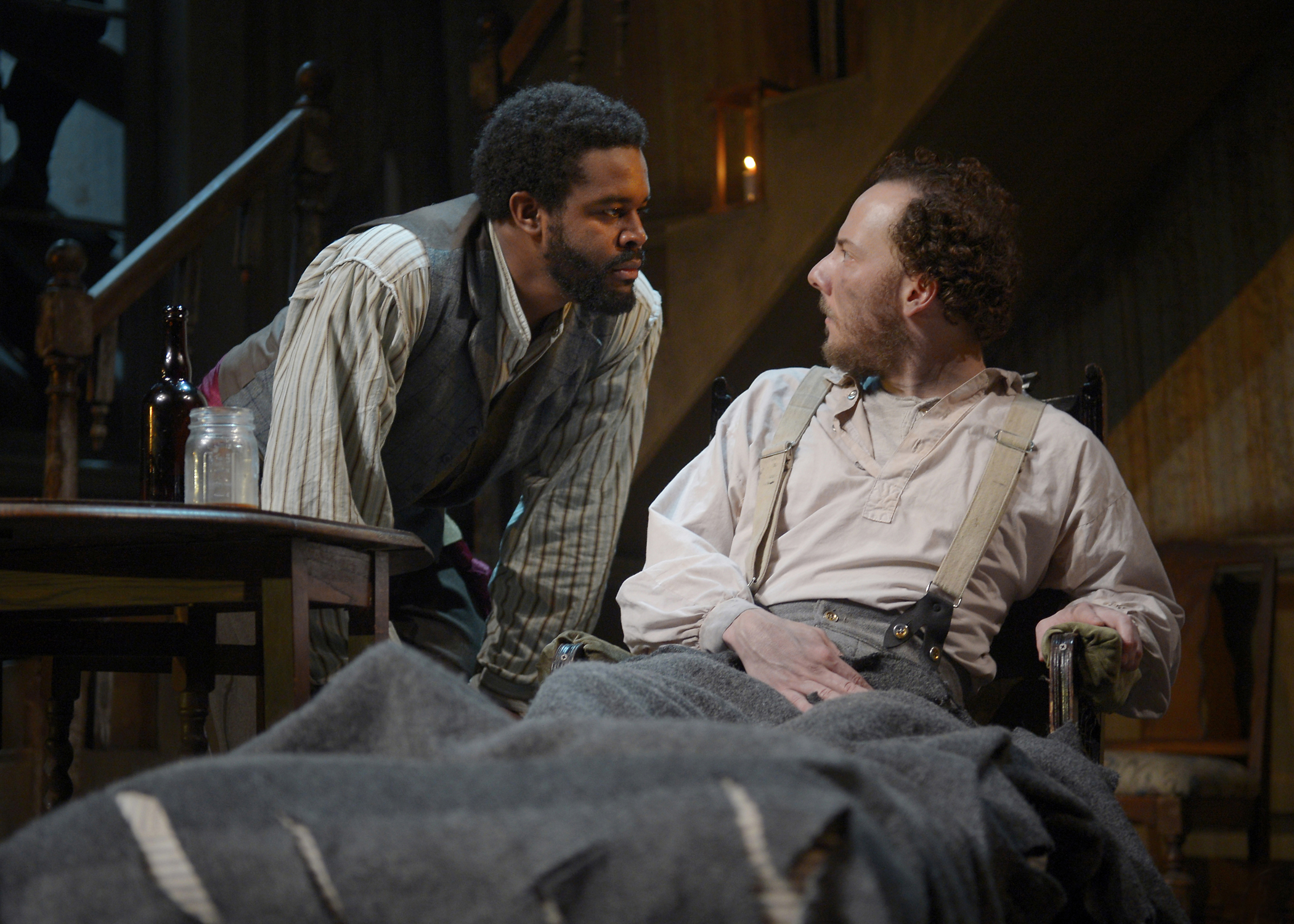
Eurydice,(Jessica Rudholm) Her Father (Fred Pitts) and the Three Stones (Jermy Parkin, Helen Papas, Stefin Collins in Custom Made’s production of Eurydice.


 NOW EXTENDED THROUGH APRIL 28!


EURYDICE by Sarah Ruhl. A reimagining of the Greek Orpheus and Eurydice myth. Directed by Katja Rivera. Production concept by Brian Katz. Original score by Liz Ryder. Custom Made Theatre Company, 1620 Gough Street, San Francisco. www.custommade.org. March 19- April 14, 2013.

AN AMBITIOUS, IMAGINATIVE, ENTERTAINING, THOUGHTFUL EVENING

Sarah Ruhl is an icon in the theatre and two of her plays (In the Next Room or The Vibrator Play and The Clean House) were Pulitzer Prize finalists. There is no doubt in this reviewer’s mind the she will eventually grab the brass ring and win that coveted prize. Her play Eurydice, written early in her career does not rate the accolades of her more recent works but is an intriguing part of her development as a playwright having more than a touch of self-importance as she undertakes a new slant on a well-known popular myth.

In ancient Greek myth Orpheus was a legendary musician with the ability to charm all living and inanimate things and even stones. When Eurydice dies shortly after their wedding and is sent to the Underworld, the distraught Orpheus breaks through the Gates Hell to retrieve her. And you know the rest of the story. If not, go to the intimate Custom Made Theatre and see an ambitious and imaginative production and find out the answer.

Where the plight of Orpheus descending into the underworld is the major theme of the myth, strong feminist activist Ruhl poses the question, “What is the plight of Eurydice?” The play is constructed from her viewpoint and requires a talented actor to play the role.  The diminutive Jessica Rudholm fits the bill beginning with the opening acrobatic love scene with statuesque David Naughton playing Orpheus. They are ably supported by Fred Pitts playing Eurydice’s father with understated charm and authority. Eric O’Kelly as a Nasty Interesting Man strides on stage on stilts and later appears without them as he pedals a child’s scooter to undertake the role of Lord of the Underworld. The ubiquitous Greek chorus is another imaginative touch being Big Stone, Loud Stone and Little Stone (Jeremy Parkin, Helen Pappas and Stefin Collins).

The production values are very clever and often whimsical with original music (Liz Ryder) well-suited to the action. There is an atmospheric modernistic set (Sarah Phykitt) in black and white skewed designs with a jagged door as Gate of the Underworld dominating rear stage. Providentially the running time of about 85 minutes will hold your attention.

Kedar K. Adour, MD

“John & Jen” perservere through the years

By Judy Richter

“John & Jen” (also written as “john & jen”), an intimate musical presented by Hillbarn Theatre, may be seen as an intriguing psychological study in family dynamics.

With just two characters, it covers 38 years in the life of a woman, Jen (Alicia Teeter), starting in 1952, when she’s 6 years old and welcoming her newborn brother, John (William Giammona), into the world. On Christmas Eve five years later, it’s apparent that their parents don’t get along and that their father is abusive.

Other transitions follow until Jen is 18 and goes off to college in 1964, leaving her despairing brother behind. In subsequent years, she becomes a hippie and peacenik, moving toCanadawith her draft-dodging boyfriend, while John becomes closer to their father. In 1970, when John is 18, he enlists in the Navy and is soon killed inVietnam, much to Jen’s sorrow.

Two years later, Jen has given birth to a son, whom she names John. Sometime after that, the boy’s father leaves. In the meantime, Jen seems determined to turn her son into her brother’s reincarnation. As he grows older, he resents those efforts, which impede his ability to follow his own path. Ultimately, she sees the light as he heads off to college.

With a book by Tom Greenwald and Andrew Lippa, much of the story is told through songs with music by Lippa and lyrics by Greenwald. It takes place on an uncluttered set created by Robert Broadfoot with lighting by Aya Matsutomo and sound by Alan Chang. The actors are onstage almost the entire two acts. Transitions from one year to another are achieved through slight changes of clothing (costumes by Mae Matos).

Director Jay Manley guides the two with intelligence and sensitivity. Although Teeter may seem to have the easier role because she’s the same person in both acts, she has some of the more demanding songs — well sung — and goes on a longer emotional journey. On the other hand, Giammona has the challenge of being an adult portraying a child or teenager. Both actors succeed.

The songs are all pleasant though not particularly memorable. Sitting on the side with a cellist and percussionist, Graham Sobelman serves as musical director and keyboardist.

“John & Jen” will continue at Hillbarn Theatre, 1285 E. Hillsdale Blvd., Foster City, through April 7. For tickets and information, call (650) 349-6411 or visit www.hillbarntheatre.org.

“Enchanted April” — Ross Valley Players Greet Spring

By Judith Wilson

England in winter with its gray skies and incessant rain can be a dreary place, so when Charlotte Wilton (Avila Reese) spots a tiny newspaper ad offering a castle for rent in Italy for the month of April, she finds the temptation of a respite with wisteria and sunshine irresistible.

Lotty (aka Charlotte) soon convinces Rose Arnott (Tweed Conrad), whose acquaintance she makes at her ladies’ club, to join her, and their plans for a holiday abroad, sans husbands, begin to take shape. The money they’ve squirreled away won’t cover the costs, so they advertise spots for two other ladies to share the expense. The severe Mrs. Graves (Anne Ripley), a widow who hobnobbed with literary notables when she was younger, and Lady Caroline Bramley (Kate Fox Marcom), a young socialite who craves a change of scene, round out the foursome. So, with an intriguing mix of disparate personalities, the sojourn at Castello San Salvatore begins.

“Enchanted April,” the Ross Valley Players production currently running at the Barn Theatre at the Marin Art & Garden Center, is based on the novel “The Enchanted April” by Australian-born British novelist Elizabeth von Arnim. Matthew Barber adapted the book, published in 1922, into the play, which made its Broadway debut in 2003 and went on to become an award winner.

The story reflects Europe of the 1920s, when the established social order was changing, and women in England had won the right to vote and were gaining new rights. Social change also has an individual effect; thus, the action revolves around four women who are unhappy with their lives and are looking for something, even if they don’t know quite know what. “Something has shifted, and I don’t recognize anything anymore,” says Lotty, as she tries to identify the source of her dissatisfaction. Spring, though, is a season for beginnings, and the light and sun of Italy prove to be an antidote to the gloom, as the women begin to blossom and change.

This is a character-driven play, and with Cris Cassell’s direction, the actresses shine, each projecting a distinct personality. Reese gives us a determined, enthusiastic Lotty who seems as though she could accomplish anything, while Conrad portrays Rose with a reserved demeanor punctuated with bursts of emotion that reveal her insecurity and sadness, as she reluctantly goes along for the ride and eventually opens herself to new possibilities.

A perfectly turned-out flapper, Marcom delivers a Lady Caroline who is somewhat aloof yet shows her vulnerability, as she warms up ever so slowly. “San Salvatore is working its magic on all of us. Just at different rates, that’s all,” says Lotty, who perceives, correctly, that Caroline is more than meets the eye.

In a masterful portrayal, Ripley’s Mrs. Graves is stern and demanding at first, laying out rules and stating that “modern language” is not acceptable. Ripley subtly transforms her from a stiff-buttoned up old lady into a complex and interesting woman who becomes increasingly more relaxed in a gentle evolution reflected in her clothing, hair and even her speech.

Although the story focuses on the women, the husbands, Mellersh Wilton (Ron Dailey) and Frederick Arnott (Tom Hudgens), are integral to the plot, and the actors convincingly show the dilemma facing them. Today, their behavior would be considered chauvinistic, but men in the 1920s had grown up in a patriarchal world, so the changing role of women must have been difficult to comprehend. Thus, Mellersh is outraged at Lotty’s temerity when he discovers she plans to go on holiday without him, while Frederick, whose life with Rose seems to be unraveling, doesn’t know how to deal with her intransigence. Both turn in polished performances, with Frederick bringing an unexpected complication to the plot, while Mellersh draws laughs in a revealing slapstick moment.

Ross Berger plays Anthony Wilding, San Salvatore’s owner, and although earnest, he misses the mark, miscast in a role that appears to be intended for someone older, who can convey the experience of a man who has lived through a war and add the sophistication and élan we expect of an eligible bachelor during the Roaring Twenties in Europe.

Rounding out the cast is Maxine Sattizahn as the delightful Italian housekeeper Constanza, whose body language and humor add a light touch to a script filled with little gems. Listen for the word marvelous in Italian as well as English.

Malcolm Rodgers’ sets serve to contrast the dull grayness of Hampstead with sunny San Salvatore, as the characters move from dissatisfaction and uncertainty to clarity and hope. At first glance, “Enchanted April” might seem simple, but in reality it’s a thoughtful play with themes as relevant today as they were almost a century ago.

“Enchanted April” plays through April 15. Tickets are $26 general admission and $22 for seniors 62 and over and students 18 and under. Thursday night tickets are $20 for all ages. For more information or to purchase tickets, go to www.rossvalleyplayers.com or call the box office at 415-456-9555, ext. 1.

Harvest of Empire — Film Review

By Joe Cillo

Harvest of Empire

Directed by Peter Getzels & Eduardo López


This is an informative, well-presented story of the Latino migration to the United States throughout the twentieth century and continuing into the present. It makes clear the relationship between the Latin migration to the United States and the economic and political policies of the United States government, examining numerous specific cases in great detail: Puerto Rico, Mexico, Cuba, Nicaragua, El Salvador, and Guatemala. Each case is somewhat different, but the basic pattern is consistent: the United States destabilizes popular governments, engineers coups, promotes civil wars, and supports repressive dictatorial regimes that promote the economic interests of large U.S. corporations who exploit the citizenry of these countries, extract their resources, pervert the local economy, and corrupt the government and the judicial system. The citizenry then flee poverty, repression, war, hopelessness, and despair, and where do they come? The United States. People do not leave their homes, their cultures, their languages, and their national identity easily. They do so reluctantly and often at great risk. In a great many cases they are not coming to seek work or to make money, but to flee terror and genocide. The United States trains, arms, and supports the repressive governments that brutalize the civilian population and create the intolerable conditions that promote large scale migration. This film documents this pattern with many vivid examples. It is based on the book Harvest of Empire, by Juan Gonzalez, who is featured as a commentator throughout the film. Anyone who is Latino should see it. Anyone who isn’t Latino should also see it, because it might help to discredit some of the paranoid nonsense being promoted in politics and the media — which is also portrayed in the film — about securing the borders with fences and drones and armed patrols and criminalizing undocumented immigrants and deporting them by the thousands and millions, which is not feasible and not in our interest in any case. It is a powerful and important story that will have lasting implications for the future of our nation. There are about 51 million Latin immigrants in the United States right now, with about two thirds of them from Mexico. According to the Pew Research Center, by 2050 the Latino population in the United States will triple in size and make up 29% of the population compared to 14% in 2005. Nearly one in five Americans will be an immigrant in 2050, compared to one in eight in 2005. It is a major long term demographic and cultural shift underway in the United States: an inadvertent, unforeseen consequence of short-sighted, misguided economic and political policies carried out by our government over many years. This film provides a clearheaded, historically informed, constructive look at the issue that is interesting and rich in examples of the many varied impacts it has on individual human lives.

HAIR

By Joe Cillo

HAIR

Reviewed by Jeffrey R Smith of the San Francisco Bay Area Theatre Critics Circle

The Encinal Drama Department courageously explores the radical sixties via the American Tribal Lock-Rock Musical HAIR.

The musical visits the incubator of many cultural and political elements that we take for granted today: the anti-war and anti-draft movement, environmental protection, women’s rights, mysticism, broad based humanism, sexual liberation, tolerance and cultural pluralism.

These features of the American landscape were brought to you by the Hippies; a utopian subculture that looked beyond materialism for a vision of what we could become.

Diane Keaton was part of the 1968 Broadway cast of HAIR; strangely, to this day she reminds us that although she played a Hippy on stage, she was not a Hippy.

Remarkably, the Encinal production seems to capture the very essence of the Hippy movement; to the credit of Director Robert Moorhead, the show—despite the enormous cast—achieves an intimate cohesive feel, a harmonic convergence of creative spirit and enlightened hope; the unifying tribal force is palpable.

The rousing opening song, Aquarius, boldly led by Brazjea Willard-Johnson with an exuberant Tribal chorus, asserts that planet Earth is governed by a celestial clock—the precession of the equinoxes—and humanity is getting its wake-up call; peace, love and understanding are about to usurp the old evil gods of greed, war and hate.

Just as the Christian era is believed to have been ushered in by a Virgin, the Aquarian Age too has its Madonna only in HAIR it is simply Donna and Berger—played marvelously by Darryl Williams—is desperately singing and searching for “my Donna.”

While drugs have been a part of the American experience since the Jamestown Colonists discovered the hallucinogenic properties of Jimson Weed, it was the sixties that brought on a proliferation of every “mind expanding” toxicant known to the recreational pharmacist and sorcerer; the song Hashish, performed by the Tribe in an eerie and trippy haunting howl, signals the audience that mystic revelation can spring from psychedelics much easier and quicker than yoga, asceticism and rigorous self-denial.

While the United States was busily bombing the Ho Chi Minh Trail and trumped-up body counts filled the evening news, the nation remained priggish about S E X; the song Sodomy drags words before the Klieg Lights that were hitherto only uttered in locker rooms, pajama parties, frat houses and confession booths; words like … like … well you know.

Woof—superbly played by the unassuming leading man of Encinal Theater, and Encinal’s West Point selectee, Raymond Cole-Machuca—lyrically runs through the entire Scortatory Dictionary trying to find the basis of its shock value.

Whether intentional or not, Raymond’s Woof is the oak tree about which the Tribe seems to hang its Teepee; he is both the Oberon and Puck of this musical.

Relentlessly threaded through the musical, submerging and reemerging repeatedly, is the problem of the Draft: compulsory military service; most likely in Vietnam.

The lead character, Claude, is inexorably ratcheted closer and closer to boot camp and the nightmare that lies beyond.

Claude—as played by Ryan Borashan is brilliant casting.

Ryan is an amazing young gentleman actor not to be under-estimated; he is so capable and expansive on stage that his own teachers have difficulty recognizing him.

Claude does his best to dismiss reality; he dives into a false identity in the song Manchester England as if to momentarily escape the Selective Service who has issued him a draft card.

Ryan’s rendering of the song betrays the desperation of a draft eligible teenager trying to suspend his sense of disbelief to buy one more day in protracted adolescence; neither his parents nor the Tribe fully comprehend the enormity of his crisis.

Later as reality begins to infiltrate Claude’s denial mechanism, Ryan wonderfully sings what is arguably the finest song of the show: Where Do I Go.

One of the most startling voices in HAIR is Kalyn Evans; when she chimes into the number Ain’t Got No, the song leaps a full octave qualitatively; this reviewer spent the rest of the evening anxiously waiting for an encore from Kalyn.

As previously stated, the environment was moved to the front burner by the Hippy Movement and the environmentalist in HAIR is the amply Pregnant Jeanie—played by very talented Miss Ruby Wagner.

Miss Wagner—one of the bright beacons in this show—perhaps acceding that there were vagaries in the sound system, not only sang mellifluously, but she communicated her song, Air, to the audience with expression, articulation and earnestness while never compromising on melody.

In a subjective debate over the virtues of Black Boys versus White Boys and in a nod to Motown and Phil Spector, Emani Pollard, Kalyn Evans and Jayla Velasquez delightfully shimmied in shimmering minis.

Costuming and make-up deserve major kudos.

Initially one might think this is a parody of the sixties until one realizes that this is how it really was, equally audacious and outrageous in the sixties as it is on the Encinal Stage.

To connect or reconnect to a time when expectation and hope trumped the status quo and the military-industrial complex, get thee to HAIR.

The show runs through Saturday March 23 and should not be missed.

Period dressing is encouraged.

Call Encinal High at 748-4023 for more details.

Pacifica Spindrift Players “Godspell” Soars

By David Hirzel

Pacifica Spindrift Players’ current production of the musical Godspell is full of such good fun, good singing, inspired stagecraft, a great score creatively adapted by the cast and the production team, and something that you don’t get in every musical—a message. “Godspell” is an archaic spelling of gospel, here cast in modern music and dance, and more than a little free-form improv.

Don’t get me wrong, there’s no preaching here, even though Jesus (Darius Rose)  has center stage here, of course.  He shares it with John the Baptist, Abraham, characters from Biblical parables and Greek mythology, and latter-day flower-children.

There are plenty of laughs, and the most memorable music in the uplifting first act.  Almost every song is a show stopper, from the gathering of philosophers lost in their own ideas in the hilarious “Tower of Babble” that opens the show, through Calypso’s (Jenna Smith) stunning performance of “O, Bless the Lord My Soul” and the charming vaudevillian soft-shoe take on “All for the Best.”

There are three “swine” on the stage for a few minutes, but everyone gets a chance to ham it up.  There’s an inspired bit of parable in the form of a sock-puppet show.  The entire cast is onstage the whole show, and everyone in the ensemble—more than I have space to mention  here—gets a turn in the spotlight.   A live band secluded onstage accompanies the singing. It’s a happy production.

It turns somber after the intermission.  Those who know the real story know what’s coming.  The party’s over.  Judgment is at hand, temptation waits in the wings, a failure of faith, betrayal.  The music sets the mood, especially the touching “By My Side.”  Judas has been an edgy character on the stage throughout the show, and here we see the complexity that John Espejo has brought to the role.  “On the Willows” puts us at the scene of the crucifixtion.  The industrial scaffolding that has been part of the stagecraft suddenly takes on a new and deeper meaning. The lesson here, repeated in so many ways throughout the show, is or could be the framework on which we build our own lives:  Love your neighbor.

Through March 31.  Box office:  650-359-8002

Pacifica Spindrift Players website:  http://www.pacificaspindriftplayers.org/

David Hirzel website:  http://davidhirzel.net

Oscar choices fail to surprise — or satisfy — critic

By Woody Weingarten

Quvenzhané Wallis (far right), best actress nominee, is joined by (from left) Jonshel Alexander, Kaliana Brower and Amber Henry on the set of “Beasts of the Southern Wild.”

Whenever my wife wants to coerce me into doing something, she doesn’t threaten to cut me off sexually. She does much worse.

She threatens to stop cooking.

As a result of my acquiescing to her beef bourguignon blackmail, she drags me into the bedroom once a year to watch the almost-four-hour Oscar trek from Hollywoodland to Boredomland.

Not only don’t I give a flying Fig Newton which female star is wearing which conventional designer’s gown on the red carpet, or showing how much rumpskin can be bared, I couldn’t care less which male actor has new stubbly facial hair or silky tux — or a shiny new rug covering his otherwise shiny pate.

So I stretched out under the covers keeping myself awake by thinking not about Barbra Streisand poignantly singing “The Way We Were” for the hundred-thousandth time or Daniel Day Lewis’ articulate and witty acceptance speech as best actor but about the Academy Awards show even at its best being just a bland bowl of cherries jubilee.

And I squirmed at Kristin Chenoweth’s obnoxious, incessant chatter on the crimson runway, and cringed at Michelle Obama’s inappropriate, tasteless flipping open the best-flick envelope in front of a decked out military contingent that looked like it came straight from central casting.

This year, I actually had a favorite, “Beasts of the Southern Wild,” that I knew couldn’t possibly — and did

n’t, despite a few raucous shouts and applause — beat out the “safe” choice, “Argo,” a tense, extremely well-directed but totally predictable thriller, for best picture.

Nor did the lead performer of the independent “Beasts,” nine-year-old Quvenzhané Wallis, or its intrepid director, Benh Zeitlin, stand a chance against two other benign selections, perky Jennifer Lawrence and politically correct Ang Lee.

In case you missed it, the quasi-post-apocalyptic film about child survivor Hushpuppy in the Louisiana bayou is a complex, multi-layered film I adored but was unable to convince many of my closest friends was worth seeing.

Not all of the gold statuette-athon was horrible.

I was glad Quentin Tarantino won a screenwriting award for “Django Unchained,” which I found incredibly funny (despite the manifold cartoonish blood-gushing sequences and voluminous use of the n-word that some non-film buffs found repulsive without having seen the film).

Christoph Waltz’ unexpected victory for “Django” in the best supporting category award also pleased me.

And I was happy to see a tie occur in the sound editing race.

But one of my favorite films of the year, “Quartet,” didn’t make any a dent in Academy voters’ lists for best anything. Those balloters apparently share most critics viewpoint that sentimentality is bad, a sentiment I don’t share at all.

Since the Academy keeps pursuing younger demographics (witness the choice of “Ted” creator Seth MacFarlane as host), there was no surprise in it overlooking a film about nostalgic seniors on the brink of Alzheimer’s or death.

For me, it felt cleansing — and good — at that movie’s end when I cried, fully content that I’d frequently laughed and chuckled and smiled before that juncture.

I’d reveled, too, in the performance of Dame Maggie Smith, who embodies a broke but not broken retired opera singer relegated to a financially strapped retirement home for musicians.

After Jimmy Kimmel’s unfunny post-Oscar show ended with a disappointing sequel to his spoofy “Movie Movie” and Jamie Foxx singing nonsensical yet slightly salacious lyrics about sprinkling Channing on his Tatum, I was left with only one question: What can I do to convince my wife to substitute the Spirit Awards next year for the Oscars?

No, wait a minute. Didn’t that organization’s voters recently pick the sanitized, feelgood star-studded “indy” film “Silver Linings Playbook” as best picture of the year?

Drama draws laughs while probing serious subcultures

By Woody Weingarten


Jackie (Gabriel Marin) and Veronica (Isabelle Ortega) get violent in “Motherf—-r with the Hat.” Photo: Jessica Palopoli.

My hat’s off to “Motherf—-r with the Hat.”

It’s off to the comic drama for having the most immoderate theatrical title in years, one that may cause scores of potential ticketholders to stay home — even in liberal, liberated San Francisco, Marin County and vicinity.But my hat’s also off to playwright Stephen Adly Guirgis and director Bill English.

They instilled “Motherf—-r” with a throbbing energy, kept my attention with verbal fireworks that relentlessly took apart lies and liars, and overlaid gobs of humor onto the often painful words of people trapped in lower socio-economic hookups.

“Motherf—-r” also provided a shrewd look at sub-cultures — 12-step programs, for example, and the easy availability of guns and bats to vent rage.It didn’t take long, however, to know this was no nursery rhyme for Rotary Club attendees — the opening scene finds Veronica (Isabelle Ortega) snorting cocaine and swearing like a longshoreman.

It also didn’t take long to know the 100-minute, intermission-less show was going to have an undercurrent of poignancy: Jackie (Gabriel Marin), smalltime drug dealer and parolee who’d spent two years in prison, barges in to hand the woman he’s adored since eighth grade a bouquet of flowers, a chocolate bar, a Lotto ticket, a stuffed animal, tickets to a movie, and news that he’s found a job.

Almost instantly, though, he finds the fedora featured in the title, along with other signs she’s been cheating.

So we’re off to what rapidly descends into a sexual roundelay, a comic romp and a semi-tragic snapshot of star-crossed lovers.

Actors in supporting roles — Carl Lumbly as Ralph, Jackie’s drug-counselor, and Margo Hall as Victoria, Carl’s angry wife — helpfully wear their characters like second skins.Yet Rudy Guerrero (Cousin Julio) is the consistent show-stopper. He’s over-the-top funny, especially when embroidering a macho Jean-Claude Van Damme persona onto his meek hairdresser gayness.

From time to time, there’s an all-too-familiar quality to the characters (despite Guirgis claiming Jackie hits multiple points of autobiography). But the persistent twists and turns of the plot lead them into fresh if depleted places.

And although chunks of the dialogue seem uninspired, others are dazzling. Frequently, in fact, individual lines become perfect permutations of what Guirgis apparently was striving for:

• “My wife is the reincarnation of Benito Mussolini.”• “Don’t underestimate my capacity for violence.”

• “You think you’re the only motherf—-r who’s hurting here.”

• “The real world largely sucks.”

• “No point in killing the messenger if you’re not gonna absorb the message.”

• “I love loving.”Particular praise is due Lynne Soffer, the dialect coach. Accents are consistently real — as, for the most part, are the five characters Guirgis invented.

Sure, the recognizable Puerto Rican and black types in this production — being presented here in association with the Lorraine Hansberry Theatre — do now and then veer into the underbrush of soap opera and caricature. At their best, however, they offer perspectives on the quest for hope, for love and trust, for forgiveness.The 2011 Broadway production of “Motherf—-r” was nominated for half a dozen Tony Awards. Chris Rock did a star turn (as did Bobby Cannavale), which made that production a little larger than life.

In contrast, the intimacy of the 300-seat SFPlayhouse, with seats only nine rows deep, almost puts you onstage right in the middle of the action.

And that, when it works, can be captivating.“Motherf—-r with the Hat” plays at the San Francisco Playhouse, 450 Post St., San Francisco (second floor, Kensington Park Hotel), through March 16. Night performances, 7 p.m. Tuesdays through Thursdays; 8 p.m. Fridays and Saturdays. Matinees, 3 p.m. Saturdays. Tickets $30-$70. Information: (415) 677-9596 or www.sfplayhouse.org. 

“Beautiful Creatures”

By Joe Cillo

Written and directed by Richard LaGravenese, from the novel by Kami Garcia, starring Alden Ehrenreich, Alice Englert, Jeremy Irons, and Viola Davis.


A MODERN FAIRY TALE

After reviewing “The Gatekeepers” for this web site, I wanted to see some fantasy, something light, so I checked out “Beautiful Creatures.”    Another reason is that one reviewer said that Jeremy Irons and Emma Thompson make a meal of the scenery.  I love both and enjoy them in anything, and listening to Jeremy Irons’ voice with its oily, James Mason-smooth, rich delivery.   If anything, maybe this film will get teens to read.

It is a modern fairy tale in which the sought after young girl is not a princess but a witch who comes from a long line of witches and warlocks.   Except they’re not called “witches” but “casters” as in casting spells.  Not casters like wheels for moving furniture around.  “Creatures” stars two unknown (to me, anyway) actors, Alice Englert as Lena Duchannes, the caster, and her teen-age suitor, Ethan Wate played by Alden Ehrenreich, who has the endearing vocal inflections and mannerisms of a young Leonardo diCaprio.  Alice Englert is the daughter of filmmaker Jane Campion; Alden Ehrenreich is said to have been discovered by Stephen Spielberg at a friend’s barmitzvah.  If he’s never acted before, you wouldn’t know it by his portrayal of Ethan.  He’s a natural.

Ethan lives in a small, moss-covered town in North Carolina. He wants to get out, and sees college as a way.  His only escape is books- good ones- literature.  Real books- paper backs.  He reads Vonnegut, Fitzgerald, Hemingway, Salinger, Bukowski, and more.  His mother is allegedly dead; his father non-compos-mentis with Alzheimer’s and never appears.  Ethan has been cared for since infancy by Amma, played by Viola Davis in a familiar role as a wise, spiritual, all-knowing woman, who lives in a spooky house in the swamps.  She is the town librarian, dresses in the latest African chic: prints, bangles, etc, and has a key to a hidden vault of secrets reminiscent of Dan Brown’s “Da Vinci Code.”  Part of the town’s history goes back to the Civil War and each year the townsfolk take part in a Civil War re-enactment of the Battle of Honey Hill.  There are flashbacks to that era shown in dreamy, surreal scenes in which a young woman a la Scarlett O’Hara, loses her young Confederate soldier to Union fire- but spookily brings him back to life.  (Could it be? . . .)

One of the things I loved about “Creatures” is that it shies away from stereotypes as much as possible in a fairy tale:  Lena, as a caster, is not a pale, anorexic, willowy girl who dresses in long, clinging, black dresses.  Though Ethan has been seeing her this way in recurring dreams, with long, black tendrils hiding her face.  In real life, Lena is the picture of rosy-cheeked health and dresses like a typical teen.   Anyway, seems she has been kicked out of every high school from here to Hades and ends up a senior at Ethan’s.  She’s the newby, and is taunted and bullied by her bland, blond classmates. (They suffer the consequences.)

Uncle Macon (Jeremy Irons) lays down the law to Lena and Ethan.

Lena lives with her Uncle Macon Ravenswood (Jeremy Irons).  From the exterior, the house looks like the Munster mansion- all ropey vines, a squeaky, baroque, wrought-iron gate, a long, winding road o’er shadowed with cypresses festooned with Spanish Moss.  Ethan pays an uninvited visit hoping to talk to her.  He is the only one willing to befriend her, having, like I said, seen her in his dreams.  The heavily carved door is, of course, somehow ajar.  He pushes his way in.  We expect to see a dark room, dimly lit with wall sconces and candelabras; overstuffed, 17th century furniture, including a mahogany dining table with scrolled legs, ending in dragon claws, clutching amber balls. But what a delightful surprise!  It is nothing you’d expect.  When Uncle Macon appears, he is elegant- suavely dressed in cream silks, his grey mane swept back in deep waves.  He speaks in well-modulated, orotund tones.

Naturally, there is a curse that has to be broken if Ethan is to get the girl before she goes over to the dark side when she turns 16 in a few weeks, epitomized by her cousin Sidney Duchannes (Emmy Rossum), who wears slinky, red dresses, shades, and speeds around in a sporty red convertible.  You know she’s evil when she causes a squad car to suddenly career off the road and burst into flames.  Another hint is that her eyes became supra-naturally luminescent immediately before she executes an evil deed.  The introduction of Sidney was, I thought, an unnecessary element, except she was a device to influence Ethan’s best friend and get Lena to come over to the dark side.  But the family relationships got confusing.  What with shape-shifting Emma Thomson as Mrs. Lincoln, the town radical fundamentalist Christian AND Serafine, Macon’s dark, caster of a sister, and Lena’s mother, as well as a bunch of other ageless relatives:  Gramma (Eileen Atkins), Aunt Del (Margo Martindale), a little-seen brother, etc.

One of the high-lights of the film takes place at a banquet at Macon’s.  Everyone’s been called together to convince the young lovers to break it off.  Ethan finds himself seated at the sumptuous table headed by Macon, with Lena and all the relatives.  Everything’s quiet.  In the background we hear the theme from the 1959 movie, “A Summer Place.”  Broke me up.  Then the room starts spinning around.  I expected everyone to end up as butter when it stopped.

Amma shows the pair the secret vault in the library where the history of the Duchannes and Ravenswood families are kept in leather-bound tomes that only Lena is privy to.  Spells are cast, Ethan loses his memory, Lena stays in her room and pouts.  It’s as though they’d never met.  Soon they all gear up for the re-enactment.  There’s some shape-shifting going on, someone is accidentally shot dead with a real bullet and is brought back to life in another body.  Serafina?  Next time you’re in the woods and see a tangle of thick vines choking a tree, think of her.  Yes, it did get a little hard to follow.  Ethan drives down the road, off to college.  Lena is in her room studying.  She looks up.  Her eyes reveal her new state of being.  The movie ends with nothing resolved, but you come away feeling that somehow, the young lovers will end up together.


Musical transforms Buddha into a woman in current world

By Woody Weingarten


Sid (Annemaria Rajala, front) must deal with her dead mother (Alexis Wong) in “The Fourth Messenger.” Photo by Mike Padua.

Hmmm, what if the Buddha were alive today — as a female?

Hmmm, now let me see, what if she were dubbed Mama Sid, after Siddhartha Gautama, and her sacrifices in the name of enlightenment were densely detailed on a Berkeley stage?

Hmmm.

Well, the epic musical loosely based on legend just might be exciting, profound and humorous, that’s what.

“The Fourth Messenger,” at the Ashby Stage through March 10, questions whether a woman can survive 100,000 lifetimes to evolve into a purely spiritual yet totally human being.

As a mainly two-person journey toward peace unfolds, the show personifies temptation, prophecy and reconciliation.

Three harbingers appear in human form and embody negatives: sickness, aging and death. The final messenger, pure soul, arrives in an unexpected manner.

All that, and so much more, is viewed through the prism-eyes of two principals — Sid (Annemaria Rajala), a world-famous guru hiding her past, and Raina (Anna Ishida), a muckraking journalist who runs smack into herself while seeking to unveil what she’s predetermined to be spiritual hypocrisy.

But director Matt August keeps the two-hour-plus, two-act world premiere tight, paced seamlessly.

He tempers the tutorial-in-music with verbal comedy and physical slapstick, and drives the silliness through Bridgette Loriaux’s choreography.

Make no mistake, playwright Tanya Shaffer’s ultimate purpose — and message — is ultra-serious: Love gives life meaning. And she appears to offer a corollary obviating the Buddhist maxim that suffering goes hand-in-hand with attachment.

Shaffer, an El Cerrito resident whose “Baby Taj” was a Bay Area hit in 2005, has bitten off a lot. As a result, her script and lyrics are intermittently too dense or preachy.

On the other hand, the text does lend itself to poetic utterances (when Sid reflects on a multi-year meditation, she tells of hearing “cats, wolves…engines… human voices…laughter and pain…and behind the sound, silence, like a bottomless pool”).

Insightful one-liners turn up as well: “You know more than you know.”

Vienna Teng’s compositions from time to time rouses the crowd and runs a musical gauntlet, from pop to jazz, rock to tango, new age to operatic.

Like an opera, not incidentally, “The Fourth Messenger” is nearly a sing-through and succeeds with that format. But Teng’s score is unlikely to compel anyone to hum while leaving the theater.

It must be said, tangentially, that Christopher Winslow, who skillfully and enthusiastically directs four excellent musicians, sporadically lets that verve drown out the singers.

That only becomes a fleeting irritation since the gist of what’s happening remains constantly accessible even when several words are missed.

In comparison, the imaginatively fluid set designed by Joe Ragey — consisting almost entirely of poles and flowing white fabric — is never less than enthralling.

Its simplicity empowers silhouette scenes, and lets the action shift rapidly and smoothly from a magazine office in New York City to a meditation retreat in Newfoundland to a faceless suburban site to a lavish gated community and to bustling urban streets.

Also praiseworthy are the props, which range from a gigantic loaf of bread to a sheet that doubles as snow powder and worldly goods stuffed into a duffle bag.

Shaffer tenaciously attempts to keep things current, to the point where some words — such as staycation — and concepts — like child-abandonment — may rankle.

All 11 performers, many of whom appear in multiple roles, excel within the parameters of complex text and lyrics. Their singing tends to sprint from good to superior, except for a handful of opening night off-notes.

One of Sid’s summation queries in “The Fourth Messenger” is, “What’s one little lifetime anyway?”

My skeptical answer might be: “It’s all that I have — but happily it includes the chance to see a flawed but extremely valuable theatrical experiment.”

“The Fourth Messenger” runs at the Ashby Stage, 1901 Ashby St., Berkeley, through March 10. Evening shows, 7 p.m. Wednesdays and Thursdays; 8 p.m. Fridays and Saturdays. Matinees, Sundays, 2 p.m. Tickets: $23 to $40, available through thefourthmessenger.com.