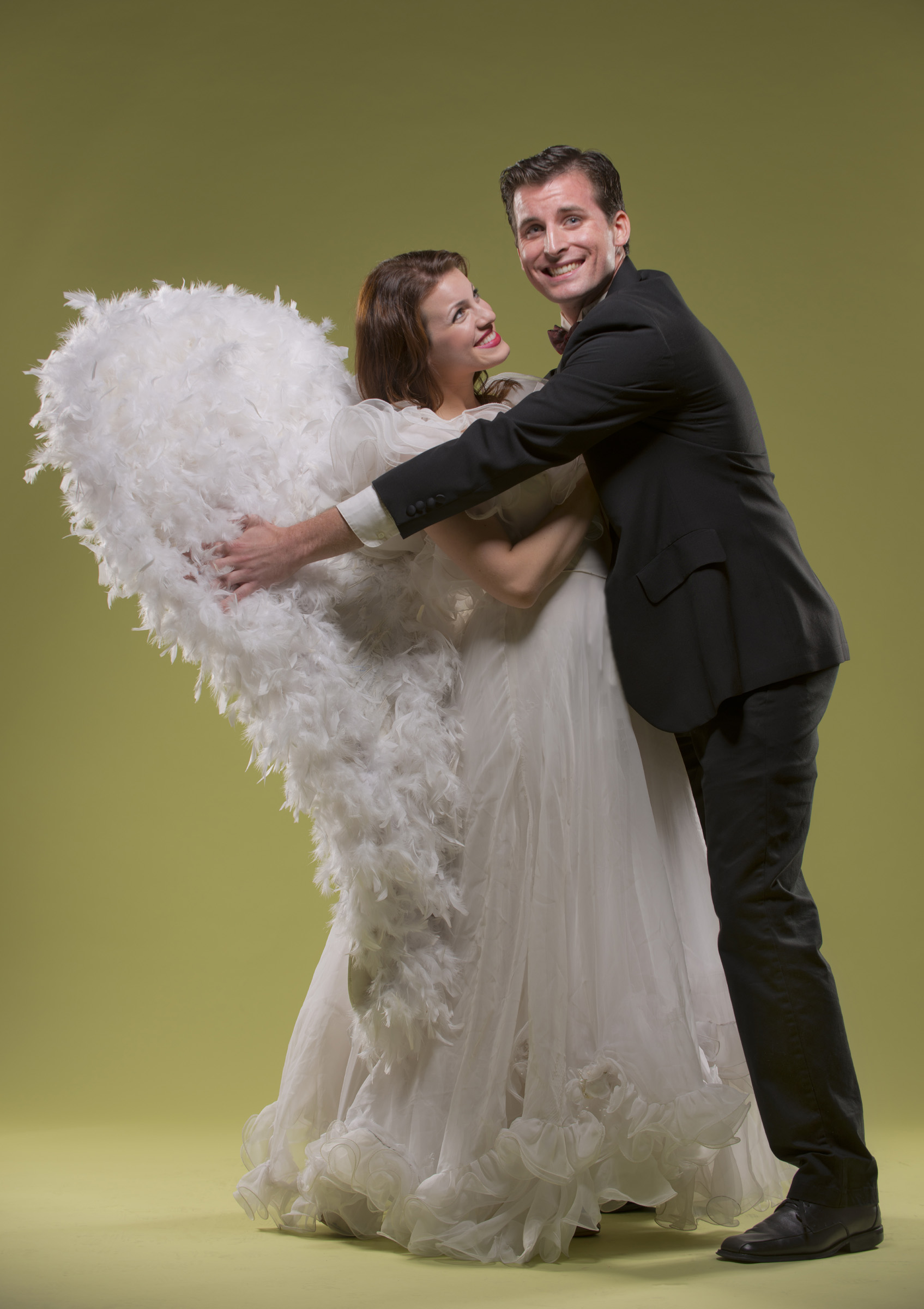
An unsettling NEXT FALL at San Jose Rep.

By Kedar K. Adour

NEXT FALL: Drama by Geoffrey Nauffts and directed by Kirsten Brandt.San Jose Repertory Theatre, 101 Paseo de San Antonio, San Jose. (408) 367-7255. www.sjrep.com.  October – November 10, 2013. [rating:3] (3 /5 stars)

An unsettling NEXT FALL at San Jose Rep.

Twenty five plus years ago there was a plethora of plays dealing with the HIV-AIDS epidemic and as that topic had become over saturated in the theatre interest has shifted to the legal ramifications of gay and lesbian relationships. There were numerous instances where a gay or lesbian was denied visitation rights and health care decision making for a partner and some states have legally sanctioned those denials. Geoffrey Nauffts’ Next Fall dramatizes one such specific case in this second play of San Jose Rep’s 2013-2014 Season.

The sold out original 2009 Off-Broadway production by Naked Angels was extended three times and the entire cast moved to Broadway in 2010 receiving good but mixed reviews. Brantley of the New York Times called it “artful, thoughtful and very moving” and critic David Cote named it “the little play that could.” It played for 132 performances. The reviews of a more recent New York and regional productions were not as well received.

One could rightly suspect that the casting and direction could be responsible for the wide range of the critical reviews but the author must share much of that criticism for setting up a hot button issue with disparate characters and dilutes the impact of the primary point at issue. He attempts to reconcile certain religious belief of the “sin” of homosexuality with a compatible loving same-sex relationship and for questionable reasons has included a taciturn white male with attraction for black men. 

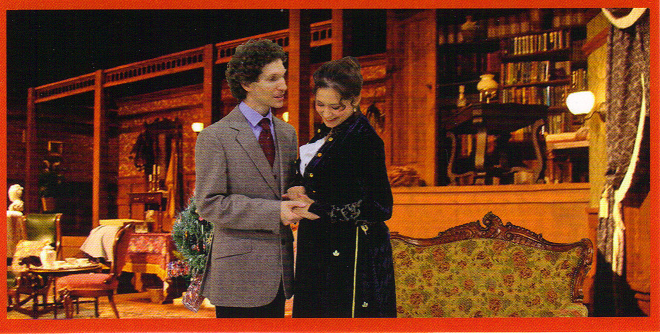
Adam (Danny Scheie) and Luke (Adam Shonkwiler) All photos by Kevin Berne

Adam (Danny Scheie) is an outwardly gay 40 year old unsuccessful writer who enters into a satisfying sexual and emotional relationship with deeply religious young actor Luke (Adam Shonkwiler) who recognizes the concept of sin and rationalizes that transgression by praying after having sex.  Luke has not come out to his family consisting of a bigoted born again Christian father, Butch (James Carpenter), his mother Arlene (Rachael Harker) divorced from Butch and an unseen stepbrother.  In the theatrical world every gay man must have a female confidant. In this play she is named Holly (Lindsey Gates). The dubious male mentioned above is named Brandon ( Ryan Tasker).

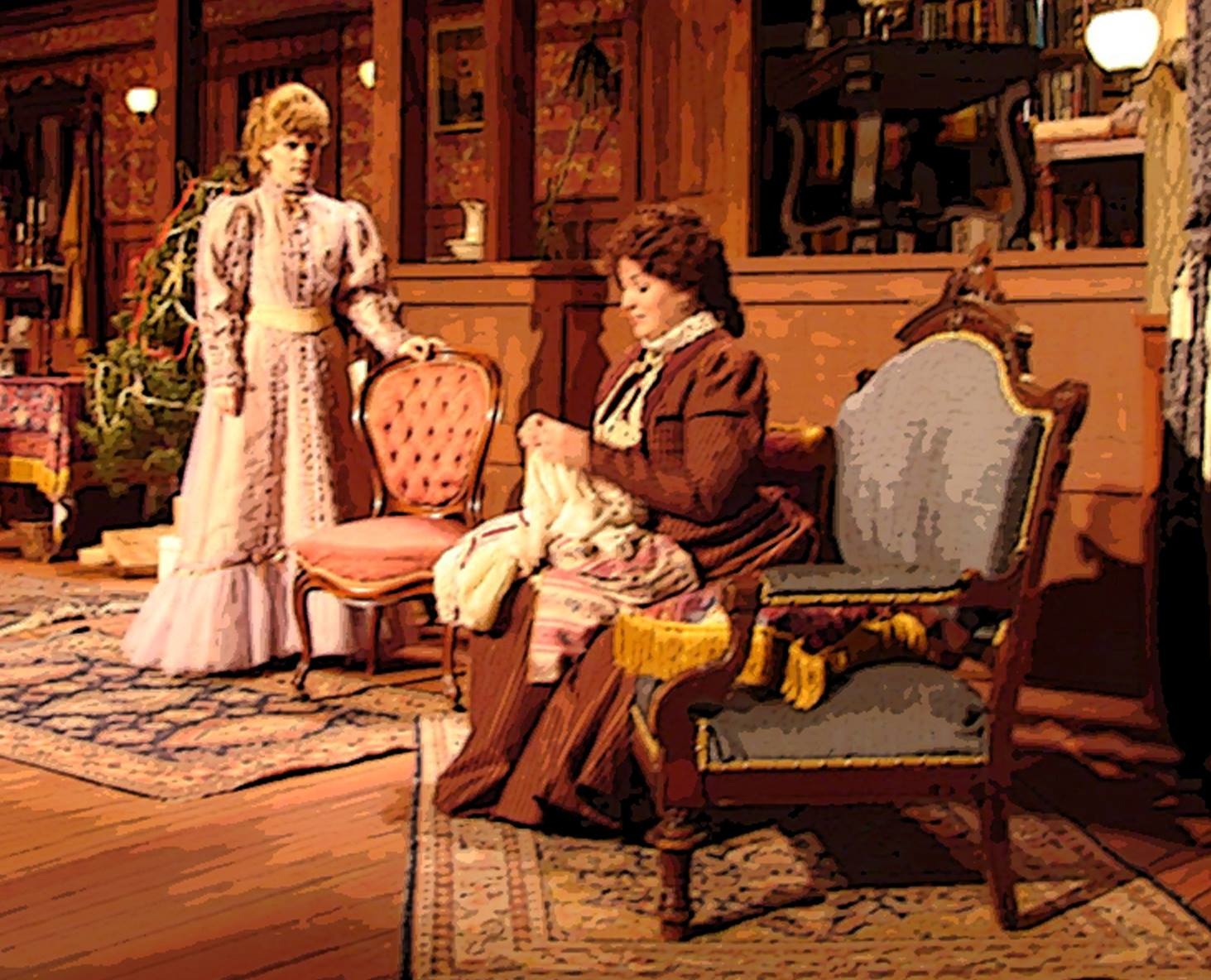
(l to r) Brandon (Ryan Tasker), Holly (Lindsey Gates), Adam (Danny Scheie), Arlene (Rachel Harker) and Butch (James Carpenter) grapple with issues of love, faith and acceptance

The play opens and mostly takes place in the waiting room of a Jewish run hospital. The fact that it is a Jewish hospital is integrated into Nauffts’ dialogue as is mention of other religions to prove one of his major tenets. Luke has been in an accident and eventually his condition deteriorates. Before that happens, Luke’s parents arrive and conflict arises as to Adam’s rights of visitation and medical decision making.

The play is non-linear with shifts back in time defining the relationship of Adam and Luke and filling background on the other characters. In that first scene, for some unfathomable reason, Lindsey Gates’ portrayal of Holly is loud conveying insensitivity that is not justified in later scenes. When Adam, who was away when the accident happened, arrives Arlene is the mollifying influence.

The storyline is predictable with only a modicum of surprises but also with a good dollop of humour. One of the funniest is a direct steal from La Cage aux Folles, when Luke attempts to de-gay the apartment by hiding fixtures and paintings before his father makes a surprise visit. With that job incomplete Butch arrives with Adam alone in the apartment. Carpenter and Scheie, both consummate actors, play off each other like finely tuned instruments and when Carpenter departs the non-physical duel is a draw.

There is more than a bit of discussion about salvation and redemption and at times seems to be proselytising. Where the first act lays the groundwork, Act 2 has powerful drama as the here-to-fore bantering between Butch and Adam verbally erupts and includes physicality with crushing emphasis that Adam has no say in the decisions that must be made concerning the dying Luke.

(James Carpenter), Holly (Lindsey Gates), Arlene (Rachel Harker) and Adam (Danny Scheie) confront personal beliefs and each other


Adam is Nauffts’ protagonist and has the lion share of dialog. Danny Scheie is a master at playing an effeminate gay man and to his credit he subverts those tendencies to give a subdued performance but there always seems to be a desire for the flamboyancy to emerge. Adam Shonkwiler’s sincerity as the religious Luke seems genuine and he makes a splendid foil for the flippant Adam. Bay Area icon James Carpenter give strength to  the role of Butch and one would wish there were more for him to do.  Of the other actors Ryan Tasker as Brandon, with minimal dialog, deserves accolades.  

Annie Smart’s spacious set allows the scene changes to move smoothly without intrusion on the action but somehow seems inappropriate for this “family-values” play. Director Kirsten Brandt decision to place an early flash-back scene on a high platform on stage left for the intimate first meeting of Adam and Luke seems self-indulgent.

With the recent legal strides of recent years, this play would be more cogent in the 1980s. Running time 2 hours and 20 minutes.

Kedar K. Adour, MD

Courtesy of www.theatreworldinternetmagazine.com


Intimacy, Sex, and Art

By Joe Cillo

Intimacy, Sex, and Art


That what we are and can be as persons is bound up completely with the quality of our most important personal relationships should be so obvious as to need no proof.  (Guntrip, p. 194)


This is an article I wrote for young people who are starting to grapple with the issues of human relatedness.  It was published by Kendall Hunt in a textbook that is used in college level human sexuality courses.  Having been dissatisfied with the presentation of the article in that venue, I decided to repost it here, with some revisions.


The three topics: intimacy, sex, and art, are closely related.  In fact, I see them as variants on a long spectrum of modes of communication of the inward heart.  Because intimacy is the most profound form of human relating and basic to the other two types, it will serve as the starting point for this discussion.  Keep in mind that intimacy is essentially communication, and it is communication of the inward heart.  By this I mean the sharing of our private inner world of thoughts, feelings, sensations, intentions, dreams, fantasies, or ideas that are in most circumstances experienced and held private within ourselves.  We all have an inner life.  We all experience the world and each other subjectively.  That is, we not only have sensations and gather information by means of our senses, but we react to those experiences, we interpret them and respond to them, in light of our previous experiences and conditioning events.  These reactions and understandings and judgments we make about our experience is not readily evident to others, although those that are closely attuned to us may have a sense of our inner states.  But this is acquired through repeated experience and careful attention.  Our bodies and our demeanor may yield some clues to some of our inner states, but most of our thoughts, feelings, intentions, and imaginings are experienced privately within ourselves.   The sharing of that private world with another person or persons is intimacy.

We live in a culture that does not value the inner life of individuals and is uneasy with the exploration and sharing of that inner life.  Americans are very outward looking and outward directed.   We like action rather than reflection.  But intimate communication and the quality of that communication is the foundation of our personal lives and our closest relationships.  It affects the social and intellectual development of children, and is a powerful motivator in all aspects of human activity.  Intimate communication reveals the structure and style of one’s personality.   It requires at least two people to be intimate, but intimacy can include more than two.  There are many ways to share our inner experience: speech, touching, movements, gestures, actions, artworks, and sex are all modes of intimate communication.   One can think of intimacy as emotional and psychological disrobing.

A persona is a mode of presenting oneself publicly in order to promote smooth functioning in society.  It is not necessarily false, although personas can often be very misleading.  At best, it is only a very partial revelation of who we are.  A persona is like a suit of clothes that we wear to meet expectations others have of us.  It is only the top layer, which allows us to carry out daily activities without causing disturbance.  There is much that goes on within us that is not revealed in how we present ourselves publicly even to close friends and family members.  Intimacy is the process of revealing those deeper layers of our inner life.  The audience for such revelations is typically small, although art is an intimate revelation that aims for a wide audience, or an undefined audience.  We will discuss the peculiar qualities of artistic communication a little further on.  But for now we will think of intimacy as communication of the inner self occurring within an interpersonal context.

Intimacy has degrees.  In an interpersonal relationship intimacy is usually reciprocal to some extent, although that reciprocity will vary.  Intimacy is rarely balanced and it is never perfect and it is never complete.  A mother’s intimacy with her infant or young child is weighted toward the child.  The mother has greater awareness of the child’s needs than the child has of the mother’s.  The intimacy of a doctor or a psychiatrist with a patient is weighted toward the patient.  In every personal relationship the degree of transparency and opacity will vary considerably from one area to another.  I like to think of relationships as having doors and windows that open and close.  Some doors open and some remain closed.  Some are closed after they have once been open.  Some windows you can see through and some you can’t.  This is intimacy.  It is highly variable depending on the person and on the relationship.

We should avoid formulating an ideal of what intimacy should be like.  Such ideals and expectations tend to be used to criticize and evaluate, and this tends to undermine intimacy.  Intimacy depends on acceptance, which is a relaxation of our defenses, expectations, and preconceptions.  Openness and receptivity are prerequisites to intimacy.   One must suspend one’s assumptions and expectations of another person in order to be intimate.  Intimacy is always full of surprises, because you really know very little of what is inside another person, and a person’s inner landscape is always in flux.  To maintain an intimate connection with another person you have to pay attention.  Rather than being something one strives for, intimacy depends on relaxation and allowing what is normally kept inward to emerge and flow freely into the mutual awareness between oneself and another.  This can be very risky.  There are good reasons why we keep many things private to ourselves.  An outlook on life and on human beings heavily committed to moral strictures and/ or to an ideal of personal behavior is an impediment to intimacy.  When a person fears judgment and censure, it is hard to be revealing.  Creating an atmosphere where a person can feel comfortable sharing what is habitually kept inside and not outwardly expressed can take considerable time and skill.  In some situations with a new person intimacy seems to appear suddenly and spontaneously.  It may yield a feeling of elation or exhilaration.  But such intimacy is only partial and often turns out to be temporary.  Intimacy has a developmental line.  It can broaden and deepen over time creating ever greater mutual awareness and interdependence, or it can shrink.  It can ebb and flow like a tide that rises and falls.  Relationships that have become dull or boring, that seem have lost their vitality,  have probably lost their intimate connection.  Small rejections and disappointments cause the doors and windows of intimacy to close.  These small alterations in the avenues of inward communication accumulate over time.  They are quite often so small and subtle that they often go unnoticed.  But their cumulative effect is that the couple begins to lose interest in one another.  One or the other might start to look elsewhere for the kind of connection they need.

Intimacy in an interpersonal context is habitual communication which creates a bond of the emotions and one’s inner personhood.  Repeated contact maintains and enhances this bond.  Intimacy tends to establish patterns of relating, small unspoken understandings and agreements.  An intimate connection that has fallen into neglect can be revived, but disuse can allow alterations in ones internal configuration to establish themselves that may make a revival of a previous intimacy difficult.

Intimacy should probably be distinguished from dependence, which is very common.  Emotional dependence, the need for the reassuring presence of another, the need for constant attention, the desperate clinging to the attention and presence of another in response to a largely unconscious premonition of abandonment or loss, is a form of one-sided intimacy akin to that of a mother with her children.  Communication and understanding flow mostly in one direction.  This kind of connection is narcissistic in the negative sense, which I will explain a little further on. It is an unbalanced form of intimacy.

Despite the many obstacles to intimacy, it is something that occurs spontaneously and naturally among people.  People want to be closely and emotionally connected to one another.  Even the most paranoid or schizoid person wants to be understood and accepted on his or her own terms.  These great public conflagrations of rage and despair such as Adam Lanza’s, Eric Harris and Dylan Klebold’s, Seung-Hui Cho’s, are meant to communicate with the entire society.  The perpetrators of these spectacles don’t want to just die, they want to be noticed.  I doubt if there is any hope or expectation of understanding left in such people.  Understanding is something they have had very little of in their lives and have long given up on.  These actions are spectacular exhibitions of destruction and despair.  Mass murder is intimate because it communicates and reveals the inward heart.  The bond it creates with its victims and society is its continuing legacy of destruction.

Empathy

Intimacy in its most mature form is related to empathy.  Empathy is the ability to accurately grasp the inner life of another person, to understand how another person feels in a particular situation, to grasp the logic of their motives, to be able to anticipate their reactions or behavior.  Empathy is not to be confused with sympathy, which is an attitude of benevolence or compassion toward another person.  Empathy is strictly informative.  It says nothing about how this accurate understanding another person’s inner life will be applied.  Salesmen need empathy, politicians need empathy, con men need empathy, torturers need empathy.  And so do doctors, mothers, artists, and lovers.  Empathy is only a tool.  Like a hammer, it can be used to build a house, or to kill somebody.

Because empathy informs one of strengths, weaknesses, vulnerabilities in another, intimacy informed by empathy carries considerable risk.  One becomes vulnerable in an intimate relationship.  A person who knows you well can hurt you, and they know best how to do it.  Exposure of one’s inner self carries with it natural vulnerability.  It takes courage and self-confidence to be intimate.  Many people who lack such inner strength and confidence have difficulty becoming intimate with another person.  Some people reach a certain level of intimacy and then panic at the realization of their own vulnerability.  They may inexplicably withdraw at the very moment when the relationship seems to be close and deepening.  Because of the high level of vulnerability entailed by intimacy, trust is an important ingredient in any intimate relationship.  It is almost a prerequisite.  People who are unable to trust others due to past injuries or painful relationships have difficulty forming intimate connections to others.

Paranoid and Schizoid Defenses 

Paranoia is an abiding condition of fear coupled with mobilization for defense that has been established through repeated attacks.  It is the great enemy of intimacy.  Paranoia is a defensive system that operates on the assumption that all human relations are essentially antagonistic and exploitative.  What it is defending against is an extreme sense of vulnerability, and rage against its many persecutors.  Paranoid people simply don’t believe in constructive, nurturing, benevolent relationships.  Every good and positive outreach toward them is converted into something hostile or manipulative.  If you succeed in penetrating the formidable defenses of a severely paranoid person, what you will find is a wounded, enraged person who sees himself as the victim of attacks from all directions.  You may find yourself playing a starring role in his persecutory delusions — not a position you want to be in.

Another common defensive system that seems to be increasingly popular in America is the schizoid.  The schizoid person withdraws from human contact.  They attempt to shrink the emotional life across the board keeping human interactions and emotional expression to an absolute minimum.  Intimacy tends to be avoided at all costs, and when ventured into is an area of great difficulty.  The schizoid challenge is disengagement.  You can’t reach the person on an intimate level.  The paranoid is engaged, but it is a hostile, destructive engagement.

They [the schizoids] are the people who have deep-seated doubts about the reality and viability of their very “self,” who are ultimately found to be suffering from varying degrees of depersonalization, unreality, the dread feeling of “not belonging,” of being fundamentally isolated and out of touch with their world.

The schizoid problem is the problem of those “who feel cut off, apart, different, unable to become involved in any real relationships.  (Guntrip, p. 148)

These two defensive styles in a range of degrees and combinations are very widespread in American society and have influenced our laws and our culture to the extent that intimate relationships are difficult to achieve and maintain in contemporary America.  Intimate relations are seen as hazardous — which they are — and this feeds the paranoid’s need for defense and the schizoid’s need to withdraw into isolation.  Intimate relationships are therefore not encouraged, or even actively discouraged, and sometimes persecuted — which tends to intensify the trend toward isolation.

The reasons for this increasing cultural trend are deep and complex and would make a good book, if someone out there wants to write it.  But one important piece of evidence, I think, is the growth and success of science and technology, especially over the last couple of centuries.  Science looks at the world in a totally impersonal way.  Explanations of natural phenomena are sought in terms of mechanical causes and effects, not for personal reasons having to do with the human world.  The success of this style of perceiving and relating to the natural world has enormously extended the human capacity to exploit, subdue, and control Nature to a degree unimaginable only a few centuries ago.  This success has encouraged its application to all areas of life.  Schizoid personalities are very common among scientists and mathematicians.  “Objectivity” means removing oneself from the matter at hand, perceiving and understanding a matter apart from one’s personal interest in it.  People are increasingly looking at one another in this depersonalized, utilitarian fashion.

This is consistent and very congenial to the values of corporate capitalism which are focused entirely on externals like production, exchange, transportation, organization, and profit.  The growth of corporations over the last century and a half, whose sole rationale and purpose for existence is to maximize profit, with all other values being subordinated to that overbearing imperative, have devalued the personal life of everyone in that economic system.  Personal happiness, interpersonal satisfaction, and sexual fulfillment, have no exchange value and therefore play no role in the economy.  Increasingly one’s personal life is forced to the sidelines as earning a living takes an ever greater proportion of time, energy, and attention.   Modern life creates numerous obstacles to forming intimate relationships and places great challenges upon them, and this has created a society full of lonely, disconnected people hungry for connection yet finding it increasingly difficult to make the kind of fulfilling connections they seek.

What is the value of intimacy?  Why strive for intimacy in our relations with others?  Intimacy is the antidote to loneliness.  Humans are by nature social.  We are a species that has always survived in groups rather than as isolated individuals, like, say, orangutans.  Humans need connection to others and that need is established in the earliest interactions between an infant and its mother.  The lack of such a connection is experienced as painful distress.  An abandoned infant will cry until it is exhausted.  The need for reassuring connection to other human beings is deep in our nature and intimacy fulfills that need for connection.  Our experience of ourselves is from the outset defined and established in relation to others, first and foremost, to our mothers.  This earliest intimacy with our mothers establishes the development of our sense of self, the narcissistic structure of our personalities.  This defines our need for intimacy and how that need is expressed and sought.

Narcissism

Narcissism in the broadest sense refers to how one experiences oneself as a human being.  It refers to one’s feelings about oneself and one’s abilities, one’s personal appearance, one’s physical capabilities and bodily integrity, and how one sees oneself in relation to others.  It has to do with how one feels about life in general.  Is it good?  Is it bad?  It is worthwhile, or not?  Should I continue living or not?  These are narcissistic issues because they refer back to the self and the engagement of the self in life. 

There are positive and negative aspects to narcissism.  Narcissism in the positive sense is the regard one feels for oneself and one’s own well being.  The care one takes of one’s own body, one’s attention to grooming and appearance, the sensitivity one has to the impression one makes on others, the care and attention one gives to one’s own health and well being, the satisfaction one feels in accomplishment or the realization of ambition, the sense of satisfaction one feels in helping others, teaching others, giving to others, one’s sense of participating and belonging to a larger group.  Good parenting is narcissism in the positive sense, the satisfaction one takes in seeing one’s children grow up healthy and constructively.  Narcissism in the positive sense is feeling a sense of abundance in oneself, having the ability and the resources to share with others and enhance the lives of others.  In a word, self-esteem.  The satisfaction one takes in giving an appropriate gift is a narcissistic satisfaction.  On the other hand, an inappropriate gift, a gift that is overly extravagant, or is otherwise not suited to the recipient shows a lack of empathy, a lack of understanding of the other person, a gift given to enhance the giver in his own eyes rather than from an appropriate understanding of the needs of the receiver is an example of narcissism in the negative sense, of deficient empathy and using others to enhance one’s own self-esteem or sense of grandiosity.  Pathological narcissism is obliviousness to the needs and feelings of others.  It is not necessarily malicious, although it often comes off that way.  It is actually a deficit in emotional perception.  Pathological narcissism cannot see beyond its own needs and interests because of a great underlying sense of vulnerability.  Pathological narcissism limits one’s capacity for intimacy because one’s need to enhance one’s own self image is so great it overwhelms and excludes the ability to be receptive and open to the needs and feelings of another.  Narcissism in the negative sense tends to exclude empathy or uses empathy selfishly and unsympathetically without consideration of the needs or feelings of others.  The narcissistic structure of one’s personality determines the degree of intimacy of which one is capable and the character of the intimate relations one is able to establish, whether constructive and enhancing, or destructive.

Art

Art is also communication of the inward heart.  An artist realizes his own inner self, or, let’s say, an aspect of it, in a work or performance that can be viewed or shared by a public audience.  This impulse to create and share one’s internal self is a narcissistic need.  Not everyone has this drive to create and share one’s inner heart through external symbolic representations.  It is a peculiarity of artists, the origins of which we will not explore here.  Art is a form of intimacy in the sense that the artist shares his or her inward self and exposes it to an external audience.  The size of the audience does not matter.  What is important is that art reaches out for connection.  Art is not masturbation.  It is not something you do for your own private comfort or amusement.  Art connects you to other people.  There is a narcissistic satisfaction in creating something with great technical skill that others can recognize and admire.  But what is essential to art is not this narcissistic satisfaction that the artist feels in his creative accomplishment, but rather the outreach to others from the core of the artist’s inner self that a work of art represents.   By creating something external to oneself, as opposed to simply daydreaming or fantasizing, one creates the possibility of a connection to others through their perception of one’s artwork.  When a person comes into contact with a work of art, they are coming into contact with a representation of the inner self of the artist who created it.  One does not create randomly.  This does not mean that a viewer can readily grasp the emotional and psychological meaning of a work of art upon encountering it.  It takes considerable time and experience to understand an artistic language, and artists are often deliberately obscure and idiosyncratic in how they present themselves in their work.  However, it is my view that artistic effectiveness is related to communicative effectiveness rather than to obscurity.

Architectural blueprints, anatomical diagrams, maps, graphs, are depictions of external reality.  They are meticulous assemblages of facts, measurements, and objective characteristics that can be seen and verified by anyone.  They are not usually thought of as art, because they do not reflect the inner self, the maker’s subjective reaction or perspective on the subject presented.  When Picasso did his painting of the Weeping Woman (1937) he was not trying to recreate this woman in a true to life rendering.  Rather, this image reflects how Picasso saw this woman and how he chose to depict her out of all the many ways he could have chosen to do this painting.  This painting is a subjective view of the woman, not an attempt to describe her body or her character with objective validity.  Art is about illusions.  It is about how the artist needs to see the world, not necessarily how the world is.  And that is entirely based on his personal psychology.  Even the Dutch masters who drew and painted meticulously accurate portraits of faces and people still had a personal style of their own.  They had to choose how to portray their subjects, what manner of dress they should wear, how they should be posed, the circumstances in which they are set, the intensity and direction of the light, the mood or facial expression to be portrayed.  These are all personal choices of the artist that go into the creation of a “realistic” portrait.  So in this sense art is always a reflection of the subjectivity of the artist.  Art is a partial intimacy because what the artist chooses to present of himself is carefully selected and meticulously prepared for public presentation to obtain a calculated effect.  The intimacy of art tends to flow in one direction, from the artist to the viewer.

Reciprocity, that is, the viewer’s experience or reaction to the artwork is not usually experienced directly by the artist, except for admiring applause or negative reviews.  But that is not the most important impact of art upon its audience.  The important and lasting impact of art is usually not expressed directly, and that is the expansion of the inner awareness of the viewer of an artwork, or an alteration in his or her perception and understanding of the external world, or of himself or herself.

I disagree with John Cage that art is non-intentional, that its purpose is to ” sober and quiet the mind, thus making it susceptible to divine influences.” (John Cage, johncage.org/autobiographical statement )  This conception of artistic purpose rejects the communicative function of art and is the polar opposite from my own view.  My understanding of art is narcissistic in the sense that it starts from the self of the artist and connects the artist to other selves through the communicative means of the artwork.  Cage’s conception of art stems from Zen Buddhist ideas that seek the annihilation of the self.  Art becomes a means of “emptying” the self, reducing the self towards the ideal of nothingness.  Nothing could be further from or more opposed to the point of view I am advancing here.  My view is that life is a process of the growth of the self and the enhancement of the self through fulfilling connections to others, as stated in the epigraph at the outset.  Art is a means toward that enhancement and fulfillment as is intimacy in personal relationships.  Zen Buddhism essentially elevates the schizoid position of detachment and isolation to an ideal of human development, a view I am totally out of sympathy with.

What is the value of art?  Art expands one’s awareness of the internal life and enables one to perceive people, the external world, the social environment, and one’s inner life in new ways.  Art alters our way of looking at things and experiencing ourselves.  In that sense art can be educational in that it offers modes of experiencing ourselves and the external world that might not be available through other channels.  Art can change people in that it alters their perceptions and awakens them to aspects of inner and outer reality of which they may not be aware.  In that sense art is volatile and can be subversive if it seeks to illuminate that which is officially suppressed.  Art fosters intimacy by expanding awareness of the inner self and directing attention toward reflection on the inner life.  Failure to educate in the arts, minimizing attention to the arts, devaluing the arts, indicate a lack of value placed on the development of the inner self.

Sex

What does all of this have to do with sex?  Sex is also communication of the inward heart and an expression of the narcissistic structure of the personality.  It falls within the broader concept of intimacy, but it has peculiarities that set it apart from other forms of intimate communication.  Sex is communication through the body that seeks the satisfaction of lust.  Lust is a powerful connecting emotion.  Lust impels one to seek contact with another person, and it is contact of a particular kind, namely contact leading to sexual arousal and genital contact.  However, many other kinds of touch and many other aspects of intimacy occur within the context of sexual activity.  Touch, physical affection, and bodily closeness are enormously reassuring and comforting.  These needs for comfort, reassurance, and affection that occur alongside the satisfaction of lust are highly intimate and satisfy a deep longing for connection and bonding between people.  This is perhaps the deepest form of intimacy because it is a sharing of the most intensely felt bodily and psychological longings.  How one expresses and seeks to satisfy lust and the need for bodily closeness reflects the narcissistic structure of one’s personality.  Sex has a lot in common with art in that the mode in which one seeks to satisfy lust reflects one’s narcissistic needs just as the art that one produces reflects the narcissistic structure of the artist’s inner self.  Sex says a lot about who you are.  Sex is not only about the satisfaction of lust.  Sex is a paradigmatic expression of narcissism.  Because sex is communication, sex tells you where you are in a relationship with another person.  When sex is going well and people find satisfaction and mutual pleasure in one another, it signifies a strong bond and a positive avenue of communication and understanding.  Of course this is not the only aspect of a relationship that is important and it is not all there is to intimate communication.  Some people use sex to cover up or avoid other issues that may be a source of discomfort.  Sex can also be used to conceal and mislead.  A dishonest heart can use sex to manipulate and destroy.  The intimacy of sex is only partial.  Sex is one aspect of intimacy, but a very important one because it embodies the energetic connection of lust and sexual arousal.  But do not think that because you have sex with a person you know everything important about them.

Kissing

There are numerous theories on the origin of kissing, and kissing can, of course, have many different meanings.  Some cultures do not kiss at all, or very little.  References to kissing in Western culture go back to ancient times, and the era of exploration and colonialism, as well as modern media have spread the practice of kissing around the world.  Psychoanalytic theory sees the propensity to kiss stemming from the feelings of warmth, safety, nurturing, and well being in the infant’s nursing at the mother’s breast.  Clamping the mouth on the nipple is a means of incorporation, of sustenance, dependence and survival.  In adults the meanings and style of kissing can be many, but kissing always carries a message related to nurturing or incorporation.  Gentle kisses of affection, pecks on the cheek and so forth, impart a message of affection, good feeling, warmth, reassurance, and nurturing.  Kisses of passion and desire communicate a will to incorporate, to possess, consume, an emotional neediness, an inner longing and loneliness for which one is seeking solace in the other.  Kissing — or not kissing — reveals how attracted a person is to your body, how much they need you, how much they like you, their willingness to depend on you, and the degree to which they can reciprocate your feelings and empathize with your needs.  All of this can be communicated through kissing.  Oral sex is a further extension of these feelings and needs of both giving and incorporating through the mouth, but applied to the genitals and the emotions of sexual arousal.  The use of the mouth as a body connector is a very powerful and effective means of intimate communication.

Orgasm

Orgasm is understudied and not well understood.  Most of what is known about orgasm has issued from studies of epilepsy and people who have had nerve damage, spinal and/or brain injuries.  Physiologically, orgasm shares a lot of characteristics with epileptic seizures.  There is no scientific consensus on the definition of orgasm or how it should be conceptualized.  For this reason I am putting forward my own conceptualization of it here.

Sexual desire, lust, sexual arousal, and orgasm are hypnotic processes.  They shift our awareness to special subjective states that mobilize emotional and physical response systems that are normally dormant during everyday experience.  Sexual desire, or lust, is the perception of the sexuality of another person.  It is looking at another person and feeling the possibility of sexual activity, creating a visualization of the other in a sexual context.  It is a conscious awareness of desirable sexual interaction, which is a continuing state.  It is different, from simply perceiving a person’s existence, or the clothes they are wearing, or their ability to perform some task, or their physical characteristics.  What makes it different is that it mobilizes our personal emotional response system and prepares us for sexual arousal in a way that other kinds of perception do not, and therefore it is an altered mode of awareness.  Sexual arousal is the next level of intensification.  The body becomes mobilized in anticipation of sexual activity.  Internal physical sensations become more prominent in our awareness and other considerations that might inhibit sexual arousal tend to be excluded from consciousness.  Arousal is intensified through physical stimulation of the genitals and other regions of the body as well as psychic stimuli such as sound, scenario, internal visualization (fantasy), and perhaps smell.  At a certain threshold orgasm is triggered.  Involuntary physical processes are set in motion accompanied by intense awareness of pleasurable sensation that excludes nearly everything else.  Orgasm is a state where physical pleasure overwhelms consciousness and obliterates the ability to attend to other inputs to consciousness.  Some people see a relationship between orgasm and the  “loss of self” reported in some mystical experiences.  My feeling is that orgasm differs from these mystical experiences in that in orgasm the self does not disintegrate.  The self remains intact.  But normal consciousness, which ordinarily processes input from numerous internal and external sources simultaneously, becomes overwhelmed during orgasm by internal physical sensations which become extraordinarily dominant.  Other modes of perception and awareness are not extinguished.  One can still see and hear during orgasm, but, orgasm is a state where interoception (awareness of the internal state of one’s body) is magnified to a unique predominance.  This makes it special.  One must be able to relax one’s external and internal perceptual apparatus in order to orgasm.  Ordinarily we are bombarded by sensate experience from the external world as well as from our own internal thought processes.  In order to orgasm one must be able to allow those perceptions to recede from consciousness so that the physical pleasure of the orgasm occupies one’s awareness to the near exclusion of everything else.  This is a hypnotic process.  It is not entirely voluntary, but it is conditioned by experience.  It is the capability of awareness to shift in a specific way under the conditions of intense sexual stimulation.  One does not orgasm from driving a car or vacuuming the carpet.  Orgasm is a special type of conscious experience that can only occur under very specialized conditions.  In my view, this is the way orgasm should be understood.

Komisaruk, et al. (2006) argue that orgasm is not a reflex, but rather a perception,  (p. 237f.)  and I concur with this  valuable insight.  That is, orgasm is not generated by muscular contractions caused by genital stimulation, which, in turn, lead to a reflexive action in the spinal column.  Genital stimulation mobilizes neurons throughout the body sending greater and greater levels of excitation to the brain.  The muscular contractions are indeed reflexive and can be elicited in the spinal column even when the spinal cord is severed.  But orgasm is not produced unless those muscular contractions are perceived by the brain as sensations.  This supports my view that orgasm should be understood as essentially a psychological phenomenon, not simply as a physical process.  The physical concomitants of orgasm are, of course, noteworthy and important, but Komisaruk and his collaborators have shown that the physical processes themselves do not constitute orgasm.  They can occur without the experience of orgasm, and orgasm can occur independently of physical arousal.  Therefore orgasm must be understood as essentially a subjective experience, a particular state of altered awareness, that is usually (although not necessarily) accompanied by specific physiological processes under the conditions of intense sexual arousal.  Orgasm is therefore primarily a narcissistic experience rather than a communicative one, although sharing orgasms is a powerful bonding experience, because sharing the special ecstatic state of orgasm is highly intimate. 

Sadism and Masochism

Sadism is the pleasure we take in the suffering of another.  It is a spectrum that extends from gentle teasing to torturing someone to death.  Sadism reflects ambivalence.  It is essentially a hostile, destructive impulse that is mitigated by feelings of good will, love, guilt, and perhaps fear.  We need the person toward whom we feel hostility, so we don’t want to destroy them.  But it feels good to see them suffer.  It is the expression of the suppressed hostile impulse that is pleasurable.  The spectrum is defined by the mix of hostile and positive feelings toward the victim.  The greater the hostility, the greater the cruelty and the darker the expression. As the mitigating feelings tend toward zero, it becomes simply cruelty.  Mild sadism is ordinary and commonplace.  Jokes are often mildly sadistic and jokes that are overly hostile can lose their humor.  Sadism is intimate because it expresses our conflicted feelings toward another person, and the pleasure we feel in the pain or discomfort of another is something usually kept private.  Sadism is common in sexual activity to a greater or lesser degree, because sexual relationships are conflicted and often mixed with hostile aspects.

Masochism is using adversity to one’s advantage and seeking it out for that purpose.  I see it as a broader concept than sadism and it is related to depression and despair.  Masochism is an adaptation of people who are habituated to suffering and adversity.  The erotic aspect of it, feeling sexual arousal in response to pain, or pain as an intensifier of erotic feeling, comes from associating sexual arousal or love with painful experiences, neglect, disappointment, and abuse.  One learns that to love, or to be aroused, hurts, and one comes to expect, or even to need, that conjunction of feelings.  In my eyes, masochism is harder to understand than sadism because in order to understand it one must grasp a lifetime of painful experiences that may not be easily accessible.  In an erotic context it is not a neat complement to sadism, in general.  It is much more complicated, whereas sadism, although conflicted, is relatively straightforward.  For that reason I don’t like the term ‘sadomasochism’.  It squashes together two things that I think are very different and don’t necessarily complement one another.

Love

Love is a word that is used in many different ways to mean many different things.  I tend to avoid it because I always fear that I am giving the wrong impression.  People attach very different meanings to ‘love’ and it raises all sorts of expectations that may not be realistic.  However, it is enormously reassuring and people love to hear it, so we must deal with it.

I will start with my definition of love in the best sense.  Mature love is good will guided by empathy and tempered with a respect for the separateness and individuality of the other person.  Empathy is very important.  Empathy means you understand how the other person feels and what his or her real needs are.  Most of what is called ‘love’ is not empathic and this leads to all sorts of turmoil.  I disagree with defining love in terms of a willingness to sacrifice on behalf of the beloved.  This is masochistic.  It implies that you are giving up something you would rather not in order to benefit the beloved.  You are inflicting some suffering upon yourself in order that your loved one may enjoy some benefit.  Love is certainly characterized by a giving spirit and a desire to enhance and bestow advantage upon one’s beloved.  But rather than self denial, love represents a sharing of the abundance of one’s physical and emotional resources.  It does not necessarily expect anything in return, but it embodies a hope for attachment and good will and an intertwining with the life of the beloved.   Love is an expansion of the self, an attempt to complete the self through emotional resonances and attachment to what is valued and idealized in the other.  Whatever is done out of love does not occur beyond good and evil, as Nietzsche once suggested (Beyond Good and Evil, 153).  Love can never be an excuse for reckless or destructive actions.  Love lies squarely within the framework of our values and constructive human relationships.  Mature love is closely related to respect for others and responsibility for oneself. 

Our common notion of “romantic” love is characterized by strong emotion, passion, elation, anticipation, despair, jealousy, possessiveness, dependence and obsessive preoccupation with the beloved.  This is what people usually mean by being “in love.”  This kind of love tends to be self-centered and unempathic, often lacking a realistic perception of the beloved as a complete person, sometimes ignoring serious character flaws in the other, and often a maintaining distorted understanding of the relationship itself.  It is sometimes manifest as a furious, psychological dependence that devours and emotionally destroys the other through insatiable demands for attention and control.  This is not mature love, in any way, shape, or form.  However, these experiences can have great emotional and psychological significance.  Relationships that start out this way can sometimes evolve into more mature forms of love without losing the passion and zest with which they began.  This romantic kind of love brings people together, but it is not what keeps them together in a satisfying relationship over a long period of time.  Empathy, good will, and respect are much more important for healthy, durable loving relationships than “love.”  Intimacy is an important element in a healthy loving relationship because intimacy informs and bonds.  Intimacy enables one to be close to another person, to know the other person in depth, to be in touch with the other person’s feelings, concerns, and needs.  Intimacy gives a sense of connection, mutual dependence, and support.  We do not face the world alone, we face it together as a couple giving strength and support to one another, informed by our intimate knowledge of one another and energized by lust and sexual pleasure.  It’s a good way to live, if you can achieve it.


Notes


Cage, John (1990) johncage.org/autobiographical statement.

Guntrip, Harry (1973)  Psychoanalytic Theory, Therapy, and the Self.  New York:  Basic Books.

Kirshenbaum, Sheril (2011)  The Science of Kissing:  What Our Lips are Telling Us.  New York:  Hachette Book Group.

Komisaruk, Barry. R.; Beyer-Flores, Carlos; & Whipple, Beverly. (2006)  The Science of Orgasm.   Baltimore:  Johns Hopkins University Press.

Nietzsche, Freidrich (1989 [1886])  Beyond Good and Evil.   Translated by Walter Kaufmann.  New York:  Vinage/Random House.

Tour de force acting in ‘Lettice and Lovage’

By Uncategorized

By Judy Richter

As bored as the tourists she leads through “the dullest house inEngland,” a guide begins to embroider her stories about the history of Fustian House.

Soon the tourists are fascinated as Peter Shaffer’s “Lettice and Lovage” gets under way at Hillbarn Theatre in Foster City. Eventually word of her fabrications gets back to her employer, England’s Preservation Trust. That’s when the guide, Lettice Douffet (Monica Cappuccini), is confronted by a Trust manager, Lotte Schoen (Celia Maurice), who fires her.

Ten weeks later, though, a contrite Lotte shows up at Lettice’s basement flat. The chilly air in this meeting begins to warm, especially when Lettice offers Lotte her special quaff, which includes vodka, other ingredients and an herb, lovage. Their friendship continues nicely until an unfortunate incident. Even that turns out well as the two middle-aged women figure out a new way to support themselves while making the best use of their particular skills.

Shaffer wrote this play for the great Dame Maggie Smith as Lettice. Although no one can duplicate a performer of that caliber, this play demands an actress who can carry it with long stretches of theatrical dialogue about English history and Lettice’s revered actress mother. Lettice tries to live by her mother’s motto, “Enlarge, enliven, enlighten.”

Director Greg Fritsch’s choice of Cappuccini is indeed fortuitous, for she delivers a tour de force performance throughout the three-act, two-intermission play. She’s well balanced by Maurice’s Lotte, whose more practical approach to life is an effective foil to Lettice’s dramatic ways.

The supporting cast is good, especially Lauren Rhodes as Miss Framer, Lotte’s giggly secretary; and John Baldwin as Mr. Bardolph, the solicitor who’s supposed to defend Lettice after the incident with Lotte.

Although their small parts are limited to the first act, Hiedeh Honari Saghi, Lindsey DeLost, Denise Beruman and Marc Berman quickly alter their personas as successive groups of tourists through Fustian House.

Using a turntable, the set by Robert Broadfoot readily switches to different locations. Shannon Maxham’s costumes are noteworthy, especially the red hats (a sly reference to the Red Hat Society for women) on one group of tourists.

Valerie Clear’s lighting works well, but the music in her sound design drowns out Lettice’s speeches at the beginning of Acts 1 and 2. This is a greater problem in Act 1, when Lettice repeats her set speech several times. Because the audience can’t hear it very well, there’s not enough contrast when the music stops and she begins to insert her own details.

Otherwise, this is an engaging, enjoyable production, thanks in large part to Cappuccini’s outstanding performance.

“Lettice and Lovage” will continue at Hillbarn Theatre, 1285 E. Hillsdale Blvd., Foster City, through Nov. 3. For tickets and information, call (650) 349-6411 or visit www.hillbarntheatre.org.


When did you last call Mom and Pop?

By Joe Cillo

BE GOOD TO YOUR PARENTS….OR ELSE!

Appreciating your parents is the only hope for civilization.
The Chinese Government & Lynn Ruth

China has decided it is a punishable crime for adult children to neglect their parents and I think that is a very wise decision. Wouldn’t it be wonderful for us all, if every nation followed suit?

It is about time someone took steps to stop the shameless way grown progeny are treating their parents these days. Elderly parents sit at home in their wheel chairs or on the sofa, counting the moments ‘til one of their offspring remembers that they are too weak and tired to get to Tesco’s; the hours tick by, their tummies gurgle, their heads ache and they stare at the door, praying it will open and the heir to their estate will appear bearing bubble and squeak and even a bit of pudding.

After all, parents have every right to expect their children to be there for them. Didn’t they clean up Junior when he got a bloody nose?  Didn’t they give their little princess dancing lessons so she could express her inner feelings? They let her get that disgusting tattoo of Frankenstein chewing a bunny and they never said a word when she appeared at the breakfast table, her hair dyed purple and three rings in her nose.

And that was before they became teen-agers.

They looked the other way, when their little darlings sold pot to the neighborhood grade-school kids, and the countless times they threw up on the couch from an overdose or got too affectionate with one another.  Remember that?

Didn’t they sacrifice that extra cruise, and the trip to see penguins copulate on an iceberg just so their son could go to university and their daughter could afford that abortion?  Of course they did.

And that is why the Chinese Government decided to step up to the plate and remind us that we owe Mummy and Daddy big time.  They were the ones who kept us alive through the bullying, the bike accidents, the shattered limbs and broken hearts.  Now, it is the children’s turn to keep their parents comfy and warm ‘til they breathe their last.  After all, there is always time to change the will, if they feel unloved.

Not that it will be easy if the law becomes universal. Take Mary Louise:  There she is galloping though her day, getting the kids to school, packing their lunches, rushing off to the office, picking up her darlings, and taking them to tap dancing and soccer, driving home, giving the house a quick dust, fixing dinner, greeting the father of her gang with a drink, serving food, cleaning the kitchen and collapsing in front of the telly.  At midnight, she and her hubby stagger up to bed, too exhausted to do what they used to do before they tied the knot. Suddenly, she sits bolt upright, snaps her fingers and says, “OH MY GOD!!!  I forgot to visit Daddy.  Now, we’ll never pay off this mortgage.”

And if her partner is a good sort, he says, “Don’t worry darling. I will visit you every Tuesday and bring chocolate.”

LA CAGE AUX FOLLES a Grand and Gaudy show at Cinnabar

By Kedar K. Adour

(L-R) Michael Van Why as Albin/Zaza and Stephen Walsh as Georges

LA CAGE AUX FOLLES: Musical Comedy. Book by Harvey Fierstein / Music and lyrics by Jerry Herman. Based on the play by Jean Poiret. Music direction by Mary Chun / Stage direction by Sheri Lee Miller. Cinnabar Theater, 3333 Petaluma Blvd. North, Petaluma, CA 94952.

707-763-8920 or www.cinnabartheater.org.  

LA CAGE AUX FOLLES a Grand and Gaudy show at Cinnabar

Sonoma County’s Cinnabar Theatre has mounted a colorful, hilarious, heart-tugging production of La Cage aux Folles which received a deservedly thunderous applause from an appreciative audience on opening night. The spacious stage of this 99 seat theatre has been converted into the night club “La Cage aux Folles” with a six piece band to back up the cast of 15 talented performers.  Thankfully, all that is missing is cigar/cigarette smoke for further authenticity.

That cast assures us in the song “La Cage aux Folles” that this is a ‘grand and gaudy’ place where you can meet your ‘mistress, boyfriend and wife’ at the same time! This new version that originated in London in 2008 traveled to Broadway in 2010 receiving accolades and awards on both sides of the Atlantic.  All the original songs are left intact and are given excellent renditions with professional singing and acting with the purposely graceless dancing by the hysterical, “hilarious kickline of Les Cagelles feature(ing) J. Anthony Favalora, Jean-Paul Jones, Quinn Monroe, Valentina Osinski, and Zack Turner.

(l to r) Quinn Monroe, Jean-Paul Jones, J. Anthony Favalora, and Zack Turner are in the hilarious kickline for “La Cage aux Folles,” (Photo by Eric Chazankin)

 This exciting and loving staging is not the flashy overproduced original musical comedy that was a smash hit on Broadway but a new more intimate show with heart. Because the recent defense of marriage act fiasco is still fresh in our minds, La Cage is even more politically/socially significant than its original performances 30 years ago.

Georges (Stephen Walsh) and effeminate transvestite Albin/Zaza (Michael Van Why) have been married for more than 20 years raising a son Jean-Michel (Kyle Stoner) born after a drunken one night liaison of Georges with Sybil a show girl (who does not appear in this new version) 24 years ago. Jean-Michel has fallen in love with Anne (Audrey Tatum) the daughter or Edouard (Stephen Dietz) and Marie Dindon (Madeleine Ashe). Mr. Dindon is the chairman of a committee to protect T.F.M. (Traditional Family Marriage) and is dedicated to removing every vestige of homosexuality from the Riviera.

Poor Jean-Michel feels that he cannot introduce Albin/Zaza as his mother and asks Georges to send Albin/Zaza away for a couple of days while they change the frou-frou apartment décor to a more staid appearance. And what are they to do with Jacob (James Pelican) the star-struck butler who dresses as a maid? [Side Note: the tall, gangly James Pelican would be hit in Charlie’s Aunt]Conflict arises and the bitter-sweet fun unfolds.

In this revision George pokes his head and then body through the stage curtain (believe it, there is an actual curtain) and introduces the up coming scenes to the audience and cues the band. First up are the Le Cagelles appearing as silhouettes behind transparent scrim panels then bursting out with dance and song with “We Are What We Are” as Georges joins in. What a great way to start.

After a swift scene change, (you will be amazed at the swift/mostly smooth scene changes) our ‘heroine’ Zaza has a copasetic solo “A Little More Mascara” before our Les Cagelles again flood the stage. You never know when they will flounce on and off the stage and that is part of the fun.

Charming Kyle Stoner is slight of build with a soft tenor voice shares his thoughts with Georges in an exuberant love song “With Anne on My Arm” that mirrors George’s plaintive love song to Albin “With You on My Arm” and the beautiful “Song on the Sand.”

While Zaza is performing with the Cagelles (“La Cage ax Folles”) George and Jean-Michel have redecorated the apartment that is now as ascetic as a Monk’s quarters with the statue of nude David replaced by a wooden cross, and butler/maid Jacob in a white wig and footman’s garb. The stunned Albin silently takes center stage for the haunting “I Am What I Am” that captivates the audience as the curtain closes on Act one.

After this marvelous first Act the anticipation of what is yet to come permeates the audience and they are not disappointed.  The scene where Georges and stage manager Francis (Miguel Evangelista) try to teach Albin “Masculinty” is a riot even though it is a direct steal from Tea and Sympathy. And more fun comes after two touching scenes defining the true meaning of “family”  no matter what are the genders involved with the tender “Look Over There.”

Then the Dindons arrive and it is too complicated to describe all the details. Suffice it to say that as usual Stephen Dietz adds zip to any part he plays even when he is the unlikeable chairman of the dastardly T.F.M! Don’t ask how it happens or why, the creators of the show have slipped in “Cocktail Counterpoint” sung and danced by ALL the family when Albin shows up as ‘mother’ in a sedate full length gown. Later, his faux pas after the charming “The Best of Times” creates pandemonium before the finale with most of cast members in drag. The costumes (Clay David) are a drag queens dream.

What really makes the La Cage aux Folles work is the fine acting of Stephen Walsh and Michael Van Why. They have a plethora of charisma that can be felt by all. Be assured you will be humming two or more of Jerry Herman’s songs on the way out of the night club “La Cage aux Folles.” Running time of 2 hours and 20 minutes.

Kedar K. Adour, MD

Courtesy of www.theatreworldintermagazine.com


MTC Presents World Premiere of Lauren Gunderson’s I and You.

By Flora Lynn Isaacson


Devion McArthur (Anthony) and Jessica Lynn Carroll (Caroline) I and You at Marin Theatre Company. Photo by Ed Smith.

I and You is a heartfelt new play focuses on how the work of Walt Whitman inspires two teenagers.  This play involves two ethnically different teens, cranky Caroline (Jessica Lynn Carroll) who is waiting for a liver transplant, and a level- headed basketball star, Anthony who loves John Coltrane, (Devion McArthur). At the beginning of the play, Anthony shows up in Caroline’s bedroom to get her to collaborate on a project to deconstruct a poem, “Leaves of Grass,” by Walt Whitman which is about the interconnectivity of everything.  But as the two cram to finish their presentation, they learn not only how to work together, but just how fundamentally, they complement each other.

Lauren Gunderson is currently a hot new playwright. Her plays are performed at Theatre Works , San Francisco Playhouse, Shotgun Players, and Crowded Fire.  Director Sarah Rasmussen, the Resident Director for Oregon Shakespeare Festival’s Black Swan Lab brings a fresh touch to the direction.  Michael Locher’s colorful attic bedroom set almost becomes a character in the play.  Devion McArthur gives a wonderfully sympathetic and supportive performance as he tries to win over Caroline.  Jessica Lynn Carroll gives a challenging performance as Caroline who is difficult every step of the way.

I and You begins its life at Marin Theatre Company and immediately goes on to productions in Maryland and Indiana.  With this play, Gunderson writes in the voice of two intelligent kids, members of a savvy generation who have a lot to say about how fast the world around them is moving.  She explains their journey of self discovery with a similar journey expressed by one of America’s finest poets over 150 years ago in a beautifully articulated, revealing piece of literature.

I and You runs October 10-November 3, 2013 at Marin Theatre Company, 397 Miller Avenue, Mill Valley. Performances are Tuesday, Thursday-Saturday at 8 p.m., Wednesday at 7:30 p.m. and Sunday at 7 p.m. Sunday matinees are held at 2 p.m. with a Saturday, November 2 performance at 2 p.m. and Thursday, October 24 at 1 p.m. For tickets, call the box office at 415-388-0208 or go online at www.marintheatre.org.

Coming up next at Marin Theatre Company will be Jacob Marley’s Christmas Carol by Tom Mula and directed by John Tracy, November 21-December 15. 2013.

Flora Lynn Isaacson


Brigadoon by Alan Jay Lerner & Frederick Loewe, Spreckels Theatre Company, Rohnert Park CA

By Greg & Suzanne Angeo

Reviewed by Suzanne and Greg Angeo

Photos by Eric Chazankin

Fanciful, Fun Brigadoon

Tyler Costin, Lauren Siler

Brigadoon, the latest in a series of musical offerings at the Spreckels Performing Arts Center, is a pleasant diversion from modern cares. Its irresistible score by Frederick Loewe, coupled with  enchanting lyrics and story by Alan Jay Lerner, has been a crowd-pleaser since it first opened on Broadway in 1947. The glorious 1954 film directed by Vincente Minelli, starring Gene Kelly and Cyd Charisse, cemented Brigadoon’s reputation as a dazzling romantic fantasy.

The story begins one summer day in 1946. Two big-city American pals, Tommy and Jeff, are on a hunting vacation in the wilderness highlands of Scotland. They stumble across a tiny village that emerges dreamlike from the mist and seems to be from another time. Intrigued, Tommy and Jeff are drawn into the village and the festivities surrounding a wedding that day. They soon find themselves involved with the townsfolk, especially two young ladies. But there is something very odd about this village; because of a miracle performed by their pastor, each night while the villagers sleep, a century passes. The kindly folks of Brigadoon are now two  nights and 200 years into their future, with no end in sight. There will be another sunset, and another century. No villager may ever leave; otherwise Brigadoon will vanish into the mists of time, forever lost. The two men leave just before the sun goes down and return to New York City, but Tommy has fallen in love and is under Brigadoon’s spell. He longs to return, remembering the words of the village schoolmaster Mr Lundie: “If ye love someone deeply, anything is possible.”

According to an old theater saying, to make a musical believable, you sing when you can no longer speak, and you dance when you can no longer walk. This allows for the illusion of logic in an illogical situation. It offers a seamless emotional and physical transition for both performer and audience. It’s tough to pull off, to say the least. In their undertaking of Brigadoon, the Spreckels Theatre Company makes an ambitious effort, and for the most part, succeeds.

William Thompson, Heather Buck

Following a traditional musical formula, Brigadoon revolves around three romances. We have the lead couple, Tommy and Fiona, played by Tyler Costin and Lauren Siler. The comic partners are Jeff and Meg, played by William Thompson and Heather Buck. The betrothed couple at the foundation of the story is Charlie and Jean, played by Sean O’Brien and Abbey Lee.

When watching someone perform, there’s a little thrill of goosebumps when you see exceptional talent, and that thrill happens whenever O’Brien takes the stage. His powerful,  lyric Irish tenor voice is easily the best of the show, especially in the numbers “I’ll Go Home With Bonnie Jean” and “Come to Me, Bend to Me”. Lee plays his beloved Jean, and she delivers a strong, sympathetic performance with a fine voice. While Costin’s Tommy doesn’t seem quite the type to be roaming the highlands in search of big game, he’s got winsome appeal in the role, and a pleasant singing voice. Thompson as his sidekick Jeff provides the right amount of comic relief and bewilderment at Meg’s advances. Played by Buck, the boisterous Meg is a treat to watch, with her strong voice, clumsy eagerness and sincere infatuation with Jeff.  Siler as Fiona is lovely and confident in her role, but her singing is pitchy in spots, although she was good in her duets with Costin.

Sean O’Brien, Ensemble

Supporting cast performances are also uneven. Dwayne Stincelli is appropriately wise and wonderful in the small role  of Mr Lundie. Connor Figurate plays the jealous Harry Beaton with physical grace, especially in his execution of the Sword Dance, but his performance lacks the necessary anger and menace. The same can be said of a number of other performances; technically good but lacking a certain inner fire, or sense of urgency.

The 20-piece orchestra, directed by Cynthia Heath, does very well with the challenging score, despite occasional off notes. Choreographer Michella Snyder did a good job with the complex numbers, but some of the dances lacked uniformity and maybe just need more rehearsal time. There were some really excellent clan dances that seemed true to the period and people. Also lending an authentic feel to the show are the colorful plaid tartans, brought all the way from Scotland by costume designer Pamela Enz.  Another wardrobe triumph by Enz is the gorgeous 18th-Century wedding dress worn by bonnie Jean. Overall the costumes are quite wonderfully done.

Wayne Stincelli

Director Gene Abravaya makes good use of the theater’s Paradyne system, created by Spreckels to allow up to ten computer-controlled projectors to incorporate still and moving images into the action onstage. For Brigadoon, six of the projectors are used, mostly to provide a natural-looking backdrop for  village, forest and city. This gives a bright, dimensional look to the stage. However, it would have been a more dramatic effect if a critical scene near the end of the show could have shown the dwindling light of the setting sun. For some reason the light did not appear to change much during this scene. A more original use of Paradyne is seen in projected musical  film sequences representing flashback memories, but they were out of sync. Whether this was by accident or design is open for interpretation. Regardless, the effect is interesting and unlike anything you’ll see on any North Bay stage. The fog machine is often busy pumping out Scottish mist, sometimes a bit thickly, but it’s a fun effect and well-applied.

Brigadoon is an exhilarating show, nicely staged and choreographed. It’s perhaps not as cohesive as other recent musicals at Spreckels, and perhaps the Paradyne system could have been put to better use, but the show is well worth seeing.

When: Now through October 27, 2013

7:30 p.m. Thursday October 24

8:00 p.m. Fridays and Saturdays

2:00 p.m. Saturdays and Sundays

Tickets: $22 to $26 (reserved seating)

Location: Codding Theater at Spreckels Performing Arts Center

5409 Snyder Lane, Rohnert Park CA
Phone: 707-588-3400

Website: www.spreckelsonline.com

A bromidic WARRIOR CLASS deftly staged at TheatreWorks

By Kedar K. Adour

Holly (Delia MacDougall) and Nathan (Robert Sicular) meet over lunch to conduct political negotiations in Kenneth Lin’s WARRIOR CLASS, receiving its California Premiere October 9 – November 3 at TheatreWorks at the Mountain View Center for the Performing Arts. Photos by Tracy Martin

WARRIOR CLASS: Drama by Kenneth Lin. Directed by Leslie Martinson. TheatreWorks, Mountain View Center for the Performing Arts, 500 Castro St., Mountain View. (650) 463-1960 or www.theatreworks.org. October 15- November 3, 2013

A bromidic WARRIOR CLASS deftly staged at TheatreWorks

When a play does not create excitement but has laudable qualities it is difficult to write an unfavorable yet fair review. The California premiere of Warrior Class at TheatreWorks on Thursday night created that dilemma. It has an excellent three person cast helmed by Leslie Martinson, an award winning director and is being performed on a superb, clever rotating set by Eric Flatmo. If we accept the adage “the play’s the thing” therein lays the fault. There is nothing original about the plot and the characters are hardly likeable.

 Author Kenneth Lin is an Asian-American writer with more than creditable curriculum vitae. His livelihood is apparently earned as a TV writer. Not only is he a staff writer on Netflix’s “House of Cards” but is the creator of a new limited series, “American Way,” for USA Networks. That is probably explains why Warrior Class has the feel of TV potboiler.

All three characters have flaws and Lin deftly inserts exposition disguised as normal dialog to flesh out his characters’ background and motivations. It all revolves around Julius Lee a charismatic Asian-American who has beaten an entrenched Democrat incumbent for seat in New York State’s House of Representative after giving an impassioned speech that turned the election in his direction. Julius (Pun Bandu)has all the credentials to progress up the political ladder.  He is an educated, charismatic son of Chinese immigrants as well as being a decorated ex-Marine. He is now ready for a step up to the NY Senate or US House of Representatives. He is labeled “a Republican Obama.” Problem: He has a “incident” in his background that could derail his and the Party,s aspirations.

Nathan Berkshire (Robert Sicular) is the savvy political strategist advisor to Julius and the Party assigned to make the incident “go away.”  It is not until the second act that he is given humanistic traits to soften his Machiavellian nature and he prides his profession as being the “warrior class.”

In the opening scene Nathan meets Holly Eames (Delia MacDougall)the former live-in girlfriend with Julius while they were in college. When Holly split from Julius he became enraged, viciously stalking her causing Holly’s mental breakdown leading to their exodus from college. He joined the Marines and she eventually married now living in Baltimore with her husband a discredited financier who needs a job.

It just so happens that there are a few appointee jobs that Julius and the Party control. Holly has come forward with details of the past, intimating that if her husband is given one of those jobs the “red flag” will disappear. That is the set-up for the play that is introduced in the first scene where Nathan has his first “back room” chat at the B & O Steakhouse with Holly.

Julius (Pun Bandhu) and Nathan (Robert Sicular) have
a tense discussion

The remainder of the play shifts between Julius’s home in a posh New York suburb and the B&O Steakhouse. The negotiations take some unexpected nasty turns giving a modicum of tension to the play. Nathan’s “warrior class” takes a verbal beating before the curtain descends. After that happens, Julius pulls out his popcorn machine making a making a bowl of his comfort food that is introduced early in scene two. . . thus an ambiguous ending to the evening. Running time one hour and 40 minutes including the 15 minute intermission.

Kedar K Adour, MD

Courtesy of www.theatreworldinternetmagazine.com