
James Dunn’s Gripping New Production of R.C. Sherriff’s Journey’s End at RVP

By Flora Lynn Isaacson


Tom Hudgens, David Yen & Francis Serpa in Journey’s End at RVP.  Photo by Robin Jackson.

 [rating:4] (4/5 stars)

Ross Valley Players presents the West Coast Premiere of the World War I drama Journey’s End by R.C. Sherriff. Set in the trenches of war, the play gives us a look into the experiences of the officers of a British Army infantry company as they prepare for an enemy attack.  Set in a dugout at St. Quentin, France in 1918, toward the end of the war, the entire story plays out over four days—March 18, 1918 to March 21, 1918.

First of all the set (Ron Krempetz) was excellent. A window dead center was brilliantly lit by Ellen Brooks and really helps to set the scene, as day breaks, the sun streams down and at night, the candles and lamps glow in the darkness.  The attention to meticulous detail takes us straight back to the damp, inhospitable setting of the trenches.  We could see two bunks, a table with candles and several makeshift chairs.

The play begins as Captain Hardy (Steve Price) prepares to go on leave—new officers will replace him for the next six days.  Captain Stanhope (David Yen) has been at the front for three years, is mentally on the edge and is always drinking whiskey. He is joined by Lt. Osborne (Tom Hudgens), 2nd Lt. Raleigh (Francis Serpa), 2nd Lt. Trotter (Stephen Dietz), and 2nd Lt. Hibbert (Phillip Goleman).  Sean Gunnell (Private Mason) is the omnipresent cook that appears hour after hour.  Jeff Taylor has a wonderful cameo as the company sergeant major.  The men eat, smoke and drink all to excess since there is nothing else to do in between being on duty. There is tension, sadness and constant fear but stories and laughter too.

The performances from the nine strong ensemble are exceptionally good with brilliant performances from many. The sound design (Stephen Dietz) really set the tone of the play and rather than drown us with constant fire, gave us deafening bombardment to spectacular effect, when necessary, but mostly, just eerie silence and pops of distant shells.  The end of the journey is a sad one, but the story of the journey is highly recommended, due to Dunn’s magnificent staging and his sterling ensemble cast.  Everything about this production has been rendered with a sensitivity and craftsmanship that represents theatre at its finest.

Journey’s End runs January 16, 2014-February 16, 2014.  Regular Thursday performances are at 7:30 p.m., Friday-Saturday at 8 p.m. and Sunday at 2 p.m. All performances are held at the Barn Theatre, home of the Ross Valley Players, 30 Sir Francis Drake Blvd., Ross, CA.  For tickets, call 415-456-9555, extension 1 or go to www.rossvalleyplayers.com.

Coming up next at Ross Valley Players will be Arms and the Man by George Bernard Shaw and directed by Cris Cassell, March 14-April 13, 2014.

Flora Lynn Isaacson

Shaw’s MAJOR BARBARA a smash hit at A.C.T.

By Kedar K. Adour

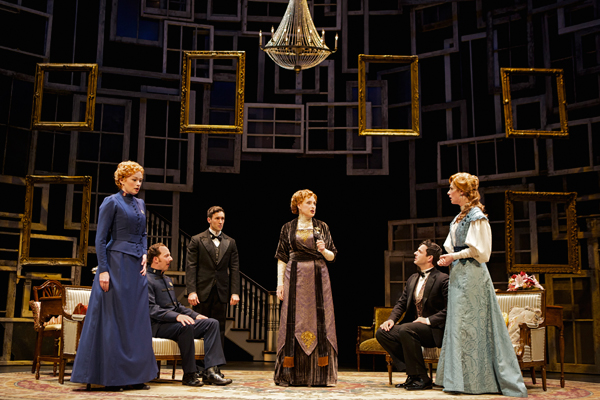
(l to r): Gretchen Hall (Barbara), Nicholas Pelezar (Adolphus),Stafford Perry (Stephen)Kandis Chapman (Lady Undershaft), Tyrell Crews (Charles Lomax), Elyse Price (Sarah) in Scene 1.

Major Barbara: Comedy by George Bernard Shaw. Directed by Dennis Garnhum. American Conservatory Theater (ACT), 415 Geary St., San Francisco, CA. (415) 749-2228 or www.act-sf.org. Through February 2, 2014

Shaw’s MAJOR BARBARA a smash hit at A.C.T.   [rating:5] (5/5 stars)

Undertaking to mount a George Bernard Shaw play requires quality actors, astute direction and understanding of his social philosophy to overcome his propensity to sermonize with lengthy dialog. In 2008 San Jose Rep, under Timothy Near’s direction, produced a brilliant and memorable Major Barbara. With that memory still vivid this reviewer entered the theatre with a bit of trepidation that totally disappeared by the time the cast took their well-deserved bows after doing great justice to Shaw’s 1905 play. Its themes are as cogent today as they were then.

 Shaw is an equal opportunity skewer of entrenched attitudes on all social levels, a champion of women’s rights, and an astute observer of injustice with the ability to strip the façade of hypocrisy. In Major Barbara he attacks with equal vigor the sanctimony of the Salvation Army and the justifications of the arms manufacturers noting the driving force of both groups is money. Consider the fact that the motto of the Salvation Army, “Fire and Blood”, is identical to that of Andrew Undershaft’s (Dean Paul Gibson) munitions factory that has developed a highly lethal bomb and a bomber capable of delivering what our present generation calls the “weapon of mass destruction.”

In between these two major themes he sneaks in the smugness of the British social elite and the self-delusion of politicians. He populates his plays with characters from all strata of society creating a fascinating mélange to carry his thoughts forward with didactic infused with humor.

Major Barbara was first produced by London’s Royal Court Theatre in 1905 and on Broadway in 1915. This production is produced in association with Theatre Calgary and their artistic director Dennis Granhum directs the cast with enthusiasm and understanding beginning with a charming first scene as a drawing room comedy with Kandis Chapman giving a stunning precise performance of an English matriarch dominating son Stephen whose responses are delightfully apprehensive. Through her extended dialog Shaw adroitly outlines the family relationships and upcoming conflicts before the arrival of Andrew Undershaft whom she has invited to visit the family.

There is the aforementioned Andrew Undershaft, who sired two daughters Barbara, the eldest, (Gretchen Hall), Sarah (Elyse Price) and son Stephen (Stafford Perry) with his wife Lady Britomart Undershaft (Kandis Chappell). Andrew has not seen his children since their childhoods, and has not lived at home but provides financial support. Barbara has joined the Salvation Army and risen to the rank of Major and has a fiancé Adolphus Cusins (Nicholas Pelezar) an Australian  professor of Greek who seems at first to be supercilious but before the play ends he matches Andrew sentence for sentence and idea for idea. Pelezar and Gibson give bravo performances during their confrontation.

Shaw creates indelible lower class characters. Act two shifts to West Ham Salvation Army shelter  where we meet Romola “Rummy” Mitchens (Valerie Planche), Bronterre O’Brien “Snobby” Price (Dan Clegg), Peter Shirley (Dan Hiatt) who have been willing to aver that their souls have been saved in order to have food and shelter. Hypocrisy dwells on all strata of society. 

Plance, Hiatt and Clegg give marvelous verisimilitude to each of their characters carrying their fine acting in their double roles in act three. Andrew’s devious confrontation with the denizens and leaders of the shelter invokes compromise of the Salvation Army’s professed motivations causing Barbara to withdraw from the Mission.

In Act three the Undershaft family and entourage visit the munitions factory and the model town of Perivale St. Andrews that has been built with the profits from arms sales. The factory workers live an idyllic life in this company town without guilt feelings about the source of their happiness. The overwhelming ambiance of this perfect town and its life style change the preconceived concepts of the Undershaft family and their entourage about the source of Andrew’s wealth.

The production values of this play are astounding.  It involves massive sets with scene one drawing room brought forward on a carriage stage to be surrounded by a junkyard of distressed windows and doors completing a semicircle around the entire rear stage. The rear wall remains intact and is integral to becoming the West Ham shelter for act two. This juxtaposition of wealth and poverty is perfectly integrated.

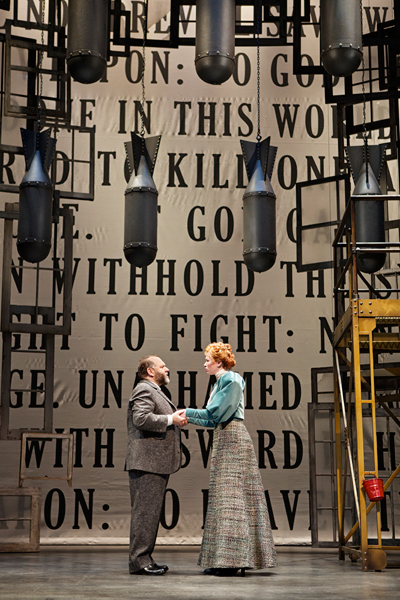
It is the final act configuration of the munitions factory that is a wonder. With aphorisms written in block letters on the huge backdrop while life-like bombs are strung up over the set signifying their potential devastation that is horrifying.  Even though they have moved the final act from a scene outside the factory, and some of the stage directions have been violated, one would hope that George Bernard Shaw would give a begrudging nod for the staging. He certainly could have no qualms about the acting. (Running time 2 hours and 40 minutes with one intermission)

(Andrew Undershaft (Dean Paul Gibson) and Barbara (Gretchen Hall in the bomb factory)

SET DESIGN by Daniel Ostling; COSTUME DESIGN by Alex Jaeger; LIGHTING DESIGN by Alan Brodie; SOUND DESIGN by Scott Killian; DRAMATURGS Michael Paller and Zachary Moull; CASTING by Janet Foster,CSA; ASSISTANT DIRECTOR Zachary Moull; STAGE MANAGER Elisa Guthertz.

Kedar K. Adour, MD

Courtesy of www.theatreworldinternetmagazine.com.

Moral ambiguities fuel ‘Major Barbara’

By Judy Richter

Right is right and wrong is wrong, one character opines, but that delineation isn’t nearly so clear cut in George Bernard Shaw‘s “Major Barbara.”

American Conservatory Theater‘s production focuses on the moral ambiguities and ironies as the title character, a major in the Salvation Army, finds herself at odds with her long-absent father, a wealthy manufacturer of weapons and gunpowder.

Barbara Undershaft (Gretchen Hall) and her father, Andrew Undershaft (Dean Paul Gibson), are reunited at the behest of her mother, Lady Britomart Undershaft (Kandis Chappell). Because Barbara and her sister, Sarah (Elyse Price), are both involved with men of little means, Lady Undershaft wants their father, her estranged husband, to provide for them. She also wants him to designate their son, Stephen (Stafford Perry), as his successor in the business, but both men understand that Stephen has no head for business.

However, Andrew is impressed with Barbara’s sincerity when it comes to saving souls, so he agrees to visit the Salvation Army shelter where she works if she will visit his factory in return.

The shelter attracts some desperately poor people, some of whom say that Barbara has saved their souls, but the real reason they say so is that they need the bread she feeds them. Barbara’s superior, Mrs. Baines (Jennifer Clement), arrives with news that a wealthy distiller will make a generous donation if other wealthy men agree to match it. Barbara would reject the money because it comes from someone whose product contributes to so many of the problems she sees at the shelter. Then when her father matches the amount, she’s so dismayed that she leaves the Army.

Still, she agrees to visit his factory along with the rest of the family the next day. Andrew has built a pleasant town for his workers, pays them well and provides generous benefits for them and their families. The money may be tainted in Barbara’s eyes, but if it weren’t for their jobs at Andrew’s factory, they would become impoverished, just like the people at the shelter, he says.

Andrew makes compelling arguments and no excuses for his line of work. Despite lives lost, war brings him money, lots of it, and the power to use it for good if he so chooses. His power also can buy politicians and the ability to create war or peace, whichever suits his purpose at the time.

Besides debating Barbara, who may not be equal to his strength in this production, Andrew matches philosophical wits with her fiance, Adolphus Cusins (Nicholas Pelczar). He’s a professor of Greek who joined the Salvation Army just to be near Barbara.

This ACT production is presented in association with Theatre Calgary, where it will go after its San Francisco run. It’s directed by the Canadian company’s artistic director, Dennis Garnhum, and features a cast of American and Canadian actors.

Despite solid performances by Hall as Barbara and Gibson as Andrew and the rest of the cast, the play’s most memorable performance comes from Chappell as the imperious, blunt Lady Undershaft.

The early 20th century costumes, so elegant for the upper crust, are by Alex Jaeger, with a set by Daniel Ostling (the bombs in the factory are scary), lighting by Alan Brodie and sound by Scott Killian.

Even though the three-act play (one intermission) is more than 100 years old, much of it rings true today, leading to many sounds of recognition in the opening night audience. “Major Barbara” is a timely, thought-provoking addition to the ACT season.


THE PAIN AND THE ITCH relieved at Custom Made Theatre

By Kedar K. Adour

THE PAIN AND THE ITCH: Comedy by Bruce Norris. Directed by Dale Albright. Custom Made Theatre Company, Gough Street Playhouse, 1620 Gough St. (at Bush), San Francisco, CA94109. Gough Street Playhouse is attached to the historic Trinity Episcopal Church 510-207-5774; www.custommade.org. January16- February 9, 2014

THE PAIN AND THE ITCH  relieved at Custom Made Theatre

Play [rating:3] (5/5) :     Set [rating:5] (5/5)   Cast [rating:3] (5/5)   Overall [rating: 4] (5/5)

Sex Therapist Ruth Westheimer (better known as Dr. Ruth) believes that a lesson taught with humor is a lesson learned well. Along with psycho/sexual therapy she also believes that viewing pornography can be a helpful stimulant to a relationship lacking passion. How are these words of wisdom applicable to The Pain and the Itch” a hilarious, thoughtful, confusing, uneven and yet fascinating production that is gracing the boards on Custom Made’s intimate three sided stage? Author Bruce Norris honed his playwrighting skills at Steppenwolf Theatre and his Clybourne Park  won Pulitzer Prize for drama and the 2011 Tony Award for Best Play.

Be forewarned that if you are not familiar with the text/plot of this Bruce Norris 2006 play it will be well into the second act when relationships finally become defined and answers to some of the questions posited above almost make sense. Even then you will leave the theatre with unanswered questions. But you will have the answer to what animal/creature is gnawing on the avocados in the kitchen.

The action takes place in an unnamed locale in the upper-middle class home of Kelly (Karen Offereins) and Clay (Justin Gillman). She is the breadwinner and Clay is a stay-at-home male parent. A ‘creature’ has been gnawing on the avocados in the kitchen. Clay’s unreasonable reaction to the question of what this ‘creature’ could be aptly foreshadows the gnawing feeling that something is not right in this household.

That gnawing feeling builds bite by bite as the family unit shreds each other with caustic remarks that may have you squirming in your seat even though some members of the opening night audience were in hysterics. Other members of the family unit are the platitude spouting mother Carol (a superb Jean Forsman), martini swigging older brother and plastic surgeon Cash (Peter Townley), young energetic daughter Kayla (charming without having a single line of dialog Gabriella Jarvie) and a new born baby. Cash has brought a young sexy middle European ( Russian?) girlfriend Kalina ( over acting Eden Neuendorf) who has adopted all things American including maxing out her credit cards.

Dorian Lockett as Mr. Hadid

Then there is a Black Muslim taxie driver Mr. Hadid ((Dorian Lockett who steals the show with his exit speech). For an unexplained reason he has been brought into the household to hear/sort out the facts/lies generated by the family during the events of previous evening Thanksgiving dinner. It includes the revelation of Kayla’s nasty genital/? sexual rash hence the title The Pain and the Itch. Late in the play he has the players re-live the scene where the rash has been discovered in order to have a better understanding of the facts. This is an unnecessary writing conceit that is more confusing than explanatory.

All in all in two hours and ten minutes with an extended 10 minute intermission author Norris and the cast inundate us with vicious social inequities that need re-emphasizing. As Dr. Ruth insists, humor carries the lessons and in this play it is dark, dark humor. Oh yes, the pornography tapes are simulated (sound design Liz Ryder) not projected to the audience.

Staff/Crew: Director, Dale Albright; Stage Managers, Linda Y. Huang/Johanna Ruefl; Scenic Design/Build, Stewart Lyle; Lighting Design, Hamilton Guillen; Sound Design/Composition, Liz Ryder; Production Manager, Kevin Dunning.

Kedar K. Adour, MD

Courtesy of : www.theatreworldinternetmagazine.com

“Jacques Brel is Alive and Well and Living in Paris” at Cinnabar Theater, Petaluma CA

By Greg & Suzanne Angeo

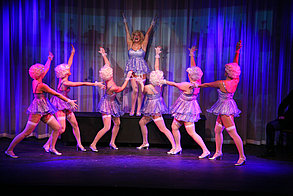
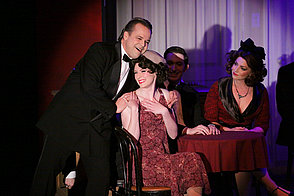
Julia Hathaway, Kevin Singer, Michael Van Why, Valentina Osinski

Reviewed by Suzanne and Greg Angeo

Photo by Eric Chazankin

Cinnabar audiences should be prepared: this is not your typical musical or revue. It’s a classy, gutsy cabaret-style presentation of the profoundly moving music of Jacques Brel, a Belgian-born singer-songwriter who rose to fame in 1950s France. Brutal honesty and self-deprecating humor, delivered with charm, wit and sometimes anger, are Brel hallmarks. This is music that brands your soul.

Brel’s songwriting style is based on the chanson, a musical form with roots in Medieval France. Back then, chansons were epic poems set to simple melodies; think Troubadour songs. The style evolved over the centuries, and by the 1940s it had become deeply embedded in  French popular culture with its stories of truth, passion and the meaning of life. Thus the “nouvelle chanson” gained worldwide fame through singers like Edith Piaf, who heavily influenced Brel’s work. In turn, scores of modern singers and songwriters have felt Brel’s influence.

“Jacques Brel…” debuted Off-Broadway in 1968 and has been performed all over the world. English translations of Brel’s lyrics were done for the show by Eric Blau and Mort Shuman. Four performers are charged with delivering each song as though it were a small one-act play.  Some pieces are solos, and some call for two, three or all four to perform together.

Bay Area vocal powerhouses Michael Van Why, Julia Hathaway, Valentina Osinski and Kevin Singer are well up to the task, delivering strong performances in Brel standards like the snappy and cynical “Madeleine”, the hauntingly poignant “Old Folks” and the hilarious, ironic “Next” (Van Why calls it “the gonorrhea song”). ”Carousel” is one of best numbers and serves as the rousing finale. A member of the band even stands up and juggles little pink balls.

Nuanced and flexible staging by director Elly Lichenstein merges well with the work of the choreographer (Joseph Favalora) and set designer (Wayne Hovey). Five onstage musicians wield instruments besides the usual suspects of trumpet, flute, guitar, bass and drums. Of course there is a very French accordion – to provide that cabaret atmosphere – but also a ukulele and marimba. This produces a lively accompaniment, although at times the vocalists seem drowned out by the musicians and are hard to hear. This weakens the effect of such a lyric-driven show. Perhaps wireless mikes could solve this problem?

To sum up, “Jacques Brel…” is an emotional rollercoaster: bleak and buoyant, laughter mixed with tears, sunshine through the rain. His raw, visceral musical style connects with the human spirit as few others can. And local audiences are responding, since the show’s run has been extended through January 26th.

When: Now through January 26, 2014

8 p.m. Fridays and Saturdays

2 p.m. Sundays

Tickets: $25 to $35

Location: Cinnabar Theater

3333 Petaluma Blvd North, Petaluma CA
Phone: 707-763-8920

Website: www.cinnabartheater.org

The Invisible Woman — Movie Review

By Joe Cillo

The Invisible Woman

Directed by Ralph Fiennes


This movie is slow moving and hard to follow.  If you don’t know much about Charles Dickens — and most Americans don’t, let’s be real — it is very hard, especially at the outset (that is, for about the first forty-five minutes) to tell what is going on, who the characters are, or what their relationships are to one another.  It takes a long time to wind up the propeller on this airplane and get it off the ground.  The plot is very simple:  an unhappily married man in midlife meets a fresh young woman and has an affair with her.  The affair goes badly, however, and they end up separating.  That is about all that happens.  So in a story like that the interest is going to be in the psychological intricacies of the characters and their relationships to one another.  But this film does not succeed in that aspect.  It is called “The Invisible Woman.”  Presumably, that refers to Nellie (Felicity Jones), but it could more aptly refer to Charles Dickens’ wife, Mary, (Susanna Hislop), who is given short shrift in the movie, and presumably also in life.  More broadly, everyone in this movie is invisible, including Charles Dickens (Ralph Fiennes).  None of the characters are well drawn.  We do see Charles Dickens’ vitality, energy, and his love of celebrity and the acclaim he received for being a famous writer.  But we see nothing of what made him tick as a writer, why he wrote the things that he wrote, what inspired him, or the dynamics of his relationships with his women.  Nellie is an aloof, self-absorbed young woman, who seems oddly conservative for a man like Charles Dickens.  They seem to break up — sort of — after a train wreck in which Nellie is injured.  She goes on and establishes a life for herself after Dickens, but none of it has any rhyme or reason.  A lot of time and attention and expense has been spent on costumes, settings, and creating the cinematic spectacle.  The result, I feel, is rather overstaged.  This striving for cinematic perfection gives the film an unreal, illusory quality.  Perhaps it mirrors the way the characters and the affair have been portrayed.  The whole thing comes off as sanitized and romanticized, which the nineteenth century definitely wasn’t, nor was anything in Charles Dickens’ books.  I don’t believe anything in this movie, and it did not make me want to read the book.  It is the kind of movie where the more I think about it, the worse it gets.   I guess that is an indication that I should stop now, but you get the idea.

‘No one has an album that’ll sound like this,” says Big Brother drummer

By Woody Weingarten

Dave Getz with a drum or two.

Dave Getz and I were relaxing on a stone bench outside Peet’s in San Anselmo’s Red Hill Shopping Center some time ago.

My friend sported his usual: a baseball cap, a mischievous smile and twinkling hazel eyes. He was so excited chatting about his new passion that an hour and a half had zoomed by before we realize our butts ached.

To a stranger, Dave might be an anomaly.

The public face of the longtime drummer for Big Brother and the Holding Company, legendary rock ‘n’ roll group, isn’t sensitivity, introspection and judiciously selected phrases.

But they’re familiar to any who know him.

That afternoon, however, his words reverberated with passion, like quivering cymbals. He was talking about premiering his original melodies instead of replicating those popularized by Janis Joplin.

And he did it, following through with a Global Recording Artists album titled “Can’t Be the Only One” — which also happens to be the name of its lead track, which features Dave’s music and previously unheard lyrics by Joplin.

The CD’s available at WWW.gragroup.com and www.cdbaby.com.

Not so long ago, over lunch on the deck of a Thai restaurant in Larkspur, I listened one more once — to a new jump-start of excitement. Dave again sported a baseball cap, a mischievous smile and twinkling hazel eyes.

The “consummate sideman,” as the Fairfax resident has called himself, had been thinking about a fresh CD — featuring the balafon, a West African instrument that looks like a xylophone made of gourds but plays an uncommon five-note pentatonic scale.

“No one has an album that’ll sound like this!” he exclaimed, his words once again reverberating with passion.

In addition to some traditional African melodies, he planned — and, in fact, is still planning — updates on some antique tunes such as “Buttons and Bows,” an Oscar-winning pop song that appeared in a Bob Hope film of the ‘40s, “The Paleface,”

Dave has long possessed the instrument, but it just as long was relegated to his home — until he showcased it at a Fairfax Library opening of an exhibit featuring the montages of, yes, Dave Getz, fine artist.

Since then, his schedule continually has been overcrowded with gigs, so he had to delay the CD.

Release date: Still undetermined, despite several tracks having been completed.

When it finally comes out, listeners can expect a revelation.

Not unlike the revelation they experienced with “Can’t Be the Only One,” which, just as he had imagined it, became a “progressive, world mix — a little jazz, a little rock, elements of African, some funk.”

All “rhythm-driven.”

I’d chuckled when he’d first used that phrase. What else could anyone expect from the drum guy?

As the sun had bounced off Dave’s white hair and white van dyke back then, I could almost feel his mind racing, hurdling all the simultaneous details required to arrange rehearsals, dodge financial perils and draw an in-person crowd for the debut of The Dave Getz Breakaway.

He had grinned broadly as he told me about the players, who turned out to include Tom Finch on guitar; Peter Penhallow on keyboards; Kate Russo on violin; Chris Collins on guitar; John Evans and Peter Albin on bass; and James Gurley on guitar.

Dave, naturally, was the drummer.

The new group’s lead singer was Kathi MacDonald, a blues diva who died a short time later.

I’d been attentive as Dave painted word-pictures, reeling off the multiple bands his musicians had played in, how he’d jammed and toured with them. He radiated while reminiscing about Mika Scott and him performing, as a duo for five years, “a lot of exotic percussion material.”

But he admittedly was skittish about segueing into bandleader and producer.

“All of a sudden,” he said, “I’m doing the calling, the hiring — in the past, I’ve always been called.”

Obviously, everything worked — after having dreamed “for 10 or 15 years” about cutting loose like that and creating a fresh “vehicle for expression.”

Nowadays, most of his gigs lean heavily on jazz. Upcoming dates include Jan. 18, when his trio will play for the annual 6-9 p.m. “Art from the Heart” auction at the Sonoma State University art gallery; Jan. 19, when his jazz quartet will be playing at the Sleeping Lady in Fairfax from 6:30 to 10; and Feb. 10, when the jazz trio will be at the Panama Hotel in San Rafael.

Being the main man has been a huge shift.

Dave had worked as a sideman himself for five decades, having others (such as Joe McDonald of Country Joe and the Fish, with whom he did two extended tours) “tell me what to do.”

He’d also worked solo — as a painter (after having earned a master of fine arts degree and won a Fulbright), despite unfounded fears that his red-green colorblindness would be discovered.

To be honest, it had felt odd watching his bandleader gland throb; I was used to him being mellow.

I was used to him gabbing breezily about yesterday (including getting his first musician’s card more than 50 years ago, at age 15), not tomorrow.

The stickman’s never been shy about his immersion in a historic cliché — sex, drugs and rock ‘n’ roll. But lately he’s been cutting down on his globe hopping with Big Brother.

The road’s not so easy anymore.

And Dave — who still stays fit by climbing the 88 steps of his Ross Valley home (the same number as piano keys, which he also noodles with) — is always the realist. He accepts, in fact, that he’s “known as a ’60s rock musician and my epitaph will be ‘The drummer who played with Janis Joplin.’”

He also accepts that after all those rock gigs, his hearing isn’t what it used to be.

Dave also knows, though, that he still “can play a lot of styles and cover a lot of people.”

And, clearly, more than one instrument.

Sondheim and Weidman’s ROAD SHOW a ‘should see’ at The Eureka

By Kedar K. Adour

ROAD SHOW: Musical. Music and Lyrics by Stephen Sondheim. Book by John Weidman. Directed by John Fisher. Musical Direction by Dave Dobrusky.  A Theatre Rhinoceros Production at the Eureka Theatre, 215 Jackson Street (between Front & Battery Streets), in San Francisco. 1-800-838-3006 or www.therhino.org.   January 2 – 19, 2014

[rating:4] (5/5)

Sondheim and Weidman’s ROAD SHOW a ‘should see’ at The Eureka

If you are a Sondheim aficionado Theatre Rhino’s production of Road Show is a must see show and for the others it is truly a ‘should see’ show. It is the only musical Sondheim has written in collaboration with John Weidman since the very successful Passion in 1994. This time around they have resurrected the lives ofthe Misner brothers who pursued the Great American Dream for wealth and social standing in the late 1800 and 1900s only to end in total disaster.

The use of the term resurrected is very appropriate since the show begins with the semi-intellectual younger Addison Misner (charming Bill Fahrner) coming out of a coffin to be chastised for the life he has led by the entire company including the wastrel brother Wilson (powerful Rudy Guerrero) in song and dance with “What a Waste.”  Fahrner and Guerrero are terrific and are ably supported by seven other cast members playing prominent roles and doubling as the ensemble.

Left to right: Rudy Guerrero* as Wilson Mizner and Bill Fahrner* as Addison Mizner

After the opening number, there is a time shift to the brother’s youthful days with Papa’s (Kim Larsen) dying words and Mama’s (Kathryn Wood) concurrence in “It’s in Your Hands Now” to go into the world and make your fortune. This starts the show on the road.

The first stop is Alaska to search for the elusive “Gold” and the ensemble belts the song with gusto. Sondheim and Weidman deftly shift the tenure with a touch of incest defining the “Brotherly Love” that will be Addison’s undoing when Wilson’s true nature is defined in “The Game.”

And then “Addison’s Trip” is a masterpiece of dark humor as every world wide venture he invests in is a total disaster and he ends up with an armful of useless souvenirs. Even though “That Was a Year” to be forgotten but remembered as an expensive lesson Addison moves on to share in the “Land Boom” taking place in Florida. On the way he meets Hollis Bessemer (handsome dulcet voiced Michael Doppe) and the sexual/love affair begins (“You” and “The Best Thing That Ever Happened”).

Left to right: Bill Fahrner* as Addison Mizner and Michael Doppe as Hollis Bessemer

The authors give Addison the major portion of the middle of the show and Fahrner nails the part and his duets with Kathryn Wood are memorable. When Wilson returns in various sections of the play he energizes the auditorium even while he is assigned a soft shoe routine complete with cane. He is the dominate force in Sondheim’s most dynamic song “Boca Raton” that young Bessemer reminds him means “mouth of the rat.”  All this leads to a powerful ending with “Get Out” and “Go.”

Full endorsement cannot be given to entire production since the staging and directing are both clever and cumbersome. There are many memorable scenes by individuals and the ensemble that earn accolades. However the central moveable 7 long 4 foot high rectangle that is constantly being rotated by the cast to depict various locales is distracting. Running time is a tight 1 hour and 40 minutes without intermission.

Note from the director: “We have not just chosen any Sondheim musical usually done by regional theatres, but the obscure ROAD SHOW. This musical has had many incarnations (previously titled Bounce, and before that Wise Guys and Gold!), but the few people who have seen it may not have seen this version being presented by Theatre Rhino. This Sondheim’s first new musical since his Tony Award-winning Passion in 1994, reunited the Pulitzer Prize and Tony Award-winning composer with book writer Weidman (Assassins, Pacific Overtures) and Tony Award-winning director John Doyle (Sweeney Todd, Company). The production played an extended run Off-Broadway at the Public Theater in 2008, but beyond a 2011 London remounting at the Menier Chocolate Factory, the musical has remained unseen by audiences until now.”

Production Crew: Stage Manager, Colin Johnson; Accompaniment, Dave Dobrusky;  Scenic Designer, Gilbert Johnson; Costume Designer, Scarlett Kellum; Lighting/Sound Design, Colin Johnson; Graphics-Ads, Christine U’Ren: Videography, Mister WA

Kedar K. Adour, MD

Courtesy of  www.theatreworldinternetmagazine.com


STOREFRONT CHURCH given a compelling staging at SF Playhouse

By Kedar K. Adour

The Church holds its first service (Derek Fischer, Gabriel Marin*, Rod Gnapp*, Carl Lumbly*, Ray Reinhardt*, Gloria Weinstock*)

Storefront Church: Comedy by John Patrick Shanely.

 Given a compelling staging at SF Playhouse

The accolades heaped on John Patrick Shanely, one of America’s premiere playwrights, include, amongst many others for his prolific plays, are a Tony and Pulitzer Prize for Doubt and an Academy Award for Moon Struck. He therefore deserves to have a mediocre play occasionally trod the boards. Storefront Church is that play and it really does not deserve the tremendous production being given it at the singular SF Playhouse. One might wish that it was staged at their intimate former 99 seat venue.

The quality cast includes the best of local actors with the addition of nationally acclaimed Carl Lumbly who garnered applause for his role at SF Playhouse in Stephen Audly Gurgis’ The MotherF**ker with the Hat  and at the Magic in  Terminus.  From the Bay Area there are (alphabetically) Derek Fischer, Rod Gnapp, Gabriel Marin, Ray Reinhardt and Gloria Weinstock superbly directed by Joy Carlin on a fantastic set by the inventive Bill English depicting a Bronx two level row house with the storefront church on the first floor.

For this reviewer the problem is the play that seems artificial, with themes that offer no new insight and require pages of exposition to fill in the back stories of the ethnically diverse characters.

When the spectacular row house parts the revolving stage brings in the aging Ethan (a loveable, laughable Ray Reinhardt), who refers to himself as a “secular Jew” and is the vociferous husband of Puerto Rican Jessie (Gloria Weinstock). He is there to convince Reed (Rod Gnapp in one of his best performances) the bank loan officer to give her an extension on her mortgage that is many months overdue.  The taciturn Reed, who has a disfigured face and is blind in one eye, remains implacable. Through exposition later in the play the cause of Reed’s physical and psychological disfigurement is revealed and is critical to the uplifting ending.

Jessie seeks out and appeals for intervention from Donaldo (the always capable Gabriel Marin) the Bronx borough president and the son of her closest friend. Donaldo, who is working with the bank to build a super-sized mall that will bring in jobs to the Bronx at the expense of losing its ethnic character. He joins Ethan’s and Jessie’s fray with the bank when he learns that his mother has co-signed the second mortgage.

Jessie’s money problems have been amplified by her “renting” the ground floor store front to Chester (beautifully underplayed by Carl Lumbly) an impoverished, both financially and mentally, Pentecostal preacher whose church was destroyed in the Katrina hurricane. In the three months he has been there, he has not paid “rent” and the “upgrades” to the ‘church” were financed by Jessie’s second mortgage. In those three months, Chester who has “lost his way” because there is a figurative “big hole in front of me” is being supported with life’s daily needs by the enthralled Jessie.

Enter Donaldo to set matters straight with Chester and the interaction between Marin and Lumbly is dynamic even though lengthy exposition is written into the script to define the conflict within Donaldo being as real as that of Chester.

Pastor Chester ( Carl Lumbly*) and Burough President (Gabriel Marin*) have a fateful meeting over church vs. mortgage.


Finally, Shanley introduces Tom (a forceful Derek Fischer), a no nonsense bank C.E.O., to set up the dichotomy of materialistic and spiritual wealth.

With all the characters and the conflicts in place, the storefront church has its first “congregation” and the taciturn Reed (possible under the influence of alcohol)who has no formal religion  rebels against the materialistic world in general and Tom in particular. Gnapp delivers a wallop of a performance and even ends up singing the rousing hymn sung by the entire cast. The audience leaves with a joyous feeling since it is Christmas Time in actuality and in the play.

There is ample doubt that his play will replace Truman Capote’s A Christmas Memory or Dickens’ A Christmas Carol. Running time about 100 minutes including the 10 minute intermission.

Directed by Joy Carlin. San Francisco Playhouse, 450 Post St, Second Floor, SF; www.sfplayhouse.org.  Tue-Thu, 7pm (Fri-Sat, 8pm (also Sat, 3pm); Sun, 2pm. Through Jan 11, 2014. Sound Design Teddy Hulsker; Production Stage Manager Tatjana Genser; Lighting Design  David K.H. Elliott; Props Artisan Yusuke Soi; Costume Design Abra Berman; Set Design       Bill English; Prosthetics Paul Theren; Casting Lauren English.


Kedar K Adour, MD

Courtesy of www.theatreworldinternetmagazine.com.


Three art exhibits stir passion, discovery, edification

By Woody Weingarten

  Woody’s [rating:5]

Passion.

Anders Zorn shows his watercolor skill with light, reflections and water via 1886’s “Summer Vacation.” Photo: Stockholms Aukionsverk.

Using a model instead of a grief-stricken person, Anders Zorn captures a photographic quality in his 1880 watercolor, ”In Mourning.” Photo: Nationalmuseum, Stockholm.

Oil “Portrait de Sarah Stein” is part of “Matisse from SFMOMA” exhibit at the de Young Museum. Photo: Ben Blackwell.

“A Bigger Message” is David Hockney’s tribute to the Sermon on the Mount, on 30 canvases that reach up, up and up. Photo: Richard Schmidt.

“The Jugglers” is a David Hockney “Cubist movie” made from 18 digital videos synchronized and presented on 18 screams to comprise a single artwork.

Museums have been arousing that sensation in me for seven decades — ever since my mom took me to Manhattan’s Museum of Modern Art when I was a gangling suburban kid who knew nearly nothing about anything except how to climb a tree barefoot.

Since then, I’ve eagerly visited museums in dozens of countries, almost always having a top-notch experience.

With my shoes on.

So read what follows knowing that “normal” for me is to wear rose-colored glasses.

But understand, too, that the three exhibits I saw recently at the two Fine Arts Museums of San Francisco would deserve high praise even if I weren’t such an enthusiast. Each provides an opportunity to cavort momentarily inside a painter’s mind, to glimpse his vision from the inside.

Most riveting for me, and edifying, is the “Anders Zorn: Sweden’s Master Painter” display at the Legion of Honor. Most likely because what I’d known about him before could have fit into Thumbelina’s pocket.

Zorn’s watercolor portraits are exquisite, even if they don’t match the genre’s highest echelon.

At first glance they may appear to be detailed yet delicate airbrushed photographs instead of multiple layered paintings. One good example is “In Mourning,” a graceful, pensive 1880 oval creation.

Superb, too, are his land- and waterscapes — showing off his fixation on reflected light. Witness, specifically, 1887’s “Lapping Waves” and 1886’s “Summer Vacation.”

Zorn’s etchings (he produced close to 300 of them) also captivate.

But they’re more vigorous, more dramatic.

His gouache work, meanwhile, is unbelievably powerful — even “Une Premiere (A First),” an 1888-94 work he modified and modified yet still hated enough to cut into pieces (it was restored by an artist friend, who donated it to a museum).

And although Zorn’s oils don’t reach the artistic heights of either his watercolors or etchings, they’re still compelling.

I found particularly intriguing “Omnibus,” an 1891-92 work that delves into the working class by focusing on a milliner, as well as the 1896 entranceway painting, “Self-Portrait with Model,” which experiments with light and shadow.

“Self-Portrait in Red” (1915), in contrast, is a blindingly bright work in which the color of the artist’s coat and vest are so strong they distract from Zorn’s stern, mustachioed face.

The artist lived and worked in Mora, Sweden; London; Paris. He visited San Francisco in the winter of 1903-04 on one of seven trips to the United States. And luxuriated in commissions of society’s elite (and painted portraits of three American presidents).

His oil of President Grover Cleveland, in fact, is one of the 100 pieces (that include a handful of sculptures) in the Legion’s exhibit.

He alone is a discovery emphatically worth a trip into the city.

But, as a bonus, right next to that exhibit in a single room is “Matisse from SFMOMA,” a display of 23 paintings, sculptures and works on paper by the Impressionist color virtuoso — plus six pieces not owned by the modern art institution.

Among the highlights are “The Girl with Green Eyes” (a 1908 oil) and 1916 commissioned portraits of Sarah and Michael Stein, brother and sister-in-law of Oakland’s legendary writer-poet-art collector Gertrude Stein.

The Stein portraits certainly prove there was a there there for Bay Area art patrons.

Why the Legion?

MOMA’s undergoing an extensive expansion and will be closed during construction until 2016. So the facility’s doing joint exhibits with virtually every area museum.

Across town at the de Young, “David Hockney: A Bigger Exhibition,” continues to draw both aficionados and new fans.

Why? Because the 300-piece exhibit is astounding — clearly showing the 76-year-old Brit’s development from 2002 through last year, including his integrating iPhone, iPad and digital movie techniques to create new art forms.

Despite his having a major stroke.

The audio guide, in fact, tells of his turning the resultant speech problems into a boon: By not talking much, he concentrates better.

But there’s too much to even sum up in a review. Oils. Watercolors. Charcoals.

Portraits. Still lifes.  Landscapes.

Homages to and parodies of van Gogh and Picasso.

And it doesn’t take long to discover the “bigger” in the title is fitting (at 18,000 square feet of gallery space on two floors, it’s the largest in the museum’s history).

Size appreciation can stem from viewing a Hockney “Cubist movie” that took 18 different perspectives from 18 digital cameras and synchronized them to comprise a single artwork on 18 screens.

Or from many of the artworks being colossal — including a fascinating strip of 12 portraits with 12 paintings beneath them of the subjects’ hands, an enormous montage of prints tracing art history from 1200 to 1900, colorful 12-foot-high images of Yosemite, and “The Bigger Message,” a 30-canvas re-working of Claude Lorrain’s “The Sermon on the Mount.”

One six-year-old boy visiting with his San Francisco Day School class exclaimed, “Wow! Those are biiig pictures.”I may be three feet taller than he, and about 150 pounds heavier, but I agreed — big time.

“Anders Zorn: Sweden’s Master Painter” will be displayed at the Legion of Honor, Lincoln Park (34th Avenue and Clement Street), San Francisco, through Feb. 2. “Matisse from SFMOMA” will run there through Sept. 7. “David Hockney: A Bigger Exhibition” will be up through Jan. 20 at the de Young, Golden Gate Park (50 Hagiwara Tea Garden Drive), San Francisco. Details: (415) 750-3600 or legionofhonor.famsf.org  or deyoungmuseum.org