Sondheim and Weidman’s ROAD SHOW a ‘should see’ at The Eureka

By Kedar K. Adour

ROAD SHOW: Musical. Music and Lyrics by Stephen Sondheim. Book by John Weidman. Directed by John Fisher. Musical Direction by Dave Dobrusky.  A Theatre Rhinoceros Production at the Eureka Theatre, 215 Jackson Street (between Front & Battery Streets), in San Francisco. 1-800-838-3006 or www.therhino.org.   January 2 – 19, 2014

[rating:4] (5/5)

Sondheim and Weidman’s ROAD SHOW a ‘should see’ at The Eureka

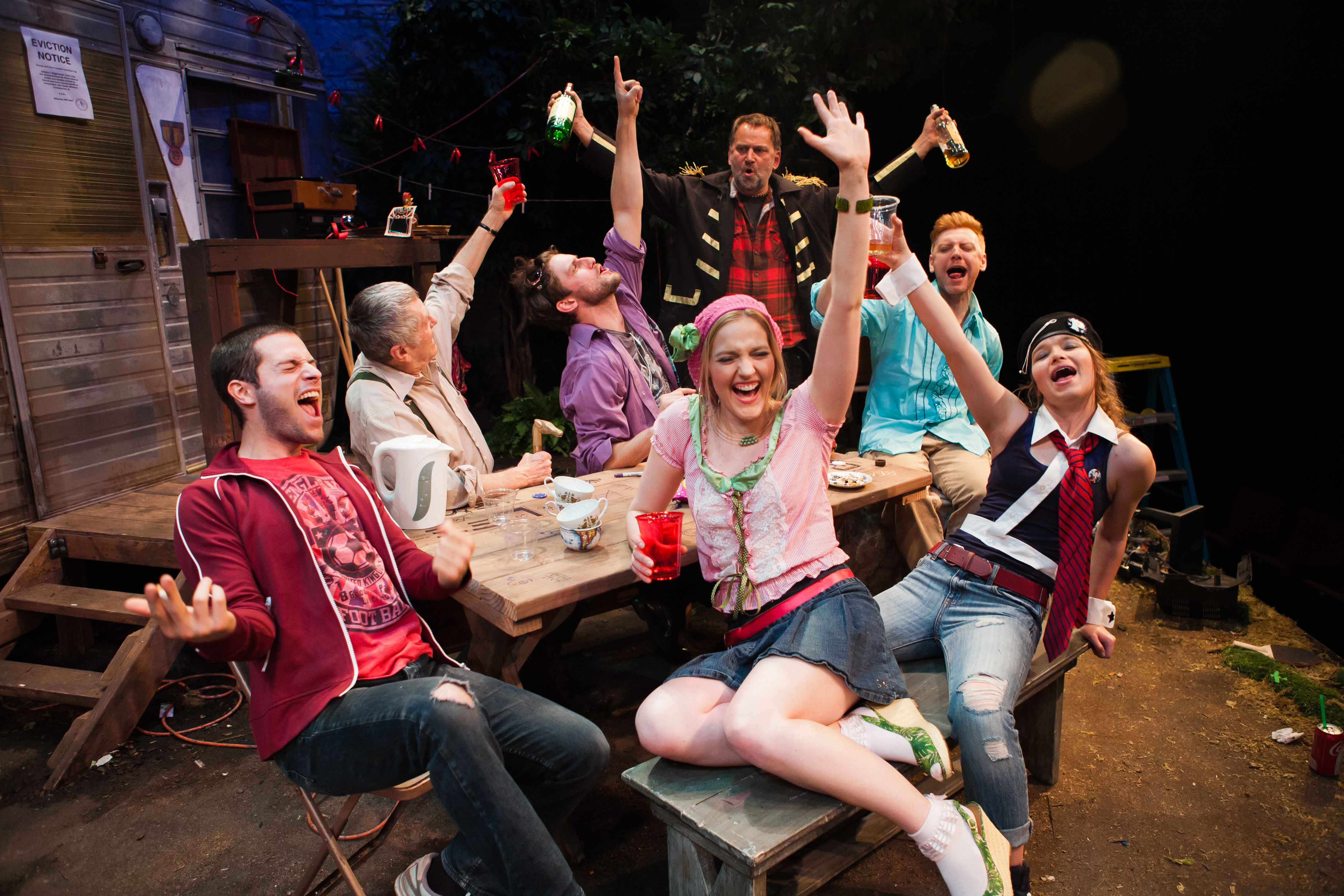
If you are a Sondheim aficionado Theatre Rhino’s production of Road Show is a must see show and for the others it is truly a ‘should see’ show. It is the only musical Sondheim has written in collaboration with John Weidman since the very successful Passion in 1994. This time around they have resurrected the lives ofthe Misner brothers who pursued the Great American Dream for wealth and social standing in the late 1800 and 1900s only to end in total disaster.

The use of the term resurrected is very appropriate since the show begins with the semi-intellectual younger Addison Misner (charming Bill Fahrner) coming out of a coffin to be chastised for the life he has led by the entire company including the wastrel brother Wilson (powerful Rudy Guerrero) in song and dance with “What a Waste.”  Fahrner and Guerrero are terrific and are ably supported by seven other cast members playing prominent roles and doubling as the ensemble.

Left to right: Rudy Guerrero* as Wilson Mizner and Bill Fahrner* as Addison Mizner

After the opening number, there is a time shift to the brother’s youthful days with Papa’s (Kim Larsen) dying words and Mama’s (Kathryn Wood) concurrence in “It’s in Your Hands Now” to go into the world and make your fortune. This starts the show on the road.

The first stop is Alaska to search for the elusive “Gold” and the ensemble belts the song with gusto. Sondheim and Weidman deftly shift the tenure with a touch of incest defining the “Brotherly Love” that will be Addison’s undoing when Wilson’s true nature is defined in “The Game.”

And then “Addison’s Trip” is a masterpiece of dark humor as every world wide venture he invests in is a total disaster and he ends up with an armful of useless souvenirs. Even though “That Was a Year” to be forgotten but remembered as an expensive lesson Addison moves on to share in the “Land Boom” taking place in Florida. On the way he meets Hollis Bessemer (handsome dulcet voiced Michael Doppe) and the sexual/love affair begins (“You” and “The Best Thing That Ever Happened”).

Left to right: Bill Fahrner* as Addison Mizner and Michael Doppe as Hollis Bessemer

The authors give Addison the major portion of the middle of the show and Fahrner nails the part and his duets with Kathryn Wood are memorable. When Wilson returns in various sections of the play he energizes the auditorium even while he is assigned a soft shoe routine complete with cane. He is the dominate force in Sondheim’s most dynamic song “Boca Raton” that young Bessemer reminds him means “mouth of the rat.”  All this leads to a powerful ending with “Get Out” and “Go.”

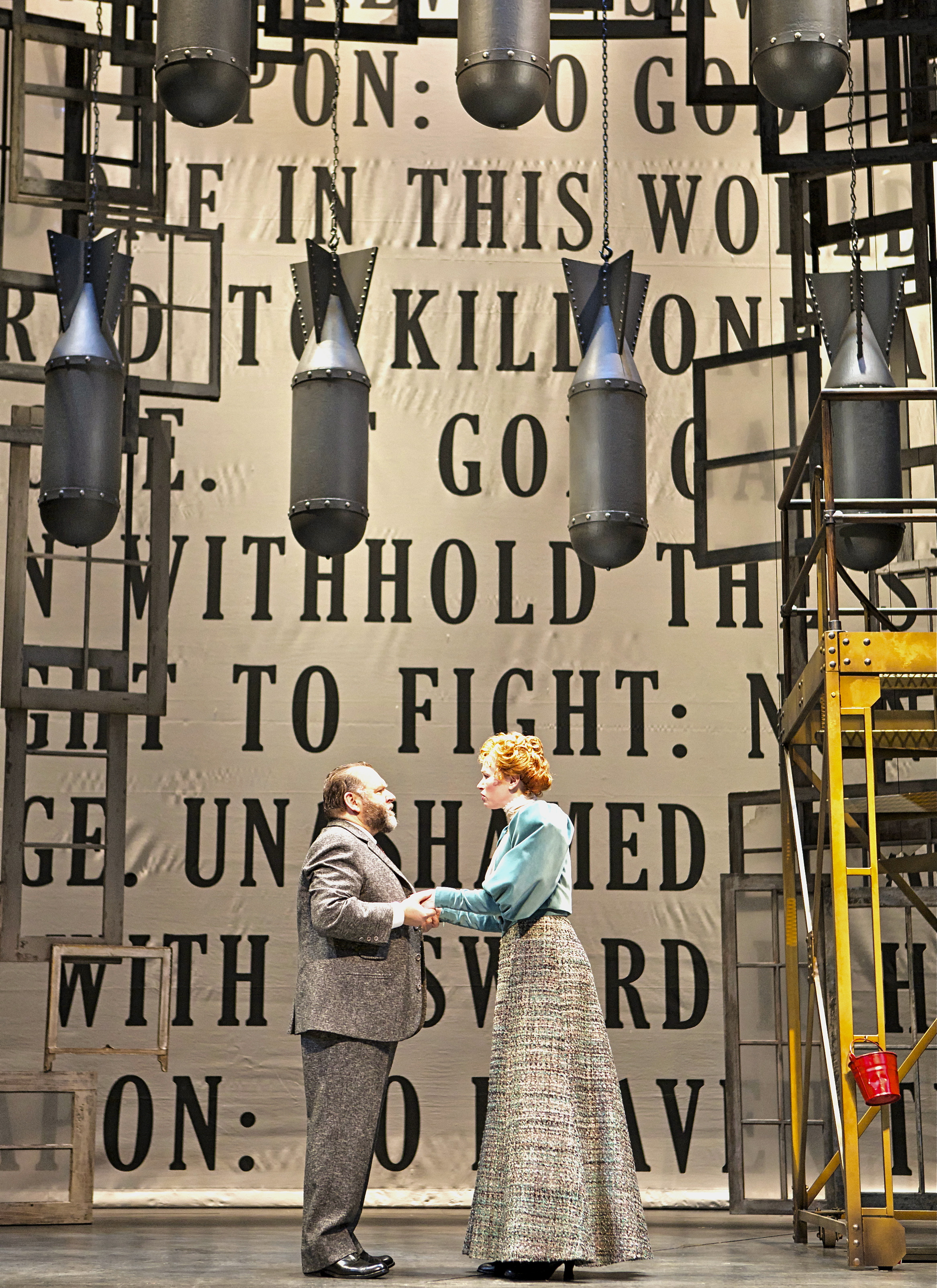
Full endorsement cannot be given to entire production since the staging and directing are both clever and cumbersome. There are many memorable scenes by individuals and the ensemble that earn accolades. However the central moveable 7 long 4 foot high rectangle that is constantly being rotated by the cast to depict various locales is distracting. Running time is a tight 1 hour and 40 minutes without intermission.

Note from the director: “We have not just chosen any Sondheim musical usually done by regional theatres, but the obscure ROAD SHOW. This musical has had many incarnations (previously titled Bounce, and before that Wise Guys and Gold!), but the few people who have seen it may not have seen this version being presented by Theatre Rhino. This Sondheim’s first new musical since his Tony Award-winning Passion in 1994, reunited the Pulitzer Prize and Tony Award-winning composer with book writer Weidman (Assassins, Pacific Overtures) and Tony Award-winning director John Doyle (Sweeney Todd, Company). The production played an extended run Off-Broadway at the Public Theater in 2008, but beyond a 2011 London remounting at the Menier Chocolate Factory, the musical has remained unseen by audiences until now.”

Production Crew: Stage Manager, Colin Johnson; Accompaniment, Dave Dobrusky;  Scenic Designer, Gilbert Johnson; Costume Designer, Scarlett Kellum; Lighting/Sound Design, Colin Johnson; Graphics-Ads, Christine U’Ren: Videography, Mister WA

Kedar K. Adour, MD

Courtesy of  www.theatreworldinternetmagazine.com


STOREFRONT CHURCH given a compelling staging at SF Playhouse

By Kedar K. Adour

The Church holds its first service (Derek Fischer, Gabriel Marin*, Rod Gnapp*, Carl Lumbly*, Ray Reinhardt*, Gloria Weinstock*)

Storefront Church: Comedy by John Patrick Shanely.

 Given a compelling staging at SF Playhouse

The accolades heaped on John Patrick Shanely, one of America’s premiere playwrights, include, amongst many others for his prolific plays, are a Tony and Pulitzer Prize for Doubt and an Academy Award for Moon Struck. He therefore deserves to have a mediocre play occasionally trod the boards. Storefront Church is that play and it really does not deserve the tremendous production being given it at the singular SF Playhouse. One might wish that it was staged at their intimate former 99 seat venue.

The quality cast includes the best of local actors with the addition of nationally acclaimed Carl Lumbly who garnered applause for his role at SF Playhouse in Stephen Audly Gurgis’ The MotherF**ker with the Hat  and at the Magic in  Terminus.  From the Bay Area there are (alphabetically) Derek Fischer, Rod Gnapp, Gabriel Marin, Ray Reinhardt and Gloria Weinstock superbly directed by Joy Carlin on a fantastic set by the inventive Bill English depicting a Bronx two level row house with the storefront church on the first floor.

For this reviewer the problem is the play that seems artificial, with themes that offer no new insight and require pages of exposition to fill in the back stories of the ethnically diverse characters.

When the spectacular row house parts the revolving stage brings in the aging Ethan (a loveable, laughable Ray Reinhardt), who refers to himself as a “secular Jew” and is the vociferous husband of Puerto Rican Jessie (Gloria Weinstock). He is there to convince Reed (Rod Gnapp in one of his best performances) the bank loan officer to give her an extension on her mortgage that is many months overdue.  The taciturn Reed, who has a disfigured face and is blind in one eye, remains implacable. Through exposition later in the play the cause of Reed’s physical and psychological disfigurement is revealed and is critical to the uplifting ending.

Jessie seeks out and appeals for intervention from Donaldo (the always capable Gabriel Marin) the Bronx borough president and the son of her closest friend. Donaldo, who is working with the bank to build a super-sized mall that will bring in jobs to the Bronx at the expense of losing its ethnic character. He joins Ethan’s and Jessie’s fray with the bank when he learns that his mother has co-signed the second mortgage.

Jessie’s money problems have been amplified by her “renting” the ground floor store front to Chester (beautifully underplayed by Carl Lumbly) an impoverished, both financially and mentally, Pentecostal preacher whose church was destroyed in the Katrina hurricane. In the three months he has been there, he has not paid “rent” and the “upgrades” to the ‘church” were financed by Jessie’s second mortgage. In those three months, Chester who has “lost his way” because there is a figurative “big hole in front of me” is being supported with life’s daily needs by the enthralled Jessie.

Enter Donaldo to set matters straight with Chester and the interaction between Marin and Lumbly is dynamic even though lengthy exposition is written into the script to define the conflict within Donaldo being as real as that of Chester.

Pastor Chester ( Carl Lumbly*) and Burough President (Gabriel Marin*) have a fateful meeting over church vs. mortgage.


Finally, Shanley introduces Tom (a forceful Derek Fischer), a no nonsense bank C.E.O., to set up the dichotomy of materialistic and spiritual wealth.

With all the characters and the conflicts in place, the storefront church has its first “congregation” and the taciturn Reed (possible under the influence of alcohol)who has no formal religion  rebels against the materialistic world in general and Tom in particular. Gnapp delivers a wallop of a performance and even ends up singing the rousing hymn sung by the entire cast. The audience leaves with a joyous feeling since it is Christmas Time in actuality and in the play.

There is ample doubt that his play will replace Truman Capote’s A Christmas Memory or Dickens’ A Christmas Carol. Running time about 100 minutes including the 10 minute intermission.

Directed by Joy Carlin. San Francisco Playhouse, 450 Post St, Second Floor, SF; www.sfplayhouse.org.  Tue-Thu, 7pm (Fri-Sat, 8pm (also Sat, 3pm); Sun, 2pm. Through Jan 11, 2014. Sound Design Teddy Hulsker; Production Stage Manager Tatjana Genser; Lighting Design  David K.H. Elliott; Props Artisan Yusuke Soi; Costume Design Abra Berman; Set Design       Bill English; Prosthetics Paul Theren; Casting Lauren English.


Kedar K Adour, MD

Courtesy of www.theatreworldinternetmagazine.com.


Three art exhibits stir passion, discovery, edification

By Woody Weingarten

  Woody’s [rating:5]

Passion.

Anders Zorn shows his watercolor skill with light, reflections and water via 1886’s “Summer Vacation.” Photo: Stockholms Aukionsverk.

Using a model instead of a grief-stricken person, Anders Zorn captures a photographic quality in his 1880 watercolor, ”In Mourning.” Photo: Nationalmuseum, Stockholm.

Oil “Portrait de Sarah Stein” is part of “Matisse from SFMOMA” exhibit at the de Young Museum. Photo: Ben Blackwell.

“A Bigger Message” is David Hockney’s tribute to the Sermon on the Mount, on 30 canvases that reach up, up and up. Photo: Richard Schmidt.

“The Jugglers” is a David Hockney “Cubist movie” made from 18 digital videos synchronized and presented on 18 screams to comprise a single artwork.

Museums have been arousing that sensation in me for seven decades — ever since my mom took me to Manhattan’s Museum of Modern Art when I was a gangling suburban kid who knew nearly nothing about anything except how to climb a tree barefoot.

Since then, I’ve eagerly visited museums in dozens of countries, almost always having a top-notch experience.

With my shoes on.

So read what follows knowing that “normal” for me is to wear rose-colored glasses.

But understand, too, that the three exhibits I saw recently at the two Fine Arts Museums of San Francisco would deserve high praise even if I weren’t such an enthusiast. Each provides an opportunity to cavort momentarily inside a painter’s mind, to glimpse his vision from the inside.

Most riveting for me, and edifying, is the “Anders Zorn: Sweden’s Master Painter” display at the Legion of Honor. Most likely because what I’d known about him before could have fit into Thumbelina’s pocket.

Zorn’s watercolor portraits are exquisite, even if they don’t match the genre’s highest echelon.

At first glance they may appear to be detailed yet delicate airbrushed photographs instead of multiple layered paintings. One good example is “In Mourning,” a graceful, pensive 1880 oval creation.

Superb, too, are his land- and waterscapes — showing off his fixation on reflected light. Witness, specifically, 1887’s “Lapping Waves” and 1886’s “Summer Vacation.”

Zorn’s etchings (he produced close to 300 of them) also captivate.

But they’re more vigorous, more dramatic.

His gouache work, meanwhile, is unbelievably powerful — even “Une Premiere (A First),” an 1888-94 work he modified and modified yet still hated enough to cut into pieces (it was restored by an artist friend, who donated it to a museum).

And although Zorn’s oils don’t reach the artistic heights of either his watercolors or etchings, they’re still compelling.

I found particularly intriguing “Omnibus,” an 1891-92 work that delves into the working class by focusing on a milliner, as well as the 1896 entranceway painting, “Self-Portrait with Model,” which experiments with light and shadow.

“Self-Portrait in Red” (1915), in contrast, is a blindingly bright work in which the color of the artist’s coat and vest are so strong they distract from Zorn’s stern, mustachioed face.

The artist lived and worked in Mora, Sweden; London; Paris. He visited San Francisco in the winter of 1903-04 on one of seven trips to the United States. And luxuriated in commissions of society’s elite (and painted portraits of three American presidents).

His oil of President Grover Cleveland, in fact, is one of the 100 pieces (that include a handful of sculptures) in the Legion’s exhibit.

He alone is a discovery emphatically worth a trip into the city.

But, as a bonus, right next to that exhibit in a single room is “Matisse from SFMOMA,” a display of 23 paintings, sculptures and works on paper by the Impressionist color virtuoso — plus six pieces not owned by the modern art institution.

Among the highlights are “The Girl with Green Eyes” (a 1908 oil) and 1916 commissioned portraits of Sarah and Michael Stein, brother and sister-in-law of Oakland’s legendary writer-poet-art collector Gertrude Stein.

The Stein portraits certainly prove there was a there there for Bay Area art patrons.

Why the Legion?

MOMA’s undergoing an extensive expansion and will be closed during construction until 2016. So the facility’s doing joint exhibits with virtually every area museum.

Across town at the de Young, “David Hockney: A Bigger Exhibition,” continues to draw both aficionados and new fans.

Why? Because the 300-piece exhibit is astounding — clearly showing the 76-year-old Brit’s development from 2002 through last year, including his integrating iPhone, iPad and digital movie techniques to create new art forms.

Despite his having a major stroke.

The audio guide, in fact, tells of his turning the resultant speech problems into a boon: By not talking much, he concentrates better.

But there’s too much to even sum up in a review. Oils. Watercolors. Charcoals.

Portraits. Still lifes.  Landscapes.

Homages to and parodies of van Gogh and Picasso.

And it doesn’t take long to discover the “bigger” in the title is fitting (at 18,000 square feet of gallery space on two floors, it’s the largest in the museum’s history).

Size appreciation can stem from viewing a Hockney “Cubist movie” that took 18 different perspectives from 18 digital cameras and synchronized them to comprise a single artwork on 18 screens.

Or from many of the artworks being colossal — including a fascinating strip of 12 portraits with 12 paintings beneath them of the subjects’ hands, an enormous montage of prints tracing art history from 1200 to 1900, colorful 12-foot-high images of Yosemite, and “The Bigger Message,” a 30-canvas re-working of Claude Lorrain’s “The Sermon on the Mount.”

One six-year-old boy visiting with his San Francisco Day School class exclaimed, “Wow! Those are biiig pictures.”I may be three feet taller than he, and about 150 pounds heavier, but I agreed — big time.

“Anders Zorn: Sweden’s Master Painter” will be displayed at the Legion of Honor, Lincoln Park (34th Avenue and Clement Street), San Francisco, through Feb. 2. “Matisse from SFMOMA” will run there through Sept. 7. “David Hockney: A Bigger Exhibition” will be up through Jan. 20 at the de Young, Golden Gate Park (50 Hagiwara Tea Garden Drive), San Francisco. Details: (415) 750-3600 or legionofhonor.famsf.org  or deyoungmuseum.org

Bench becomes epicenter of raconteur’s ‘gift of gab’

By Woody Weingarten


Ron Ratchford relaxes on bench outside Town Hall in San Anselmo. Photo by Woody Weingarten

If you believe my wife, Ron Ratchford’s middle name should be “Raconteur.”

Or “Boulevardier.”

Or, if all else fails, “Bon Vivant.”

My, my, she certainly has a penchant for French appellations, doesn’t she?

Yet each works.

A raconteur skillfully tells the best stories and anecdotes, sometimes dramatic, other times witty.

Ron’s that, for sure.For two hours one weekday, he regales me on a favorite bench in front of San Anselmo’s Town Hall (another is nearby on the edge of the new Imagination Park) — with stories purloined from his past.

A boulevardier is a sophisticated, worldly, socially active “man-about-town.”

When I spot Ron strolling through a recent art and wine festival, he pauses to chat about what he encountered.

A boulevardier? Surely.

A bon vivant is somebody with cultivated, refined and convivial tastes.

Ron’s that, too, though I can’t swear to his palate for fine wine or gourmet food. And as far as conformity goes, I know he eschews wristwatch, cell phone and landline.

All the years he worked, “usually just to pay the rent,” he felt intruded upon, controlled by such gadgets.

He was a teacher in Appalachia, a buyer for a microbiology company, a social worker, a cook, a mailroom clerk, a waiter and a designer-stitcher for an art group.

“I used to be a scheduler, overburdened by the limits of time,” he remembers.

So, after his last job, he tossed his wristwatch into the ocean.

He feels freer without the devices.

The San Anselmo renter has succumbed to the computer age, however, and is having a love affair with his machine despite it weaning him from legal pad and pen.

On this particular day he wears chinos, a straw hat, sandals, gold-rimmed eyeglasses and a T-shirt featuring his own pattern (“Most of my designs,” he tells me puckishly, “start with stains. I think this one was chocolate”).

He’s obviously more interested in being comfy than being Beau Brummell.

And he’s adamant about nixing fixing a chipped tooth that’s been conspicuous for more than a decade.

He’s also into multi-tasking, steadily knitting (a top pastime) while fielding my questions.

The seventysomething bachelor with a white van dyke dating to the 1960s chuckles a lot. My stories amuse him. So do his.

He playfully skips from this topic to that. “I’m never sequential,” he explains.

One second he talks about toiling as a child-caddy on a golf course and gardener in a cemetery, the next he tells me of Army duty, the moment after that he jabbers about being a financial theatrical consultant.

As befitting a retired gentleman, he’s volunteered with Marin Literacy, teaching adults how to speak and write English.

And he’s tutored at the local library for years — unexpectedly, perhaps, in “Introduction to Computers.”

Admittedly, Ron doesn’t charm everyone. Several in the library’s book-reading group that he attended for years claim — to his face — he hijacked many of the monthly discussions, leaving insufficient time for others.

A voracious reader, he countered that too many believe they, and only they, have the right interpretation” of whatever book is being read.

His favorite activities also include leisure with “coffee-shop friends and old friends from the old days, by email mostly” — and writing at home.

He’s been working for years on his book, “historical fiction, character-driven rather than plot-driven social criticism about passing the status quo from one generation to the next.”

He also keeps a journal/blog consisting of “expanded ideas,” such as musicals based on Flash Gordon or Anne Frank.

Details are, for the most part, secret.

“When people find out I write,” he says, “they start giving me potential plots, plots that usually reveal something about themselves.”

Ron also walks a lot, sometimes twice daily, from downtown to the Seminary and back, and occasionally to Fairfax or San Rafael. He prefers shoe-leather to cars, which “damage the Earth.”

He’s opinionated on everything except TV shows (he doesn’t own a set).

To wit: “There are a lot of people in this area who could be in a book, people who went through the ‘6os but are now the soberest people in town.”

On the other hand, “we have a glut of people here who substitute a nanny for themselves. That’s not good.”

Ron Raconteur Bon Vivant Boulevardier Ratchford —owl- and bird-lover, San Anselmo ambassador without portfolio.

I relish running into this man for all seasons and all seasonings and what my grandmother would have called his “gift of gab.”

To turn an infamous Sally Field quote on its head, I like him, I really like him.

Chipped tooth and all.

‘Peter and the Wolf’ again enchants kids — and grown-ups

By Woody Weingarten

 Woody’s [rating:4.5]

John Lithgow narrated “Peter and the Wolf” with aplomb and humor. Photo: Courtesy, S.F. Symphony.

Donato Cabrera, S.F. Symphony Youth Orchestra conductor, led “Peter and the Wolf.” Photo: Kristen Loken.

The decibel count in Davies Symphony Hall grew as fast as a Miley Cyrus stunt going viral on the Net.

Hundreds of kids squealed in unison — and glee — as actor John Lithgow interactively drew big pictures of animals and narrated Prokofiev’s “Peter and the Wolf” and a musical composition he co-wrote, “The Bandshell Right Next to the Zoo.”

The former piece rewove the original tale into a politically correct saga: The hunters don’t shoot the wolf dead but participate, instead, in a buoyant procession to the zoo.

And the duck that the wolf swallowed lives “rent-free” and warm in its belly, with plenty to eat.

Not quite what I experienced.

“Peter,” my introduction to symphonic music as a four-year-old, scared me.

But the narration was softened years later when I took my son and daughter. And this go-round of an event that pops up annually — with my six-year-old granddaughter in tow — was by far the easiest for innocent children to handle.

“Bandshell, ” which references (besides the usual monkeys, tigers and such) the likes of yaks, jackals and ferrets, is an especially interesting piece for kids — because it features a healthy but brief dose of dissonance, which Lithgow described as what might happen if “a bunch of animals [tried] to play music.”

The musicians seemed to enjoy thoroughly the musical ruckus they were creating. Many of them smiled broadly.

They also appeared to relish — along with a matinee crowd that collectively copied his rhythmic clapping — the headliner’s remaining on stage during Johann Strauss’ “Radetzky” march.

Kids and adults alike consistently focused their attention on Lithgow, who besides being a living cliché (“star of stage, screen and television”) is an award-winning author of nine children’s picture books and a memoir.

San Francisco’s Davies Hall was jam-packed for the event, with at least half the attendees well under four feet tall.

A bunch, indeed, may not have reached their third birthday.

Most youngsters remained motionless, their eyes and ears glued to every note by — and every musician in — the San Francisco Symphony Youth Orchestra.

More than a few, possibly fledgling music students, were fingering air-horns, air-clarinets or air-flutes.

A handful, not spellbound by the proceedings on the stage, were staring at the ultra-high ceiling, jabbering, fidgeting, curling up in a ball or climbing over the backs of their seats.

Nobody wrestled a sibling, though.

The 75-minute performance began with five excerpts from Tchaikovsky’s classic ballet, “The Nutcracker Suite” (with Donato Cabrera, who’s been the youth orchestra’s music director since 2009, pointing out passages underscored by celesta, harp and flute).

And the show ended with three sing-along chestnuts including “Jingle Bells” and “Rudolph, the Red-Nosed Reindeer.”

The 108-piece orchestra, which began three decades ago, currently features well-rehearsed musicians between the ages of 12 and 21 — every one excellent (if any of them flubbed anything during the holiday concert, I missed it).

Parents and grandparents of the young concertgoers, as well as the numerous relatives of instrumentalists, delighted in the presentation.

And in their charges’ delight.

Looking for other family-oriented events? Cabrera will lead the adult symphony in 2 p.m., 90-minute concerts (including intermission) on Jan. 25 (“Music Here, There, Everywhere!”) and May 3 (“Musical Postcards!”). Both are intended for youngsters seven or older.For families wanting to learn about music, the symphony also provides a website — SFSKids.org.

It’s a cool way to encourage navigating the learning curve.

Most San Francisco Symphony concerts take place at Davies Hall, Grove Street (between Van Ness and Franklin), San Francisco. Information: (415) 864-6400 or www.sfsymphony.org.

Disease can’t shake photographer’s tenacity

By Woody Weingarten

Photographer Alan Babbitt and his “un-still photography” creation, “Ferris Wheel — Marin County Fair.”

“Shake, Not Quake,” an “un-still” Alan Babbitt photo of the Golden Gate Bridge, illustrates the art of motion within a still.

It’s a paradox.

Alan Babbitt doesn’t see well. But his vision is sharper than most.

The sixtysomething Fairfax resident is succinct: “I was born with a whole bunch of eye problems, so I was wearing thick glasses from the age of 2 or 3. There’s no question — without contacts, I’d be legally blind.”But he refused to let the impairment get in his way.

It certainly didn’t block his becoming a successful film and video producer, webmaster or award-winning photographer.

Babbitt’s online site clearly shows his skill. One portfolio spotlights the Santa Cruz boardwalk on a winter’s day. Another contains dramatic, artsy New York City street scenes. A third focuses on lighthearted images.

Showcased are unusual angles and perspectives, brilliant colors and poignant black-and-white shots.Babbitt’s originality makes the scenically difficult look easy to capture. And he loves peppering his explanatory text with dubious puns and any remnants of humor that happen to be lying around.

He confesses, for example, that he once “joined a therapy group for photo addicts based on the ‘12-Stop program.’”

Ten years ago, though, Parkinson’s Disease invaded his life “like a loud, uninvited house guest who won’t ever leave.”

The physical shaking made him totally reexamine his life — and shelf his camera for a while.

Not that long ago he and I sat in a quiet Thai restaurant in San Anselmo enjoying the sunshine streaming through the windows. He smiled, almost mischievously, like a kid about to let me in on a gigantic secret.

“Parkinson’s adds to my vision,” he said. “Recognizing I could use the tremor freed me up like nothing else.”

I needed no follow-up question; he was on a roll.

“The disease is about losing control. Finding I could use it was empowering.

“When you first learn photography, they tell you over and over about crispness, about keeping the camera steady with a tripod. One evening in Las Vegas, where I was alone with a digital camera, I just started shooting. I was able to see right away what I got. Blurs. Streaks.

“And then people started reacting to it, liking it.”

So that became his style for some time — “tremor-enhanced photography.”

His web site — www.abproductions.com — contains portfolios dedicated to that innovative technique, “Movement Disorder” and “Shake Me Out to the Ball Game,” for example.

Babbitt grinned as he chatted about “crossing the border” and journeying to metaphoric “other lands” through his camera lens — speeding past his disability: “The tremor is only one kind of movement. I can shoot from a moving car, and move the camera around as well. It’s sort of what I call ‘un-still photography.’”

He, too, is very much un-still.

Babbitt’s taught at the de Young Museum Art School in San Francisco, exhibited at galleries and studios in the city and Marin, held shows at the Richmond Library, Half Moon Bay and Washington state.

His photos sold out at a December exhibit/silent auction/fundraiser in Santa Monica for the Greater Los Angeles chapter of the American Parkinson’s Disease Association.

In Marin, he’s part of a group show, “Artisans!” — that will continue, after a holiday break, from Jan. 2 through March 8 at the Falkirk Cultural Center, 1408 Mission Ave. (at E St.), San Rafael. Works from his new “Photo Blendo series” that fuses “symmetry, synthesis and serendipity” also can be viewed on the walls of San Rafael’s Miracle Mile Café, 2130 4th St., through the end of January.A while ago Babbitt participated in an Art for Recovery program in San Francisco featuring readings from letters exchanged by patients and medical students.

“One of the gratifying things is that people have seen the work and been inspired by what I’m doing,” he tells me. “It feels good getting those e-mails and letters.

“Some of them have been from photographers.

“And a 12-year-old girl wrote me and asked to use me as the basis of a school report. That’s the kind of thing that inspires me to do more.”

Still, it can feel pretty heavy — until you fully grasp the positive attitude that springs from the bearded, gray-haired guy with brown eyes that frequently display a twinkle:

There’s no doubt Babbitt cultivates his tendency to be upbeat, his affinity for the amusing.

“Soon after I got the diagnosis,” he recalled, “I thought of occupations that would be possible by using tremors: egg-scrambler, paint can-shaker, human vibrator. Sure, having Parkinson’s can be depressing, but humor can help fight that.”

His occasionally dark humor is quickly evident online, sprinkled be

tween his straightforward photos and experimental tremor shots that highlight bright streaks and patches, rings and blotches of light, geometric shapes.Spoofing a Viagra ad, he warns that “if feelings of giddiness…persist for more than four hours, just turn on the news for a few minutes.”

Want to witness what he labels “titters, snickers and snorts”? Or, more to the point, want to be visually impressed? Check out his work and see for yourself.

STOREFRONT CHURCH

By Uncategorized

STOREFRONT CHURCH

Reviewed by Jeffrey R Smith of the San Francisco Bay Area Theatre Critics Circle

As Oscar Wilde once said, “Anything worth doing is worth doing to excess.”

Artistic Director Bill English and Director Joy Carlin took Wilde’s aphorism seriously when they envisioned their production of STOREFRONT CHURCH.

Starting with a script by one of America’s premier living playwrights—John Patrick Shanley—it only gets better.

Shanley is probably best known for his Academy Award winning screenplay MOONSTRUCK and his Pulitzer Prize winning DOUBT—outside of Stockholm, you cannot earn higher accolades than that.

A stage design by Bill English defies all of Euclid’s Postulates; it spins; it slides and it looks like it belongs in an Edward Hopper or a Gottfried Helnwein painting—when the show closes, he should auction it off at Sotheby’s.

Joy Carlin skimmed some of the West Coast’s best stage talent from San Jose to Ashland.

Rod Gnapp, a stalwart of Bay Area stages—most memorable for TRIPLE X LOVE ACT by Cintra Wilson at the Magic, MAD FOREST by Caryl Churchill at Berkeley Rep and most recently BURIED CHILD at the Magic—is very moving as Reed, even if only half of Rod’s face actually does move in the play, (you’ll have to see the show to understand why) he’s highly animated as he comes to a slow explosive boil.

Carl Lumbly—most recently seen at the SF Playhouse in THE MOTHER F_ _ KER WITH THE HAT—is not only one of the Bay Area’s finest, Carl has strutted and fretted his hour upon New York City stages; Carl plays the forlorn Pastor of the Storefront Church who has yet to find his pastor voice, a pastor message or some pastoral sheep; needless to say the felt is showing in the bottom of his collection plate and the rent is overdue.

Gabriel Marin—an actor who works a frantic 54 weeks a year—is one of the Bay Area’s two funniest comic actors. Gabriel, who can ladle out a Napolitano accent as thick as Pasta Fazoo, reaches energy levels on stage that are best measured in mega or gigawatts. Excitement, high anxiety and rapid fire talking are Gabe’s strongest suits; give him a minor crisis and he can turn it in Vesuvio the Comedy.

STOREFRONT CHURCH is a feel good play; ideal for the holidays; it has that Frank Capra “life is only good because people do matter” theme that is guaranteed to lift your spirits, warm your heart and make you want to sing Christmas songs as you sit in gridlock traffic, look for parking and feed your VISA statements into the document shredder.

Get tickets online at www.sfplayhouse.org or by calling 415-677-9596

MAME

By Guest Review

Hillbarns Theatre, in Foster City production of MAME, for the most part is very good. Annemarie Martin as MAME SHINES. Her supporting cast is highlighted by the young man playing, Young Patrick. All others in cast are meerly “OK”.

Un-ordinary Joe pushes poetry, combats bullying

By Woody Weingarten


I’m ignorant about oh, so many things.

Joe Zaccardi, in his home office, contemplates a new poem. Photo: Woody Weingarten.

Poetry may top the list.

So it amazed me that I wanted to interview Joseph Zaccardi, Fairfax resident and Marin’s poet laureate.

Joe’s scarcely the only poet in Fairfax. There’s also Kay Ryan, Pulitzer  Prize-winner and U.S. poet laureate whom Barack Obama just handed a major medal (along with filmmaker George Lucas, a San Anselmo resident).

Can I deduce poetry’s as popular hereabouts as Indiana Jones and Yoda (who are standing tall  — and short — in San Anselmo’s Imagination Park)?

No way.But down-to-earth Joe Zaccardi could become the antidote for anti-poets.

His tips: “Don’t be afraid of poetry. You have to cultivate a taste for it. Read widely. Try writing free verse — you’ll surprise yourself. You’ll find yourself writing about love, or the death of someone. You’ll remember something someone said. Or you might ask yourself a question, really off the wall, like, ‘I wonder if they ever fried insects.’”

Of his work, the 65-year-old notes, “Every once in a while my sense of humor slips into my poetry and I leave it there. But I’m usually serious.”

He cites as a solemn for-instance, “Arroyo’s Soul,” which emphasizes subject matter “that’s really quite deep — about our not believing in anything anymore.”

Joe’s background isn’t riddled, however, with the snooty posturing sometimes attributed to writers.For much of his life, after apprenticing as a butcher, he functioned as “a barber, not a stylist, and I used to tell people I do one style — it’ll be shorter.”

He hung up scissors and combs in 2003.

Retirement means he now can take whatever time is necessary, rather than jotting down a word or two between clients. First drafts average 30 to 40 minutes. “Of every 10 of those, I only continue one or two” — and then his editing process “can be another month.”

He’s published 240 poems so far but is “sure I’ve written 1,000.”

“Written” is precise.Although he utilizes a computer for other tasks, he creates poems in longhand, in a notebook, in pen.

Joe gets $5,000 for his two-year stint as poet laureate, barely enough to buy writing materials. But the meager honorarium isn’t the point: The position enables him not only to promote poetry but use the bully pulpit to stage a panel discussion on “bullying and bystanders.”

He remembers being 13.

“A fat kid was picked on at lunch every day. One day six guys were doing it. I’m not brave, but I stepped in front of him and said, ‘Hit me instead.’ The leader said, ‘Let’s leave them alone.’ And I realized one person could make a difference.”

Also as a teenager, Joe — who last month married his longtime partner, Dave Eng — recognized he was gay.A teacher concurrently spurred his interest in poetry through William Carlos Williams, a New Jersey native like Joe, and advised him not to worry about punctuation marks or rhymes.

At 25, though, he started punctuating. “Now I love it,” he says, “especially semi-colons.”

Today he’s drawn to Jane Hirshfield of Mill Valley, Pablo Neruda, Gerald Stern “and lots of Chinese poets.” Earlier favorites? Shakespeare, Chaucer and Allen Ginsberg.

Ginsberg, in fact, had hit on him.“I was in my 20s and I met him. He bought me a Heineken’s beer, put his hand on my leg and said, ‘You have very nice thighs,’ and I said, ‘The thigh’s the limit.’”

Joe laughs at both pun and memory.

The skinny, six-foot poet’s totally animated when speaking. His hands perpetually move, and he occasionally jabs a finger at something invisible. Off and on go his wire-rimmed eyeglasses.

His soulful eyes remind me of actor Steve Buscemi’s.

“They used to be brown, but now they look gray, really strange,” Joe says, not

ing that as a schoolboy he asked a nun what color Jesus’ eyes were. “The color of yours, I’m sure,” she replied.Since the early ‘80s, he’s been hanging out at the Marin Poetry Center in San Rafael, which “puts on monthly sessions with visiting poets, an open mic once a month, and a wonderful thing called the Summer Traveling Show, which sponsors about 125 readings in various venues.”

He likes reading aloud: “You can feel an audience when you read a poem.”

When, at his request, I audibly read one — about his father, from his anthology “Render” — I’m overwhelmed by its power.

And I understand why Zaccardi’s a very special Joe, not an ordinary one.


A Christmas Memory: The Musical will not replace A Christmas Carol

By Kedar K. Adour

A CHRISTMAS MEMORY: A Musical Adaptation. Book by Duane Poole based on the short story by Truman Capote. Music by Larry Grossman and lyrics by Carol Hall. Directed by Nick DeGruccio. The Laguna Playhouse, 606 Laguna Canyon Road, Laguna Beach, CA. 949-497-2787 or www.lagunaplayhouse.com.

A Christmas Memory: The Musical will not replace A Christmas Carol

Truman Capote’s short story A Christmas Memory was an instant classic when it first appeared in “Mademoiselle” magazine in December 1956. Since that time it has been a mainstay on radio and is extremely popular as stage dramatizations. One of the finest was by the Word for Word Company’s presentation in the San Francisco Bay area. In that staging the story is acted with the actual words including the “he said” and “she said” etc. It is a perfect way to present Capote’s beautiful writing.  In this musical adaptation many of those words poignantly drift across the footlights with fine actors skillfully giving meaning to their lines.

However, one might wonder why a musical version is necessary. It is not necessary but the Laguna Playhouse Company is giving it a valiant and often heart touching rendition and this reviewer reservedly gives it a “thumbs up.”

The use of a narrator, in the mode of Our Town is essential in keeping with the style of the short story. The adept staging by Nick DeGruccio on the attractive atmospheric open set (D Martyn Bookwalter) allows the story to flow. It is a semi-autobiographical memory play of Capote’s early life in rural Alabama during the Great Depression that often tugs at your heart wishing for less materialistic times.

In the story, seven year old Buddy (William Spangler) is the unwanted child who is sent off to live with distant cousins. The members of the house are poor and include the elderly child-like Sook (Marsha Waterbury), her sister Jennie (Tracy Lore) the supporting head of the household, ineffectual brother Seabon (Tom Shelton) and the mangy-loveable dog Queenie (Pickle).

Outside the household there is the friendly neighbor Anna Stabler (Amber Mercomes) and young buddy’s friend and partner in shenanigans Nelle Harper (Siena Yusi). Tom Shelton does triple duty as the inquisitive postman Farley and HaHa Jones the moonshiner who supplies the secret ingredient (liquor) for the fruit cakes made with loving care by young buddy and Sook, to the charming song “Alabama Fruitcake.”

 Before ubiquitous fruitcakes enter the picture, the narrator Adult Buddy (Ciaran McCarthy) and the company set the tone with a nostalgic “Imagine a Morning.” Attractive McCarthy has an expressive tenor voice that gives depth to his solos of “What’s Next” and “Paper and Cotton.” In the second act his versatility is displayed in the trio “Nothing More Than Stars” blending seamlessly with the baritone voice of Shelton and the prepubescent voice of Spangler.

The adult members of the cast (all Equity actors) are excellent performers bringing their characters to life and adding further class with fine singing voices. Marsha Waterbury’s depiction of Sook is a joy to watch and a pleasure to hear in her duets with young Buddy and the tear producing “The Kite Song.” Amber Mercomes gets her turn to shine with “Detour” and Tracy Lore gains our understanding with “You Don’t Know It.”  William Spangler’s taxing role as young Buddy does not quite create the needed empathy written into the story line.

Running time 2 hours and 15 minutes including an intermission.

Production Staff: Scenic designer D Martyn BookWalter; Costume designer Bruce Goodrich; Lighting designer Steve Young; Sound designer Joshua McKendry; Stage managers Don Hill and Luke Yankee; Musical Director Darryl Archibald. Musicians Darryl Archibald, Tyler Emerson and Drew Hemwell.

Kedar K. Adour, MD

Courtesy of www.theatreworldinternetmagazine.com