Baryshnikov turns talents to other ventures

By Judy Richter

Mikhail Baryshnikov was one of the greatest male ballet dancers of his time. Now that he’s in his 60s, he has taken his talents to other ventures, such as his Baryshnikov Productions.

Most recently, he’s starring in the venture’s “Man in a Case,” adapted from two 1898 short stories by Anton Chekhov and presented by Berkeley Repertory Theatre.

In the first story, “Man in a Case,” Baryshnikov plays Belikov, a teacher of Greek who’s so rigidly moralistic that he casts a pall over everything and everyone. He briefly comes out of his shell when he meets Barbara (Tymberly Canale), the outgoing sister of a newly arrived teacher, Kovalenko (Aaron Mattocks). Unfortunately for Belikov, the relationship doesn’t work out.

In the second story, “About Love,” Baryshnikov plays a lonely man who falls in love with a friend’s wife, also played by Canale. Even though the attraction is mutual, the relationship ends because she leaves when her husband takes a job in a different town.

The stories were adapted and are directed by Paul Lazar and Annie-B Parson, founders of Big Dance Theater. Parson also choreographed the interactions between Baryshnikov’s and Canale’s characters.

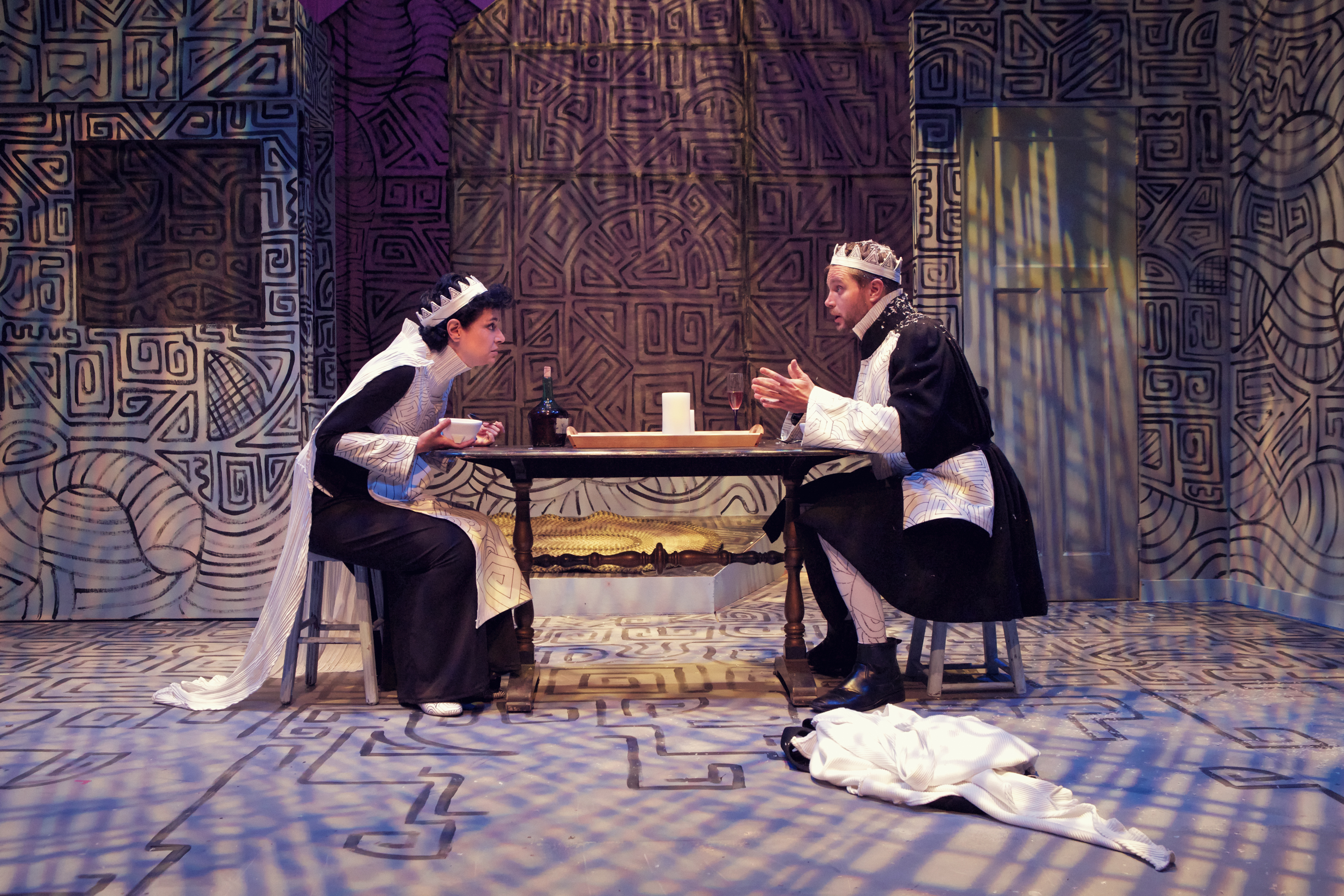
Much of the production features effective live and recorded videos designed by Jeff Larson. He and sound designer Tei Blow do their work while seated at a long table onstage (set by Peter Ksander with lighting by Jennifer Tipton and costumes by Oana Botez). Sitting with them most of the time are the show’s other two actors, Paul Lazar and Chris Giarmo, who also serves as music director and sometimes plays accordion.

The show runs about 75 minutes with no intermission. Despite the creative staging and multimedia and despite fine performances by the cast, the show is only mildly interesting. It’s difficult to care much about Chekhov’s characters.

“Man in a Case” runs through Feb. 16 in Berkeley Repertory Theatre’s Roda Theatre, 2015 Addison St., Berkeley. For tickets and information, call (510) 647-2949 or visit www.berkeleyrep.org.

‘The Grapes of Wrath’ comes to life on Hillbarn stage

By Judy Richter

In a nation already reeling from the Great Depression, states like Oklahoma were hit especially hard after prolonged drought and fierce winds transformed them into the Dust Bowl.

John Steinbeck told how one extended family dealt with these hard times in his greatest novel, “The Grapes of Wrath.” Hillbarn Theatre brings this saga to its stage in the theatrical adaptation by Frank Galati.

Having lost their livelihood and home to that double whammy of the Depression and Dust Bowl, the extended Joad family, like many others, set off for California in search of work and a better life in the 1930s.

Thirteen people piled into and onto a beat up old truck and headed west. Shortly after they arrived in Southern California, only eight remained. The others had died or left.

The first victim was the family’s patriarch, Granpa Joad (Bob Fitzgerald), soon followed by his wife and the family matriarch, Granma Joad (Kay “Kiki” Arnaudo).

Trying to hold the family together was the indomitable Ma Joad (Claudia McCarley), along with her husband, the less decisive Pa Joad (Wes Chick), and their eldest son, the loyal Tom Joad (Rich Matli).

When they arrived in California, they found that competition for jobs such as picking fruit was keen. Landowners took advantage of the migrants by paying practically nothing. Local police harassed the newcomers, especially those who would dare to try to organize for better pay. Violence and death were common.

Thanks to imaginative direction by Greg Fritsch, the 22-member Hillbarn cast brings Steinbeck’s characters to vivid life. However, the show starts slowly because it’s so talky when Tom, just paroled from prison for a murder conviction, encounters Jim Casy (Jerry Lloyd), a former preacher.

The pace picks up as other characters are introduced and the family heads west in the first act. It moves better with more action in the second of the two acts.

Moreover, the acting can be uneven, but the lead characters are fine. Especially noteworthy are McCarley’s Ma Joad and Matli’s Tom Joad.

Alan Chang’s sound design adds drama, especially at the very first with the sounds of a fierce wind whipping up the top soil and blowing it away.

Scenic designer Cheryl Brodzinsky has created a central set piece, complemented by Matthew Royce’s lighting, that does multiple duties, mainly as a wrecked house, the truck and a box car.

Kate Schroeder’s costumes reflect the times and the characters’ circumstances. However, it seems odd that the mechanically inclined Al Joad (Jeremy Helgeson) would wear the same grease-stained outfit throughout the play.

Songs like “Going Home” and others from the time enhance the production, thanks to music direction and arrangements by Greg Sudmeier.

Because of its scope and large cast, “The Grapes of Wrath” is an ambitious undertaking, especially for a community group like Hillbarn. For the most part, it’s successful, thanks not only to the cast and artistic staff but also to the genius of Steinbeck.

It will continue at Hillbarn Theatre, 1285 E. Hillsdale Blvd., Foster City, through Feb. 9. For tickets and information, call (650) 349-6411 or visit www.hillbarntheatre.org.

Giselle — San Francisco Ballet Performance — Review

By Joe Cillo

Giselle

San Francisco Ballet Performance

January 27, 2014


This is a very strange story that ultimately doesn’t make sense.  Maybe I just don’t understand it.  A prince disguises himself as a peasant and moves to a village to court a peasant girl of irresistible charm.  It would be like Jamie Dimon disguising himself as a bus boy to court a waitress in a restaurant.  A rather odd concept, don’t you think?  Especially since the prince is already engaged to another woman — but we don’t find that out until later. 

It is a narrative, and I do like ballets that attempt to create a narrative line simply through dance without verbal support.  But the narrative here is convoluted and rather bizarre.  Without first reading the synopsis in the program, a viewer would be lost trying to figure out what is going on.

The first act, after doing a passable job of establishing the story gives way to a long cadenza-like display of dancing virtuosity.  I had trouble grasping what all this athleticism had to do with the story.  There is nothing wrong with virtuosic dance.  This is, after all, the San Francisco Ballet.  But virtuosity for its own sake, is self indulgent and risks becoming dull if it is overworked.  I think this ballet, since it had so little substance in the story line, relied a little too much on dazzle.

I don’t like scenes where one or a small group of dancers perform while a multitude of bystanders sits idle on the stage just watching.  This technique is employed to excess in this ballet.  My feeling is that if someone is on the stage they should be doing something besides being part of the scenery.  I don’t like spearholders.  If they are doing nothing, then they should be doing nothing for a good reason.  Inertness should speak.  But in this ballet it doesn’t, and you’ve got these vast stationary multitudes on stage serving as an adjunct to the audience of paid ticket holders while a few dancers hold court.

The prince’s rival is Hilarion, a “woodsman,” or hunter from the village.  He is a known quantity to Giselle and she finds him much less appealing than the disguised prince.  Hilarion exposes the prince’s disguise, reveals his true identity, and the fact that he is already engaged to Bathilde, a woman of his own class.  This puts the kibosh on Giselle, and instead of taking it in stride and chalking it up to experience (or taking up with Hilarion), she runs herself through with the prince’s sword and dies.  You can always tell a vacuous story by the need for phony melodrama to pump some life into it — in this case, killing off the heroine at the end of the first act.

The music is undistinguished and tends toward the banal and the schmaltzy. Visually, however, it is very beautiful.  The sets, costumes, configurations and choreography are interesting and make a pleasing impression.  The dancers are outstanding, as usual.  The San Francisco Ballet has done a superb job with mediocre material.  Apparently it is enough to seduce the audience.  The house was full and seemed to give a good response to this vapid nonsense.

The second act was way too long.  It could have been cut in half to a much more pleasing effect.  It takes place at midnight in a forest where Giselle’s grave is located.  Giselle returns as a ghost accompanied by a cohort of Wilis, forest spirits all decked out in pure white wedding dresses, to comport with the prince who has come to visit her grave — in the middle of the night.  The tenor of the whole second act seems to imply no hard feelings on the part of Giselle toward the prince, even though she was upset with him enough to kill herself with his sword at the end of the first act.  Now that she is dead, all is forgiven and they dance like they are freshly love struck.  It’s idiotic and extremely repetitious.  I was getting so tired of it, just waiting for it to end, and it went on and on.  The curtain call seemed overdone as well, but then, I didn’t feel much like applauding and wanted to get out of there.

The moral of the story seems to be: you should not look for love outside your own social class, and if you are a woman, you are bound to get the worst of any such liaison — a reassuring, conservative, message for all the stodgy Republicans in the San Francisco audience.

Marga Gomez is Captivating in “Love Birds”

By Uncategorized

Marga Gomez is Captivating in “Love Birds”

Marga Gomez is back in the Mission with her new show called “Lovebirds”. Bi-costal playwright and lesbian comic extraordinaire has the folks rolling in the aisles with her 75 minute solo performance with the world premiere of “Lovebirds” at The Marsh in San Francisco. This marks her 10th solo performance which is being directed by David Schweizer. Ms. Gomez who I call a Latino Whoopi Goldberg has been one the better lesbian comics traveling all over the United States with her one person show. She has an amazing personality with a great wit, a mobile face and a lithe body. She is one foxy lady who could be called a lesbian Jennifer Lopez.

“Lovebirds” is not one of her autobiographical soliloquys that she usually does. Here Marga plays Polaroid Phillie an enchantingly unconventional street photographer who still takes photos of couples with of all things with a Polaroid camera in Greenwich Village haunts gay ladies bars and Spanish restaurants.
Marga as Polaroid Phillie tells the audience about fond memories of taking photos in the 70’s in these clubs. She then portrays a crew of incurable romantics as they chase their heart’s desires into the night, through decades and to insane lengths. She is fantastic playing Orestes, a macho maître d’ infatuated with a tin eared singer who is married to an academic who never sleeps or even never awake.

Marga is also brilliant playing an emerging lesbian named Barbara and through her eyes we meet a raucously “butch” Turkey who comes on strong at a local disco. She changes her name to Dahlia and she wants to leave this selfish butch Turkey for a new love with a bewitching New York University woman’s studies teacher, Aurora. She also plays the tone deft singer and even herself toward the end of the 75 minute of the comic tour de force.

“Lovebird “ is Marga Gomez at her best. I wanted to see more but this fast pace presentation is over much too soon. “Lovebirds” runs through March 15 at The Marsh San Francisco Studio, 1062 Valencia Street, San Francisco. For tickets call 415-282-3055 or on line at www.themarsh.org

JERUSALEM blasts out at SF Playhouse

By Kedar K. Adour

Johnny issues his call to arms: Paris Hunter Paul*, Richard Louis James, Joshua Schell, Brian Dykstra*, Riley Krull, Devon Simpson, Ian Scott McGregor*.

JERUSALEM: Drama by Jez Butterworth. Directed by Bill English. The San Francisco Playhouse, 450 Post Street (2nd Floor of Kensington Park Hotel, b/n Powell & Mason). 415-677-9596, or www.sfplayhouse.org. West Coast Premiere.

January 21 – March 8, 2014.

JERUSALEM blasts out  at SF Playhouse [rating:3] (5/5 stars)

In the 1920s there was a literary battle between Henry Luce, editor of Time, and Harold Ross, editor of The New Yorker who is oft incorrectly quoted for his infamous line “not edited for the lady in Dubuque.” Rarely mentioned is Ross’ reply to Luce, “You’ve put your finger on it. I believe in malice.”  In our time, Bill English, Artistic Director of SF Playhouse, can be equated with Ross. Once again English and The Playhouse have mounted a block-buster of a show not for the lady in Dubuque.

It may not be for the aforementioned lady but it certainly was a hit for the youth of London who queued up at the Apollo Theatre where Jerusalem ran for over 1000 performances and winning the Olivier Award and the Tony on Broadway for Mark Rylance in a leading role in a play. If Bill English is attempting to attract younger people to the theatre, this show will probably do it.  However, this three hours and 20 minute show in three acts creates ambivalent feelings. Oddly the structure is Aristotelian following the constraints of the three unities of time, place and action.

The time is St. George’s Day in present day England and the action takes place in 24 hours in the illegal encampment of Jez Butterworth’s protagonist Johnny “Rooster” Byron (an excellent Brian Dykstra) who is a braggart with exuberant (or lousy with.  . your choice) charisma sufficient to attract the disenfranchised.  It is not only his charisma that attracts the young and old. It is his stash of drugs and booze that is available mostly for a price but also some freebies for the young girls that are attracted to him. Late in act one two of those young girls (Riley Krull  and Devon Simpson) crawl out from under the decrepit bus that hasn’t moved in 25 or so years.

You certainly would not want Rooster and his decrepit bus surrounded by detritus left over from nights of multifarious carousing parked in your back yard. Nor do the local law enforcement officers who arrive to paste the final eviction notice on the door. Before that happens, on a darkened stage there is a cacophony of rock music and with a burst of light the play begins. A young girl (Julia Belanoff) in a gossamer fairy costume steps forward to sing “Jerusalem” a William Blake poem that apparently is an anthem more revered than “God Save the Queen.” A four page glossary of terms is provided with the program to help the audience understand much of the dialog.

The eclectic denizens that occupy the encampment include Rooster’s wannabe side kick Ginger (a fine Ian Scott McGregor) who provides much of the humor with his persistent questioning of Rooster’s tall tales even though Rooster has the ability to give verisimilitude to them. His story about being born of virgin birth by a bullet is hilarious as is his meeting with the 40 foot giant who created Stonehenge and provided him with a drum to be used when help is needed.

There is befuddled Professor (Richard Louis James) who wanders in and out spouting bits of literature while searching for his long since dead dog. Young Lee (great acting by Paris Hunter Paul) who is immigrating to Australia and his close friend Davey (Joshua Schell) the slaughter-house guy who is emotional chained to the village.  Wesley (Christopher Reber) the local pub landlord, he is involved in the festivities for St George’s Day and has been roped in to doing the Morris Dancing but requires a drug fix to be able to perform.  Troy (Joe Estlack) who gives a spot-on frightening touch to his role as a local thug who, it is strongly implied, has sexually abused his missing step-daughter.

Within this maelstrom of hedonistic activity, Butterworth has written a touching scene between Rooster’s, his ex-girlfriend Dawn (a marvelous Maggie Mason) and their 9 year old son Marky (a charming Calum John) that almost ends in reconciliation.

The show ends with Rooster beating the drum with the thunderous steps of the Giant (??) approaching.  Dykstra gives a powerful performance that is worth the price admission.  The production with all the caveats should not be missed.One would hope that the dialect coaches would spend more time with the actors since the dialects ranged from excellent to unintelligible.

Production: Sound Design, Theodore J.H. Hulsker; Stage Manager, Maggie Koch; Lighting Design, Kurt Landisman; Props Artisan, Jacqueline Scott; Costume Design, Tatjana Genser; Set Design, Bill English; NY Casting, Judy Bowman; Dialect Coaches, Deborah Sussel and Jessica Berman; SF Casting, Lauren English                      

Cast(in alphabetical order) Julia Belanoff (Phaedra), Ian DeVaynes (Markey), Brian Dykstra (Johnny Rooster), Joe Estlack (Troy), Richard Louis James (Professor), Calum John (Marky), Riley Krull (Tanya Crawley), Maggie Mason(Dawn), Ian Scott McGregor (Ginger), Aaron Murphy (Parsons), Paris Hunter Paul (Lee), Christopher Reber (Wesley), David Raymond (Man 1/Understudy), Joshua Schell (Davey/Man 2), Devon Simpson (Pea), Courtney Walsh (Fawcett, U/S Dawn)

Kedar Adour, MD

Courtesy of  www.theatreworldinternetmagazine.com

.


NEVER UNDERESTIMATE THE POWER OF KNITTING

By Joe Cillo

KNIT ONE, PURL TWO AND YOU’RE FREE

Properly practiced, knitting soothes the troubled spirit,
and it doesn’t hurt the untroubled spirit either.
Elizabeth Zimmerman

I was a nervous child.  I was terrified of the horrible dangers that lurked around every corner.  If I talked to strangers because they would abduct me; I must never argue with my mother or she would give me back to the Indians.  I couldn’t cross a street without risking my life; if I dared to boil water, the steam would blind me.  Touching the pan would cost a finger. Boys with nasty leers jumped out behind bushes at little girls like me, and teachers got angry for no reason at all.

Reality was too much for me to absorb.  My nerves were jangled and my nails bitten to the quick.  I jumped at an unexpected sound; I screamed when a light flashed; I hid under the couch when someone slammed the door.

My mother was a redhead with an attitude.  She was afraid of nothing. Danger actually thrilled her and she met it head on with eyes flashing and acid repartee that quelled the bravest among us.

And it was she who made me quiver and shake at the thought of facing another day with all its pitfalls.  It was she who reminded me that I might trip if I ran too fast; I might break that dish I was wiping; or jam the brush into my eye when I brushed my hair.  She couldn’t stand the fidgeting, the nail biting, and the twitches.  “This kid is driving me crazy,” she told my Aunt Hazel.  “She is a nervous wreck.”

My Aunt Hazel was a pragmatist.  When she didn’t get enough meat for dinner, she left home.  When she couldn’t earn enough money to support herself she married a bootlegger.  She was one of the first in that generation to think outside the box.  “Teach her to knit,” she told my mother.

“Are you crazy?” said my mother.  “She jiggles so much she’ll poke her eyes out with a knitting needled. “

“Well that’s one way to calm her down,” said Aunt Hazel.

So it was that my aunt took me with her to the Stitch In Time Knitting shop filled with yarn in every color and an oval table piled high with pattern books. Several ladies sat around that table drinking coffee, smoking cigarettes (this was 1943) chatting about the war effort and knitting scarves, mittens and caps for our servicemen.  Their needles clicked and they smiled and laughed as they worked.  As I watched these women moving those needles at the speed of light, I saw to my amazement that they were creating all kinds of garments: sweaters with lace sleeves, block patterns and colors, plaids and stripes and polka dots.

“I want to do that,” I told my aunt.

“I thought you would,” she said.  “What would you like to make?”

My aunt took me home that afternoon and told my mother, ”She’s knitting a scarf.  That will keep her in line.”

That was back in 1943, but my aunt’s wisdom holds truth even today.  In fact, a maximum-security prison in Brazil came to the same conclusion.  They have decided that if their inmates knit something for three days, it is worth one day off their sentence.  They know what my aunt figured out so many years ago.  Knitters don’t have time to get in trouble.  They might drop a stitch.


THE PARIS LETTER effective and affective staging at NCTC

By Kedar K. Adour

THE PARIS LETTER: Drama by Jon Robin Baitz. Directed by George Maguire. New Conservatory Theatre Center (NCTC), Walker Theatre, 25 Van Ness @Market, San Francisco, CA. 415-861-8972 or www.ntcsf.org.  Through February 23, 2014.

THE PARIS LETTER effective and affective staging at NCTC. [rating: 4] (5/5 stars)

When George Maguire helms a theatrical production it is assurance that the audience is in for a theatrical experience. So it is with the Bay Area premiere of The Paris Letter. Considering that the play is non-linear, covers 40 years of relationships, the cast with one exception play dual roles and there is a narrator such an undertaking deserves and earns accolades. The original three hour play that opened in Los Angelos in 2004 was pared to two hours for the 2005 off Broadway opening and this latter version is playing on NCTC’s intimate Walker Theatre.

Author Jon Robin Baitz is no stranger to the Bay area. His tightly written play Other Desert Cities that received a nomination for the Tony Award and won the Outer Critics circle Award in 2011 received a striking production last year at TheatreWorks. The Paris Letter written much earlier in his career and is said to be semi-autobiographical tends to ramble and requires the audience to pay close attention to fully appreciate the time line and some of the nuanced details.

Maguire cleverly separates the time shifts and allows the scenes to flow with minimal interruption by creating a charming set (Devin Kasper) framed by red velvet drapes and gilt framed shadow boxes containing props with a huge circular central backlit scrim that is also used for projections (Lighting/projections by Christian Meja). Those projections are integrated into the story and there is no doubt that a scene takes place in winter when snow gently falls.

But in the words of William Shakespeare, “The plays the thing” ( Hamlet Act 2, Scene 2) and Baitz begins with a stunning first volatile first scene between an older Sandy Sonneberg (Ron Dritz) and his younger paramour Burt (David Ewing) that ends with a suicide taking place behind the circular scrim with a projection of the Eiffel Tower. Blackout and the aforementioned narrator an older wiser and fey Anton (a superb Tom Reilly) steps forward, addresses the audience informing us he is going to tell us the story behind that scene and what is in a letter from Paris that he is holding then secrets in his jacket pocket. The contents of that letter are not revealed until late in the play.

The play is a convoluted love story wrapped in the problematic history of gay acceptance from the 1960s to the present tracing the journey of a successful investment advisor who is closeted gay man denying his sexuality and attempting to be ‘cured’ of his affliction. The man in question is young recent Princeton graduate Sandy (Paul Collins) whom is befriended by young Anton (David Ewing) who is living comfortably with his homosexuality. Anton introduces Sandy to the hidden gay world, appreciation of art, theatre and enjoyment of accepting ones nature. Sandy thoroughly enjoys the sexual experience, insists “I am not a homosexual” but confesses to love of Anton. That love eventually becomes oppressive leading to catastrophic results in later years.

After a few months of this new hedonistic experience with young Anton (handsome David Ewing) Sandy visits Dr. Schiffman (Ron Dritz in his second role), a misinformed psychiatrist claiming to have the ability to change same sex attraction in men to a more conventional life style. This is the start of five day a week therapy (“And if you miss a day, you still have to pay!”) that continues for 15 years.

Baitz then solidifies his play scene by scene adding characters that define the time frame of the play and attitudes of each individual. Early on there is a charming scene between Sandy’s mother Lillian (Michaela Greeley) young Sandy and young Anton taking place in a gay oriented restaurant. The interchange between the three is delicious and Greeley gives a beautifully nuanced portrayal of a mother who knows her son is gay and secretly is accepting of it.

Sandy, to complete his conversion to heterosexuality, falls in love with Katie (Greeley again) who has a gay son Sam (Collins) and through clever sub-rosa dialog infers that she is fully aware of Sandy’s proclivities. Herein lays a perceived flaw in this the production. Although there is a plethora of physical contact between Greeley and Dritz the charisma signifying love is not generated.

Through the years Sandy and Anton have remained friends with Anton as father confessor and Sandy insisting he is ‘love’ with Anton and Katie. Sandy uses the friendship/love of Anton to keep Anton near and available for selfish reasons. There is a secondary contemporary plot line involving Burt in a Ponzi type scheme that eventually leads to the suicide in scene one. Be advised to watch and listen closely to the dialog and action in the penultimate scene of the play that is a shocker.  You will never hear a more satisfying and meaningful “I TOLD YOU SO!” Maguire’s spot on direction does great justice to Baitz’s convoluted play.

Running time 2 hours 10 minutes including the intermission.

Courtesy of www.theatreworlintermagazine.com.

Cast: Paul Collins as Sam/Young Sandy; Ron Dritz as Sandy/Schiffman; David Ewing as Burt/Young Anton; Michaela Greeley as Katie/Lillian; Tom Reilly as Anton.

Production Staff: David Kasper (Set Design); Billie Cox (Sound Design); Christian Mejia (Lighting/Projection Design); Rebecca Madsen (Properties); Samantha Young (Stage Manager); Miriam Lewis (Costume Design); Lori Fowler (Casting Director); Ed Halvey (Program Design).


JOURNEY’S END echoes at Ross Valley Players

By Kedar K. Adour

JOURNEY’S END: Drama by R.C. Sherriff. Directed by James  Dunn.Ross Valley Players.Barn Theatre at the Marin Art & Garden Center, 30 Sir Francis Drake Blvd. in Ross. For tickets, call 415-456-9555 or go to www.rossvalleyplayers.com.

JOURNEY’S END echoes at Ross Valley Players [Rating:4] (5/5 stars)

There are no living survivors of “The Great War”, as it was called, that devastated an entire elite generation of youth during the senseless World War I that was fought in trenches from 1914 to 1918. Playwright, novelist, screenwriter R. C. Sheriff fought in that war and received a serious wound and a medal for his efforts. It also gave him fodder for his most famous play Journey’s End that is receiving a stunning production at Ross Valley Player’s Barn Theatre.

Wars in the trenches are usually fought by the poor and lower class youths and there are many books, plays and movies that document their plight. In Journey’sEnd authorR. C. Sheriff creates characters emphasizing the humanity and inhumanity of the officer class.  Although he specifically portrays the British Officer class there is a universality that extends to all.  Sadly youth of the present generation who have been inundated with the total destruction of modern warfare certainly would find the play very tame. Hopefully they will be able to identify with the driving motivations of the well-drawn personalities who await their eventual destruction.

It is the waiting that is oppressive and the play offers a spectrum of how that waiting affects men and the manner in which they respond. Captain Hardy (Steve Price) is the one who delivers the orders from the High Command to Captain Stanhope (David Yen) a dedicated soldier and leader of the regiment stationed inFrance where there is 50-70 yards of no-man’s land between the British and German trenches.  His psyche and guilt is assuaged by consuming alcohol and he refuses to accept his well-earned relief from his tour of duty. “I couldn’t bear being fully conscious all the time.”

Three other men share the officer’s wooden quarters (magnificent set by Ron Krempetz). Avuncular Lieutenant Osborne (Tom Hudgens) a school teacher, whom is called “Uncle” by his peers and who reads from “Alice in Wonderland’ that is symbolic of nonsensical purpose of the war. Second Lieutenant Hibbert (Phillip Goleman) who whines about his neuralgia attempting to be sent back to a hospital behind the lines. Level headed Second Lt. Trotter (Stephen Dietz) who relies on his wife’s letters to tell him what is happening in the war. Young idealistic gung-ho Second Lieutenant (Raleigh (Francis Serpa) who asked to be sent to Stanhope’s command since he has always admired him beginning in their school days. Necessary humor is interjected in the serious oppressive monotony of waiting for the inevitable with Private Mason (Sean Gunnell) the irreverent cook. (Photo : L-R: Osborne (Tom Hudgens); Stanhope (David Yen);  Raleigh (Francis Serpa))

Director Jim Dunn allows the interaction and motivations of the characters to flow naturally with a modicum of dramatic flare-ups that are superbly projected by theirrespective personalities. A memorable scene ensues when a confrontation between Hibbert and Stanhope reveals that each is driven by the same fears.

Ross Valley’s admirable production values are on abundant display beginning with the claustrophobic set, great directing and acting. Running time 2 hours and15 minutes with an intermission.

Kedar K. Adour, MD

Courtesy of www.theatreworldinternetmagazine.com

Cast: Stanhope (David Yen); Osborne (Tom Hudgens); Raleigh (Francis Serpa), Mason (Sean Gunnell); Trotter (Stephen Diet); Hardy & The Colonel (Steve Price); Cpl. Broughton & German Soldier (Ross Berger); Sgt. Major (Jeff Taylor); Hibbert (Philip Goleman).

Production Staff: Director, James Dunn; Production Manager, Robin Jackson; Production Consultants, Suzie Hughes, Bob Wilson; Stage Manager, Frank Cardinale; Asst Stage Manager, Steve Stromberg; Set Design   Ron Krempetz; Costume Design, Michael Berg; Lighting Design, Ellen Brooks; Lighting Technician, Ian Lamers; Sound Design, Stephen Dietz; Property Design, Maureen Scheuenstuhl; Set Construction, Ian Swift.


Reaching for the stars in ‘Silent Sky’

By Judy Richter

A groundbreaking discovery by a female astronomer a century ago paved the way for much of what is known about the universe today. This true story is compellingly told in Lauren Gunderson’s “Silent Sky,” presented by TheatreWorks.

A Midwesterner and honors graduate of Radcliffe, Henrietta Leavitt (Elena Wright) went to work for free and later was paid $10.50 a week as a “computer” at the Harvard Observatory in 1900. She and two other women, Annie Cannon (Sarah Dacey Charles) and Williamina Fleming (Lynne Soffer), were supposed to catalog and measure stars’ brightness.

They did so by studying glass photographic plates from the observatory’s telescope. Over time, Henrietta figured out a way to measure the size of stars and the distance between them. This discovery opened the door for other astronomers’ discoveries to result in greater understanding of the universe.

Her pioneering work came despite the lack of respect given to women in the workplace at that time. She and her two colleagues couldn’t do the more advanced work that men did, according to their supervisor, Peter Shaw (Matt Citron), who called them girls. He reported to the observatory’s director, Edward Charles Pickering, who doesn’t appear in the play. They were known as Pickering’s harem.

Playwright Gunderson inserts an element of romance with a growing attraction between Henrietta and Peter. However, it’s interrupted when Henrietta must return home to help her married sister, Margaret (Jennifer Le Blanc), after the illness and subsequent death of their father.

As directed by Meredith McDonough, the characters come to vibrant life. Wright’s luminous Henrietta is a determined, dedicated woman who overcomes obstacles that would have discouraged most people, let alone women at that time. As Henrietta’s sister, Le Blanc offers a loving contrast as a woman who chooses marriage and family over a career.

Charles’s Annie Cannon comes across at first as stern and rigid, but she gradually warms to Henrietta and becomes a caring friend. She also becomes involved in the women’s suffrage movement and shows up in pants when the play ends in 1920.

As Williamina Fleming, Soffer is friendly, down to earth and motherly. Citron as Peter Shaw, the play’s only man, is believable as his character undergoes changes in his attitude toward Henrietta.

Henrietta died of cancer in 1921 at the age of 53. Rather than a sad deathbed scene, though, the uplifting conclusion focuses on the outcomes of her discoveries.

This production benefits from outstanding design elements, starting with Annie Smart’s set, which features a glass-domed observatory that easily becomes other sites with the addition of a few set pieces. Paul Toben’s lighting not only establishes mood but also becomes star-studded over time.

Carefully tailored costumes by Fumiko Bielefeldt reflect each character’s personality as well as changing fashions. Music by Jenny Giering complements the drama, aided by Jeff Mockus’s sound.

“Silent Sky” is a fascinating tribute to a woman who received little recognition during her lifetime and who probably isn’t widely known to the general public today.

It continues at the Mountain View Centerfor the Performing Arts, 500 Castro St., Mountain View, through Feb. 9. For tickets and information, call (650) 463-1960 or visit www.theatreworks.org.


Journey’s End — A Picture of War

By Judith Wilson

The horrors of war are impossible to truly comprehend without experiencing them firsthand, and the toll on men’s psyches is equally difficult to convey to the uninitiated. When R.C. Sherriff wrote the award-winning play “Journey’s End” in 1928, he’d had a taste of the real thing as a soldier in World War I, so he was able to draw on his own wartime memories to tell a compelling story, but he didn’t show the battlefield and attempt to portray combat. Instead, he set the action in a dugout behind the front lines and focused on individual men and the way they coped with the worst ordeal of their lives. In doing so, he created a powerful anti-war message that draws on the human experience and allows the audience to empathize with the characters.

Jim Dunn, director of the Ross Valley Players’ production of “Journey’s End,” first saw the play in London in 2005, and “I was knocked out by it,” he says. He observes that it’s about a war that took place almost a hundred years ago, but has held up over time. “It’s a love story,” he says, explaining that the play looks at the way men lived, how they responded to the circumstances they found themselves in and how they tried to take care of each other. The interaction and relationships are key to the play’s success. Surroundings change, but behavior doesn’t, and that could well be the reason the play stands up so well. Its themes are timeless.

The action takes place in France on two days in 1918, when the troops are expecting German attacks to escalate. A young officer, Second Lieutenant Raleigh, played by Francis Serpa, arrives to take up duties with the company and discovers that his commanding officer, Captain Stanhope is an acquaintance from his hometown. Stanhope bears a weighty burden as a leader forced to send his men into situations where survival is unlikely, and as a consequence, he has become a heavy drinker. David Yen does a fine job of portraying Stanhope, capturing his changing emotions, which range from authoritarian to anger to resignation, as his character evolves and gradually reveals his vulnerability in the face of unrelenting stress.

Rounding out the cast are Tom Hudgens as Lieutenant Osborne, Sean Gunnell as Private Mason, Stephen Dietz as Second Lieutenant Trotter, Ross Berger in the dual roles of Lance Corporal Broughton and a German soldier, Philip Goleman as Second Lieutenant Hibbert, Steve Price as both Captain Hardy and the Colonel and Jeff Taylor as the Sergeant Major. Goleman is notable as a soldier attempting to confront crippling fear, and Berger’s turn as a German soldier shows that anxiety and longing for home are the same for soldiers everywhere, regardless of nationality. This is a strong cast, with every actor displaying a different aspect of the emotional impact of war, but relating to the other actors in often touching ways to create a larger picture.

Designer Ron Krempetz’s set is dingy, with water-stained boards serving as the dugout’s walls, real dirt on the floors and small details, such as a copper bucket under a cot and snapshots from home on the walls. It’s appropriately confining and primitive, but shows that as undesirable as it might be, it’s home for the duration, so the men make the most of it. A small opening to the outside shows the change from day to night and back again, as well as artillery fire from the battlefield nearby lighting up the sky. It serves to underscore the play’s world of contrasts: light vs. dark, silence in contrast to noise, and naiveté as opposed to reality.

Costumes by Michael A. Berg and property design by Maureen Scheuenstuhl, from the vintage Brodie helmets to the teacups on the bunker’s table, add historic elements. The program credits Wally Peterson of Military Antiques & Museum in Petaluma and David White of the College of Marin Drama Department for assistance, and the research and care in getting the details right result in a feeling of authenticity.

The sound design by Stephen Dietz is also effective, with periods of ominous silence punctuating the noises of battle, forcing soldiers who can never be well enough prepared to anticipate what might come next. Before the show and during intermission, wartime music reflects the mood of the era.

Dunn says that he loves military plays, and it shows. His direction, a strong ensemble of actors and attention to detail make “Journey’s End” immediate and riveting. It’s a dark play with little to relieve the tension, but is enlightening nonetheless, with truth in every performance.

“Journey’s End” runs Thursday through Saturday until February 16 at the Marin Art & Garden Center, 30 Sir Francis Drake Blvd., Ross. Thursday performances are at 7:30 p.m., Friday and Saturday shows are at 8 p.m., and Sunday matinees are at 2 p.m. A “Talkback” with the director and actors takes place after the matinee performances on February 2 and 9. Audience members are welcome to participate.

Tickets are $26 general admission, $22 for seniors 61 and over and $13 for children under 18 and students with valid IDs. Thursday night tickets are $13 for children and students and $20 for adults.

To order tickets, go to www.rossvalleyplayers.com or call 415-456-9555, ext. 1.