Labèque Sisters Duo Piano Performance — Review

By Joe Cillo

Labèque Sisters Duo Piano Performance

Davies Symphony Hall, San Francisco

April 7, 2014


I don’t usually review musical performances, but I have to say something about the Labèque sisters’ two piano concert last night at Davies Symphony Hall.  They were electrifying.  I have seen Vladimir Horowitz three times in concert, and many of the great contemporary pianists:  Richard Goode, Garrick Ohlsson, Martha Argerich, Murray Perahia, Andras Schiff, Zoltan Koscis, Krystian Zimerman, Paul Lewis, Pierre Aimard, Jeremy Denk, and many others, and I would have to place this performance last night among the most memorable and outstanding of all that I have seen and heard.  The Labèques, Katia and Marielle, play with great energy and vivaciousness.  They can range from bombastic to touchingly thoughtful and sensitive.

They played a lively program that I didn’t expect to like, but they quickly won me over to riveting enthusiasm.  The program was interesting and well thought out.  The selections complemented each other very well and gave the whole concert a feeling of unity and balance.  Gershwin’s Three Preludes (which I have played myself) were arranged very imaginatively and tastefully for two pianos by Irwin Kostal.  But what really grabbed hold of me were the Four Movements for Two Pianos by Philip Glass.  Until last night I had never heard anything by Philip Glass that I really liked, but this piece for two pianos is interesting, imaginative, and substantial.  I would like to hear it again, and it opened my mind to reconsider Philip Glass and to extend to him another chance.  The Labèques really understand the piece and are able to get it across in a way that draws the listener in to its varied moods and textures.  The Four Movements makes good use of the two pianos.  You really need both pianos to make the piece work and the Labèques understand that and their seamless integration gives the performance body and vitality that cannot help but engage the listener.

The second half of the program was a rare treat in a classical concert:  a bold departure from conventional norms that was pulled off magnificently.  Selections from Leonard Bernstein’s West Side Story were arranged for two pianos and percussion, once again by Irwin Kostal.  I was skeptical when I saw two sets of drums out on the stage with two grand pianos, and was ready for failure.  Boy, was I wrong!  It was a marvelous showpiece that was tempestuous, interesting, somber, cute, and above all, energetic and full of life.  The two percussionists, Gonzalo Grau and Raphael Séguinier, were superb virtuosos in their own right.  I think they all owe a lot to their arranger, Irwin Kostal, who was not even written up in the program.  This was a very imaginative, interesting arrangement of these pieces that worked very well for the Labèques and for the percussionists.  It had to have been arranged by someone who knew these performers well and drew upon their capabilities to the best effect.  The choice of percussion with two pianos was a bold move that required the percussion to hold its own as a complementary partner to two strong pianos.  The percussion was not simply used as accompaniment, but as a full participant and an integral part of the composition.  This rather tricky challenge was pulled off tastefully, even masterfully.  Both the piano and percussion have a tendency to dominate a musical passage and keeping these strong instruments in a pleasing balance was quite a respectable achievement by all of these performers.  It was a powerfully effective effort all the way through and justly brought the audience to its feet.  I hope they come back soon.  The Labèques are top flight performers, showpersons, virtuosos, and masters of taste and style.  I am definitely a confirmed fan from henceforth.

Dirty Rotten Scoundrels at 6th Street Playhouse, Santa Rosa CA

By Greg & Suzanne Angeo
 

Barry Martin, Taylor Bartolucci DeGuilio, Rob Broadhurst

Reviewed by Suzanne and Greg Angeo

Members, San Francisco Bay Area Theatre Critics Circle

Photo by Eric Chazankin

Dirty Rotten Good Time

By definition, art and magic both involve use of the imagination to create something real that can be seen and felt. Director Craig Miller and the cast of Dirty Rotten Scoundrels are artists with the kind of imagination that makes musical comedy magic happen onstage at 6th Street Playhouse. It’s a  jolly, rollicking show that will lift your spirits and stay with you long after you walk out of the theater. That’s about as real, and as magical, as you can get these days.

Dirty Rotten Scoundrels is based on the 1988 film of the same name, which was itself a remake of Bedtime Story, a film from 1964 about a pair of enterprising gigolos on the French Riviera. It was adapted for the stage by Jeffrey Lane and David Yazbeck, and opened on Broadway in early 2005, receiving an impressive ten Tony nominations. Since then, it has been performed all over the world from Tokyo to Reykjavik, and finally arrived at London’s West End – and 6th Street Playhouse – just this year.

The story is about master trickster Lawrence Jameson (Barry Martin), who has been using his charms for years to gain the trust (and money) of lonely, wealthy ladies who wander onto his turf – a ritzy casino-hotel on the French Riviera. Martin displays a genius for silly sophistication, especially in his masquerade as Dr Shuffhausen, where he really gets to chew some scenery, and with a German accent to boot.  At the same time he gives authentic depth to the character Jameson in what may be his best performance. In his role as Jameson’s right-hand man Andre, the always-excellent Larry Williams plays his character like the love child of Edward Everett Horton and Peter Sellers. One of Jameson’s many admirers is the long-suffering Muriel, played by the gifted Kim Williams, who later finds true love in an unexpected place.

Jameson pretty much rules the roost until young hustler Freddy Benson (Rob Broadhurst) shows up one day and rocks everybody’s world. Broadhurst as the uncouth but clever Freddy  brings fabulous vocals, charisma and comic timing to his role. His performance of “Great Big Stuff” is one of the best in the show. Freddy has the aspirations, but not the experience, to operate at Jameson’s level. Out of dire necessity Jameson finally agrees to take Freddy under his wing. He soon comes to regret this decision which is hilariously evident in Martin’s performance with Broadhurst in “Ruff Housin’ Mit Shuffhausen”.

Amy Webber  as Jameson’s would-be bride Jolene Oakes, the rowdy big-oil heiress from Oklahoma, is a real showstopper doing cartwheels and drawing cheers from the audience during her number “Oklahoma” (no, not the song from that other musical). Taylor Bartolucci DeGuilio makes a grand entrance upon her arrival at the casino hotel as “The American Soap Queen” Christine Colgate. She immediately proves to be irresistible to both Jameson and Freddy as she sings “Here I Am”. Christine has everyone convinced that she’s a grown-up Shirley Temple (complete with the curls), but there’s something wild lurking underneath that soft, lovable exterior.

It’s obvious that the exuberant cast is having as good a time as the audience. Director Craig Miller fills the stage with brilliant comic touches and bits of business; an accordion player strolls onstage from time to time, a flower girl scampers by with her basket. There are wordless vignettes with sweetly subtle visual humor, in vivid contrast to the raunchy insanity of musical numbers like “All About Ruprecht”.  It’s true that in one of the show’s early performances, the orchestra was a bit off-key during the overture and opening numbers which in turn seemed to throw the singers off at first, but everyone soon recovered. Kudos for great choreography by Alise Gerard, visiting back home again from New York. Sets feature glitter-sprayed cutouts which lend a cartoonish air to the stage. An ensemble cast and director performing at the top of their game, combined with catchy musical numbers, make this one heckuva sexy, fun show.


When: Now through April 13, 2014

8:00 p.m. Thursday, Friday and Saturday

2:00 p.m. Saturday and Sunday

Tickets: $23 to $35

Location: GK Hardt Theater at 6th Street Playhouse

52 West 6th Street, Santa Rosa CA
Phone: 707-523-4185

Website: www.6thstreetplayhouse.com

Nunsense! (Windsor)

By Lloyd Kenneth

If you’re an established theatre company reaching out to a new community, why not start out with a proven audience pleaser?  So goes it with the Raven Players, based in Healdsburg, who have expanded their sphere of entertainment with the opening of a second venue – The Raven Theater Windsor – and their inaugural production of “Nunsense” running now through April 19.

“Nunsense” is probably the only theatrical production to date that started out as a line of greeting cards. Expanding on the success of those cards (featuring nuns making slightly naughty quips), creator Dan Goggin soon developed a cabaret show and by 1985 had a full-fledged off-Broadway musical to show for his work.  Running for ten years, the show is the second-longest running off-Broadway show in history.

“Nunsense” is the tale of the surviving Little Sisters of Hoboken, who find they need to raise money to bury the last four members of their cloister who fell victim to a terrible cooking accident. It seems that the convent cook – Sister Mary Julia (Child of God) – prepared a bad batch of vichyssoise and knocked off most of her fellow nuns. The survivors, who were off playing bingo, have come together to produce a benefit with the hope of moving the deceased out of the kitchen freezer and into sacred ground.  And so the evening goes, as the Sisters sing, dance, crack jokes, and run a Bingo game at intermission to raise the money and (hopefully) the audience’s spirits. 

The Cast of “Nunsense!”

It’s pretty much a one-joke show – nuns doing slightly bawdy material – but director Joe Gellura gets a lot of mileage out of that one joke.  It helps to have a talented cast and this production is fortunate to have Shirley Nilsen Hall (Reverend Mother), Bonnie Jean Shelton (Sister Mary Hubert), Janine La Forge (Sister Mary Robert Anne), Cindy Brillhart-True (Sister Mary Amnesia), and Lydia Revelos (Sister Mary Leo)  as the vestal performers.  Hall has the look (and index finger) of a Mother Superior down pat.  Brillhart-True’s cherubic face and mile-wide beatific smile were perfect for her character.  All the ladies are in fine voice, bringing their distinctive personalities to such numbers as “Playing Second Fiddle”, “Tackle that Temptation with a Time Step”, “Dying Nun Ballet”, “I Could’ve Gone to Nashville” and about a dozen others, accompanied by Sister Mary Melody (Ginger Beavers) on piano and Father Tom Beatatude (Kent Wilson) on drums. By the end of the evening, circumstances find the Sisters with the means to send the chilled members of their Order on their way to the Pearly Gates and you on your way home.

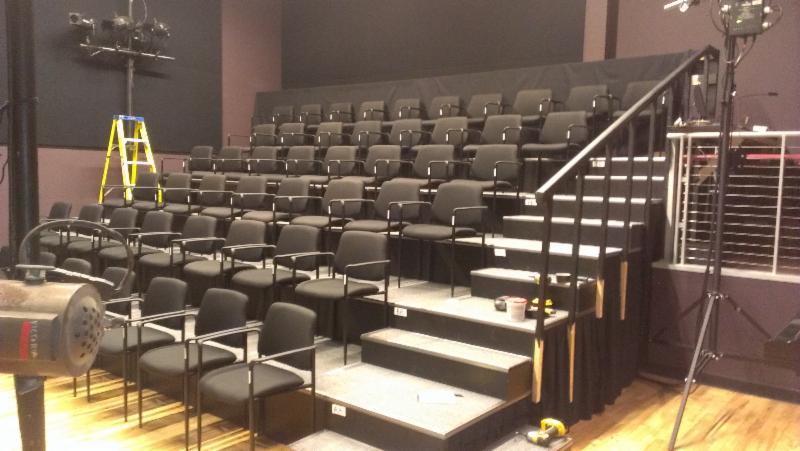
The venue itself was a perfect setting for this production, as the building saw duty most recently as a church.  The Raven has taken what was a cinder block box church and converted it into a cinder block box theater. With a capacity of about one hundred seats, rows of 14/15 comfortably padded chairs face a slightly raised stage.  Sight lines were a problem for folks sitting in the rear of the house, so either raising the stage more or putting the audience seats on risers is probably in the future.  Concerns about the acoustics were quickly abated, as their sound system and sound designer did the job of allowing the audience to clearly hear the dialogue and singing with a minimum of distortion.  Located just on the edge of the Windsor Town Green area, the Raven Theater Windsor is perfectly situated to provide an audience with new options for those looking for a night out on the town with dinner and a show.

With a running time of just under two hours (including the intermission/bingo game with “good Catholic prizes”), you should find yourself often chuckling and surely smiling a whole lot at the Little Sisters of Hoboken. With plenty of audience interaction, “Nunsense” is a perfect community theatre piece to introduce the Raven Players to a new community. 

Nunsense

A Raven Players Production

April 4 through April 19

Evenings Fri, Sat @ 8pm – Matinees Sat/Sun @ 2pm

Thurs Apr 10 @ 8pm – Value Night

Raven Theater Windsor
195 Windsor River Rd
Windsor, CA 95492

(707) 433-6335

www.raventheater.org

Photo by Ray Mabry

‘Evita’ opens in Redwood City

By Judy Richter

“Evita,” the blockbuster based on the life of Argentina’s Eva Peron, has been a staple of the musical theater for more than three decades, starting as an album and then opening in London before moving to the United States.

Its U.S.appearances started with the production that moved fromLos Angeles to San Francisco and then to Broadway in 1979. Now Broadway By the Bay is staging it.

With music by Andrew Lloyd Webber and lyrics by Tim Rice, “Evita” starts with the heroine’s death from cancer in 1952 at age 33, when she was a world celebrity. It then goes back to a small Argentina town in 1934, when Eva Duarte (Alicia Gangi Malone) was a 15-year-old aspiring actress with big ambitions. She connects with a nightclub singer, Agustin Magaldi (Daniel Hurst), and persuades him to take her toBuenos Aires.

There she establishes a career as an actress and radio performer while sleeping her way upward until she becomes the wife of Gen. Juan Peron (Anthony Bernal), who is elected president.

Commenting on her actions is revolutionary Che Guevara (Alex Rodriguez). In real life, the two probably never met, but in the theater he serves as an effective foil to her questionable tactics.

This is BBB’s third go at the show. Then known as Peninsula Civic Light Opera, the company staged it in 1986 and again in 2002 under its present name.

Directed by Jason Hoover, this latest production is intriguing because its staging is new, at least to me. Others have either been directed by the original director, the brilliant Hal Prince, or inspired by him. Likewise, the sets and choreography in those previous shows were based on the original, which included newsreels and photos of the real Eva.

This new approach isn’t nearly as impressive, but perhaps because it’s so spartan, it can offer new insights into the music. Although it might seem that Lloyd Webber is merely recycling some melodies in the two-act show, he’s actually using them to ironic effect to illustrate changes in Eva’s life.

For example, one of the sweetest songs is “Another Suitcase in Another Hall,” sung by Peron’s mistress (Samantha Cardenas) after Eva has unceremoniously evicted her from Peron’s bed. One of her lines is “So what happens now?” The male chorus softly replies, “You’ll get by, you always have before.” This refrain is reprised in a final scene between Juan and the dying Eva.

The penultimate number, “Montage,” is just that — a montage of the songs that chronicle Eva’s life from age 15, a kind of deathbed flashback.

Choreography by Alex Hsu comes closest to the original in “Peron’s Latest Flame,” sung by Che, a chorus of soldiers and a chorus of the aristocracy. The soldiers march rectangularly in stiff precision while the aristocrats move diagonally in a lock step of their own. Both groups oppose Eva, but the rousing “A New Argentina,” which immediately follows and ends Act 1, shows how much the common people adore her.

The best-known song is “Don’t Cry for Me Argentina,” sung by Eva at Juan’s inauguration and in her final broadcast to the nation. Although Malone is an effective actor and good dancer, her singing isn’t up to this demanding role. She sometimes becomes shrill or goes flat.

The others are all good singers, especially Rodriguez as Che, the second-most important character. Unlike his predecessors, who usually wore scruffy beards and fatigues, Rodriguez is well-groomed and wears a suit and tie at first (costumes by Margaret Toomey). He’s then in shirtsleeves and blends in well with the people of Argentina.

David Möschler directs the excellent orchestra.

The set by Jerald Enos features three movable structures with arches. It’s adequate for this show and could probably be recycled for a “Camelot.”

Sound and lighting are the biggest weakness. Jon Hayward’s sound is so loud that it muddies the lyrics. Since the show is sung through like an opera, understanding the lyrics is crucial to following the story.

The lighting by Seamus Strahan-Mauk is too busy, sometimes calling so much attention to itself that it’s distracting, especially when overhead lights swing into the audience’s eyes.

After seeing many previous productions, including the film with Madonna, it’s difficult to see this one as if it were the first and I didn’t know much about the show. It’s likely that many people in the audience, especially the younger ones, actually were new to the show. However, there’s no doubt that the music and most of the performances are captivating whether this is one’s first or eighth viewing.

“Evita” will continue at the Fox Theatre, 2215 Broadway St., Redwood City, through April 13. For tickets and information, call (650) 579-5565 or visit www.broadwaybythebay.org.


Remarks on Adam Lanza and the Sandy Hook School shooting

By Joe Cillo

Remarks on Adam Lanza and the Sandy Hook School shooting


The Reckoning:  The father of the Sandy Hook killer searches for answers.  By Andrew Solomon.  The New Yorker, March 17, 2014, pp. 36-45.


This article, in the March 17, 2014 issue of The New Yorker, is the outcome of six interviews Andrew Solomon conducted with Peter Lanza, the father of Adam Lanza, last fall, some lasting as long as seven hours.  It is Peter Lanza’s first public statement since the killings at Sandy Hook Elementary School on December 14, 2012.  The Sandy Hook massacre has been portrayed in the media and by law enforcement as “incomprehensible,”  however, I think this summary of Solomon’s interviews with Peter provides a basis for some insight and interpretation that has not heretofore been considered.

Solomon describes Peter’s state of mind regarding the incident as one of “sustained incomprehension.”  Peter tells us, “I want people to be afraid of the fact that this could happen to them.” (p. 37)  Solomon himself accepts this admonition and says so explicitly in his NPR interview with Terry Gross.1   However, this warning reflects Peter’s lack of insight and understanding of his own family.   It is not an uncommon position for an American father to find himself in, but we need not fear that this can happen to just anyone, that any kid can become a mass murderer.  It can certainly happen again, and probably will, given conditions within American society.  The New York Daily News (December 12, 2014) recently reported a total of 44 school shootings that have occurred since Sandy Hook.2  But these are not random events.  They are not lightning strikes.  They reflect widespread conditions of psychological and social disintegration in American society.   We will see what those conditions are in the case of Adam Lanza.  At the same time, it would have been difficult for anyone to have foreseen what was coming in Newtown — except, perhaps, for Nancy, Adam’s mother and first victim.

Solomon’s article is spare in what I would most like to know about, namely, Adam’s earliest years and a close examination of his relationship with his mother, Nancy.  Apparently there is a treasure trove of e-mails between Adam and Nancy in the last years before the event that are under seal with the Connecticut State Police, and which Solomon did not have access to.  He tells us of this in his NPR Fresh Air interview.  If those e-mails could be examined it might shed a great light on the final trajectory of this tragedy and on the plausibility or implausibility of the interpretation being offered here.

Solomon tells us in the article that

he [Adam] didn’t speak until he was three, and he always understood many more words that he could muster.  He showed such hypersensitivity to physical touch that tags had to be removed from his clothing.  In preschool and at Sandy Hook, where he was a pupil till the beginning of sixth grade, he sometimes smelled things that weren’t there and washed his hands excessively.”  A doctor diagnosed sensory integration disorder, and Adam underwent speech therapy and occupational therapy in kindergarten and first grade.   Teachers were told to watch for seizures.  (p. 37)

This might have been an early indicator of the autism that was later diagnosed.  Autism is a vast concept that encompasses a broad array of behavioral anomalies, learning disabilities, and social difficulties.  A recent article in the New England Journal of Medicine linked it to prenatal abnormalities in cerebral cortex development.3  The cerebral cortex has many disparate areas and governs many aspects of sensory processing, motor skills, and language skills.  Depending on the area and extent of developmental abnormalities, the resulting manifestations, what is called “autism,” could differ markedly.  From what I could glean from Solomon’s article, Adam did show indicators of autism, in respect to the hypersensitivity to sounds and touch.

Sensory overload affected his ability to concentrate; his mother xeroxed his textbooks in black and white, because he found color graphics unbearable.  He quit playing the saxophone, stopped climbing trees, avoided eye contact, and developed a stiff, lumbering gait.  He said that he hated birthdays and holidays, which he had previously loved; special occasions unsettled his increasingly sclerotic orderliness.  He had “episodes,” panic attacks that necessitated his mother coming to school . . . (p. 38)

All of the above enumerated behaviors have to do with mitigating stimuli that can evoke emotional response:  color, music, eye contact, birthdays, holidays, and the panic attacks were probably situations where his anxiety got out of control.

My personal experience with autism is limited to one person, whom I knew rather closely.  My observation of this woman was that her emotions appeared to be hooked up to an amplifier with the volume turned up too loud.  She reacted with great intensity, particularly to anything negative, often going to the extreme.  Her reactions were not inappropriate, as in schizophrenia, but disproportionate.  She didn’t seem to have any ability to modulate her feelings.  She took everything to the ultimate.  She was a woman of extremes.  Once she started careening out of control,  it was very hard to rein her in.  She could be violent.  She could be explosive.  Whenever she came to visit, I always made sure that any knives, scissors, pencils, letter openers, or anything with a blade or a sharp point were put away inside drawers and cabinets rather than lying around on tables, desks, and countertops, where they could be grabbed quickly.  And I certainly wouldn’t have taught her how to use a gun.

This intensity of emotional response in autism is echoed in an account by Tara Kaberry.4  Kaberry’s observations of her son are very similar to what I saw in the woman I knew.   Kaberry also described a tendency of her son’s to shut down in response to overstimulation.  The autistic person, having limited or no ability to regulate emotional intensity, shuts down emotionally in order to avoid getting out of control.  It is a defensive move.

Adam’s showed many similar behaviors and his ability to regulate his own emotions seemed to deteriorate as he got older.  Was this a progression of the autism, or was it a response to changes in his human relations and social environment filtered through the autism?  It is hard for me to say.  There was a lot of emotional hardship going on in the family throughout Adam’s years growing up.  His parents separated in 2001, when he was 9, and no doubt their relationship had been strained for some time before that.  They divorced in 2009 when he was in his teens.  His father remarried within a year or two.  This affected his mother, may have intensified her loneliness and depression, and she seemed to distance herself from his father after that.  This negative progressive development in his parents’ relationship could represent quite an intense overload for a boy who couldn’t bear color in his textbooks.  It could explain his progressive shutting down and withdrawal from human contact.  Suicide would represent the ultimate withdrawal and shutting down.  But this should not be seen as a natural progression of autism.  It is a response to changes in the human environment, albeit to an extreme.  It seems that the human environment can be an exacerbating or mitigating factor in the type and degree of the manifestations of autism.

It is also true that some autistic people can be aggressive and violent, especially as they approach young adulthood.  However, when autistic children are violent it tends to have a history and a pattern of circumstances that triggers it.5  But apparently Adam had no history of violent or troubling behavior (p. 40) — unless Nancy was not revealing all that she knew.    Because the Newtown rampage was such a singular outburst that was focused on well chosen targets, that took careful planning and good functionality to execute, I discount autism as a determining factor, although it may have played a role in laying the foundation as an emotional intensifier.  The causes of Adam Lanza’s debacle were primarily interpersonal, social, and psychological, as I see it.  There is some evidence that suicide ideation is significantly higher in autistic children than in the rest of the population, except for depressed children.6  But the suicidal tendencies seem to be related to social factors more than to the autism itself, i.e., to the brain abnormalities.  This agrees with my assessment of the Sandy Hook case.  If there is anything that Adam Lanza’s case teaches us, it is that autism should never be mixed with guns.

The presence of autism complicates any attempt at psychological analysis.  It is difficult to separate the impact of autism, that is, the abnormalities in the structure of the brain, and the resultant distortions in the processing of emotional stimuli, from the environmental impacts of the human and social relations on both personality structure and emotional responses to particular situations.

Solomon presents a rather disconnected, confused discussion of empathy in relation to Adam. (p. 40-41)  On the one hand he seems to want to say that Adam lacked empathy, which he sees as a manifestation of autism, but on the other he enumerates plenty of evidence that Adam had excellent empathy.  Adam understood the people around him well enough to know exactly how to hurt them with the most brutal effect.  Kaberry also points out how the emotional shut down which autistic people use as a defense against overstimulation and a lack of emotional control is often misread as a lack of empathy.

Empathy is the ability to read another person’s mental state: to grasp what they are thinking and feeling, to anticipate their subjective, internal responses.   Empathy is strictly informative; it is not prescriptive.  Some people confuse empathy with sympathy, but they are not the same.  Empathy is neutral in the way that vision and hearing are neutral.  It gives you information, but it does not tell you what to do with it.  An autistic person’s hypersensitivity to emotional stimuli may interfere with his ability to empathize, but it also may be selective in the quality of feelings that are impeded.  In other words, autism may create empathic blind spots — which could be situational — rather than a general degradation in the ability to empathize.  The defensive shutting down (refusing to make eye contact, to shake hands, speaking in a flat monotone, etc.) does not necessarily imply a lack of understanding of the feelings and intentions of another person.  It implies rather a refusal to allow a response, and an unwillingness to engage in the unpredictable give and take of a human interaction.  Adam’s atrocity was informed by the most astute empathy for its impact on the whole society.  In respect to his crime, Adam was not unempathic, he was evil.

From his earliest years Adam’s experience of school was interventionist and “therapeutic.”  But apparently his relationship with Nancy was not examined in any depth nor was his relationship with his parents connected in any way to the symptoms he presented.  It was a very inauspicious omission.  This was the point where an appropriate intervention might have made a meaningful difference.  Doing the wrong thing  and evincing  gross misunderstanding of the young boy was probably the kindling point of what later became the blazing rage that was turned on the school.

Another important lacuna in Solomon’s account is Nancy’s preoccupation with guns and her frequent trips with Adam to the shooting range to see that he was well trained in the use of firearms.  Peter also participated in these shooting range trips, but apparently less often.  It was a very important part of Adam’s relationship with his parents, particularly with his mother, right up to the very end, and Solomon barely mentions it.  Solomon emphasizes psychiatrists and schools.  His article becomes so sanitized it is almost disingenuous.  In contrast,  The New York Times reported that

Inside the rambling, pale-yellow Colonial-style home in a Connecticut suburb, Adam Lanza lived amid a stockpile of disparate weaponry and macabre keepsakes:  several firearms, more than 1,600 rounds of ammunition, 11 knives, a starter pistol, a bayonet, 3 samurai swords.  He saved photographs of what appeared to be a corpse smeared in blood and covered in plastic, as well as a newspaper clipping that chronicled a vicious shooting at Northern Illinois University.7

This house was ready for serious combat.  But the real enemy was within.  Nancy complained that she couldn’t get Adam to go to a tutor, but she never mentions having trouble getting him to go to the shooting range.

When Adam was thirteen he was taken to Paul J. Fox, a psychiatrist who first gave Adam the Asberger’s syndrome diagnosis and recommended that Nancy homeschool Adam, arguing that isolating him from his peers would be better than the many difficulties Adam was having in school.  (p. 39)  When I saw that I thought, “Oh, no!”  Isolating this troubled boy with his overinvolved mother in an emotional hothouse.  Wrong move.  This was an unfortunate, and I think, fateful turning point.  Fox also prescribed a psychotropic drug called Lexapro, which caused immediate, severe side effects and was promptly discontinued — by Adam himself, not the adults.

Robert King, the psychiatrist at Yale’s Child Study Center, who examined Adam, “was concerned that Adam’s parents seemed to worry primarily about his schooling, and said that it was more urgent to address ‘how to accommodate Adam’s severe social disabilities in a way that would permit him to be around peers.’  King saw, ‘significant risks to Adam in creating, even with the best of intentions, a prosthetic environment which spares him having to encounter other students or to work to overcome his social difficulties.'” (p. 39-40)  In my opinion, this doctor got it right.  But they don’t seem to have followed his advice.

I am deeply mistrustful of psychiatric diagnoses.  Their purpose is to develop a uniform approach for treating all with the same label, but when dealing with people and their inner lives a customized individual approach is what is necessary.  In our time psychiatric diagnoses are being used to market a host of drugs designed to modify and control behavior, so there is a vast and powerful industry invested in them.  This case calls into question with the utmost poignancy the faith we place in these diagnostic concepts.

Once you have one of these labels pinned on you, it affects the way you are regarded and treated in school.  It affects the way your peers perceive you.  It affects expectations others have of you.  It might affect opportunities that are available to you.  Everything you do becomes interpreted in terms of your diagnostic category.  Your diagnosis becomes your identity as a person.  And these labels are extremely persistent.  Once they get stuck on you, it is very hard to peel them off.

In his interview with Terry Gross on NPR’s Fresh Air program (March 13, 2014), Solomon remarked at how the dispensation of a psychiatric diagnosis can be a profound relief to parents of a troubled child or to an individual who is suffering.  At last, one has a definition of the problem.  One is not alone in ones troubles, but becomes part of a community of those similarly afflicted.  The case of Adam Lanza illustrates how perilous such comfort and relief can be, how misleading conceptualizations and misguided treatments can easily result.   One must treat each case as an individual, look closely at the peculiarities of each situation and understand what is going on in the human relationships of that person before presuming to make active interventions, particularly in altering the chemistry of the brain in order to manipulate behavior or numb emotions that are a natural response to the human and social environment.

Adam rejected with some vehemence the diagnoses that were made of him (Asberger’s syndrome, autism, obsessive compulsive disorder, etc.), and insisted that the problems were external, i.e., between him and his parents, especially his mother.  But no one listened.  In fact, from the sound of Solomon’s interview and the article, they completely failed to examine the relationship between Nancy and Adam as having any bearing on Adam’s problems.  The problem was always with Adam.  There was something wrong with him, we have to find out what it is.  We have to treat Adam.  This can be understandably enraging to a young boy, when he knew very well that the basic problem was his mom, and that rage, being reinforced and intensified in countless small interactions day by day, can build up over time to a feverish intensity.  The basic problem in understanding this case, as I see it, is the lack of attention that has been paid to Nancy and her relationship with Adam as a determinative factor in the outcome.

The Connecticut State Attorney’s report8 also fails to examine Adam’s relationship with his mother in any great detail, offering only a few conflicting generalities.  In fact, it ignores Adam as a human being altogether, referring to him throughout as ‘the shooter.’  The State Attorney can’t even bear to use his name.  They were not interested in Adam Lanza as a person, but only as ‘the shooter.’  It is not surprising that this police report sheds no light on Adam’s motivation for the rampage.

Solomon tells us that Peter “maintains a nearly fanatical insistence on facts, and nothing annoyed him more in our conversations that speculation — by me, the media, or anyone else.” (p. 37)  However, Peter indulges in numerous speculations himself throughout the article that I very much question.  For example, “With hindsight, I know Adam would have killed me in a heartbeat, if he’d had the chance.  I don’t question that for a minute.” (p. 43)  I question it very much.  Peter’s relationship with Adam seems to have been the most positive, constructive, nurturing one that Adam had in his life.  Throughout his life up to the very end, Peter reached out to Adam in very positive, supportive, helpful ways, playing with Lego blocks, taking him on hikes, shopping for Christmas presents to donate to needy children (at Adam’s initiative), buying him a car, teaching him to drive, offering to buy him a new computer.  There is a very touching picture in the Connecticut Attorney General’s report of a birthday card Peter sent to Adam in the last year of his life inviting him to send an e-mail if he would like to go hiking or shooting.  The best times of Adam’s life appear to be the times he spent with his dad.  If Peter had been around to act as a buffer between Adam and Nancy, Adam might not have killed anybody.  That is my counter speculation.

“I was doing everything I could, ”  Peter said.  “She was doing way more.  I just feel sad for her.”  Peter is convinced that Nancy had no idea how dangerous their son had become.  “She never confided to her sister or best friend about being afraid of him.  She slept with her bedroom door unlocked, and she kept guns in the house, which she would not have done if she were frightened.”  (p. 43)

Of course she wasn’t frightened.  But for reasons that Peter had no capability to fathom.  I have a very different conception of Nancy and her role in this tragedy.  I see her as the driving force that impelled Adam toward a violent consummation.  In my view Peter was a man of limited insight into emotional issues and woefully incapable of perceiving the emotional needs of his family, first of all of his wife, and more pertinently of his son.   But it is certainly true as well that Nancy was not up to being an effective wife and mother, and this resulted in Peter turning away from the family fairly early on and divesting himself to a large extent of this tangled emotional morass of Adam and Nancy, leaving them to more or less fend for themselves.  “I took a back seat,” he tells us. (p. 39)  By his own admission he wasn’t around that much, even when he was married to Nancy and living with the family.  “I’d work ridiculous hours during the week and Nancy would take care of the kids.  Then, on weekends, she’d do errands and I’d spend time with the kids.” (p. 38)  It doesn’t appear that they spent a lot of time together with their children, so Peter would not have observed much of the day to day interactions between Nancy and Adam.  He was a man who did not know what was going on in his own house, and he seems to have had a limited emotional connection to his wife.

Nancy, quite naturally, being socially isolated and profoundly insecure, turned to Adam with her tremendous neediness, monumental anxieties, loneliness, sense of futility, and tendency to control and manipulate.  Adam, being a child and having the limitations of his autism, was not equipped to deal with this overwhelming onslaught, and began to withdraw in various ways, incorporating many of Nancy’s anxieties, showing various asocial symptoms, while at the same time steadily building up a volcanic rage that he could not express directly.  But he was given explicit encouragement in the use of guns and implicit permission for an interest in violence and murder.  So his anger became channeled in this direction and coalesced around the condensation points of mass shootings, and, especially, shootings at schools, since schools were the places he could best relate to, and which were the bane of his life and the perpetual measuring stick against which he was always coming up short.

It was after Peter’s marriage to Shelly Cudiner that things seem to careen toward their final demise.

Nancy wanted to take him to a tutor, but, she wrote, ‘Even ten minutes before we should leave he was getting ready to go, but then had a meltdown and began to cry and couldn’t go.  He said things like it’s pointless, and he doesn’t even know what he doesn’t know.’  In early 2010, when Nancy told Peter that Adam had been crying hysterically on the bathroom floor, Peter responded with uncharacteristic vehemence:  ‘Adam needs to communicate the source of his sorrow.  We have less than three months to help him before he is eighteen.  I am convinced that when he is eighteen he will either try to enlist or just leave the house to become homeless.’ (p. 42)

My feeling is at this point Adam should have been hospitalized.  Clearly the situation was getting worse and worse and Nancy was not managing it.  This is where an intervention that would have altered this downward spiraling dyad of Nancy and Adam should have been imposed.  Peter was completely blind to the problem and its seriousness.  He was only looking at Adam and not at the relationship between Adam and Nancy.  It was a fateful and fatal misperception.

Shelley Cudiner had apparently been living in the Sandy Hook community for at least ten years, and had been previously married.  I was not able to find out the date of her marriage to Peter, but it had to have been in late 2010 or 2011, nor was I able to find out the history of their relationship, and if it played any role in Peter’s divorce from Nancy in 2009.  It is pretty clear that the divorce of his parents had a negative effect on Adam, contrary to Peter’s assessment. (p. 38)  It took Peter even further out of the life of the family than he already was, and left Adam indelibly fixed in the orbit of his mother.  The marriage of Peter to Shelley some time in late 2010 or 2011 was probably what set things on their final course.  Adam decided (perhaps in error) that his father was of no further use, and began to withdraw from him.  Nancy also distanced herself from Peter and began to impede his access to Adam while maintaining a pretense as a helpful intermediary, offering misleading signals that Adam’s condition might be improving.  At some point after his father’s remarriage Adam made up his mind that he would have to deal with this himself in his own way, and his mother was giving him plenty of clues as to how to go about it.

“A word document called ‘Selfish,’ which was found on Adam’s computer, gives an explanation of why females are inherently selfish, written while one of them was accommodating him in every possible way.” (p. 43)

This comment illustrates how effective Nancy’s dissimulation was in misleading Peter, Solomon, the community, and the media.  But she didn’t fool Adam.  Adam was closer to her than anyone else and knew her best.

The portrayal of Nancy as the hapless, longsuffering victim of a monster child increasingly out of control due to mysterious internal forces is not credible.   What follows is a speculative reconstruction, with no apologies, Peter — and I don’t regard you as the most authoritative commentator.  I do welcome concrete evidence that would refute or confirm it.  I believe such evidence exists and that it is possible to definitively understand what happened in this tragedy.  But it requires a close examination of Nancy, who she was, and her impact on Adam’s psychological development.

As I see it, at some point Nancy must have decided that death was an increasingly appealing alternative to the deteriorating life she had.  There is simply not enough information to determine at what point this occurred.   Whether it was after her separation from Peter in 2001, after her divorce in 2009, or after Peter’s remarriage in 2010 or 11, or perhaps even way before at some time during her marriage when Peter was nominally living with her.  But Nancy seems to have become increasingly depressed and very likely suicidal.  She did not have the inner resolve to kill herself, so she chose Adam for the role of her executioner, and she made sure he had the means at his disposal, and gave him plenty of training for the task.  Some people commit suicide by provoking others to kill them.  Nancy was using Adam as her instrument.   There was an implicit understanding between them.  Adam may well have realized where his mother was driving them both, and it could explain his attempts to wall himself off from her and isolate himself in the last months before the killings.  Just before the shootings, Nancy wrote Adam a Christmas check for the purpose of buying a CZ 83 semiautomatic pistol. (CT State Attorney’s Report, p. 26)  It may have been Nancy’s Christmas wish for herself to Adam.  And Adam got the message.  Of course Nancy wasn’t frightened.  She had a pretty good idea what was coming and was resigned to it, even encouraging of it.  In committing a murder-suicide Adam may have been carrying out his mother’s final wishes.

Anyone who does not accept this or some similar reconstruction of Nancy must account for one overpowering fact that transcends all diagnosis:  Adam Lanza killed his mother.  If there was nothing terribly wrong in the relationship between Adam and Nancy, and she was just a well meaning parent doing everything she could for her troubled child, then you have no choice but to see Adam as in inexplicable demon who randomly snapped and lashed out blindly at anyone who happened to be around.  It is an untenable view that goes against common sense and everything we know about psychology.

What Nancy probably did not count on was the conflagration at Sandy Hook Elementary School.  That was most likely Adam’s own twist on the matter.  Nancy was probably visualizing her own murder, or perhaps murder-suicide — and was quite prepared for it.  Adam, through his study of mass shootings, particularly the one at Columbine High School in Colorado, visualized a more dramatic exit.  He did not want to just die a mediocre death of a murder-suicide that would be swept under the rug and quickly forgotten.  He wanted lasting infamy.  It also served as a final assertion of independence from his mother.  Blasting the school away was a final comment on his parents’ values and expectations.  It was Adam’s verdict on everything that they tried to impose on him throughout his entire life.  It makes perfect sense.

The massacre of young children at Sandy Hook was a further stab in the eye of society and of life itself.  It is one thing to say, “My life is not worth living.  Therefore I will kill myself and end it.  You may see things differently, so you will choose to continue to live.  Very well, but I will say good-bye.”  That is the simple suicide.  Murder-suicide is suicide coupled with the murder of one (or perhaps others) with whom one feels inextricably bound and who is the partner in a consummating sense of despair and rage.  When the suicide is accompanied with murders of strangers who are not chosen at random, but share some characteristics, such as children at a school, then the act represents an attack on the society, and reflects a perception on the part of the killer that society is in some way to blame for his demise and for the destructive retribution that he is meting out.  The school killings at Columbine, Sandy Hook, Virginia Tech, Northern Illinois, and many others around the world are acts of vengeance.  They are retribution on the part of the shooter for perceived injuries and insults that have intolerably afflicted his life.  The perceptions may be accurate or inaccurate, justified or delusional, but the killer is lashing out at specific targets that represent an inchoate enemy.  Children represent the hopes and dreams of a society.  They represent the future, its continuation and growth.  Killing children is the most vicious, categorical attack on any society, because it aims at the destruction of that society’s future.  Adam’s attack on the Sandy Hook Elementary School represents his complete alienation, not only from his own family, but from his community and his entire society.  He wanted to destroy not only himself and his mother, but everything.

This is what people find so difficult to comprehend.  How is such complete, thoroughgoing alienation possible?  It occurs when all the roads forward seem blocked or unappealing to the point of being unacceptable.  This has a great deal to do with schooling, because school is where one comes into contact with society and its values, and where one begins to formulate a vision for one’s personal future in that society.  One meets peers in one’s age group and begins to form friendships and associations.  Patterns become established in how one interacts with other people and one’s expectations of oneself and for the future.  This is sometimes called “socialization.”  When this process doesn’t work out, alienation is the result, and manifests itself many ways, the most common in American society are drug and alcohol abuse, which are passive and withdrawing, and criminality, which is assertive and defiant.  American schools are virtual factories of alienation.  The medical establishment is another.  Adam Lanza experienced both to an inordinate degree from early in his life.  When he reached the point of unleashing a terrible vengeance, he chose the most appropriate target.

I divide this case into two parts:  I see the murder of his mother together with Adam’s suicide as an outgrowth of the pathology in the relationship between Nancy and Adam superimposed on the autism.  The massacre at Sandy Hook Elementary had less to do with autism and more to do with Adam’s personal psychopathology.  It consisted of his essentially depleted, empty inner self, his estrangement from his father, which was related to his parents’ divorce and his father’s remarriage, the compensatory identification he made with the mass murderers who had attacked schools, which was made possible by his negative experiences with schools throughout his life, and the excessive value his parents placed on school achievement and the iatrogenic effect this had on their relationship with Adam.  Adam also had encouragement and training in violence and the use of weapons.  Violence and the use of guns was egosyntonic in the atmosphere of his home.  Furthermore, Adam desired significance.  He wanted greatness and a lasting legacy, and he found plenty of role models in the examples of previous mass shooters at schools.

Peter told Solomon that he wished Adam had never been born.  But to wish Adam had never been born is to wish Peter’s entire adult life had never happened: his marriage to Nancy, the many good times spent with Adam, his divorce and remarriage.  It is an indication that he is not dealing with the matter well.  He wants to distance himself and obliterate it rather than look at it closely and understand exactly what happened and why.   It is once again his characteristic unwillingness to look at human problems in any depth.

The media and the police portray Adam as a monster.  But he was only a monster on the last day of his life.  If we subtract the last day of his life, Adam Lanza was a rather inconsequential person, except to his immediate family.  If he had just killed himself, or even just himself and Nancy, it would have been tragic, but it is unlikely that he would be demonized to the degree that he has been.   It was the murder of the children at Sandy Hook that transformed the mediocre Adam Lanza into a larger than life immortal monster.

This murder of the children, I must stress, should not be seen as a manifestation of hatred or rage toward the children themselves.  There has been some suggestion that Adam was bullied during his school days, and that this contributed to his motivation for the rampage at the school.  I discount that.  If there was any bullying, it was not a major factor.  There is lots of bullying among kids, but few mass murderers.  What bullying he might have experienced at school paled in comparison to what he faced at home with his mother.  And the children he killed were not the children who had bullied him.  They were much younger and strangers to him.  So the idea that this was vengeance for bullying that had taken place years ago is facile to the point of being farfetched.  Adam’s outburst was rage against the school as an institutional force in children’s lives, and in his in particular, against the society that places inordinate emphasis on school achievement, against his parents who placed such importance school and children’s performance therein, and against the medical community that misdiagnosed him and therefore failed to understand him and provide appropriate interventions.  It was also an immature desire for infamy through massive destruction.  Grandiosity run amok.

There were several psychological factors that propelled Adam toward the conflagration at Sandy Hook Elementary.  First of all and most fundamentally was his inner sense of emptiness, isolation, and a lack of self definition.  Adam had no firm sense of who he was, or what his values were, or his purpose and significance in life.  This is all related to inadequacies in his relationship with his mother, the details of which are unavailable, and a turning away from his father as a viable role model, probably in response to his father’s remarriage.  He also had his rage and his alienation from school and from society.  He also had permission and even encouragement from his parents to use guns.  Into this psychological void and hunger for self definition and significance stepped Dylan Clebold and Eric Harris, Steven Kazmierczak, Seung-Hui Cho, Anders Brevik, and other mass shooters he had studied in some detail, who used the school as a stage for macabre theatrics.   Adam saw in these mass killers a kinship.  Identification with them solved a psychological problem in how he should define himself as a person, and it incorporated the important raw materials he had available, namely, the weapons, the rage, the hatred of school, and his contempt for society.   When you look at it closely, it is almost overdetermined.

Of course Nancy bears a lot of the responsibility for the outcome, as does Peter.  Parents matter.  But their responsibility is not total.  Nancy set the course toward murder-suicide certainly within the last few years of their lives, and possibly long before.  But ultimately Adam made a choice and took an action that defined himself independent of his parents.  It may have been the first time in his life that he was able to take such a self defining step.  Being a mother is a weighty responsibility that goes unrecognized in American society.  It is even despised by many women and men.  But when it is handled badly, the cost can be great, both for the children and the family, and also for society.  The important lessons from the Sandy Hook massacre are the value of motherhood, the social significance of alienation, and the perils of the ready availability of guns.  These three factors, built on a substrate of autism, caused this event.  It is not at all incomprehensible.  It is very clear, and these conditions are not uncommon in American society.  More such atrocities are likely brewing.  Not every situation that could develop toward this outcome does.  Many, many factors can derail, divert, or mitigate such an person from carrying forward to the most extreme outcome.  Thankfully, it should be a rarity, but the prevalence of the right soil conditions is bound to produce some malignant fruit.

The realization of this whole episode and many others like it of lesser import are made possible by the ready availability of guns in American society.  There are lots of troubled people; there are lots of crazy people; there are lots of people with evil hearts who desire to destroy themselves and others.  Giving them effective means to carry out their worst intentions and encouraging their use is the worst possible thing a society can do.  Yet this is what America does.  So we as a society also bear a large part of the responsibility for the demise of Adam Lanza and the calamity at Sandy Hook Elementary.  Adam may have been supremely evil on the last day of his life, but Nancy was evil and malevolent for a very long time, molding and shaping Adam into the explosive time bomb he became, and America is sinister and evil in providing the conditions that enable and promote the most extreme outcomes of psychopathology and emotional disintegration.

Depending on whom you ask, there were twenty-six, twenty-seven, or twenty-eight victims in Newtown.  It’s twenty-six if you count only those who were murdered at Sandy Hook Elementary School, twenty-seven if you include Nancy Lanza; twenty-eight if you judge Adam’s suicide as a loss.  There are twenty-six stars on the local firehouse roof.  On the anniversary of the shootings, President Obama referred to ‘six dedicated school workers and twenty beautiful children’ who had been killed, and the governor of Connecticut asked churches to ring their bells twenty-six times.  Some churches in Newtown had previously commemorated the victims by ringing twenty-eight times . . . (p. 37)

Society wishes to exclude Adam and Nancy in death as they had been in life: ignoring them, misunderstanding them, wishing, like Peter, that they had never existed.  We are not learning the lessons that their lives and deaths should teach us.


Notes


1.  Fresh Air with Terry Gross.  National Public Radio broadcast. March 13, 2014.

2.   New York Daily News, February 12, 2014

3.  New England Journal of Medicine

4. Kaberry, Tara. Can Emotional Overload Look Like a Lack of Empathy?  Yes.  Autism and Empathy.  October 28, 2011.   http://www.autismandempathy.com/?p=713

5. Washington Post, March 13, 2011.  Also

http://www.ageofautism.com/2013/10/lost-afraid-where-to-turn-when-autism-turns-violent.html

6.  Mayes, Susan Dickerson; Gorman, Angela A.; Hillwig-Garcia, Jolene; Syed Ehsan (2013)  Suicide ideation and attempts in children with autism.  Research in Autism Spectrum Disorders, Vol. 7, No. 1, pp. 109-119.

7.  New York Times  March 28, 2013.

8.  Report of the State’s Attorney for the Judicial District of Danbury on the Shootings at Sandy Hook Elementary School and 36 Yogananda Street,

Newtown, Connecticut on December 14, 2012.  OFFICE OF THE STATE’S ATTORNEY JUDICIAL DISTRICT OF DANBURY, Stephen J. Sedensky III, State’s Attorney.  November 25, 2013


SF Playhouse Presents World Premiere of Bauer by Lauren Gunderson

By Flora Lynn Isaacson


Ron Guttman plays Rudolf Bauer at SF Playhouse through April 19, 2014. Photo by Jessica Palopoli.

 [rating:4] (4/5 stars)

Lauren Gunderson is a hot new playwright with six productions (some world premieres) in the Bay Area during 2013-2014, including Silent Sky at Theatre Works,  By and By at Shotgun Players, the Taming at Crowded Fire, and I and You at Marin Theatre Company.

Gunderson’s newest play, brilliantly directed by Bill English tells the compelling and controversial tale of a world renowned artist Rudolf Bauer who was so driven to create, he sketched on scraps in a Nazi prison and yet, eventually stopped painting forever, when a feud erupted among himself, his patron and benefactor, Solomon Guggenheim, and Bauer’s lifetime love, Baroness Hilla Rebay, one of Guggenheim’s most trusted curators.

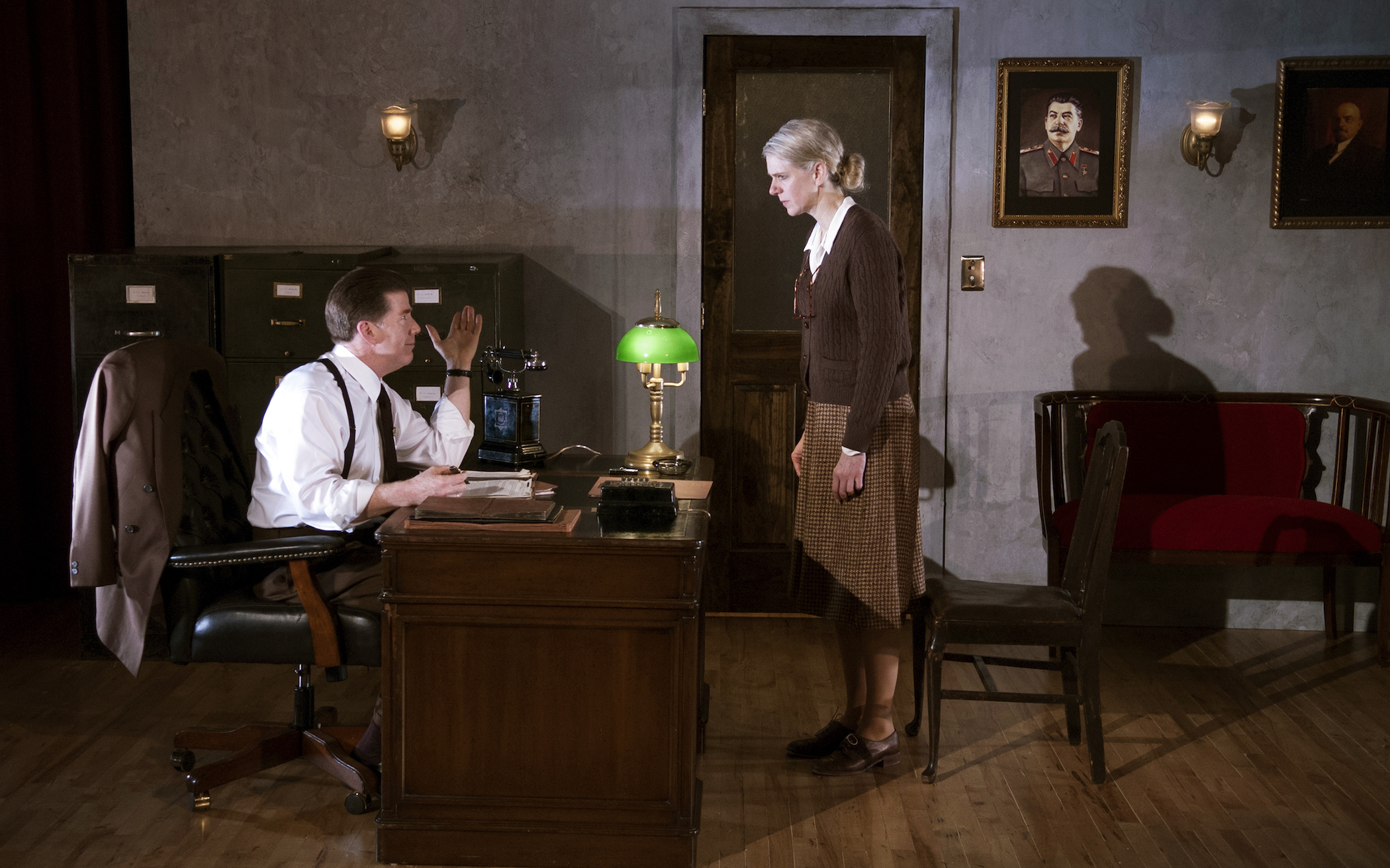
After receiving a letter from Bauer’s wife Louise (a humble Susi Damilano), the Baroness Hilla Rebay (an elegant Stacy Ross) visits Bauer (Ronald Guttman) after a long separation to help save his soul and to start painting again.

Director Bill English frames the action in an impressive white-on-white studio adorned with projections of Bauer’s work.

In the lead role of Bauer, Ronald Guttman presents the tortured soul of this ma who has been crushed by betrayals.  Abra Berman beautifully designs the appropriate costumes. To sum up, Bauer, his wife Louise and former love (the Baroness), dance around each other in a tug of war similar to Jean Paul Sartre’s No Exit.

Bauer is performed March 18-April 19, 2014, Tuesday-Thursday at 7 p.m., Friday-Saturday at 8 p.m., Saturday at 3 p.m. and a select Sunday matinee, April 13 at 2 p.m. SF Playhouse is located at 450 Post Street (2nd floor of Kensington Park Hotel, b/n Powell and Mason), San Francisco.  For tickets, contact the box office at 415-677-9596 or go online at www.sfplayhouse.org.

Coming up next at SF Playhouse will be Seminar by Theresa Rebeck and directed by Amy Glazer, April 29-June 14, 2014.

Flora Lynn Isaacson

The Habit of Art in a bi-polar production by Theatre Rhinoceros

By Kedar K. Adour

L-R: Donald Currie as Auden, Tamar Cohn as Kay, Michael DeMartini as Neil, Justin Lucas as Stuart, and John Fisher as Britten in The Habit of Art by Alan Bennett, directed by John Fisher. A Theatre Rhinoceros production at Z Below. Photo by Kent Taylor.

The Habit of Art: Comedy by Alan Bennett. Directed by John Fisher. Theatre Rhinoceros, being performed at Z Space Below, 470 Florida St., San Francisco, CA. 866-811-4111 or www.therhino.org. Wednesdays through Sundays, March 27 – April 13, 2014

 The Habit of Art in a bi-polar production by Theatre Rhinoceros [rating:3] (3/5 stars)

Before every performance Theatre Rhinoceros prides themselves on their longevity as a unique gay theater company being in existence for 36 years. Unfortunately, after losing their home base on 16th Street in the Mission District they have been nomadic moving between various venues. For their latest venture, The Habit of Art, they have landed in the intimate Z Space Below and they use every foot of the commodious stage to give credence to Alan Bennett’s latest play that is a paean to theatre as well as to W.H. Auden and Benjamin Britten.

 If you are not familiar with the writing of Auden and the music of Britten be advised to brush up on their biographies before seeing this problematic play. They were among the most revered artists of their generation and their reputations have extended beyond their graves. However, since their deaths information about their sexual orientation has been revealed by their biographers and is included in Bennett’s play.

To give credence to the personalities of Auden (Donald Currie) and Britten (John Fisher), his major characters in this intricately woven play, Bennett uses the device of a play within a play. The actors break the fourth wall to comment on their interpretation of the parts they are playing.

The setting is a theatrical rehearsal hall where the actors are having a run through of a play called Caliban’s Day that takes place in Auden’s rooms at Oxford in 1973. The play is about a fictitious meeting between Auden and Britten who had not been in contact for 25 years. Britten is writing an opera of Thomas Mann’s “Death in Venice” and is there to ask Auden’s advice on how to portray the potential pedophilic relationship within the book. Auden erroneously assumes Britten is there to ask him to write the libretto. Bennett slyly inserts comments about Britten’s association with Peter Pear and Auden’s partner Chester.

Before that engrossing scene takes place late in act one, we are treated to the semi-chaotic run through directed by Kay, the stage manager (Tamar Cohn) whose love of the theatre is palpable with her protective nature of her aging leading man who seems unprepared with his lines. There are the conflicts with the author and between actors.

In the play within the play there is a hilarious scene where biographer Humphrey Carpenter (Craig Souza) arrives to interview Auden and is mistaken for the rent boy Stuart (Justin Lucas) hired by Auden. 

Bennett’s dialog between Auden and Britten are handled brilliantly by Currie and Fisher. Justin Lucas does a creditable job as the sensitive rent boy. This review is being written about a preview performance and Craig Souza’s bombastic voice and his entrance in drag playing a tuba to start the second act throws the play out of kilter. Hopefully that will be corrected.

Within the play within the play, there is a conflict between the cast and the playwright as to the play’s ending. Currie gives a beautiful delivery of one of Auden’s poems that is suggested as the ending but Bennett has elected to give the love of the theatre the final shrift. Running time 2 hours and 20 minutes with intermission.

Cast: Tamar Cohn, Donald Currie, Michael DeMartini, John Fisher, Justin Lucas, Seth Siegel, Craig Souza, Kathryn Wood.  Creative team: Valerie Tu, Gilbert Johnson, Jon Lowe, Alicia Bales, Scarlett Kellum.

Kedar K. Adour, MD

Courtesy of www.theatreworldinternetmagazine.com


Mysterious woman, power shifts highlight ‘Venus in Fur’

By Judy Richter

Shifts in power and a woman who isn’t what she seems at first make David Ives‘ “Venus in Fur” a fascinating 90 minutes of theater.

Presented by American Conservatory Theater and skillfully directed by Casey Stangl, this well-acted, two-person play features Brenda Meaney as Vanda, a hopeful actress, and Henry Clarke as Thomas, a director/adaptor.

Thomas has had a long, unproductive day auditioning actresses for the role of Vanda in “Venus in Fur,” a play he’s adapting from “Venus in Furs,” an 1870 novel by Leopold von Sacher-Masoch. It’s from Sacher-Masoch that the term “masochism” has evolved.

Thomas is just about to go home from a sparsely furnished rehearsal studio (set by John Lee Beatty) to his fiancee when the breathless, flustered Vanda bursts in from a rainstorm and insists on auditioning. She says that because the woman in the two-character play is named Vanda, she’s perfect for the role.

She convinces Thomas to allow her to read from the first three pages of the script as Thomas reads the role of the male character, Severin.

Although she initially professes to know little about the play, it soon becomes apparent that she knows a great deal, having memorized many lines. Soon she and Thomas are not only reading the lines but re-enacting them.

The play-within-a-play concerns the dominant-submissive role in the sexual relationship between the fictional Vanda and Severin. Severin, like Thomas the director, has the power at first, but that power gradually transfers to Vanda, both the actress and the character.

Besides this element to Ives’ play, there’s also the question of who Vanda really is. Might she have supernatural qualities?

Costumes by Alex Jaeger speak volumes about each character. Thomas is casually dressed in jeans, a V-neck knit shirt and light jacket. Wearing stiletto heels, Vanda takes off her raincoat to reveal a sexy black leather miniskirt and black bustier to go with black stockings and black garters. The voluminous bag she carries contains a period dress for the Vanda character. It also contains a frock coat and butler’s jacket that fit Thomas perfectly even though they’ve never met. Likewise, she seems to have surprisingly accurate knowledge about Thomas, his fiancee and even their dog.

Sound by Will McCandless and light by Alexander V. Nichols from the outside storm heighten the tension in this 2012 Tony-nominated play, which has some sharply witty lines.

“Venus in Fur” has enjoyed great success around the country. This ACT production is sure to be a hit, too.

PEARLS OVER SHANGHAI is historically hysterical at Thrillpeddlers’ Hypnodrome.

By Kedar K. Adour, Uncategorized

PEARLS OVER SHANGHAI: Comic mock-operetta:  Thrillpeddlers at  the Hypnodrome, 575 10th Street, San Francisco, 94103 (Bryant & Division Streets).  For tickets: http://www.brownpapertickets.com/event/571738  or by calling 800-838- 3006.

March 27 – May 31, 2014

PEARLS OVER SHANGHAI is historically hysterical at Thrillpeddlers’ Hypnodrome. [rating:4] (5/5 stars)

Steven King’s admonition “They’re Back!” is the scary introduction to the return of the Gremlins. “They’re back” in reference to the Cockettes is partially scary and definitely thrilling in the remounting of The Fifth Anniversary Revival of Pearls Over Shanghai.  It is a special engagement for Thrillpeddlers’ Spring 2014 season and it seems new and is surprisingly fresh although the world premiere of the Cockettes was 45 years ago.

The present generation might legitimately ask “Who are (were) the Cockettes?”  They were

Rumi Missabu, “Sweet Pam” Tent, & Scrumbly Koldewyn (Composer); the three original Cockettes

hardly ‘legitimate’ but were a wild, wacky, wonderful and irreverent bunch who performed in the free-wheeling years of the 1960-70s at the Palace Theater in North Beach. Sadly there are only three members of the original group performing in this must see revival. Gratefully, auteur (writer, pianist, actor and director) Scrumbly Koldewyn, with the help of a tremendous artistic staff, is still around to produce music and lyrics that seem to spoof every conceivable music genre. He not only handles the musical direction he sneaks away from his piano accompaniment to take part in the storyline.

Scrumbly (that’s his real name . . . check out his web site) with the help of Link Martin, Peter Mintun and Richard Elfman come up with ballads, torch songs, opera, patter and pop songs for their spoofs that the cast of 20 plus wade into with gusto. The energy fills the miniscule stage and spills into the funky Hypnodrome venue.

The entire evening is a gender bender played with over-the-top performances infused with slapstick and sight gags too numerous to mention. The quality of the singing/acting ranges from great to so-so and you will have your favorites. The production numbers seem impossible to stage but the choreographers almost always keep them in line with more than an occasional individual doing a bit of mugging and spanking or playing to the front row of the audience. Even the occasional goofs seem directed into the action.

The costumes are to die for and appear new although those aficionados (and there are many) who will attend again and again will recognize some of them. The stage setting is a marvelous mash-up of oriental kitsch perfect for the twisted tale(s) being told. The make-up is indescribable with enough glitter for a dozen shows.

The two major stories involve Mrs. Goldberg (Pam Trent an original Cockette) and her three daughters (Delightful, Deluxe and Delicious who do a great take-off on the Andrew Sisters) arrive via luxury liner in Shanghai where virgins are a prime commodity. Yes, the girls are virgins (ha-ha) but they do not end up that way once they are abducted and (horrors) end up in an opium den half way through the second act. The journey to that nefarious place in tune with the “Opium Song” production number is one of the highlights (and there are many) of the evening.

.(l to r) Victoria Hibbert, Noah Haydon, Bryn Lux, (seated) Rose Bobrick,
& Roxanne Redmeat in Thrillpeddlers’ production of Pearls Over Shanghai,

The opera “Madame Butterfly” suffers the indignities of spoofing with the Captain of the ship falling for a hardly little and greatly hair-chested Eric Tyson Wertz as LiLi Frustrata. It is just an oversight that the locale is China and not Japan. There too many deserving individual accolades to list each separately but the cast and artistic crew are listed below.

Directed by Russell Blackwood Music by Scrumbly Koldewyn Book & Lyrics by Link Martin with additions by Scrumbly Koldewyn & Pam Tent

 The musical stars in order of appearance: The 3 Wobbling Robin Sisters – Zelda Koznofsky (Delightful), Birdie-Bob Watt (Deluxe), Jesse Cortez (Delicious); Steven Satyricon (Captain Eddy), Eric Tyson Wertz (LiLi Frustrata), Russell Blackwood (Mother Fu), Earl Paus (Chop Chop), Rumi Missabu (Madam Gin Sling), John Flaw (Chang), Sloane Smith (Woody), James Toczyl (Shangri La), Flynn Witmeyer (Hank, Wuwu), Bonni Suval (Lottie Wu), Gabriel Ross (Sebastian), Noah Haydon (Petrushka), Bruna Palmeiro, Diego Gomez, Jessica Finn, Bryn Laux (Whores), Rose Bobrick, Victoria Hibbert (Denizens), Steve Bolinger (Stewpot) and “Sweet Pam” Tent (Mrs. Goldberg).

Technical credits: Scenery by James Blackwood; costumes by Tina Sogliuzzo, Dwight Overton, Billy Bowers & Flynn DeMarco and Tahara; lights by Nicholas Torre; choreography by Noah Haydon and Bonni Suval.

Kedar K. Adour, MD

Courtesy of www.theatreworldinternetmagazine.com


Venus in Fur a stunner at A.C.T.

By Kedar K. Adour

Venus in Fur: Fantasy/Comedy by David Ives. Directed by Casey Stangl. American Conservatory Theater (A.C.T.),  A.C.T.’s Geary Theater, 415 Geary Street, San Francisco. 415-749-2228 or www.act-sf.org. March 19 – April 13, 2014

Venus in Fur a stunner at A.C.T.

[rating:4](5/5 stars)

(Vanda (Brenda Meaney), an aspiring actress, convinces Thomas (Henry Clarke), the adaptor/director of a new play based on Leopold von Sacher-Masoch’s 1870 novel of the same name, to read with her. Photo by Kevin Berne.)

Words enter our lexicon for various reasons, some for their infamy others for ordinary reasons. Three words associated with infamy are ‘quisling’ with reference to Norwegian traitor Vidkun Quisling, ‘sadism’ for the sexual practices of the Marques De Sade and ‘masochism’ for Austrian Leopold von Sacher-Masoch who, in 1870, wrote the novel “Venus in Furs.” The play Venus in Fur is based on that novel and is a play within-a-play. However, it is as much about theatrical intrigue as it is a study of BDSM.

For those unfamiliar with the term BDSM, it is shorthand for bondage/discipline, domination/submission and sadism/masochism. Local audiences had a big dose of BDSM in 2012 at the Marines Memorial Theatre in the sold out run of 50 Shades! The Musical, based on the runaway best seller novel “50 Shades of GreyAt the risk of being labeled chauvinistic, little old ladies flocked to the theatre to be titillated by raunchy hilarious implications of sado-masochism. Be assured that ‘raunchy’ probably will not be used in reviews of this semi-intellectual extremely well-acted, clever and disturbing two-hander but it might be.

The proscenium arch curtain has been replaced with a non-descript scruffy drape that lifts to reveal a non-descript rehearsal hall to the sight and sound of thunder, lightning and flickering lights. Author/director Thomas Novachek (Henry Clarke) is bemoaning into a telephone the problems he has undergone auditioning women for a part in an adaptation of Sacher-Masoch’s novel. Enter Vanda Jordan (Brenda Meaney) loaded down with bags, losing a battle with a recalcitrant umbrella and three hours late for the audition. Her description of the tribulations she had to endure getting to the audition is hilarious and the audience responded with appreciative laughter.

The laughter continues with Vanda’s outwardly scatterbrained dialog ending with the plaintive resignation that the part for which she wishes to audition is “Somebody who isn’t me. I’m too young, I’m too old. I’m too big, I’m too small. My résumé’s not long enough. O.K.” Through what appears to be innocence without guile, she weasels her way into giving an audition even though she is told the subject involves masochism. Her response that brings down the house is “You don’t have to tell me about masochism, I’m in the theater!”

In the stage adaptation that Thomas has written there are two characters Vanda von Dunayev and Severin von Kushemski both from Carpathia. They meet when Vanda returns Severin’s copy of “Faust” containing a bookmark of Titian’s painting of “Venus with a Mirror” that she found by the fountain statue of Venus.  Severin, after a childhood incident with his aunt who whipped him as he lay on her fur piece, has become obsessed with a predilection to be enslaved by woman. Vanda Jordan’s off handed reply, “Oh! It’s about child abuse” sets Thomas into a defense of love associated with sado-masochism and Ives’ play moves into more serious and dangerous ground.

There is a constant shift back and forth to the present audition and the fantasy of the adaptation replete with appropriate thunder, light changes (Alexander V. Nichols) and incidental music (Will McCandless). Vanda, the neophyte actor, is much more than what she first seems to be. She has come scantily dressed in a leather dominatrix outfit replete with stiletto heeled shoes. Out of her tote bags she brings forth a white 1800’s style dress to play Severin’s Vanda .  Those tote bags also provide period costumes (Alex Jaeger) when the time shifts back to Austro-Hungarian Empire.

Brenda Meaney’s performance is riveting and her switch between the two different characters is a marvel to behold and it absolutely believable as she gradually morphs into the male dominant role while Severin/Thomas becomes the begging female subservient slave. Henry Clarke’s performance has more than a touch of verisimilitude with his switches back and forth into reality and fantasy but must play second fiddle to Meaney.

There is a plethora of mystery cleverly within into the play that fortifies Ives’ reputation as a master of dialog. Even with that accolade there are stretches of this 90 minute play without intermission that are redundant and tedious. This reviewer recommends it for the theatre aficionado but not the lady from Dubuque.

Cast: Henry Clarke as Thomas and Brenda Meaney as Vanda .

Artistic Crew: Scenic designer John Lee Beatty; Costume designer Alex Jaeger; Lighting designer Alexander V. Nichols; Sound designer Will McCandless.

Kedar K. Adour, MD

Courtesy of www.theatreworldinternetmagazine.com