Clybourne Park, 6th Street Playhouse, Santa Rosa CA

By Greg & Suzanne Angeo

Reviewed by Suzanne and Greg Angeo

Members, San Francisco Bay Area Theatre Critics Circle (SFBATCC)


Photos by Eric Chazankin

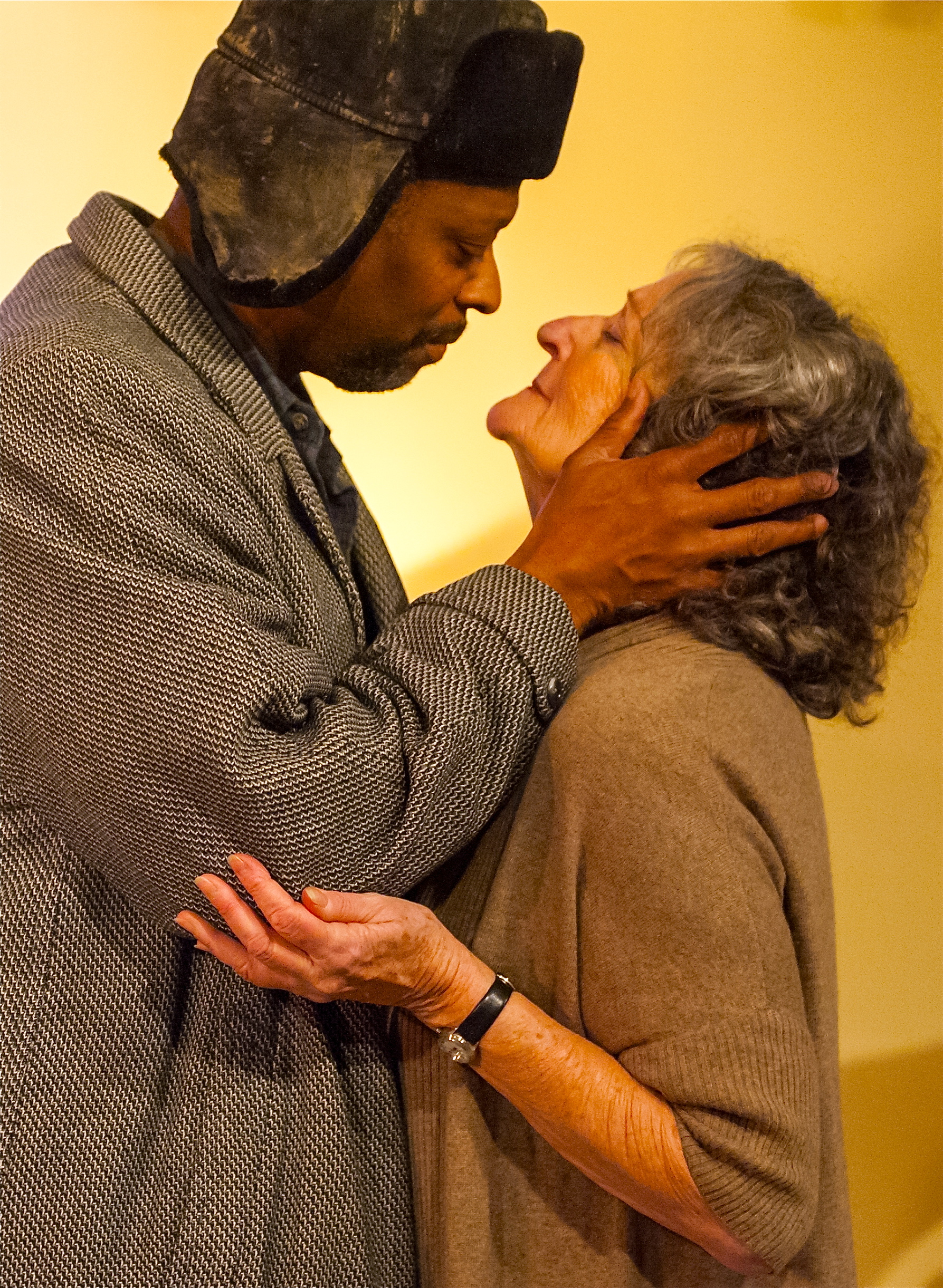
Jill Zimmerman, Melissa Claire, Mike Pavone, Jeff Cote, Serena Flores, Dorian Lockett


Stunning Cast and Director Hit ‘Clybourne’ Out of the Park

With the winning combination of a Pulitzer Prize-winning script, a visionary director and a superb cast, “Clybourne Park” at 6th Street Playhouse was certainly destined to be pretty good. But there is an almost mystic alchemy at work here in what may be the best show in the North Bay.

Playwright Bruce Norris won the Pulitzer Prize for Drama for “Clybourne Park” in 2011, and the Tony Award for Best Play in 2012. Norris was inspired by characters and events in the 1959 play “A Raisin in the Sun”, and his play can be seen as a companion piece, but it stands powerfully on its own. With a uniquely deft touch, Norris explores the dark side of human nature and the different forms that discrimination and prejudice can take. Hot-button social issues like civil rights, racism, family loyalty and gentrification are tackled head-on. Filled with biting humor and sarcasm, awkwardly hilarious at times, the dialogue crackles and flows like an electric current.

The story takes place in a house in a Chicago neighborhood called Clybourne Park, over two acts that are bookends to a half-century span, with a lifetime of world-changing events happening in between. Each actor in the brilliant cast of seven has a dual role, one for each of the two acts. The roles and events in each act are in sharp contrast, but there are threads that unite the two halves: Both acts open at 3:30 in the afternoon…someone is being discouraged from selling the house to “the wrong people”…the clock strikes four…phone calls are taken…a character is pregnant …an army trunk makes an appearance…members of the neighborhood association meet…tensions grow into a volcanic explosion…common elements that interweave and tie the acts together in the most graceful, engaging way. The catalyst is a Korean War vet’s suicide that haunts the play from beginning to end.
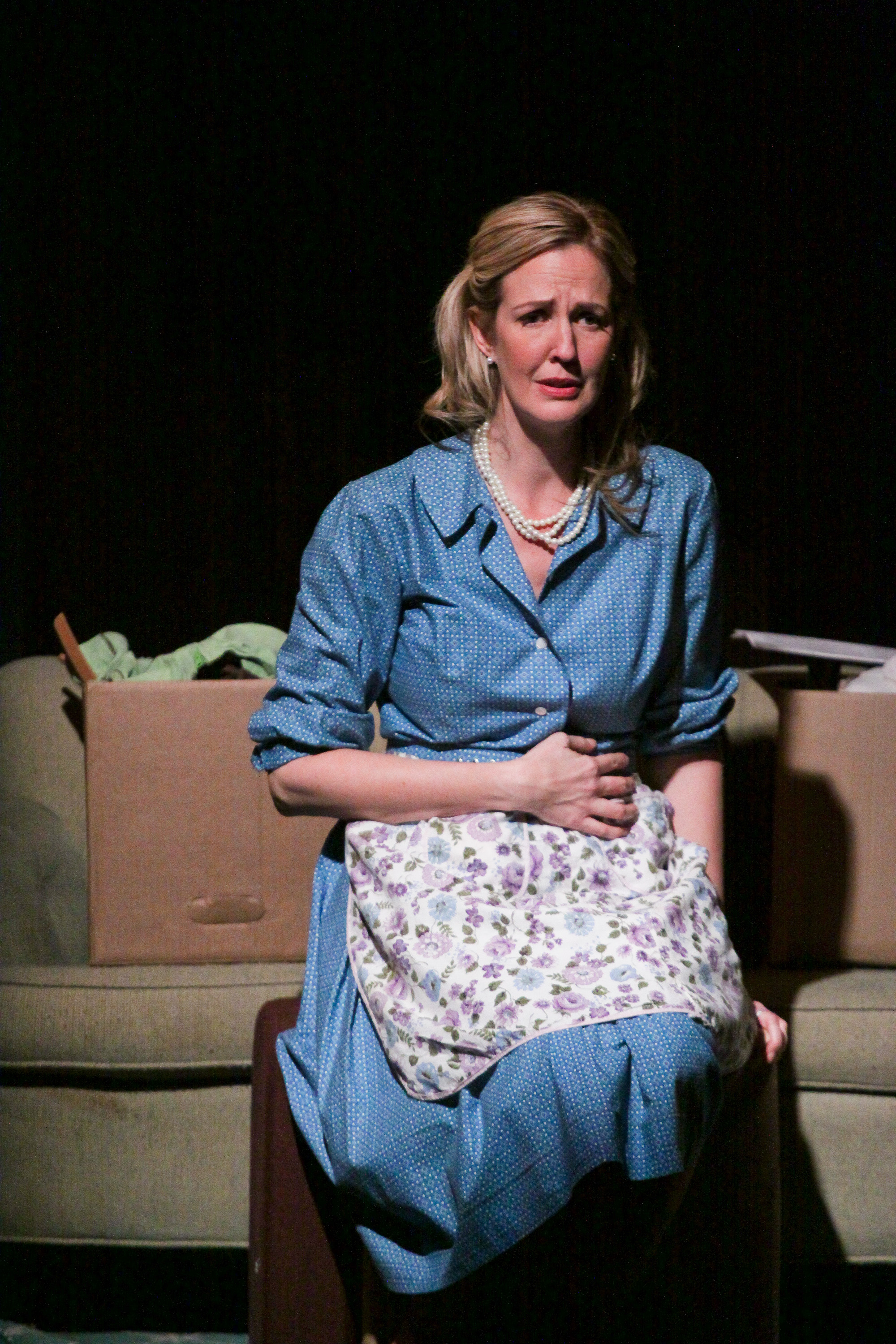
Jill Zimmerman

Act I is set in pre-civil rights 1959. It begins with Bev (Jill Zimmerman) and her husband Russ (Mike Pavone), in the midst of packing up and moving from their longtime home, and mourning the recent loss of their son, Kenneth. Russ is nearly paralyzed by grief, with rage simmering just below the surface. Bev is masking her feelings and at the same time trying to be of some comfort to Russ. Their black maid Francine (Serena Flores) is on hand to assist, and her husband Albert (Dorian Lockett) arrives to pick her up. Kindly minister Jim (Chris Ginesi), who’s also a family friend, pays a visit to offer solace. All seems well until Karl (Jeff Cote), a member of their neighborhood association, drops by with his very pregnant wife Betsy (Melissa Claire), who is also deaf. Karl is on a mission: To get Bev and Russ to back out of the sale of their home to the “colored” family that bought it (the Youngers in “A Raisin in the Sun”). The neighbors, all white, fear that a black family will cause their property values to plummet. Russ and Bev call upon the hapless Francine and Albert to weigh in. There are razor-sharp exchanges and some outrageous jokes, and an enraged Russ finally throws Karl and Betsy out. The act closes with a spotlight on Bev, a tear shining on her face, a moment of breathtaking artistry by Zimmerman.

Chris Ginesi, Dorian Lockett, Serena Flores

Act II finds a very tense neighborhood association meeting in progress. It’s now 2009, in the same Clybourne Park house. Social and cultural revolutions have come and gone over the past 50 years, the neighbors have changed from white to black, but the house still stands, though a bit worse for wear with gaping holes in the walls and trash strewn over the floor. The new owners – a very pregnant Lindsey (Claire) and husband Steve (Cote), who are white – want to tear the dilapidated house down and build a much larger one in its place. Present is their lawyer, Karl and Betsy’s daughter Kathy (Zimmerman). A descendant of the Youngers, Lena (Flores), is there with her husband Kevin (Lockett) to represent the association. Tom (Ginesi) is running the discussion, and it’s not going well. The neighbors claim that they object to the new house because of its size, but Lindsey and Steve suggest it’s really just thinly-veiled racial prejudice. More razor-sharp exchanges and even more outrageous jokes, and more volcanic explosions of temper. A brash and funny contractor named Dan (Pavone) walks in and begins to describe what he found while digging outside. It turns out he has uncovered the sad heart of the story that began 50 years earlier. The light changes, time travels back to 1959 again, and Kenneth has the last word. It’s an exquisite ending to a compelling show and tour-de-force ensemble performance.

Each and every actor in “Clybourne Park” is performing at the highest level one could hope to see on any stage, giving remarkable gifts to the audience: Zimmerman (winner of the SFBATCC Award for Best Actress for “August: Osage County”) through her controlled emotional build and sensitivity; Pavone’s fearless revelation of rage and sorrow; Cote’s relentless comic agility; Ginesi with his warm honesty and naturalism; Flores’s striking versatility and discipline; Lockett and his magnetic yet subtle delivery; Claire (a 3-time SFBATCC nominee) and her lively, irresistible characterizations.

Crafting of the set was placed in the capable hands of noted area set designer Ronald Krempetz, who deserves special mention. As Resident Set Designer and Instructor at College of Marin Kentfield, he has designed sets for hundreds of productions at the college and around the Bay Area, including the San Francisco Ballet and Marin Theatre Company. Kudos is also due to Tracy Sigrist for her superb costume design, as well as Theo Bridant’s excellent work on lighting.

Jeff Cote, Dorian Lockett

When asked what first drew him to the play, director Carl Jordan said it was its sheer complexity, and that he approached the script much like a musical score to be conducted. Jordan has also won awards from SFBATCC, for directing and choreography. Through his guidance and perfect casting, each actor wears their dual roles like a pair of comfortable shoes, walking around in them very naturally. This lends an air of authenticity and realism throughout. A rich and profoundly moving experience, “Clybourne Park” is a roller-coaster of a show that will leave you breathless.

When: Now through January 25, 2015

8:00 p.m. Fridays and Saturdays

8:00 p.m. Thursday, January 22

2:00 p.m. Saturdays and Sundays

Tickets: $15 to $32

Location: GK Hardt Theater at 6th Street Playhouse

52 West 6th Street, Santa Rosa CA
Phone:
707-523-4185

Website: www.6thstreetplayhouse.com

 

Nomadic San Rafael theater probes Native American identity

By Woody Weingarten

In “Landless,” an angry Josiah (Nick Garcia) chases Natalie (Emilie Talbot) from shop owned by Elise (Patricia Silver). Photo by David Allen.

Elise (Patricia Silver) and Walt Harrison (Michael J. Asberry) share a rare moment of hope in “Landless.” Photo by David Allen.

[Woody’s [rating: 2.5]

Two long rows of seats bordering the latest AlterTheater stage were so tightly packed it could have been a disaster had anyone needed a bathroom break mid-show.

A single theatergoer’s bad breath, in fact, might have been nearly as bad.

But, thankfully, nothing disrupted the world premiere of “Landless” in a storefront next to Johnny Doughnuts on west 4th Street in San Rafael.

That was a good thing because I, like everyone else opening night, needed all my faculties to absorb the breadth of issues  — and myriad flashbacks — proffered by playwright Larisse FastHorse in a mere two hours.

Enough, actually, to swamp my mind:

Native American heritage, homelessness, racism, bullying, discount stores choking ma-and-pa shops, the proliferation of casinos, and — in case that’s insufficient — friendship, love and benevolence.

It was as if she wanted to probe in two acts every feeling she’d had in her 43 years.

Her thematic pileup parallels the set, a mélange of cartons and racks of outdated and broken dreams from the life of Elise, a worn out and tapped out 68-year-old whose fingers are wedged in a metaphoric post-recession dike at her Matthews Mercantile store.

Not everything in “Landless” is hyper-serious, though.

Or depressing.

FastHorse sporadically uses humor as a leaven.

The play takes place in a small town where a new Walmart is squeezing fourth-generation Main Street merchants. But to find the heart of “Landless,” FastHorse, a member of the Sicangu Lakota Nation originally from South Dakota, interviewed local Indian elders, shopkeepers and business district residents.

Plus the homeless.

Silver makes the drama’s heart pound rapidly by passionately running a proverbial gamut of emotions as Elise.

And Nick Garcia is alternatively childlike, joyous, unhappy and angry as Josiah. a Hispanic-surnamed boy/man Elise had rescued 17 years before, a gay dreamer who’s part of a “landless tribe” seeking federal recognition.

He repeatedly tests the topic of identity.

“Do you know what it’s like to know who you are?” he ponders.

Emile Talbot and Michael J. Asberry fill out the cast by proficiently assuming several supporting roles each.

Mood-heightening lighting by Jack Beuttler also is noteworthy, especially since the storefront windows are left undraped so passersby can sneak a peek.

Bay Area theatrical legend Ann Brebner is an ex-casting director who led the drive to restore the Rafael Theatre and co-founded the Marin Shakespeare Company. Jeanette Harrison co-founded the nomadic AlterTheater in 2004, when the troupe turned a rocking chair store into a performance space.

Jointly, they directed “Landless.”

The two worked extremely well together, Harrison told me, but some rehearsal differences led them to test opposite ways of doing some scenes and then choose.

Opening night jitters, I suspect, can be blamed for multitude lines spurting forth before their cues were uttered.

That problem will undoubtedly get ironed out quickly.

But other flaws are not so easily corrected.

The faint recorded musical backdrop, for example, seems more intrusive than illuminating.

And I found some clichés irritating. Such as “You are not alone.” Or, “I need you to walk out this door and never look back.”

From play to play, the AlterTheater moves from storefront to storefront in downtown San Rafael, priding itself on prompting artists to “dream big, take risks, and push themselves to the limits of their imagination…and then take another step.”

I believe by exploring Indian culture and heritage, certainly not a mainstay of the Bay Area theatrical scene, it again has met that objective.

Now, if it would focus on a couple of the planet’s ills and not try to solve all of them at once…

“Landless” will play at the AlterTheater’s temporary space at 1619 4th St. (at G), San Rafael, through Feb. 1, then at the A.C.T. Costume Shop Theater, 1117 Market St. (at 7th), San Francisco, Feb. 12-22. Evening performances in San Rafael, Fridays and Saturdays at 8 p.m., Sundays at 7 p.m.; matinees, Sundays at 2:30 p.m. Tickets: $25. Information: (415) 454-2787 or www.altertheater.org.

Check out Woody Weingarten’s www.vitalitypress.com blog, or contact him at voodee@sbcglobal.net.

‘Anarchist’ is an intense, intellectual David Mamet exercise

By Woody Weingarten

[Woody’s [rating: 3.5]

Tamar Cohn (left, as Cathy) confronts Velina Brown as Ann in “The Anarchist.” Photo by David Wilson.

I normally love playwright David Mamet’s rhythms.

And his caustic humor.

Nor am I put off by his usual torrent of f-bombs.

But “The Anarchist” is cerebral horseplay of a noticeably different color. It’s Mamet soberly executing mental calisthenics, taking both sides of an argument at the same time.

Using longer — and complete — sentences. Without vulgarities or drollness.

And with less of individuals talking over each other.

In a new Theatre Rhinoceros production, Mamet still does what he does best — poke beneath the veneer of characters to exhume the vagaries of human nature.

I see it as an 85-minute double diatribe.

Director John Fisher combines with Mamet to offer an intensely dramatic, philosophical feast that pinpoints a two-woman tug-of-war over rehabilitation, faith and sex.

But they present a dense repast not easily digested.

The storyline?

A lesbian anarchist on the day of a parole interview confronts a female “representative of the state” — perhaps her warden, maybe a prison psychologist, conceivably a parole officer — who will decide whether she should be freed.

The drama stars Tamar Cohn as bilingual, properly educated Cathy, an admitted terrorist killer of two guards in an echo of a real incident involving the Weather Underground in the 1970s.

She performs in tandem with Velina Brown as Ann, Cathy’s interrogator who may have been persecuting her —perpetually.

Both actors are splendid.

Flawless, in fact.

Each steeps her character with flesh and blood, with all the nuanced emotional back-and-forthness humans bring to challenging situations.

Each excels, too, at extracting the most from Mamet’s prose.

Such as Cathy’s pithy, “Neither God nor human worth can be proved.” Or, “The state does not have [the] power to put me on the cross.”

Fisher, meanwhile, magnifies the duo’s conflict by placing Brown, whose height is imposing and whose demeanor is appropriately unbending, next to Cohn, whose smaller, chameleon-like body can shift in an instant from servile to haughty.

Cohn, who lives in Marin County “with a terrific husband and a decrepit cat,” adroitly depicts an inmate who’s served 35 years and become a believer in Christ despite her Jewish upbringing.

Brown, co-artistic director of the San Francisco Mime Troupe, deftly reproduces a bureaucrat plagued with a major decision just before her tenure ends but hell-bent on having the prisoner reveal where her former accomplice/lover is.

Fisher and Mamet are, in a sense, joined at the hip.

Mamet had encouraged Fisher as a young director. And Fisher directed his “Boston Marriage” at The Rhino, America’s longest running queer theater.

When I attended “The Anarchist,” news bulletins became a factor.

I found it chilling that a trio of terrorists murdered a dozen people in the Paris office of a satirical publication the same day.

An anachronistic chunk of recorded pre-show music — Bob Dylan’s “The Times They Are A’Changin’” — also bothered me. I understood its symbolic value but the tune was jarring because it pre-dates by years the founding of the Weather Underground, whose terrorism had begun at San Francisco’s Ferry Terminal.

I’ve enjoyed Mamet creations for decades — “Glengarry Glen Ross,” which earned the Pulitzer Prize in drama, “Speed the Plow,” “American Buffalo,” “Oleanna,” “Race.”

As I do with Picasso’s diverse periods, I revel in Mamet’s — from his earliest male-oriented works (that emphasize character and the way people really talk) to his middle years (in which plot grows more important) to his latter-day female-oriented plays and their accent on social and political issues.

But “The Anarchist” is by far his thickest, most intellectual, wordiest exercise — and arguably the least entertaining.

The playwright apparently insisted that I — and the young, mostly gay crowd at The Rhino — work harder than I’d wanted.

It was as if I were expected to hold my breath for the duration of the play lest I miss a crucial phrase or concept.

Ultimately, however, the drama merited my full attention — even though critics bashed the original 2012 Broadway offering with Patti LuPone and Deborah Winger.

Causing it to run only 17 performances.

“The Anarchist” plays at the Eureka Theatre, 215 Jackson St. (at Front and Battery streets), San Francisco, through Jan. 17. Evening performances, Sundays, 7 p.m.; Wednesdays through Saturdays, 8 p.m. Matinees, Saturdays and Sundays, 3 p.m. Tickets: $15 to $30 (subject to change). Information: (800) 838-3006 or www.TheRhino.org

Contact Woody Weingarten at voodee@sbcglobal.net or check out his blog at www.vitalitypress.com/

Edith Piaf: Beneath Paris Skies, World Premiere at Cinnabar Theater, Petaluma CA

By Greg & Suzanne Angeo

Reviewed by Suzanne and Greg Angeo

Members, San Francisco Bay Area Theatre Critics Circle

Photos by Eric Chazankin


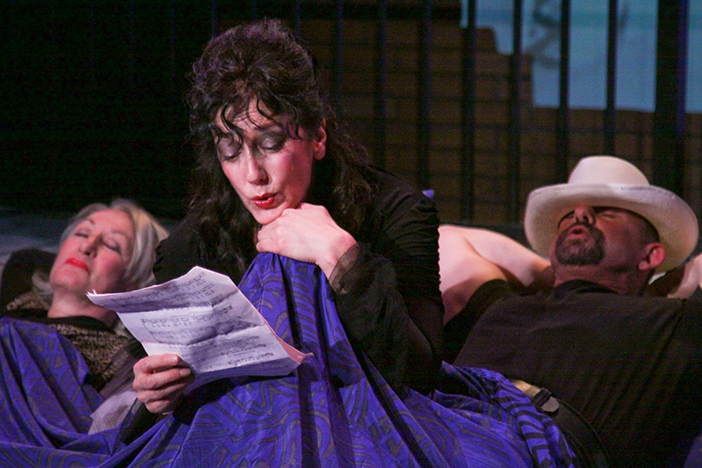
Melissa Weaver, Valentina Osinski, Michael Van Why

Triumph of a Sparrow

It’s the ultimate rags-to-riches story, from the streets of Paris to Carnegie Hall and beyond, the urchin who became a legend in her own time, a delicate sparrow-girl with a roaring, passionate voice. ”Edith Piaf: Beneath Paris Skies” in its world premiere at Cinnabar, is a stunning, beautifully realized cabaret-style production. Created by Valentina Osinski and Michael Van Why, it’s a truly unique revelation of la Piaf’s stormy soul. 

Piaf wrote many of her own lyrics to songs that became classics, the result of a lifelong collaboration with songwriter and composer Marguerite Monnot. Born Edith Gassion, she soon picked up the nickname “piaf”, French slang for sparrow, due to her tiny frame and jaunty spirit. She soared to fame during and after World War II. Raw and sensitive, vulgar and elegant, she was a study in contrasts and adored by millions the world over.

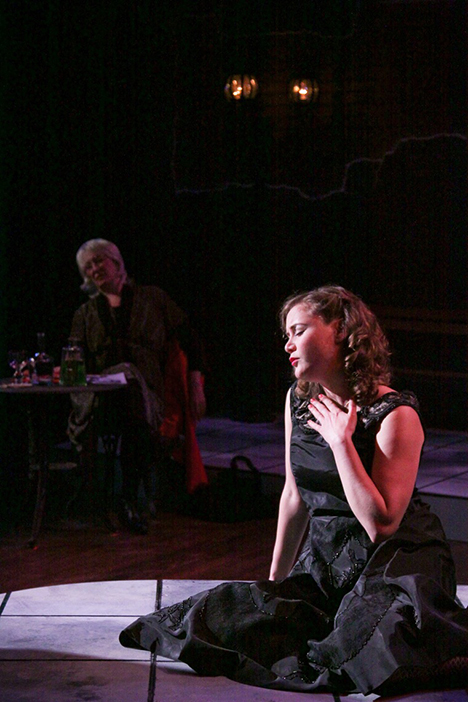
Melissa Weaver, Julia Hathaway

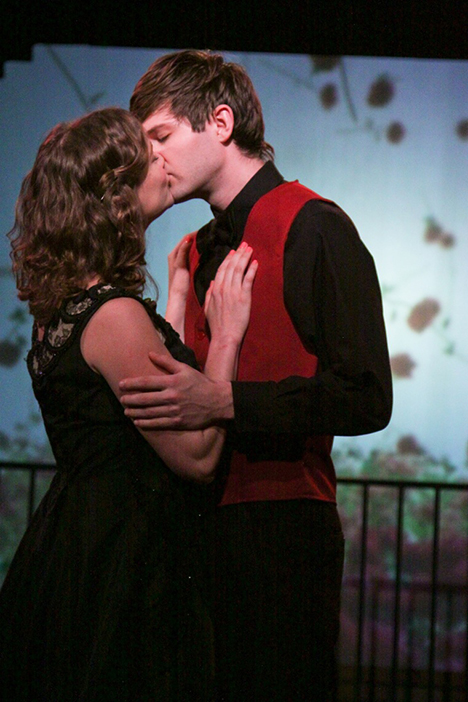
“Beneath Paris Skies” captures Piaf’s short, tempest-tossed life through distinct personas performed by four talented singers: Julia Hathaway displays Piaf’s Romantic aspect, Kevin Singer offers her Traditional side, Osinski as the Reckless Piaf, and Van Why as her Jaded self. Rounding out the cast in a non-singing role is Melissa Weaver as Simone, Piaf’s devoted half-sister. It’s interesting that men were chosen to reveal certain parts of Piaf’s character, showing that her struggles and joys transcend gender. Each of the vocalists, and Weaver, is nothing less than sublime. Together, as an ensemble, they forge an emotional connection with the audience that remains unbroken long after the music is done. 

The inspiring, lively show unfolds in a series of musical vignettes. French lyrics to 20 of her best-loved songs have been adapted by Lauren Lundgren, who sought to reveal more of the truth behind the songs than previous translations. A band of five top-notch musicians (Al Haas, Robert Lunceford, Daniel Gianola-Norris, Jan Martinelli and John Shebalin) are on hand to provide quality accompaniment.  A pink rose turns up in nearly every scene, a metaphor for Piaf’s undying hope in love amid the ruins of her life. 

Julia Hathaway, Kevin Singer

Stage direction by Weaver is a brilliant, magical mix of high and low-tech, where a section of a stage platform can become a bed, and projected images can provide vivid illustration to the stories behind the songs. And what songs they are! Many are instantly recognizable: “Non, Je Ne Regrette Rien (No, I Regret Nothing)”, “Mon Manege a Moi (My Own Carousel)”, and the eternal standards “La Vie en Rose (Life in Pink)” and “Sous le Ciel de Paris (Beneath Paris Skies)”. 

A woman whose life was ruled by her never-ending quest for love never quite found what she was looking for. But what she did find was worldwide acclaim, and a place in history and in the hearts of romantics everywhere. “Beneath Paris Skies” offers a rare glimpse into Piaf’s world, and into her heart.  


When: Now through January 25, 2015  (Just extended due to sell-out shows – hurry, tickets are going fast!)

8 p.m. Fridays and Saturdays

2 p.m. Sundays

2:00 p.m. Saturday, January 17

Tickets: $25 to $35

Location: Cinnabar Theater

3333 Petaluma Blvd North, PetalumaCA
Phone: 707-763-8920

Website: www.cinnabartheater.org

Two powerful performers salvage a murky The Anarchist by The Rhino

By Kedar K. Adour

The Anarchist: Psychological Drama by David Mamet.  Directed by John Fisher. Theatre Rhinoceros, Eureka Theatre, 215 Jackson Street, between Front & Battery, SF, CA Box office: www.TheRhino.org or 1-800-838-3006 (24-hour ticket Hotline).

January 2 – 17, 2015 – Limited Engagement – 15 Performances Only!

Two powerful performers salvage a murky The Anarchist by The Rhino. [rating:3]

David Mamet is an accepted master as a playwright and has received, nay earned, all the prizes heaped on his body of work. His star ascended in 1975 with the premiere of Sexual Perversity in Chicago, continued in 1975 with American Buffalo. Other well-known titles of his voluminous body of work include Glengarry Glen Ross, Speed the Plow, Oleanna and Race, all of which have been produced in the Bay Area. He has not always been given accolades and his Faustus that had its world premiere at the Magic in 2004 was a colossal bomb and apparently never seeing another production.

The latest Mamet play to reach San Francisco is The Anarchist now in a limited engagement at the Eureka Theatre under the auspices of The Rhino Theatre organization.  The decision for The Rhino and their noted Artistic Director John Fisher to stage this two-hander play raises questions even though it is extremely well performed by Velina Brown and Tamar Cohn and thoughtfully directed by Fisher. If Patti Lapone and Debra Winger could not garner favorable reviews on Broadway in 2012 where the play lasted only 17 performances what convinced Fisher to mount it here?

Like Oleanna it is a verbal battle between two discordant characters that lasts bout 80 minutes and has a gut-kicker ending. Whereas Oleanna involved a university professor and his graduate student, The Anarchist involves a lesbian prison inmate Cathy (Cohn) and the warden Ann (Brown). Cathy has been incarcerated for 35 years with consecutive indefinite sentences that is really a life sentence for terrorists’ acts that killed two police guards. The play is based on true acts committed by groups similar to the Weather Underground and the Brinks robbery of 1981 that involved Patty Hearst.

Although parole hearings involve a board with the family of the deceased allowed to speak for or against release, Mamet reduced the board to one with a member of the family off stage with the warden making references to her desires. To make up for the lack of a parole board, Fisher has placed six chairs on each side of stage with audience members sitting there. The central area of the fine stark set by Jon Wai-keung Lowe is uncluttered allowing Fisher to move his two characters around like boxers in a ring with each actor circling for advantage. The advantage is in the language. Mamet puts forth his ideas about crime against the State, the State’s response to those crimes and the damage inflicted on humanity/individuals and rehabilitation.

Both Velina Brown and Tamar Cohn give bravura performances adding verisimilitude to their   characters and doing justice to Mamet’s intellectual dialog with nary a swear word.

Theatre Rhinoceros is proud that they are “America’s longest running and most adventurous queer theatre that explore both the ordinary and the extraordinary aspects of our queer community. .” The fact that Cathy has a lesbian lover who has not been caught is integral to the plot and is most likely the major reason the play is receiving its West Coast Premiere.

CREATIVE CREW: Director, John Fisher; Stage Manager/Assistant Director, Sarah Young; Scenic/Lighting Designer, Jon Wai-keung Lowe; Costume Designer, Christine U’Ren; Assistant Lighting Designer, Sean Keehan; Sound Designers,        Gene Mocsy, Sarah Young; Graphics/Ads/Photography, David Wilson; Prop Design , John Fisher.

Kedar K. Adour, MD

Courtesy of www.theatreworldinternetmagazine.com

New San Anselmo shop delights used book fanatics

By Woody Weingarten

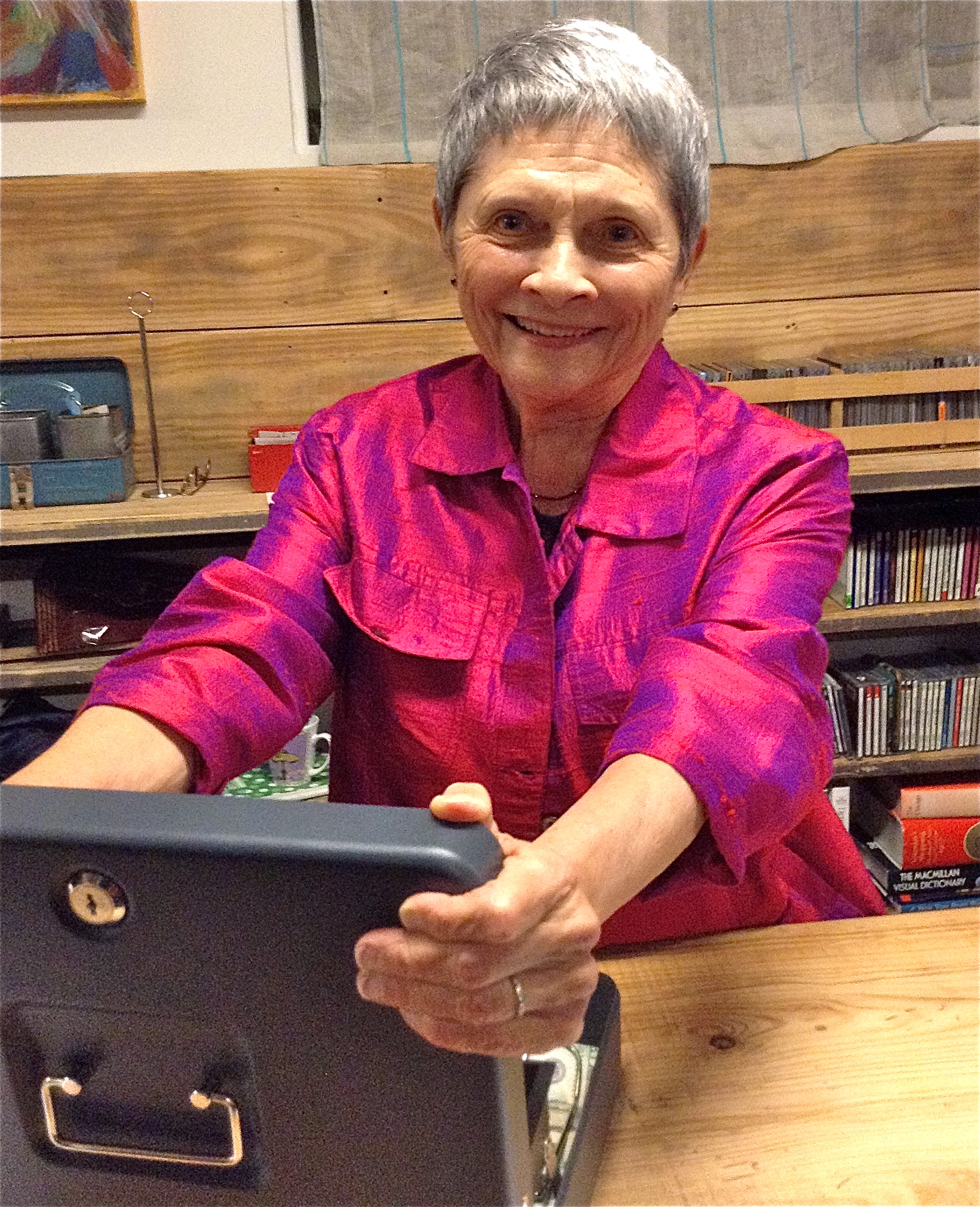
Kristy Thompson cradles her dog, Jasmine Sage, in front of Town Books’ pets section. Photo: Nancy Fox.

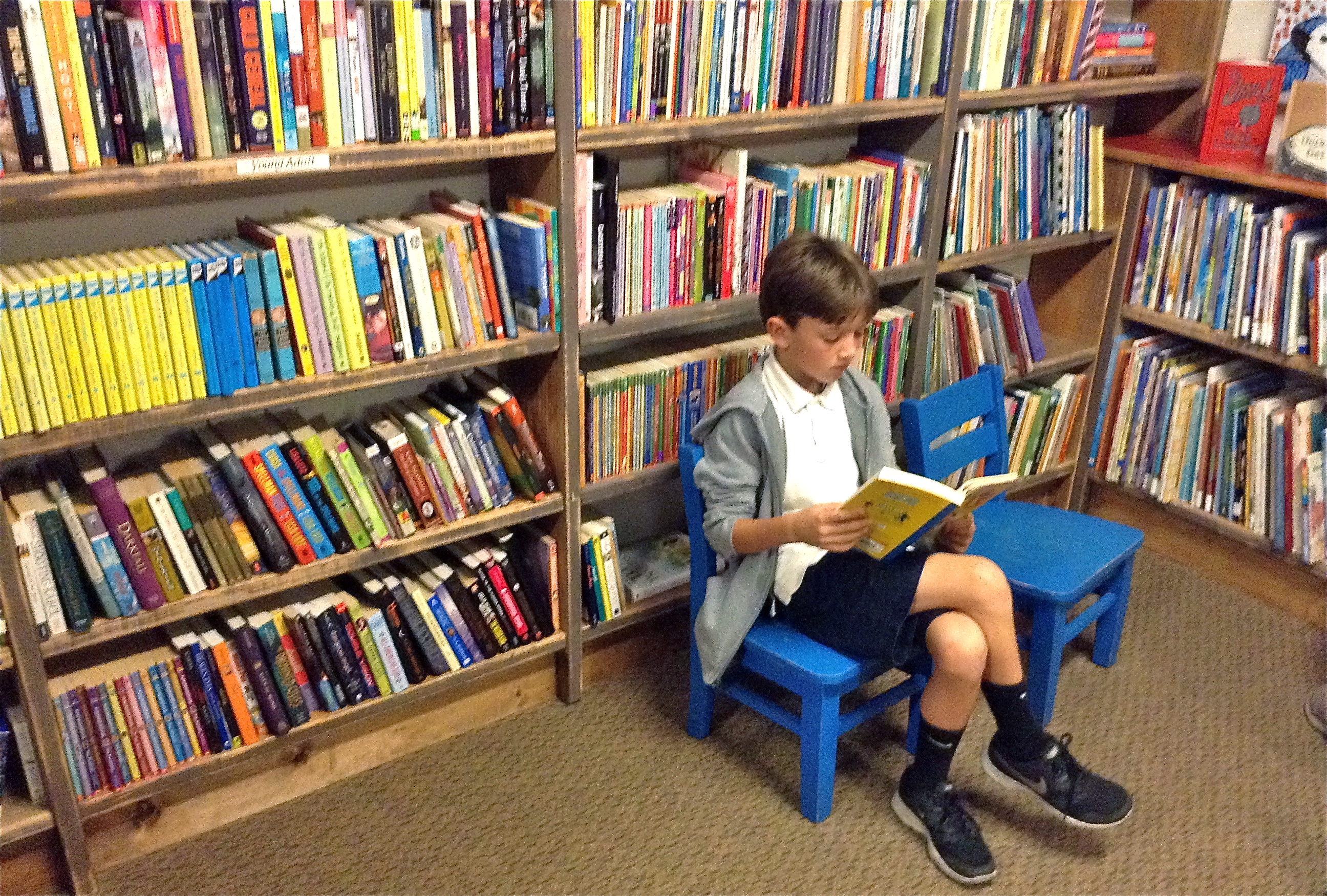
Nine-year-old Daedan Cutter reads in children’s corner of Town Books. Photo: Nancy Fox.

Cinnie Barrows helped create Town Books, new Friends of the San Anselmo Library shop. Photo: Nancy Fox.

Almost all the buyers are incurable addicts.

So are the sellers, who occasionally purchase items when not volunteering.

But don’t be misled: There are no drugs. No booze. No butts.

Used books are their preferred vice.

Some are addicted to romance novels, bodice-rippers and the like. Some are drawn to true murder stories. Some favor volumes about sports or politics or scientific expeditions to the outskirts of civilization.

And some — like my wife — lean toward lighter fare, such as the humor of David Sedaris.

The buyer-fanatics would make the register in San Anselmo’s 20- by 40-foot Town Books ca-ching, ca-ching, ca-ching if the spanking new store had a machine instead of a cash box.

Me? I’ve bought nothing yet.

A voracious book reader into midlife, I’ve since turned to alternate worlds provided by newspapers, magazines, websites and, if you believe my spouse (who insists I’ll read anything), the backs of cereal boxes.

Cinnie Barrows — Friends of the Library stalwart who’s been as responsible as anyone for the shop’s birth — is much more typical.

She got hooked on books when her parents read to her “at a very early age. Then, still pre-school, I started using the library in my small West Virginia hometown. It was above the jail.”

She’s still addicted.

But others involved with the library, she insists, are even more so: “Some of the Friends read all the time.”

Cinnie’s worked her way down to wearing only two hats — “volunteer coordinator, which means I’m in charge of recruiting, and being the Tuesday manager.”

And she’s quick to cite two other Friends instrumental in the store’s gestation, Sue Neil and Shelagh Smith.

Sue, with her daughter Julie, helmed the shop’s design, including racks in the center of the room that clear away for special events.

She’s particularly proud of the shelves.

They were hand-picked, one by one, she says: “They’re all old bleacher benches from St. Louis that were re-purposed — some red, some black, some that had chewing gum on the bottom that had to get scraped off.”

Shelagh, who oversees Friends’ finances, co-wrote the volunteers’ handbook with Joan Boodrookas, the organization’s president.

Unpaid regular Sharon Bluhm commends it.

And says, “Fiction sells well — because it’s what we have most. So do children’s books and cookbooks.”

Early revenues hit between $500 and $600 a week, but they were based on being open only Tuesdays, Thursdays and Saturdays from 10 to 4.

“When you consider most books sell for under $5,” says Sue, “even at $500, that’s a lot of books.”

Sales are expected to rise now because Fridays have been added.

Proceeds will help the library with what Debbie Stutsman, tow n manager, calls “a myriad of…things not covered by the general fund or parcel tax budgets.”

At least two volunteers staff the store at 411 San Anselmo Ave. each morning, two more each afternoon. Each day has a designated manager.

Though Town Books opened mid-September, the official launch wasn’t until last month, when 150 book lovers jammed what once housed Riccardo’s Italian restaurant and its endless empty bottles hanging from the ceiling.

Down San Anselmo Avenue, Michael Whyte, owner of Whyte’s Booksmith, rejects my question about competition. “I feel it’s more collegial,” he says. “The more bookstores in San Anselmo, the better.”

Whyte’s been supporting library projects for 30-plus years — “generously,” comments Cinnie.

Most of Town Books’ stock comes from individuals cleaning out their homes — folks like Lisa Mackey. “My mom is ill, in a nursing home,” she tells me, “and I’m bringing her books here.”

“Here” is the single room, but down the hallway is a 16×22 office where Eli Welber scans non-fiction barcodes to see if they can be marketed on Amazon.

His current online inventory is about 500 tomes. He expects the number to go up exponentially.

The afternoon I visit, a San Anselmo newbie who prefers anonymity scours the place for books dealing with the history of American poetry, while Oliver Kaufmann of Ross surfs the shelves (he’d earlier bought a novel and two nonfiction volumes).

They voice delight.

Some — like Kat Hench, who lived in San Anselmo but now resides in Novato — come to Town Books seeking something specific but don’t find it.

Few leave empty-handed.

But almost all, addicts or not, somehow leave with a smile on their faces.

Check out Woody Weingarten’s new blog at www.vitalitypress.com/ or contact him at voodee@sbcglobal.net.

Impressive but uneven OUR TOWN by Shotgun Players

By Kedar K. Adour

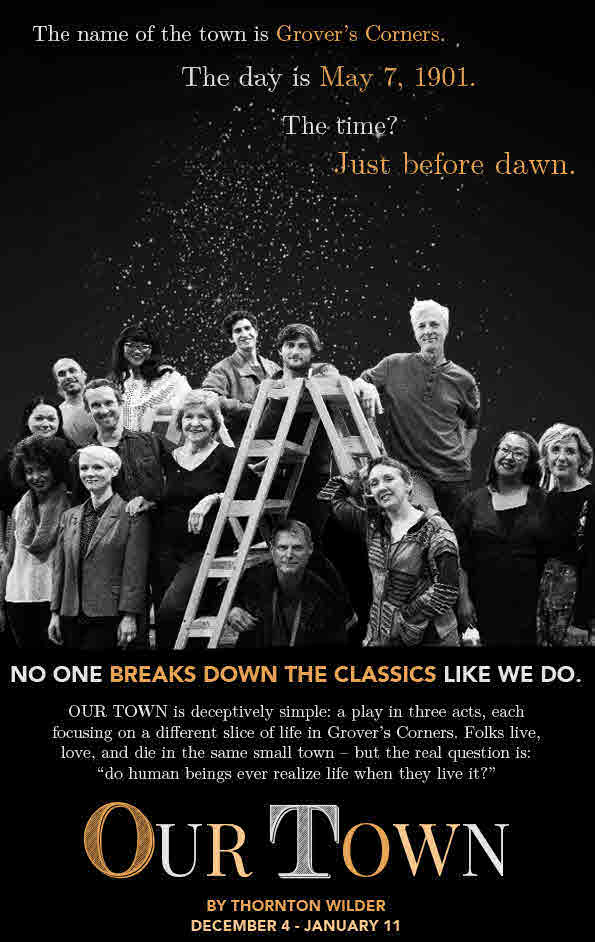
OUR TOWN by Thornton Wilder. Directed by Susannah Martin. Shotgun Players, Ashby Stage, 1901 Ashby Ave., Berkeley. (510) 841-6500. www.shotgunplayers.org.

EXTENDED TO JANUARY 25, 2015

Impressive but uneven OUR TOWN by Shotgun Players [rating:4]

Thornton Wilder is best known for his full length play Our Town, but he was also an accomplished master of the short play form, specifically creating shorter works to be staged in spaces such as Shotgun’s Ashby Theatre, with the action taking place with the audience seated on either side of the performing area. Lifelong friends with Gertrude Stein and a mentor to Edward Albee, Thornton Wilder tirelessly experimented with theatrical forms and conventions. In the early 1930s he wrote The Happy Journey to Trenton and Camden (1931), which features the first appearance of Wilder’s narrating Stage Manager character (seven years before Our Town was produced). Later he wrote The Long Christmas Dinner” in which he breaks the boundaries of time as we measure it, following 90 years of an extended family’s holiday dinners. Those two conventions foreshadow his magnum opus Our Town that won a Pulitzer Prize and is probably the most popular play still being produced around the world.

The Shotgun Players has put together a fine production of the play adhering to the Wilder’s tenants of bare bones staging with the cast miming the actions, breaking the fourth wall and taking the characters through a 14 year journey. It all takes place in a specific time and place. The Stage Manager tells us that the place is “Grover Corners, New Hampshire – just across the Massachusetts line-   and the day is May 7, 1901.”

Written in three acts, Act 1 introduces “Daily Life”, Act 2 is “Love and Marriage” and Act 3 is “Death and Dying.” The Stage Manager (Madeline H. D. Brown) describes the town and introduces the major and minor characters who have cogent remarks or observations that create a ‘real town’ of the fictional Grover’s Corners. The major characters are the Webbs (Mrs. Webb [Michelle Talgarow], Mr. Webb [Don Wood] and Emily [El Beh]) and Gibbs families (Mrs. Gibbs [Molly Noble], Doc Gibbs [Tim Kniffin] and George Gibbs [Josh Schell]). The denizens of the town are introduced by the Stage Manager who has cogent remarks about each as they enter the acting area. Their entrance and exits are through the audience and up and down the raked seating area, often sitting with the audience.

Director Susannah Martin has grasped Wilder’s intent and inventively moves the actors about drawing the audience into the play. Accolades are earned by (alphabetically) Tim Kniffin, Molly Noble, Josh Schell, Michelle Talgarow, Don Wood and Christine Macomber.  This  reviewer has ambivalent feelings about depicting an androgynous Stage Manager.  This may be to emphasize the universality of Wilder’s play but is not necessary since both males and females have effectively played the role. Madeline H. D. Brown beautifully under-plays the role and does not miss a line but just misses giving superb performance.

One should see this staging since it does justice to Wilder’s concepts of theatre. Running time is 2 hours and 20 minutes with two intermissions.

CAST: MADELINE H.D. BROWN (Stage Manager); EL BEH (Emily Webb); WILEY NAMAN STRASSER (Howie Newsome, Ensemble); MICHELLE TALGAROW (Mrs. Myrtle Webb); MOLLY NOBLE (Mrs. Gibbs); SAM JACKSON(Mrs. Soames, Ensemble); KAREN OFFEREINS (Rebecca Gibbs, Ensemble);TIM KNIFFIN (Dr. Gibbs); VALERIE FACHMAN (Constable Warren, Ensemble); CHRISTINE MACOMBER (Professor Willard, Ensemble); JOSH SCHELL (George Gibbs); CHRISTOPHER W. WHITE (Simon Stimson, Ensemble); ELI WIRTSCHAFTER (Joe/Si Crowell, Sam Craig); DON WOOD (Mr. Webb);

ARTISTIC CREW: SUSANNAH MARTIN (Director);  (NINA BALL (Set Design); HEATHER BASARAB (Lighting Design); ABIGAIL NESSEN BENGSON & SHAUN BENGSON (Music Directon); THEODORE J. H. HULSKER (Sound Designer); KATHERINE BICKFORD (Production Assistant); ANNE KENDALL (Technical Director); KATJA RIVERA (Assistant Director); DEVON LABELLE (Props Designer;) ASHLEY ROGERS (Wardrobe); CHRISTINE CROOK (Costume Designer); ELIZABETH HITCHCOCK-LISLE (Production Manager); HANAH ZAHNER-ISENBERG (Stage Manager & Acting Production Manager; PATRICK DOOLEY (Founding Artistic Director)

Kedar K. Adour, MD

Courtesy of www.theatreworldinternetmagazine.com

Mr. Turner — Film Review

By Joe Cillo

Mr. Turner

Directed by Mike Leigh


I read one blurb that called this film an “epic biography” of British painter William Turner.  Well, that’s hype of the most grandiose favor.  This film is not a biography at all.  It would be stretching it to call it even a portrait.  It is more of a sketch, and a rather superficial one at that.  William Turner is the dominant figure in the film and he is played superbly by Timothy Spall.  It is his rendering of Turner’s character that holds this rather disconnected, aimless film together and prevents it from falling apart into an amorphous nothing.  He is almost always on screen.  There is hardly a time when he isn’t.  Because he is such an imposing presence, you do get a feel for Turner’s personality, at least in this conception (whether it has anything to do with reality, I do not know.  I take the film at face value).  I suppose the way I should say it is that it is a supremely convincing portrayal.  The cinematography is exquisite.  Every scene is perfectly composed, perfectly lit.  England in the nineteenth century must have been a wonderful clean, neat, orderly place with everything properly arranged, minimal clutter, and people wearing clean clothes all the time and smelling so good.

The problem with this film is that it lacks depth and insight.  We don’t see what is driving Turner in any aspect of his life, whether it is his painting, or his relations with his women, or within himself.   He has an ex-wife or mistress with whom he had two grown daughters, who hate him bitterly — a feeling he reciprocates.  What’s that about?  He has an apparently long established relationship with his housekeeper.  But he leaves her for a new woman who rented a room to him on a painting excursion.  Why did he do this?   He does seem to have a positive, supportive relationship with his father, with whom he was living until his father’s death.  He belonged to some sort of society of fellow painters among whom he was highly regarded.  His life overlapped the early days of photography, and he had a portrait taken of himself with his last mistress, the landlady.  He seemed to think photography boded ill for him as a painter, but neither his interest in photography nor his attitude toward it are explored in any great detail.

This is about all you find out about William Turner from this film.  It is not a lot for a two hour and forty minute session.  It is slow moving with an absolute minimum of “action.”  It avoids becoming tedious or boring, at least for me, strictly on the strength of Timothy Spall’s riveting performance.  He makes this character come to life enough that you don’t mind staying with it for over two hours even though nothing is happening and you are not getting a very full or satisfying treatment of the subject.  It’s not all bad, but I can’t recommend it unless you have an exceptional interest in nineteenth century painting.  But if you are that type of person, you probably won’t learn very much from this film.  

VIEW FROM ACROSS THE : POWER

By Joe Cillo

ANIMALS GET US

An animal’s eyes have the power
To speak a great language.
Martin Buber

A.R. Gurney created a debutante in his comedy “The Cocktail Hour” who cries, “No one understands me but my horse.”  The line got a big laugh but it wasn’t a joke. Our horses, dogs and cats catch on to our moods a lot faster than our partners or our relatives do.

Mothers, of course, are an exception. One glance from you tells them everything.  My own mother insisted she could read my entire days activities on my forehead.  It turns out that my puppy could do the same thing.

A new study confirms that animals gather information and transmit it through their eyes. This can be very unsettling….especially when sitting down to a holiday meal. There you are digging into your roast turkey and gobbling up your roast potatoes when you feel a forceful presence watching you lift your fork to your mouth and chew those brussel sprouts.  You look down at Fido, his mouth open and saliva dripping down his fuzzy little chin.  He is watching you so intently he doesn’t even blink.   You would have to have a heart of iron to ignore the longing, the unbridled desire on your puppy’s face.

Guilt overwhelms you and you slip him a bit of dark meat and then a bit more.  How can you resist?

Fluffy is even more insistent.  The minute you put your napkin in your lap, there she is, her whiskers quivering with desire. What can you do?  You were the one who rescued her from the shelter.  The other guests at the table try to ignore the fact that your cat is sitting ON the holiday table lapping up your cranberry sauce as if it were catnip.

Horses are even more capable of transmitting their needs to you with their unblinking eyes.  Last year, I had Christmas dinner in the country and as I dug into my mince pie, I froze.  There was Dobbin staring through the window with such intensity that the glass melted.  It was no use.  I picked up my plate and handed it over.

This year, I have decided to fast for the holiday.  It is a lot easier on my conscience.


Crispy Green Crispy Fruit Snacks

By Mary Buttaro

Crispy Green Wholesome, Delicious Freeze-Dried Fruit Snacks with Less than 40 Calories per Serving


Crispy Green Crispy Fruit products are a fun and delicious way to increase your daily fruit intake. These light, crisp, all-natural freeze-dried fruit slices with explosive fresh fruit taste will put you into a state of bliss – you’ll never feel this good about snacking.

Crispy Fruit snacks are made of high-quality freeze-dried fruit with no additives or preservatives. With 40 or less calories per serving, they’re a healthy alternative to sugary snacks. Available in convenient single-serving packages, Crispy Fruit is prefect for children’s lunch boxes or keeping them in your briefcase, purse or in a school locker or office as an “emergency snack.” Healthy, natural fruit at your fingertips anytime!

Crispy Green Crispy Apples, Crispy Apricots and Crispy Peaches are available in selected retail stores. They are also available at Crispy Green’s online store. For a complete list of retailers or to purchase Crispy Green Crispy Fruit online, visit crispygreen

Look for new additions such as Crispy Mangoes, Crispy Pears and Crispy Pineapples coming later this year.

Crispy Green Crispy Fruit …real fruit, real taste and nothing else!