

Kedar [rating:5] (5/5 stars)
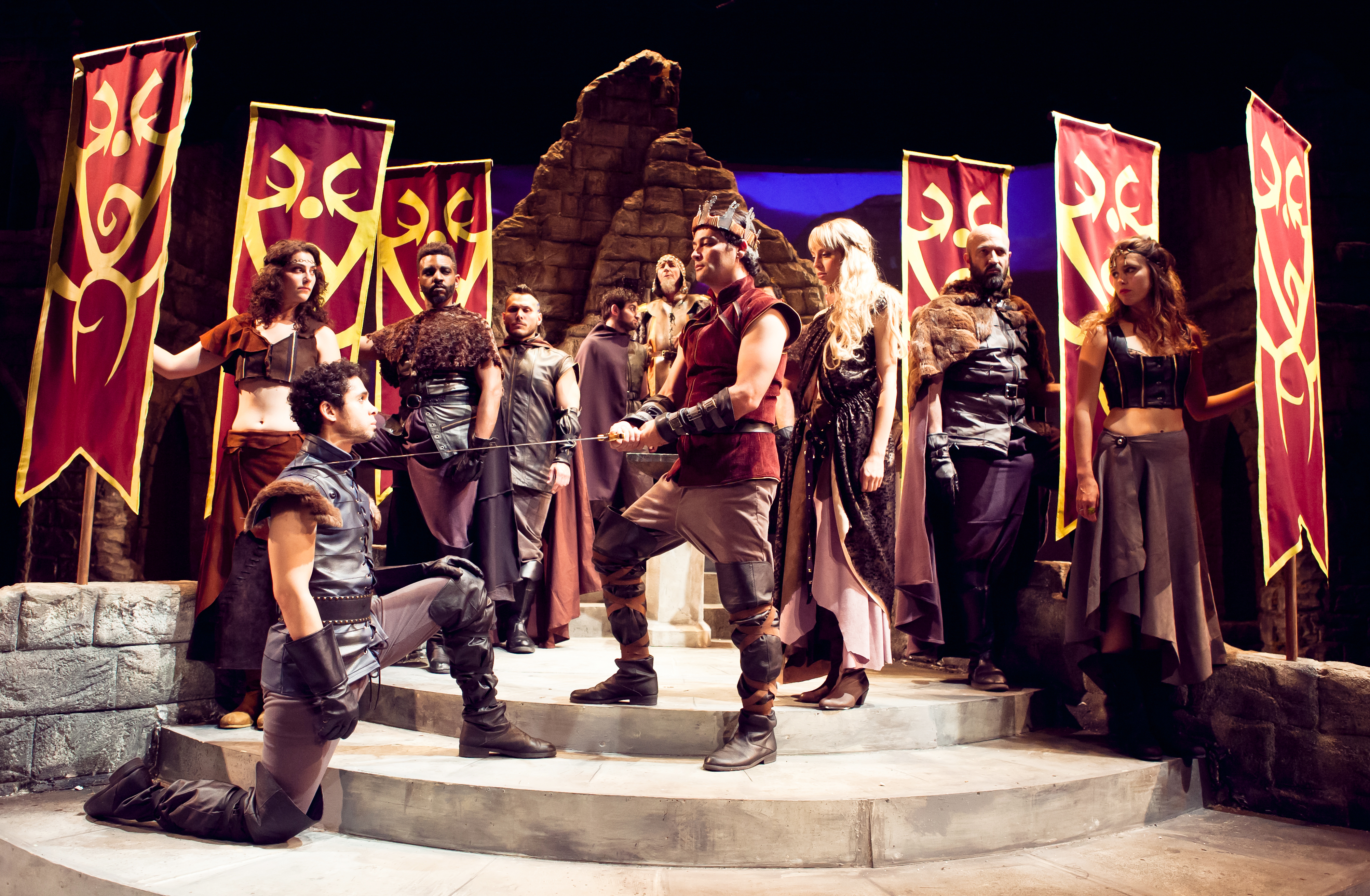
Lancelot (Wilson Jermaine Heredia*), King Arthur (Johnny Moreno*) and Guenevere (Monique Hafen*) at Knighting Ceremony Photos by Jessica Palopoli.
CAMELOT: Musical. Book and lyrics by Alan Jay Lerner.Music by Frederick Loewe. Based on “Once and Future King” by T.H. White. Directed by Bill English. Music director Dave Dobrusky. July 16 – September 14, 2013.
CAMELOT rides into San Francisco on Harley motorcycles!
We aficionados (with synonyms of connoisseurs, devotees, enthusiasts, fanatics) of the SF Playhouse are mostly inured to seeing volatile productions of the under-belly of society parade the boards of their theatre. They have done it again with an ‘in your face’ staging of the musical Camelot. If any of their productions can be summarized with Harold Ross’s 1925 quote from “The New Yorker”, “It has announced that it is not edited [produced] for the old lady in Dubuque” , this staging of the once (and hopefully future) uplifting King Arthur/Round Table/Camelot story is it.
Last year Bill English’s re-imagination of My Fair Lady at their former intimate Sutter Street Theatre was a success and played to substantial crowds throughout the summer. It seems that the “summer musical” has become a standard for SF Playhouse to catch the vacation crowds that swarm San Francisco. This year they are in the substantially larger venue (up from 99 to 265 seats) that has a huge stage with a plethora of technical equipment. For Camelot Nina Ball has created a massive set using two or three turntables, an integrated rear stage screen for impressive projects and to hide the (count them) eight piece orchestra under SF favorite Dave Dobrusky. The well-known and acclaimed title of Camelot will surely attract crowds.
Those crowds will be overwhelmed with the colossal staging but they will not be humming the charming tunes associated with the musical but rather be shaking their heads as many were on opening night. Although there was appreciative applause at the curtain, the usual spontaneous standing ovation was absent.
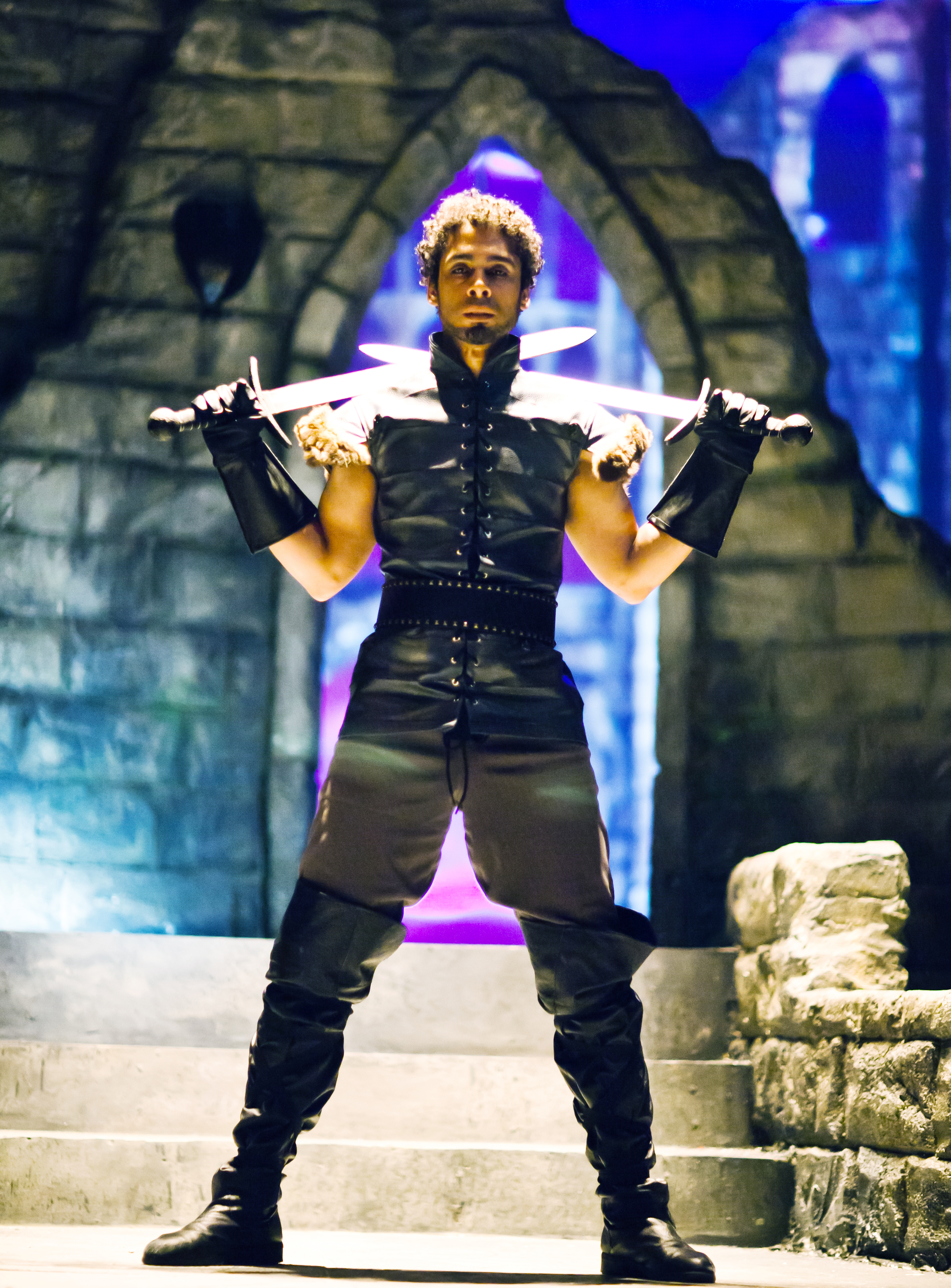
Wilson Jermaine Heredia* as Lancelot prepares to battle knights
It was absent for good reason despite a spectacular performance by Wilson Jermaine Heredia as Lancelot. Heredia is a Tony and Oliver Award winner for his role as Angel in the Broadway and London productions of Rent. Director English, using some of his own words, has created knights in the mold of grungy (costumes by Abra Berman) bikers (Ken Brill, Rudy Guerrero, Robert Moreno, George P. Scott), Guenevere (Monique Hafen) as an angry Goth princess, King Arthur (Johnny Moreno) as a day-dreaming dolt and Mordred as a potential to play Richard III. Charles Dean a Bay Area favorite who brought the house down with his role as Doolittle in My Fair Lady is cast as both the magician Merlyn and Arthur’s confidant Pelinore. Sadly, the only distinction in those characterizations is a change of costume.
There is much to like about this twisted version of what should be a romantic escapist evening that includes excellent singing voices (with exception of Johnny Moreno’s limited range), eye-catching projections, energetic acting and exuberant fight scenes staged by Heredia. The marvelous score and lyrics are still enchanting and include “Camelot”, “Follow Me”, “The lusty Month of May”, “How to Handle a Woman”, “Before I gaze at You Again”, “If Ever I Should Leave You”, and “I loved You Once In Silence.”
Running time 2 hours and 40 minutes including the intermission.
Kedar K. Adour, MD
Courtesy of www.theatreworldinternetmagaine.com
A Change Like No Other
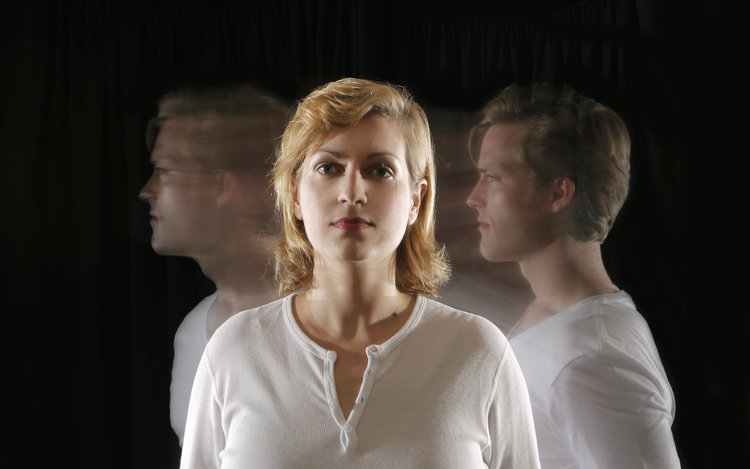
“As One” is aptly depicted as a chamber opera for two voices. The instrumental foundation of the opera is carried by a traditional string quartet, which suits the intimacy of the story. Uniquely, only one person is represented by the two vocalists.
The poignancy of this new piece, recently premiered at Brooklyn Academy of Music, is its concurrence with the recent media frenzy over the gender transition of Bruce Jenner to Caitlyn Jenner. “As One” deals with the before, during, and after transition of Hannah on one of life’s smaller stages – and three decades earlier, an eternity before the more accepting era we are in now.
“As One” is one of the three operas produced for the West Edge Festival, which takes place over three short but glorious weekends in Oakland at three different site-specific locations. This production is at the Oakland Metro, a warehouse-like performing arts venue near Jack London Square that is usually home to high energy rock and related concerts.
The concept and music come from Laura Kaminsky, a versatile composer who writes in the modern, post-minimalist dissonant idiom. She partnered with Mark Campbell, an accomplished librettist, and co-librettist Kimberly Reed, a transgender woman, whose life experience is the basis for the narrative.
The live action takes place on a spare, elevated stage, with the two singers always present, even through long musical monologues by one or the other. They are occasionally joined by up to ten supernumeraries, who act as witnesses or silent participants to the action. The visual simplicity of the staging is matched by the costuming, in which the singers are both in white t-shirtish tops and blue bottoms, and the supers are in white. The effect of the simplicity on stage works well in contrast with the five video screens behind the stage that run film associated with the character’s life. The films are designed by Reed, whose career is in that medium, notably, the documentary “Prodigal Son”, which is also autobiographical.
The story arc is almost necessarily non-linear. Otherwise, the early section of the opera would be exclusively in the male voice and the latter in the female. Appropriately, the voices align with the apparent gender at the respective time of each vignette, but several duets reflect the inner conflicts and transition. Although there are light moments, Hannah’s stress during her youth as a boy predominate – from learning to write like a boy, when it is natural to write like a girl, to the confusion in watching circa ’50s-’60s sex education films. And the violence that is disproportionately felled upon transgender people is addressed when Hannah begins to face the world as a young woman.
Both singers have rich, round voices. Though each would seem well suited to the melodious world of 19th Century opera, mezzo Brenda Patterson specializes in new vocal music, while Baritone Dan Kempson is the more traditional. Whatever acoustic deficiencies the site may have are overcome by the power of the vocalists. Their portrayals are both so sensitively drawn and so in concert with one another, that it seems right to address their performances as one – as ethereal aspects of the same underlying character they represent.
“As One” opens a new page in the opera catalogue. Dramatically, it is a sensitive depiction concerning a corner of humanity that has undeservedly been misunderstood, bullied, and deprived human rights. The music is often harsh, as is appropriate to circumstances, but with softer edges as needed. It is a very well spent 80 minutes.
The final performance of West Edge Opera’s “As One” is at the Oakland Metro, 522 2nd Street, Oakland, on Saturday, August 8 at 2 PM. www.westedgeopera.org

Earthquake Storms: The Fascinating History and Volatile Future of the San Andreas Fault. By John Dvorak. New York: Pegasus Books. 2014.
Earthquake Storms is indeed a fascinating history, not only of the San Andreas Fault that runs along the western edge of California, but also of the State of California itself, the cities of San Francisco and Los Angeles, the building of the Golden Gate Bridge, the California Gold Rush, the development of the oil industry in California, the growth of the science of geology, the increasing understanding of earthquakes, the development of the Richter scale, the Trojan War, paleoseismology, as well as the future of the San Andreas Fault and the prospects of predicting earthquakes, in addition to many other interesting side roads. The book is well written, well researched and has depth as well as breadth. It is a stimulating panorama that includes colorful depictions of the personalities whose curiosity and dogged persistence made the breakthroughs that moved our understanding of earthquakes forward. Dvorak makes interesting connections between personal peculiarities and psychological needs of individuals and the influence it had on their work as a researchers and scientists.
Until the latter half of the twentieth century earthquakes were mysterious, apparently random events, that could be enormously destructive. But people had no clue why they occurred when and where they did and what caused them. The destructive potential of earthquakes has grown with the growth of civilization and the construction of large cities on or near the faults in the earth where earthquakes occur, and this in turn has stimulated the study of earthquakes and their causes. Earthquake Storms documents this growing interest and understanding of earthquakes beginning in the nineteenth century with dramatic strides forward in the twentieth. However, this understanding has not reached a point where earthquakes can be foreseen with the kind of accuracy that has come to forecasting the weather. Dvorak cites a 2008 report by the Working Group on California Earthquake Probabilities that asserts a 31% probability of a magnitude 6.8 or stronger quake along the Hayward Fault, which runs along the eastern side of San Francisco Bay from Richmond, through Berkeley, Oakland, Hayward and Fremont, within the next thirty years. (p. 235) Not exactly something you can make plans around, but it does emphasize the need to strengthen buildings and infrastructure for the inevitable traumas that will be visited upon them.
While this book is well thought out, well organized, and coherently written, it does have one major drawback, and that is a dearth of maps, drawings, diagrams, and illustrations that would make some of these concepts and descriptions a lot easier to grasp. Dvorak does include eight pages of black and white photographs that are very interesting and helpful, but the book needs a lot more. I would recommend another fifty pages of maps and illustrations. I’ll give you an example.
When the North American plate began to drift over the Farallon-Pacific’s spreading central region, a transform fault formed, and then a peculiar feature developed at either end of that fault. The feature, known as a triple junction, is a place where the boundaries of three tectonic plates meet. In this case, two of the plates are the North American and Pacific plates; the third, which is actually what remains of the Farallon plate, has been given a different name depending on whether it is north or south of the transform fault. At the north end, the surviving part of the Farallon plate is now known as the Gorda plate and the point where the three plates meet is the Mendocino triple junction, because the point is currently located near Cape Mendocino. At the south end is the Cocos plate — a remnant of the Farallon plate — and the Rivera triple junction. What is important here is that, because of the directions in which the various plates are moving, neither the Mendocino nor the Rivera triple junction is stationary; both migrate. And they migrate in opposite directions, the Mendocino triple junction to the north and the Rivera to the south. As time progresses, the transform boundary between the Pacific and North American plates lengthens. And that brings us back to the San Francisquito-Fenner-Clemens Well Fault. (p. 211)
Can you visualize that all right? Maybe you don’t really need a map. It should be no problem to anyone who is steeped in the geology and geography of California. But how many people would that be? This book is written, supposedly, for a wide audience. But doesn’t Dvorak know that Americans are among the most geographically illiterate people in the developed world? According to National Geographic and Roper surveys:
About 11 percent of young citizens of the U.S. couldn’t even locate the U.S. on a map. The Pacific Ocean’s location was a mystery to 29 percent; Japan, to 58 percent; France, to 65 percent; and the United Kingdom, to 69 percent.1
If people cannot even find the Pacific Ocean on a map, how are they going to visualize the Mendocino and Rivera triple junctions that are moving in opposite directions? Dvorak does this all through the book. He is very good at verbal descriptions, but he expects his reader to have encyclopedic knowledge of geography and a vivid imagination for the movements of large objects, how they interact, the stresses they create, and the outcome of these colliding forces that would be worthy of an experienced civil engineer. It may be bad news to the publisher, but his book needs illustrations and photographs on nearly every other page, perhaps another hundred. There are so many things that Dvorak describes very well in words, but they cry out for a picture that would simplify the cumbersome description.
Another example would be his descriptions of rocks and mineral specimens.
I draw attention to this particular component of the conglomerate because it is easy to identify. About one out of every ten boulders, cobbles, or pebbles in the conglomerate is this purple rock peppered with pink flecks of feldspar crystals, which adds to its attractiveness and ease of identification. (p. 205)
A picture would do a much better job of fixing the image of this mineral in the mind, and I think it would also make the point he is trying to get across more accessible as well. In this subject material, which is very visual to begin with, descriptions of the movements of land masses and geographical features almost require pictures and illustrations. He really needs to do a second edition, updated and improved with lots of visual imagery.
One lesson that you can’t help but take away from this book is that earthquakes are inevitable and the San Andreas fault, as well as many other faults all throughout California, are ticking time bombs that will certainly go off as major seismic events in the foreseeable future, with powerful and terrible effect. The title of the book, Earthquake Storms, refers to another realization, first argued for by Amos Nur in the 1990s, that earthquakes tend to occur in clusters, or as Dvorak calls them, storms. Once you have a major earthquake, the chance of having another one of equal or stronger magnitude is actually greater than it was before the first event. He likened a fault’s slippage to the opening of a zipper that catches on successive teeth as it slides down the chain. Amos Nur has suggested that such a series of successive earthquakes over a period of decades may have contributed to the end of the Bronze Age 3300 years ago. (pp. 226-28) Dvorak points out several examples of successive major quakes along fault lines within relatively short spans of time, including along the San Andreas.
It is also worth mentioning, Kathryn Schulz’s recent, excellent article in the New Yorker that describes a much more monumental disaster waiting to happen on the Cascadia fault off the Pacific Northwest. The Cascadia Fault, has been quiet for over three hundred years, in contrast to the San Andreas, which has been quite active in recent times. In other words, the Cascadia Fault, while not considered overdue in a statistical sense, has been ominously quiet for a very long time, and when it does give way, could prove cataclysmic for the Pacific Northwest. Schulz points out that faults have a maximum magnitude in the strength of earthquake they can produce that is based on the length and width of the fault and the amount that the fault can slip. She does not discuss the science of this in any detail and Dvorak does not mention the earthquake magnitude potential of faults at all. But for the San Andreas Fault, Schulz claims that 8.2 is the maximum magnitude it can generate — which is a pretty good shake that will wreak a lot of havoc. But it pales in comparison to the potential awaiting in the Cascadia Fault off the Pacific Northwest coast. If the Cascadia gives way in a really big way the result could be anywhere from 8.0 to 9.2, which would leave much of the Pacific Northwest, which is profoundly unprepared for such an event, in rubble.
Generally, I would heartily recommend this book, especially to well educated people who live in California. But it could be equally relevant and illuminating for people all around the world who live in earthquake zones were it to be revised and expanded to include illustrations that would make the text much easier to follow and the conceptual arguments easier to visualize.
Notes
1. National Geographic News, October 28, 2010. http://news.nationalgeographic.com/news/2002/11/1120_021120_GeoRoperSurvey.html
See also the National Geographic/ Roper study from 2006 on Geographic Literacy.
http://www.nationalgeographic.com/roper2006/pdf/FINALReport2006GeogLitsurvey.pdf
2. The Really Big One. By Kathryn Schulz. The New Yorker, July 20, 2015, pp. 52-59.

A Farcical Take on the Mistakes We Make in Life
To contextualize Soren Oliver’s “Demetrius Unbound (or the Homeric Midlife Crisis)”, those familiar with Shakespeare’s “Midsummer Night’s Dream” will remember this title character as one of the four lovers subjected to Puck’s pixie dust. Thus, Demetrius was tricked into marrying Helena, rather than Hermia, whose father had committed to Demetrius.
Our story picks up twenty years on in ancient Athens, when we learn that as chicken supplier to King Theseus, Demetrius is “Lord of the Fowl”, which designation becomes fodder for several plays on words. Trapped in a comfortable, but loveless marriage, he learns of the con that led to his marriage and uses that revelation to divorce Helena and pursue Hermia, a quest that leads to complicating intersections.
The concept of this farce is clever, and the script has many moments. But which parts seem to work may depend on the viewer’s preference for spoof versus satire versus wit, each of which abound. A classic door-slamming sequence is well choreographed, but the set undermined the comedic impact as actors blast through one flimsy door and three curtains.
The story line is clear, but unevenness and lack of focus mark the production. Much of Act 1 deals with the apparent infliction of a succubus upon Demetrius and his attempt to resolve it. The remainder of the play deals more with the impacts of decisions that characters have made and the rearrangement of relationships among them, with some unexpected and humorous outcomes.
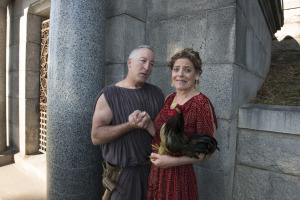
The play is populated with ancient practices, having Greek and Shakespearian references that many will enjoy. But there is an interesting overlay of modern attitudes and values that we Californians can relate to. Along the way, humorous anachronisms are introduced concerning health care coverage, computational technology, abusive banking, and the hard-for-the-playwright-to-resist, Nike footwear, swoosh and all. The inclusion of modern day feminism, transgenderism, and immigrant labor give more spine and purpose to the humor. However, the instrumentalized Motown music that plays during the scene changes is one modern element that escapes me, though I did find myself humming along to the tunes.
“Demetrius Unbound….” is the inaugural production of Bare Flag Theatre, and the company has attracted a largely Actor’s Equity cast, most of whom have dual roles. Each actor rises to the occasion, though some interactions between them are not as crisp as they could be. Stacy Ross plays Helena with the brightness and sense of clarity that she seems to bring to every role she plays. In grittier roles as Hermia and Pythia, Delia MacDougal also shines, while Gendell Hernandez’s Puck is a frenetic whirlwind of action.
The surprise performance comes from our Demetrius – the playwright, Soren Oliver, himself. The company lost it’s lead actor one week before opening, and fortunately, Oliver also acts and already knew the lines fairly well. He is well suited and comports himself with aplomb in the central and one of the most comic roles in the play. The other actors deserve recognition – Robert Sicular, Dodds Delzell, Jordan Winer, and Molly Benson, all of whom performed well.
As many world premiers this work may not have its final polish, but it is thoughtful; produces many laughs; and will likely improve over the run. Possibly with a few tweeks it will satisfy an even larger audience.
Demetrius Unbound (or the Homeric Midlife Crisis) plays at the Live Oak Theater in Berkeley through August 22.

Reviewed by Suzanne and Greg Angeo
Members, San Francisco Bay Area Theatre Critics Circle (SFBATCC)
Photos by Eric Chazankin
The past is never dead. It’s not even past.
— From “Requiem for a Nun”, Act I, Scene III, by William Faulkner
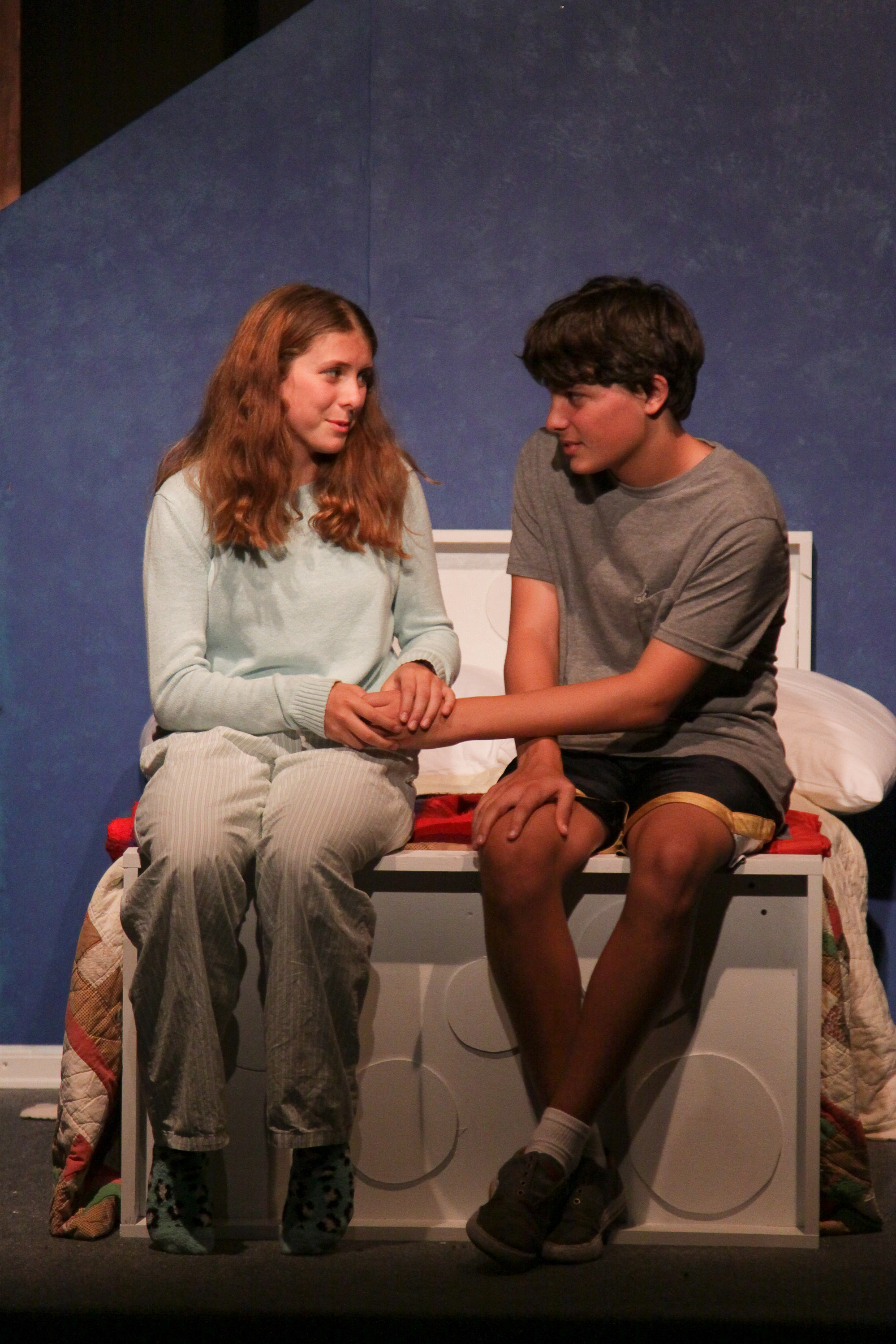
Lucy London, Jack Wolff
Local playwright/wunderkind Dezi Gallegos was certainly off to a good start in his career. He knew even before he could write that he wanted to tell stories. And by his early teens he had accomplished what many writers can only dream of: he co-wrote an award-winning play that was published and performed off-Broadway, “Prop 8 Love Stories”. He’s perhaps best known to Sonoma County theatregoers for yet another award-winning original work, “Hamlet’s Orphans”, which he wrote while still in high school. For this, he received the inaugural Annette Lust Award for Potential and Promise in Theatre at this year’s SFBATCC Awards Gala.

Barry Martin, Lucy London
Now 19 and a student at the University of Southern California studying film and TV production, he’s back at it with his latest, “Yesterday Again”. It’s a haunting, bittersweet love story with a brilliantly unique concept. This new effort has a “mini-rolling” world premiere at 6th Street Playhouse’s Studio Theater in Santa Rosa, rolling on to finish its run at the Lucky Penny Community Arts Center in Napa.Director Sheri Lee Miller (with a commendable assist from Gallegos and stage manager/co-producer Natalie Herman) makes good use of the vignettes that are so integral to the story. It centers on Eric and Bella, close childhood friends who lose touch with each other as very young teens after things get too hot and heavy between them and their parents find out. Circumstances lead them down separate but strangely parallel paths. The set by Vincent Mothersbaugh is divided into four distinct time capsules, with different actors representing each character as their past, present and future selves. Some of these temporal zones have the actors performing simultaneously in all three of the characters’ life stages, an interesting effect. And there’s a phantom in their midst, but we don’t know it until the very end – a very tasty red herring.
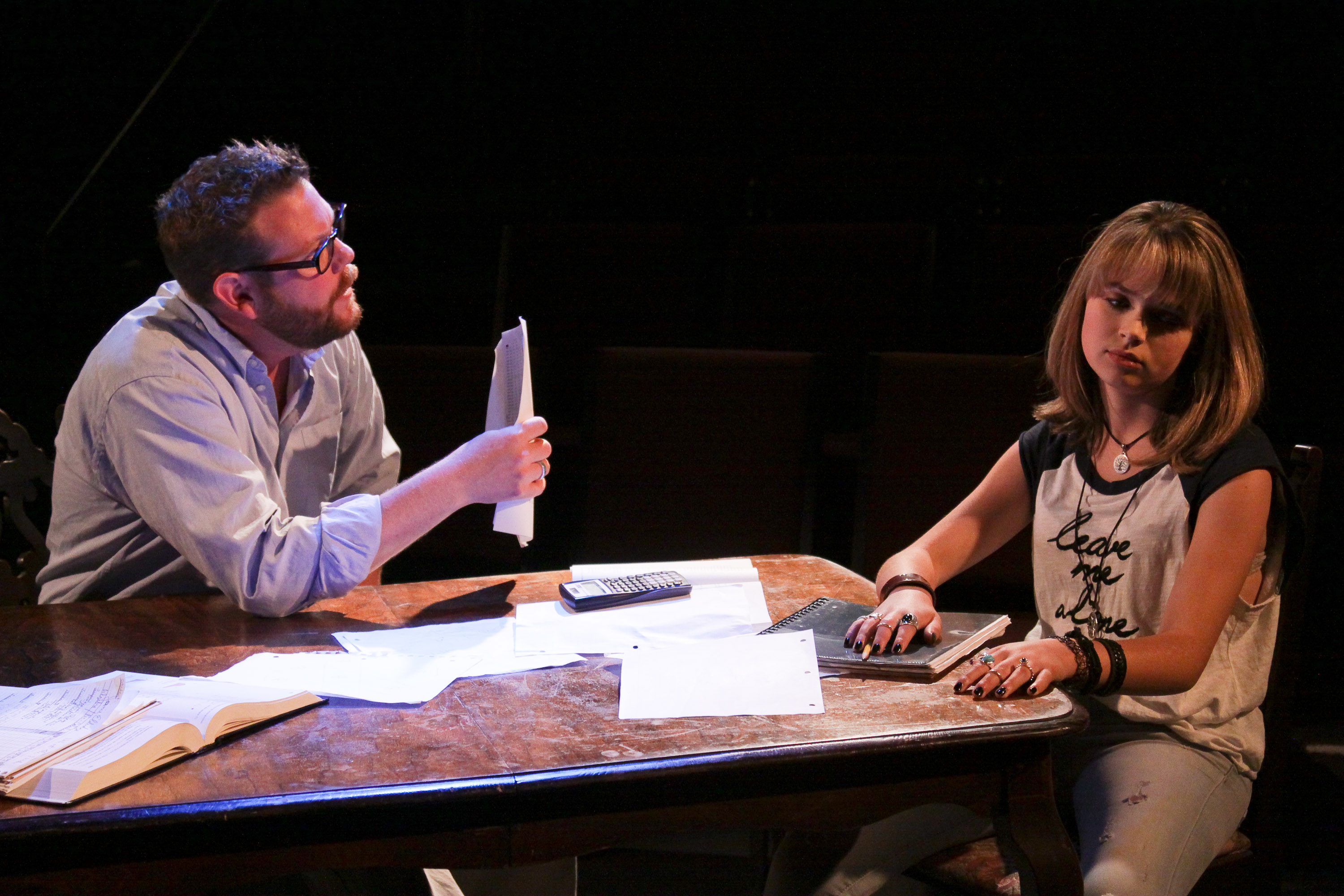
Craig Miller, Alyssa Jirrels
Lucy London and Jack Wolff play the tween-aged Bella and Eric with great charm and poignancy. Their college-age selves are capably portrayed by Olivia Marie Rooney and Isaac Jay. As the mature Eric, 6th Street’s Artistic Director Craig Miller offers a touching, earnest performance. He’s joined by Alyssa Jirrels, noteworthy as Jamie, a young student he’s tutoring. Sharia Pierce is superb, displaying the bitter disappointment of Bella’s later years. John Browning gives a strong performance as Bella’s slightly creepy husband Mark. Barry Martin, co-founder of Lucky Penny Productions, delivers a vivid, heartbreaking Rick, her ultra-conservative and overbearing father, in sharp contrast to her weak and timid mother Lisa, played by Pam Koppel.
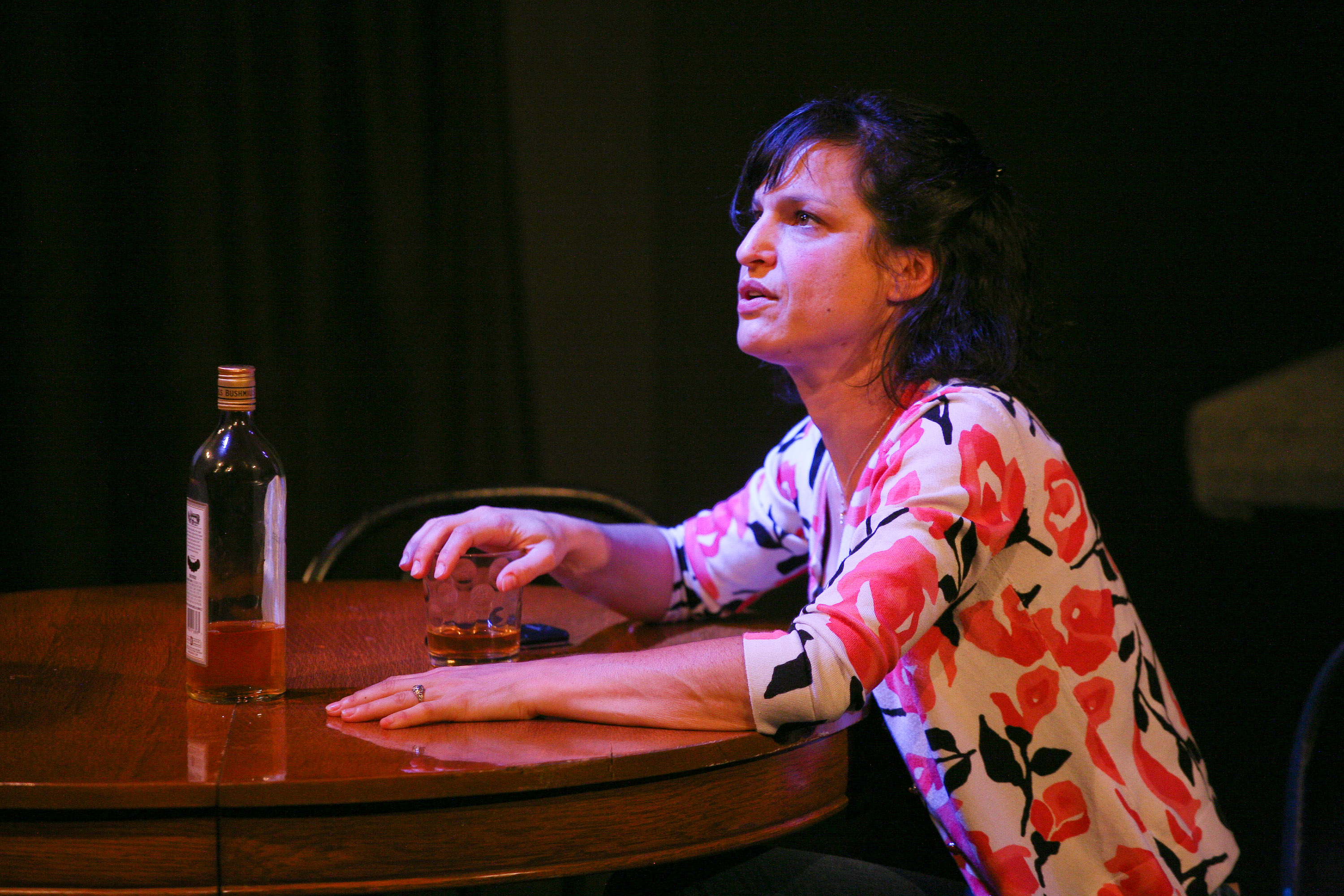
Sharia Pierce
“Yesterday Again” is ambitious, with a complex story and characters dealing with very mature subject matter. It also has a lot to say. Like, the best of intentions can have bad consequences. Or, you don’t always know how important you are to someone until it’s too late. It also asks important questions: Are we predestined to keep making the same mistakes throughout our lives? Are we at the mercy of unconscious choices we make based on past experiences, or can we take control and change our direction?The show has good bones, with just a few ragged holes in the storytelling itself (unclear choices and motives, under-developed characters, uneven transitions). It occasionally wanders into soap opera territory but finds its way out again, sometimes with extraordinary results. It also was under-rehearsed in its opening weekend and remains a work in progress, but a little polish will make this diamond-in-the-rough a real gem.
When: Now through August 2 (6th Street) & August 16 (Lucky Penny)
8:00 p.m. Fridays and Saturdays, 2:00 p.m. Sundays
Tickets: $15 to $25
Locations: Studio Theater at 6th Street Playhouse (through August 2)
52 West 6th Street, Santa Rosa CA
Phone: 707-523-4185
Website: www.6thstreetplayhouse.com
Lucky Penny Community Arts Center (August 7 – 16)
1758 Industrial Way, Suites 204-209
Napa, CA
707-266-6305


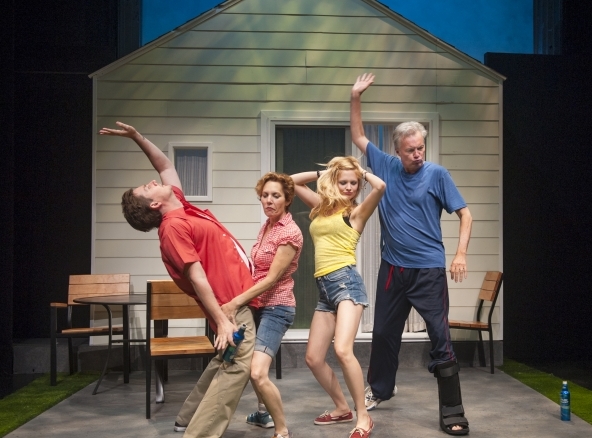
A 2011 Pulitzer Prize finalist, Detroit is as humorous as it is sharp. With tight writing by Lisa D’Amour (Airline Highway), the critically acclaimed play skillfully tangles the lives of aseemingly responsible older couple and a younger, more careless pair. Josh Costello ably directs Aurora Theater’s production in Berkeley, which leaves some in the audience diffident at best.
A friendly BBQ serves as a façade to the wreckage ahead in this well-structured expose’ on American life that shows just how distrusting people should be of others during oppressive economic times. At the outset, Ben (Jeff Garrett) and Mary (Amy Resnick) are a sharply drawn lower-middle class couple who fire up the grill for an All-American BBQ to welcome Sharon (Luisa Frasconi) and Kenny (Patrick Jones), a couple of drifters who move into the house next door — sans furniture.
As the neighborhood foursome bonds over backyard barbecues, remembered dreams and helping hands, their neighborly connection gets personal and accelerates into unanticipated directions, which threatens to ignite more than just their friendship.
Jeff Garrett is a Dick Van Dyke clone—with loose limbs, a rubbery face, and impeccable comedic timing. Even when the play’s focus is elsewhere, his impressive and adept listening and reactionary skills command attention. While most actors simply wait for their turn to speak, Mr. Garrett has truly mastered the art of active listening. Luisa Frasconi is, well, simply an amazing talent in bloom. It takes no stretch of the imagination to say that, one day, in the not-too-distant-future, we will all be paying large sums to see this funny, gifted lady work. Patrick Jones and Amy Resnick are solid performers.
Mr. Costello’s direction takes full advantage of the intimate space that is Aurora Theater’s main stage. His stage pictures are well-chosen, and his blocking, which can be tricky in a thrust environment like Aurora’s, almost always works smoothly.
The lighting design by Kurt Landisman is precise and skillful, at times even approaching ingenious. While most of the production is set outside the house, his clever lighting effects, used to light the interior during the tumultuous conclusion, are simple but very powerful. Using light to emphasize the denouement of Detroit is a bold choice that pays off in huge dividends.
Mikiko Uesugi’s set design masterfully takes advantage of the postage stamp stage. The attractive, solid and spare set could be a lesson in space economization for other designers. Uesui’s set construction — a wholly underappreciated aspect of live theater– was professional and well done. Theater carpenters, set construction staff, and set designers: this production is a shining example of design and handiwork.
The modern-day costumes by Christine Crook are perfect for the urban setting and complement the actors and the script.
The work backstage is deftly navigated. Set changes are flawless. Special marks go to the small backstage crew who not only maneuver what must be a chaotic backstage, but also who help the actors effect costume changes in the blink-of-an-eye, and under enormous performance pressure.
Daniel Banato resists the urge, too common in contemporary theater, to present the audience with a prop-laden set. Mr. Banato’s choices are largely complementary. His top-shelf props for the iterative grilling action are creative.
As pivotal to the plot as food and drink are, the clear sight of plastic props in lieu of legitimate consumables is an eye sore. While some productions get away with fabricated food and beverage, this piece demands the consumption of real, genuine food and ditto for the beverages which figure so prominently in the story.
Cliff Caruthers deserves special note for his very personal sound design. From subtle sound effects to music he specially produced for Detroit, Caruthers gives audiences something they rarely get today in a dramatic comedy, a well thought-out, carefully-considered and crisply rendered sound design—four stars for Mr. Caruthers.
Wesley Apfel’s stage management was tight, effective, and well executed. With as many moving parts as this production has, it’s clear Apfel’s presence and skill are in demand backstage.
Detroit’s greatest strengths lie in its technical aspects. From direction and stage management to lighting and sound, and from costumes and props to set design and construction, Aurora Theater’s production is a winner. It’s a real master class in technical artistry of contemporary theater.
Detroit ends its extended run on Sunday July 26, 2015. Tickets are available by phone on (510) 843-4822, online at www.auroratheater.org, or in person at the Aurora Theater Box Office, 2081 Addison St., in Berkeley.
Mr. Kris Neely is a member of the San Francisco Bay Area Theater Critics Circle. A director who earned an SFBATCC Best Director award (2012, ‘Lend Me a Tenor’, Ross Valley Players), his commentaries are focused, primarily, on the production, direction, and technical aspects of Theater.
The 1962 Broadway hit “A Funny Thing Happened on the Way to the Forum” was the first musical for which Stephen Sondheim wrote both the music and lyrics.
Much of his unique style can be heard as Foothill Music Theatre presents this show, based on farces by an ancient Roman, Plautus (254-184 B.C.).
Because it’s a farce and because it has Sondheim’s music and lyrics, it’s a challenge both dramatically and musically. Thanks to canny direction by Milissa Carey and Michael Ryken, who also choreographed the show, the comedic aspects work well.
Some of the singing isn’t quite as successful, but musical director Katie Coleman has made sure that excellent diction makes the intricate lyrics clear.
The show opens with a great introductory song, “Comedy Tonight,” featuring the central character, Pseudolus (Doug Santana), a Roman slave around 200 B.C.
Pseudolus desires his freedom, but in order to secure it, he must help his master, Hero (Anthony Stephens), win over the beautiful new woman whom he has seen on the balcony of neighbor Marcus Lycus (Ray D’Ambrosio), a keeper of courtesans.
However, the woman, Philia (Jessica Whittemore), has already been sold to a blustering general, Miles Gloriosus (Scotty Shoemaker), who’s due soon in Rome.
Other subplots arise in the book by Burt Shevelove and Larry Gelbart, several of them due to mistaken identities. All of these complications require Pseudolus to think quickly, which he does.
Santana does an excellent job with this balancing act. Others who contribute to the fun are Todd Wright as Senex, Hero’s would-be philandering father; Jenifer Tice as his mother, Domina; and Mike Meadors as Hysterium, one of their slaves.
Then there are the courtesans, who have the most challenging of Ryken’s choreography. They are Vanessa Alvarez as Tintintabula, Evelyn Chan as Panacea, Sarah Hammer and Cami Jackson as the Geminae and Sara-Grace Kelly as Gymnasia.
Many of Pseudolus’s antics are witnessed by the Proteans: Jason Engelman, Marc Gonzalez and Kevin Reid.
The set is by Kuo-Hao Lo, the lighting by Michael Ramsaur, the outstanding costumes by Robert Horek and sound by Andrew Heller.
Running about two hours with one intermission, it’s an enjoyable show.
“A Funny Thing Happened on the Way to the Forum” will continue in Foothill College’s Smithwick Theatre, 12345 El Monte Road, Los Altos, through Aug. 9. For tickets and information, call (650) 949-7360 or visit www.foothillmusicals.com.