
All Posts By

Woody Weingarten

Musical transforms Buddha into a woman in current world

By Woody Weingarten


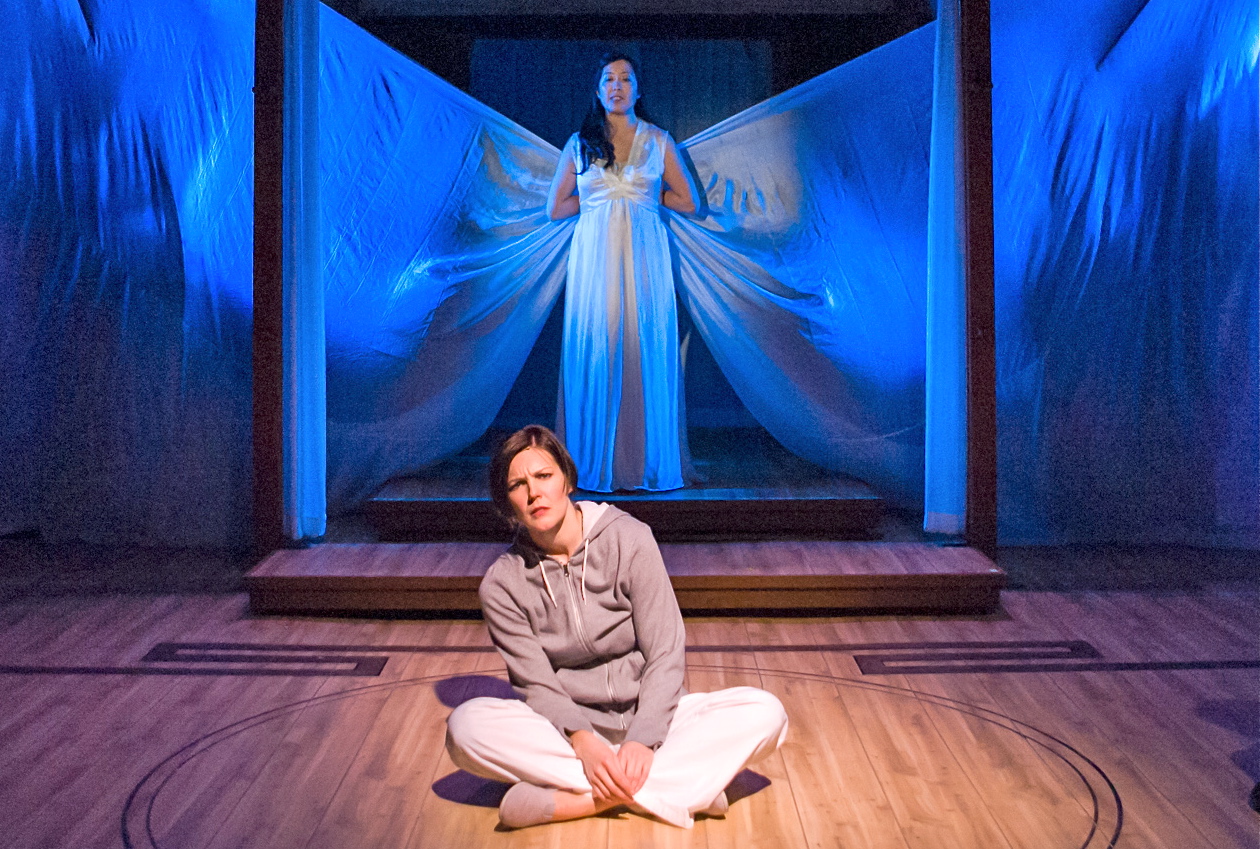
Sid (Annemaria Rajala, front) must deal with her dead mother (Alexis Wong) in “The Fourth Messenger.” Photo by Mike Padua.

Hmmm, what if the Buddha were alive today — as a female?

Hmmm, now let me see, what if she were dubbed Mama Sid, after Siddhartha Gautama, and her sacrifices in the name of enlightenment were densely detailed on a Berkeley stage?

Hmmm.

Well, the epic musical loosely based on legend just might be exciting, profound and humorous, that’s what.

“The Fourth Messenger,” at the Ashby Stage through March 10, questions whether a woman can survive 100,000 lifetimes to evolve into a purely spiritual yet totally human being.

As a mainly two-person journey toward peace unfolds, the show personifies temptation, prophecy and reconciliation.

Three harbingers appear in human form and embody negatives: sickness, aging and death. The final messenger, pure soul, arrives in an unexpected manner.

All that, and so much more, is viewed through the prism-eyes of two principals — Sid (Annemaria Rajala), a world-famous guru hiding her past, and Raina (Anna Ishida), a muckraking journalist who runs smack into herself while seeking to unveil what she’s predetermined to be spiritual hypocrisy.

But director Matt August keeps the two-hour-plus, two-act world premiere tight, paced seamlessly.

He tempers the tutorial-in-music with verbal comedy and physical slapstick, and drives the silliness through Bridgette Loriaux’s choreography.

Make no mistake, playwright Tanya Shaffer’s ultimate purpose — and message — is ultra-serious: Love gives life meaning. And she appears to offer a corollary obviating the Buddhist maxim that suffering goes hand-in-hand with attachment.

Shaffer, an El Cerrito resident whose “Baby Taj” was a Bay Area hit in 2005, has bitten off a lot. As a result, her script and lyrics are intermittently too dense or preachy.

On the other hand, the text does lend itself to poetic utterances (when Sid reflects on a multi-year meditation, she tells of hearing “cats, wolves…engines… human voices…laughter and pain…and behind the sound, silence, like a bottomless pool”).

Insightful one-liners turn up as well: “You know more than you know.”

Vienna Teng’s compositions from time to time rouses the crowd and runs a musical gauntlet, from pop to jazz, rock to tango, new age to operatic.

Like an opera, not incidentally, “The Fourth Messenger” is nearly a sing-through and succeeds with that format. But Teng’s score is unlikely to compel anyone to hum while leaving the theater.

It must be said, tangentially, that Christopher Winslow, who skillfully and enthusiastically directs four excellent musicians, sporadically lets that verve drown out the singers.

That only becomes a fleeting irritation since the gist of what’s happening remains constantly accessible even when several words are missed.

In comparison, the imaginatively fluid set designed by Joe Ragey — consisting almost entirely of poles and flowing white fabric — is never less than enthralling.

Its simplicity empowers silhouette scenes, and lets the action shift rapidly and smoothly from a magazine office in New York City to a meditation retreat in Newfoundland to a faceless suburban site to a lavish gated community and to bustling urban streets.

Also praiseworthy are the props, which range from a gigantic loaf of bread to a sheet that doubles as snow powder and worldly goods stuffed into a duffle bag.

Shaffer tenaciously attempts to keep things current, to the point where some words — such as staycation — and concepts — like child-abandonment — may rankle.

All 11 performers, many of whom appear in multiple roles, excel within the parameters of complex text and lyrics. Their singing tends to sprint from good to superior, except for a handful of opening night off-notes.

One of Sid’s summation queries in “The Fourth Messenger” is, “What’s one little lifetime anyway?”

My skeptical answer might be: “It’s all that I have — but happily it includes the chance to see a flawed but extremely valuable theatrical experiment.”

“The Fourth Messenger” runs at the Ashby Stage, 1901 Ashby St., Berkeley, through March 10. Evening shows, 7 p.m. Wednesdays and Thursdays; 8 p.m. Fridays and Saturdays. Matinees, Sundays, 2 p.m. Tickets: $23 to $40, available through thefourthmessenger.com.

Ex-champ Mike Tyson shadowboxes his life on stage

By Woody Weingarten

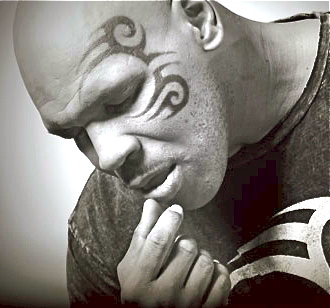
The tattooed Mike Tyson.

I went to “Undisputed Truth,” ex-heavyweight champ Mike Tyson’s one-man show, expecting to find a human version of a car wreck by the side of a highway.

Or a five-legged fuming bull.

I got what I’d anticipated — and much more.

His performance at the Orpheum Theatre in San Francisco confirms he’s still misogynistic and an egocentric bully — and that he’s still in denial about raping a beauty contestant (“I was convicted before the trial”), despite spending three years in prison for it.

He skirts no major details of his bad-boy history, though he excuses biting off a chunk of Evander Holyfield’s right ear because his foe head-butted him in a previous bout, and he justifies bashing his first wife, actress Robin Givens, because she and her mother “jumped on my wallet like the wild dogs of Africa.”

To me, that particular rant feels as brutal and painful as their yearlong marriage must have been.

The 46-year-old does, however, evoke sympathy and forgiveness from having been the son of a prostitute and a pimp, for conquering his drug and booze addictions (“I’ve been clean and sober for four years”), and for enduring the deaths of his mother, sister and 4-year-old daughter.

His troubled environment and childhood (“I was arrested 30 times by age 12”) and financially ripped-off adulthood (fight promoter Don King allegedly charged him $8,000 a week for towels) also draw compassion and a touch of pity.

In addition to a big box-office, “Undisputed Truth” clearly seeks an influx of forgiveness and love.

Spike Lee directed the show and indisputably helps Tyson obtain those two elements (while taking a break from his films and his courtside seats at N.Y. Knicks basketball games).

And Kiki Tyson, the ex-boxer’s third and current wife, aided the quest by scripting a 100-minute show peppered with tons of self-deprecating humor and a modicum of pathos (not to mention a torrent of rhythmic f-bombs and n-words).

Tyson does comedy set pieces particularly well.

For example, he evokes heavy laughter from his exaggerations of polite white speech patterns (which he juxtaposes with the rough ‘n’ tumble phrases that pour off the tongues of street hoodlums of color).

He claims, in context, that he would have preferred his show be called “Boxing, Bitches and Lawsuits.”

At Thursday night’s opening of the ultra-brief, three-day SHN engagement, Tyson’s fans and cheerleaders virtually packed the 2,200 seats. They made up an audience unlike most theater throngs — younger (mostly 20- to 40-year-olds), more ethnically diverse (lots of Hispanics and African-Americans), and less well attired (sneakers and jeans, with a smattering of baseball caps, some worn backwards).

More like a crowd I’d expect at ringside.

His devotees cheered and laughed enthusiastically and often, even when Tyson was recounting past behaviors that had brought him almost universal disfavor.

None seemed bothered by the ex-champion’s speech impediment or occasional mumbles. And no one visibly winced when he talked about becoming “tired of ripping off my prostitute girlfriend and waking up next to people I never saw before.”

The so-called “baddest man on the planet” drew extra sympathy by relating he went from banking $400 million to bankruptcy, finding himself “ho-less and homeless,” and suffering through rehab before hitting an emotional growth spurt in prison resulting in transformation.

The change didn’t hold, unfortunately.

So he continues to shadowbox his demons — and his life — onstage.

Though he skips it in the show, which is definitely not for the squeamish, Tyson has confessed to being on cocaine while filming a cameo appearance in the movie comedy “The Hangover.”

That altered state probably didn’t matter much: His meager acting chops are as evident here as they were there (as well as in the sequel that featured a replica of his facial tattoo more than it did his bigger-than-life persona).

Last December, Time magazine quoted Tyson as claiming he gets a high, despite constant nagging doubts, from going on stage — a similar high to the one he used to derive climbing into a boxing ring.

The opening night’s crowd, which proffered Tyson a standing ovation, apparently got its own high from the solo showcase.

Its excitement was palpable, even to the minority who weren’t disciples.

“Undisputed Truth” runs at the Orpheum Theatre, 1192 Market St., San Francisco, through March 2. Performances tonight and tomorrow, 8 p.m. Tickets: $50 to $310. Information: (888) 746-1799 or shnsf.com.

‘Se Llama Cristina’ bends characters and timeframes

By Woody Weingarten

Sarah Nina Hayon and Sean San José star in the Magic Theatre production, “Se Llama Cristina.” Photo: Jennifer Reiley.

Offbeat.

A handful of Bay Area theater companies strive for it by focusing on the uncommon, the unusual, the unique.

These troupes provide a contrast with those that prefer to pick low-hanging fruit like Chekhov’s “The Cherry Orchard” for the 17th time, or retread musicals like “Grease” for the 11th local go-round, or believe casting two women as “The Odd Couple” will add laughs.

The Magic Theatre, thankfully, belongs in the first category.

Witness its latest chancy venture into the known unknown, “Se Llama Cristina.” In it, San Francisco playwright Octavio Solis toys with words (ranging from coarse to poetic) and emotions (ranging all over the proverbial map) and timeframes (troubled flashbacks, a problematic present and tentative flashes forward).

He embraces hyper-serious subject matter, then switches moods by lacing it with verbal gags (many of the gallows humor variety).

His main characters often speak in ultra-short outbursts that can long remain ambiguous (or appear unrelated to the topic at hand).

Vespa (or Vera) and Mike (or Miguel or Miki), start off trapped in a seedy, locked room with drug paraphernalia on the kitchen table, scraps of crumpled poetry covering the floor, and an empty crib (except for a fried drumstick) enticing them.

Are they really victims? Are they really junkies (or alcoholics)? Are they really parents?

Interactions with Rod Gnapp’s alter ego (Abel and Abe) are equally unclear. Is he an abuser, a lover, a sperm donor?

Even if you can answer all those questions, more emerge. Did Vespa’s minister-father impregnate her, beat her, abandon her? Will Mike replicate those patterns?

Does all the action actually take place in one nightmarish room, or does it shift from Texas to New Mexico to Arizona to Daly City, where Miki proclaims, “This ain’t no home. This is squalor. This is a dead end. This is not my California dream.”

Was the pair’s relationship an extension of how they met — a wrong number? If they indeed had a child, is it a “weight” or an “encumbrance”?

Director Loretta Greco, in her fifth season as the Magic’s producing artistic director, keeps the 80-minute, one-act play moving at breakneck speed, and she skillfully keeps the audience guessing about the substantial changes Solis puts his characters through.

Now and then the dialogue acts as synopsis, as clear as a winter’s night illuminated by a full moon: “I’m scared, Miguel, that we’re not going to make it…that you’ll leave me in a town I don’t know with a child so sick and hungry and you’ll be gone. I’m scared that she’s gonna end up like me.”

More often than not, though, it’s terse and punchy: “I’m damaged goods.”

Alas, the comic drama feels marginally derivative, evoking shades of other plays and playwrights.

It may for a moment drag your mind back to the hysterical pregnancy of “Who’s Afraid of Virginia Woolf?” It also may bring to mind the four-letter words and poetic phrases created by David Mamet, or the humor that makes Tony Kushner uses to make his ultra-heavy “Angels in America” bearable.

“Se Llama Cristina” is far from perfect — you’re apt, for instance, to be fuzzy about the protagonists’ backgrounds (at first they don’t speak Spanish despite being of Mexican extraction, then they do, in torrents that include dueling curse words).

Sarah Nina Hayon, who plays Vesta (designated in the program only as “Woman”), and Sean San José, who becomes Mike (“Man”), both deliver potent anguish and stinging humor.

Gnapp, too, holds your attention — with a gamut of verbal moves.

Perhaps one reason the Magic fills most of its seats with enthusiasts under 40, as opposed to the gray-hairs that populate many local venues, is its willingness to take chances — with its plays, playwrights and actors.

“Se Llama Cristina” plays at the Magic Theatre, Building D, Fort Mason Center, Marina Boulevard and Buchanan Street, San Francisco, through Sunday, Feb. 24. Performances Wednesdays through Saturdays, 8 p.m.; Tuesdays, 7 p.m.; Wednesday, Saturday and Sunday matinees, 2:30 p.m. Tickets: $17 to $60. Information: (415) 441-8822 or www.magictheatre.org.

ACT’s ‘4000 Miles’ tenderly targets granny, grandson

By Woody Weingarten

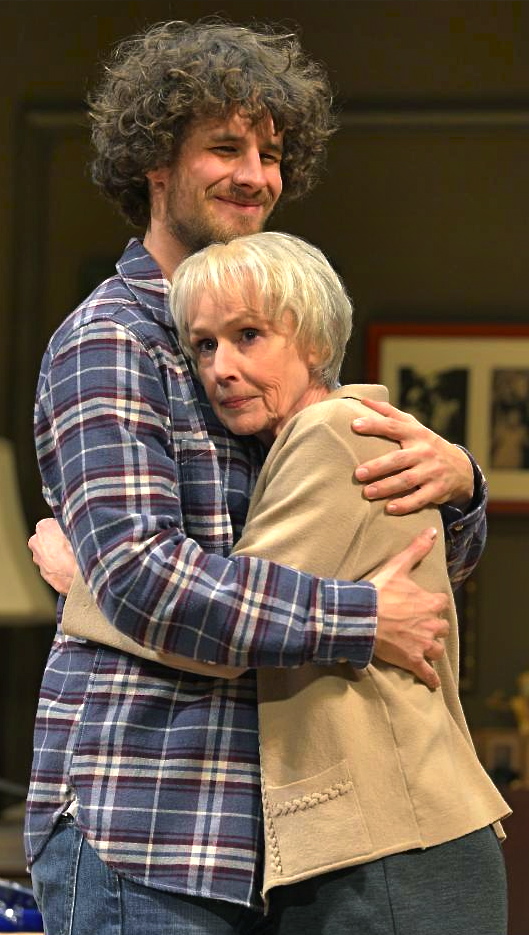
Susan Blommaert portrays Vera, and Reggie Gowland becomes Leo, in ACT’s “4000 Miles” in San Francisco. Photo by Kevin Berne.

My review of “4000 Miles” requires only four words: It’s sweet. See it.

But you have to get there in a hurry — it’s only scheduled to run through tomorrow night.

Prefer a little embellishment? OK then, here goes…

Playwright Amy Herzog, 33, has written a thoroughly charming, tender show about Vera, a 91-year-old granny who’s still a full-blooded Commie-Pinko-Fellow Traveler, and her 21-year-old neo-hippie grandson Leo, a latter-day armchair anarchist stuck in a belated coming-of-age learning curve.

He unexpectedly visits her slightly rundown, rent-controlled Greenwich Village apartment after a cross-country bike trip that’s left him smelly, broke, frazzled, confused and intensely desirous of comfort and love.

He last was there a decade ago, for the funeral of her Marxist editor-writer husband.

More often than not, he calls her Vera or “dude.”

They’re uncomfortable together, and director Mark Rucker underscores those awkward moments by using lengthy pauses that counter the crisp dialogues in the American Conservatory Theater show in San Francisco.

As any semi-astute theatergoer might predict, Vera eventually meets most of the young man’s needs, unscrambling his mind and emotions along the way. He, of course, simultaneously helps her come to grips with her current life instead of focusing on the past or the habituated behaviors that no longer serve her well.

“4000 Miles” is more than the sum of its parts, though: Herzog turns a soft, endearing, often humorous series of vignettes into a sympathetic single-act portrait of, as the old song lyric goes, people who need people.

The play’s most dramatic moments take place offstage or in conversation, yet not once did I think the piece could be improved by an explosion, stabbing or car chase.

The comic drama, which deftly contrasts leftist politics of yesteryear with those of today, is staged without frills: The characters simply talk to each another.

Their venue, Vera’s apartment, should be recognizable as one inhabited by Every American Widow.

But the main characters’ flesh-and bloodness shouldn’t surprise anybody who googled Herzog’s background — Vera was directly inspired by the playwright’s now 96-year-old grandmother (who’s not above protesting in the streets yet).

“4000 Miles” also leans on a six-month stint the writer, then a novice actor, had spent living with the old lady in The Big Apple.

It was a period in which, she has contended, “It wasn’t clear the relationship would survive.”

The playwright also lifts another page from her mental autobiography: She’d made a painful, exhausting eight-week 4,250-mile trip across the United States with Habitat for Humanity.

Plot highlights, ranging from droll to poignant, include Vera detailing her husband’s sexual affairs; the bizarre death of Leo’s best friend, Micah; a misimpression about Leo kissing his adopted sister, Lily; and a granny-grandson stoner session that celebrates the autumnal equinox.

Susan Blommaert, wholly believable as Vera (although the actor is actually much, much younger), finds a synchronistic stage partnership in Reggie Gowland as the youth.

The show, which runs only an hour and 20 minutes without intermission (and which won two Obie Awards for its 2011 Lincoln Center staging in Manhattan), is not a sequel to Herzog’s “After the Revolution” despite Vera being a continuing character.

Speaking of characters, Camille Mana gloriously renders Amanda as a high-energy art student and Leo pickup who’s an almost-one-night-stand. She appears in only one scene but nearly steals the show.

OMG. It seems I’ve written a deluge of words. I probably should have stopped at the pithier “It’s sweet. See it.”

“4000 Miles” plays at the American Conservatory Theater, 415 Geary St., San Francisco, through Feb. 10. Performances Tuesdays through Sundays, 8 p.m.; matinees, Wednesdays, Saturdays and Sundays, 2 p.m. Tickets: $20 to $105. Information: (415) 749-2228 or www.act-sf.org.

Revival of ‘Wicked’ delivers spectacular stagecraft

By Woody Weingarten

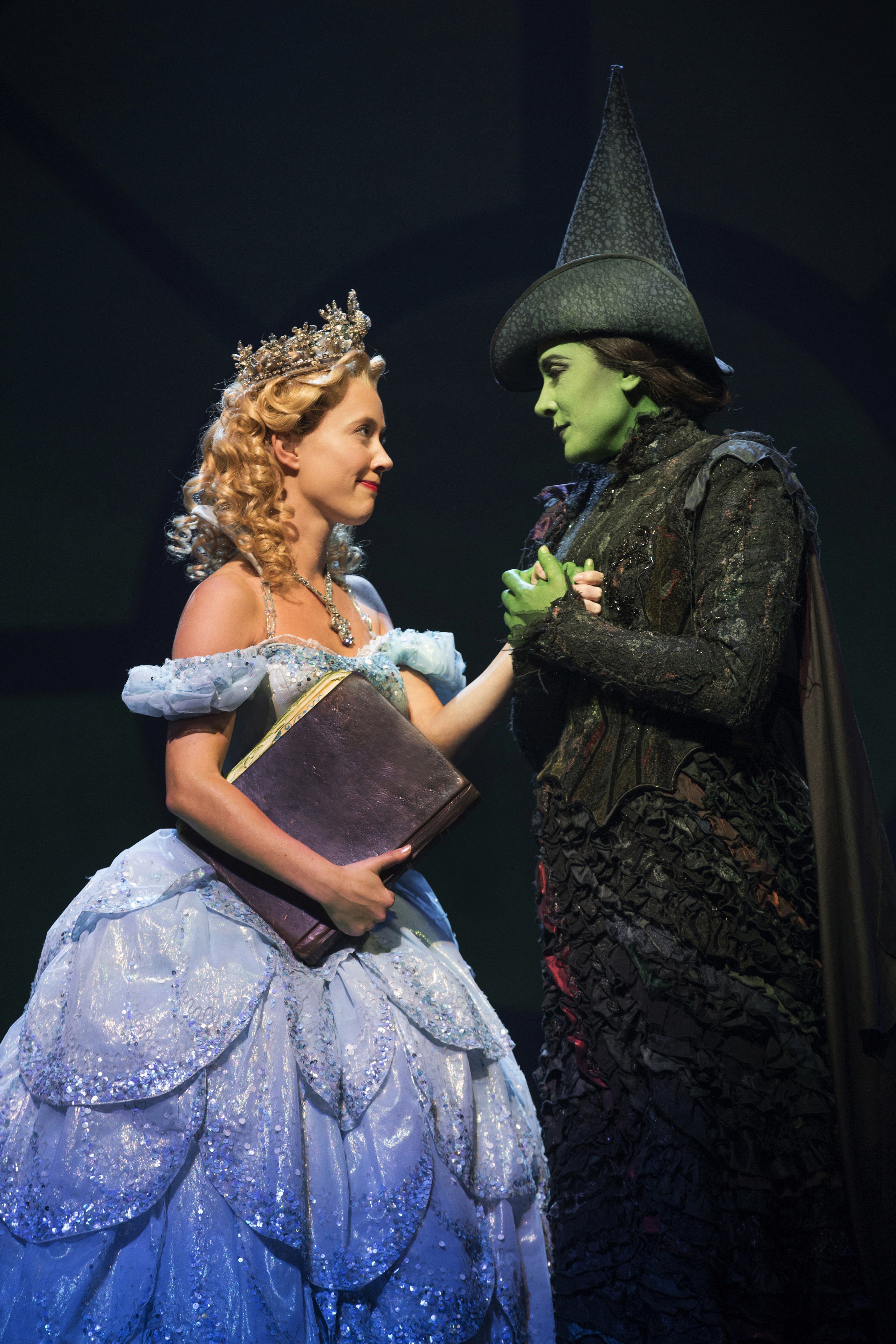
In “Wicked,” Dee Roscioli (right) plays Elphaba, and Patti Murin normally morphs into Glinda, but flu felled Murin opening night. Photo by Joan Marcus.

Has it really been 10 years since I first saw “Wicked” in its pre-Broadway run in San Francisco?

Indeed.

Back when, I thought the show was as deep as a pool that had been drained yet as light and wondrous as an exquisite soufflé.

Recently I went to opening night of its latest incarnation, at SHN’s Orpheum Theatre in San Francisco.

The show, which has grossed more than $500 million over the last decade on the Great White Way, where it’s still financially healthy, was severely restructured before it originally opened in New York.

And it’s been retailored a bit since.

Now, unless you’re in the mood for a dose of heavy Shakespeare or Kafka or perhaps an experimental John Cage-like version of “Les Miz,” you should find this a spectacular divertissement — in every sense of the word spectacular.

The glitz-laden stagecraft — including gigantic sets with their zillion lights ablaze and guaranteeing to keep PG&E in the black for a long time — will keep you, well, spellbound.

And you’re likely to find the sumptuous, ruffled costumes equally stunning.

Expect total visual and vocal candy.

That having been said, the musical comedy’s still as deep as a pool that had been drained yet as light and wondrous as an exquisite soufflé.

The lead role of Elphaba, the Wicked Witch of the West, which was padded exponentially since the show’s inception, lies now in the green makeup and extremely capable throat and of Dee Roscioli, a Broadway luminary who’s portrayed Elphaba more than 1,000 times.

The clout of her pipes is amazing to behold.

On opening night, the role of Glinda, the Good Witch of the North, was sung by Cassie Okenka, arguably the most skilled understudy since Barbra Streisand exploded onstage in “Funny Girl.”

Replacing the flu-ravaged Patti Murin, Okenka was no slouch in the comedy department, either.

Her enchanting scratchy voice is akin to that of Kristin Chenoweth (who’d blossomed here in the pre-Broadway version and then went to New York wearing full star skin), and her outrageously manic body movements kept the entertainment moving as fast and exciting as magical white river rapids.

The fantasy plotline, a prequel/sequel to “The Wizard of Oz,” hasn’t changed: Elphaba and Glinda are mismatched roommates and schoolyard best friends. They become rivals. They grow and overcome their differences.

Along the way, “Wicked,” in hit-and-run fashion, digs into the subjects of popularity, power and prejudice.

Think about it.

Think, too, about The Emerald City and Dorothy’s shiny red slippers, as well as the Tin Man and the Scarecrow and the Cowardly Lion.

Then, perhaps, think about The Odd Couple meeting The Lord of the Rings.

Opening night of the revival, Kevin McMahon’s thinking was probably elsewhere — on how to suitably step in for the flu-ish Tom McGowan as the wizard.

He needn’t have worried: He was strong.

Strong support also came via the performances of Kim Zimmer as lower-level villainess Madame Morrible; Demaree Hill as Nessarose, Elphaba’s disabled younger sister; Clifton Davis as a goat/scapegoat/professor, Dr. Dillamond; and Cliffton Hall as Fiyero, Glinda’s intended who’d rather be with Elphaba.

But the two-hour, 25-minute production did have a few weak spots.

Words sung in unison by the chorus were sometimes muffled to the point of being indecipherable. Much of the choreography seemed like works in progress, with the flying monkeys flailing wildly and the rest of the ensemble twirling and kicking with bland precision. Superficiality prevailed.


And Act I felt a trifle long at an hour and a half.


Highlights were not difficult to ascertain, though. They included the first act finale, “Defying Gravity,” which ended with breathtaking special effects; several duet riffs by the two witches; and the lone memorable Stephen Schwartz tune, “Popular.”


All in all, hilarity was almost ubiquitous in the audience. Simple lines like “Something’s wrong — I didn’t get my way” evoked big laughs.


Belted-out songs, meanwhile, drew big applause and boisterous cheers — even if no one could remember the words or melodies five minutes after leaving the theater.


You might pay no-never-mind to that, however, since “Wicked” has more pleasurable big-production numbers per square inch, more buoyance per minute, than any show in recent memory.


Versions were previously staged in San Francisco — in addition to the initial 2003 run — in 2005 and 2010. In each of them, the Glinda character came and went in an ostentatious bubble, a quick prompt to the show’s bubbly mien.


And with all that effervescence, it was — and is — virtually impossible for anyone who loves flamboyant theatricality to dislike this variation on a familiar theme.


“Wicked” runs at the Orpheum Theatre, 1192 Market St., San Francisco, through Feb. 17. Night performances Tuesdays through Saturdays, 8 p.m.; Matinees, Wednesdays, Saturdays and Sundays, 2 p.m. Tickets: $50 to $275 (subject to change). Information: (888) 746-1799 or shnsf.com.

Helping Keep Cabaret Alive and Well in San Francisco

By Woody Weingarten


Cabaret producer Marilyn Levinson has lived in Larkspur a dozen years. But her work has thrived in San Francisco, with its impact felt throughout the Bay Area.

We share muffins in a casual breakfast chat at Corte Madera’s Il Fornaio restaurant. She laughs freely — and often.

Her eyes and conversation sparkle almost as brightly as her tasteful diamond earrings.

She charms me with her first few sentences.

Clearly, she explains, cabaret “can be much more than a show in a tiny dark cavern by a stereotypically aging ex-Broadway songstress in a tight gown dripping with sequins.”

Sooooo much more.

I’m there to glean details about the performances she’s generating at the Venetian Room of San Francisco’s Fairmont Hotel.

But I also get intriguing onstage, backstage and off-the-record stories about artists she encountered since she swapped lawyering for coordinating Cabaret Marin, which morphed into Bay Area Cabaret.

The nonprofit’s ninth season opened Oct. 28 with “the quintessential cabaret singer, Mary Wilson, in an intimate act that talks about her life after The Supremes,” then continued Nov. 11 with Tommy Tune. Another schedule highlight was a Dec. 9 encore  by movie-TV-Broadway star Peter Gallagher, who prompted one female fan to write, “When he left the stage, I was ready to see his show all over again — and have his baby.”

Levinson finds it impossible to pick only one favorite local cabaret star or moment.

But she did enjoy Tony-winner Lillias White spontaneously yanking off her sharp-pointed high-heels and saying, ‘I’d like to see how you’d feel if you had to wear these shoes.’

Laura Benanti also delighted her by pulling out a uke and confessing “that when

she was a girl, she thought Marilyn Monroe was so sexy when she played ukulele in ‘Some Like It Hot,’ then later realized that the ukulele wasn’t what made her so sexy.”

This six-show season, her ninth, will end with a tribute by Oscar-winning lyricists Alan and Marilyn Bergman to the late Marvin Hamlisch, on the composer’s June 2 birthday. Hamlisch had been the star when the Venetian Room reopened after being dark for 21 years.

Such offerings are a long way from Levinson’s first Marin productions, which spotlighted an opera singer, Sondheim music and dog stories.

Today, she says, “we try to mix it up, to aim things at difference audiences — like those of ‘Rent,’ Teen Idol and the older-crowd Chita Rivera appeals to.”

The producer’s moment of truth occurred when the last Mabel Mercer Cabaret Convention at the Herbst “was not too well attended despite the great performances. Because it was sad to see the audience dwindling, I thought it important to educate the audience or potential audience to an expanding definition of cabaret.”

Levinson’s introduction to the genre actually came at a little black-box theater in West Village in Manhattan, where she was living at the time. The singer, she remembers, “made me feel she was in dialogue with me in my living room, revealing herself. I just loved that.”

Her intro to show biz goes further back than that, however.

As executive coordinator of the precursor to the San Francisco Civic Light Opera, her mom invited stars such as Bing Crosby, Don Ameche and Mary Martin to their home.

Levinson herself volunteered at the American Conservatory Theatre as a teen, later founded a jazz dance company, worked for Joseph Papp’s Public Theatre, Broadway producer Arthur Cantor and became Yul Brynner’s road manager for his final national tour of “The King and I.”

And then she went to Stanford Law School, becoming an entertainment and intellectual-property lawyer. She wed, had two sons, and cocooned in Larkspur.

The most difficult part of her work now, she discloses, “is the booking process, which begins in New York in the coldest month of the year and can go on for a full nine months after that.”

What makes it particularly tough, she says, “is having to compete for talent with venues three or four times our size.”

As for her biggest reward, that’s seeing what top-notch cabaret artists she can snare.

In that regard, filling out this season will be Marin Mazzie and Jason Danieley, a Valentine’s Day offering Feb. 17; Elaine Paige, March 1; and Nellie McKay paired with Chanticleer, March 23.

Levinson started her cabaret business, she tells me, because she had experienced so much good cabaret in New York and didn’t want to see the genre die.

Obviously, she’s succeeding.

So all I can add is, “Viva cabaret!”

The Bay Area Cabaret series will be held at the Fairmont’s Venetian Room, 950 Mason St., atop Nob Hill, San Francisco, from Oct. 28 through June 2. Tickets: $40-$75 per show, (415) 392-4400 or www.bayareacabaret.org

‘I Love Lucy’ spoof overcomes glitches galore

By Woody Weingarten

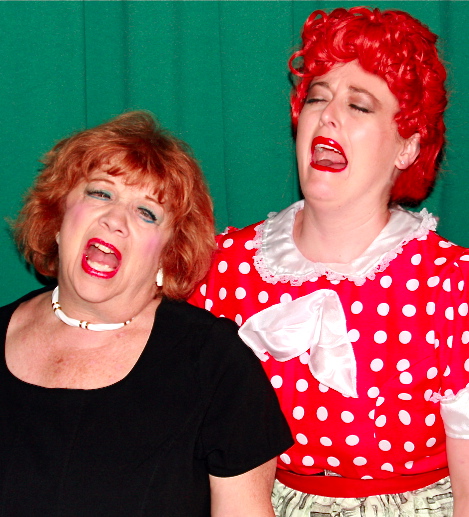
Adrianne Goff (right) stars as Lucy Bicardi, and Leslie Klor is Ethel Schmertz, in "Trouble at the Tropicabana," a comic murder-mystery dinner show at the Marin Rod & Gun Club, San Rafael. Photo by Wendell H. Wilson.


Adrianne Goff could be a magician.

On a recent Saturday night at the Marin Rod & Gun Club, she yanked several rabbits out of a hat — simultaneously — to successfully produce, direct and star in an interactive comic murder-mystery dinner show aptly titled “Trouble at the Tropicabana.”

The slight-of-hand was needed because so many things were going south, as if Murphy’s Law had been cloned and re-cloned by a humorless sitcom writer.

Somehow, Goff managed to make the difficulties vanish — including a pre-show party that lingered too long, 30 aggressive wannabe theatergoers who showed up unexpectedly, waitresses who filled tall water glasses from a tiny pitcher that could replenish only two at a time at tables that sat eight, and a computer that conked out and had to be replaced before any essential recorded music could be played.

Goff’s Band-Aids, chewing gun and similar quick-fixes kept a packed house from shouting, “Adrianne, you got some ‘splainin’ to do.”

Not incidentally, if that reference means nothing to you, you must have missed each and every episode of the classic “I Love Lucy” series — and each and every one of Ricky’s mangled sentences.

The audience obviously hadn’t missed any. It cackled each time it was expected to during the campy, pun-laden, mistaken-identity, mega-melodramatic antics that took off where the historic and hysteric sitcom left off.

And at least a third of it grinned gleefully while misstepping all around the huge room in a makeshift, voluntary conga line.

None of the deer or elk heads on the walls criticized their dancing.

Goff, who, believe it or don’t, was also responsible for the costumes, was a comic standout as a whiny Lucy, donning a carrot-colored fright wig that intentionally didn’t cover all of her own brunette locks.

She and perfect sidekick Leslie Klor, who inhabited the body of Ethel, were funniest when they dressed in slapdash mustaches and black suits and delivered seamless clowning in the majestic tradition of Mutt and Jeff, Laurel and Hardy, Martin and Lewis.

They also were strikingly and stridently amusing in a set piece in which they talked extra fast trying to out-jabber one another.

Another dazzling performance came in the form of Vanessa Vazquez as Cookie, aka the duplicitous siren-vamp Celia B. DeMilo.

The dinner by caterer Stacy Scott that complemented the show was spicy, tasty and, appropriately, Cuban-based.

But not everything hit an “A” level.

The five “Tropicana Girls” would have garnered many more giggles had their simplistic choreography been outrageously klutzy instead of bland.

The often-repetitive script would have evoked a lot more guffaws had its spoofiness not been so faithful to the original and, instead, been translated into more visual, fresh gags.

And, unfortunately, the actors stayed mostly in the front of the audience rather than mingling with it, unlike the last Marin Murder Mysteries production at a smaller venue, San Rafael Joe’s.

The best move of the evening, however, was an ad lib from Wendell H. Wilson, who portrayed Ricky.

When a two-year-old sitting on his dad’s lap at a front table started to cry after a handgun was wielded, he told the boy, “We’re just playing. We’re all gonna have fun.”

Surely, most folks did.

“Trouble at the Tropicabana,” part of the Marin Murder Mysteries series, will play at the Marin Rod & Gun Club, 2675 E. Francisco Blvd., San Rafael, on various dates through New Year’s Eve. Reservations required. Tickets: $40 to $65, including dinner, tax and tip; $30, show only. Information: www.marinmurdermysteries.com or (415) 306-1202.

Multi-faceted exhibit at de Young: exquisite, inspiring

By Woody Weingarten

Picasso’s “Nude with Joined Hands,” from the artist’s Rose Period, features a definitively sculpted head atop a less-defined body.

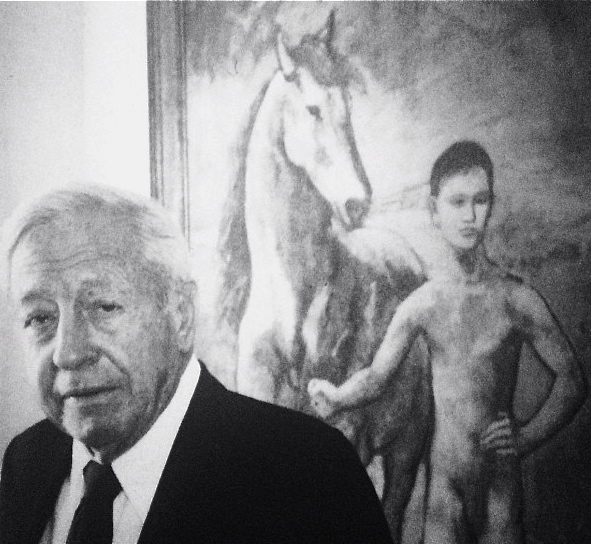
William S. Paley stands in front of Pablo Picasso’s classic “Boy Leading a Horse” in his New York City apartment.

You well might question the artistic wisdom of a man responsible for such lowbrow TV hits as “I Love Lucy,” “Gunsmoke” and “The Ed Sullivan Show.”

But William S. Paley, longtime titan of the CBS network, vividly demonstrated through major artworks he collected that he was perceptive and intuitive — and perhaps clairvoyant as to which artists would grow in fame.

“The William S. Paley Collection: A Taste for Modernism,” a new, multi-faceted exhibit at the de Young Museum in San Francisco, can prove it.

In the show are masterpieces from Braque, Cézanne, Degas, Gauguin, Manet, Miro, Picasso, Renoir, Rousseau, Toulouse-Lautrec and others, many others. Sixty paintings, drawings and sculptures in all.

Impressionism. Post-Impressionism. School of Paris. Modernism.

Exquisite.

And evocative.

Timothy Anglin Burgard, curator-in-charge of American Art for the Fine Arts Museums of San Francisco, indicated that the exhibit, organized by The Museum of Modern Art in New York, to which Paley had bequeathed his collection, simultaneously informs and inspires viewers.

Bulls-eye.

Consider, for example, Henri Matisse’s 1927 painting “Woman with a Veil,” which shows his desire to utilize “a flatness, a two-dimensionality” combined with a classic pose of melancholia to “get at a greater truth…as well as beauty.”

Or two Pablo Picasso paintings from his Rose Period — the 1905-06 “Boy Leading a Horse” (which was owned originally by Oakland poet laureate Gertrude Stein and her brother Leo) and the 1906 “Nude With Joined Hands.”

“Boy,” which portrays a much younger Picasso than the 27-year-old painter who’d already become a master when he brush-stroked it, is visibly a work of genius.

It also was a linchpin of last year’s successful San Francisco MOMA exhibit, “The Steins Collect: Matisse, Picasso and the Parisian Avant-Garde.”

For “Nude,” the artist painted a definitively sculpted head atop a less-defined body of a woman who is modestly covering her genitalia with her hands.

It’s alleged that Picasso stole the sculpture on which he based the head from the Louvre, returning it when he was done.

The exhibit, not incidentally, is majestically mounted, with paintings given breathing space on shaded walls that make them stand out.

Facts about Paley’s collection can be intriguing. But so can the attendant fiction.

In that category, said Burgard, is the broadcasting innovator’s middle initial, which didn’t stand for anything (though he’d never dissuade folks from believing that it represented his father’s name, Samuel).

Another inaccuracy: Paley was a co-founder of CBS, not its exclusive architect, Burgard noted during his brilliant and witty pre-opening press tour of the exhibit.

Also, Paley insisted “Woman with a Veil” was purchased directly from Matisse. The truth, said Burgard, is that the spinmeister bought it from artist’s son.

One real fact is that Paley’s first art purchase, in 1935, was the 1875-1876 “Self-Portrait in a Straw Hat” by Paul Cézanne.

Another fact is that Paley, as a Jew, had to overcome the rampant discrimination of his time.

He was denied admission to fraternities in college, and despite his subsequent major philanthropy and an upper-crust reputation garnered by owning a string of racing thoroughbreds, he was denied membership in multiple posh clubs.

As a young man, Paley, who died at age 89 in 1990, wasn’t exactly self-made. His father had earned millions manufacturing and selling cigars, giving William S. Paley quite a jump-start.

Paley the Collector, on the other hand, was strictly his own person: The range of the paintings in this exhibit is wider than you might expect.

On the modern end, for instance, are two existential early-‘60s triptychs of distorted faces by Francis Bacon. According to the audio tour, the artist said his portraits were of friends — because if they hadn’t been, “I could not do such violence to them.”

In contrast, on the other end, are two soft 1866-68 pencil sketches by Hilaire-Germain-Edgar Degas, “Portrait of a Woman” and “The Jockey.”

A photographic bonus for visitors is a hallway of large images revealing the interior of Paley’s Fifth Avenue apartment in Manhattan, where masterworks adorned the walls.

If you visit the de Young exhibit, make sure to stop in front of Henri de Toulouse Lautrec’s “Mme Lili Grenier.”

It’s a 1988 painting soul-stripping the wife of a wealthy friend. She’s lounging in a chair while wrapped in a Japanese kimono, her hands toying with a pale blue ribbon. At age 20, she has a smug look of self-satisfaction — reflecting, most likely, how well she married.

Don’t miss it.

In fact, don’t miss the exhibit as a whole.

“The William S. Paley Collection: A Taste for Modernism” will be at the de Young, Golden Gate Park, San Francisco, through Dec. 30. Hours: Tuesdays through Sundays, 9:30 a.m. to 5:15 p.m., except Fridays, when open until 8:45. Admission: $10 to $20, free for members and children 5 and under. Information: (415) 750-3600 or www.deyoungmuseum.org.

‘Elaborate Entrance’ grasps pro wrestling — via satire

By Woody Weingarten

In “The Elaborate Entrance of Chad Diety,” the champ (Beethovan Oden, center) confronts VP (Nasser Khan) as The Mace (Tony Sancho) looks on. Photo by David Allen.


I’m surprised that, considering their enormous popularity, Spiderman, Batman, Wolverine and other trademarked superheroes don’t show up in professional wrestling circles.

Those figures apparently are confined, principally, to comic books and screen adaptations.

So wrestling buffs have to settle for the more mundane likes of John Cena or past heavyweights like Gorgeous George, Hulk Hogan, The Rock, Steve Austin or Andre the Giant.

Such mental meanderings lead me to Kristoffer Diaz’s “The Elaborate Entrance of Chad Deity,” one of the season’s worst titles but most amusing plays.

The serio-comic satire, proficiently directed by Jon Tracy, is unique.

The Aurora Theatre Company stage in Berkeley has been transformed into a wrestling ring by set designer Nina Ball and the actors mutated into what one correctly refers to as “caricatures in a world of cartoons.”

To ensure a frenzied atmosphere, the audience is urged during a pre-play warm-up to shout out the characters’ hyperbolic names, boo the villains, cheer the good guys, and perforate the air with outstretched fingers.

The crowd spiritedly follows instructions, lending an exciting interactive quality to the production.

The only thing missing, according to my archaic recall of a live match in New Jersey, would be a cloud of cigar smoke hovering over the ring.

Because the Aurora is small, the faux wrestlers often thrust themselves in your face.

More distant are twin screens in the rear. They playfully project a variety of images, including deliberately awkward and de-sexed go-go dancing by Elizabeth Cadd.

As well as two wonderful sequences that Photoshop real-life heroes Abe Lincoln and Martin Luther King into shots of the flamboyant champ, Chad Diety, and villains like Stalin and Darth Vader with the contender, VP, who changes into a Muslim-terrorist type, The Fundamentalist, who can annihilate foes with a mysterious kick dubbed “The Sleeper Cell.”

You need know nothing about wrestling or its Pay-Per-View paydays to enjoy the ridicule.

That’s because the protagonist, The Mace, a journeyman Puerto Rican wrestler from the Bronx who’s forever cast as a loser, provides all the necessary background.

He intertwines fact, fiction, labor-versus-management feelings, metaphor, social consciousness, seriousness and humor in his narration. At the same time, he deals with characters wrestling with their identities as men, as ethnics, as Americans, as wage slaves.

His is a fast-talking monologue that ties together action scenes as professionally as a doc might stitch a wrestler’s wounds.

Actual wrestling-mat moments, by the way, are chiefly limited to the second act of the two-hour play, which make it pass more swiftly than the first.

Nasser Khan is exceptional as VP (or Vigneshwar Paduar), an anti-stereotype character who speaks six languages, does one-arm push-ups and performs rap.

And Beethovan Oden stands out as Chad, a charismatic giant whose strut replicates actual “champions” of the World Wrestling Federation (now WWE instead of WWF).

Tony Sancho, who portrays Macedonio Guerra (or The Mace), also does well, considering he has about a zillion words to deliver. His speeches thankfully are leavened with bright asides to the audience and countless sardonic one-liners (“It is teamwork even if I’m the only one on the team doing the work”).

If I closed my eyes, I could visualize the WWF’s Vince McMahon via Rod Gnapp’s portrayal of THE league owner and chief conniver, Everett K. Olson, who at one juncture reclines effortlessly on one rope of the ring.

Finally, Dave Maier skillfully rounds out the cast — in multiple roles, including a lithe descent from the ceiling.

Sometimes “The Elaborate Entrance” message is a bit heavy-handed, such as the dollar sign displayed on Chad’s hindquarters. And sometimes it borders on the offensive, as when it derides pro wrestling’s racist and xenophobic attitudes via over-the-top costuming by Maggie Whitaker (an incredibly large Mexican sombrero and ammo belts, for example).

“The Elaborate Entrance of Chad Diety” won an Obie and was a finalist for the Pulitzer Prize. In my view, it deserved both accolades.

Playwright Diaz, an honest-to-goodness wrestling fan with a full grasp of the genre, has been quoted as saying that the mock sport is a “really wonderful art form but…does tend to play to the lowest common denominator.”

No matter. Diaz has created a let’s-pretend world that highbrow or middlebrow audiences can enjoy every bit as much.

“The Elaborate Entrance of Chad Deity” runs at the Aurora Theatre, 2081 Addison St., Berkeley, through Sept. 30. Night performances, Wednesdays through Saturdays, 8 p.m., Tuesdays and Sundays, 7 p.m.; matinees, Saturdays and Sundays, 2 p.m. Tickets: $32-$50. Information: (510) 843-4822 or www.auroratheatre.org

‘Chinglish’ is a two-act, double-barreled comic winner

By Woody Weingarten

Michelle Krusiec and Alex Moggridge star in “Chinglish,” a comedy at the Berkeley Rep. Photo, courtesy kevinberne.com


It’s fast-paced.

It’s a clever dismemberment of East-West cultural differences and the mind-muddles created by shoddy translation.

And it’s consistently funny.

The laughter starts even before “Chinglish” — a two-act bilingual comedy at the Berkeley Rep — begins.

Humdrum theater messages about shutting off cell phones and finding exits in case of emergency become a gigglefest by being simulcast incomprehensibly in Mandarin and English.

Mostly, the show’s hilarity doesn’t translate well in a review — the best lines just don’t work on paper.

On stage and in context, though, hilarity is guaranteed.

I guess you have to be there.

As the play unfolds, playwright David Henry Hwang and director Leigh Silverman rarely wait for one chuckle to subside before beckoning the next. I sometimes felt as if I were witnessing a stand-up’s jackhammer delivery rather than a two-hour production.

Supertitle projections of mangled English translations — readable white letters against a gray backdrop — added a steady stream of chortles.

The story, which underscores cultural, political and relationship gaps between citizens of the United States and China, focuses on an ineffectual American salesman and ex-Enron lackey (Daniel Cavanaugh, portrayed exquisitely by Alex Moggridge) who has traveled to Asia to lock up a game-changing contract for his family’s sign-making business.

He quickly becomes entangled with a sexy bureaucrat (Michelle Krusiec as Xi Yan), a British teacher masquerading as a consultant (Brian Nishii playing Peter), and a Communist minister trapped in a futile attempt to save face and freedom (Larry Lei Zhang as Cai).

Krusiec foreshadows the verbal shenanigans that lie ahead when, following a torrent of English words, she declares in Mandarin, “I didn’t catch a word.”

He later offers a perfect parallel to define the farce: “I don’t have a clue what’s really going on around here.”

One set piece, in which the enigmatic phrase “through the back door” repeatedly jumps out, is particularly engaging. Even more sidesplitting is an intercultural jumbled-word exchange reminiscent of the classic Abbott & Costello “Who’s on First” routine.

I also enjoyed watching Moggridge and Krusiec banter at length with a zero-sum understanding until, exhausted, they seemingly agree on a lone point and gleefully high-five each other.

Massive miscommunications tend to retain a vise-like grip on the audience’s funnybone. Such as when Moggridge tries to mumble “I love you” in Mandarin but it comes out, the third time around, as “Frog loves to pee.”

The more serious shades of “Chinglish” brought to my mind the real-life scandal revolving around Gu Kailai, wife of deposed political leader Bo Xilai. She was just given a two-year reprieve from the death penalty imposed for murdering a British businessman, and that is likely to be reduced to a life sentence.

For the record, there’s no reference in this play — which was written before the scandal erupted — to murder.

But the 55-year-old, Los Angeles-born Hwang, who won a Tony for “M. Butterfly” and an Obie for “Yellow Face,” obviously can “kill” at the box office. He just received a $200,000 Steinberg Distinguished Playwright Award for his body of solo work covering a 32-year span.

For “Chinglish,” on the other hand, he worked closely with a translator — because Hwang speaks only English.

The show, a co-production with the South Coast Repertory, had a four-month Broadway run starting in October 2011. After playing in Costa Mesa next January, it will go to Hong Kong, where it will be a March festival entry.

In Berkeley, revolving, beautifully designed sets by David Korins prove how rapidly locales can be switched.

And basic-black, we-mean-business costumes by Anita Yavich are impeccably functional. Brilliantly contrasting is her outlandish garb for a male Chinese translator: white shoes and ostentatious argyle sweater.

Sound by Darron L. West (particularly effective between scenes) and lighting by Brian MacDevitt (stretching from subtle to blinding) are both executed seamlessly and augment theatergoers’ pleasure.

“Chinglish” has time to play with only a few of the 10,000 Chinese calligraphy characters that comprise the language. Despite that, the show’s clearly a double-barreled winner.

With that appraisal in mind, I’m convinced you should seriously consider seeing it — twice, perhaps.

“Chinglish” plays at the Berkeley Repertory Theatre‘s Roda Theatre, 2015 Addison St., Berkeley, through Oct. 21. Night performances, Tuesdays, Thursdays, Fridays and Saturdays, 8 p.m.; Wednesdays and Sundays, 7 p.m. Matinees, Thursdays, Saturdays and Sundays, 2 p.m. Tickets: $14.50 to $99, subject to change, (510) 647-2949 or www.berkeleyrep.org.