


dddddddddddddddd test
By WOODY WEINGARTEN
Choreography by Cat Delos Santos Reyes, often sidesplittingly funny, usually with the highest energy possible, became the primo star of the Berkeley Playhouse’s presentation of Legally Blonde The Musical.
A dance between two gay men, in fact, was once of three showstoppers at a recent Sunday matinee that drew full-throated laughs, roaring cheers, and heavy applause.
This is a test of Woody’s new copy and paste procedure.
TEST 123
ABC
ABC
A Night at the Theater
By WOODY WEINGARTEN
The audience arrived expecting an evening of entertainment. What followed was a lively performance filled with humor, energy, and unexpected surprises.
The actors delivered their lines with confidence and enthusiasm. Their timing brought frequent laughter from the audience.
One particularly memorable scene earned enthusiastic applause. The combination of clever dialogue and physical comedy made the moment especially enjoyable.
Final Assessment
An entertaining evening that demonstrated the importance of strong performances, good direction, and a well-written script.
END OF TEST ARTICLE
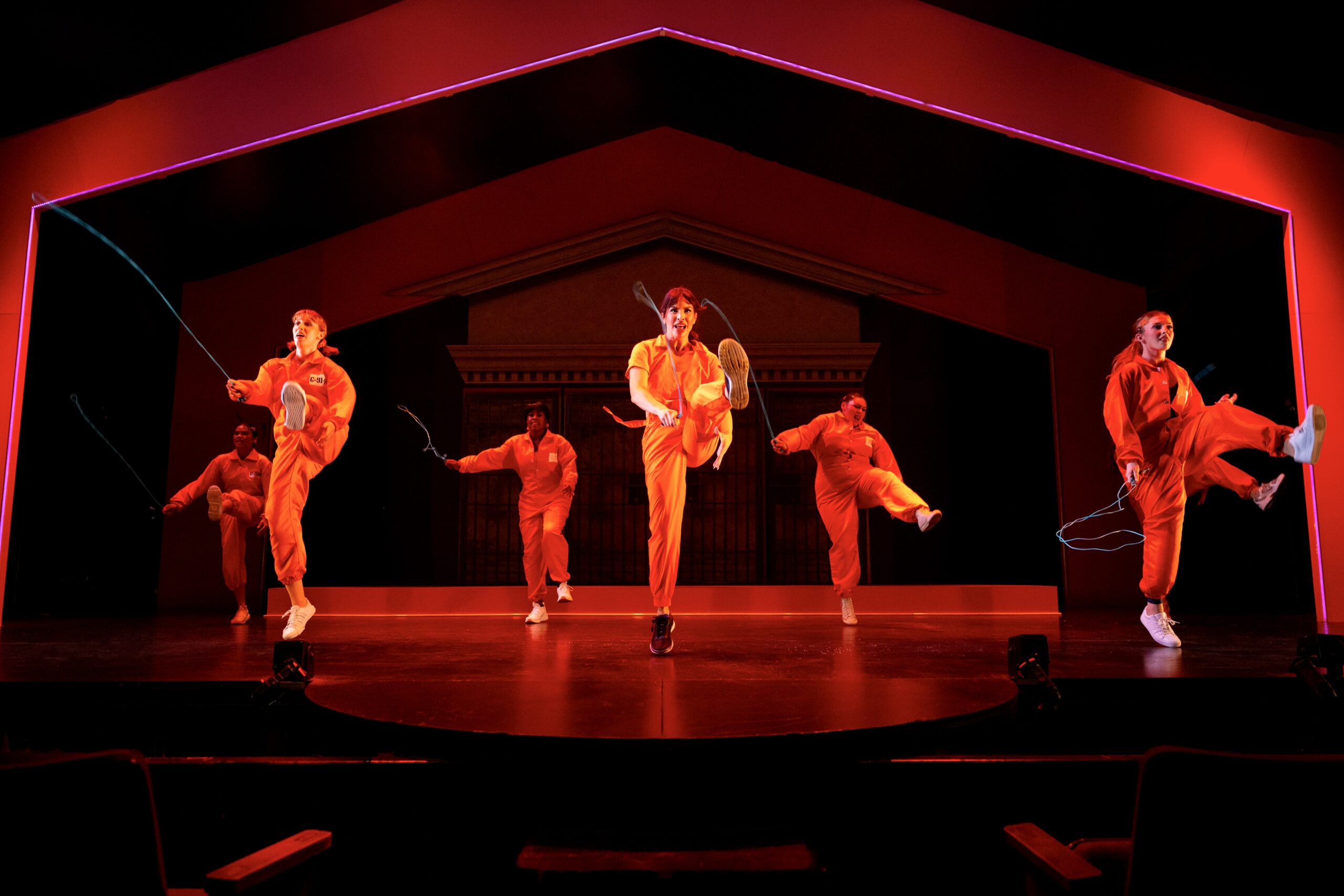
Jump-rope dance is a showstopper in ‘Legally Blonde The Musical’ at the Berkeley Playhouse. Photo copyright Thomas Campitelli/Berkeley Playhouse.
By WOODY WEINGARTEN
Choreography by Cat Delos Santos Reyes, often sidesplittingly funny, usually with the highest energy possible, became the primo star of the Berkeley Playhouse’s presentation of Legally Blonde The Musical.
A dance between two gay men, in fact, was once of three showstoppers at a recent Sunday matinee that drew full-throated laughs, roaring cheers, and heavy applause.
In-sync jump-rope dancing to “Whipped into Shape” was a definite eye popper that didn’t stop, and three damsels in white togas representing a Greek chorus emerged as the epitome of silliness.
Elizabeth Curtis, in the role of Paulette, hair stylist with a hard edge, a soft heart, and a longing for Ireland, ran a musical gamut from hilarious to poignant. “She’s funnier than Jennifer Coolidge was in the movie,” an older woman in the audience called to after one bit.
Curtis showed off her comic chops in both solo bits and in conjunction with Adam Mendez Jr. as Kyle, a burly UPS deliveryman who stalked her lovingly i the second act. Rollickingly amusing!
Vivienne, portrayed perfectly by the mellifluous singer Grace Margaret Craig, was the character who changed the most — from snarky, stuck-up boyfriend poacher to warm activist supporter of females.
Major diversity in actors’ size and skin color was a definite plus.
The central character, Elle Woods, pink-garbed UCLA sorority sister cum Harvard Law student who finds ways to do things her individualistic way and still succeed, normally steals the show. Here, however, Ayani Dorsey’s high-pitched voice didn’t fit her mic well so her words — sung and spoken — were often difficult to make out.
Although the dark-skinned Dorsey wore a curl-heavy blonde wig and a perma-smile through most of the campy two-act, two-hour show, she didn’t quite inject the quirkiness remembered from the fire-cracking Reese Witherspoon role in the original 2007 film comedy.
And while male characters’ tones were clear because of their lower registers, difficulty discerning lyrics also happened in several chorus numbers (though amazing dance moves tended to overshadow that flaw).

Elle Woods (Ayana Dorsey, center) celebrates an insight as her sorority sisters egg her on. Photo copyright by Thomas Campitelli/Berkeley Playhouse.
Humor, from Heather Hach’s book, was frequent. And — yippie! — none of the jokes depended on f-bombs.
Welcome too, drawing smiles each time they were on stage, were too pooches: Latke, a Pomeranian normally carried in Elle’s purse and dubbed Bruiser in the show, and Stella, a French bulldog mix who, as Rufus, was trotted around by Kyle. Neither yipped nor barked, neither wet or soiled the stage. Good doggies! Instagram — quick!
Hey, don’t make the mistake thinking Legally Blonde is only fluff ‘n’ stuff and as sugary as cotton candy. Underlying the unsubtle modern fairytale are questions of feminism and sexism, identity, self-worth, authenticity, and how to navigate a relationship — all tucked neatly into a musical extravaganza spotlighting glitzy costumes by Ashlee Renee and fast-moving backdrops by scenic designer Sarah Phykitt (including an imaginative center-stage door to nowhere).
No’eau Kahalekulu, in her main stage directorial debut, makes sure everything moves at a lightning pace, with exceptions like “Blood in the Water,” a brooding satire that illustrates how lawyers become sharks.
The musical, which opened on Broadway in 2007, contains 20 numbers including three reprises), staring with the incredibly bouncy “Oh My God.” They’re mainly jukebox pop tunes with touches of hip-hop — music and lyrics by Laurence O’Keefe and Nell Benjamin — virtually guaranteed to make theatergoers feel good.
Proof? Well, a raft of pre-pubescent girls who filled about ut a third of the seats happily chatted up a storm while shaking their bottoms and hips in the aisles as they left.
Legally Blonde The Musical will run at the Berkeley Playhouse, 2640 College Ave., Berkeley, through Oct. 18 (it’s been extended). Tickets: $19 to $56 (plus a $3.95 ticketing fee). Info: 510-845-8542 or www.berkeleyplayouse.org.

Bulk of cast of The 25th Annual Putnam County Spelling Bee at Novato Theater Company. Photo by Jere Torkelsen.
By WOODY WEINGARTEN
Some may attend The Novato Theater Company’s The 25th Annual Putnam County Spelling Bee expecting less than perfect performances, mistakes, and unclear words because it’s a community theater production.
They’ll be deliciously surprised. The show’s phenomenal, on any level anyone might judge.
No bad performances. No screw-ups. No muffled words.
The fun begins with the first song and continues throughout. It’s most clearly shown through the limber, Ray Bolger-like legs of Dominic Marco Canty as speller William Morris Barfée; the wild-eyed, pigtailed Carly Harrington (inhabiting the body of Logainne “Schwartzy” SchwartzandGruenierre, daughter of two dads who’s an endless activist for this cause and that); and Marlee Ostrom, who with flying red cape and yellow helmet zips back and forth in her gender-bending role as Leaf Coneybear.
The rest of the nine-member ensemble acquit themselves marvelously well, not missing an opportunity to make the perma-smile on audience faces deepen.
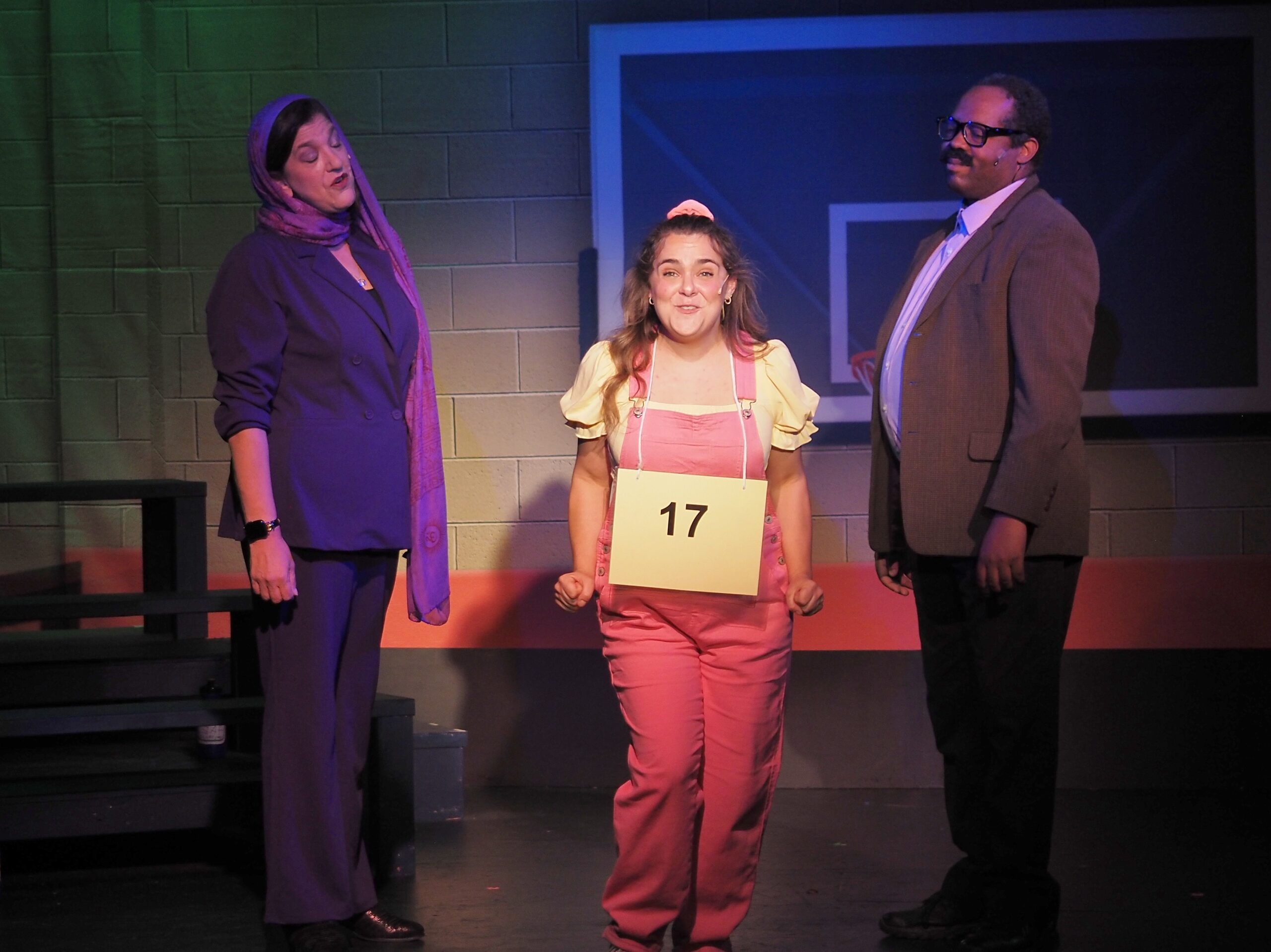
Nicole Stanley (center) communicates with spirits of absent parents, Dani Innocenti Beem and Nick James Augusta. Photo by Jere Torkelsen.
Best of the 24 musical numbers include “My Favorite Moment of the Bee,” a three-part tune by Dani Innocenti-Beem as Rona Lisa Peetti, past winner and bee host, and “The I Love You Song,” poignantly sung by Nicole Stanley as Olive Ostrovsky, with her typically absent parents joining her in a cameo at tune’s end.
The 25th Annual… features a handful of role-changing cameos, in fact, by actors doubling or tripling their personas. And, similarly, Marilyn Izdebski is her usual triple threat, fashioning the sprightly choreography, casting the production along with the director and music conductor, and overseeing the consistently unobtrusive but effective lighting (except when it flashes frenziedly during “Pandemonium”).
The Tony Award-winning show, which ran on Broadway from 2005 to 2008, starts in Novato by displaying bursts of energy, an aspect that will be emphasized throughout. Original lyrics and book, which explore contestants’ inner hopes, feelings, identities, and home life, are by Rachel Sheinkin. William Finn composed the music. Christopher Hewitt artistically conducts three other musicians and plays keyboards for this rendition, making sure the rhythms don’t override the ubiquitous wit, puns, and physical comedy.
Director Larry Williams has ensured that, at any given moment, the quirky, caricature-like characters are extremely bug-eyed with wonder or forlornly tight-lipped.
Four audience volunteers are — surprise! — smoothly added to the spellers’ lineup (and, as might be expected, equally smoothly eliminated one by one by impossibly difficult words).
Some set-pieces are ecstatically gleeful — such as a Pledge of Allegiance in which no two kids are on the same page; a boy eliminated because he’s crushing on a girl in the crowd and awkwardly hiding his erection (which he gloriously sings about); and a personal appearance by Jesus.
Joyous, too, are some character delineations: The boy who spells out the words on the floor with his “magic foot” and a girl who spells them out on her forearm.
And local viewers can’t help but grin at current references to Zandaya, GLP-1 weight-loss pills, and Donald J. Trump’s banning three progressive media outlets from the White House and proclaiming that “we should all spell the woke-iest words we can.”
The set, which immediately places theatergoers in a high school gym replete with grandstands, a scoreboard, a basketball hoop, and a bee-funding ad by local optometrists, was designed by Perry Nelson. Playful costumes by Christina Stephan and Cheryl Evans add to the exuberance evidenced by the cast.
Amazingly, unlike almost all Broadway extravaganzas, the 1¾-hour show totally avoids four-letter words (not counting love).
So remind me: How do you spell sluice? And fun?
The 25th Annual Putnam County Spelling Bee will run at the Novato Theater Company, 5420 Nave Drive, Novato, through Oct. 11. Tickets: $28.50 to $40.50 (plus $1.50 booking fee). Info: info@novatotheatercompany.org or 415-883-4498.
Woody Weingarten, a longtime voting member of the San Francisco Bay Area Theater Critics Circle, can be contacted by email at voodee@sbcglobal.net or on his websites, https://woodyweingarten.com and https://vitalitypress.com. His books include Rollercoaster: How a man can survive his partner’s breast cancer, aimed at male caregivers; MysteryDates — How to keep the sizzle in your relationship; The Roving I, a compilation of 70 of his newspaper columns; and Grampy and His Fairyzona Playmates, a whimsical fantasy intended for 6- to 10-year-olds that he co-authored with his then 8-year-old granddaughter.

(L-R) Hannah Martínez-Crow as Dusty, Karla Acosta Ormond as Jean and Nicole Naffaa as Bernadette appear in The Royal Underground Theatre Company’s “POTUS: Or, Behind Every Great Dumbass Are Seven Women Trying to Keep Him Alive” onstage in Berkeley through Sept. 27, 2026. (Jerianne Banson via Bay City News)
by Woody Weingarten, Bay City News
“POTUS: Or, Behind Every Great Dumbass Are Seven Women Trying to Keep Him Alive,” onstage in Berkeley’s Live Oak Theater, may be just satirical enough, with its thinly veiled references to the current White House.
But the chaotic all-woman, two-act farce may be a tad too over-the-top. While it’s happily missing the rapid-fire slamming of doors, the foundation of farce, the characters bellowing and yelling at the same time is excessive.
Still, all seven performers are excellent.
The best part of the 1¾-hour show, presented by the Royal Underground Theatre Company, a “nomadic” Bay Area troupe established in 2002, is the slapstick of Stephanie, the beleaguered presidential secretary (played hysterically by Jules Weiss) and Dusty (played lustily as a “woke powderpuff” by Hannah Martinez-Crow).
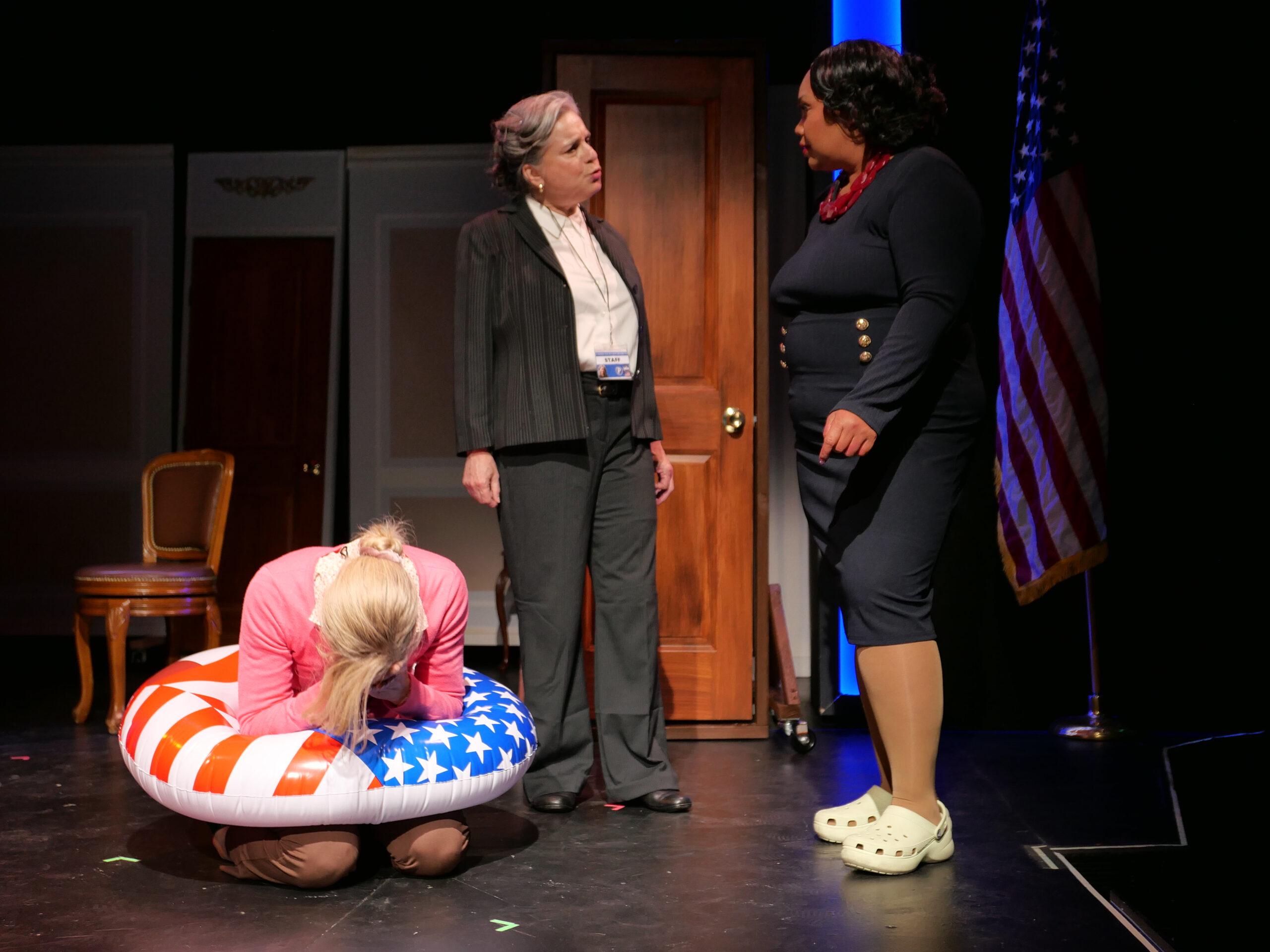 (L-R) Jules Weiss as Stephanie, Michele Rabkin as Harriet and Asoula “Jasmine” Avegalio as Margaret, appear in The Royal Underground Theatre Company’s “POTUS: Or, Behind Every Great Dumbass Are Seven Women Trying to Keep Him Alive.” (Jerianne Banson via Bay City News)
Stephanie, often stoned, wears minimal clothing and an oversized, patriotic life preserver around her waist, and abruptly spouts one of the five languages she speaks. Dusty, a jovial cheerleader-type, doesn’t let having been impregnated by POTUS (the president of the United States) stop her from doing the splits or trying to sexually service civilians as a way of helping the White House staff.
Some theatergoers might believe that playwright Selina Fillinger (a writer on Apple TV’s “The Morning Show”) conceived the story in a crowded sports bar or a makeshift homeless tent city. It’s based on the vulgar “c” word, which, in fact, is the play’s startling first word.
Each character is adept in her tasks. Some of the women even act as proxies for the offstage president —until West Wing pressures make them more than a little crazy.
Theatergoers who like tons of curse words will be happy, even though the barrage becomes unfunny and redundant by the second act. Those who love clever subtitles, exemplified by the one in this show, also will be happy, as will those seeking quarrels between co-workers that signify open rivalries and screwed up relationships.
Director Anna Oglesby-Smith keeps things tight throughout; audiences don’t know what the next twist, the next enabling action, the next invective, will be.
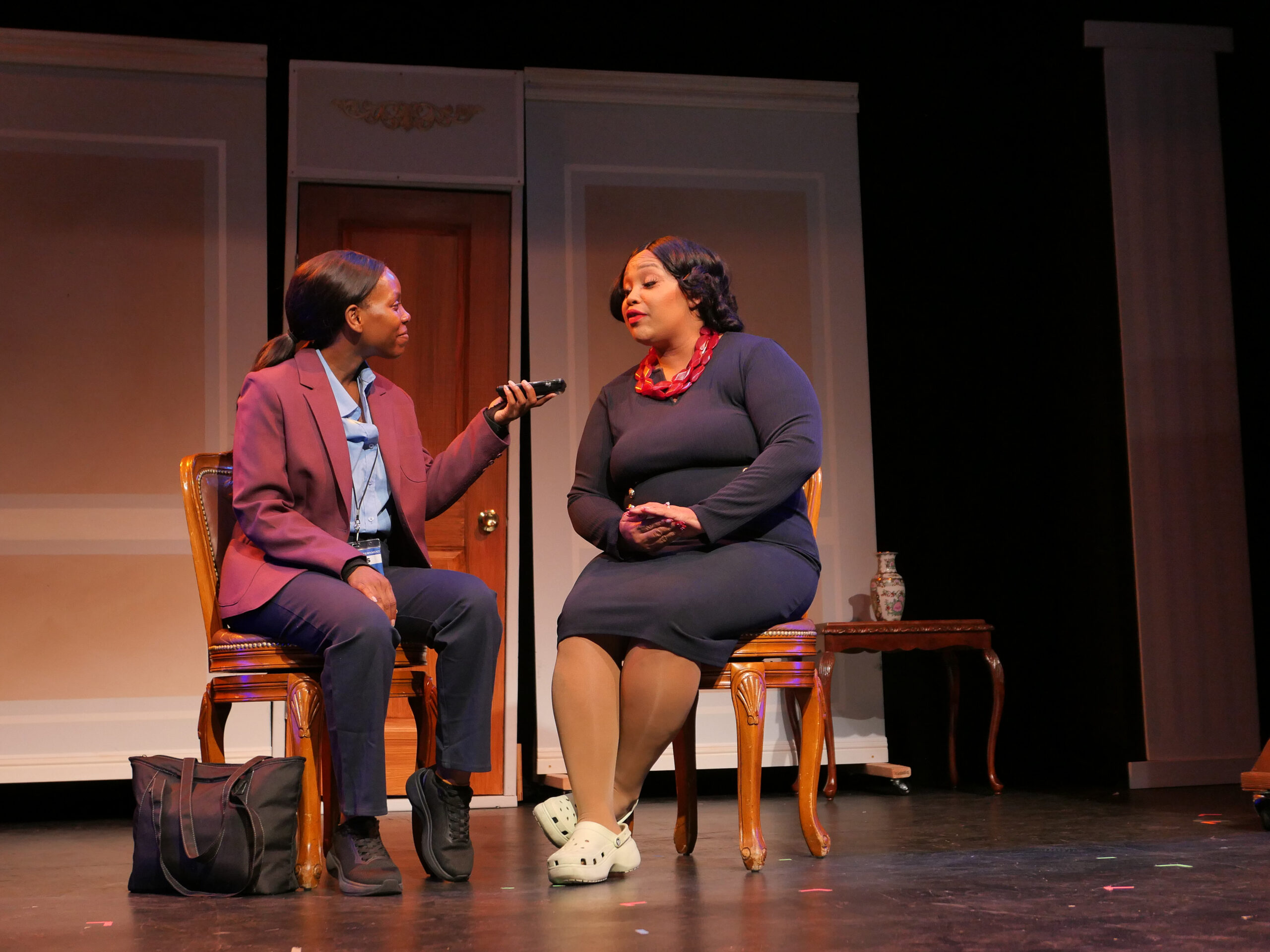
(L-R) Raven Douglas plays Chris, a reporter, and Asoula “Jasmine” Avegalio plays Margaret, the First Lady, in “POTUS: Or, Behind Every Great Dumbass Are Seven Women Trying to Keep Him Alive.” (Jerianne Banson via Bay City News)
Jean, the overwrought, overwhelmed press secretary (played by Karla Acosta Ormond) has to deal with numerous makings of public relations nightmares: post-feminist fervor, the destruction of historically valuable statuary, frequent presidential sexual misbehavior, a conference on nuclear banning, an anal abscess, and all-too familiar political endorsements and photo ops.
There are outstanding performances by Michele Rabkin as Harriet, the mannish chief of staff who’s appropriately standoffish, until she completely loses it; and Asoula “Jasmine” Avegalio as Margaret, the over-educated First Lady who’s perfected a snarl and a sneer.
Nicole Naffaa as Bernadette, the president’s butch, drug-dealing sister, and Raven Douglas as Chris, a frenetic magazine reporter seeking a scoop, fill out the cast.
Among the costumes by Maggie Brennan, some silently scream “laugh at me, laugh at me,” a message received and followed. It doesn’t matter that the show’s sets are minimal. Its verbal and physical gags are maximal, even though more than a few fall flat.
Overall, “POTUS” is easy to enjoy, particularly for those who don’t let themselves get bogged down in gutter language or worry too much about it being a real though distorted reflection of what’s happening today in the part of the White House that hasn’t been bulldozed yet.
The Royal Underground Theatre Company’s “POTUS: Or, Behind Every Great Dumbass Are Seven Women Trying to Keep Him Alive” runs through Sept. 27 at Live Oak Theatre, 1301 Shattuck Ave., Berkeley. Tickets are $37.89 at https://www.theroyalunderground.org.
This article was first published on LocalNewsMatters.org, a nonprofit site supported by Bay City News Foundation http://www.baycitynews.org/contact/.
Woody Weingarten can be contacted at www.woodyweingarten.com or www.vitalitypress.com or www.voodee@sbcglobal.net.

(L-R) Danny Scheie, Benjamin Clark and Lyndsy Kail play members of Alcoholics Anonymous in Marin Theatre’s “The White Chip” onstage in Mill Valley through Sept. 20, 2026. (David Allen via Bay City News)
by Woody Weingarten, Bay City News
“The White Chip,” a one-act play at Marin Theatre, might easily have slipped into being an “alcohol-is-evil” sermon if not for the skills of playwright Sean Daniels and director Lance Gardner. They don’t allow more than a few seconds to pass without a funny one-liner or a funny physical gag. Elements of addiction and recovery, the fast-paced show’s main motifs, are quasi-autobiographical for both.
The show is buttressed by stellar acting by Benjamin Clark as Steven, an on-again, off-again, self-destructive drunk; and Lyndsy Kail and Danny Scheie, a two-person battalion of swift-change, often humorous characters.
Steven, who works relentlessly to grab theatrical success on Broadway, relies on booze binges trying to escape inescapable pressures. Making a good choice is a difficult task for him, except perhaps when he must pick either “the fat Elvis or the skinny Elvis” to be in his Las Vegas wedding party.
The nerdy protagonist chronologically revisits his life on the treacherous road to recovery, defensively citing famed alcoholic playwrights, then rhetorically asking the audience if it would really “want to read a sober Jack Kerouac or a sober Hunter S. Thompson.”
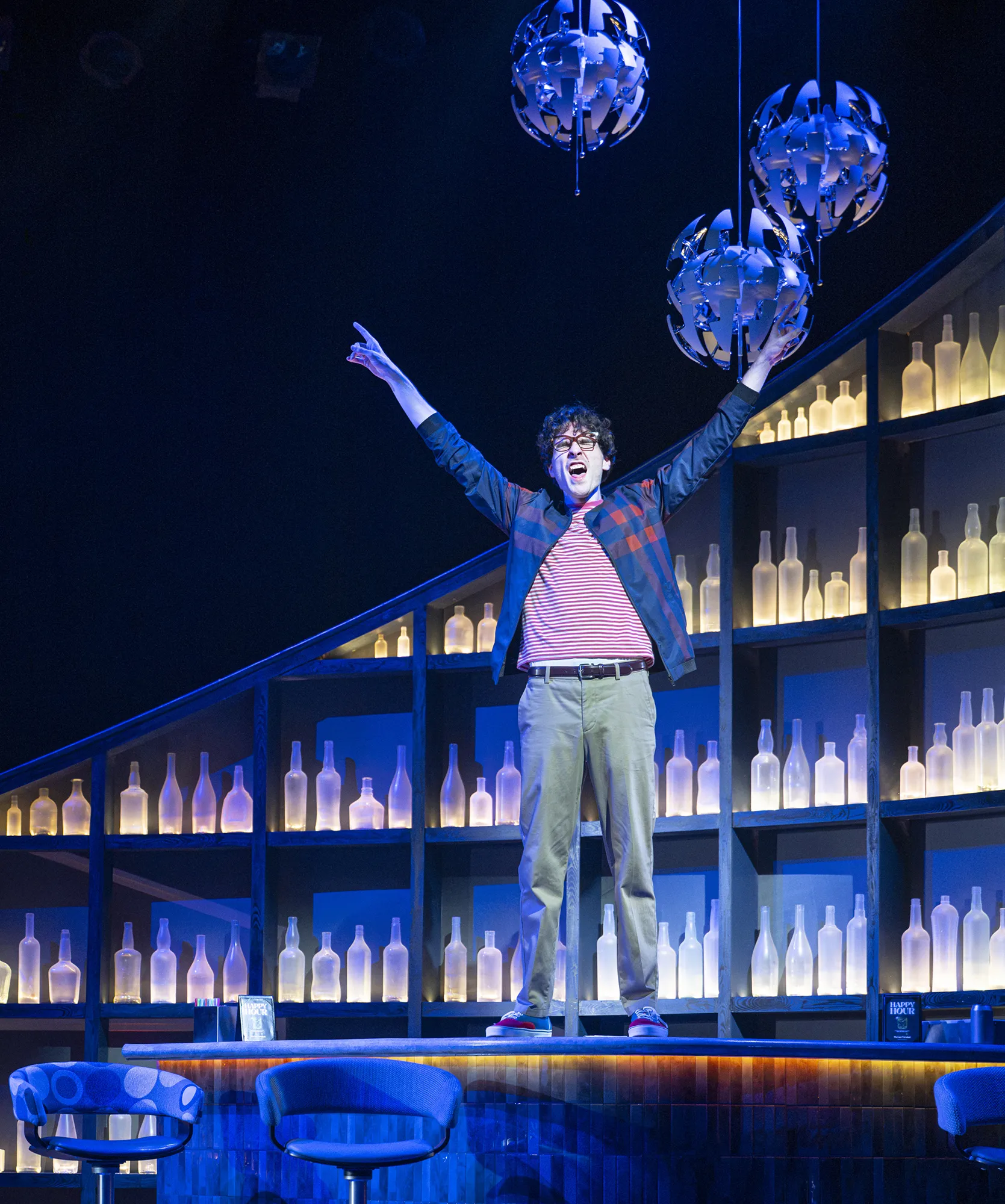 Benjamin Clark plays Steven in Marin Theatre’s “The White Chip” onstage in Mill Valley, Calif., through Sunday, Sept. 20, 2026. (David Allen via Bay City News)
One of the funniest bits is a slapstick sequence in which white chips — from Alcoholics Anonymous, signifying 24 hours of sobriety or, indeed, simply a desire to stop imbibing — are flung around the stage as if they’d been shot from a cannon.
Steven refers to his “lifetime love affair” with the bottle, especially vodka, because it’s not detectable on the drinker’s breath. He darts from New York to Florida to Kentucky, blacking out more than once. And he details a string of accidents, arrests and relapses. But he also pinpoints moments of sheer joy and interrupts his trek to the bottom when he finds both his higher power and help from Jewish alcoholics, whose sense of humor is healing.
Those moments are opposite to his “imprisonment” in a reboot camp.
Meanwhile, Scheie, with excellent accents and facial mugging, adroitly races between being Steven’s frail father, a spunky airport bartender, a curt German interloper and a kid with squeaky voice and baseball cap turned sideways.
And Kail is so good at what she does, there’s never a question of whether she’s portraying Steven’s mom, who constantly greets him with f-bombs, or one of his multiple girlfriends, or other characters who become real with a flip of her hair or a wide-eyed expression.
Also, both Scheie and Kail imitate the voices in Steven’s head, two cats, and, hilariously, walls and doors of a moving elevator.
The show boasts excellent stagecraft. The set by Christopher Fitzer has a shiny bar with a wall full of bottles that light up for emphasis. Spense Matubang’s lighting, from sensually dim to brilliantly bright, adds drama, and Lisa Townsend’s choreography is sublime, whether in a Keystone Cops-like chase scene or a change-personality moment resulting from a flip of a cap.
“The White Chip,” which runs 1¾ hours with no intermission, might leap from a B-plus to an A-minus if 20-30 minutes were chopped from the second half. Nonetheless, this hard-on-the-tush version is worth a theatergoer’s time. It’s always a tough job to balance comedy and poignancy, and this production does it well.
Marin Theatre’s “The White Chip” continues through tomorrow at 397 Miller Ave., Mill Valley; tickets are 39 to $110 at www.marintheatre.org.
This article was first published on LocalNewsMatters.org, a nonprofit site supported by Bay City News Foundation http://www.baycitynews.org/contact/.
Woody Weingarten can be contacted at www.woodyweingarten.com or www.vitalitypress.com or www.voodee@sbcglobal.net.

Jereme Anglin, left, and Kevin Bordi, right, appear in “Equivocation,” a comedic and philosophical play set in Shakespearean times onstage at Spreckels Performing Arts Center in Rohnert Park, Calif. (Jeff Thomas via Bay City News)
By WOODY WEINGARTEN, Bay City News
“Equivocation,” a Spreckels Performing Arts production onstage in Rohnert Park, is a seriocomedy with endless levels and disparate themes, all of which are delightfully exceptional.
In its 2¾-hour running time, there are repeated examples of equivocation by circa 1605 Shakespearean-style characters, both whimsically and seriously drawn by playwright Bill Cain.
It’s a fictional history detailing King James I’s Machiavellian right-hand man, Robert Cecil (played sneeringly evil by Zane Walters), who’s pitted against poor, mostly ethical actors.
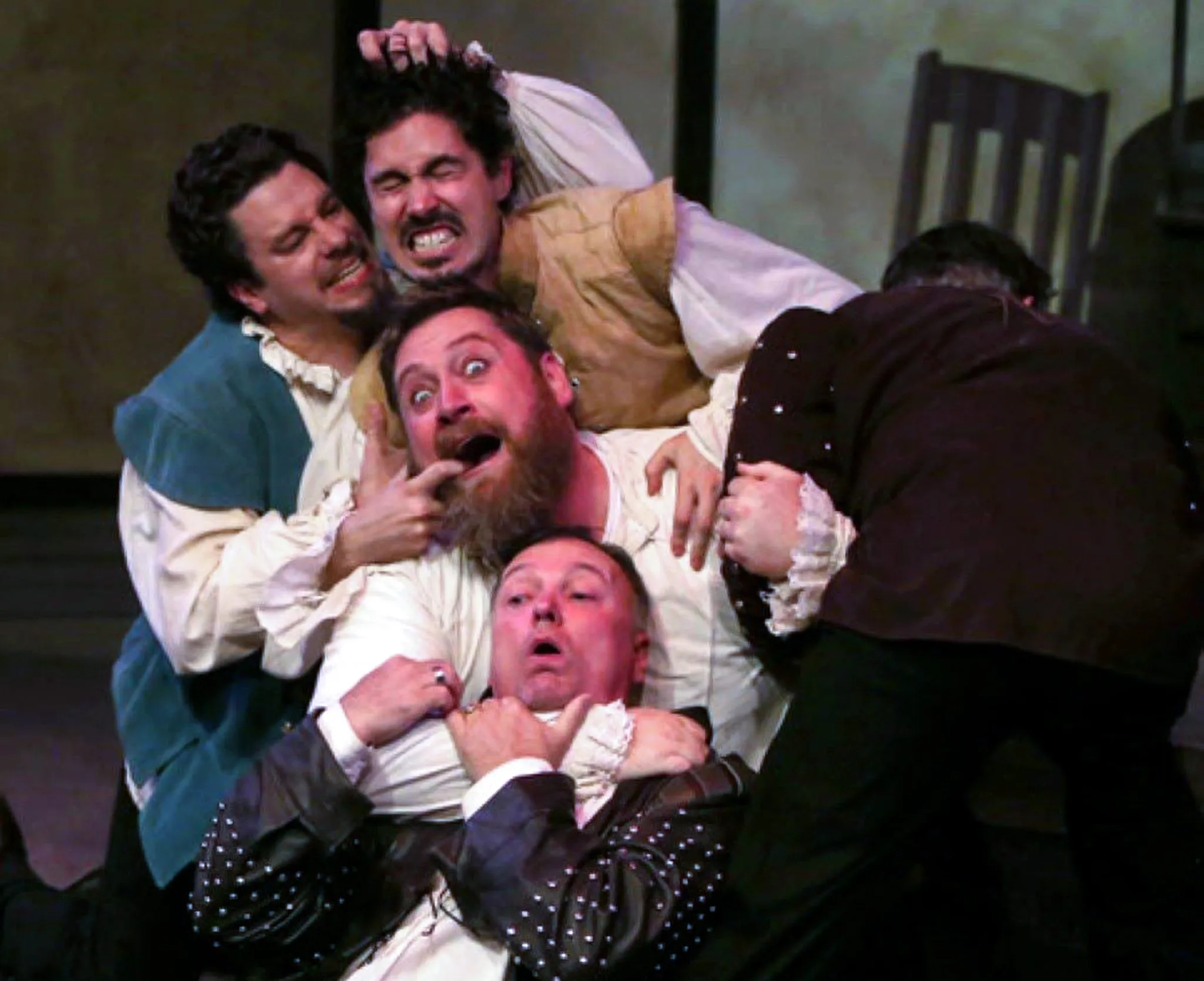 “Equivocation,” a comedic and philosophical play set in Shakespearean times, played onstage at Spreckels Performing Arts Center in Rohnert Park, Calif. (Jeff Thomas via Bay City News)
Cecil commissions Shag-speare, or Shag (skillfully portrayed by Jereme Anglin) in the name of the Scottish king to write a play about the recently foiled Gunpowder Plot by 13 Catholic terrorists-liberators aiming to blow up parliament and kill the king.
Shag is reluctant to complete the assignment at first, musing about whether the basis for the play is a coverup, or pure propaganda. And maybe there wasn’t a plot, or gunpowder at all. Besides, he says, “We don’t do current events. We do histories, true histories of the past.”
Given a choice between emphasizing Cain’s side-splitting, droll comedy or a touching, morally explorative melodrama-thriller, “Equivocation” director Sheri Lee Miller often opts for slapstick. There’s abundant histrionics in the play-within-a-play conceit.
The Globe Theater actors frequently break time barriers and worm their way into “real-life” philosophical discourse as the play introduces heavy concepts:
• Whether to risk actors’ lives by telling the truth or to massage a lie that will result in a big payday — or to deceptively offer truth and lie at the same time
• Whether Catholicism or Protestantism is the “right” religion
• Whether torture and execution are better solutions than diplomacy
• Whether a writer should answer yes or no questions with a single word or convoluted paragraphs that obfuscate meaning
While “Equivocation” provides intellectual fodder for those desiring it (with references to “the Scottish play,” “King Lear” and “Richard III”), there’s more than sufficient silliness for those hoping to laugh, particularly in scenes with three witches and mirrors.
Cain tosses in the kitchen sink via philosophical questions galore (at times repetitious, other times so complex, they’re nearly impossible to follow) and avoids answering most. However, the play becomes more easily digestible with actors in street dress and using street lingo, and profanity, when not “in character.”
The six-member ensemble cast is superb. Jeff Coté plays multiple roles, and Natalie Tichenor, the sole woman, is appropriately low-key as Judith, the Bard’s daughter who can never quite meet standards set by her dead twin brother. She’s rather quiet until she delivers a poignant soliloquy toward the play’s end.
Kevin Bordi, who appears as Father Henry Garnet and Richard, also is choreographer of an amazingly authentic fight scene. Intricate colorful costumes by Adriana Gutierrez instantly yank theatergoers back multiple centuries. English accents are absent, but Drew Bolander’s high-pitched Scottish inflections are spectacularly amusing.
Torture, hangings and beheadings in “Equivocation,” which debuted in Ashland, Oregon in 2009, might be disturbing and perhaps draw a gasp. Frequent time changes may also be distressing.
However, theatergoers at a recent weekend matinee were smiling through most of the performance and jumped to their feet when it ended.
While audiences may not instantly “get” all aspects of “Equivocation,” or perhaps get a trace of fanny fatigue toward the end, they’re almost sure to enjoy being transported back to Elizabethan times. And to laugh. A lot.
This article was first published on LocalNewsMatters.org, a nonprofit site supported by Bay City News Foundation http://www.baycitynews.org/contact/.
Woody Weingarten can be contacted atvoodee@sbcglobal.net, https://woodyweingarten.com or https://vitalitypress.com.
by Woody Weingarten, Bay City News
 (L-R) Cove Elementary fifth grader Nora Zalewski speaks with an Áegis Living Corte Madera resident in Corte Madera, Calif., on Monday, Dec. 15, 2025. (Kristy Dell via Bay City News)
“BINGO! OH, YEAH!”
That could have been anyone yelling at a bingo palace, but this time it was a resident senior at Áegis Living Center in Corte Madera.
In the Marin County assisted living memory care facility, the game’s not all about winning; it’s the basis of a learning exercise.
Kids from Kristy Dell’s fifth grade class at Cove Elementary School, on field trips, have been teaching the gray-hairs how to play, how to follow the rules and still enjoy the game, while they, in turn, learn how to really talk with old-timers and how to learn from them.
Dell’s brainchild, the project also led her charges to read poetry and share artwork with their elders, make greeting cards for them, present a Constitutional play and follow up with a song, and teach and fold origami.
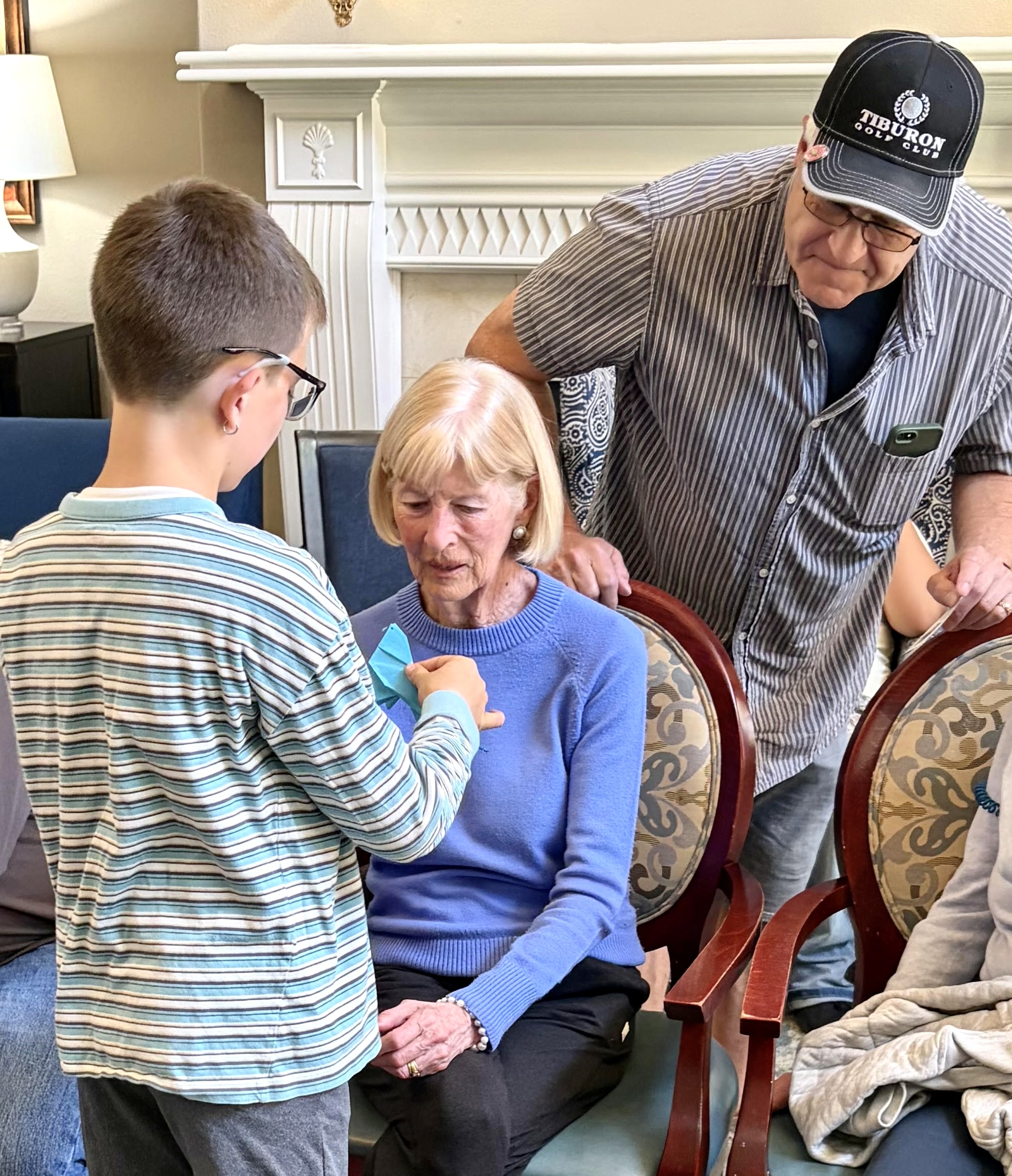 (L-R) Elementary student Ben Dell explains how origami works to an Áegis Living Corte Madera resident in Corte Madera, Calif., on Monday, June 1, 2026. (Kristy Dell via Bay City News)
All this took place during six different visits last year, and Dell can’t wait for the next semester, which starts in August at the East Corte Madera school. Although she believes that a good mix already was provided her 41-student, double-sized class (in which she supervises two other teachers), she’s convinced that the variety of activities can be increased.
“And I’d like the class to get more of the residents’ stories,” she says. “This year, my first of doing it, it was very kid-heavy, and I’d like to make it more resident-heavy.”
Dell’s son, Ben, was in the pilot program. “There was no greater joy than seeing the seniors light up upon seeing us,” he says.
Classmate Marlowe Uchrin echoes the positivity: “I loved going to Áegis because it was a great way to talk with people in our community and learn about the people around me. Looking back on elementary school will be a memory that will stay with me for a long time.”
On the senior side, Nancy Morrow reports that “what I liked best was how honest the kids were, and how willing they were to share their ideas with older people. I thought they were terrific.”
And Susan Perdiue says “the best thing about the fifth graders coming here was that they were very open, friendly, and polite. They were well prepared, and it was clear that were having fun, too.”
Dell had accurately warned the students upfront that “singing a song or playing bingo may not be as easy as you think it is — some seniors may be grumpy, not hear well, or not move around well, and you may have to make space for wheelchairs, walkers and canes, and learn to remain in what might be an uncomfortable situation.”
She had the kids role-play to see how it would work, how their behavior could have a big impact on other people, and how they could develop leadership skills. She also hoped to weave in what she believed was being lost these days — a sense of morals and ethics.
She wasn’t sure, of course, that her intergenerational idea would work. “You can talk to the kids about something like kindness, conflict resolution, empathy, or good communication skills, but until you put their feet to the fire, you don’t know if they really learn those things.”
Áegis, which sits on East Paradise Drive, also offers residents the following, according to its website, www.aegisliving.com — chef-prepared meals, a full-service salon, a private theater, a library, daily on-site licensed nurses, pet-friendly apartments, and transportation to shops and restaurants, medical appointments, and the Moraga Country Club.”
Still, Dell admits she wasn’t 100% comfortable during the kids’ first visit. That’s because “although half were all smiles, some were curmudgeonly about having kids in their space. By the end, though, everyone wanted to know when we were coming back.”

Kristy Dell teaches class at Cove Elementary School in Corte Madera on Thursday, May 7, 2026. (Angela Roche via Bay City News)
One senior who’d been hesitant at first, she remembers, “cried when one of the kids gave him a drawing of a car from the 1930s and, not assuming his age, said, ‘Maybe your parents drove this car.’”
The kids, who also led a holiday toy drive in conjunction with the Central Marin Fire Department, sidestepped potential minor problems.
Dell and they had decided together that they should do Q&A sessions so residents could throw un-censored questions at them. But one asked, “What was the last time you got into trouble and how?” The kids were cautious enough not to reveal any dark secrets and instead “answered about having an extra scoop of ice cream, not brushing their teeth, or not practicing their instrument for 15 minutes.”
Dell “didn’t think to warn them not to bring up politics. The facility has a social chair who asked a political question that was a little tricky, and all bandwagoned against Trump.
 (R-L) Elementary student Marlowe Uchrin sits with an Áegis Living Corte Madera resident during a round of BINGO in Corte Madera, Calif., on Monday, June 1, 2026. (Kristy Dell via Bay City News)
That, she added, “also led to a discussion when we got back to class and did a debriefing about never making assumptions about other people’s beliefs about politics, religion, or anything else — and watching out for regurgitating what your parents or older siblings say, or what you overhear from anyone else.”
Dell’s excitement about how her program worked is easily summed up. “Everything went smoothly, and my overall take was that the kids were thrilled because a lot of them overcame fears, a lot pushed themselves out of their comfort zones, and a lot got to see the instant gratification of what can come from their kindness, their words, or their action.”
She, too, learned from the intergenerational sessions — “that there’s still good in the world, post-Covid, despite the news being the way it is. The kids found a way they could help, be vulnerable and kind, and see that those actions will pay back ten-fold when it might initially feel cheesy or be something they don’t want to do.
“And I learned that I can foster that.”
This article was first published onLocalNewsMatters.org, a nonprofit site supported by Bay City News Foundation http://www.baycitynews.org/contact/.
Woody Weingarten, a longtime voting member of the San Francisco Bay Area Theater Critics Circle, can be contacted by email at voodee@sbcglobal.net or on his websites, https://woodyweingarten.com and https://vitalitypress.com. His books include Rollercoaster: How a man can survive his partner’s breast cancer, aimed at male caregivers; MysteryDates — How to keep the sizzle in your relationship; The Roving I, a compilation of 70 of his newspaper columns; and Grampy and His Fairyzona Playmates, a whimsical fantasy intended for 6- to 10-year-olds that he co-authored with his then 8-year-old granddaughter.
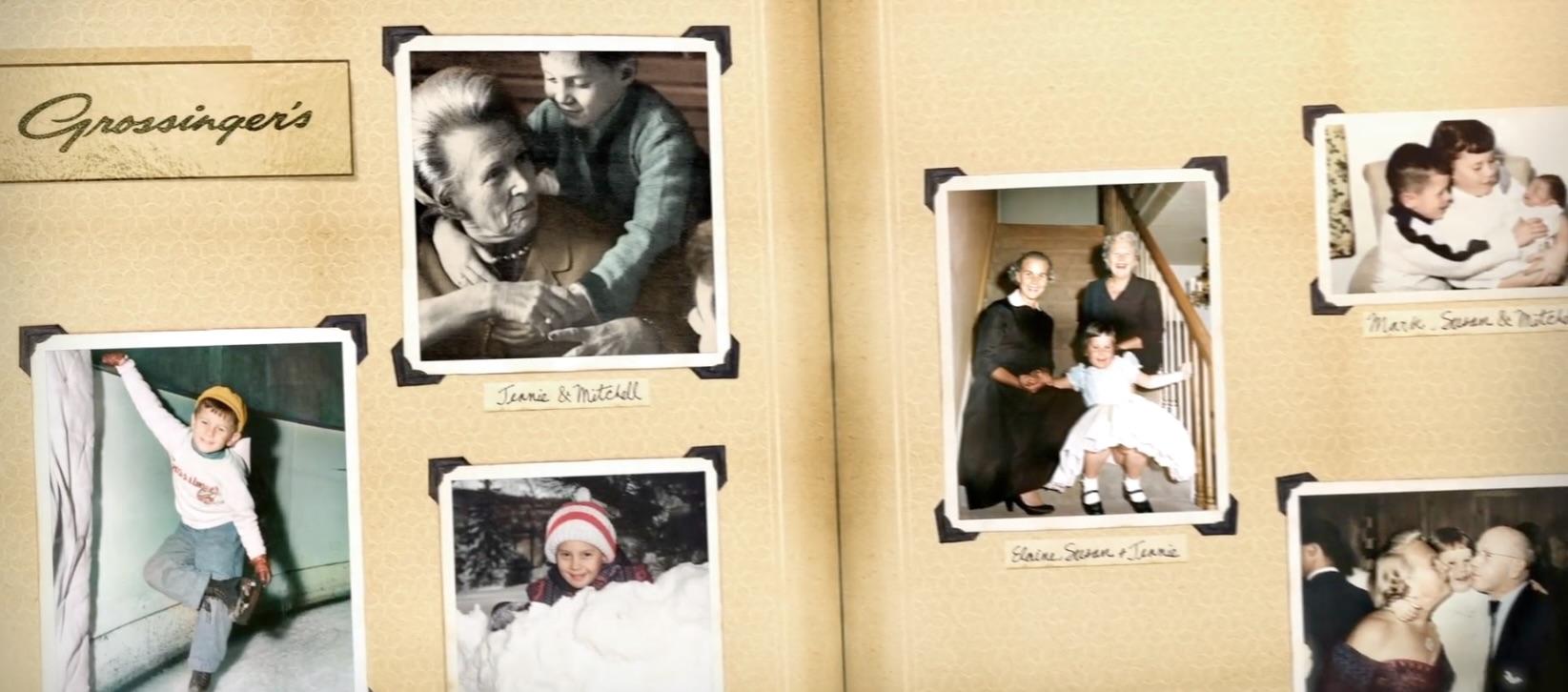
Snapshots of Grossinger family are featured in documentary. Screenshot from We Met at Grossinger’s.
By WOODY WEINGARTEN
People with a mere two drops of cultural Jewish blood trickling through their veins are still likely to enjoy a new film centering on the heyday of the Catskill Mountains, We Met at Grossinger’s.
The historical documentary also focuses on family (the Grossinger’s and everyone else’s), and on kosher food and vacations and corny jokes.
And anti-Semitism.
Not to mention Jackie Robinson, Barney Ross, Eleanor Roosevelt, Mel Brooks, The Marvelous Mrs. Maisel, and name changing.
Plus a taboggan slide, all-you-can-eat food orgies, and Woodstock.
The nostalgic documentary virtually guarantees that viewers — non-Jews included — can smile at its homey (haimish) tales and “Jewish vibe,” and maybe even once or twice tear up.
But it’s also likely to frustrate, with Borscht Belt stars like Joel Grey being interviewed too rarely live — and segments with five living members of the Grossinger family not being labeled enough so it’s tough to grok who’s narrating at any given moment.
The keyword in We Met at Grossinger’s could be excess — excess menu choices, excess sports and dancing and other activities, excess passive entertainment, excess exhaustion, even excess sex.
All salted with joy, however.
The 1¾-hour doc begins with the notion of the upstate New York resort hotel starting as a place for immigrant Jews and their children — who’d suffered from deprivation abroad and were still banned from many, many venues in the United States — to escape from discrimination and the intolerable summer heat of New York City.
We Met at Grossinger’s pulls no punches, referring to signs like “No Jews or dogs allowed,” in golf and country clubs and so many other venues.
The film talks of the family beginning with a boarding house with seven rooms that took in $81 a week, then building a nest egg that allowed purchase of a bigger structure down the road. Ultimately, Grossinger’s rested on 1,000 acres on a lake.
The growth spurts jumpstarted other Borscht Belt folks building “everything included” complexes that at the area’s peak in the ‘50s included 537 other hotels.
The hotel’s first turning point, the film indicates, comes when co-founder Jennie Grossinger invites Barney Ross, in effect, to be a “boxer in residence.” Another milestone follows shortly thereafter when she invites Major League Baseball’s black race barrier-buster Jackie Robinson to the facility.
Later in the documentary, directed by Paula Eiselt, Robinson shows up for television’s first interracial hug in the episode of the groundbreaking Ralph Edwards’ reality show, “This Is Your Life,” that was a tribute to her.
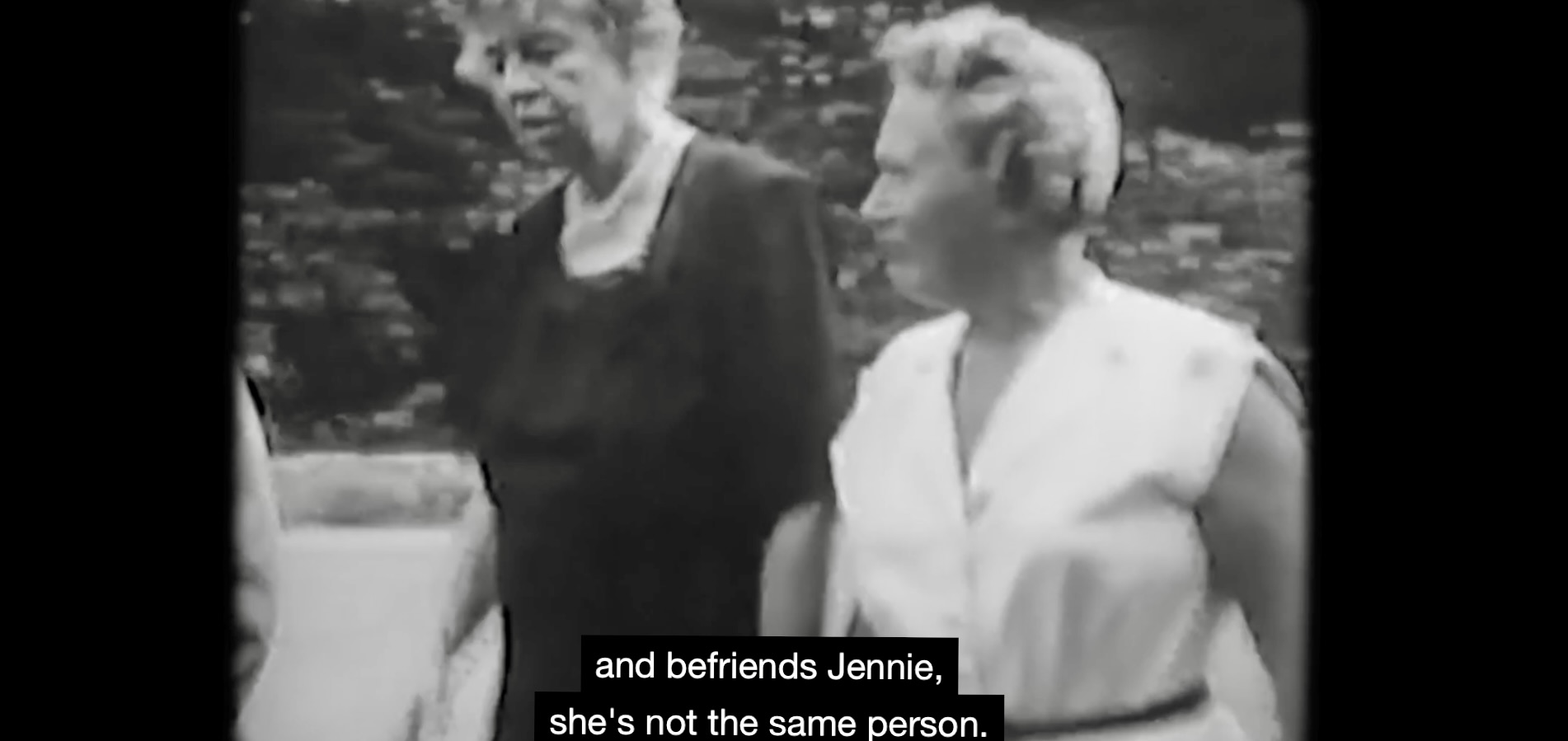
First Lady Eleanor Roosevelt (left) is a house guest of Jennie Grossinger. Screenshot from We Met at Grossinger’s.
In its mid-section, We Met at Grossinger’s details the story of its main character, Jennie, overachiever/hotel hostess who’d left school after the sixth grade to help her family get enough to eat.
Also spotlighted are Jennie’s immigrant mother, Malka, who is surprisingly progressive for an Orthodox Jew; and her daughter Elaine, who readily admits she was long angry with her mom because the elder Grossinger had dumped her into the lap of a governess while Jennie made love to a hotel.
Often and at length.
Ironically, perhaps, the women form a trifecta of successive empowerment that ran one of the biggest cold-beet-soup and entertainment centers in the mountains.
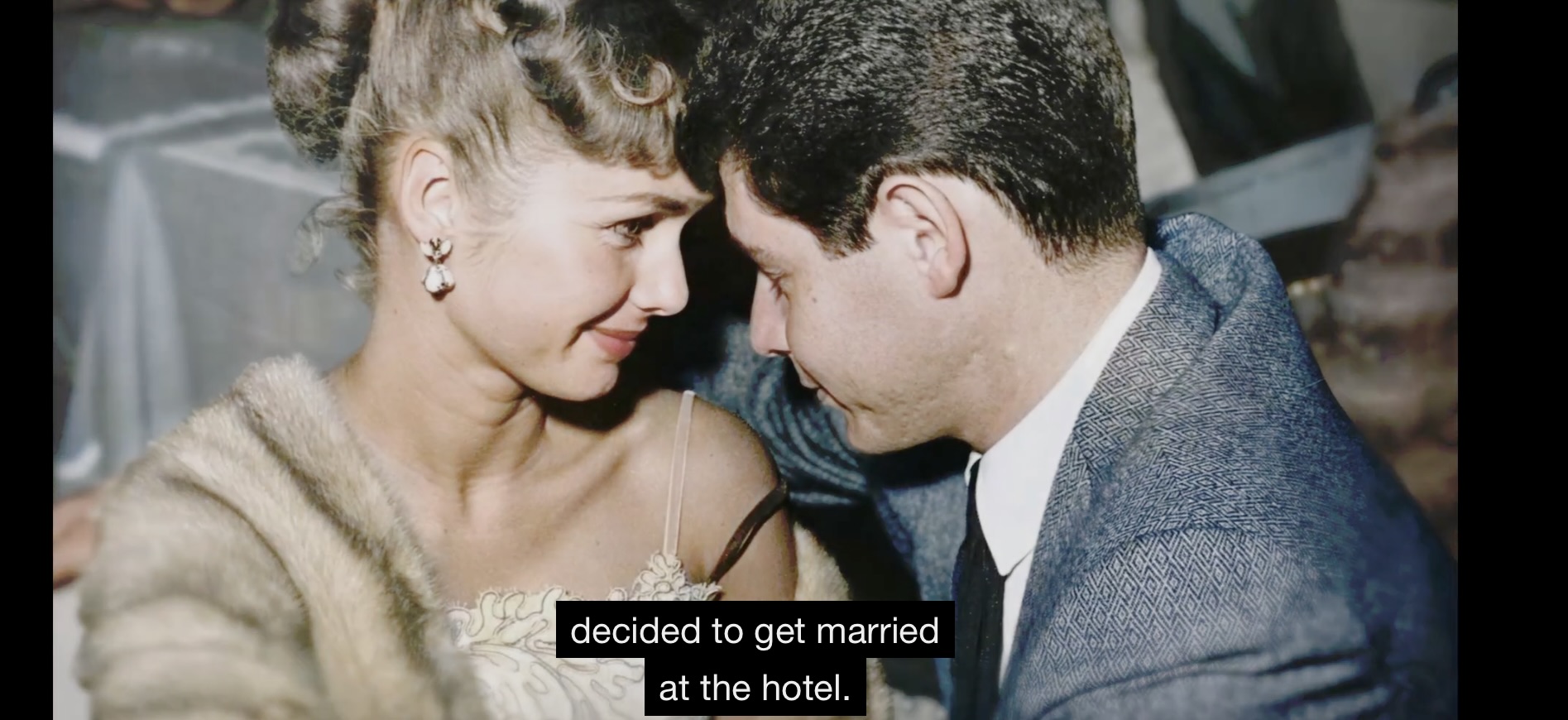
Actor Debbie Reynolds and singer Eddie Fisher are among the thousands who married at Grossinger’s resort. Screenshot from We Met at Grossinger’s.
Throughout the flick, as might be expected, there are talking heads interspersed with short film and TV clips, photo album family shots, gag-lines, and name-dropping, name-dropping, name-dropping.
Factual tidbits can be amusing when we learn that Jenny’s yummy rye bread made its way onto supermarket racks, and that she compiled a Grossinger’s cookbook even though she has no time to cook.
We stop, too, for a moment to linger at Dirty Dancing, which used Grossinger’s as the inspiration for its location.
We also are fed references to more modern times — including the Covid-19 pandemic and Israel’s plight in the Middle East.
We Met at Grossinger’s, which is sold out for tomorrow’s screening in the 46th San Francisco Jewish Film Festival (at the Jewish Community Center San Francisco), will be shown again, as the fest’s Closing Night feature, at the Piedmont Theatre in Oakland, on Saturday, Aug. 1.
The film uses words well to create a mood. It sums things up with these phrases, “We have made this country a better place, we have actually made this country a funnier place.”
Then it proffers the slightly schmaltzy, feel-good idea that Jewish history has “lots of dark moments, but the Borscht Belt was anything but.”
The title is a bit misleading, of course. We Met at Grossinger’s sounds like a run-of-the-mill rom-com — implying, let’s say, an actress like Jennifer Grey, after a botched abortion, runs off with a testosterone-heavy Patrick Swayze — when, in truth, the doc covers an entire short-lived universe at a time when The American Dream was a good deal more accessible than now.
Woody Weingarten, a longtime voting member of the San Francisco Bay Area Theater Critics Circle, can be contacted by email at voodee@sbcglobal.net or on his websites, https://woodyweingarten.comand https://vitalitypress.com. His books include Rollercoaster: How a man can survive his partner’s breast cancer, aimed at male caregivers; MysteryDates — How to keep the sizzle in your relationship; The Roving I, a compilation of 70 of his newspaper columns; and Grampy and His Fairyzona Playmates, a whimsical fantasy intended for 6- to 10-year-olds that he co-authored with his then 8-year-old granddaughter.

The front yard of Tam House 1 in San Anselmo, Calif., on Thursday, June 25, 2026. Tam House is a non-profit cooperative living facility in downtown San Anselmo, California, that provides affordable, shared housing for independent seniors aged 62 and over. (Suellen Lamorte via Bay City News)
By WOODY WEINGARTEN, Bay City News
Affordability is shaping up to be the buzzword for this year’s midterm elections, and housing is the central issue.
The solution to achieving widespread affordability is complex, certainly. But in upscale San Anselmo, Tam House offers a seemingly simple answer — lodging 21 single seniors in private rooms and communal spaces in two homes.
Low-income residents pay rents of only $1,130 (private bath) or $1,050 (bath shared with one other person).
Tam House, a nonprofit linked to the Ross Valley Ecumenical Housing Association (RVEHA), apparently achieves the “high quality affordable housing” that’s always been its goal. Because of that, it regularly draws kudos from its residents.

Peter Penhallow, a 72-year-old, has lived in Tam House 1 with 10 others for 3½ years. His attitude is upbeat. “I’m lucky to have a roof over my head at a reasonable price in a familial community in the town that I grew up in,” he reports.
Suellen Lamorte can see Tam 1 from her nearby home. She, too, as might be expected of a five-year member of the board, is a cheerleader. “I am honored to be a part of Tam House, which is unique and a good model that works so well it could be copied by communities all across the country. Seeing it just makes me happy.”
Tam House — which restricts itself to folks 63 or older willing to share chores such as washing dishes, sweeping floors, or light gardening — is subsidized by grants from a multitude of civic organizations.
And tradespeople sometimes give discounts to known residents, “because everyone seems to like the basic idea,” says Lamorte.
The facility is not assisted living, however, which means — she says — “that residents have to take care of all their daily functions alone and are mobile.”
Hal Russek, house manager for both buildings, explains that “generally, we are looking for people on fixed income, but whose funding is adequate so they can pay rent at this low rate.”
The maximum annual income for a working person is $65,000.

No smoking is allowed but shared-living benefits include Comcast on flat-screen TVs in the two living rooms and access to wi-fi and a newspaper. Tam 1 has an upright piano.
A few current residents have cars and drive, and a handful do work (one, for example, is a crossing guard, another is employed by a dog-grooming place).
“Generally, people who come in are a few years short of or over 70,” says Russek, who makes sure to point out that “we no longer require funds from local, state or federal subsidies. Tam House should be able to sustain itself for generations to come.”
To be accepted, prospective residents need credit and criminal background checks; once in, each person is expected to get along with the others and be considerate. “One man was a dangerous hoarder whose place wasn’t safe. He was asked to move,” notes Lamorte, a retired teacher who has also volunteered for Marin Villages and Age and Disability Friendly San Anselmo.
Although alcohol is permitted, “inappropriate, intoxicated behavior is cause for termination,” the Tam House website proclaims — as are bullying, verbal threats, and violence, the last being a cause for action right on the spot.
Rent includes five dinners a week, Monday through Friday, freshly cooked by affable Martin (pronounced Mar-teen) Michael. Although no special diets are accommodated, health-conscious menus vary considerably. Examples include eggplant parmesan with orzo and green salads; cashew chicken with jasmine rice; salmon with avocado, brown rice, and veggies; pasta with artichokes and sun-dried tomatoes; roast lamb; beef stew; and chicken enchiladas with rice and beans.
Food, the Tam House Mission Statement says, is also “on hand for residents to prepare their own breakfasts.”


Tam House has no wait list, “but if you would like to be informed when a place opens up, just send us your email [to tamanager@comcast.net] and we will let you know,” says Lamorte, who had been San Anselmo’s representative on the Marin County Commission on Aging.
Physically, Lamorte adds, “Tam 1 is on Tamalpais Avenue, right downtown, and Tam 2 is on the corner of Woodland and Cedar, so each is within walking distance of the other as well as the library, parks, coffee shops, and restaurants.”
Tam 1 opened in 1982, Tam 2 in 2007. Both sit on quiet, tree-lined, residential streets.
It took the four organizational founders — Ross Valley Rotary Club, First Presbyterian Church of San Anselmo, and St. Anselmo Catholic Church and St. John’s Episcopal Church, both in Ross — several years of exploration and study before they could incorporate RVEHA in 1977.
Lamorte notes that no ceiling exists on how long an individual can stay, so it’s not surprising that the two Tam House buildings have become the site of “lots of friendships.”
No romances have been leaked to the press.
This article was first published onLocalNewsMatters.org, a nonprofit site supported by Bay City News Foundation http://www.baycitynews.org/contact/. ‘
Sherwood “Woody” Weingarten, a longtime voting member of the San Francisco Bay Area Theater Critics Circle, can be contacted by email at voodee@sbcglobal.net or on his websites, https://woodyweingarten.comand https://vitalitypress.com. His books include Rollercoaster: How a man can survive his partner’s breast cancer, aimed at male caregivers; MysteryDates — How to keep the sizzle in your relationship; The Roving I, a compilation of 70 of his newspaper columns; and Grampy and His Fairyzona Playmates, a whimsical fantasy intended for 6- to 10-year-olds that he co-authored with his then 8-year-old granddaughter.