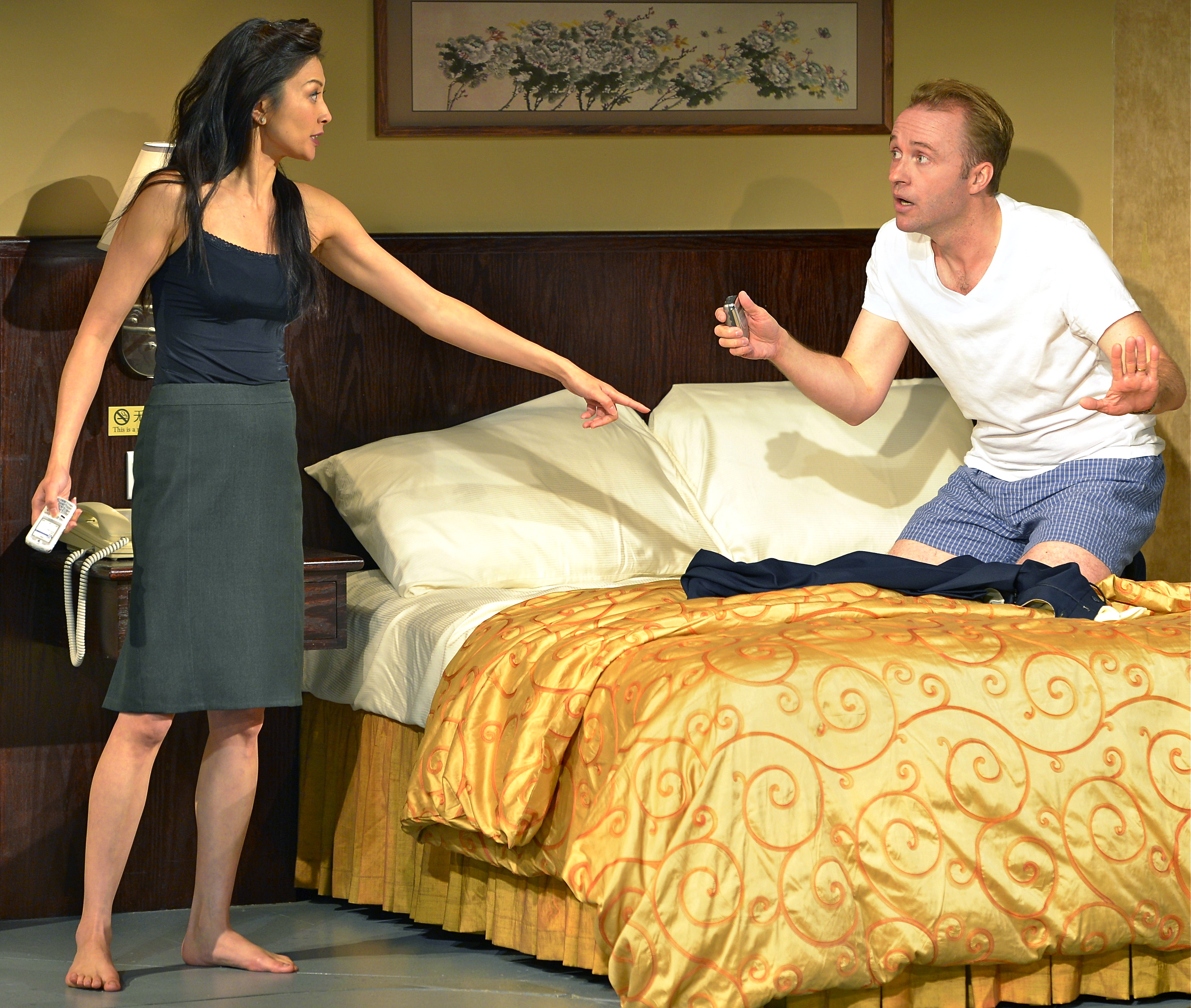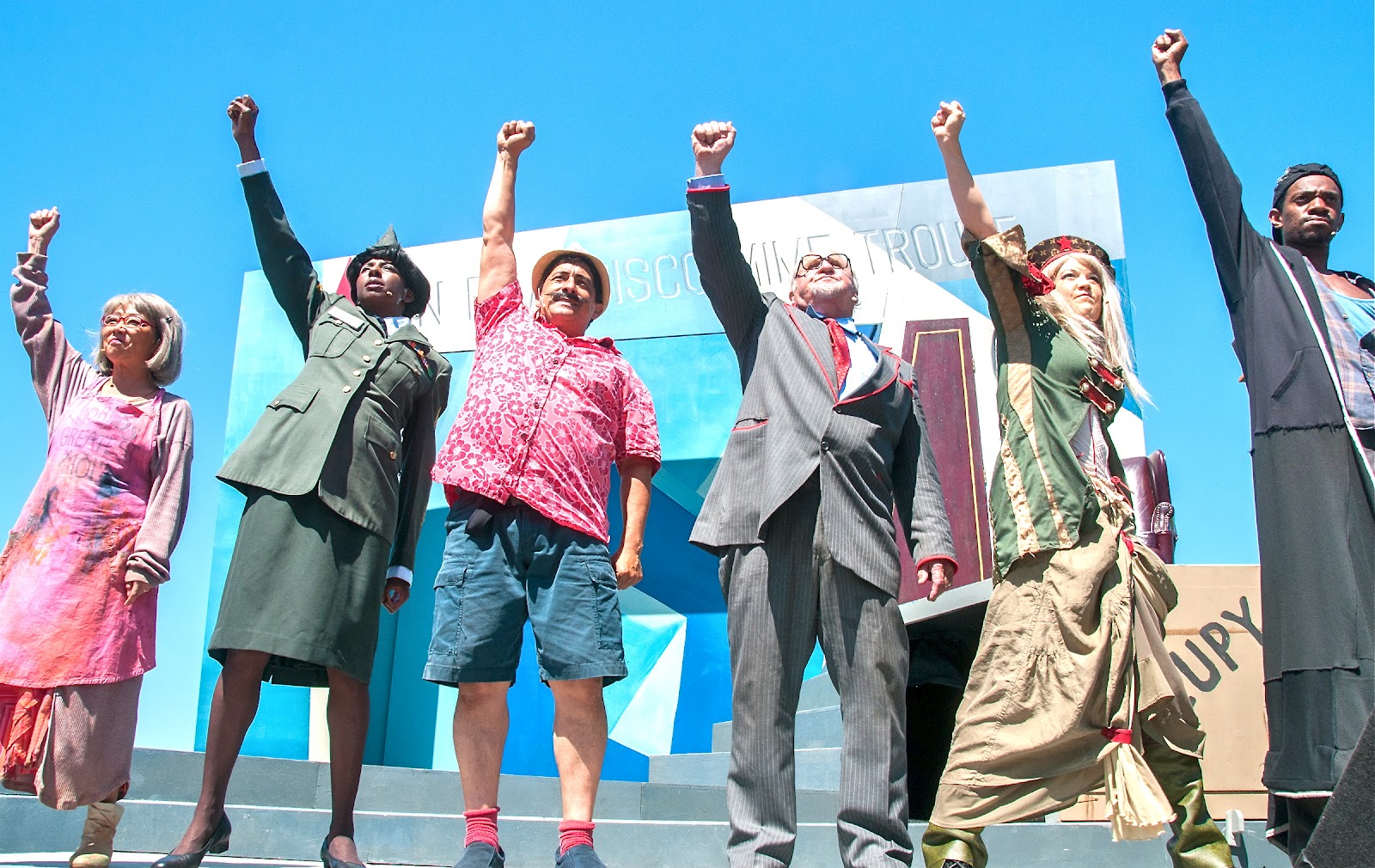
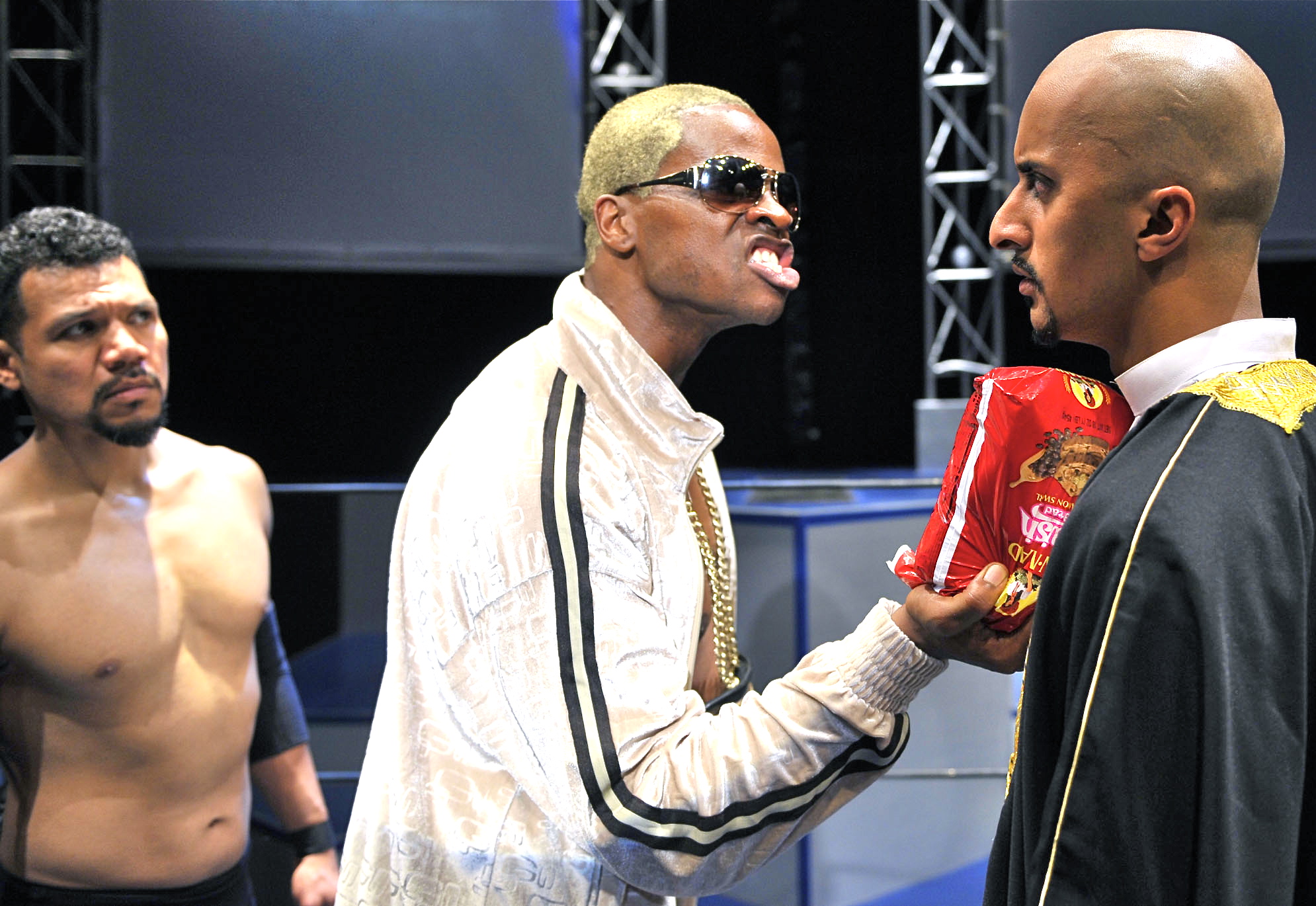
In “The Elaborate Entrance of Chad Diety,” the champ (Beethovan Oden, center) confronts VP (Nasser Khan) as The Mace (Tony Sancho) looks on. Photo by David Allen.
I’m surprised that, considering their enormous popularity, Spiderman, Batman, Wolverine and other trademarked superheroes don’t show up in professional wrestling circles.
Those figures apparently are confined, principally, to comic books and screen adaptations.
So wrestling buffs have to settle for the more mundane likes of John Cena or past heavyweights like Gorgeous George, Hulk Hogan, The Rock, Steve Austin or Andre the Giant.
Such mental meanderings lead me to Kristoffer Diaz’s “The Elaborate Entrance of Chad Deity,” one of the season’s worst titles but most amusing plays.
The serio-comic satire, proficiently directed by Jon Tracy, is unique.
The Aurora Theatre Company stage in Berkeley has been transformed into a wrestling ring by set designer Nina Ball and the actors mutated into what one correctly refers to as “caricatures in a world of cartoons.”
To ensure a frenzied atmosphere, the audience is urged during a pre-play warm-up to shout out the characters’ hyperbolic names, boo the villains, cheer the good guys, and perforate the air with outstretched fingers.
The crowd spiritedly follows instructions, lending an exciting interactive quality to the production.
The only thing missing, according to my archaic recall of a live match in New Jersey, would be a cloud of cigar smoke hovering over the ring.
Because the Aurora is small, the faux wrestlers often thrust themselves in your face.
More distant are twin screens in the rear. They playfully project a variety of images, including deliberately awkward and de-sexed go-go dancing by Elizabeth Cadd.
As well as two wonderful sequences that Photoshop real-life heroes Abe Lincoln and Martin Luther King into shots of the flamboyant champ, Chad Diety, and villains like Stalin and Darth Vader with the contender, VP, who changes into a Muslim-terrorist type, The Fundamentalist, who can annihilate foes with a mysterious kick dubbed “The Sleeper Cell.”
You need know nothing about wrestling or its Pay-Per-View paydays to enjoy the ridicule.
That’s because the protagonist, The Mace, a journeyman Puerto Rican wrestler from the Bronx who’s forever cast as a loser, provides all the necessary background.
He intertwines fact, fiction, labor-versus-management feelings, metaphor, social consciousness, seriousness and humor in his narration. At the same time, he deals with characters wrestling with their identities as men, as ethnics, as Americans, as wage slaves.
His is a fast-talking monologue that ties together action scenes as professionally as a doc might stitch a wrestler’s wounds.
Actual wrestling-mat moments, by the way, are chiefly limited to the second act of the two-hour play, which make it pass more swiftly than the first.
Nasser Khan is exceptional as VP (or Vigneshwar Paduar), an anti-stereotype character who speaks six languages, does one-arm push-ups and performs rap.
And Beethovan Oden stands out as Chad, a charismatic giant whose strut replicates actual “champions” of the World Wrestling Federation (now WWE instead of WWF).
Tony Sancho, who portrays Macedonio Guerra (or The Mace), also does well, considering he has about a zillion words to deliver. His speeches thankfully are leavened with bright asides to the audience and countless sardonic one-liners (“It is teamwork even if I’m the only one on the team doing the work”).
If I closed my eyes, I could visualize the WWF’s Vince McMahon via Rod Gnapp’s portrayal of THE league owner and chief conniver, Everett K. Olson, who at one juncture reclines effortlessly on one rope of the ring.
Finally, Dave Maier skillfully rounds out the cast — in multiple roles, including a lithe descent from the ceiling.
Sometimes “The Elaborate Entrance” message is a bit heavy-handed, such as the dollar sign displayed on Chad’s hindquarters. And sometimes it borders on the offensive, as when it derides pro wrestling’s racist and xenophobic attitudes via over-the-top costuming by Maggie Whitaker (an incredibly large Mexican sombrero and ammo belts, for example).
“The Elaborate Entrance of Chad Diety” won an Obie and was a finalist for the Pulitzer Prize. In my view, it deserved both accolades.
Playwright Diaz, an honest-to-goodness wrestling fan with a full grasp of the genre, has been quoted as saying that the mock sport is a “really wonderful art form but…does tend to play to the lowest common denominator.”
No matter. Diaz has created a let’s-pretend world that highbrow or middlebrow audiences can enjoy every bit as much.
“The Elaborate Entrance of Chad Deity” runs at the Aurora Theatre, 2081 Addison St., Berkeley, through Sept. 30. Night performances, Wednesdays through Saturdays, 8 p.m., Tuesdays and Sundays, 7 p.m.; matinees, Saturdays and Sundays, 2 p.m. Tickets: $32-$50. Information: (510) 843-4822 or www.auroratheatre.org