Category

Woody Weingarten

Woody
Weingarten

Two local women who resisted the Nazis can’t forget

By Woody Weingarten

Some things we should never forget.

Like, the Holocaust wasn’t limited to Jews. And, Jews did fight baWe certainly must remember the six million dead. But the Nazis also killed millions of non-Jews — Soviet prisoners of war, Polish citizens, Gypsies, the disabled, political and religious dissenters, gays.

Decades ago, my first day at the Jewish Bulletin of Northern California, a man who’d survived Auschwitz-Birkenau and four other World War II camps pleaded, “No matter what else you do, don’t let anyone forget the Holocaust.”

Sonia and Paul Orbuch. Photo: Woody Weingarten

I never forgot him, or the slogan “Never forget!” — the rallying cry for Jews the world over.

But it was a while before I’d encounter anyone who’d joined the resistance.

They, too, bear scars — physical, emotional.

A month ago I met octogenarian Sonia Orbuch. She fought Nazis as a teen, part of a partisan unit whose mission was resistance and sabotage, including the mining of train tracks.

Mostly she was an impromptu field nurse, helping doctors amputate limbs, treating the wounded with skimpy supplies and blood-soaked bandages — and cradling the dying.

The Corte Madera resident can’t forget the nightmare, or a brutal winter hiding in a Ukrainian forest.

She lived fearfully “all the time” then, and knows she’ll never forgive. “Even when it’s a happy moment or a holiday, I cannot smile, cannot laugh,” she told me. “The pain is tremendous.”

In a book aimed at teenagers, Sonia said, “Every day my heart aches for the loss of my mother and two brothers, dozens of other relatives, and nearly all of my childhood friends.”

But she also knows it’s crucial to dispel the myth that Jews didn’t resist the Nazis.

Her son, Paul, a San Anselmo resident, actualized his legacy by co-founding the Jewish Partisan Educational Foundation, www.jewishpartisans.org. It, he noted, is “seeking 100,000 teachers, Jewish and non-Jewish” to inspire new generations by showing “the history and life lessons of the Jewish partisans.”

What’s it like being a survivor’s child?

“I always go back to what Sonia’s said, ‘You have to stand up early against tyranny, oppression, discrimination, anti-Semitism, whenever and wherever it occurs, and you have to teach the kids.’”

Yet even as his messages spread hope, others dispense hatred: The Associated Press reported a 30 percent worldwide surge in anti-Semitic violence and vandalism last year, economic nosedives again making Jews scapegoats.

Paul once told a Marin Jewish Community Center audience about hearing Sonia’s friends reminisce “about the war, their losses and their survival experiences. They did so with tears and sometimes with humor. And almost always there was anger and the refrain…of ‘never again.’”

His daughter, Eva, who lives in San Jose, subsequently recalled that she’d told her bat mitzvah tutor she “understood what my grandmother had gone through. My tutor challenged me…and I came to realize…I may never be able to truly understand or feel what my family and millions of others endured. I will only be able to ask questions and grapple with my past.”

Another resister, Paula Ross, lived in Fairfax since 1990 but just moved to the Veterans Home of Yountville.

Paula Ross outside Whistlestop in San Rafael. Photo: Yvonne Roberts.

The Vienna-born 92-year-old can’t forget either — how she fought with the resistance to retaliate: “They killed my uncles, aunts, cousins and friends.”

She still doesn’t “like to talk about it, because it was very traumatic,” but, despite misgivings, she returned to Austria two years ago “and taught teenagers about the Holocaust, telling them exactly what the Nazis did.”

Morgan Blum, a Tiburon native, is director of education for the Holocaust Center, part of Jewish Family and Children’s Services in San Francisco. She says a survivor once was defined as someone who’d been in a death camp but now signifies “anyone who was targeted for death and survived.”

That means they “may have been in an extermination camp, may have been a hidden child, may have been a Partisan, may have fled in 1936.”

Morgan recently gathered “600 students and teachers from 101 private, public and parochial schools to participate in our annual Day of Learning. About 95 percent were not Jewish. Over 70 percent had never heard a survivor before, but meeting one, they could make a connection.”

One attendee, after hearing about Rwandan, Cambodian, Bosnian, Darfur genocides, vowed “to prevent this from happening again, to not be a bystander.”

Another told Morgan it’s critical “to carry on this story because the next generation won’t be able to hear from a living survivor.”

Yes!

‘Stuck Elevator’ is astute musical look at immigration

By Woody Weingarten

Julius Ahn portrays Guāng in A.C.T.’s “Stuck Elevator.” Photo: Kevin Berne.


Like God with a capital G, the little-g theater gods work in mysterious ways.

Or maybe it’s all happenstance.

Either way, A.C.T.’s “Stuck Elevator,” an insightful peek at the mental meanderings of Guāng, an undocumented Chinese worker, coincided with the U.S. Senate beginning debate on immigration reform and feasible pathways to legalization and citizenship.

The American Conservatory Theatre’s world-premiere musical leans on a true story of a takeout delivery guy trapped in a Bronx elevator 81 hours.

It’s chiefly about fear:

Rescuers might learn he has no papers, and that would lead to deportation.

Guāng frets, too, about thieves stealing the seat of his bike, a Mexican deliveryman “getting all my tips,” and being fired because he’s too old.

Stuck Elevator,” like Joseph’s biblical coat of many colors, rapidly becomes a metaphor, in this case unveiling deep personal feelings of apprehension, frustration and prejudice.

Its framework is a bilingual montage that conveys multi-pronged points (led by the strain of being an outsider).Thematically, the 80-minute, one-act show works incredibly well.

Yet it lacks the musical power it might have had despite the commendable operatic voices of Julius Ahn as Guāng and Marie-France Arcilla as Ming, his wife (who’s also stuck — in a Nike factory in China).

Because the issues are so blatant, the blandness in some of the sung-through score by Byron Au Yong and verbal redundancies by librettist Aaron Jafferis may leave audiences desiring more oomph. That’s true even with the show’s two dozen tunes cross-fertilizing contemplative Chinese melodies (albeit sometimes too withheld, other moments too screechy) with bouncy Latin airs and wistfully romantic refrains.

Ahn, as an immigrant caught as much in his fantasies and self-limitations as he is by the shaft, gets enough stage time for a one-man performance though four supporting actors play multiple roles.In rapid succession, he thrusts his voice, body language and facial expressions into an emotional gamut: fear, sadness, joy, acceptance.

But it’s Joel Perez as Guāng’s co-worker, Marco, who stops the show with a hip-hop tune.

In addition, Raymond J. Lee is artfully villainous as Snakehead, the human parasite who forced Guāng into lifelong debt by charging $120,000 to smuggle him and his nephew into this country. And Joseph Anthony Foronda is appropriately over-the-top in the drag role of the Ross’ Wife and the armor-clad Elevator Monster.

It takes no time for Ahn to bring home everyone’s dread of elevator entrapment and claustrophobia.

And it takes no time for the crowd to adjust to supertitles that alternately translate the lyrics into Chinese or English, depending on which language is being sung.

Occasional bittersweet humor makes the sung-through show’s earnestness more palatable — like a line referring to Guāng’s predicament being “the first time in my life I haven’t had to share a room.”Quirky characters that populate his past, current and future daydreams and nightmares also amuse.

Guāng sings and sings and sings — to himself, to his family, to the elevator.

His mental twists and turns include, at one point, being attacked in song by a

mugger, his boss’ wife, his own wife — and his bladder. At another juncture, he imagines becoming so successful he can make Donald Trump deliver chicken to him.

In his darkest reverie, though, he watches “the edge of mind…starting to fray.”

His fantasies sharply vary in tone.

The best one may be a sequence in which characters drum with chopsticks and then use them as utensils to poke at a carcass on a table.“Stuck Elevator” is ably supported by Daniel Ostling’s set design (with dreamlike frame and simple cage), effective projections by Kate Freer, lighting by Alexander V. Nichols that facilitates quick mood changes, and costuming by Myung Hee Cho that detail characters’ socioeconomic status as it showcases flamboyant figments of Guāng’s imagination.

The Bay Area, with its large blocs of new Hispanic and Asian immigrants (as well as older Italians, Russians and you-name-its), people who fled poverty and oppression, should be particularly receptive to “Stuck Elevator.”

Regular theater buffs are likely to enjoy it because it’s different.

Once-in-a-whilers might consider it because it’s inspirational, a paean to the human spirit.

“Stuck Elevator” plays at the American Conservatory Theater, 415 Geary St., San Francisco, through April 28. Night performances Tuesdays through Saturdays, 8 p.m., and Sundays, 7 p.m. matinees, Wednesdays, Saturdays. Tickets: $20 to $85. Information: (415) 749-2228 or www.act-sf.org.

‘Whipping Man’ is a fresh, exciting Mill Valley must-see

By Woody Weingarten

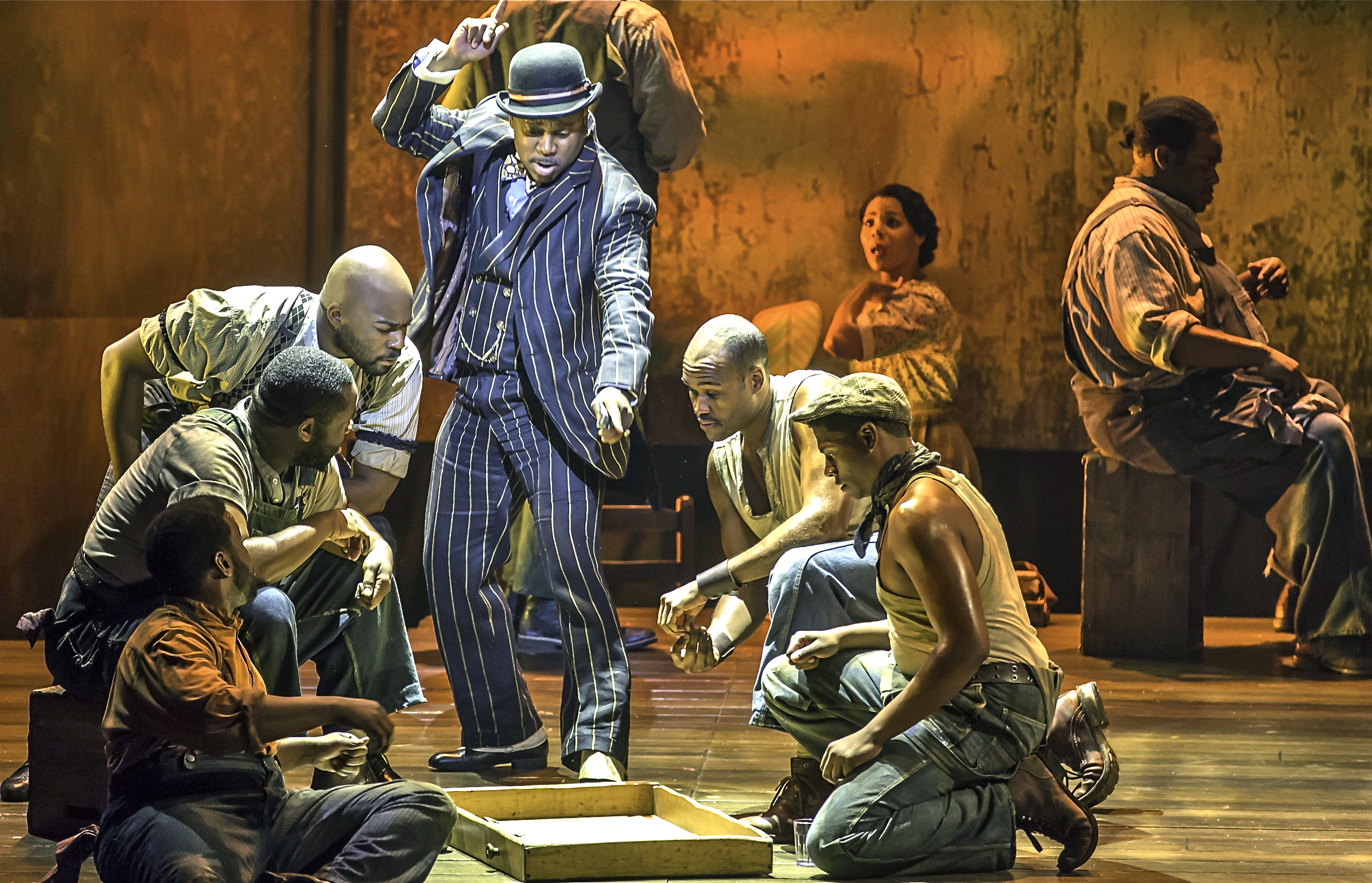
Momentarily celebrating in “The Whipping Man” are (from left) Tobie Windham (as John), L. Peter Callender (Simon) and Nicolas Pelczar (Caleb). Photo: Kevin Berne.


Minutes into it, I surmised that all the elements in “The Whipping Man” would come together as exquisitely as a Rubik’s Cube.

My instincts were right.

The drama by Matthew Lopez, who simultaneously slices into the vagaries of humanity and inhumanity as skillfully as he depicts a gangrenous Civil War amputation, is a one-of-a-kind powerhouse despite it making me think of August Wilson one minute and Redd Foxx the next.

The Marin Theatre Company production in Mill Valley in fact isn’t derivative. It’s as fresh and exciting as anything on the boards in the entire Bay Area.

Director Jasson Minadakis has excelled his previous successes with this show, making the opening night audience leap to its collective feet with approval. Like a magician whose magic wand is finely tuned, he ensures that each action, each phrase, each emotion is cloaked in authenticity.

The acting — by L. Peter Callender as black patriarch and ex-slave Simon; Tobie Windham as John, a freed sneak thief and dreamer seeking refuge; and Nicholas Pelczar as Caleb, a Jewish white slaver’s scion who’s been wounded in more than one way — is universally superb.Inspired, also, are the intentionally decrepit set by scenic designer Kat Conley, the dramatic lighting by Ben Wilhelm, the moody sound effects by Will McCandless and the apt costumes by Jacqueline Firkins.

On the surface, the play — marked by sharp dialogue that draws not nervous laughter but guffaw

s triggered by genuine characters rather than stereotypes — is about Jews and blacks and, surprisingly, black Jews. Its themes erupt in a series of verbal mazes — including the DNA of slavery, the roots of freedom, and the construction and deconstruction of family and forgiveness.Let alone brotherhood, faith and hypocrisy.

Much of the subject matter’s been tackled before, but rarely executed as well, possibly never in a scenario involving black Jews.

The scene is a dilapidated homestead in Richmond, Virginia, in 1865, over a stormy three-day peri

od that includes Abe Lincoln’s assassination.A makeshift Passover Seder (commemorating the Israelites escape from Egyptian bondage) becomes an unusual focus, masterfully created by Lopez, a gay Episcopalian of Puerto Rican and Polish-Russian heritage whose direct knowledge of Jewish holidays apparently came in part from attending ritual meals hosted by his Semitic aunt and cousins.

The play, presented as a co-production with Virginia Stage Company, stays on point throughout — another kudo due Minadakis.

Its only inconsistency is the dialogue, which sometimes veers into current usage rather than yesterday’s.

And its only flaw is that once in a while a character talks in needlepoint-speak. Such as: “War is not proof of God’s absence; it’s proof of his absence from men’s hearts.”More insightful is what I perceive to an accurate portrayal of Jewish sensibility: “We talk with God…sometimes we even rassle with Him. But [as Jews] we keep asking questions.”

Astute, too, is this poignant passage about slavery: “It wasn’t a friendship…not when one owns the other.”

Lopez is consistently sharp but occasionally shows flashes of brilliance. As in labeling Lincoln, in keeping with biblical inserts and the Exodus theme of Passover, as “Father Abraham, who set us free” and “our American Moses.”

Highlights in “The Whipping Man” range from a hilarious set piece about cutting and chewing horsemeat to a rousing rendition of a multi-purposed spiritual, “Let My People Go” — along with shocking, intense moments stemming from both verbal and visual reminders of whippings and their aftermath.Revelations of long-held secrets only deepen the drama.

“The Whipping Man,” finally, attacks with passion and muscle. There’s no question that it burned into my brain and resonated long after I left the theater. Bay Area showcases seem to exist in every nook and cranny, but a theatrical must-see is rare.

This is one.

“The Whipping Man” plays at the Marin Theatre Company, 397 Miller Ave., Mill Valley, through Sunday, April 28. Performances Tuesdays through Saturdays, 8 p.m.; Sundays, 7 p.m.; Wednesdays, 7:30 p.m.; matinees Saturdays and Sundays, 2 p.m. Tickets: $15 to $57. Information: (415) 388-5208 or marintheatre.org.

‘The Happy Ones’ fails to make reviewer happy

By Woody Weingarten

Woody [rating:3] (3/5 stars)

Walter (played by Liam Craig, left) and Gary (Gabriel Marin) momentarily experience a 1975 version of the Good Life in “The Happy Ones.” Photo: Jennifer Reiley.

The Magic Theatre habitually risks audience disapproval.

It nurtures edginess.

It wrestles with uncomfortable subject matter.

And, happily, it aims many productions at crowds more youthful — and ready to laugh and cry — than your average card-carrying AARP member/theatergoer.

In recent years, it has produced “Any Given Day,” a tragicomedy that examined fear and hope through two developmentally disabled characters; “Jesus in India,” which tackled and turned upside down the oft-debated lost years; “Brothers Size,” a tear-jerking drama (peppered with spicy humor) about brotherly love; and “Another Way Home,” a serio-comedy that probed how a family’s life could be narrowed by a teenager’s mental problems.They all flourished. They all pleased me. A lot.

“The Happy Ones,” unfortunately, is an exception that proves different isn’t necessarily good.

The synthetic comic drama falls several degrees south of mediocre.

In my view, the Bay Area premiere at San Francisco’s Magic was almost totally void of theatrical magic.Ostensibly a peek at lives being inside-outed by a fatal accident, Julie Marie Myatt’s play simply languishes as it turns grief into boredom.

Before it flat-lines, her creation crawls like an injured sloth, working its predictable storyline about suburban Paradise Lost into a non-crescendo — despite a final scene that contains the lone sincerely touching moments in close to two hours.

It’s a shame, because all four actors — Jomar Tagatac as Bao Ngo, Marcia Pizzo as Mary-Ellen Hughes, Liam Craig as Walter Wells and Gabriel Marin as Gary Stuart — are top drawer as they project awkwardness and distance (and because the details of the period set, costuming and ‘70s music work extremely well).

Yet all of it becomes wasted wrapping paper for a basically empty gift box.Opening night, “The Happy Ones” — which drew lukewarm laughter and polite applause from a mega-friendly audience — kept the word “contrived” flashing in my mind like a neon sign gone bonkers.

That made it difficult for me to relate to the plights of the Orange County husband/father/appliance store owner who discovers his American Dream turned into a nightmare, the accidental Vietnamese killer who repeatedly says he wants

to die but can’t and therefore concocts an unbelievable route to forgiveness, a fifth-rate minister who repeatedly bemoans his being a fifth-rate minister, and an aging, insecure sexpot looking for a good time or a good partner, whichever comes first.In a similar vein, allusions to the end of the Vietnam War and the wave of refugees to the United States had zero emotional impact for me.

I’d hoped to find “The Happy Ones,” as advertised, hilarious and heartbreaking — filled with nuances and strength.

I didn’t.

“The Happy Ones” plays at the Magic Theatre, Building D, Fort Mason Center, Marina Boulevard and Buchanan Street, San Francisco, through Sunday, April 21. Performances Wednesdays through Saturdays, 8 p.m.; Tuesdays, 7 p.m.; matinees, Saturdays and Sundays, 2:30 p.m. Tickets: $22 to $62. Information: (415) 441-8822 or www.magictheatre.org.

Drama scrutinizes famed journalist’s mind, spirit, vitriol

By Woody Weingarten

Concetta Tomei (right, as Oriana Fallaci) and Marjan Neshat (as a journalist) star in “Fallaci” at the Berkeley Rep. Photo, courtesy kevinberne.com.

“Fallaci” is — according to my personal stage evalu-ometer — 85.3 percent brilliant, 14.7 percent boring or overly dense.

It’s 82.2 percent sterling drama (with a tinge of comedy), 17.8 percent polemic.

Despite its negligible drawbacks, I believe the drama’s definitely worth experiencing.

“Fallaci,” at the Berkeley Rep through April 21, confronts myriad Big Issues — truth, women’s freedom and power (and their nonexistence), domestic abuse, torture, tyranny, hatred, destiny, motherhood, father-daughter relationships, anti-Islamism, forgiveness.

So many, in fact, it’s easy to become inundated with the gravitas.

Playwright Lawrence Wright probes the liberation of women through the famed, cynical eyes of inconsistent, caustic Italian journalist Oriana Fallaci, who insists that, always, “you have to find the lie” underneath what interviewees offer as the truth.

Contrasted and compared is the view of a young female writer, Maryam, who wavers between awe and distaste for the elder journalist’s technique, mind and spirit but settles for empathy.

Wright’s skill at fictionally getting inside Fallaci’s head at the tail of her life is complemented tidily by the unwavering direction of Oskar Eustis.

It’s noteworthy that these two talented men are responsible for the onion-like peeling that occurs on stage to delineate each woman’s self-deception and lies — a verbal scrutinizing that links the essences of the females.

Wright, a writer for The New Yorker and author of eight books, including a Pulitzer Prize-winning volume on al-Qaeda and a headline-grabbing tome on Scientology, actually traces Fallaci’s life all the way back to her childhood resistance against the Nazis.

Concetta Tomei portrays the combative, opera-loving Fallaci with a comprehensive range of emotions and outbursts as omnipresent as the cigarette in her aging hand.

Tomei, whose Broadway credits include stints with Kevin Kline and David Bowie, smoothly captures the polarized segments of Fallaci’s life — after a tenure in Hollywood, she becomes the verbal darling of the left (when she mercilessly bludgeons the likes of Ayotollah Khomeini, Moammar Qaddafi, Yasser Arafat and Fidel Castro), then is adopted by the right after she attacks all of Islam in reaction to 9/11.

The actor’s Italian accent and physicality are impeccable.

Majan Neshat competently plays a “lowly” obituary writer cum inquisitor — first with a coupling of reserve and youthful brashness, then with panache.

She seamlessly integrates her Iranian background and position with The New York Times in a way that makes her believable, all the while running a heady gauntlet to unearth her own truth.

The lone set by Robin Wagner, a three-time Tony Award-winner, represents Fallaci’s obsession with words via a cavernous room that has books stacked on the floor, a table and ceiling-high shelves.

The costumes (by designer Jess Goldstein, also a Tony winner) are drab, drabber and drabbest (perfectly in keeping with outer-appearances).

Considering the fiery quality of Fallaci, one of the first rock stars of modern journalism, and some of the gut-wrenching topics it tackles, it’s strange the highly intellectual play lacks much of a visceral punch.

Intermittently, in fact, I now and then felt I was witnessing a tableaux of a corpse being autopsied, made even worse by a hokey ending.

Wright, unfortunately, may have become too entangled in his theatrical conceit of a writer writing about two writers.

Still, “Fallaci,” which reveals how debilitating a diet of controversy, controversy and controversy ultimately can be on a journalist, can be riveting — especially whenever it pauses to let the audience’s reactions catch up with the verbiage.

That said, it should be noted that I often found Wright’s weighty subject matter stunning (for instance, when a reflective Fallaci wistfully intones, “They say I lost the appetite for blood”).

Opening night, despite the 90-minute show being without intermission, not one soul left the theater before the play went dark.

It may be ironic that the opening of this world premiere, which at one point deals with the rape of a condemned woman who can’t be executed unless her virginity is taken, occurred on the same day as some fundamental Muslims ripped into a U.S. document on combatting violence against women.

So it looks like “Fallaci” is hardly just a story of yesterday.

“Fallaci” plays at the Berkeley Repertory Theatre‘s Roda Theatre, 2015 Addison St., Berkeley, through April 21. Night performances Tuesdays, Thursdays, Fridays and Saturdays, 8 p.m.; Wednesdays and Sundays, 7 p.m.; matinees, Thursdays, Saturdays and Sundays, 2 p.m. Tickets: $14.50 to $89, subject to change, (510) 647-2949 or www.berkeleyrep.org.

Flowers, despite short shelf life, complement museum art

By Woody Weingarten

Floral materials (forefront) burlesque American Art piece in “Bouquets to Art.” exhibit. Photo: Woody Weingarten.

Simple, elegant floral construct by Friends of Filoli (Valerie Meechi, Elsa Wyant and Jeanne Maniscalco) pays homage to “Oranges in Tissue Paper” by William Joseph McCloskey. Photo: Woody Weingarten.

Floral art sits in front of Whistler’s “The Gold Scab” in de Young’s “Bouquets to Art.” Photo: Woody Weingarten


Colorful creation by Waterlily Pond Floral Design Studio (Natasha Lisistsa and Carla Parkinson) mirrors the tree of Richard Mayhew’s “Rhapsody.” Photo: Woody Weingarten.

Risking being taunted as a wretched pun-tificaotr, I hereby affirm that the de Young’s floral-art exhibit  unearths how great it is when artisans put their mettle to the petal.

Truly.

“Bouquets to Art,” a vital though short-lived array at that San Francisco museum, colorfully blossoms each year like a perennial.

The gestalt of this year’s parade of flora is much more vibrant than any of its component blooms — and the work of more than 125 exhibitors as a whole is as compelling as any of its 28 annual predecessors.

Skeptics beware: Floral art can dynamically complement oils and sculptures.

The two-floored 2013 display, where each artist (or group of floral designers) is inspired by an individual piece of the permanent collection to create a tribute to that art, can comfortably be covered in a few hours. But expect your ears to be filled during that brief visit with glowing, gushing commentaries from other guests ­— art lovers, floral lovers, “Bouquets to Art” lovers.

This year’s exhibit provides sharper contrasts than usual.

Why?

Ultra-simple arrangements vie for attention with complicated constructions.

Monochromatic wonders compete with glitzy, sparkly thingies (yes, art snobs may quake in their finery at my use of such a slangy term — and my tinge of derision).

And fancy draped fabric, string and high-wire acts steal the floodlights of more modest interpretations — impressionistic or realistic — of fine art.

My favorite is by Half Moon Flowers (Leila Simms), a homage to James McNeill Whistler’s 1879 “The Gold Scab: Eruption in Filthy Lucre (The Creditor),” an unusual dark painting that caricatures Whistler’s benefactor.

The floral display ideally mimics the artwork in both tone and color.

Since whimsy was under-represented this year, I was particularly happy to find an American Art burlesque by violetta (arlene boyle) of a head with horns.

“Bouquets” always acts as a reminder to me of how fleeting life is — and how lasting art can be.

Most of the flowers — like the sand sculptures created on a beach only to have the waves wash them away shortly after they’re built — survive only a few days (some must be replenished daily), while the paintings and sculptures they represent are, well, a lot more permanent.

So, if require additional reassurance about longevity when you finish your tour, you might wander downstairs to another exhibit, “Girl with a Pearl Earring,” subtitled “Dutch Paintings from the Mauritshuis.”

That display features the famed 1665 Vermeer oil on canvas. But if that and its companion pieces don’t satisfy your quest for classics, try the tangential exhibit of “Rembrandt’s Century,” which features 200 smaller works (including rarely seen Rembrandt depictions of homelessness and poverty).

Though you must rush to catch “Bouquets to Art,” you can be a little more leisurely with “Girl” and “Rembrandt” — those shows will run through June 2.

“Bouquets to Art” runs through March 23 at the de Young, 50 Hagiwara Tea Garden Drive at John F. Kennedy Drive, in San Francisco’s Golden Gate Park. Tickets: Free for members and children under 5, $20 adults, $17 seniors (over 65), $16 youths (6-17). Information: (415) 750-3600 or contact@famsf.org.

Oscar choices fail to surprise — or satisfy — critic

By Woody Weingarten

Quvenzhané Wallis (far right), best actress nominee, is joined by (from left) Jonshel Alexander, Kaliana Brower and Amber Henry on the set of “Beasts of the Southern Wild.”

Whenever my wife wants to coerce me into doing something, she doesn’t threaten to cut me off sexually. She does much worse.

She threatens to stop cooking.

As a result of my acquiescing to her beef bourguignon blackmail, she drags me into the bedroom once a year to watch the almost-four-hour Oscar trek from Hollywoodland to Boredomland.

Not only don’t I give a flying Fig Newton which female star is wearing which conventional designer’s gown on the red carpet, or showing how much rumpskin can be bared, I couldn’t care less which male actor has new stubbly facial hair or silky tux — or a shiny new rug covering his otherwise shiny pate.

So I stretched out under the covers keeping myself awake by thinking not about Barbra Streisand poignantly singing “The Way We Were” for the hundred-thousandth time or Daniel Day Lewis’ articulate and witty acceptance speech as best actor but about the Academy Awards show even at its best being just a bland bowl of cherries jubilee.

And I squirmed at Kristin Chenoweth’s obnoxious, incessant chatter on the crimson runway, and cringed at Michelle Obama’s inappropriate, tasteless flipping open the best-flick envelope in front of a decked out military contingent that looked like it came straight from central casting.

This year, I actually had a favorite, “Beasts of the Southern Wild,” that I knew couldn’t possibly — and did

n’t, despite a few raucous shouts and applause — beat out the “safe” choice, “Argo,” a tense, extremely well-directed but totally predictable thriller, for best picture.

Nor did the lead performer of the independent “Beasts,” nine-year-old Quvenzhané Wallis, or its intrepid director, Benh Zeitlin, stand a chance against two other benign selections, perky Jennifer Lawrence and politically correct Ang Lee.

In case you missed it, the quasi-post-apocalyptic film about child survivor Hushpuppy in the Louisiana bayou is a complex, multi-layered film I adored but was unable to convince many of my closest friends was worth seeing.

Not all of the gold statuette-athon was horrible.

I was glad Quentin Tarantino won a screenwriting award for “Django Unchained,” which I found incredibly funny (despite the manifold cartoonish blood-gushing sequences and voluminous use of the n-word that some non-film buffs found repulsive without having seen the film).

Christoph Waltz’ unexpected victory for “Django” in the best supporting category award also pleased me.

And I was happy to see a tie occur in the sound editing race.

But one of my favorite films of the year, “Quartet,” didn’t make any a dent in Academy voters’ lists for best anything. Those balloters apparently share most critics viewpoint that sentimentality is bad, a sentiment I don’t share at all.

Since the Academy keeps pursuing younger demographics (witness the choice of “Ted” creator Seth MacFarlane as host), there was no surprise in it overlooking a film about nostalgic seniors on the brink of Alzheimer’s or death.

For me, it felt cleansing — and good — at that movie’s end when I cried, fully content that I’d frequently laughed and chuckled and smiled before that juncture.

I’d reveled, too, in the performance of Dame Maggie Smith, who embodies a broke but not broken retired opera singer relegated to a financially strapped retirement home for musicians.

After Jimmy Kimmel’s unfunny post-Oscar show ended with a disappointing sequel to his spoofy “Movie Movie” and Jamie Foxx singing nonsensical yet slightly salacious lyrics about sprinkling Channing on his Tatum, I was left with only one question: What can I do to convince my wife to substitute the Spirit Awards next year for the Oscars?

No, wait a minute. Didn’t that organization’s voters recently pick the sanitized, feelgood star-studded “indy” film “Silver Linings Playbook” as best picture of the year?

Drama draws laughs while probing serious subcultures

By Woody Weingarten


Jackie (Gabriel Marin) and Veronica (Isabelle Ortega) get violent in “Motherf—-r with the Hat.” Photo: Jessica Palopoli.

My hat’s off to “Motherf—-r with the Hat.”

It’s off to the comic drama for having the most immoderate theatrical title in years, one that may cause scores of potential ticketholders to stay home — even in liberal, liberated San Francisco, Marin County and vicinity.But my hat’s also off to playwright Stephen Adly Guirgis and director Bill English.

They instilled “Motherf—-r” with a throbbing energy, kept my attention with verbal fireworks that relentlessly took apart lies and liars, and overlaid gobs of humor onto the often painful words of people trapped in lower socio-economic hookups.

“Motherf—-r” also provided a shrewd look at sub-cultures — 12-step programs, for example, and the easy availability of guns and bats to vent rage.It didn’t take long, however, to know this was no nursery rhyme for Rotary Club attendees — the opening scene finds Veronica (Isabelle Ortega) snorting cocaine and swearing like a longshoreman.

It also didn’t take long to know the 100-minute, intermission-less show was going to have an undercurrent of poignancy: Jackie (Gabriel Marin), smalltime drug dealer and parolee who’d spent two years in prison, barges in to hand the woman he’s adored since eighth grade a bouquet of flowers, a chocolate bar, a Lotto ticket, a stuffed animal, tickets to a movie, and news that he’s found a job.

Almost instantly, though, he finds the fedora featured in the title, along with other signs she’s been cheating.

So we’re off to what rapidly descends into a sexual roundelay, a comic romp and a semi-tragic snapshot of star-crossed lovers.

Actors in supporting roles — Carl Lumbly as Ralph, Jackie’s drug-counselor, and Margo Hall as Victoria, Carl’s angry wife — helpfully wear their characters like second skins.Yet Rudy Guerrero (Cousin Julio) is the consistent show-stopper. He’s over-the-top funny, especially when embroidering a macho Jean-Claude Van Damme persona onto his meek hairdresser gayness.

From time to time, there’s an all-too-familiar quality to the characters (despite Guirgis claiming Jackie hits multiple points of autobiography). But the persistent twists and turns of the plot lead them into fresh if depleted places.

And although chunks of the dialogue seem uninspired, others are dazzling. Frequently, in fact, individual lines become perfect permutations of what Guirgis apparently was striving for:

• “My wife is the reincarnation of Benito Mussolini.”• “Don’t underestimate my capacity for violence.”

• “You think you’re the only motherf—-r who’s hurting here.”

• “The real world largely sucks.”

• “No point in killing the messenger if you’re not gonna absorb the message.”

• “I love loving.”Particular praise is due Lynne Soffer, the dialect coach. Accents are consistently real — as, for the most part, are the five characters Guirgis invented.

Sure, the recognizable Puerto Rican and black types in this production — being presented here in association with the Lorraine Hansberry Theatre — do now and then veer into the underbrush of soap opera and caricature. At their best, however, they offer perspectives on the quest for hope, for love and trust, for forgiveness.The 2011 Broadway production of “Motherf—-r” was nominated for half a dozen Tony Awards. Chris Rock did a star turn (as did Bobby Cannavale), which made that production a little larger than life.

In contrast, the intimacy of the 300-seat SFPlayhouse, with seats only nine rows deep, almost puts you onstage right in the middle of the action.

And that, when it works, can be captivating.“Motherf—-r with the Hat” plays at the San Francisco Playhouse, 450 Post St., San Francisco (second floor, Kensington Park Hotel), through March 16. Night performances, 7 p.m. Tuesdays through Thursdays; 8 p.m. Fridays and Saturdays. Matinees, 3 p.m. Saturdays. Tickets $30-$70. Information: (415) 677-9596 or www.sfplayhouse.org. 

Musical transforms Buddha into a woman in current world

By Woody Weingarten


Sid (Annemaria Rajala, front) must deal with her dead mother (Alexis Wong) in “The Fourth Messenger.” Photo by Mike Padua.

Hmmm, what if the Buddha were alive today — as a female?

Hmmm, now let me see, what if she were dubbed Mama Sid, after Siddhartha Gautama, and her sacrifices in the name of enlightenment were densely detailed on a Berkeley stage?

Hmmm.

Well, the epic musical loosely based on legend just might be exciting, profound and humorous, that’s what.

“The Fourth Messenger,” at the Ashby Stage through March 10, questions whether a woman can survive 100,000 lifetimes to evolve into a purely spiritual yet totally human being.

As a mainly two-person journey toward peace unfolds, the show personifies temptation, prophecy and reconciliation.

Three harbingers appear in human form and embody negatives: sickness, aging and death. The final messenger, pure soul, arrives in an unexpected manner.

All that, and so much more, is viewed through the prism-eyes of two principals — Sid (Annemaria Rajala), a world-famous guru hiding her past, and Raina (Anna Ishida), a muckraking journalist who runs smack into herself while seeking to unveil what she’s predetermined to be spiritual hypocrisy.

But director Matt August keeps the two-hour-plus, two-act world premiere tight, paced seamlessly.

He tempers the tutorial-in-music with verbal comedy and physical slapstick, and drives the silliness through Bridgette Loriaux’s choreography.

Make no mistake, playwright Tanya Shaffer’s ultimate purpose — and message — is ultra-serious: Love gives life meaning. And she appears to offer a corollary obviating the Buddhist maxim that suffering goes hand-in-hand with attachment.

Shaffer, an El Cerrito resident whose “Baby Taj” was a Bay Area hit in 2005, has bitten off a lot. As a result, her script and lyrics are intermittently too dense or preachy.

On the other hand, the text does lend itself to poetic utterances (when Sid reflects on a multi-year meditation, she tells of hearing “cats, wolves…engines… human voices…laughter and pain…and behind the sound, silence, like a bottomless pool”).

Insightful one-liners turn up as well: “You know more than you know.”

Vienna Teng’s compositions from time to time rouses the crowd and runs a musical gauntlet, from pop to jazz, rock to tango, new age to operatic.

Like an opera, not incidentally, “The Fourth Messenger” is nearly a sing-through and succeeds with that format. But Teng’s score is unlikely to compel anyone to hum while leaving the theater.

It must be said, tangentially, that Christopher Winslow, who skillfully and enthusiastically directs four excellent musicians, sporadically lets that verve drown out the singers.

That only becomes a fleeting irritation since the gist of what’s happening remains constantly accessible even when several words are missed.

In comparison, the imaginatively fluid set designed by Joe Ragey — consisting almost entirely of poles and flowing white fabric — is never less than enthralling.

Its simplicity empowers silhouette scenes, and lets the action shift rapidly and smoothly from a magazine office in New York City to a meditation retreat in Newfoundland to a faceless suburban site to a lavish gated community and to bustling urban streets.

Also praiseworthy are the props, which range from a gigantic loaf of bread to a sheet that doubles as snow powder and worldly goods stuffed into a duffle bag.

Shaffer tenaciously attempts to keep things current, to the point where some words — such as staycation — and concepts — like child-abandonment — may rankle.

All 11 performers, many of whom appear in multiple roles, excel within the parameters of complex text and lyrics. Their singing tends to sprint from good to superior, except for a handful of opening night off-notes.

One of Sid’s summation queries in “The Fourth Messenger” is, “What’s one little lifetime anyway?”

My skeptical answer might be: “It’s all that I have — but happily it includes the chance to see a flawed but extremely valuable theatrical experiment.”

“The Fourth Messenger” runs at the Ashby Stage, 1901 Ashby St., Berkeley, through March 10. Evening shows, 7 p.m. Wednesdays and Thursdays; 8 p.m. Fridays and Saturdays. Matinees, Sundays, 2 p.m. Tickets: $23 to $40, available through thefourthmessenger.com.

Ex-champ Mike Tyson shadowboxes his life on stage

By Woody Weingarten

The tattooed Mike Tyson.

I went to “Undisputed Truth,” ex-heavyweight champ Mike Tyson’s one-man show, expecting to find a human version of a car wreck by the side of a highway.

Or a five-legged fuming bull.

I got what I’d anticipated — and much more.

His performance at the Orpheum Theatre in San Francisco confirms he’s still misogynistic and an egocentric bully — and that he’s still in denial about raping a beauty contestant (“I was convicted before the trial”), despite spending three years in prison for it.

He skirts no major details of his bad-boy history, though he excuses biting off a chunk of Evander Holyfield’s right ear because his foe head-butted him in a previous bout, and he justifies bashing his first wife, actress Robin Givens, because she and her mother “jumped on my wallet like the wild dogs of Africa.”

To me, that particular rant feels as brutal and painful as their yearlong marriage must have been.

The 46-year-old does, however, evoke sympathy and forgiveness from having been the son of a prostitute and a pimp, for conquering his drug and booze addictions (“I’ve been clean and sober for four years”), and for enduring the deaths of his mother, sister and 4-year-old daughter.

His troubled environment and childhood (“I was arrested 30 times by age 12”) and financially ripped-off adulthood (fight promoter Don King allegedly charged him $8,000 a week for towels) also draw compassion and a touch of pity.

In addition to a big box-office, “Undisputed Truth” clearly seeks an influx of forgiveness and love.

Spike Lee directed the show and indisputably helps Tyson obtain those two elements (while taking a break from his films and his courtside seats at N.Y. Knicks basketball games).

And Kiki Tyson, the ex-boxer’s third and current wife, aided the quest by scripting a 100-minute show peppered with tons of self-deprecating humor and a modicum of pathos (not to mention a torrent of rhythmic f-bombs and n-words).

Tyson does comedy set pieces particularly well.

For example, he evokes heavy laughter from his exaggerations of polite white speech patterns (which he juxtaposes with the rough ‘n’ tumble phrases that pour off the tongues of street hoodlums of color).

He claims, in context, that he would have preferred his show be called “Boxing, Bitches and Lawsuits.”

At Thursday night’s opening of the ultra-brief, three-day SHN engagement, Tyson’s fans and cheerleaders virtually packed the 2,200 seats. They made up an audience unlike most theater throngs — younger (mostly 20- to 40-year-olds), more ethnically diverse (lots of Hispanics and African-Americans), and less well attired (sneakers and jeans, with a smattering of baseball caps, some worn backwards).

More like a crowd I’d expect at ringside.

His devotees cheered and laughed enthusiastically and often, even when Tyson was recounting past behaviors that had brought him almost universal disfavor.

None seemed bothered by the ex-champion’s speech impediment or occasional mumbles. And no one visibly winced when he talked about becoming “tired of ripping off my prostitute girlfriend and waking up next to people I never saw before.”

The so-called “baddest man on the planet” drew extra sympathy by relating he went from banking $400 million to bankruptcy, finding himself “ho-less and homeless,” and suffering through rehab before hitting an emotional growth spurt in prison resulting in transformation.

The change didn’t hold, unfortunately.

So he continues to shadowbox his demons — and his life — onstage.

Though he skips it in the show, which is definitely not for the squeamish, Tyson has confessed to being on cocaine while filming a cameo appearance in the movie comedy “The Hangover.”

That altered state probably didn’t matter much: His meager acting chops are as evident here as they were there (as well as in the sequel that featured a replica of his facial tattoo more than it did his bigger-than-life persona).

Last December, Time magazine quoted Tyson as claiming he gets a high, despite constant nagging doubts, from going on stage — a similar high to the one he used to derive climbing into a boxing ring.

The opening night’s crowd, which proffered Tyson a standing ovation, apparently got its own high from the solo showcase.

Its excitement was palpable, even to the minority who weren’t disciples.

“Undisputed Truth” runs at the Orpheum Theatre, 1192 Market St., San Francisco, through March 2. Performances tonight and tomorrow, 8 p.m. Tickets: $50 to $310. Information: (888) 746-1799 or shnsf.com.