Category

Joe Cillo

Joe
Cillo

Was Brahms Really a Misogynist?

By Joe Cillo

Was Brahms Really a Misogynist?


This first began as a review of Bob Greenberg’s video presentation Brahms, The Ladies, and the Trick Rocking Chair (2015a) in his Scandalous Overtures series, but I realized that I needed to go beyond Greenberg’s presentation, because he is relying on well known biographical sources that are taken to be authoritative, but which are biased, misinformed, and seriously misrepresent Brahms, his life, and his attitude toward women.

Greenberg’s presentation on Brahms sex life and his attitude toward women amounts to a moralizing tirade that is offensive for its sanctimonious presumptuousness, its patronizing condescension, and its utter ignorance of the evolution in sexual culture from the nineteenth century to our own time.  He reminded me of one of those television evangelists championing marriage, monogamy and sexual asceticism.  The lesson suggested by Greenberg’s talk is: “Thank God we live in a time when people are so much better than they were in Brahms’ time, and, my haven’t we improved our sexual culture since way back when!”  But it is all nonsense.

First of all he declares that Brahms was a “misogynist.”  This is a key point that echoes Swafford’s (1997) biography.

As he approached puberty, Brahms was steeped in an atmosphere where the deepest intimacies between men and women were a matter of ceaseless and shameful transaction.  That sense of human relations haunted him for life.  He felt intimacy as a threat, female sexuality as a threat.  To preserve yourself, look away, get away! Even before puberty his relations with women were subverted: “You expect me to honor them as you do!”  All his life Brahms would sustain a taste for whores and a deep-lying misogyny.” (Swafford, 1997, p. 30)

‘Misogyny’ is a term Swafford likes to use in his book and Greenberg has accepted it without thinking too much about it.  You can see from this quote that Swafford has a romanticized, elevated, very modern middle class conception of sex that has no understanding of the coarseness and roughness of a low class waterfront brothel.  Some people find the association between a composer of Brahms’ stature and the sordid, seedy, brothels where Brahms came of age in his preteens so repugnant that they try to deny that it even happened [See Styra Avins (1997), p.3; Hofmann (1986)].  Swafford (2001) does a very convincing job of dispelling this lame attempt at revisionist history and I am not going to rehash it.  Greenberg accepts Swafford  and the traditional view that Brahms came of age and performed on the piano in these rough waterfront brothels in Hamburg.  There seems to be plenty of good evidence that this was indeed the case, and I don’t feel a need to take up this epistemological aspect of the matter.

What I object to is Greenberg’s and Swafford’s (and Schauffler’s) claim that this background in Brahms early life: being introduced to sex in a brothel at an early age, was abusive, led to lifelong misogyny, ruined his relationships with women, and was the reason Brahms never married.  These claims are totally false and there is plenty of evidence to refute them.  Greenberg presents much of it himself.  Brahms sex education in the brothels of Hamburg undoubtedly influenced his future sex life, his preference for whores, and did present an alternative sexual adjustment to modern middle class monogamous marriage, which became his established lifestyle.  That is not necessarily a bad thing, and it certainly does not amount to misogyny by any stretch of the imagination.

Schauffler offers this amateurish and somewhat fantastical analysis.

Let us briefly summarize:  Brahms’ early environment and life caused a psychopathic condition which probably made him impotent to all but women of a low class.  This probably defeated his projects for marriage with one respectable woman after another.  He explained these defeats by rationalization, salved his wounded pride with the healing balsam of wit, and grew expert in evading the embarrassing advances of his lady admirers.  (Schauffler, 1972, p. 283)

Greenberg follows Schauffler and Swafford in asserting that Brahms early experiences in the Hamburg brothels “Twisted his sexual psyche for the rest of his life.”  “Messed him up for life.” “Screwed up his attitude toward women for the rest of his life.” (Greenberg 2015a&b)  But Greenberg’s own presentation of Brahms relationship with Clara Schumann in this same video series (Greenberg, 2015b) provides a stark refutation of all of that hyperbolic nonsense.  Brahms relationship with Clara Schumann was a long, close, emotionally and psychologically rich relationship that was quite literally the emotional mainstay of Brahms’ life.  True, he chose not to marry Clara, and the relationship was conflicted, but it was a long way from Who’s Afraid of Virginia Woolf?

Swafford tells us, “Brahms felt intimacy as a threat.” (Swafford, 1997, p. 30)  But Brahms had many well documented relationships of profound intimacy and seriousness.  If you simply listen to his music, you can see that this statement is baseless.  How could Brahms write music of such profound depth and emotional richness if he experienced intimacy as a threat?  Brahms wrote volumes of music that is extremely tender and intimate.  Listening to Brahms’ music one hears a very complex man.  Brahms’ music has rage and vehemence, turmoil and contention, regret and grief, profound reflection and sadness, harshness and tenderness — and sometimes a lively good spirit.  Swafford’s statement is not credible and indicates a desire to impose a disparaging moral interpretation on Brahms’ life that has nothing to do with the reality he experienced.

He felt female sexuality as a threat?  Why don’t we ask the whores about that?  They would know best.  But Swafford has not done that.  Swafford is ignorant and a prude and is presenting a distorted image of Brahms that reflects his own biases and sexual conservatism

The simple facts are that Brahms insisted all his life that he played in rough waterfront taverns, that he was abused by prostitutes, that the experience left a “deep shadow on his mind,” that it wrecked his relations with women—and that it ultimately strengthened him. (Swafford, 2001, p. 275)

The word “abuse” is not Brahms word.  It is an interpretation by Swafford, as is the conclusion that it “wrecked his relations with women.”  In fact, it did not wreck his relations with women.  Besides his long relationship with Clara Schumann, Brahms had numerous liaisons and relationship of various kinds with women, among the documented are: Luise Meyer-Dustmann, (Avins, p. 246)  Ottilie Ebner (Avins, pp. 425-26), Bertha Porubsky (Avins, pp. 202-207), Agathe von Spiebold, to whom he was briefly engaged (Avins, p. 173f; Gal, 1963, pp. 94-95).  If you look at Brahms letters to his many female friends and lovers, it is plain and clear that Brahms felt love, passion, warmth, and deep good will toward his many women.

This quote from a memoir Agathe von Siebold wrote many years later does not evince misogyny on the part of Brahms or an inability to be intimate.

I think I may say that from that time until the present, a golden light has been cast on my life, and that even now, in my late old age, something of the radiance of that unforgettable time has remained.  I loved Johannes Brahms very much, and for a short time, he loved me.  (Avins, p. 173)

He had a relationship with Elizabeth von Stockhausen whom he came to know when she was sixteen.  Brahms taught her piano and found himself falling in love with her from which he reportedly withdrew.  She married a man named Heinrich von Herzogenberg a few years later, and Brahms continued a fairly close relationship with both of them.  Elizabeth became a long time musical confidant and critic for Brahms.

Hermine Spies was a much younger woman with whom Brahms was preoccupied for several years during his early fifties.  (Neunzig, 2003, p.102; Avins, 1997, p.603, 637, 647) She once wrote Brahms describing a frolic she had with two other men on a beach, and Brahms responded with pointed and suggestive jealousy.

Dear very esteemed, or esteemed and very dear Fraulein!

Eight pages I wrote you yesterday, but I cannot send them off, they are a pure and unadulterated E flat minor chord, so sad, and by the way replete with poisonous envy of cellists and poets, and how well off they are! . . .

Greetings to your slaves or friends, whose elongated shapes must surely be getting tiresome — a change is definitely needed there!  And that might as well be provided by your poor, complaining

Outsider!  (Avins, 1997, pp. 647-48)

Gal mistakenly claims that Brahms was celibate and lonely (Gal, 1963, p.88).  The first is certainly not true, as the above letter, for one, suggests.  Schauffler reports, “‘He was highly sexed,'” Professor Kahn tells me.  And this is confirmed by many of his other living friends.” (Schauffler, 1972, p. 284)  Although Brahms lived alone, he was not isolated.  Swafford tells us, “Brahms remained a lone wolf in the midst of friends and fame, as happy living alone in his Karlgasse rooms as out in company.” (Swafford, 1997, p. 427)  If Brahms was lonely, I think it came from a feeling of being misunderstood by the people around him, even his closest friends.

In Bonn, Clara invited young Max Kalbeck, who had come on Brahms’ recommendation to consult with her about editing Robert’s letters, to return to Frankfurt with them and stay over to celebrate Johannes’s forty-seventh birthday.  At home on May 7, she played the new Opus 79 Rhapsodies for the assembled guests.  Brahms had been in a foul  mood throughout the visit, and Clara asked Kalbeck if he knew why.  The young man had no idea.  Suddenly Clara’s eyes filled with tears.  ‘Would you believe,’ she said to Brahms’ future biographer, ‘that in spite of our long and intimate friendship Johannes has never told me anything about what excites him or upsets him?   He is just as much of a riddle, I could almost say as much of a stranger, as he was to me twenty-five years ago. (Swafford, 1997, p. 459)

Being married to Clara would not have helped this.  In fact, it might have made it worse.  And notice that Clara called her friendship with Brahms “intimate,” contradicting Swafford.

Schauffler reports another early relationship with a female almost in passing that made me pause and wonder.  In 1847, when Brahms would have been fourteen, he was invited by one, Adolph Giesemann, to spend a long sojourn in the country about sixty miles outside of Hamburg in Winsen.  There he taught Giesemann’s little daughter on the piano, came to love the woodlands and meadows of the countryside, conducted a men’s chorus, and

Mr. Charles Muller of New York tells me that his mother, Matilde Kock, then a lass of thirteen, used to spend many hours of this vacation playing four-hand duets with Hannes. (Schauffler, 1972, p. 38)

What about that?  This is a fourteen year old boy who had been socialized and sexualized in the rough Hamburg brothels spending long hours sitting side by side a thirteen year old girl at the piano playing four-hand duets.  Would you let your thirteen year old daughter sit that long leg to leg next to a boy like Brahms?

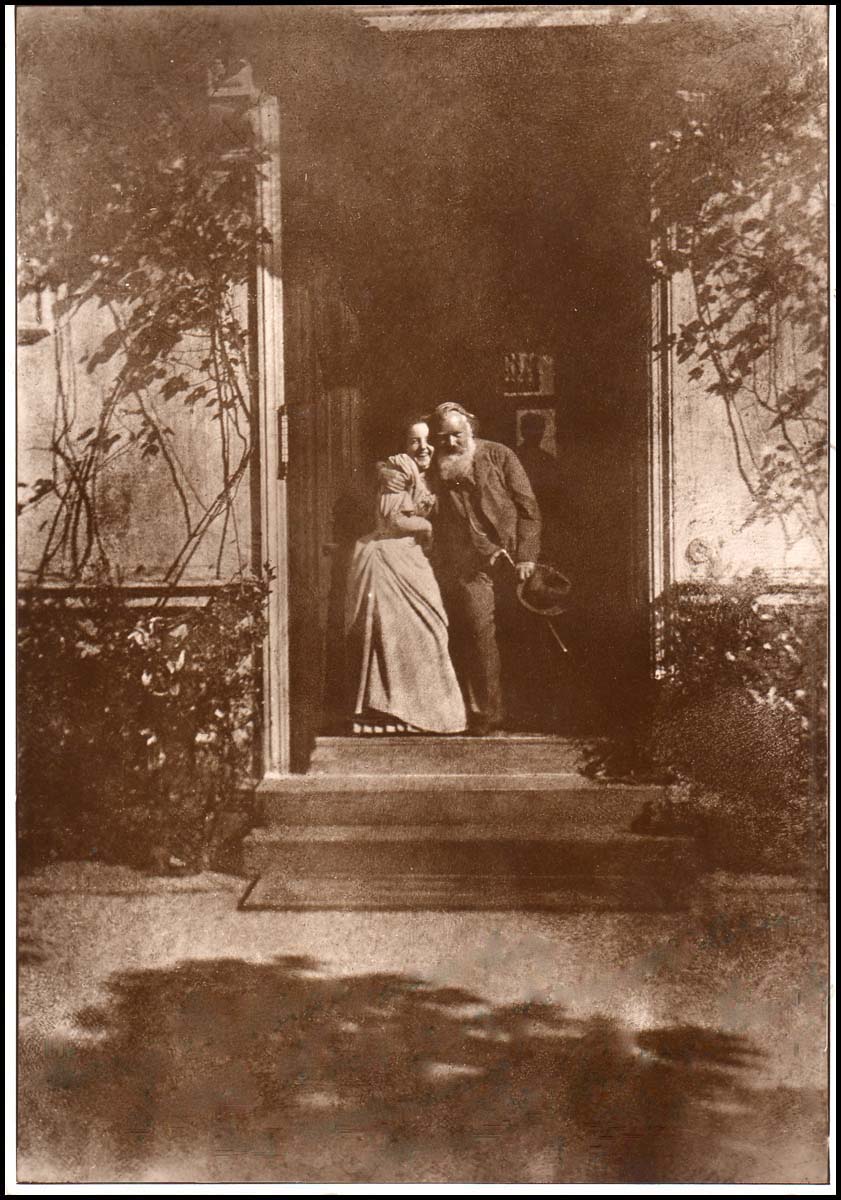
Swafford gives a different version of this relationship that makes Giesemann’s daughter, Lieschen, the thirteen year old piano companion and does not mention Matilde Kock (Swafford, 1997, pp. 34-5).  I am inclined to give more credence to Schauffler’s account — even though it is third hand — because Schauffler impresses me as striving for facts and authenticity, whereas Swafford, although a much more polished scholar and writer, is attempting to craft an image of Brahms consistent with his conservative moral and social biases.  Schauffler traveled widely over many years searching out people who knew Brahms, interviewed them, ferreted out documents.  His anecdotes are sometimes hearsay by third parties and many years removed from the events.  But he had a real passion for discovering the unknown facts about Brahms life and strived to authenticate everything as best he could.  He might have made some mistakes, but I think he had an honest heart.  I don’t feel that way about Swafford.  Opposite the title page of Schauffler’s book is an 1894 photograph of Brahms with his arm around eighteen year old Henrietta Hemala: a very unmisogynistic late portrait.
The many whores with whom Brahms consorted are not documented, but it is quite likely that Brahms liked many of them very much.  I would surmise that collectively they were as important as any of the women who are well documented, but they left no writings and were not involved in music.  I found the following reports in Schauffler.

Brahms found what solace he could in his venal loves of the moment.  In general, it may be safely asserted that servants, provided they were simple enough daughters of simple enough people, were the prostitutes’ only rivals for his sexual interest.

Mr. Oscar Ullmann of New York, who in his youth used to know Brahms well in Ischl, tells me that a very pretty girl working for concert manager Kugel was a favorite with the Master.  She told my informant what a passionate but awkward lover Brahms was.  (Schauffler, 1972, p. 277)

Before he had lived long in Vienna, Brahms knew most of the daughters of joy by name, and when he walked up the Kärnthnerstrasse they would greet him with affectionate enthusiasm as “Herr Doktor!”  If hard pressed, they would seek him out in some cafe, and he would always cheerfully give them two gulden, or more if they needed it.

A now celebrated musician has told me that in his youth Brahms recommended a certain public woman to him; and when he looked her up, she could not find words enough in praise of Herr Doktor, who had, she bore witness, treated her with the indulgent tenderness of a father.

“After a concert,” Frau Prof. Brüll tells me, “our party set out for a cafe.  Brahms gave me his arm and we met some streetwalkers, who hailed him with enthusiasm, embarrassing him very much.”  (Schauffler, 1972, p. 259)

How do you get misogyny out of all of this?  The only thing that Greenberg has to support his viewpoint is that Brahms didn’t marry; he preferred to live alone; he preferred the company of men; and he liked whores for sex.  So does that mean he didn’t like Women?  People who call Brahms a “misogynist” simply do not approve of his personal life.  The label says more about them that it does about Brahms.

Greenberg tells us about a trick rocking chair Brahms had in his living room that he invited unsuspecting women to sit in which would then throw them into embarrassing poses at which Brahms would laugh with uproarious, sadistic glee.  Greenberg takes this as telling evidence that Brahms did not like women.  The women that he perched in that chair were probably not his favorites, and the rocking chair served as a useful device for keeping these unwanted women away from him, but he did it with some good humor, albeit a little rough.

The rocking chair is a mischievous, childish, mildly sadistic device that gave Brahms a chance to mock the modesty and prudishness of middle class women who invaded his space, and it also served to keep these awful women that he despised, and who might have had designs on him, at a distance.  It is very unlikely that his prostitute friends would have been upset by the chair (but they never visited his residence).  They probably would have shared in the laugh.

Abraham Lincoln had some similarities in his character to Brahms.  He preferred the company of males.  He was noticeably uncomfortable around women and tended to avoid them.  He was very unhappily married to a woman who was mentally ill (Ferguson, 2010).  Lincoln was actually much more negative in his orientation and attitude toward women than Brahms, but no one calls Lincoln a misogynist.  Actually this pattern exemplified by Brahms and Lincoln was very typical for the nineteenth century male.  The sexes were more segregated in their social roles and same sex companionship was much more the norm and much more emotionally rich than it is today, especially for males (Ferguson, 2008).

Brahms’ attitude toward women was not any more negative than anyone else’s in nineteenth century Germany.  In fact, Brahms was probably more positive and nuanced than most.  It should be kept in mind that over the span of Brahms’ life women did not have the vote in Germany.  Germany did not even become unified as a nation state until 1871, well into Brahms life.  Married women did not have property rights.  They could not enter the university.  Their legal rights and social possibilities were unimaginably restricted by today’s standards.  Social agitation for women’s rights was only beginning to coalesce toward the end of Brahms’ life.  We can sit in our armchairs and pass judgment on the entire nineteenth century, but it is a meaningless exercise in arrogance.  People have to be understood and evaluated in the context of their own time and culture.

Edward M. Clarke, in the 1870s, studied the education of girls and women, arguing for greater equality between the sexes in educational opportunity.  His observations about Germany were that urban girls of the middle and upper classes were educated in schools until about the age of 15 or 16, then if they were educated any further, it would take place at home, perhaps with tutors.  However, peasant girls were not educated at all.

German peasant girls and women work in the field and shop with and like men. None who have seen their stout and brawny arms can doubt the force with which they wield the hoe and axe. I once saw, in the streets of Coblentz, a woman and a donkey yoked to the same cart, while a man, with a whip in his hand, drove the team. The bystanders did not seem to look upon the moving group as if it were an unusual spectacle. The donkey appeared to be the most intelligent and refined of the three. The sight symbolized the physical force and infamous degradation of the lower classes of women in Europe.  (Clarke, 1875, p. 178-79)

Brahms is starting to look better and better all the time.  What does ‘misogyny’ mean in a cultural climate such as nineteenth century Europe?

Brahms’ life, experiences, and attitudes were very typical for his time and culture.  He was not at all anomalous in his sexuality.  Brothels were readily available everywhere in the nineteenth century and men, especially, were sexualized from an early age.  Same sex relations were commonplace and close, affectionate ties between males was the rule, not the exception.  It was not at all unusual for men to prefer the association of other men over women in the nineteenth century, and indeed, many men today share that preference.

I suppose I should interpose a parenthetical comment on the other pressing question which Greenberg made the subject of another presentation in his video series that deals with Johannes Brahms and Clara Schumann:  Did they, or didn’t they? (Greenberg 2015b)  The short answer is: I don’t know.  But it is pretty clear that sex was not the center of this relationship.  Whether it might have been important in the early phase, or episodically, who knows?   But I agree with Avins that this is not the most interesting question to ask about Brahms and Clara (Avins, 1997, p. 757).  Avins, after long and careful study, thinks that the relationship was platonic.  Many others have concurred.  But the evidence is very incomplete and could be misleading.  Clara Schumann also had another significant relationship with Joseph Joachim alongside her relationship with Brahms at the time her last child, Felix was born.   She chose Brahms, Joachim and Mathilde Hartmann to be godparents to the new baby.  Avins notes that many take the fact of the choice of Brahms to be godfather to the boy as evidence that he was the father, but Avins thinks that the child’s having three godparents casts doubt on that.  (Avins, 1997, p. 760)  But the three godparents could also suggest that Clara wasn’t sure who the father was.  We don’t really know what might have gone on in these matters.

The argument I would give for Clara and Brahms’ relationship being platonic is of a different character than what is usually put forward.  I would point out that since Brahms’ sexual preference was for whores and brothels, he didn’t need Clara for sex, and therefore did not press the issue with her, and probably avoided it with her.  Perhaps he explored it with her in the early going and decided that Clara was no match for a St. Pauli girl, and left off with it.  Brahms having an established sexual alternative meant that a nonsexual relationship with Clara was tolerable and perhaps even desirable.  The interesting question that I would ask is to what extent was Clara cognizant of Brahms’ real sex life, and to what extent did Brahms share his adventures in the brothels with her?  If Brahms compartmentalized, that is, kept his sex life strictly separate from his relationships with his music women, then that argues for a platonic attachment to Clara.  Whereas if Brahms told Clara about his whoring adventures with relish, that would suggest a strong sexual component to the relationship.  The former seems the most likely to me.

How much Clara knew about Brahms sex life is less clear.  Brahms, though reserved, does not appear to have been secretive about it, and people do talk.  Something must have gotten back to Clara, but she might not have known the full proportions of it, and she may have been disinclined to probe into it.  She seems wise enough not to have made an issue of it, although many letters were deliberately destroyed, so the full story will probably never be known.

The view that Brahms’ impetuous ardour would have been irresistible for her does not ring true for the mother of seven who was keenly aware of the proprieties, who had borne more children than she had wanted, and who prided herself above all on knowing her duty and fulfilling it conscientiously (Avins, 1997, p. 759)

We can only go on what we have, and there is nothing that conclusively points to an ongoing sexual relationship between Johannes Brahms and Clara Schumann.

In my opinion, a more likely possibility for a sexual liaison, or at least a strong interest, is Brahms’ attachment to Clara’s oldest daughter, Julie.  Brahms was quite distressed when the news came that Julie was to be married, and this anguish caught Clara by surprise — another example of how Clara was out of touch with the emotional life of Brahms in matters relating to sex and romantic attachments (Avins, 1997, p. 394, 759 for more details).  It is always fair game to wonder and speculate about such matters in a person’s life, but it is also true that people tend to imagine more than actually happens, and not everything that actually happens is of great significance, although Brahms’ reaction to Julie’s marriage was reportedly strong.

Schauffler states that from the age of twenty-four Brahms was financially capable of supporting a marriage, but he felt that Brahms was not well suited to marriage, and judged it a plus for Brahms’ work as a composer and for his peace of mind that he did not marry. (Schauffler, 1972, p. 73)  Brahms recognized this as an important need himself to further his creative accomplishments, and in an 1887 letter to Freifrau von Heldberg he expressed this very frankly.

I dislike speaking of myself and my peculiarities.  The confession is plain:  I  need absolute solitude, not only in order to accomplish what I am capable of, but also, quite generally, to think about my vocation. . . But just now, with a new and major work sitting finished before me, I really do take some pleasure in it and have to say to myself:  I would not have written it had I enjoyed life ever so splendidly on the Rhine and in Berchtesgaden. (Brahms to Freifrau von Heldberg August 11, 1887, Avins p. 645)

Schauffler does relate an incident, though, that reveals the negative side of Brahms’ feelings toward women.  It was told to him by Max Friedlander about a birthday dinner for Brahms where some heavy drinking took place.  It should be noted that one aspect of the brothel culture that Brahms did not carry with him into his adult life was its promotion of heavy drinking.  Although Brahms was not sympathetic to the temperance movement which was gaining strength in his later years (Avins, p. 636), as an adult he drank very little, although there were exceptions.  And this birthday dinner was one of them.  It was his birthday and the champagne was good.

Brahms grew more and more silent, but nobody noticed anything curious about him.  The talk turned on a beautiful woman whom we all knew.  Still the Master was silent — until someone pressed him for his opinion.  That was a moment which I shall never forget!  Abruptly his harsh voice broke into a horrible, coarse tirade against this lady, broadening out to include women in general, and actually ended by applying to them all an incredible, unspeakable epithet — a word so vile that I have never been able to repeat it, even to my wife. (Schauffler, 1972, p. 224)

Later, after some coffee and a walk in the park, Friedlander and Brahms discussed the incident.

‘Look here,’ he demanded abruptly, ‘how were you brought up?’  So I told him of my childhood in the rather poor Silesian home with the six brothers and sisters of us; how devotedly my parents were attached to one another, how tenderly we were guarded from everything ugly and painful, and so on.

Suddenly Brahms burst with violence into my reminiscences, making a furiously angry scene in the middle of the Prater.  His eyes grew bloodshot.  The veins in his forehead stood out.  His hair and beard seemed to bristle.

‘And you,’ he cried menacingly, ‘you who have been reared in cotton wool;  you who have been protected from everything coarse — you tell me I should have the same respect, the same exalted homage for women that you have!’ (I had not, of course, put this into words, but his sensitive soul had caught my unuttered reproaches.) ‘You expect that of a man cursed with a childhood like mine!’

Then with bitter passion he recounted his poverty-stricken youth in the wretched slums of Hamburg; how as a shaver of nine, he was already a fairly competent pianist; and how his father would drag him from bed to play for dancing and accompany obscene songs in the most depraved dives of the St. Pauli quarter.

‘Do you know those places?’ he asked.  ‘Only from the outside.’  ‘Then you can’t have the least idea of what they are really like.  And in those days they were still worse.  They were filled with the lowest sort of public women — the so-called “Singing Girls.”  When the sailing ships made port after months of continuous voyaging, the sailors would rush out of them like beasts of prey, looking for women.  And these half-clad girls to make the men still wilder, used to take me on their laps between dances, kiss and caress and excite me.  That was my first impression of the love of women.  And you expect me to honour them as you do!’  It was long before his anger simmered down and we left the park. (Schauffler, 1972, pp. 225-26)

For the purpose of this discussion we will take Friedlander’s report at face value and not question its veracity or any bias that may be distorting it — which, I think, is a generous assumption.  What does it show about Brahms?

This is Brahms’ response to Friedlander, Swafford, Greenberg, Schauffler, and all the other saintly would-be biographers.  “Who the hell do you think you are to tell me I should hold women in the same high esteem that you do?”  Brahms knew a different side of women, a different type of woman than the middle class women who came to him for piano lessons.  The whores in the brothels didn’t play the piano and didn’t want piano lessons.  They didn’t care about his piano rhapsodies or his string quartets.  They wanted something else.  And, if you notice, the women Brahms despised were the middle class women, such as the one that touched off the tirade at the dinner party, not the whores.  But Greenberg thinks if you like whores and you don’t like prudish middle class women, then you are a misogynist.  A drunken rant against women does not make Brahms a misogynist.  It just means he is in a bad mood.  Misogyny is about the big picture; it is about pervasive trends and patterns of behavior, and in Brahms’ case the big picture regarding women, while mixed, is decidedly positive.

‘Misogyny’ is a term with a simple definition, but it does not really describe anybody.  It is used rather to tar someone whose behavior or lifestyle one disapproves of.   Misogyny is bad.  We aren’t supposed to be misogynistic in this enlightened day and age.  So if you can stick that label on someone, that means they’re a bad person and you are justified in disliking them, hating them, dismissing them, and inflicting all sorts of abuse on them.  The simplistic use of ‘misogyny’ that equates any negative feeling toward women with a general, implacable hatred can be used to vilify almost anybody.  All males have ambivalent feelings about women and all men have episodes in their lives where they might have behaved better toward particular women.  Relations between the sexes are inherently conflicted and have many sharp edges.  This doesn’t mean that we are mortal enemies, or that we don’t like each other in principle.  Even women could be labeled as misogynists.  ‘Misogyny’ is one of these terms we use to marginalize people we don’t like and want to transform into social outcasts.  It is an oversimplification that should be abandoned.

Avins, to her credit, noticed that

Amidst all the speculation as to why Brahms never married, virtually no attention has been paid to the unhappy marriage he was continual witness to as he was growing up. (Avins, 1997, p. 334)

Avins also notes that Brahms’ brother, Fritz, also never married.  This is a much more promising approach to understanding Brahms’ avoidance of marriage than anything that might have happened in the Hamburg brothels.  His parents were his primary role model for marriage.  If their marriage was something that looked good and inspiring to the young Brahms, (in the way Friedlander’s parents did to him) that ambition would have survived the dissoluteness of the brothels.  If indeed the brothels were so awful and the experiences there so abusive and disagreeable, Brahms would have had all the more reason to gravitate toward marriage as a glowing salvation.  He had plenty of opportunities and plenty of encouragement in his adult life to do that.  But he didn’t.  Instead he disparaged marriage, repudiated it, and kept the whores.  Brahms’ life, and his experiences with women, sex, and marriage confirm that his experience in the brothels represented his authentic, egosyntonic self.  He rejected and despised the prudishness and sexual conservatism of the middle class society into which he emerged as an adult.   His heart remained true to his roots in those Hamburg brothels.  That is the judgment that is so hard for people like Greenberg, Swafford, Avins, Gal, and Schauffler to swallow.  They chorus that there must be something wrong with Brahms!  Brahms is damaged; Brahms is screwed up; Brahms is defective!  All because he didn’t get married.  The whores must have done this to him, those bad girls!  What is wrong with these people?  Let Brahms be Brahms.  If Brahms accomplishments have any bearing on the matter, then maybe people should not get married.

But they don’t even give his parents so much as a glance. Yet this is really the key to understanding Brahms’ lifelong aversion to marriage, not the brothels.  If they did look at his parents’ marriage, they might have to face the discomfiting truth that marriage is not all that good for most people, that marriage screws up a lot of people for life, as well as a lot of children, and there are a lot of advantages to whores in the eyes of many men.

[In 1864] he returned to Hamburg to find his family in disastrous discord.  His parents had come to a bitter parting of the ways, his father insisting he could no longer live with an aged wife and the ailing daughter he viewed as a malingerer (she suffered from migraine headaches).  The events leading to this crisis are impossible to sort out in detail, given the surviving facts.  .  .  The current difficulty was nothing new.  Life in the Brahms household had been troubled for a very long time, as witnessed by the details of the letter Christiane Brahms wrote to Johannes just before her death (Letter 191), and had now come to a terrible climax. By July, Johann Jakob had left his family and stopped supporting his 73 year old wife, who was becoming blind.  She too was forced to move.  Brother Fritz and sister Elise never forgave their father; to Clara’s astonishment, Brahms had some understanding for him, as indeed he did for all the parties involved, and he tried to reconcile his parents.  When that failed, he urged the family to remain on speaking terms (in vain), acted as go-between when that too failed, and did his utmost to provide money for mother, father, and sister.  As a consequence, the next few years were the leanest ones of his life, as there were now separate households to pay for.  (Avins, 1997, p. 297-98)

Nothing to recommend marriage in any of this.

The 1864 letter Avins mentions (no 191, Avins, 1997, pp. 311-17) from Brahms’ mother to himself is a long, melancholy litany detailing her side of the marriage to Brahms’ father from beginning to end.  If you want to understand why Brahms feared marriage, take a look at this. I won’t quote it because there is too much, but it is clear that Brahms’ did not have an appealing example of marriage to inspire him or model himself on from his parents, and this had much more to do with his avoidance of marriage than his cavorting with the whores.

Swafford tells us that when Brahms’ parents married, his father was twenty-four and his mother forty-one. (Swafford, 1997, p. 13f.)  Brahms was born in the red-light district of Hamburg in 1833.  Swafford alludes to accumulated incompatibilities in the marriage of Brahms’ parents, which he doesn’t specify, but attributes to their difference in age (again demonstrating his ignorance and superficiality in understanding human relations).  One thing that everyone (except Avins and Hofmann) agrees on, but no one seems to grasp the significance of, is the fact that it was Brahms’ father who took the young boy to the brothels and got him the job playing the piano for the revelers.  This implies that his father must have been familiar with these establishments.  I doubt if they were answering a want ad.  This means that Johann Jakob knew the environment that he was taking his young son into, the kind of activities he would be exposed to, the kind of experiences he was likely to have, and he didn’t seem to have a problem with it.  This may additionally have been a partial reflection on his marriage to Brahms’ mother, Christiane.  The young boy, Hannes, absorbed this, and made a good strong identification with his father and with his father’s sexual pattern.  As an adult, he preferred whores and shunned marriage, very much in keeping with the example set by his father.  Don’t blame it on the whores.

To be sure, Brahms had a lot of negative feelings toward women; he tended to disparage them, avoided their company, and this is evident in his personal relationships, including with Clara.  He once confessed to being prejudiced against women pianists.  “I have a powerful prejudice against women pianists and anxiously avoid listening to them.” (Avins, p. 502)  However, he did ask Clara to play through all of his songs prior to their publication “and say a word to me about them.”  (Avins, 1997, 509)  Brahms behavior toward women shows inner conflict and contradictory trends, but not implacable hatred.

It is patently mistaken to attempt to trace this back to the Hamburg brothels. The kind of attitude toward women that we see in Brahms was very typical for nineteenth century Europe (and America).  The label  ‘misogyny’ distorts and simplifies it to the point where it becomes mendacious.  I would further speculate that the negative feelings Brahms expressed at times toward women went back primarily to his mother, rather than the whores in the brothels.  From an early age Brahms likely sympathized with his father, identified with his father, and perhaps took his father’s part and held his mother responsible for the ills in their marriage.  That is speculative.  But it is certainly not fear of sexuality as Swafford tries to insist.

The stain of Hamburg prostitutes continued to taint all his response to women.  He feared their sexuality, and like many self-protective, solitary men, feared even more the sexual and emotional power women wielded over him. (Swafford, 1997, p. 323)

Brahms was not afraid of sex.  Gal tells us that “Brahms was and remained a worshipper of feminine beauty, easily set afire but apparently just as easily cooled off.” (p. 94)  And as we noted earlier Schauffler reported from numerous sources that Brahms was highly sexed.  Some of his hostility toward women was born of attraction coupled with fear.  A temptation that is regarded as dangerous can provoke a hostile response in a person.  But the fear is not of sex.  His penchant for whores disproves that.  The fear is of being enmeshed in the kind of morass that his family was mired in, and that wrecked his father’s life.

You can’t underestimate the influence of his father, Johan Jakob, on Brahms.  Brahms saw his father’s dissatisfaction with his marriage from a very early age, and he also saw the satisfaction his father took in the brothels and in other sexual liaisons outside of his marriage.  His father clearly wanted Brahms to be sexualized in the brothels at a very early age, rather than saving himself for marriage.  And it took root.  Brahms was sympathetic to his father.  He did not despise him or repudiate him.  In letters as an adult he addressed him as “Beloved Father, ” “Dearest Father.” (Avins, 1997, pp. 333, 345, 347, 399, etc.)  He had an especially warm relationship with his father with good communication.  He enthusiastically endorsed his father’s remarriage in 1865 following his mother’s death and supported him financially as well (Avins, 1997, pp. 333f.).  He took the good in his father’s example, namely, the whores and the brothels, and rejected the bad: marriage.

The attempt by Greenberg, Swafford and the other biographers to blame the shape of Brahms personal life on his early experiences in the brothels of Hamburg is misguided and yields a distorted image of Brahms that is out of sync with the reality that he himself experienced and felt.  These biographers are men who are deeply committed to marriage and sexual conservatism as the normative lifestyle for people, and Brahms was an adamant dissenter from that social tide.  Greenberg, Swafford, and Schauffler are much more threatened by Brahms than Brahms was by sex.  This is why it is necessary to discredit Brahms, to label him a ‘misogynist’, a psychological misfit, a damaged victim of childhood abuse, etc.  Brahms had a hard childhood, to be sure, and he had a lot of negative feelings toward women.  But he was also resilient and flexible and he was able to respond above his prejudicial dispositions to individual people, and his relations with women, while conflicted and adumbrated in some respects, are warm, often passionate, and overwhelmingly constructive.  The attempt by these biographers to simplify Brahms, or to bring him into line with the moral prejudices or our own time, or to dismiss him with some facile label that carries within it a negative moral judgment, is offensive and intellectually dishonest.


References


Avins, Styra, Ed. (1997)  Johannes Brahms: Life and Letters.  Oxford, New York:  Oxford University Press.

Clarke, Edward H. (1875)   Sex in Education: Or, a Fair Chance for Girls.  Boston:  James R. Osgood & Company.

Ferguson, Michael (2010)  Was Abraham Lincoln Gay?  Journal of Homosexuality.  Vol. 57, No. 9, pp. 1124-1157.

Ferguson, Michael ( 2008)  Book Review.  Picturing Men:  A Century of Male Relationships in Everyday American Photography, by John Ibson.  Chicago:  University of Chicago Press.  2002.  Journal of Homosexuality  Vol. 55, No. 2, pp. 319-323.

Gal, Hans (1963)  Johannes Brahms:  His Work and Personality.  Translated from the German by Joseph Stein.  New York:  Alfred Knopf.

Greenberg, Robert (2015b)  Brahms, the Ladies, and the Trick Rocking Chair.  Video presentation in the Ora.tv series Scandalous Overtures.  http://www.ora.tv/scandalousovertures/johannes-brahms-brahms-ladies-trick-rocking-chair-0_4vxpe6o87dy8    March 3, 2015.

Greenberg, Robert (2015a)  Johannes Brahms and Clara Schumann: Did They or Didn’t They?.  Video presentation in the Ora.tv series Scandalous Overtures.  http://www.ora.tv/scandalousovertures/johannes-brahms–clara-schumann–0_5gjeid2yimd9  January 29, 2015

Hofmann, Kurt (1986)  Johannes Brahms und Hamburg.  2nd Revised Edition.  Reinbek.

Neunzig, Hans A. (1973 [2003]) Brahms. Translated by Mike Mitchell.  London:  Haus Publishing.

Schauffler, Robert Haven (1933 [1972]) The Unknown Brahms: His Life, Character, and Works; Based on New Material. Westport, CT:  Greenwood Press.

Swafford, Jan (1997)  Johannes Brahms:  A Biography.  New York:  Vintage/Random House.

Swafford, Jan (2001)  Did the Young Brahms Play Piano in Waterfront Bars?  19th Century Music 24/3, pp. 268-275.

The Dawn of Human Culture — Book Review

By Joe Cillo

The Dawn of Human Culture:  A Bold New Theory on what sparked the “Big Bang” of Human Consciousness.  By Richard G.  Klein and Blake Edgar.  New York:  John Wiley & Sons.  2002.


This is the best overview of the archeological perspective on human evolution that I have seen.  I have not seen them all, but I have followed developments in this field for at least forty years.  Reading about the different fossils and different archeological finds and different human ancestors in isolation can be confusing.  It is hard to tell the relationships between one ancient ancestor and another.  It is hard to keep the chronology in mind.  It is not clear what came from what or how and when developments took place.  This book straightens a lot of that out.  It is a clearly written, readable, interesting, well organized presentation, well illustrated with many drawings, charts, and maps that powerfully enhance the text.

The dawn of culture doesn’t really break until the last chapter.  Most of the book is just setting the stage for the dawn of culture.  But that is very OK, because it underlines how long it took to get to the place where what we think of as human culture could appear, and it emphasizes through most of human evolution there was no “culture” as we think of it.  People have been making tools out of stone for about 2.5 million years, but if culture means representing ideas to one’s fellow creatures, thinking beyond day to day survival, that did not exist until very recently, say about 50,000 years ago.

It appears to have been a quantum behavioral and psychological leap.  There was no gradual evolution toward “culture.”  It seems to have exploded with modern humans after about 50-60,000 years ago, and within a relatively short time spread to the far corners of the earth.  This seems to call out for an explanation since the ways of life, technology, economy, social organization, and relationship to the natural world remained relatively stable in human ancestor populations for eons prior.  Human anatomy has been stable for about 200,000 years.  Brian Sykes tells us that all living humans can be traced to a single woman living in East Africa about 150,000, years ago, and all non-African modern humans can be traced through another East African woman about 50,000 years later.  (Sykes, 2001, pp. 276-78)  So modern humans, homo sapiens sapiens, have been established as a species for at least 150,000 years.  But culture did not appear until about 100,000 years into that span.  What took so long?  And when it did appear, it came in a flood.  It was around that time that modern humans began to migrate out of Africa and displace all of the proto-human ancestor populations like the Neanderthals, homo erectus, and perhaps others in the Middle East, Europe, and Asia.  Technology dramatically changed.  Stone tools developed much greater variety and sophistication.  Beads and jewelry appeared.  The first sculptures and figurines were made.  Cave painters began painting magnificent murals on the walls of caves starting at least 32,000 years ago.  What was the spark that lit this fire?

Klein and Edgar think it had to do with a genetic mutation that altered brain function and/or anatomy.  They cite a 2001 paper by Lai, et al.  (Lai, et al, 2001) that claims to have discovered a gene that plays a role in language development.  Were such a gene to be missing or mutated in non-human hominids, it could explain why humans have spoken languages and non-human hominids didn’t.  If that were a gene that mutated in a small human population 50,000 or so years ago and allowed people to develop spoken languages, it could have been the point at which modern humans leaped into the Late Stone Age.   The problem with it is that it is putting a lot on one gene.  This kind of theory is going to be hard to validate from fossils.  The human brain reached nearly its full size by 600,000 years ago.  The Neanderthals actually had larger brains that we do.  So size isn’t everything.  Klein and Edgar think that a genetic modification altered the organization of the brain that allowed for the development of spoken languages.  Spoken languages are considered to be closely linked to the development of “culture.”  Spoken languages powerfully change social relations between people, facilitate organization, enable human beings to develop ideas, modify behaviors, make corrections, improve things, “advance.”  The Neanderthals lived in Europe and the Middle East for at least 200,000 years.  But their technology and way of life did not change very much over that vast time period.  Once modern humans set the cultural snowball rolling it has been growing and accelerating at an increasing pace ever since, to the point where we now completely dominate the globe and are on the verge of destroying it, ourselves, and everything else.  Human intelligence and human culture may turn out to be a failed evolutionary experiment.

I don’t have an opinion on what sparked the advent of human culture.  Klein and Edgar’s hypothesis is speculative.  It could have some plausibility, but the arguments are inconclusive.  The real value of this book, aside from wrestling with the issue of how human culture originated, is its clear, comprehensive, well organized, well illustrated exposition of the evolution of the human species from the fossil record, how that record was assembled, and the issues and controversies that accompanied its growth.  This book makes it all much more comprehensible than anything else I have seen to date.


Notes


Lai, Cecelia S. L.; Fisher, Simon E.; Hurst, Jane A.; Vargha-Khadem, Faraneh; Monaco, Anthony P. (2001)  A forkhead-domain gene is mutated in a severe speech and language disorder.  Nature 413: 519-23.

Sykes, Brian (2001)  The Seven Daughters of Eve:  The Science that Reveals our Genetic Ancestry.  New York & London:  W.W. Norton.

A Month in the Country Not Always a Vacation

By Joe Cillo

A Month in the Country Not Always a Vacation
Russian drama requires some effort from American audiences. We must distinguish the Kolyas from the Katyas, the Alexseys from the Arkadys, and then we need to adapt to political and family systems that were in place at the time. Most Russian drama performed here is from Chekhov, but Ross Valley Players’ new production is pre-Chekhovian, “A Month in the Country” by Ivan Turgenev. Its Russian gloom has been brightened by an adaptation from Irish playwright Brian Friel and by lively direction from James Nelson.
First, the audience is warned that cossacks will be on hand to enforce the no cell phone rules, and then the garden wall opens to reveal a comfortably-furnished country estate with a card game going on in the background. The game is being made more difficult by the German tutor’s language struggles. When Herr Schaaf accuses his partners of “stealing the cat,” they stop and correct him: “the kitty.”
Natalya, the lady of the house, lounges on a nearby sofa, wheedling a long-time admirer to read to her and whining how sick she is of these “gloomy, airless rooms, just like those of the lace makers.” Michel, the admirer, clearly adores her, though it’s hard to see why.
Residents and visitors come and go with other complaints and needs. Natalya’s husband Arkady Islayev bursts in, full of enthusiasm for his new winnowing machine, but explaining to all who will listen about the need to supervise Russian workmen. Two household servants, Matvey and Katya, continue their disagreement about Matvey’s marriage proposal and whether or not he’s too old for her.
Anna, Arkady’s dignified mother lives here on the estate, and so does Lizaveta, a snuff-sniffing companion. Neither of them seems to have much to do, other than maintain the status quo.
A new member has recently joined the household: Alexsay, another tutor for the Islayevs’ son. Natalya is besotted with the handsome young man. The possibility of forbidden romance relieves her boredom, though he’s only twenty-one , and she’s twenty-nine. However, an attractive seventeen-year-old girl is also on the premises, a foster daughter named Vera, and she’s interested in Alexsey as well. Seeing Natalya’s distress, Dr. Shpigelsky says he’s found a perfect husband for Vera. It will turn out that the suitor is a rich neighbor, fifty-seven years old. This suggestion brings on more conflict. And when Natalya’s husband becomes dimly aware of Michel’s infatuation with his wife, he comes up with an astonishing way to keep everybody happy. Who will stay here? Who will go?
Director James Nelson sees Turgenev’s play as “the destructive and incendiary nature of desire,” with each character involved in “a web of romantic pursuit” that contrasts with their polite and ordered setting.
Ken Rowland designed the set for them, a garden and interior suitable for country gentility. Michael A. Berg fashioned costumes for the different social classes of the 1840’s.
Shannon Veon Kase has the difficult role of Natalya, petulant, spoiled and sometimes shrill in her discontent. Her devoted Michel, subtly played by Ben Ortega, seems genuinely lovable, though unloved. Tom Hudgens portrays Arkady, the tradition-bound husband, with natural authority, while Wood Lockhart depicts Dr. Shpiegelsky’s self-awareness and good humor.
Zach Stewart plays the appealing tutor, Alexsey, and Emily Ludlow is talented young Vera. The arguing servants, Matvey and Katya, are acted by Johnny DeBernard and Jocelyn Roddie. Robyn Wiley is the snuff-addicted Lizaveta, and Kim Bromley is the estate’s distinguished owner, Anna. The outsider, Herr Schaaf, is given a humorous turn by Mark Shepard, with Frederick Lein as the unwelcome suitor, Bolshintsov.
“A Month in the Country” will be at the Barn Theatre in the Marin Art & Garden Center, Ross, Thursdays through through Sunday April 12. Thursday shows are at 7:30 p.m., Fridays and Saturdays at 8 p.m., and Sunday matinees at 2 p.m.
(NOTE: There will be both 2 p.m. and 8 p.m. performances on Saturday, April 11.
Ticket prices range from $14 to $29. For complete information, call 415-456-9555 or see www.rossvalleyplayer.com

up with an astonishing way to keep everybody happy. Who will stay here? Who will go?
Director James Nelson sees Turgenev’s play as “the destructive and incendiary nature of desire,” with each character involved in “a web of romantic pursuit” that contrasts with their polite and ordered setting.
Ken Rowland designed the set for them, a garden and interior suitable for country gentility. Michael A. Berg fashioned costumes for the different social classes of the 1840’s.
Shannon Veon Kase has the difficult role of Natalya, petulant, spoiled and sometimes shrill in her discontent. Her devoted Michel, subtly played by Ben Ortega, seems genuinely lovable, though unloved. Tom Hudgens portrays Arkady, the tradition-bound husband, with natural authority, while Wood Lockhart depicts Dr. Shpiegelsky’s self-awareness and good humor.
Zach Stewart plays the appealing tutor, Alexsey, and Emily Ludlow is talented young Vera. The arguing servants, Matvey and Katya, are acted by Johnny DeBernard and Jocelyn Roddie. Robyn Wiley is the snuff-addicted Lizaveta, and Kim Bromley is the estate’s distinguished owner, Anna. The outsider, Herr Schaaf, is given a humorous turn by Mark Shepard, with Frederick Lein as the unwelcome suitor, Bolshintsov.
“A Month in the Country” will be at the Barn Theatre in the Marin Art & Garden Center, Ross, Thursdays through through Sunday April 12. Thursday shows are at 7:30 p.m., Fridays and Saturdays at 8 p.m., and Sunday matinees at 2 p.m.
(NOTE: There will be both 2 p.m. and 8 p.m. performances on Saturday, April 11.
Ticket prices range from $14 to $29. For complete information, call 415-456-9555 or see www.rossvalleyplayers.com

Vera. The arguing servants, Matvey and Katya, are acted by Johnny DeBernard and Jocelyn Roddie. Robyn Wiley is the snuff-addicted Lizaveta, and Kim Bromley is the estate’s distinguished owner, Anna. The outsider, Herr Schaaf, is given a humorous turn by Mark Shepard, with Frederick Lein as the unwelcome suitor, Bolshintsov.
“A Month in the Country” will be at the Barn Theatre in the Marin Art & Garden Center, Ross, Thursdays through through Sunday April 12. Thursday shows are at 7:30 p.m., Fridays and Saturdays at 8 p.m., and Sunday matinees at 2 p.m.
(NOTE: There will be both 2 p.m. and 8 p.m. performances on Saturday, April 11.
Ticket prices range from $14 to $29. For complete information, call 415-456-9555 or see www.rossvalleyplayers.com

670 words By ROSINE REYNOLDS

A Month in the Country Not Always a Vacation
Russian drama requires some effort from American audiences. We must distinguish the Kolyas from the Katyas, the Alexseys from the Arkadys, and then we need to adapt to political and family systems that were in place at the time. Most Russian drama performed here is from Chekhov, but Ross Valley Players’ new production is pre-Chekhovian, “A Month in the Country” by Ivan Turgenev. Its Russian gloom has been brightened by an adaptation from Irish playwright Brian Friel and by lively direction from James Nelson.
First, the audience is warned that cossacks will be on hand to enforce the no cell phone rules, and then the garden wall opens to reveal a comfortably-furnished country estate with a card game going on in the background. The game is being made more difficult by the German tutor’s language struggles. When Herr Schaaf accuses his partners of “stealing the cat,” they stop and correct him: “the kitty.”
Natalya, the lady of the house, lounges on a nearby sofa, wheedling a long-time admirer to read to her and whining how sick she is of these “gloomy, airless rooms, just like those of the lace makers.” Michel, the admirer, clearly adores her, though it’s hard to see why.
Residents and visitors come and go with other complaints and needs. Natalya’s husband Arkady Islayev bursts in, full of enthusiasm for his new winnowing machine, but explaining to all who will listen about the need to supervise Russian workmen. Two household servants, Matvey and Katya, continue their disagreement about Matvey’s marriage proposal and whether or not he’s too old for her.
Anna, Arkady’s dignified mother lives here on the estate, and so does Lizaveta, a snuff-sniffing companion. Neither of them seems to have much to do, other than maintain the status quo.
A new member has recently joined the household: Alexsay, another tutor for the Islayevs’ son. Natalya is besotted with the handsome young man. The possibility of forbidden romance relieves her boredom, though he’s only twenty-one , and she’s twenty-nine. However, an attractive seventeen-year-old girl is also on the premises, a foster daughter named Vera, and she’s interested in Alexsey as well. Seeing Natalya’s distress, Dr. Shpigelsky says he’s found a perfect husband for Vera. It will turn out that the suitor is a rich neighbor, fifty-seven years old. This suggestion brings on more conflict. And when Natalya’s husband becomes dimly aware of Michel’s infatuation with his wife, he comes up with an astonishing way to keep everybody happy. Who will stay here? Who will go?
Director James Nelson sees Turgenev’s play as “the destructive and incendiary nature of desire,” with each character involved in “a web of romantic pursuit” that contrasts with their polite and ordered setting.
Ken Rowland designed the set for them, a garden and interior suitable for country gentility. Michael A. Berg fashioned costumes for the different social classes of the 1840’s.
Shannon Veon Kase has the difficult role of Natalya, petulant, spoiled and sometimes shrill in her discontent. Her devoted Michel, subtly played by Ben Ortega, seems genuinely lovable, though unloved. Tom Hudgens portrays Arkady, the tradition-bound husband, with natural authority, while Wood Lockhart depicts Dr. Shpiegelsky’s self-awareness and good humor.
Zach Stewart plays the appealing tutor, Alexsey, and Emily Ludlow is talented young Vera. The arguing servants, Matvey and Katya, are acted by Johnny DeBernard and Jocelyn Roddie. Robyn Wiley is the snuff-addicted Lizaveta, and Kim Bromley is the estate’s distinguished owner, Anna. The outsider, Herr Schaaf, is given a humorous turn by Mark Shepard, with Frederick Lein as the unwelcome suitor, Bolshintsov.
“A Month in the Country” will be at the Barn Theatre in the Marin Art & Garden Center, Ross, Thursdays through through Sunday April 12. Thursday shows are at 7:30 p.m., Fridays and Saturdays at 8 p.m., and Sunday matinees at 2 p.m.
(NOTE: There will be both 2 p.m. and 8 p.m. performances on Saturday, April 11.
Ticket prices range from $14 to $29. For complete information, call 415-456-9555 or see www.rossvalleyplayer.com

670 words By ROSINE REYNOLDS

A Month in the Country Not Always a Vacation
Russian drama requires some effort from American audiences. We must distinguish the Kolyas from the Katyas, the Alexseys from the Arkadys, and then we need to adapt to political and family systems that were in place at the time. Most Russian drama performed here is from Chekhov, but Ross Valley Players’ new production is pre-Chekhovian, “A Month in the Country” by Ivan Turgenev. Its Russian gloom has been brightened by an adaptation from Irish playwright Brian Friel and by lively direction from James Nelson.
First, the audience is warned that cossacks will be on hand to enforce the no cell phone rules, and then the garden wall opens to reveal a comfortably-furnished country estate with a card game going on in the background. The game is being made more difficult by the German tutor’s language struggles. When Herr Schaaf accuses his partners of “stealing the cat,” they stop and correct him: “the kitty.”
Natalya, the lady of the house, lounges on a nearby sofa, wheedling a long-time admirer to read to her and whining how sick she is of these “gloomy, airless rooms, just like those of the lace makers.” Michel, the admirer, clearly adores her, though it’s hard to see why.
Residents and visitors come and go with other complaints and needs. Natalya’s husband Arkady Islayev bursts in, full of enthusiasm for his new winnowing machine, but explaining to all who will listen about the need to supervise Russian workmen. Two household servants, Matvey and Katya, continue their disagreement about Matvey’s marriage proposal and whether or not he’s too old for her.
Anna, Arkady’s dignified mother lives here on the estate, and so does Lizaveta, a snuff-sniffing companion. Neither of them seems to have much to do, other than maintain the status quo.
A new member has recently joined the household: Alexsay, another tutor for the Islayevs’ son. Natalya is besotted with the handsome young man. The possibility of forbidden romance relieves her boredom, though he’s only twenty-one , and she’s twenty-nine. However, an attractive seventeen-year-old girl is also on the premises, a foster daughter named Vera, and she’s interested in Alexsey as well. Seeing Natalya’s distress, Dr. Shpigelsky says he’s found a perfect husband for Vera. It will turn out that the suitor is a rich neighbor, fifty-seven years old. This suggestion brings on more conflict. And when Natalya’s husband becomes dimly aware of Michel’s infatuation with his wife, he comes up with an astonishing way to keep everybody happy. Who will stay here? Who will go?
Director James Nelson sees Turgenev’s play as “the destructive and incendiary nature of desire,” with each character involved in “a web of romantic pursuit” that contrasts with their polite and ordered setting.
Ken Rowland designed the set for them, a garden and interior suitable for country gentility. Michael A. Berg fashioned costumes for the different social classes of the 1840’s.
Shannon Veon Kase has the difficult role of Natalya, petulant, spoiled and sometimes shrill in her discontent. Her devoted Michel, subtly played by Ben Ortega, seems genuinely lovable, though unloved. Tom Hudgens portrays Arkady, the tradition-bound husband, with natural authority, while Wood Lockhart depicts Dr. Shpiegelsky’s self-awareness and good humor.
Zach Stewart plays the appealing tutor, Alexsey, and Emily Ludlow is talented young Vera. The arguing servants, Matvey and Katya, are acted by Johnny DeBernard and Jocelyn Roddie. Robyn Wiley is the snuff-addicted Lizaveta, and Kim Bromley is the estate’s distinguished owner, Anna. The outsider, Herr Schaaf, is given a humorous turn by Mark Shepard, with Frederick Lein as the unwelcome suitor, Bolshintsov.
“A Month in the Country” will be at the Barn Theatre in the Marin Art & Garden Center, Ross, Thursdays through through Sunday April 12. Thursday shows are at 7:30 p.m., Fridays and Saturdays at 8 p.m., and Sunday matinees at 2 p.m.
(NOTE: There will be both 2 p.m. and 8 p.m. performances on Saturday, April 11.
Ticket prices range from $14 to $29. For complete information, call 415-456-9555 or see www.rossvalleyplayer.com

The Wrecking Crew — Film Review

By Joe Cillo

The Wrecking Crew

Directed by Denny Tedesco

This is a fascinating look at the West Coast music industry of the 1960 and 70s.  There are many intimate interviews with many of the insiders who made the hit records happen time and time again.  The film was made by Denny Tedesco, the son of Tommy Tedesco, one of the lead guitarists in the group.  The real story that this film seeks to lift up is the musicians who played on those records and who were a large part of the creative input on those records, but who never got a visible credit and whose names are unknown to the public.  It was the same small, tight group of high quality musicians that played behind a diverse group of front bands that included The Beach Boys, The Mamas and the Papas, The Monkees, The Fifth Dimension, The Association, The Ronettes, John Denver, Nancy Sinatra, and many many others.  These were the studio musicians who played on the records that were played on the radio and sold in record stores.  They also played on popular commercials and theme music for television programs such as Hawaii Five-O.  They did not tour with the bands.  They did not play in stadiums and concert halls.  They were the invisible musical force behind the scenes that gave this music its power and appeal.  For anyone born before 1960 it is a must see, but anyone who listens to the music from that era and is interested in the cultural history of the United States at that time will find much that is of great interest.

What Tedesco has exhibited is the raw material of a documentary, but I think he needs to work on it.  Tedesco is not Ken Burns, but he needs to take some lessons from him.  This material needs some thematic organization, some historical and cultural context, some chronological definition.  This film has no center of gravity.  It lacks a narrative line that would unify it and weave these disparate pieces together into a continuous whole.  As it is, it’s a bit of a hodgepodge, a bunch of very interesting, provocative clips strung together, and each person and each interview is interesting in and of itself, so you cannot fail to be captivated by the content of this film.  I wish Tedesco had a broader and deeper concept of his task.  I think it should be about four times as long.  He should present more background, not only on the individual musicians, but on the entire music phenomenon of the 1960s rock and roll scene.  I would like to see a much more complete catalog of the groups, the albums, and the songs that The Wrecking Crew worked on, as well as a contrast with the groups that did not use the studio musicians from the Wrecking Crew.  Was there discourse between them?  Occasional collaborations and crossovers?  I also wasn’t satisfied with his account of the demise of the Wrecking Crew and how the recording industry changed in the latter half of the 1970s.

In the question and answer session afterwards he said the film is finished, but at the same time he told us he did an interview with Michael Nesmith of the Monkees that very morning.  I hope he will continue to go forward with the project, expand it, and forge a real historical documentary that will become the definitive statement on the period.  He certainly has a priceless trove of material and I could see in the question session that he has much more in his head than he could convey in the film.  I congratulate him on a superb effort in collecting it and truly wish him well in developing it.

Beach Blanket Ephesus at COM

By Joe Cillo

When we’re enjoying a well-staged Shakespeare comedy, life’s a beach, and this one comes complete with a lifeguard chair, a parked surfboard and an obliging Pepsi machine. As soon as the Beach Boys launch into, “Surfin’ USA,” the boardwalk comes to life with skaters, twisters, comic policemen and dancers doing “The Swim.” The Bard’s Ephesus, it turns out, looks a lot like SoCal’s Venice Beach.
Instead, it’s “The Comedy of Errors” at College of Marin, and its director, James Dunn, has explained that the play is a farce, with all the characters trying to find out who they are and what they’re supposed to be doing. It’s fast-moving, he says, and Dunn should know. This was the first production from COM’s new Drama Department in 1964, which he founded. The present “Comedy,” being shown in the James Dunn Theatre, is the Department’s 272nd.
But not everybody is welcome in Ephesus. A new arrival, pushing a vendor’s cart, is from Syracuse, and the Duke — the one on the beach trike — says the stranger has to pay a big fine or die at sunset; sorry, but that’s the law.
Egeon, the stranger, using props from the cart, explains his situation. He’s here in search of his missing family, separated from him in a shipwreck five years ago. He had twin sons, entirely identical, even to their names. Both were named Antipholus. (Odd, but there’s more.) On the same day in his former home, a servant girl gave birth to another pair of identical twin boys, and these were both named Dromio. The servant twins were raised to serve Egeon’s twins. So there are two Antipholi and two Dromii.
One Antipholus is already a respectable citizen of Syracuse, while the other is about to arrive, each accompanied by a Dromio. More remarkable still, each pair is identically clothed. Let the fun begin.
Shakespeare loved mistaken identity jokes, and this plot gave him all a writer could ask for: a jealous wife, a lovestruck kitchen wench, an impatient goldsmith and general confusion, another comedy standby.
However, Egeon’s death sentence remains since his ransom money keeps vanishing, and everyone comes together for his scheduled execution, including a surprise witness. Then the Duke turns out to be a good guy after all.
Familiar names have contributed to this antic anniversary show. Kenneth Rowland designed the set, Patricia Polen and Jennifer O’Neill provided the costumes and Linda Dunn arranged the props.
In the cast, former Belvederean Steven Price plays the long-suffering Egeon, Skylar Collins appears as a doubly-confused Antipholus, and a tireless Jon Demegillo takes on the role of the much-battered Dromio. Both Demegillo and the saucy actress who plays Angela, the goldsmith — Trungta (Kae) Kositchaimongkol — also assisted with set and costume construction.
Robert Garcia plays both the trike-riding Duke and the creepy Dr. Pinch, Eileen Fisher is Antonius’ wrathful wife, with Melanie Macri as her sister. Michel Harris doubles as Antonius’ friend and a Merchant. The Beach Police are composed of Jesse Lumb, Evan Louie and Jeremy Snowden. Keara Reardon is a Courtesan, with Jannely Calmell and Ariana Mahallati serving as Apprentices. Jeffrey Taylor is another Merchant. (All the merchants have colorful bits.) Christina Jaqua as the Abbess provides the necessary happy ending.
Another reason to enjoy COM’s production: Shakespeare’s original was five acts; this one’s two.
A fine exhibit of artifacts and memorabilia from all fifty years of shows is open to the public in the College of Marin Fine Arts Gallery. The exhibit, assembled by set designer Ron Krempetz, is a lively collection of costumes, props, photos and mini-sets, with videos around the room to bring previous shows to life. The exhibition will remain the length of the show, through March 22. It’s free, but donations are encouraged. The theatre lobby also has a photo display from the early career of the late Robin Williams, when he was a student at COM.
Opening night’s show was also honored with visits by Supervisor Katie Rice and by a representative from Sen. McGuire’s office, presenting the Drama Department with a Certificate of Recognition for its fifty years in the community.
“The Comedy of Errors” will play in the James Dunn Theatre at the College of Marin Fridays and Saturdays through March 21 and Sunday, March 22. Friday and Saturday shows are at 7:30 p.m.; the Sunday matinee is at 2 p.m. Prices range from $10 to $20.
For additional information, call the box office, 415-485-9385, or see brownpapertickets.org.

750 words By ROSINE REYNOLDS

Beach Blanket Ephesus at COM
When we’re enjoying a well-staged Shakespeare comedy, life’s a beach, and this one comes complete with a lifeguard chair, a parked surfboard and an obliging Pepsi machine. As soon as the Beach Boys launch into, “Surfin’ USA,” the boardwalk comes to life with skaters, twisters, comic policemen and dancers doing “The Swim.” The Bard’s Ephesus, it turns out, looks a lot like SoCal’s Venice Beach.
Instead, it’s “The Comedy of Errors” at College of Marin, and its director, James Dunn, has explained that the play is a farce, with all the characters trying to find out who they are and what they’re supposed to be doing. It’s fast-moving, he says, and Dunn should know. This was the first production from COM’s new Drama Department in 1964, which he founded. The present “Comedy,” being shown in the James Dunn Theatre, is the Department’s 272nd.
But not everybody is welcome in Ephesus. A new arrival, pushing a vendor’s cart, is from Syracuse, and the Duke — the one on the beach trike — says the stranger has to pay a big fine or die at sunset; sorry, but that’s the law.
Egeon, the stranger, using props from the cart, explains his situation. He’s here in search of his missing family, separated from him in a shipwreck five years ago. He had twin sons, entirely identical, even to their names. Both were named Antipholus. (Odd, but there’s more.) On the same day in his former home, a servant girl gave birth to another pair of identical twin boys, and these were both named Dromio. The servant twins were raised to serve Egeon’s twins. So there are two Antipholi and two Dromii.
One Antipholus is already a respectable citizen of Syracuse, while the other is about to arrive, each accompanied by a Dromio. More remarkable still, each pair is identically clothed. Let the fun begin.
Shakespeare loved mistaken identity jokes, and this plot gave him all a writer could ask for: a jealous wife, a lovestruck kitchen wench, an impatient goldsmith and general confusion, another comedy standby.
However, Egeon’s death sentence remains since his ransom money keeps vanishing, and everyone comes together for his scheduled execution, including a surprise witness. Then the Duke turns out to be a good guy after all.
Familiar names have contributed to this antic anniversary show. Kenneth Rowland designed the set, Patricia Polen and Jennifer O’Neill provided the costumes and Linda Dunn arranged the props.
In the cast, former Belvederean Steven Price plays the long-suffering Egeon, Skylar Collins appears as a doubly-confused Antipholus, and a tireless Jon Demegillo takes on the role of the much-battered Dromio. Both Demegillo and the saucy actress who plays Angela, the goldsmith — Trungta (Kae) Kositchaimongkol — also assisted with set and costume construction.
Robert Garcia plays both the trike-riding Duke and the creepy Dr. Pinch, Eileen Fisher is Antonius’ wrathful wife, with Melanie Macri as her sister. Michel Harris doubles as Antonius’ friend and a Merchant. The Beach Police are composed of Jesse Lumb, Evan Louie and Jeremy Snowden. Keara Reardon is a Courtesan, with Jannely Calmell and Ariana Mahallati serving as Apprentices. Jeffrey Taylor is another Merchant. (All the merchants have colorful bits.) Christina Jaqua as the Abbess provides the necessary happy ending.
Another reason to enjoy COM’s production: Shakespeare’s original was five acts; this one’s two.
A fine exhibit of artifacts and memorabilia from all fifty years of shows is open to the public in the College of Marin Fine Arts Gallery. The exhibit, assembled by set designer Ron Krempetz, is a lively collection of costumes, props, photos and mini-sets, with videos around the room to bring previous shows to life. The exhibition will remain the length of the show, through March 22. It’s free, but donations are encouraged. The theatre lobby also has a photo display from the early career of the late Robin Williams, when he was a student at COM.
Opening night’s show was also honored with visits by Supervisor Katie Rice and by a representative from Sen. McGuire’s office, presenting the Drama Department with a Certificate of Recognition for its fifty years in the community.
“The Comedy of Errors” will play in the James Dunn Theatre at the College of Marin Fridays and Saturdays through March 21 and Sunday, March 22. Friday and Saturday shows are at 7:30 p.m.; the Sunday matinee is at 2 p.m. Prices range from $10 to $20.
For additional information, call the box office, 415-485-9385, or see brownpapertickets.org.

The Convert debuts at Marin Theatre Company

By Joe Cillo

African Drama in Troubled Times, Troubled Places

For its first production of the new year, Marin Theatre Company is presenting  “The Convert,” a Bay Area premiere by Zimbabwean-American playwright and actress, Danai Gurira.  The play is important for its originality. It’s an African period piece and a dual-language script set in the present Zimbabwe — Rhodesia in 1896 — at a time when native Africans had begun to strike out against the British colonists and other Africans who sided with them. It’s also another culture’s views of family loyalty.

The play opens with Jekesai, half naked, fleeing with her cousin Tamba from her forced marriage to a much-married older man. This flight will enrage her uncle, who was waiting to collect his “bride price.” Tamba takes her to a safe house, the home of Chilford, a young Catholic clergyman, not yet ordained, where Mai Tamba, Jekesai’s aunt, is housekeeper. The home is furnished with a few pieces of Victorian-style furniture and a small altar on one side of the room. The only other ornamentation is a large, wall-mounted crucifix that startles the young  Shona girl. Before Chilford arrives, Mai Tamba throws a concealing, shapeless gown over her niece, then introduces her as a new student and convert. His claim to have the power of God with him will keep Jekesai safe from her enraged uncle. And because Chilford needs converts to improve his status with the Jesuits, he accepts the protege and changes her name to Ester.

Mai Tamba keeps the house in order, but keeps her beliefs to herself. She recites her prayers as required: “Hail, Mary, full of ghosts,” but privately scatters unknown herbs around the home and later upbraids her niece for not going to the family ceremony to honor the dead.

Others come to the home. Chancellor, a friend of Chilford, affects British dress and language because he wants to be part of the winning team. The two friends speak an ornamented kind of English together, while Chancellor’s fiance, Prudence, presents herself as more British than Queen Victoria.

The play’s accents, bilingualism and length make huge demands on both cast and director. MTC’s Jasson Minadakis has assembled a superb, all-Equity cast from locals and imports. Both Katherine Renee Turner (Jekesai/Ester) and Jefferson A. Russell (Chancellor) were together in MTC’s recent production, “Fetch Clay, Make Man.” L. Peter Callender (Uncle) and Omoze Idehenre (Prudence) have made many appearances in the Bay Area, including in Marin Theatre Co’s “Seven Guitars.”  Elizabeth Carter (Mai Tamba) has multiple acting credits locally, while both Jabari Brisport (Chilford) and JaBen Early (Tamba) are making their Marin debuts in this play.

Excellent actors and direction will be necessary for “The Convert” to continue in production at other theatres. Ms. Gurira’s script is almost three hours long and burdened with lengthy speeches. “Wordy,” was a remark overheard at the first of two intermissions. Further, the accents can sometimes overcome the dialogue and make it hard to understand — especially during the speeches. This script will need a tune-up if it’s going to get “legs,” but meanwhile, Marin Theatre Company has given “The Convert” a fine introduction to the west coast.

“The Convert” will play at the Marin Theatre Company in Mill Valley Tuesdays through Sundays till March 15. Sunday matinees are at 2p.m.  All evening shows begin at 7p.m. Ticket prices range from $20 — $58, with discounts available for seniors and military. For additional information, see the website, marintheatre.org, or call the box office, (415) 388-5208.


Print Publications

By Joe Cillo

My print publications going back to 1981 can now be accessed online at the following link.

http://michaelfergusonpublications.blogspot.com/


Topics include:


J.D. Salinger, The Catcher in the Rye

Alan Turing

Was Abraham Lincoln Gay?

Janusz Szuber, They Carry a Promise

William Carlos Williams

Jeffery Beam

John Rechy, City of Night

Kobo Abe, The Face of Another

Heinz Kohut, The Two Analyses of Mr. Z

Yves Saint Laurent

Poetry

Portraiture and Art

Photography as cultural history

Psychoanalysis as a Scientific Discipline

Adolph Grünbaum

Psychoanalytic Theory of Male Homosexuality

Multiple Personality and Hypnosis

History of sex laws in the United States

Gays in the U.S. military

Religion and sexual culture

Christianity and sexuality

The concept of sexual orientation

Lesbianism

Masculinity

Gender identity, cross dressing, and transsexuals or intersex

Japanese sexual culture

Arab sexual culture

Sexual culture of American Indian tribes

Gun control


The Revenge of the Dead Indians: In Memoriam, John Cage (1993)

By Joe Cillo

The Revenge of the Dead Indians

Directed by Henning Lohner

Reflections on Beethoven, John Cage, Music, and Human Connection


On the first page of his manuscript to Missa Solemnis, Beethoven wrote: “Music is communication, from the heart to the heart.”  By extension we might say in general that art is communication from the heart to the heart.  It is a very deep seated assumption of western cultures for millennia.

The Revenge of the Dead Indians (1993) is an excellent documentary introduction to the music and ideas of John Cage.  At the very end of the film John Cage was asked three simple questions interspersed among the credits as they rolled by.  The first was, “What is music?”  To which he responded, “Music is paying attention to sound.”   The second, “What is art?”  His reply, “Art is being attentive to everything that is there.”  And finally, “What is love?”  To this he answered, “We don’t know.”  These three answers to these simple questions are very telling and key to understanding John Cage’s music and what sets it apart from more traditional western music, represented par excellence, by Beethoven.   The film delivers a sympathetic and enjoyable presentation of his music and his ideas.   He was a charming, interesting, thoughtful man.  The crux of it, interestingly, came at the very end during the credits when these three basic questions about the philosophical foundations of his art were put to him.

The contrast between Beethoven’s concept of music as communication and Cage’s concept of music as attention to sound represents two different continents upon which music and art find themselves.  Beethoven’s view that music is communication, music is a language, means that music is a way to connect people to one another at the deep level of the heart, the emotional and personal center of each person.  There is one who creates the music in order to convey something of his inner self to an assumed audience who is receptive and capable of receiving its message.  By immersing oneself in a musical experience one merges one’s consciousness through sound and emotive resonance with that of others sharing the same experience.   Music is a social experience which creates positive bonds between people, inner resonances of emotion and psychic orientation.

Cage’s concept is entirely asocial, or I would say, narcissistic, in that music is the private experience, or we might say, the condition, of being attentive to all of the sound in one’s environment.  It is an attitude of openness and acceptance to all the experiences of sound that are available in the world rather than a communicative relationship to other people.  We might say that music is an attitude of the self as subject, rather than a bridge between the self and other selves.  Therefore music has nothing to do with the meaning of the sound or whether the sound originates in some human intention.

Not all sound communicates.  There are huge telescopes scanning the heavens right now listening for communications from other civilizations in far off depths of space.  These telescopes are picking up all manner of radio signals.  But they are not communication, at least not yet.  John Cage may call this music because it is attentive listening, but there is no meaningful connection being made to the origins of the sounds and therefore it is not music as far as Beethoven is concerned.  It is just sound.

Sound may have a meaning or it may not, but that is not important for John Cage.  Music is not about meaning or interpretation or connection.  Music is a way of being, that is, a way of experiencing the world of sound.  To try to “understand” it is already mistaken.  “Understanding” implies that there is some intention behind the sound.  In traditional classical music one attempts to grasp the composer’s intentions as conveyed by the printed score and then render those intentions to an audience in a musical performance.  This is how classical musicians are brought up and how they approach their art all their lives.  John Cage is a radical departure from this.  The composer’s intentions become irrelevant.   The sound created can be completely random.

He talks a lot in the film about chance and how important it is to be open to chance and to allow chance sounds to become music.  How do chance sounds become music?  Through our being attentive to them and accepting them, as opposed to filtering them out in order to hear something else.  It implies a calm acceptance of whatever is.  The sound of rain tapping on a window may create a feeling of warmth, soothing, calmness, anxiety, distress, or somnolence.  But it is not communication because there is no communicator originating the sound we perceive.  If a sound should give rise to an emotional response in us, it will be due to unconscious associations we make based on our past experience.  If someone recorded such a sound and played it for someone else hoping to signify something or elicit a response in them, then it would be music in Beethoven’s sense:  a chance sound could become music through selection and presentation by a human subject.

For John Cage the sound of the rain is a musical experience just by virtue of our listening to it, allowing it to occupy our attention.  Such openness and calm acceptance can be very liberating.  It disposes of the need to filter sounds in accordance with our likes and dislikes.   Being disposed to accept whatever may come does indeed reduce stress.  But it substitutes juxtaposition for meaningful connection.  It is very much a Zen Buddhist idea.  Yoko Ono immediately grasped the relationship between John Cage’s approach to music and Zen Buddhism as she stated during her interview in the film.

Beethoven, on the other hand, is nobody’s Buddhist.  Beethoven is about connection, striving, and struggle.  In the music of Beethoven we see life in all of its many incarnations of passion and struggle: the turmoil, the suffering, the longing, the triumphs, the moments of profound peace.  Music has intentionality.  Music can and must be understood, or it can be misunderstood.  In any case it must always be “interpreted.”  There can be disagreements over meanings and interpretations.

In John Cage’s music there can be no such thing.  There is no “interpretaton.”  There is only one’s openness to sound and to chance.  It can never be the same twice.  Whatever is, is ‘right,’ but the concept of right and wrong do not really apply here.   It is the state of being open that is paramount.  The act of selecting is already mistaken.

On a deeper level it is a repudiation of human intention and even of the human self. By selecting some sounds over others and imbuing them with meaning we assert ourselves and our personal needs and desires.  This is contrary to the Buddhist philosophy of simply being, without intention, without desire, without asserting oneself in the world, or toward other people.    This is really what John Cage’s music reflects.  It invites you to just be, to simply receive, to expand your awareness and acceptance of all ambient sound.  With John Cage each listener becomes a receptacle rather than an active interpreter.  The consequence of this is that one loses one’s grasp of music as a communicative language.

It is not an accident that John Cage answered “We don’t know” to the question “What is love?”  He doesn’t have a clue what love is, because love is about connecting with other people through need and desire.  But Zen Buddhism repudiates need and desire.  It embraces only being.  Love is a different world, a world of intensity, of need and hunger and longing and dreaming and desiring.   For Buddhism love is a world of futility and ultimate disappointment.  Most music in the western tradition is about expressing the nuances and varieties of this world of experience as an attempt to connect and resonate with others.  This was Beethoven’s understanding, which he took for granted.  Beethoven lived in a world of human connection intensely felt.  John Cage lived in a world of random sounds acutely observed but devoid of “meaning,” and indifferent to human connection.

Beethoven’s definition is the greater, I think, because it encompasses the human experience of connectedness, which has been crucial to our survival since humanity emerged as a species hundreds of thousands of years ago.  Cage’s music is severely limited by its indifference to the needs of human beings who create sound for their own purposes.  This is why Cage’s music will never be as popular or as great as Beethoven’s, because ultimately human beings need and seek connection.  It is our destiny from birth and throughout our lives.

Buddhism cannot be refuted in the sense that there is nothing to tell us a priori whether life is a good thing or it isn’t.  There was a time when we did not exist, but we came into existence, more or less by chance.  But how should we regard this condition?  Is it better to exist or not to exist?   This question cannot be answered except to say that everything that is alive strives to grow, increase itself, continue its life, and reproduce.  This seems to be hard wired into all living things.  We are thus accustomed to making the assumption that life is “good,” because we all struggle to maintain ourselves and continue living.  Buddhism calls this assumption into question.  It does not assert that life is a bad thing, that we should not exist, but it tells us that life is problematic and that the fundamental problems of life cannot be solved — in principle.  Therefore all the struggle and tumult of striving to improve our lives and create more of ourselves is fundamentally futile and will actually increase the suffering that is inherent in all of life.  John Cage made a series of oral recordings called, “Diary:  How to improve the world ( you will only make matters worse),” which is very consistent with this Buddhist idea of futility and passivity.

Buddhism is based on several observations that I believe are distortions and profoundly mistaken:  that all life is suffering, that suffering stems from desire, and that all of our striving to reduce or eliminate suffering only increases it.  These are some of the basic falsehoods that are the foundation of the Buddhist outlook.  While it is true that all things are transitory, this is not a reason to disengage oneself from life or relinquish all desire for things that must ultimately pass.  Transitoriness does not imply futility.  What Buddhism fails to recognize is that there is profound satisfaction in the transitory pleasures of life that give us a deep sense of fulfillment within ourselves as well as a sense of meaningful connection to our fellow human beings.  This enhances our sense of wellness in life and enables us to impart that sense of well being to others to whom we are connected.  We are naturally predisposed to experience life in this way.  And while it is true that all such satisfactions are transitory, it is also true that a life filled with those small satisfactions is better than one lived in deficiency and deprivation.  One must learn the indifference of Buddhism through long years of self discipline.  It does not come naturally.  Buddhism is contrary to everything that is natural in life, and it is very hard to learn this mode of experiencing oneself.

Throughout the film we can see the very powerful impact of Buddhism on John Cage and his music.  His use of chance elements in his musical compositions “to free his music from his likes and dislikes,” is totally contrary to Beethoven’s approach to music, which is echoes Nietsche’s maxim in Twilight of the Idols : “the formula for my happiness: a Yes, a No, a straight line, a goal.”  Yoko Ono saw John Cage as a bridge between western and oriental cultures.  But how can there be a bridge between engagement in life and the repudiation of life as a fundamental value, which is what Buddhism does?  It is existence without “living.”  And the art that it gives rise to is limited and minimalistic and repudiates of all the reasons people create music with their voices, with instruments, and through the incorporation of random sounds.  Most people who embrace Cage’s music as a curiosity do not grasp its radical and profound rejection of the very foundations of human existence.  This is why it will never have more than a limited following and why Beethoven will continue to inspire and be embraced by people as long as they are able to play and hear him.


VIEW FROM ACROSS THE POND: SLOGANS

By Joe Cillo

SLOGANS

Our major obligation is not to
mistake slogans for solutions.
Edward R. Murrow

David Cameron made the headlines not long ago because he refused to wear a t-shirt proclaiming: THIS IS WHAT A FEMINST LOOKS LIKE.  I have no problem with his refusing to wear a slogan like that, because it is just a bunch of words that are meaningless until you act on them.


I wonder if people realize that a statement means nothing unless is indicates an action.   Wearing a sentence doesn’t make it happen.  I think we should pass a law that forces you to stand by what you say.  For example, if you are wearing a t shirt that says WELL BEHAVED WOMEN RARELY MAKE HISTORY you better get naughty or no one will believe in you anymore.

I have always loved: THE EASIEST WAY TO GET A HEALTHY BODY IS TO MARRY ONE because it gives me an excuse to have flabby arms and a sagging bum. If anyone sees me in that t-shirt, I always say, “That’s why I’m single.”

I am being an honest woman just like my mother said I should be.

Now you take the slogan: IF WOMEN WERE REALLY LIBERATED, WHO WOULD DO THE DISHES?  The only women that should wear that one are female executives who get up at 6 in the morning to pack the kids’ lunches and make a hearty breakfast for the family, rush off to the office to do important things and then, at five o’clock, slip off the high heels, don the sensible oxfords and drive to the supermarket to buy dinner.  They hurry home, run the vacuum as they rush upstairs to change into something comfortable and loose enough to handle pots and pans, dash downstairs, create a gourmet feast for everyone, light the candles rearrange the flowers on the table and call “Dinner’s ready.”  Yes sir. That is THE t- shirt for them.

Their husbands and children should bow down to these heroines of the modern world and present them with shirts that say MOTHERS ARE MIRACLE WORKERS.

If you wear a t-shirt that says: I DON’T NEED YOUR ATTITUDE, I HAVE MY OWN you better have a smart mouth on you.  Someone dressed in a shirt like that is telling everyone, “Watch out!  I don’t take garbage from anyone.”   Yet invariably, the person sporting that kind of slogan will be a skinny five-foot failed football player.  Doesn’t he realize he is wearing a lie?

I am a woman of a certain age and I am sick of people giving me t-shirts that shout things like I AM ONE HOT COOKIE because I am not, anymore (if I ever was..but that is another  story.)  And what about AGE IS JUST A NUMBER. No, it isn’t .  It is an accomplishment.

I have been shopping for a t-shirt that tells all you youngsters why I stay out late at night and don’t take good care of my liver and I finally found the perfect one: YOU CAN LIVE TO BE 100 IF YOU GIVE UP ALL THE THINGS THAT MAKE YOU WANT TO LIVE TO BE 100.

I bought it without even looking at the price.  I wear it when I go to the pub and I admit I flaunt it when I pass the gym and see those wild-eyed, determined people sweating it out on their stationary bikes.  “See this?”  I say as I stick out my chest and lap up my chocolate ice-cream cone. “I have discovered truth.”


The Man Who Knew Too Much: Alan Turing and the Invention of the Computer – Book Review

By Joe Cillo

Summary/Abstract

Michael Ferguson, in reviewing two recent biographies of Alan Turing’s life, concludes that to answer the enigma at the heart of Alan Turing’s death, you have to get inside the complex head of the great mathematician.

His book review entitled ”The Man Who Knew Too Much: Alan Turing and the Invention of the Computer’, by David Leavitt and ‘Alan Turing, the Enigma’, by Alan Hodges”, recently published in the, ‘Journal of Homosexuality’, considers the circumstances of Turing’s death on June 7, 1954.

An apple was found near Turing’s deathbed, out of which several bites had been taken. Froth around his mouth was consistent with cyanide poisoning, but according to sources cited by Michael Ferguson, the apple was never analysed. It has therefore never been definitively confirmed that it had been laced with poison, although there was both potassium cyanide and cyanide solution in Alan Turing’s house.

………………………………..

Read complete article here as PDF:

Alan Turing December 2009