Category

Joe Cillo

Joe
Cillo

Print Publications

By Joe Cillo

My print publications going back to 1981 can now be accessed online at the following link.

http://michaelfergusonpublications.blogspot.com/


Topics include:


J.D. Salinger, The Catcher in the Rye

Alan Turing

Was Abraham Lincoln Gay?

Janusz Szuber, They Carry a Promise

William Carlos Williams

Jeffery Beam

John Rechy, City of Night

Kobo Abe, The Face of Another

Heinz Kohut, The Two Analyses of Mr. Z

Yves Saint Laurent

Poetry

Portraiture and Art

Photography as cultural history

Psychoanalysis as a Scientific Discipline

Adolph Grünbaum

Psychoanalytic Theory of Male Homosexuality

Multiple Personality and Hypnosis

History of sex laws in the United States

Gays in the U.S. military

Religion and sexual culture

Christianity and sexuality

The concept of sexual orientation

Lesbianism

Masculinity

Gender identity, cross dressing, and transsexuals or intersex

Japanese sexual culture

Arab sexual culture

Sexual culture of American Indian tribes

Gun control


The Revenge of the Dead Indians: In Memoriam, John Cage (1993)

By Joe Cillo

The Revenge of the Dead Indians

Directed by Henning Lohner

Reflections on Beethoven, John Cage, Music, and Human Connection


On the first page of his manuscript to Missa Solemnis, Beethoven wrote: “Music is communication, from the heart to the heart.”  By extension we might say in general that art is communication from the heart to the heart.  It is a very deep seated assumption of western cultures for millennia.

The Revenge of the Dead Indians (1993) is an excellent documentary introduction to the music and ideas of John Cage.  At the very end of the film John Cage was asked three simple questions interspersed among the credits as they rolled by.  The first was, “What is music?”  To which he responded, “Music is paying attention to sound.”   The second, “What is art?”  His reply, “Art is being attentive to everything that is there.”  And finally, “What is love?”  To this he answered, “We don’t know.”  These three answers to these simple questions are very telling and key to understanding John Cage’s music and what sets it apart from more traditional western music, represented par excellence, by Beethoven.   The film delivers a sympathetic and enjoyable presentation of his music and his ideas.   He was a charming, interesting, thoughtful man.  The crux of it, interestingly, came at the very end during the credits when these three basic questions about the philosophical foundations of his art were put to him.

The contrast between Beethoven’s concept of music as communication and Cage’s concept of music as attention to sound represents two different continents upon which music and art find themselves.  Beethoven’s view that music is communication, music is a language, means that music is a way to connect people to one another at the deep level of the heart, the emotional and personal center of each person.  There is one who creates the music in order to convey something of his inner self to an assumed audience who is receptive and capable of receiving its message.  By immersing oneself in a musical experience one merges one’s consciousness through sound and emotive resonance with that of others sharing the same experience.   Music is a social experience which creates positive bonds between people, inner resonances of emotion and psychic orientation.

Cage’s concept is entirely asocial, or I would say, narcissistic, in that music is the private experience, or we might say, the condition, of being attentive to all of the sound in one’s environment.  It is an attitude of openness and acceptance to all the experiences of sound that are available in the world rather than a communicative relationship to other people.  We might say that music is an attitude of the self as subject, rather than a bridge between the self and other selves.  Therefore music has nothing to do with the meaning of the sound or whether the sound originates in some human intention.

Not all sound communicates.  There are huge telescopes scanning the heavens right now listening for communications from other civilizations in far off depths of space.  These telescopes are picking up all manner of radio signals.  But they are not communication, at least not yet.  John Cage may call this music because it is attentive listening, but there is no meaningful connection being made to the origins of the sounds and therefore it is not music as far as Beethoven is concerned.  It is just sound.

Sound may have a meaning or it may not, but that is not important for John Cage.  Music is not about meaning or interpretation or connection.  Music is a way of being, that is, a way of experiencing the world of sound.  To try to “understand” it is already mistaken.  “Understanding” implies that there is some intention behind the sound.  In traditional classical music one attempts to grasp the composer’s intentions as conveyed by the printed score and then render those intentions to an audience in a musical performance.  This is how classical musicians are brought up and how they approach their art all their lives.  John Cage is a radical departure from this.  The composer’s intentions become irrelevant.   The sound created can be completely random.

He talks a lot in the film about chance and how important it is to be open to chance and to allow chance sounds to become music.  How do chance sounds become music?  Through our being attentive to them and accepting them, as opposed to filtering them out in order to hear something else.  It implies a calm acceptance of whatever is.  The sound of rain tapping on a window may create a feeling of warmth, soothing, calmness, anxiety, distress, or somnolence.  But it is not communication because there is no communicator originating the sound we perceive.  If a sound should give rise to an emotional response in us, it will be due to unconscious associations we make based on our past experience.  If someone recorded such a sound and played it for someone else hoping to signify something or elicit a response in them, then it would be music in Beethoven’s sense:  a chance sound could become music through selection and presentation by a human subject.

For John Cage the sound of the rain is a musical experience just by virtue of our listening to it, allowing it to occupy our attention.  Such openness and calm acceptance can be very liberating.  It disposes of the need to filter sounds in accordance with our likes and dislikes.   Being disposed to accept whatever may come does indeed reduce stress.  But it substitutes juxtaposition for meaningful connection.  It is very much a Zen Buddhist idea.  Yoko Ono immediately grasped the relationship between John Cage’s approach to music and Zen Buddhism as she stated during her interview in the film.

Beethoven, on the other hand, is nobody’s Buddhist.  Beethoven is about connection, striving, and struggle.  In the music of Beethoven we see life in all of its many incarnations of passion and struggle: the turmoil, the suffering, the longing, the triumphs, the moments of profound peace.  Music has intentionality.  Music can and must be understood, or it can be misunderstood.  In any case it must always be “interpreted.”  There can be disagreements over meanings and interpretations.

In John Cage’s music there can be no such thing.  There is no “interpretaton.”  There is only one’s openness to sound and to chance.  It can never be the same twice.  Whatever is, is ‘right,’ but the concept of right and wrong do not really apply here.   It is the state of being open that is paramount.  The act of selecting is already mistaken.

On a deeper level it is a repudiation of human intention and even of the human self. By selecting some sounds over others and imbuing them with meaning we assert ourselves and our personal needs and desires.  This is contrary to the Buddhist philosophy of simply being, without intention, without desire, without asserting oneself in the world, or toward other people.    This is really what John Cage’s music reflects.  It invites you to just be, to simply receive, to expand your awareness and acceptance of all ambient sound.  With John Cage each listener becomes a receptacle rather than an active interpreter.  The consequence of this is that one loses one’s grasp of music as a communicative language.

It is not an accident that John Cage answered “We don’t know” to the question “What is love?”  He doesn’t have a clue what love is, because love is about connecting with other people through need and desire.  But Zen Buddhism repudiates need and desire.  It embraces only being.  Love is a different world, a world of intensity, of need and hunger and longing and dreaming and desiring.   For Buddhism love is a world of futility and ultimate disappointment.  Most music in the western tradition is about expressing the nuances and varieties of this world of experience as an attempt to connect and resonate with others.  This was Beethoven’s understanding, which he took for granted.  Beethoven lived in a world of human connection intensely felt.  John Cage lived in a world of random sounds acutely observed but devoid of “meaning,” and indifferent to human connection.

Beethoven’s definition is the greater, I think, because it encompasses the human experience of connectedness, which has been crucial to our survival since humanity emerged as a species hundreds of thousands of years ago.  Cage’s music is severely limited by its indifference to the needs of human beings who create sound for their own purposes.  This is why Cage’s music will never be as popular or as great as Beethoven’s, because ultimately human beings need and seek connection.  It is our destiny from birth and throughout our lives.

Buddhism cannot be refuted in the sense that there is nothing to tell us a priori whether life is a good thing or it isn’t.  There was a time when we did not exist, but we came into existence, more or less by chance.  But how should we regard this condition?  Is it better to exist or not to exist?   This question cannot be answered except to say that everything that is alive strives to grow, increase itself, continue its life, and reproduce.  This seems to be hard wired into all living things.  We are thus accustomed to making the assumption that life is “good,” because we all struggle to maintain ourselves and continue living.  Buddhism calls this assumption into question.  It does not assert that life is a bad thing, that we should not exist, but it tells us that life is problematic and that the fundamental problems of life cannot be solved — in principle.  Therefore all the struggle and tumult of striving to improve our lives and create more of ourselves is fundamentally futile and will actually increase the suffering that is inherent in all of life.  John Cage made a series of oral recordings called, “Diary:  How to improve the world ( you will only make matters worse),” which is very consistent with this Buddhist idea of futility and passivity.

Buddhism is based on several observations that I believe are distortions and profoundly mistaken:  that all life is suffering, that suffering stems from desire, and that all of our striving to reduce or eliminate suffering only increases it.  These are some of the basic falsehoods that are the foundation of the Buddhist outlook.  While it is true that all things are transitory, this is not a reason to disengage oneself from life or relinquish all desire for things that must ultimately pass.  Transitoriness does not imply futility.  What Buddhism fails to recognize is that there is profound satisfaction in the transitory pleasures of life that give us a deep sense of fulfillment within ourselves as well as a sense of meaningful connection to our fellow human beings.  This enhances our sense of wellness in life and enables us to impart that sense of well being to others to whom we are connected.  We are naturally predisposed to experience life in this way.  And while it is true that all such satisfactions are transitory, it is also true that a life filled with those small satisfactions is better than one lived in deficiency and deprivation.  One must learn the indifference of Buddhism through long years of self discipline.  It does not come naturally.  Buddhism is contrary to everything that is natural in life, and it is very hard to learn this mode of experiencing oneself.

Throughout the film we can see the very powerful impact of Buddhism on John Cage and his music.  His use of chance elements in his musical compositions “to free his music from his likes and dislikes,” is totally contrary to Beethoven’s approach to music, which is echoes Nietsche’s maxim in Twilight of the Idols : “the formula for my happiness: a Yes, a No, a straight line, a goal.”  Yoko Ono saw John Cage as a bridge between western and oriental cultures.  But how can there be a bridge between engagement in life and the repudiation of life as a fundamental value, which is what Buddhism does?  It is existence without “living.”  And the art that it gives rise to is limited and minimalistic and repudiates of all the reasons people create music with their voices, with instruments, and through the incorporation of random sounds.  Most people who embrace Cage’s music as a curiosity do not grasp its radical and profound rejection of the very foundations of human existence.  This is why it will never have more than a limited following and why Beethoven will continue to inspire and be embraced by people as long as they are able to play and hear him.




VIEW FROM ACROSS THE POND: SLOGANS

By Joe Cillo

SLOGANS

Our major obligation is not to
mistake slogans for solutions.
Edward R. Murrow

David Cameron made the headlines not long ago because he refused to wear a t-shirt proclaiming: THIS IS WHAT A FEMINST LOOKS LIKE.  I have no problem with his refusing to wear a slogan like that, because it is just a bunch of words that are meaningless until you act on them.


I wonder if people realize that a statement means nothing unless is indicates an action.   Wearing a sentence doesn’t make it happen.  I think we should pass a law that forces you to stand by what you say.  For example, if you are wearing a t shirt that says WELL BEHAVED WOMEN RARELY MAKE HISTORY you better get naughty or no one will believe in you anymore.

I have always loved: THE EASIEST WAY TO GET A HEALTHY BODY IS TO MARRY ONE because it gives me an excuse to have flabby arms and a sagging bum. If anyone sees me in that t-shirt, I always say, “That’s why I’m single.”

I am being an honest woman just like my mother said I should be.

Now you take the slogan: IF WOMEN WERE REALLY LIBERATED, WHO WOULD DO THE DISHES?  The only women that should wear that one are female executives who get up at 6 in the morning to pack the kids’ lunches and make a hearty breakfast for the family, rush off to the office to do important things and then, at five o’clock, slip off the high heels, don the sensible oxfords and drive to the supermarket to buy dinner.  They hurry home, run the vacuum as they rush upstairs to change into something comfortable and loose enough to handle pots and pans, dash downstairs, create a gourmet feast for everyone, light the candles rearrange the flowers on the table and call “Dinner’s ready.”  Yes sir. That is THE t- shirt for them.

Their husbands and children should bow down to these heroines of the modern world and present them with shirts that say MOTHERS ARE MIRACLE WORKERS.

If you wear a t-shirt that says: I DON’T NEED YOUR ATTITUDE, I HAVE MY OWN you better have a smart mouth on you.  Someone dressed in a shirt like that is telling everyone, “Watch out!  I don’t take garbage from anyone.”   Yet invariably, the person sporting that kind of slogan will be a skinny five-foot failed football player.  Doesn’t he realize he is wearing a lie?

I am a woman of a certain age and I am sick of people giving me t-shirts that shout things like I AM ONE HOT COOKIE because I am not, anymore (if I ever was..but that is another  story.)  And what about AGE IS JUST A NUMBER. No, it isn’t .  It is an accomplishment.

I have been shopping for a t-shirt that tells all you youngsters why I stay out late at night and don’t take good care of my liver and I finally found the perfect one: YOU CAN LIVE TO BE 100 IF YOU GIVE UP ALL THE THINGS THAT MAKE YOU WANT TO LIVE TO BE 100.

I bought it without even looking at the price.  I wear it when I go to the pub and I admit I flaunt it when I pass the gym and see those wild-eyed, determined people sweating it out on their stationary bikes.  “See this?”  I say as I stick out my chest and lap up my chocolate ice-cream cone. “I have discovered truth.”


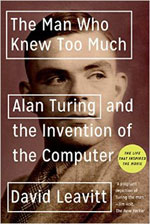
The Man Who Knew Too Much: Alan Turing and the Invention of the Computer – Book Review

By Joe Cillo

Summary/Abstract

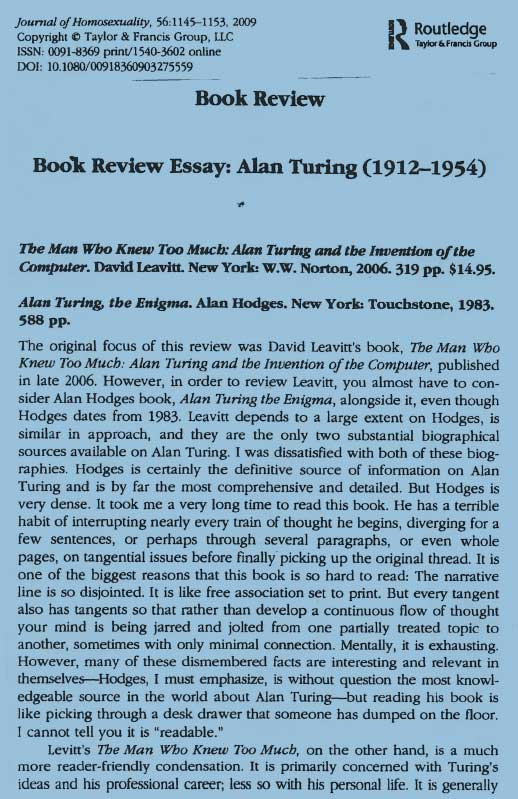
Michael Ferguson, in reviewing two recent biographies of Alan Turing’s life, concludes that to answer the enigma at the heart of Alan Turing’s death, you have to get inside the complex head of the great mathematician.

His book review entitled ”The Man Who Knew Too Much: Alan Turing and the Invention of the Computer’, by David Leavitt and ‘Alan Turing, the Enigma’, by Alan Hodges”, recently published in the, ‘Journal of Homosexuality’, considers the circumstances of Turing’s death on June 7, 1954.

An apple was found near Turing’s deathbed, out of which several bites had been taken. Froth around his mouth was consistent with cyanide poisoning, but according to sources cited by Michael Ferguson, the apple was never analysed. It has therefore never been definitively confirmed that it had been laced with poison, although there was both potassium cyanide and cyanide solution in Alan Turing’s house.

………………………………..

Read complete article here as PDF:

Alan Turing December 2009

Mr. Turner — Film Review

By Joe Cillo

Mr. Turner

Directed by Mike Leigh


I read one blurb that called this film an “epic biography” of British painter William Turner.  Well, that’s hype of the most grandiose favor.  This film is not a biography at all.  It would be stretching it to call it even a portrait.  It is more of a sketch, and a rather superficial one at that.  William Turner is the dominant figure in the film and he is played superbly by Timothy Spall.  It is his rendering of Turner’s character that holds this rather disconnected, aimless film together and prevents it from falling apart into an amorphous nothing.  He is almost always on screen.  There is hardly a time when he isn’t.  Because he is such an imposing presence, you do get a feel for Turner’s personality, at least in this conception (whether it has anything to do with reality, I do not know.  I take the film at face value).  I suppose the way I should say it is that it is a supremely convincing portrayal.  The cinematography is exquisite.  Every scene is perfectly composed, perfectly lit.  England in the nineteenth century must have been a wonderful clean, neat, orderly place with everything properly arranged, minimal clutter, and people wearing clean clothes all the time and smelling so good.

The problem with this film is that it lacks depth and insight.  We don’t see what is driving Turner in any aspect of his life, whether it is his painting, or his relations with his women, or within himself.   He has an ex-wife or mistress with whom he had two grown daughters, who hate him bitterly — a feeling he reciprocates.  What’s that about?  He has an apparently long established relationship with his housekeeper.  But he leaves her for a new woman who rented a room to him on a painting excursion.  Why did he do this?   He does seem to have a positive, supportive relationship with his father, with whom he was living until his father’s death.  He belonged to some sort of society of fellow painters among whom he was highly regarded.  His life overlapped the early days of photography, and he had a portrait taken of himself with his last mistress, the landlady.  He seemed to think photography boded ill for him as a painter, but neither his interest in photography nor his attitude toward it are explored in any great detail.

This is about all you find out about William Turner from this film.  It is not a lot for a two hour and forty minute session.  It is slow moving with an absolute minimum of “action.”  It avoids becoming tedious or boring, at least for me, strictly on the strength of Timothy Spall’s riveting performance.  He makes this character come to life enough that you don’t mind staying with it for over two hours even though nothing is happening and you are not getting a very full or satisfying treatment of the subject.  It’s not all bad, but I can’t recommend it unless you have an exceptional interest in nineteenth century painting.  But if you are that type of person, you probably won’t learn very much from this film.  

VIEW FROM ACROSS THE : POWER

By Joe Cillo

ANIMALS GET US

An animal’s eyes have the power
To speak a great language.
Martin Buber

A.R. Gurney created a debutante in his comedy “The Cocktail Hour” who cries, “No one understands me but my horse.”  The line got a big laugh but it wasn’t a joke. Our horses, dogs and cats catch on to our moods a lot faster than our partners or our relatives do.

Mothers, of course, are an exception. One glance from you tells them everything.  My own mother insisted she could read my entire days activities on my forehead.  It turns out that my puppy could do the same thing.

A new study confirms that animals gather information and transmit it through their eyes. This can be very unsettling….especially when sitting down to a holiday meal. There you are digging into your roast turkey and gobbling up your roast potatoes when you feel a forceful presence watching you lift your fork to your mouth and chew those brussel sprouts.  You look down at Fido, his mouth open and saliva dripping down his fuzzy little chin.  He is watching you so intently he doesn’t even blink.   You would have to have a heart of iron to ignore the longing, the unbridled desire on your puppy’s face.

Guilt overwhelms you and you slip him a bit of dark meat and then a bit more.  How can you resist?

Fluffy is even more insistent.  The minute you put your napkin in your lap, there she is, her whiskers quivering with desire. What can you do?  You were the one who rescued her from the shelter.  The other guests at the table try to ignore the fact that your cat is sitting ON the holiday table lapping up your cranberry sauce as if it were catnip.

Horses are even more capable of transmitting their needs to you with their unblinking eyes.  Last year, I had Christmas dinner in the country and as I dug into my mince pie, I froze.  There was Dobbin staring through the window with such intensity that the glass melted.  It was no use.  I picked up my plate and handed it over.

This year, I have decided to fast for the holiday.  It is a lot easier on my conscience.


VIEW FROM ACROSS THE POND: REASON

By Joe Cillo

REASON

The heart has its reasons
Of which reason knows nothing.
Blaise Pascal

A member of the Taliban scrawled “Throw reason to the dogs” on the walls of the Ministry of Justice in Kabul. I get that.

All too often, reason keeps us from listening to our hearts.  I think the beauty of life lies in the myths we create.  Take Santa Claus.  Everyone KNOWS he is a fictional character we created in the nineteenth century to whip children into shape and convince them that obeying us would give them marvelous rewards.

It doesn’t take huge intelligence to figure out that if Santa were as big, fat and jolly as everyone says he is, he couldn’t possibly fit into a chimney much less a standard front door what with that sleigh he drags behind him and all those reindeer defecating in the snow. (And you KNOW that’s what they must do if they nibble on the cakes and cookies Mrs. Santa gives them)  A child of four could figure out that Santa could not possibly read all the letters children send him and actually decide who gets what on Christmas morning.

And what about all those clones we see on the street, at parties and ringing bells to make us give them money?  How did Santa manage that?  Did he form some kind of club with admission requirements (weight, girth, long white beard; jolly laugh required).

The truth is that reason would erase Santa Claus and I think that would constitute a criminal offense against childhood.  Way back in 1897, Virginia O’Hanlon wrote the editor of the New York Sun because her common sense told her that St Nicholas was a fraud…a tool to force a little girl like her toe the line.  This is what the editor said: “Yes, Virginia, there is a Santa Claus. He exists as certainly as love and generosity and devotion exist, and you know that they abound and give to your life its highest beauty and joy.”

I don’t know about you, but I would hate to think my world was governed by logic and common sense.  I would not like a reality without the certainty that there is good karma, the power of love and the faith that life has a noble purpose.

Besides, where would I send my Christmas want list?


VIEW FROM ACROSS THE POND: I AM IN CHARGE

By Joe Cillo

I AM IN CHARGE

There is nothing in the world to which every man
Has a more unassailable title than to his own life.
Arthur Schopenhauer

My friend Helen Osterman was 86 years old when her husband died.  “Now, it’s my turn,” she told me.  “I cannot wait to join him.”

I was 28 when she told me that and I was appalled.  I could not imagine anyone wanting to die.  The urge to live is so strong in us all, I could not believe that someone who was in good health would choose to end it all.  Besides, I did not believe you went anywhere when you were dead.  I thought it was a final finish.

I know now that what you believe is what will happen.  It makes no difference that we cannot prove that we will come back in another form after we leave this earth.  It is immaterial that there is no evidence that our spirits will ascend to a heaven that is described in different terms by different faiths.  It is what you think is true that matters.  Helen Osterman was sure she would see her husband again when she died and she did go to join him just six months after he left her.  She was finished with her life.

I have lived almost 60 years since that day and I have a very different perspective now.  I have seen people tied to tubes and bottles, their brain barely functioning, who have become nothing but blobs of living flesh.  I have heard tales of people riddled with agonizing pain who cannot be relieved of their suffering because it is against the law for a doctor to assist a patient to end his life.  And I know now that those people did not make proper arrangements for their finish.  They did not specify that they did not want to suffer without respite.  They did not insist that they not be kept alive by artificial means.

We are the only ones who have the right to make a decision about our body.  It is the one thing that belongs only to us and it is our duty to determine the way we care for it and when it is time to stop its functioning.  It is not a decision for a doctor or a relative to make.

However, once we make our wishes known it is incumbent upon all who know us to follow our wishes.  I remember a man who was in a coma whose wife insisted he be fed intravenously and on monitoring machines to keep him breathing.  She sat by his side all day into the night holding his hand but he did not know she was there.  He had made his living will.  He had trusted her to abide by his wishes but she couldn’t bear to let him go.  She insisted that keeping her husband alive was an act of love.  I think she committed an unforgiveable crime.

There are times when a physician finds himself caring for a person who has stopped functioning.  I cannot believe he has committed a crime when he simply removes all life support systems and lets his patient expire.

It seems to me that governments have taken over the responsibility for our well-being.  They pass laws to protect us from abuse, from accidents on the road and from habits they have decided will kill us.  Legislators have forgotten that we are unique individuals and it is the responsibility of each of us to listen to his body and keep it in running order.  It is for every person to decide if he wants a particular treatment to cure a diagnoses.  A diagnoses is after all only one person’s opinion.  The amount of cigarettes we smoke, the quantity of drugs we put into our systems and the type of exercise we care to do is a personal decision.  We own ourselves. No one else does.

Just as we all cherish the right to live our lives in our own way, we also have a right to decide when we are finished.  When life gives us no satisfaction…when we are stalled and are repeating the same routine every day, it is time to say goodbye to this life.  Once we make that decision, it must be respected.  The trick is to make that judgment when you still can think and to be sure that it is evident.

I have always loved the story of the woman who had DO NOT RESUSITATE tattooed on her chest and on her back, TURN ME OVER.  That is my kind of gal.


VIEW FROM ACROSS THE POND: FANCY FRUIT

By Joe Cillo

DRESSING UP THE FRUIT BOWL

One that would serve fruit
Must give it a good presentation.
An anonymous Chinese philosopher

A Chinese fruit seller in Nanjing decided to dress his peaches in fancy knickers and triple the price. He labeled them fancy peach butts and charged £48 a dozen. What a great gift idea!!!

What a great solution for the person on your Christmas list who has everything.  Can you imagine a better present than a cute little peach decked out in lacy underwear?

And why stop there?  Imagine awakening on Christmas morning to discover a banana in a bow tie and a top hat doing a soft shoe just for you?  Think of the delight children would have when they opened up Santa’s gifts to find a pair of plums in tutus and lace bodices tucked into a chiffon lined box?

I cannot think of anything better to give your Nan, than a cluster of grapes laced with garlands of velvet ribbon.  After all, she has received enough lace hankies to last a lifetime.  She will thrill to the novelty of something she doesn’t have to tuck in a bureau drawer to give to someone else next year.

Christmas shopping would be so much easier for us all. No more beating our way through crowded malls trying to outspend each other, piling up mountains of colorful boxes filled with useless trinkets no one wants under the tree.    We would not have to spend hours exploring one expensive novelty shop after another in the Lanes trying to find just the right tie, or the prettiest bauble for our loved ones.  All we would need to do is run over to the green grocer and load up on produce, take it home and dress it up. On Christmas morning, the house would be filled with jolly pears in tap shoes and apples sporting feather boas.  Wow!

And don’t forget the veggies!  They tart up amazingly well. There is nothing as appealing as a mushroom in spats and every potato worth its butter and cheese, looks better in mesh stockings with a flowered garter.

What to serve for Christmas breakfast?  Problem solved.  Just put all the gifts in a large bowl, add some scones, clotted cream  and a bit of eggnog and enjoy.


VIEW FROM ACROSS THE POND: A GOOD DEATH

By Joe Cillo


LIVING THE GOOD LIFE

There are three ingredients in the good life:
Learning, earning and yearning.
Christopher Morley

Ezekiel Emanuel is 57 years old.  He is a physician specializing in cancer and the Vice Provost professor The University of Pennsylvania. He is a very smart man. Last October, he wrote an essay saying he wanted his life to end at 75.

He is a fool.

When I was 57, I had no idea what fun I could have once I crossed the line where productivity, beauty and fame topped the list of what I needed to make my day.   When I was 57 I cared that my face was drooping, my hearing dulled and my walk slowed, step by step.  I am 81 now and I love my wrinkled face.  It gets me every perc I could possibly want.  I step into a packed car in the tube and at least 3 gorgeous men stand up so I can rest my wrinkled bum on a seat.  I board a train and take a premium seat that is labeled Priority Seating just because I have been around a long time.

When I carry packages up or down stairs, there is always someone to carry those bundles for me and usually with a smile.  I hop (yes I can still hop) on a bus and sit down without worrying about the fare.  I go to movies, plays and concerts and pay at least 25% less than everyone else including all those youngsters under 60 with low paying jobs and expensive taste.

If I am in a queue and it is taking too long I clutch my heart and gasp a little; that gets me to the head of the line before I can exhale.  I stand at a counter rummaging though endless coins I cannot recognize without my glasses and NOT ONCE has anyone said, ”Hurry up, Bitch.”  No indeed.  Invariably there will be some kind soul who will hold my packages while I search for coins I dropped in the bottom of my purse and the clerk will ALWAYS smile and say, “Take your time, darling.”

And that brings me to another point:  EVERYONE, man, woman and even toddlers, address me as “Darling” and they mean it. The very things I did at 50 that annoyed the hell out of everyone; the missteps and accidents I had in my twenties that made both husbands leave me; all are absolutely adorable now that I am in my ninth decade.

But it isn’t just the attitude of everyone around me that has made life so very sweet these days.  It is MY attitude.  I am no longer concerned with what I see in the mirror.  It never got me much when I was younger and I don’t expect it to be the 8th aesthetic wonder of the world now.  That means that all the time, money and anguish I spent in beauty shops and on countless rejuvenation creams, skin enhancers, hair boosters…all of it is now spent on more rewarding activities like eating anything I want because what the hell: by the time I am too obese for my coffin, I won’t care. I won’t have to spend the extra money for it either.  The welfare department will.

I am at the age now where I can spend as much as I want for anything I want.  If I run out, I can get benefits.  My intention is to reduce my bank balance to zero and then apply for residence in a home.   We take care of our elderly here.  I am not worried about my liver either.  It’s held up this long, hasn’t it?

When I was in my fifties, I anguished because I had not made a visible mark in the world.  No one knew who I was.  My name never made a headline.  Now I realize that it isn’t the publicity you get for what you do, it is what you do that matters.  If it makes me happy and I am involved, then hooray; getting some award or a mention in someone’s column won’t change that.  It took me this long to get that.

“But here is a simple truth that many of us seem to resist: living too long is also a loss. It renders many of us, if not disabled, then faltering and declining, a state that may not be worse than death but is nonetheless deprived. It robs us of our creativity and ability to contribute to work, society, the world,” says Emanuel.

And I say, “How does he know that?  He hasn’t gotten there yet.”

Well I have and I can honestly say that my walk is slower, but I get where I want to go and I do not feel deprived.  I enjoy my life just as it is.  I do not have the same desires I had at twenty or thirty or forty because that is not the stage of life I am in right now.  My perspective has improved.  I have confidence in myself. I trust my judgment.  I don’t want to go to bars and find a hot sex pot to take me to bed.  That doesn’t interest me anymore.  I don’t want to wear uncomfortable clothes that reveal my nether parts because my nether parts are not the focus of my pleasure anymore.  My mind and my heart are the hungry organs now and I do everything I can to feed them.  It is more fun and not as sloppy.

It took me a long time to figure out that life is like a card game.  You take the hand you get and play it out the best you can. It does no good to bemoan what you didn’t get or begrudge others for what they have achieved.  You do not know what they had to do to get there.  I am happy now with the life I have but I am not content to stand still.  Not yet.

I am living in the now.  What is past is gone.  I am not that person anymore.  I don’t look good in her clothes.  I do not want to walk in her shoes.  They would pinch my bunion.  I do not want to waste the time she did on the telephone bemoaning what she didn’t have.  I love my current life and I am determined to make the most of it.  I will not waste my energy worrying about what I will do when I am ninety because I am not there yet.  When I am, I have no doubt that I will have adjusted to the difference in my motor abilities, my memory and my diminished life style.  I do not know how I will like it until it happens.

Do not get me wrong.  I do not want to waste away in a hospital bed anymore than you do.  I have reached an age where I am determined to let my body fall apart at its own pace.  I do get my flu shots but I am not sure I would allow any procedures to prolong my life if I had a terminal illness.  I am not afraid of dying.  It is after all the most dramatic event in our life other than birth.  I cannot recall being afraid when I exited my mother’s body and I have no intention of being consumed with fear about my death because I have no idea when it will happen or how.  When I am there, I will deal with it. Hopefully it will be a grand and dramatic departure.

My goal right now is to live abundantly.  I will not spend one iota of the time I have in worry because worry never accomplished anything and I have a lot I need to do.  I want to learn to fan dance. I see me shimming and swaying to the music showing off my cute bum and my shapely lets and then turning to the crowd, peeking out of the fans with a face that looks for all the world like an abandoned prune that needs ironing.  It should have an amazing effect on the crowd.

I want to play the ukulele and tap dance while I do it.  I want to explore the nooks and crannies of a Europe I have read about and I want to make a lot of strangers laugh.   Want to fall in love the right way this time…loving who he is, not how he looks, what he buys me or what he wears. The size of his wallet or his dick are not barometers of love for me anymore.  They never were but I thought they were.  I know better now.   I cannot be bothered regretting the hump on my back or the arthritis that has gnarled my fingers.  They still work and while they do, I am using them.

I have done the accepted thing.  I have prepared a directive that tells everyone not to resuscitate me and not to use any artificial means to keep me alive.  I have donated all the organs that work to anyone who needs them although who would want my ears is something I still cannot figure out.  My kidneys however are stellar and I hope the person who gets them appreciates how beautifully they have worked for me.

I do not want to lie in a hospital bed on life support with medical science keeping me alive and i know very well that is a decision I must make while i have all my faculties and can prepare the proper papers to keep an exuberant medical staff from pumping up my lungs and stimulating a heart that no longer wants to beat.  I have done that but that is all I have done.  I am ready and willing for death to happen when it is ready for me.  My mother always said I arrived two moths after I was due.  “You were always slow,” she said.”Right from the beginning.”

But I got here didn’t I?

I hope my exit will be cleaner and faster but if it isn’t well…I cannot know what it will be like until it happens.  I am determined to only die once….and that will be on the day my heart stops beating and my lungs give  me no air.  …not one minute before.

The trick is to live…live as fully, as beautifully and as daringly as you can.  Reach for every star and don’t be afraid to meet the price, do the work and pay the dues to get you there.  There is no dream that is impossible.  Wallace Stegner says we do not die from a disease.  We die because we are finished.

I am not finished.  Are you?