Category

Joe Cillo

Joe
Cillo

“Cymbeline” – Marin Shakespeare Company

By Joe Cillo

Paul Abbott as Cymbeline, Rod Gnapp as Belarius, with Zack Purdy and Patrick St. John as the Princes with Jed Pirario as Pisanio.

William Shakespeare’s Cymbeline, Marin Shakespeare Company.

Directed and adapted by Robert Currier, with a cast of thousands- no, not really. No one really knows much about Cymbeline, Shakespearse’s convoluted rom-com (in today’s parlance), except that it’s alleged to be one of his last plays.  It is believed to have been written in 16ll and to echo the Bard’s own coming to terms with his family as he approaches his final act. Director Robert Currier has effectively trimmed the play to a manageable couple of hours and still maintain its coherence, continuity and major and minor plot twists.  To his credit as well is his clever incorporation of contemporary tropes, such as Nat Curries’ additional lyrics to Brooks’s and Warner’s “That’s Amore.” Another that elicited delightful laughter from the audience was Rod Gnapp’s (the leader of the uncouth Mountain Folk of Wales, Belarius) deliberate breaking of the fourth wall to clarify the multiple names for his “adopted” sons to help us make sense of the confusion.  The play is upbeat and never loses our interest thanks to the actors who maintain high energy throughout.  Kudos to composer Billie Cox for her musical adaptations from Shakespeare’s lyrics as well as original compositions.  She created lovely musical interludes in the style of the era, everything from romantic ballads, a rock tune played on a ukulele no less; a madrigal, a monologue mimicking Gibert and Sullivan; an Irish dirge and a jaunty woodsman tune.  Cox also designed the sound for the outdoor arena, enabling us to hear every word and song lyric.

Cymbeline is the bellicose King of the Britons, beautifully played by a believable, heavily-bearded Paul Abbott.  Cymbeline ruled when Rome occupied Briton and battles were still being fought over payment of the tribute owed Rome. His daughter and only heir is Imogen (a sweet yet strong and determined Stella Heath).   In order to ensure that she will stop at nothing to attain her goal, she at one point disguises herself as a boy.  Cymbeline’s (nameless) narcissistic and perfidious Queen (Lee Fitzpatrick) had a son (from a previous marriage?), Cloten (Thomas Gorrebeeck).   He is spoiled and self-indulgent, a dandy with shoulder-length blond locks.  He swans about on stage flipping those locks, seeing himself as the proverbial God’s gift, yet cannot understand why he’s rebuffed!

Thomas Gorrebeeck as Cloten and Lee Fitzpatrick as his mother, the Queen

The plot begins to confuse when it is revealed that Imogen had two brothers who were kidnapped as infants by Belarius, from Cymbeline and their mother.  We meet him and his charges near play’s end.  The boys, Guiderius, known as Polydore (Zack Purdy) and Arviragus, known as Cadwall (Patrick St. John) are now twenty-something strapping mountain dudes in their own right, but innocent of their rightful heritage.  They leap agiley about the mountain set created by set designer Jackson Currier.  Then there’s Posthumus, a poor orphan, raised by Cymbeline.  He’s shy thus non-assertive and hopelessly in love with Imogen. Actor Thomas Gorrebeeck plays both Cloten and Posthumus, two totally different characters.  Unless you followed the cast list, you’d never know this, which attests to the actor’s versatility. A delightful, expressive Jed Parario, who moves about the stage like a dancer, plays Posthumus’s loyal servant, Pisanio.

Imogen and Posthumus    Stella Heath as Imogen and Thomas Gorrebeeck as Posthumus

Others vie for Imogen’s hand.  Davern Wright credibly acts the part of the most aggressive suitor, Iachimo, rightly billed as “a smarmy” Italian.  His cohort played by Zack Purdy is Philario; in the mix is a Frenchman played by Rafael Sebastian.  Glenn Havlan returns to Marin Shakes for a third season after a successful run of “Taming of the Shrew,” by Theater of Others in San Francisco of which Havlan is the founder and director.   In “Cymbeline” he plays a musician as well as a rather thankless rôle as Calius Lucius, the Roman Consul; Xander Ritchey played his Captain. Caius’s soldiers are played by Carolyn Doyle and Isabelle Grimm. Shakespeare most always writes otherworldly characters into his plays.  “Cymbeline” is no exception: Debbie Durst plays Cornelius, a doctor in the ruler’s court.  She is referred to as a witch, carries a wand, and is dressed in a black cowl and flowing gown.  Ms. Durst delivers her portends with commanding, yet wry ominousness.   Lee Fitzpatrick also plays a Goddess (the dead Queen?) and Annika Gullahorn is double-cast as a court gentlewoman and an Otherworldly Mercury.

Costume designer Tammy Berlin deserves praise for her work in this production.  A costume can either make or break the believability of a character. “Cymbeline” will play at Marin Shakespeare’s Forest Meadows Amphitheatre, Dominican University of California in San Rafael, through July 26.  Go to: www.marinshakespeare.org for more information and a schedule of upcoming plays..

The Trojans — San Francisco Opera Performance — Review

By Joe Cillo

The Trojans

By Hector Berlioz

San Francisco Opera Performance

June 20, 2015


This is actually two operas and performing them together creates a mammoth production.  The Capture of Troy occupies the first two acts.  Acts three through five make up The Trojans at Carthage.  The two operas are really distinct despite the fact that the composer, Hector Berlioz, conceived of them as a unified whole.  When the opera was first performed at the Theatre Lyrique in Paris, they would only do the second part, The Trojans in Carthage — and they cut it down quite a bit.  Berlioz never saw The Fall of Troy performed.  Thomas May’s offers a lengthy and informative discussion of the history of this opera’s composition and performance in the program.  It is very good and I highly recommend it.  May tells us,

the lack of a definitive full-scale production when Les Troyens was new to the world caused even more long-lasting damage than Berlioz had pessimistically foreseen.   The division and cutting of the work perversely underscored the notion that Berlioz had written a sort of heroic “ruin” that lacked coherence and integral construction. . . Worse, distorted perceptions of Les Troyens encouraged stereotypes of the composer as a washed up Romantic revolutionary who had lost his fire and reverted to a more “conservative” approach.  (p. 39)

I am largely in agreement with this assessment.  This monstrosity is unwieldy and it does lack internal coherence.  What is consistent is that the males end up ignominiously deserting the scene at the end of each opera, and the females end up dead.  There is very little that connects The Fall of Troy to The Trojans in Carthage except that some of the same characters are used.  But it is two very different, very loosely related stories.  Neither opera is very well written and putting them together on the same program subjects the audience to a long, punishing evening.

I always try to say something positive, if I can, and in this opera what is positive is the music.  The music score is outstanding, and it considerably raised my estimation of Berlioz as a composer.  It makes it all the more poignant that this music composer of the first rank had no talent as a dramatist or as a storyteller.  The Trojan War has a vast wealth of dramatic possibilities, and yet the best Berlioz can get out of it is dull, slow moving, repetitious, and interminably long.  He seems to avoid anything truly dramatic on stage and relates the real drama and conflict in the story line through narratives in soliloquies.  The romance between Aeneas and Dido in The Trojans in Carthage is juvenile and melodramatic.  Berlioz knew nothing about love relationships.  The character of Dido is particularly incoherent and ad hoc.  She starts out as a queen beloved by all of her people and ends up this embittered, venomous, vengeful, suicidal woman — nothing like a queen at all.  How could she have ever been a queen, let alone a queen of such capable leadership?  She is a totally cartoonish, unconvincing character.

It doesn’t help that the sets were unimaginative, the lighting was uninteresting, and the costumes were from the nineteenth century.  They had the Trojan soldiers in nineteenth century military uniforms carrying nineteenth century swords.  Some of them were even carrying long rifles and muskets.  Since when did the Trojans carry rifles in 1200 BC?  In Act 5 two soldiers shared a cigarette.  Was it the Trojans’ own brand, or did they import them from Greece?

Act 4 started with a ballet segment that was well conceived and beautifully done.  No vocal music during the ballet, only orchestral accompaniment.  The structure of Act 4 was two ballet segments alternating with two vocal segments.  The ballet segments were very well imagined and well executed and could work as standalone ballet pieces were they to be excised from this opera.  The choreographers, Lynne Page and Gemma Payne did an excellent job along with the dancers, and the orchestral score was very well suited to the dance.   It made me think that this whole idea of the Trojan War could be recast as a ballet, and it would be much leaner and much more interesting than this long, cumbersome opera.  It is unfortunate that Berlioz’s score was crafted for this dreary, undramatic opera.  Maybe there is a creative composer and a choreographer out there who could adapt it into much more dynamic and aesthetically pleasing ballet.

By the middle of the first act I was wondering if I should sit through all five hours of this.  I couldn’t think of a good enough reason not to, such is the state of my life right now, so I stayed and watched the whole thing.  It was akin to long flight on an airplane, where it is mildly uncomfortable and you are looking forward to it ending.  If Berlioz had been able to collaborate with someone who had ability in theatrics he might have produced a great opera.  Unfortunately, this is a mediocre work, but with a first rate sound track.

Two Women — San Francisco Opera Performance — Review

By Joe Cillo

Two Women

By Marco Tutino

San Francisco Opera Performance

June 13, 2015


This was one of the best opera performances I have seen.  It was a modern opera — if you call World War 2 modern.  It was imaginatively staged, using modern video and lighting techniques, and the music was suited to the story line and worked.

It was set in Italy in the midst of the Second World War right at the moment of the Allied invasion and the subsequent fall of Mussolini.   But the war and politics serve as a backdrop.  The opera is about the universal miseries of war visited upon a civilian population: displacements, deprivations, disruptions, separations, deaths, rapes, duplicities, betrayals, constant fear, and the eternal struggle to develop and maintain personal relationships and pursue love in the midst of upheaval and turmoil.  It was a well told story that held my interest all the way through from beginning to end.

I studied the synopsis provided by the San Francisco Opera beforehand.  I went through it three times.  The synopsis sounded confusing and complex.  I was afraid I wasn’t going to be able to follow the opera because there are a lot of characters, they are on the move all the time, settings are changing, and even revisiting previous locations, as well as relationships that keep changing and evolving.   But the performance told the story very clearly and logically.  Video and visual displays were used very effectively to set each scene in its temporal and geographical context.  It was straightforward and clearly presented.  I was surprised.  It was really good.  The sets were imaginative and visually pleasing.  The lighting and special effects were just right and powerfully enhancing.  It was all together a top quality production.

Before the performance and during intermission repeating video sequences were shown that provided visual footage of the war in Italy at the time and the military operations that were going on.  I found this very helpful for setting the background of the performance and was very glad they did it.

The story was based on a novel by the name of La Ciociara, by Alberto Moravia.   I haven’t read the novel and there doesn’t seem to be a recently published English translation of it.  I happened to sit next to a gentleman who had read the novel a number of times and loved it, and he said it was the reason he wanted to see the opera.  He felt that the opera was a faithful representation of the novel, although he said the ending was different, which I had suspected.

The ending did not make any sense and was the only part of this opera that really failed — which to me, is pretty good for an opera.  I regard opera as the most conservative of all the art forms, and therefore do not expect to agree with the philosophical viewpoints expressed.  In this case it is an enigmatic finish that makes nonsense out of the character of Rosetta.  After the gang rape of the two women by the Moroccan soldiers an estrangement seems to appear between the mother and the daughter that is not adequately explored.  It seems to have to do with differing reactions of the two to the rape.  The daughter, Rosetta, seems to find it liberating in a sexual sense, and she begins asserting this new found independence from her mother through some rather casual sexual adventures, to which her mother strongly objected.  Rosetta reappears at the very end and derides the naivete and foolishness of Michele to her mother, but then, informed of his death, she is devastated and falls prostrate to the ground in a depressed stupor as the curtain falls — the news of Michele’s death apparently suffocating the sexual rebellion and affording a kind of reconciliation between the two women.

But it’s crazy.   One moment Rosetta is telling her mother what a naive fool she considers Michele to be, and as soon as she finds out he is dead, she practically dies herself.  Rosetta was never that attached to Michele.  He was her mother’s obsession, not hers.  Of course she liked him and bore some attachment to him, but the reaction depicted in the performance is far out of proportion to the emotional temperature of that relationship.  I don’t know how the book ends.  If I ever read it, I’ll revise this, but trying to turn Michele into some sort of Christ-like Savior, a model of goodness and hope, just doesn’t fit with the rest of the story, with the characters of the women, or with the character of Michele.  It’s like the director of the performance didn’t know what to do about the ending.  He didn’t understand the characters and how events had changed them internally, and so he couldn’t see a way for them to go forward.  So he invented this foolish reconciliation through the death of goodness and innocence and put that on the stage.  It was a big mistake.

I think a different director could do something more interesting with the ending of this story.  In fact, the more I think about it, the more it seems to me that this story is about the death of innocence, pacificism, and simpleminded goodness, and nothing illustrates that better than the atrocities of war and the gang rape of women by conquering soldiers.  It is a somewhat negative commentary on human nature and the darkness within the human heart.  Michele, the romantic dreamer, is killed off by the conniving, insecure, duplicitous Giovanni.  The gang rape of the two women by the soldiers serves as a sexual awakening for the young daughter and she begins to assert her independence from the sexual conservatism of her mother.  The director does not seem to be comfortable with this outcome and tried to turn it into a morality play that would sit better with his conservative American audience by bringing Michele back from the dead to beat down the rebellious Rosetta, turning the dead Michele into a kind of Christ-like Savior of the young girl from sin.  No. No. No.  Sorry.  It doesn’t work.  That’s not what happened here.

But aside from this confusing, ill thought out, bizarre ending, the opera is pretty good.  It is a well presented, interesting story, a timely topic, visually engaging, and musically satisfying.   If the ending were more coherent and consistent with the rest of the import of the opera, it could be one of the greatest operas.

Cleanliness and Fragrances — Reviews and Essay

By Joe Cillo

Cleanliness and Fragrances — Review Essay


Fragrance Reviews begin at the end of this essay. 


Because of the savour of thy good ointments thy name is an ointment poured forth, therefore do the virgins love thee.      Song of Songs 1:30

Who is this that cometh out of the wilderness like pillars of smoke, perfumed with myrrh and frankincense, with all powders of the merchant?   Song of Songs 3:6


Most people, throughout most of history, in most times and places, most of the time, stunk.  Left unattended the human body will stink to high heaven in a very short time.  It is eminently natural to stink.  It is said that the Mongol army could not launch a surprise attack because it was possible to smell them from twenty miles away.  They prided themselves on never bathing.  They were barbarians.  The Mongols did not torture people to death, unlike most civilized societies of their time (Weatherford, pp. 115-16).  The Romans and most other civilized societies made torture a public spectacle to entertain and intimidate their citizenry.  They were sadistic.  What made the Romans civilized and the Mongols barbarians was that the Romans took baths and the Mongols stunk.  The Mongols believed that a person’s body odor was part of their soul (Weatherford, p. 12) , and this probably was part of the reason they refused to bathe — in addition to the scarcity of water on the Central Asian steppe.

It is the practice of bathing, the attendance on personal hygiene, the mitigation of offensive odor from the body, rather than moral superiority, that distinguishes civilized people from uncivilized.  Not stinking, or actually smelling good, is the mark of civilization.  One of the most commendable achievements of modern capitalism is that it has made people smell better.

In former times the practice of bathing was much less common and human body odor was ubiquitous, although attitudes toward body odor and bathing are highly variable from culture to culture (Ashenburg, Introduction).  The ancient Egyptians were known for being fastidious about bathing and personal cleanliness (Ashenburg, p. 6).  They were one of the earliest civilizations.

It was Christian hatred of the body that brought about the demise of the Roman public baths and ushered in a long era of despising and devaluing bodily cleanliness and sanitation (Ashenburg, p. 58f.)  From the 16th to the 18th centuries it was not unusual for people to go for a year or more without ever bathing.  Even the aristocracy was noted for rank malodor (Ashenburg, Ch. 4).  Queen Elizabeth I bathed once a month “whether she needed it or not” (Ashenburg, p. 99).  If the queen only bathed once a month, imagine what the rest of the people were like.  It was a different time.

This long era of filth and stink in the western world began to recede in the last half of the eighteenth century and accelerated in the nineteenth, especially with the advent of running water in the home.

As cities expanded, and people worked close to one another in crowded offices and factories, they grew unhappily aware of the smells produced by their own bodies and those of others.  The arrival of women in the work world accelerated this new sensitivity.  The fastidiousness that had first surfaced, tentatively, in late eighteenth-century Europe was becoming an American obsession.  At the same time, prosperity was at an all time high.  People could afford the products that would enable them to live in a smell-less zone, a safe place where they would neither “offend” nor be “offended.” (Ashenburg, p. 244)

Advertising campaigns in the 1930s and 40s promoted deodorant, shampoo, and razors to women, and later sanitary napkins (Ashenburg, p. 5).  A major industry has been built in the twentieth century around suppressing natural body odor and replacing it with something supposedly better.

My own attitude is that one should have to get pretty close to another person in order to smell their body.  Smell is intimate, and one’s personal body odor should be largely private.  If you can smell a person from more than a few feet away (and that includes perfume, or anything), that person is not civilized and is out of place in a modern society.

“the slovenly folk, who have been going on the theory that they can take a bath or leave it, are to be brought to their senses,” (NYT, July 10, 1927.  Ashenburg, p. 255)

“Odors are unnecessary and those that have them are violating rules of courtesy.” (Ashenburg, p. 254; quoting Hadida, 1932, pp. 98-104)

“Smelling someone’s real body or allowing your own body to be smelled has become an intrusion, a breach of a crucial boundary.”  (Ashenburg, p.271)

San Luis Obispo, CA, law bans people from the library for having offensive odor.  This provision was part of a list of disruptive behaviors prohibited from the library.  (Los Angeles Times, March 5, 2005.  Ashenburg, p. 273)

Why not make scentless the modern ideal, since ever greater cleanliness seems to be the American way?  There is a lot to be said for that, and the only argument I would make against it is that people have always smelled, and so we are accustomed to our bodies emitting odors and to perceiving the odors of others.  If we are going to smell, why not smell good rather than offensive?  Scentless in my view is too conservative and carries the war on body odor to an untenable extreme.  The aesthetic I advocate is that body odor should be minimal and not intrusive or attention seeking, pleasing if possible, but at least minimally offensive.

The word ‘perfume’ comes from the Latin per fumum meaning “through smoke.”  (Morris, p. 16)  The earliest perfumes were likely the burning of wood or meat to offer a pleasant savor to the gods.  Burning incense to the gods was a widespread practice in the ancient world. (1 Kings 11:8, Ezekiel 6:13)  The sweet smell of the incense was judged to be pleasing to the gods and the rising smoke and fragrance would carry aloft the prayers of the people and provide a pleasing presentation to the deities.  In the thirtieth chapter of Exodus God commands Aaron to build an altar and burn incense on it.

Of shittim wood shalt thou make it. . . And Aaron shall burn thereon sweet incense every morning: when he dresseth the lamps he shall burn incense upon it.  And when Aaron lighteth the lamps at even, he shall burn incense upon it, a perpetual incense before the Lord throughout your generations.  Exodus 30: 1-8

Of the three gifts that the wise men brought to the baby Jesus, two of them were fragrances.  In a world where obnoxious smells were the rule, pleasing fragrances were valued on a par with gold.

There is archeological evidence of a thriving perfume industry on the island of Cyprus as early as 2000 BC.  Perfumes have been found in Egyptian graves going back to 3000 BC.  (The Scotsman: Scotland on Sunday, September 21, 2014)

A pleasing fragrance, a sweet savor, was thought to be better than the ordinary rancidness of daily life and thus worthy of presentation to the gods.  So also in perfuming the body one gains favor and elevates oneself in the noses of one’s peers and especially in one’s estimation of oneself.  One gains in self confidence and self esteem knowing that one’s fragrance is apt to make one pleasing and attractive to others.  A pleasing fragrance is a sign of cultivation, sophistication, aristocracy.

The European tendency to be more accepting of the stink of everyday life is a cultural difference which I regard as somewhat primitive.  You have to keep in mind that the smells that come off of our bodies are the result of bacteria and fungi inhabiting our skin and orifices and these organisms can be pernicious. They can create infections, irritations, illnesses.  They can cause your teeth to rot and fall out.  The odor that we perceive is only the first indication of their presence in significant numbers and the impact they are beginning to have on our bodies and health.  Body odor tells us that it is time to wash off the bacteria before things get worse.  Modern hygiene has made us healthier and lengthened our lives — not to mention improved the aesthetic quality of our personal interactions.

The modern perfume industry began in the eighteenth century, mainly in France and Germany, with the return of bathing.  As people bathed their bodies they found it pleasant to anoint themselves with fragrant waters and oils.  The spread of the use of fragrance grew in conjunction with the development of porcelain ceramics and glass which were used to make containers for these fragrant concoctions, because they would not react with the fragrant oils and extracts in the perfumes.  (Morris, 1999, pp. 74-82)

This nascent perfume industry, catering as it did to the aristocracy, was nearly obliterated in the French Revolution.  However, Napoleon Bonaparte, who came to power in 1804, was a dandy, who was very conscientious about bathing and hygiene, even on military campaigns, and he revived the perfume industry in France, giving it generous support and encouragement (Morris, 1999, pp. 84-87).  The discovery of chemical solvents in the 1830s that allowed for the extraction of exotic scents from many flowers and plants that had never been possible before, led to an explosion of perfume manufacturing.  Many of the major perfume houses that exist today got their start in the nineteenth century.  It was the growth and rising affluence of the middle class and the increasing attention to bathing and hygiene that fostered this prodigious growth of the perfume industry.

Today the fragrance industry is a multibillion dollar worldwide behemoth that employs sophisticated technology, marketing, and huge budgets for product research and development.  The Perfect Scent by Chandler Burr is an excellent inside look at this modern industry.  I am not going to go into surveying it here.  I think this is long enough already.  But Burr is an excellent, knowledgeable writer whose books are readable and very interesting.

I want to make one more philosophical foray into aesthetics and taste before I leave you to peruse my reviews of individual fragrances.  Ashenburg gives an unwarranted amount of space to Sissel Tolaas, who runs a research lab in Berlin devoted to scent (Ashenburg, 2007, pp. 271-74).  Among other projects, the lab is building an archive of scent which includes over 7000 aromas neatly labeled and catalogued.  Tolaas hopes to develop a vocabulary of fragrance that will allow us to describe and discuss fragrances in words for which for which our current linguistic capability is dearth.  These are laudable projects and I do wish her success in these efforts and I remain interested in her progress.  Where I differ with Tolaas and the slant that Ashenburg gives to her, is her aesthetic.  It is best illustrated by an anecdote that she relates herself:

Once at the Berlin Film Festival I wore a beautiful evening dress and put on a smell which was the absolute contrast — the smell of garbage and the stench of dogshit!  And people were completely confused because the way I looked and the way I smelled had nothing to do with each other.  And I had the most fun time in my life!  In this case the purpose of smell was to say “leave me alone.”

Normally the role of smell in our society is to say “come to me!” but I did the opposite and I succeeded.  Maybe at some point we will have smells for different purposes, the “stay alone” smell, “come halfway” smell, “come close” smell.  What’s wrong with that?!”  ( Tolaas, Huffington Post, September 24, 2013)

What’s wrong with it is that you don’t need smell to communicate those intentions, and Tolass was sending out a very mixed message by her appealing dress on the one hand and her offensive odor on the other.  The point was to create confusion in people and thus draw attention to herself.  She was at an event where everyone would be dressed fashionably and thus dress alone may not have been sufficient to make a distinguishing splash, so she doused herself in stink in order to make herself stand out from the crowd.  A kind of grandstanding with odor and dress.  There is also a hostile, contemptuous element in it.  It’s childish.

My view is that smells are mostly offensive, probably 80 percent, ranging from the mild to the disgusting.  The evolutionary purpose of smell was primarily to warn us of danger and secondarily to help us find something to eat.  In civilized societies the role of smell in meeting these needs has been minimized and thus smell has been freed from its primary function of perceiving hazard to offering the possibility of aesthetic enhancement, in the same way that clothing has gone beyond simply protecting us from the elements to making a personal statement about ourselves in society.  Deliberately wearing a fragrance to make oneself stink in public is either a reflection of low self esteem and the anticipation of rejection, or a childish, sassy provocation.

Luca Turin has a somewhat different sensibility and aesthetic.  But he is French and Italian.  He tells us

France is a country of smells. . . The idea that things should be slightly dirty, overripe, slightly fecal is everywhere in France.  They like rotten cheese and dirty sheets and unwashed women  (Burr, 2003, p. 3-4).

I noticed that in many of the fragrances that Turin favors and praises.  They sort of stink.  He thinks it is sophisticated to like these somewhat offensive smells.  I think it is civilization turned on its head.  One might question whether Turin speaks for the whole kingdom of France, but his comments are echoed by Henry Miller writing in Paris in the 1930s

That’s the first thing that strikes an American woman about Europe — that it’s unsanitary. (Miller, p. 137)

Chandler Burr rightly calls Luca Turin the “Emperor of Scent.”  Turin probably knows as much as anyone alive about scent, its history and the contemporary industry of scent.  In addition he has an extraordinarily discerning and well trained nose for grasping the ingredients and building blocks of a fragrance.  In presenting these fragrance reviews here I don’t claim anywhere near the skill and sophistication that Turin has to offer.  He is the unquestioned master.  His perception of odors is unmatched and his ability to analyze the compositions of perfumes are far more precise than my own.  I am totally untrained in the language of fragrance and the building blocks of modern perfumes.  Everything I have picked up on my own, with gaps and limitations.  The differences I have with Turin are in taste.   What one chooses to wear, in both clothing and in fragrance, has to do with personality and style and the image one wishes to project in the world.  In this we have substantial differences, and this is reflected in our respective evaluations of perfumes.  It is also true that perfumes can smell differently on different person’s bodies.  That might also be a source of difference in some evaluations.  Turin’s Perfume Guide is the standard classic on this subject.  Anyone who is with more than a passing interest in perfumes should have it.  I used it to help select some of the fragrances to sample.  I did not consult it in formulating my evaluations.  My evaluations and comments on the fragrances are my own.

Every fragrance listed here I have used on my body.  Most of the time I bought small samples and wore them for a couple of days.  In many cases one day was enough.  My comments are generally spare, mostly little more than a reaction.  In rare cases I have changed my mind after a second try.  Usually I know right away whether I like something or not.  However, perfumes change on the body after some time wearing them.  Some perfumes might start out good and then slide downhill after a couple of hours.  Less often they will start out somewhat negative and then evolve in a pleasing way later on.  All of the fragrances that I tried are marketed as “Men’s” or “Unisex.”  There are women’s fragrances that I like, but since I haven’t worn them or tested them myself, I didn’t think it was appropriate to include them in this list.

I also tried a number of “essential oils” in an effort to sharpen my powers of discernment of the components of a fragrance.  I don’t know that it helped all that much, but I listed my comments on the essential oils as well.

After some debate I decided to list the fragrances in alphabetical order.  This posed some problems because some fragrances are known by the perfume house that created them, but many are known by their trade names, with the name of the manufacturer being less well known.  I have tried to list them by the manufacturer, but some that are better known by their trade name may be listed that way.  If you are looking for something and you don’t find it by the manufacturer, try looking for it by the commercial trade name.

A key to the entries.  If a fragrance has a + after it, that means I like it.  If you see ++, then it means it is on my shopping list, or I may have bought a bottle of it already.  The vast majority of commercial fragrances I do not like and would not wear.  So these reviews are overwhelmingly negative.

Chandler Burr’s estimation of the typical commercial masculine fragrance is as follows:

The surefire formula for making a bestselling masculine seems simply to be mixing together enough dihydromyrcenol (laundry detergent) with the smell of metal garbage can to choke a horse, then topping that with the scent of cryogenically frozen citrus peel dusted with DDT and a whiff of recycled plastic.  Chrome is fit, at 10 percent dilution, for controlling weeds on your lawn.  Aramis makes a fine garage floor sterilizer.  But following a plan of simply pumping out some metallic doesn’t always work.  All sorts of things that smelled of the effluent of arms manufacturing plants were put on the shelves every year and, for some reason, refused to sell.  (Burr, 2007, p. 151)

I’m not as caustic as that, but I understand where he is coming from.  However, what I do like, I like a lot, and I admire expert perfumers who are able to create interesting, unique fragrances that have a pleasing effect.  I plan to update this list from time to time as I try new samples.


References


Ashenburg, Katherine (2007)  The Dirt on Clean:  An Unsanitized History.  New York:  North Point Press.

Burr, Chandler (2003)  The Emperor of Scent:  A True Story of Perfume and Obsession.  New York:  Random House.

Burr, Chandler (2007)  The Perfect Scent:  A Year inside the Perfume Industry in Paris and New York.  New York:  Picador/ Henry Holt.

Hadida, Sophie (1932)  Manners for Millions:  A Correct Code for Pleasing Personal Habits for Everyday Men and Women.  New York: Doubleday, Duran & Co.

Miller, Henry (1961)  Tropic of Cancer.  New York:  Grove Press.

Morris, Edwin T.  (1999)  Scents of Time:  Perfume from Ancient Egypt to the 21st Century.  New York, Boston, London:  Metropolitan Museum of Art, Bulfinch Press/Little, Brown & Co.

Turin, Luca and Sanchez, Tania (2009)  Perfumes:  The A-Z Guide.  New York and London:  Penguin Books.

Weatherford, Jack (2004)  Genghis Khan and the Making of the Modern World.  New York:  Three Rivers Press.


The Fragrances


A*Men by Thierry Mugler      Smells like the Wysteria incense my dad used to burn.  But also has a strong vanilla fragrance that becomes dominant.  Very durable.  Too sweet and perfumey for me.  Womanish.  A woman could wear this.


Agonist  Black Amber           Rather light, grassy, hint of vanilla, some wysteria if applied more heavily, vaguely pleasant, not strong, not durable


Agonist  Dark Saphir           Fresh, Soapy, clean, little bit smoky, pleasant, not bad, durable    +     Second time better, more smoky, incense, pungent, good  ++

Agonist Infidels      Smoky, herbal, kind of biting.  Nice.


Amouage Ciel Man          Citrus, lime, fresh, clean, something slightly dark, not strong, not durable


Amouage Epic        Nothing


Amouage Gold      Detergent, stinking, offensive


Amouage Honour         Spicy, smoky, fresh, clean  very durable   + +


Amouage    Journey Man          smoky, spicy, pungent, clean, rather nice.  Softens later on but still retains its spicy character.  Very durable.  Excellent.   ++


Amouage   Jubilation   XXV  Mens        smoky, moderate, durable   + +


Amouage Lyric      Detergent, chemicals, durable


Amouage Memoir     Fresh & light at first, smoky, can’t make up my mind.  Second try:  Negative.


Amouage  Opus VIII               Rancid, watery, rotting vegetables, foul,  not strong, fortunately not durable, threw it out


Amouage Puro  Nejma    Fruity, rich, dark, pungent  Durable   Excellent     + +


Amouage Silver      Moth balls, offensive, choking


Andy Tauer  Lonestar Memories     Stinks  chemicals  detergent  very durable


Anise   — Smells like licorice, but better than licorice.  It has a sweetness and a smokiness, rather pungent.  Very pleasant and fresh.  Could wear it alone.  Fairly durable.  I only used a very little bit.


07-31-14   Tried a bit of anise w a little bit of lime oil on top.  At first it smelled a little rancid, then got itself under control.  The lime seems to freshen and brighten the anise, but the lime disappears quickly, but then occasionally reappears from time to time.  Anise is much stronger and more durable than the lime.  Good mix.


Anubis  Papillon Artisan Perfume          Musky, woody, little spicy, fairly strong, not bad, not durable


Armani    Acqui di Gio — watery, somewhat offensive, very durable, definitely a no


Armani        Light, fresh, little bit spicy, not durable.  So light hardly noticeable.  Don’t really like it.


Armani /Prive  Ambre Soie    Light incense, Pleasant,  not long lasting    +


Aspen         Very nice.  Fresh, woodsy, clean, slightly bitter, but pleasantly so.  The opposite of sweet powdery, perfumey.  Has a kind of tang, but not citrus.  Very interesting.


Bogner Wood Man            Light, pleasant, slightly perfumey.  Not much.


Bulgari Pour Homme —  Light, watery, little bit detergent.  Don’t like it.  Very durable.


Bulgari Aqua Marine Pour Homme          Clean, fresh, watery.  Not offensive but not compelling either.  Fairly durable.


Burberry  Brit — Spicy  >  Old Spice Lite    durable  not bad


Burberry London — Grassy, citrus, light OK, but not much


Burberry  Touch —  Grassy, pungent, watery.  Don’t care for it.


Burberry Weekend            Fresh and clean, little bit grassy, little bit spicy.  Maybe a little bit soapy, but that fades.  Durable.  Rather fresh and pleasant.  Not all that bad.   +


By       Dolce Gabana       Sweet, perfumey, light, slightly watery, little bit sickening.  Not distinctive.  Unfortunately rather durable.  Threw it out.


Calvin Klein  Obsession —  Spicy > Old Spice but light,  OK usable, but not impressive


Canati  — Sweet, musty, pungent > mothballs   don’t like it


Calvin by Calvin Klein           Light, fresh, kind of spicy, reminiscent of new carpet.  Durability only moderate


Carrot seed — Essential oil.  grassy, waxy, little bit sharp, herbal.  Not strong, not durable.


Cuiron Helmut Lang     Nothing.  Couldn’t smell it.  Very indistinct, no character.  Later becomes watery and gains strength.  Very unimpressive.


Cedarwood —  Essential oil.  Heavy, musky, woody.  Without the sweetness and freshness of real cedar.  Not very durable.


Clove bud —  Essential oil.  Smells just like cloves.  Spicy, pungent.  Lovely.


CB I hate Perfumes  Lavender Tea Absolute            Fairly strong  Long lingering   +


Compagnia del Indie  Vetyver       light pleasant   not long lasting


Carven  Vetiver            Nothing much.  OK.


Charvet Cuvee Speciale      Stinks and is durable.  Double negative.


Charvet Cuvee Special         Stinks


Comme de Garcons Avignon    Incense, Smoky, very strong, pungent,  use sparingly  very durable  gets better  ++   Bought larger sample  Very strong, pungent, very durable, Too much.   Sweet.  Threw it out.


Courduroy by Zith        Sweet, perfumy, womanish.  Fairly durable


Clive Christen   X for Men      A little too sweet.  Durable


Clive Christian No. 1 for him          Grassy, stinky.  Nothing.  Short-lived.


Creed Vetyver              Nothing special


Creed Green Irish Tweed —  Grassy, Fresh, clean, later spicy.  Durable.  Nice one.  ++


Creed Royal Water      Grassy, little bit spicy, very light.  Not durable. Unimpressive


D & G Masculine         Spicy, some citrus, rather pungent, little musky,  pleasing, becomes sweeter after a while, somewhat oppressive, quite durable.  I’m giving it a   + but I don’t wear it very much because it’s after effect is so strong and lingering and frankly rubs me the wrong way.  It is much better when you first put it on.  If it would disappear after a couple of hours, I would be much more inclined to wear it.  It makes a good impression, but then hangs around too long.  +


Dark Blue by Hugo      Sort of stinks, sweat plus baby powder,  not durable, fortunately


Davidoff  Hot Water —   Sweet, sickening, threw it out


Davidoff  Cool Water — Spicy, fresh, little bit pungent,  pretty good


Davidoff Cool Water    Edt         Very light, fresh, hint of pine, unimpressive


Declaration by Cartier         Sweet, syrupy, perfumey, sickening, offensive.  Strong, enduring.  After 3 hours had to wash it off, but it still lingered.


Dior Homme         Very light, fresh, little grassy, powdery, womanish, next to nothing, powdery smell becomes stronger.


Donna Karan Fuel Original        Not bad, Nothing special


Dunhill Black           Little grassy, musky, fresh, light,  not impressive, not durable.


English Pear and wild flower — Essential oil.  Strongly soapy, choking,  grows more intense.  Very durable.


Egyptian Musk — Essential oil.  Fresh and clean.  Little bit soapy.  Very light.  Hardly smell it.  Emerges later.  Watery, clean.  Somewhat durable, but fades.


Escada Pour Homme Light Silver Edition      Clean, fresh, slightly smoky,   Not real strong.  Moderately durable  Pleasant.  +


Etro  Messe de Minuit       Smoky, pungent, durable   excellent  + +


Exceptional —    Grassy, light, insubstantial.  Not impressed


Fennel — Essential oil.  Pungent, sharp, spicy, clean > anise.  Later becomes sort of toasty, but sweet.  Durable.


Frank No. 1    Frank Los Angeles         Fresh, clean, herbal, fruit > grape juice? little bit smoky.  Nice.  Not strong.  Not durable.  Unimpressive.


Frankincense — Essential oil.  Light, clean, woodsy, not much.  At first I could hardly smell it at all.  After about half an hour a beautiful smoky, wood fragrance emerges.  It is not strong, but it is marvelous.  An exhilarating surprise.


French Lavender —  Essential oil.  Fresh, clean, musky, very light at first but grows stronger and lasts all day.  Becomes spicy, little bit smoky.  Very pleasant.


Frederic Malle Musc Ravageur edp      Urine plus Vanilla


Fueguia 1833   Darwin    Fresh, clean, woodsy > pine,  nice,  good one   fairly durable   ++  I’m going to get this one.  Excellent.


Fueguia  1833     Otro Peoma de los Dones   Musky, dusky, rotting leaves, not much


Fueguia 1833    Pulperia         Grassy, pungent, sharp, smoky, different, not bad, sort of fresh and clean, interesting, not real durable  +


Givenchy Eau de Vetyver        Musty  Durable


Grey Flannel    Musky, pungent, little bit grassy, decomposing vegetation, Little bit stinking, little bit shit, musty, Smells like a horse barn, but without the sweetness of hay.  There is a vague medicinal quality, but it is very remote.  Becomes somewhat soapy.  Don’t really like this, but it is wearable.

Gucci Pour Homme  (2003)   Smoky, pungent, strong, but not overwhelming, use sparingly, durable.  Very good one.  Discontinued.  Has become expensive on the secondary market.   ++

Guerlain  Apres L’Ondee   Edt   Very fresh and clean, kind of spicy, earthy.  Little bit sweet.  Maybe a hint of citrus.  Well balanced.  Sort of womanish.  The sweetness seems to grow, but does not become too much.  The earthiness holds it in check.  I wouldn’t buy it, but it is very pleasant.  Fairly durable.  Luca Turin likes this one.  +


Guerlain  Bois  D’Armenie           Vanilla  Pleasant, sweet


Guerlain  Derby            Grassy, fresh, very light, hint of pine, not much


Guerlain  Jicky   EDP        Grassy, little bit pine, clean, light, unimpressive


Guerlain  Mitsouko   EDP       Musky >  Patchouli  Fresh, not strong, not impressive


Guerlain  Mitsouko   Edt        Little bit Pine, Little bit Musky, little bit horseshit, not real strong, not to my taste


Geurlain Sous le Vent        Stinks


Guerlain Vetyver          Stinks


Halston Z12  New bottle 08-14    Little grassy, little musky, little rough like sandpaper, not sweet, powdery, flowery, or perfumey at all.  Totally unwomanish.  Not real strong.  There’s a freshness to it.  Clean smelling but not soapy.  As it goes on becomes stronger and more pungent.  The freshness and lightness disappears.  I like it rather less after an hour or so.  Becomes detergent-like.  Astringent.   Very durable and exceedingly strong.  I don’t like this.  I think I am going to throw it out.


Helmut Lang Cuiron       Almost nonexistent.  Very light.  Pleasant.  Practically nothing.


Hermessence Poivre Samarchande    Nothing


Hermessence Vetiver Tonka    Light grassy, fresh, not durable


Histoires Parfums  1740     Woodsy, herbal, rotting vegetation, strong, not durable


Histoires Parfums 1899      Little spicy, maybe citrus, little musky,  not strong. Later spicy vanilla.  Pleasant.  Just a whisper.  Not strong, but has some durability.


Histoires Parfums  Vidi          Watery, soapy, little herbal, light.  Herbal grows stronger and later dominates.  Little bit spicy or smoky.  Durable.  Interesting mix, but too soapy for me.


Hyssop — Essential oil.  Turpentine, Eucalyptus, pungent.  Later softens, less astringent, vaguely sweet.  Rather nice.


Intoxicated  Killian   Little spicy, maple syrup, pancakes, not strong, not durable


Jean Paul Gautier Le Male —  Vanilla, womanish  don’t like it


Jo Malone Ambr & Lavender     Nothing special


Jo Malone  Lime Basil & Mandarin   Fruity, lime, clean, little bit sweet, on the light side, not impressed


Juniper — Essential oil.  Woodsy, musky, fresh, reminiscent of pine, but the muskiness and woodsiness give it a different character


Kinski  Eau de Toilette      chemicals, sweat, mildly offensive, vaguely fresh  durable


Kinski       Eau de Toilette            grassy, soapy, musky, hint of pine, rather pungent, not offensive, but not to my taste, after a while somewhat fresh, watery, not bad as a change of pace, fairly durable   Second try.  Do not like this.  Rancid.  Grassy.  Offensive.


Knize Ten    Grassy, little bit shit, or decomposing vegetation.  Pungent shit smell grows stronger with time.  Fortunately not real durable.


L’Art de la Guerre  Jovoy   Clean, minty, perhaps a little musky, not strong, not durable.  Not much.


Lanvin  Vetyver    Light, pleasant


Le Labo   Santl 33        Little grassy, little watery, little musky, fresh, not strong, not durable


L’occitane Vetyver      Light, almost nonexistent


Lubin Idole Edt         Nothing


Lubin   Korrigan       Musky, incense, rotting leaves, not strong, becomes softer, sweet, finally kind of powdery, womanish, durable.


MEMO    Quartieer Latin      Little bit sweet, flowery, musky, not strong.


MDCI Ambre Topkapi      Light  Citrus, Fresh  Not much


Mohave Ghost   Byredo Parfums    Herbal, little watery, little musky, light, not distinctive


Montale Dark Aoud          chemicals, detergent, but clean smelling   durable


Moroccan Myrrh — Essential oil.  Sweet, spicy, extremely light.  Can hardly smell it.  Later it emerges.  Sweet.  Maybe a little herbal.  Pleasant.   Fairly durable.


Narciso Rodriguez Musc for Him    Oily, grassy,  not much


Oakmoss — Essential oil. Musky, decaying vegetation, leaves, little bit watery.  Very light at first.  Pungent.  Does not emerge.  Not durable.  Very minimal.


Odin    10  Roam     Vanilla, sweet, musky, perfumey, not strong, not durable


Odin Tanoke         Grassy, charcoal, pungent  +


Old Spice    Spicy, somewhat smoky, subdued sweetness which emerges later on, pungent, clean and fresh, fairly durable.  One of my all time favorites.  Cheap, but very distinctive.  ++


Oregano — Essential oil.  smells like oregano, musty, heavy.  Not real durable.  Unimpressive.


Oriental Kush —  Essential oil.  Heavy, flowery, incense, sweet, kind of womanish.


Ormonde  Jayne Isfarkand   Very light, non existent


Oud  — Essential oil. Musky, dusky, little bit watery.  Not real strong.  Increases somewhat with time and becomes perhaps a little more pleasant.  Woody.


Parfum d’Empire Ambre Russe        Smoky, pungent, very durable   Excellent  + +


Parfum d’Empire    Fougere Bengale        Syrupy, little but smoky, not impressed


Paris LA   Lab on Fire       Citrus, lime, fresh, bright, little watery, maybe mint.  Becomes somewhat more watery, and sweeter, mild powder, but retains the citrus element.  Not particularly durable.  Nice but weak.


Pi by Givenchy      Very sweet, womanish, cheap, tacky, tasteless woman, vanilla.  Over much.  Can’t stand it.  Threw it out.


Prada Pour Homme            Spicy, little bit sweet, reminiscent of baby powder, but not offensive, very light, not durable, unimpressive


Profumum Eccelso          Light Pleasant  not durable or distinctive


Profumium Fumidus         Smells like rotting potato skins, then later turns smoky.  Not half bad.  Very durable.


Profumum  Olibdanum       Grassy  Musky  mildly offensive


Puig  Vetyver               Nothing  Unimpressive


Ramon  Monegal    Agar  Musk          fresh, light, grassy, watery, pleasant, not strong, very durable, don’t like it


Robert Piguet  Vintage Bandit  Edt   Grassy, motor oil, little bit shit, mildly offensive, not strong, not durable.


Rosemary — Essential oil.  Pungent > Turpentine or Eucalyptus, can feel in sinuses.  Not durable.  Not strong.


Rosewood — Essential oil.  At first nothing.  Couldn’t smell it.  Applied a moderate amount.  Once it is on the skin the scent begins to emerge.  A little bit pine, a little bit woody.  Fresh and clean.  Not real strong.  Seems to develop after a while.  Slight sweet smell emerges freshened by the woodiness.  Hint of anise could be left over from yesterday although I washed my neck well this morning.  Overall, nice, subtle.  Not a strong impact.


Salvatore Ferragamo Subtil Pour Homme        Fresh, clean, light, a little grassy.  Not durable.  Nothing special.


Salvador Dali  Purple Light         Mothballs, disinfectant.   Fairly durable.


Santal Carmin   Atelier Cologne     Smoky, incense, wysteria, very light at first.  Grows stronger and becomes somewhat powdery.  Pleasant, but too sweet and womanish for me.


Sassafras —  Essential oil.  When I was a kid, sometimes when we visited my cousin we would walk up on the wooded hill behind the town where he lived.  We would pull up sassafras saplings and cut the roots off them and bring them home to boil and make tea.  The tea was awful.  But the smell of the sassafras roots was wonderful.  It was a sweet, pungent, clean, woody fragrance.  This oil is nothing like that. It is like someone took that sassafras fragrance and painted over it with a translucent gray paint.  It is very muted and subdued compared to real sassafras.  It is reminiscent of pine and shoe leather.  It is clean, but not very strong, not real durable, and nothing like real sassafras which is exhilarating.


Serge Lutens    Ambre Sultan          Smoky,  incense, vanilla, little bit pungent, kind of sweet, womanish, at first I liked it but turned against it.  Arabie is better


Serge Lutens   Arabie     Strong, pungent, spicy, hint maple syrup, hint of leaves, pretty good.  Fairly durable +


08-08-14  A dark, rich, pungent fragrance.  Strong tea.  Maybe Anise covered w maple syrup or marmalade, a hint of apricot or pomegranate, something vaguely fruity, but way in the background, not pronounced.  Compelling.  Interesting.  Wonderful.  ++   A couple of websites that had this for sale called it “Arabie for Women.”  It does not say “for women” on the box it came in or on the label on the bottle.  I regard it as a masculine fragrance because of its depth, complexity, and richness, although I suppose a woman could wear it.  It would be sexy and alluring on a woman.


06-01-15    It has become one of my favorites.


Serge Lutens   Chergui    Musky, herbal, not strong, quickly gives way to soft powder.  Not durable.  Womanish.


Serge Lutens  De Profundis      Musty grassy repugnant


Serge Lutens    Enscense et Lavande      Light, fresh, clean.  Turns smoky.  Not very durable  +


Serge Lutens Fourreau Noir        Smoky, rather strong,  very durable  compliment from a girl   ++


Serge Lutens  Gris Clair        Smoky quality that grows   +

Sergei Lutens Muscs Kublai Khan        Musky like dust not durable


Serpentine   Comme des Garcons       Medicinal, alcohol, little grassy, not much.


Sexiest Scent on the Planet Ever    Tuesdays      Musky, spicy, cloves, hint of mint.  Later on becomes smoky, clove scent grows, > incense.  Fairly durable.  I wouldn’t call this sexual but it is very good.  ++


Simply Belle (free sample)   Fresh, clean, watery, hint of smoke, little bit soapy.  Not bad.  I usually don’t like this kind of a fragrance, but I don’t mind this.  Soapiness increases as we go along — a negative.  Fairly durable.  +


S-Perfumes   S-ex      Fresh, clean, musky, woodsy, rather light,  vague hint of sweetness or flowers, hint of something herbal: maybe coriander, nutmeg, patchouli?   Grows stronger, rather spicy, interesting. +


Tauer  L’air du desert Moroccan            Pungent, not bad


Terre D’Hermes        Grassy, fresh, very light.  You have to use a goodly amount.  It does linger, becomes somewhat pungent.  Not half bad.

Tom Ford  Bois Morcaine       Light, grassy not much


Tom Ford Grey Vetiver — Grassy, light, not much, hardly noticeable


Tom Ford   Patchouli Absolu    Pungent, smoky, woodsy, strong, very nice, durable.  ++


Tom Ford   Private Blend Tobacco Vanilla         Strong vanilla odor  sweet  womanish    fairly durable


True Lavender —  Essential oil.  Clean, herbal, little medicinal, somewhat pungent.  Evolves into smooth, polished blend.  Spicy, slightly sweet.  Very nice.


Une Nuit Magnetique  Different Company      Flowery plus rotting vegetation.  Sweet shit.  Interesting mix.  The sweetness is not overly so and held in check by the earthiness.  The whole thing is not very strong.  Not durable.  Rather weak.


Une Rose de Kandahar  Tauer          Floral, little bit smoky, little bit sweet.  Nice  Not strong. Turns powdery, but still retains some smokiness.  Not durable.


White Amber — Essential oil.  Practically nothing.  Musky, little watery.  Can hardly smell it.  Becomes more decisively watery.  Unimpressive.  Not durable.


Wit   Parfums Delrae            Clean, somewhat choking,  > moth balls, detergent, musky.  softens later, becomes less astringent, somewhat powdery.  Not terribly appealing, very durable.  Lasts all day.


Versace Blue Jeans   Very light, little bit sweet, little bit powdery,  little bit musky, not impressed.  Later, increasingly sweet and powdery.  Womanish.  Dislike.  Moderately durable     Threw it out.


Yves Saint Laurent Body Kouros      Smoky, but a little too sweet,  durable


Yves Saint Laurent La Nuit de la Homme — Smoky, spicy, rather light, not impressive

About Elly — Movie Review

By Joe Cillo

About Elly

Directed by Asghar Farhadi

This is a contrived, manipulative, ridiculous piece of melodramatic fluff that provides a very uncomplimentary depiction of Iranian culture.  If you think American culture is bad — and I do — this is much worse.  No wonder a simple weekend outing turns into a grotesque nightmare.  These people are intolerable.  They can’t do anything right.  Everything they do is stupid from beginning to end.  Part of the problem is that the filmmaker seems to be improvising the story line as he goes along.  He’s got a boring subject with boring people and he keeps looking for ways to jazz it up and keep the audience from falling asleep or getting up and leaving.  Nothing is convincing, though, and the outcome does not make sense and is so unconvincing that I would argue that Elly is not really dead and the idiot that looked at her body in the morgue misidentified her.

The film is Iranian.  It is in Persian with subtitles.  One of the features of Iranian culture that I discerned from this film is that it is a group culture, where one’s participation in the group is more important than one’s individuality.  It is a busybody culture where the group knows everyone’s personal business and is very much involved in regulating and directing the personal life of each member.  I wouldn’t be able to stand it, and in fact, it is exactly that feature of this group culture that gives rise to all the conflicts that make up the substance of the film, if you want to call it that.

Another difficulty, from a western observer’s point of view, is that this group culture makes it difficult to get to know the members of the group as individuals.  You come away from this film not really knowing who the characters are, with one exception that I will mention later.  Everything is done in a group and even conversations are group conversations.  The conversation goes on with all members of the group participating at once.  So when you read the subtitles, it is hard to connect the subtitles to the particular individuals making the utterances, because they are coming so fast and almost at once.  As the film goes on, individual personalities begin to emerge, but “character” in the usual sense that we understand in a western film is decidedly downplayed.

The subtitles must have been done by someone who is not a native speaker of English.  What gives this away is a discussion they had about someone “ululating” during some horseplay the night before.  How many Americans know what “ululating” is?  It suggests that somebody found the word in the dictionary, but didn’t really understand how (rarely) it is used.

The film is marred by a number of arbitrary turns whose only purpose seems to be to create melodrama, like leaving young children unattended on a hazardous beach when there are about eight adults present who could watch them.  This is what I mean about these people being dumb.  They’re careless, shortsighted and irresponsible — not to mention manipulative and deceitful.  They have all kinds of hang-ups about women and personal relationships.  They get into these huge squabbles over small interpersonal trifles.  It’s very tiresome.  They’re uncivilized.  If you want to watch a bunch of morons argue and bicker and fight amongst themselves about a bunch of nothing, then this is the movie for you.

There is one beautiful woman who has potential as an actress in this film.  Golshifteh Farahani who played Sepideh in the film is a gorgeous woman with beautiful captivating eyes.  It is unfortunate that she had to play this badly written role in this lousy movie, but she has the magnetism and the physical presence as well as the skill to be a heavyweight in a really good film.  But she is not enough to make this film worth sitting through.  I hope she will get a better chance in something else.


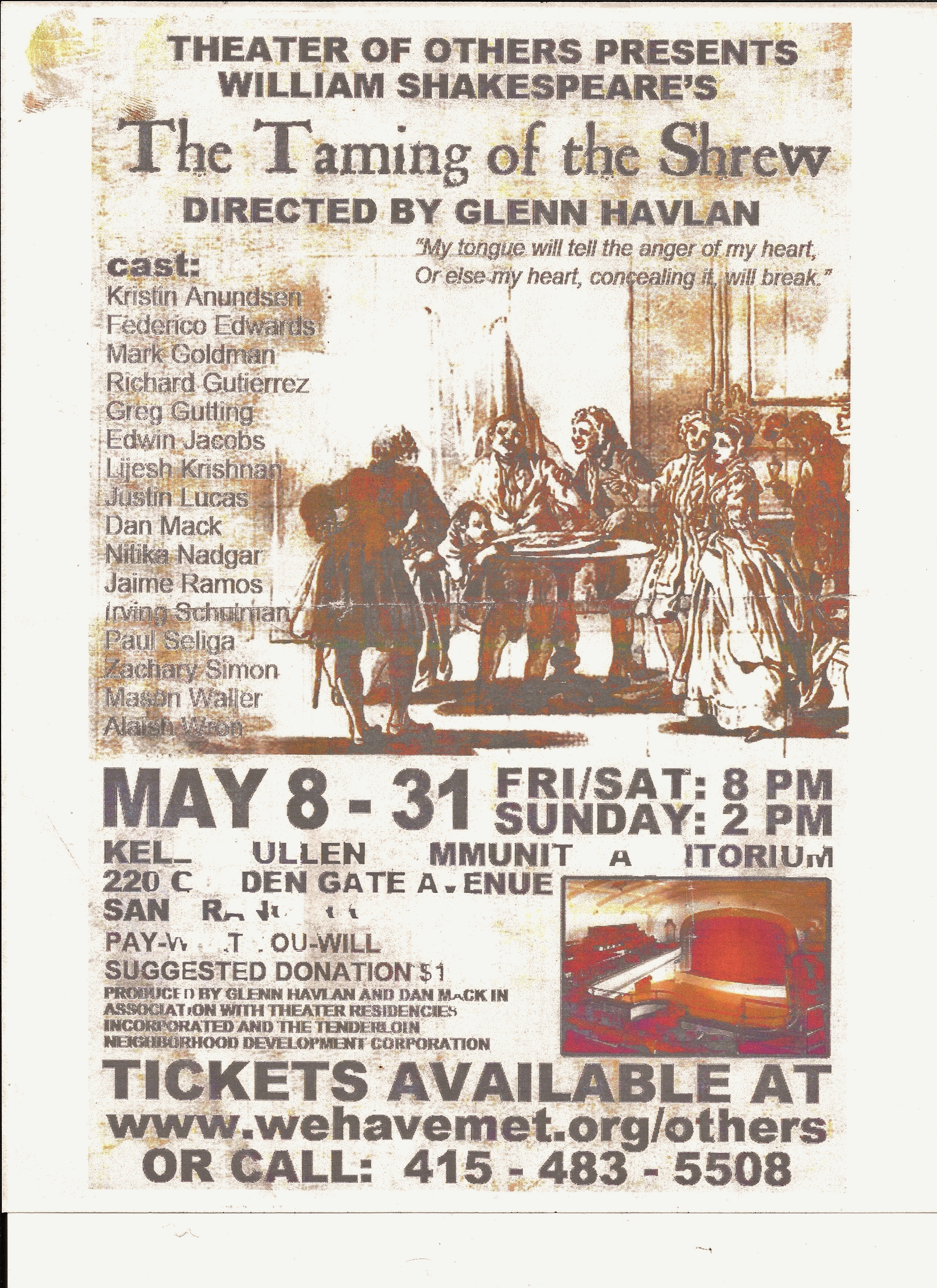
“The Taming of the Shrew” – Theater of Others

By Joe Cillo

Presented by Theater of Others.

Director Glenn Havlan’s “Taming of the Shrew” is not your usual “Taming.”  Havlan has created a most outrageous, boistrous, raucous  version of Shakespeare’s comedy through costuming and staging.  He has rearranged the auditorium at the Kelly Cullen Community Auditorium on Golden Gate Avenue in San Francisco to accommodate his free-wheeling, in your face (literally) cast of fifteen.  The audience sits on folding chairs, angled off to the side on the floor where most of the action takes place, while in the Induction (Scene I), the tinker Christopher Sly (Mason Waller) and his “lady” are ensconced on a chaise lounge on the stage.  The Players below  are welcomed by the chiseled,  stentorian-toned, Lord of the Household (Greg Gutting); his huntsmen played by Richard Gutierrez and Paul Seliga, and his Page, Zach Simon, who also plays Sly’s “lady.”  Thus the play begins.

Maria Graham offered costume assistance, working with the actors to come up with inventive attire, from rag-tag to formal with matronly and cocktail somewhere in between.  What is a Shakespeare’s comedy without switching or mistaking identities, gender confusion, and a long lost heir suddenly being revealed.  Basically Baptista (Irving Schulman), a gentleman of Padua, must marry off his eldest daughter, Katherine,  before the younger, Bianca (a sweet, comely Alaish Wren).   No one wants to marry headstrong, feisty Katherine (aptly played by Nitika Nadgar).  Outstanding suitors for Bianca are Hortensio. who is to prove his worth in the arts but has no talent.  And  Gremio- the three “Rs”; and he woos her in Latin.

Petrucio, a gentleman of Verona, is Katherine’s suitor, the only man willing to take her on.   Petrucio is played by a very physical Dan Mack, whose red hair signals a well-suited temperament for the role. He appears mostly in formal dress, yet his wedding outfit comes as a delightful shock and surprise.  Other “players” Are Lucentio (Edwin Jacobs), a Gentleman of Pisa, his servent, Tranio (Lijesh Krishnan); Biondella, Lucentio’s dithering secretary (an understated and subtly comic Kristin Anundsen).

As in Shakespeare’s time, the audience becomes part of the play.  Half the fun is interacting with the actors when they purposely break the “fourth wall” to make you part of their act.

Final performances: Fri May 29; Sat, May 30, 8PM; Sun May 31, 2PM $10.00 or Pay what you will.

Kelly Cullen Community Auditorium

220 Golden Gate Auditorium,SF, CA

38 Geary, BART, 19 Polk.


This Covered Wagon Needs a Tow Truck

By Joe Cillo

This Covered Wagon Needs a Tow Truck

How does the old-fashioned pioneer spirit handle modern problems? What does it do about bankruptcy, wrecked cars, obstinate offspring? The character of Mom in Marin Theatre Company’s “The Way West,” manages them by denying everything, telling stories or singing. These strategies have always worked for her, but Mom may have come to the end of the trail this time.

“The Way West” forecasts its journey with a wonderful set by Geoffrey M. Curley, a tilted construction of disordered tables and overstuffed furniture, ribbed over with arches that evoke the interior of a covered wagon. In it, Mom quarrels with her two daughters, Manda, the high achiever from Chicago, and Meesh, the loser who stayed home. Both of them often agree that they don’t know what Mom’s talking about.

Still, Manda’s going to help Mom complete the paperwork for bankruptcy, a procedure this lady sees as her last chance, and Manda’s  old boyfriend, Luis, is available to help with the legalities.

There will be a lot of them. Has Mom really charged $3500 to an Elizabeth Arden account? Is it possible she’s paid $500 for a tiny bottle of “magic water” that her friend Tress is selling to her spa customers?  Did Mom actually crash Meesh’s car in the garage? She doesn’t think so. “Prairie wisdom,” she says, “is not to talk about it.” And then Manda is downsized. The wheels have, as the title card says, come off this covered wagon.

Playwright Mona Mansour sees her own American mother as the inspiration for Mom and for the “theatrical moments” in the play. These are the stories Mom tells — real whoppers — that are supposed to illustrate to the girls how fortunate they are not to be dying along the route, starving and confronting ravening coyotes. She also tosses musical instruments at them like a cheerleader, rallying songs that urge “Roll, roll, roll!” or “Fight! Fight! Fight!”  And even though this family has come to a dead stop somewhere around Stockton or Modesto, Mom’s core belief is, “The next place will be better.”

The songs are not old campfire favorites, like “Home on the Range.” They’re originals, composed by Megan Pearl Smith and Sam Misner. During the singing, Director Hayley Finn has the cast members sing not to each other, but to the audience; the same occurs with Mom’s stories. It’s unusual direction and seems to freeze any forward action.

Anne Darragh presents a warm-hearted, gullible Mom, the object of equal parts affection and exasperation. Marin Theatre Company newcomer Rosie Hallett plays daughter Meesh, who’s stayed at home much too long. Kathryn Zdan — as good a musician as she is an actress — has the part of Manda, the one who almost got away by going east.

Stacy Ross, MTC regular, here has a small, but effective role as Tress, the spa owner who has come to believe her own sales pitches. And Hugo E. Carbajal, another newcomer, carries two entirely different parts as boyfriend/legal advisor Luis and as the no-pay-no pizza delivery guy.

“The Way West” has a short run of only twenty-nine shows. It will close on Mother’s Day, May 10. Tuesday, Thursday, Friday and Saturday performances are at 8p.m., Wednesdays are at 7:30 and Sundays are at 7p.m. Matinees are every Sunday at 2p.m., also Thursday, April 30 at 1p.m. and May 9 at 2p.m.

Ticket prices range from $20 to $53, and discounts are available for teens, seniors, military personnel and their families. (Bring ID.)

For reservations or more information, call the Box Office, (415) 388-5208 or see boxoffice@marintheatre.org.

Deep Web — Film Review

By Joe Cillo

Deep Web

Directed by Alex Winter


This is a partisan, advocacy film that champions the legal cause of Ross Ulbricht, who was convicted of heading the website Silk Road, which was the E-bay or Amazon of every imaginable illegal drug on the internet.  I was rather dissatisfied with the film from beginning to end.  The film is naive and hypocritical and its audience is basically Silicon Valley tech nerds and people who want to buy and sell illegal drugs on the internet.

I have been cynical about the so-called “War on Drugs” since it was declared by Nixon in 1971 and amplified by Reagan in the 1980s.  The film is not about the longstanding folly of the misguided Drug War.  It is narrowly focused on the case of Ross Ulbricht, who in my view is simply another casualty of this poorly conceived governmental policy.  Ulbricht and his collaborators tried to set up a website that could be used anonymously to traffic in illegal drugs.  Well, the government found out about it, hatched an undercover operation, and brought it down and arrested Ulbricht.  It is probably true that the government used illegal means in its assault on the Silk Road.  It is probably true that Ross Ulbricht’s trial was not fair, that the government fabricated evidence, trumped up false charges, tried to smear him in the media and so bias the trial against him.  But this is standard procedure in these drug cases.  The filmmakers are shocked and appalled that the government would behave this way.  But this has been going on for decades in this country and there are thousands, perhaps more than a million people in jail in this country who were put there the same way.  Why do they think there have been riots recently in Ferguson, Missouri and Baltimore?  What do they think of all the unrest all across the country about police heavy handedness and brutality?

I have never regarded anything that is done or communicated over the internet as private:  e-mail, “chat,” business transactions, anything bought or sold, anything looked at, shopped for, searched for, read, photographs, pornography, anything.  My attitude is that there is no such thing as anonymity or privacy on the internet.  So my expectations are extremely low.  Everything can be recorded, everything can be saved, everything can be traced.  Nothing is secret.  Don’t even think about it.

The people who invented the Silk Road and other similar sites, as well as the filmmakers, don’t believe this.  They think that secrecy on the internet is possible, that anonymity is possible, that it can be mechanically constructed and preserved indefinitely.  But the case of Ross Ulbricht demonstrates that a determined adversary can thwart such illusions.  It is a chess game that can probably go on forever.  But it does not really interest me.  If you really want secrecy and privacy, keep it off your computer and pay in cash.  It is very easy, and very old fashioned.

Ross Ulbricht, the filmmakers, and the intended audience are mostly white, upper middle class younger people who grew up in a comfortable bubble playing video games and never really knew what was going on around them.  Suddenly they are waking up to find that they can’t freely buy marijuana and other drugs that they want.  But the United States has been moving toward a fascistic, authoritarian governmental system for at least fifty years.  It is a very steady progression that can be seen and measured by anyone who cares to look carefully.  Nixon was forced to resign from the presidency for ordering a burglary into the offices of his political rivals.  At the time that was considered a great vindication of the justice and righteousness of the American system.  Today Obama orders extrajudicial murders all around the world, even of American citizens, and no one bats an eye.  It’s just another day in the news.

In 1970 there were less than 200,000 people in prison in the United States.1   Now (2007), according to the Pew Research Center, there are 2.3 million incarcerated, and if you count all the people on parole and probation it comes to 7.3 million.2  Do the filmmakers care about all of those people?  No.  They care about Ross Ulbricht because he is one of their own.  He is white, upper middle class, and a techie.  But the film is also naive about Ross Ulbricht.  They paint him as a kind of libertarian idealist, who set up this website where people could buy and sell illegal drugs for the good of humanity.  They give an inordinate amount of time to Ross Ulbricht’s mother and father, who are squarely in his camp.  What they did not do was follow the money.  How much money did Ross Ulbricht make running the Silk Road, and where is it?  They never bothered to ask themselves that question.

I wish the film had been a more comprehensive exposition of the so called “Deep Web,” websites that are not readily accessible with the usual browsers and require special anonymizing software to gain access.  I have no knowledge of this aspect of the internet and would be curious to see how it works and see a broad overview of the kinds of communications and transactions that are carried on within it and who uses it.  But this film was not educational, although it did lament that the vast majority of computer and internet users have no understanding of the deep web and how to use and access it.  But the film did nothing to dispel that ignorance and incapacity.  It actually made it seem all the more remote and inaccessible for the average computer user.

This film is very insular.  It is for tech insiders, not a general audience.  It champions the cause of a rather dubious individual engaged in flagrantly illegal activities.  It is mostly oblivious to social and political trends that have been going on in the United States for a very long time.  It represents a kind of awakening for people who have been asleep and who are suddenly realizing to their shock and horror that the world they live in is nothing like the world of their dreams.  I was not impressed with it at all.

We have a government that has kept people in Guantanamo prison for over a decade without charges, without a judicial hearing of any kind, contrary to the Geneva conventions to which it is a signatory, and contrary to our own constitution, and legal tradition going back to the Magna Carta.  It kidnaps people off the street, renditions them to foreign countries where they are held anonymously in secret prisons and tortured.  And you expect this government to respect your privacy?  Who do you think you are kidding?  Our government wants secrecy for itself, but not for you.  They would love to get their talons into Edward Snowden and Julian Assange, just like they did to Chelsea Manning.  They can come after you any time they want for any reason or no reason.  All citizens and non citizens are vulnerable in a society where the government does not abide by its own laws, does not respect its own constitution, and allows the executive and the police to rule by decree.  This is the consistent trend in the United States over a very long period of time.  I have watched this progression over the course of my life time.  Things are not getting better.  They are getting worse.  And I don’t think this small group of bold, tech savvy hackers is going to change that long term trend.  The forces behind it are powerful and deeply entrenched. The monster is more likely to do itself in before they will.  Seen at the San Francisco International Film Festival, May 4, 2015.


Notes


1.  Unlocking America:  Why and How to Reduce American’s Prison Population.  JFA Associates, November 2007.

2.   Pew Center on the States, One in 31: The Long Reach of American Corrections. Washington, DC: The Pew Charitable Trusts, March 2009


Love and Mercy — Film Review

By Joe Cillo

Love and Mercy

Directed by Bill Pohlad


This is a superb rendering of the life and music of Brian Wilson, the creative force behind the Beach Boys of the 1960s and 70s.  It is a fascinating, complex story — and distinctly incomplete.  When they introduced the film at the San Francisco International Film Festival, they mentioned that Brian Wilson had seen the film and pronounced it an accurate depiction of his life.

Brian Wilson struggled with severe mental illness.  He was certainly psychotic at times in his life, although his psychologist’s (Eugene Landy) diagnosis of paranoid schizophrenia was later repudiated by doctors at UCLA.  It is not so important for our purposes to try to pin down an accurate psychiatric diagnosis, but Brian Wilson has presented a number of psychotic symptoms in his adult  life.  He heard voices, had delusions, extreme anxieties, he has been extremely withdrawn for long periods of time, at one point spending up to three years in bed.  He drank a lot, abused many drugs, overate, became obese, engaged in many forms of self destructive behavior.  Nearly died.  But he was lucky.  At crucial points in his life he was able to find people who pulled him back from the brink.  One of them was Eugene Landy, a psychologist who was nearly as crazy as he was.  Landy was controlling, manipulative, and corrupt, but his overbearing style might have been just what a man who was completely out of control needed, at least for a while.  However, Landy’s “treatment” — which amounted to taking over Brian Wilson’s life and overdoping him with a plethora of drugs — might have killed him if he hadn’t been rescued by the woman who became his second wife, Melinda Ledbetter (Elizabeth Banks).

The film is divided into two parallel stories.  One of them is this saga of Melinda liberating Brian from Eugene Landy.  The other is the struggles and tensions of the Beach Boys at the height of their fame and Brian’s creative output, concentrating on the character of Brian Wilson.  The film is skillfully put together and these two parallel narratives work well without getting in each other’s way.  Elizabeth Banks, is beautiful, sensitive, and perfectly suited to her portrayal of Melinda Ledbetter.  Her beauty and personal magnetism give this film much of its strength.  I wouldn’t say that she takes over the film, but she is a very strong, dominating presence.  You can’t help but be captivated by her.  The film does what it does expertly and effectively, but at the same time it awakens further interest in this extraordinarily complex individual, the incredible struggles of his life, and the fabulous music he was able to produce in the midst of it all.  Seen at the San Francisco International Film Festival May 4, 2015.

Salt of the Earth — Film Review

By Joe Cillo

Salt of the Earth

Directed by Wim Wenders and Juliano Ribeiro Salgado


This documents the life and work of Brazilian photographer Sebastião Salgado.  Salgado was one of my own photography teacher’s favorites and I went to see an early exhibit of his in San Francisco, probably around 1990, of South American Indians.  I remember being impressed by the quality of his prints and his compositions.  This film confirmed the correctness of that early impression and showed how much Salgado has developed in the intervening years to the point where I would call him one of the greatest photographers of all time.  He belongs in the company of Adams, Weston, Steichen, Steiglitz, Cartier-Bresson, Evans, Frank, Strand, Maier, and Mapplethorpe — although Mapplethorpe was mostly a studio photographer, he had the same eye for quality, composition, and human sensitivity.  Salgado is the very top level of photography.  Whether he is photographing landscapes, portraits, refugee camps, dead bodies, burning oil wells, portraits, or his wife, he is always an artist.  He is always aware of composing the image for the maximum aesthetic power and emotive effect.  His mastery of light and how to use light in a photographic composition is equal to or beyond anyone’s.  The film did not say whether he makes his own prints, but I was able to find out from an excellent interview by photographer Anthony Friedkin with Salgado’s gallery dealer Peter Fetterman, that Salgado works with several printers, at least in his later years, and he is very hands on in supervising them, going over contact sheets himself with a loupe, and directing the darkroom work in creating the prints.  The interview with Peter Fetterman is lengthy and excellent and I highly recommend it.1

Salgado went through an interesting evolution in his work and within himself that the film presents to great effect.  In his early years he documented the plight of the poor and the downtrodden.  He photographed native peoples, workers, refugees.  He traveled to war zones, famines, refugee camps, burning oil wells in Kuwait, Africa, Rwanda.  He was interested in destruction, genocide, starvation, human brutality, indifference, and suffering.  After decades of immersing himself in the abyss of human cruelty and suffering he came to the conclusion that “we are a terrible species.”  The most destructive and pathological that evolution has produced.  The darkness within human capability is unfathomable and horrifying.

And then there was a change, a turnaround.  Since about 2004 he has been documenting the beauty and renewal of the earth.  He discovered that there is as much going on in the world that is good as there is evil.  And so his recent work, called Genesis, is a compendium of magnificent landscapes from around the world, especially Siberia, Antarctica, the Galapagos Islands, and Africa, coupled with the human interest photos of which he is a master.  This inner transformation, from being preoccupied with destruction and brutality to growth and renewal, expressed outwardly in his photographic work, is one of the most interesting aspects of the film and of Salgado’s life.

In a world where everyone is a photographer and more pictures are being taken of everything than can ever be imagined or ingested, Salgado stands out as one at the very pinnacle of quality and substance.  This film is a beautifully made presentation of his life and work and I wholeheartedly recommended it with high accolades.


1.  Interview with Peter Fetterman by Anthony Friedkin.  September 13, 2013.  http://www.samys.com/blog?action=viewBlog&blogID=-103189848642139966&dest=/pg/jsp/community/printblog.jsp