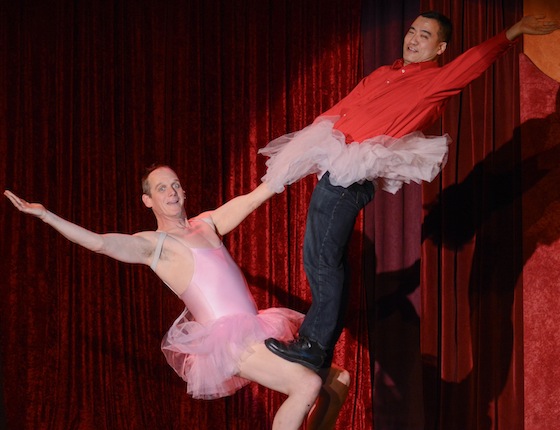
Community theater’s musical ‘Pirates’ defies logic but enchants, amuses

By Woody Weingarten

[Woody’s [rating: 5]

Norman A. Hall portrays a blustery Major-General Stanley in “The Pirates of Penzance.” Photo by Robin Jackson.

Phillip Percy Williams plays a swashbuckling Pirate King in “The Pirates of Penzance.” Photo by Robin Jackson.

Jim Dunn’s retired from directing colossal musicals for The Mountain Play in Mill Valley.

But he hasn’t quit doing them elsewhere.

Exquisitely.

Need proof? Check out the Ross Valley Players’ production of “The Pirates of Penzance” at the Marin Art & Garden Center in Ross.

The company’s professionalism, congeniality-packed presentation, and mastery of the 136-year-old musical comedy/light opera may raise your perception of community-theater.

It did mine.

I’d expected it to be fun, but I hadn’t imagined it to be as impressive as it is.

This two-hour show’s as good as anything anywhere in the Bay Area.

Some folks may be more familiar with Capt. Hook’s crew, from this summer’s “Peter Pan” Mountain Play, or Johnny Depp in the “Pirates of the Caribbean” movie franchise, or, for that matter, the Pittsburgh Pirates.

But Gilbert & Sullivan’s tender-hearted pirates, I believe, are funnier.

And more enchanting.

Even though their actions defy logic and common sense.

It’s almost impossible to watch the 22 performers spilling over the stage at The Barn, the RVP’s home, without feeling good.

Especially when the dainty daughters of Major-General Stanley prissily twirl their parasols, the bobbleheaded British bobbies stumble and bumble like Keystone Cops, or the decidedly un-menacing pirates engage in unison foot-stomping — all courtesy of imaginative choreographer Sandra Tanner.

Most audience members grinned from the first lines of the first number past the final curtain.

Like me.

Before the show, Dunn admitted to early birds he chose the show mainly because it was in the public domain, which meant the RVR wouldn’t have to pay royalties (as it would most modern musicals).

But he also informed one woman that, in contrast to the vulgar “Book of Mormon” he’d recently caught, he loved “Pirates” because of its old-fashioned innocence and it being a crowd-pleasing summer diversion.

Dainty daughters of Major-General Stanley in Gilbert & Sullivan’s “The Pirates of Penzance” include (from left) Kathryn McGeorge, Dana Cherry, Katie Sorensen, Chloe Hunwick and Arden Klizer. Photo by Robin Jackson.

In my view — one that dates back 70 years to a time when my father introduced me to the frenzied rhythms and lyrics of Gilbert & Sullivan, whose sprightliness and cleverness dad relished — Dunn utilizes his own fondness for G&S to inject a comedic music-hall over-the-topness that works extraordinarily well.

His direction, especially turning minor details into major laughs, is brilliant — as might be anticipated from an 83-year-old who’s been directing and teaching theater arts for half a century.

Everything works.

Even having two couples seated in extra-fee boxes on stage and waving teeny Union Jacks.

The cast as a whole is uncommonly good.

In a word: superb.

But several are even better than that: Norman A. Hall’s Major-General Stanley is letter perfect, setting a sky-high bar for other comic performers. Phillip Percy Williams’ Pirate King weaves exaggeration and energy into a smile-inducing, ideal blend. And Joni DeGabriele magnificently flaunts her coloratura, fancifully flutters her eyelashes and unsubtly scrunches up her face as Mabel, wannabe bride.

They’re all accompanied by the piano talent of Music Director Paul Smith, who, from the first note of the overture to the last note of the show, keeps well within the parameters of feel-good.

All that’s amazingly supplemented by the classic, colorful costumes of Michael A. Berg and the enchantingly spare but picturesque sets by Ron Krempetz.

The irrational plot finds Frederic mistakenly apprenticed to the pirates until age 21 by his nurse. But because he was born on Leap Year’s Day, he’s stuck for an extra 63 years — despite having fallen for Mabel, daughter of Major-General Stanley. The pirates are sympathetic to orphans, so all who run afoul of them claim they’re orphans — including Stanley. Pirates pursue Stanley’s daughters. Police pursue pirates.

It all ends with everything in harmony — or in unison, if you prefer accuracy.

The best of the 28 musical numbers are — as always — the rollicking “I Am the Very Model of a Modern Major-General” and “The Policeman’s Lot Is Not a Happy One.”

Nitpickers may gripe about some British accents coming and going like the tide off the shore of Cornwall, the play’s setting, or the old theater’s lack of air conditioning.

Clearly, their joy-ometer is off.

I spied no children in the audience opening night. A pity. Kids would undoubtedly find the frisky silliness to their liking.

As did the child in me.

“Pirates of Penzance” will run at The Barn, Marin Art & Garden Center, 30 Sir Francis Drake Blvd., Ross, through Aug. 16. Night performances, 7:30 p.m. Thursdays, 8 p.m. Fridays and Saturdays. Matinees, 2 p.m. Sundays. Tickets: $17-$33. Information: (415) 456-9555 or www.rossvalleyplayers.com.

Contact Woody Weingarten at www.vitalitypress.com/ or voodee@sbcglobal.net


Unique Berkeley Rep show faces racial conflicts but may miss mark

By Woody Weingarten

[Woody’s [rating: 3]

Anna Deavere Smith portrays Johns Hopkins research Professor Robert Balfanz and many other characters in “Notes from the Field.” Photo courtesy of kevinberne.com.

Anna Deavere Smith beat the odds — and became a theatrical powerhouse.

Despite being an African-American, despite writing one-woman shows with multivarious characters all played by Anna Deavere Smith, despite staging controversial in-your-face portraits of racial conflict.

Now she’s battling the odds again.

But is likely to fail.

In the unique Berkeley Rep’s “Notes from the Field: Doing Time in Education,” she takes on the entire American educational system and its undermining attitude toward poor people of color.

It simply may be too wide a target.

The experimental piece — part drama, part audience participation — covers dense terrain and poses tons of questions.

But it provides only amorphous answers.

I kept waiting for a specificity that never came.

Part of Smith’s “Pipeline Project,” which is seeking to alter school-to-prison practices she contends have decimated the future of a generation, “Notes” is based on 150 interviews she conducted.

In sub-divided sections of an 80-minute first act, she impersonates a riot videographer, an Oakland mentor, a Stockton councilman, a Stanford shrink, UCLA and Johns Hopkins professors, a protestor from Baltimore (where the playwright-performer was born), a Native American ex-con, an emotional support counselor and a high school principal — plus a Philadelphia judge who cried when sentencing a young man because society also was guilty.

She recreates the individuals’ stories precisely as told to her.

That, according to a National Endowment for the Humanities website profile, means “complete with false starts, coughs, laughter, and so on…‘If they said ‘um’…I don’t take the ‘um’ out.’

As in the 64-year-old’s previous shows, Smith’s performance is phenomenally good.

Although her olive drab jacket/shirt and dark pants stay put, she changes personalities by altering facial expressions, verbal pace and timbre — and footwear.

Projected film clips of cops beating blacks and of rioting underline the painful pleas of her portrayal of youngsters being forced into the criminal justice system, of white officials who find few alternatives.

I found it depressing.

But not as disheartening as the ostensibly novel audience breakout sessions about which in a pre-show briefing Susan Medak, Rep managing director, said, “You are the second act.”

The mostly white 23-member group I attended — one of 20 clusters in all — just didn’t come alive.

Its discussion was buried in idealistic but impractical notions, though the writing pads we’d been given carried the printed motto, “The change starts with you.”

Participants proffered suggestions to “move beyond our comfort zone,” “fight racism” and “stop police brutality” — without explaining how.

I had the distinct sense I was at a rally that couldn’t gel.

Smith, who labeled this special presentation “The California Chapter” and a “work in progress,” punctuates all the heaviness with humor.

The opening night audience chuckled accordingly.

If a bit uncomfortably.

It also appeared to dismiss Marcus Shelby’s plucky but sometimes sorrowful jazz bass accompaniment.

Smith, who’s probably best known for her TV roles on “Nurse Jackie” and “The West Wing,” initially gained fame through two early ‘90s documentary theater inventions, “Fires in the Mirror” and “Twilight: Los Angeles, 1992.”

The first, dealing with the Crown Heights riots in Brooklyn, earned her a Pulitzer Prize nomination.

The second, about the Rodney King verdict aftermath, won two Tony nods.

“Notes” is in effect a variation of the theme.

Smith, who won a MacArthur fellowship for blending theatrical art, social commentary, journalism and “intimate reverie,” believes she’s now delivered “a chance to reimagine and recreate a new war on poverty. Education is a crucial part of that.”

In a dramatic coda, she utilizes circa 1970 quotes from black writer James Baldwin that the problem is “the children and their children.”

Not that much, I guess, has changed.

Yet 45 years have passed.

Smith’s UCLA character adds a thought in “Notes.” The “biggest problem in our country,” he proclaims, “is indifference.”

Anna Deavere Smith’s latest magnum opus may be many things, but uncaring isn’t any of them.

“Notes from the Field: Doing Time in Education, the California Chapter” plays at the Berkeley Repertory Theatre‘s Roda Theatre, 2015 Addison St., Berkeley, through Aug. 2. Night performances, 8 p.m. Sundays and Tuesdays through Fridays, 7 p.m. Wednesdays, Thursdays and Saturdays. Matinees, 2 p.m. Saturdays and Sundays. Tickets: $25 to $89, subject to change, (510) 647-2949 or www.berkeleyrep.org.

Contact Woody Weingarten at www.vitalitypress.com/ or voodee@sbcglobal.net

Unaccustomed Earth by Jhumpa Lahiri– Book Review

By Joe Cillo

Unaccustomed Earth.  By Jhumpa Lahiri.  New York:  Vintage/Random House.  2009.


This is a collection of eight elegantly written stories that depict the adjustment and maladjustment of immigrants and their families to life in the United States.   In this case, the country of origin is India, but the challenges and personal issues that Lahiri writes about will be familiar to anyone who has come to this country from a foreign shore, and particularly to anyone born in this country whose parents grew up in a different culture.

The title and lead story in the volume is my favorite.  It is a benign story, told with exquisite sensitivity, about a mixed marriage (Indian female, American male), and the issues facing an immigrant family struggling with life in the United States.  The protagonist’s mother has died, and her father, now seventy, is savoring life as newly single after a long marriage:  traveling, visiting his daughter, Ruma, and her family, and carrying on a secret relationship with a new woman that he met on one of his trips.  Lahiri shows a perceptive eye on every page drawing the contrasting cultures and grasping the implications of small details in behavior and expression in her characters.

Her characters are ordinary middle class people, usually on the affluent side: students struggling with parents and school, professionals, corporate types, with very common middle class anxieties, concerns, and assumptions. This very mundaneness of her characters makes her writing relevant and accessible to a wide audience of both immigrants and native born Americans.

She’s a very insecure woman when it comes to her social status and educational achievement.  She often goes out of her way to make allusions to literary works, esoteric foods, and scientific ideas, as if she wants to establish her own sophistication and educational credentials.  Her characters are always attending or are connected in some way to expensive, prestigious east coast universities. Sometimes I wonder if she thinks her audience is a bunch of graduate students studying humanities.  I guess in many social climbing immigrant families such as hers one can never get enough education.  She is most in your face about it in Going Ashore, the final story in the volume.  In almost every line she is trying to remind us of how educated, worldly and sophisticated she is, especially in the food she eats.  We know you’ve been to school and read a few books, Jhumpa.

Lahiri shows an unflinching commitment to monogamous heterosexual marriage as the definitive lifestyle for human beings throughout her work, even though it never works very well in most of her stories, the possible exception being A Choice of Accommodations.  She seems to blame the men for this, and in a way she is right.  Men are not well suited to monogamous marriage and the growing heavy handedness with which it has been promoted and imposed upon men in America over the last 170 or so years has not been good for men or for women or for society.  I think we can declare it an experiment that has failed.  Nevertheless, a great many American middle class women, such as Lahiri, still believe in it and cling to it as an ideal for their lives, in spite of the fact that it leads to so much disappointment and tragedy.

In A Choice of Accommodations, we see a marriage that actually seems to be working, more or less.  It is an action packed story about a married couple, Amit and Megan, who attend a wedding at Amit’s old boarding school. (Once again we see school as a looming presence.)  They leave their kids with Megan’s parents and go off by themselves for a wild weekend.  At the wedding dinner they decide to call and check on their kids, but Amit had left his cell phone in the hotel room.  He decides to walk back to the hotel room to retrieve it, leaving Megan alone at the wedding party.  He finds the cell phone, but cannot remember his in laws phone number, so having had a few drinks he falls asleep on the bed and doesn’t return to the party.  In the morning he wakes up and finds his wife pissed off that he stranded her and fell asleep drunk on their wild weekend away from the kids.  So they walk around the campus going through some of the buildings and end up making love in a deserted dormitory room.  The end.  It is a rare story where something gets resolved favorably and the couple reestablishes some equilibrium.   Lahiri gets forty-three pages out of this.  You’ll have to read it to see all the exciting parts I have left out.  But notice, it is the man’s irresponsibility that precipitates a problem in the marriage.  This is a motif that will recur throughout the volume.

Males are the destroyers in Lahiri’s world.  In every story it is the moral failings or character flaws in the men that destroy families and relationships.  Women are the hapless victims swept along by the destructiveness of the males that they are unable to tame and unable to save from themselves.  The destructiveness is always inexplicable.  It seems to happen almost arbitrarily.  One seldom sees a cause and effect relationship between anything else in the story and the hand grenades dropped by the males.

In Hell-Heaven Pranab Kaku leaves his American wife of twenty-three years to marry a Bengali woman, after the whole story presents a picture of the two of them in a long, successful marriage.  No hint of dissatisfaction or conflict is offered.  He was also the one who, apparently without realizing it, nearly drove Usha’s mother to suicide with a love she never expressed.  And on the very last page in the very last sentence of this same story Usha’s heart is broken by a man she had hoped to marry.  All this disappointment around marriage, yet Lahiri never questions marriage itself, and she is never able to see marriage from an American male’s point of view.  I think she understands the Indian male’s attitude somewhat better.  In Nobody’s Business Indian men who have never met her and don’t even know her cold call Sang and ask her to marry them.   It is impossible to imagine an American man doing such a thing.

In Going Ashore she describes an alternative to the American way of courtship in Hema’s relationship with Navin, the man to whom she would eventually be betrothed.

They wandered chastely around Boston, going to museums and movies and concerts and dinners, and then beginning on the second weekend, he kissed Hema goodnight at the door of her home and slept at a friend’s.  He admitted to her that he’d had lovers in the past, but he was old fashioned when it came to a future wife.  And it touched her to be treated, at thirty-seven, like a teenaged girl.  She had not had a boyfriend until she was in graduate school, and by then she was too old for such measured advances from men.  (p. 297)

I felt a shudder when I read that paragraph.  It felt ominous to me, that these two people are going to get married.  They both seem woefully unprepared.  The man, Navin, does not seem real, like many of Lahiri’s male characters.  He is the fantasy of a naive, young girl.  If he is real, then his behavior and attitude toward this woman, coupled with her world of illusions does not bode well.  Can they possibly adjust to one another?  Or maybe it will be the kind of marriage where each lives a parallel life and they will share only a small circumscribed relationship in common.  Maybe they will approach the marriage with low expectations and make few demands on one another.  I suppose those kinds of arrangements can work, depending what you mean by ‘work.’  Perhaps in a different kind of society with different assumptions and a different social system.  But in modern America, a couple of this sort faces a daunting rock climb.  I feared for them even before I turned the page.  For all her sophistication in food and the culture of universities, Lahiri is very childlike and ignorant in her understanding of men.

There is never a hint of same sex interest in any of her characters.  No triangles, except clandestine.  Everybody is deceiving each other or living in a world of their own very conventional illusions.  She does seem to have some acquaintance with casual sex, but again, without understanding, especially from the male point of view.  Her eye is always on marriage.

The story of the development of Rahul’s alcoholism from childhood in Only Goodness on puts Lahiri’s superb observational gifts on display to supreme advantage.  She clearly knows something about the developmental line of alcoholism and the various behavioral patterns that accompany it.  But once again it lacks psychological insight.   She gets a lot of the dots, but she doesn’t connect them.  The appearance of alcoholism in an adolescent indicates serious problems within the family as a whole, and particularly in the marriage of the parents.  Lahiri focuses the story on the relationship between the troubled younger son, Rahul, and the older sister, Sudha, almost implying that Sudha is responsible for Rahul’s alcoholism, but avoids looking at the parents’ marriage in any great depth.  Sudha introduced Rahul to alcohol, and helped him sneak booze into their parents’ house and hide it from them.  She facilitated and participated in his early experiments with drinking, but it is profoundly mistaken to think that this led to his later problems.   One has to look at the parents and the onerous pressures they put on their son, their lack of understanding of his emotional needs, and his ultimate rebellion against all of them by destroying himself.  Lahiri puts way too much emphasis on Sudha.

When Rahul expressed a wish to be left alone with his infant nephew while Sudha and Roger go out to a movie, Sudha was worried and did not trust her brother alone with her young son.  When they returned home and found Rahul drunk and passed out on the bed and the infant left perilously alone in a tub of water, there is no explanation for the incident.  It was not unexpected, in fact it was foreshadowed, and Sudha had an palpable worry of such a possibility.  But no understanding is offered.  No insight into Rahul’s murderous rage against his sister is put forward.   Alcoholics are, of course, full of rage and envy, with a will to destroy themselves and those around them.  Lahiri understands this and observes its manifestations very accurately with her exquisitely sensitive eye.  But she doesn’t connect events with their antecedents.  Throughout the book Lahiri’s men seem to go off on destructive tangents after long years of stability and apparent sanguinity.   Lahiri seems genuinely puzzled by men.  Maybe she thinks they are inherently defective or inclined toward destruction.  It seems to be the best she can come up with.  But at the same time she never allows a full blown tragedy to occur.   There are no murders, violence, tragic deaths in her stories.  Even at their most destructive, her men are still under control.

In Nobody’s Business it is Farouk who is the destructive male villain, carrying on simultaneous love affairs with two different women and deceiving both.  Yet both women remain resolutely attached to this very unattractive man.  There is no explanation for why these two women are so attached to Farouk.  He has absolutely nothing to recommend himself.  He treats both women badly and appears to mock their expectation of his monogamy.  Paul is the most problematic character in this story.   He is a roommate of Sang and the story is told through his eyes. He is definitely interested in Sang, he knows a lot about her private life, yet he is at great pains to remain as neutral and nonparticipating as possible.  He is even privy to crucial information that would be of keen interest to Sang.  But he withholds it and does not tell her, allowing the situation to play itself out as if he were watching an experiment on laboratory rats.  No wonder Sang never takes an interest in him.  Deidre also provides an opening for him, which he roundly spurns.  Paul has no sex life or social life of his own.  He is the consummate academic monk.  But it is not quite believable.  We never really see who this guy is from the inside.  He is sort of a place holder.  His function is strictly narrative.  He does not participate in the story line any more than he absolutely has to — despite his inclinations.  He is a kind of living, breathing nonentity.  I think Lahiri could have done without him.  He is a man without a soul, whose only function is to narrate, but the story functions very well without him.

The last three stories in the volume form a trilogy about two characters:  Hema and Kaushik.  The first story, Once in a Lifetime, is written in the second person addressed to Kaushik from Hema.  It has a feeling of reproach running through it.  It is the story of a young girl’s crush on an older boy (16) whose family is friends with her family  — sort of.  The “sort of” is the source of the tone of reproach and resentment running through the story.  Kaushik’s family is considerably better off than Hema’s family, but is staying with Hema’s family and living in their residence for an extended time while they resettle into the United States from India.  Hema is forced to give up her room so Kaushik can occupy it during this rather long, temporary stay.  Kaushik’s mother is dying.  That is the reason for the stay and the resettlement from India.

The second story, Year’s End, is also written in the second person, but it feels as if it is in the first person.  The second person pronoun is rarely used.  In contrast to Once in a Lifetime, where the ‘you’ pronoun is used throughout and the story feels like a long letter, this story feels more like a narrative, and it is in Kaushik’s voice addressed to Hema.  However, Lahiri’s Kaushik is completely unconvincing as a male voice.  Kaushik thinks, feels, and acts like a woman.  He is a woman in a man’s clothes with a man’s name.  Reading this story I felt how thoroughly feminine Lahiri is.   Despite her acute sensitivity and observational skills, she is not able to get inside a man’s head.  That is why I didn’t believe the character of Paul in Nobody’s Business and why I felt she failed to understand the character of Rahul and his drinking in Only Goodness.   She’s out of touch with the male mentality in its depths, but I haven’t quite figured out the reason.  It probably has to do with sex, but I don’t want to say that in print.  She observes the surface with the remarkable sensitivity, which makes her writing such a pleasure to read.  Her eye for small details and their emotional meanings is beguiling.  It draws you in and holds your attention page after page, and yet she seems to miss what drives men in the depths of their hearts, why they need women after all anyway.  She doesn’t quite get it.  She gropes around as if searching, trying to grasp the secrets of a man’s heart, but what she comes up with is always through a woman’s lens.  She does better with her older males, the father figures who are married.   Kaushik’s father in Year’s End, Ruma’s father in Unaccustomed Earth, They feel a little more real, a little more tangible, but young men are a world apart from her.  I can see that she is truly puzzled and intimidated by them.

In Year’s End, we see another instance of the demonic male wreaking destruction upon a family.  While his father and his new wife, Chitra, are out to a New Year’s party, Kaushik is alone in the house with Chitra’s two young girls.  He finds them on the floor of their bedroom — which used to be his — sitting on the floor looking at pictures of his dead mother, which they found in the closet.  He explodes in a tantrum as if they had committed some sacrilege, bullying them and shaking them violently.  The whole incident has a surreal quality to it, and it doesn’t make sense.  There is absolutely nothing in the story that prepares one for this outburst of crazed violence.  It is another example of Lahiri’s inability to create a credible male character.  It further evinces her deep fear of men and her perception of them as unpredictable bomb throwers.

This incident in Year’s End and Rahul’s episode of leaving Sudha’s infant alone in the bathtub in Only Goodness present a clear message from Lahiri about men and young children:  you cannot leave young children alone with a male, particularly a young male.  Young males are irresponsible, negligent, unpredictable, and violent.   Children dare not be left alone with them under any circumstances, even for short periods of time.  Only women can be trusted to care for children properly.

The final story in the trilogy, Going Ashore, is a narrative in the third person, except at the very end where we return to Hema’s voice.  It is about Kaushik and his life as a journalistic photographer assigned to the most dangerous and tumultuous parts of the world.  She thus associates Kaushik with everything she hates and fears about males:  war, violence, atrocities, torture, mutilations, brutality, savagery.  But Kaushik himself does not engage in any of the atrocities.  He does not cut off anyone’s penis, he does not blow up any school buses full of young children, he does not machine gun people with their hands tied standing over an open trench.  He is an outsider who only observes and photographs — like Lahiri.  This is as close as Lahiri can get to the abyss of violence and aggression in male souls.

She is correct that violence, brutality, atrocities, unspeakable cruelty, are the near exclusive province of men.  It is one area that of life that women’s equality has not yet penetrated, and probably won’t.  Women are certainly capable of violence, brutality and cruelty.  But it is usually in response to some personal insult or injury.  Male violence can be more generalized, indiscriminate, and extreme.  Lahiri correctly perceives these capabilities in men, but she does not understand them; she deeply fears them, and she does not grasp their necessity, their inevitability, nor their value.  Men are capable of violence, brutality, and savagery for very good reasons, and women have suffered and benefited from it.

Although she loves Kaushik she ultimately repudiates him and sends him off to Thailand, then she goes a step further and actually kills him off in a tsunami, making sure that there is no possibility of a sequel.  She really doesn’t like men very much.  Only emasculated, tame, domesticated men who don’t stir up any strong feelings.  It is those strong passions of lust and hate that Lahiri sees as giving rise to all the ugliness and pain of life.  Lahiri’s world represents the triumph of duty over love, the triumph of arranged marriage over passion, the triumph of routine over adventure, the triumph of cottage cheese over a good Thai restaurant.  She wants men to be responsible drones, working like slaves for years on end to support their families, but without having to interact with them very much.  Lahiri is the patron saint of all bored suburban housewives.

When Kaushik says to Hema on the day before they are to separate, “Come to Hong Kong with me.  Don’t marry him, Hema.[Navin]”  She should have countered.  “Will you marry me then?”  Because if he wasn’t willing to marry her, then her choice would have been clear and his suggestion would have been out of order.  But if he had answered, “Let’s stay in Italy another week and get married here.  Then we’ll go to Hong Kong together.  Tonight there will be no condoms.  We’ll throw them away.”  “Take me, I’m yours!”  Two weeks later Hema sends Navin an e-mail from Hong Kong.  “Dear Navin,  I’m sorry I couldn’t be present for our wedding, but I eloped and married someone else.   Hema.”  That would have been made a much better story, Jhumpa.  Much better than that dreary ending you wrote.  But it is probably too late to revise it.

I like Lahiri as a writer.  I read The Namesake several years ago, and was favorably impressed with some qualifications, as I recall.  I would probably read other things by her.  Stylistically, her femininity and her keen perception draw me in.  She has a good eye for the nuances of cultural assumptions and expectations, the contrasts, the plusses and minuses in both Indian and American cultures, the quandaries of an immigrant’s adjustment, but I find myself turning against her as a woman, because she fails to understand men so utterly, and because she is at such pains to keep reminding us of her education and social status.  This type of insecurity puts me off.  I gave a copy of this book to an Indian woman I know who was not familiar with Lahiri, but I almost wish I hadn’t.  I have very mixed feelings about the book and about Lahiri.


MATILDA THE MUSICAL earns a standing ovation at the Orpheum Theatre

By Kedar K. Adour

MATILDA THE MUSICAL. Book by David Kelly. Music and lyrics by Tim Minchim. Based on the book by Roald Dahl. Presented  by the Royal Shakespeare Company and the Dodgers. SHN Orpheum Theatre, 1192 Market Street, San Francisco, CA 94102.

888-746-1799 or www.shnsf.com. July 15 – August 15, 2015.

MATILDA THE MUSICAL earns a standing ovation at the Orpheum Theatre. [rating:4]

There is much to like about Matilda the Musical, the multi-award winning play that was imported from England, was a smash hit on Broadway and now is on its second stop of the first national road show. It is based on the Roald Dahl’s children’s book of the same name. The musical book by Dennis Kelly is apparently faithful to the written book (this reviewer was not familiar with it) and the music and lyrics by Tim Minchin have been highly praised. The colourful staging, hilarious costumes and comedic acting add pizzazz to the evening. The defect is in the 2500 seat Orpheum Theatre’s sound system that is less than optimal and excessively loud burying many of the lyrics. With that caveat out of the way, the evening is filled with eclectic music that carries the storyline and a fine cast of adults to match the shenanigans of a plethora of rambunctious children.

Three children (Gabby Gutierrez, Mia Sinclair Jennes and Mabel Tyler) alternate in the lead role of Matilda who “travelled all over the world while sitting in her little room in an English village” reading books.” On opening night in San Francisco it was diminutive, clear voiced Mabel Tyler who took centre-stage to play the precocious 5 year old that through thick and thin saves the day with her honesty aided by telekinetic powers.

The adults do not take a back seat to the children even though they are outnumbered by a ratio of five to one. They include home-grown Olympic athlete Bryce Ryness in almost drag playing the wicked Miss Trunchbull, headmistress of the second rate school populated by the kids she calls “maggots” who almost steals the show. The protector of the maggots is Miss Honey (Jennifer Blood) the teacher who befriends Matilda and is perfect in the part. Along with her fine singing voice displays physical agility.  Cassie Siva and Quinn Mattfeld as Mr. and Mrs Wormwood are allowed to be almost likeable villains even though they mistreat their unwanted daughter Matilda. Then there is Ora Jones as the sympathetic librarian providing books to our soon to be heroine and is fascinated by her story telling.

The staging (Ryan Emmons) and choreography (Kate Dunn) are eye-popping colourful adding non-stop dynamism. Cassia Silva and Jaquez Andre Sims perform a dynamic tango that matches Quinn Mattfeld’s opening number of the second act “Telly” advising the audience against reading in favor of watching television.  The depiction of the story being concocted by Matilda about The Escape Artist (Justin Packard) and the Acrobat (Wesley Faucher) is inserted to emphasize further that the play is a fantasy.

Tim Minchim’s music and lyrics have won multiple awards and includes the memorable “When I Grow Up”, “Quiet” and “My House.”

All in all it is stunning evening with a running time of two hours and 30 minutes with an intermission. Recommendation: Should see and bring a child along.

CAST:  Gabby Gutierrez, Mia Sinclair Jenness, and Mabel Tyler rotate as Matilda. With the adult principals featuring (alphabetically): Jennifer Blood (Miss Honey), Quinn Mattfeld (Mr. Wormwood), Bryce Ryness (Miss Trunchbull) and Cassie Silva (Mrs. Wormwood).

Kedar K. Adour, MD

Courtesy of www.theatreworldinternetmagazine.com


Film: A Wolf at the Door — The Art of Deception

By Judith Wilson

A Wolf at the Door (O Lobão atrás da Porta) is a chilling tale. Inspired by the real-life story of the Beast of Penha and a kidnapping that shocked Brazil in 1960, it is Brazilian writer and director Fernando Coímbra’s examination of the personalities involved and how an act of poor judgment can unleash demons no one knew existed and lead to unimagined consequences.

This isn’t postcard-pretty Rio de Janeiro. Rather, it takes place in the suburbs far from Corcovado and the groomed beaches of Guanabara Bay and begins with a simple flirtation on the platform of a stop on the commuter rail line. Rosa (Leandra Leal) and Bernardo (Milhem Cortaz) quickly end up having a romp in bed, but Rosa wants more than a one-time fling, and things take a peculiar turn after they launch an affair, and she finds out that Bernardo is married. She wants him for herself, and one of her strategies is to seek out his wife Sylvia (Fabiula Nascimento), stage an accidental meeting and use the opportunity to win Sylvia’s friendship and find out the intimate details of Bernardo’s family life.

The lovely Leal’s performance as Rosa is riveting, as she gradually reveals a personality far more complex than a girl looking for a good time and challenges the audience to look beyond her outer beauty and warmth to see the ugliness inside a woman who lacks a moral conscience and has a heart that turns truly frigid when she doesn’t get what she wants.

Cortaz plays Bernardo as a macho, selfish man, who puts himself first and hurts the women in his life while seeming clueless to the damage his irresponsible behavior is causing. Nascimento as the decent, trusting Sylvia shows a range of emotions, ranging from the nagging suspicion that her husband might be having an affair to paralyzing fear when she discovers that her daughter is missing.

This is Coímbra’s first feature film, and he frames the story masterfully with noir elements, beginning with the police’s investigation of the kidnapping as they hear three different versions of the events leading to it, and then going back to the beginning to have Rosa tell her story in detail, slowly revealing a damaged woman who sees herself as the victim in a love triangle and calculates her revenge. Coímbra’s choice of a drab working-class suburb for the setting adds to the sense of desperation and desire to escape that drives Rosa.

The Beast of Penha, Rosa’s counterpart in real life, never expressed any remorse for her actions, and ultimately, it’s that lack of humanity that Coímbra captures, shocking the audience with the reality that evil can appear where we least expect it, and beauty really is only skin deep.

The film (100 minutes) opened at Smith Ranch Road on July 16, 2015. It was released in 2013, screened at the Mill Valley Film Festival in 2014 and has won numerous awards for Coímbra’s direction and Leal as best actress. In addition, it won the Grand Jury Prize at the Miami Film Festival in 2014 and an ABC Cinematography Award in 2015 for best cinematography and best editing. It is unrated, but contains sex, violence and one particularly shocking scene.

It is in Portuguese with English subtitles, and the English title, “A Wolf at the Door,” is something of a misnomer. A more accurate translation is “The Wolf Behind the Door,” and although the difference is subtle, it is a better reflection of the story. Once the wolf is inside, it’s impossible to escape the danger.

Tartuffe, presented by SRT at Santa Rosa Junior College, Santa Rosa CA

By Greg & Suzanne Angeo

Reviewed by Suzanne and Greg Angeo

Members, San Francisco Bay Area Theatre Critics Circle

(Photos courtesy of SRT)


Craig Brauner

A Dazzling New Look at Moliere Classic

The Summer Repertory Theatre festival, now in its 44th year at Santa Rosa Junior College, is a popular summer escape for local theatre lovers. The repertory company draws dozens of the most promising theatre students from all over the United States. SRT’s 2015 program includes five plays and musicals performed at two professional-quality theaters on the JC campus – the 600-seat Burbank Auditorium, and the 198-seat Newman Auditorium. It’s in the smaller Newman venue where perhaps one of the most entertaining and original incarnations of a centuries-old theatre classic, Moliere’s “Tartuffe”, is being presented.

Bringing the setting of an old standard into modern times is nothing new in theatre. Recent presentations by Cinnabar Theater include “Falstaff” set in the 1950s and “The Marriage of Figaro” in the Jazz Age (both shows previously had similar stagings in New York City). But earlier this year, a review for a production of “Tartuffe” at Berkeley Rep may have provided a spark of inspiration. The reviewer suggested that this 17th-century potboiler could be a reality TV show today.

Albert Rubio

Someone was paying attention. Through director Anne McAlexander’s innovation and skilled eye for both comic and dramatic timing, we do indeed get to see what the characters in “Tartuffe” would look like as reality stars. From TV monitors mounted around the stage, characters deliver their deepest, darkest confessions when asides to the audience are called for. Camera crews are in hot pursuit as characters scamper away. They may be holding smartphones, but the actors speak lines that are faithful to Richard Wilbur’s translation into rhyming couplets, which is great fun to hear.

There are some outstanding performances: Nancy Ross is fabulous as the ditzy Mariane; Albert Rubio has some great moments as pious family man Orgon; Craig Braunerplays the title role with farcical wit. The smooth-talking swindler Tartuffe is armed only with phony religion, used as a front to get sex and riches. Ross is especially good, playing a sympathetic, comical sexpot worthy of Marilyn Monroe.

Lauren Hart (center) with Tartuffe Cast

The cast as a whole is an excellent working ensemble. Notable are Devin White (Damis), Lauren Hart (Elmire) and Andrew Cohagen (Valere). What the show needs is a stronger Dorine, the wisecracking, ever-present housemaid. The role is pivotal – she’s the family negotiator, conscience, scold, confidante and watchdog. Danielle Cohn is pleasant enough, but plays it a little too awkward, too soft and restrained when sharpness and force are called for.

Crazy little bits of business that are obviously not in Moliere’s script give jolts of surprise, propelling the action from beginning to end. The focal point seems to be the household cocktail bar, strategically positioned downstage center, where nearly everyone in the show stops for refreshment (some more than others). McAlexander uses the whole stage with impeccable, choreographic blocking that really enhances the effect of a piece like this, where timing is everything. McAlexander, who also happens to be a talented choreographer, saves some of her best handiwork for last, with a Bollywood-style dance number at the end of the show that rocked the house on a recent evening.

The controversy and salaciousness embedded in “Tartuffe” travel very well between centuries and lose none of their titillating appeal. Self-righteousness, religious hypocrisy and the seven deadly sins are all right there, fully intact and ready to be enjoyed. The deeper message, according to McAlexander: “…certain reality TV franchises hold a mirror up to the viewers, forcing us to reflect on our own shortcomings and actions. Heightened lifestyles and extreme circumstances allow us to maintain a safe distance from which to both be entertained and judge.” But who can judge Tartuffe? He readily admits, “I’m no angel nor was meant to be.” Just like all of us.

When: Now through August 2, 2015

Performances: Weekdays (except Mondays) and weekends

2:00 p.m. matinees, 7:30 p.m. or 8:00 p.m. evenings

(See www.SummerRep.com for details)

Tickets: $15 to $25

Where: Newman Auditorium at SRJC 1501 Mendocino Avenue (off Elliott Avenue in Emeritus Hall)

Santa Rosa, CA 95401

(707) 527-4307


Other shows being presented by SRT Festival at SRJC:

Emma” by Jane Austen (Newman Auditorium)

Peter and the Starcatcher” (Burbank Auditorium)

South Pacific” (Burbank Auditorium)

Little Shop of Horrors” (Burbank Auditorium)


Festival runs through August 8, 2015 www.SummerRep.com

Stanford stages good comedy of bad manners

By Judy Richter

Whether the Bliss family represents that state of minds depends entirely on whether one is an insider or outsider. That’s apparent in Noël Coward’s frothy comedy, “Hay Fever,” presented by Stanford Repertory Theater.

Perhaps a more appropriate name for the family might be the Bickersons because bickering seems to be the favorite sport of all four Blisses. Overdramatizing is another.

These sports come to light one weekend when, unknown to the rest of the family, each Bliss invites someone of the opposite sex to visit the family’s country home.

The bickering begins even before the first guest arrives as young adult siblings Sorel (Kiki Bagger) and Simon (Austin Caldwell) go at it. As the play continues, everyone get in on the act, especially their mother, Judith (Courtney Walsh), a retired actress who still delights in dramatic behavior. Their father, David (Bruce Carlton), a novelist, joins in.

Judith’s guest is young admirer Sandy Tyrell (Andre Amarotico). Simon has invited Myra Arundel (Deb Fink), who is older than he, while David has invited the much younger Jackie Coryton (Kathleen Kelso). Completing the list is Sore’s much older guest, Richard Greatham (Rush Rehm), a diplomat.

As each guest arrives, the family’s maid, Clara (Catherine Luedtke), merely opens the door and walks away, giving the guest a first taste of the bad manners that lie ahead. The guests then find themselves ignored or seduced. Each family member seems properly indignant about such indiscretions.

The play is loaded with some amusing scenes, such as proper Richard’s attempts at conversation with vacant Jackie and an after-dinner game involving behavior in the manner of a particular adverb.

For the most part, director Lynne Soffer’s cast does well with Coward’’s often subtle wit. Bagger and Caldwell as the Bliss siblings got the first act off to a rocky start on opening night with Bagger’s English accent difficult to understand. She improved after that, though.

At other times, various cast members didn’t wait for laughter to subside before their next lines. However, this was the first performance before an audience. The actors hadn’t had the advantage of a preview to refine their performances.

Nevertheless, the show delivered an ample share of laughs from both the over-the-top antics of the Bliss family, especially Walsh as Judith, and the guests’ increasing discomfort.

The production is enriched by Annie Dauber’s set, Connie Strayer’s elegant costumes, Michael Ramsaur’s lighting and Brigitte Wittmer’s sound.

In her program notes, director Soffer gives  “a tip o’ the hat to Nagle Jackson for his inspiration.” Jackson directed the hugely popular American Conservatory Theater production of “Hay Fever” in 1979 and 1980, when ACT had a resident company of actors.

Soffer told me at intermission that she was using a sight gag that had worked so well for ACT in the breakfast scene of Act 3.  It worked again in this Stanford production.

Running just over two hours with one intermission, “Hay Fever” is the centerpiece of SRT’s summer festival, “Noël Coward: Art, Style and Decadence.” It includes a cabaret show, “Cowardy Custard,” a revue of Coward’s songs. Also included are a film series and a community symposium.

“Hay Fever” runs through Aug. 9 in Stanford’s Pigott Theater, Memorial Auditorium (Memorial Way and Galvez). Tickets and information about the play and details about all of the summer festival events are available by visiting www.repertorytheater.Stanford.ed  or calling (650) 725-5838.


Noel Coward’s Hay Fever is a hectic romp at Stanford Rep

By Kedar K. Adour

The Bliss Family (l-r)David (Bruce Carlton), Judith (Courtney Walsh), Sorel (Kiki Bagger) and Simon (Austin Caldwell) in Stanford Rep’s Hay Fever.

HAY FEVER: Comedy by Noel Coward. Directed by Lynn Soffer. Stanford Repertory Theater
551 Serra Mall, Stanford, CA 94305 @ Stanford University. 650-725-5838 or www.repertorytheater.stanford.edu.  July 16- August 9, 2015

Noel Coward’s Hay Fever is a hectic romp at Stanford Rep [rating:3]

Research on the background of the play Hay Fever by Noel Coward revealed facts that still apply. Apparently he wrote the play in three days in 1924 specifically for a leading lady of the time who thought it “amusing and not substantial for a whole evening.” Coward remembered that the initial reviews “were amiable and well-disposed although far from effusive” although the play had a respectable run in 1925. Those remarks are applicable to Stanford Repertory Theater’s present production. It was noted, as indeed it has been today, that the play had no plot and that there were few if any ‘witty’ lines’ although the action is almost non-stop. A very attractive set, marvellous fashionable 1920’s costumes and competent cast need a bit more to bring the quintessence of a Noel Coward play to life.

That quintessence is a touch of savoir faire and distinct diction to do justice to his delicious and sometimes memorable lines. To be fair to the director and cast, the production seen on opening night was the first to performed with a live audience and knowing the quality of the director and some of the actors those perceived defects will be corrected.

Experienced director Lynn Soffer has an added disadvantage with the play since the primary characters are not very likeable bohemians whose self-centered life styles would dictate over-the-top performances that are rampant.

The three acts zip along in only two hours with an intermission between Act I and II with dimming of stage lights before the dénouement of Act III. The setting is the country home (fine set with obligatory French doors to a garden and a two level staircase on stage rear) of the Bliss family. The matriarch, Judith Bliss (Courtney Walsh), is an aging actress who has desires to return to the stage. She is married to David Bliss (Bruce Carlton), a bland novelist working on his latest book. Their spoiled young children Simon (Austin Caldwell) an artist and Sorel (Kiki Bagger) who amuse themselves are acting out passages from the play Love’s Whirlwind. A bit of banter telegraph’s the surprise denouement; “Is this a game?” and “Yes, a game that must be played to the finish.”

Unbeknownst to the others Judith has invited a handsome sportsman admirer Sandy Tyrell (Andre Amarotico), Simon has invited the vampish Myra Arundel (Deb Fink) and David invited diplomat Richard Greatham (Rush Rehm), who brings along a beautiful young flapper Jackie Coryton (Kathleen Kelso). With the maid Clara (Catherine Luedtke) all the characters are in place and Act I ends.

Act II is the humdinger with the family and guests in evening dress (Costumes by Connie Strayer) engaging in a word game that apparently was popular in the 20s and 30s. It is this game that sets up the conflicts that morph into potential relationships that carry the plot hellishly forward giving each actor a chance to emote with entrance and exits out the French doors into the garden or up the stairs. Soffer keeps the action at a high pitch moving her actors about adroitly expertly mixing pathos with the humor.

All quiets down for Act III with the unnoticed departure of the guests leaving the Bliss family on their own.

 The acting is best described as emoting with each getting their turn on center stage. Courtney Walsh gives a touch of the theater as the flamboyant actress having to match the hectic histrionics of the Austin Caldwell and Kiki Bagger. Equity Actor Deb Fink has that touch of savoir faire needed as the vamp Myra with Rush Rehm a perfect match for her with his understated performance. Beautiful Kathleen Kelso steals the show displaying Jackie’s uncertainty and vulnerability.  Catherine Luedke gives her role as the maid a perfect touch.

On this opening night the timing and diction were deficient but this should be corrected in future performances.

Artistic Staff: Director, Lynne Soffer; Set Designer, Annie Dauber; Costume Designer, Connie Strayer; Lighting Designer, Michael Ramsaur; Sound Designer, Brigitte Wittmer; Stage Manager, Analyssa Lopez; Props Mistress, Christine Edwards; Wig Designer, Vicky Martinez; Assistant Director & Dramaturg, Patty Kim Hamilton; Assistant Lighting Designer, Keenan Molner; Assistant Stage Managers, Annabel Ostrow and Victor Spielberg Verdejo.

Cast in Order of Appearance: Sorel Bliss, Kiki Bagger; Simon Bliss, Austin Caldwell; Judith Bliss, Courtney Walsh; David Bliss, Bruce Carlton; Clara, Catherine  Luedtke; Sandy Tyrell Andre Amarotico; Myra Arundel, Deb Fink; Jackie Coryton, Kathleen Kelso; Richard Greatham, Rush Rehm.

Kedar K. Adour, MD

Courtesy of www.theatreworldinternetmagazine.com.


The Bliss Family (l-r)David (Bruce Carlton), Judith (Courtney Walsh), Sorel (Kiki Bagger) and Simon (Austin Caldwell)

A Poem is a Naked Person — Film Review

By Joe Cillo

A Poem is a Naked Person

Directed by Les Blank


This is not a documentary despite the film’s pretensions.  This is a video scrapbook or an upscale home movie.  The video clips that have been strung together in this are pretty good quality.  The camera crew that shot them was excellent.   The editing and the conceptualization are amateurish, but each small bit is interesting in itself and the music selections are outstanding.  This film, despite its many limitations, takes hold of you and doesn’t let go.  It is carried strictly by the power of the subject matter and the quality of the music — and there is a lot of music, and a great variety of music.  All the time I was watching the film I was trying to figure out when it was shot.  I recognized a brief cameo of Cass Elliot, so I knew it had to be not later than the early 1970s. It was actually shot by Les Blank in 1972-1974.  (This is not presented in the film.  I had to look it up.)  Most of it was shot in Tulsa, Oklahoma, maybe some of it in Louisiana, I’m not sure.  This film is not a presentation of the facts.  It is a raw, informal portrait of Leon Russell from his peak years as a singer and performer.  The title of the film is a quote from Bob Dylan’s liner notes to his album Bringing It All Back Home (1965).

There are a couple of things this film does well.  The presentation of Leon Russell as a singer, pianist, and performer, work.  I was impressed with what an excellent pianist he is.  There is a wedding scene where he plays Wagner’s “Bridal Chorus” from Lohengrin and Mendelssohn’s “Wedding March” unaccompanied on the piano.  I believe they were his own arrangements very sensitively performed.  He has a very commanding presence on stage.  In front of an audience he was comfortable and unquestionably in charge.  I could also feel a hard, driving ambition in him that was very disciplined and insistent on excellence.  Off stage he was casual and relaxed.  He seemed to tolerate bozos well and there seemed to be a lot of them around him.  But when it came to music and performing before an audience, he took it very seriously, and he must have been demanding of his band mates.  The film did not make a point of this, but I surmised it from the quality of the performances and his demeanor on stage.

The film gives one a good feel for the culture of Oklahoma and the various musical influences absorbed by Leon Russell from middle America and the South.  There is a shot of some rollicking gospel in a black church, Sweet Mary Egan on unaccompanied fiddle, band member Charlie McCoy on harmonica, young Malissa Bates singing Hoyt Axton’s “Joy to the World” unaccompanied,  a very young Willie Nelson doing “Good Hearted Woman,” some native Americans in traditional dress dancing to their native drum music.  The film is rich in the musical culture of the American heartland.

One also gets a feel for the culture and temperament of the people of Oklahoma: provincial, unsophisticated, simple and straight ahead.  There is a clip of a precision parachute jumping competition, another of a controlled demolition of a building in downtown Tulsa, another of a man in a small boat catching a quite large catfish.  Some things you probably couldn’t get away with today, like feeding a small chick to a boa constrictor and watching him kill it and eat it before your eyes.  The man who guzzles down a glass of beer and then bites off the edge of the glass with his teeth and chews it up and swallows it.  That may represent the culture and mentality of the people of Oklahoma, but Leon Russell is a couple of pegs above that.

He is comfortable in that provincial backwater.  It has molded him and shaped him and he has incorporated its varied influences into his own style, and the people see him as one of their own.  But he is able to move beyond that world that gave him birth.  He knows of a bigger world beyond the confines of Oklahoma and he wants to be part of it and be successful in it.  While Leon Russell can fit in with those unvarnished yokels, he is not really one of them.  His mind, his taste, his skill, and his ambition reach far beyond his roots, but he does not repudiate his background, rather he embraces it and embodies it and forges from it a very appealing, unique personal style.  The film does give you that much, although there is much more you will wish it had done.  It is an excellent and interesting introduction to the music and the person of Leon Russell.


Anna Deavere Smith tackles educational system

By Judy Richter, Uncategorized

Playwright-actor-teacher Anna Deavere Smith has created and presented several one-woman shows dealing with important social issues or events.

Her latest is “Notes From the Field: Doing Time in Education, the California Chapter,” presented by Berkeley Repertory Theatre.

As she has done in her previous shows, such as “Fires in the Mirror” and “Twilight: Los Angeles, 1992,” she bases this work on hundreds of hours of interviews with people who have varying experience with, in this case, education and the criminal justice system. Directed here by Leah C. Gardiner, she then re-creates these people using their exact words and manner of speaking.

She focuses on the school-to-prison pipeline, in which students failed by the schools are highly likely to land up in jail. Many of them are people of color whose needs aren’t served by their schools and community. Many are treated unfairly by the police, who are subject to frequent criticism in this show.

This aspect of the show is punctuated by cell phone videos of police mistreating young black people. One is a 14-year-old girl in her bathing suit who is thrown to the ground and handcuffed with her hands behind her back. Another is the notorious death of Freddie Gray after he was arrested by Baltimore police earlier this year.

One of the people interviewed by Smith and re-created in this show is the Baltimore deli worker who took a video on his cell phone. Others include a Yurok fisherman with numerous run-ins with police, plus educators, a judge and researchers.

There’s a woman from Philadelphia whose mother was determined to see her rise above poverty and get a good education. When she became the first person in her family to graduate from college, her mother ignored admonitions against applause. Instead, when the woman crossed the stage to get her diploma, her mother jumped up and cried, “Thank you, Jesus.”

The title of each monologue along with the person’s name and position is shown on three screens arrayed around the stage (projections by Alexander V. Nichols). In the set design by John Arnone, various pieces of furniture are moved on and off stage by stagehands. Smith dons various jackets or accessories designed by Ann Hould-Ward.

Each monologue also is accompanied by unobtrusive but effective music composed and performed by bassist Marcus Shelby.

The first act runs about 90 minutes, followed by a break of 25 minutes or so. During this time, the audience gathers in randomly assigned groups throughout the theater and lobby to talk about ways “to help dissolve the school-to-prison pipeline and inequities in the education system,” a press release says. Each group is guided by a facilitator.

Hence, “You are the second act,” Berkeley Rep managing director Susan Medak told the opening night audience before Act 1. It’s “a grand experiment” meant to generate conversation, she said.

The final part of the show, which totals about two and a half hours, is “Coda.” This 10-minute section features Smith again and concludes with words by the late James Baldwin. This is perhaps the only weak spot in what otherwise is a compelling presentation by a gifted, thoughtful performer.

As for the goal of generating conversation, the show apparently achieved just that as people were engaged in lively conversations in the lobby and outside afterward.