‘West Side Story’ remains fresh at Broadway By the Bay

By Judy Richter

The story of “Romeo and Juliet” finds its 20th century counterpart in “West Side Story,” presented by Broadway By the Bay.

With music by Leonard Bernstein, lyrics by Stephen Sondheim and book by Arthur Laurents, Shakespeare’s battling Capulets and Montagues in 16th century Italy become the Sharks and Jets, street gangs in New York’s Upper West Side in the mid-’50s

In the BBB production, the star-crossed lovers are played by Nikita Burshteyn as Tony, a member of the white Jets, and Samantha Cardenas as Maria, part of the Puerto Rican Sharks.

Both are noteworthy in songs like “Maria,” “Tonight” and “One Hand, One Heart.” As the two gangs vie for turf, Tony and Maria become its victims.

They’re well supported by Taylor Iman Jones as Maria’s friend Anita and others in the 40-member cast, ably directed by Amanda Folena.

The 1957 Broadway smash was originally directed and choreographed by Jerome Robbins. Nicole Helfer recreates some of that original choreography and adds some of her own with dynamic results. The outstanding orchestra is conducted by musical director Sean Kana.

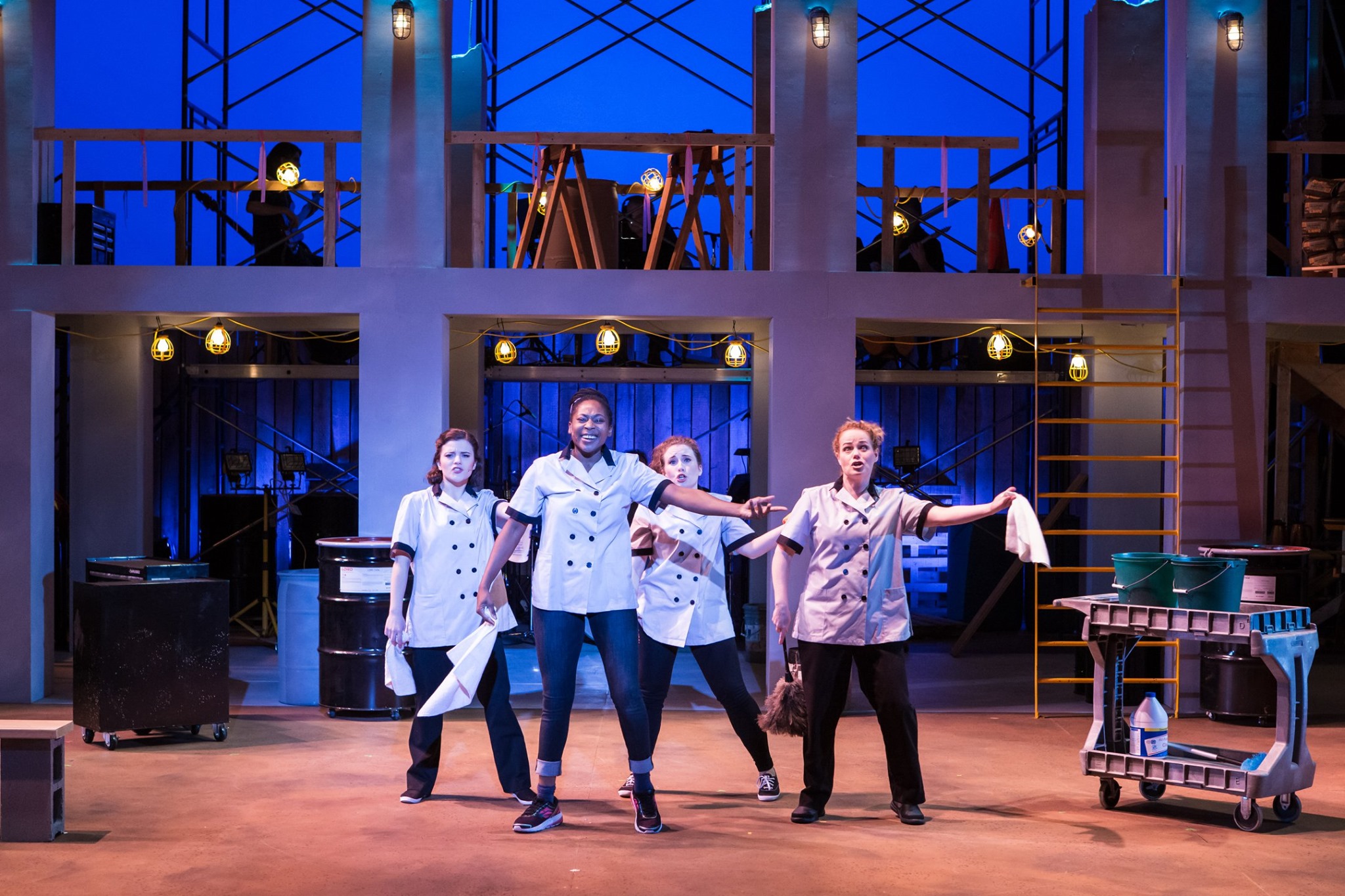
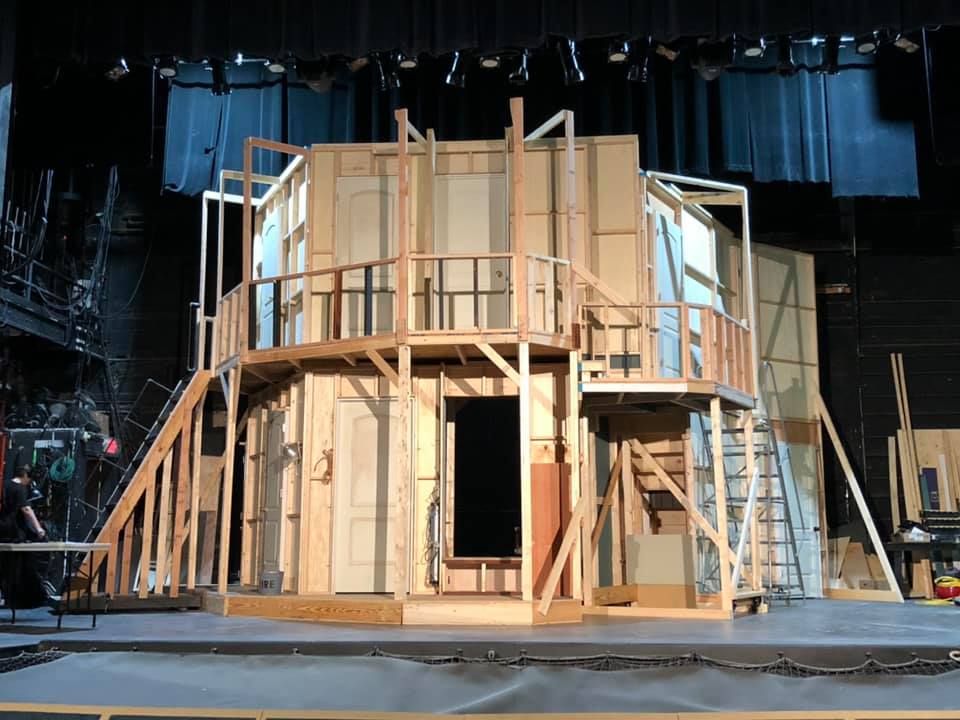
Kelly James Tighe’s set of scaffolding, with lighting by Joe D’Emilio, evokes the neighborhood’s grittiness, as does the sound design by Jon Hayward. The ’50s costumes are by Margaret Toomey.

This is Folena’s final show after four years as the company’s artistic director. She “will be pursuing a teaching opportunity,” she says in the program. The company will celebrate its 50th anniversary on Oct. 4 at LV Mar restaurant in downtown Redwood City.

Although “West Side Story” is based on an old story updated to the ’50s,  it’s still timely today as gangs, sects and nations throughout the world fight over territory and innocent people suffer.

It will continue at the Fox Theatre, 2215 Broadway St., Redwood City, through Aug. 30. It will then move to the Golden State Theatre, Monterey, Sept. 4-12.

For Redwood Citytickets and information, call (650) 579-5565 or visit www.broadwaybythebay.org. For Monterey, call (831) 649-1070 or visit www.goldenstatetheatre.com.


Best of Enemies — Film Review

By Joe Cillo

Best of Enemies

Directed by Robert Gordon and Morgan Neville


This is a rehash of the 1968 political conventions and the debates between William F. Buckley Jr. and Gore Vidal that were aired as part of ABC’s alleged news coverage.  I vaguely remember watching some of these when I was about fourteen years old.  These debates varied in length between about 8 and 22 minutes.  They were not very long.  I am quite sure I did not watch all of them, but I did watch the famous ninth debate when Buckley lost his temper and threatened to sock Gore Vidal in the face.  I don’t remember too much else about this and at the time I was ignorant and had a very limited perspective on the country and what was happening to us as a nation.  I remember checking Buckley’s book, Up From Liberalism, out of the library and carrying it around for some time.  I didn’t read the whole thing.  I started it, but Buckley is pompous and rather boring.  I didn’t warm to Gore Vidal either.  Vidal represented an iconoclasm and counterculture to which I had no exposure growing up in a small, backward, conservative town in Ohio.  I like him much better now that I have become an iconoclast and counterculture figure myself.  What I say here is not what I recall or influenced in any way by my own very vague memories of these events.  It is based strictly on what was presented in the film.

This film is interesting and presents a clash of two strong intellectual personalities.  They were both members of the east coast elite.  Buckley was well-to-do and educated in his early years in England.  Vidal’s family was military and political.  I wish the film was a little better than it was.  These two men had a deep visceral hatred for one another that lasted their entire lives.  They represented polar opposites in values, lifestyle, and vision for the country.  I didn’t really grasp the source of this rancorous hatred.  I understand they are different, they have different points of view, etc.  But difference does not entail that they must hate each other with such implacable animosity.  They seemed to need each other as enemies.  There was a peculiar bond of rivalry that they seemed to revel in.  I think there was some mutual jealousy as well as morbid fascination.  There was no foundation of good will or mutual respect.

Buckley was a grandiose, well defended person who hid behind this pose of intellectual superiority.  Vidal detested this.  He could see Buckley for what he was, namely, an authoritarian, narcissistic bigot, and he knew how to needle him.  He knew how to get under his skin and expose that ugly, violent, spite and disdain for those he considered beneath himself, which was almost everybody.  Vidal was not intimidated by Buckley’s intellect.  In fact, he mocked it.  Buckley wasn’t used to being challenged on his own turf, especially by someone for whom he had little more than contempt.  The fact that Vidal was able to bring Buckley to the point where he completely lost it in a public forum was deeply wounding to him and he never recovered from it.  But Vidal had been wounded long before, and throughout his life, by the narrow minded prejudices and righteous exclusion that Buckley embodied.  However, Vidal was accustomed to being insulted and disdained for what he was and was much better prepared for the attacks from Buckley.

These so-called debates reflected a cultural and political divide in the United States that existed at the time, but which has deepened and intensified ever since.  The election of 1968, and particularly the Democratic Convention in Chicago of that year, can be seen as the beginning of a long downward spiral in the United States, politically, culturally, economically, philosophically, and in terms of the media’s role in informing and educating the public.  We are now living in the shadow of that long process of cultural and political degeneration.  We have gone from William F. Buckley to Donald Trump.  Gore Vidal is all but forgotten.

The subject of this film, I think, is rather difficult, because these two men were primarily writers, who expressed their ideas in books and long essays and arguments.   A film does not and cannot capture all that has been laid down in pages and pages of print.  So the portrait of these two men and their rivalry is somewhat truncated.  Buckley, however, also had a presence in television and for that reason is probably better known.  It takes a lot more effort to read a book, and I think Vidal’s reputation and legacy has been hampered by that, in contrast to Buckley.

The film is a good, intriguing introduction.  I come away from it feeling more curious than informed.  I think I might read Myra Breckenridge.  It might give me better insight into Gore Vidal, who for me is the more remote of these two characters.  Buckley is a much better known quantity, although the film gave me some curiosity about his later years, particularly the despair and depression he expressed in his late interview with Charlie Rose.

I wish the film had shown more of the debates themselves.  The early debates were shown and the ninth debate, where the uproar occurred.  But the tenth debate was skirted with only scant mention.  It would have been interesting to see how they rebounded after that inglorious spectacle.  I think this film will be of special interest to those who are preoccupied with politics or who are interested in journalism and the information media.  Personally, I never watch television, except when I visit my dad.  And I am always shocked at the degradation that has occurred both in news coverage and in the popular culture.  This film is a measuring stick of that process of decline, like returning to the wilderness and seeing how much the glaciers have melted after many years.  It does what it does about as well as it could, but I think it is necessary to read in order to understand who these two men were and what this confrontation of personalities was really all about.

1 2 3 – a play about abandonment & ballroom dancing: a review by Victor Cordell

By Victor Cordell

Save the Last Dance for Me

” 1 2 3: A Play About Abandonment and Ballroom Dancing” is a world premier play written by Lila Rose Kaplan, appearing in the San Francisco Playhouse Sandbox Series.  It is about three sisters that we first meet as teenagers.  Their parents are political radicals that have been arrested for killing a police officer, though that act was an unintended consequence of their civil disobedience.

Along with their parents, the sisters had long been on the lam, changing residences and names much in the same manner as the 1988 movie “Running on Empty”.  After the parents’ arrest, the girls are placed with three different foster families in close proximity in Massachusetts.  As the girls to decide what names to use this time, one proposal is that they simply be 1, 2, and 3 in order of age, hence the title.

Kaplan clearly delineates the sisters, yet makes them multidimensional.   Agatha is the current name taken by 1, the eldest.   She is played by Jessica Bates, whose tall, thin physique corresponds well with the authoritarian figure she is in loco parentis.  Though austere and somewhat distant, Agatha is sacrificing, and she babysits to pay for the middle sister’s dance lessons.  Bates’ portrayal leaves room for a hidden warmth, as she demonstrably tries to keep the sisters together.

T is 2, the middle child.  Unlike her sisters, she is bitter about the itinerant life they’ve led and openly describes the parents as terrorists.  Tristan Cunningham is T, and she embodies T’s hostility to the point that you want to jump onto the stage and shake her into reason.  Though she is very close to her sisters, virtually any comment sent in her direction that doesn’t conform to what she wants to hear is met with a sharp riposte.  T has issues.

Lynn, or 3, was blessed with both a cute and a happy gene.  She has taken her name as a fractured abbreviation of Ellen DiGeneris, and her choice foretells her future in the entertainment business.  Devin Shacket plays her role frenetically and with charm.  Always positive, she is also intrusive, camcording every event she can in the girls’ lives.

To keep the family bond strong through their foster separation, Agatha institutes breakfasts at a diner owned by the mother of the final character of the play.  Jeremy Kahn as Luke completes the outstanding, highly energetic acting ensemble.  Luke is a vision of easy going and friendly.  A lover of words, yet he doesn’t seem to have academic aspirations.  However, he is a talented ballroom dancer, highly successful in competitions.


Adolescents grow to adults, and events drive people together and apart.  Thus Agatha becomes a professor whose life intertwines with the parents; T becomes Luke’s partner and gives herself totally over to dance; and Lynn becomes a reality TV  producer.  And life continues, and life ends.

Director Lauren English marshals the limited resources available for a short run in a small house deftly.  The sticks and rags set and props are modestly reconfigured to be the diner, a basement, and more.  The full width of the stage comes into play, with the appropriate use of a spotlighted front fringe, while the center stage is darkened.  The overall impact is enhanced by a significant sound track and dancing, with fine choreography by Bates for Cunningham and Kahn’s elegant execution.  Finally, the actors are superb as they transition from adolescence to maturity, with Shacket undergoing a dramatic change, well affected.

“1 2 3…..” is playing at SF Playhouse Sandbox at 533 Sutter, San Francisco, until August 30.

The Mystery of Irma Vep has the audience ‘howling’ with laughter at Cal Shakes

By Kedar K. Adour

THE MYSTERY of IRMA VEP: Satirical Mystery-Farce  by Charles Ludlum. California Shakespeare Company (CalShakes), Bruns Amphitheater, 100 California Shakespeare Theater Way, Orinda. (510) 548-9666. www.calshakes.org.  August 12-September 6, 2015.

The Mystery of Irma Vep has the audience ‘howling’ with laughter at Cal Shakes [rating:4]

For the past 15 years Jonathan Moscone has guided the California Shakespeare Company to becoming a premiere theatrical group in the San Francisco Bay Area. Under his direction productions of Shakespeare alternated with modern plays and the classics by such greats as Shaw, Beckett including the memorable two parts The Life and Adventures of Nicholas Nickleby the 8½ hour-long adaptation of Charles Dickens’ novel by David Edgar. For his swan song as director of CalShakes he has inexplicably elected to mount The Mystery of Irma Vep: A Penny Dreadful that has made the local rounds starting in 1997.

The play is the product of the late “off-the-wall and out-of-the-closet actor, playwright, director, and producer” Charles Ludlam and his partner Everett Quinton. When first produced by Ludlam’s Ridiculous Theatrical Company in 1984 it won a Drama Desk Award and an Obie Award for Ensemble Performance. Ludlam and his partner usually played all the roles (male and female). A 2011 local incarnation was the brilliant Masquer’s production in Point Richmond that was extremely outrageous with the 20 year partners Peter Budinger and DC Scarpelli (they are married) playing all the roles that tested their endurance with quick changes of costumes  and demeanor.

The Masquer’s staging was a tight, taunt 90 minutes without intermission. Moscone and Cal Shakes have added shtick and directorial conceits to the play extending the running time to two hours and 10 minutes with an intermission. It is a big beautifully staged sprawling production with the caveat that it is more about the actor(s) and director than the hilarious script.

“That actor” is Bay Area icon Danny Scheie who performs admirably in drag and dominates the stage with his classic drag queen demeanor deservedly garnering many of the laughs that abound. One might change the ancient axiom of W. C. Fields “never share the stage with children or animals” to “never share the stage with Danny Scheie.” That being said, Liam Vincent holds his own playing opposite Scheie and director Moscone has given Vincent solo stage actions that earn deserved accolades from his first appearance as maid Jane Wisden and later with an ad lib about a recalcitrant wig.

All the pieces of what makes a production memorable are here. The play opens on a gorgeous creepy, charming English mansion interior set, complete with fireplace and French doors (set by Douglas Schmidt) with a wild storm brewing (lighting by Alex Nichols & sound by Cliff Caruthers) with maid Jane Twisden (Liam Vincent) engaging Nicodemus Underwood (Danny Scheie) the stableman in conversation. The out and out laughs begin and continue until the final tableau that received a standing ovation.

Alfred Hitchcock could not write a better script in this mystery/satire/farce genre that throws in references to every horror film imaginable with The Mummy’s Curse receiving special attention.

Oh yes, the story line. Lord Edgar Hillcrest has brought his second wife to live at Hillcrest Estate where his former wife Irma Vep and son may have been tragically murdered. As one would expect with an estate located in the moors, strange growling creatures(s) roam emitting blood curdling howls. Poor Lady Enid and the others have to put up with a ghost, a werewolf and a vampire. A mummy and an Egyptian princess make their entrance in a beautiful sarcophagus that adds a further touch of class to the proceedings. Some of the added shtick includes a scene with dueling dulcimers (think dueling banjos for the movie Deliverance) and a solo song for Vincent.

Scheie and Vincent are absolutely superb with perfect timing in their body actions, facial expressions and vocal intonations as the switch from male to female to animalistic characters. With a few exceptions (“Some men look good in drag.”) they play their roles “straight” and seem to be having as much or more fun than the audience.

(L to R) Danny Scheie as Lady Enid Hillcrest and Liam Vincent as Lord Edgar Hillcrest in California Shakespeare Theater’s The Mystery of Irma Vep, directed by Jonathan Moscone; photo by Kevin Berne.

Jonathon Moscone adds some spot-on directorial touches to embellish the non-stop action. Special honors to costume designer Katherine Roth and the unlisted off-stage dresser(s) who handle 35 different costume changes.

Never fear, the mystery of Irma Vep is solved and Lord and Lady Hillcrest probably will live happily forever as they walk hand and hand through the French doors into the miasma of machine produced fog.

Recommendation: Should see.

CAST: (In Order of Appearance):Jane Twisden, Liam Vincent; Nicodemus Underwood, Danny Scheie; Lady Enid Hillcrest, Danny Scheie; Lord Edgar Hillcrest, Liam Vincent; Alcazar, Danny Scheie; Ensemble, Liam Vincent and Danny Scheie.

ARTISTIC STAFF: Scenic Designer, Douglas Schmidt; Costume Designer, Katherine Roth; Lighting Designer, Alex Nichols; Sound Designer, Cliff Caruthers; Text/dialect Coach, Dominique Lozano; Resident Fight Director, Dave Maier; Stage Manager, Laxmi Kumaran; Assistant Director, Thomas Chapman; Assistant Lighting Designer, Hamilton Guillen; Resident Dramaturg, Philippa Kelly.

Kedar K. Adour, MD

Courtesy of www.theatreweorldinternetmagazine.com.

(L to R) Danny Scheie as Lady Enid Hillcrest and Liam Vincent as Lord Edgar Hillcrest in California Shakespeare Theater’s The Mystery of Irma Vep, directed by Jonathan Moscone; photo by Kevin Berne.

Two Trains Running – Multi Ethnic Theatre

By Joe Cillo

The Multi Ethnic Theatre in association with Custom Made Theatre presents August Wilson’s “Two Trains Running.”

“Two Trains Running,” which premiered in 1990, is set in the 1960s. It is one in a series of Wilson’s plays for each decade from the 1900s through the 1990s called the “Pittsburgh Cycle.” The plays are about Black lives in America.   Opening night at Custom Made Theatre there was a lighting glitch so someone offstage verbalized the lighting cues. Nevertheless, it was not a problem.

“Trains,” takes place in 1969 over a few days; it was directed by Lewis Campbell (who also designed the set).   Wilson, like other 20th Century playwrights, such as Eugene O’Neill, wrote plays that unfold slowly, asking the audience’s patience as the characters take their time telling their stories. There is a lot of talk and very little action. The dialogue throughout concerns Black’s relationship to the white man, much of it tracks with the current white-cops-shooting-innocent-Blacks milieu. A major character in Wilson’s “Pittsburgh Cycle” is Aunt Esther, mentioned, but never seen. In earlier plays, she is 285 years old. In “Trains” she is 322. She is known as the “washer of souls”. All believe that if you visit Aunt Esther and do as she says, your wish will come true. Yet she is rarely home or is “sleeping.”

With the audience on three sides of the realistic set, depicting a typical diner complete with booths, a jukebox, and pass-through window to the kitchen, we felt we were patrons in Memphis Lee’s (an excellent Bennie Lewis, whose scowl almost outdoes the late Toshiro Mifune’s) diner in Pittsburgh, Pennsylvania, along with his regulars. Prices written on a blackboard for fried chicken with dumplings, beans and corn bread, and steak and potatoes range from 65 cents to $2.35; and coffee is a nickel.

Sleek, catlike, well-dressed Fabian Herd plays 40s-something Wolf, a numbers-runner. Old man owner Memphis Lee, who comes off angry most of the time, railing at cook/waitress Risa (played with quiet introspection by Beverly McGriff), warns Wolf about using the diner’s payphone for his business. The city wants to buy his building cheap and tear it down, part of the gentrification of the city, forcing out black communities. He holds out for a higher price. A heavy-set, older man, Holloway (Stuart Elwyn Hall) sprawls in his booth, doing what looks like crossword puzzles, or studying racing forms; he often interjects philosophical comments. Keep an eye on the actor to catch his facial expressions as he listens to the others. For most of the first act we hear about West, the undertaker- black suit, black hat, black gloves. When we finally meet him (Vernan Medearis ), we are surprised. He appears to have once been a much larger man. Sporting a gray goatee, he comes in for his cuppa, always reminding Risa to bring the sugar packets. He talks about the man he’s burying for whom a crowd of mourners line the block for a last look, and the treasure the dead man is bringing into the afterlife. He boasts that he will never go out of business. People are always dying. Opening night, Anthony Pride replaced Geoffrey Grier as the believable, pathetic character of Hambone. Hambone is obviously mentally ill. Seems he was duped into painting a fence and never got paid what was promised. Other regulars want him to shut up, and some sympathize, especially Risa.

Sterling (a stocky, handsome Keita Jones), a newcomer, appears. He is a young ex-con who brings to the diner the current events of the time about which the others seem uninterested or cynical, and a stack of flyers for a Malcolm X rally which is building up outside. He wants a girlfriend and courts Risa. Risa has mystery behind her, which is obvious physically, but doesn’t speak about it, leaving us to wonder what she is all about. The play ends with Sterling rushing in with Hambone’s payment. There’s an explosion offstage and sirens.

I encourage you to see this play which runs through August 30.

Go to www.wehavemet.org for information and tickets.

In August 2016, Multi Ethnic Theatre will present Wilson’s last play, “Radio Golf” (August in August) at the Gough Street Playhouse.

Coward’s songs featured in Stanford show

By Judy Richter

Noël Coward was a man of many talents. Besides writing witty plays like “Private Lives” and “Blithe Spirit,” he was a prolific songwriter.

“Cowardy Custard,” presented by Stanford Repertory Theater, provides a tasty sampling of those songs, performed by four engaging young singers.

In this show devised by Alan Strachan, Gerald Frow and Wendy Toye, the 20 songs are narrative or satirical.  Directed by Brendon Martin, it starts on a snappy note with the foursome marching in singing “Has Anybody Seen Our Ship?”

Among the highlights are “Mad Dogs and Englishmen,” sung by student Andre Amarotico and recent graduate Dante Belletti, and “Don’t Put Your Daughter on the Stage, Mrs. Worthington,” sung by student Samantha Rose Williams. She and student Ellen Woods are featured in “Mad About You.”

Belletti returns in “Mad About the Boy” as Amarotico seems indifferent. This song is an apparent reference to Coward’s closeted homosexuality, but this production then steers away from that as the two women join in.

Other highlights are “Someday I’ll Find You,” followed by the concluding “I’ll See You Again,” featuring all four.

Woods is a sweet-voiced soprano, while Williams has a more operatic voice with a wide range. Local audiences may recall her as Eliza Doolittle in Broadway by the Bay’s “My Fair Lady.” Both men sing well, too.

All four are multi-talented, executing choreography by Jamie Yuen-Shore.

They’re accompanied by three fine young musicians: Wyatt Smitherman on violin, Christopher Davis on bass and music director Makulumy Alexander-Hills on piano.

The show is presented in the Nitery Theater in Old Union. It’s an intimate space with four rows of theater seats on a riser plus round tables, mostly for four, dispersed through the rest of the space.

The only drawback is that it isn’t air-conditioned, so it can become quite warm even though SRT provides a bottle of water at each seat.

Running about 75 minutes with no intermission, “Cowardy Custard” is the concluding feature of SRT’s Noël Coward Festival. It featured several events, including a topnotch production of “Hay Fever,” with Amarotico in the cast.

“Cowardy Custard” continues through Aug. 23. For tickets and information, call (650) 725-5838 or visit http://repertorytheater.stanford.edu.


Dragon at Edinburgh International Festival

By Jo Tomalin
above: Dragon – Photo by © Drew Farrell

Review by Jo Tomalin

Dragon
Edinburgh International Festival 2015
Pictured: Scott Miller as Tommy
Vox Motus/National Theatre of Scotland/Tianjin People’s Arts Theatre
Photo credit: Drew Farrell
Fri 14 & Sat 15 Aug 7pm, Sat 15 Aug 2pm, Sun 16 Aug 12noon & 4pm
Royal Lyceum Theatre Edinburgh
+44 (0)131 473 2000
eif.co.uk/dragon

Outstanding  

Mesmerizing Dragon!

Visually stunning and beautifully performed by the ensemble of seven actors, Dragon explores themes of telling the truth and staying silent. Vox Motus, National Theatre of Scotland, and Tianjin People’s Art Theatre (China) present Dragon – a spectacular piece of theatre without words for adults, teenagers and children, marking the first co-production between the three companies.

Directors Jamie Harrison and Candice Edmunds, and Designer Jamie Harrison have developed an exceptionally creative production, which received a well-deserved ovation on opening night, August 14, at the Edinburgh International Festival 2015.

Dragon
Photo © Drew Farrell

After losing his mother the character Tommy experiences fear, grief and bullying. Trying to deal with everything unsuccessfully on his own, a friendly dragon becomes his guide to help him. The dragon is a shape shifter – arriving when least expected and looking slightly different each time.

The wonderful ensemble of seven actors (Martin McCormick, Joanne McGuinness, Scott Miller, Amanda Wright, Gavin Jon Wright, Kai Zhang and Yan Tao) play authentic and compelling characters, supported by outstanding physical acting skills – and they manipulate puppets and props with precision. Without any spoken words the actors use their physicality to emote subtly. This is very effective storytelling and what is so special is that the physical acting is very pure –with no mime, exaggeration or pretend speaking – these actors do not need words.

Design for every part of this production is excellent! Harrison’s gorgeous Set Design is like pages in a picture book…dark blue sky, silhouettes of houses, huge stuffed clouds that change from white to dark grey. Tables, beds and doorways glide on by the actors with some genius staging.

Lighting Design by Simon Wilkinson is dramatic and unifies the design of the play perfectly. Music composed by Tim Philips underscores throughout and has a filmic quality that moves the story forward and complements the action. Mark Melville’s Sound design includes clever sound effects matching the action. Puppets designed by Harrison and Guy Bishop are awesome, have remarkable movement and are built with a variety of textured materials. Don’t miss this show – it’s absolutely enchanting.

Tickets and More Information:

Performances: Fri 14 & Sat 15 Aug 7pm, Sat 15 Aug 2pm, Sun 16 Aug 12noon & 4pm
Royal Lyceum Theatre Edinburgh
+44 (0)131 473 2000
eif.co.uk/dragon


Jo Tomalin, Ph.D. reviews Dance, Theatre & Physical Theatre Performances
More Reviews by Jo Tomalin
TWITTER @JoTomalin
www.forallevents.com  Arts & Travel Reviews

Hotel Paradiso at the Edinburgh Fringe

By Jo Tomalin
above:  Hotel Paradiso Photo by © Michael Vogel

Hotel Paradiso – Mask Theatre at Edinburgh Fringe Festival

Hotel Paradiso is a mask theatre show set in a modest family run hotel in the Alps – silent and very funny. Four physical actors actors from the established Berlin-based Familie Flöz mask theatre company perform three or four different characters each, so there’s never a dull moment as the staff get on with their work and a stream of guests enter the hotel seeking hospitality.

There are not so many mask shows – or good ones around these days and Hotel Paradiso is a great example, so see it while you can. Their masks cover the actors’ faces completely with exaggerated features and neutral expressions. The neutral faces make it possible for the actors to tilt their head or use their physicality to show different moods such as happy, sad, or secretive – and their reactions to each other without speaking a word. These actors are quick change artists because they change characters, masks and costumes very quickly and return to the stage looking completely different for each character.

Think of it as a day or two in the life of this hotel. The actors take time to establish who is who from the beginning – this timing offers moments that show their personalities to the audience and it’s also good mask theatre technique. They use their entire bodies to show different characters by changing their posture or gestures and by moving their head.

Slapstick features in several scenes and this ensemble is very good at justifying these sequences within their characters – this is not mindless slapstick but it adds to the story and relationships. Several doorways that are well used give a farce-like quality to the story, which moves along swiftly and takes unexpected turns – and surprises – along the way.

This hotel has an old fashioned feel to it, is in need of modernizing, but charming nevertheless. The guests are hilarious and all have their idiosyncrasies, such as the trendy lady, wealthy lady with lots of the luggage and the sweetheart. The receptionist has his own way of doing things and doesn’t mind a bit of flirting. The hotel staff and owners are generally friendly but have secrets, which add depth and dimension to the characters. A large detailed colorful set has its own nooks and crannies, as well as a secret or two, which make it fun. There are also soulful moments, which draw the audience in even more. The 75 minute show is very entertaining and relatable to all ages.

Review originally published in: www.FringeReview.co.uk

More Information:


Jo Tomalin, Ph.D. reviews Dance, Theatre & Physical Theatre Performances
More Reviews by Jo Tomalin
TWITTER @JoTomalin
www.forallevents.com  Arts & Travel Reviews

Antigone – Binoche & Van Hove at Edinburgh International Festival

By Jo Tomalin
above: Antigone Patrick O’Kane + Samuel Edward-Cook  Photo credit: Jan Versweyveld

Juliette Binoche as Antigone Photo © Jan Versweyveld
Edinburgh International Festival 2015Sat 8 – Sat 22 Aug 7.30pm (except Mon 10 & Mon 17 Aug); Sat 15 & Sat 22 Aug 2.30pm; Preview Fri 7 Aug 7.30pm
King’s Theatre
eif.co.uk/Antigone
+44 (0)131 473 2000 

Highly Recommended

Ivo van Hove’s Antigone

Ivo van Hove directs Antigone, currently on tour at the 2015 Edinburgh International Festival from 12 to 22 August at the King’s Theatre. Antigone is headlined by the acclaimed actor Juliette Binoche, with an excellent cast.

Antigone’s brother Polyneikes has been killed but Kreon says he was a traitor, therefore, refuses him a proper burial. In this play Antigone makes her case to Kreon to bury her brother.

Sophocles wrote the original version of the play which has been translated for van Hove by Anne Carson. Van Hove has been widely acclaimed for his unusual but stark powerful choices in his recent directing on Arthur Miller’s A View from the Bridge. Antigone’s set and lighting design by Jan Versweyveld is stark and streamlined in it’s all black set, a wide stage with a raised platform, and a lower area resembling a slick city flat with built in sofa and table. On the back wall there is a huge disk, which changes in significance during the play.

As soon as the play starts there is a deliberateness in the pacing of the spoken text. The language, updated by Carson, is spoken in a restrained and pointed ‘unpresentational’ and unemotional way that takes a bit of getting used to at first. The addition of body microphones on most of the actors means it is possible to speak softly with nuances and still be heard very clearly. This allows the actors, the excellent Patrick O’Kane’s Kreon in particular, to sound like he is thinking about what he is saying as he talks to his fellow characters – and not ‘proclaiming’ or projecting his speeches. His scenes are very effective and there is a combustible tension when he realizes that Antigone washed her brother.

The five-person Chorus is fascinating – each actor in the Chorus doubles up as another character: Obi Abili is also a Guard, Kirsty Bushnell also Ismene, Samuel Edward-Cook is Haimon, Finbar Lynch plays Teiresias and Kathryn Pogson plays Eurydike. These characters stay on stage a lot of the time, and transition effortlessly from the Chorus – hanging out in the living room – to their second character. They each distinguish themselves as both characters, particularly Abili’s matter of fact contemporary take as the Guard, which added humour, planned or not.

Juliette Binoche’s Antigone is fresh, raw, determined and naïve, believing that it is her brother’s right to an honourable burial and she fights for it. Binoche and O’Kane’s scene where Antigone tells Kreon that she did right by her brother is authentic, bringing out  Kreon’s paternal side. Bushnell’s intervention in this family crisis as Ismene, fighting with Kreon for her sister, Antigone’s life is a high point for these actors.

Modern costumes by An d’Huys comprising black or dark textured overcoats, suits and Binoche’s two piece trouser and short sleeved top add to the production’s contemporary feel. Video projections of street scenes and others by Tai Yarden play intermittently throughout the play with chilling images near the end.

This is a new take on Antigone which is very interesting and quite effective. The pacing lets the audience in to listen, reflect and appreciate the language and situation.

Tickets and More Information:


Jo Tomalin, Ph.D. reviews Dance, Theatre & Physical Theatre Performances
More Reviews by Jo Tomalin
TWITTER @JoTomalin
www.forallevents.com  Arts & Travel Reviews

Breaking the Code given a taut staging at the Eureka.

By Kedar K. Adour

Pictured left to right: John Fisher as Turing, Val Hendrickson as Knox in Breaking the Code by Hugh Whitemore; A Theatre Rhinoceros production at the Eureka Theatre. Photo by David Wilson

Breaking the Code: Bio-Drama by Hugh Whitemore. Directed by John Fisher. Theatre Rhinoceros, Eureka Theatre, 215 Jackson St., San Francisco, CA 94111 www.therhino.org/buy.htm or 1-800- 838-3006 Return Engagement: Aug. 5 -29, 2015

Breaking the Code given a taut staging at the Eureka. [rating:4]

The genius of Alan Turing became common knowledge with the release of the 2014 movie The Imitation Game that garnered many awards including Academy Award nominations for best picture and best actor for Benedict Cumberbatch. It was based on the biography Alan Turing: The Enigma by Andrew Hodges that had been previously adapted for the stage as Breaking the Code by Hugh Whitmore in the 1980s with Derek Jacobi playing Turing in London, on Broadway and television.

Since its initial production the play has been revised and the staging by Theatre Rhinoceros at the intimate Eureka theatre is a compact, engrossing two hours and ten minutes including the intermission. Much of that credit is earned by director John Fisher who also plays the lead role as Alan Turing. It is a multi-scene non-linear construction that has a simplistic but derivative set allowing the movement of sparse furniture by the actors in full view of the audience to signify the scene and time shift. Occasionally this is a disadvantage since the time frames of individual scenes are not clearly defined.

 This staging is re-run of Rhino’s critically acclaimed initial 4 week run in March of this year with significant changes in actors thus challenging comparisons of each. John Fisher dominates the play as the insecure, stuttering nail-biting protagonist Alan Turing who challenged the mores of the time while making a significant contribution to ending World War II and the development of the modern day computer. It was his orientation as a homosexual and his truthfulness about his sexual dalliances that eventually were his undoing.

The play introduces the major characters that define and reflect Turing’s personality. These include his clueless mother Sara ( Celia Maurice), his public school intellectual partner and lover Christopher Morcom (Heren Patel), his female working partner and potential wife Pat Green (Gloria McDonald), his understanding co-worker/confidant Dillwyn Knox (Val Hendrickson) and a young hustler Ron Miller (Frank Wang). A detective Mike Ross (Patrick Ross) became the initial nail in Turing’s coffin.

The work that Turing was doing was highly confidential and his actions were minutely scrutinized thus his proclivity for the company of young boys was known but due to the need for his genius were tolerated during the war. After the war while working as a lecturer in what was to become computer science, a robbery at his home led to police intervention by Detective Ross and Turing being honest about his engaging in what at that time was called “gross indecency” was sentenced to either prison or submitting to chemical castration. He sought the later and in 1954 committed suicide.

Fisher’s performance as Turing is a tour de force as he shifts from adulthood to public school student, from insecurity with Pat to defiance of co-worker Dillwyn and then confusion in his love for the young hustler Ron. Patrick Ross gives a touch of empathy to his interrogation of Turing while being perplexed by Turing’s honesty in confessing to his relationship with Ron.  Val Henrickson is a true professional with beautiful underplaying of the elder Dillwyn Knox and Heren Patel’s shift from school boy to Greek rent boy is laudable. Celia Maurice and Gloria McDonald perform admirably in this male dominated milieu.

The major gut wrenching theme is the unvarnished inhumanity of anti-homosexual laws that were in effect as late as the 1960s in Great Britain that lead to an early death of a man whose work saved thousands of lives. In 2009 he posthumously received an official public apology and in 2013 a pardon from Queen Elizabeth.

CAST: Kevin Copps (John Smith); John Fisher (Alan Turing); Val Hendrixson (Dillwyn Knox); Celia Maurice (Sara Turing; Gloria McDonald (Pat Green); Heren Patel (Christopher Morcom/Nikos); Patrick Ross (Mick Ross); Frank Wang (Ron Miller).

Technical credits: Lighting & Scenic Design: Jon Wai-keung Lowe; Costumes:
Lara Rempel; Sound Design: Colin Johnson/Anthony Jue; Photos by David Wilson.
Directed by John Fisher.

Recommendation: A should see. (Be advised it is open seating).

Kedar K. Adour, MD

Courtesy of www.theatreworldinternetmagazine.com.


Pictured left to right: John Fisher as Turing, Val Hendrickson as Knox in Breaking the Code by Hugh Whitemore; A Theatre Rhinoceros production at the Eureka Theatre. Photo by David Wilson