Pear Slices 2025 is an interesting mix of humorous and serious short plays

By Joanne Engelhardt

PEAR SLICES 2025: Eight short (8 – 10 minutes each) plays written by Bay Area award-winning playwrights. The Pear Theatre, 1110 La Avenida, Suite A, Mountain View, CA 94043. (650) 254 – 1148. www.info@thepear.org. May 23 – June 6, 2025.

 Pear Slices 2025 is a mix of humorous and serious short plays that are presented each year at Pear Theatre [rating:4] Each year Pear Theatre  offers up a menu of eight short plays written by award-winning playwrights in the greater Bay Area.

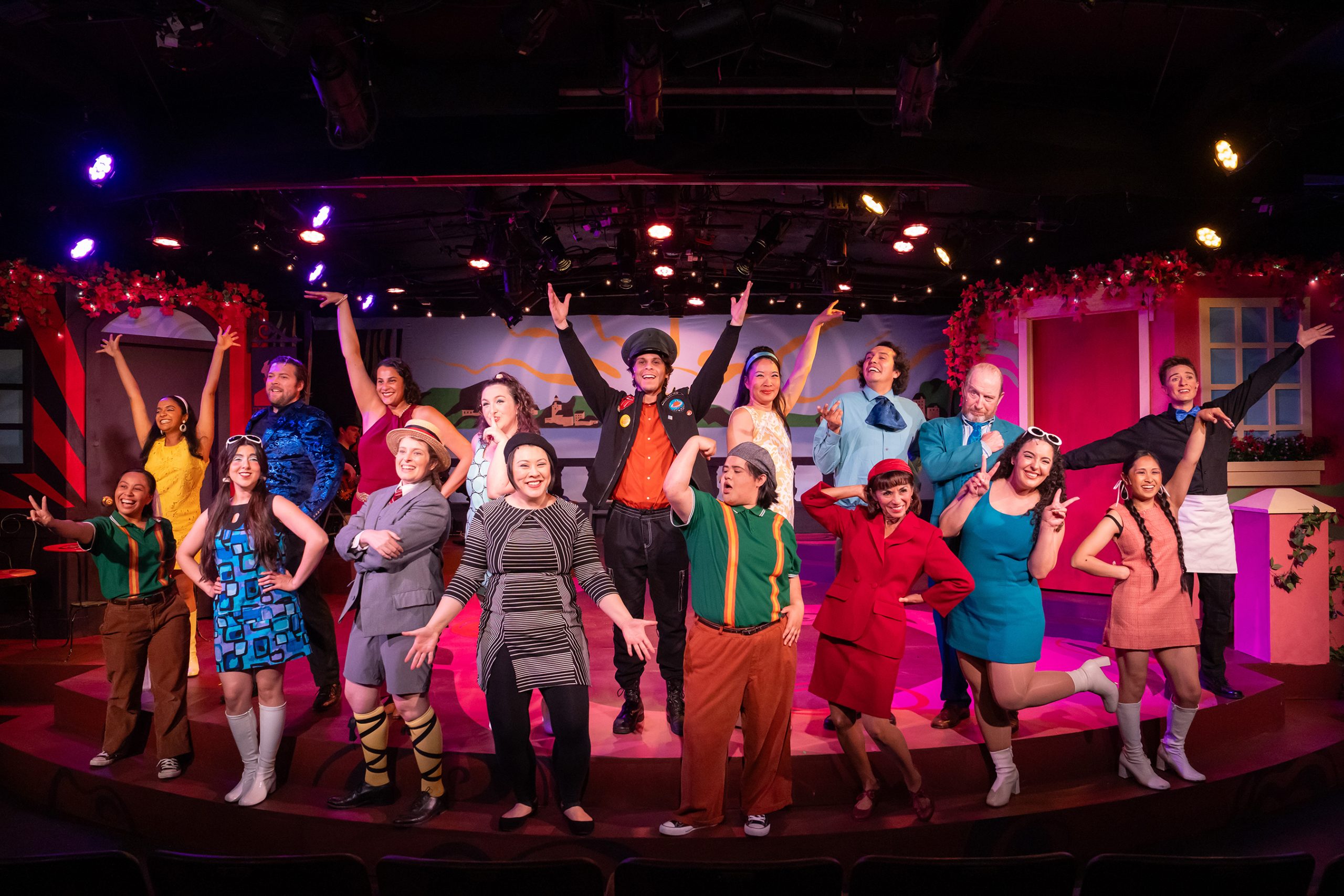
 This year’s production was directed by Jasmine Lew and Bryan Moriarty. Two of the best short plays were written by Bay Area playwright Paul Braverman. Other local playwrights who have short plays in this year’s Pear Slices are Sophie Naylor, Greg Lam, Bridgette Dutta Portman, Erin Panttaja, Enrique (Henri) Munoz and Cheriellyn Ferguson.


Max Mahle as The Wall in “A Mysterious Demise.” Photo by Tim Garcia.

 In “A Mysterious Demise” by Braverman, there are so many egg-centric jokes because it’s about the mysterious demise of Humpty Dumpty who was sitting on a wall –- until he wasn’t.  Vanessa Alvarez does a fine job of portraying hard-boiled (pardon the pun) detective, Jo Sunday, while Max Mahle portrays the wall from which Humpty Dumpty fell.

Jaime Melendez plays the scramble-brained Henny Penny while Stephen Sherwood is Sunday’s assistant.

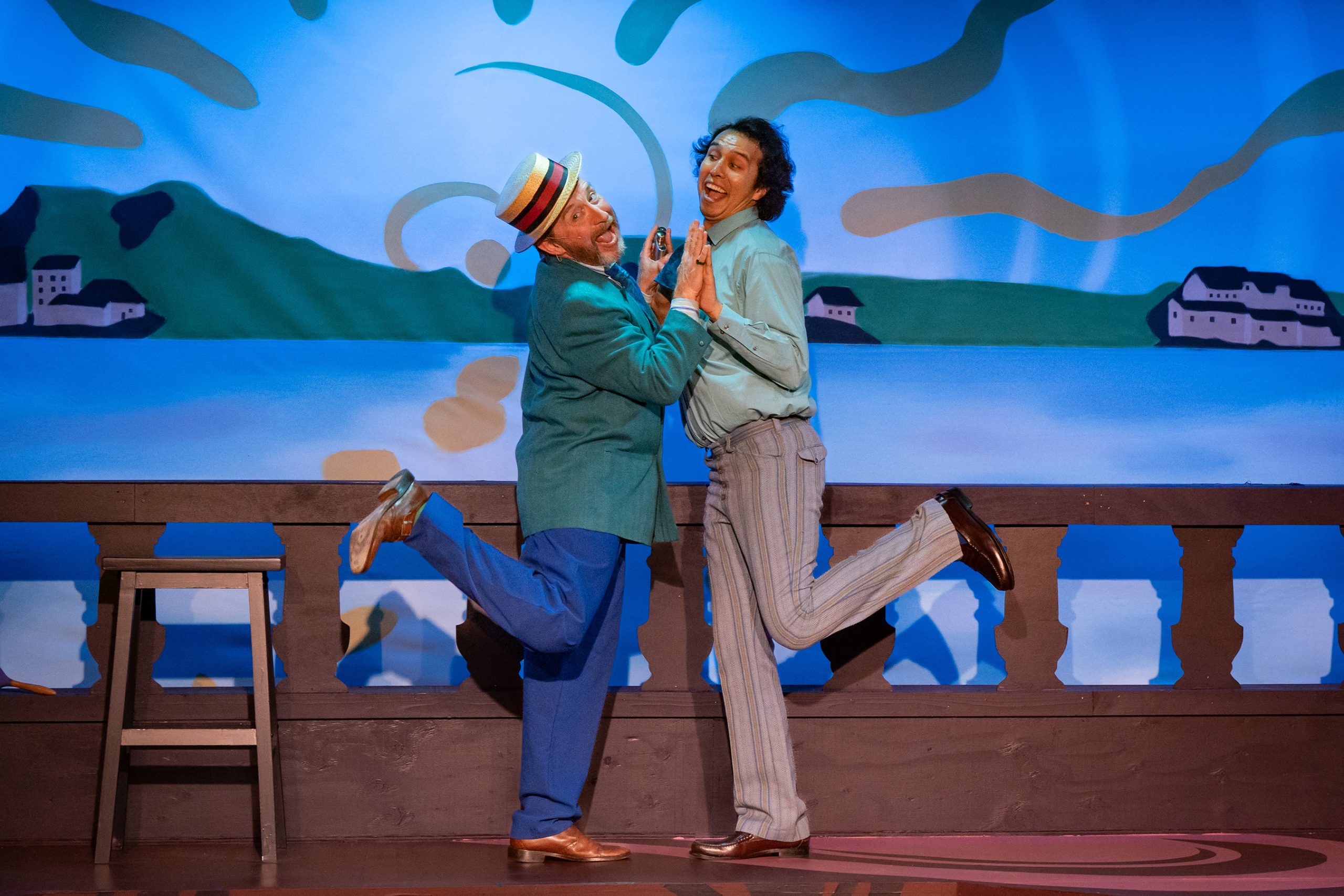
 In Braverman’s other short play, “Deuce Cooper: Full House,” he brings back some familiar characters, Deuce played with masculine panache by Dave Leon and later by Alvarez as Donna Cooper. It’s a convoluted story of protecting a witness (Guy Debalizi played by Sherwood) who may or may not be dead (he keeps falling over, but apparently still has a pulse).  Mahle plays Officer Ross while Jaime Melendez is Flo Ebbs.

 “Occupied” by Greg Lam is a funny take on the situation when there is only one bathroom in a building.  It’s labeled for he’s and she’s – and it’s occupied.  Leon is hilarious as the guy who really, REALLY has to pee, while the voice behind the located door is Sherwood. Sherwood insists that he also has to go – but the more he tries, the less happens.  This short has a surprise ending, which won’t be revealed here.

 Ferguson is the playwright of “Fair Play,” which has promise but still needs some work to make it a complete. Delaney Bantillo plays the clerk at the “Marriage Bureau” as well as Friar Lawrence, while Mahle as Juliet, Sherwood as Romeo and Leon as the Bard himself round out the cast of this shor

 Several of the other shorts (“Probably Not a Bag of Ears” by Naylor, “”Stargazers” by Portman, “Rossum’s Robot Truckers” by Panttaja and “Not in America” by Munoz) show promise but still need work to make them stand out.

 “Pear Slices 2025” runs approximately 1 hour, 45 minute including a 15-minute intermission.

 CAST: Vanessa Alvarez, Delaney Bantillo, Dave Leon, Max Mahle, Jaime Mellendez, Stephen Sherwood, Allison Starr. :

 ARTISTIC STAFF: Directors: Jasmine Lew and Bryan Moriarty; Stage and Production Manager: Kelly Weber Barraza; Producer: Robyn Ginsburg Braverman; Assistant Stage Manager: Bella Campos Hintzman; Sound Design: Carsten Koester; Set Design: Louis Stone-Collonge.

Joanne Engelhardt is a former San Jose Mercury and Santa Cruz Sentinel writer and theatre critic and is a member of the San Francisco Bay Area Theatre Critics Circle. Contact: joanneengelhardt@comcast.net.

Ironbound

By Joseph Cillo


A One-Woman Masterclass in Grit, Survival, and the Spaces In Between

If you’ve ever waited for a bus that didn’t come—through sleet, heartbreak, or bureaucratic letdowns—Ironbound will ring true. It’s not some abstract metaphor. It’s a beat-up bench in Elizabeth, New Jersey, and a woman who’s been through more than her share of no-good men, low-wage jobs, and broken promises.

That woman is Darja, played by Lisa Ramirez, and she is no-nonsense with a capital NOPE. The play’s writer, Martyna Majok, doesn’t write soft characters—she gives Darja all the hard lines, sharp angles, and glints of buried hope you can pack into 90 minutes. Ramirez doesn’t sand any of it down. She builds Darja from the inside out—tough, tired, and just barely holding the line.

Majok’s Darja is tough as steel wool—and twice as useful.

Darja’s got a story made of flashbacks and freeze-frames. We see her with three men across 20 years: Maks (played with sincerity and sweetness by Adam KuveNiemann), Tommy (a fleeting figure with just enough charm to bruise), and Vic (brought to life with quirky kindness by Kevin Rebultan). There’s heartbreak, survival, and something like love. But mostly there’s grit.

Photo Credit: Ben Krantz Studio

Director Emilie Whelan keeps it all on the rails, knowing when to pause and when to let the silence do the talking. She writes in the program that Ironbound is about those moments where we can’t choose—when we’re stuck at life’s intersection, “like a leaf on the ground in the middle of a highway, begging for a breeze.” That’s the kind of line you underline and stick on your fridge.

The design team—Sam Fehr (set), Ashley Munday (lighting), Bethany Deal (costumes), and Ray Archie (sound)—delivers just enough world to keep us anchored without ever distracting from the story. A curb. A streetlamp. A hum of the past.

You walk out of Ironbound not inspired, exactly, but steadied. You think about the people you pass every day and don’t see—people making tough calls, again and again, without fanfare or applause.

And here’s the kicker: Darja might frustrate you. She clings to the wrong men. Pushes away the right ones. She trades safety for money, money for control, and control for silence. You might even think: why does she keep doing this?

But that’s the point.

Majok doesn’t give us a saint. She gives us a woman stuck in a system that grinds people down. Darja isn’t noble—she’s real. She makes bad choices because those are the only choices on the table. The play doesn’t ask us to agree with her. It asks us to see her.

What does love look like when it costs too much? What does dignity mean when you’re broke?

That’s what Ironbound is really about: a woman at the edge of the world, still getting up every day, still showing up at the stop, still hoping the next ride takes her somewhere better.

Oakland Theater Project nails it again with this beautifully stripped-down gut-punch of a play.


Performances:
Now through May 25, 2025
Thursdays through Sundays at 7:30 pm
Run Time: 90 minutes, no intermission

Location:
Oakland Theater Project
Inside the FLAX Building
1501 Martin Luther King Jr. Way
Oakland, CA

Tickets:
$10–$60, with pay-what-you-can available at the door (space permitting)
oaklandtheaterproject.org/ironbound
Email: tickets@oaklandtheaterproject.org

★★★★★

Authorship & Creative Statement

Each review is created through my proprietary FocusLens℠ method—an original editorial process shaped by firsthand experience, critical insight, and structured narrative design. Original photography, graphics, director quotes, and animated elements are incorporated to enhance reader engagement and visual impact. State-of-the-art scaffolding systems support organization and phrasing, but every sentence and decision reflects my own voice and judgment. These are not AI-generated reviews—they are authored, shaped, and published by me.

Theater review: Lackluster actors can’t make “Rhinoceros” interesting even when reduced to an 88-minute production

By Joanne Engelhardt

What happens when you take a play that was originally three acts, condense it into an 88-minute production with lackluster actors playing the roles?

You get a lackluster production that is difficult to keep the audience’s attention even for that short of a time.

Director Bruce McLeod needed to find more believable actors than the ones who took the stage at Foothill Theatre Arts in Lohman Theatre in Los Altos Hills last Friday night.  The production runs through June 8.

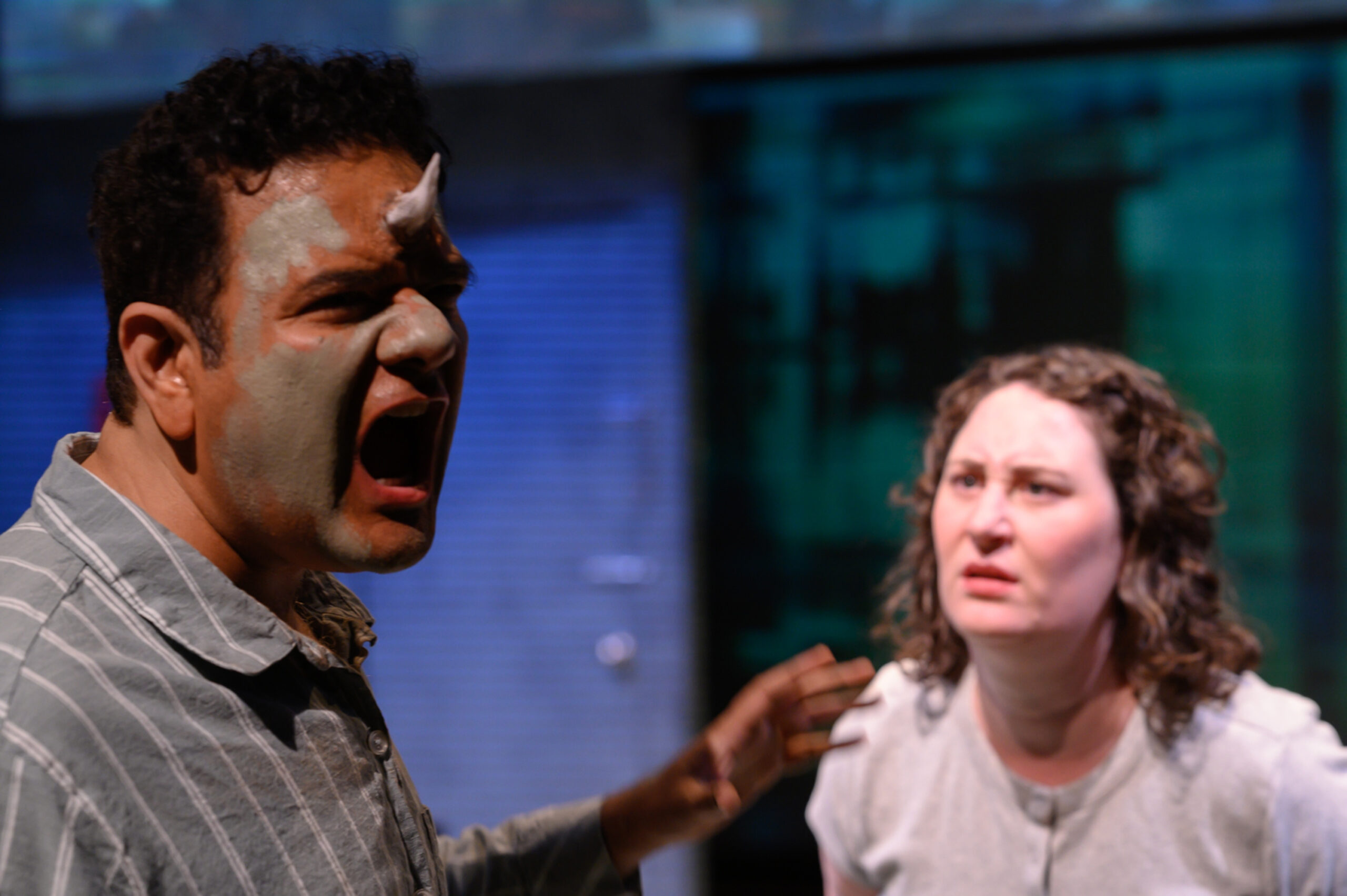
As Berenger, Caitie Clancey at times made the audience hope that she would get her act together, but most of her scenes seemed rote rather than real.  Her counterpart and boss, Liam Malla as John, also has his moments, especially whenever he went into his bathroom and then came out with a larger horn on his forehead as he turned into a rhinoceros before the audience’s eyes.

But even that gets old fast.

Tiffany Walters as Papillion also has a few good scenes, as does Daniel Spiteri Sr. as Corey, but the rest of the cast is easily forgettable.

Laura Merrill’s scenic design consists of some photos that are enlarged across the sides and back of the stage and about 20 feet from the floor.  There’s also a slanted table with a tablecloth, some containers of fruit, a sign that says “Boeuf’s” and another sign that says “Eggs $1.99.”  On the other side of the stage is a table and two chairs, and a high counter with a sign that says “Doggies.”

As far as costumes go, most of the actors look as if they are wearing their own clothes, although it’s possible costume designer Julie Engelbrecht selected some of the actor’s clothing.  She likely also created the rhino horns that appear on Hogsett’s forehead.

One of the most authentic sounds in this show are the rhinoceros sounds emanating from offstage.  At times it did, indeed, sound as if there were a herd of rhinos outside.

Edward Hunter’s lighting filled the stage so that the audience could see all that was going on.

Another problem with this production is that some of the actors and what they were doing just weren’t all that interesting.  Do we care when an older woman comes in, sits down to have some coffee and carries her little dog in a basket?  Do we care when a young man wearing a beige-and-black vest portends to be a “know-it-all” and pontificates to the audience?

A resounding no.

When Eugene Ionesco wrote “Rhinoceros,” his three-act play in 1959, it supposedly was considered a criticism of the sudden upsurge of Nazism prior to the beginning of World War II.  It explored the themes of conformity, mob mentality, morality and logic.

So with all that is happening in the United States now, perhaps director McLeod felt it was a good time to offer up a condensed version of “Rhinoceros.”  If that was his intent, it was a good one.

But this production just seems too banal to be what he wanted it to be.

Foothill Theatre Arts, Lohman Theatre, 12345 El Monte Road, Los Altos Hills.  Shows: Thursdays, May 29 and June 5 at 7:39 p.m.; Fridays, May 30 and June 6 at 8 p.m.; Saturdays, May 31 and June 7, at 8 p.m. and Sundays, June 1 and June 8 at 2 p.m.  For tickets ($5 – $20), call (650) 949-7360 or visit www.foothill.edu/theater

Joanne Engelhardt is a former San Jose Mercury and Santa Cruz Sentinel writer and theatre critic, and is a member of the San Francisco Bay Area Theatre Critics Circle. Contact: joanneengelhardt@comcast.net.

Matilda the Musical

By Joseph Cillo


A Little Girl with Big Ideas and Even Bigger Courage

Matilda Wormwood is not your typical child. Just 5 years old when the story begins and turning 6 along the way, she’s whip-smart, book-obsessed, and deeply misunderstood by the two people who should love her most—her parents. While her father scams customers and her mother dreams of dance trophies, Matilda finds comfort at the local library, spinning stories for a kind librarian and devouring everything from Dickens to Dostoevsky.

But things don’t get easier when she starts school. Crunchem Hall—a joyless institution that sounds exactly like what it is—is more a battleground than a classroom, ruled by Miss Trunchbull, a former hammer-throwing champion turned headmistress who delights in terrorizing children. Her signature punishment? The Chokey—a dark, narrow, spike-lined cabinet where misbehaving students are locked away. Subtle it is not.

Fortunately, Matilda is tougher than she looks. As the chaos builds, she discovers she has a special power (yes, the moving-things-with-her-mind kind), and with the help of her gentle teacher Miss Honey, Matilda finds a way to stand up for herself—and everyone else—before rewriting the ending to her own story.

That’s the plot. Now here’s what Novato Theater Company does with it: they bring the magic to life—and then some.

Under the surefooted direction and choreography of Marilyn Izdebski, Matilda the Musical strikes a beautiful balance between spectacle and storytelling. With Judy Wiesen guiding the music, Tim Minchin’s rapid-fire, emotionally rich score shines—full of wit, rhythm, and unexpected sweetness.

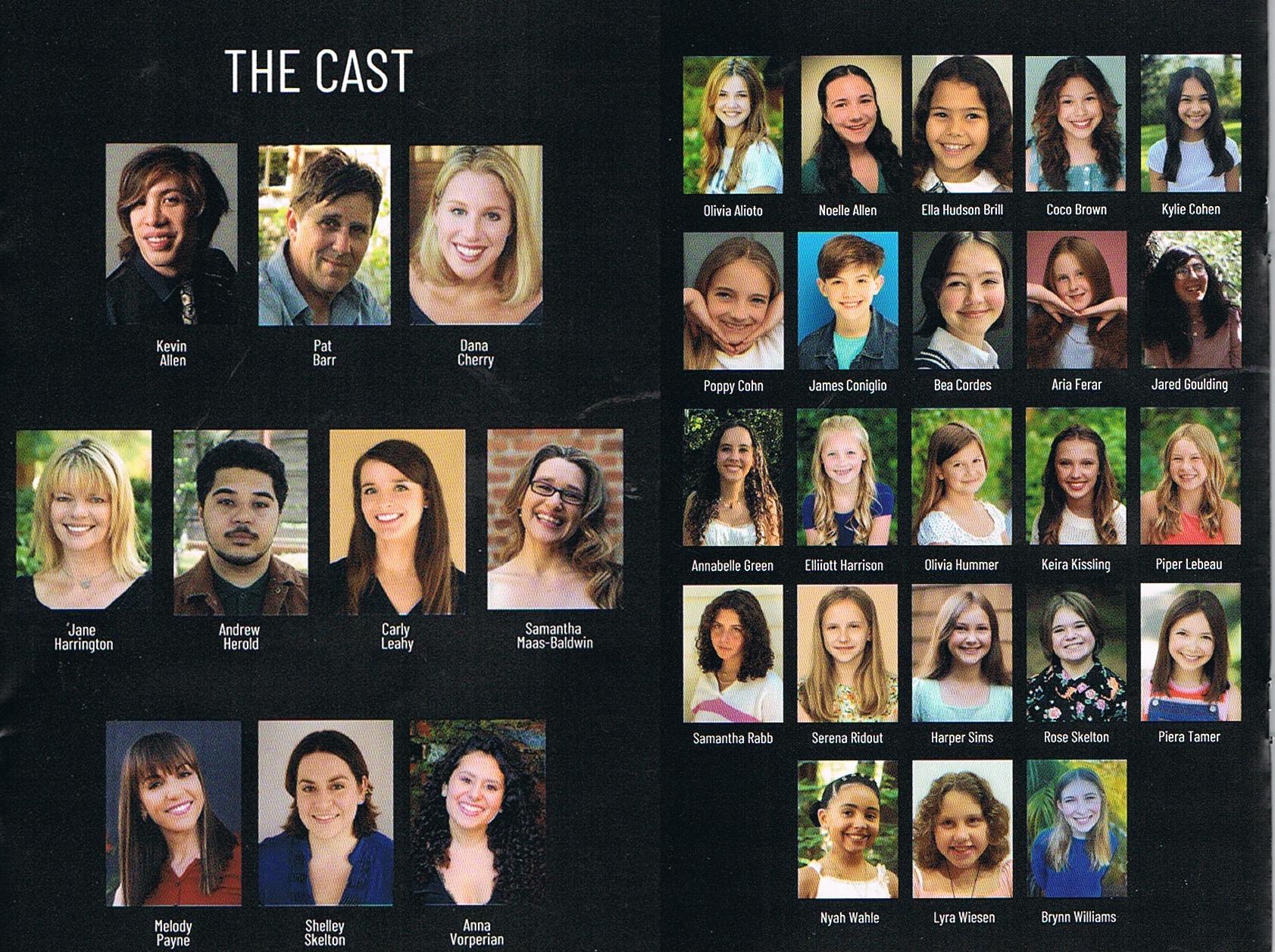
Piera Tamer brings the role of Matilda to life with remarkable poise, intelligence, and just the right touch of mischief—anchoring the show with a performance that feels both grounded and luminous. Jane Harrington’s Miss Trunchbull is a towering comic force—she’s the Hunchback of Notre Dame with her hunch on the front, stomping through scenes with a chest full of rage and ridiculousness. It’s a big, bold performance that leans into physical comedy without losing the menace, and Harrington pulls it off with fearless commitment. Anna Vorperian delivers a quietly powerful performance as Miss Honey—the gentle presence who shows Matilda what kindness and courage can look like.

Photo Credit: Jere Torkelsen

Pat Barr and Melody Payne, as Matilda’s cartoonishly awful parents, go gleefully over the top—delivering perfectly timed performances that feel outrageous but never out of step with the story’s tone. They’re not just a source of comedy—they help define what Matilda is fighting against.

❦ ❦ ❦    ❦ ❦ ❦    ❦ ❦ ❦ 

And then there are the kids.

A couple dozen young performers light up the stage like a coordinated burst of energy. They sing, dance, and nail tight choreography with the kind of discipline that would be impressive at any age. But beyond the precision, there’s something else happening: joy. Watching these kids perform—fully present, fully committed—is enthralling, entertaining, and yes, inspiring. For a few shining scenes, everything feels right with the world. That’s the kind of theater that sticks with you.

By the time “Revolting Children” kicks in, the audience is with them—cheering not just for Matilda, but for every underdog who dares to speak up. This production isn’t just a good time—it’s a reminder that stories matter, kids matter, and sometimes, the smallest voices carry the most power.

❦ ❦ ❦    ❦ ❦ ❦    ❦ ❦ ❦

Performances:
Through June 8, 2025
Fridays & Saturdays at 7:30 pm
Sundays at 2 pm

Novato Theater Company
5420 Nave Drive, Novato, CA

Tickets:
Visit NovatoTheaterCompany.org
or email Tickets@NovatoTheaterCompany.org
★★★★★

Authorship & Creative Statement

Each review is created through my proprietary FocusLens℠ method—an original editorial process shaped by firsthand experience, critical insight, and structured narrative design. Original photography, graphics, director quotes, and animated elements are incorporated to enhance reader engagement and visual impact. State-of-the-art scaffolding systems support organization and phrasing, but every sentence and decision reflects my own voice and judgment. These are not AI-generated reviews—they are authored, shaped, and published by me.
The Curious Incident of the Dog in the Night-Time

By Joseph Cillo


A dog lies dead in a garden. A 15-year-old boy stands beside it.

The boy is Christopher Boone, a brilliant math student with autism, and the scene sparks a journey that’s part mystery, part emotional odyssey. What begins as an investigation into the dog’s death soon unravels a complex web of family secrets, personal revelations, and a powerful coming-of-age story told through a lens both singular and universally human.

San Francisco Playhouse’s staging of this Tony and Olivier Award-winning play is captivating—visually, emotionally, and intellectually. Under Susi Damilano’s clear and compassionate direction, the production draws on stunning design and movement elements to immerse us in Christopher’s mind while never losing sight of the tender human story at its core.

Brendan Looney makes a stunning Playhouse debut as Christopher. An actor with autism portraying an autistic role, Looney brings truth, nuance, and intensity that make this portrayal particularly poignant. This marks a turning point not just for Looney’s career, but for Bay Area theater representation more broadly.

Liz Sklar (Judy) and Mark P. Robinson (Ed) deliver compelling turns as Christopher’s parents—flawed, loving, and struggling with their own truths. Sophia Alawi gives a calm, steady presence as Siobhan, guiding Christopher with warmth.

The supporting ensemble—Cassidy Brown, Laura Domingo, Whit K. Lee, Catherine Luedtke, Renee Rogoff, and Wiley Naman Strasser—morphs effortlessly between characters and moments, helping to build a cohesive world where every element—movement, sound, visuals, and narrative—serves a unified vision.

Photo Credit: Jessica Palopoli

This production succeeds on all levels. Like a master painting built from layered textures, each theatrical choice adds definition and emotional depth. It’s a master class in integrated stagecraft:

  • Narrative: A compelling mystery that becomes a deeply moving emotional journey.

  • Performance: Anchored by a remarkable portrayal of Christopher, supported by an expressive, adaptive ensemble.

  • Visuals: A vivid map of Christopher’s mind brought to life through precise, electric, and ever-shifting design—including tightly integrated projections that enhance both setting and emotion.

  • Movement: The choreography is the glue and the guide—holding the story together while revealing inner truths.

  • Sound: A rich, immersive soundscape that echoes Christopher’s heightened perception and emotional states.

❦ ❦ ❦    ❦ ❦ ❦    ❦ ❦ ❦ 

Choreography Highlight
The movement direction by Bridgette Loriaux is transformative. Her choreography is central—turning narrative beats into kinetic bursts of insight, structure into emotion, and ensemble transitions into visual poetry. It’s through her work that Christopher’s inner world comes vividly alive on stage. The choreography doesn’t just support the story—it is the story’s heartbeat. Kudos to Loriaux for crafting a movement language that elevates this production to something extraordinary.

Design and technical execution are equally impressive. Scenic designer Bill English creates a flexible, geometric environment pulsing with light and motion, thanks to Christian Mejia’s lighting and Sarah Phykitt’s projections. James Ard’s sound design and Kimberly Mohne Hill’s dialect coaching enhance the clarity and emotional impact of every line and cue.

❦ ❦ ❦    ❦ ❦ ❦    ❦ ❦ ❦ 

Tickets & Info:

  • Through June 21, 2025

  • San Francisco Playhouse – 450 Post Street, San Francisco

    • Tuesdays & Thursdays: 7 PM

    • Wednesdays: 2 PM & 7 PM

    • Fridays & Saturdays: 3 PM & 8 PM

    • Sundays: 2 PM

  • Tickets: $35–$135

  • Box Office: (415) 677-9596

  • Online:sfplayhouse.org

Imaginative, emotionally charged, visually striking — The Curious Incident of the Dog in the Night-Time is a rare theatrical event that fully engages the heart and the mind—anchored by movement that makes it soar.

Mark Morris Dance Troupe pays homage to Sgt. Pepper with out-of-the-box choreography

By Woody Weingarten


Odd angles are a highlight of Mark Morris’ “Pepperland” at Zellerbach Hall in Berkeley. Photo by Frank Wing/Cal Performances.


By WOODY WEINGARTEN

A black man scurries onstage and is introduced to the audience as white science giant Albert Einstein, only one of multiple racial- and gender-bending flashes and same-sex moves in a 12-part, 60-minute ballet, “Pepperland.”

The squatting dancer then mimics a classic photo of Einstein by sticking out his tongue and wiggling his brows.

A brunette Marilyn Monroe prances. Shirley Temple preens. So does Sonny Liston. They’re joined by other celebrities, all extracted from the cover montage of The Beatles’ groundbreaking concept album, “Sgt. Pepper’s Lonely Hearts Club Band,” to which the ballet pays homage.

The life-size cartoons specifically flesh out “Magna Carta,” one of five original pieces by arranger/composer Ethan Iverson squeezed between seven Fab Four tunes used in the Mark Morris creation at Zellerbach Hall in Berkeley.

“Pepperland” features oblique postures. Photo by Frank Wing/Cal Performances. 

Morris’ out-of-the-box choreography — highlighted by dancers repeatedly standing and walking at virtually impossible angles, frequent three-person lifts and dancers melting/collapsing onto the floor, groupings of two and four, and frequent insertions of visual humor — guarantees to put a grin on your face and to keep it there.

The music itself is another story.

Fusion — which combined jazz harmonies and improv with rock, funk, and rhythm and blues — hadn’t yet become “the thing” in 1967. But that’s when The Beatles released their groundbreaking concept album, a whimsical stroke of imagination that superimposed psychedelia and pop onto rock rhythms.

Musical moments later, the term fusion became stretched beyond imagination following trumpeter Miles Davis’ experimentations with electric instruments and rock beats in his jazz.

Ultimately, to virtually everyone’s confusion, public relations flacks started defining fusion as the blending of any two or more genres of music, no matter how disparate, even when the notion of playing five tempos simultaneously was a part of the melodic landscape.

Iverson might not be fond of the label either, despite his arrangements rapidly slip-sliding like a roller coaster between slow, mournful blues to almost deafening jazz that features amazing runs on clarinet, sax, and drums.

“Pepperland,” which Morris first mounted in 2017 as a 50th anniversary tribute to the Sgt. Pepper album, was revived this weekend at Zellerbach Hall in Berkeley under the auspices of Cal Performances. It not only merged elements of yesteryear seamlessly, it accomplished that task with light-hearted charm, dark aviator sunglasses, and Elizabeth Kurtzman’s brightly colored Mod-style costumes that couldn’t help but bring to mind 1967’s Summer of Love.

The often quaint and/or oblique dance moves wash, rinse, and repeat, then wash, rinse, and repeat again and again, their consistency playing off the low backdrop of irregular mylar-like pieces that reflect various colors.

Those who came to see unadulterated Beatles would have been disappointed. Iverson’s score, played live by seven musicians (including him on piano), emphasizes vocals by Clinton Curtis and an electric instrument, the theremin, which requires no human touch (though Rob Schwimmer’s body parts hover over it to produce a cornucopia of sound).

Theremin riffs varied, from lovely high-pitched wailings that might potentially evoke tears to screechy chalk-on-blackboard sounds that could trouble eardrums.

Innovative were moments like Iverson’s conversion in “A Day in the Life” of individual vowels into two-note grunting patterns. Amusing, too, was a double-take-inducing move in which one dancer is hidden behind another to create a laughable form.

Mark Morris (left) and Ethan Iverson collaborate on a tribute to The Beatles. Photo by Trevor Izzo/Cal Performances.

Morris seemed genuinely overjoyed Opening Night as he acknowledged with a smile and deep bow that a healthy chunk of the audience was giving his ballet a standing ovation.

“Pepperland” starts with company members in a tight circle smoothly dancing their way into a larger design. The ballet ends similarly, just in reverse. In between are tons of smooth transitions from one grouping to another. And yes, Morris’ flamboyant, carefree, entertaining approach to modern dance does delete much of the edginess and tension in the original Beatles musicology.

What’s left, sometimes, are mugging dancers and an over-all cutesiness with which all you can do is lean back and enjoy.

The Mark Morris Dance Group has one more show at Zellerbach Hall in Berkeley, this weekend — at 3 p.m. today. Info: 510-642-9988 or https://calperformances.org. Upcoming Cal Performances include the June 21 roots music of Rhiannon Giddens and The Old-Time Revue.

Sherwood “Woody” Weingarten, a longtime member of the San Francisco Bay Area Theater Critics Circle and the author of four books, can be contacted by email at voodee@sbcglobal.net or on his websites, https://woodyweingarten.com and https://vitalitypress.com.

The Book of Will

By Joseph Cillo


Saving Shakespeare, one page at a time.

If you’ve ever wondered how we ended up with Shakespeare’s greatest hits — Macbeth, Twelfth Night, As You Like It — we have a few theater friends from the 1600s to thank. The Book of Will, now playing at Ross Valley Players, tells their story with warmth, wit, and a whole lot of heart.

The play opens with a problem: Will Shakespeare is gone, and half his plays are scattered, misquoted, or just plain missing. So two of his fellow actors set out to track them down, page by page, and preserve them in what became the First Folio. It’s part detective story, part backstage comedy, and all love letter to the power of storytelling.

Director Mary Ann Rodgers keeps the pacing light but grounded. You’ll laugh, probably tear up once or twice, and leave reminded that theater isn’t just about what’s on the page — it’s about the people who keep the pages from disappearing.

While the story follows two main friends of Shakespeare, this production is absolutely an ensemble piece. The cast is strong across the board, with actors stepping into multiple roles — printers, poets, pubgoers, and players — and giving each moment real presence. Fred Pitts and Malcolm Rodgers anchor the narrative as Henry Condell and John Heminges, Shakespeare’s loyal compatriots. Marty Pistone brings theatrical flair to both Richard Burbage and the blustery William Jaggard, while Steve Rhyne easily navigates the quieter corners of the script as Ralph Crane, Barman #1, and Francisco.

Sean Mireles Boulton (Isaac Jaggard / Ed Knight), David Smith (Edward Dering), and Michael-Paul Thomsett round out the core group with strong turns. Thomsett gives a sharp, dry-edged performance as Ben Jonson — Shakespeare’s longtime rival, reluctant admirer, and, in this telling, something of a poetic grump with a conscience. He adds tension and bite to several scenes, grounding the humor with just enough acid to keep things honest.

The women add emotional depth and grounding: Cathleen Riddley (Rebecca Heminges / Anne), Kelly Rinehart (Elizabeth Condell / Emilia), Jannely Calmel (Alice Heminges), and Raysheina De Leon (Susannah / Fruit Seller / Bernardo) all give rich, layered performances. Sam Hjelmstad handles several roles — Marcus, Boy Hamlet, Crier, and Horatio — with clarity and presence, while Ben Vasquez moves smoothly among his parts as the compositor, Marcellus, and Barman #2.

Design-wise, the show looks great without trying too hard. Ron Krempetz’s set feels sturdy and lived-in, Valera Coble’s costumes are on point, and Billie Cox’s music and sound add just the right tone. Lighting by Ellen Brooks shifts scenes with elegance, never shouting for attention.

Movement by Elena Wright and choreography by Jennifer LeBlanc (who’s lived this play inside and out) give the actors room to breathe and the audience moments to lean in.

Ross Valley Players continues its successful relationship with Lauren Gunderson’s work — this is their third Gunderson production — and The Book of Will is another win. It’s a backstage story that doesn’t need to be flashy to be unforgettable.

Showtimes: Thursdays–Saturdays at 7:30 p.m.; Sundays at 2:00 p.m.
(No performances May 29–30; special 2:00 p.m. matinee on Saturday, May 24)
Tickets: $35 general admission; youth and member discounts available
Venue: Barn Theatre, Marin Art and Garden Center, Ross, CA
Info: www.rossvalleyplayers.com | boxoffice@rossvalleyplayers.com

This show doesn’t just tell you Shakespeare mattered — it shows you what it took to make him matter for 400 years and counting.


A heartfelt, theatrical toast to Shakespeare — and the determined friends who kept his plays alive.


Company

By Joseph Cillo


1 bachelor, 5 married couples, 3 girlfriends + a ticking sense of self-examination 

Over a series of New York City vignettes, we follow Bobby as he drops in and out of dinner parties, bedrooms, and uncomfortable conversations—all while trying to decide whether being single at 35 is freedom or failure. What unfolds is a sharp, funny, and emotionally layered look at modern relationships: messy, mismatched, and occasionally meaningful.

Spreckels Theatre Company delivers a brisk, polished, and emotionally astute production that captures all the charm, bite, and complexity Sondheim intended.

Andrew J. Smith’s Bobby anchors the show with subtle magnetism—someone who’s been the life of the party just long enough to start wondering what happens after the guests leave. His performance builds gradually, until “Being Alive” sneaks up and lands exactly where it should: vulnerable, hopeful, and a little shell-shocked by self-awareness.

Maeve Smith’s Amy tears through “Getting Married Today” with precision and comedy so sharp you almost want to hand her a towel and a lozenge. Shannon Rider, meanwhile, absolutely commands the stage as Joanne. Her rendition of “The Ladies Who Lunch” is more than a performance—it’s a full-on showcase. Joanne is one of those sharp-tongued, seen-it-all New York women, and Rider leans in with biting elegance and wry detachment. It’s a showpiece that lets a gifted actor show off with razor-sharp timing and emotional precision—shining a spotlight on cynicism, self-awareness, and, in one of Sondheim’s cleverest asides, wondering aloud whether anybody still wears a hat.

Marta, April, and Kathy—played by Evvy Carlstrom, Katie Rain, and Bethany Cox—sparkle through “You Could Drive a Person Crazy” with confidence and polish. The married couples are brought to life with specificity and wit, each offering Bobby (and us) a slightly different lens on what love looks like once the cake’s been cut.

It’s worth noting: Company is steeped in New York energy. The humor, the tempo, the sidelong glances and cocktail-sharp observations—they all carry that distinctive, insider rhythm. If you’ve ever lived in or loved someone from New York, the show feels just a little more familiar, like you’re being let in on the unspoken rules of Manhattan relationships.

Under the direction of Sheri Lee Miller and James Pelican, the show moves with confidence and clarity. Karen Miles’ choreography is nimble and character-driven. Lucas Sherman leads a polished orchestra that handles Sondheim’s famously intricate score with care and precision. Donnie Frank’s costumes speak volumes before the characters do, and Eddy Hansen’s scenic and lighting design keep the story grounded in place and time without distraction.

And yes, for those keeping score, here’s the full lineup of musical numbers:


ACT I

  • “Overture” – Orchestra

  • “Company” – Robert & Company

  • “The Little Things You Do Together” – Joanne & Couples

  • “Sorry-Grateful” – Harry, David & Larry

  • “You Could Drive a Person Crazy” – Kathy, April & Marta

  • “Have I Got a Girl for You” – The Guys

  • “Someone Is Waiting” – Robert

  • “Another Hundred People” – Marta

  • “Getting Married Today” – Amy, Paul, Jenny & Company

  • “Marry Me a Little” – Jenny

ACT II

  • “Entr’acte” – Orchestra

  • “Side by Side by Side” – Robert & Company

  • “What Would We Do Without You?” – The Ladies

  • “Poor Baby” – Amy & Joanne

  • “Barcelona” – Robert & April

  • “The Ladies Who Lunch” – Joanne

  • “Being Alive” – Robert

  • “Finale Ultimo (Company)” – Full Company


Spreckels’ Company is brisk, smart, and deeply human. If you’ve ever questioned love, resisted commitment, or made peace with the mess of connection, this show will feel like a familiar (and stylish) conversation. Whether you see yourself in Bobby, the couples, or all of the above, you’ll likely leave thinking, yeah, that hit close to home.


Performances:
Fridays & Saturdays at 7:30 PM
Sundays at 2:00 PM, through May 18, 2025

Location:
The Codding Theater at Spreckels Performing Arts Center
5409 Snyder Lane, Rohnert Park, CA

Tickets:
$16 – $42, available at spreckelsonline.com
Or call the box office at 707-588-3400 (open Wed–Sat, noon to 5 PM, and one hour before showtime)

A sharp, stylish, and heartfelt Company that speaks with a New York wink but hits universal nerves. Funny, thoughtful, and refreshingly real.


Provocative Emotive show – N.Ormes with Agathe and Adrien

By Jo Tomalin


Photo: SFIAF

N.Ormes with Agathe and Adrien is presented in San Francisco May 8 and 10 at the 2025 San Francisco International Arts Festival (SFIAF). Canada’s duo Agathe Bisserier and Adrien Malette-Chénier created and perform N.Ormes, which is an intriguing expression and investigation into gender norms.  They blend their physical expertise integrating circus acrobatic balance skills seamlessly into elements of dance, theatre, and performance art.

While we may imagine traditional hand /balance skills punctuated by a broad flourish after each daring balance of the female partner on the shoulders of the male partner, Agathe and Adrien turn this idea upside down completely! Their visual and physical storytelling has no words and relies only on the physical aspect of strength plus subtle looks or gestures to each other or the audience that speak volumes. Their approach to their creation and performance is to apply the physical skills learned from their professional training at the Circus School of Quebec to develop their unique form of storytelling.

Agathe and Adrien perform variation upon variation of balances with hands, head and limbs and movement around the space as they build their imaginative story, which develops based on a relationship. They have joyous moments as well as disagreements – the addition of theatricality is relatable and draws the audience in effectively. What follows is no less than a continuous flow of action with cleverly coordinated jumps, rolls, runs, balances on head and limbs accompanied by fascinating music by Simon Leoza.

The athletic strength of Agathe and Adrien is immense and the basis of this story. While the pairing of both Agathe and Adrien during the physical moves is traditional at first, Agathe sees that she is as strong as Adrien and the only difference is their height. The acrobatic dance in this piece is original and visceral, it follows a relationship and also makes a statement. Agathe is determined and soon she finds the fairness and equity she sought. Her response is outstanding!

Costumes by Sophie El-Assad are white, straw and black, and look like everyday clothes, which is a smart choice and sets the tone for the physical storytelling that develops organically and becomes significant in the latter half of the show.

Lighting by Claire Seyller adds atmosphere and pin like focus on the movement, expert balances, creative lifts and interesting shapes Agathe and Adrien form on and around each other. The build of the show is dynamic as it develops brilliantly although the last ten minutes might benefit from streamlining.

This is a must see show if you are interested in movement and acrobatics with theatrical and unexpected action in creative unique exploration of gender norms – Provocative and emotive!

More Information:

Date(s) & Time(s): Thu May 8, 8:30pm; Sat May 10, 8:00pm
Duration: 60 minutes 
Venue: Dance Mission Theater
Location: 3316 24th St, SF, CA 94110,

Ticket Information

Early Bird: $20, Advance: $25, Door: $28
For the best deals, see multiple shows with a discount Festival Pass.

TICKETS FESTIVAL PASS

Agathe & Adrien Website:
https://www.agathe-adrien.com/

SFIAF
https://www.sfiaf.org/

MEMBER is Poignant Riveting and Vital Theatre – at SFIAF

By Jo Tomalin

Memory

Fairly Lucid Productions from Australia and the UK present MEMBER, a U.S. Premiere one person play written and performed by Ben Noble, directed by David Wood, with music composed and performed by Stephen Choi running at the 2025 San Francisco International Arts Festival (SFIAF) May 8-11, 2025.

MEMBER is a creatively complex and searingly moving tale of a father and son, embroiled in homophobia and the brutality of a gang targeting gay men. In Sydney, Australia hate crimes against gay men were rife during the 1970s through to the 1990s and Noble’s seventy minute play delves into such deep hatred and prejudice, with his own courageous crafting, a will to push boundaries and his expert storytelling.

Sitting in a chair onstage Noble gently starts the story. He is an imposing presence, wearing a red and black shirt and jeans, he retells what’s happening and what led up to his son’s daunting situation. The setting is ominous, a hospital waiting room, that is created so effectively and minimally by a blue curtain centre stage, with heartbeat pulsating sound effects and live music played onstage by musician Stephen Choi in blue scrubs.

Noble, as the personable father recounts memories of his relationship with his son. We meet several characters and hear about their jobs or quirks as the stories are woven in MEMBER seamlessly by Noble. Thirteen characters take focus and appear, sometimes once only but some come back again through the story. Noble’s character, the father is a supervisor who takes his job seriously, exemplified when he apprehends Ernie with salty language. There’s Butterworth who likes cookies and Bob who talks to Ernie about going gay clubbing…

Noble is adept at switching characters with his voice, posture, facial expressions and gestures integrating humor and equal amounts of drama and pathos.

In a tender scene at his son’s birth – Noble’s performance is poignant and riveting going from banal to emotive in twenty seconds! Throughout the play there are several lump in the throat moments as well as brashness and anger – a notable contrast is Noble’s scenes as the father with his wife Cheryl. These scenes and dialogue draw on her husband’s gentle demeanor and a warm relationship, which adds depth to this story in between the homophobic brutality and the young son’s salubrious invitation to ride in a car up the hill with a stranger.

Light changes create new shape to the stage, together with location and mood effectively and the live music adds texture to the setting, although the first riffs would benefit from a lower volume.

MEMBER is supported by an impressive group of creative artists including both Ben Noble, a queer disabled actor, writer, creative producer and teacher & Sarah Ranken who run independent theatre company Fairly Lucid Productions in Melbourne, Australia; David Wood, director, facilitator and theatre-maker; Ro Bright, a kiwi writer based in Australia; Meg Courtney, Script Assessor; Björn Deigner a German writer, director and composer for theatre; Dan Giovannoni, playwright; Elise Esther Hearst, a Melbourne-based playwright and author; and playwright Finegan Kruckeymeyer.

Highly Recommended!

More information and Tickets:

MEMBER

Date(s) & Time(s): Thu May 8 – Fri May 9, 7:00pm, Sat May 10, 6:30pm, Sun May 11, 2:30pm
Duration: 70 minutes (No Intermission)
Venue: The Marsh Studio
Venue: 1062 Valencia St, SF, CA 94110

The SFIAF runs from April 30 to May 11, 2025 and presents 50 companies and 100 concerts and shows in this year’s festival, including theatre, music, spoken word, dance and much more!